







Abstract
With a growing population of emergent bilingual learners in the United States, we are seeing more emergent bilinguals qualifying for special education services. Special education teachers must be prepared to meet the linguistic needs of their students in addition to disability related needs. One way of doing so involves adopting Culturally Sustaining Pedagogy to sustain students’ varied linguistic practices in the classroom. The present article outlines five considerations that may help special educators, including monolingual educators, invite students to draw upon their full linguistic repertoires. Considerations include: providing opportunities for students to use their multiple languages in the classroom, making explicit connections across languages, thinking expansively about literacy, modeling the use of multiple languages and literacies, and being critical of texts used in practice.
Ms. Wilson is a White, monolingual English-speaking special education teacher. Her students speak a variety of languages at home, including Arabic, Somali, Nepali, Spanish, and English. Teaching in an elementary school resource room, Ms. Wilson spends part of her day co-teaching in general education classrooms and part of her day providing pull-out instruction, where she has limited time with students to support their literacy skills. She has noticed that her instruction does not always seem to be meaningful to her students, and she is wondering how the curriculum is influencing student engagement. As the learners in her classroom have become more diverse, Ms. Wilson has begun to notice that her students are not reflected in the curriculum. In an effort to improve learning experiences for her students, Ms. Wilson is looking for strategies to make her instruction more responsive to the diverse languages and cultures represented in her classroom while continuing to utilize the curriculum mandated by her district.
Ms. Wilson’s experience is becoming more common in U.S. schools, with the number of emergent bilingual learners increasing and, based on 2015 data, about 14% of all emergent bilingual learners receiving special education services (U.S. Department of Education, 2017). Unfortunately, it has been found that emergent bilingual students who receive special education services have less access to bilingual programs than their general education peers, despite evidence that students with disabilities can communicate and learn bilingually (Martínez-Álvarez, 2019). The general lack of opportunity for emergent bilingual students to draw upon their full linguistic repertoires can have lasting harmful effects, as language is central to one’s identity (Bucholtz et al., 2017). In fact, many children who enter school as emergent bilinguals transition to using primarily or only English as a result of the constant privileging of English in schools (Wong Fillmore, 1991, 2000). This is unfortunate given the many known benefits to bilingualism. Barac and Bialystok (2012) found that bilingualism is associated with higher levels of executive function. Further, in a review of the literature, Cheatham et al. (2012) reported cross-language associations, indicating knowledge of one language has a positive impact on learning in an additional language. Across studies, they also found that when emergent bilingual children labeled as disabled received intervention bilingually or in their home language alone, children achieved as well as or better than peers receiving second-language instruction alone. In a similar review, Lim et al. (2019) found that in general, emergent bilinguals with neurodevelopmental disorders who received intervention in their home language demonstrated a small positive effect on either language development or academic achievement. Though educators may not be able to provide intervention in each student’s home language, this article presents ways in which they can create opportunities for all students to draw upon their full linguistic repertoires during intervention. This is possible even when teachers themselves are not bilingual (Blair et al., 2018; Pacheco et al., 2015).
Although some efforts have been made to support bilingualism in schools, these typically treat bilingual education as a tool to support children in transitioning to English only or seek to help students to develop proficiency in two languages used in isolation (García & Torres-Guevara, 2010). However, this does not reflect the way emergent bilingual individuals naturally use their languages through the use of translanguaging (García, 2009). Translanguaging refers to the fluid use of language bilingual individuals use to make meaning and express themselves (García et al., 2017). It may include using more than one language in a conversation or even within a single sentence. Bringing translanguaging into special education settings provides an opportunity for emergent bilinguals labeled as disabled to access bilingual services.
Culturally Sustaining Pedagogy
Increasing bilingual learning opportunities for emergent bilinguals labeled as disabled can be achieved through instructional practices that seek to sustain students’ culture and language. In the research community, there have been calls to go beyond providing culturally responsive instruction to work toward sustaining students’ linguistic and cultural practices (Machado, 2017; Paris & Alim, 2014; Waitoller & Thorius, 2016). Culturally sustaining pedagogy (CSP) “seeks to perpetuate and foster—to sustain—linguistic, literate, and cultural pluralism as part of the democratic project of schooling and as a needed response to demographic and social change” (Paris & Alim, 2014, p. 95). It is important to consider culture as dynamic, with students taking up traditional cultural practices while other practices evolve across time and space, varying from one community to another (Thorius et al., 2018). Maintaining this pedagogical stance allows educators to focus on creating learning environments in which students are able to develop their linguistic repertoires rather than using various languages as leverage to gain proficiency in English.
CSP extends asset pedagogies, including the notion of funds of knowledge, or “historically accumulated and culturally developed bodies of knowledge and skills” (Moll et al., 1992, p. 133). Accessing students’ funds of knowledge requires recognition that all students bring a wealth of resources with them to the classroom, especially historically accumulated cultural knowledge and knowledge gained through lived experiences (Moll & González, 1994). This includes linguistic practices as well as generalized knowledge and specific skills (e.g., trade skills, knowledge of and relationship to the environment). Regarding language, bilingualism is understood to develop within cultural communities, which informs classroom practice. This framing recognizes that emergent bilinguals often engage in translanguaging rather than engaging with language in the same way as monolingual individuals (García, 2009), making intentional decisions about their language use across interactions throughout the day (Lee & García, 2020). Given the disproportionate access to bilingual learning opportunities among emergent bilinguals labeled as disabled, special education teachers must be prepared to adopt CSP and translanguaging to ensure equitable learning opportunities for all learners. When teachers bring translanguaging into classrooms, they are intentional about drawing on students’ full linguistic repertoires while teaching to academic standards (García et al., 2017). How can educators create opportunities for students labeled as disabled to engage and learn bilingually? This article outlines strategies special educators can use to create multilingual learning environments, leading to more equitable access to bilingual programming.
Instructional Practices to Consider
In response to the need to bring CSP and students’ funds of knowledge into special education classrooms, I outline several considerations for special educators to reflect upon. These considerations can be found in Figure 1. Although examples are provided, teachers must consider the cultural and linguistic context for their own students, as differing practices will be observed within each community of learners.
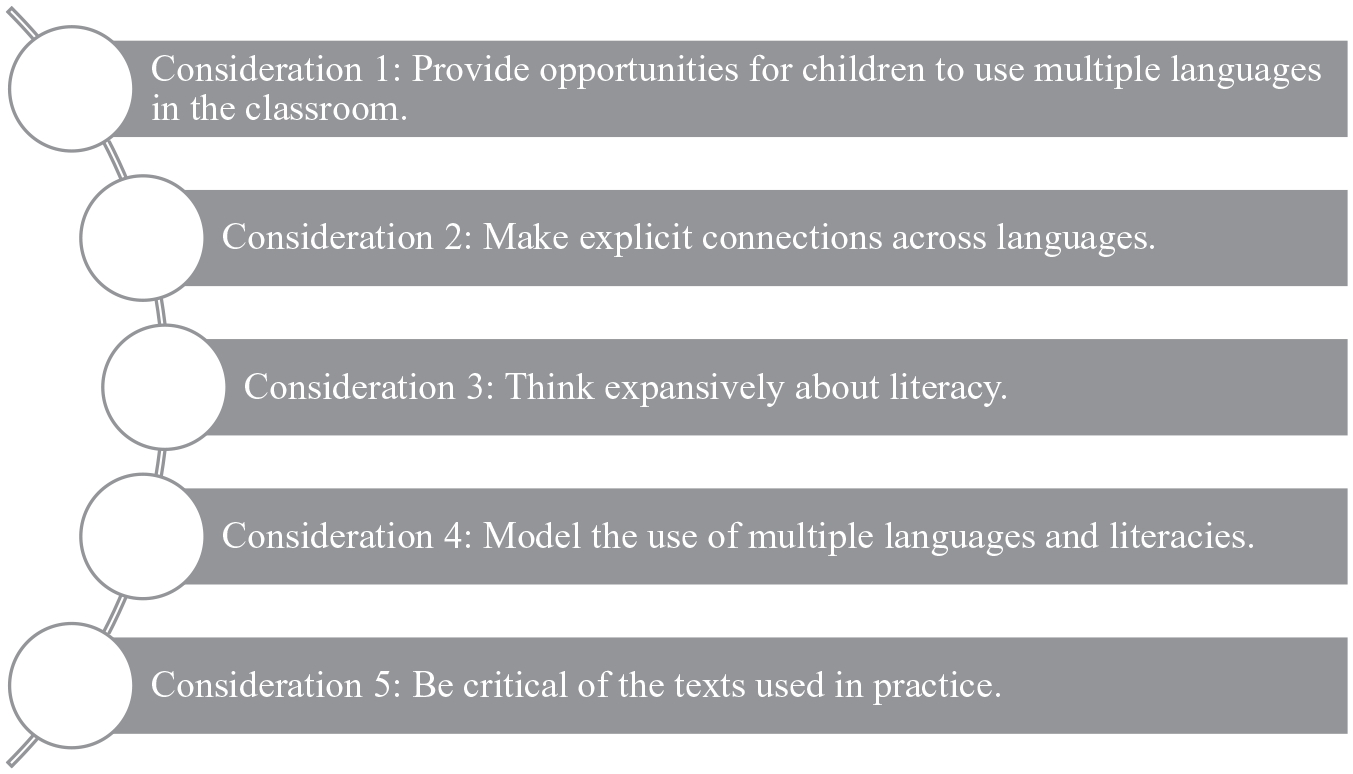
Considerations for sustaining linguistic practices
Consideration 1: Provide Opportunities for Children to Use Multiple Languages in the Classroom
Special educators can better support learners across educational settings by creating learning environments in which students are able to engage using their full linguistic repertoires. One way of doing this is to promote the use of translanguaging among emergent bilingual learners. “Translanguaging is the act performed by bilinguals of accessing different linguistic features or various modes of what are described as autonomous languages, in order to maximize communicative potential” (García, 2009, p. 140). In practice, this might mean individuals use a combination of languages in speech or writing, or they may apply grammatical rules from one language to another. Bilinguals often use each of their languages intentionally and with different purposes and may have more advanced literacy skills in a language compared with their oral language skills (Gort, 2019; Moll et al., 2001). Keeping these characteristics of language learning in mind can be helpful in planning meaningful instruction for emergent bilinguals. Additionally, consideration of these tendencies can allow for more accurate assessment, creating opportunities for students to more effectively communicate their knowledge (García, 2009).
When working with emergent bilingual learners, educators can encourage translanguaging and support the development of all languages by creating opportunities for children to use their full linguistic repertoires. This is intended to sustain students’ linguistic and cultural practices rather than strictly to support the development of English language proficiency (García & Torres-Guevara, 2010). Educators can do this in many ways. First, they might take advantage of students’ conceptual knowledge to engage in multilingual discourse as an opportunity for language transfer (Briceño, 2015). For example, if a student is able to discuss a concept in one language, they may need to learn key vocabulary in an additional language, but the conceptual knowledge transfers and provides a foundation for learning additional vocabulary. Students with shared linguistic repertoires can engage in talk together to further support transfer. Classwide discourse in multiple languages can also support transfer, with discussion around key vocabulary and concepts (García et al., 2017). This type of learning can be supported by creating opportunities for students with shared linguistic resources to engage in activities or discussion together (García et al., 2017). For instance, a teacher might pose a question for students to discuss related to a shared reading and place students in groups based on the language(s) they speak. Once students have had the opportunity to discuss in their preferred language(s), the teacher may choose to facilitate a large group discussion primarily in English.
Ms. Wilson joins Mr. Graham in a fourth-grade class to co-teach during writing. They are teaching a unit on story writing. Together, Ms. Wilson and Mr. Graham consider how they might invite students to use their varied linguistic knowledge to engage in the writing process. They feel hesitant to invite students to write in various languages given that they are both monolingual speakers of English. Ms. Wilson and Mr. Graham question whether they would be able to read students’ writing and offer meaningful feedback, as well as plan next steps for instruction, if students are writing in different languages. However, they decide to think more deeply about where opportunities for multilingual engagement might occur. They agree that their students benefit from having opportunities to discuss their ideas with a partner prior to writing. This seems like a great place to start, so early in the writing unit, Ms. Wilson and Mr. Graham invite students to discuss their ideas with a peer in a language of their choice. Students choose their partners, and many decide to work with a peer with shared linguistic resources. Later in the unit, students are able to write in a language of their choice as they brainstorm ideas for their stories. Students write their final stories in English, although some choose to include key words from other languages. When students publish their writing, they share the meaning of these words with the class. This opportunity allows students to be positioned as language experts and helps students become more engaged in the writing process.
Consideration 2: Make Explicit Connections Across Languages
Research has shown that emergent bilinguals have greater metalinguistic awareness than their monolingual peers (Barac & Bialystok, 2012). When children have opportunities to use varied languages in a shared space, they are able to develop their metalinguistic awareness, comparing the syntax, organization, word choice, and vocabulary used across languages (García et al., 2017). For example, discussions of word meanings and sentence structure can help students understand how languages might be similar or different. Vocabulary in particular must be taught explicitly, with opportunities to discuss cognates and false cognates to support language learning and vocabulary transfer (García, 2009). Cognates are words that are similar in pronunciation and meaning across languages (García, 2009), whereas false cognates are words that sound similar but have different meanings. As emergent bilingual learners develop their skills across languages, they can develop more sophisticated patterns of language use. For example, when a word or concept does not translate directly across two languages, students are able to explore meaning more deeply as they engage in a multilingual discussion of a text (Pacheco et al., 2015). Teachers may ask students to translate a small portion of a text that is essential for comprehension (Pacheco et al., 2015), paraphrase part of a text in another language, engage in discussion about how students use language differently depending on their audience, and encourage students to comment on cognates when they are recognized in a text (Martínez et al., 2008). All of these practices promote metalinguistic awareness, relate to translation, and position students as experts with rich linguistic knowledge. Further, these practices can support language and reading comprehension (Cisco & Padrón, 2012; Pacheco et al., 2015) as well as increase active participation and engagement (Blair et al., 2018).
While working with a small group of fifth graders in the resource room, Ms. Wilson decides to ask her students to work in partners. Three students in the group speak Spanish and English, and two students speak Somali and English. The group is reading a text together and Ms. Wilson wants to be sure her students are understanding the internal conflict the main character is facing. Ms. Wilson chooses one sentence in the text that she believes may be difficult for students to comprehend, so she plans a group discussion to unpack this part of the text. She asks students to work together to translate the sentence into either Spanish or Somali. This leads to rich discussion of the meaning of the sentence in which students recognize that sometimes rather than translating word for word, they must consider the idea behind a word or phrase in order to capture the meaning in a different language. Through explicit discussions about language, Ms. Wilson’s students also begin to recognize that some words are very similar across languages. They are recognizing cognates. For example, they discuss the Spanish-English cognate “miserable,” noting that although the pronunciation is not exactly the same, the words sound similar, are spelled the same, and have the same meaning. When this comes up in the group discussion, Ms. Wilson creates a chart where the group begins to record cognates and, later, false cognates they come across in their reading. These activities help strengthen students’ metalinguistic awareness even as their reading comprehension improves. This provides an opportunity for the class to examine how languages are similar and different and allows learners to be positioned as experts in the classroom.
Consideration 3: Think Expansively About Literacy
What counts as literacy? When educators limit the definition of literacy to include only the formal book reading and writing emphasized in schools, they deny students the ability to draw on their full linguistic repertoires and ignore their funds of knowledge (Moll, 2015). When educators expand views of literacies to include formal and informal texts—those encountered in school as well as in other settings, such as text on the internet, audio and video text, music, art, oral traditions, and more—educators can better build upon students’ literate experiences (Piazza et al., 2015). Recognizing these various forms of literacy across languages allows students to share their full expertise in school settings. In one study, students engaged with digital literacy by developing bilingual PowerPoint presentations that included recorded interviews and voice recordings, images, and text (Pacheco & Smith, 2015). The authors reported that engagement with digital literacies in this project allowed emergent bilingual learners to reach multiple audiences, draw upon their full linguistic repertoires, and apply knowledge of various literacies, including image-based, text, and digital literacies. As different types of texts are explored, teachers might work with emergent bilingual learners to develop co-constructed charts or engage in discussions that highlight features of various genres, compare and contrast the purpose of various text genres and formats, and explore strategies to reach particular audiences, as Ms. Wilson demonstrates next.
In a reading group, Ms. Wilson is teaching her students to use text features to navigate nonfiction text. Initially, she is thinking about using nonfiction texts in English. As she is looking for resources online, she recognizes the prevalence of text features on the internet. She decides to introduce the lesson by showing her students how she uses text features to navigate the internet to find and read an article online. Next, she does the same with a nonfiction book. Students are then asked to think about how and when they use text features to navigate a text and to bring an example to share with the class. Students are encouraged to bring texts in a variety of formats and languages. As a result, students bring in newspapers and song lyrics printed in various languages, bilingual books, magazines, and bus schedules and share websites in English and other languages. In this way, students generalize their knowledge of text features beyond those typically seen in books, leading to a richer understanding of the usefulness of text features. As students notice patterns in the features used across texts, Ms. Wilson records ideas on a chart, with students helping to translate ideas into various languages for future reference.
Consideration 4: Model the Use of Multiple Languages and Literacies
Modeling can be done in collaboration with community partners. It may be possible to invite multilingual community members into the classroom to facilitate and participate in multilingual discussion, modeling the natural use of various languages. Zapata and Laman (2016) describe examples in which parents were invited to the classroom and positioned as experts who speak multiple languages. In these classrooms, students were encouraged to use their multiple languages in writing, and a variety of text formats were used to allow students to draw upon their full linguistic repertoires for learning and communicating their understandings with one another and their teachers. When teachers position multilingual family and community members as leaders in the classroom, it is possible to draw on various funds of knowledge and bring a range of linguistic practices into the classroom, modeling sophisticated linguistic practices and placing value on multiple ways of knowing (Zapata & Laman, 2016). Along with partnerships in the community, special educators can provide additional modeling by creating opportunities for students to engage with bilingual videos and print or audio books related to content instruction (García et al., 2017).
Returning to Ms. Wilson’s co-teaching unit with Mr. Graham, the students are now engaged in planning their own stories. The teachers agree that it would be helpful for students to learn how narratives can be organized in different ways, despite knowing that one dominant form of narrative is typically privileged in schools. Recognizing their own limited knowledge of varied narrative structures, Ms. Wilson and Mr. Graham agree that they would benefit from seeking input from the community. In their effort to build on students’ existing knowledge and sustain students’ linguistic practices, Ms. Wilson and Mr. Graham invite two bilingual parents to share stories and discuss narrative structure in different languages. During planning conversations with these parents, Ms. Wilson and Mr. Graham learn that one family has a rich history of oral narrative, so this parent agrees to share a story orally whereas the other parent plans to read a storybook aloud. On separate days, each parent shares a narrative with the class in their primary language and then answers questions from students. Ms. Wilson and Mr. Graham also ask the parents and students to discuss how the narrative structure in these bilingual stories might be similar to or different from what they already know about organizing stories. Students are also able to engage in partner talk to discuss their thinking in whichever languages feel most helpful for their learning. As she listens to student dialogue, Ms. Wilson notices that students often use multiple languages in a single conversation, and sometimes within a single utterance, allowing them to articulate their full depth of knowledge around the features they are noticing. The class then contributes to creating a co-constructed chart to share their observations of the different narratives they have heard, a tool they can refer to as they plan and write their own stories. Later, as Ms. Wilson and Mr. Graham examine students’ writing, they can see that students are trying on the different narrative features discussed in class.
Consideration 5: Be Critical of the Texts Used in Practice
Along with considerations for interaction, educators must ensure the texts used in classrooms reflect and engage students in meaningful ways. Braden and Rodriguez (2016) conducted a critical analysis of children’s picture books containing Latinx content. They found five themes across texts, including the privileging of English, the inclusion of superficial cultural references, a tendency toward traditional gender roles, and a representation of a utopian society. English can be privileged in a text when it is the dominant language, with few words presented in another language. Additionally, English can be privileged in bilingual books when English text is presented more prominently throughout the book. In either case, these representations reinforce English as the language of power (Braden & Rodriguez, 2016). However, when multiple languages are used in intentional ways, authors can decenter monolingualism (Ghiso & Campano, 2013). When evaluating texts for use in the classroom, special educators must consider what assumptions an author may be making about a community and examine the portrayal of power dynamics related to language, class, race, gender, and ability. Meaningful and accurate portrayals of culture must be represented, as opposed to focusing on foods and other superficial representations as in a “tourist approach to culture” (Braden & Rodriguez, 2016, p. 65). As educators evaluate texts for classroom use, they are positioned to select texts that are meaningful and engaging for students rather than perpetuating systems of inequity. By carefully considering the messages conveyed about culture, language, class, and ability, educators can select texts that allow students to see their own identities reflected in authentic ways.
Ms. Wilson is selecting texts to use in an upcoming writing unit on personal narratives. She wants to provide students with several examples to show how personal narratives might be organized differently, make use of language in different ways, and highlight different kinds of events in individuals’ lives. She decides to include examples of bilingual personal narratives and those that include individuals representing various identity markers to share with her students. As she explores her options, Ms. Wilson keeps the following questions in mind: How are languages represented in this text? Is it written in English first, with a translation written below, or are languages represented in a balanced way? Are all of the examples organized with a temporal sequence, privileging dominant narrative structure, or do some prioritize emotions experienced during an event or another type of organization? When the personal narrative is describing cultural practices, are these described by members of the cultural group, or is the author presenting an outsider perspective? These are some of the questions Ms. Wilson keeps in mind in order to select texts that will help her students understand various aspects of personal narrative without perpetuating dominant narratives around language and race. By considering these critical questions, Ms. Wilson identifies several examples of personal narratives to share with her students, with opportunities for each of her students to see aspects of their own linguistic, racial, and cultural identities represented in authentic ways.
Closing
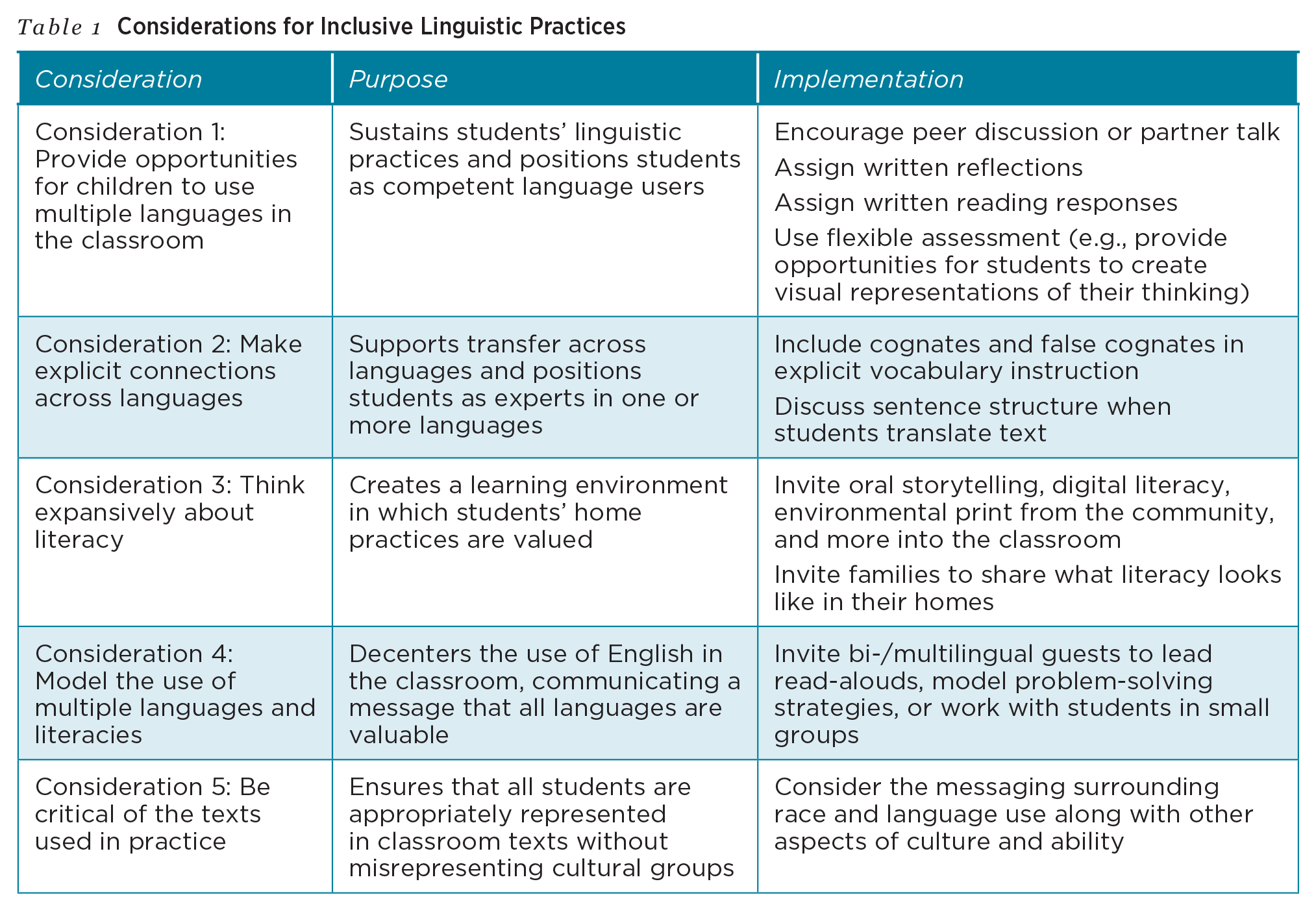
Special educators, like Ms. Wilson, can more effectively and meaningfully engage emergent bilingual learners by working to sustain students’ cultural practices. One way of doing so is through sustaining students’ linguistic practices, which can also lead to increased metalinguistic awareness (Laurent & Martinot, 2009) and potentially improved academic outcomes (Cheatham et al., 2012). A summary of the considerations outlined in this article can be found in Table 1, and Figure 2 presents a checklist to help special educators identify areas for implementation. Bringing CSP into special education classrooms is a powerful approach to resisting deficit narratives that are often told about emergent bilinguals labeled as disabled, positioning students as knowledgeable leaders within a learning community.
Considerations for Inclusive Linguistic Practices
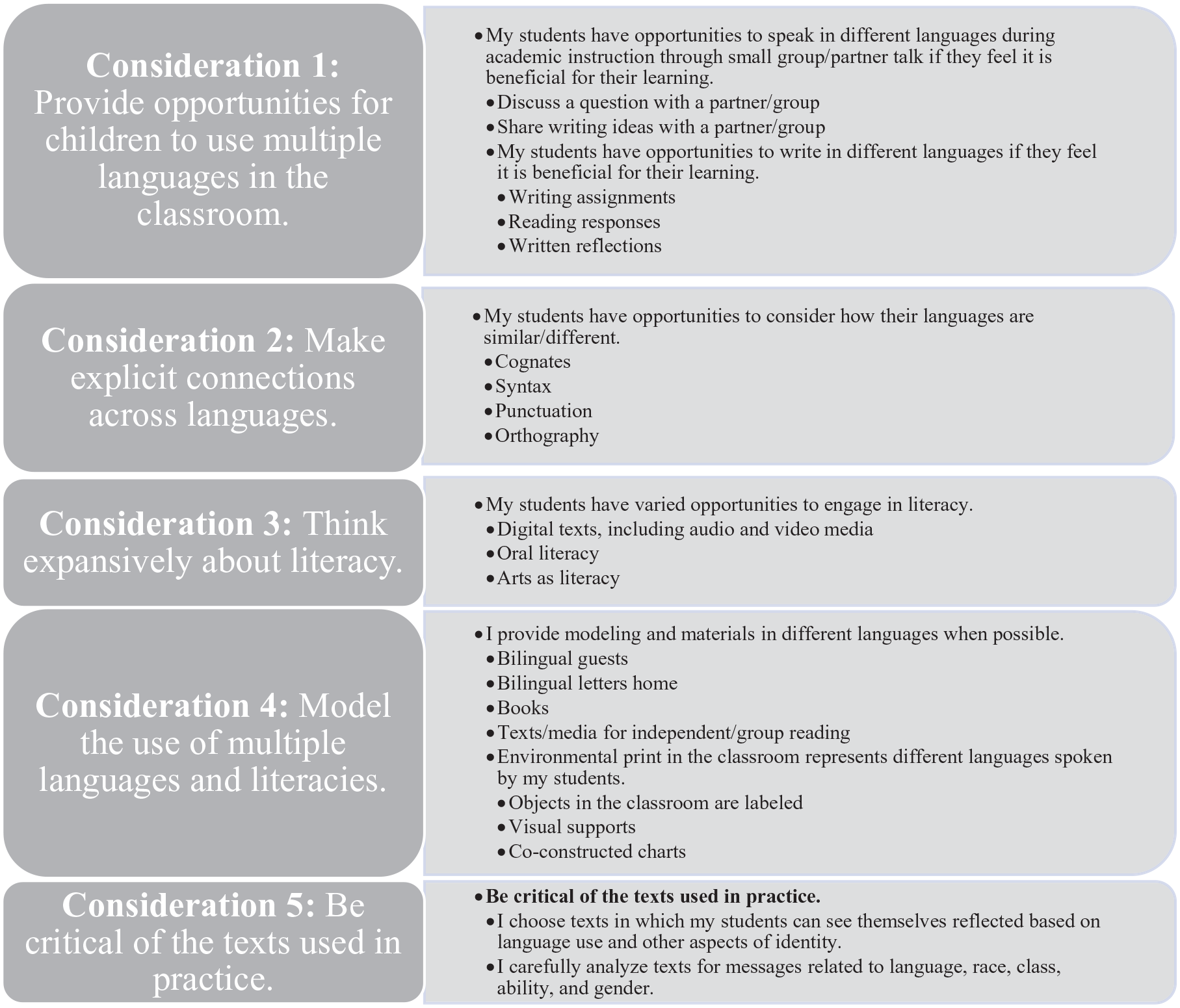
Checklist for implementation
As Ms. Wilson continues to think about sustaining her students’ cultural and linguistic practices throughout the school day, she is noticing her students becoming more engaged in learning and developing more confidence in approaching academic skills. She is also noticing shifts in the way she thinks about and positions her students, recognizing their wealth of knowledge regarding a wide range of topics. Ms. Wilson has realized that incorporating opportunities for students to use their full linguistic repertoires in the classroom has led to rich learning opportunities across academic areas. Her instruction remains closely tied to students’ individualized education program goals as well as the general education curriculum and now extends students’ learning in meaningful and engaging ways.
Footnotes
Declaration of Conflicting Interests
The author(s) declared no potential conflicts of interest with respect to the research, authorship, and/or publication of this article.
Funding
The author(s) received no financial support for the research, authorship, and/or publication of this article.
