







Abstract
Phoneme discrimination is the ability to detect subtle similarities and differences between phonemes. Phoneme discrimination is a strong predictor of reading development and poor phoneme discrimination may predict reading disabilities (Lyytinen et al., 2004). The ability to discriminate phonemes may be an even more critical skill for Emergent Bilinguals (EBs, also known as English Learners) and EBs with reading disabilities because they need to enhance their perception of phoneme boundaries to enhance their word reading ability. As EB populations in schools increase, addressing phoneme discrimination gaps becomes increasingly important. Classroom instruction should include repeated exposure to differentiating phonemes with known high frequency words and minimal pairs to develop a strong foundation for discerning phonetic features.

Ms. Lewis (all names are pseudonyms), a first-grade teacher, reflected on several students and the ways they have misidentified certain phonemes in their word sorts with minimal pairs, which are words that differ by one sound. Specifically, she noticed a gap in students distinguishing the orally produced sound contrasts between these words, particularly with several emergent bilingual (EB) students who vary in their development of English language acquisition. Ms. Lewis recalled when she read aloud minimal pairs during a small group lesson, some EBs have difficulty distinguishing certain phonemes. For example, she noted when she said the word “bear,” Juan, a 6-year-old boy whose family immigrated from Venezuela and was recently diagnosed with reading disabilities, pointed to a picture of a pear. This happened again with Mei, who is at risk for English reading disabilities, a 6-year-old girl from a Chinese family who pointed to a picture of a sink when Ms. Lewis orally said “think.” And when students lined up for dismissal, Ms. Lewis remembered, Abdo, a 6-year-old boy whose family speaks Arabic, pronounced “fast” as “vast.” These observations made Ms. Lewis wonder why these at-risk EBs and EBs with disabilities struggle to distinguish and identify different phonemic sound contrasts within certain minimal pairs. She considered how she might support her EBs with special needs so they may acquire novel English sounds that are not heard in their first languages (L1).
The ability to detect subtle similarities and differences between phonemes is known as “phoneme discrimination” (Joanisse et al., 2000; Lyytinen et al., 2004). It is an aspect of oral language proficiency. Like phonological awareness, which refers to the ability to manipulate speech sounds or phonemes in words, phoneme discrimination is also associated with the processing of phonemes (McBride-Chang, 1996). The difference between the two are that phonological awareness focuses on phoneme manipulations such as blending, segmenting, or deleting phonemes in words (e.g., in the elision task, “Say ‘stop.’ Now say it without the /s/”), while phoneme discrimination involves the understanding that “think” and “sink” or “pear” and “bear” are not the same words and the ability to distinguish similarities and differences between phonemes that vary only by one phonetic feature (Smith et al., 2022). Therefore, phoneme discrimination is a more fundamental processing skill than phonological awareness, and children acquire the relevant sound contrasts earlier than phonological awareness (Corriveau et al., 2010; McBride-Chang, 1996; Watson & Miller, 1993). “Some EBs find it even more difficult to acquire new phonemic contrasts not only because they are second-language (L2) learners but also because they have reading disabilities (Farnia & Geva, 2019).
Emergent bilinguals (also known as English learners) are those who are continuing to develop their home language while also learning an additional language (García & Kleifgen, 2018). The term “EB” is used to highlight the benefits of students who can speak two languages rather than highlighting a deficit of limited English proficiency. Home language is the most valuable resource EBs bring to the classroom. Ignoring EBs’ home languages perpetuates inequalities in education and discounts their cultural knowledge and understanding (Flores & García, 2020). Sometimes EBs may have challenges in learning new sound contrasts in English because phoneme boundaries are in different places across languages such that two phonemes differentiated in one language might fall within a single phoneme category in another language (Giannakopoulou et al., 2013). In addition, some EBs find it even more difficult to acquire new phonemic contrasts not only because they are second-language (L2) learners but also because they have reading disabilities (Farnia & Geva, 2019). Effective intervention is of great importance for EBs with disabilities. This calls for general classroom teachers, bilingual education teachers, and special education teachers to be aware of specific needs of EBs with disabilities and provide appropriate educational opportunities for them to develop their language and literacy skills (Lopes-Murphy, 2020).
The Role of Phoneme Discrimination in Reading Development
Phoneme discrimination involves the ability to recognize differences among phonemes. It is essential for differentiating among spoken words that differ by a single phoneme or sound in minimal pairs, for example, big-pig, sink-think, seek-sick (Scarborough, 2001). A child's experience with their native language affects their L2 learning (Spies et al., 2018). Children learning to read in L2 initially process novel phonemes according to the categories available to them in their L1 but gradually acquire the novel phonetic units and master phonemic contrasts that are productive in their new language (Fashola et al., 1996; Wang & Geva 2003). Sensitivity to distinctive features is essential for acquiring new vocabulary in a given language because individuals need to perceive words that may vary by one distinctive feature to realize that it is a different word. For example, failure in communication or failure to acquire a new vocabulary item may result when a child may not be able to distinguish between /sh/ in “ship” and /s/ in “sip” or between the short /i/ in “bit” and the long /i/ in “bite.”
Phoneme discrimination affects the development of high-quality phonological representations, which, in turn, impacts reading acquisition (Goswami, 2003; Llombart-Huesca, 2019). With young EBs’ limited vocabulary, phonological representations are holistic, and there is no need to distinguish phonological differences (Metsala & Walley, 1998). For example, it is easy to distinguish “bear” from “dog” because of obvious phonetic distinct features between the two words. However, as an EB’s vocabulary grows and they encounter words that contrast on fewer phonemes, for example, “bear” and “pear,” the ability to distinguish fine-grained sound contrasts between minimal pairs can be more challenging, especially if the phonemes do not sound the same in the EB’s L1 (Fennell et al., 2016) or the EB has reading disabilities (Brown, 2000). Difficulties in being able to distinguish among phonemes that contrast by one feature is a characteristic of EB with disabilities (Lyytinen et al., 2004; McBride-Chang, 1995). There is a causal relationship between phoneme discrimination and reading ability (Manis et al., 1997; Pennala et al., 2013). Research shows EBs with reading disabilities are challenged with discriminating among similar phonemes and perform worse on phonological awareness and word reading tasks than EBs without disabilities (e.g., Heiervang et al., 2002; Wade-Woolley & Geva, 2000).
Learning to discriminate among phonemes that are productive in English is essential for developing English vocabulary and literacy skills for EBs with disabilities. EBs with reading disabilities are challenged by perceiving and producing L2 speech sounds that are absent in their L1 (Soto et al., 2019). For instance, EBs who speak Japanese as their home language may have difficulties in differentiating the phoneme /r/ and /l/ because the phoneme /r/ is absent and pronounced as /l/ in Japanese. In their longitudinal study, Wang and Geva (2003) showed in Grade 1 the EBs whose L1 was Cantonese had difficulties in spelling the phoneme /θ/ in words such as “teeth” and “think” because /θ/ does not exist in Cantonese, while their English spelling of phonemes that exist in their L1 did not differ from the spelling of their monolingual peers. In a recent longitudinal study, Li et al. (2022) followed 200 EBs with diverse L1 backgrounds and 156 English monolingual students twice in Grade 1 (fall and spring) and twice in Grade 2 (fall and spring) on their phoneme discrimination performance. At the beginning of the first grade, all EBs fell behind their English monolingual peers on phoneme discrimination task, but they performed similarly to their English monolingual peers by Grade 2. EBs with reading disabilities had lower performance on phoneme discrimination in Grade 1 and continued to perform poorly compared to their typically developing EB peers. The gap between the two groups was not closed even by the end of the second grade. This study underscores the importance of phoneme discrimination challenges faced by EBs with reading disabilities.
“To EBs with reading disabilities, distinguishing novel sounds is even more challenging and requires students to acquire the distinctness of phonological representations in the emerging mental lexicon (Janssen et al., 2015; van Goch et al., 2014). “Instruction or intervention programs that address sound contrasts within minimal pairs have the potential to offer phoneme discrimination skills to EBs with reading disabilities (Krenca et al., 2020; Li et al., 2019).
We acknowledge that L1 facilitates L2 learning and that strong English (L2) literacy is dependent on L1 literacy. However, some English sounds that are not experienced by EBs in their L1 need to be explicitly taught to EBs, particularly those EBs with reading disabilities, so they are able to distinguish them. To EBs with reading disabilities, distinguishing novel sounds is even more challenging and requires students to acquire the distinctness of phonological representations in the emerging mental lexicon (Janssen et al., 2015; van Goch et al., 2014). Thus, instruction or intervention programs that address sound contrasts within minimal pairs have the potential to offer phoneme discrimination skills to EBs with reading disabilities and improve their phonological awareness to support reading development (Krenca et al., 2020; Li et al., 2019). Because phoneme discrimination is related to reading development and connects with writing, spelling, and encoding development, instruction should be developed simultaneously with other literacy components to enhance language learning of EBs with reading disabilities. In the following sections, we first identify the minimally paired phonemes that EBs struggle with and then provide explicit instruction and repeated auditory exposure with sound contrasts. In doing so, we describe for educators and practitioners effective instruction and interventions to help EBs with reading disabilities enhance their reading ability.
Identifying Struggling Minimal Pairs in EBs
To determine which phonemes EB students lack discrimination for, teachers can conduct an informal assessment with EBs with a disability. For EB students who share similar L1 backgrounds, these informal assessment data can be used for planning small group instruction. To determine the phonemic strengths or gaps, an assessment of common minimal pairs can be instrumental (see
Modeled Example for Phoneme Identification
Teacher says “bath” and points to the image that represents bath.
Teacher says “bass” and points to the image that represents bass.
Teacher says “mouse” and points to the image that represents mouse.
Teacher says, “Now it is your turn. Bass . . . Bath” and prompts student to point to the corresponding image for the minimal pairs.
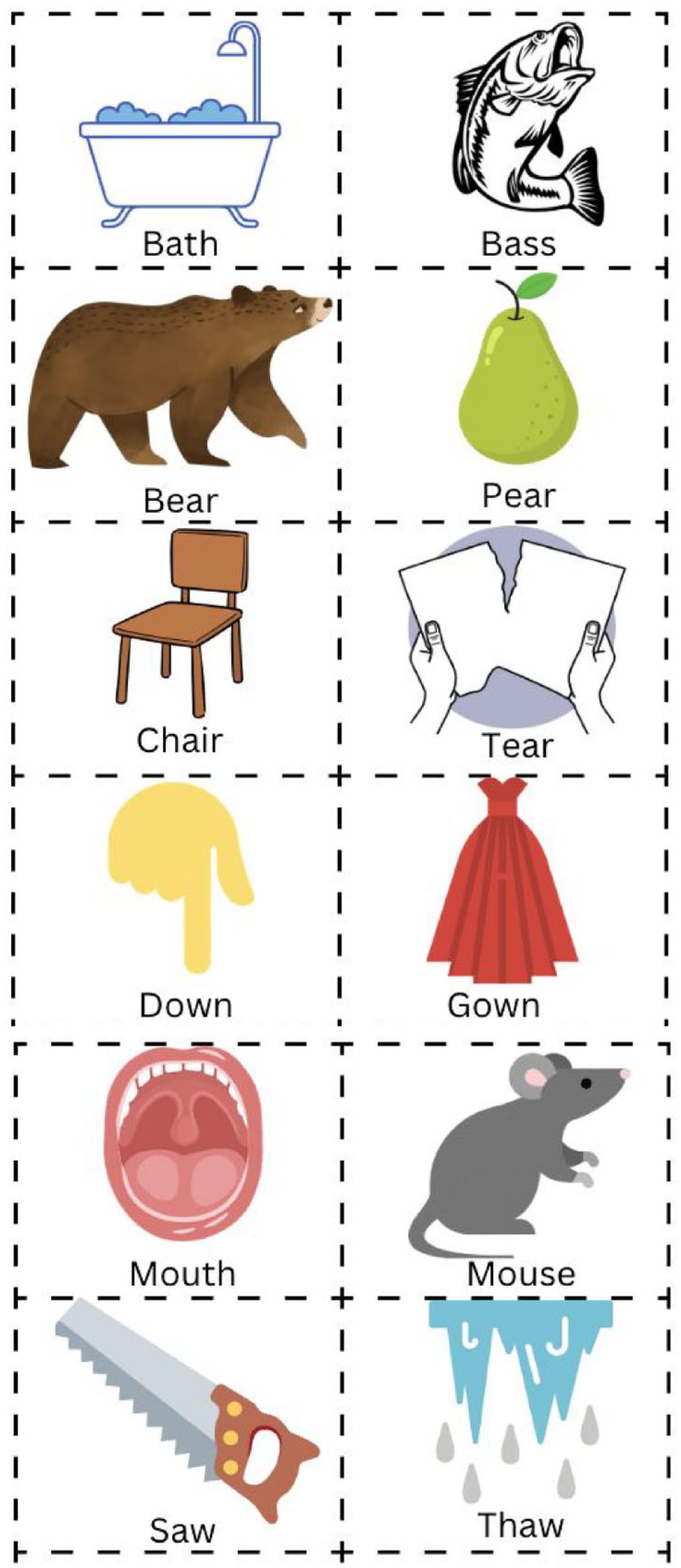
Sample of High-frequency minimal pairs for phoneme discrimination with image cards
During the assessment, give at least a 5-second recall for students to respond with the correct image selection and keep note of the phonemes students can discriminate. Having a selection of three cards (minimal pair and a non-minimal pair card) reduces the possibility that students will guess. For an assessment checklist, please see
Modeled Example for Phoneme Production
Teacher says “mouth” and points to the image that represents mouth.
Teacher says “mouse” and points to the image that represents mouse.
Teachers says “bass” and points to the image that represents bass.
Teacher says, “Now it is your turn, say the word I point to” and points to mouth . . . mouse and prompts the student to produce the correct phoneme in the word. If a student has trouble recalling that word, the teacher can repeat the word and listen for the student’s oral pronunciation of the phoneme.
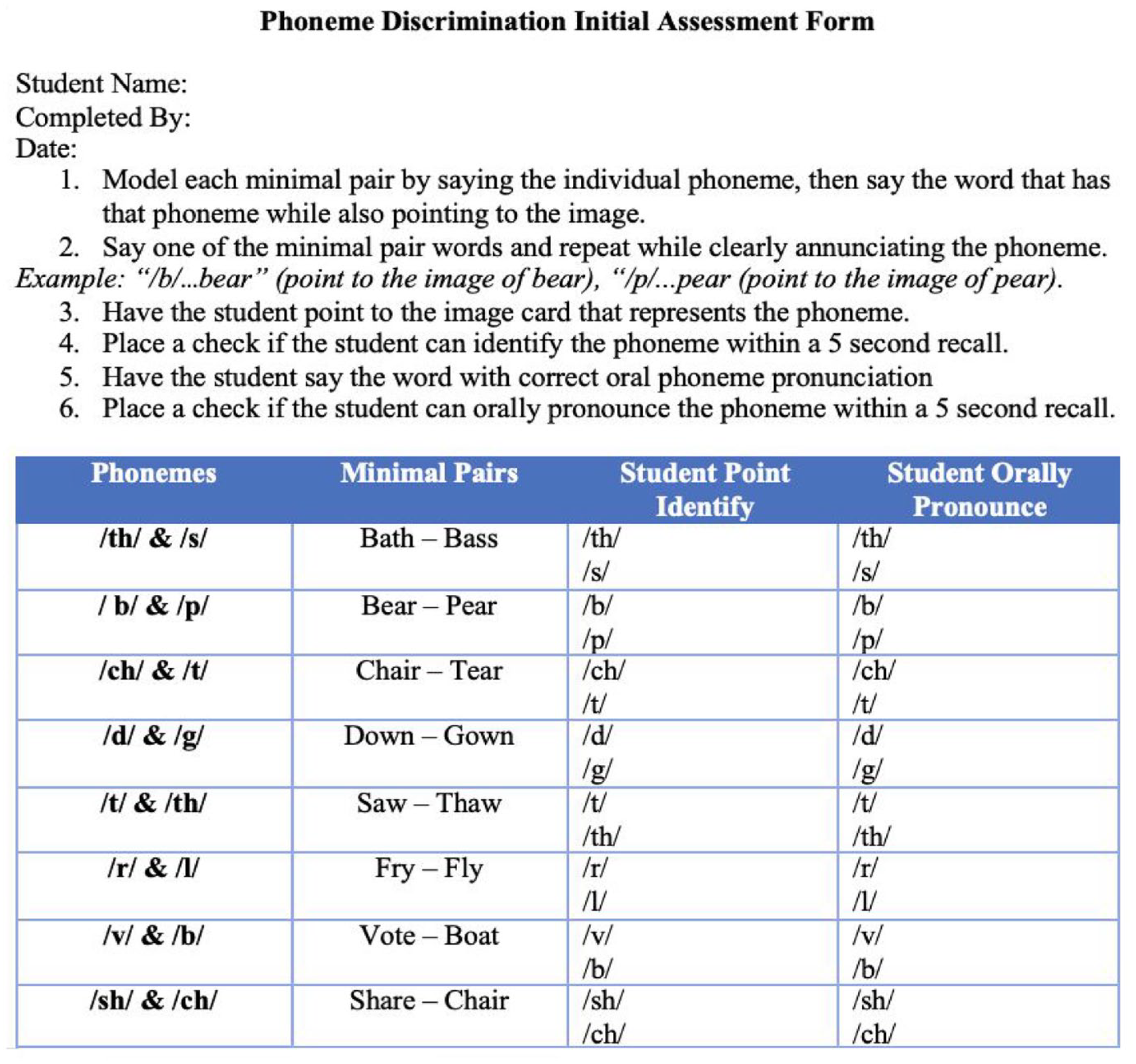
Phoneme discrimination initial assessment form
Once phoneme gaps have been identified, explicit instruction with repeated auditory exposure and mouth formation modeling with sound contrasts can be introduced. The instruction should include opportunities for oral pronunciation and listening comprehension of minimal pairs while also providing one-on-one support or small group instruction three to four times per week. The following sections delineate instructional activities that can be provided to support phonemic discrimination of minimal pairs.
Classroom Support Through Oral and Listening Experiences
Once teachers are aware of the specific phonemic discrimination gaps, it is important to consider how instruction can support EBs with reading disabilities to identify sound contrasts in minimal pairs. Research from Krenca et al. (2020) and Li et al. (2019) showed that significant gains in phoneme discrimination can be supported through effective auditory training where phonemes are isolated and distinguished using minimal pairs when spoken orally. This means EBs with reading disabilities need to be given multiple opportunities to hear, identify, speak, and discern phonemes through repeated oral and listening experiences to enhance phoneme discrimination. To increase phonemic abilities, EB students with reading disabilities need opportunities to hear phonemes in a different context in a word where its sound is voiced and distinct (i.e., /b/ phoneme in “boy” and “bear”). When EBs with reading disabilities can blend familiar words with minimal pairs, they are more likely to discern and build their phonemic knowledge to distinguish the course and soft sound contrasts in given minimal pairs.
Monitor achievement in phoneme discrimination by measuring the fluency and accuracy for EBs with reading disabilities to respond, repeat, or recall phoneme differences within 1 minute (Krenca et al., 2020; Wang & Geva, 2003). EBs with reading disabilities are more likely to first identify the phoneme difference in a minimal pair through auditory exposure first and verbal articulation later. Classroom instruction should include opportunities for EBs with reading disabilities to not only orally practice different phonemes in minimal pair sets but to also provide opportunities to listen and identify sound differences within minimal pairs in highly familiar, high-frequency words that share similar phonemes. Additionally, instruction should allow for students to see modeled mouth and tongue positioning for phoneme formation through oral pronunciation. These approaches allow EBs with reading disabilities to develop a stronger foundation to discern sound contrasts within minimal pairs in the language(s) they are exposed to (Janssen et al., 2015; Li et al., 2019).
Oral Sound Image Sound Sort
Step 1: Prepare a list of minimal pair words that share common initial phonemes with familiar words to be orally pronounced and create image cards with those words for EBs with reading disabilities to identify. This activity’s goal is for each minimal pair to have a common or high-frequency word to distinguish the phoneme clearly.
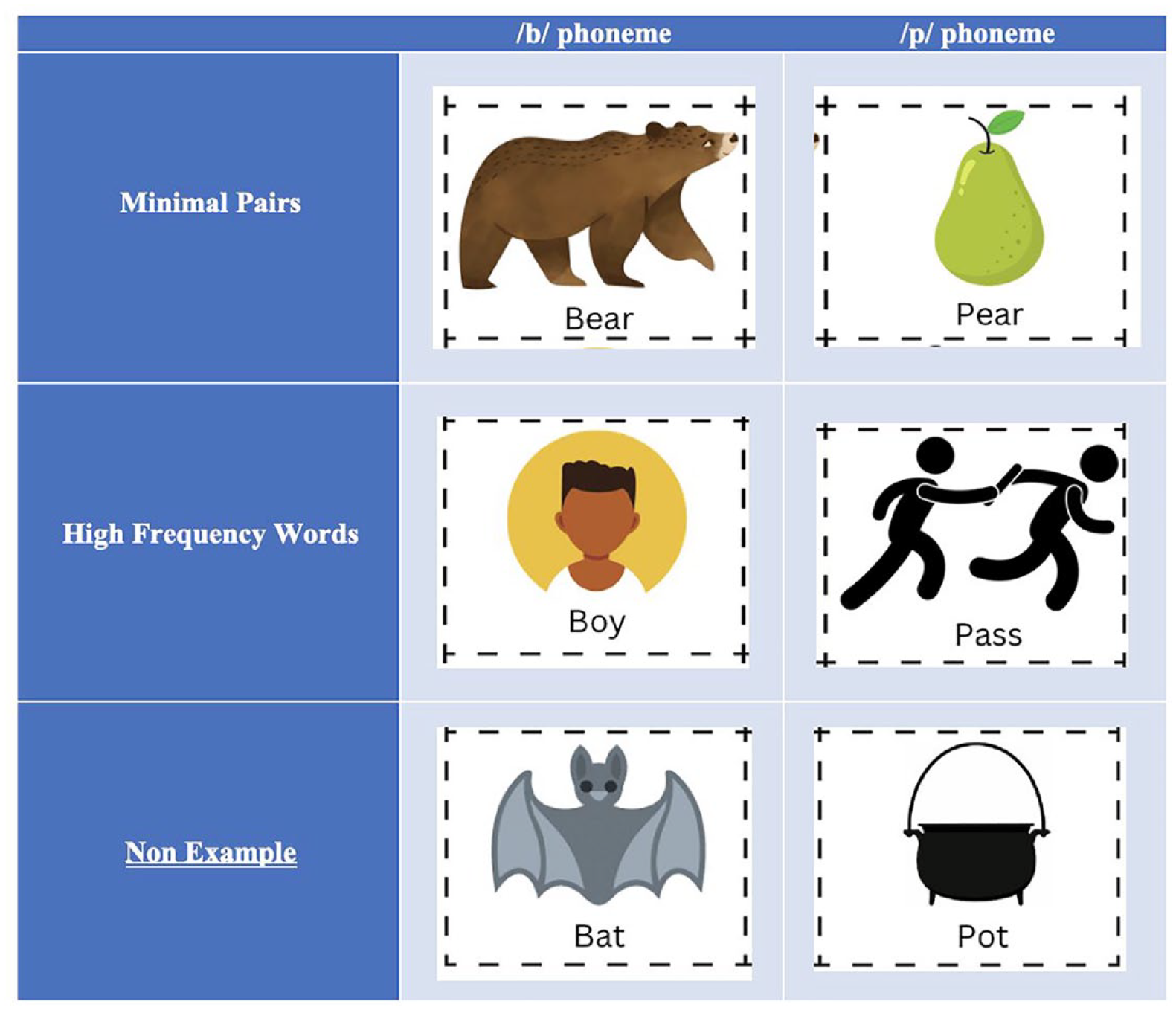
Listening comprehension activity phoneme discrimination image sound sort
Step 2: Orally pronounce the minimal pair word (i.e., bear and pear) for the student while simultaneously pointing to the corresponding image. Be mindful of the correct mouth formation and tongue placement for each oral pronunciation of the phoneme. Then, say a high-frequency word that shares the practiced phoneme (i.e., boy for /b/ sound and pass for /p/ sound) and point to the corresponding image.
Step 3: The EB with reading disabilities will orally pronounce and point to the image based on the teacher’s oral pronunciation of high-frequency words (boy) followed by the minimal pair (bear) and then switch to the other focused phoneme (/p/) by saying the high-frequency word (pass) followed by the minimal pair (pear). Repeat this exercise approximately four to five times per instructional session. Have the nonexample card available as a card option to prevent students from randomly guessing.
Step 4: Monitor student progress (see
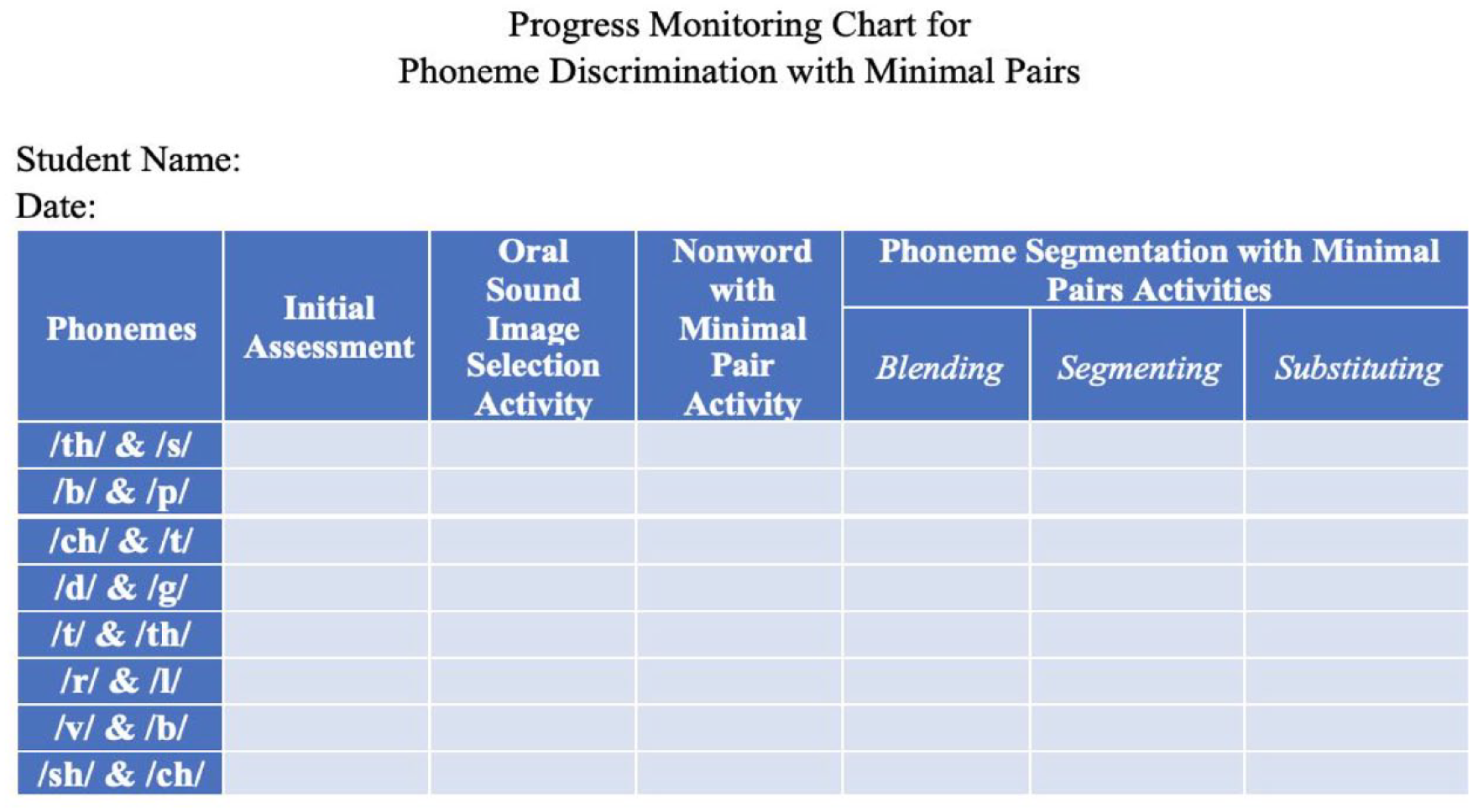
Progress monitoring chart for phoneme discrimination with minimal pairs
In this instructional strategy (see
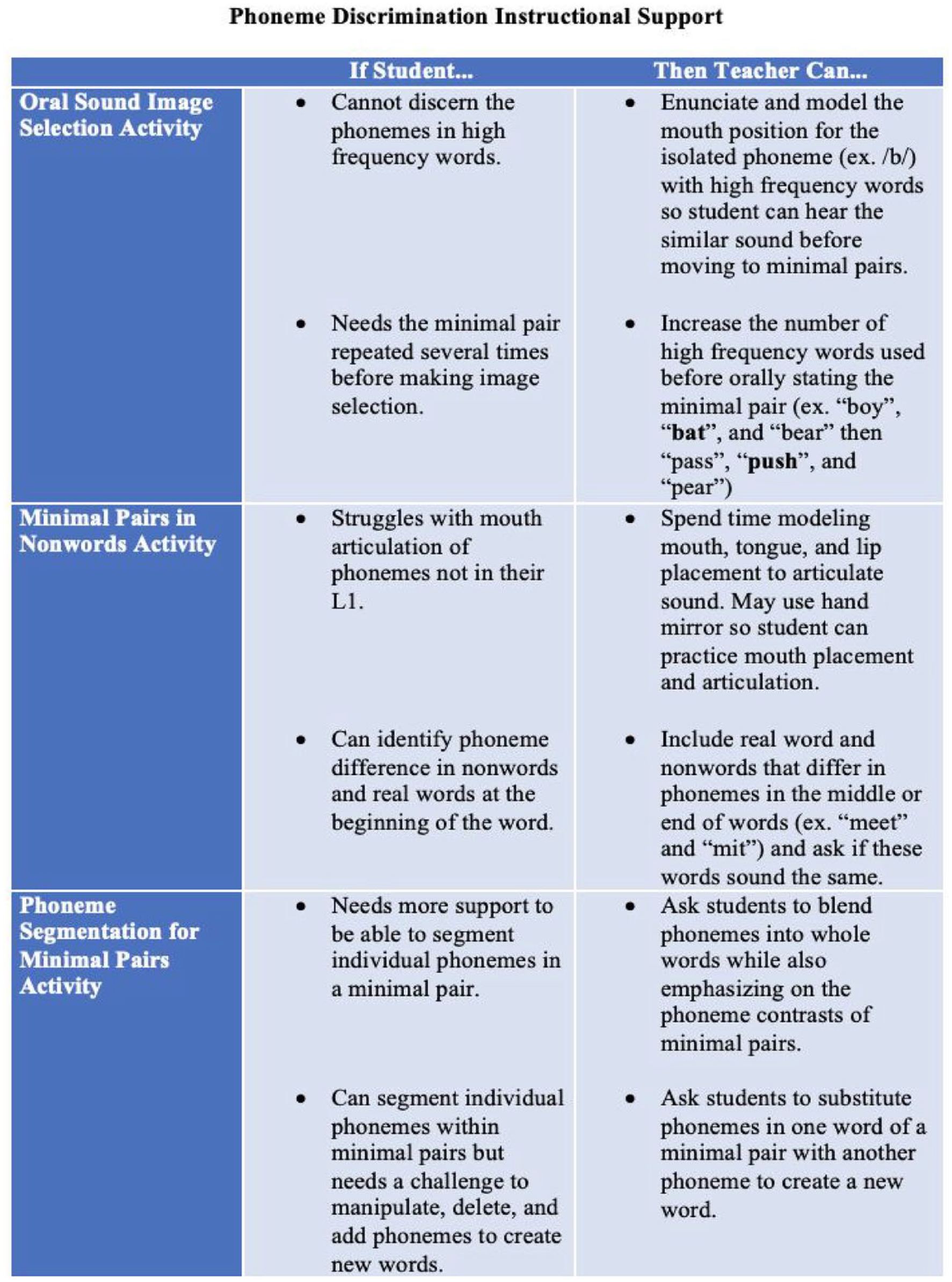
Phoneme discrimination instructional support chart
During this oral exercise, Ms. Lewis noticed Juan at first started to need longer periods of time to listen carefully. He also needed the high-frequency words and minimal pairs orally repeated multiple times. To support Juan, Ms. Lewis enunciated more on the /b/ and /p/ phonemes for the high-frequency words, “boy” and “pass,” so Juan could better discern the sound contrasts She also started pointing to her mouth formation when enunciating on /b/ and /p/ phonemes, showing him how her mouth and tongue changed positions.
Like many instructional activities for phonemic awareness, consistency over short periods of time results in greater outcomes than extensive instructional interventions for phonemic acquisition (Kjeldsen et al., 2003). As such, spending just a short amount of time (5–10 minutes) each day over a period of 3 weeks has the potential to produce noticeable results in students’ phonemic discrimination. As students progress, extend and challenge EB students by adding additional minimal pairs (i.e., bowl and pole) and high-frequency words (i.e., book and pack). In addition to image cards (as seen in
Use of Minimal Pairs in Nonwords
Nonword decoding or repetition has been used in reading research for both English native-speaking children and EBs with or without reading disabilities (Farnia & Geva, 2011; Gathercole, 2006). It is indicated that measures of nonword tap a common phonological processing, which is the primary determinant of ease of phonological learning (Bowey, 2001; Metsala, 1999). The intention of using nonwords is to train EBs with reading disabilities to focus on letter-sound correspondence to sound out “wordlikeness” nonwords that follow alphabetic rule. The ability to sound out nonwords supports learning of the sound structure of new words, which in turn facilitates vocabulary learning (Farnia & Geva, 2011; Masoura & Gathercole, 2005). Nonwords can often be a useful tool to support EB students’ phoneme discrimination as they are still acquiring their L2 proficiency (Masterson et al., 2005). By using nonwords, teachers can determine whether an EB with reading disability knows the most common sounds and whether he or she can tell the difference between two similar sounds.
Ms. Lewis wanted an intervention that would help with some of her at-risk EB students who struggle identifying images with phonemes. Her school’s interventionist suggested using listening activities with nonwords, which are words that do not have meaning in the English language. Because the focus of this activity is on the phonemes and not vocabulary development, Ms. Lewis felt Abdo, her at-risk EB student, would benefit from this practice to discriminate a phoneme within a nonword minimal pair, rather than having to recall or identify a word in their L2 repertoire. For this activity, Ms. Lewis wanted Abdo to identify by oral pronunciation and listening whether two nonwords sounded the same.
Conducting nonword listening activities
Step 1: Prepare real-word minimal pairs and nonword minimal pairs based on students’ phonemic needs. Ms. Lewis prepared her real-word minimal pairs, “share” and “chair,” and nonword minimal pairs, “shob” and “chob,” for her student, Abdo.
Step 2: Orally pronounce the real-word minimal pair and ask “Do ‘share’ and ‘chair’ sound the same?”and wait for students to respond.
When Ms. Lewis said the real-word minimal pairs, Abdo was able to identify the sound contrasts between /sh/ and /ch/.
Step 3: Repeat Step 2 but read the nonword minimal pair (i.e., “shob” and “chob”) and ask, “Do ‘shob’ and ‘sound the same?” The student should identify the sound contrasts for the nonword minimal pair. Ms. Lewis noticed when she said the nonword minimal pairs, Abdo showed surprise to hear a word that was unfamiliar to him. Ms. Lewis had to explain she would be saying words that are not real in English. Ms. Lewis thought to also mix the real word, “share,” with the nonword, “shob,” to see if her students could identify the same sounds. After several repeated attempts, Ms. Lewis was pleased Abdo was able to correctly identify the sound contrast in both real-word minimal pairs and nonword minimal pairs. Ms. Lewis also provided Abdo a hand mirror for him to see his mouth and tongue positions for accurate phoneme pronunciation. This allowed Ms. Lewis to extend their work by incorporating other nonwords that also shared the /sh/ and /ch/ phonemes. Ms. Lewis noticed Abdo really enjoyed listening to the nonword minimal pairs because many of the words sounded silly and the identification became an entertaining game.
Step 4: Monitor student progress (see
This activity can include several variations to support EBs with reading disabilities. For example, teachers may mix real words and nonwords that share similar phonemes (i.e., “share” and “shob”) to see if students can identify the same sound. Although this may feel like a form of informal assessment, asking students to identify the same or differing sounds is part of the instruction to model phoneme differences to be recognized, thus strengthening students’ phoneme discrimination. Another way to modify this activity is by changing the question asked after pronouncing the real-word and nonword minimal pairs. For example, say a nonword minimal pair such as “Lees . . . Lis” and then ask, “Did I say the same thing?” Allow time for the EBs with reading disabilities to respond and identify whether the same sound was pronounced in the real-word or nonword minimal pair. This listening exercise with the same phoneme can be repeated several times a week until EBs with reading disabilities are able to discern the differences in the pronounced minimal pairs. See
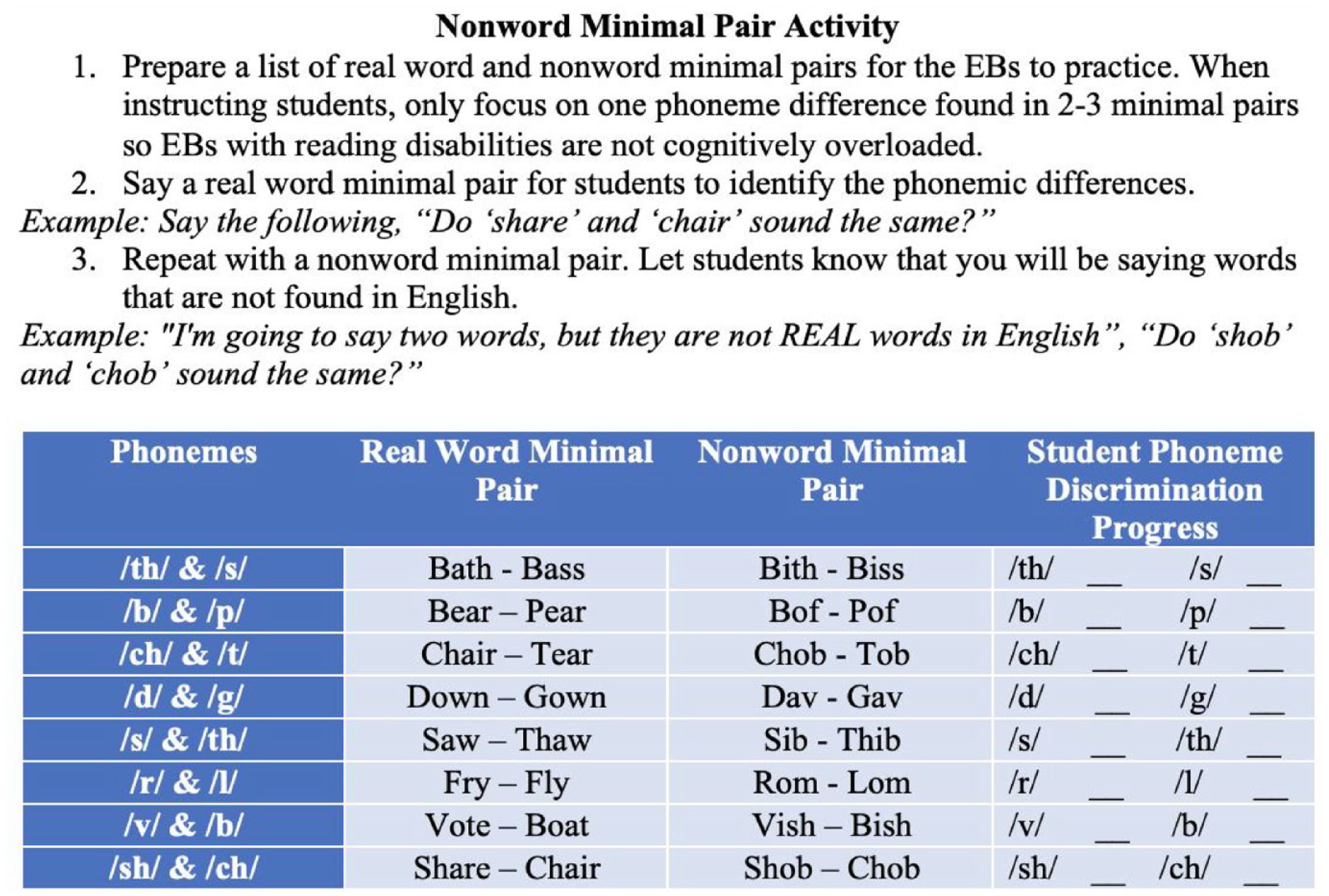
Nonword minimal pair activity
For students like Abdo, who mispronounce the phonemes that are not in their L1 repertoire, including a component of oral pronunciation with nonwords can also be supportive for discerning phonemes and developing spoken sounds within their L2. Asking students to orally repeat the words and nonwords while asking, “Did you say the same thing?” can help for teachers guide students toward articulation placement for sound production. See
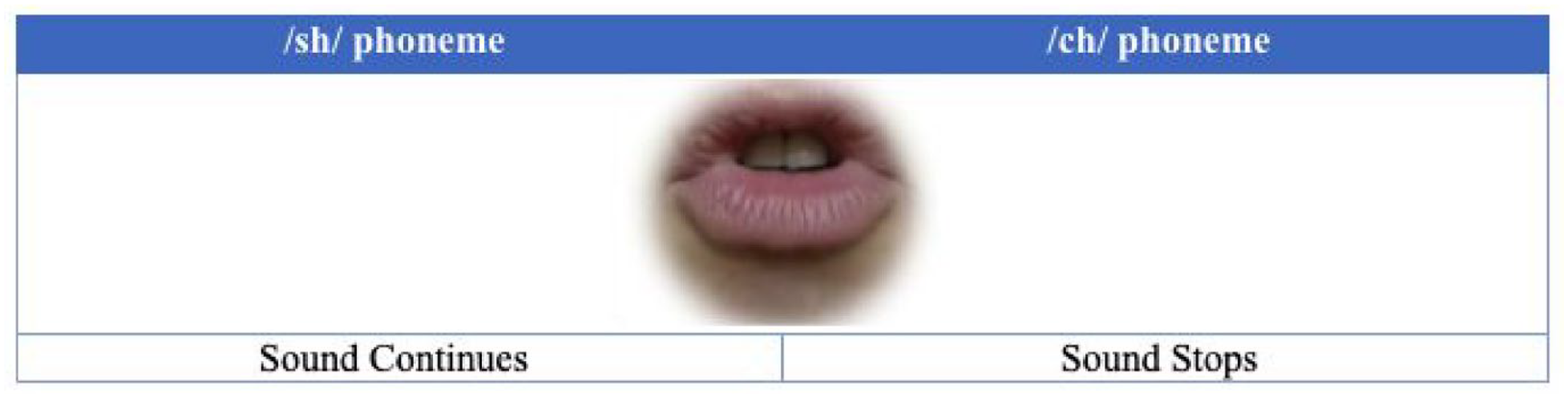
Example articulation chart for /sh/ and /ch/ phoneme discrimination
Phoneme Segmentation for Minimal Pairs
To support the ongoing development of phoneme discrimination, it is also key to include activities that ask EBs with a reading disability to not only identify differences but also to break apart phonemes within words. Research shows that segmentation training, where phonemes of a word are articulated and separated, not only increase phoneme awareness but also increase an EB’s reading ability (Ball & Blachman, 1988). While traditional phoneme segmentation activities include teacher pronunciation of a word with students orally breaking the word into individual sounds, to support phoneme discrimination, it is important to include minimal pairs into the activity.
Ms. Lewis noticed improvement with Mei’s ability to identify phonemes within minimal pairs but wanted to support her ongoing phoneme awareness growth by including phoneme segmentation with minimal pairs. She first began by selecting several minimal pairs with the /d/ and /g/ phonemes to use for one-on-one instruction with Mei. Additionally, Ms. Lewis gathered tokens and printed Elkonin boxes (Elkonin, 1971) as a manipulative to help Mei visualize and use a hands-on approach to move through each individual phoneme of the minimal pairs. During the one-on-one lesson, Ms. Lewis said to Mei, “Today we are going to break the words I say into sounds. Let me show you an example ‘dog . . . /d/ . . . /o/ . . . /g/.’ As I say each sound, I will move this token into a box” (see
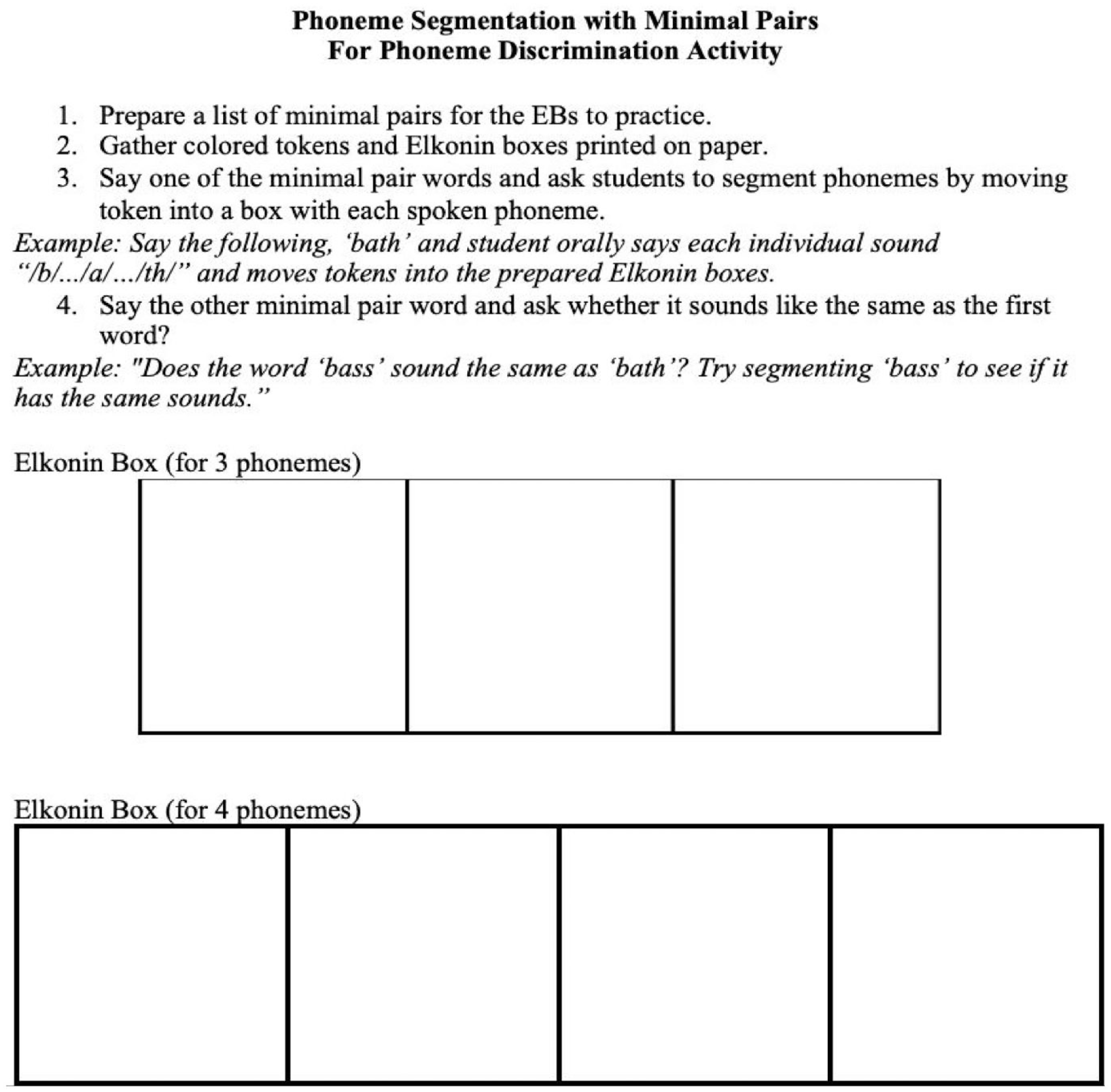
Phoneme segmentation with minimal pairs activity
After several practice rounds, Ms. Lewis asked Mei to listen and segment phonemes for the word “down.” After Mei segmented the word into the phonemes (“/d/ . . . /ow/ . . . /n/”) correctly, Ms. Lewis then said, “Does the word ‘gown’ sound the same as ‘down’?” while prompting Mei to segment the phonemes of “gown” to determine the phoneme differences between the minimal pairs.
One component of phoneme segmentation is understanding how to adjust the difficulty of the task for EB students with a reading disability. Asking students to blend phonemes is typically easier than segmenting or breaking a word into individual phonemes (Burkins & Yates, 2021). This means if phoneme segmentation is too challenging, teachers can adjust their instruction by asking students to blend phonemes into whole words (i.e., “/d/ . . . /ow/ . . . /n/” makes what word? Does it sound the same as /g/ . . . /ow/ . . . /n/?”). For students who show success being able to identify and segment phoneme contrasts, teachers can extend this lesson and challenge EB students with a reading disability to engage in substitution tasks with minimal pairs (Burkins & Yates, 2021) where students will segment, blend, delete, and add phonemes to create a new word. See
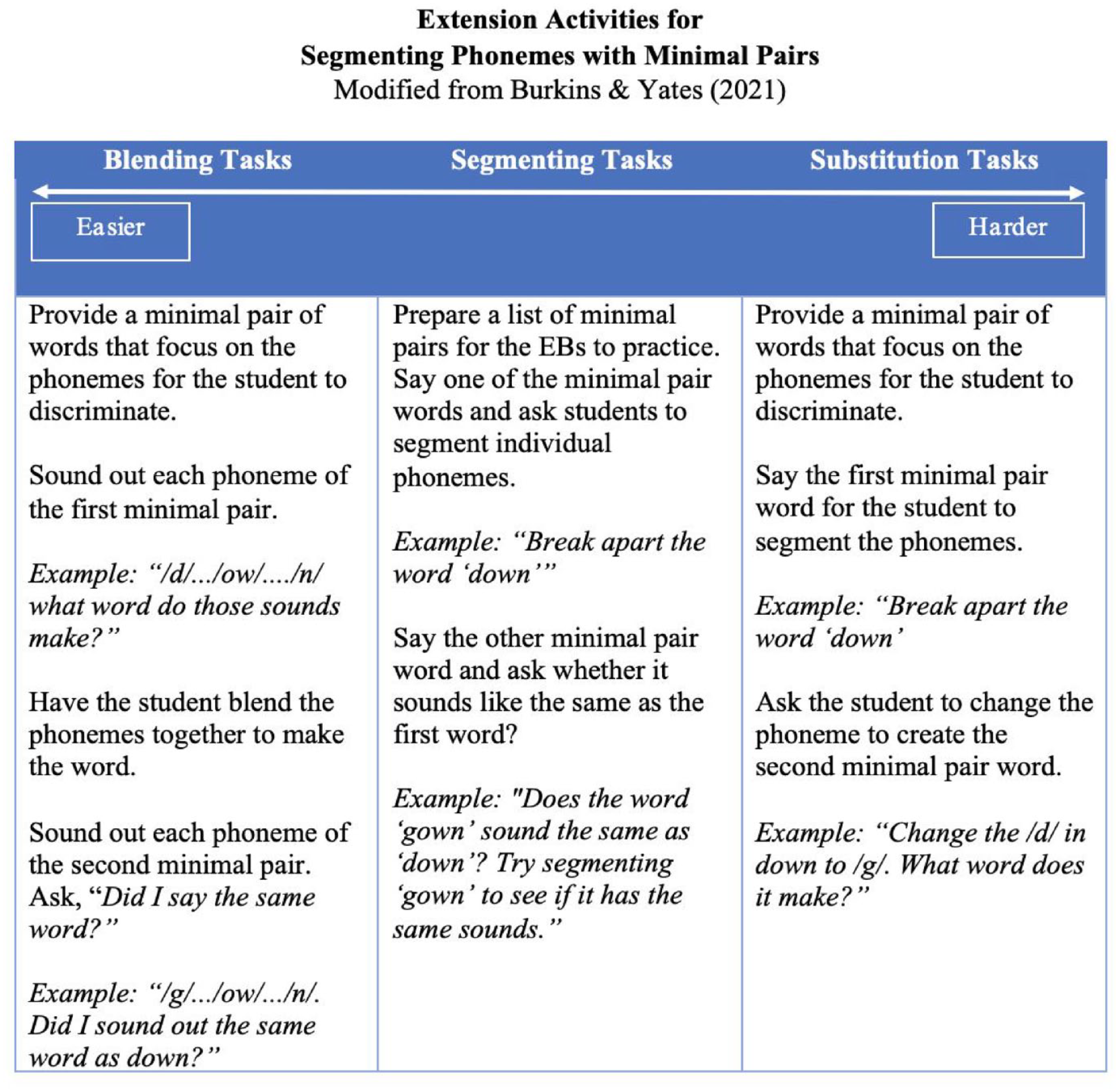
Phoneme segmentation extension activities
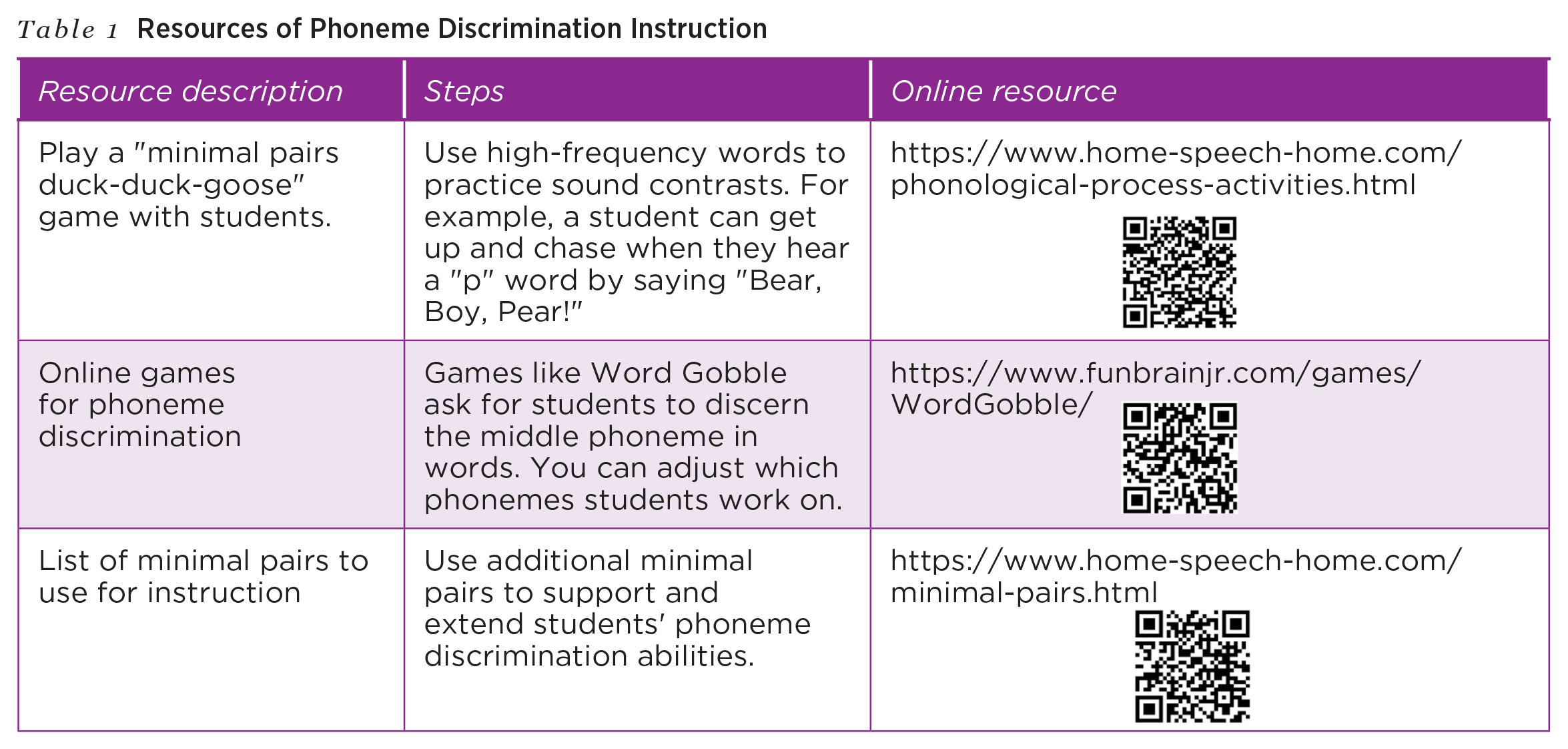
Because many of the activities provided focus specifically on the needs of EB students with a reading disability, there are additional activities you can also incorporate into your daily instruction that will provide ongoing phonemic awareness while also emphasizing phonemic contrasts. This might include providing opportunities for students to practice sound contrasts by oral pronunciation or listening identification in a low-pressure environment through casual conversations and not just in a one-on-one instructional situation. Table 1 offers a list of additional activities or resources teachers can use to continue supporting their EB students’ phonemic discrimination development.
Resources of Phoneme Discrimination Instruction
Conclusion
EBs with reading disabilities need clear and explicit instruction that provides repeated exposure and practice to distinguish sound contrasts in minimal pairs. Considering the importance of phoneme discrimination and the potential limitations for reading progress in EBs with reading disabilities, it is crucial teachers know how to support them to identify sound contrasts for phoneme discrimination. Phoneme discrimination is a more basic and fundamental skill than phonemic awareness; therefore, teachers can introduce phoneme discrimination skill early, before the instruction of phonemic awareness. As students progress in their phoneme discrimination, the teacher can add more challenging minimal pairs and gradually add phonemic awareness instruction. Knowing that some EBs with reading disabilities do not have knowledge of some phonemes based on their L1 understandings, it is important teachers embed known high-frequency words with minimal pairs as critical steps toward acquiring and mastering English language phonemes.
Footnotes
Declaration of Conflicting Interests
The author(s) declared no potential conflicts of interest with respect to the research, authorship, and/or publication of this article.
Funding
The author(s) disclosed receipt of the following financial support for the research, authorship, and/or publication of this article: This work was supported by the William T. Grant Foundation (Grant No. 189631) and the Social Sciences and Humanities Research Council of Canada (Grant No. 430-2016-00747).
