







Abstract
The US is becoming progressively diverse and so are our classrooms. Home-school partnerships are essential to supporting diverse learners. It is critical both new and veteran practitioners make intentional efforts to provide culturally proficient practices when building home-school partnerships. Cultural awareness is identified across disciplines as the initial step to being a culturally proficient practitioner (e.g., CCPEP, nd; Randall-David, 1989; SAMHSA, 2014). Self-awareness is an important but often overlooked step in cultural awareness. This article addresses three techniques to increase cultural self-awareness as an initial step to building effective home-school partnerships with diverse families.

Although Ms. Allen has been teaching for several years, this is her first year teaching at an urban high school with a diverse student population (e.g., language, ethnicity, race, immigration status). She is a bit nervous due to the diversity of the classroom. She understands the importance of family involvement in meeting the needs of all students and wants to leverage home-school partnerships. She knows her views might differ from some of the students and their families and wants to make sure her initial and continuing interactions are appropriate, positive, and successful.
Effective family engagement involves a reciprocal partnership between home and school, one in which educators “learn from” and “work with” families (Amatea, 2013, p. 10). However, cultural differences between educators and families can pose challenges, limiting home-school partnerships for students who are culturally and linguistically diverse (Ford et al., 2014; Fowler et al., 2019; Yull et al. 2014). Cultural self-awareness, being attuned to how our personal culture influences our perceptions and interactions, is a prerequisite to understanding individuals from other cultures and essential for educators wishing to partner with diverse families (Center for Culturally Proficient Educational Practice [CCPEP], n.d.; Randall-David, 1989; Substance Abuse and Mental Health Services Administration [SAMHSA], 2014; Spitzer, 2015).
The Family’s Impact on Cultural Identity
Culture is the degree to which a group of individuals learns to behave (e.g., act, speak, think) similarly in situations and their behavior distinguishes them from other groups (Sugai et al., 2012). There are several domains of culture used to differentiate groups. These domains extend beyond the often visibly obvious (e.g., race and gender) and include but are not limited to race, gender and gender identity, ethnicity, sexual orientation, age, religion, ableness, socioeconomic status, immigration status, marital status, and geographic location. The way one identifies and has learned to behave in these domains makes up their cultural identity.
The family plays a critical role in the development of one's culture (Fuligni et al., 1999; Lareau & Horvat, 1999). Culture is developed through learning from personal experiences (Lareau & Horvat, 1999). In developmental years, family provides many of these experiences, exerting a powerful influence over the development of culture and cultural identities. From family experiences, expectations and practices are formed, initiating the development of cultural identities across the various domains of culture (Fuligni et al., 1999). Many of these practices are modeled and reinforced across life experiences. Consider a female child, for example, who observes multiple female models in her family participate in child-rearing activities in the absence of male models (e.g., grandmother cooking, aunt helping with homework, mother communicating with the school), and as she matures, these child-rearing activities are taught, encouraged, and reinforced. This child is likely to grow up identifying child-rearing as a female-specific role. Furthermore, if not exposed to multiple examples of various genders participating in child-rearing activities, this limited exposure could impact her professional practice as an educator (e.g., contacting or addressing home-school communications to the female guardian, using examples in lessons of child-rearing activities that only or mostly include references to females, using communication that only or mostly includes female referents to child-rearing activities—“let your mom know that you weren’t feeling well today”).
Responding to Cultural Diversity
The way educators respond to cultural differences can enhance or impede the home-school partnership (Henderson et al., 2020; Páez et al., 2019; Yull et al., 2014). Culturally and linguistically diverse families indicate the response they often receive from educators lacks cultural competence (e.g., lack of knowledge of the student population, insensitivity to customs) and includes stereotyping (e.g., lower student academic expectations, parents viewed as uneducated, parents treated as a problem and with hostility) and inequities (e.g., disproportionality in discipline practices; Yull et al., 2014). These responses to cultural differences inhibit reciprocal home-school partnerships (Henderson et al., 2020; Páez et al., 2019; Yull et al., 2014).
Cross et al. (1989) identified a continuum of six responses to cultural diversity: (a) cultural destructiveness, (b) cultural incapacity, (c) cultural blindness, (d) cultural precompetence, and (e) cultural proficiency. The initial response, cultural destructiveness, is a response (e.g., attitude, policy, structure, and practice) to cultural differences that is harmful to certain cultures and individuals identifying with those cultures. Cultural destructiveness is represented by educators’ comments like, “Those families are so difficult to work with” or “They don’t value education.” The beliefs conveyed in these comments and comments like them are detrimental to forming effective home-school partnerships with all families. For example, if educators believes that families from a particular culture are “difficult” or “don’t value education,” their beliefs can impact interactions, and they may be less likely to attempt to engage with those families.
At the center of the continuum is cultural blindness. Cultural blindness is a response to cultural differences in which one views all people the same. Examples of statements representative of cultural blindness are “I treat all people the same” or “I don’t see color.” While these statements may have good intentions, they are problematic. Cultural-blind responses disregard the value of differences, encourage assimilation, and overlook cultural strengths. The culturally blind practitioner fails to acknowledge the unique needs of diverse populations within practices designed for mainstream culture, believing that the practices used for the majority group will work for all (DeCuir-Gunby et al., 2020).
At the opposing end of the continuum from cultural destructiveness is cultural proficiency. Cultural proficiency is a response to cultural differences that esteems and affirms diversity. It includes the ongoing acquisition of knowledge and transformative practices to effectively respond to a progressively diverse world (e.g., Cross et al., 1989; Quezada et al., 2012). An example of a culturally proficient response to cultural differences is learning some basics of a foreign language to enhance communication with families. Culturally proficient practices can help reduce the challenges educators experience when trying to build effective home-school partnerships with a diverse group of families (e.g., Ford et al., 2014; Yull et al. 2014). Cultural awareness is identified as an initial step in the process of becoming a culturally proficient practitioner (CCPEP, n.d.; Randall-David, 1989; SAMHSA, 2014).
Cultural Awareness
A general misunderstanding about cultural awareness is it focuses solely on understanding the culture of others. While knowledge of other cultures is a part of the process, cultural awareness is recognizing the nuances of one’s own culture in addition to the cultures of others (CCPEP, n.d.; Labor Occupation Health Program, n.d; Spitzer, 2015). The culturally proficient educator is self-aware; conscious of the nuances of their own culture and the impact it may have on the home-school partnership. Through reflection, practitioners can identify beliefs or behaviors that may hinder culturally responsive practices and impede home-school partnerships. Without self-reflection as an initial step, well-intentioned practitioners may attempt activities to increase awareness of other cultures unaware of how their beliefs impact their views (Skogsbergh, 2020). This article presents three reflective activities: (a) reflection on cultural identity, (b) reflection on the response to diversity, and (c) reflection on home-school partnerships. Educators can use these self-reflections to increase awareness of their cultural beliefs and behaviors, understand how personal beliefs impact their response to diversity, and identify the impact their personal beliefs and behaviors have on their approach with families.
Reflection on Cultural Identity
One way to gain awareness of one’s culture is through self-reflection (Cross et al., 1989; Gay 2010; Quezada et al., 2012; Randall-David, 1989; SAMHSA, 2014). Attempts to evaluate one’s culture through general discussions about cultural identity (e.g., asking questions such as “What is your culture?” or “How does your culture impact your personal and professional practices?”) are seldom effective in recognizing the nuances of one’s culture (Gay, 2010). These types of reflection often lead to a response indicative of cultural blindness (e.g., “We are all the same and should be treated the same”) or neutrality (“I don’t have a culture”; Gay, 2010). Instead, focusing on lived experiences in several cultural domains will aid in identifying cultural identities and their influence on our beliefs and behaviors. Additionally, identifying how personal identities are situated in a social context helps to recognize the advantages and challenges experienced by various cultural identities and how the status of personal identities impacts behaviors and beliefs.
Table 1 provides examples of questions designed to lead practitioners through personal reflection on lived experiences across several cultural domains. Each section of the table addresses a different cultural domain. The questions in each section aid the practitioner in understanding the development of their cultural identity. Initial questions in each section address lived experiences during developmental years and aim to prompt practitioners to reflect on familial impact in the development of their cultural identity.
Reflection Questions for Practitioners: Cultural Identity
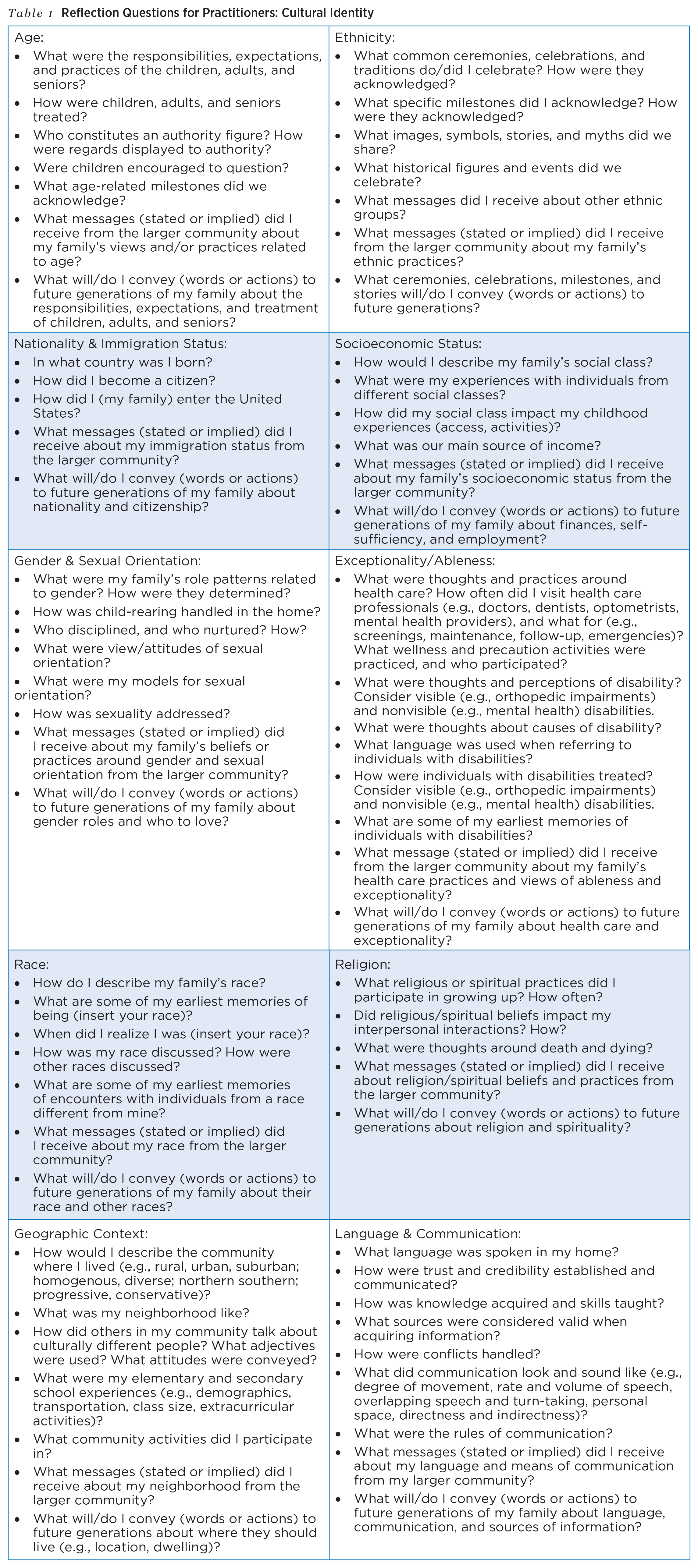
Questions referencing “the larger community” are designed to help guide practitioner reflection on the advantage and/or challenge identity may present in the dominant community. If one feels the question does not apply to them because they never had to think about how their identity was viewed by others, then they may be part of a dominant group with their identity serving as an advantage. If you fall into this category, then consider how different individuals within that cultural domain may respond to the question. For example, a Christian growing up in the United States may have never had to consider messages about their religion from the larger community because Christianity is the dominant religion in the United States. In this instance, it may be beneficial to do a reflective comparison of the experiences of a nondominant religious group (e.g., Muslim). This type of reflection may help to reveal personal advantages one might have never considered (Skogsbergh, 2020; e.g., time off for religious holidays and no pressure to celebrate holidays outside my religion; accessible religious music, programs, services, attire, symbols; harassment- and violent-free worship and practice of religious customs; individuals I encounter and politicians share or have an understanding of my faith; my scripture is used when taking an oath; Killermann, 2014).
Questions in each section about messages one “will/does convey” are designed to help guide reflection on current beliefs and values within identity. Each question is posed to help identify personal values we hold in relation to each cultural domain. When reflecting on this question, consider what messages are conveyed in words and actions. If more than one message is identified, try then to identify the one that is most important to a core belief.
A reflective understanding of lived experiences helps educators become aware of their beliefs and behaviors. After reflecting on lived experiences, practitioners can begin to acknowledge how their beliefs and behaviors influence their views and interactions with others, especially the students and families they serve.
When reflecting on the initial questions in the “age” domain, Ms. Allen reveals she grew up in a home where adults were revered as authority figures. Considering the question “What will/do you convey (words or actions) to future generations of my family about the responsibilities, expectations, and treatment of children, adults, and seniors?,” she proudly identifies she will convey her core belief of “children respecting their elders” to future generations of her family.
Reflection on Response to Diversity
The culturally proficient educator is aware of how their personal experiences influence their beliefs about and interactions with individuals of varying cultures. Our behaviors, including what we believe, are shaped by our experiences. This includes our view of cultural differences, our concept of family, and our beliefs about family engagement. Both educators and families may hold beliefs that hinder the home-school partnership (e.g., biases, preconceptions, beliefs about roles), however, school personnel have the responsibility of fostering and maintaining the home-school partnership (Henderson & Mapp, 2007).
We have the best understanding of our cultural norms and standards because we practice them daily. If not careful, we can begin to believe that our norms are universal and evaluate and judge others accordingly. It is important for educators to have an awareness of their cultural standards and expectations and recognize the role they play in evaluations of others during interactions. For example, a teacher who values parent engagement and understands its benefits may interpret a parent’s reluctance to display engagement in school, in ways familiar to the teacher, as a lack of concern about the child’s education (Doucet, 2008). When we are aware of our personal cultural standards and expectations, we can reflect on how they might bias our views of and interactions with others and work to minimize damaging responses to cultural differences (McIntosh et al., 2014; Skogsbergh, 2020).
After using the questions in Table 1 to reflect on lived experiences, educators can begin to identify the cultural standards and expectations they have developed across the various domains of culture and how those standards impact their professional practice. Additional questions in Table 2 (“Response to Diversity”) can be used to promote reflective thought on the impact personal standards and expectations might have on professional practice when building home-school partnerships. The questions should be considered for each cultural domain addressed in Table 1. Reflection should be based on responses to reflection questions in Table 1. Special consideration should be given to the answer to the question about messages conveyed to future generations.
Reflection Questions: Response to Diversity and Home-School Partnerships

Evaluating how her core belief, “children respecting their elders,” may impact her response to diversity, Ms. Allen identifies an expectation she holds, which is that children identify all adults as authority figures and adults require respect from children. Contemplating how her expectation influences her evaluation of others, she acknowledges she is bothered when observing children interacting with adult family members and school staff disrespectfully (e.g., looking away when an adult is speaking or questioning a directive). She recognizes she unconsciously evaluates others according to her standard, often labeling the student as disrespectful and the family and staff member as having poor parenting or behavior management skills. As she reflects on the last three “Response to Diversity” questions, she realizes her evaluations might not be fair to those with different beliefs, behaviors, expectations, and standards due to their lived experiences and familial practices. She recognizes identifying families as lacking parenting skills and raising disrespectful children could directly impact her interactions with the family.
In addition to conscious influences that bias our beliefs about and interactions with individuals of varying cultures, unconscious associations that are not so obvious also bias our beliefs and behaviors (Starck et al., 2020). These unconscious associations are referred to as “implicit biases” (McIntosh et al., 2014). Implicit biases are automatic and unconscious associations that impact our perceptions, or how we make sense of things. These associations can occur due to repeated exposure or limited experiences or a combination of both (McIntosh et al., 2014; Starck et al., 2020). Due to their unconscious nature, implicit biases can result in cultural responses that may not align with our stated beliefs (Starck et al., 2020). For example, repeated exposure to images of Black fathers portrayed as uninvolved in media and/or limited experiences, such as knowing one Black family and the father happens to be uninvolved, may unconsciously influence a well-intentioned educator to assume that most Black students come from families with absent fathers. These assumptions and associations could lead the educator to remit Black fathers from the home-school partnership. Despite having good intentions (e.g., in an effort not to offend anyone), such assumptions can harm the home-school partnership and perpetuate false stereotypes, particularly as research indicates that Black fathers are often highly involved in their children’s lives (Jones & Mosher, 2013). While self-reflection can reveal explicit biases, implicit biases are more challenging to identify. It is difficult to identify a bias we are not aware that we have.
According to research, awareness of implicit biases is the first step in counteracting their influences (Nosek, 2007). Awareness of our implicit bias allows us to make a conscious effort to align our behaviors with our expressed beliefs. There are tests available that measure implicit associations. One example is the Implicit Association Test (IAT; Greenwald et al., 1998; Nosek, 2007), a set of assessments that identifies associations the brain has made across a variety of cultural domains (e.g., age, race, gender, sexuality, religion, nationality, and disability), therefore revealing unconscious or implicit biases held. If implicit biases are identified, the following questions can be used to reflect on the potential influence of implicit bias on interactions with others.
How do my results coincide with or differ from my expressed beliefs?
How might the identified bias impact my professional practice and practices when building home-school partnerships with diverse families?
What conscious efforts could I take to counter the unconscious bias revealed?
Once implicit biases are identified, educators can employ practices to modify their beliefs and behaviors. Increased interactions are one way to modify beliefs about diverse groups due to limited experiences or repetitive exposure to negative stereotypes. Meaningful interactions with diverse groups improve attitudes and can help to modify beliefs in several ways (Lemmer & Wagner, 2015; Sparkman, 2020). First, during interactions, educators can reconstruct biased beliefs by identifying counter stereotypes. Counter stereotypes are ways in which the group defies stereotypes (Liu et al., 2021). For example, the teacher who attributes a parent’s reluctance to display school involvement in ways familiar to him/her with a lack of concern about the child’s education could identify, through interactions, ways in which the group engages in academic activities and supports their children’s learning. Second, through interactions, educators can begin to deconstruct any faulty associations (implicit bias) they have (e.g., most Black students come from a family with an absent father) and build positive ones (Lemmer & Wagner, 2015; Sparkman, 2020). Third, to minimize the negative effects of our ethnocentric nature, educators can look for commonalities they have with diverse groups and identify assets. Finally, educators can engage in perspective taking by identifying how the questions in Table 1 apply to diverse groups and reflecting on how the group's responses may be similar or different from their own. Although the exercises presented in this article can support your initial understanding of your implicit biases, effectively addressing implicit biases requires a continual commitment to evaluate their existence and actively address them.
Ms. Allen's results on the Sexuality IAT revealed a preference for straight relative to gay people. She is surprised by the results as she prides herself in being inclusive. Reflecting on Question 1, she concludes the assessment outcomes do not align with her conscious belief and must be due to some automatic unconscious associations. Reflecting on the second question, she wonders if her revealed bias has impacted her professional interactions. She begins to reflect on ways her bias could be revealed through professional interactions and on recent interactions she has had with families. Although she cannot remember any incidents, she is now conscious of her bias and how it could impact her interactions with families. As she reflects on the third question, she realizes that she has had limited exposure to the LGBTQ+ community and decides to identify experiences to increase her interactions with the community.
Lastly, in addition to reflecting on how our personal lived experiences have shaped our beliefs and behaviors across the various domains of culture and how biases impact our views of and interactions with others, educators seeking cultural proficiency must also evaluate their personal beliefs about home-school partnerships.
Reflection on Home-School Partnership Beliefs
Beliefs about family engagement also impacts the ability to build effective home-school partnerships with diverse families. Before effective partnerships can be created, educators must believe not only that home-school partnerships are important but also that they can create them (Henderson & Mapp, 2007). One way educators can identify if their beliefs about home-school partnerships support or hinder their ability to effectively partner with all families is to evaluate their beliefs against core beliefs essential to establishing effective home-school partnerships. Henderson and Mapp (2007) identified four core beliefs educators should possess to build effective home-school partnerships:
“All families have dreams for their children and want the best for them” (Henderson & Mapp, 2007, p. 31).
“All families have the capacity to support their children’s learning” (Henderson & Mapp, 2007, p. 34).
“Families and schools are equal partners” (Henderson & Mapp, 2007, p. 38).
“The responsibility for cultivating and sustaining partnerships among school, home, and community rests primarily with school staff, especially school leaders” (Henderson & Mapp, 2007, p. 41).
To constructively use these core beliefs in a self-reflective evaluation, practitioners must (a) reflect on each belief statement separately; (b) decide if they agree, partially agree, or disagree with each statement; and (c) if in agreement, determine how their practices reflect that belief. For example, if in agreement with the statement “All families have dreams for their children,” reflect then on how this belief is displayed in practice when building effective home-school partnerships and on what actions are taken to ensure that this belief is evident to families.
If the practitioner determines that they partially agree or disagree, they can expand their reflection to investigate why. The practitioner can identify the parts of the statement that prompt disagreement and determine how it could be revised to align with their belief. For example, if the word “all” in the statement “all families have dreams for their children” is troublesome, then reflect on what families should be excluded to make the statement true and why they would be excluded. Next, reflect on personal standards and expectations that may bias the views of and interactions with those families. Finally, identify resources that can be provided to support those families (e.g., homework hotlines, tutoring, referrals to the counselor or social worker). The home-school partnership questions in Table 3 can be used to reflect on how personal standards and expectations may limit our acceptance of core beliefs required for effective home-school partnerships.
Reflection Questions for Practitioners: Home-School Partnerships
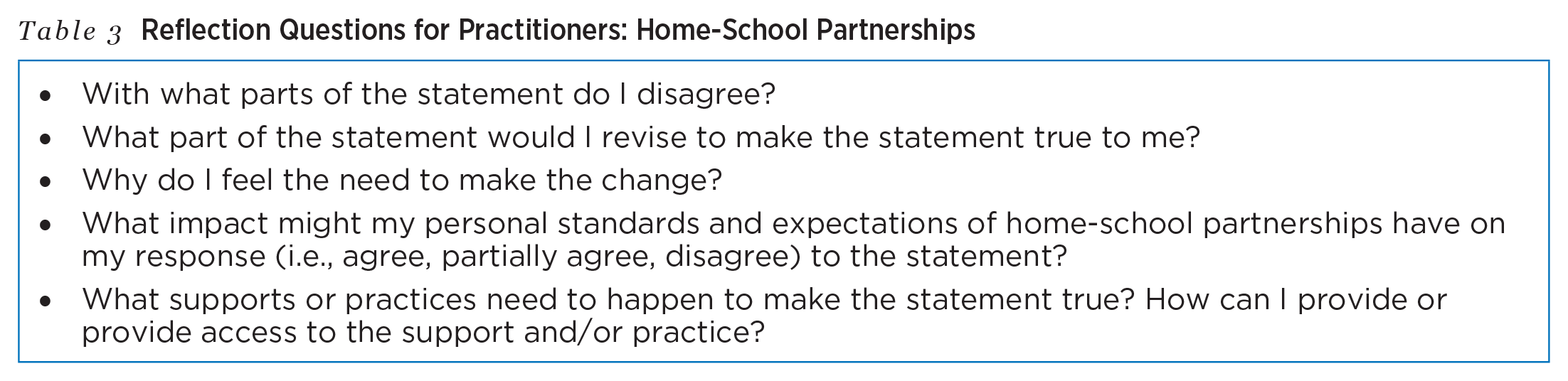
By evaluating personal beliefs against the beliefs posed by Henderson and Mapp (2007), educators can identify those that complement and those that counter the core beliefs necessary for effective home-school partnerships. Educators can work to enhance practices demonstrating their beliefs that foster effective home-school partnerships with all families and modify their beliefs and behaviors that do not.
While reflecting, Ms. Allen identifies that she partially agrees with the core belief, “All families have the capacity to support their children’s learning.” She realizes that she struggles with the words “all” and “capacity.” She believes that some families with financial challenges and disabilities (e.g., cognitive impairments, orthopedic impairments) or those who are English language learners often lack the “capacity” to support their child’s learning. After pondering how to make the statement true, she realizes that her idea of “support” might also be limited. She realizes that she is limiting her view of “support” to her experience growing up (e.g., support with homework and attending school events). She decides to research additional ways parents can “support” their child and how she can modify her practices to support their “capacity.” She comes up with the following activities she believes all families can do to support their child: discuss school happenings and events, provide positive reinforcement, demonstrate a positive attitude about academics and school, provide affirmations, ensure the child is ready to learn when arriving at school (e.g., proper sleep, arrive on time), model organization and time management skills, encourage the child to complete homework and routine readings, foster independence, and model learning behaviors at home. She identifies that she can modify her practices to support families’ capacity by identifying community resources (e.g., homework help, tutoring services, charitable organizations), scheduling school/class events at varying times to give working families a chance to attend, and identifying take-home volunteer activities so working families can volunteer and be recognized,
In conclusion, cultural differences between educators and families can present a challenge to effective partnerships (Fowler et al., 2019; Yull et al., 2014). Cultural awareness is identified across disciplines as the initial step to being a culturally proficient practitioner (e.g., CCPEP, n.d.; Randall-David, 1989; SAMHSA, 2014). An often overlooked component of cultural awareness is self-awareness. The activities presented in this article are designed to support practitioners in their journey to become aware of their personal beliefs and behaviors and how they impact interactions with others. Once educators understand the nuances of their cultural identities and how they impact their beliefs and behaviors, they can begin to transform their practices related to home-school partnerships and respond effectively to a progressively diverse world.
Footnotes
Declaration of Conflicting Interests
The author(s) declared no potential conflicts of interest with respect to the research, authorship, and/or publication of this article.
Funding
The author(s) received no financial support for the research, authorship, and/or publication of this article.
