







Abstract

The Individuals with Disabilities Education Improvement Act (IDEA; 2004) entitles students with disabilities to “a free appropriate education that emphasizes special education and related services designed to meet their unique needs and prepare them for further education, employment and independent living.” IDEA also facilitates the transition from school to adulthood by requiring that each student have an individualized transition plan with goals and activities that relate to life after high school, based on the individual student’s interests, strengths, and needs. This legislation is well-meaning, but the reality is that despite the required transition planning, students with disabilities tend to fall behind their peers in a number of ways, including employment (U.S. Bureau of Labor Statistic, 2020), postsecondary education enrollment (Newman et al., 2011), and independent living (Sanford et al., 2011). Students categorized by the federal government as culturally and linguistically diverse and having disabilities face additional barriers when transitioning from school to adulthood, such as unequal access to social and economic opportunities (Fallon et al., 2022), disproportionate tracking into low-status disability categories (Skrtic et al., 2021), and a lack of access to grade-level curriculum (Blanchett, 2014). With these obstacles to a successful transition, one would assume that researchers and policy makers would attempt to address these failures to support students. However, key decision makers often take a different approach attempting to address systemic inequities by privileging interventions instead of attending to sociocultural factors impacting transition and equitably redistributing funding to schools that need it most (Trainor, 2017).
Researchers studying transition planning in special education primarily concentrate on developing interventions within systems that lack equity and often do not include racially and culturally marginalized youth in the conceptualization or implementation of research (Scott & Shogren, 2023). Interventions are posed as culture-free practices, therefore denying the influence of how culture shapes learning (Bal & Trainor, 2016). This denial, in turn, privileges normative values instead of designing for the material, linguistic, or historical contexts that shape learning for students (Trainor, 2017). As a result, transition services fail to account for the diverse experiences, abilities, and literacies of students (Achola & Greene, 2016). Instead of locating the problem within students, some argue for reform in how schools conduct transition planning by changing the systems and policies affecting students to make them more equitable through culturally sustaining practices (Trainor et al., 2020). In this article, I posit that transition planning should not be passively driven by dominant-culture narratives of identity but instead be intentionally grounded in culturally sustaining practices that embrace the plurality of student multilingual and multicultural wealth. Critical literacy instruction is proposed to enhance student transition through culturally sustaining instruction. Specifically, critical literacy helps students engage in identity exploration and critique societally imposed deficit narratives directed to students who are placed into various categories in a school for their diversity (Leu, 2020; Trainor et al., 2022), which may, in turn, lead to a greater sense of confidence about navigating transitions and improved academic and vocational outcomes.
Critical literacy is a form of literacy instruction that helps students analyze the relationship between language and power in what they read so that they can critique and reconstruct narratives about their identities in empowering ways. Because critical literacy prioritizes students’ cultures and experiences, it is considered a culturally responsive practice (Robinson, 2019). Culturally responsive teaching practices “empower students intellectually, socially, emotionally, and politically using cultural referents to impart knowledge, skills, and attitudes” (Ladson-Billings, 1994, pp. 16–17). Culturally responsive teaching comprises three criteria—academic success, cultural competence, and critical consciousness—to challenge social orders. According to Ladson-Billings (1995), “students must develop a broader sociopolitical consciousness that allows them to critique the cultural norms, values, mores, and institutions that produce and maintain social inequities” (p. 162). Developing a critical consciousness is the main goal of critical literacy whereby students critique in empowering ways how hierarchies of power and privilege shape what they read and rewrite what they learn. These skills empower students to make personally meaningful decisions regarding their postsecondary goals (i.e., employment, postsecondary education/training, independent living) because they prompt students to ask essential questions about their goals in relation to their identities.
Although critical literacy and culturally responsive teaching are not evidence-based interventions, extensive research attests to improvements across a broad array of academic and social outcomes when teachers align instruction to the complexity of student diversity (Esteban-Guitart et al., 2019; Ferrell, 2021; Leu, 2020; Robinson, 2019; Wah & Nasir, 2019). Furthermore, recent policy guidance from the Office of Special Education Programs highlights the importance of culturally and linguistically responsive practices “that affirm the multi-faceted identity of each child” (U.S. Department of Education, 2022).
In this article, practitioners who provide literacy instruction to secondary students with disabilities learn how to use critical literacy practices to enhance transition planning. The need and relevance of critical literacy are discussed through (a) a brief description of transition, (b) a brief description of critical literacy, and (c) an example unit plan for using critical literacy with high school students as a practice for exploring transition-related identity.
Transition
The purpose of transition planning is to provide students with disabilities services to help them transition to adult living (Mazzotti & Rowe, 2015). Transition planning is based on transition assessments compiled within a student’s individualized education program (IEP). These assessments collect data such as students’ interests, strengths, and areas of growth. Based on the assessments, teachers create goals for a student’s academic postsecondary career and independent living. The intention of these assessments is to determine how to best provide students with services to make progress toward their goals. Students’ goals and interests are, unfortunately, often dictated by normative ideas about what someone who shares their identities does (Hammack, 2008). For example, limiting discourse such as “women become teachers” based on gender identity or “people from my town just work at the power plant” based on geographical identity may passively drive students’ decision making.
Identity is particularly important to consider during adolescence because this is a critical time during which students form beliefs about themselves (Hartung et al., 2005). Research has shown that students’ identities as having disabilities inform their experiences as they move through transition (Trainor et al., 2022; Verhoeven et al., 2019). Students may have more concrete goals if provided with time to consider their identities. Students need opportunities to deconstruct how they are positioned as learners and members of the various communities to make empowered decisions throughout their transition.
Psychologists are becoming increasingly aware that a more impactful way to help individuals set goals is to mentor by affirming an individual’s identity than through strategic goal-setting exercises (Greco & Kraimer, 2020). Students need to develop a clear picture of their interests and career goals, known as “vocational identity” (J. L. Holland, 1985). Still, the completion of assessments and creation of goals or services does not guarantee a student has been afforded opportunities of critical analysis around identity-related concepts, such as vocational identity. In this instance, schools only symbolically comply with the mandate for a supported transition (Voulgarides, 2018). When students critique normative understandings of identity throughout content areas, they may be better prepared to self-report on career assessments.
Using critical literacy instruction to prepare students for transition is consistent with elements of the Kohler et al. (2016) Taxonomy for Transition Programming 2.0. The Kohler et al. model is a framework developed by experts in transition from extensive reviews of the extant literature that recommends the services schools should provide for a successful transition across five domains (Kohler & Field, 2003). Although discussions about identity are not explicitly included, critical literacy use in the content areas aids in achieving the demands of the Kohler et al. framework by encouraging active collaboration around programming with all members of the IEP team and by using “student-focused planning” (p. 7). According to the Taxonomy for Transition Programming 2.0, schools need to build a collaborative service delivery by sharing roles among professionals. Critical literacy instruction can be implemented in all content areas that involve literacy instruction and so involves students’ content instructors in planning with the students’ transition goals in mind during content instruction. Critiquing representations of identity during social studies or history shifts the responsibility of planning for transition goals from the special education teacher only to include general education teachers. By incorporating critical literacy instruction to discuss identity in content areas, conversations about crucial transitions align with what students learn daily (Holzberg & Rusher, 2017).
In addition, critical literacy instruction is student-focused planning that centers around the cultural, linguistic, and experiential wealth of the learner. Critical literacy centers students’ culturally and historically embedded knowledges, which is referred to as students’ “funds of knowledge” (FOK; Moll, 2019). Educators often focus on the content contained in the state or national standards (Pugach et al., 2020). However, FOK recognizes that students’ out-of-school knowledge is just as valuable and should be centered in the learning process (Nasir et al., 2008). By discussing identity, which is socially situated, and centering the culture of the student, critical literacy expands the breadth of skills covered throughout students’ transitions and more comprehensively achieves the aims of the Kohler et al. (2016) framework.
Identity
Drawing on the work of Vygotsky, Mead, and Bakhtin, Dorothy Holland et al (2001) described the concept of identity as the stories we tell others about who we are. She explained how identity forms in an ongoing evolution that is shaped by social context and individual agency. Our understanding of ourselves is socially and historically situated in that an individual’s sense of identity forms in conjunction with their social contexts (Cole & Engeström, 1993). At the same time, the individual authors their own identity (D. Holland et al., 2001). Authoring occurs as a reflexive yet decided choice of taking on the social discourses available to oneself as part of one’s identity. Therefore, identity is “a central means by which selves, and the sets of actions they organize, form and re-form over personal lifetimes and in the histories of social collectivities” (D. Holland et al., 2001, p. 270). Considering the collective nature of identity formation, schools have a responsibility to purposefully arrange culturally responsive contexts in which students construct, break down, and rebuild their understanding of their identities.
Intersectionality is a lens for analyzing how subjectivity is formed by an interplay between markers of identity (Collins, 2008). It is used for examining oppression, privilege, and power (Crenshaw, 1995). Identities are like the melodies of a fugue, which present all at once but can be experienced more readily by the listener based on their own experiences, the pitches their ears hear most clearly, and the activity in their environment that mediates their song. At the same time, the performer may choose which melodies they want to emphasize. In this way, identities are multifaceted and dynamic.
Identity is often reduced to race or gender, but individuals possess identities across an ever-evolving array of domains, including religion, diaspora, socioeconomic status, ethnicity, gender, and so on. Identity is a powerful force, and some identities, although based on social fabrication, such as race, are used to justify oppression and inequity. Considering this complexity, schools need to respect how groups or individuals who have been oppressed can reclaim identities used to oppress them as identities of empowerment (Annamma, 2016). For example, a student with a disability may choose to be called “disabled” to claim their disability identity with pride even though historically, being called “disabled” may have been a term used to marginalize. Acknowledging the complexity of intersectionality and the agency of individuals to author their identities will help educators make space for students to navigate the challenges they face throughout transition.
Erickson theorized that adolescence was a time of fluctuations in confidence and ego development (Kidwell et al., 1995). To help conceptualize this time of change, Holland et al. (2001) borrowed from Vygotsky’s constructs of “semiotic mediation” and “play.” Vygotsky provided semiotic mediation, or the appropriation and use of signs as a construction of identity development. As we engage with language, it transforms the way we see ourselves and how we think (Vygotsky & Cole, 1978). In these ways, literature selected by practitioners along with the social interactions encouraged can provide opportunities for identity exploration. Providing literature that affirms student identity and considers the social and historical constructs surrounding identity formation may serve as a valuable tool by which students may author their place in the world around them (Bean & Rigoni, 2001).
D. Holland et al. (2001) explained the importance of Vygotsky’s construct of play to identity formation. Vygotsky suggests that play is integral to children’s development. In playing, children construct the symbolic worlds around them and thus solidify how they see themselves within their communities. So too do students, through opportunities for expression and engagement in self-determined action, create the systems in which they learn. Consequently, intentionally considering opportunities for expression, rituals, and activities becomes essential for constructing culturally responsive communities. Moreover, the narratives students tell themselves about their identities shape future goals (Verhoeven at al., 2019). To build school communities where expression and student-willed action are prized, the importance of culturally responsive practices that incorporate the funds of knowledge students bring to learning cannot be overemphasized. Therefore, critical literacy is proposed as a culturally responsive means by which students may author their identities, affording opportunities for expression and agency.
Critical Literacy
Although there is no universally agreed-on definition of critical literacy, practitioners primarily describe critical literacy as a critical lens or perspective through which practitioners design literacy instruction (Vasquez et al., 2019). Students who utilize a critical lens contextualize the author’s intention for writing by critiquing relationships of power and identity within a text (Woodard et al., 2017; Yoon & Sharif, 2015). Similarly, traditional power hierarchies within the classroom shift as students deconstruct what they read and then engage in dialogue with the teacher and other students around what they learned. Students use such dialogues to reconstruct the text with a broader understanding of the social and historical surroundings within which the text was written. In this way, students develop the critical consciousness demanded of culturally responsive teaching because they analyze the relationship between language and power and consider how they can be involved in social action (C.-J. Lee, 2019; Venegas & Scott, 2023). Critical consciousness is one’s awareness of oppression and their desire and actions to work against oppression (Freire, 1970/2000). Students who possess a critical consciousness have a greater awareness of their desired vocation and demonstrate increased academic and social outcomes (Herbele et al., 2020).
Critical literacy instruction emphasizes students’ autonomy by acting on topics relevant to their lives. Students who engage in critical literacy take what they have learned and act on it in constructive ways beyond the classroom. Take, for example, students in Venegas and Scott (2023), who researched factors contributing to child homelessness in their city and wrote petitions to local officials with ideas they created to act against homelessness. Because of this activity, students exercised agency, voicing their solutions and advocating for something they valued with community members. Students deconstructed the policies that drove youth homelessness and reconstructed how these policies could be improved to benefit the community. The social action intrinsic to critical literacy engaged students in their communities and gave them opportunities to build agency by acting on an issue that mattered to them.
Critical literacy encourages the use of multimodal literacies, or meaning-making across more than one mode, such as a video, podcast, or social media post (Kress, 2015). Providing content in various modes increases accessibility (Watts-Taffe, 2022). At the same time, students present their understanding in forms that are relevant to them and increase their ability to navigate our technologically driven world (Scholes, 2023).
Here, I break down critical literacy instruction into two stages: deconstruction and reconstruction. In deconstruction, students analyze the sociopolitical influences that determine who holds power in a text by asking critical literacy questions (Jones, 2006). The critique in deconstruction helps students question socially constructed narratives of, in this case, disability to help them begin brainstorming the goals and outcomes they hope to achieve. Students may even be prompted to break down the concept of disability itself to critique how disability in some instances has been used to marginalize and oppress. In reconstruction, students act on what they have learned in ways that create new narratives of what transition will look like for them.
Critical Literacy and Identities Marginalized as “Different”
Students with disabilities encounter obstacles throughout their educational journey, such as reduced access to a full range of curricular options (Johnson et al., 2002) and ableist narratives that make them feel as if their disability is something that needs to be fixed (Kozleski et al., 2020). Notably, students of color encounter additional barriers, such as deficit ideologies held by fellow students that “undermine [student] attempts at self-determination” (Banks, 2014) and disproportionate labeling of students of color in certain disability categories (Skrtic et al., 2021). Learning occurs within these culturally situated barriers that drive how students envision their futures and what they think they will become (Nasir, 2010). The culturally and historically situated nature of learning and identity development then calls for practices that help students actively author their understandings of identity (C. D. Lee, 2017).
With critical literacy, students consider multiple ideologies, particularly those that combat ableism, racism, and monolingualism (Leu, 2020). One positive outcome of critical literacy is forming new identities as students become aware of how history, culture, and institutions have influenced the way they may construct their identities (Goodman & Cocca, 2014). Section 1400(c)(14)(B) of IDEA (2004) describes the need to provide “effective transition services to promote successful post-school employment and/or education,” services that take into account a child’s needs, strengths, preferences, and interests. For a teacher to promote transition services desirable to students, schools must provide opportunities for students to explore their identities and experience autonomy. Because adolescents may view the problems that characters face in novels as similar to their own (Kokesh & Sternadori, 2015), coming-of-age stories such as the Bildungsroman (Okuyade, 2010) could enable students to construct empowering narratives about their own futures. These novels relate to the experience of identity formation and as such could be particularly beneficial for youth as they move through transition. Furthermore, because students have many essential skills they must learn, embedding transition-related skills into instruction is helpful for covering a more complete range of skills (Holzberg & Rusher, 2017).
Illustration of Using Critical Literacy to Inform Transition
The following unit plan uses critical literacy to support students in navigating the challenging time of transition that takes place during senior year of high school. As seen in Figure 1, the unit was designed with a student named Tobi in mind. Tobi is a 17-year-old Nigerian American female student with a learning disability who plans to be a nurse. Tobi’s teacher, Ms. Sterling, designed the unit plan to align with the strengths of Tobi and her peers. Through the provided rationale and resources, you can create a unit that aligns with your student’s strengths or FOK to help them critique normative ideas of identity in alignment with their goals for transition. This unit plan can be modified across content areas to incorporate transition planning that challenges restrictive understandings of identity.
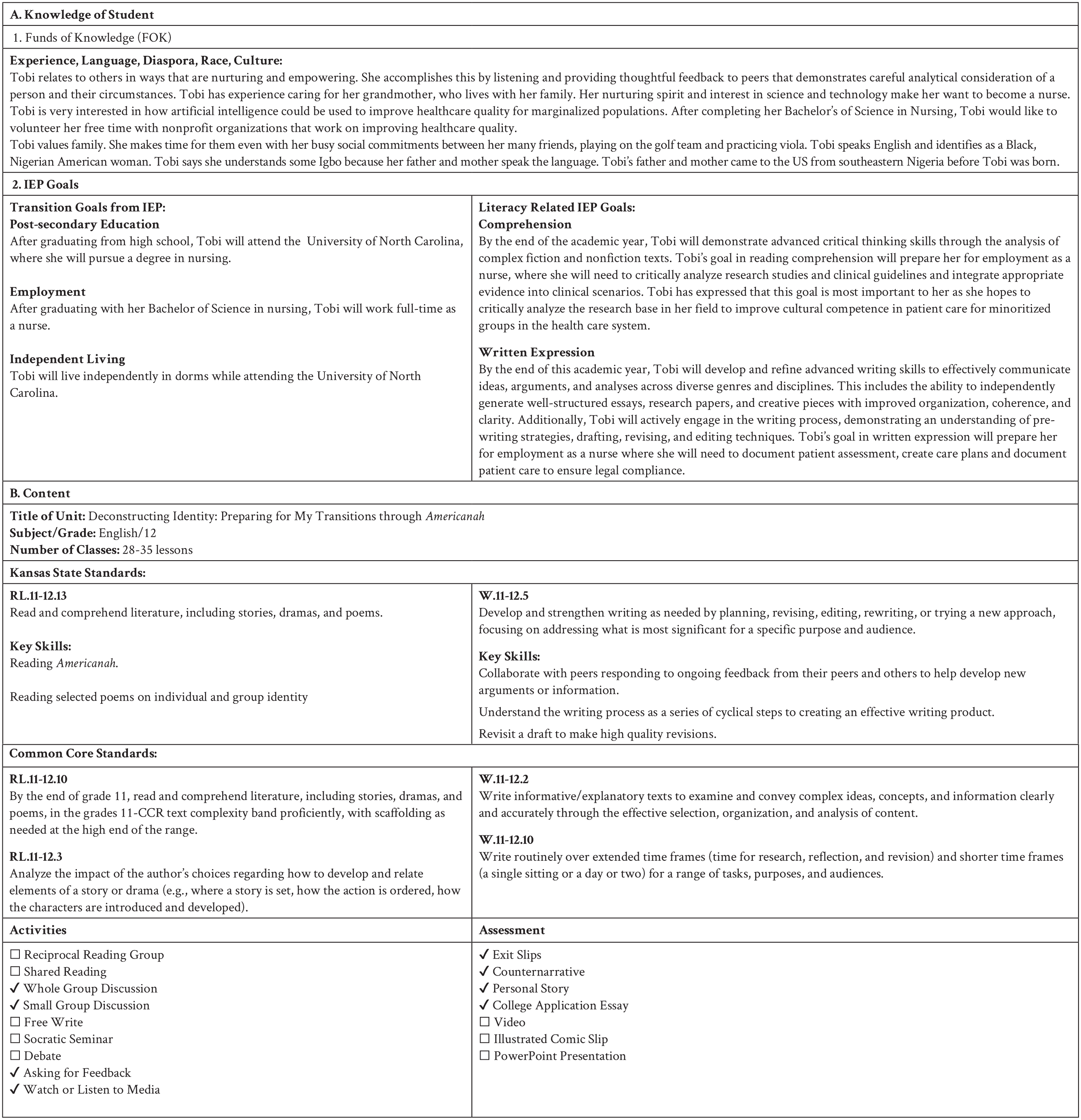
Guide for preparing a critical literacy unit plan to enhance student transition
Knowledge of Student
In Section 1, Knowledge of Student, Ms. Sterling reflects on her students’ FOK. Teachers who use students’ FOK provide opportunities to engage and sustain students’ cultural resources and experiences (Kim, 2023). Because Tobi has expressed, along with other students, the tensions of hybrid identities across American and Nigerian cultures, Tobi’s teacher selects Chimamanda Ngozi Adichie’s (2013) Americanah to read as a class. The novel’s protagonist, Ifemelu, immigrates to the United States from Nigeria to attend college. Ifemelu relates the challenges of finding employment and building relationships while navigating the complexities of her racial and national identities. The events of the novel and the struggles of the main character are culturally relevant to Ms. Sterling’s students. Ms. Sterling uses the characters and their experiences to design activities that discuss Tobi’s IEP goals throughout the unit. Before Ms. Sterling designs the lesson content, to meet Tobi’s literacy and transition goals, she needs to determine the final assessment for the unit.
Content
In Section 2, Content, Ms. Sterling plans her unit with students’ IEP goals, the end assessment, and state standards in mind (Black et al., 2019). For this unit, students will write a final assessment with the opportunity to choose between writing a college essay, counternarrative, or personal story, thereby providing them with options to enhance self-determination (Wehmeyer & Shogren, 2016). Tobi expresses a desire to attend college, so her recommended final writing project is a college essay. The final project will take several weeks and span the entire writing process, so it covers all the skills in the required state standards and in Tobi’s literacy goals. As discussed in the next section, Ms. Sterling selects additional activities and assessments beyond the final writing assignment that engage the standards with appropriate scaffolds.
Learning experiences
Next, Ms. Sterling selects the learning experiences that align with the Knowledge of Student, including viewing a TedTalk, free writing, and dialoguing. Students watch Adichie’s (2009) TedTalk titled The Danger of a Single Story. According to Adichie, as a child, she wrote stories in which all characters had blonde hair and blue eyes. It was not until she began reading literature by African authors that she created African characters with different features in her writing. Adichie explains that she had come to believe a “single story” about which races the characters in books could be. She then provides an example from her own life of how she viewed one of her childhood friends whose parents were employed to clean her house as “poor” and did not see her friend’s other attributes. Adiche warns us to consider whether we, too, may believe single stories about others.
After viewing Adichie’s (2009) TedTalk, students engage in a free writing activity during which they write single stories they may have believed about themselves or others. In this personal written reflection, the teacher asks students to consider questions that help students reflexively construct what the TedTalk means to them. One fundamental question Ms. Sterling asks is, “What single stories do I believe about myself or others?”
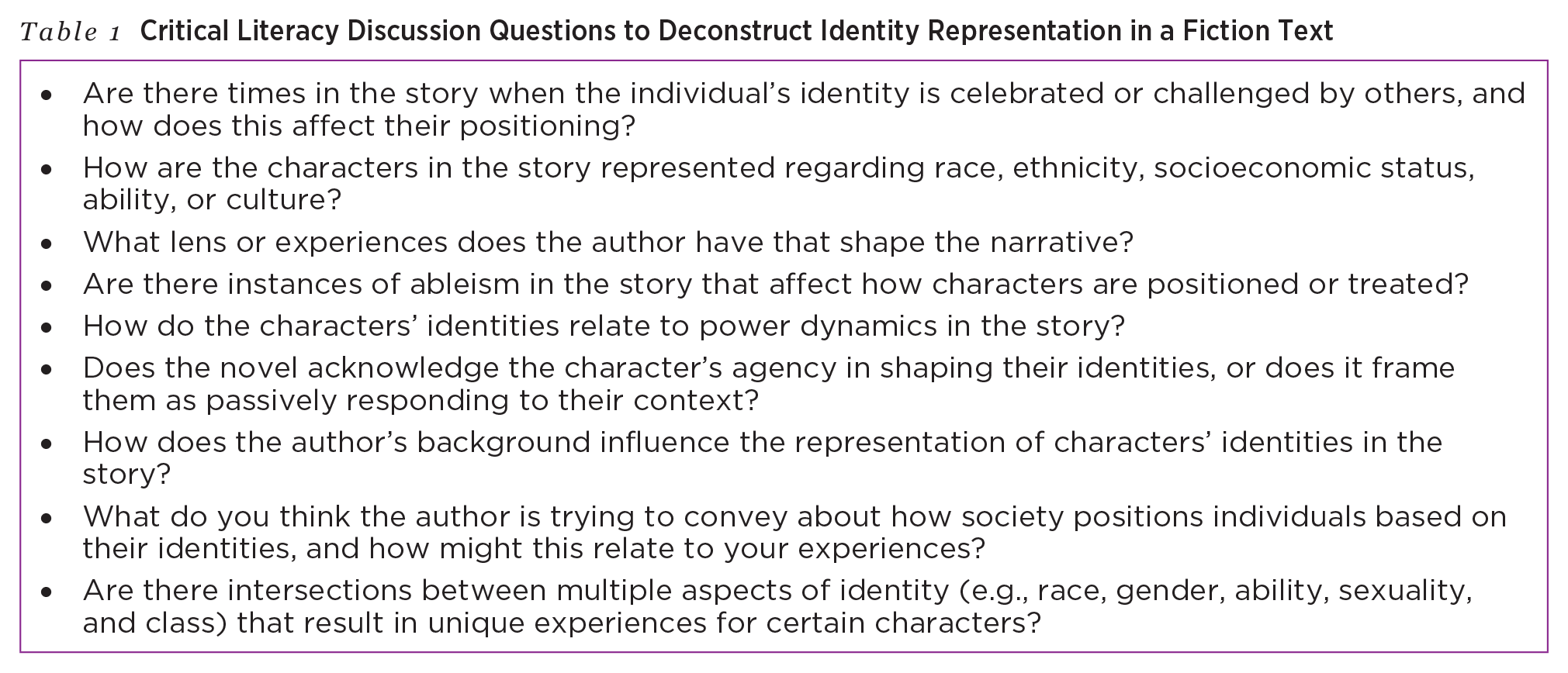
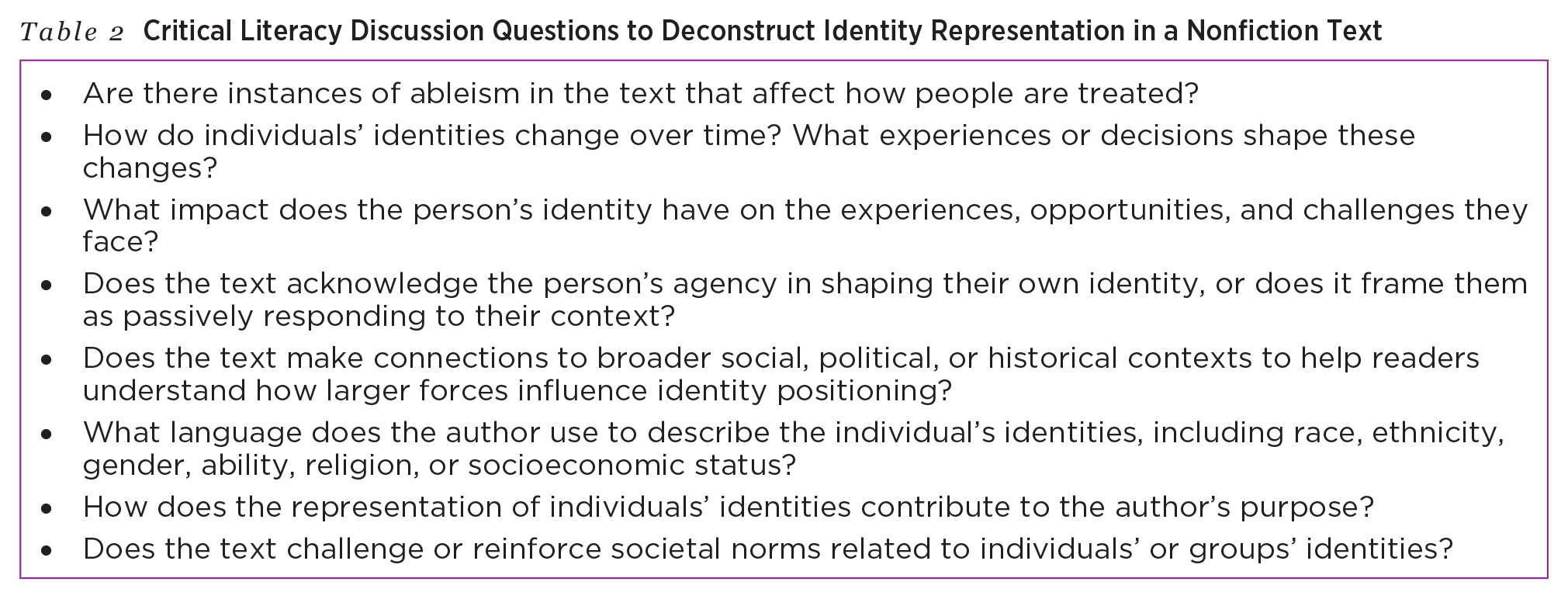
Ms. Sterling plans additional activities that engage students in dialogues, such as whole-group and small-group discussions. During these dialogues, students critique how various identities are represented in the novel and how contexts reveal certain identities more saliently (Nasir, 2010). Tobi’s teacher uses critical literacy questions while reading. Critical literacy questions for fiction and nonfiction texts are provided in
Critical Literacy Discussion Questions to Deconstruct Identity Representation in a Fiction Text
Critical Literacy Discussion Questions to Deconstruct Identity Representation in a Nonfiction Text
Assessments
Students select their final assessment of choice from a college writing sample, counternarrative, or personal story. The final written assessment serves for students to reflect on their successes and as an avenue through which students can choose to rewrite narratives of the single stories that may have affected their lives. After finishing a draft, students can ask someone in the community for feedback. They reach out to a fellow student, guidance counselor, community member (i.e., advocate, business owner, religious leader), or family member. This action involves community members in the student’s college application process and provides meaningful feedback to students. In addition, students conference with their teacher and other students to get targeted feedback to help them learn and reflect on their writing (Dorn & Soffos, 2023).
Ms. Sterling helps Tobi prepare for aspects of her transition by asking her to consider them in informal exit slips at the end of class. For example, Ms. Sterling helps Tobi consider her transition to college by asking her to think about how her identities will be shaped by the college institution she attends. Tobi identifies strongly as a musician because she enjoys playing viola, so she writes about finding spaces on campus in which she can perform and practice her viola. After class, this questioning prompts Tobi to research spaces on campus at the college she hopes to attend where she may share her love for music. Tobi finds an orchestra on campus in which she can be involved one day as a college student.
Some students may choose to write counternarratives, or stories that consider the perspectives of marginalized voices by rewriting events from their perspectives (Delgado, 1989). In critical literacy instruction, students write for purposes that are personally significant instead of writing for the sake of an assignment (Nyachae, 2019). For Tobi, writing a college essay sample may be most personally relevant, but for other students, writing a counternarrative on a social justice topic that they share in a blog, social media post, or alternatively to save for self-reflection may be more meaningful.
Text Selection
As demonstrated in the sample critical literacy unit, instead of utilizing literature that overtly reinforces the status quo, teachers of critical literacy prioritize texts that provide multiple perspectives, magnify the voices of those marginalized, and model critical reflection. The literature provided in Figure 2 highlights the experiences of young adults across a wide breadth of experiences, cultures, and identities. The selected novels explore disability as a central element, allowing the novels to address issues of identity and societal perceptions during adolescence. Centering young protagonists provides a starting point for students to critically examine the interplay between how characters are socially positioned regarding their identities and how the protagonists author their identities with agency.
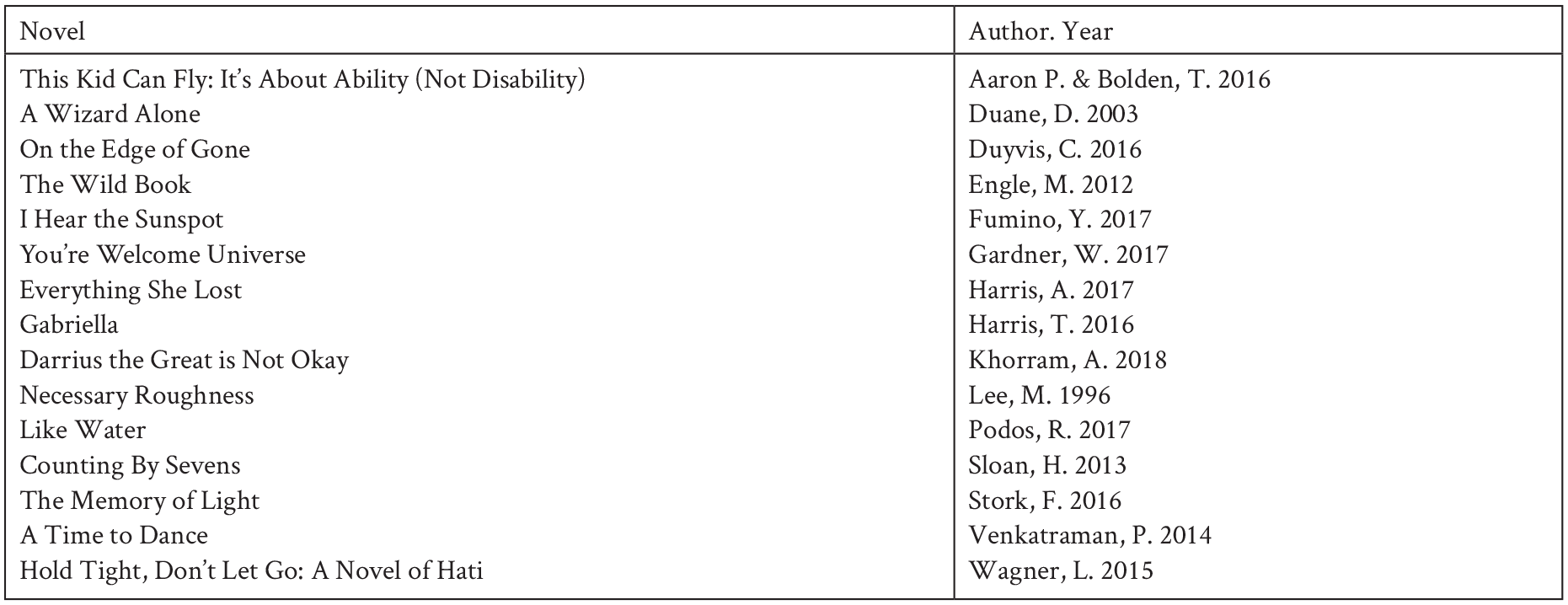
Novels for Teaching Secondary Students through a Critical Lens to Support Transition
Text selection is just one aspect of critical literacy instruction. In the sample unit provided, students deconstruct the TedTalk (Adichie, 2009) through dialogue and reconstruct their understanding of single stories through their desired writing assignment. By reaching out to members of the community for feedback, students advocate for themselves about an issue that matters to them. They can engage their FOK and receive positive feedback from community members. These experiences may help students establish a greater sense of belonging as they build connections with others through positive social interactions (Hughes et al., 2011).
Opportunities for students to read about characters who challenge normative ideas of identity are appropriate for students at any age. Teachers use critical literacy instruction to examine societal inequities and highlight for students how these shape present-day ideas about identity. By intentionally designing instruction in this way, teachers help students envision themselves in a field they may otherwise have never considered (Calabrese Barton, 2013) and see themselves as more capable (Cone et al., 2014; Lambert, 2015) of achieving the goals they set for their transition.
Conclusion
Learning, including the full breadth of special education interventions and services administered throughout transition, do not occur in a cultural vacuum (Bal & Trainor, 2016; Trainor, 2017). Instead, a student’s transition is shaped by sociocultural influences that impact their identity (Trainor et al., 2022). Discussions of power, identity, and access are culturally sustaining practices that help students analyze the narratives that shape their identities (Leu, 2020; Woodard et al., 2017). These critical discussions, when centered on issues relevant to students’ lives and made concrete through social action, have the potential to guide students in constructing their identities in ways that empower them throughout important transitions. As a result, students may have a more authentic identity that better prepares them to make vital decisions about their future.
Footnotes
Declaration of Conflicting Interests
The author(s) declared no potential conflicts of interest with respect to the research, authorship, and/or publication of this article.
Funding
The author(s) received no financial support for the research, authorship, and/or publication of this article.
