







Abstract
Samuel is a 5-year-old boy with autism spectrum disorder (ASD) who just joined Mrs. Whitaker’s kindergarten class. During the first week of class, Mrs. Whitaker noticed that Samuel wasn’t playing with other children during recess. Instead, Samuel walked around the playground running his hands along the fence. When a classmate tried to throw a ball to Samuel, he put his hands out, but the ball just bounced off him. As the school year continued, Mrs. Whitaker noticed that Samuel had additional issues during the school day related to motor skill development, such as balancing on a stepstool, putting on a jacket, and walking up and down stairs. Mrs. Whitaker knows she needs to do something to support Samuel’s motor delays and get him more involved on the playground. Although she has expertise in language and social development, she doesn’t know much about motor development and exercise. Consequently, she is unsure of exactly what strategies would work best to facilitate increased movement and how to incorporate these activities into Samuel’s school day.
ASD is characterized as a group of developmental disabilities causing significant delays in communication and social skills and is associated with repetitive behavior and stereotypical movements (American Psychiatric Association, 2013). In exploring the motor and exercise patterns of children with ASD, researchers (e.g., Lloyd et al., 2013; Nordin et al., 2021) note motor development delays are an attribute of ASD. Children with ASD may struggle to develop proficient motor skills and, consequently, may be less likely to engage in physical activity (PA) across their life span (e.g., Ming et al., 2007; Telama et al., 2005). They may experience limited opportunities to engage in PA through play or organized sports due to motor, social, and behavioral concerns (Bhat et al., 2011) and may be less active overall than typically developing peers (Pan, 2011). Fundamental motor skills (i.e., locomotor, object control) are essential precursors for more complicated and activity-specific skills that allow children to engage in more organized sport (e.g., García-Villamisar et al., 2017; Lubans et al., 2010). Notably, Westendorp and colleagues (2014) found that delays in fundamental motor skill development are strongly correlated with intellectual quotient and executive functioning, which can compound learning challenges for children with ASD.
Physical Activity for Children With ASD
There are significant advantages to helping children with ASD engage in PA during the school day, in the classroom or in a recreation area. Benefits include academic growth, behavioral growth, social growth, and enhanced mood or attention, which can result in positive behavioral changes (e.g., Lang et al., 2010; Ploughman, 2008).
Areas of Growth and Behavioral Changes
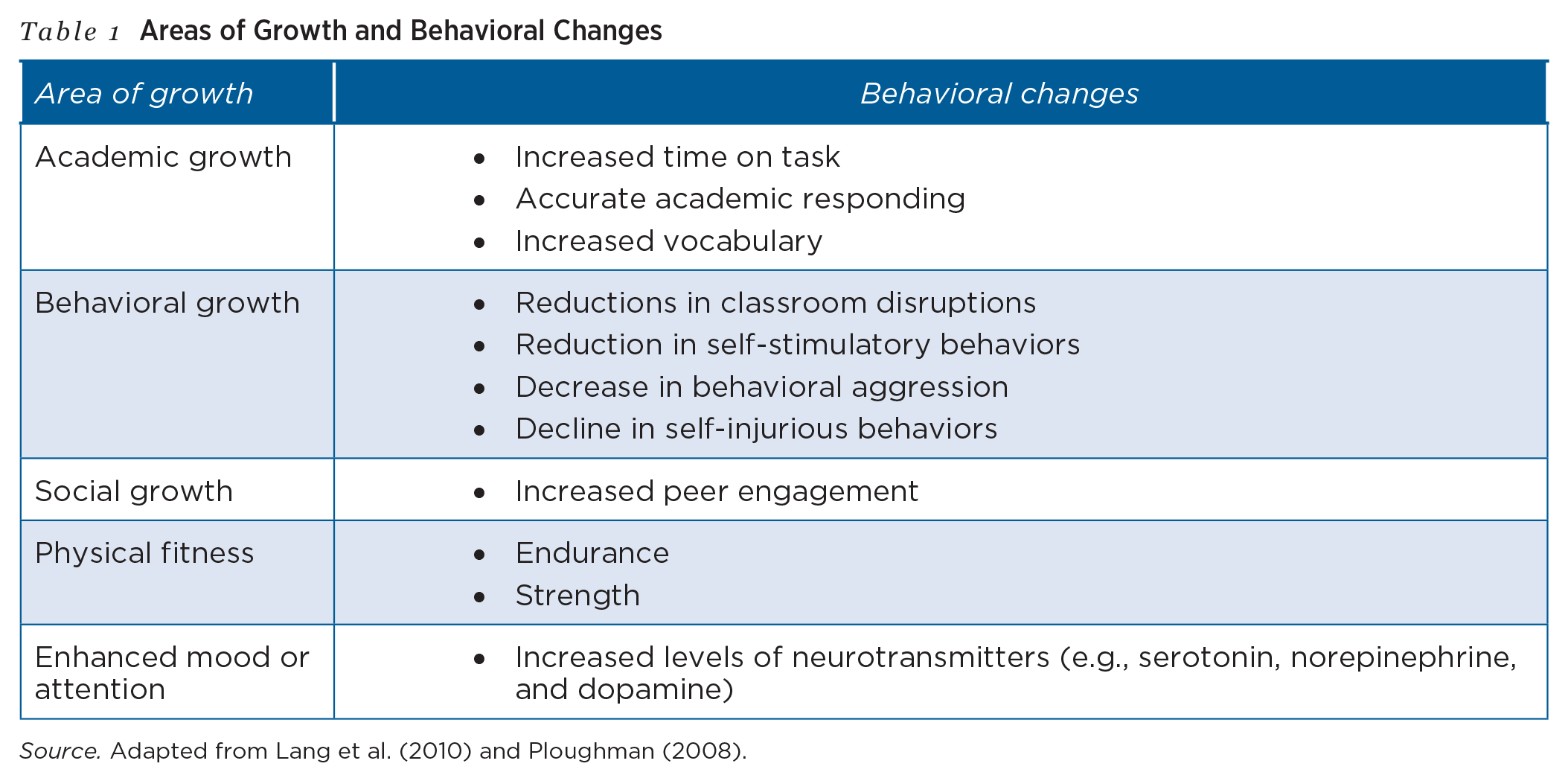
Source. Adapted from Lang et al. (2010) and Ploughman (2008).
In short, engaging in PA during the school day may improve classroom performance for children with ASD by supporting motor development and growth in multiple areas (e.g., Howie et al., 2014). Like Mrs. Whitaker, from this article’s case study, many educators may not have a good understanding of motor development and appropriate skill development across the life span. Similarly, educators and parents may not be aware of existing evidence-based interventions available to enhance the motor development of children with ASD. This article’s purpose is to (a) show the importance of engaging in PA for children with ASD and (b) provide guidance, strategies, and programs to increase movement during the school day.
Researchers (e.g., Nordin et al., 2021; Obrusnikova & Cavalier, 2011; Pan & Fray, 2006) have noted that children with ASD tend to have lower levels of PA than children without ASD and that the physical participation level of children with ASD declines with age. However, there exists overwhelming evidence that PA for children with ASD can yield significant benefits. Exercise and movement are identified as evidence-based practices for individuals with ASD (e.g., Hume et al., 2021). When considering how PA can benefit children with ASD, vigorous exercise (compared to mild exercise) has a more pronounced effect (Celiberti et al., 1997). Additionally, duration of positive effects does not extend throughout the entire school day, so children with ASD might benefit from engaging in multiple bouts of PA per day (Prupas & Reid, 2001). National guidelines on PA suggest preschool-age children engage in at least 120 minutes (about 2 hours) of accumulated physical activity each day with 60 minutes in structured activities and 60 minutes in unstructured activities (National Association for Sport and Physical Education, 2020). Guidelines for children older than 6 include at least 60 minutes per day of activity, and most of that activity should be aerobic (U.S. Department of Health & Human Services, 2018). This information may shape how an educator supports a student’s motor development.
As Mrs. Whittaker learns more about the benefits of PA for children with ASD, she realizes that adding it into the school day can improve Samuel’s focus, may reduce off-task behaviors, and can create opportunities for Samuel to engage with his peers on the playground. Other children would benefit, too. Adding PA during the school day can help all children in her class reach recommended guidelines. Now she must decide how to structure the program.
Thirty years ago, Gabler-Halle and colleagues (1993) posited that physical fitness programming for children with ASD might be more welcomed if it were embedded into the broader context of positive psychological and behavioral change. Over the past 3 decades, schools have become increasingly more friendly to socio-emotional curricula, warranting a revisit of the idea that integrating physical activity and psychological skills into schools might prove useful for children with ASD.
Guidance, Strategies, and Programs to Increase Movement in the Classroom
Despite barriers to implementation (e.g., scheduling, time, resources, overstimulation; Lang et al., 2010), educators can increase opportunities for PA for children with ASD during the school day that include exercises that raise children’s heart rate and require complex motor movements (e.g., balance beam, catching or throwing, crossing midline). The following section presents guidance, strategies, and programs to support this integration in the classroom, incorporating evidence-based practices and practitioners’ successful experiences.
For optimal implementation, educators should remain consistent with a set structure to the PA program (Schultheis et al., 2000). Educators can help students prepare by previewing expectations or activities, providing photographs, and modeling of specific skills. For example, video modeling may be an effective way to illustrate how to complete specific skills (Hume et al., 2022; Judge et al., 2022). Educators might increase motivation by embedding exercise into age-appropriate games or activities or embedding play-oriented activities within preferred activities. Repeating lessons and activities allows children to become familiarized with the routine and become more successful performing the learned skills (Schultheis et al., 2000). Educators might consider providing a space for children to rest if necessary (e.g., chairs for waiting time).
When considering integrating movement into the classroom for children with ASD, educators might choose to follow the following format. Implement a program at least two to three times per week for approximately 30 minutes, recognizing the importance of creating experiences that are alluring and fun for children and the need for repetition and consistency. The program could involve a routine consisting of (a) 10 minutes of exercise, (b) one or two activities to practice motor skill development (e.g., balance, catching, throwing), and (c) a 5-minute focused cooldown activity. The cooldown activity can calm children and transition them to the next activity in the school day. Alternatively, educators could incorporate multiple 5- to 10-minute exercise or activity breaks throughout the school day (e.g., activity cards; Pangrazi et al., 2009). This would provide the benefit of adding movement into the day, is more flexible to implement, and capitalizes on the idea of an immediate benefit of movement on focus, engagement, and reduced self-stimulatory behaviors (e.g., Prupas & Reid, 2021)
There are many ways to add PA into the school day. Recent systematic reviews have highlighted the successful implementation of PA programs that include walking, jogging, walk/run interval training, cycling, and swimming (e.g., Craig, 2022; Park et al., 2021). The key is finding an activity that children can perform that keeps them moving and elevates their heart rate.
Warm-Up Activities
Various warm-up activities could be used to start a program or could be used on their own if educators are looking for a short (e.g., 5–10 minutes) movement break. What educators choose to do will depend on available resources but can include an activity as simple as a walk (Lang et al., 2010) around the school grounds or running laps around a gym. In brainstorming short (e.g., 5–10 minutes) activities, educators might consider referencing the website Go Noodle, which includes video models for activities. Educators can create a login for individuals or the entire class, and the site tracks group or individual progress. Based on what the teacher selects, these activities could occur in the classroom or an adjacent space (e.g., hallway, cafeteria, gym, playground, or multipurpose room).
Educators can encourage children to engage in an activity like standing at their desks and practicing cycles of movement, such as jumping jacks, running in place, high knees, or butt kickers (e.g., running in place and trying to tap your heel to your butt). To differentiate, educators can have children choose which activity they would like to participate in and take turns leading the activity. Educators might also consider employing a cycle of four activities and having children rotate 90° after each one. The class could complete three or four cycles and then sit back down to start working on academic activities again. Children may even engage in activities in the hallways, such as taking turns running back and forth down the hall, if such activity does not interfere with learning in other classrooms. Alternatively, educators could practice motor movements with the class as they walk down the hall, such as hopping like a bunny. There are many ways to add a short bout of movement into the school day.
Physical Activity and Exercise
Educators have many choices when considering longer movement activities to integrate into the classroom while using limited resources. The four corners activity (Grenier, 2013;
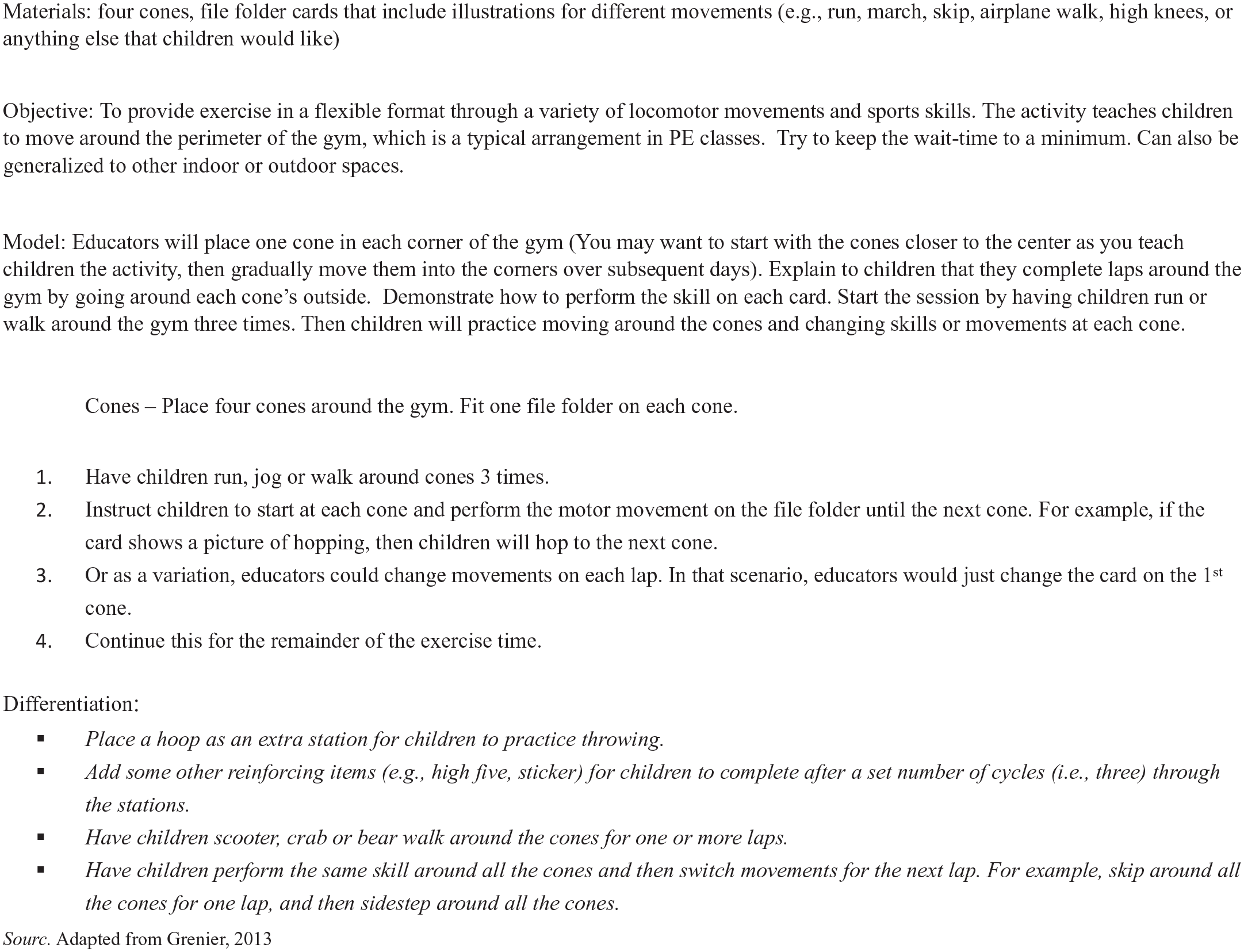
Stations (four corners, four cones)
Another activity for early elementary school classrooms, called “teacher leader,” includes PA and locomotor movement practice (Pangrazi et al., 2009). To start, educators play music while children walk around the room for 30 seconds. After 30 seconds, the music stops, and children freeze. The educator then leads the class in an exercise (e.g., stretching) for 30 seconds. Then the music begins again, and the class performs a locomotor movement (e.g., hopping) for 30 seconds. The cycle is repeated for 5 to 8 minutes. The intention is to integrate learning and movement in a streamlined and consistent manner.
Lastly, educators might consider building obstacle courses that utilize available resources or materials. For example, educators may set up an obstacle course with stations in the classroom (e.g., balls to throw in a bin, discs to jump between), the hallway (e.g., markers to run between, tape on a wall to use as a throwing target), or the gym (e.g., cones in each corner to run around, scooters to use between cones). Obstacle courses are a fun way to get children moving, with many opportunities to differentiate by altering materials and activities. This information may shape how an educator integrates PA into the classroom.
After learning about some of the ways to add movement into the school day, Mrs. Whitaker decided to try the four corners activity (Grenier, 2013) on the playground and in the gym during rainy or cold days. She borrowed four cones from the PE teacher, put pictures on four file folders to represent movement ideas, and then cut holes to put them over the cones. Her class really enjoyed the activity, especially Samuel. Other classroom teachers saw her and asked her what she was doing. Eventually, many classrooms were using the cones and helping to think of innovative ideas for activities.
Motor Skill Development Activities
Practicing motor skills can be fun for children, a wonderful opportunity to experience success, and can create pathways into more organized activities (e.g., soccer, basketball). Activities can run for 5 to 10 minutes, and given the benefits of repetitive action for children with ASD, educators can repeat activities for a week or longer. Repeating activities is also time efficient because it limits the number of new routines for educators to learn and then teach. It also allows children to gain confidence in developing specific skills. When determining motor skill targets, educators should consider relevant developmental milestones.
Developmental Milestones by Age
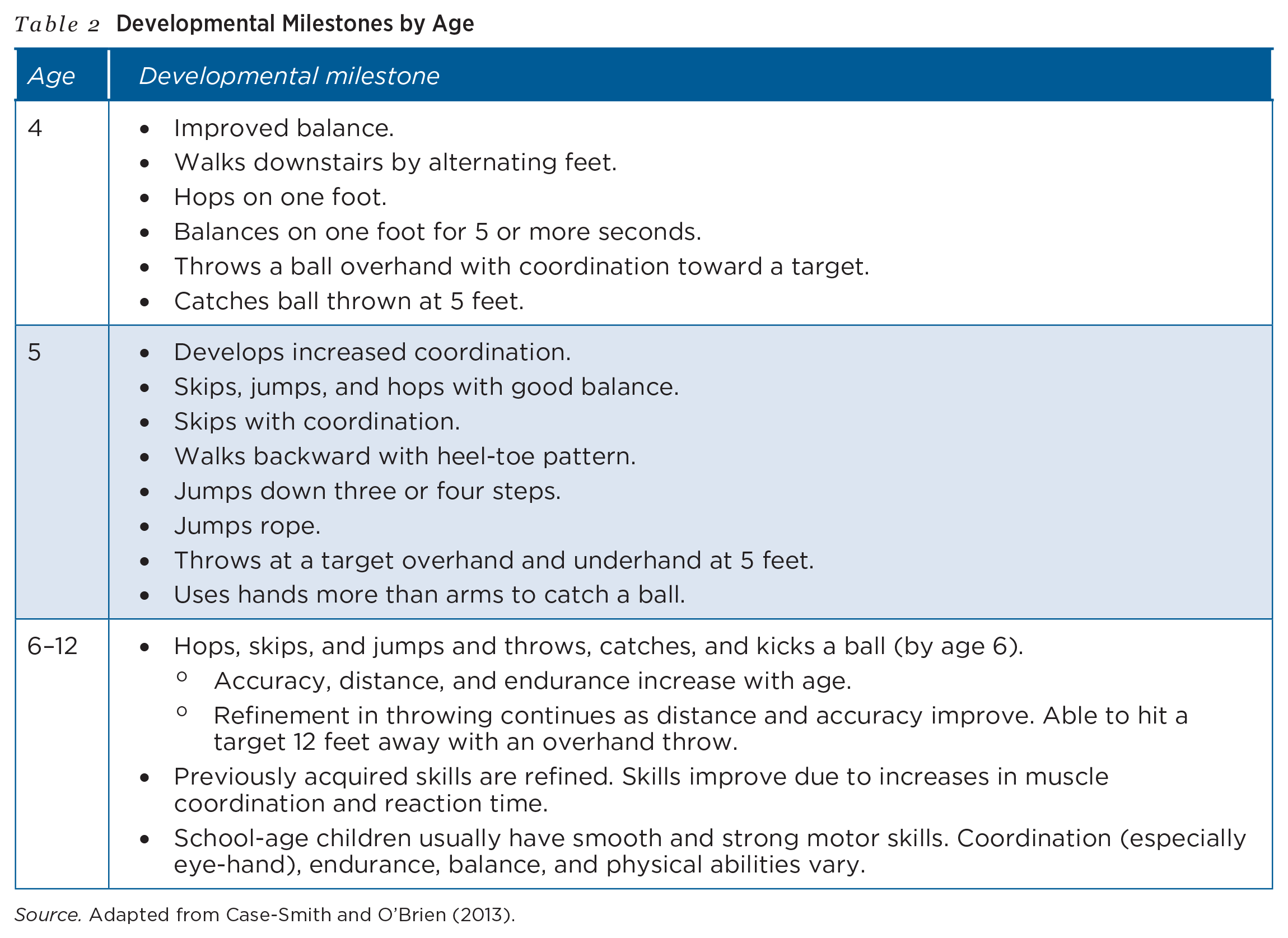
Source. Adapted from Case-Smith and O’Brien (2013).
To illustrate how educators might base skill acquisition on developmental milestones, consider the activities illustrated in Figures 2 and 3, which can be used to support children from ages 4 to 12.
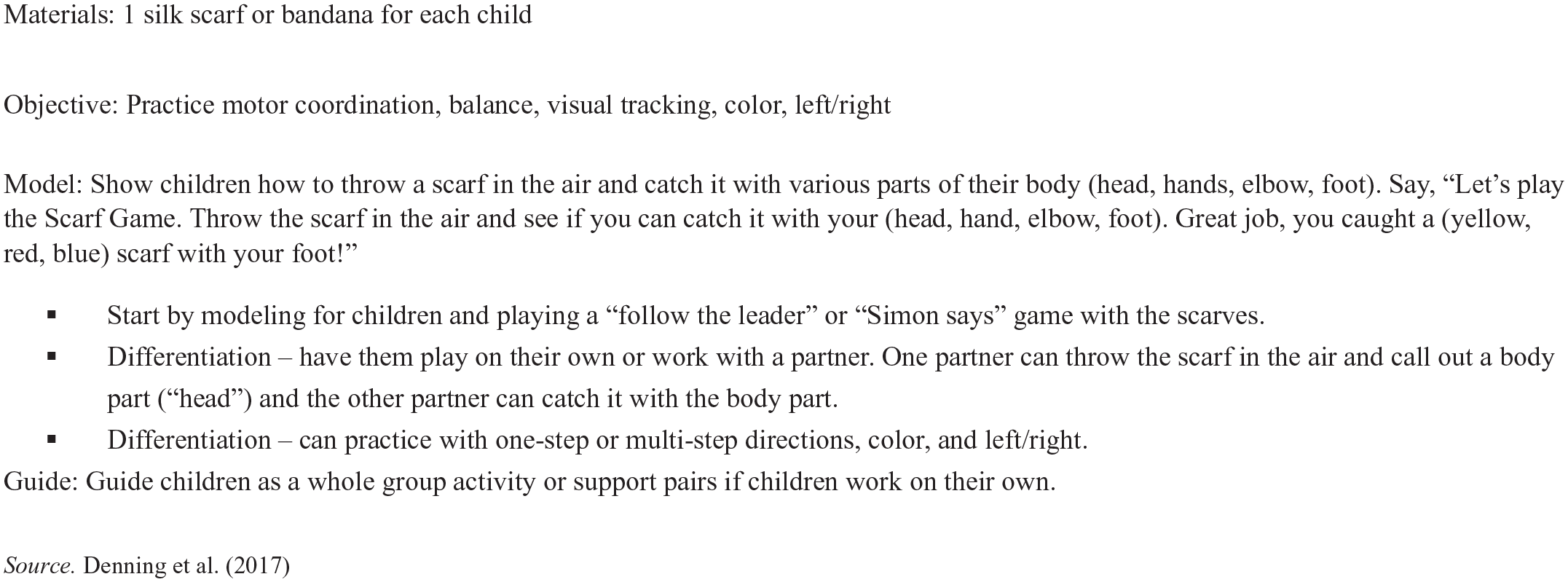
Scarf game
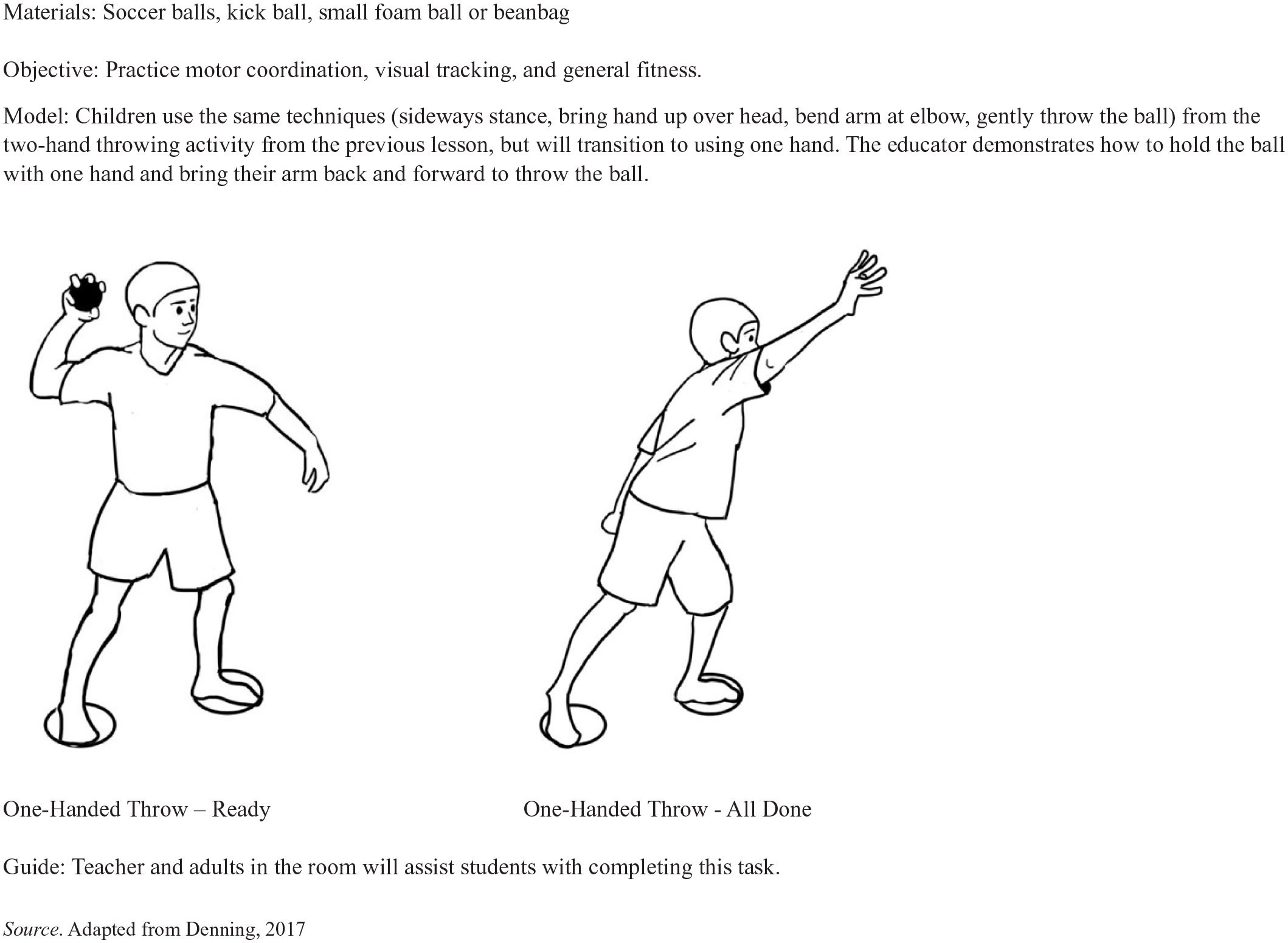
One-handed throw
A third suggestion is for educators to encourage children to use a kickball or soccer ball to practice passes. This would involve teaching children to look at the ball when they kick it and to use the inside of their foot to improve accuracy. Children could start with short passes of less than 5 feet and gradually increase distance as their accuracy increases. Educators can differentiate by increasing lengths of passes, having children aim passes at specific targets, and creating groups of three or more children who can form a triangle or square and take turns passing the ball. This skill can prepare children for organized games, such as soccer or kickball.
Cooldown Activities
Thus far, this section provides sample activities and programs to include movement in the classroom for children with ASD. Another consideration is regulating arousal levels to ensure children can transition from these activities back to learning, which can occur during the cooldown. Exercise and motor activities can be incredibly stimulating, and a short (e.g., less than 5 minutes), meditative cooldown can help children with ASD transition back to more sedentary classroom activities. Routhier-Martin et al. (2017) found that mindfulness and meditation practices help elementary school children stay calm, control distractions, and reduce stress.
In building a cooldown, consider using multiple meditative flows, such as tickle the sky, tickle the ground in
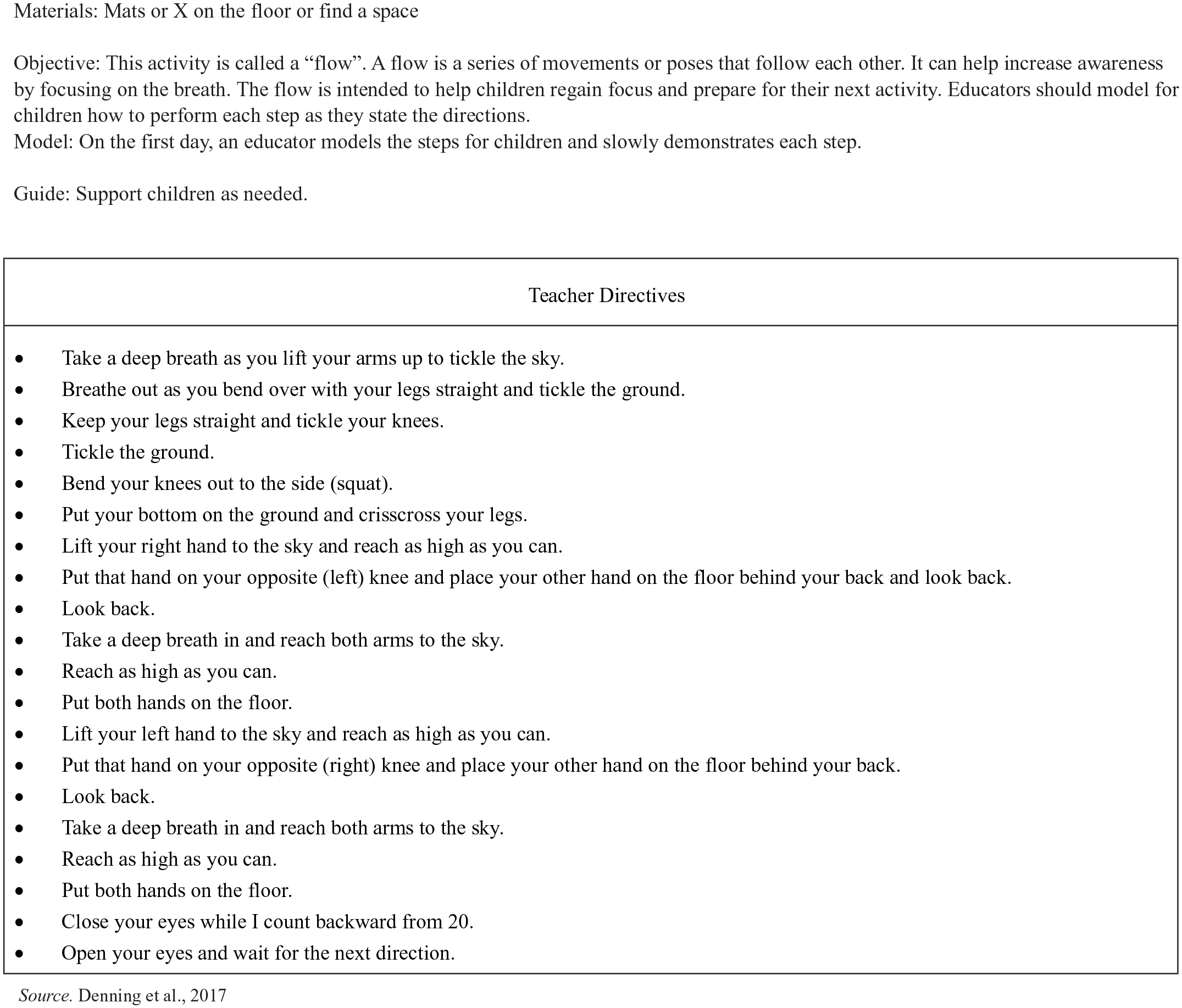
Tickle the sky, tickle the ground
Breathing strategies can be useful to help calm and refocus (Gould et al., 2012). Strategies can be as simple as focused breathing cycles, whereby educators guide students through various steps, including (a) look down or close your eyes, (b) breath in slowly through your nose, (c) hold for 3 seconds, (d) breath out slowly through your mouth, (e) hold for 3 seconds, and (f) repeat for three to five cycles. Another strategy called “count down to five” (Flynn, 2010) involves teaching students to use their hand to create a visual structure for the activity. Steps include (a) holding up a hand and using each finger to count as you inhale through your nose (e.g., 1-2-3-4-5), (b) then exhale slowly through your mouth as you count back down (e.g., 5-4-3-2-1), and (c) repeat a few times.
Other techniques may help children to visualize. One example is gratitude relaxation (Flynn, 2010). In this activity, children can focus on gratitude and appreciation. Educators will guide children to sit and to practice slow, deep breathing (e.g., breathing in through the nose and out through the mouth). An educator might say, “With each exhale, ask your mind and muscles to relax” (Flynn, 2010, p. 150). Then, an educator might ask children to reflect on a time when they felt appreciative, grateful, or thankful, encouraging them to connect this reflection to someone to whom they feel grateful. An educator might encourage children to think about how this makes them feel, what this feeling looks like, and describe this feeling to themselves. Throughout the activity, an educator would encourage children to keep breathing slowly in through their mouth and out through their nose until the activity concludes, when they are encouraged to open their eyes and rejoin the classroom. Finally, educators can ask children to notice how they feel and then return to the next activity.
Similarly, Go Noodle (http://www.gonoodle.com) includes activities that focus on meditative breathing, such as bee breath or snake breath. Both activities help children pause by focusing on their breathing. Children are instructed to take a slow breath in through their nose, out through mouth, and then to repeat the process. Bee breath teaches children to breathe in slowly through their nose and then breathe out through their mouth with a humming sound. These activities encourage children to focus on their breathing and block out other distractions, thereby lowering their heart rates and facilitating a sense of calmness. Integrating a cooldown can support children’s transition back to learning.
Mrs. Whitaker noticed that her class was getting overly excited during the PA program, so she chose a cooldown activity. She stood in front of the group in the middle of the basketball court and modeled the movements as she spoke. At the end, she looked around and noticed the whole class was quietly looking at her, even Samuel. She’d never seen them so silent. Someone asked, “Can we do that again?” Yes, they would do it again!
Conclusion
Children with ASD can benefit from deliberate engagement in movement and motor skill development. Intentionally including movement supports academic growth, behavioral growth, social growth, improved physical fitness (endurance or strength), and enhanced mood or attention (e.g., Lang et al., 2010). This article provides strategies and resources to educators interested in including PA into their classrooms to support the holistic development of children with ASD in a safe, enjoyable, and predictable manner.
Selected Websites for Resources and Activities
BOKS Kids: https://www.bokskids.org/
○ Includes a curriculum to support physical activity before and after school.
Be Active Kids: http://www.beactivekids.org/
○ Provides resources to support increased movement during the school day.
Exercise Connection: https://exerciseconnection.com/why-exercise/
○ Provides resources to support exercise and physical activity.
Go Noodle: http://www.gonoodle.com
○ Includes videos and interactive games.
Healthy Schools: https://www.cdc.gov/healthyschools/physicalactivity/guidelines.htm
○ Provides resources for educators to add physical activity into the school day.
PE Central: http://www.pecentral.org/
○ Provides resources for physical education educators that includes lesson plans and activities that educators.
Footnotes
Declaration of Conflicting Interests
The author(s) declared no potential conflicts of interest with respect to the research, authorship, and/or publication of this article.
Funding
The author(s) received no financial support for the research, authorship, and/or publication of this article.
