







Abstract

Dear Special Education Colleagues,
January of 2024 provided us with two great assistive technology (AT) policy guidance resources to start off our calendar year. First, we have received our first updated national education technology plan (NETP) since 2016 (U.S. Department of Education, Office of Educational Technology, 2024). NETP 2024 provides strong support for using technology to support student learning. Universal Design for Learning (UDL; CAST, 2024), AT, accessible educational materials, and accessibility for all learners are well represented throughout the new NETP. Second, the Office of Special Education and Rehabilitative Services released new AT guidance (U.S. Department of Education, 2024). This guidance does not change any previous laws, but it does provide clarity to 28 myths and misconceptions around assistive technology. This “Assistive Technology at Work” column is too brief to comprehensively cover these two new policy documents, but in the following are a few features that are worth highlighting.
National Education Technology Plan 2024
The NETP (U.S. Department of Education, Office of Educational Technology, 2024), A Call to Action for Closing the Digital Access, Design, and Use Divides, emphasizes UDL as a foundation for creating educational environments that serve all learners, including those with disabilities. In the 113-page plan, UDL is regularly discussed and central to its recommendations. As a field, we have seen UDL grow from its humble beginnings from the Center of Applied Special Technology (now called CAST) to UDL being a central foundation of the NETP. We helped to make that happen.
The NETP also underscores the importance of integrating AT to ensure accessible and personalized learning experiences. The plan advocates for the adoption of AT to remove barriers in learning and provide all students with the means to participate fully in their education. Through UDL and AT, the NETP aims to foster inclusive education where technology supports diverse learning styles and needs. Using the NETP as guidance, special education professionals, general education professionals, and other district personnel can work to improve the understanding of how UDL, AT, and a district’s existing instructional technology can work together more seamlessly.
New AT Guidance
Myths and Facts Surrounding Assistive Technology Devices and Services (U.S. Department of Education, 2024) provides new clarifications of AT guidance. This document is a crucial resource for special educators, related service providers, and administrators because it ensures that educational strategies are inclusive and tailored to meet the diverse needs of all learners. By reviewing the latest AT guidance, educators can stay informed about the best practices for implementing AT in educational settings. The U.S. Department of Education’s (2024) new AT guidance presents 28 myths and dispels each with a fact about AT and a detailed discussion of how implementation should work. AT teams should review the document in full and work to “Say yes to address AT.” Table 1 provides a list of the AT myths and the facts that dispel them.
Myths and Facts about Assistive Technology
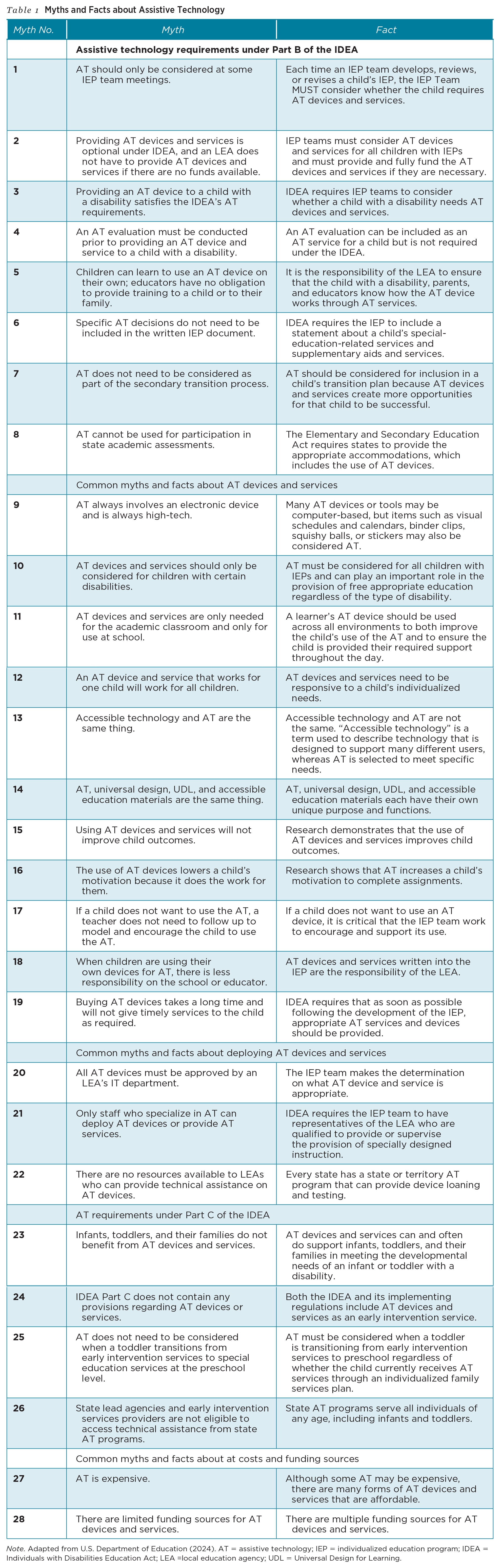
Note. Adapted from U.S. Department of Education (2024). AT = assistive technology; IEP = individualized education program; IDEA = Individuals with Disabilities Education Act; LEA =local education agency; UDL = Universal Design for Learning.
This knowledge is vital for creating an accessible learning environment that accommodates the individual needs of students with disabilities, ensuring they have equal opportunities to engage with the curriculum and achieve their individual goals.
AT guidance provides a framework for educators and administrators to understand the legal requirements surrounding the provision of AT, which can seem complex and ever evolving. This guidance helps in decision-making processes and individual education program (IEP) development, ensuring that all educational technology decisions are compliant with federal mandates such as the Individuals with Disabilities Education Act. By staying current with AT guidelines, schools can better advocate for necessary resources, support teachers in their professional development, and ultimately enhance the educational outcomes for students with disabilities by integrating effective AT solutions.
Below are some scenarios of a student experiences in the context of some of the AT Myths and Facts.
The Long Journey to TTS
In the following, we describe two situations for Kyra, a third-grade student who loves to participate in her regular education classroom and receives special education services for reading remediation because her decoding and fluency is below grade level. In the first example, Krya’s team makes choices based on the AT myths. In the second example, her team applies myth busting.
Recognizing that Kyra’s performance in the regular education classroom was decreasing, Mx. Rivera, Kyra’s special education teacher, mentioned the possibility of considering AT to facilitate Kyra’s progress in the regular education classroom. Mx. Rivera’s supervisor shared that the district only considers AT for students with complex communication needs. At Kyra’s PPT (Planning and Placement Team is a local term for IEP. In hindsight lets call it IEP meeting. Individualized Education Program) in January, the team shared Kyra’s decreasing performance, and her mother, Erin, also expressed concern about her attitude toward school. The team agreed to keep an eye on Kyra’s performance for the next marking period and touch base at progress marks in March.
The team continued Kyra’s special education services, and she began demonstrating distractibility in the regular education classroom and work avoidance. Erin’s concern for her performance increased. At a special education PTO meeting, Erin was chatting with another parent about her concern. It was recommended that Erin request an AT evaluation to see if any tools can improve her performance. During March parent-teacher conferences, Erin asked about the possibility of an AT Evaluation. Mx. Rivera and Ms. Freeman, Kyra’s English language arts (ELA) teacher shared they could not make that decision without an IEP meeting. A meeting was scheduled for April to discuss considering AT for Kyra. After much discussion and strong advocacy from Kyra’s parents, the district agreed to request an AT evaluation from one of their outside service providers. It took 1 month to complete the paperwork to request the evaluation, and the outside provider stated the waitlist for an evaluation was 3 months.
The evaluation was completed in October and reported in November, and the team reviewed the report at Kyra’s annual review in January. During her annual review, the AT specialist was unable to attend the meeting, and Mx. Rivera reported the findings but was unsure of how to purchase the recommendations. After a month of communication, Mx. Rivera was able to download a text-to-speech (TTS) extension and schedule a training session for March. Kyra, Mx. Rivera, and Kyra’s parents were all trained on the tool. Kyra first used it in late March in her ELA class, but because her teacher, Ms. Freeman, was unaware of the tool, she did not model its use with the class. Kyra was self-conscious to use it within the classroom and would only use it with Mx. Rivera. By May, Mx. Rivera checked in with Kyra, and she stated she did not want to use the tool anymore because it made her look different. Mx. Rivera did not push Kyra, so she added additional para support within her classroom. Ultimately, Kyra did not adopt the recommended tool, and at the end of fourth grade, she was more dependent on adult support to access grade level material.
Myths Reinforced for Kyra
• Myths 1, 2, 3, 4, 5, 10, 17, 19, 21 (see Table 1 )
• Timeline: January → May: 14 months
• Result: Abandonment
Myth Busting in Action: Empowering Kyra Through Text to Speech
Kyra is a third-grade student who loves to participate in her regular education classroom. She loves unicorns, dancing, and going on vacation with her mother. She receives special education services for reading remediation because her decoding and fluency is below grade level. Recently, her participation has waned, and she is expressing to her mother, Erin, that she does not want to go to school. Kyra’s special education teacher, Mx. Rivera, recently started following a Facebook group facilitated by the CEC Innovations in Special Education Technology that provides practical AT tips. After watching a short video on TTS to increase access to classroom material, they immediately thought of Kyra’s needs. Instead of waiting for Kyra’s next IEP meeting, Mx. Rivera did their own research and modeled the use of the free version of the Chrome extension Read and Write for Google during a co-taught literacy lesson in December. Kyra, in addition to other students, demonstrated increased independence and task completion. Mx. Rivera decided to take baseline data over 2 weeks to see how the use of TTS impacted her independence, task completion, and quality of work. Mx. Rivera partnered with Ms. Freeman, Kyra’s ELA teacher, to collect data on number of prompts during ELA class, incomplete work, and accuracy.
At the end of the 2 weeks, Mx. Rivera and Ms. Freeman met to discuss Krya’s progress before her annual IEP meeting at the end of January. Both teachers confirmed that Kyra’s progress and independence improved with the use of the TTS extension. Mx. Rivera created a data chart comparing data from before and after the implementation of Read and Write for Google. During her IEP meeting, the team decided to add TTS to Kyra’s accommodations page and added a summary of the data from her TTS integration in the present level of performance area. Given the data presented at the IEP, the team agreed to continue to implement TTS for the duration of her next IEP and include the TTS accommodation on her standardized assessments. After the IEP meeting, Mx. Rivera scheduled training with Kyra’s parents to demonstrate the tool in early February. This step is crucial because Kyra will be using the AT to complete her homework tasks as well. By the end of March, Kyra was demonstrating how to use the tool to her peers, and her parents reported an increased positive attitude toward school. Kyra was even able to show her mom how to use the tool to listen to a current events article. By the end of third grade, Kyra demonstrated improved self-confidence and independence when completing her homework and schoolwork through the implementation of her AT.
Myths Busted for Kyra
• Myths 1, 2, 3, 4, 5, 6, 8, 10, 11, 15, 16, 17, 19, 20, 21 (see Table 1 )
• Timeline: January → March: 3 months
• Result: Adoption
Developing Your Assistive Technology Action Plan
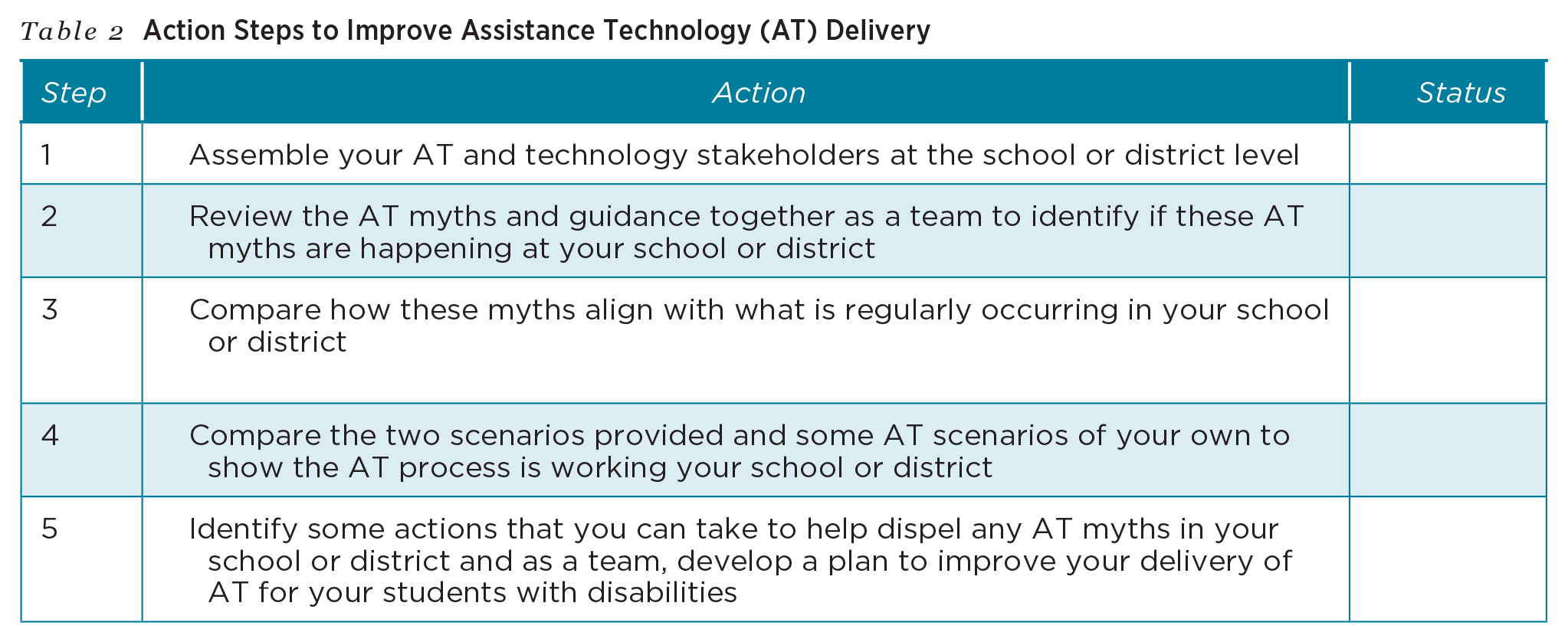
This new guidance gives school and district level teams additional policies to align AT implementation efforts. Your school can start with the AT guidance and work collaboratively to improve AT delivery as part of an action plan using the steps in Table 2 .
Action Steps to Improve Assistance Technology (AT) Delivery
Conclusion
Say yes to address AT by using the latest AT policy guidance to debunk AT myths and improve AT cultures and delivery methods. This commitment fosters an inclusive educational culture that values accessibility, inclusion, and empowering all students. We can leverage these policy clarifications to create more inclusive learning environments and remove barriers for learners with disabilities.