







Abstract

There has been limited progress toward more equitable outcomes for culturally and linguistically diverse (CLD) youth served in special education despite targeted policy and practice efforts (Artiles et al., 2002; Griner & Stewart, 2012; Wagner, 2017). There is a growing diversity in K–12 school populations in the United States such that in 2022, 56% of students enrolled in school were non-White student populations (National Center for Education Statistics [NCES], 2024). Further, between 2012 and 2022, public school enrollment by Latino students increased from 12.1 million to 14.4 million (NCES, 2024).
In very recent years, Latino and Black student 8th grade reading scores have declined, particularly for students attending urban, public high schools and for students served in special education (NAEP, 2025). Thus, instructional and social-emotional strategies to support these students academic progress are critical (Hall et al., 2025).
As racial and ethnic diversity of classrooms increased, there has been a simultaneous push for high-stakes, accountability-driven standardization of pedagogical approaches and scripted curriculum with pacing guides in schools serving often marginalized CLD students (e.g., Cochran-Smith & Lytle, 2009; Parcerisa et al., 2022). In this current climate of standards-based reform, other educational reforms, such as inclusion, are also increasing diverse populations of students with disabilities in inclusive general education classrooms, with 67% of students with disabilities served in general education settings for most of the school day in 2022 (National Center for Education Statistics, 2024).
As racial and ethnic disproportionality continues to be documented in special education, the need for integration of culturally responsive approaches in inclusive classrooms is clear (Kumar et al., 2018; National Center for Learning Disabilities, 2020). Specifically, there is a critical need for equity-focused, culturally responsive pedagogical approaches to be enacted within education systems to increase the likelihood of more equitable outcomes for CLD youth with disabilities (Griner & Stewart, 2012).
Ms. Edwards 1 is a teacher in an eighth-grade inclusion class in an urban middle school in a school district that emphasizes standardized student assessment. Her English/language arts (ELA) inclusion class was comprised of primarily Latinx and Black students that included those with individualized education programs (IEPs) served primarily under the learning disability and/or emotional behavior disability categories and general education students. Ms. Edwards’s school district required a pacing guide that adhered to a structured and standardized curriculum that Ms. Edwards felt did not reflect or engage her CLD students. Ms. Edwards wanted to make the scripted curriculum more relevant for her eighth-grade students, particularly for her students with IEPs. To accomplish this, she focused on reflective practice for increasing equity pedagogy in her class.
In the following sections, we describe the importance of teacher critical reflexivity as a culturally responsive pedagogical practice to increase more equitable outcomes for students and outline the steps for implementation. Next, we describe equity pedagogy as it undergirds the critical reflexivity process for teachers. Finally, we describe Ms. Edwards’s process of combining these two concepts to better support the CLD learners in her inclusion class.
The Potential of Critical Reflexivity
Critical reflection has to do with the examination of assumptions (Ng et al., 2019), but reflection on its own does not necessarily lead to changes in practices. The research literature has emphasized the importance of engaging in a reflexivity process to transform passive reflection into action (Archer, 2012; Lunn Brownlee et al., 2017; Ryan & Bourke, 2013). Thus, reflexivity is an action-oriented process that turns teachers’ beliefs about instructional practices into intentional enactments (Archer, 2012).
“
Lunn Brownlee et al. (2017) explained that reflexivity is an internal dialogue that has the purpose of modifying our beliefs and our practices. In a critical reflexivity process, teachers must revisit their values, biases, and motivation, and they must also consider their actions and interactions within the larger sociopolitical, cultural, and economic context in which they work (Archer, 2012; Bywaters et al., 2022; Ryan & Bourke, 2013). Specifically, educators must consider how the different contexts in which they operate affect the assumptions they have about the learning process related to their students of varying abilities and backgrounds. Specifically, the reflexive process has been recommended for educators to interrogate and consider the impact of their complex microcultures on their interactions with students in special education and collaboration with their families (Francis et al., 2025). The importance of reflective practice has also been identified for special educators as “a way of educating children, young people, and adults with special needs with quality” (Fernandes et al., 2021).
The social, cultural, political, and economic contexts in which teachers work undergird their reflexivity process. For instance, educators need to be conscious of how ability, culture, and language influence how they view students and interpret their actions. Dray and Wisneski (2011) suggested that when teachers reflect on their practice, they should ask questions such as: “What attributes am I assigning to the student? What are my assumptions?” (p. 32). Engaging in reflexivity helps teachers move away from deficit thinking models (Dray & Wisneski, 2011) as teachers self-reflect on their own histories and beliefs and the broader socioecological context as part of the instructional cycle. Teachers must consider how their perspectives and assumptions affect teaching and learning as a critical aspect of the reflexivity process. As Moore (2004) explained: In understanding the development of pedagogical practice, one needs to access not only what is “immediate” and “visible,” but also what is not always immediately accessible in the specific classroom situation—what is sometimes called “the baggage” teachers bring into the classroom with them. (p. 20) “
To develop an asset-based perspective and increase equity pedagogy approaches, the critical reflexivity process must include a consideration of situated practice that considers the significant structural issues that contribute to the disparate outcomes of multiply marginalized students. Thus, there is great potential in a reflexivity model that integrates teacher reflection and reflexivity and the consideration of contextual factors that contribute to students’ school experience (see
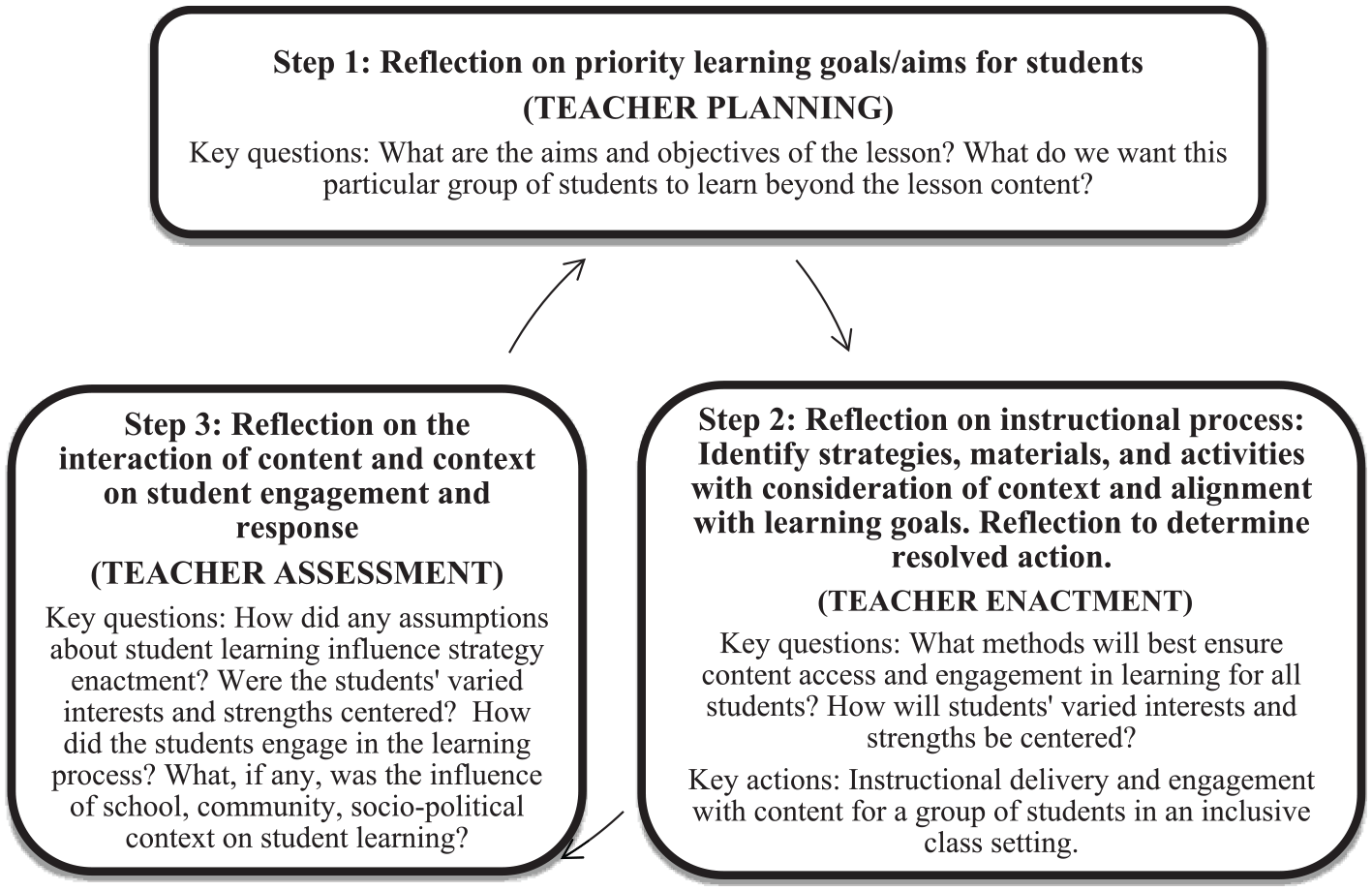
Reflexivity model.
Reflexivity Model
In Step 1 of the reflexivity process, teachers identify the priority learning goals that should be adapted for the particular group of students in each classroom at a particular period in time. Learning goals should not be detached from the identities of the students or from the sociopolitical climate of the community and school.
In Step 2, teachers deliberate on the instructional process and identify strategies to help the students of varying abilities and backgrounds interact with content and achieve the learning goals identified in Step 1 (Lunn Brownlee et al., 2017). Specifically, teachers weigh the advantages and the disadvantages of different teaching and learning strategies that could be used in the particular learning context. It is often helpful to draw from the Universal Design for Learning principles of multiple means of representation, engagement, and expression to facilitate access to the content for all students (for a detailed overview, see CAST, 2025). Teachers determine a “resolved action” that represents the enactment of the strategies considered (Lunn Brownlee et al., 2019, p. 235). This step represents the transformational potential of the reflexive process (Lunn Brownlee et al., 2019). In determining their enactment practice, teachers consider the key question related to the strengths and weaknesses of the instructional delivery and content options and then enact them with students. The emphasis provides students content access to achieve the learning goals drawing from Banks’s (1995) equity pedagogy practice of content integration, knowledge construction, and prejudice reduction.
Lastly, in Step 3, teachers reflect on the interaction of their own assumptions and positionality and how it influenced instructional delivery and expectations of students’ (particularly those with IEPs) engagement in learning. During this step of the reflexivity process, teachers must pay attention to how their own biases, values, and assumptions manifest in various actions and practices. Thus, in Step 3, the internal dialogue focuses on how teachers evaluate who they are affects what they do and how students respond. In this step, teachers also consider if the students’ varied identities and strengths were represented in class content and how the context may have impacted student engagement and response. Teachers also reflect on strategies that could be incorporated to increase engagement of CLD students with disabilities. For example, are there better ways of facilitating content integration and knowledge construction in instruction?
The Promise of Equity Pedagogy
Green and Stormont (2018) highlighted the importance of culturally responsive pedagogy to improve the school experience and outcomes of CLD students with disabilities. Culturally responsive pedagogical approaches include multicultural education (Banks, 1995), culturally relevant pedagogy (Ladson-Billings, 1995), and culturally responsive teaching (Gay, 2000). Banks’s (1995) equity pedagogy approach undergirds the instructional and curricular transformation goals of culturally responsive pedagogy. Banks’s dimensions of multicultural education include both structural and pedagogical components. The pedagogical dimensions are aligned with culturally relevant pedagogy and culturally responsive teaching and include an overarching equity pedagogy that is enacted by teachers in modifications to their instructional methods to highlight cooperative learning and intergroup interactions that support common goals. This equity pedagogy involves specific enactment practices by teachers that include (a) content integration that provides representation from a variety of cultures and groups within course content, (b) a knowledge construction process where teachers help students develop a critical lens and foster equal value of perspectives, and (c) prejudice reduction, which involves explicit cross-cultural activities, such as intergroup dialogue and cooperative learning activities, that can challenge negative racial/ethnic attitudes of students. However, the true realization of prejudice reduction requires a macro approach that recognizes school as an “interrelated social system” (Banks, 2016, p. 283).
Banks’s (1995) equity pedagogy practices of content integration, knowledge construction, and prejudice reduction provide an outline for teachers to reflect on their content/curriculum to ensure representation of CLD communities for cultural affirmation of students. Additionally, scholars have long identified the need for “well-trained, reflective personnel to work with and affirm students with special academic, cultural, and linguistic needs” in inclusive multicultural settings (Sobel & Taylor, 2006, p. 28). One challenge has been that teachers are often aware of the goals of equity pedagogy, but methods for the enactment of practices in service of the goals are not often clear (Moore, 2018; Richards et al., 2007). Griner and Stewart (2012) noted that many teachers believe that equity pedagogy approaches are critical for working with diverse populations, but teachers often “lack clear examples and tools” for enactment of these practices (p. 589). Banks’s dimensions of content integration, knowledge construction, and prejudice reduction provide explicit dimensions of multicultural education that can be enacted by teachers in inclusive settings. In addition, the critical role of reflection and reflexive practice for teachers to meaningfully enact transformative changes in instructional practices has been identified (Bywaters et al., 2022; Kavanagh, 2017).
Putting It All Together: Reflexive Model for Equity Pedagogy Enactment
Ms. Edwards wanted to increase her students’ engagement with the ELA curriculum in her inclusion class by adapting learning activities and including culturally relevant materials for her students with IEPs that were complementary to the school district’s curriculum pacing guide. She engaged in the reflexivity process to identify the priority learning goals and aims for her students (Step 1). She described her process drawing from Banks’s (1995) dimensions of multicultural education:
I saw how the upcoming curriculum could be complemented and made dynamic with a culturally responsive approach by increasing content relevant to students, developing collaborative and interactive learning activities, and explicitly focusing on problem solving for prejudice reduction. I chose my eighth-grade class because of the autonomy and independence the students exhibit. They can use the tools of these lessons to build strengths and empower their voice and agency for the next chapter of their educational journey as they move into high school.
The following steps of the critical reflexivity model and the highlighted alignment with Banks’s (1995) dimensions of content integration, knowledge construction, and prejudice reduction provide an exemplar of teacher practice in using a critical reflexivity model as an enactment tool for equity pedagogy within an inclusive class setting.
Step 1: Identify Equity-Pedagogy-Focused Learning Goals
In the enactment of equity pedagogy, this critical reflexivity step involves a teacher reflecting on learning goals for students beyond just the content material. These learning goals build on a strengths-based view of student identities and abilities and consider the context of the community and school. Teachers reflect on the objectives of the lesson that will need to be met so that students can meet the equity goals within the larger potentially marginalizing context. Step 1 is focused on the teachers’ planning stage of lesson design. Teachers, especially those working within high-stakes accountability settings, will need to explicitly consider what additional materials and activities will be needed to facilitate the attainment of the equity-pedagogy-focused learning goals in addition to the context-specific goals for all students (often mastery of specific state standards or benchmarks within a content and grade level area).
Ms. Edwards identified her key objectives for her students within her inclusive ELA class—these were to (a) empower student voice, (b) affirm students’ culture and identity, and (c) reduce prejudice/bias. Her overarching equity pedagogy goal was to teach her students authentic strategies that would allow them to successfully navigate real-life contexts where discrimination and racism are present.
Step 2: Identify Content and Implement Instructional Strategies to Support Equity-Pedagogy-Focused Learning Goals
In this step of the reflexivity process, teachers deliberate on the instructional process and identify materials, activities, and instructional strategies to help the students achieve the learning goals. Teachers focus on enhancing access to the content for CLD students with disabilities by drawing from Banks’s (1995) equity pedagogy practice of content integration, knowledge construction, and prejudice reduction. The teachers consider what additional culturally relevant materials will activate student interest and engagement. Specifically, the reflexive process for Step 2 includes the consideration of the current context and required curriculum and content that can be built on (content integration) and the identification of student-centered activities (knowledge construction) that will facilitate the attainment of the learning objectives and overarching goal.
Materials and Activities
In the case of Ms. Edwards, the eighth-grade ELA curriculum included the Narrative of the Life of Frederick Douglass (Douglass, 1845). The eighth-grade ELA benchmarks aligned with this book (from state department of education documents) included the following: (a) Explain how an author establishes and achieve purposes(s) through rhetorical appeals and/or figurative language and (b) track the development of an argument, analyzing the types of reasoning used and their effectiveness, identifying ways in which the argument could be improved.
Ms. Edwards engaged in the reflexive process to identify additional materials and activities that would allow her CLD students with disabilities to access the content and achieve the eighth-grade ELA benchmarks and support her equity pedagogy goals of empowering student voice, affirming students’ culture and identity, and reducing prejudice/bias. These additional materials consisted of sharing Yosso’s (2005) concept of community cultural wealth (CCW). Yosso’s model of CCW challenges the traditional interpretations of cultural capital that often reflect a deficit view of CLD communities as disadvantaged and instead highlights the deep knowledge, skills, and abilities possessed by socially marginalized groups that are often unacknowledged. The CCW model identifies forms of capital that include aspirational, navigational, cultural, social, linguistic, familial, and resistant capital. These forms of capital draw on the knowledge that CLD students with disabilities bring with them from their homes and communities into the classroom and “acknowledge the multiple strengths of communities of color in order to serve a larger purpose of struggle toward social and racial justice” (Yosso, 2005, p. 69). After this stage of content integration, Ms. Edwards considered Banks’s (1995) concept of knowledge construction and developed a class activity in which students identified forms of oppression evidenced in the Narrative of Frederick Douglass.
Ms. Edwards’s learning goals for her students included having them recognize forms of oppression, some subtle and others more overt. Within the lesson, Ms. Edwards observed that her students were able to recognize various forms of oppression (religious intolerance, discrimination based on disability, bias, genocide, racism) and were ready for strategies to overcome. She then explicitly taught how Yosso’s (2005) CCW reconceptualizes deficit perspectives and how it could be used as a lens to focus on the array of cultural knowledge and abilities possessed by socially marginalized groups. It was a way to make cultural connections to the past and the present. Ms. Edwards guided her students to collaboratively use the model of CCW to identify the forms of capital and cultural wealth within the book. The students completed the “Guiding Questions for Text” within the CCW graphic organizer. Ms. Edwards wanted her students to think critically and to recognize the strengths and CCW in the Narrative of the Life of Frederick Douglass so that they would be able to recognize it in themselves when they completed the “Guiding Questions for Your Life” in the CCW graphic organizer completed in Step 3.
For an example of the CCW graphic organizer, see
Community Cultural Wealth Graphic Organizer
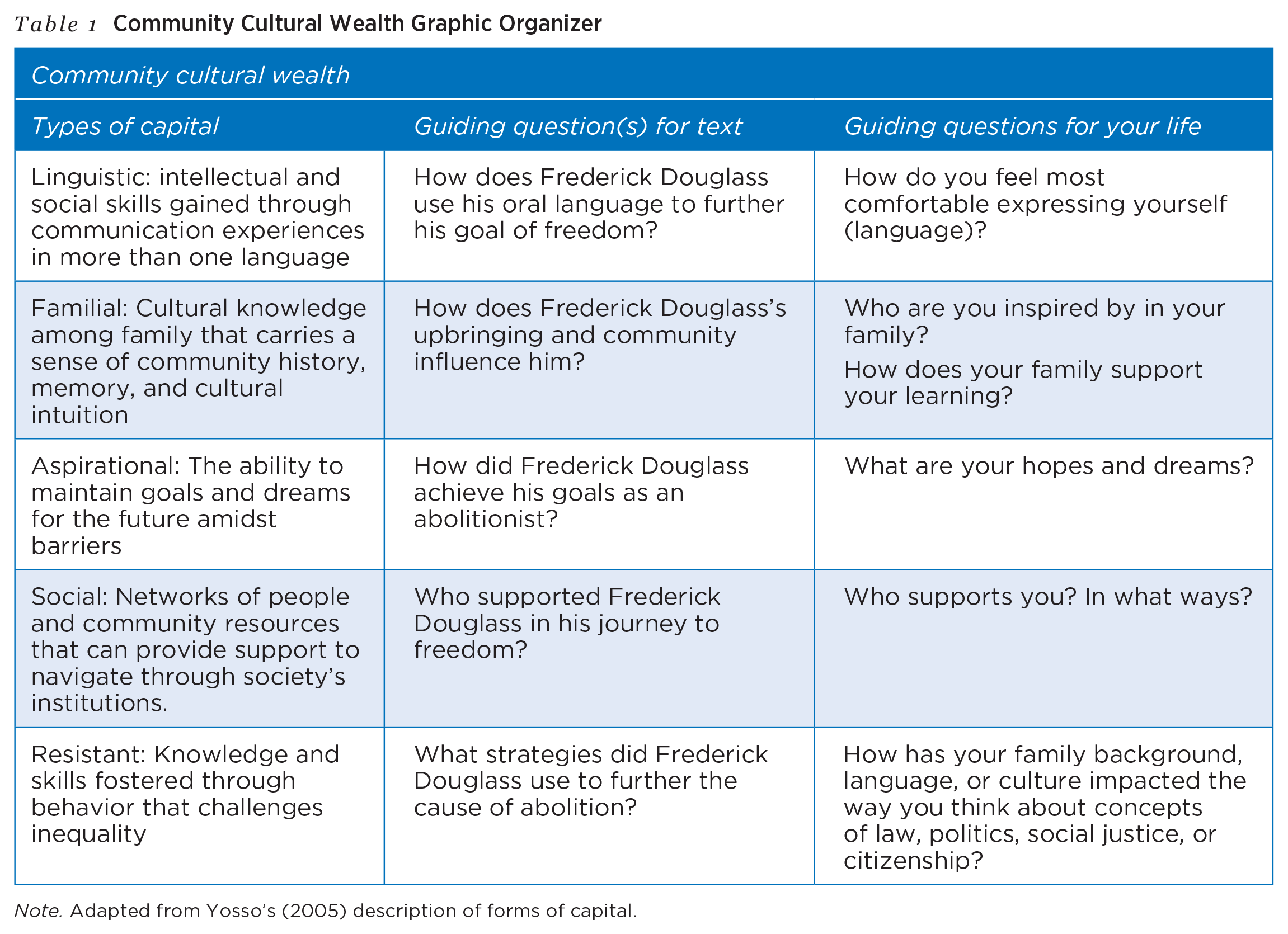
Note. Adapted from Yosso’s (2005) description of forms of capital.
Step 3: Assess Student Engagement and Consider Influence of Content and Context
In Step 3, teachers engage in the assessment process through an evaluation of their practice and student response to the lesson. Teachers reflect on their own identity and how this may have influenced their instructional delivery. Specifically, teachers consider how their own biases, values, and assumptions manifest in their classroom practices. Also in Step 3, teachers evaluate if their students’ identities and strengths were represented in the class content and materials (content integration) and how the class, school, or community context may have impacted student engagement in class activities and attainment of learning goals (knowledge construction). Teachers reflect on how their assumptions about student learning may impact students’ engagement with the class materials and activities.
Ms. Edwards also identified learning goals for her students that would teach them their own reflective practice to consider components of their identity. She then engaged her students in the construction of an identity web and reflection. She modeled the activity first—reflecting on the component parts of her own identity and sharing with students as they constructed their own. The class identity webs were called “The Sum of Our Parts.” Ms. Edwards and the class collaboratively determined that identity is dynamic and ever changing based on lived experiences, and she guided students in recognizing these components as part of each student’s personal strengths. As a means of assessing the attainment of the equity-pedagogy-focused learning goals (identified in Step 1 and related instructional strategies enacted in Step 2), Ms. Edwards and her students used their personal identity webs to create their own CCW graphic organizer as had been used with the Narrative of the Life of Frederick Douglass.
For an example of the identity web, see
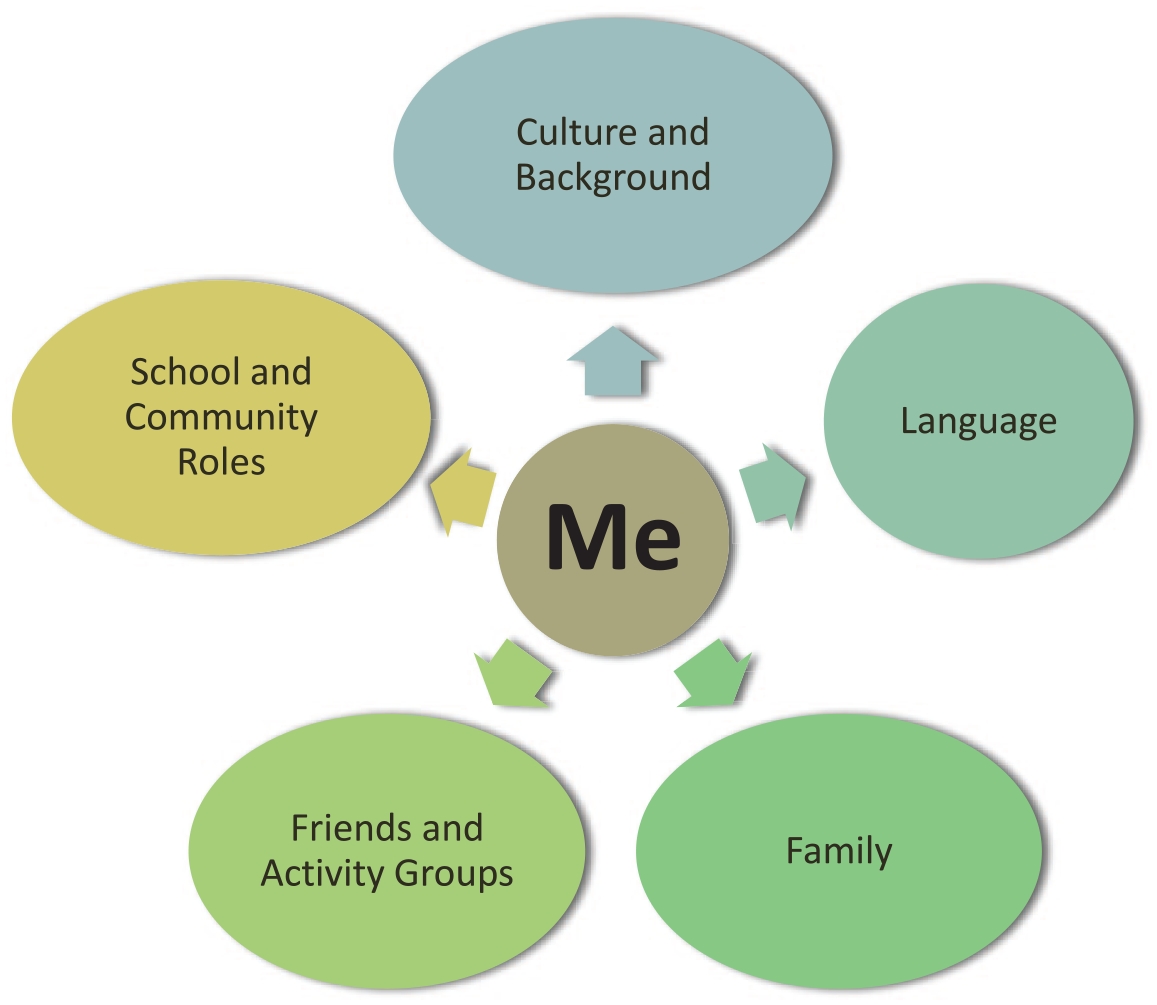
Identity web template
After this activity, Ms. Edwards reflected on whether she achieved her goals and considered the students’ responses. Her overarching goal was to make the curriculum relevant for her CLD students. She wanted her students to think critically and feel empowered. She believed that she achieved her goal through the use of the supplemental (to the school curriculum) activities of the identity web and CCW graphic organizers. These activities were successful ways to move from deficit foci to strengths-based perspectives, an important shift particularly for multiply marginalized students. Student engagement was high in both the identity web and collaborative CCW activities. Overall, Ms. Edwards achieved her goal and was able to facilitate greater levels of participation and task completion on these activities with the students compared to the school district reading-comprehension-focused materials for The Narrative of the Life of Frederick Douglass.
The multistep process of critical reflexivity to identify instructional goals and tools for increasing equity pedagogy through content integration, knowledge construction, and prejudice reduction is evidenced through Ms. Edwards’s process in planning and implementing this ELA unit within a diverse inclusion class in a high-stakes accountability school that required standard curriculum and pacing guides for content. This exemplar demonstrates the potential of utilizing explicit reflection questions that can guide teachers’ instructional planning for culturally relevant content and activities, mutually respectful enactment of instructional strategies, and reflective assessment of student engagement. The equity pedagogy practice of content integration included racial, ethnic, and cultural representation distributed across the curriculum. Through the identity webs and CCW maps and the critical engagement with the curriculum via intergroup dialogue and cooperative learning groups, the equity pedagogical practice of knowledge construction was integrated to help students to understand, investigate, and determine the implicit cultural assumptions and frames of reference and perspectives of the ELA content.
“
Conclusion
The long-standing disparities in school outcomes for CLD students with disabilities necessitate the integration of culturally responsive approaches in inclusive classrooms (Losen et al., 2021; National Center for Learning Disabilities, 2020). J. Banks’s (1995) equity pedagogy approach, planned and enacted using a critical reflexivity model (Lunn Bownlee et al., 2017), has tremendous potential for the realization of instructional and curricular transformation goals of culturally responsive pedagogy. The promising practices of content integration, knowledge construction, and prejudice reduction provide an outline for teachers that can address the “lack [of] clear examples and tools” that has been identified in previous research on equity pedagogy approaches (Griner & Stewart, 2012).
Footnotes
Declaration of Conflicting Interests
The authors declared no potential conflicts of interest with respect to the research, authorship, and/or publication of this article.
Funding
The author(s) disclosed receipt of the following financial support for the research, authorship, and/or publication of this article: The authors acknowledge that this work was made possible by the U.S. Department of Education Supporting Effective Educator Development (SEED) grant #U423A170078. The content does not necessarily reflect the views or policies of the U.S. Department of Education nor does mention of trade names, commercial products, or organizations imply endorsement by the U.S. Government.
