







Abstract
Students who are blind or visually impaired (BVI) require specialized literacy instruction that aligns with both braille reading development and evidence-based literacy practices. With the increasing adoption of Science of Reading policies, teachers of students with visual impairments (TSVIs) must navigate new literacy mandates while ensuring their students receive appropriate instruction. This article presents a research-based approach to integrating braille literacy assessment with structured, evidence-based reading instruction. Using a case study of a second-grade braille reader, the article illustrates how a TSVI, a reading specialist, and a general education teacher collaborated to develop and implement an Informal Braille Reading Inventory (IBRI). The IBRI provided meaningful data to guide instruction, improve literacy outcomes, and align braille instruction with general education reading expectations. Practical strategies for assessment, intervention, and interdisciplinary collaboration are discussed, offering a model for ensuring BVI students receive equitable literacy support.
Mrs. Santos, a teacher of students with visual impairments (TSVI), just received notice of a brand new second-grade braille student, Demarcus, being added to her caseload. In the past, Mrs. Santos has always used a student-centered approach to her braille instruction. However, her state recently passed a new literacy law that requires evidence-based literacy instruction (EBLI) and frequent progress monitoring aligned with science-based reading research (SBRR) or the science of reading. At a district-wide literacy training, the reading specialist, Mr. Allen, reviewed the new mandated requirements for all students in kindergarten through third grade. She decided to reach out to Mr. Allen to learn more how these new requirnments might impact her teaching of braille.
Introduction
Within policy, there has been a push to embrace the science of reading as a way to combat low reading success for students across the nation (Lexia, 2023). Currently, 38 states have enacted legislation grounded in the science of reading movement (Schwartz, 2025). Laws, like the one mentioned in the vignette, use terms such as “science-based reading research” and “evidence-based literacy instruction” to ensure that reading instruction is guided by empirically validated practices. For example, the Virginia Literacy Act (2022), which targets the declining reading scores within the state, defines EBLI as structured instructional practices, including sequential, systematic, explicit, and cumulative teaching, that (i) are based on reliable, trustworthy, and valid evidence consistent with science-based reading research; (ii) are used in core or general instruction, supplemental instruction, intervention services, and intensive intervention services; (iii) have a demonstrated record of success in adequately increasing students’ reading competency, vocabulary, oral language, and comprehension and in building mastery of the foundational reading skills of phonological and phonemic awareness, alphabetic principle, phonics, spelling, and text reading fluency; and (iv) are able to be differentiated in order to meet the individual needs of students. (§ 22.1-1)
According to the National Center for Educational Statistics (2024), 60% of school-aged students who are blind or visually impaired (BVI) are educated within their home schools with their general education peers. Literacy instruction is the primary role of the classroom teacher; however, for students who are BVI and are braille readers, a close collaboration between the general education teacher, reading specialist, and TSVI should be encouraged to help the student succeed and reach their literacy goals. Braille instruction should not be an isolated “add-on”; rather, braille should be an integrated literacy activity for students who are braille readers (Swenson, 2008). Students who are BVI have unique literacy needs that draw on the skills of all participants.
When Mrs. Santos and Mr. Allen met, she went over the unique learning needs of students, like Demarcus, who have congenital blindness. Mr. Allen went into depth about Scarborough’s (2001) reading rope. Together, they were able to make the connection with how this new law impacted students who were BVI. In their district, reading specialists relied on informal reading inventories to assess students’ decoding, fluency, and comprehension, key components of Scarborough’s reading rope. Mrs. Santos used commercially available braille reading inventories when conducting learning media assessments. However, with the state requirement for monthly progress monitoring, something else needed to be considered. If Demetrius was to receive EBLI rooted in SBRR, Mrs. Santos needed a way to gather meaningful data on the new student’s skills in word recognition (including phonemic awareness and decoding), language comprehension, and braille knowledge.
The Science of Reading
The science of reading builds on the five skills identified by the National Reading Council (National Institute of Child Health and Human Development, 2000) and expands the skill of comprehension based on the components Scarborough (2001) outlined in the reading rope (Lexia, 2024). Scarborough’s reading rope is a literacy model that illustrates how successful reading skills develop through the integration of word recognition and language comprehension (Lexia, 2024). There is a body of knowledge that supports that students with BVI progress through similar stages as their sighted peers as they gain literacy (Kamei-Hannan & Ricci, 2015; Steinman et al., 2006). Additionally, the components of reading outlined by the National Reading Council (National Institute of Child Health and Human Development, 2000, phonemic awareness, phonics, reading fluency, vocabulary, and reading comprehension) are essential to all readers, including those with a visual impairment (Kamei-Hannan & Ricci, 2015; Stewart et al., 2022). For students who are braille readers, additional skills are required (Kamei-Hannan & Ricci, 2015; Swenson, 2016). Kamei-Hannan and Ricci (2015) identified the skills of knowledge of braille code, braille syntax, and tactical discrimination as essential for braille readers.
“ “
Modified Scarbough’s Reading Rope of Reading Skills for Braille
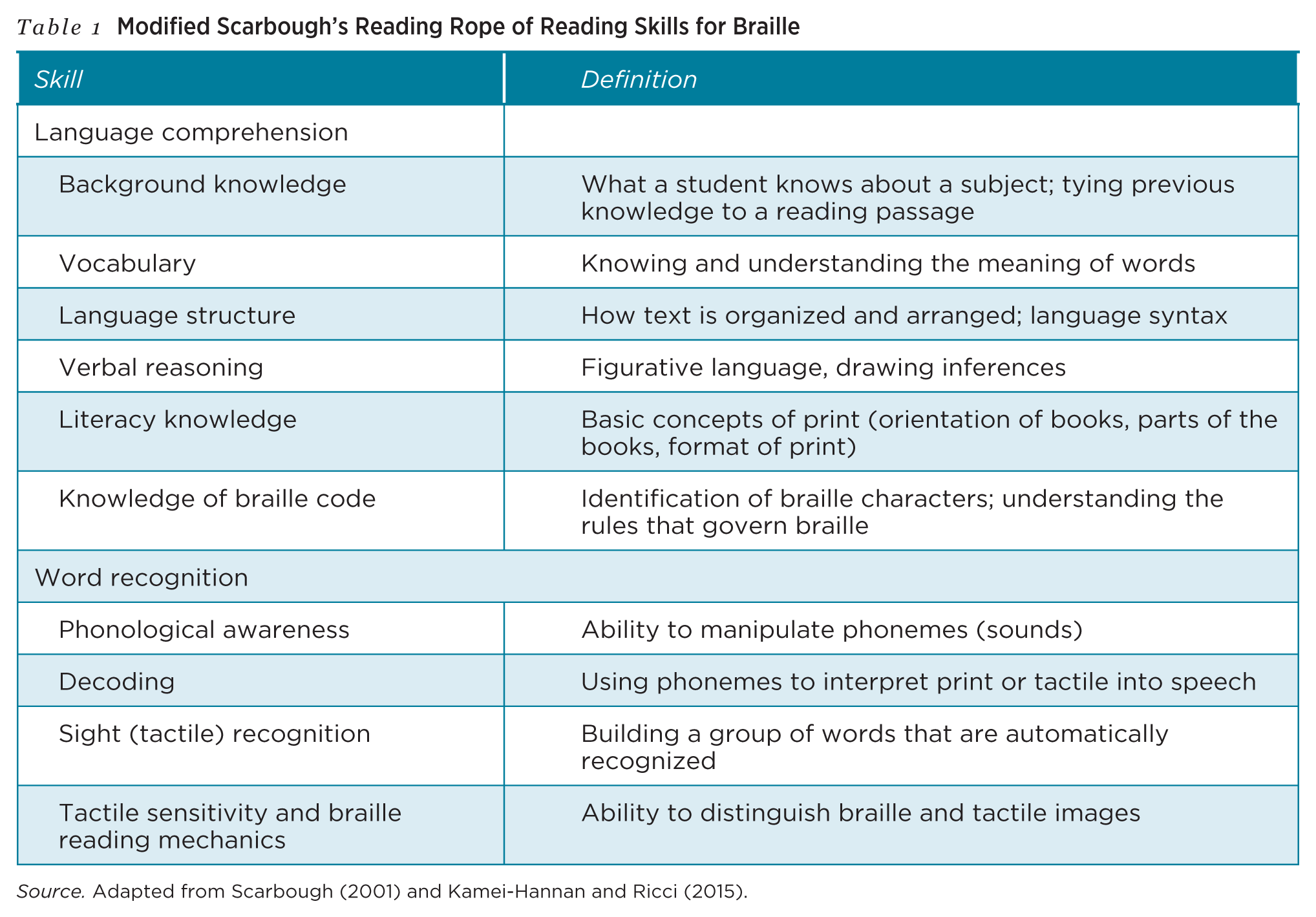
Source. Adapted from Scarbough (2001) and Kamei-Hannan and Ricci (2015).
Unique Reading Needs of Students Who Are Visually Impaired
With collaboration between the TSVI and the school-based literacy personnel (i.e., general education teacher and the reading specialist), the TSVI brings their specialized knowledge of braille and of the literacy needs unique to students who are congenitally visually impaired. Unsurprisingly, with the low incidence of students who are BVI and the complexity of visual perception, empirical research is slim in the field of literacy development and interventions (Cooney et al., 2015; Ferrell et al., 2014; Sutter et al., 2020). However, the information found in the relatively small body of research regarding reading development can help both TSVIs and school-based literacy personnel support the literacy development of students who are braille readers.
Activities to Build Reading Skills
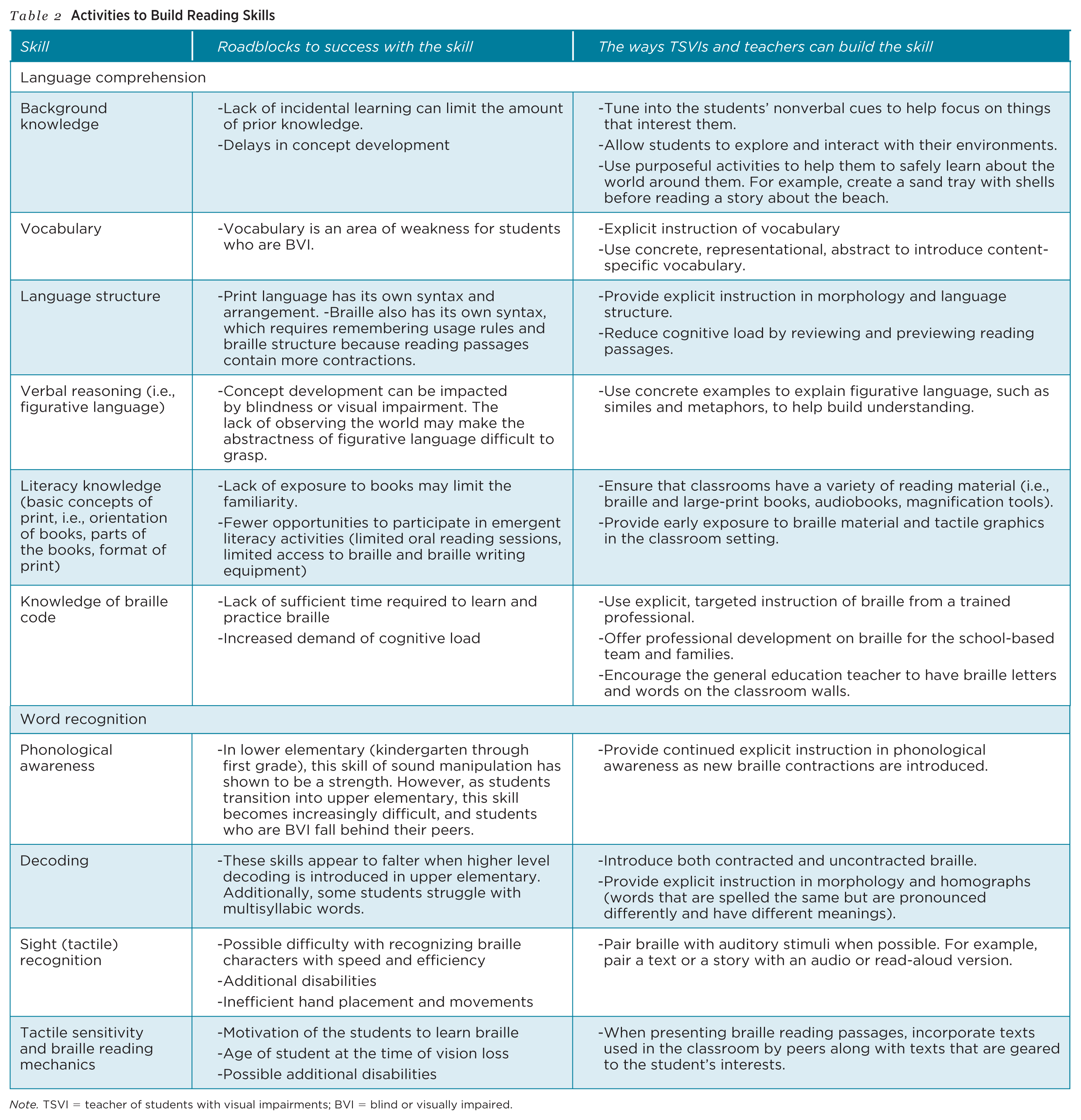
Note. TSVI = teacher of students with visual impairments; BVI = blind or visually impaired.
Using Assessment to Aid in Instruction
Assessment is a vital step in offering effective instruction (Barone et al., 2019; Provost et al., 2010; Swenson, 2016). Creating an informal braille reading inventory (IBRI) is a strategic method to determine a student’s abilities (Risko & Walker-Dalhouse, 2010). Assessment can help establish a baseline for learning, determine the skills of a student, allow for adjustments in teaching to be made, and monitor progress toward goals on a student’s individualized education program (IEP; Barone et al., 2019; Swenson, 2016). For example, in the Virginia Literacy Act (2022), progress monitoring is an integral component of the students’ literacy development. In addition, frequent assessment is one of the Council for Exceptional Children’s high-leverage practices (Council for Exceptional Children & CEEDAR Center, 2017).
There are many benefits to creating an IBRI that aligns with the classroom assessment. One benefit of creating an aligned teacher-made braille assessment is that all school personnel can compare the student’s progress to their grade-level peers. Additionally, by using an aligned tool, the entire literacy team (TSVI, general education teacher, and the reading specialist) can all better understand the students’ strengths and areas of need (Provost et al., 2010). Aligning assessments between the classroom teacher and the TSVI streamlines instruction and progress monitoring (Swenson, 2008). It also allows students to participate with peers. Fluency, comprehension, sight words, braille contractions, hand placement, and decoding can all be assessed using an IBRI. Finally, a common assessment enables the literacy team to provide detailed feedback to families on the student’s literacy growth.
Developing and Conducting an IBRI
Drawing on research, the following steps are recommended to develop and conduct an IBRI in collaboration with the school-based literacy personnel. After the IBRI is completed, the TSVI can better create targeted lessons to deliver explicit instruction (Barone et al., 2019).
Step 1: Select a Reading Passage
To determine the skills a student possesses in braille and literacy, select a reading passage on the student’s reading level. This is an excellent opportunity to work in collaboration with school personnel (i.e., the general education teacher or the reading specialist). School personnel will be able to provide a reading passage that is used in the general education classroom. Typically, these passages will have comprehension questions that are similar to what the student will be encountering during their time spent in the general education classroom. The entire passage does not have to be used; a short portion of 100 words would be appropriate. For demonstration,
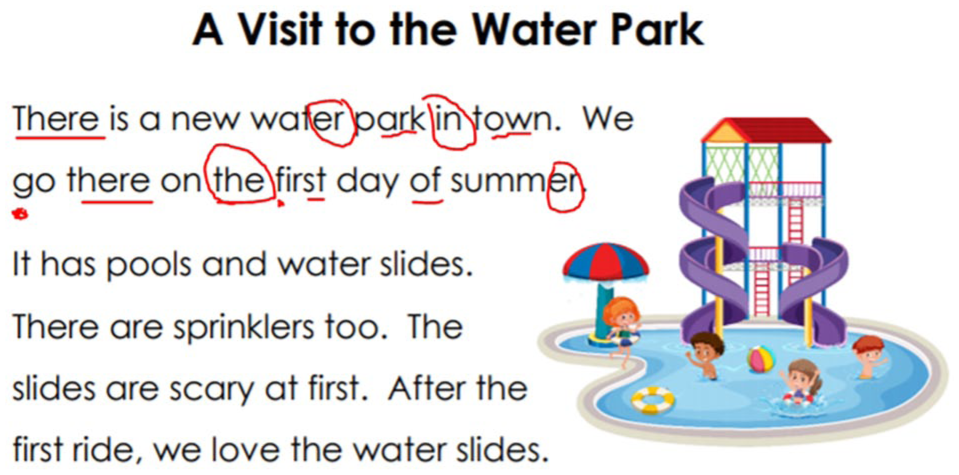
Review of reading passage for braille contractions
Step 2: Review and Prepare Passage
When preparing the reading passage, the text should be analyzed to find which of the 222 contractions in Unified English Braille (Willings, 2016) are presented in the passage. It is important to identify which braille contractions are present in the text to help determine which contractions can be assessed alongside the oral reading fluency of the student. Therefore, assessment data can be collected for documentation of IEP goals and provide information to help develop future lessons for the student (Swenson, 2016).

Braille passage for informal braille reading inventory
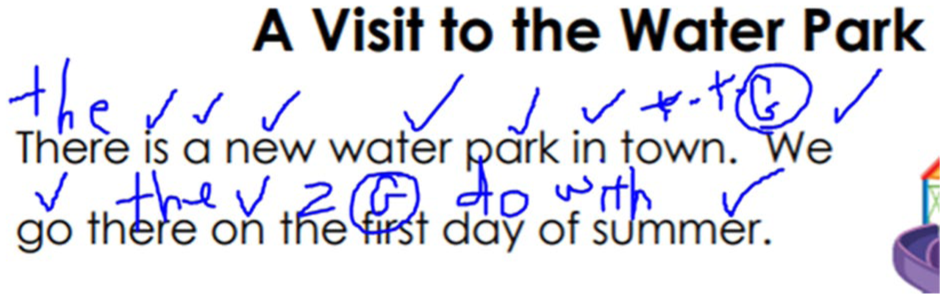
Sample reading passage noting student miscues
Step 3: Test the Student
While the student reads the passage, a timer should be used to help determine reading speed. The timer then is stopped when the student has finished reading the text. Next, the school personnel can orally ask comprehension questions for the student to answer. The answers should be recorded as either correct or incorrect to determine the level of comprehension. Finally, observations about the student’s oral reading fluency (expression, intonation, and phrasing) can be noted by the school-based reading personnel, whereas the TSVI can note hand placement. For example, is the student scrubbing (repeatedly rubbing over a braille cell in an attempt to distinguish the tactile raised dots)? Or is the student using efficient, smooth hand movements as they read braille?
Step 4: Analyze the Results
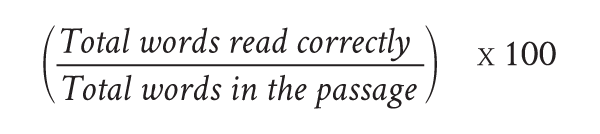
The next step is to analyze the student’s miscues and determine oral reading fluency. Three major types of miscues are substitution, insertion, and omissions. Braille miscues can be categorized into these three types (see
Types of Miscues and Their Braille Equivalent
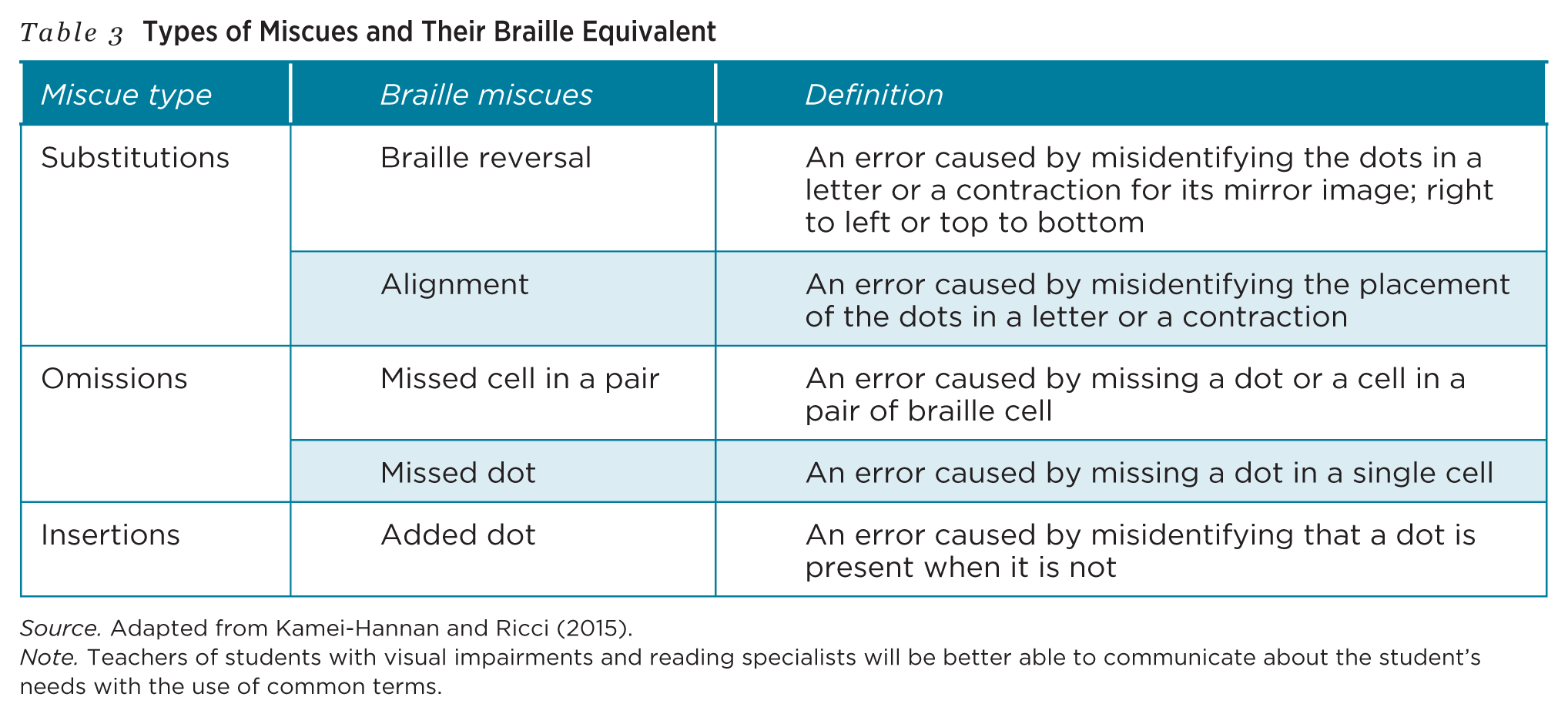
Source. Adapted from Kamei-Hannan and Ricci (2015).
Note. Teachers of students with visual impairments and reading specialists will be better able to communicate about the student’s needs with the use of common terms.
Step 5: Determine Skills to Focus on for Instruction
The final step in the process would be to use the information that was obtained to craft lessons that build on the student’s strengths and improve the areas of weakness. High-Leverage Practice 6 encourages teachers to use the information gathered from assessments to adjust instruction so that students can become more successful (Council for Exceptional Children & CEEDAR Center, 2017). Once the data have been analyzed, the TSVI and the school-based literacy team should meet to discuss next steps for remediation and instruction of weak areas. For example, if the student pronounced “care;l” (“careful”), which has the final group sign for “-ful,” as “carel” (“carel”), the student has missed (omitted) the first braille cell in the paired cell that makes up the final-letter group-sign for “-ful.” Likewise, if the student mispronunciation of the word contributed to them not being able to correctly answer a comprehension question, the general education teacher can help the student improve their self-correction skills while reading. Also, she might develop a mini-lesson on the suffix “-ful” that incorporates the braille contraction with the meaning of the suffix as practice.
“
Ms. Cole, Demarcus’s general education teacher, and Mrs. Santos called Demarcus over to the small group table to complete the IBRI. Demarcus seemed happy to be included like his classmates in small group rotation. After they had finished, the pair were able to sit down with Mr. Cole after school to discuss the results.
The data revealed important insights. Demarcus demonstrated phonemic awareness of the contraction “er.” He also demonstrated good hand placement while he was reading braille. Mrs. Santos was happy to observe that as Demarcus read, he kept both hands on the page and that his fingers were slightly curved. However, his fluency rate of 25 words per minute was well below expectations. Additionally, his substitution errors were based on him making braille reversals. His comprehension scores showed solid factual recall but difficulty making inferences. Many of the errors Demarcus made while reading impacted his reading comprehension. He had missed two out of the four comprehension questions. They decided that Mr. Allen could support Demarcus with comprehension in the classroom as he worked with a small group of students from Demarcus’s class. Mr. Allen also supplied a few comprehension activities that Mrs. Santos could braille for them both to use with Demarcus. Mrs. Santos also decided that she would begin developing lessons on the reversals Demarcus made and dot five initial letter contractions.
The team used the data to develop goals for Demarcus’s reading plan that the state’s literacy law required. Mr. Allen listed all their names on Demarcus’s plan because they all played a critical role in his development. Based on SBRR-aligned interventions, Mrs. Santos developed an instructional plan focusing on fluency-building strategies (e.g., repeated readings with modeled prosody) and explicit comprehension instruction targeting inferencing skills.
Working in Collaboration
It is important for all school personnel to support a student who is BVI. Each member of the literacy team (the general education teacher, the TSVI, and the reading specialist) plays an important role. They each hold a piece of the puzzle to unlock the successful path to literacy. The TSVI understands the unique learning needs in addition to the braille code, the general education teacher understands the grade-level curriculum and the state assessment criteria, and the reading specialist understands the fundamental elements of teaching children how to read.
“
Often, reading specialists and general education teachers lack the knowledge and experience of teaching a student who is BVI (Wang & Al-Said, 2014). Equally, TSVIs may not have the specialized knowledge of how to teach literacy. Therefore, arranging time for collaborative meetings between the three will help support the growth of literacy in the student. The vignette demonstrated an example of co-assessing the student. This can be continued when the TSVI pushes into the classroom, and both professionals can co-teach a particular skill the student may be having difficulty with mastering.
Another possibility for collaboration comes in the form of professional development. General education teachers and reading specialists may feel more confident in incorporating braille throughout the student’s day if they attend a professional development session on braille. Likewise, TSVIs should be included in district-wide or schoolwide literacy professional development. This mutual exchange of knowledge fosters a more inclusive learning environment, ensuring that all educators are equipped to support the literacy development of students who are BVI.
Conclusion
Building literacy for a student who is BVI can be greatly improved when the TSVI and the school-based literacy team (general education teacher and the reading specialist) work collaboratively. Each member brings their specialized knowledge to contribute to instruction and progress monitoring of the student’s development. As shown in the vignette, assessment can be used to design lessons to provide explicit instruction to the student who is BVI to target areas of weakness in both braille and literacy. By working collaboratively with school-based literacy specialists, adapting evidence-based assessments, and applying the principles of the science of reading, TSVIs can ensure that every student with BVI receives the high-quality, data-driven literacy instruction they deserve—unlocking their full potential as readers and learners.
Footnotes
Declaration of Conflicting Interests
The authors declared no potential conflicts of interest with respect to the research, authorship, and/or publication of this article.
Funding
The authors received no financial support for the research, authorship, and/or publication of this article.
