







Abstract

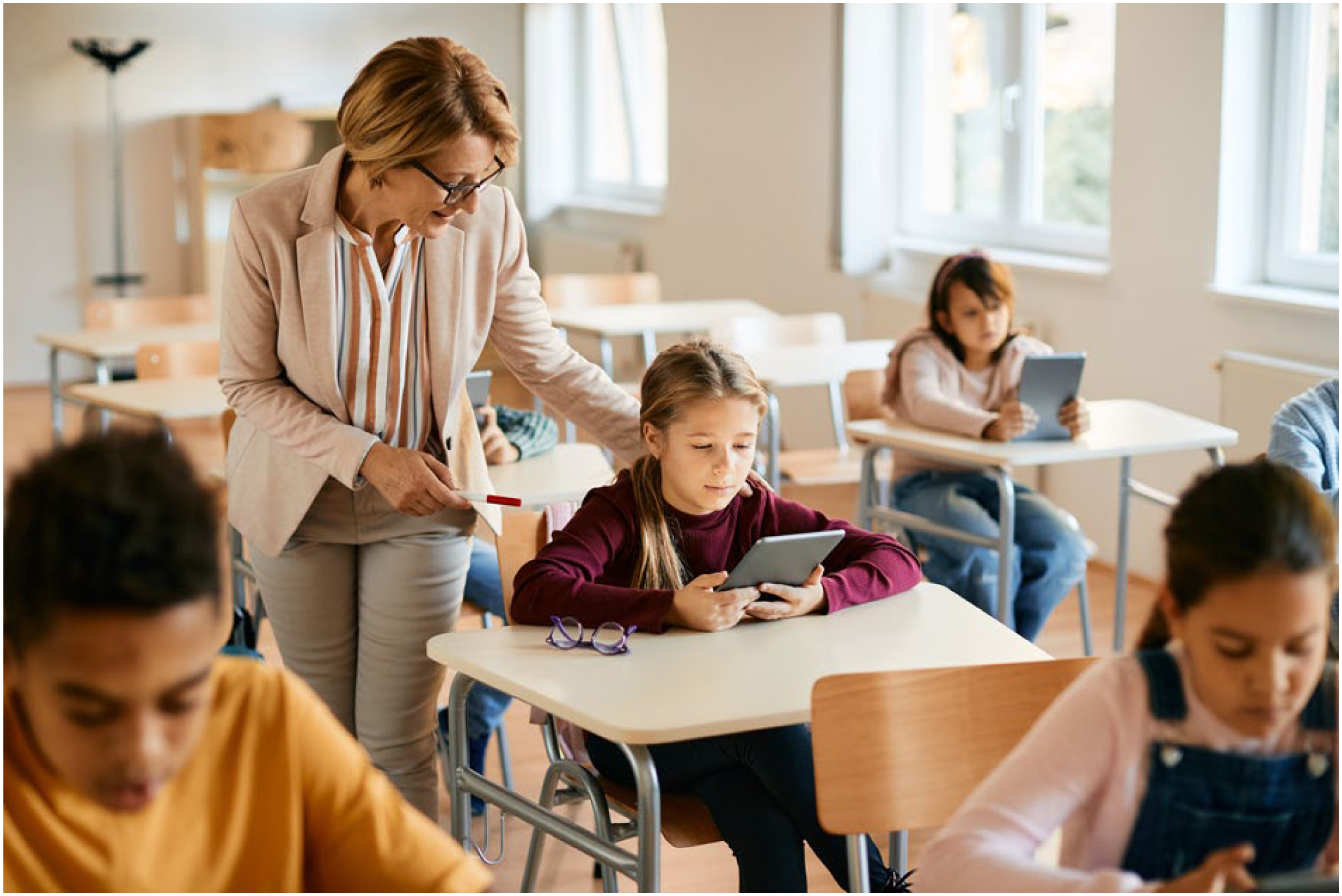
Joe is a 6-year-old boy with autism spectrum disorder (ASD). His parents immigrated from Jordan 9 years ago. He is a first grader in an inclusive classroom with 18 typically developing children and three children with disabilities. Besides the adapted curriculum, Joe receives three sessions of speech therapy and one session of occupational therapy every week. He also has an individualized education program (IEP) focused on building expressive and receptive language skills. On a recent assessment, Joe’s classroom teacher, Ms. Stephenson, noticed he cannot label several two- and three-dimensional curriculum-related stimuli, such as pictures of historical figures, plants, planets, animals, and story characters. Most students acquire the names of characters in the stories she reads to them in the reading class; however, she needs to sit with Joe individually and teach him each character’s name separately. Ms. Stephenson believes Joe’s limited naming repertoire could influence his performance in all subject areas. Hence, she receives in-class coaching from the special education teacher on implementing stimulus pairing to support Joe’s access to grade-level vocabulary items across content areas.
Definition of Naming
According to Merriam-Webster (n.d.), name is defined as “a word or phrase that constitutes the distinctive designation of a person or thing.” Horne and Lowe’s (1996) naming theory suggests that humans acquire the names of stimuli around them both expressively and receptively merely listening to someone labeling the stimulus. For instance, when the science teacher points to the digestive system while talking about its main functions and says this is the esophagus, the student acquires the name “esophagus” both as a speaker (i.e., expressively) and a listener (i.e., receptively). In other words, if the teacher points again to the digestive system and asks the student “Where is the esophagus?,” the student will point to it on their own. Similarly, if the teacher points to the esophagus and asks the same student, “What is this?,” the student will say “esophagus.” The following section describes why teaching names to students matters.
The Importance of Teaching Names to Children
Naming is an emergent verbal behavior. It is also a verbal developmental cusp (Gilmore et al., 2024) that will “open new doors” for future language and increases the rate of learning in children (Greer et al., 2011). A cusp is a type of learning that allows the learner to access new experiences or environments that were previously inaccessible. In other words, when the children acquire the naming cusp, they become able to learn new names without direct instruction. Learning the names of objects, feelings, or events is necessary for all children because it facilitates learning and social interaction. For instance, children need to use naming to request items, talk about feelings, invite others to share ideas, and answer questions about experiences.
Although it may be assumed that all children acquire the names easily and incidentally, as in the example of the science teacher, children with ASD and other developmental disabilities may have language delays that might require repeated pairings of the stimuli with their assigned names. There is evidence from research that children with ASD may not be able to name several two-dimensional pictures and objects by the end of the first grade (Greer & O’Sullivan, 2007). This lack in naming capability could result in poor educational performance in the future (Greer et al., 2011). For instance, Joe would not be able to make connections between different species and categorize them because he cannot label different types of animals. Greer et al. (2011) emphasized that naming capability is necessary for learning untaught responses with and without direct instruction. In other words, if the teacher shows a maple leaf and says, “leaf,” the learner can recognize the leaf and other similar leaves (e.g., oak leaf, rose leaf) because they have learned the vocabulary explicitly. The same thing could happen without direct instruction if the learner hears the word “leaf” on YouTube or any other source (e.g., TV, audiobook). Next, we discuss one method to teach naming to children with language delays, known as stimulus pairing observation procedure (SPOP; Smyth et al., 2006).
Stimulus Pairing Observation Procedure
The mechanism of SPOP rests on the idea that new responses develop when two stimuli (e.g., object and its name) are paired. For example, the child mimics the sound of a chicken when they see one because it was previously presented with its sound. Unlike structured teaching approaches that require certain verbal responses and programmed consequence, SPOP is straightforward (Rosales et al., 2012), requires minimal learner effort, and is easier for teachers to implement (Byrne et al., 2014). The mechanism of SPOP involves pairing a stimulus with its label repeatedly, similar to the way adults incidentally teach children new words by labeling objects in the environment without expecting immediate verbal responses (Hart & Risley, 1995; Rosales et al., 2012). Although SPOP does not follow the traditional model of systematic instruction involving prompting, feedback, and required learner responses, it maintains a systematic structure in terms of stimulus presentation, repetition, and mastery criteria.
Research on SPOP
Although SPOP is not presently considered an evidence-based practice as per the standards of What Works Clearinghouse (2022) and the Council of Exceptional Children (2014), the existing evidence on its use to teach expressive and receptive naming is promising. For instance, Byrne et al. (2014) used SPOP in a classroom setting to teach expressive and receptive labeling to three children with ASD. In a replication study using similar procedures, Solares and Fryling (2019) reported that three children with ASD met mastery criteria. This difference might be ascribed to the differing characteristics of the children in the two experiments, such as absence of interfering behaviors and better attention span. In a more recent study, Aal Ismail et al. (2023) used SPOP to teach labels of environmental sounds to a 6-year-old child with ASD. The intervention was mediated by the participant’s mother, and it successfully increased, generalized, and maintained some target sounds (e.g., doorbell, lawn mower, helicopter) for 1 week after intervention.
Steps for Implementing SPOP in the Classroom
To successfully implement SPOP, there needs to be systematic steps created and followed by the teacher or instructor. Based on the findings from the literature, the following three steps are summarized. Figure 1 provides an overview of these procedures to support application in classroom settings.
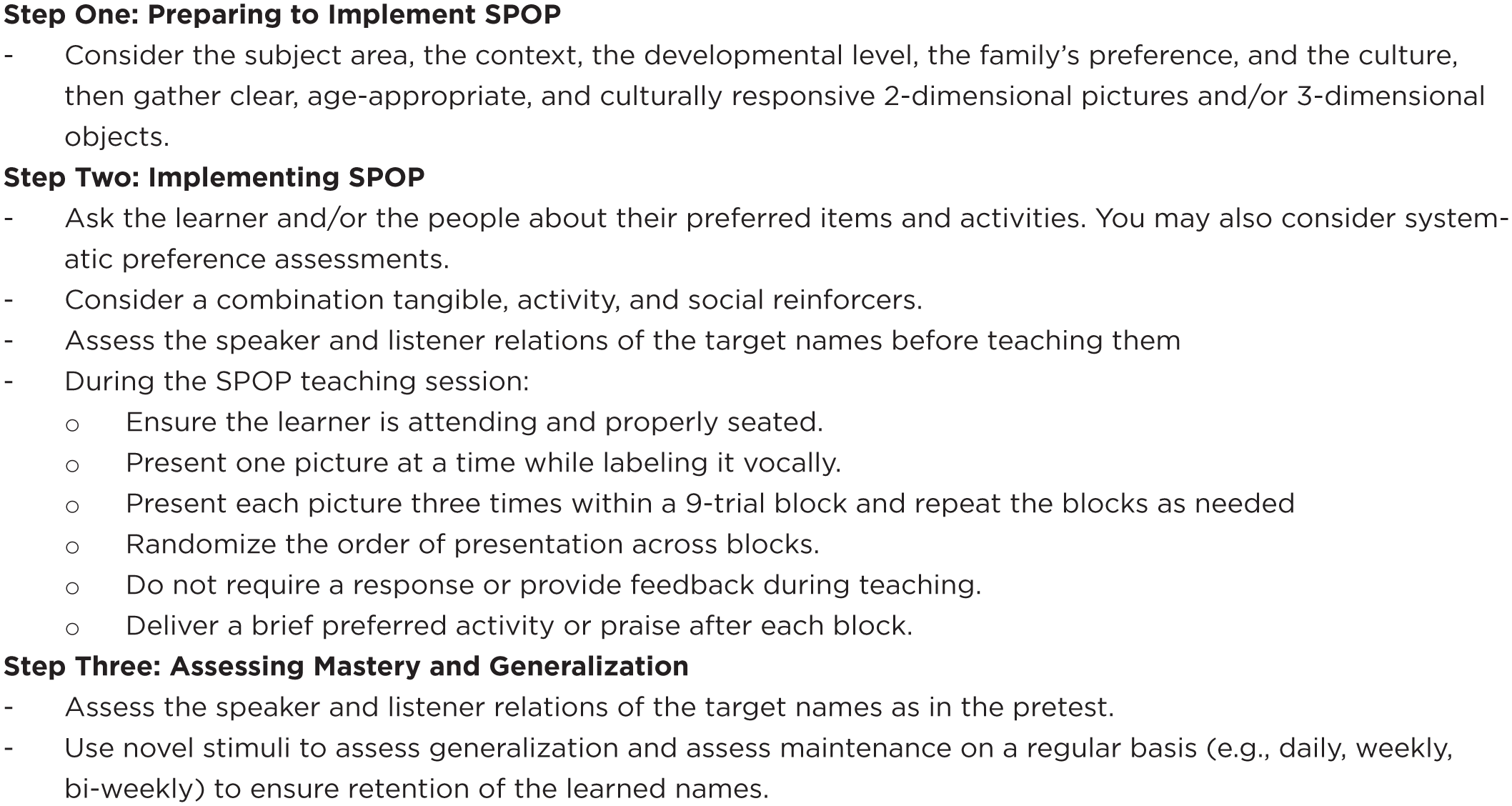
Summary of three steps to teach naming using stimulus pairing observation
Step 1: Preparing to Implement SPOP
Purpose of the step
The purpose of this step is to select the appropriate vocabulary items for SPOP instruction. Selection process also involves the modality in which stimuli will be presented (e.g., pictures, objects, sounds).
What it looks like in practice
Teachers begin by reviewing curriculum materials and selecting a small number of target vocabulary items related to current content areas (e.g., social sciences). When choosing items, they should consider student’s developmental level, age, cognitive performance, cultural background, and grade-level or adapted content standards. Family input must also be considered as per Special Education Professional Ethical Principles (Council for Exceptional Children, 2010). Teachers can supplement these items with culturally meaningful words suggested by families, such as names of foods, clothing, and celebrations. They may also use standardized assessments, such as the second edition of the Test of Word Reading Efficiency (Torgesen et al., 2012), eighth edition of the Dynamic Indicators of Basic Early Literacy Skills (University of Oregon, 2018), and/or teacher-generated content vocabulary lists to determine the student’s ability to name developmentally appropriate stimuli.
Ms. Stephenson collaborated with the speech language pathologist (SLP) and the special educator to create a separate vocabulary list for each content area. For example, the vocabulary list of social studies includes “map,” “land,” and “globe,” and the vocabulary list of science includes “leaf,” “root,” and “stem.” These vocabulary items were aligned with first-grade Common Core State Standards (e.g., CCSS.ELA-LITERACY.L.1.4) and the science curriculum. The SLP also aligned the selected vocabulary items with Joe’s expressive and receptive language goals. Ms. Stephenson also made a list of stimuli she is not sure if Joe can name on his own to assess them later. Because the family returns to Jordan every summer, they suggested a list of names such as places (e.g., Dead Sea, Wadi Rum), foods (e.g., Warak Enab, Maklouba), and relatives (e.g., Ami Hussam, Khalti Nawal), helping Joe connect with his heritage.
Special considerations
Stimuli used in teaching the names are either two-dimensional pictures, three-dimensional objects, or a combination of both. As in the study described earlier (Aal Ismail et al., 2023), teachers may also use auditory stimuli (e.g., washing machine noise) and pair it with its label (e.g., “washing machine”). Regardless of modality, stimuli should be age-appropriate and culturally responsive. There is some evidence children with autism show greater retention in picture-based tasks that involved color photographs than black-and-white cartoons (Carter & Hartley, 2021). Hence, teachers should ensure that images are clear, functional, and representative of the target concept. To facilitate stimulus generalization, teachers should present several exemplars of each stimulus (see Figure 2).
Currently, Ms. Stephenson noticed Joe becomes distracted when she uses “busy” picture scenes. A general picture of people in the park with multiple trees may be too difficult for Joe right now; therefore, the isolated science vocabulary needs to be introduced first. Hence, Ms. Stephenson and the paraprofessional, Ms. Smith, will collect isolated pictures that feature the target stimulus without any additional elements or surrounding context.
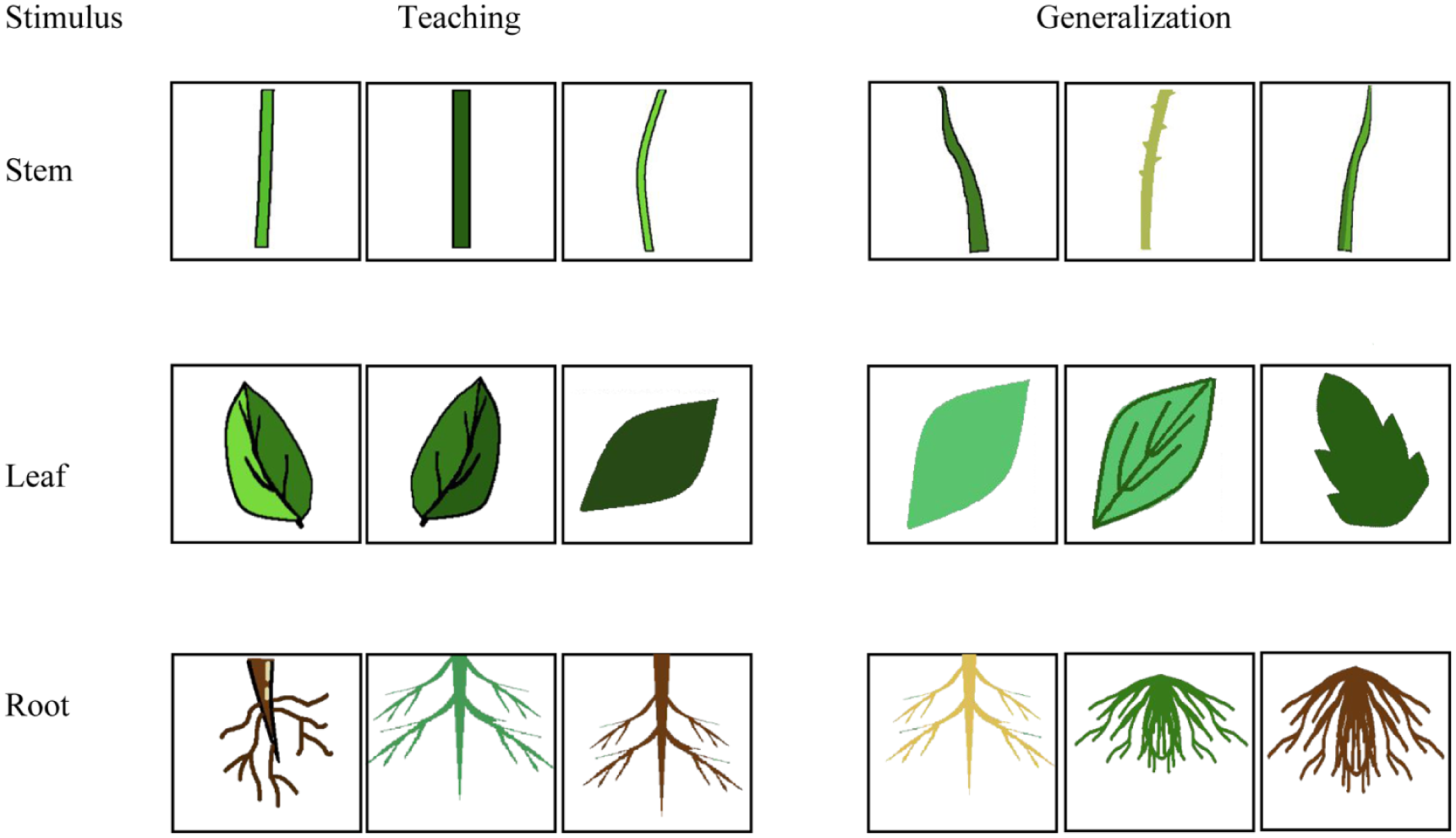
Stimuli used in teaching and generalization sessions
Step 2: Implementing SPOP
Purpose of the step
The purpose of this step is to assess the student’s preference, conduct receptive and expressive pretests, and teach the target vocabulary using SPOP.
What this step looks like in practice
Preference assessment
Teachers should begin by assessing the students’ preference. This can be done by asking the students about their preferred items or activities and consulting with the family and other school professionals. Teachers may also conduct a more formal preference assessment, as described in Chazin and Ledford (2016). The preferred items are delivered at the end of teaching and testing sessions to maintain attention. Tangibles and activities may not always work as effective reinforcers. Therefore, teachers should gradually shift to natural reinforcers, such as praise. Preference for social reinforcers (e.g., praise, high five) can be assessed via four modalities: people-based, picture-based, video-based, and vocal-based. People-based assessments show adults interacting (e.g., clapping). Picture-based assessments show images of people rewarding each other. Video-based assessments show short clips of praising or cheering. Vocal-based assessments play audio clips of verbal praise, clapping, or cheering. The teacher observes and records the student’s reactions to the modeled social stimuli and the time spent attending to teach one to determine which social reward is the most and least preferred. Video-based assessment is considered the most effective modality (Morris et al., 2023).
Ms. Stephenson created an “I am working for” board. On the board, she placed laminated picture cards that represent the items Joe likes so he can choose what he wants to receive after completion of the task. Joe’s family also provided Ms. Stephenson with the songs and the praise statements he loves to hear, such as an individualized song named “Hello, My Name Is Joe.”
Pretests
Pretests should be conducted immediately before each teaching session. Prior to the pretest, the teacher ensures that the learner is paying attention by either making eye contact or looking at the teaching materials. If the learner is not attending, the teacher prompts them by saying, “Look at me” or “Look at the picture.” If the learner is attending, the teacher assesses the preference by asking “What do you want to work for?” or by asking them to select their favorite tangibles and activities from the choice board. The pretest assesses two naming relations: speaker (i.e., expressive) and listener (i.e., receptive). Each part has three stimuli in a 9nine-trial block, with each stimulus presented three times (see Figure 3). The teacher begins with the speaker relation, holding up a picture and asking, “What is it?” Responses are coded as correct (C), incorrect (I), or no response (NR). A correct response matches the target stimulus without a prompt, such as saying “stem” when seeing the flower’s stem. Incorrect response does not match the target stimulus, such as saying “root” when the teacher is pointing to the stem. Making more than one response in the same trial is counted incorrect even if the learner responds correctly. No response is when the learner makes no response after the passage of predetermined period (e.g., 3–5 seconds). Teachers should not praise or correct responses during the pretest but may thank the learner, deliver a small edible, or allow brief access to preferred activities after the session.
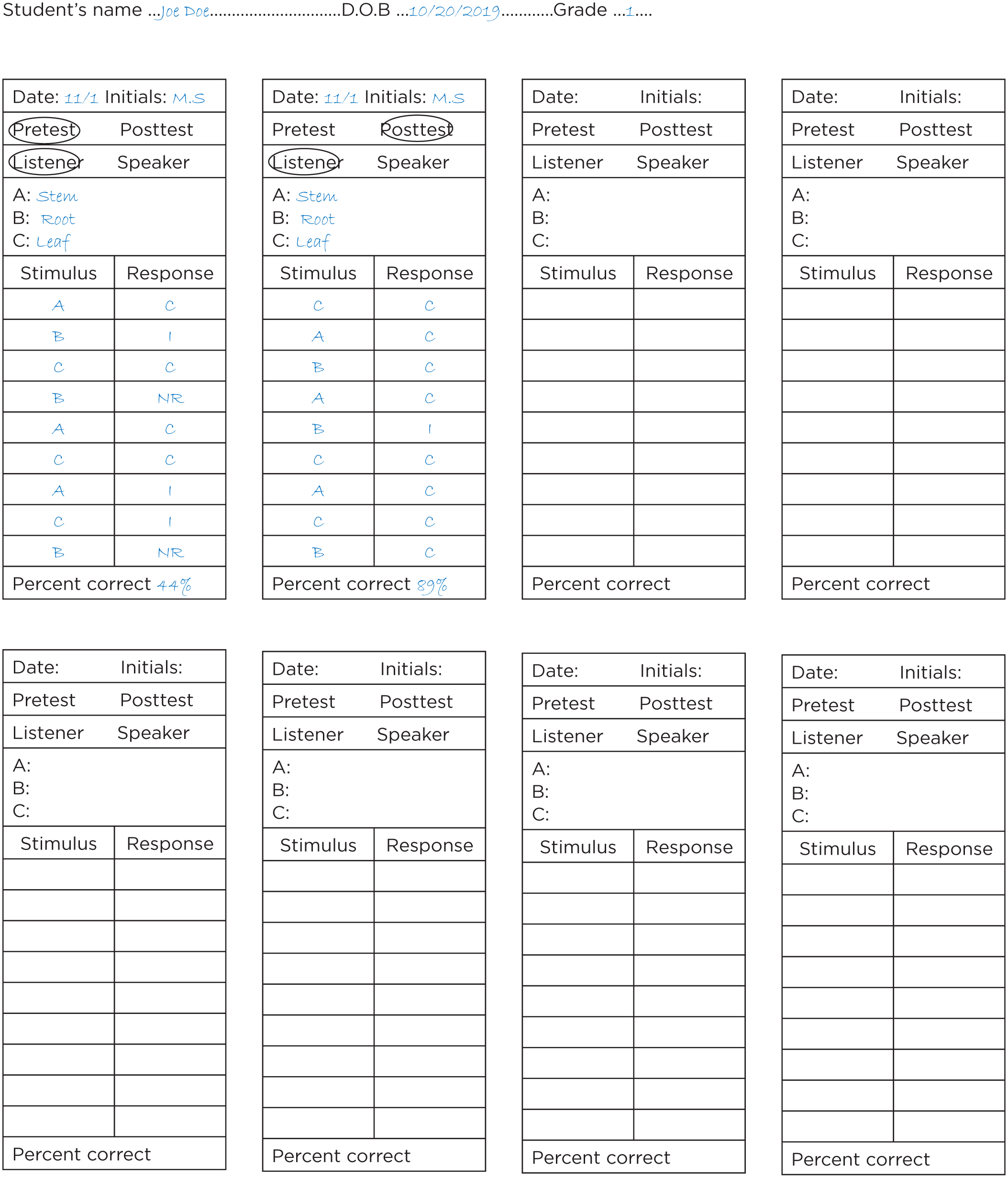
Data collection sheet
Joe was not attending during the pretest. Ms. Stephenson noticed he keeps fidgeting and rocking the chair. She told him, “Let’s do a quick activity. I will show you some pictures, and then I will give you a movement break.” Joe happily agreed to do the task and showed compliance.
After a brief or timed break, the teacher assesses the preference again and conducts a pretest for the listener relation of naming (i.e., receptive). To assess the listener relation, the teacher makes sure the learner is attending, places the same three pictures used in the pretest of speaker relation on the table or on a board, and says “point to,” “touch,” or “find” [stimulus’s name]. The teacher allows a predetermined period for the learner to respond (e.g., 3–5 seconds). This period varies depending on the learner’s required response latency. The teacher records the response as in the speaker relation and should not move to the next trial if the learner is not attending. The correct response (C) again is recorded if the learner points or touches the correct picture without prompt. The incorrect response (I) is recorded if the learner points to or touches a picture other than the one the teacher names, such as pointing to the flower when the teacher says “bee.” If the learner points to or touches more than one picture, including the correct one, the teacher records this response as incorrect. No response is when the learner makes no response after the passage of predetermined period (e.g., 3–5 seconds). The teacher ends the session with praise and/or a small reward.
Teaching procedure
Before SPOP instruction, the teacher conducts a quick preference assessment and ensures the student is attending and seated. Teaching begins by presenting one picture at a time while naming it. The teacher presents stimuli systematically to avoid errors or overload. For example, the teacher shows the picture of leaf and says “leaf” and then waits 2 seconds before the next stimulus. The teacher should not proceed if the learner is not attending. Stimuli are presented in random order to prevent rote learning. Each trial block has nine trials, with each stimulus shown three times (see Figure 3).
Ms. Stephenson scheduled brief 1:1 SPOP sessions during literacy centers to avoid disrupting the class. Other students worked in small groups, with Ms. Smith providing support as needed. Ms. Stephenson sat across from Joe with nine picture cards. She showed each card, named it, waited 2 seconds, and then presented the next card. After presenting all nine cards, Joe received praise and a 1-minute break. Sessions lasted about 5 minutes and occurred three to five times per week.
Special considerations
In case of noncompliance or inattentiveness, the teacher may implement one or more of the following behavioral strategies that enhance attention, such as (a) redirection (e.g., reminder to sit nicely in order to do a more preferred activity), (b) reducing the distractors (e.g., moving the activity away from the window), (c) moving to a less noisy environment, and/or (d) response blocking in case of aggressive or self-injurious behaviors (e.g., self-biting). If the student has a behavior intervention plan, the teachers should strictly adhere to the recommended strategies and procedures. We warn against introducing more than three to five stimuli in one session to avoid overwhelming the student.
The teacher may divide the session into trial blocks separated by brief breaks in which the praise and/or the rewards are delivered. The number of trial blocks depends on the learner. One trial block may be adequate for some learners, whereas others may require additional blocks to meet the mastery criterion. However, deciding whether the student requires additional blocks and/or sessions is determined by the data collected on the posttest. Generally, the teachers may begin with five nine-trial blocks, as in the studies of Solares and Fryling (2019) and Byrne et al. (2014). It is worth reminding that the SPOP approach does not require any verbal response from the learner and no feedback from the teacher. Also, data collection is not required during the teaching session.
Other school professionals can guide the instruction. For instance, the occupational therapist might offer sensory and seating supports to enhance attentiveness and regulation. For more efficient, ethical, and individualized delivery of reinforcement, teachers should plan beforehand to gradually reduce tangible reinforcers and shift from a continuous (i.e., delivering a reward after every correct response) to an intermittent reinforcement schedule (i.e., delivering a reward after some correct responses). This shift is determined by the learner’s progress and performance.
Step 3: Assessing Mastery and Generalization
Purpose of the step
The purpose of this step is to assess mastery of target vocabulary items and whether they generalize to novel exemplars and are maintained over time following instruction.
What this step looks like in practice
Before initiating SPOP instruction, teachers should set criteria for mastery. The initial mastery criteria may be set at eight out of nine (89%) for three consecutive days or sessions. To assess mastery, the teacher conducts at least three posttests in three consecutive days or sessions. However, raising the mastery criterion to 100% enhances the maintenance of the mastered skills for children with developmental disabilities (Pitts & Hoerger, 2021). If the data show that the student did not meet the mastery criterion for one or more stimuli, the SPOP must be repeated until the mastery criterion is met. The teacher should not repeat the posttest if the first posttest shows the mastery criterion has not been met yet. Rather than conducting additional posttests, it is more efficient to use that time to repeat the SPOP instruction.
Students with ASD may not relate new stimuli with ones they experienced previously (de Marchena et al., 2015). For example, Joe may expressively and receptively identify maple leaf as a leaf but may not do so when the teacher presents a picture of rose leaf. Therefore, it is important to assess generalization of the stimuli the student was taught and has acquired at mastery. To assess generalization, the teacher follows the same procedure of the posttest using novel stimuli. For example, the teacher uses three pictures of leaves that were not previously included in the pretest, posttest, or teaching sessions. Generalization should extend beyond identifying different exemplars of a single stimulus. It must also encompass identifying the target stimulus across content areas, for example, labeling “root” whether it appears in the science laboratory or in a social studies textbook.
Learners with ASD also tend to lose the skills after they acquire them (Weiss et al., 2008). To facilitate maintenance, it is recommended to run daily cold probes. Cold probes help the teacher track the target skills without collecting trial-by-trial data. On the cold probe, the teacher presents one picture at a time for each target stimulus, and asks, “What is this?” If the student responds correctly, the teacher praises the student. If the student responds incorrectly or gives no response after the passage of predetermined period (e.g., 3–5 seconds), the teacher prompts the correct response and repeats the question. The teacher also runs another cold probe in the same session for the listener relation of naming by presenting three pictures at a time and asking the student to touch or point to a specific one. The teacher may use the tracking sheet in Figure 4 to track acquisition, maintenance, and generalization of each stimulus. This tracking sheet not only provides the dates of task completion, but it may also be used as a communication tool to families and in the individualized family services plan or IEP meeting.

Naming tracking
Ms. Stephenson noticed that Joe made several specific errors during the posttest. For example, when asked to label a picture (speaker relation), he often did not respond at all. During the listener posttest, when given the direction “Find the stem,” he incorrectly touched the picture of a leaf. Based on these observations, Ms. Stephenson decided to withhold the posttest and repeat the SPOP session to support Joe in reaching mastery.
Special considerations
The teacher should be flexible with response latency based on individual needs, such as auditory or motor delays. The predetermined period between the question and the student’s response varies across learners. For example, students with auditory processing deficits or motor difficulties may need longer time to respond. If the student responds correctly on the second trial, the teacher will praise the student and move to the next stimulus. What also helps maintaining the skills after learning them is contacting naturally occurring reinforcers (Wheeler et al., 2014). Teachers should gradually reduce the tangible reinforcers for the mastered responses and increase opportunities for contacting the naturally occurring consequences. For instance, the teacher may plan for a game or group activity in which the learner and their peers use the target stimuli.
Ms. Stephenson and Ms. Smith designed an activity in which Joe and two of his peers will glue parts of the flower (leaves, stem, root) onto a heavy paper. Later, Joe and his peers will share their work with the teachers and name each part. Ms. Stephenson and Ms. Smith will clap and praise Joe and his peers after completing the activity.
Technology and Special Populations
Two-dimensional pictures and three-dimensional objects are not the only types of stimuli a teacher may use when implementing the SPOP approach. The teacher may display the stimuli on a smartboard, smartphone, or tablet device, such as an iPad (Vallinger-Brown & Rosales, 2014). To enhance generalization outcomes, the teacher may alternate the presentation of target stimuli between physical pictures, objects, and digital ones. Many learners with ASD and other developmental and physical disabilities are minimally verbal. A considerable number of learners with ASD use augmentative and alternative communication aids, such as picture exchange communication system (Bondy & Frost, 1994), sign language, or tablet devices, to communicate. The teacher may adjust the response requirement and the teaching format depending on the individual needs and abilities of each learner. For example, the teacher may replace the verbal response on the speaker relation of naming by manual signs. As another example of adjusting the response requirement, the teacher may require a student with severe physical disability to use an eye-tracking system instead of pointing or touching in listener relation tasks.
Addressing Limited Learner Progress
There are several factors the teacher should consider if the learner is not making significant progress. First, reconsider the stimuli. The pictures or objects used in teaching may lack clarity or iconicity, such as a blurred image, a cluttered photo with various elements, and abstract illustrations. It is also important to think of the resemblance between the stimuli used in teaching and the novel ones. For example, as he learns the vocabulary “leaf,” Joe may not recognize the picture of pine leaves used to probe generalization because they resemble needles. Second, consider the similarity of names or stimuli used in teaching. For example, the homonyms “there” and “their” may confuse the learner because they sound similar. Also, some names might sound different but look similar, such as apple, peach, and pomegranate. In these cases, the teacher may teach similar words or stimuli in separate sessions. Third, the target words are possibly hard to articulate. The teacher may think of easier alternatives if the student is unable to produce some words. Fourth, challenging behaviors during teaching sessions may hinder the progress. Teachers should consider the student’s behavior intervention plan and behavior management strategies and/or consult a behavior specialist. Fifth, reconsider the reinforcers. It is possible the learner is not attending or making significant progress because they are not receiving sufficient reinforcement or the rewards are not reinforcing. The teacher may readminister the preference assessment as needed. Asking the learner about their preferred items and activities on an ongoing basis is crucial because preferences vary across time. The student may also not be able to wait until the end of the session to receive the reward. Thus, the teacher may offer small rewards and/or praise in between the trials during teaching or probe sessions to maintain compliance and attentiveness.
Conclusion
Naming is a vital skill for children with ASD and other developmental disabilities because it facilitates learning and social interaction. Unlike traditional methods of teaching in which the instructor collects trial-by-trial data and gives feedback in form of reinforcement or error correction for each response, the SPOP approach (see Figure 1) facilitates acquisition of names by merely pairing the stimulus with its corresponding label. Incorporating the target stimuli in naturalistic activities (e.g., games, leisure activities), administering quick probes, and presenting novel stimuli may help with generalization and maintenance of the acquired names.
Footnotes
Declaration Of Conflicting Interests
The authors declared no potential conflicts of interest with respect to the research, authorship, and/or publication of this article.
Funding
The authors received no financial support for the research, authorship, and/or publication of this article.
