






Abstract
Ms. Rivera was concerned about how to prepare for her incoming student, Alex, a student with visual impairment (VI), who was expected to join her eighth-grade English class. Before the school year started, she studied Alex’s individualized education program (IEP) thoroughly, noting his ability to read large print but his preference for audio materials during longer readings. She also noted that Alex utilized equipment that she had never heard of, such as a portable video magnifier and a screen reader. Feeling overwhelmed by new terminology and accommodation requirements, Ms. Rivera sought guidance from her school’s itinerant teacher of students with visual impairment (TSVI), Mr. Thompson. Itinerant teachers, or teachers who travel between campuses, carry a caseload of students across schools or districts (Holbrook et al., 2017a, 2017b). Mr. Thompson scheduled a virtual meeting with her to define his role as a TSVI, discussed some practical ways to immediately address Alex’s accommodations in the classroom, and committed to ongoing collaboration with her. He started with a comprehensive list of strategies (see Table 1) and scheduled convenient co-planning sessions according to her schedule as they worked together to create an inclusive classroom environment. This approach would help her ensure Alex could fully participate in every aspect of Ms. Rivera’s English class.
Inclusive Practices to Promote Classroom Community
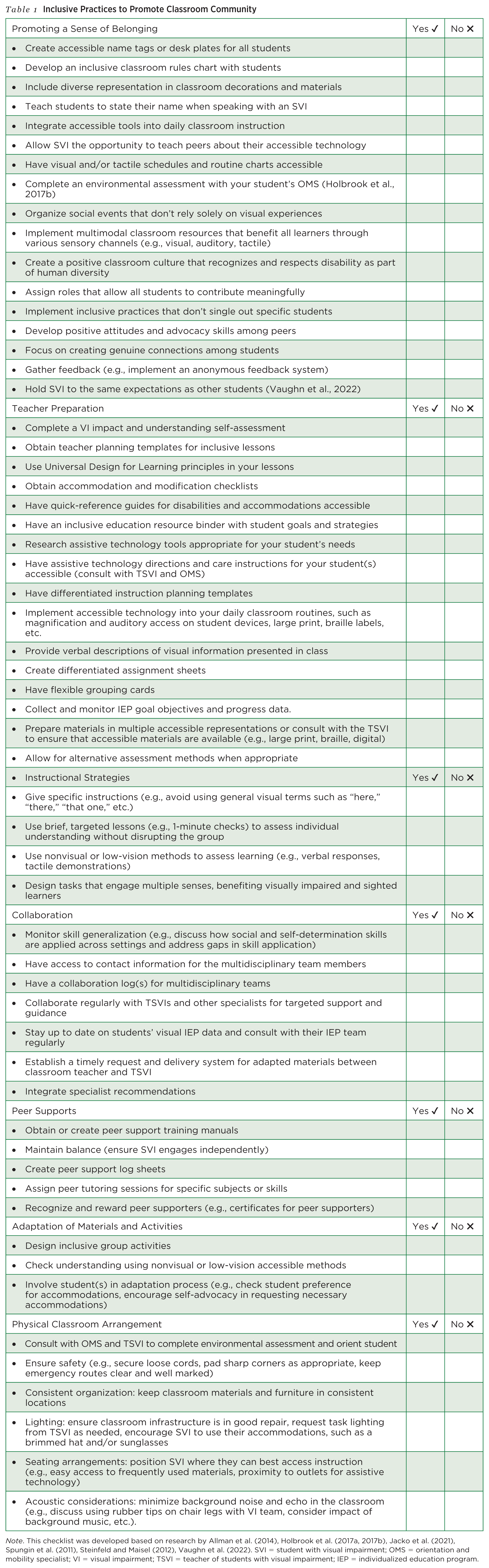
Note. This checklist was developed based on research by Allman et al. (2014), Holbrook et al. (2017a, 2017b), Jacko et al. (2021), Spungin et al. (2011), Steinfeld and Maisel (2012), Vaughn et al. (2022). SVI = student with visual impairment; OMS = orientation and mobility specialist; VI = visual impairment; TSVI = teacher of students with visual impairment; IEP = individualized education program.
This guide provides an overview of strategies to support students with visual impairments (SVIs) in the general education classroom. Due to the visual nature of child development and learning, VI can have a wide-reaching impact on individuals that can include an individual’s ability to learn, understanding, and use of social-emotional skills (Allman et al., 2014; Manitsa & Doikou, 2020). According to the World Health Organization (2019), VI occurs when an eye condition impacts one or more of the functions of the visual system. Although VI is a spectrum that can range from no light perception to low vision, the legal definition of blindness is considered to be 20/200 or a field loss of 21° or less (American Printing House for the Blind, 2025; Social Security Administration, 2019). However, a student does not need to qualify as legally blind to be identified as an SVI. Under the Individuals with Disabilities Education Act (2006), the key eligibility criteria for services from a TSVI or orientation and mobility specialist (OMS) in schools is a visual diagnosis and an impact in access to the educational curriculum that requires explicit instruction (Darst & Tabb, 2021). TSVIs utilize three main evaluations: functional vision assessment (FVA), learning media assessment (LMA), and expanded core curriculum assessment (ECC), to determine educational access needs; OMSs conducts an orientation and mobility evaluation to assess safety and independent mobility skills (Holbrook et al., 2017a, 2017b). During their evaluations, TSVIs and OMSs use a combination of medical, educational, and observational data in combination with family and staff interviews to determine if a student is eligible for services. If a student is eligible for services, the TSVI and OMS then utilize tools such as the ECC to determine IEP goals, accommodations, and service times (Allman et al., 2014).
Specifically, considering the unique needs of SVIs, educators can create respectful, equitable, and inclusive learning environments. This guide employs strategies based on Universal Design for Learning (UDL) principles to discuss how to design and implement an inclusive classroom setting for SVIs. The strategies discussed here aim to promote collaboration among teachers, providers, and service team members, recognizing that SVIs require individualized, interdisciplinary approaches for effective classroom access and support (Gimbert et al., 2021; Spungin et al., 2011). By moving beyond simple adaptations to embrace comprehensive inclusion, educators can transform their classrooms into spaces where SVIs not only participate but also truly belong. Through these efforts, educators can create inclusive classrooms, where all students can thrive academically, socially, and emotionally regardless of visual ability.
UDL in the Classroom for SVIs
Creating an inclusive classroom environment for SVIs requires a comprehensive, systematic approach that addresses multiple aspects of the educational experience. UDL principles provide an effective guideline for creating an inclusive environment (Steinfeld & Maisel, 2012). UDL principles emphasize the importance of learner agency through multiple means of engagement, representation, actions, and expression, such as optimizing choice and autonomy, accessible design and language, multiple methods for interaction, and intentional planning (CAST, 2024). While universal design does not negate the need for specific tools, such as assistive technology, it incorporates common accessibility features into the classroom for all learners. Educators can implement universal design principles and multimodal classroom resources that benefit all learners through various sensory channels (Stylianidou & Nardi, 2023). This approach allows teachers to support SVI swithout singling them out or drawing unnecessary attention to their disability. UDL is particularly helpful for SVIs because it promotes flexible learning pathways and multiple ways to demonstrate knowledge, allowing students to engage with content and express their understanding through their strongest sensory modalities and learning media.
The following sections are based on UDL principles and outline six key areas of focus: teacher planning, preparation, and instructional strategies; collaboration with specialists; physical classroom setup; adaptation of materials and activities; fostering peer supports; and promoting a sense of belonging (CAST, 2024). Each area includes practical strategies, reflection questions, and action steps to help educators implement these approaches effectively in their classrooms.
Planning, Preparation, and Instructional Strategies
A significant and effective strategy to promote community and belonging in the classroom is through teacher planning, preparation, and utilization of strategies. The general education teacher is a pivotal member of the student’s service team (Allman et al., 2014; Holbrook et al., 2017a, 2017b) and is essential in promoting community and belonging for SVIs. While specialists such as the TSVI and OMS provide consultative and direct services to special education teachers, staff, and students, general education teachers are responsible for the daily implementation of most accommodations and modifications (Allman et al., 2014; Spungin et al., 2017). By staying flexible, seeking feedback from their student(s) and specialists, and being willing to adopt new approaches, general educators participate in the ongoing iterative processes of effective inclusion (see Table 1).
Reflection questions
What do I know about the specific SVI needs in my classroom?
How flexible are my current instructional strategies in accommodating different learning needs?
What resources or training do I need to support SVIs better?
Action steps
Choose one strategy from Table 1 to implement in your next lesson. Reflect on its effectiveness and adjust as necessary.
Ms. Rivera learned to modify her usual teaching style based on Alex’s learning needs. She learned how to remind Alex to use his video magnifier to look at the interactive whiteboard and how to ensure that the accessible features were turned on in the learning platform that her district used for lessons and student work. She was pleased to notice that several students had started using features such as text-to-speech and digital highlighting in the learning platform since they became available.
She met with Alex several times to develop a system of providing instructions in multiple formats. Alex preferred most materials in a digital format through the learning platform so that he could adjust the contrast of the image, toggle his screen reader on and off, and enlarge the text as needed. Alex used tools like Bookshare and Learning Ally to access adapted, digital versions of many of the texts used in class.
Once a month, during her planning period, Ms. Rivera met virtually with Mr. Thompson, the TSVI, for about 15 to 30 minutes to review upcoming lessons and discuss adaptations. They used emails and a shared folder in a cloud-based storage service to share information between meetings. Their timely collaboration allowed Mr. Thompson to order materials on quota from American Printing House for the Blind ahead of time, request various assistive technology devices according to Alex’s FVA and LMA and classroom needs, and plan lessons to ensure Alex had access to appropriate digital tools and knew how to use them effectively.
Collaborating With Specialists and Support Staff
Another crucial component of creating an inclusive classroom is collaboration (Leigers et al., 2017). Creating an inclusive classroom for SVIs requires effective collaboration with specialists and support staff (Spungin et al., 2011). SVIs may receive services from a variety of providers, including what is commonly referred to as the “visual impairment” team. The VI team may consist of specialists such as the TSVI, the OMS, a braillist or transcriber, and other VI professionals (Society of Exceptional Educators, 2025). Some TSVIs also serve as their students’ OMS, which is called “dual certification” (Texas School for the Blind and Visually Impaired, 2024). Approaching services with an interdisciplinary mindset, collaborating with specialists to develop materials in a timely manner, and making time to train together as a professional team are the first steps to creating an inclusive classroom community. IEP service team members, including classroom and special education teachers and TSVIs, should communicate regularly with each other to plan and review goal progress and inclusive strategies both within and outside of their own instructional spaces. This collaboration allows team members to determine why a goal-based skill is or is not successful in various settings and to prioritize specific instructional strategies over others.
Although it can be difficult for classroom teachers to consistently participate in IEP meetings, they can support their SVI by providing the rest of the IEP team with observations and data about student progress and seeking clarification on implementing IEP goals (Allman et al., 2014). When feasible, opportunities to learn from specialists, such as observing lessons conducted by TSVIs and requesting specific training, are essential. Equally important is sharing expertise about student performance in the general education setting and discussing ways to make academic content more accessible. Teachers can use technology for virtual meetings when necessary to overcome collaboration barriers, such as time constraints and scheduling conflicts. Finally, integrating specialist recommendations by implementing one to two specific suggestions after each collaboration and documenting results for discussion in subsequent meetings helps ensure continuous improvement in supporting SVIs (see Table 1).
Reflection questions
How can I improve my collaboration frequency and effectiveness?
What barriers hinder collaboration, and how can I address them?
How can I better integrate specialist recommendations and IEP goals into my teaching?
Action steps
Schedule a meeting with the TSVI to discuss current student IEPs and strategies.
Create a shared document for ongoing communication with support staff.
Observe a TSVI-led lesson to learn new techniques.
Ms. Rivera had carefully organized her classroom with accessibility in mind. She had met with Ms. Johnson, Alex’s OMS, to create a more accessible classroom arrangement with clear pathways between the desks and other major classroom features. Ms. Rivera had worked with Mr. Thompson, Alex’s TSVI, to create a consistent color-coded system with large print labels where materials were always stored in the same locations. She made sure to quietly take a moment to show Alex any changes to the classroom organization system before announcing it to the whole class. Alex also chose to put a strip of neon green paper across the top of his journal with clear packing tape so that his journal was easier to spot in the bin.
Ms. Rivera made sure to submit a work order before the school year officially started to repair the window blinds so that the classroom lighting was more adjustable. In addition to Ms. Rivera submitting the work order, Alex’s TSVI provided a small desk lamp that could be used for specific task lighting as needed. Thanks to the telescoping feature of his portable video magnifier, Alex did not necessarily have to sit in the front of the classroom to see the board, so he was able to choose a seat that was more effective for reducing glare.
Setting Up the Classroom
The physical arrangement of the classroom is vital for creating an inclusive environment for SVIs. By arranging the classroom with considerations to safety and full participation of all students, teachers can create a space that promotes independence, safety, and full participation for all students (Vaughn et al., 2022). Key elements include clear pathways and consistent organization, tactile symbols as needed, high-contrast colors, adequate and adjustable lighting, strategic positioning of students, and minimizing background noise. An SVI’s TSVI and OMS can provide specific guidance from the FVA, LMA, and orientation and mobility assessment to ensure that the accommodations are appropriate. The TSVI and OMS are also responsible for providing specific materials, such as tactile symbols for pre-braille or Deafblind students, braille labels, or other materials accessible for individuals with VI. The VI team works with the IEP service team to determine which materials are necessary for the classroom. While the VI team provides specialized materials as needed, many adaptations can be made using common items already found in the classroom. Furthermore, meaningful and universal adaptations create a more accessible and supportive learning environment for all students (see Table 1).
Reflection questions
How does the current classroom layout support or hinder SVIs?
What areas of the classroom could be more clearly defined or organized?
How can I balance the needs of SVIs with those of other students?
Action steps
Conduct an environmental assessment of your classroom with your student’s TSVI and/or OMS, noting areas for improvement.
Implement a consistent organization system for classroom materials each week.
Adjust lighting in at least two areas of your classroom to support various visual tasks.
For the poetry unit, Ms. Rivera prepared materials in multiple formats. Following the core principles of UDL, Ms. Rivera gave all students a printed copy of the poems in a 14-point sans serif font. She also uploaded a digital copy of the poems and accompanying YouTube links of audio recordings of the poems to the learning platform for her class. During group analysis activities, Alex used his handheld video magnifier to complete the worksheets because he could carry it around to each gallery walk station around the room. His TSVI, Mr. Thompson, had provided Alex with the handheld video magnifier based on a variety of data, such as Alex’s medical eye report, LMA, and the scope and sequence that Ms. Rivera had provided at the beginning of the school year. Alex and Mr. Thompson also had individual lessons throughout the week for Alex to work specifically on using his equipment, also known as assistive technology, independently.
Adaptation of Materials and Activities
Creating a supportive environment involves several key areas of adaptation of materials and activities. Additionally, balancing diverse learner needs with group dynamics for an inclusive classroom can be achieved by using differentiated instruction and flexible teaching roles, designing activities that provide meaningful reinforcement for all students, and implementing brief, targeted lessons to check individual understanding without disrupting the group (Singer et al., 2021; Vaughn et al., 2022).
To ensure lessons are accessible to SVIs, teachers should follow a systematic approach. First, assess current materials by reviewing the scope and sequence of the year’s lesson content through the lens of visual accessibility, identifying which materials need adaptation. It may be helpful to review lessons by unit or chapter. Next, work with the TSVI to determine necessary adaptations, such as large print versions of written materials; tactile graphics of diagrams, charts, or maps; converting text to braille or digital formats for screen readers; and high-contrast colors for visual materials. While the TSVI is responsible for providing adapted materials, such as braille and tactile graphics, materials must be provided ahead of time to the TSVI in an agreed-on period, such as 1 to 2 weeks, to allow for material preparation (Holbrook et al., 2017a, 2017b). Additionally, modify classroom activities to allow extra time for hands-on exploration of materials. Lastly, remember that effective adaptation is an ongoing process; regularly assess the effectiveness of the adaptations and be willing to adjust the approach based on student feedback and performance. Combined with differentiated instruction and flexible teaching roles, this process helps create a supportive and inclusive environment that balances diverse learner needs with group dynamics (see Table 1).
Reflection questions
How can I make my current materials more accessible?
What materials require planning ahead and support from the TSVI?
Which activities might unintentionally exclude SVIs?
How can I better involve students in the adaptation process?
Action steps
Review upcoming lessons and identify at least one material to adapt.
Create a tactile version of a frequently used classroom resource.
Schedule a meeting with your student to discuss preferences for adaptations.
Ms. Rivera had carefully selected and trained several peer supporters, rotating them regularly to prevent overdependence while ensuring Alex always had support when needed.
Fostering Peer Supports and Interactions
Peer supports are an effective strategy for promoting SVI inclusion. This approach involves training grade-level peers to provide social and academic support to classmates with disabilities (Leigers et al., 2017). Kennedy et al. (2008) defined peer supports as “arranging for one or more peers without disabilities to provide ongoing social and academic support to their classmates with severe disabilities while receiving guidance and support from paraprofessionals, special educators, and/or general educators” (p. 10). Peer support reduces the need for constant adult intervention, improves classroom dynamics, enhances social interaction, and minimizes potential social stigma (Leigers et al., 2017). However, it is crucial to maintain a balanced approach.
Implementing peer supports for SVIs promotes inclusion through a structured approach (Heyl & Hintermair, 2015; Kennedy et al., 2008). Teachers should identify potential peer supporters who demonstrate empathy, patience, and leadership skills, ensuring a diverse group to prevent burnout. These peers receive specialized training from IEP service team members covering VI, support techniques, and academic and social assistance strategies. Clear roles and expectations are established, defining peer support in the classroom and emphasizing that supporters should not complete work for SVIs. Regular monitoring is essential, with teachers observing interactions and checking in with both supported students and peer supporters. Again, balance is key; SVIs should engage independently in classroom activities, manage their materials, and complete their own work. To prevent overreliance, rotate peer supporters. By recognizing and implementing peer support as an evidence-based practice, teachers can effectively promote inclusion and independence for SVIs while fostering a supportive classroom environment.
Reflection questions
How can I enhance current peer interactions in my classroom?
What barriers exist to positive peer interactions, and how can I address them?
How can I ensure that peer support promotes independence rather than dependence?
Action steps
Identify three to five potential peer supporters in your classroom this week.
Schedule a brief training session for these students.
Implement one peer-supported activity in the next 2 weeks.
Rather than singling Alex out, Ms. Rivera created opportunities for all students to shine in their own ways. During poetry recitations, some students performed traditionally, others created musical interpretations, and Alex chose to record his performance with carefully selected background sounds to enhance the imagery. Ms. Rivera had also established a class culture where asking for preferences and accommodations was normalized. Students regularly shared their learning preferences, and adaptations were seen as tools available to anyone who found them helpful.
Promoting a Sense of Belonging
As referenced in the UDL principles, promoting community and a sense of belonging in the classroom offers numerous benefits for all SVIs (CAST, 2024). These benefits include enhanced social inclusion, improved peer relationships and empathy, feelings of acceptance, and potentially higher achievement for individuals with disabilities compared to segregated settings (Jacko et al., 2021; Manitsa & Doikou, 2020; Oviedo-Cáceres et al., 2021). It is important to note that while schools strive for policy compliance in educating students in the least restrictive environment, for many individuals with disabilities, the sense of belonging takes precedence over inclusion (Leigers et al., 2017; Ziegler et al., 2020). Creating belonging is crucial for all students, especially those with VIs. One of the best ways to brainstorm inclusive classroom strategies is to simply ask SVIs for their input on how they would adapt their classrooms. To promote belonging, follow these key strategies: (a) implement high-quality inclusion practices, (b) use cooperative learning activities, (c) foster social and academic belonging, (d) enhance learning opportunities for all students, and (e) develop positive attitudes and advocacy skills among peers (Leigers et al., 2017; Ziegler et al., 2020; see Table 1).
Reflection questions
How welcoming is my current classroom environment for all students?
What assumptions might I have that could unintentionally exclude students?
How can I better incorporate diverse representations in my classroom?
Action steps
Implement a system of nonvisual cues this week.
Create a leadership opportunity for an SVI in your next class project.
Review and update your classroom decorations to ensure diverse representation.
As the semester progressed, Ms. Rivera noticed an increase in Alex’s comfort and participation in class. The combination of clear verbal descriptions, consistent classroom layout and organization, and providing materials in various formats had created an environment where Alex could fully engage. She also observed that her inclusive strategies had benefited all students. The clear organization helped everyone stay focused, the multiple methods of representation for materials supported different learning preferences, and the collaborative atmosphere strengthened the entire class community.
Additional Considerations
Creating an inclusive environment for SVIs involves balancing support with privacy preferences. Some students may wish to keep their disability private, necessitating a sensitive approach from educators. To address this, UDL principles and multimodal resources can benefit all learners without singling out individuals (Stylianidou & Nardi, 2023). Inclusion and self-determination are crucial, allowing students control over their voice, agency, and choices (Allman et al., 2014; Burke et al., 2024; Leigers et al., 2017; Ziegler et al., 2020). To understand student preferences without drawing attention to specific individuals, educators can use reinforcement surveys (Stylianidou & Nardi, 2023). For learners who are more private, classroom teachers can offer support by articulating clear expectations, modeling positive interactions, and embedding social skills in daily routines and academic instruction (Manitsa & Doikou, 2020; Spungin et al., 2011). Throughout this process, it is important to recognize that SVIs may face frustration due to reduced visual access. Therefore, building strong relationships with these students is paramount for improving access, participation, and overall inclusion.
Collaboration with VI specialists, such as TSVIs and OMSs, is essential for providing targeted support. To create an accessible classroom environment, teachers should consult with these specialists to determine the best strategies for each SVI. Practical strategies can then be implemented to ensure general classroom access. It is necessary to communicate and coordinate with the VI team to align classroom support with specific goals and standards for SVIs. This collaboration helps maintain consistency across materials and ensures that the final product meets the required specifications. Classroom teachers should consult with their VI teams as needed to create and implement the strategies outlined in Table 1. By combining respect for privacy, UDL principles, fostering self-determination, collaboration with specialists, and implementing practical accessibility strategies, educators can create an inclusive environment that meets diverse needs while respecting individual preferences.
Conclusion
The journey from Ms. Rivera’s initial overwhelm to Alex’s full participation illustrates a fundamental truth: Creating inclusive classrooms for SVIs requires moving beyond mere compliance with accommodation requirements to fostering genuine belonging. This transformation is made possible through the systematic integration of UDL principles, collaborative partnerships with the IEP service team, and student-centered approaches that honor both individual needs and the classroom community. The six key areas outlined in this guide—teacher planning and preparation, specialist collaboration, physical classroom design, material adaptation, peer support systems, and belonging cultivation—work synergistically to create environments where SVIs exercise full agency in their learning. Moving forward, the field must prioritize ongoing professional development that equips general education teachers with both practical skills and collaborative frameworks for working with the VI specialists and support staff. Furthermore, the field must continue centering student voice and self-determination, recognizing that SVIs are the ultimate experts on their own learning needs and preferences.
The evidence is clear: When educators commit to comprehensive inclusion rather than surface-level adaptation, they create classrooms where every student, regardless of visual ability, can experience academic success, social connection, and authentic belonging. This is not just an educational imperative but also a moral one as it prepares all students for a world of diversity, collaboration, and mutual support. The transformation from adaptation to belonging is achievable, sustainable, and essential for creating the equitable educational experiences every student deserves and ultimately preparing them for success beyond the classroom.
Footnotes
Declaration of Conflicting Interests
The authors declared no potential conflicts of interest with respect to the research, authorship, and/or publication of this article.
Funding
The authors disclosed receipt of the following financial support for the research, authorship, and/or publication of this article: This work is partially funded by NSF Grant 2202632 and OSEP H325D210036. The views and conclusions contained herein are those of the authors and should not be interpreted as necessarily representing the official policies or endorsements, either expressed or implied of NSF and/or OSEP.
