






Abstract
Marcus is an 18-year-old high school senior with big plans for his future! He stays active in school, participating in academics and extracurricular clubs, and also enjoys spending time with family and friends in the community. He plans to attend a postsecondary program at his local university for students with intellectual and developmental disabilities (IDD) after high school graduation. Importantly, Marcus has extensive support needs (ESN) and requires significant support for everyday tasks, including accessing community experiences and engaging in leisure activities of his choosing. Marcus is ambulatory and can read common sight words on a third-grade level if associated with familiar pictures. He uses vocal language as his primary mode of communication, but his language skills are limited. Although Marcus participates in some recreational activities with support, he does not access these independently or follow proper safety steps and guidelines in all situations. Marcus reported he desires to visit these places in his community to remain a healthy, active, and valued member of his community after graduation. These community places include the bowling alley, park, and local gym. Based on current research and in coordination with his parents and family, Marcus’s teacher plans to teach Marcus a variety of skills in the community settings in which he will utilize them, but she wonders how to provide appropriate support and instruction for Marcus along the way.

Students with ESN are those who need pervasive and significant assistance in their daily lives, including individuals with intellectual disability, autism, and multiple disabilities who are typically eligible to participate in their state’s alternate assessment (Frates et al., 2022). Teaching recreation and leisure skills to students with ESN is vital for fostering autonomy, social inclusion, and overall quality of life. Dattilo (2024) suggested that social justice is an important rationale for leisure education, meaning that students with disabilities should have access to the same opportunities for fun and relaxation in their communities as their peers without disabilities. Indeed, community-based instruction (CBI) is a critical aspect of teaching leisure skills and preparing students with ESN for adult life.
CBI is instruction that takes place in the community setting in which a skill will be utilized (Anderson et al., 2026). Teachers should address all of the noted domains of CBI to ensure that students are successful. These domains include vocational, community, daily living, and recreation skills (Anderson et al., 2024; Walker et al., 2010). CBI has been associated with a variety of positive post-school outcomes, such as greater community access, opportunities for inclusive experiences, and an increased sense of belonging and self-determination for students with ESN (Mazzotti et al., 2021). There have been two systematic literature reviews of CBI (Anderson et al., 2024; Walker et al., 2010) covering research on teaching community skills (e.g., vocational, daily living, and recreation/leisure) in the last 33 years. Both reviews emphasize the importance of teaching leisure skills through the application of evidence-based practices (EBPs). In the first, Walker et al. (2010) examined studies spanning the years 1990 to 2006, approximately 65% of which were conducted and published prior to passage of the No Child Left Behind Act of 2001 (NCLB; 2002). One of the influences in the decrease in the importance of CBI from 2002 and beyond is the NCLB mandate to teach academic skills (Spooner et al., 2006), which can be identified as a major barrier to teacher implementation of instructional strategies for CBI in daily practice. The second major review, Anderson and colleagues (2024), examined investigations from 2010 to 2023 and found similar results, indicative that CBI focuses on vocational tasks with greater consistency but also includes the use of technological support in the last 15 years. In both reviews, less research was conducted on the recreation/leisure domain compared to the vocational, daily living, and community domains.
Steinbrenner and colleagues (2020) validated many practices for students with ESN and autism (e.g., behavioral momentum intervention, discrete trial training, prompting), many of which require systematic instruction. Snell (1983) defined systematic instruction as instruction that reflects best practice, includes a replicable process, and uses performance data to make modifications. Collins (2022) further described systematic instruction as a group of instructional practices based on the principles of applied behavior analysis that have been identified by a large body of research as being effective with learners with disabilities, especially those with moderate and severe disabilities. Many such practices identified as systematic instructional strategies have been identified as effective for teaching leisure skills for students with ESN. These include video modeling (Park et al., 2019), system of least prompts (Shepley et al., 2019), and visual supports (Spriggs et al., 2017). Furthermore, peer supports have been identified as an EBP to promote social interactions for secondary students with ESN (Brock & Huber, 2017) because peers can more naturally augment CBI in an age-appropriate manner.
Teachers should be prepared to utilize a variety of strategies that fit the needs of their students to teach a variety of leisure skills. In a recent demonstration, Anderson and colleagues (2026) utilized an intervention package consisting of video modeling, visual supports, and system of least prompts delivered by peers to teach three recreation/leisure skills (i.e., use of physical fitness equipment, walking trails in a park, and bowling preparation) to two young adults with ESN. Results indicated the intervention package was effective to improve skill acquisition of the leisure tasks. Furthermore, the young adults with ESN reported they enjoyed learning leisure skills of their choice in community settings. In another investigation, Aldabas (2023) trained three high school students with multiple disabilities to successfully and independently listen to music via an iPad with video prompting strategies. Relatedly, Lancioni et al. (2022) used technology-aided instruction to teach four adults with intellectual and multiple disabilities to access leisure events, make phone calls, and perform daily tasks using a smartphone-linked two-switch device.
Based on her own research into CBI, Marcus’s teacher recognizes that she should teach leisure skills in the applicable community settings. She comes across a guide of six practical steps for implementation of systematic instruction to teach these skills to Marcus to help him reach his goals. She aims to support Marcus’s ambitions in the community to access community locations of his preference as independently as possible and build these skills into adulthood. The teacher ensures that key people in Marcus’s life are willing to support the efforts related to teaching leisure/recreation skills to enhance community participation.
The purpose of this article is to examine how special education teachers can implement six practical steps to teach and assess the development of leisure skills for transition-age youth with ESN and ultimately enhance future instruction focused on leisure skill development as part of a CBI model. Furthermore, we include how this teaching may be supported by family members and caregivers when working in collaboration. The six identified steps include evaluating student needs, conducting assessments, identifying appropriate leisure skills to teach, determining a support plan, targeting EBPs and a schedule of instruction, and creating an appropriate model for generalization and maintenance of the skills. See Figure 1 for key ingredients at the individual and community levels to teach leisure skills in community settings.

Key ingredients to teach leisure skills in community settings
Step 1: Evaluate Needs and Determine Preferences for Leisure Skills
The first step when considering how to teach leisure skills to transition-age youth is to consider if leisure skills should be part of the student’s life or future plans. Choices are often made for students with ESN by caregivers or teachers (Shogren et al., 2013), especially when safety and/or time are concerns for that student. Because leisure skills typically are not a defined part of the educational curriculum, it can be difficult to understand how these skills fit into practical teaching methodologies and schedule them on a regular basis. Teachers should consider the specific role that leisure skills will play in their student’s life and how learning these important skills may enhance their life.
Involvement in leisure activities (or time spent in activities of their own choosing in the community) includes a range of ways for students with ESN to participate. Simply accessing a community site or location independently may be an appropriate goal for some students. On the other hand, partial participation (Baumgart et al., 1982; Walker et al., 2010) with support from a caregiver or friend is ideal for other students. Lastly, participation in leisure activities may be defined as being able to safely and successfully complete the entire activity independently for some individuals. Therefore, understanding the goal of leisure time and level of independence for your student is important. Teachers should evaluate both the goal of the activity and the individual’s ideal participation level and consider the level of support needed in the community environment (Brown et al., 1979).
In addition to these considerations, ensuring that student preferences are met is crucial. Leisure skills should be meaningful to the student not only at the current time in their life but also relevant skills they will likely use in the foreseeable future. For instance, a student who wants to learn how to attend a concert safely should have plans to attend concerts or other similar outings on a regular basis. Teachers must understand the student’s needs, goals, and wishes for how to spend their leisure time to effectively plan for support. They also may consider preference assessments to help with this process. Common preference assessments may include the use of pictures, words, videos, or even simply taking students into community settings to ask about their preferences for common community activities. Preference assessments can be conducted in any environment, such as school, home, or community locations.
As the last part of this first step, teachers should informally evaluate students’ current abilities and strengths. Because some community settings in which leisure skills may be taught can be new to students and/or family members (i.e., visiting a new park or a new recreational facility), many teachers and families may not be aware of the level of support needed in these novel environments. One such tool to evaluate the level of supports needed is the Supports Intensity Scale-Adult Version (SIS-A; Thompson et al., 2023). This assessment was first utilized in 2004 and helps to establish an understanding of the needs and supports for participants with ESN across community settings. The SIS-A is normed against other individuals of transition age (16 or older) with IDD and provides a complete summary of the supports needed across their lifetime. It should be completed by someone who knows the individual with ESN well. Assessments such as the SIS-A provide the teacher with a more robust picture of the student’s needs across different settings so that leisure skills are appropriately chosen and subsequently taught (see Table 1 for sample hypothetical SIS-A results).
Example Supports Intensity Scale-Adult Version Community Living Domain and Potential Support Needs Identified
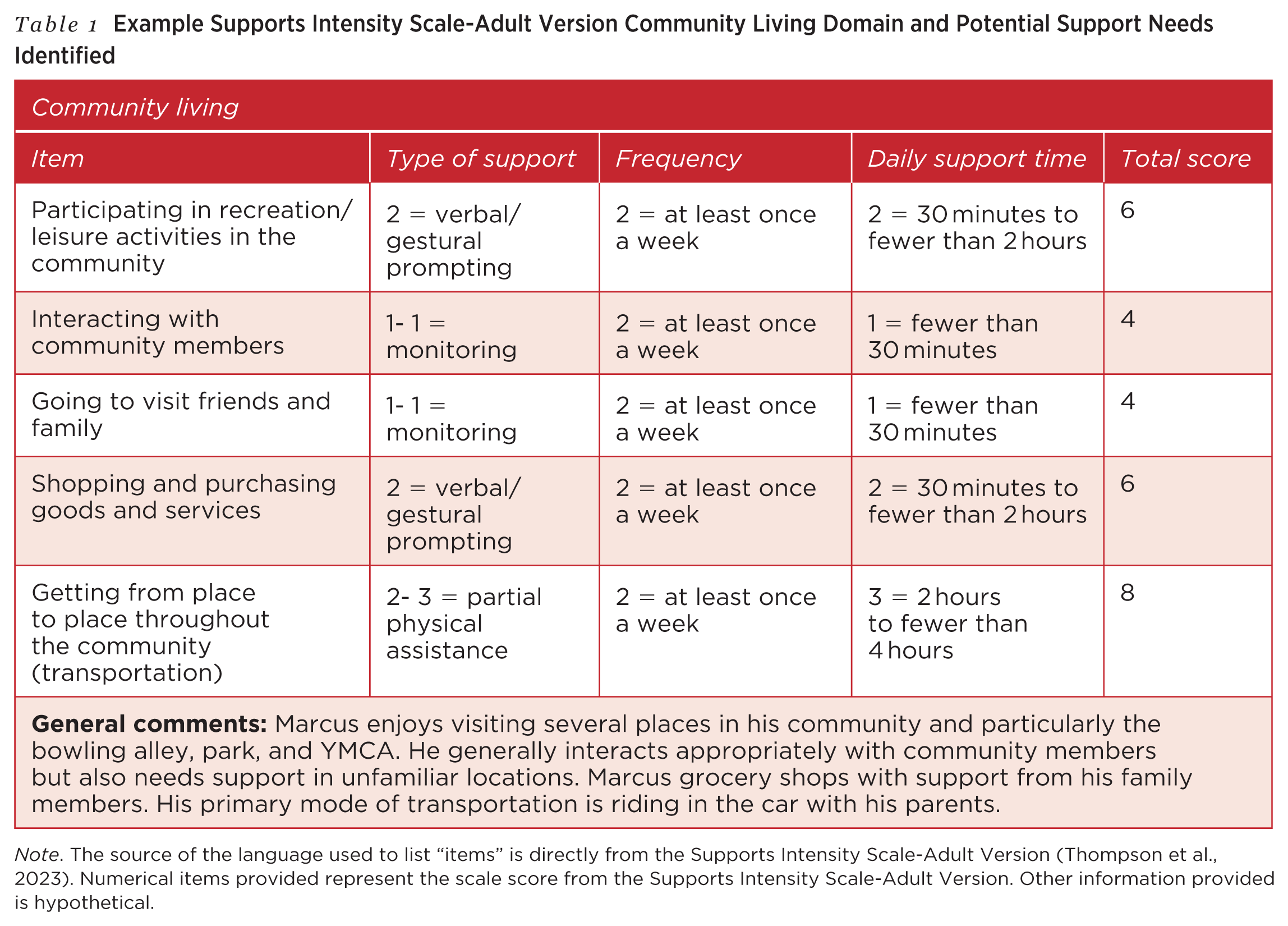
Note. The source of the language used to list “items” is directly from the Supports Intensity Scale-Adult Version (Thompson et al., 2023). Numerical items provided represent the scale score from the Supports Intensity Scale-Adult Version. Other information provided is hypothetical.
Given support from his special education teacher, family, and friends, Marcus leads his yearly individualized education program (IEP) meeting and participates in transition-based activities at school and home. His teacher and mother worked together to complete the SIS-A for Marcus. The results indicate that Marcus has significant support needs in the areas of safety and community living. He has mild support needs in the areas of advocacy and social skills. Based on current observations and work samples, the team makes a list of Marcus’s strengths that relate to choosing and using leisure skills on his own. Marcus has strengths in socializing with friends, asking questions to get involved or seeking clarity, and reading common sight words and signs for navigation. During his IEP meeting, Marcus stated that he wants to access the three previous locations of interest: bowling alley, park, and the gym. He wants to engage with friends while in these locations because he is very social, but he also wants to be as independent as possible.
Step 2: Conduct Assessments
The second step when teaching leisure skills is to conduct additional assessments as needed for your student. Assessments may be either formal or informal, and the need for each likely will vary based on your individual student with ESN. Informal assessments may include conducting additional observations of your student in the community environment or asking questions to caregivers or other people in that student’s life to determine their ability level to perform those skills. Formal assessments may include conducting a community-needs assessment or an assessment of functional living skills.
In addition to formal and informal assessments, it is imperative that you also conduct an ecological inventory (Brown et al., 1979). This will take place in the community setting where the skill is to be taught/performed. Ecological inventories provide information about the community setting so that students may be successful in that setting. During this process, you will be asked to observe and record the skills that are utilized in that leisure/recreational environment and what skills are necessary for success. For instance, at a local gym, the student must be able to scan their card to enter the facility. Otherwise, they will not be allowed to enter the facility with everyone else. Understanding the necessary skills for the environment can help teachers decide if that environment is appropriate and safe for the student and if the student’s abilities (current or future) match the environment and subsequently identify the skills necessary for teaching. Alterations to the chosen leisure environment may be made based on the ecological inventory results. For more information about how to conduct an ecological inventory, additional steps may be found in the work of Brown and colleagues (1979).
A final consideration when assessing the leisure skill environment is to consider peer performance and skill development in that environment. Consider these questions:
What skills do you notice same-age peers demonstrate in that environment?
What skills do peers have that allow them to function in that environment independently?
What skills do you notice that peers may not have in that environment (if any)?
Teachers may set up opportunities for peers to perform skills and interact in these environments on an ongoing basis. As teachers, it is important to set high goals for our students with ESN while also ensuring these goals are realistic and achievable. Moreover, the selected goals for students with ESN should be aligned with skills demonstrated by same-age peers in the same leisure settings. For example, in a technology-driven world, it is not uncommon to see teenagers or young adults on their mobile phones scrolling through social media while sitting in a community location. Understanding these “norms” from same-age peers in these settings will help teachers prepare realistic and age-appropriate plans of support for students with ESN.
Marcus’s teacher decided to observe three same-age peers during a field trip into the community while at the park, gym, and bowling alley to compare skills across students and determine the necessary skills needed for each environment. Marcus’s teacher determined that he needs to be able to perform some skills independently while at the gym, such as using equipment on his own, but that he could receive support while walking at the park because most of his same-age peers often walk with friends and also use their phones while at the park on a trail.
Step 3: Identify Select Leisure Skills to Teach
Next, consider the specific skill to teach based on your student’s assessments, observations, preferences, and strengths. Provided input from family members, teachers, and natural supports will help to also guide the selection of this skill (Brown et al., 1979). Consider the following when selecting an appropriate skill: amount of time to teach the skill, frequency of access to the community location, and prerequisite skills necessary to perform the skill.
First, selected skills should be necessary for both the student and the environment. Based on the ecological inventory conducted, consider if the chosen skill matches the environment in which the student is asked to perform it. For example, if the bowling alley provides balls at the lane in various sizes, then the student would not need to obtain a ball at the front. At the gym, a student may need to learn to turn equipment on and off if there is an on/off switch as part of that machinery. In addition to environmental considerations, the targeted skills must be relevant, useful, and age appropriate.
Second, when choosing a skill, the teacher should consider how that skill is broken down, as presented in a task analysis. Are there steps to learning that skill, and if so, what are these steps? Can the student learn the steps sequentially or in any order? Can the student learn them incidentally from a peer? What parts of the skill can be learned naturally? Because leisure skills contribute to an improved overall quality of life for many individuals with ESN, it is essential that teachers decipher and break down necessary steps so that students with ESN are not overwhelmed and receive the repetitious practice necessary to master the skill.
Lastly, teachers should consider a variety of appropriate leisure skills for students in community environments and choose the most appropriate and timely skill for the student to learn first. While leisure skills are defined as a subgroup of life skills, there are numerous possibilities as to the skills that can be targeted even in one community environment given that students may express a large array of interests in a particular setting. For instance, students can explore a variety of different types of exercise at a local gym, such as learning to play basketball, exercise with equipment, swim, and walk the track. When numerous leisure skills are available in a community setting, teachers must choose the most relevant skill to target first aligned to the student’s preferences, interests, and goals.
Next, Marcus’s teacher determined that the first skill for Marcus was to learn to use physical equipment at his local gym. This skill was chosen based on observations of Marcus at the gym, preference assessments conducted with Marcus, and observations of his peers at the gym. The teacher determined this was the most relevant skill for Marcus to learn based on his personal goal to continue to be active and stay physically healthy during the summer after graduation. Marcus’s team helped to select a goal to utilize physical gym equipment independently because he would need to perform this skill independently in the future with no peer support. The team determined he had some prerequisite skills, such as using his phone to set a timer and finding the on/off switch on machines in his classroom, which would be similar to the exercise equipment.
Step 4: Determine Evidence-Based Practices to Utilize and Schedule for Instruction
The fourth step requires teachers to determine what EBPs to utilize to support your student in acquiring the targeted leisure skill(s). Table 2 provides an overview of EBPs utilized to support students with ESN across leisure skills. Important considerations when selecting EBPs are to individualize how the EBP is implemented and if several EBPs will be combined into a package. For instance, some students may require additional levels of prompting, and other students may benefit from the use of visual supports. Most often, a package of EBPs for students with ESN across leisure skills should include the use of visual supports (either on a handheld device or on paper) in the form of pictures, words, and/or a task analysis; the system of least prompts; and some type of direct instruction (e.g., video modeling or other EBPs that demonstrate the skill being performed naturally in that community environment; Browder et al., 2014). See Table 3 for an example task analysis that could be used in conjunction with other EBPs. Importantly, same-age peers can be used in the implementation of various EBPs, such as a peer model in a video modeling intervention.
EBPs Utilized to Support Students With ESN Across Leisure Skills

Note. EBPs = evidence-based practices; ID =Intellectual Disability; ESN = extensive support needs; ASD = autism spectrum disorder.
Task Analysis for Using Fitness Equipment at the Gym

When teaching leisure skills, students may first learn the skill in the context of the classroom and then be provided with an opportunity to utilize that skill in the community setting, or they may learn the skill completely in the natural setting. Transition-age youth may have some prior experience with specific leisure skills across contexts but not have mastery in performing the skill(s). For instance, they may be able to follow a trail at the park to walk but cannot do so safely on their own or follow signs for directions when doing so. This prior experience can be something that is built on during both classroom instruction (i.e., how to stay safe) and community outings when directly teaching this skill. Lastly, teachers should be clear about the percentage of mastery for each skill. Some leisure skills require 100% accuracy (i.e., those with safety concerns), whereas with others, it may be appropriate to rely on support in natural contexts (i.e., asking for help at the bowling alley is appropriate), so a more realistic goal for that skill may be 90% accuracy. Teachers should clearly define the criteria and ensure that all team members are aware of the rationale for the target criteria.
Marcus and his team determined that he would visit the gym three times a week to exercise on the equipment. Marcus has been to the gym before but has not been successful at using this equipment independently. He does well when given both visual and verbal directions. His teacher decides to use a same-age peer from his school to create a video model and show the video to Marcus before each session in which he exercises. He has an opportunity to ask questions for clarification. He is provided with a task analysis of the steps for using the equipment that has both pictures and words on his phone that he can pull up easily and naturally while he is going through the steps. The teacher (and his brother when available) utilizes a system of least prompts to provide support for Marcus while he is learning this skill.
Step 5: Determine Your Support Plan
The fifth step involves determining the appropriate support plan to utilize for your student. Teachers should consider the environment and natural supports first. In most leisure settings, visual aids and verbal prompts serve as natural reminders or indicators of change in the environment. For example, some entrances use stop signs or gates for entrances that require users to scan in to have access to something. Other natural visuals and verbal prompts may come in the form of greetings, gestures, clocks, or other signs with relevant information in the environment.
Support also comes in the form of specific people in the life of the person with ESN. Teachers want to create a support system in which family members, caregivers, and friends are available as needed but not overbearing or overshadowing the individual with ESN. First, consider natural supports that may be in the environment. Are there people in the environment who can be a support system for reminders or to assist the student without additional personnel stepping in? Leisure skills should be addressed as naturally as possible, and extra personnel can limit this for many students. However, support in the form of additional personnel on a partial or semipartial basis may be necessary for some students. While learning skills, students may need increased instructional support but may not require the same level of intensity throughout all stages of instruction and maintenance of the skill (Baumgart et al., 1982). In addition, it is important to consider the system of least prompts when providing support. What prompts and support are natural in that environment, and by contrast, are there actions or activities that would limit students with ESN in that environment?
Lastly, appropriate support for learning leisure skills starts with planning. Students with ESN should lead all efforts to choose and maintain the skills that they are learning. Regular meetings led by the student with ESN should include natural peer supports and other personnel helping the student to learn that skill. Support plan meetings can be virtual or in person. There also is flexibility as to what the meetings look like and how the student chooses to lead these (e.g., reporting progress, giving updates). The student should take ownership of discussing their progress with all team members so the instructional plan can be altered on an ongoing basis.
As Marcus considers the first targeted leisure skill of his choosing to learn how to use equipment at the gym independently, he forms a support team. He considers that the staff at the gym will serve as natural supports for reminders and instruction while he is at the gym. For safety reasons, he will have his teacher attend with him while he is learning this skill because it is an extension of skills that he has been working on during physical education class at school. He will also have his brother join him at the gym. Both support staff (teacher and sibling) will provide support in a faded model so Marcus can utilize gym staff for questions and support as well. Marcus decides to report on his progress at the 1-month period by gathering his support team on a phone call together.
Step 6: Determine Method of Generalization and Maintenance of Skill
The last step when teaching leisure skills is to determine the method of generalization and maintenance of the skill. Generalization of leisure skills is important because as transition-age youth move into adulthood, they often shift their access to community resources, goods, services, and more. Options for available health care, recreation, exercise, and social opportunities may be altered as one moves from their youth into their teenage years and then into adulthood, which also may be met with changes related to postsecondary educational options or further vocational or educational considerations as well. Given these unavoidable changes, a plan for generalization of skills is necessary, especially for students with ESN, to ensure that they are able to transfer the knowledge of skills from one setting to another (e.g., using high school gym equipment and also a community gym after graduation; Stokes & Baer, 1977).
To best plan for generalization of skills, teachers should consider natural opportunities for the student to utilize that skill across community resources. It also is important to consider opportunities that are happening now and in the future. For instance, if a student is learning to go bowling, they should learn to bowl at different locations across their local community if available. Other natural generalization opportunities for bowling may include bowling at an arcade or in the gym with friends at church or other community organization. These opportunities may change based on your students’ access to these locations and experiences but should be a part of the plan for generalization. Students should access a minimum of one or two additional community locations where they can utilize their learned leisure skills.
Maintenance of the skill also can be challenging because students typically have fewer opportunities to utilize leisure skills compared to daily living or academic skills. Therefore, mastering leisure skills may take more time for students with ESN. Leisure skills likely will not follow a predictable schedule, adding to the difficulty of planning maintenance (i.e., students are not likely to go bowling every day). Teachers should take direct maintenance measures in the same setting with the identified skill at 2-week and 1-month intervals. Additional maintenance measures may include a 2-month or even 3-month follow-up data point. At these points, if students are continuing to have opportunities (as they should) to practice these skills, teachers should expect that the skill is being maintained with at least 90% accuracy (see Table 4 for sample goals and progress monitoring). Importantly, reviewing missed steps and/or correction of errors may be necessary during maintenance.
Sample Goal and Progress Monitoring at Various Community Locations

As Marcus achieves mastery using the gym equipment at his local YMCA, his teacher and support team ask Marcus where else he may use gym equipment in the future. His mother mentions his local college gym and another gym location across town. Marcus’s team plans to take Marcus to both locations to generalize his learned skills. Additionally, data are taken during a follow-up period of 2 weeks, 1 month, and 2 months after mastery to ensure that he is maintaining these skills. Marcus reports on his progress to his support team. Throughout this process, Marcus demonstrated increased independence using various equipment at different gym locations. He utilized EBPs and natural supports to learn and maintain the leisure skills.
Final Thoughts
The majority of transition planning for youth with ESN rightly focuses on competitive employment, postsecondary education/training, and community participation. However, teaching leisure skills is an important aspect of the transition to adulthood that should not be overlooked for any secondary student with a disability and particularly students with ESN. This is because individuals with ESN are vulnerable to community disengagement and exclusion (Beadle-Brown et al., 2016), and learning leisure skills can promote more opportunities and experiences in the community. In addition, increased community participation can contribute to overall social inclusion (Simplican et al., 2015). Applying these six steps provides a necessary framework for systematic instruction that matches student need to practice. Furthermore, the use of peer and natural supports provides opportunities for students with ESN to learn and apply skills in everyday community environments. By implementing the steps presented in this article, teachers can increase the community engagement of their students with ESN who have the right to learn a variety of recreational and leisure skills aligned to their interests.
Footnotes
Declaration of Conflicting Interests
The authors declared no potential conflicts of interest with respect to the research, authorship, and/or publication of this article.
Funding
The authors received no financial support for the research, authorship, and/or publication of this article.
