






Abstract
Ms. Rivera, a special education teacher, and Mr. Thompson, a seventh-grade geography teacher, sat together in Mr. Thompson’s classroom reviewing student responses from their latest co-taught lesson on human-environment interaction. “It’s just not clicking for them,” Mr. Thompson said, shaking his head. “We’re asking them to analyze reports and firsthand accounts about the impact of human actions on wildlife, but they’re struggling to make sense of the text.” Ms. Rivera nodded. “I’ve noticed that too. They get stuck on the vocabulary or the structure of the reading. They’re trying, but the language is dense, and the concepts are abstract.” Mr. Thompson leaned back in his chair. “Even when they’re interested, they don’t always know how to pull out the important ideas. And I don’t think they see how it connects to anything beyond this class.” Ms. Rivera paused, thinking, “What if we tried breaking the text into smaller sections and gave them some tools to help identify what’s important? Maybe something that supports vocabulary and gives them a strategy to talk through the ideas with a partner?” Mr. Thompson nodded. “Yeah, like an intervention or something. I’d be open to trying something new if it helps them actually engage with the reading.” Ms. Rivera offered, “I’ve used something called collaborative strategic reading before. It’s a way to guide students through texts in steps—previewing, figuring out confusing words, summarizing, and wrapping it up with discussion. It might give them more structure and confidence.” Mr. Thompson smiled. “That sounds promising. If it helps them slow down and work with the text more intentionally, I’m in.”
Reading comprehension is critical in social studies, where students are expected to engage with complex texts, including primary sources, maps, and data, to understand historical and geographic concepts and to develop the knowledge and skills necessary for informed citizenship (National Council for the Social Studies, 2020; Russell & Waters, 2022). Primary sources in particular require readers to interpret original language, contextualize information within a specific historical moment, and attend to discipline-specific features, such as perspective, purpose, and embedded academic vocabulary (Russell & Waters, 2022). Developing these skills during the middle school years is especially important as students are transitioning from learning to read toward reading to learn across content areas.
Despite the centrality of complex text engagement in social studies, many students, especially students with learning disabilities (LD), experience significant barriers when interacting with disciplinary texts (Nokes, 2022). These barriers include difficulties with decoding multisyllabic and domain-specific vocabulary, maintaining reading fluency and stamina across extended texts, synthesizing information across multiple sources, and engaging in higher-order comprehension and critical analysis (Vaughn et al., 2022, 2024). Many students with LD also experience dyslexia or symptoms of dyslexia, which further compounds challenges related to word reading accuracy, fluency, and sustained engagement with text, often limiting opportunities for deep comprehension and inquiry.
Understanding contemporary social studies topics, such as climate change, illustrates these challenges. For example, in the instructional context described in this article, Ms. Rivera and Mr. Thompson ask students to analyze a climate report that includes dense academic language, specialized vocabulary, and implicit assumptions about audience and context. Engaging meaningfully with such texts requires not only foundational reading skills but also active reasoning, interpretation, and discussion; such demands can become barriers rather than opportunities for inquiry without structured instructional support (Vaughn et al., 2024).
Researchers consistently demonstrate that explicit, evidence-based literacy interventions support students’ ability to engage with complex texts by addressing both foundational reading skills and higher-level comprehension processes (Ciullo et al., 2020; Curtis & Green, 2021). However, social studies instruction has historically emphasized content coverage over disciplinary literacy instruction, often assuming students can independently navigate challenging historical documents, policy texts, and data visualizations (Nokes, 2022). As a result, well-established literacy practices are frequently underutilized in social studies classrooms, particularly in inclusive settings.
Collaborative strategic reading (CSR) offers a promising framework for addressing these challenges. CSR combines explicit instruction, peer-mediated learning, and scaffolded comprehension strategies to support students’ engagement with complex texts (Klingner & Vaughn, 1998). Through its core components—Preview, Click and Clunk, Get the Gist, and Wrap-Up—CSR directly targets common barriers to disciplinary reading by supporting vocabulary acquisition, monitoring comprehension, identifying key ideas, and promoting active discussion and inquiry. Importantly, CSR’s collaborative structure fosters motivation and sustained engagement, which are critical when students work with demanding primary and secondary sources. Additionally, CSR can be layered with interventions that address multisyllabic word reading, repeated reading for fluency, and explicit vocabulary instruction, making it particularly well suited for students with LD and dyslexia. This article examines the implementation of CSR in inclusive secondary social studies classrooms, illustrating how its components support students’ ability to engage critically with primary sources while developing the disciplinary literacy skills necessary for meaningful participation in social studies learning.
Collaborative Strategic Reading
CSR is a multicomponent reading comprehension intervention (Klingner & Vaughn, 1998). Initially developed for general reading, researchers adapted CSR for social studies to help students analyze historical documents and policy reports (Boardman et al., 2016, 2018). In an evidence-based synthesis of reading-comprehension-based interventions supporting secondary students with LD in social studies, Jakubow (2025) determined CSR to be an evidence-based practice. Across the three phases of instruction (i.e., before, during, and after reading), teachers implement specific CSR components (i.e., Previewing, Click and Clunk, Get the Gist, and Wrap Up) that support student comprehension by activating background knowledge, clarifying vocabulary, summarizing key ideas, and synthesizing information (Klingner & Vaughn, 1998).
Teachers use explicit instruction to model each CSR component, guide students through practice, and support independent application (Boardman et al., 2018; Klingner & Vaughn, 1998). For each CSR component (i.e., Previewing, Click and Clunk, Get the Gist, and Wrap Up), teachers model the component, demonstrating how to apply it with a text. This is followed by guided practice, during which students engage with the component alongside teacher support and feedback. Once students demonstrate proficiency, they transition to independent practice.
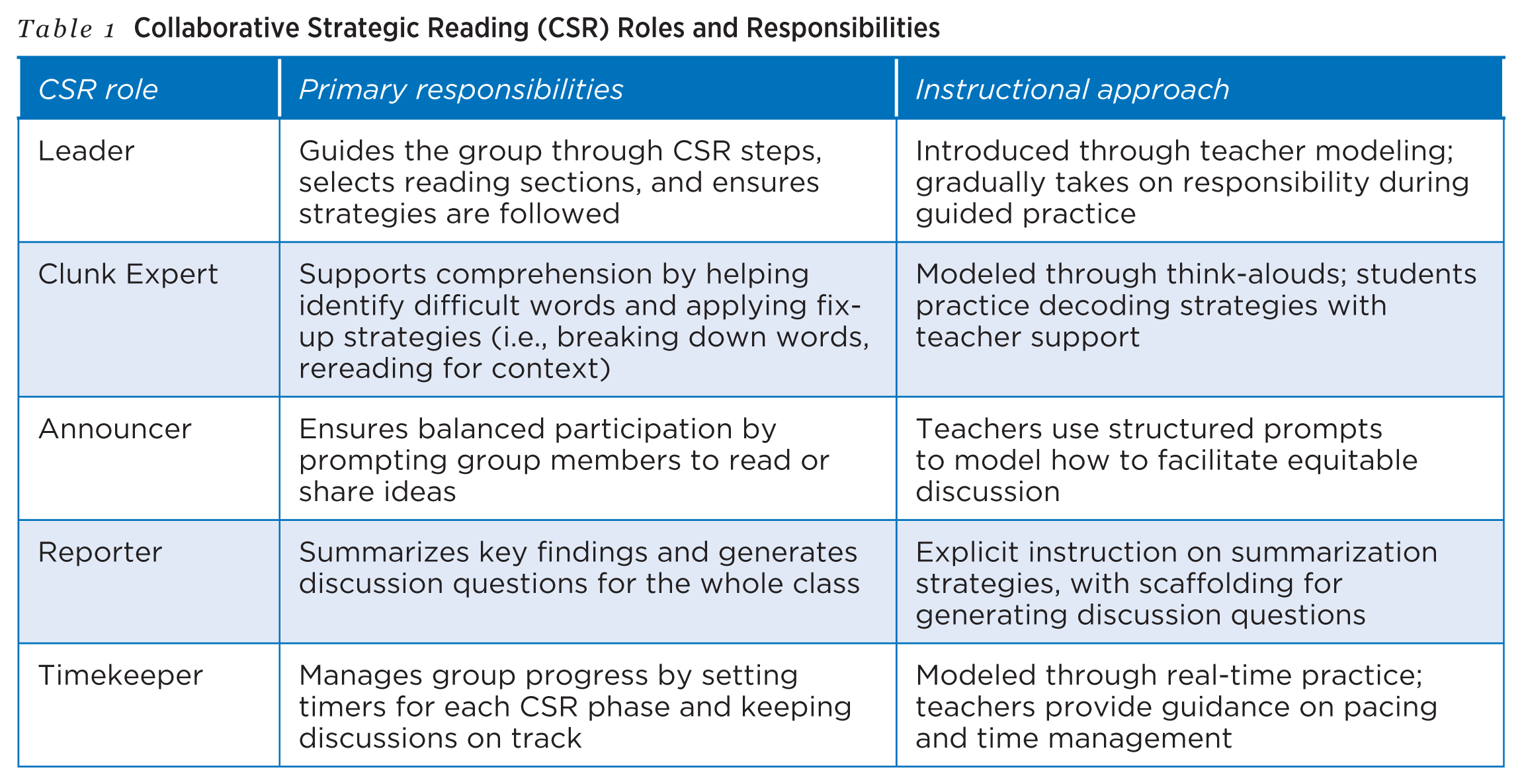
In CSR, independent practice often takes the form of structured peer collaboration. During this phase, teachers facilitate interactions in which students take on specific roles and work together to apply the CSR components—predicting, clarifying unfamiliar terms, summarizing, and synthesizing content (Vaughn et al., 2013). Structured collaboration supports students in internalizing the components through purposeful, guided interactions (Fisher & Frey, 2021). To promote accountability and engagement, students are assigned defined roles and follow established procedures (Klingner & Vaughn, 1998; see Table 1 for a summary of student roles and their functions within CSR). For students with more intensive reading support needs, additional scaffolds are necessary to ensure meaningful participation during collaborative reading rather than passive involvement. Teachers can support full participation by purposefully grouping students, explicitly teaching and modeling CSR roles, and assigning roles that allow students to contribute without relying solely on independent reading (e.g., Clunk Expert, Announcer). Teachers can scaffold these roles by first modeling them explicitly and then gradually shifting responsibility during guided practice (Klingner & Vaughn, 1998). For example, the teacher may initially serve as the “Leader” before releasing responsibility to a student. Over time, scaffolds such as role cards, sentence stems, and prompts are faded as students demonstrate independence in applying CSR components collaboratively.
Collaborative Strategic Reading (CSR) Roles and Responsibilities
CSR Phases
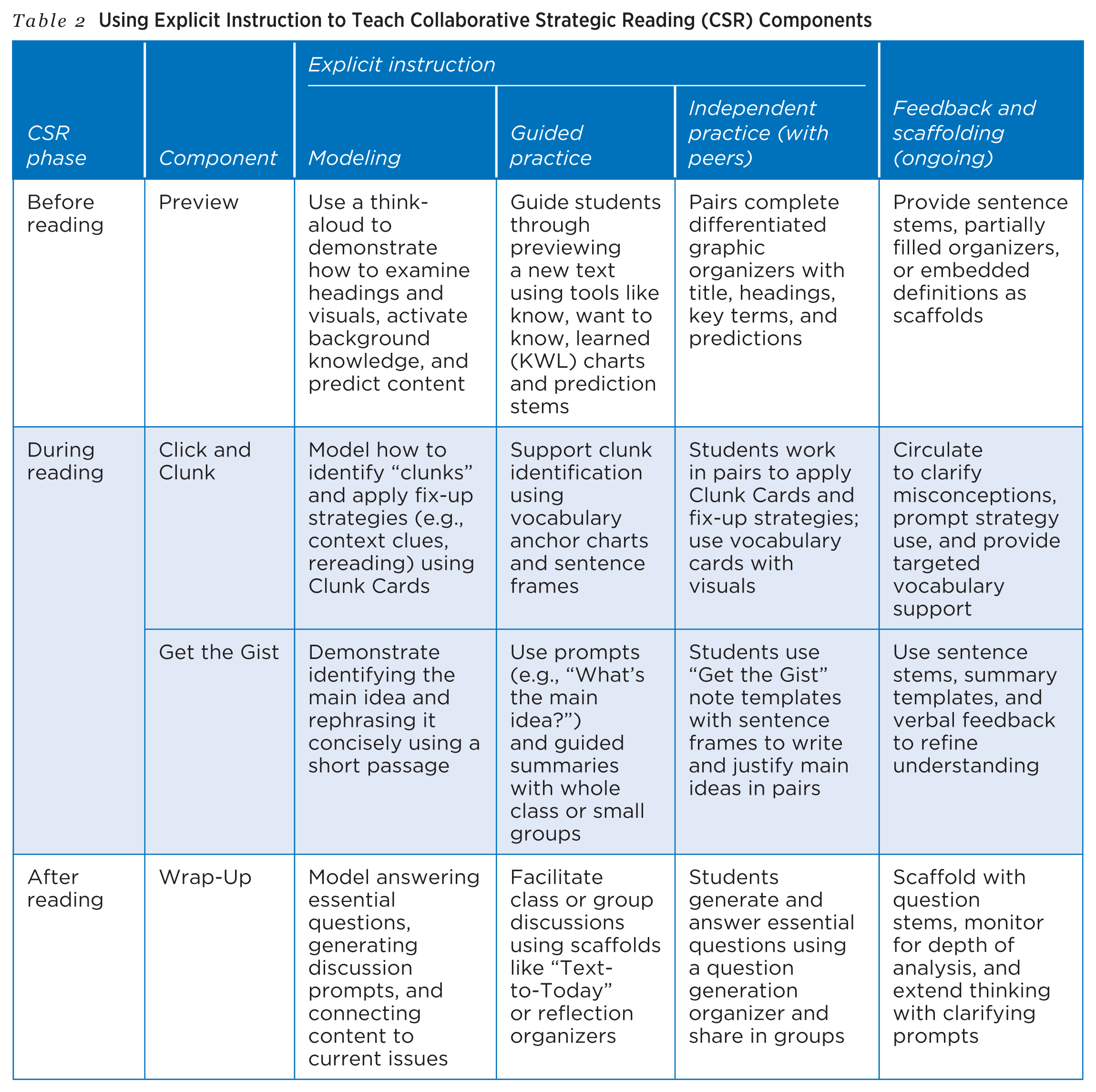
CSR is organized into three instructional phases—before, during, and after reading—during which teachers provide specific components that support students in accessing and understanding complex texts, such as primary sources (see Table 2 for examples of supports for each instructional phase and component of CSR). In the before-reading phase, teachers guide students in activating background knowledge through the Preview component (Klingner & Vaughn, 1998). This component helps students examine text features such as the title, author, and broader historical or thematic context. Teachers also provide explicit instruction on essential vocabulary and engage students in structured prediction, which are tasks that rely on text cues or teacher-directed prompts to guide them to anticipate the text’s main ideas using cues such as the title, headings, and highlighted terms.
Using Explicit Instruction to Teach Collaborative Strategic Reading (CSR) Components
The during-reading phase promotes active comprehension monitoring through two key CSR components: Click and Clunk and Get the Gist (Klingner & Vaughn, 1998). Teachers first model each component using explicit instruction—such as with think-aloud—and then guide students through scaffolded practice with feedback. As students build confidence, they begin applying the components collaboratively with peers, often in structured reading groups. In Click and Clunk, students identify confusing words or phrases (i.e., clunks) and apply strategies, such as rereading, using context clues, breaking the word into parts, or consulting glossaries or digital supports, to clarify meaning (Amjadi & Talebi, 2024). Teachers may provide a checklist or sentence starters (e.g., “This clunk might mean . . . because . . . ”) to support the process.
In Get the Gist, students work together to identify the most important idea in a section of text and restate it in their own words. Teachers may use guiding questions like “Who or what is this section about?” and “What is the most important thing about it?” to help students focus on essential content and eliminate irrelevant details. Teachers support this process with guided notetaking, collaborative discussions, and digital tools like shared documents or annotation features to keep students engaged in constructing meaning.
The after-reading phase deepens comprehension by encouraging synthesis and reflection. This phase involves the Wrap Up component, which helps students identify overarching themes and connect them to broader contexts (Klingner et al., 1998; Klingner & Vaughn, 1998). Teachers often facilitate this process through structured discussions, debates, or project-based responses, allowing students to demonstrate their understanding in varied and meaningful ways.
Although CSR provides structured support for many students, students with dyslexia or more intensive learning needs may not respond as expected to initial implementation. In these cases, teachers can intensify CSR by increasing explicit instruction, reducing text length, and layering additional supports. Examples include providing side-by-side texts with embedded definitions, increasing opportunities for repeated reading and oral rehearsal, offering more frequent teacher check-ins during collaborative work, and pairing CSR with targeted decoding or fluency interventions. These adaptations allow students to continue participating in inquiry-based reading tasks while receiving the individualized support necessary for comprehension.
Research on CSR
Jakubow (2025) evidence-based systematic review concluded CSR as an evidence-based practice based on two studies of 734 secondary students with LD. Boardman et al. (2016) found the CSR intervention provided the necessary support for middle school students with LD to break down complex historical and legal texts into manageable components. Boardman et al. (2018) determined CSR supported middle school students with LD to engage meaningfully with challenging texts and improve their overall comprehension. They also noted students became more confident in their comprehension and more likely to engage in discussions, ask questions, and take ownership of their learning. Boardman et al. (2018) also concluded using CSR helped students draw more meaningful connections between historical documents and contemporary issues in inclusive social studies classes, which empowered them to think critically and independently in an inclusive classroom environment.
Implementing CSR in the Inclusive Secondary Social Studies Classroom
For planning, CSR can be implemented with minimal preparation and is feasible for teachers who want to begin quickly. Teachers new to CSR typically spend 30 minutes to 60 minutes preparing materials for an initial lesson, including selecting a text, identifying key vocabulary, and preparing graphic organizers or role cards; once routines are established, preparation time is substantially reduced. A CSR lesson can be embedded in an existing class period, with each phase (Preview, during reading, and Wrap-Up) taking approximately 10 minutes to 15 minutes, depending on text length and instructional goals (Klingner & Vaughn, 1998). For teachers unfamiliar with CSR or evidence-based literacy practices, accessible resources such as the IRIS Center’s online CSR modules, CEEDAR Center practitioner briefs on explicit instruction and scaffolding, and What Works Clearinghouse practice guides provide free, step-by-step support and classroom examples to scaffold successful implementation.
Before Reading: Previewing
In the first phase of CSR—Previewing—teachers use explicit instruction to prepare students for reading by activating background knowledge, building essential vocabulary, and setting a purpose for reading (Hughes et al., 2022). Teachers begin by introducing key vocabulary terms from the primary source. For example, from the case vignette, Ms. Rivera and Mr. Thompson might identify such vocabulary as biodiversity and deforestation. Teachers define each word explicitly, use it in context, and reinforce understanding with examples. Then, they prompt students to make predictions using a sentence stem such as, “Based on the title and headings, I think this text will be about . . . .” Teachers model how to scan the document’s title, headings, and visuals to gather clues and then guide students in recording their predictions. Teachers provide a graphic organizer—such as a cause-and-effect or text features chart—to support vocabulary and structure and model how to fill it in.
To support vocabulary acquisition, teachers provide word banks that include teacher-defined terms with space for students to write meanings in their own words. These vocabulary supports also contribute to knowledge building, a critical factor in reading comprehension (Smith et al., 2021). By anchoring CSR vocabulary routines in broader content goals, teachers simultaneously strengthen word knowledge and background knowledge, which reinforces comprehension across social studies texts. In print formats, this may be a vocabulary chart; in digital formats, teachers embed supports like clickable definitions, audio recordings, and example sentences. Teachers introduce the word bank before reading and guide students through a matching or sorting activity to reinforce meaning. To support comprehension of historical documents, teachers also model how to use a document analysis organizer. Using a think-aloud, the teacher highlights key elements such as author, purpose, and audience: “Let’s look at who wrote this, why they wrote it, and who the audience was.” Teachers guide students in completing the organizer using prompts or sentence stems such as, “What clues tell you who wrote this?” or “What words suggest the author’s purpose?” For students who need more support, teachers provide partially completed organizers to focus their attention on the most challenging elements.
Mr. Thompson and Ms. Rivera introduce a primary source excerpt from a World Wildlife Fund (WWF) fact sheet focused on deforestation. To support comprehension, they select a cause-and-effect graphic organizer aligned with the structure and purpose of the text, helping students track how deforestation leads to specific environmental outcomes and affects human communities. These teacher-created organizers are available in both print and digital formats, with differentiated versions that include sentence stems or partially completed sections for students who benefit from additional scaffolding. To model the Preview component, Mr. Thompson displays the fact sheet on the whiteboard, reads the title and headings aloud, and uses a think-aloud to highlight key vocabulary and prompt predictions. As he underlines the phrase “biodiversity loss due to deforestation,” he reflects, “Biodiversity means a variety of living things. If deforestation is causing biodiversity loss, I wonder what species or ecosystems—and even what human communities—might be impacted.” He draws a box around the word “ecosystems” and turns to the class: “We’ve talked before about how people interact with their environment. Can someone remind us what an ecosystem is?” A student replies, “It’s where living things interact with each other and their environment.” “Exactly,” Mr. Thompson says. “So, as we preview, let’s keep that in mind—this fact sheet might describe how cutting down trees disrupts ecosystems and affects people who depend on those environments.” He then instructs students to open their graphic organizers, modeled after the CSR Preview guide, and helps them record the title and headings in the first column. “Let’s jot down our predictions about what we think this fact sheet will explain—especially how cutting down trees affects both the environment and human communities. Then, as we read, we’ll check to see if our predictions were accurate or if we need to update them.” Ms. Rivera provides multiple entry points for engaging with the primary source, tailoring supports based on students’ instructional needs. Some students receive annotated excerpts with embedded definitions, guiding questions, or visual cues. Others work with side-by-side supports that pair the original text with sentence starters or paraphrased passages. Students ready for the original document engage with the full excerpt independently. To support interaction with the text and visuals, Ms. Rivera provides annotation tools, such as highlighters and sticky notes for print versions and comment features for digital formats, enabling all students to engage actively with the material.
During Reading: Click and Clunk and Get the Gist
In the during-reading phase of CSR, teachers support students in navigating complex vocabulary and concepts (e.g., abstract ideas, unfamiliar historical references, or technical academic language) through the Click and Clunk and Get the Gist components. In Click and Clunk, students learn to identify “clicks”—words that support comprehension—and “clunks”—unfamiliar terms that disrupt understanding (Klingner & Vaughn, 1998). To teach this component, the teacher projects a sentence from the text and models identifying a clunk word. For example, a social studies teacher might read, “The Constitution outlines the enumerated powers of Congress” and then pause and say, “Enumerated powers—that’s a clunk. I’m not sure what that means. Let’s check the surrounding sentences for clues.” The teacher models using context clues and prior knowledge to figure out the meaning, thinking aloud through the process. After modeling, the teacher provides a new sentence and asks students to identify clunks and apply fix-up strategies using guided questions, such as “What clue in the sentence helps you understand that word?” or “Can we substitute a word that makes sense here?” As students gain confidence, they work with a partner to identify clunks and apply strategies independently. Teachers circulate to provide feedback, clarify misunderstandings, and prompt deeper analysis. Tools like Clunk Cards (see Figure 1) offer step-by-step prompts students can use while reading.
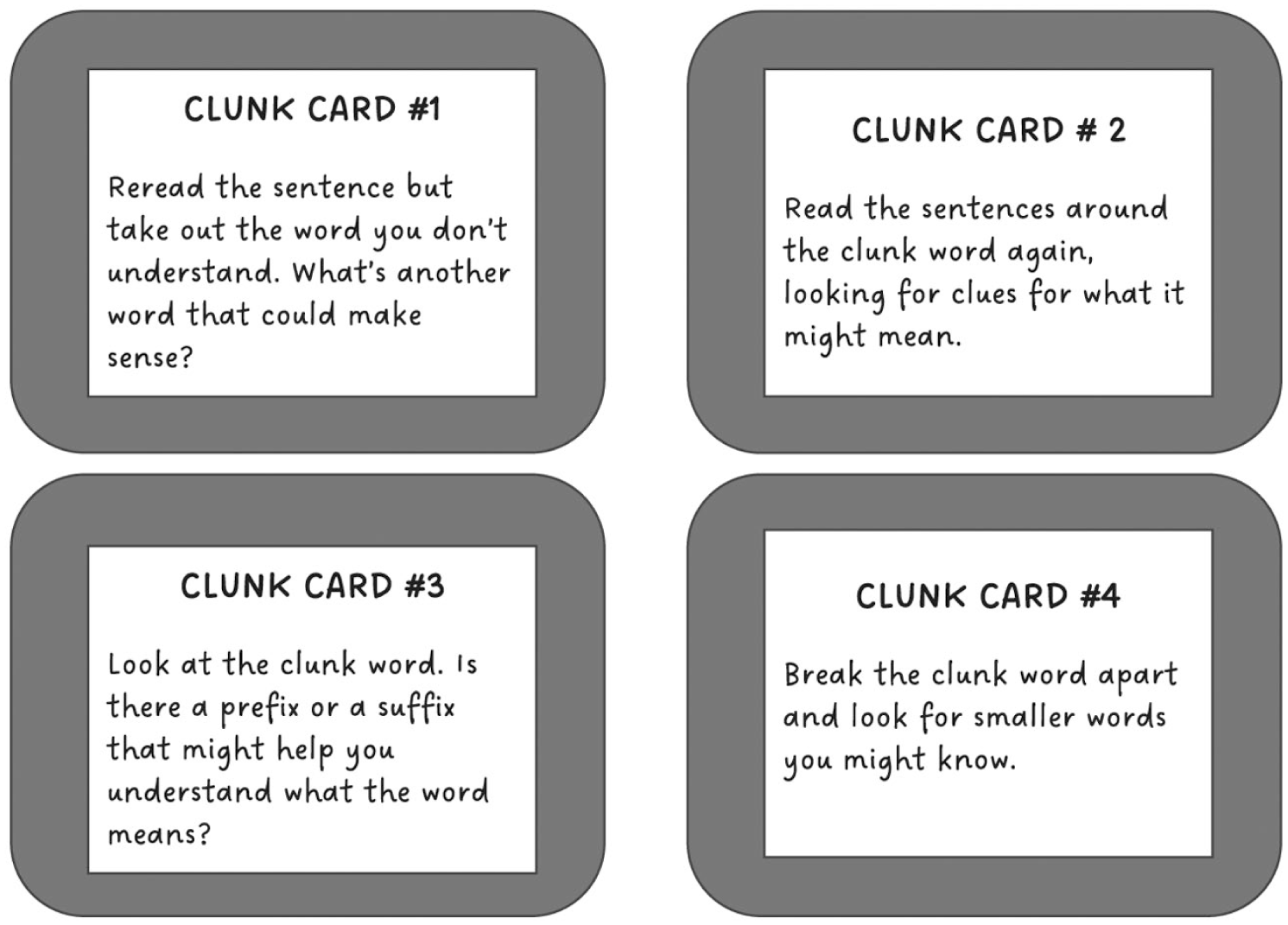
Clunk Cards for breaking down unknown words
In the next class period, Mr. Thompson and Ms. Rivera introduce students to the Click and Clunk component, explaining a click is a word or phrase that makes sense, while a clunk is something unfamiliar that disrupts comprehension. To reinforce this concept, they begin by modeling the component using an example sentence: “Deforestation contributes to biodiversity loss and disrupts ecosystems worldwide.” Mr. Thompson underlines key terms and prompts students to reflect on prior knowledge, asking, “Do these words click for us? Have we seen them before?” Ms. Rivera highlights the phrase “disrupts ecosystems” and, noticing hesitation, models how to determine its meaning using context and analogy: “If a storm disrupts a city, what happens? Now think about what might happen when ecosystems are disrupted.” She walks students through applying reasoning to determine the meaning of the sentence. As they continue, Ms. Rivera models identifying both clicks and clunks while reading an excerpt from the WWF fact sheet. When she encounters the phrase “sustainable land management,” she pauses: “This might be a clunk. Let’s break it down—what do we already know about the word ‘sustainable’? And what about ‘land management?’” She then connects the ideas, reinforcing how the meaning of unfamiliar terms can be constructed using known vocabulary and context clues. To support students as they begin practicing the component, the teachers provide guided notes with highlighted key terms and sentence stems (e.g., “One reason deforestation impacts biodiversity is . . . ”). As students continue reading, they identify clicks and clunks with a partner, using strategies modeled earlier, while Mr. Thompson and Ms. Rivera circulate to offer feedback and reinforce comprehension strategies.
After clarifying unfamiliar vocabulary through Click and Clunk, teachers introduce the Get the Gist component to help students summarize the main ideas from complex texts (Klingner & Vaughn, 1998). To model the component, the teacher projects a short excerpt and reads it aloud, pausing to think aloud: “This sentence introduces the main idea—deforestation accelerates climate change. The next sentence gives an example, so I don’t need to include that in my summary.” The teacher underlines key phrases on the board and shows how to restate the main idea in one sentence. Students follow along using their own annotated copies or digital tools. Next, the teacher provides a new excerpt and guides students through the same steps using prompts like “Which part tells us the main idea?” or “What detail can we leave out?” As students gain skills, they work with a partner or small group to apply the component independently. Teachers support by checking for accuracy and prompting for clarity.
During guided practice, the teacher provides students with a new text excerpt and supports them in identifying the main idea and restating it in their own words. The teacher uses prompts like “What is the most important point in this paragraph?” and “Which details can we leave out?” to focus student attention. As students work, the teacher circulates to offer feedback, reinforce the summarization process, and clarify misunderstandings. To support organization, the teacher often provides a graphic organizer—such as a main idea/detail chart or a Get the Gist template—and models how to use it (see Table 3 for an example from the case vignette). As students demonstrate increased accuracy, the teacher gradually reduces support and transitions to structured peer practice. Students apply the component in pairs, compare summaries, and justify their choices using sentence stems or guiding questions.
Example of a “Get the Gist” Graphic Organizer Based on a World Wildlife Fund Fact Sheet
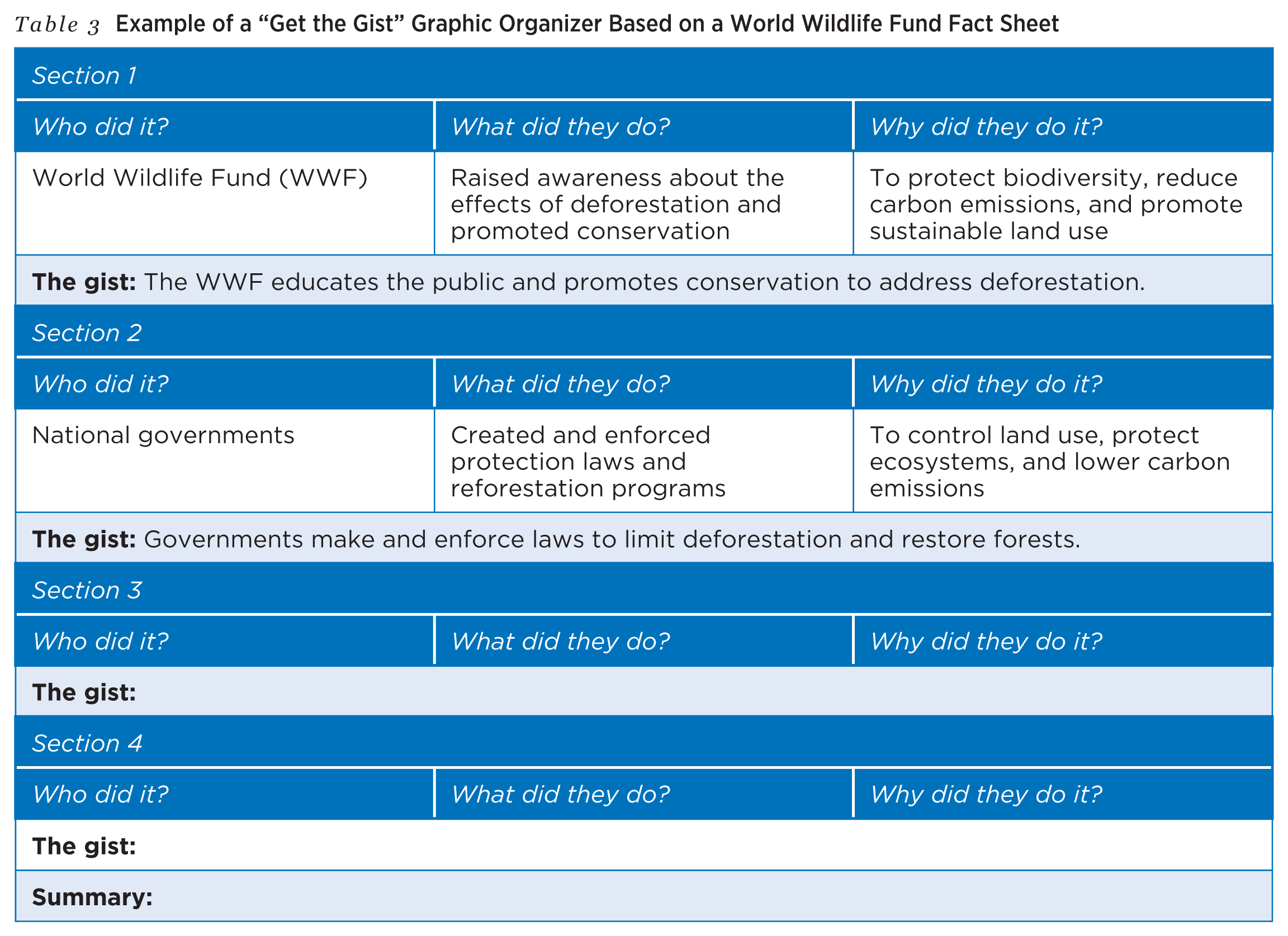
The following day, Ms. Rivera begins by reviewing key vocabulary from the previous lesson and introduces the Get the Gist component to help students summarize key ideas. She projects an excerpt from the WWF fact sheet and highlights central phrases, such as “deforestation leads to biodiversity loss” and “increases carbon emissions.” Using a think-aloud, she models how to identify the main idea and distinguish it from supporting details. She verbalizes her thought process as she condenses the information into a clear summary, writing it below the passage to show how essential meaning can be kept while unnecessary details are omitted. Mr. Thompson introduces a graphic organizer that guides students through the summarization process (see Table 3). He models its use by selecting key words from the text and paraphrasing them into a summary. As students apply the component with support, Ms. Rivera circulates, offering feedback and prompting students with questions such as “What is the main point of this section?” or “Which details can you leave out?”
After Reading: Wrap Up and Beyond
In the after-reading phase, teachers help students synthesize their understanding by identifying key takeaways, asking and answering meaningful questions, and making connections beyond the text (i.e., Wrap Up; Klingner & Vaughn, 1998). Teachers often pose an essential question—such as “What is the author’s main argument, and why does it matter?”—and model how to identify and explain evidence that supports a response. For example, the teacher might say, “Let’s look back at paragraph four. This sentence about government regulation stands out—why might the author include that?” Then the teacher highlights a key phrase, explains its significance, and connects it to prior learning: “This statement connects to our earlier discussion about climate policy and how governments can limit deforestation.” To guide student responses, teachers provide sentence stems such as “The most important takeaway is . . . ” or “This connects to . . . ”. These stems can be displayed on the board or included in student materials. The teacher then facilitates a short discussion or collaborative writing task in which students use evidence from the text to respond to the essential question. For example, students might work in pairs to construct a written response that includes a claim, supporting evidence, and a conclusion.
During guided practice, teachers lead small-group or whole-class discussions to help students explore key themes and refine their responses. As students share ideas, the teacher circulates and prompts deeper thinking with questions, such as “How does this idea compare to another source we read?” or “What are the real-world implications of this issue?” The teacher offers feedback, affirms strong ideas, and helps students clarify or expand their reasoning. To support independent application, teachers may assign a reflective writing task, a peer discussion, or a student-generated question tied to the essential question. Graphic organizers—such as comparison charts, cause-and-effect maps, and then-and-now organizers—help students structure their thinking and extend comprehension into analysis and synthesis (see Figure 2).
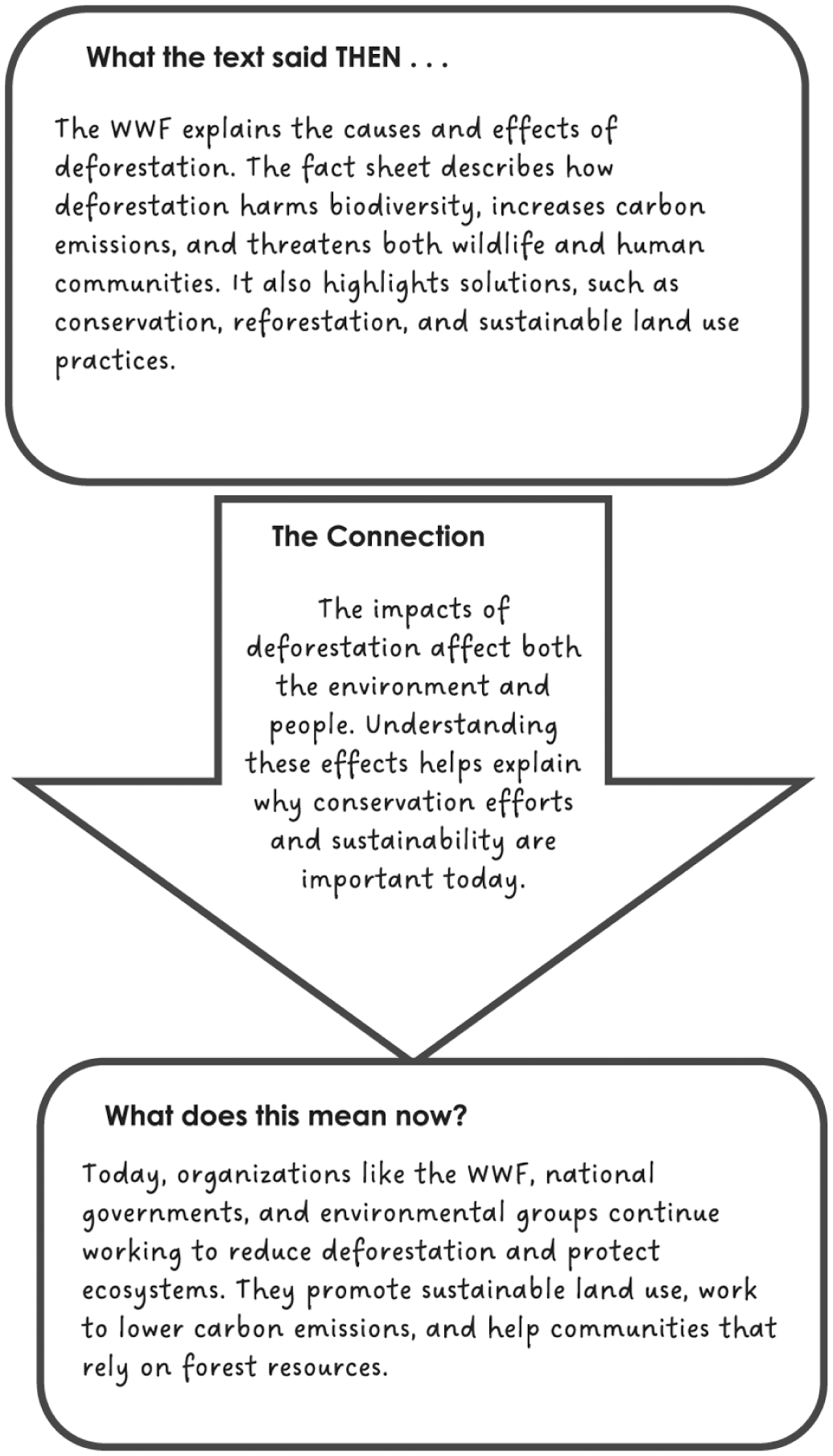
Then-and-now graphic organizer
After analyzing the WWF fact sheet, Mr. Thompson prompts students to connect the environmental impacts of deforestation to contemporary issues. To scaffold this process, he introduces question stems such as “What does this fact sheet suggest about the role of governments in environmental protection?” and “How do the consequences of deforestation relate to current climate policy discussions?” These guided prompts support students as they begin small-group discussions, drawing on textual evidence and prior knowledge to extend their thinking. Ms. Rivera facilitates by circulating and prompting deeper analysis, asking questions like “How might deforestation caused by agriculture differ from deforestation driven by urban development?” To help students structure their responses, she introduces a text-to-today graphic organizer (see Figure 2), which guides students in connecting the text to real-world contexts and raising new questions. For students who benefit from additional support, both teachers provide sentence starters, such as “One way this issue connects to today is . . . .” Throughout the Wrap-Up component, Mr. Thompson and Ms. Rivera monitor student understanding, pose follow-up questions, and offer targeted feedback to extend analysis.
While CSR ends at Wrap Up, there is an opportunity to use CSR as a scaffold to deepen understanding and foster disciplinary literacy (Faggella-Luby et al., 2012). In social studies, CSR prepares students to engage in discipline-specific practices—such as sourcing, contextualization, and corroboration—by first ensuring they can access the text and identify key ideas. For example, after generating questions within their groups, students can use these questions to engage in whole-class discussions. Structured discussions not only heighten engagement but also promote critical thinking and help students solidify knowledge through dialogue (Boardman et al., 2016). Additionally, students can transition from discussion to writing and authorship tasks either individually or collaboratively. Writing about their interpretations, connections, or extended inquiries provides an authentic learning experience, mirroring the practices of historians and geographers who analyze sources and communicate findings (Wineburg et al., 2012). These writing tasks could include brief constructed responses, multimedia presentations, or even the creation of informational posters or digital fact sheets aimed at informing their peers or the school community. By engaging in public authorship, students take ownership of their learning and develop communication skills that extend beyond the classroom (Amjadi & Talebi, 2024; Fisher & Frey, 2021). In addition to general writing tasks, CSR can transition into discipline-specific writing genres, such as drafting historical arguments, constructing debates, or creating historical accounts and artifacts. These tasks align CSR routines with authentic disciplinary practices while maintaining accessibility.
Conclusion
The ability to critically engage with complex texts is essential for informed citizenship in today’s interconnected world (National Council for the Social Studies, 2020). CSR offers a structured, evidence-based approach for supporting students with LD in inclusive secondary social studies classrooms. Through its four components—Preview, Click and Clunk, Get the Gist, and Wrap Up—teachers provide explicit instruction and scaffolded peer collaboration to help students access challenging texts, clarify unfamiliar vocabulary, identify main ideas, and make meaningful connections. When implemented across the before, during, and after phases of reading, CSR not only removes common literacy barriers but also promotes active, inquiry-based engagement with primary and secondary sources (Boardman et al., 2016, 2018). By embedding reading comprehension into social studies instruction, CSR helps all learners—especially those with LD—develop historical understanding, build content knowledge, and participate meaningfully in discussions about issues that shape our world.
Footnotes
Declaration of Conflicting Interest
The authors declared no potential conflicts of interest with respect to the research, authorship, and/or publication of this article.
Funding
The authors received no financial support for the research, authorship, and/or publication of this article.
