






Abstract

Ms. Sanchez is a new special education teacher hired to teach in a local high school, supporting students with a range of disabilities. As part of her role as a special education case manager, Ms. Sanchez printed out the accommodations from the individualized education programs (IEPs) for the students she supports. She shared them with the general education teachers with whom she is collaborating. Upon reviewing the accommodations, she noticed that many of them were vague and written in an unclear manner. It also appeared that most of the accommodations were identical for many students.
As Ms. Sanchez passed out the accommodations pages, Mr. Smith, a new science teacher, asked Ms. Sanchez to help him understand the accommodations and how he could best support students in his class. The two teachers sat down together to review the accommodations. Looking through the accommodations, Mr. Smith asked what some of the accommodations meant, asking, “What is preferential seating?” and “When is it appropriate to allow the student to use text-to-speech, and when do I ask the student to read the textbook themselves?” Ms. Sanchez realized she could not answer his questions; she understood the basic concept of providing accommodations to students with disabilities, allowing them to fully access the general education classroom, but she struggled to understand when and how specific accommodations were designed for individual students.
What Are Accommodations?
Accommodations are adjustments to the instructional environment or how students access and demonstrate their learning while keeping the curriculum content intact (Lazarus et al., 2021). Accommodations affect how students access information (Painter, 2015). Accommodations are a key aspect of an IEP that supports students with disabilities across settings. IEP teams, consisting of the student (if appropriate), parent or guardian, general education teacher(s), special education teacher, school district representative (local education agency), related service providers, and anyone else with knowledge or expertise about the student, work together to identify accommodations to support the student across all educational environments.
Accommodations are distinct from modifications. Modifications change, or modify, the content being taught or assessed. Modifications can lower or reduce learning expectations (Lazarus et al., 2021). For example, providing a student with fewer math problems or offering a text at a lower reading level is a modification. Both accommodations and modifications may be used in the general education setting for different purposes. IEP teams are tasked to determine if a student would benefit from accommodations and/or modifications and then plan out the accommodations and/or modifications in the IEP document.
The Individuals with Disabilities Education Act (IDEA; 2017) requires instructional accommodations and specific testing accommodations to be documented in a student’s IEP and supported in the classroom setting (Lazarus et al., 2021). General education and special education teachers are responsible for “using appropriate supports, accommodations, and curriculum modifications” (IDEA, 2017, 34 C.F.R. § 300.1462[b][2][a][ii]). IDEA recognizes that “all children with disabilities are included in all general State and district-wide assessment programs . . . with appropriate accommodations and alternate assessments, if necessary, as indicated in their respective IEPs” (IDEA, 2017, 34 C.F.R. § 300.160[a]).
Accommodations are separate from goals and direct special education services on the IEP, focusing on ways to support students in participating in the general education curriculum (Goran et al., 2020). Accommodations documented on an IEP become a part of the legal requirement of the document and are not “optional” or a list of ideas for teachers to use if desired. These supports listed on an IEP must be implemented and used as is written on the IEP (Painter, 2015). There are two common classroom accommodations in schools: instructional accommodations and testing accommodations.
Instructional Accommodations
Instructional accommodations are provided in the classroom and throughout the school environment to help students fully access the general education curriculum. These accommodations refer to any change or adjustment to the instruction that a student requires to access information (Lazarus et al., 2021). Instructional accommodations can be used in one specific setting or across multiple settings. They may also be written for times that are “nonacademic,” such as additional supports during transitions from one room in the school to another or specialized equipment to be used on the playground. Instructional accommodations most frequently fall into the following four categories: presentation, response, timing/scheduling, and setting, with presentation being the most common accommodation category (Kern et al., 2019).
Testing Accommodations
Testing accommodations include alterations to the administration of tests or assessments (Salend, 2008). Testing accommodations are specifically designed to support students in the test environment, allowing students with disabilities to demonstrate their knowledge and understanding of a topic. These accommodations provide access to the test without altering its nature (Salend, 2008; Xu & Kuti, 2024). The intent of providing accommodations on a test is not to give a student an unfair advantage over their peers (Lazarus et al., 2021). Testing accommodations are used on all levels of assessments, including classroom-based/formative, school-wide or district-level/interim, and state/summative assessments (Lovett, 2023; Salend, 2008). Accommodations should never be used for just one type of assessment. For example, an accommodation used for a state assessment should be consistent with an accommodation used for a classroom-based test.
S.H.A.R.P.: A Framework for Designing Accommodations
Accommodations are designed by the whole IEP team (Lazarus et al., 2021). Part of this process involves ensuring that all team members have an equal voice in discussing possible IEP accommodations and supports (Kurth et al., 2020; Salend, 2008). To support IEP teams in designing effective accommodations, the S.H.A.R.P. acronym (specific, helpful, appropriate, relevant, and personal) provides a framework for implementing best practices in writing accommodations and fosters a common understanding of effective accommodations. Reviewing IEP accommodations through the S.H.A.R.P. process can help IEP teams focus on including only well-designed, purposeful accommodations. S.H.A.R.P. accommodations are specific, helpful, appropriate, relevant, and personal (see Table 1).
S.H.A.R.P. Accommodations Overview Summary

Specific
Accommodations for students need to be specific and written in a way that clearly indicates when and how the strategy should be used (Lazarus et al., 2021). For example, an accommodation stating “use of noise-cancelling headphones during transitions in the hallways” provides more specific information than “headphones.” Knowing when and where to offer the headphones will help any teacher working with the student use them in a consistent manner. When an unfamiliar teacher reviews an IEP, they should gain a clear understanding of the support a student requires from the accommodations listed. Yet when accommodations are not specific, it is hard to discern a student’s needs. When designing specific accommodations, it is best to avoid vague phrasing, such as “as needed” or “when appropriate,” which can make it unclear to all team members when an accommodation will be utilized (Kern et al., 2019). Including all IEP team members on the same page is crucial for providing consistent and reliable support to a student (Petersson-Bloom & Holmqvist, 2022).
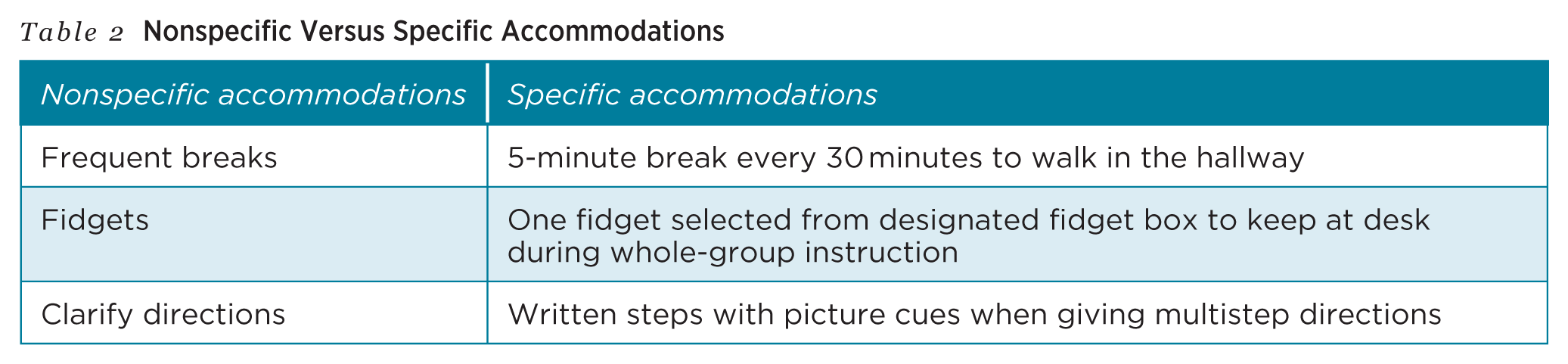
Some examples of specific accommodations include the following: (a) offer a 5-minute standing break in a designated place in the classroom when the student appears anxious or off task, (b) option to use a small fidget during group discussions or whole group instruction, and (b) written step-by-step directions with picture cues when giving multistep directions. These accommodations are specific, rather than generic phrases like “frequent breaks,” “fidget,” or “clarify directions.” See Table 2 for a comparison of nonspecific and specific accommodations. By incorporating clear and precise accommodations, students can expect consistent responses and predict how situations will be handled in the school environment.
Nonspecific Versus Specific Accommodations
When Mr. Smith read the accommodation “preferential seating,” he was unsure of the type of seating the student required. Does the student need to sit near the teacher for frequent redirection to tasks? Does the student need to sit on the left side of the board because they have a vision loss in their left eye and thus their right eye is stronger for reading written words on the board? Does the student often stand up in class and benefit from sitting at the back of the room, where they have the opportunity for physical movement? All of these situations could call for “preferential seating,” but the seating location varies greatly. Mr. Smith asked the IEP team to be more specific with this accommodation.
Helpful
When it comes to writing accommodations, more is not always better. One mistake IEP teams make is having a long list of numerous accommodations. Research indicates that many accommodations have not proven more effective and that providing students with accommodations they do not truly need can have a negative impact (Ketterlin-Geller et al., 2007; Lazarus et al., 2021; Lovett, 2023). IEP teams are tasked with identifying accommodations that are most helpful in specific situations rather than providing every possible accommodation.
A student struggling to focus and attend in class may benefit from a variety of types of accommodations. These could include: frequent breaks, heavy lifting, visual schedules, visual timers, task lists, visual directions, fidgets, and modified schedule. Yet if all of these accommodations are written into an IEP, it would be unproductive for a teacher to implement them simultaneously.
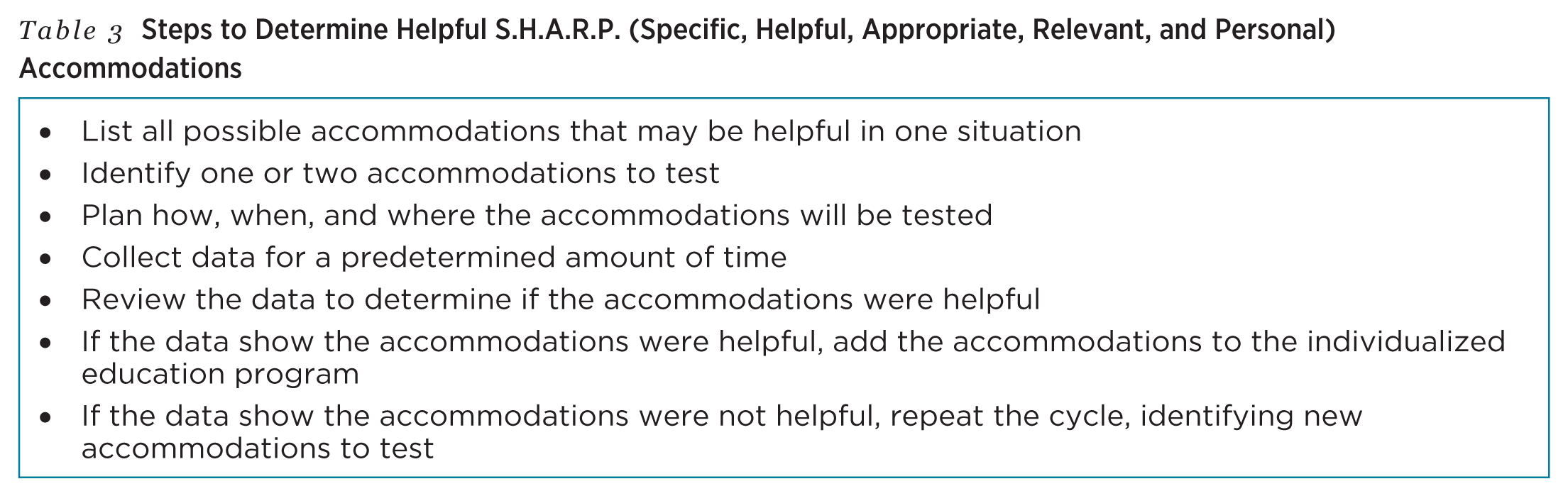
Collaborative teams may consider implementing one or two of these accommodations, such as starting with planned breaks and using a visual timer to count down to them. As different supports are tested, data can be collected to determine the effectiveness of individual accommodations. When implementing these chosen accommodations, the team would collect data on how they are helping and revise them as needed (see Table 3 for steps to determine helpful accommodations). By introducing one or two accommodations at a time, the IEP team can better determine which accommodation is meaningful to the student instead of having a long list of accommodations and then not knowing which accommodation(s) is actually having an effect. Attempting to implement all of these accommodations to support on-task behaviors may take too much time and energy away from instructional time, resulting in a negative impact on the student’s achievement.
Steps to Determine Helpful S.H.A.R.P. (Specific, Helpful, Appropriate, Relevant, and Personal) Accommodations
Ms. Sanchez reviewed one student’s IEP and noticed the student had many accommodations. There were accommodations for using speech-to-text, a scribe, and oral reports instead of written ones and allowing the student to respond to the text through drawings rather than writing. All of these accommodations focused on responding to learning, but it would be impossible to use them simultaneously. Ms. Sanchez made a note to ask the IEP team to consider the different ways a student could demonstrate learning and determine which mode the student used most frequently to clarify the accommodation in the IEP and make it more helpful for future teachers.
Appropriate
Accommodations are designed to consider the individual student’s age, grade level, interest, and ability (Lazarus et al., 2021). Not all great teaching ideas are appropriate for all students. For example, using a visual schedule is a common accommodation for students who struggle with transitions and routines throughout the school day (Petersson-Bloom & Holmqvist, 2022). Some students benefit from a visual schedule with pictures that are hung up on the wall or taped to the child’s desk for easy reference. Older students may not find a visual schedule with pictures appropriate. Instead, the student may benefit from notes on their computer calendar, reminding them which class is coming up next and what materials they need to get out for that class. Other students may find a written planner more appropriate.
Ms. Sanchez noted on one student’s IEP that the student had an accommodation for a visual schedule. Upon reviewing all the classrooms, Ms. Sanchez did not see any schedules posted on the walls or on a student’s desk. She asked the English teacher if the teacher had used any type of visual schedule with the student in the previous year. The teacher indicated that she had not but that she did know the student often looked at the calendar on their phone. The English teacher said that last year, she helped the student learn how to add events to the calendar and make notes on the calendar to track when assignments were due. Ms. Sanchez felt it might be more appropriate to suggest changing the accommodation to “use of calendar on phone” instead of “visual schedule.”
Relevant
Accommodations must be tailored to the student’s current educational needs and designed to support specific educational environments. Although accommodations may be carried over from year to year on an IEP document, the team is responsible for reviewing them each year to determine which ones remain relevant and which ones should be removed (Lazarus et al., 2021).
If a student had an accommodation for taking frequent breaks but does not appear to benefit from breaks and has a hard time transitioning back to work after a break, the IEP team could remove the accommodation of frequent breaks and instead consider sensory-regulating strategies in the classroom. Just because an accommodation is on an IEP one year does not mean it must remain for the next year. Some accommodations, such as walking breaks, may be more relevant in elementary school. In middle school or high school, when students switch classes every period, taking a walking break is built into the schedule already and may no longer be relevant. Accommodations may be added, removed, or changed at any point in time (see Table 4 for questions for reviewing relevant accommodations). Any member of the IEP team, including parents and teachers, can call an IEP meeting or addendum to discuss adjustments to accommodations. This does not have to wait until the annual IEP meeting.
Questions for Reviewing Relevant Accommodations

Another area to consider when reviewing accommodations is the use of technology in accommodations. Technology is constantly changing; thus, IEP teams should consider each accommodation that relates to technology and whether that tool is still relevant or should be removed or changed. Carefully considering what accommodations are relevant for the student at their age, grade level, interests, and abilities will help IEP teams write relevant accommodations using the questions to guide IEP team discussions
In reviewing another student’s IEP, Ms. Sanchez noticed the student had an accommodation to use word processing to respond to written assignments instead of handwriting. As she looked through historical documents, Ms. Sanchez saw that this accommodation was added in the middle of elementary school and has carried over on the IEP every year since. In reflecting on her observations and work with general education teachers at the middle school, Ms. Sanchez noted that all students in all classes were using computers to type their responses, utilizing multiple online curricula. Ms. Sanchez could not find any instances where the students were required to handwrite assignments. She made a note to bring this up at the IEP meeting to discuss with the team whether the accommodation of using word processing to respond to written assignments instead of handwriting was still relevant at this point in time for this student.
Personal
Accommodations are individualized, personal supports provided to students, not uniform across disability (Painter, 2015). For example, not all students who are identified with a specific learning disability benefit from using text-to-speech. Therefore, an IEP team should not write “text-to-speech” on all students’ IEPs just because they are identified with a specific learning disability. IEP teams work together to identify strategies and supports that help students access the general education curriculum and then use those strategies and supports to design individualized accommodations. When designing personalized accommodations, IEP teams consider the individual student and the data collected on how the student benefits from support (Lovett & Nelson, 2021). Teachers can use systems, such as making a tally mark on a calendar when a student uses an accommodation. Analyzing the data can help the IEP team determine if there are observable patterns in when and how often a student uses an accommodation and whether that accommodation should be continued on the next IEP or removed. Once the IEP team reviews the data, they can make personalized recommendations for that individual student.
One example of this is data tracking for taking breaks. A student requires an accommodation that involves being offered a break when they become dysregulated or off task. The teacher can use a calendar and tally mark how often a student takes a break in a given week. Depending on the focus of the data tracking, data may be collected daily, by the time of day (e.g., a.m. vs. p.m.), or even by subject, period, or hour. Observable patterns can emerge, such as the time of day when accommodations are needed more, different periods or subjects that are more challenging, or days of the week that are harder.
When Ms. Sanchez reviews the accommodations listed on her students’ IEPs, she focuses on each individual student’s strengths and needs. What are some tools that support this student in accessing the general education curriculum? What does this individual student prefer to use in class to support their learning? How does this student learn best? Yet at an IEP meeting, Ms. Sanchez heard a teacher comment that all students benefit from “positive reinforcement” for good behavior; therefore, this student needed “positive reinforcement” as an accommodation. Ms. Sanchez was a little confused because the IEP team had just discussed how the student exhibited great behavior in school. Ms. Sanchez took this opportunity to explain that all accommodations should be personalized to each student’s unique needs, not uniform across all students.
Determining the Need for Accommodations
How do IEP teams identify strategies and supports that benefit students? A variety of tools can be utilized to determine what strategies and supports benefit a student the most. These tools include structured observations, interviews, self-reports, and document reviews.
Structured Observations
Observing a student is one of the best places to start in determining what types of accommodations would best support a student’s learning. An observer can monitor a student in various settings and at different times throughout the day, see Observation Data Tracking Chart in Table 5. During observations, the observer can note areas of strength and areas of need as well as the tools or strategies they require to access the general education curriculum successfully. Ecological assessments help to identify typical routines in the class, which parts of the routines the student was successful in, and what else is needed to help them be successful in the classroom (Kurth et al., 2020). Identifying key strengths and strategies can help IEP teams design individualized, focused supports and accommodations (Kluth & Dimon-Borowski, 2003).
Observation Data Tracking Chart

Ms. Sanchez decided to focus on one student, Jose, who had an upcoming IEP. Ms. Sanchez set up time to observe Jose in three different subjects for 15 minutes in each class. She completed an Accommodation Observation Chart documenting her observations (see Table 6).
Sample Observation Data Tracking Chart for Jose
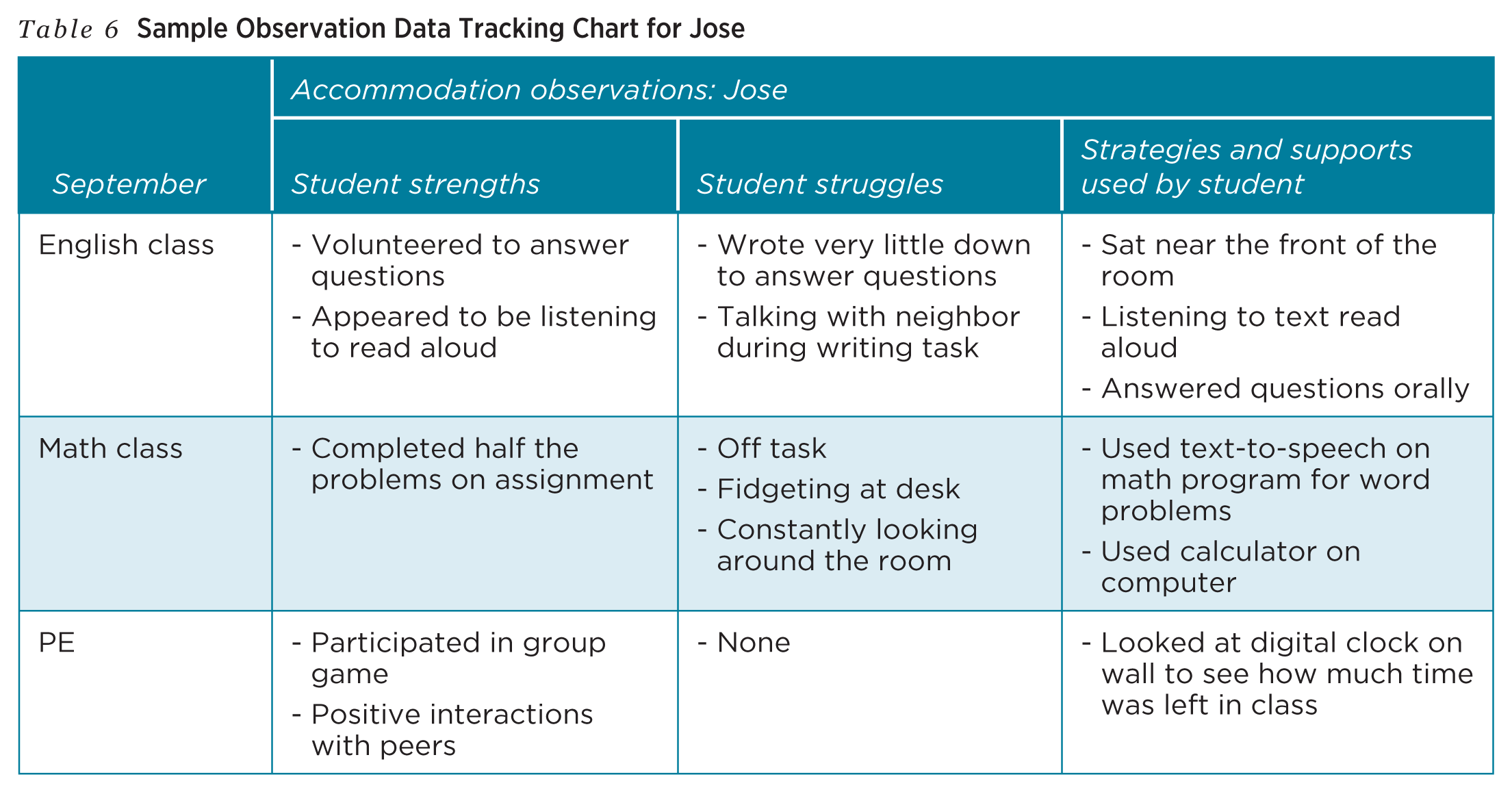
In reviewing these data, Ms. Sanchez noted that sitting near the front of the room appeared to help Jose in English class, so she wondered if the same approach might also be beneficial in math class. She also noticed in English class that he wrote very little but answered questions orally when asked. These data prompted her to consider how Jose might benefit from using speech-to-text tools to document his answers to written questions. Ms. Sanchez asked the IEP team to meet together to review these data and consider adjusting Jose’s accommodations on his IEP.
Interviews
Another source of information for determining accommodations is interviewing current or past teachers, support providers, family members, and the student (Kurth et al., 2020; Lazarus et al., 2021). Interviewing familiar adults provides a clear picture of the student, including their strengths, needs, and the supports or tools currently used (Salend, 2008). Each person can provide information from a different perspective. Family members can identify helpful tools and strategies at home, which could help an IEP team create similar tools and supports at school (Lovett & Nelson, 2021). Current or past teachers can offer valuable insights into the challenges they have faced and the strategies they have employed to address them. Looking for patterns of behavior among different teachers aids in clarifying accommodations needed in differing situations versus those needed for an isolated situation. Therapists, such as occupational, physical, and speech language therapists, can provide crucial information as they look at the student through their specialized lenses. Students can provide information about the accommodations they are currently using, their preferences, and areas where they feel they need more support. Each member on the student’s support team can be asked specific questions to guide the interviews. Are there gross- or fine-motor strategies that could help a student? Is there a specific self-regulation strategy that is effective? Are there language or communication supports that may benefit a child? (see Table 7).
Accommodation Interview Questions for Teachers and Families
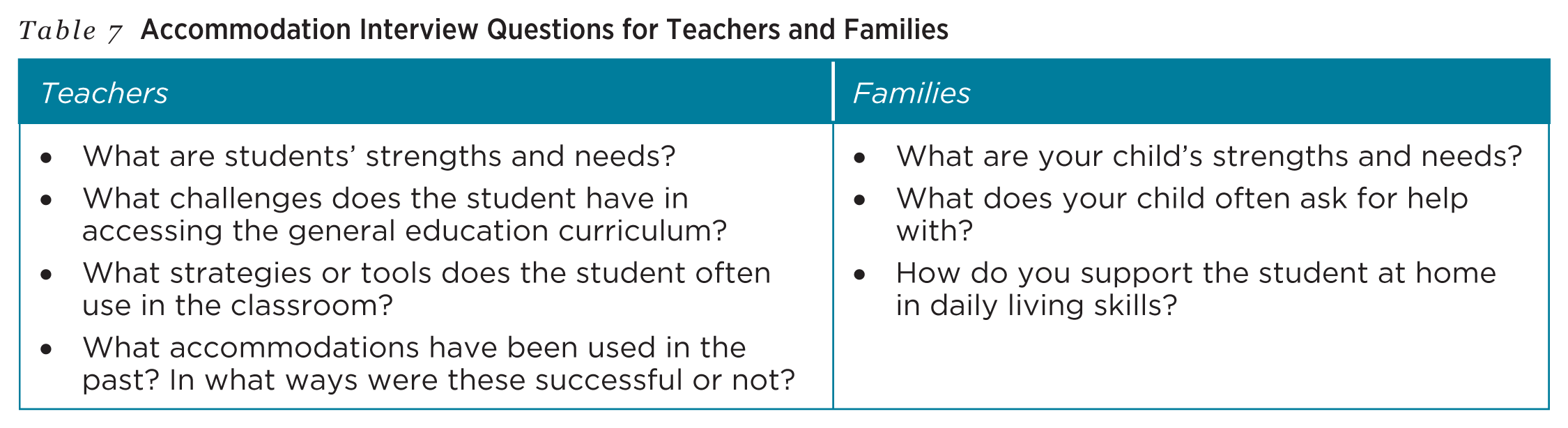
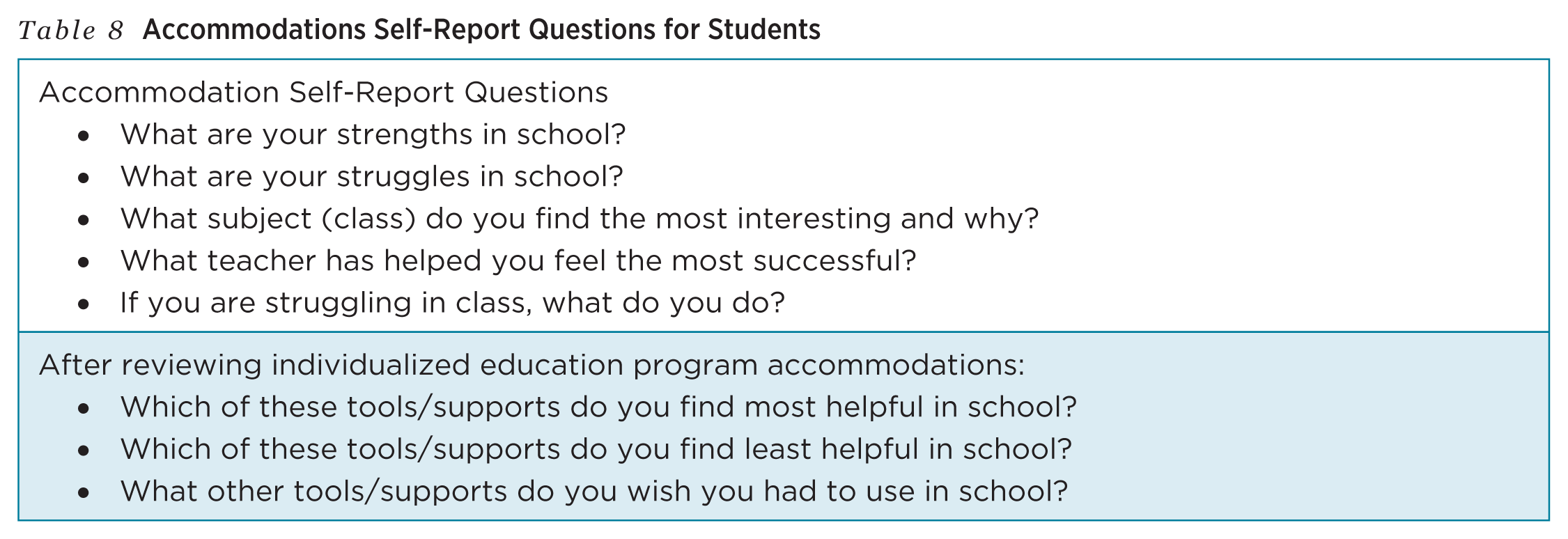
Students can be pivotal in providing information about their strengths, areas for improvement, and strategies that help them succeed. Interviewing students can provide valuable insights into their strengths and the challenges they perceive in their own learning. Students can identify different classes or subjects that are a strength and those that are a struggle. Asking students about the ways they prefer to learn, the teachers with whom they have felt most successful, and the projects they have completed successfully can provide valuable information.
Students are often unaware of the accommodations listed in their IEP (Painter, 2015). Depending on the student’s age and abilities, discuss the past IEP document with the student, review the accommodations information, and ask the student to self-reflect on the accommodations and what they perceive as helpful over the past year. Teachers can ask students to reflect on the tools or supports that help them when they struggle with a task in school to identify future accommodations (see Table 8).
Accommodations Self-Report Questions for Students
Document Reviews
Reviewing previous IEP documents can help an IEP team understand accommodations that have been historically offered to the student. Teams can compare multiple documents over time to see how accommodations have changed or evolved. In reviewing past accommodations, look for similarities and differences in the accommodations over time. What accommodations have remained consistent? What accommodations have been added or removed? Additionally, review the rest of the IEP to identify the strengths and needs the student demonstrates. Are there areas of need that have changed and may require consideration of new accommodations?
Along with IEP documents, review other relevant documents in the student’s historical file. Evaluation reports often provide suggestions for accommodations (Lovett & Bizub, 2019). School psychologists or diagnosticians review assessment results and their potential classroom impact on a student. These professionals will often add suggested accommodations to evaluation reports. The IEP team reviews the suggested accommodations and considers what best applies to the individual student in the current situation. It is critical to consider the accommodations suggested in evaluation reports to ensure they are specific, helpful, appropriate, relevant, and personal. IEP teams do not want to ignore suggested accommodations, but it is also a mistake to simply copy and paste them directly into an IEP without reviewing them to ensure they are S.H.A.R.P.
Implementing S.H.A.R.P. Accommodations
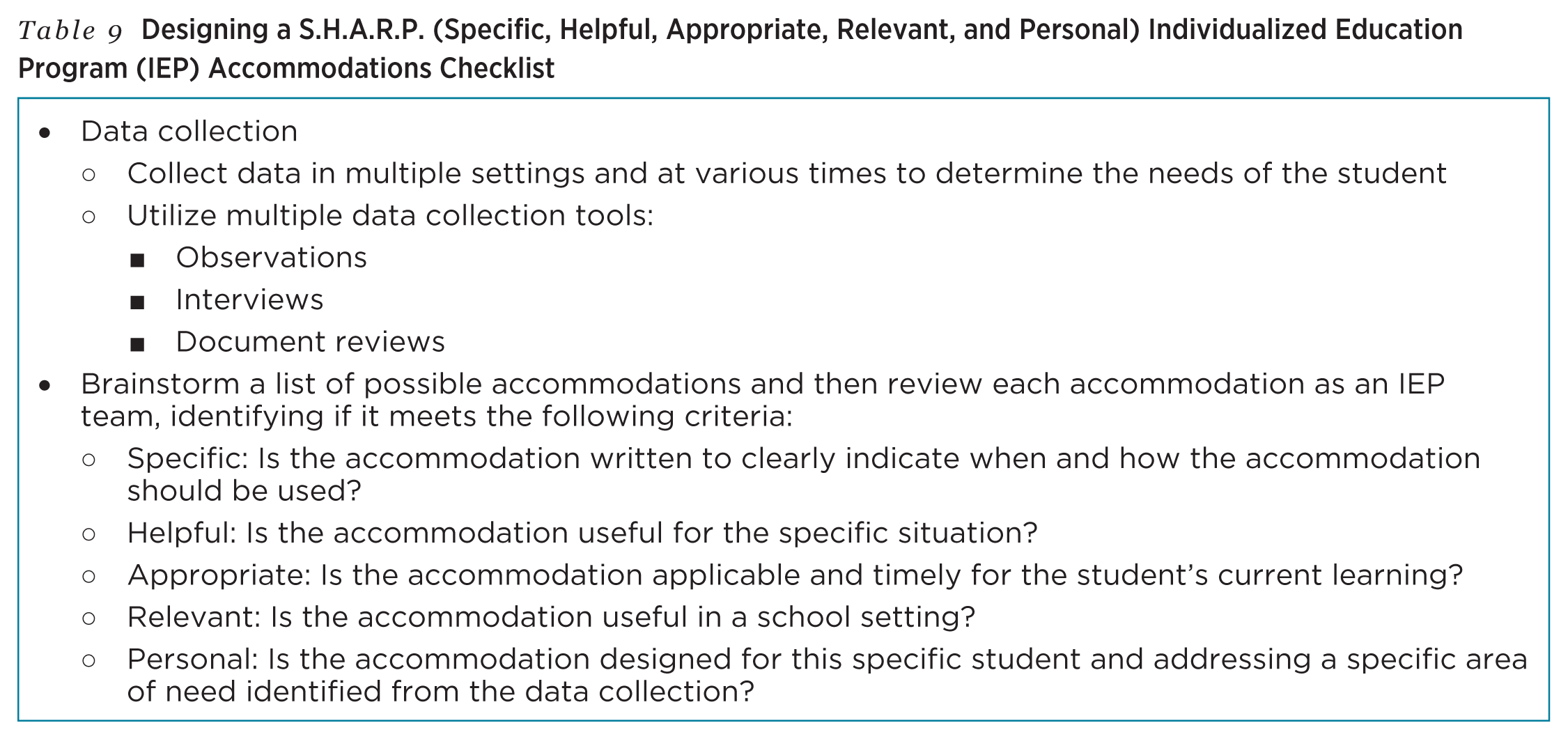
IEP teams develop accommodations to ensure students have full access to the general education curriculum. Yet often, accommodations can be seen as just another box to check or task to complete during an IEP meeting. Accommodations are a key part of an IEP, helping ensure that the IEP is “reasonably calculated” to enable a student to make adequate progress. Taking the time to review accommodations and discuss their practical implications can help ensure that accommodations truly impact a student’s education. The step-by-step checklist in Table 9 will help IEP teams design and review accommodations to ensure they are S.H.A.R.P.
Designing a S.H.A.R.P. (Specific, Helpful, Appropriate, Relevant, and Personal) Individualized Education Program (IEP) Accommodations Checklist
There are multiple possible barriers to implementing the S.H.A.R.P. process for determining accommodations. Determining accommodations requires a collaborative team. Many educational teams struggle to find time to work together in the school setting. Data collection in the classroom and other settings requires dedicated time. Reviewing the data as a team to look for patterns and trends requires dedicated time. None of this is feasible at the last minute, during a rushed IEP meeting.
For IEP teams to truly design S.H.A.R.P. accommodations, time must be set aside to collect data, review it, and write accommodations. Accommodations should not be considered an afterthought in the IEP process but instead one of the primary focuses in creating a truly individualized plan for a student. This process must include all of the team members who support students, including parents and families. Including all team members requires that all team members are trained on what S.H.A.R.P. accommodations are and how they are created and designed.
Conclusion
IDEA requires that IEPs are reasonably calculated; as such, accommodations are an important component to ensure that full access is individualized and tailored to the student. Accommodations must be based on data collected to identify areas of need and the supports that help students overcome them. IEP teams should consider multiple types of accommodations, including presentation, response, time, setting/environment, and aid accommodations. All accommodations written are focused on specific, helpful, appropriate, relevant, and personal accommodations. By following the S.H.A.R.P. accommodations framework, educators can provide students with full access to the general education environment and ensure that all team members consistently implement these supports.
Footnotes
Declaration of Conflicting Interests
The author declared no potential conflicts of interest with respect to the research, authorship, and/or publication of this article.
Funding
The author received no financial support for the research, authorship, and/or publication of this article.

Sarah Vogt, Department of Special Education, University of New Mexico, Albuquerque