Abstract
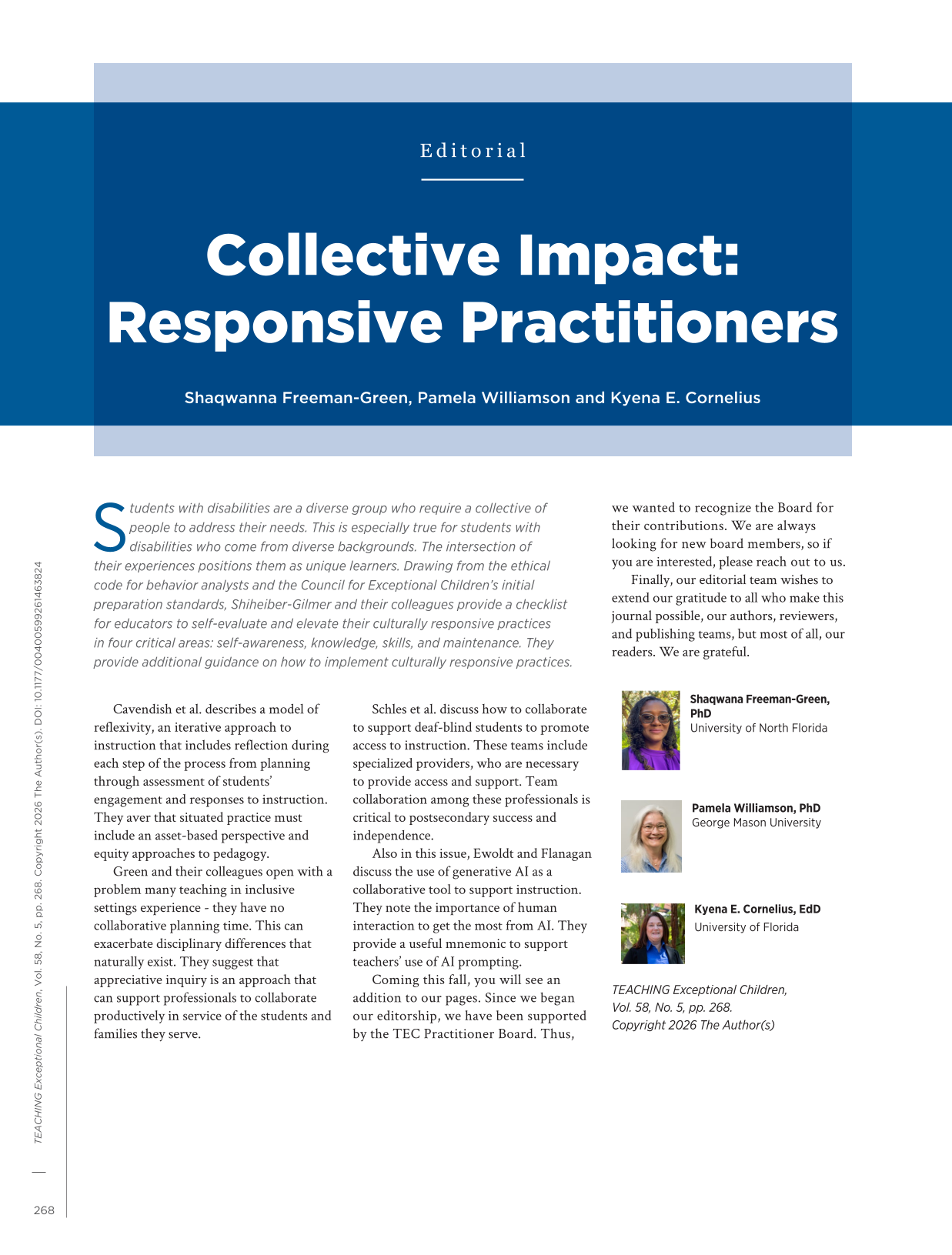
Students with disabilities are a diverse group who require a collective of people to address their needs. This is especially true for students with disabilities who come from diverse backgrounds. The intersection of their experiences positions them as unique learners. Drawing from the ethical code for behavior analysts and the Council for Exceptional Children’s initial preparation standards, Shiheiber-Gilmer and their colleagues provide a checklist for educators to self-evaluate and elevate their culturally responsive practices in four critical areas: self-awareness, knowledge, skills, and maintenance. They provide additional guidance on how to implement culturally responsive practices.
Cavendish et al. describes a model of reflexivity, an iterative approach to instruction that includes reflection during each step of the process from planning through assessment of students’ engagement and responses to instruction. They aver that situated practice must include an asset-based perspective and equity approaches to pedagogy.
Green and their colleagues open with a problem many teaching in inclusive settings experience - they have no collaborative planning time. This can exacerbate disciplinary differences that naturally exist. They suggest that appreciative inquiry is an approach that can support professionals to collaborate productively in service of the students and families they serve.
Schles et al. discuss how to collaborate to support deaf-blind students to promote access to instruction. These teams include specialized providers, who are necessary to provide access and support. Team collaboration among these professionals is critical to postsecondary success and independence.
Also in this issue, Ewoldt and Flanagan discuss the use of generative AI as a collaborative tool to support instruction. They note the importance of human interaction to get the most from AI. They provide a useful mnemonic to support teachers’ use of AI prompting.
Coming this fall, you will see an addition to our pages. Since we began our editorship, we have been supported by the TEC Practitioner Board. Thus, we wanted to recognize the Board for their contributions. We are always looking for new board members, so if you are interested, please reach out to us.
Finally, our editorial team wishes to extend our gratitude to all who make this journal possible, our authors, reviewers, and publishing teams, but most of all, our readers. We are grateful.