







Abstract
This study investigated a new phenomenon of liquid water transport in woven fabrics by using a specially-designed liquid water transport detecting device. It was found that within 6 mm space from liquid water resource, transient transport of liquid water in a woven fabric appears to have non-Fick effect, that is, liquid water transport in a woven fabric processes obvious transient shock effect. After this transient period, water transport in the fabric follows the classical mass transfer theory, and tends to maintain a constant rate. The non-Fick effect of the water transport varied with fabric densities and yarn twists. In general, the lower the fabric density and the yarn twist are, the more obvious the non-Fick effect is. The non-Fick effect of transient transports of liquid water also behaved differently for fabrics made of different fiber materials.
The process of liquid transport in a fabric is controlled by many factors, including the surface properties and hydrophilicity of the fibers in the fabric, the geometric characteristics of yarn and fabric structure, fabric finish, the quantity of fluid, environmental temperature and humidity and so on. 1 Since the 1950s, there have been a number of investigations on this subject. Norman et al.2,3 briefly analyzed water transport mechanisms in yarns and fabrics. They found that water transport in yarns was only slightly influenced by the wetting properties of the individual fibers and depended mainly on the wetting behavior of the whole yarn. In addition, they also found that the movement of water along fabrics depends on the laws of capillary action. Woodcock 4 developed the moisture permeability index to describe the efficiency of fabrics or fabric systems in transferringmoisture and its associated latent heat. Miller et al.5,6 investigated a method of measuring liquid transfer through fabrics. Yoon et al. 7 – 16 analyzed the water transport properties through various kinds of fabrics and the factors influencing moisture transport. Li et al. 17 – 19 developed a new method to characterize fabric liquid moisture management properties. They also investigated the liquid moisture transport performance of wool knitted fabrics and the influence of thickness and porosity on coupled heat and liquid moisture transfer in porous textiles. Crow and Osczevski 20 discussed the interaction of water with fabrics. They found that water absorption by a fabric is strongly correlated with the fabric's thickness and the amount of water wicked from one layer to another depends on pore sizes and their corresponding volumes. Ito and Muraoka 21 investigated the water transport along textile fibers, as measured by an electrical capacitance technique. Adler and Walsh 22 reported the mechanisms of transient moisture transport between fabrics. They found that major transport mechanism at low moisture content is vapor diffusion and wicking between fabrics does not take place until there is a sufficient amount of water to fill capillaries that are formed between fibers and yarns. Ren et al. 23 found that vapor diffusion in the hydrophilic fiber assemblies is governed by a non-Fickian anomalous diffusion.
When a woven fabric is in contact with liquid water, the liquid water will diffuse towards the orientation of pores under the comprehensive action of the forces, including interfacial tension between liquid water and air, self-weight of liquid water absorbed, and the friction force between liquid water and the fabric. Thus it can be seen that the liquid water transport in a woven fabric involves two main aspects. One is the relationship between the forces in the process of liquid water transport and the liquid water transport in a fabric, that is, the kinetic rules of liquid water transport in a fabric. The other is the liquid transport (mass transport) velocity and liquid quantity transported, that is, the kinematical rules of liquid water transport in a fabric. Obviously, the former scholars mentioned above paid attention to the dynamic rules of liquid water transportin a fabric. However, little work has been reported on the kinematical rules of liquid water in a woven fabric.
Macroscopically, the mass transfer of liquid water in a porous solid media obeys Fick's law, that is, under the steady-state conditions, the quantity of mass diffusing through a unit cross-sectional area of porous materials per unit time is proportional to the gradient of liquid concentration. The premise of Fick's law is that the velocity of mass transfer is infinite and there is a one-to-one correspondence between the mass disturbance and the establishment of a concentration gradient. However, when the scale variation of mass disturbance time is less than the relaxation time scale of component A in component B, it is found that the mass transfer in this case does not obey Fick's law and it shows a non-Fick effect. 24 A woven fabric is a kind of porous material. When the fabric is in quick contact with liquid water, the liquid water transport shows an accumulative effect. It is impossible for the liquid water within a limited contact space to be transferred to an adjacent space in time. From the microcosmic viewpoint, once the water molecules at the front-end strike the fabric, part of them will accumulate there and the others will return. The returned molecules will transfer ahead due to being struck by the liquid water molecules at the back. In the next adjacent micro-thickness space, the water molecules transfer in a similar way as the earlier one. So it goes on and mass transfer occurs. The liquid water transport within a limited space and in a short time possesses step-change characteristics andit shows a non-Fick effect. Then, the velocity of liquid water transport in the fabric tends to be constant under the action of the balanced forces mentioned above. Of course, the liquid water transport in a woven fabric is also influenced by the environmental conditions. When the environmental humidity is lower, part of the liquid water transported will evaporate, which could reduce the quantity of liquid water transported in the fabric. However, the moisture evaporation can be negligible under the condition of higher environmental humidity and within a very short time.
Based on the traditional theory of moisture transport, this work is to further investigate the kinematical rules of liquid water transport in a woven fabric. The experiments were performed with a self-set-up apparatus that detects liquid water transport in a woven fabric. Furthermore, the effects of different factors on liquid water transport in a woven fabric were investigated, including fiber material, fabric density and yarn twist.
Experimental
Experiment set-up and materials
A woven fabric is a kind of material with high electric resistance. However, after the fabric absorbs liquid water, the resistance value of the fabric decreases greatly and hence brings a change in electric current it conducts, accordingly. By monitoring changes in the voltage of a given distance on a fabric, the kinematics of liquid water transport in the fabric can be studied. Based on such a principle, a testing apparatus for observing liquid water transport along a fabric was developed. The experiments were conducted under the following laboratory conditions: 65% ± 3% relative humidity and a temperature of 20 °C ± 2 °C.
Figure 1 shows the schematic diagram of the experimental set-up for testing the transport rules of liquid water in a woven fabric. The size of the testing fabric was 20 mm wide and 50 mm long. On the testing fabric, four groups of silver probes, in total, were placed at regularly spacings of 3 mm and the distance between the first group of silver probes and the edge of the testing fabric, in length direction, was also 3 mm. The transverse distance between the two silver probes of each group was 10 mm and the distances between the two probes and the adjacent fabric edges in width direction were both 5 mm, as shown as in Figure 1. The data acquisition system usedPCI 1713 high speed data acquisition card (made by Advantech Co., Ltd. in China) for converting the analog electrical signals output by the humidity sensor into digital signals that could be recognized by a computer. Figure 2 shows the detecting principle diagram of a group of silver probes. For considering the sensitivity and the accuracy tested, the power supply in the apparatus adopted 5 V D.C. stabilized source. The value of electrical resistance, R, is determined by the resistance values of dry fabric and wet fabric. According to the testing results, the resistance of a wet fabric ranges from 105–107 Ω. In order to ensure the accuracy of the testing results, the value of resistance, R, needs to be close to the resistance of the wet fabric and was selected as 2 MΩ in the experiment. Because of the insulation of dry textiles, when the surrounding of the silver probe 2 is dry, the resistance between the silver probe 2 and 1 would be so high that the circuit was broken and the output voltage of the detecting circuit would be zero. However, when the surrounding of the silver probe 2 is wet, the resistance between the silver probe 2 and 1 would decrease suddenly and the circuit would be closed. Then the output voltage of the detecting circuit would be produced. So based on the difference of the output voltage, the moisture content of the fabric could be obtained accordingly.
Schematic diagram of experimental set-up for testing transient transport of liquid water. Detecting principle diagram of a group of silver probes.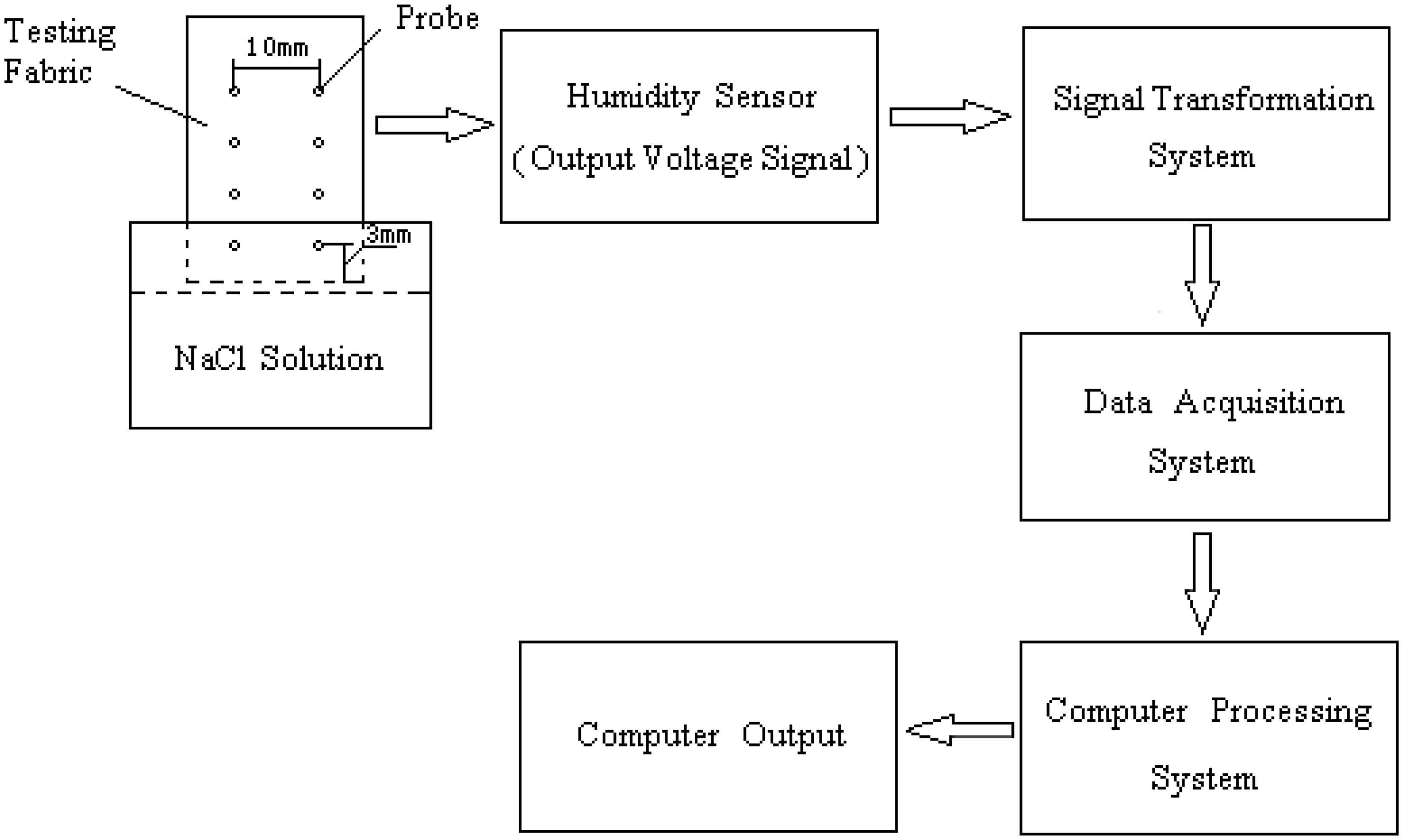
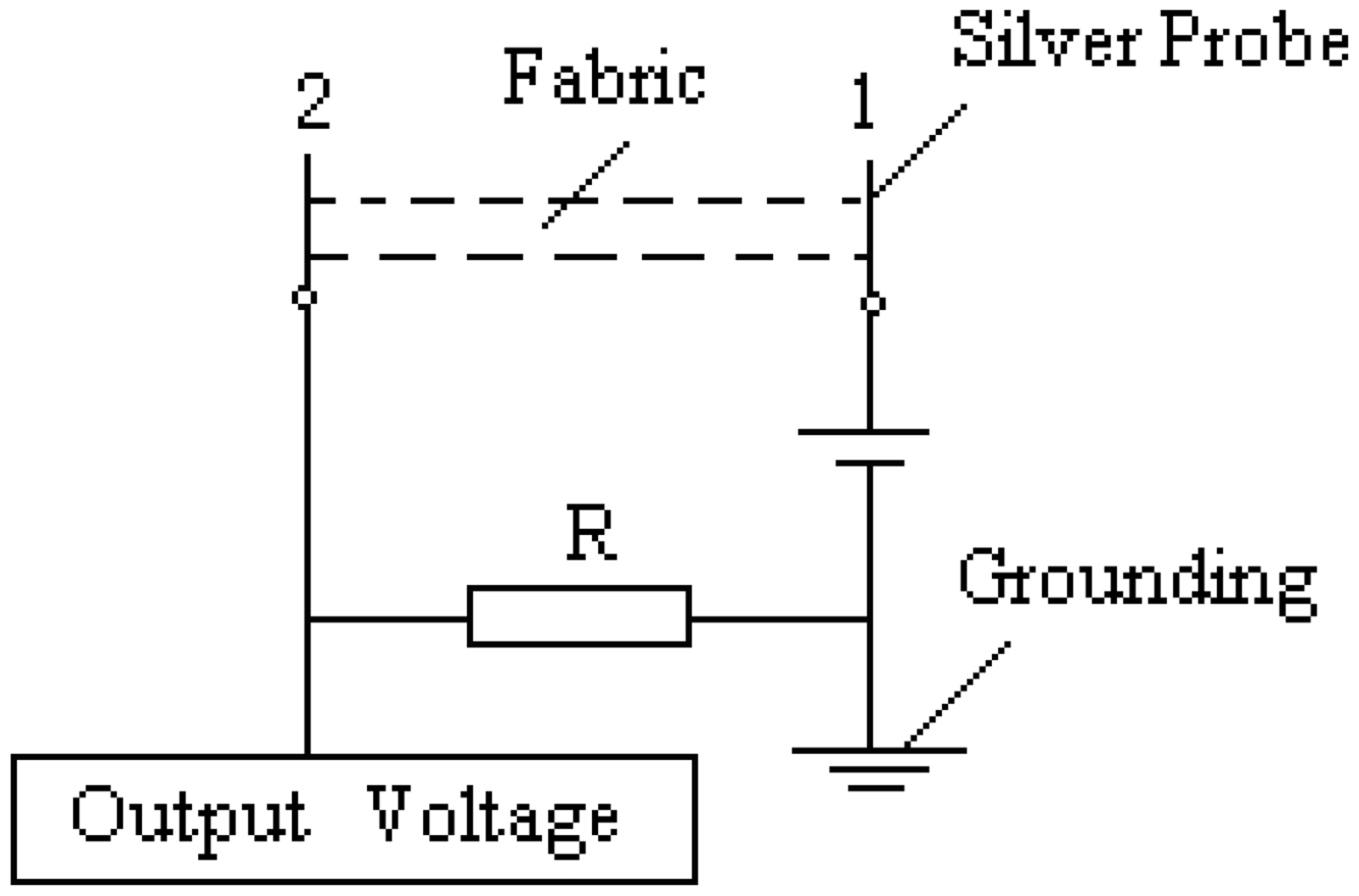
Pure water is not conductive. However, when water drops down on a fabric, it will result in the formation of a certain amount of ions due to the salt contained in the fabric. A wet fabric has a certain conductivity. The output voltage at a specific point of a wet fabric can indirectly reflect the moisture content at this point of the wet fabric. All the moisture testing instruments which uses the electric resistance method and the moisture management tester developed by Hu et al. are based on this principle. 19 In order to enhance the electrical conductivity of the wet fabric and simulate the state of sweat transport of the human body, 5% NaCl solution was prepared instead of liquid water in this work.
Here, the output voltage at a specific point of a wet fabric reflects the ion content of the NaCl solution at thispoint of the wet fabric. However, the movement of ions can be used to characterize that of liquid water molecules for the following reasons. First of all, the diameters of the sodium and chloride ion are both no bigger than the outside diameter of a water molecule. 25 So the sodium and chloride ion can approach the position of the water molecule. Secondly, the distributions of sodium and chloride ion in liquid water are uniform and they can only transport ahead with liquid water. Finally, the voltage between the two silver probes is very low as 5 V and its electric field direction is perpendicular to the direction of water transport. So the ion distribution in liquid water should not be affected by an electric field.
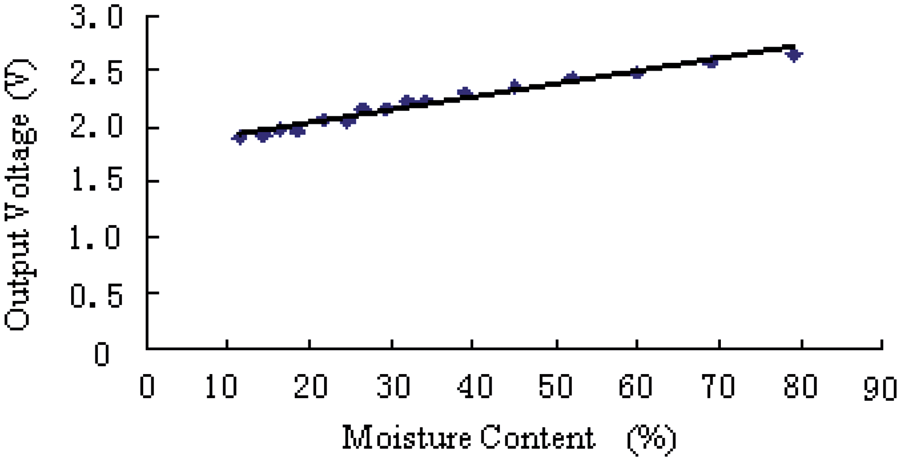
In order to investigate further the relationship of output voltage and the NaCl solution content of a wet fabric, the weft-wise fabrics made with round cross-section polyester filaments, as sample A, as shown in the following Table 1 were washed with pure water and dried, then moistured with different contents of 5% NaCl solution. After measuring the corresponding output voltages with the testing appratus, the relationship between the NaCl solution content of the wet fabric and the corresponding output voltage was obtained, as shown in Figure 3. It can be seen from Figure 3 that the NaCl solution content of a wet fabric correlates with the output voltage in a linear relationship. The regression model of the output voltage with NaCl solution content is obtained as equation 1:
The relationship between output voltage and 5% NaCl solution content of a fabric.
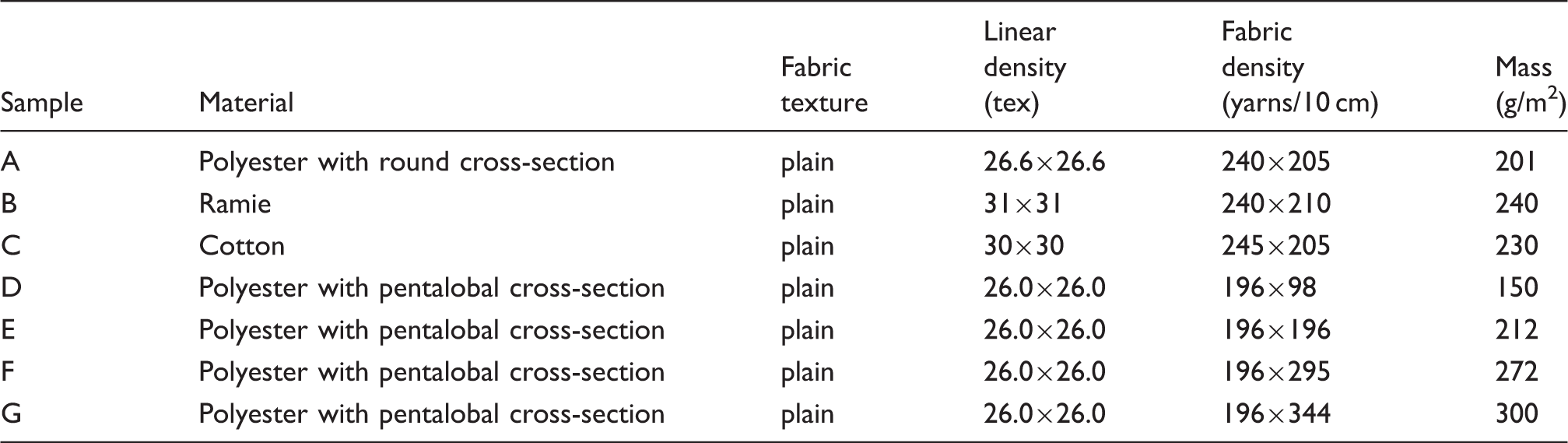
Selected fabric descriptions
Therefore, the value of output voltage U of a wet fabric can really reflect the NaCl solution content, M, of the testing fabric.
In this work, seven kinds of white bleached woven fabrics were prepared for investigating the transport rules of liquid water in a woven fabric and the descriptions of the fabrics are listed in Table 1.
Results and discussion
Non-Fick effect of transient transport of liquid water
Figure 4 displays the NaCl solution transport performances in weft-wise sample C under different testing distances from the NaCl solution resource. It can be seen that, on the whole, the quantities of NaCl solution transported to different testing points from the NaCl solution resource increase gradually from zero until thesaturated NaCl solution contents at different testingpoints are reached. The whole transport process ofNaCl solution in sample C follows Fick's law. However, the output voltage curves of the testing distances at 3 mm and 6 mm from the NaCl solution resource are slightly different from those of the testing distances at 9 mm and 12 mm from NaCl solution resource. The analysis of testing data shows that, when the testing distances from NaCl solution resource are 9 mm and 12 mm, the NaCl solution transports in sample C, no step change appears at the beginning and it follows Fick's law completely. However, when the testing distances from NaCl solution resource are 3 mm and 6 mm, the output voltages appear with varying degrees of step change at the beginning, that is, the NaCl solution transports in sample C possess an obvious transient shock effect. They deviate from Fick's law and show an obvious non-Fick effect. Such experimental results further verify that the ions in the NaCl solution will not accumulate due to the action of electric field, that is, the ion distribution in liquid water is not at all affected by the electric field and the ions can only move forward with liquid water.
Output voltage variations with time of sample C under different testing distances.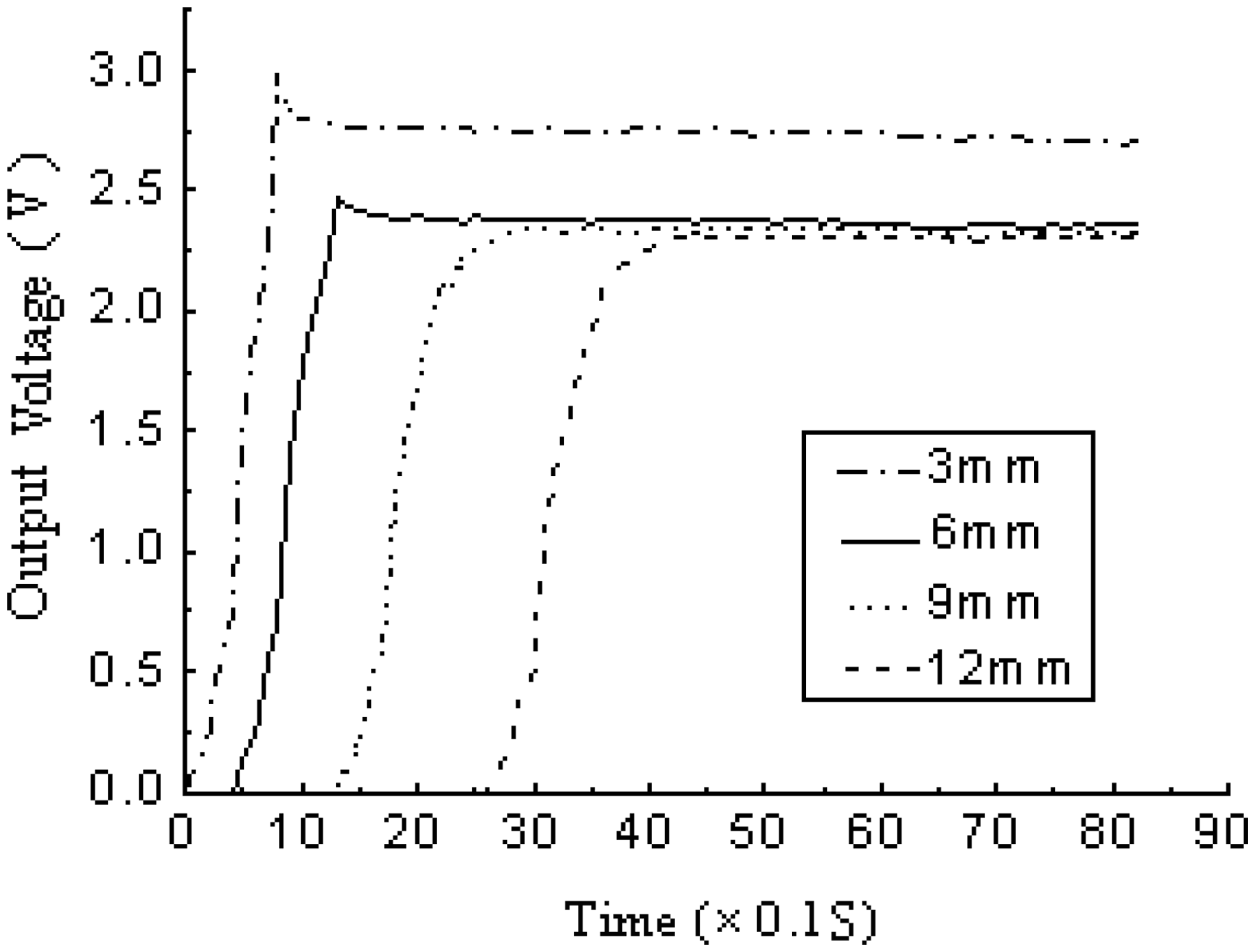
The above results indicate that, liquid water transported in a fabric to a limited space from a liquid water resource shows an accumulative effect at the beginning and then tends toward the maximum wicking quantity ofliquid water under the action of the balanced forces, which include interfacial tension between liquid water and air, self-weight of liquid water absorbed and the friction force between liquid water and the fabric. However, with the further increase of transport distance of liquid water in the fabric, the mass transport velocity of liquid water in the fabric was gradually reduced due to the cross-sectional swelling behavior of moist cotton fiber. The accumulative effect becomes less obvious or even disappears and the liquid water transport follows classical mass transfer theory completely. Furthermore, in this work, the moisture evaporation has no influenceon the liquid water transport in the fabric due tothe experimental conditions, that is relatively high humidity at 65% ± 3% and a very short experimental time. So the amount of liquid water transported in the fabric tends to be stable and the output voltage curves tend to be straight lines, as shown as in Figure 4.
Thus, it can be seen that the result from this experiment is completely consistent with the foregoing theoretical analysis.
When the testing distance is 3 mm from the NaCl solution resource, the transient liquid water transport in a fabric gives the sharpest non-Fick effect, hence the following experiments in this paper were all based on a 3 mm testing distance from the NaCl solution resource, i.e. the lowest group of probes.
Effect of fiber material on transport performance
Woven fabrics with different materials have different levels of wetability, which will result in different liquid water transport rules. Figure 5 shows the output voltage varations with time of the weft-wise fabrics made of different materials. It can be seen that no matter what kind of material the fabric is woven from, a step change appears in the output voltage within a very short span time and after that, it tends to be stable. It indicates that the NaCl solution transport in the fabrics woven by different materials displays a transient shock effect and shows a non-Fick effect within a very short span time. Then as time goes on, the amounts of NaCl solution transported in the fabrics tend to be saturated wicking values of the fabrics. However, the fabrics by different materials display transient shock effect in varying degrees. Among the three fabrics, sample A displays the sharpest transient shock effect, followed by sample B, and then sample C. The reasons for this are complicated. Many factors control the transport performance of NaCl solution in a fabric, including the hygroscopicity of the fabric material, the size and quantity of inter-yarn poles or voids and capillaries in the fabric, and theconsistency of these poles and capillaries and so on. Among the three testing fabrics, sample A is a polyester filament fabric which has many continuous poles and capillaries and it has a better capillary effect. Furthermore, polyester filament possesses poor hygroscopicity. So sample A displays the fastest transport velocity of NaCl solution and more NaCl solution is transported through sample A in a very short time. Thus the transport of NaCl solution in sample A possesses the sharpest transient shock effect. The material for sample C is cotton yarn, which is a staple structure, so the consistency of the capillaries between fibers is notso good. Furthermore, cotton fiber possesses good hygroscopicity and some of the water would be absorbed by the fiber during the transport process of NaCl solution. Therefore, the transport velocity of NaCl solution in sample C is very slow. As for sample B, the situation is slightly different to sample C. The material for sample B is ramie, which has many cracks on the fiber surface, so sample B displays a moisture transport velocity that is a little faster than sample C.
Output voltage variations, with time, of fabrics by different materials.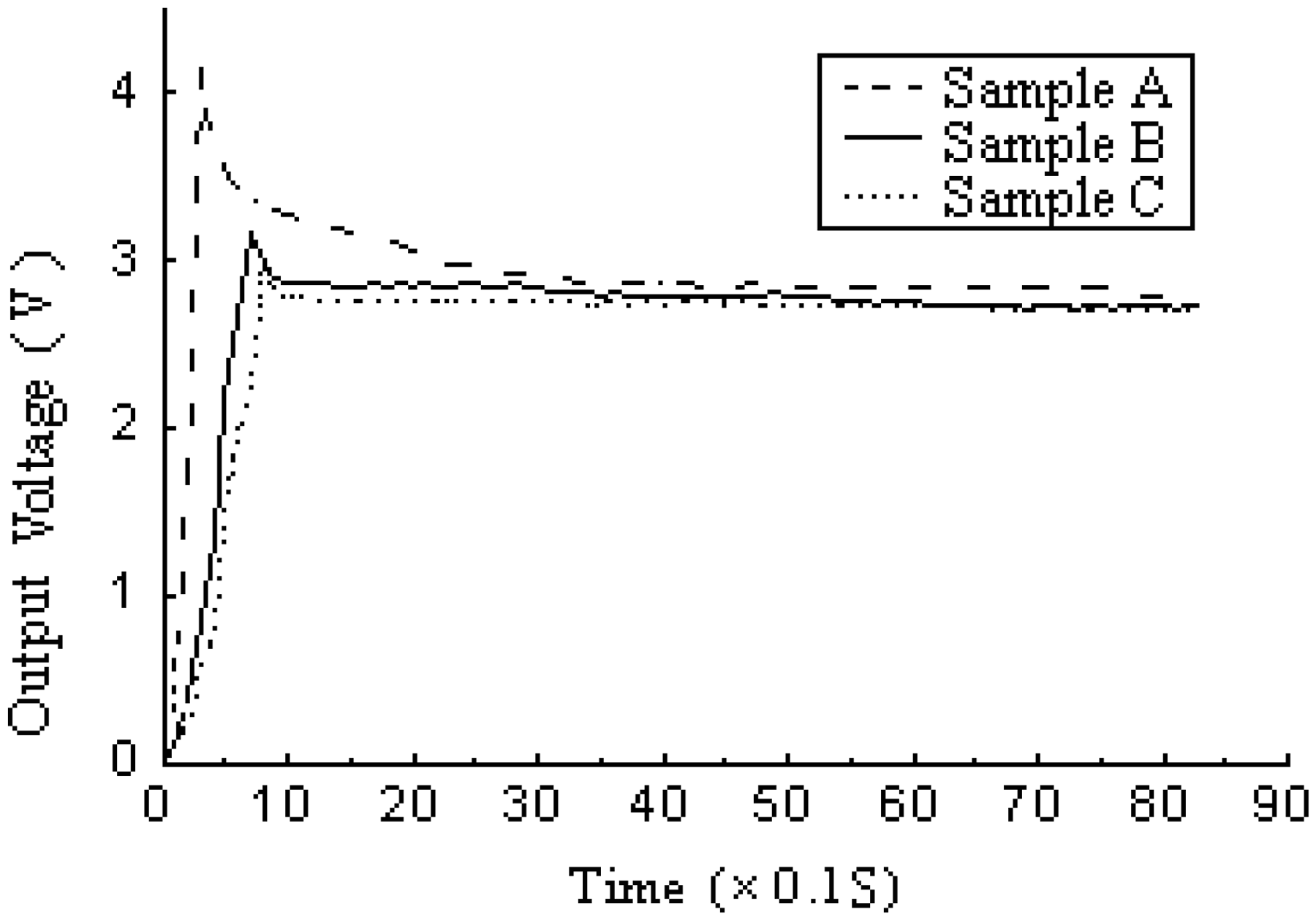
It can be concluded from the above discussion that, from observing the whole transport process of liquid water, the transport of liquid water in the fabrics of different materials follows Fick's law. However, transient transport of liquid water in the fabrics deviates from classical mass transfer theory and exhibits a non-Fick effect. Moreover, the faster moisture transport velocity displayed by a fabric, the sharper the non-Fick effect appears for the liquid water transport in the fabric.
Effect of fabric density on transport performance
Different fabric densities will directly influence the yarn arrangement density and the size and quantity of the inner capillaries. So the transport performances of NaCl solution in the weft-wise fabrics with different densities were investigated in this paper. Figure 6 represents the output voltage variations with time of the fabrics with different densities. It is apparent that the output voltage variations, with time, of the fabrics with different densities show the same trend. These output voltages of the fabrics with different densities all increase sharply at the beginning and display a transient shock effect, after which they tend to be stable. However, with the increase of the fabric density, the yarns in the fabric are compacted and the number and size of the poles and capillaries in the fabric all reduce. The transportability of NaCl solution in the fabric is weakened. Then the amount of NaCl solution transported through the fabric in a very short time reduces. So with the increase of the fabric density, the output voltage value of the fabric slightly decreases and the transient shock effects of the fabrics with differentdensities are slightly different. Overall, the transient transport of liquid water in the fabrics with different densities displays a non-Fick effect, after that the amounts of liquid water transported in the fabrics tend to be the saturated wicking values of the fabrics and the output voltage curves of the fabrics tend to be straight.
Output voltage variations, with time, of the fabrics with different densities.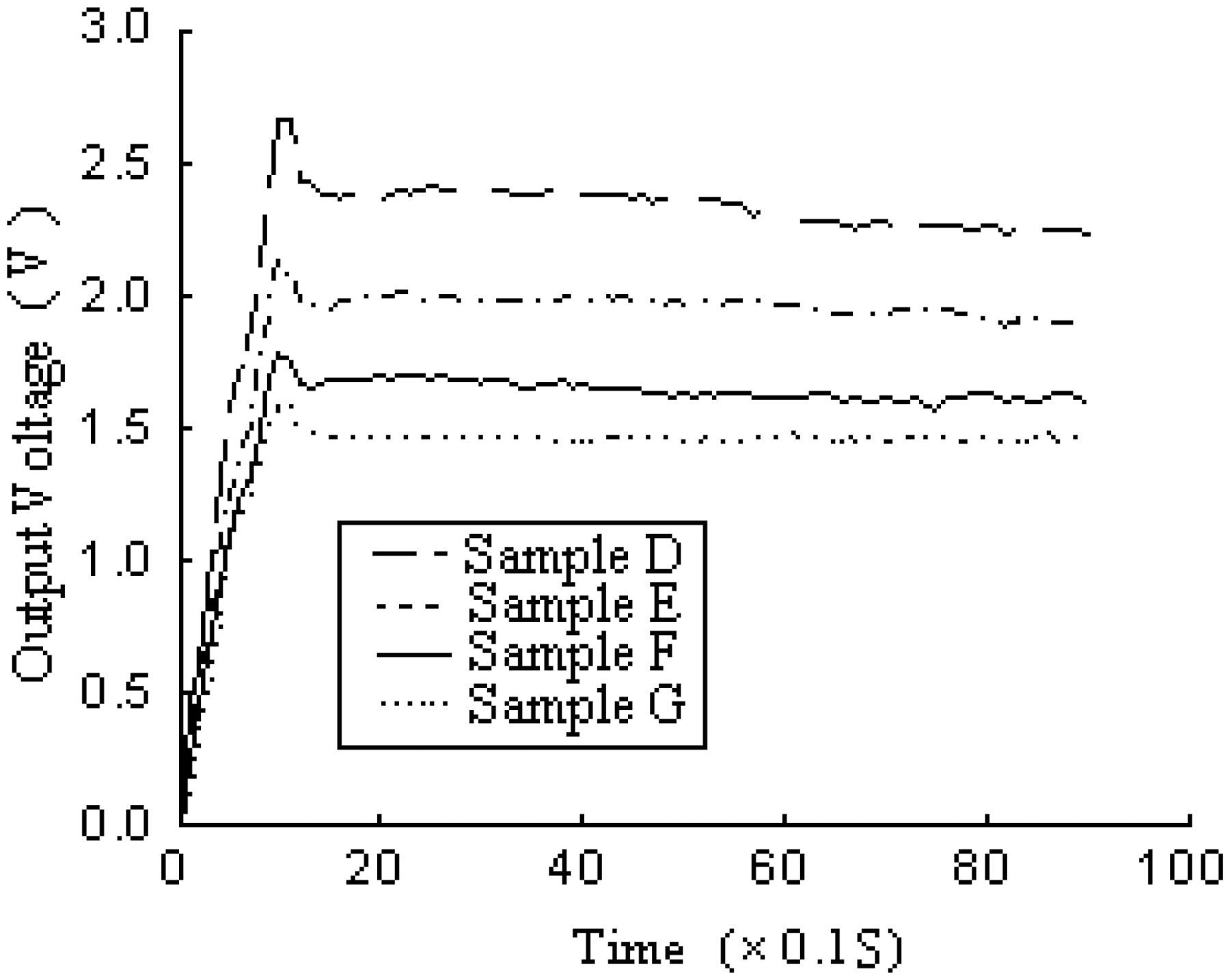
Effect of yarn twist on transport performance
Descriptions of the fabrics woven by the yarns with different twists
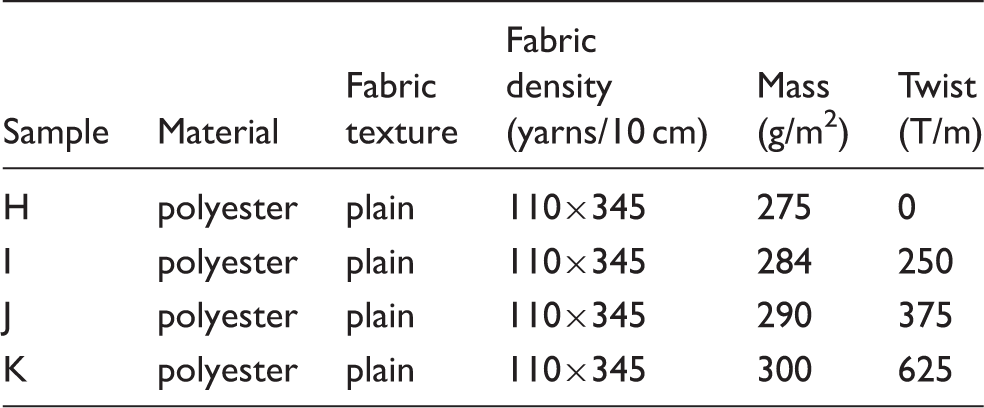
Figure 7 shows the output voltage variations with time of the polyester fabrics woven by the yarns with different twists. Note that the yarn twist will affect the transport performance of NaCl solution in a fabric. Among the four samples, the transient transport of NaCl solution in sample H, woven by the yarns withouttwist, shows the most obvious non-Fick effect. However, with the increase of the yarn twist, the sizes and quantities of the capillaries formed between fibers and yarns will decrease gradually. Furthermore, with the increase of the yarn twist, part of the capillaries will be blocked up and the consistency of the capillaries will deteriorate gradually. Accordingly, the transport velocity of NaCl solution in the fabric was gradually reduced and the transient accumulation amount of NaCl solution decreases. So the peak of the output voltage curve becomes less obvious, that is, the transient transport of NaCl solution appears to have a less obvious non-Fick effect, as shown by the output voltage curves of sample I and sample J in Figure 7. Then with the further increase of the yarn twist, the non-Fick effect disappears and the NaCl solution transport follows classical mass transfer theory, as shown by the output voltage curve of sample K in Figure 7. However, as time goes on, the amounts of NaCl solution transported in the fabrics tend to be their respective saturated wicking values of the fabrics.
Output voltage variations, with time, of the polyester fabrics woven by the yarns with different twists.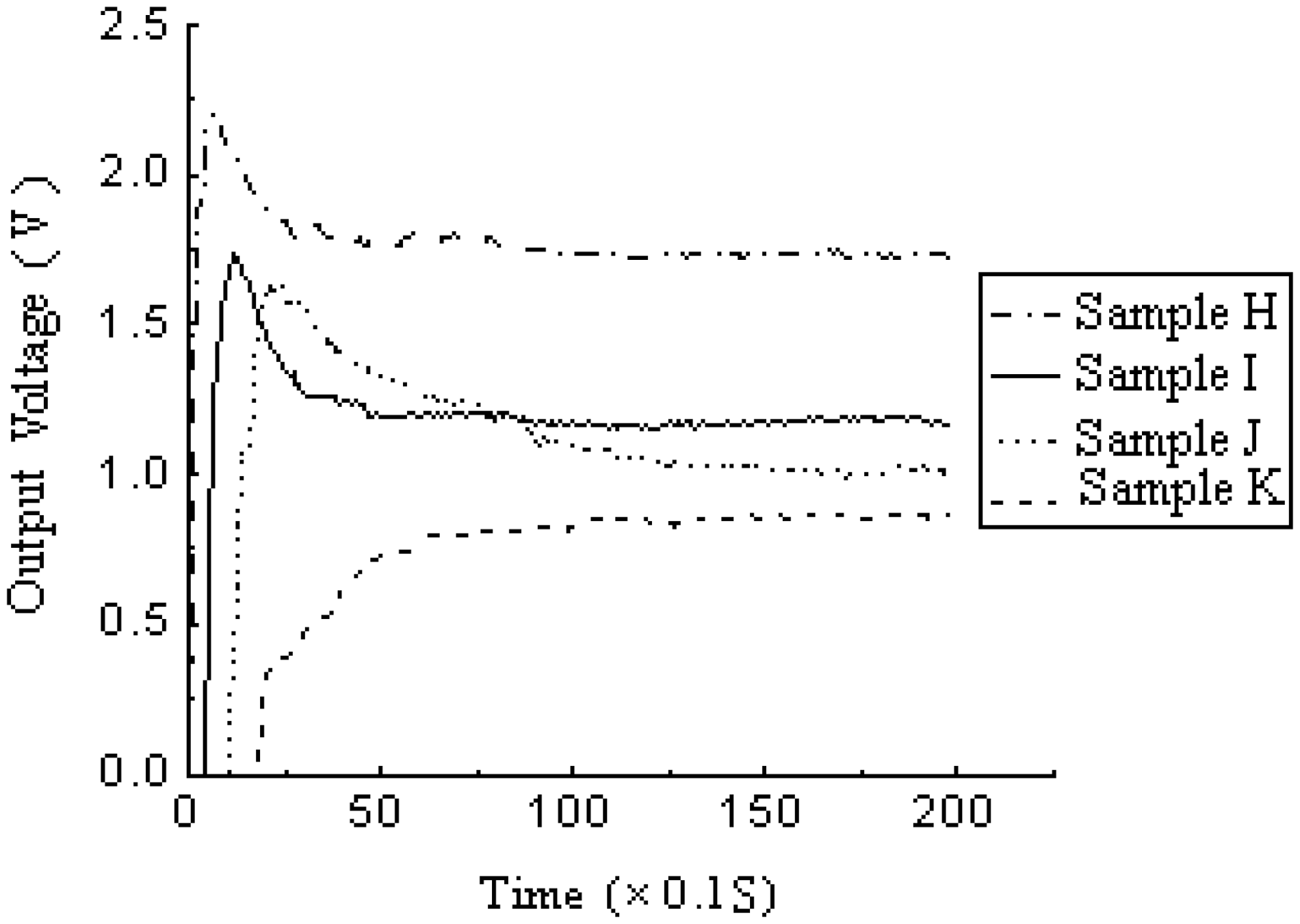
Conclusion
Transient transport of liquid water along a woven fabric appears to have a non-Fick effect within a limited space and in a very short time. By using a specially designed testing device for liquid water transport, we found that within a 6 mm space from the liquid water resource, transient transport of liquid water in a woven fabric appears to have a non-Fick effect. After this transient period, water transport in the fabric follows the classical mass transfer theory, and tends to maintain a constant rate. In addition, the results of this study also support the following conclusions:
Liquid water transport in fabrics made of different materials shows various degrees of non-Fick effect. The higher hydrophobicity the fabric material possesses, the higher the transport velocity of liquid water in the fabric is, and the more obvious the non-Fick effect is. The lower the fabric density is, the more obvious the non-Fick effect of the liquid water transport in the fabric appears. With the increase of the fabric density from 196×98 to 196×344 yarns/10 cm, the transient output voltage value at 3 mm testing distance from liquid water resource decreases from 2.67 V to 1.59 V. The yarn twist will affect the transport performance of liquid water in a fabric. The lower the yarn twist used in a fabric is, the more obvious the non-Fick effect of the transient transport of liquid water in the fabric appears within a limited space. With the increase of the yarn twist used in a fabric from 0 to 375 T/m, the transient output voltage value, at 3 mm testing distance from the liquid water resource, decreases from 2.17 V to 1.63 V. However, when the yarn twist used in a fabric increases to 625 T/m, thenon-Fick effect disappears and the liquid water transport follows classical mass transfer theory.
Footnotes
Funding
This work was supported by Shaanxi Province Leading Academic Discipline Project (grant number 2050205).
Acknowledgements
Furthermore, we gratefully acknowledge The Academician Research Center of Xi'an Polytechnic University, Shaanxi Research Center of Engineering Technology for Textile Testing and Control, as well as Shaanxi Research Center of Engineering Technology for Technical Textiles for providing the experimental devices and the test instruments to accomplish this study.