







Abstract
Auxetic materials are a kind of non-conventional materials having negative Poisson’s ratio. They laterally expand when stretched or laterally shrink when compressed. Compared to conventional materials, auxetic materials have a number of enhanced properties that could be very interesting for some special applications. This paper reviews the latest achievements in auxetic materials, including their properties, structures and applications. A special discussion on their potential applications in textiles is also made. It is expected that this review could provide some useful information for the future development of auxetic textile materials.
Most materials exhibit a positive Poisson’s ratio, that is, they laterally shrink when stretched (Figure 1(a)) or expand when compressed (Figure 1(c)). On the contrary, auxetic materials exhibit a negative Poisson’s ratio (NPR), that is, they laterally expand when stretched (Figure 1(b)) or laterally shrink when compressed (Figure 1(d)). In the 1800 s, Voigt
1
and others had already discovered the auxetic or NPR effect in some materials. At that time, auxetic materials were only limited to natural materials and did not draw too much attention. In 1987, Lakes
2
first reported an auxetic foam structure that could easily be manufactured by tri-compression and heating process. His work showed that auxetic materials could also be obtained in a man-made way. After that, more scientists began to research auxetic materials. To date, many auxetic materials have been found or manufactured (Table 1), including foams,2–4 composites,5–7 crystals,8–11 metals,
12
ceramics,
13
etc. For convenience, Evans et al.
14
named this kind of material ‘auxetics’ in 1991, which is commonly used today.
Stretch/compression behavior of materials: (a)/(c) conventional materials; (b)/(d) auxetic materials. Some auxetic materials found or manufactured PU: polyurethane, PP: polypropylene.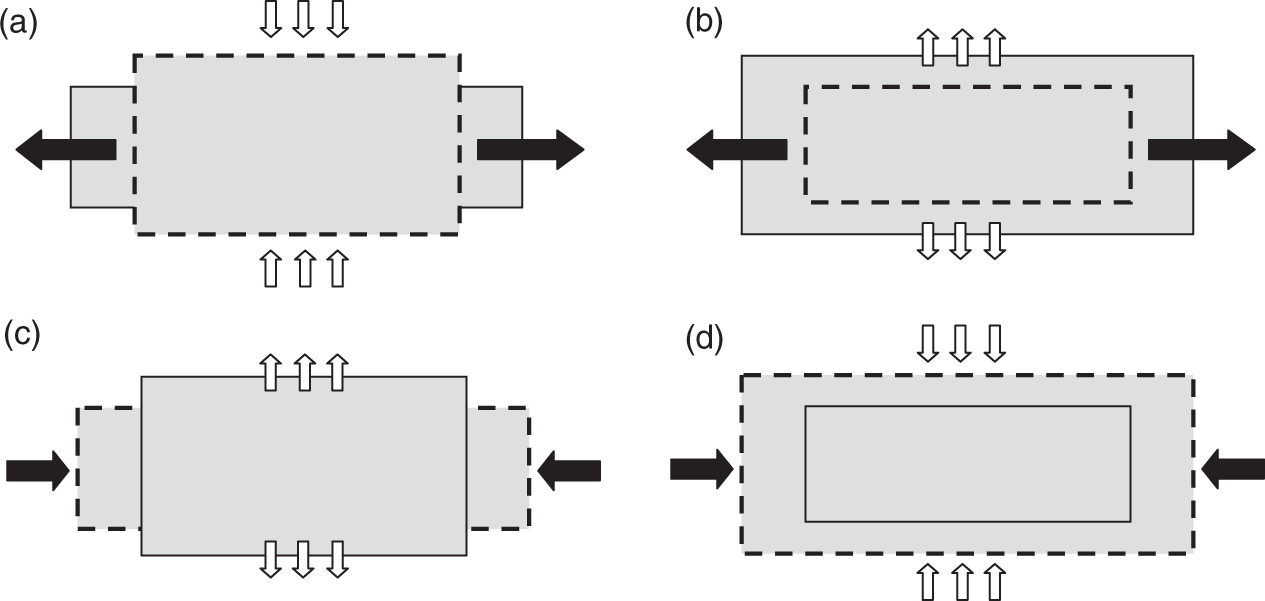
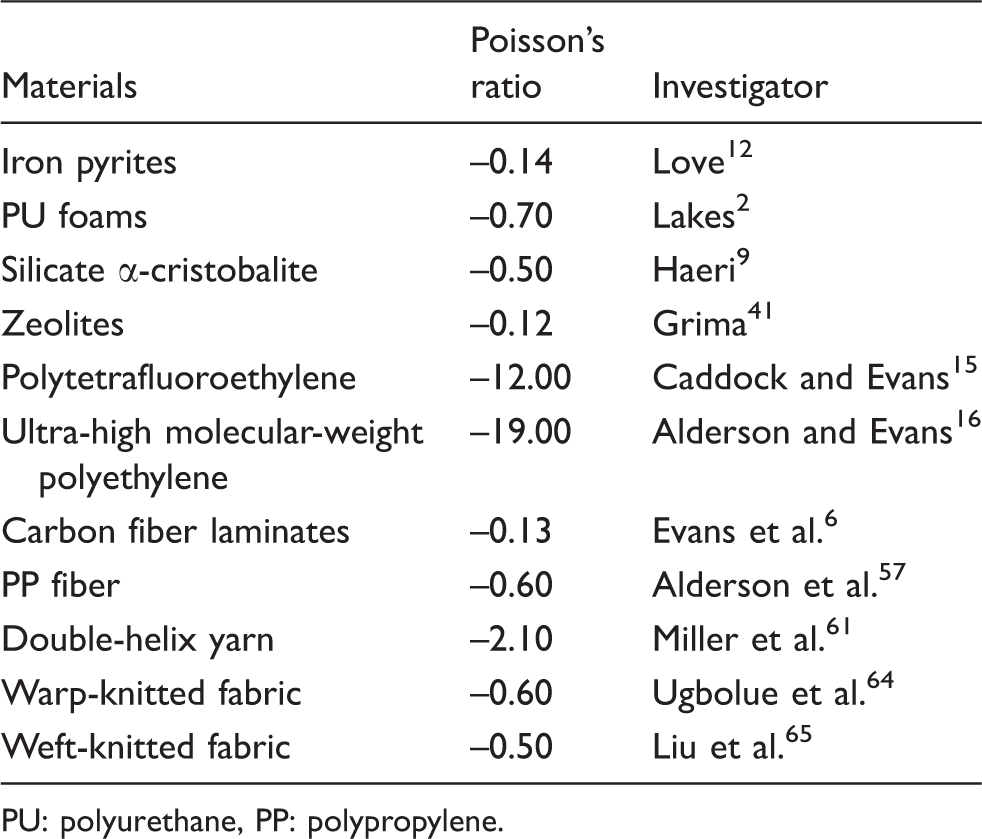
With development, auxetic materials have exceeded the isotropic and macro-scale limit and have been extended to both the isotropic and anisotropic, ranging from macro- to nano-scales. Some large auxetic materials15–17 and molecular auxetic materials18–21 have been found to have good potential uses. Compared to conventional materials, auxetic materials possess some enhanced properties, such as shear resistance,22,23 indentation resistance,24,25 synclastic curvature, 26 crashworthiness, 27 sound absorption,28–30 etc. These enhanced properties make the auxetic materials very attractive for many potential applications, such as personnel protection, 31 military use, 32 biomedicine,26,33,34 aerospace35,36 and textiles.31,37
This paper reviews the latest research achievements in auxetic materials, including their properties, structures and applications. A special discussion on their potential applications in textiles is also made. It is expected that this review could provide some useful information for the future development of auxetic textile materials.
Auxetic materials
Natural auxetic materials
Naturally occurring auxetic materials have been found for more than 100 years. Today, a large number of natural auxetic materials have been discovered and investigated, including skins,38,39 ceramics, 13 graphite, 40 metals, 12 Zeolites, 41 etc.
Silicate α-cristobalite, which is considered as a class of natural auxetic material, has attracted a lot of attention in recent years. The NPR effect of silicate α-cristobalite comes from the intrinsic rigid structure of the silicate. The elastic behavior of α-cristobalite was investigated by the first-principles calculations and its NPR was first found. 8 Tensorial analysis of the elastic coefficients showed that the auxetic effect of α-cristobalite could be measured in some directions and its NPR value was relatively high (−0.5). 9 The models, such as ‘rotation of rigid units’, ‘rotating rectangles’ 10 and ‘the rotation, dilation or concurrent rotation and dilation of the tetrahedral’,11,42,43 were proposed to explain its auxetic behavior based on the molecular framework analysis and nano-level deformation of the silicate. 10
Zeolites are another important kind of natural auxetic materials. Grima et al. 44 first predicted the NPR of zeolites by using force-field-based molecular modeling. Based on the model and mechanism study, 41 the auxetic behavior of the zeolite natolite was confirmed. It was found that the zeolite natolite exhibited the NPR effect at 45° to the main crystallographic axis in the 001 plane for a value of −0.12.
Natural auxetic materials are very useful and have many potential applications in sensor, molecular sieve and separation technologies. For example, zeolites are used as molecular sieves because of their availability and their well-defined molecular-sized cavities and pathways. 44
Auxetic polymers
Polyurethane (PU) foam was the first man-made auxetic polymer manufactured from the conventional open-cell PU foam by Lakes 2 in 1987 through the tri-compression/heating process. The NPR value obtained was −0.7. Then, Chan and Evans 3 improved the quality of auxetic foams by dividing tri-compression into three stages, that is, only compression in one direction at each stage. This method was used to make auxetic foams with higher NPR. The highest NPR measured was −0.82.
According to the elasticity theory, the NPR of isotropic materials is limited to −1, but the NPR of anisotropic materials can be very high. The auxetic polytetrafluoroethylene (PTEE), 15 based on the particles and fibrillar microstructure, can achieve a high NPR of −12, and the auxetic ultra-high molecular-weight polyethylene (UHMWPE) can even reach a higher NPR up to −19 by compaction, sintering and extrusion of the conventional UHMWPE. 16 Multi-sintering after compaction without the extrusion step was used to manufacture auxetic UHMWPE with improved NPR effect. Some properties of the UHMWPE made with this new method could be further enhanced compared to those of the old one. 17
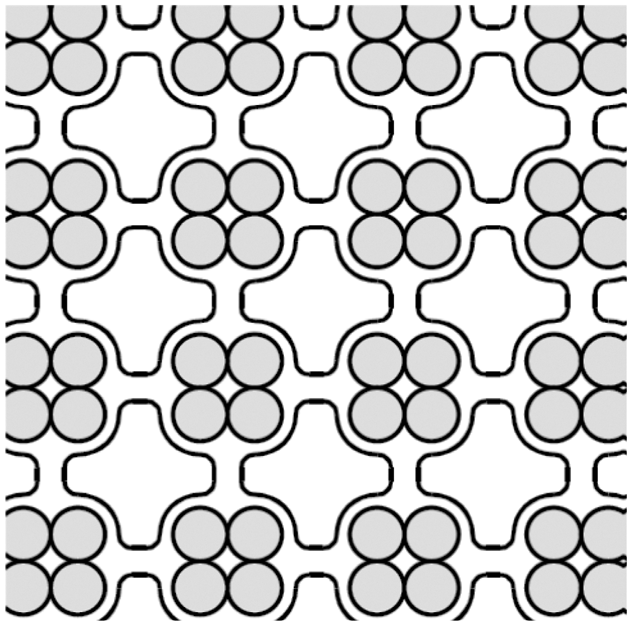
It has been found that the open-cell auxetic foams with large cell size have low stiffness, which restricts their applications. To improve the stiffness, auxetic closed-cell (Figure 2) foams obtained by foaming a liquid substance or by microspheres joining were molded and studied.
4
Another method to obtain auxetics with higher stiffness was to make them at the molecular level. The poly[n]prismanes (n = 3−6) were first identified to be auxetic at the molecular level.
18
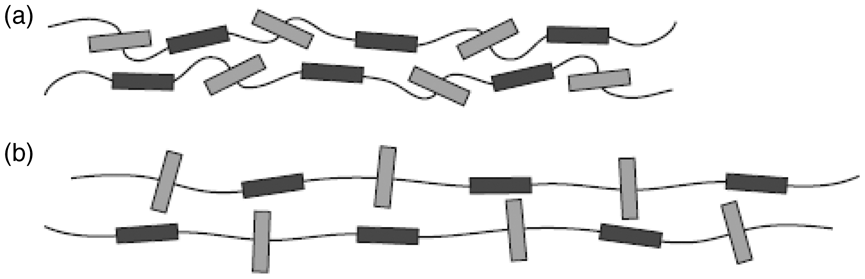
The NPR was found between −.007 and −0.15. He et al.19,20 proposed a simple molecular-level approach to achieve the NPR effect, and a main chain liquid crystalline polymer was designed by a simple site-connectivity driven rod reorientation molecular method. The NPR effect was achieved by the rod rotation from the horizontal direction to the perpendicular direction (Figure 3). Grima and Evans
21
also investigated the molecular auxetics and presented a parallel ‘graphite-like’ layers model in which each of the layers contained a planar polyphenylacetylene infinite network having a rotating-triangle structure. The possibility of nanoporomaterials with NPR by the compression-driven self-assembly method was also discussed. The prediction model showed that the nanoporomaterials have good strength and deformation performance.
45
Auxetic closed-cell foams model (after Shilko and Konyok
4
). Site-connectivity driven rod reorientation molecular model: (a) before stretch; (b) after stretch (after He et al.
20
).
Auxetic polymeric materials cooperated with other properties will give a big leap in application. Recently, Xu and Li 46 manufactured a shape memory auxetic polymer based on syntactic foams through the two-dimensional (2D) stress method (stretch in one direction and compress in the transverse direction). Handjigeorgiou and Stavroulakis47 designed a smart structure that used piezoelectric actuators as the face layer and auxetic material as a core to analyze the problem of the shape control of sandwich beams. Scarpa and Smith 48 coated auxetic rigid PU foam with magneto-rheological fluid to increase the electromagnetic property of the auxetic foams. These materials have multi-functions, which could be very useful in the future.
Auxetic composites
Low Young’s moduli are a big problem of auxetic cellular solids, which restricts their applications.49–51 Making auxetic composites with auxetic inclusions is an effective way to enhance Young’s moduli of the auxetic materials.
Milton first predicted auxetic fiber-reinforced laminates with NPR near to −1. 52 After that, a number of auxetic laminates have been designed and manufactured. 6 The carbon/epoxy is the preferred choice to make auxetic laminates. 6 It has been found that the fatigue property of laminates is highly concerned with the fiber orientation. 53 Young’s moduli are also found to be increased by laminating the auxetic layer and aluminum alternately. 54
Auxetic core structures can be used in laminated composites due to their synclastic curvature properties. The auxetic hexachiral 7 truss core, trichiral honeycomb core and double arrow core 55 have been reported and their mechanical properties have been investigated.
It is necessary to note that the semi-auxetic composites are also found to have properties that are not between the conventional and auxetic composites but are unique from both. 56
Auxetic textiles
Auxetic textiles, including auxetic fibers, yarns and fabrics, have attracted great attention in recent years. Alderson et al.
57
first produced the polypropylene (PP) fibers that displayed auxetic behavior using a continuous partial melt extrusion process. The NPR obtained was −0.6. After that, different auxetic fibers, such as auxetic polyester fibers58,59 and nylon fibers,
58
were invented and developed. Compared with auxetic fibers, auxetic yarns can be realized with non-auxetic fibers using a special yarn structure. An auxetic helical yarn (Figure 4(a)) was manufactured by wrapping together two non-auxetic filaments with different stiffness
60
in such a way that the stiffer filament is wrapped around the softer core filament. When stretched, the stiff filament becomes straight and the soft core filament gets wrapped around the stiff filament, as shown in Figure 4(b). This kind of auxetic yarn was used to fabricate woven fabric
61
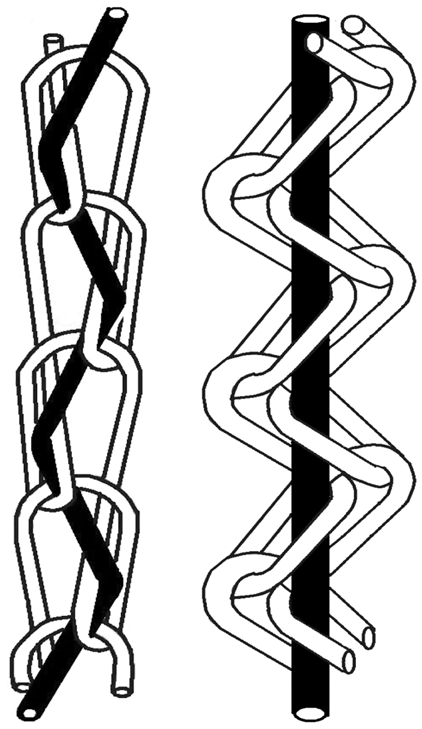
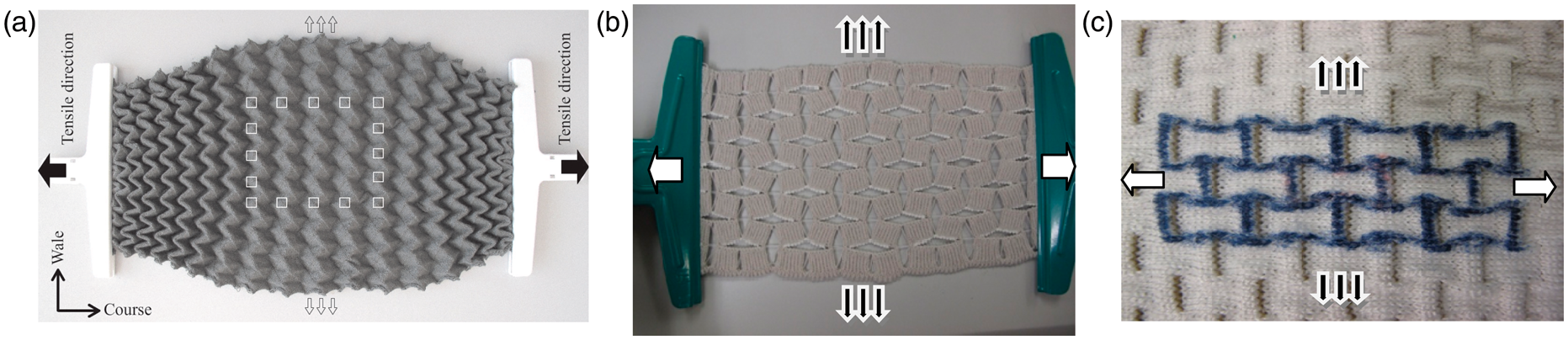
(Figure 4(c)), which could inherit the auxetic effect from the yarn. Furthermore, the composite (Figure 4(d)) reinforced with this fabric still has the auxetic behavior. Different from the fabric made from auxetic yarns, auxetic fabrics could also be manufactured from non-auxetic yarns by using special fabric structures. Most recently, knitted auxetic fabrics were manufactured using both the warp and weft-knitting technologies. Ugbolue et al.62–64 designed several warp-knitted structures by inspiring the auxetic yarn structure (Figure 4(a)), as mentioned above. These structures were constructed from wales of chain and inlay yarns. The wales were knitted from open loops using thicker, low-stiffness filaments, and a high-stiffness filament is inlaid around the underlaping loops. When stretched, the high-stiffness filament becomes straight and causes open loops to wrap around them, thus the NPR is obtained (Figure 5). Several auxetic warp-knitted fabrics were produced. The best NPR value was −0.6. Auxetic weft-knitted fabrics were mainly produced on electronic flat knitting machines. Various auxetic weft-knitted fabrics, developed by Liu et al.
65
and Hu et al.
66
based on different geometrical arrangements, are shown in Figure 6.
(a)(b) Auxetic yarn; (c) auxetic woven fabric; (d) auxetic composite (after Miller et al.
61
). Warp knit structures from wales of chain and inlay yarns; (after Ugbolue et al.
64
). Auxetic weft-knitted fabrics developed based on different geometrical arrangements: (a) Miura-ori pattern; (b) rotating squares; (c) re-entrant hexagons (after Hu et al.
66
and Liu et al.65)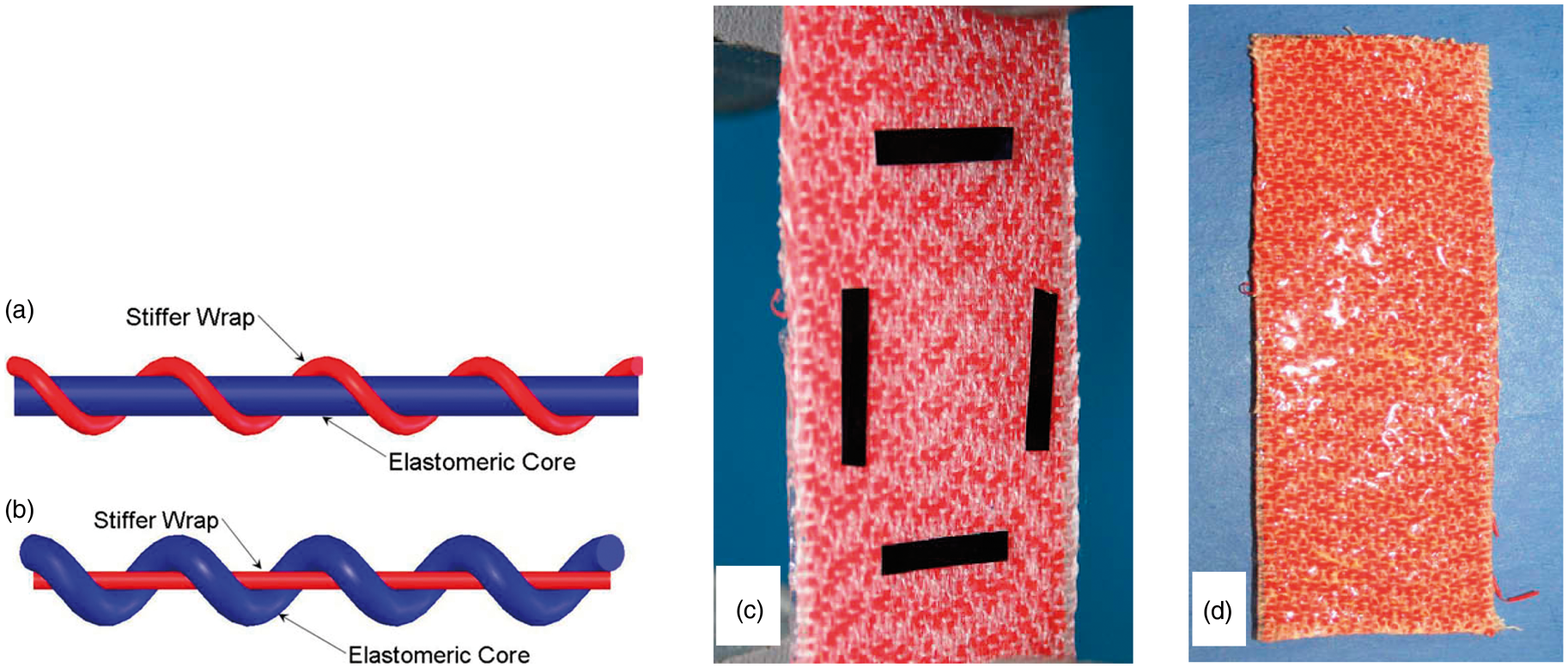
Geometry structures and models
Re-entrant structures
Re-entrant structures are the most commonly used auxetic structures. The first investigated re-entrant structure was a 2D re-entrant hexagon (Figure 7).
67
When it is subjected to an axial extension, its diagonal ribs will rotate to the horizontal direction, which leads to a transverse expansion of the structure. Therefore, the NPR effect is achieved. Masters and Evans
68
studied the re-entrant honeycomb by together considering the bending, stretching and hinging deformations of the honeycomb cells to derive expressions of tensile moduli, shear moduli and Poisson’s ratio. A missing rib 2D model that could better predict the NPR and stress–strain behavior of auxetic foams was proposed by Smith et al.
69
Re-entrant honeycomb structure (after Hu et al.66).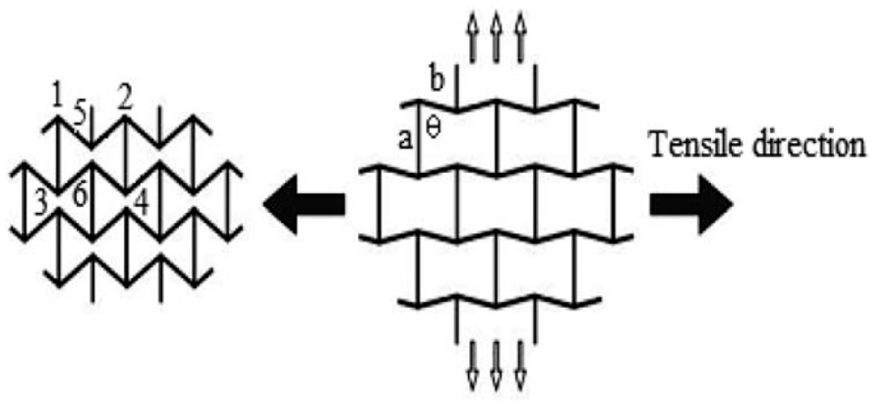
The limit of the 2D model is that it can only be used to predict the in-plane behavior, and the out-of-plane behavior is completely ignored. However, auxetic materials do exist in the three-dimensional (3D) form. That implicates that the 3D model will be more accurate to predict the auxetic behavior. Lakes and Witt 70 designed a tetrakaidecahedra model for foam cells. The foam cell ribs are protruding inwards compared to the conventional foam cell, and when subjected to load, the ribs will unfold to achieve the NPR effect.
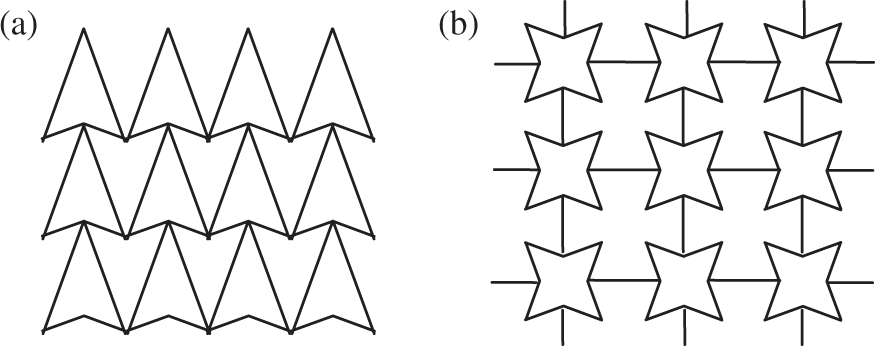
Other re-entrant structures are also found to have the NPR effect. The double arrowhead
71
(Figure 8(a)) structure achieves the NPR by opening the arrowheads when stretched, while the star-shaped structure
72
(Figure 8(b)) obtains the NPR by rotating its ribs. The sinusoidal ligaments structure gets the NPR by opening up the re-entrant cells.
Rotating structures
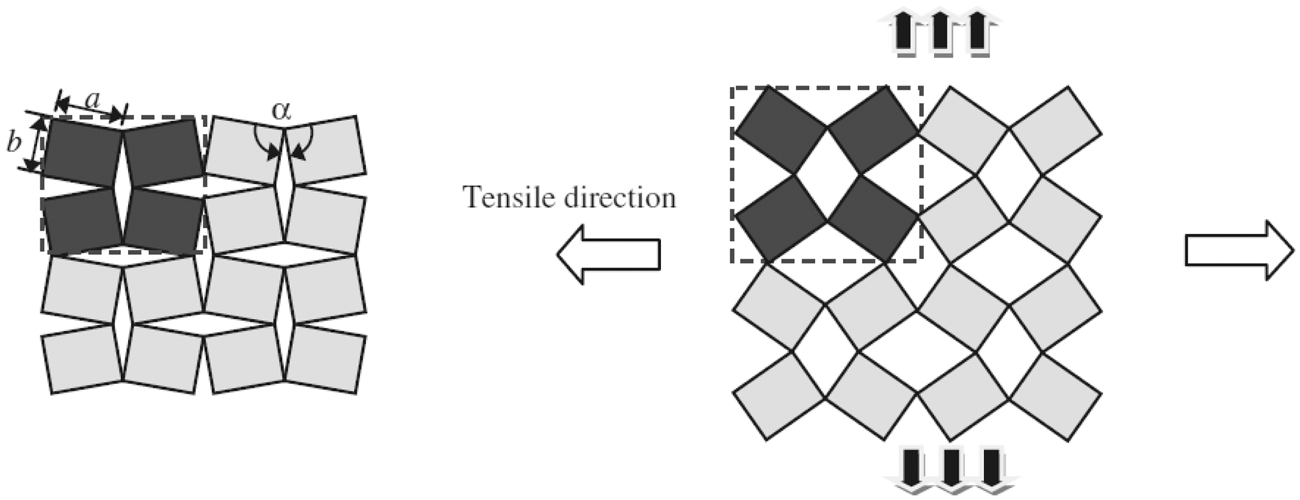
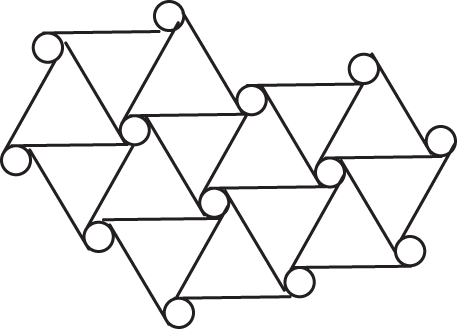
Rotating structures are based on the arrangement of some uniform or different size or shape units connected at the vertices. When a rotating structure is stretched, its units will rotate to open up to achieve the NPR, as shown in Figure 9. Grima and Evans
73
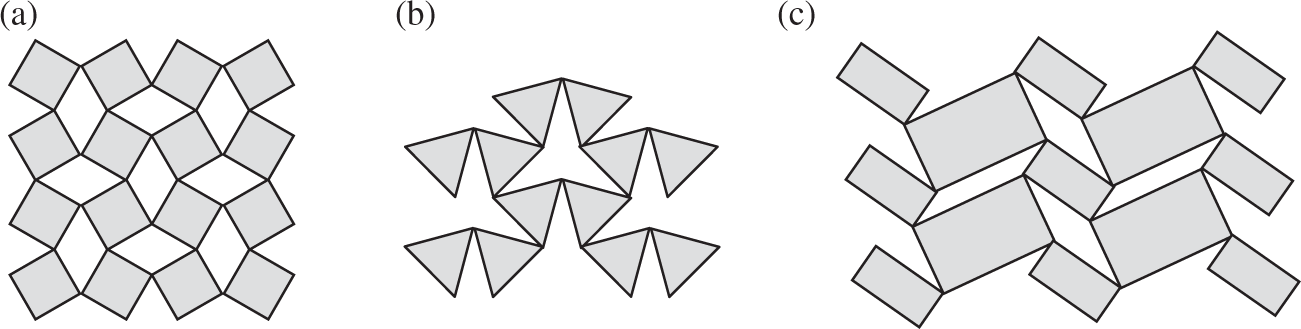
first found this kind of structure in inorganic crystalline materials, and then proposed rotating squares (Figure 10(a)), rotating triangles (Figure 10(b)) and rotating rectangles (Figure 10(c)). The ideal model of rotating squares with rigid units was found to be independent to the initial geometry and the loading directions, keeping the NPR at −1. So it was too simplistic to characterize the deformation of uniaxial extension. The ‘semi-rigid units’,
74
‘stretch-units’, were investigated in order to better capture the deformation characteristics of auxetic materials. The model of different-sized rigid rectangles
75
was also proposed to represent the properties of different systems ranging from silicates and zeolites to liquid crystalline polymers.
Rotating units open up when stretched (after Hu et al.66). (a) Rotating squares; (b) rotating triangles; (c) rotating rectangles structure (after Grima et al.
73
).
Nodule and fibril structure
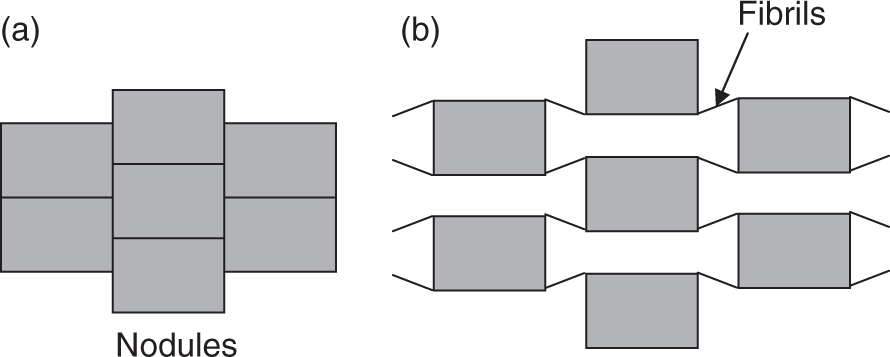
Nodule and fibril structure was first reported by Caddock and Evans for auxetic micro-porous polymer in a 2D model (Figure 11).
15
The NPR effect comes from the nodule translation by the stretched fibrils when loaded.
25
Including the out-of plan effect, the 3D nodule and fibril model
76
could be applied to more materials, such as micro-porous expanded polymers, body-centered cubic metals and foams. Lim and Acharya
77
modified the rectangle nodule to hexagonal nodule, which is approximate to sphere-like nodules for the property prediction of PP films and fibers. Investigations showed that the 3D hexagonal nodule and fibril models exhibited a greater NPR effect compared to the equivalent 2D ones.
Nodule and fibril model (after Caddock and Evans
15
).
Other structures
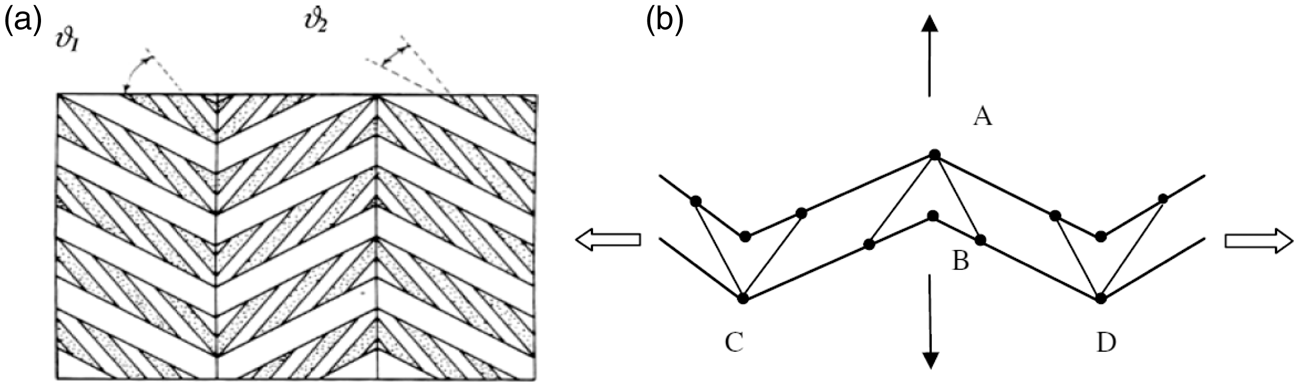
The chiral structure (Figure 12) obtains the NPR effect by wrapping and unwrapping the ligaments around the nodes.
78
The auxetic behavior of the site-connectivity driven rod reorientation structure (Figure 3) comes from the rotation of the rods.20,79 The rod model (Figure 13) for describing the angle-ply composites,
80
molecular rods with prismatic structure to achieve auxetic behavior at the molecular level,
18
double-arrow-like ‘hard’ block and a spring-like ‘soft’ segment model for copolymers
81
was also proposed.
Chiral structure (after Grima et al.
78
). Angle-ply composites: (a) structure; (b) model (after Shilko et al.
80
).
Properties
Auxetic materials have many enhanced properties compared to conventional materials. These enhanced properties make auxetic materials very attractive for many special applications. In this part, some important properties of auxetic materials are presented.
Mechanical properties
The mechanical properties of auxetic polymeric foams were systematically studied.82,83 In general, the auxetic foams exhibit a lower Young’s modulus compared to conventional foams. The compressive Young’s modulus of auxetic foams is about half that of conventional foams in small deformation, and the same figure was found in the tensile Young’s modulus in the linear elastic deformation region. However, the shear modulus of auxetic foams is higher than conventional foams.22,83 This property can be explained by the relations among shear modulus G, Poisson’s ratio ν, Young’s modulus E and bulk modulus K. For isotropic materials, the relations are: E = 2G (1 + ν) = 3K (1 − 2ν). From the relations, it can be found that the Young’s modulus E of conventional materials is at least twice as high as the shear modulus G. However, for auxetic materials, as the Poisson’s ratio is negative, the shear modulus G becomes higher and the bulk modulus K becomes lower. For example, when ν = −1, much higher G than K can be obtained. That means the material becomes difficult to shear and easy to deform volumetrically. 36
Indentation resistance
Auxetic materials have enhanced indentation resistance compared with conventional materials. When an object is impacting on a conventional material, the material flows away (Figure 14) in the lateral directions, which causes the density reduction. On the contrary, an auxetic material flows into the vicinity of the impact point when impacting because of the NPR effect. The material becomes denser at the impact point, resulting in an increase of the indentation resistance. The auxetic UHMWPE was found to be 2.5 times the indentation resistance of conventional UHMWPE.
17
The enhanced indentation resistance has also been found in the other auxetics, for instance, auxetic fiber-reinforced composites.24,84
Indentation resistance.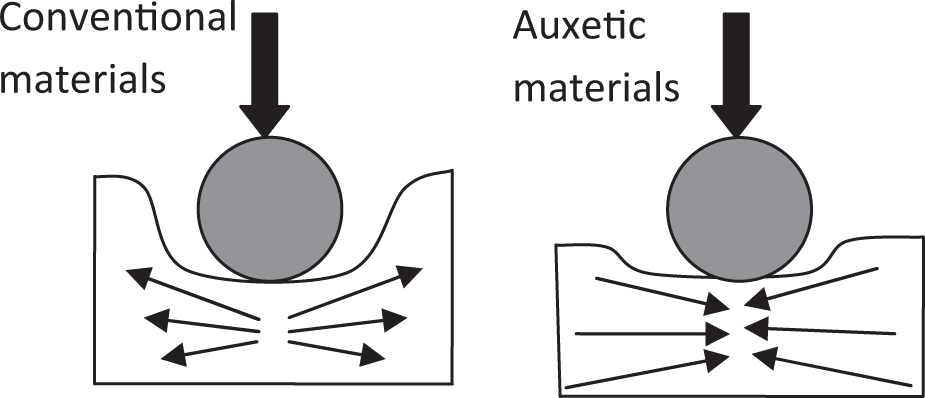
Synclastic curvature
When a conventional material is subjected to a bending force, it shows a saddle shape (Figure 15(a)) due to the perpendicular shrinkage. For an auxetic material, it demonstrates a dome shape in that the perpendicular direction has the same curve trend with the bending direction, that is, synclastic curvature (Figure 15(b)).
26
The synclastic curvature property makes an auxetic material better fitting with the curve surface, such as a dome.
(a) Anticlastic curvature; (b) synclastic curvature.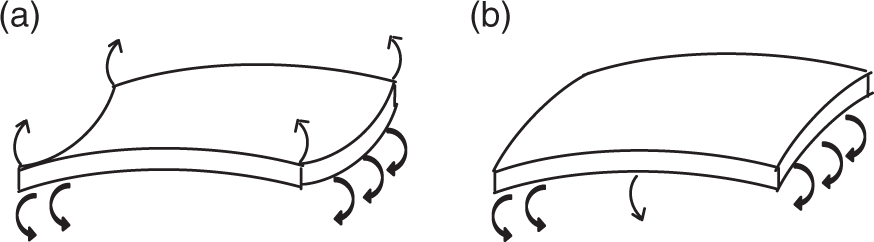
Fracture toughness and crack resistance
Auxetic materials have increased fracture toughness. The toughness of auxetic foams was investigated as a function of the permanent volumetric compression ratio. 85 The toughness of auxetic foams were increased by 80%, 130% and 160% for permanent volumetric compression ratios of 2.0, 2.5, 3.0, respectively, compare to the conventional foams. The auxetic materials also have enhanced crack resistance. A crack will close up under loading due to the NPR effect.
Energy absorption properties
Auxetic materials have better energy absorption properties. The cyclic compression tests on auxetic foams showed the damping capacity of auxetic foams was 10 times higher than that of the original conventional foams that were used for making the auxetic foams.28,86 Sound absorption28–30 and crashworthiness27,28,30 of auxetic materials were also found to be enhanced compared to the conventional materials.
Variable permeability
The auxetic materials have superior permeability compared with conventional materials, because of their pore-opening properties (Figure 16). The pores become wider in the perpendicular direction when stretched, so the pore size becomes larger in both axial and perpendicular directions. The variable permeability of the auxetic honeycomb was studied and it was found that the variable permeability could be improved from macro-scale to nano-scale.
87
Permeability of the auxetic honeycomb.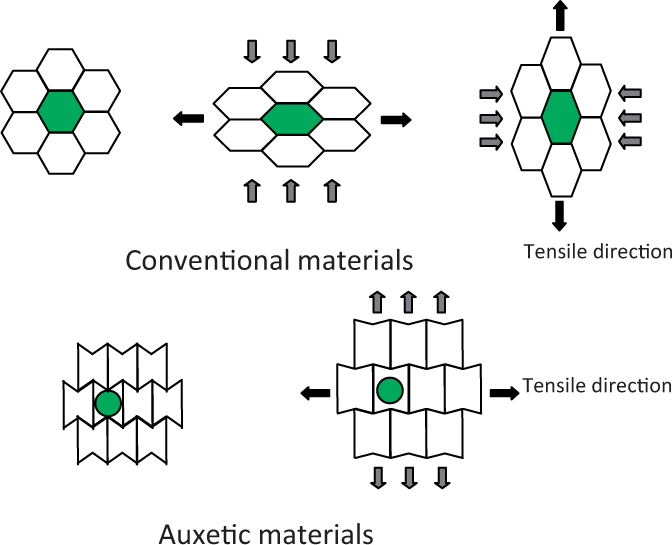
Applications
General applications
Due to their unusual properties, auxetic materials have found variable applications. 87 Auxetic materials with a pores structure can be used in the filters88–91 because the pores open up when stretched, such as in the case of re-entrant honeycomb. Due to the low bulk modulus, auxetic materials are more sensitive, which allows them to be used in sensors, 92 such as hydrophones. Another usage of auxetic materials can be in aerospace applications, such as an auxetic gradient cellular core for aero-engine fan blades, 35 vanes for gas turbine engines, 93 thermal protection, 40 aircraft nose-cones, 94 wing panels, 87 etc. Special auxetic materials can be used in the biomedical area,33,34 including auxetic spinal implants, 95 auxetic annuloplasty prosthesis, 96 artificial blood vessels 26 and auxetic esophageal stents. 97 Auxetic materials can be used as fasteners. The fastener designed by Choi and Lakes 98 is larger than the hole by a tolerance in the radial dimension. When inserted, the diameter of the fastener becomes smaller under the compressive axial force, which makes it easy to insert. When removed, the fastener laterally expands due to axial extension to resist removal. The advantage of this auxetic fastener is the simplicity of the press-fit insertion. Auxetic materials can also be used as seat cushions, 99 earphones, 100 etc.
Applications in textiles
It should be pointed out that the potential applications of auxetic textiles are vast. In the fiber or yarn form, auxetics can be exploited in different ways, for example, to lock the textiles in position when a tension load is applied on a fiber-reinforced composite. 37 The fiber becomes fatter laterally when loaded and is locked into the composite, which effectively prevents the pull-out problem that often occurs in conventional fiber-reinforced composites. Another example was the auxetic blast curtains 101 produced on a craft loom using the helical auxetic yarn (Figure 4(a)). The curtain opens up when the pressure wave comes. The glass fragments coming after the pressure wave can then be captured by the curtain. Therefore, the blast-proof function is achieved.
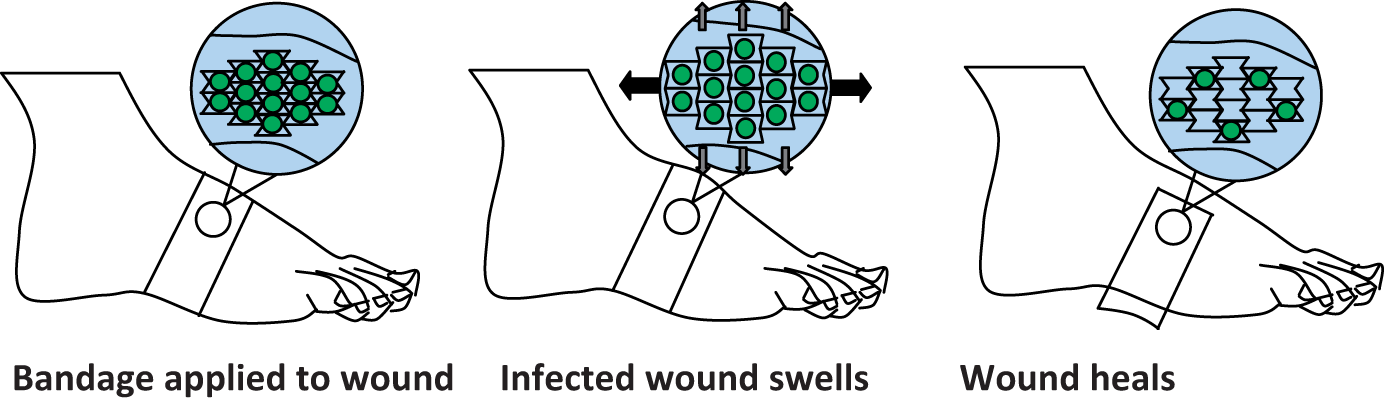
Auxetic materials can be used as medical textiles. One of the examples is the smart bandage.
37
The bandage made from auxetic filaments can carry some wound-healing agent. When the bandage is applied on the swelled wound, it will open up and released the agent. When the wound heals and swelling decreases, the bandage will close and stop to release the agent, as shown in Figure 17.
Smart bandage (after Alderson et al.
17
).
Auxetic fabrics can be used in protective clothing and equipment because of their good energy absorption properties and shape fitting. Protective clothing and equipment are indispensable for some dangerous sports, such as riding, racing and skating, to protect wearers from injuries by impact forces. In particular, the parts of the body, such as elbows and knees, which are easily injured, need to be protected, so that the protective pads are usually used in these areas of the protective clothing and equipment. However, the protective pads found on today’s market are mostly made from foams that have low air permeability. Three-dimensional auxetic fabrics (e.g. auxetic spacer fabrics) can be used to replace foams with ones that have a better comfort property. In addition, the formation of the dome shape of auxetic fabrics under bending due to the synclastic curvature feature also makes them very easy to fit the shapes of elbows and knees and thus increases their protective performance and the freedom of movement of these body parts. The anti-vibration gloves 31 made from auxetic PU foams have been proved to have a good anti-vibration effect by decreasing the compressive stresses. However, this kind of glove is not comfortable, and allergies could occur with long-time wearing. Like the protective clothes, using auxetic 3D fabric to replace the PU foams can be a good way to resolve this problem. Auxetic material is also a good candidate for bullet-proof vest use, because the force of the bullet can be reduced by the sideways expansion of the auxetic vest. 102
Using auxetic fabric to make children’s wear can be another application. Parents may know how fast their children grow up. The clothes that were just bought several months ago may get too tight and not fit their children. Many parents may buy looser clothes for their children to let them grow. However, the looser clothes may cause falls or injury when children are playing. Auxetic children’s wear can resolve this problem effectively. Auxetic fabrics made of foldable structure can easily expand in both the length and width directions, which makes the clothes be well fitted for children for a long time, so that parents do not have to frequently buy clothes for their children and can save a lot of money. It is more important that good fitting can be achieved with auxetic wear, so children do not need to wear poor-fitted clothes anymore.
Maternity dresses made from auxetic fabrics can obtain a great effect. Elastic fabrics are commonly used for the belly or adjustable waist in the maternity dresses. This will cause a severe discomfort problem because more and more pressure will be applied on the belly by elastic fabrics when the belly grows up. The use of auxetic fabrics can solve this problem. When the belly grows, the auxetic fabric becomes wider in both the waist direction and the direction perpendicular to it. In this case, the belly does not have to bear too much pressure as the auxetic fabric can naturally form a dome shape, which perfectly fits the belly shape.
There are still many other potential applications of auxetic textile materials. Auxetic spacer fabrics can be used for bra cups due to their excellent shape fitting and comfortable property. Auxetic fabrics with increased air permeability under extension can be used for summer wear and functional sportswear. Auxetic yarns can be used as dental floss. The safety belts of cars can be produced with high-performance auxetic fabrics to decrease the concentration of impact pressure due to increased contact area with the human body, etc.
Challenges and perspectives
The development of auxetic materials has been fast in recent years. A large number of auxetic materials have been discovered, made or investigated, including fibers, yarn, fabrics, foams, composites, metals, ceramics, etc. Although many potential applications have been proposed, real applications of auxetic materials are still limited at the primary stage. The work in the future should make more effort on the development of new auxetic materials that have real applications. The combination of auxetic effect with other functions, such as shape memory and electromagnetic effect to make multi-functional auxetic materials, should be taken into consideration to upgrade material properties and usages. The extension of auxetic materials to more field applications, such as textiles, aerospace or biomedicine, should be a future trend.
To date, only a few auxetic fabrics have been developed and they have not been very suitable for apparel use yet. The design and manufacture of auxetic fabrics with non-auxetic yarns still remains a great challenge for textile specialists. Further systematic studies of auxetic fabrics should be carried out in order to fully exploit this new kind of material based on textile technology. The most important factor that needs to be improved is to make auxetic fabrics keep their auxetic effect during repeating uses. More effort should be made to develop auxetic fabrics with better wearability. Three-dimensional auxetic fabrics to replace foam pads used in protective clothing need further development. Smart textiles incorporated with auxetic behavior could be a good choice for the further development of auxetic textiles. For example, anti-bacteria clothes with auxetic behavior can open up pores to release the drug when put on, and close the pore when taken off by using the variable permeability properties of auxetic materials. With the effort of researchers, it is believed that more auxetic textile materials will successfully be developed for a large number of applications in the future.
Footnotes
Funding
This work was supported by the Research Grants Council of the Hong Kong Special Administrative Region Government (grant number PolyU5165/10E).