






Abstract
To obtain acrylic fiber with excellent deodorant performance, the effects of titanium dioxide photocatalyst were examined. When titanium dioxide was added to acrylonitrile copolymer and wet spun, the resulting fiber displayed insufficient photocatalytic activity. The acrylonitrile copolymer was then mixed with 30 wt% cellulose diacetate and wet spun. A very finely fibrillated structure resulted, and the official moisture regain of the blend fiber doubled, from 2.03% to 4.03%. While applying ultraviolet (UV) light to these blended fibers, the dye decomposition effect of the fibers was examined. When titanium dioxide was then added, significant dye decomposition ability appeared. When the blend fiber containing cellulose diacetate was saponified by alkali, the official moisture regain increased by 2.5–2.8%, and dye decomposition ability improved. While applying UV light to these acrylic-based fibers, the deodorant ability against ammonia gas was also examined. Fibers with cellulose diacetate deodorized ammonia well within six hours. For the saponified blend fiber with 5.0 wt% titanium dioxide, the odor residual rate decreased to 3.0% within 1 hour. Clearly, the addition of diacetate and subsequent alkali saponification produced acrylic-based fiber with excellent deodorant performance.
Keywords
The aging of Japanese society has resulted in an increase in the number of elderly and patients who are bedridden or housebound, dramatically enhancing the social need for deodorant fiber. 1 In recent years, titanium dioxide has attracted significant attention as a photocatalyst in environmental cleaning applications, and it is anticipated to be an innovative 21st-century technology.2–5 However, when titanium dioxide photocatalyst particles are kneaded into fibers for the purpose of deodorization, they are likely to be embedded within the fibers, limiting interaction with odor-causing substances. For this reason, the coating of the fiber surface with substances containing titanium dioxide photocatalyst is carried out.6–8 However, it cannot be denied that titanium dioxide particles coated on a fiber surface are detached through repeated washing. As another method, the synthesis of fiber through electrospinning method is carried out. 9 Deodorant fibers that can effectively demonstrate photocatalytic activity cannot be easily achieved. 10
Acrylic fiber obtained by the wet spinning method not only has a wide range of applications, but also has specific features, such as the large specific surface area of the fiber due to its cross-sectional, chrysanthemum-shaped structure. 11 For this reason, when titanium dioxide powder is kneaded into the fiber, it is expected that the particles would be exposed on the fiber surface. Given this idea, titanium dioxide photocatalyst powder was kneaded into acrylic fiber, to develop fiber with photocatalytic activity. In order to further enhance the effect of the titanium dioxide additive, wet spinning was performed after blending with cellulose diacetate (“diacetate”), which is immiscible with the acrylonitrile copolymer and is highly hydrophilic. In addition, the obtained blend fiber was subjected to alkali saponification treatment, in order to convert the diacetate structure to a cellulosic structure and enhance fiber hydrophilicity. In a deodorant test, the adjustment of odor concentration requires much manpower and time. In addition, it is impossible to test a large number of samples at the same time. Then, dye decomposition was performed as an evaluation method for photocatalytic function and, after screening the samples with high photocatalytic function, they were subjected to a deodorant test. The deodorant performance of the acrylic-based blend fibers was examined in detail. These results are reported below.
Experimental details
Samples
Acrylonitrile copolymer
Aqueous suspension polymerization was performed, using ammonium persulfate and sodium hydrogen sulfite, on a mixed solution of 94 wt% acrylonitrile, 5.5 wt% vinyl acetate, and 0.5 wt% sodium methallyl sulfonate. The average molecular weight of the obtained copolymer was 130,000.
Cellulose diacetate
Cellulose diacetate L-50 (average acetylation degree: 55.2%; polymerization degree: 179), obtained from the Daicel Corporation, was used as a raw material. This sample will be referred to as “diacetate.”
Titanium dioxide
Anatase-type titanium dioxide (purity: 99.9%; particle size: 30 nm; Showa Titanium Co., Ltd) was used. Titanium dioxide is synthesized once according to a vapor phase method. This titanium dioxide has a complex structure between titanium dioxide photocatalyst and silica (SiO2), where the surface of particles is covered with silica. This complex will be referred to as “titanium dioxide.”
Preparation of fibers
Formation of fibers based on the wet spinning method
Acrylic-based copolymer was dissolved in N,N-dimethylacetamide (DMA) to produce a solution with 25% solid content (A). Diacetate was separately dissolved in DMA to produce a solution with 25% solid content (B). Solutions (A) and (B) were mixed in a designated ratio, and titanium dioxide was added and dispersed with a bead mill. After confirming that the mixed solution had been very well dispersed uniformly, it was used as a stock spinning liquid. This mixed solution was used as a spinning raw liquid; it was heated to 80℃ and injected from 1000 spinning nozzles (diameter: 0.08 mm) into a coagulating bath composed of 50% aqueous DMA solution, for fiber formation. The resultant fiber was drawn in hot water at 95℃, dried of solvent, treated with oil solution, dried for densification, and relaxed under pressurized steam at 130℃ to prepare an acrylic-based blend fiber of 2.2 dtex (the fineness of a single fiber).
The oil solution used in the spinning process was an anionic oil agent that was easily removed by laundering. After spinning, the fiber was washed for 30 min in boiled water containing 1300 ppm JAFET (Japanese Association for the Functional Evaluation of Textiles) standard detergent (polyoxyethylene alkyl ether, 16 wt%) as a non-ionic surfactant, and then sufficiently washed with distilled water to remove the spinning oil solution residue.
Alkali saponification treatment of fibers
In order to convert the diacetate component of the fiber to a cellulosic structure, the acrylic-based blend fiber obtained in the previous section was immersed in 3.0 M NaOH solution. The fibers were treated at 70℃ for 30 min, and the liquor ratio of fiber to NaOH solution was 1:40. The fiber was immersed in 2.74 × 10⁻¹ M HCl solution for 20 min to neutralize, and washed with distilled water.
Measurement
Observation of fine structure by scanning electron microscopy (SEM)
Observation was performed using JSM-840 scanning electron microscope (JEOL Ltd) at an accelerating voltage of 7.0 kV. The sample was dried under vacuum at room temperature for one day, and treated by gold vapor deposition using JFC-1100 ion beam sputtering unit (JEOL Ltd). The sample was observed at 5000× magnification.
Official moisture regain of fiber
The sample was kept in a hot-dryer at 105℃ until a constant mass was obtained, and the sample mass (Ma) was recorded. Then, the sample was kept at constant temperature (20℃) in a desiccator containing 36% aqueous H2SO4 solution until a constant mass was obtained, and the sample mass (Mb) was recorded. The humidity of the desiccator was 65 ± 2%. Using Equation (1), the official moisture regain was calculated:

Fiber degree of acetylation
The sample (∼2.0 g) was placed in a weighing bottle, dried at 105℃ for 2 h, cooled in a desiccator for 1 h, and then its mass was recorded. After adding acetone (100 ml) and dimethylsulfoxide (300 ml), the sample was let stand for 20 h. Aqueous NaOH solution (1 N, 30 ml) was added and the sample was agitated for 2 h. With the addition of several drops of phenolphthalein solution as an indicator, the excess NaOH was titrated with 1 N aqueous H2SO4 solution to obtain the mean degree of acetylation.
Weight reduction ratio of fiber
The dried sample masses before (Wb) and after (Wa) alkali saponification treatment were measured. The weight reduction ratio of the fiber was calculated using Equation (2):

Evaluation of dye decomposition ability
In a quartz cell with a cap, a fiber sample (0.107 g), loosened to the cottony appearance, was inserted so that it could be uniformly immersed in 100 mg/l methylene blue aqueous solution. The cell was tightly capped. The inserted quantity of the fiber per cell volume was 0.022 g/ml. Using two units of straight-tube black lights (20 W × 2, Toshiba FL20S-BLB), the sample was irradiated for 24 h with ultraviolet (UV) rays from a position 50 mm in the lateral direction. The schematic representation of the evaluation device for dye decomposition ability is shown in Figure 1.
Schematic representation of the apparatus used to examine dye decomposition by fibers upon ultraviolet (UV) irradiation.
To examine the extent of dye decomposition, photographs were taken three times: before UV irradiation, and at t = 6 and 24 h after the start of irradiation. The absorbance at 620 nm, which is the absorption peak for aqueous methylene blue solution, was measured spectrophotometrically (UV-3100, Shimadzu Corp). Measurements were made with reflective light in a state where the fiber was kept in the cell.
The black light used in the evaluation of dye decomposition and deodorant ability was a UV light with a peak at 367 nm of wavelength, and its wavelength range is 335–405 nm. The UV intensity of the black light at the sample position was measured using a digital UV intensity meter (UVX type, US Ultraviolet Corp.) and was found to be 1.28 mW/cm2 at a wavelength of 365 nm.
Mechanical properties of fibers
A tensile test was carried out using a sample of 20 mm length with a Tensilon Universal Testing Machine (UTM; Orientec Co.) at the strain rate of 100%/min. The tensile strength and breaking elongation were determined from breaking points of the stress–strain curves. Tensile strength was measured using a single fiber as a sample.
Evaluation of deodorant ability
A sample (1 ± 0.0001 g) was placed in a 1 -l Tedlar® Gas Sampling bag, to which ammonia gas (1.0 l, 66 ± 2 ppm) was transferred at a flow rate of 500 ml/min with a measuring pump. The gas concentration in the bag was measured using a Gastec gas detector tube (Type: GV-100) at 1, 3, 6, and 12 h from the onset of gas injection. Odor residual rate was calculated using Equation (3). Here, “ODa (=66 ± 2 ppm)” and “ODb” show the ammonia concentrations measured at the initial stage and after predetermined intervals, respectively:

In the evaluation of deodorant ability, the sample was irradiated from a distance of 10 cm with a 75 W black light bulb (Asahi Electric Co.). The UV intensity of the black light at the sample position was determined to be 10.0 μW/cm2 at a wavelength of 365 nm. The schematic representation of the apparatus for examining deodorant ability is shown in Figure 2. Measurements were performed five times, and the average was adopted.
Schematic representation of the device used to examine the deodorant activity of fibers upon ultraviolet (UV) irradiation.
When the UV intensity of the black light at the sample position was measured using the digital UV intensity meter (UVX type) made by US Ultraviolet Corp., it was 10.0 μW/cm2 at 365 nm wavelength. The Tedlar bag is made of polyvinyl fluoride (PVF) polymer resin, and it has a very thin thickness of 0.2 µm.
Results and discussion
Structure and dye decomposition ability of acrylic fiber
Despite the addition of titanium dioxide, fiber formation based on wet spinning could be reliably obtained, resulting in acrylic fiber with 2.2 dtex in fineness as a single fiber and without problems such as fiber disconnection. The surface and cross-section of the fiber were observed with an electron microscope at a magnification of 5000×. The results are shown in Figure 3. The results showed that the surface of acrylic fiber prepared in this experiment based on wet spinning was covered with numerous wrinkly convexities and concavities, and the cross-section was ellipsoidal with chrysanthemum shape. The addition of titanium dioxide tended to increase the wrinkled convexities and concavities on the fiber surface, but distinct differences were not found between fibers with the addition of 5.0 and 10.0 wt% titanium dioxide.
Scanning electron micrographs of acrylic fibers with different TiO2 content (5000×).
In order to examine the photocatalytic activity of the acrylic fiber containing titanium dioxide, methylene blue aqueous solution and the cottony appearance fiber were placed in a quartz cell, and the cell was irradiated laterally with UV light. The results of the decomposition of methylene blue aqueous solution by the fiber are shown in Figure 4. From the left, the photographs show sample cells for 0 wt% (①), 1.0 wt% (②), 5.0 wt% (③), and 10.0 wt% titanium dioxide (④). For the samples with relatively large amounts of titanium dioxide (5.0 and 10.0 wt%), the blue color of methylene blue tended to fade after 24 h of irradiation. However, these color changes were so small that the addition of titanium dioxide to acrylic fiber was judged as very weak in the expression of photocatalytic activity.
Acrylic fibers containing differing amounts of titanium dioxide-silica complex photocatalyst in methylene blue solution before and after ultraviolet (UV) irradiation. L to R: ① 0 wt%; ② 1.0 wt%; ③ 5.0 wt%; and ④ 10.0 wt% titanium dioxide.
Using titanium dioxide photocatalyst without coating with silica (SiO2), similar wet spinning was conducted. As a result, a large amount of deteriorated products attached around the exit of spinning nozzles, which induced frequent thread breakage and prevented a long-term stable spinning. It is supposed that the coating of the surface of titanium dioxide particles with silica gives steric hindrance between the fiber matrix and the particles, diminishing the direct contact with titanium dioxide. 12
Improvement of dye decomposition ability by diacetate blending
To improve the photocatalytic activity of titanium dioxide added to acrylic fiber, it was considered necessary to finely fibrillate the fiber surface, which would expose the added titanium dioxide particles. In addition, to facilitate penetration of the aqueous dye solution into the fiber and promote contact with titanium dioxide particles, an increase of the fiber hydrophilicity would also be required. By enhancing the fiber hydrophilicity, dye molecules would more likely be absorbed. Because the titanium dioxide particles exposed on the fiber surface, as well as those embedded inside the fiber, would be in contact with dye molecules, the photocatalytic activity of the fiber could easily be expressed. It is known that titanium dioxide forms electrons and holes under UV irradiation, and generates hydroxyl radicals after reaction with water molecules. 12 Through increasing the hydrophilicity of the fiber, hydroxyl radicals are also more likely to be formed, which gives the expectation of increased photocatalytic activity.
In order to spin acrylonitrile copolymer fibers blended with other components, they must be dissolved in the same solvent. Thus, it was necessary to select a polymer that dissolves in the same solvent as the acrylonitrile copolymer, as well as a good solvent for both components. In addition, if the partner component were not compatible with the acrylonitrile copolymer, it would easily fibrillate the fiber surface after spinning. As the hydrophilic polymer to satisfy these conditions, diacetate was selected. As the solvent, DMA was selected. Acrylonitrile copolymer and diacetate were separately dissolved in DMA, making two solutions. After mixing these solutions in a designated ratio, titanium dioxide was added. Using this mixed solution as a raw material, wet spinning was carried out.
The structure of the obtained acrylic-based blend fiber containing 30 wt% diacetate was examined by electron microscopy (Figure 5). Three types of fibers were chosen: 0, 5.0, and 10.0 wt% titanium dioxide addition. A very finely fibrillated condition was detected as compared to the acrylic fiber shown in Figure 3. From the cross-sectional fiber structure, innumerable fine cracks or spaces were found.
Scanning electron micrographs of acrylic-based fibers containing 30 wt% diacetate with different TiO2 contents (5000×).
Official moisture regain of acrylic-based fibers containing diacetate
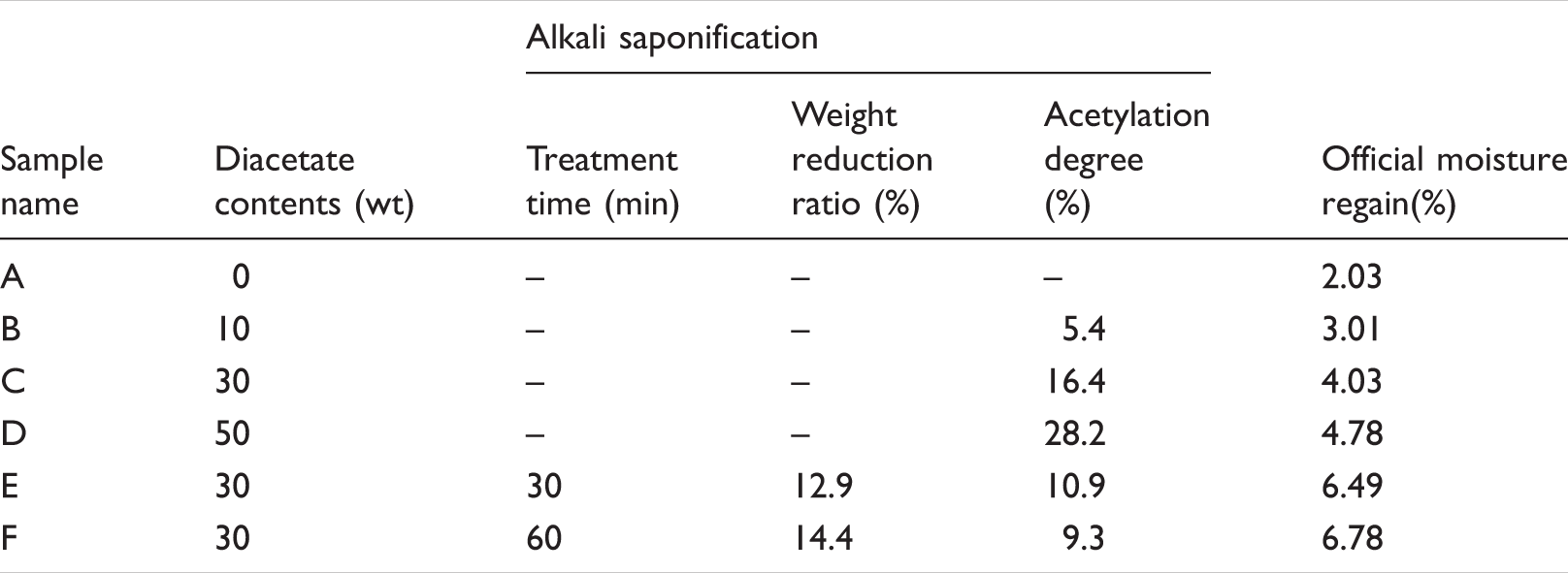
From these results, the addition of titanium dioxide to the fiber would be expected to result in effective photocatalytic activity. The photocatalytic function was examined based on dye decomposition ability, as described for the acrylic blend fibers. The results are shown in Figure 6. Fibers containing 5.0 and 10.0 wt% titanium dioxide clearly displayed photocatalytic activity. After 24 h UV irradiation, the blue color of methylene blue faded and turned colorless.
Acrylic-based fibers containing 30 wt% diacetate in methylene blue solution with different TiO2 contents before and after ultraviolet (UV) irradiation. L to R: ① 0 wt%; ② 1.0 wt%; ③ 5.0 wt%; and ④ 10.0 wt% titanium dioxide.
In order to examine this color change quantitatively, the absorbance at 620 nm was measured (Figure 7). Results for the sample without diacetate are shown as (○, □, △), and those for the sample with 30% diacetate are shown as (•, ▪, ▴). Although the data are not continuous functions, those trends can be shown with curved lines. Acrylic fiber with neither diacetate nor titanium oxide showed no drop in the absorbance even after 24 h UV irradiation, but rather tended to increase. Even with the addition of titanium dioxide, absorbance decreased very little after 24 h UV irradiation. However, the sample with 10.0 wt% titanium dioxide showed decreased absorbance by about 0.09 compared to the 5.0 wt% sample.
Effects of the addition of diacetate on the absorbance of acrylic-based fibers with different amounts of titanium dioxide: ultraviolet (UV) irradiation time dependence of absorbance (wavelength = 620 nm).
In contrast, the acrylic-based blend fiber with 30 wt% diacetate showed a large decrease in absorbance with UV irradiation time. After 24 h irradiation, absorbance decreased to 0.67 in the sample containing 10.0 wt% diacetate, quantitatively demonstrating that the addition of diacetate helped titanium dioxide to decompose methylene blue aqueous solution.
As a further step, the effect on the dye decomposition ability of the fiber was examined by changing the diacetate content up to 50% (▵, •, □, Figure 8). Also, the effect of the addition method (adding titanium oxide to different components) was examined: fiber made by spinning after adding titanium dioxide particles only to the acrylonitrile copolymer solution (▴ in Figure 8), and fiber made by adding titanium dioxide particles only to the diacetate solution (▪ in Figure 8). The additive content was selected as 30% in both cases. To all of these blended fibers and the control in Figure 8, 10.0 wt% titanium dioxide was added.
Effects of the diacetate content on the absorbance (wavelength = 620 nm) of acrylic-based blend fibers, and the difference due to the titanium dioxide addition method—addition to acrylonitrile copolymer component or to diacetate component. All fibers contained 10.0 wt% titanium dioxide. Alkali-saponified acrylic-based fibers containing 30 wt% diacetate with different TiO2 contents in methylene blue solution after ultraviolet (UV) irradiation. L to R: ① 0 wt%; ② 1.0 wt%; ③ 5.0 wt%; and ④ 10.0 wt% titanium dioxide. Effects of alkali saponification treatment on the absorbance (wavelength = 620 nm) of acrylic-based blend fiber containing 30 wt% diacetate and with different titanium dioxide contents.


Although the data are not continuous functions, those trends can be shown with curved lines. As a result, in acrylic-based blend fibers containing diacetate, absorbance decreased significantly with extended UV irradiation compared to the acrylic fiber without diacetate. However, when the diacetate content was increased from 30% to 50%, the difference was slight. When the fibers were spun after titanium oxide was added to only the acrylic fiber component or only the diacetate component, the absorbance of the obtained fibers was barely affected. In short, an increase in the diacetate content, or a change in the titanium dioxide addition method (whether to acrylic fiber or to diacetate), had little effect on the dye decomposition ability of the fiber.
By way of comparison, a similar experiment was performed under dark conditions without UV irradiation. The color did not change at all after 24 h, irrespective of the addition of diacetate. In other words, color change was clearly caused by the photocatalytic function of titanium dioxide.
Improvement of dye decomposition ability through alkali saponification treatment
To further enhance the photocatalytic activity of the titanium dioxide added to the fiber, the fiber was structurally modified: the acetyl groups in diacetate were cleaved to hydroxyl groups, effecting a chemical change to the cellulosic structure. The acrylic-based blend fiber containing 30 wt% diacetate was saponified by treatment with alkali to enhance the hydrophilicity of the fiber by increasing the hydrophilicity of the diacetate component. Entries E and F in Table 1 describe the weight reduction rate, acetylation degree, and official moisture regain of fibers for two cases: after 30 and 60 min of alkali saponification. As a result, the weight reduction ratios of the fibers after alkali saponification treatment were 12.9 and 14.4% for 30 and 60 min of treatment, respectively. The acetylation degree of the fiber decreased from 16.4% (before treatment) to 10.9 and 9.3%, respectively. The official regain of the fiber was 4.03% before alkali saponification treatment. After treatment, it increased to 6.49% for 30 min of treatment and 6.78% for 60 min of treatment. In other words, the official moisture regain increased by about 2.5–2.8%. In short, alkali saponification treatment was very effective in the hydrophilicity enhancement of the acrylic-based fiber containing diacetate.
The dye decomposition rate was examined for the acrylic-based blend fiber containing 30% diacetate that was saponified for 30 min (Figure 9). Visual observation clearly revealed that the dye decomposition activity was enhanced compared to the samples without treatment (Figure 6). In particular, the sample with 10 wt% titanium dioxide showed clear effects.
In order to quantitatively examine the differences in dye decomposition activity, the absorbance of the fibers after UV irradiation was examined. In Figure 10, the results for the samples without alkali saponification treatment are shown as (○, □, △) and those after alkali saponification treatment as (•, ▪, ▴). Although the data are not continuous functions, those trends can be shown with curved lines. For samples containing titanium dioxide, the absorption differences due to alkali saponification treatment were significant. The samples after alkali saponification clearly showed lower absorbance. In short, it was quantitatively demonstrated that alkali saponification treatment enhanced dye decomposition. Therefore, the addition of diacetate to acrylic fiber and subsequent alkali saponification was very effective in enhancing the photocatalytic activity of added titanium dioxide.
Mechanical properties of acrylic-based blend fiber
Mechanical properties of acrylic-based fibers
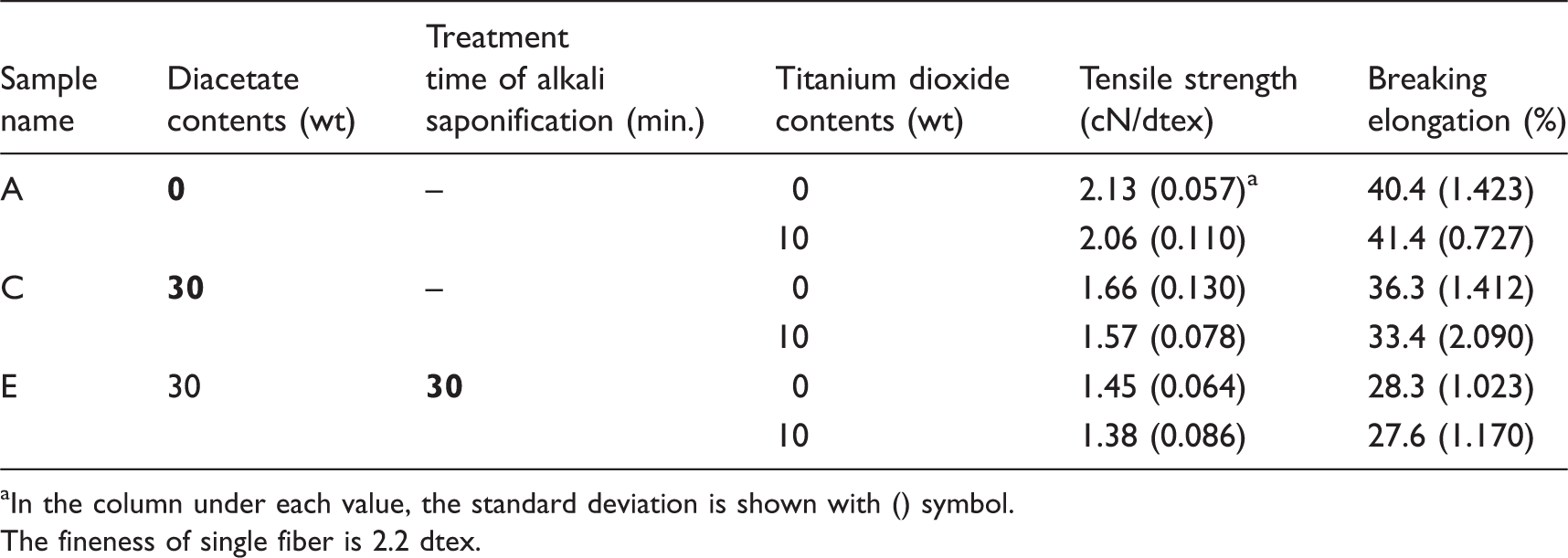
In the column under each value, the standard deviation is shown with () symbol.
The fineness of single fiber is 2.2 dtex.
Although the strength of fibers deteriorates through the addition of diacetate and alkali saponification as mentioned above, even after the acrylic-based fiber containing 10 wt% of titanium dioxide and 30 wt% of diacetate was further saponified with alkali, the strength of the fiber was still maintained 1.38 cN/dtex. This is strong enough to sufficiently endure practical use as staple fiber. The texture, such as soft touch, was completely maintained, unlike with common acrylic fiber.
Meanwhile, even after UV irradiation with a black light for 24 h, the strength and elongation rate of fibers hardly changed compared with those before UV irradiation. The reason why the mechanical properties of fiber hardly deteriorated may be because the UV irradiance with the black light was feeble (the UV intensity was 10.0 μW/cm2 at 365 nm), and that titanium dioxide surface-coated with silica (SiO2) was used. Our presumption is as follows: when titanium dioxide whose surface was not coated with silica (SiO) was added, rayon is liable to suffer oxidative decomposition, since titanium dioxide directly contacts with rayon as the matrix inside the fiber. On the other hand, when titanium dioxide was surface-coated with silica (SiO), titanium dioxide and rayon as the matrix had very little contact with each other directly due to the silica’s effect as a sterific hindrance.
Improvement of deodorant performance of acrylic-based blend fiber
For these acrylic-based blend fibers, deodorant performance was examined using ammonia gas. Meanwhile, since ammonia is one of the biggest four odors, as well as the odor component of various malodors, such as excretion odor, septic odor of meat, and cigarette odor, this study chose ammonia as the odor for deodorant ability judgment. Results are shown in Figures 11(a)–(c), where (a) is for the fiber made with only acrylonitrile copolymer (0 wt% diacetate); (b) is for the acrylic-based blend fiber with 30 wt% diacetate; and (c) is for the acrylic-based blend fiber with 30 wt% diacetate after alkali saponification. For each fiber type, the titanium dioxide content was adjusted to 0, 5.0, and 10.0 wt%. Although the data are not continuous functions, those trends can be shown with curved lines.
Time dependence of odor residual rate for gaseous ammonia (initial concentration: 60 ± 2 ppm) for different TiO2 contents: (a) pure acrylic fibers; (b) acrylic-based fibers containing 30 wt% diacetate; and (c) alkali-saponified acrylic-based fibers containing 30 wt% diacetate.
With regard to the deodorant performance of the acrylic blend fibers against ammonia gas, the diacetate-containing fiber afforded a lower odor residual rate compared to that without diacetate (cf. Figures 11(a) and (b)). The difference was especially large during the period 1–6 h. Diacetate addition decreased the odor residual rate by 10–30% over the period 1–3 h. This may have been caused by the enlargement of the specific surface of the fiber, which allowed gas adsorption and encouraged the photocatalytic function of titanium dioxide.
Inclusion of the alkali saponification treatment increased deodorant performance by a large margin (cf. Figures 11(b) and (c)). Even after 1 h of testing, samples containing 5.0 or 10.0 wt% titanium dioxide decreased the odor residual rate to a mere 0.2–3.0%. This result is a groundbreaking advance for the development of acrylic-based deodorant fibers.
The alkali saponification treatment appeared to be more effective for deodorant performance than for dye decomposition ability. This may be attributed to testing conditions: the deodorant test involved chemical reactions in the air, while the dye decomposition test involved chemical reactions in solution. When titanium dioxide is irradiated with UV rays, electrons and electron holes are formed, which generate superoxide anions through the reaction with oxygen in the air, and hydroxyl radicals through the reaction with water molecules in solution. The difference in these decomposition mechanisms may have affected the decompositions of color and odor.
In summation, acrylic-based fiber with excellent deodorant performance was obtained by the following process: acrylonitrile copolymer and diacetate were dissolved in DMA and mixed; titanium dioxide was added; the mixture was converted to fiber through wet spinning; an alkali saponification treatment was applied. Generally, acetate fiber has excellent features, such as good luster and the same feeling as silk has, and it is also excellent in soft texture and drapeability. The acrylic-based blend fiber obtained in this study has the same features. By making the best use of its deodorant performance, this fiber is promising for many applications.
Conclusions
To obtain acrylic fiber with excellent deodorant performance, the addition of titanium dioxide photocatalyst was examined.
When titanium dioxide particles were added to acrylonitrile copolymer and wet spun, the obtained fiber did not display sufficient photocatalytic activity, and could not significantly decompose methylene blue dye solution. When diacetate was added to the acrylonitrile copolymer at 30 wt% and wet spun, very finely fibrillated fiber was obtained. The official moisture regain increased from 2.03% to 4.03% due to the addition of diacetate, and the fiber displayed dye decomposition ability upon the addition of titanium dioxide. When the acrylic-based blend fiber with 30 wt% diacetate was saponified with alkali, the official moisture regain further increased by about 2.5–2.8%, compared to the sample before treatment. The photocatalytic activity of the titanium dioxide added to fiber was easily displayed, resulting in further improvement in dye decomposition ability. When the deodorant performance against ammonia gas of the obtained acrylic fibers was examined, the addition of diacetate tended to decrease the odor residual rate in the initial stage (up to 6 hours). When alkali saponification treatment was applied to the blend fiber containing diacetate, the fiber after the addition of 5.0 wt% titanium dioxide decreased the odor residual rate by a large margin—to 3.0% in one hour. As mentioned above, the addition of diacetate and subsequent alkali saponification treatment made it possible to obtain acrylic-based fiber with excellent deodorant performance.
Footnotes
Funding
This research received no specific grant from any funding agency in the public, commercial, or not-for-profit sectors.