







Abstract
A color matching algorithm has been developed to solve the color mismatch problems encountered during the digital transfer textile printing process. To match the colors between display and fabric, standard red, blue, green (sRGB) and International Commission on Illumination (CIE) color systems were used. For an affordable color matching process, sRGB values of printed fabric were extracted by a general flatbed scanner instead of an expensive spectrophotometer. Extracted sRGB values and originally intended target sRGB values were used as input and output values to form artificial neural networks and multiple regression equations to establish the relationship between those values. To verify the color matching algorithm, a total of 100 random color samples were printed, scanned, and analyzed. Both methods showed good correlations between input and output color values, which implied that the color matching algorithm developed in this study improved the color correspondence between the original design and its printed results.
Keywords
Digital transfer textile printing (DTTP) differs from conventional digital textile printing (DTP) in that images are not printed directly on the fabric but printed on a decal paper first and then transferred onto the fabric by the heat press process. Although it takes a long time to print decal papers, the overall printing process is shorter than that of DTP, because DTP requires complex preparatory and finishing processes. 1
In general, four kinds of basic ink are used in DTP, namely cyan, magenta, yellow, and black. Additional colors, such as orange, topaz, dark cyan, dark magenta, and dark yellow, can also be used to enhance the color expression. As the color is one of the most important elements in product design, accurate color communication is necessary. However, a color printed on the fabric usually looks different from how it is seen on the designer's display monitor. This is because the same color may appear differently according to the characteristics of the display device, illumination, observer, fabric surface property, and so on. 2
There have been many studies to solve such problems. Senthilkumar 3 tried to predict the International Commission on Illumination (CIE) Lab color values of cotton fabric dyed with vinyl sulfone dyes according to the dyeing condition. Li et al. 4 tried to predict CIE Lab color values according to the concentration of reactive dye without measuring the actual color. Almodarresi et al. 5 tried to predict the concentration of reactive dye from the CIE Lab color values of a dyed cotton fabric using an artificial neural network system with a scanner.
However, color matching in current industry still depends on generating and comparing thousands of color charts, which requires a lot of time and expensive apparatus, such as a spectrophotometer. However, it is not so easy to get objective color values due to the factors related to the observer and illumination conditions.
In this study, a novel color matching algorithm has been developed. Standard red, blue, green (sRGB) color values of printed fabric are extracted by a scanner. Those values and the initially intended sRGB values are used as input and output values, respectively, to train artificial neural networks and to setup multiple regression equations, which can establish a relationship between input and output values that are assumed to have a nonlinear relationship. 6 A total of 100 random color samples were used to verify the performance of the proposed color matching algorithm. By this method, corrected color values, which can reproduce the target color intended by the designers accurately on the fabric, can be obtained reliably.
Principles of color matching
sRGB color system
As each display device has its own characteristics, color values must be adjusted in some way to reproduce the color correctly on it. For example, the available range of RGB (red, green, blue) values may differ from one device to another. Therefore, Hewlett-Packard and Microsoft suggested a neutral and versatile color system known as the sRGB color system. The sRGB system does not require a color transformation from device to device, so that hardware using the sRGB color system work faster than other systems based on the RGB color system . 7
CIE color system
In 1931, the CIE announced an international standard for color measurement and display known as the CIE color system. In this system, a color is represented by the tristimulus values of X, Y, and Z, which are measured under the condition of CIE standard illumination with the standard observer color matching function. 8
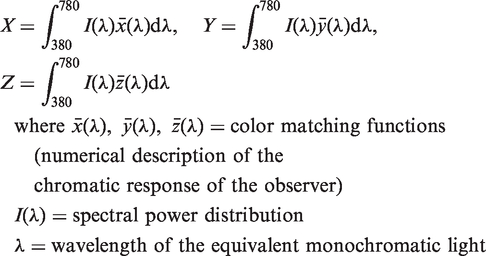
The CIE tristimulus values of a sample can be obtained by multiplying the relative energy of CIE standard illumination, reflectance of the material, and the standard observer color matching function, as shown in Equation (1):
CIE Lab color space
The CIE Lab color space is defined in a three-dimensional space using the L-, a-, and b-axes, as shown in Figure 1.
9
The L-axis represents the lightness (0–100, black–white), +a-axis redness, –a-axis greenness, +b-axis yellowness, and –b-axis blueness.
International Commission on Illumination (CIE) Lab color space.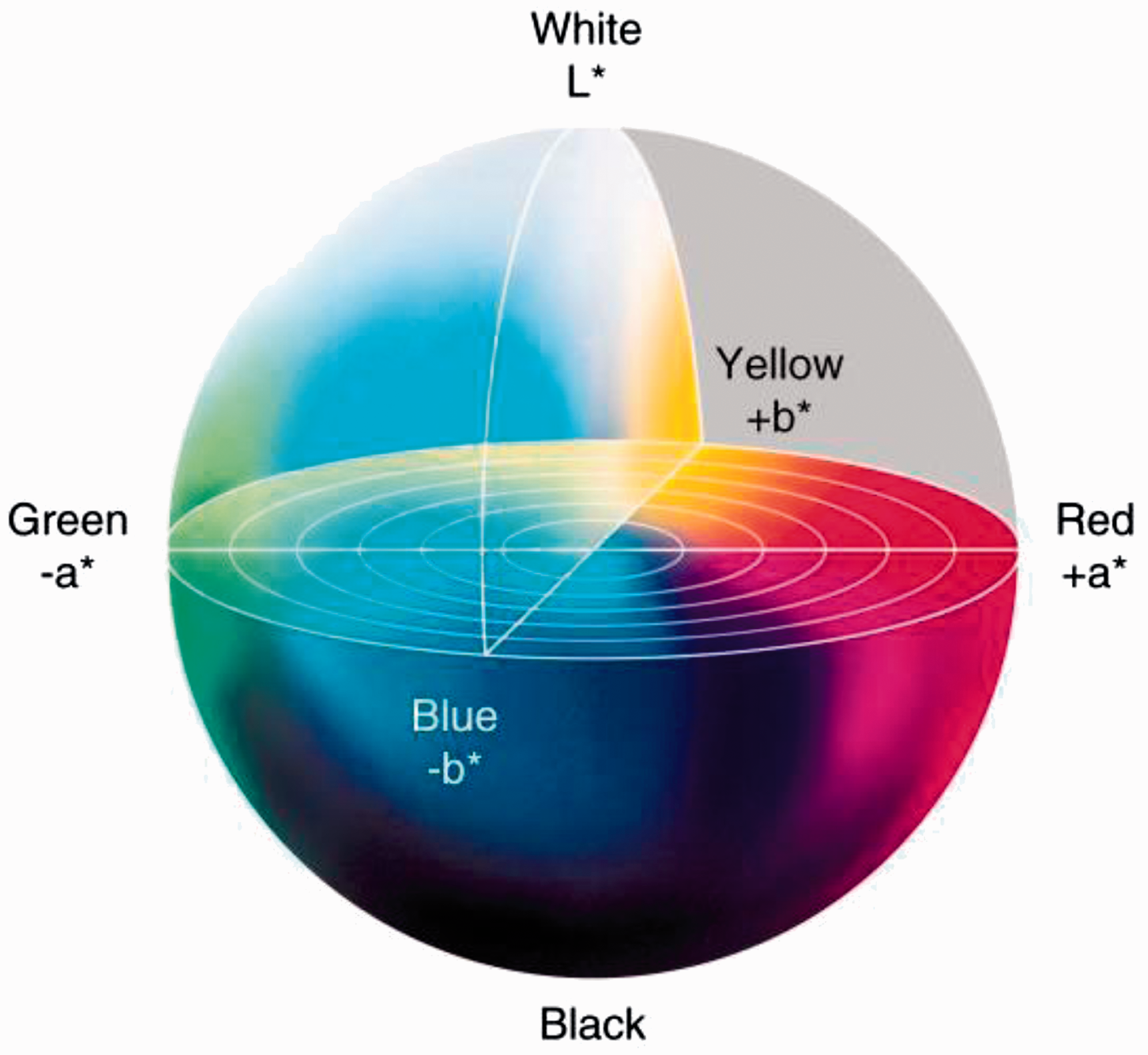
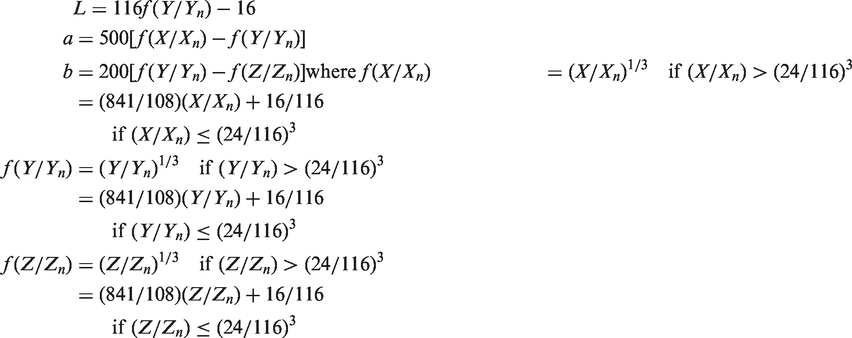
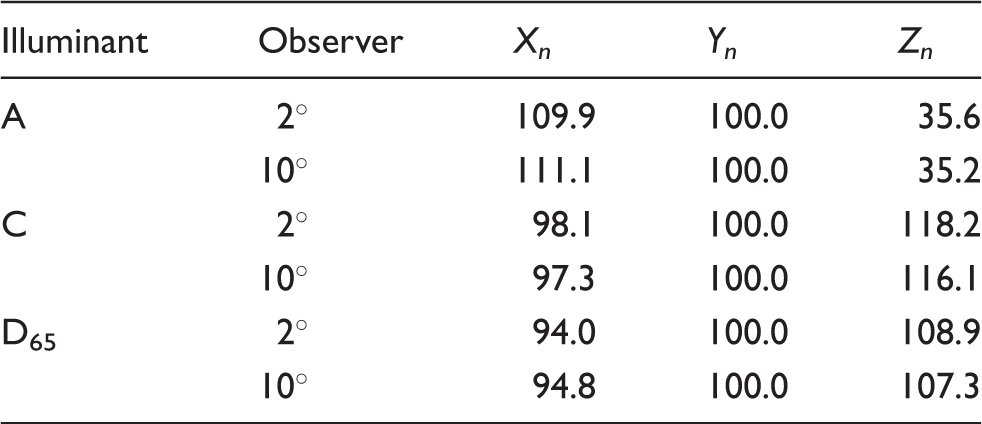
Tristimulus value of the white point.
Color conversion from sRGB to CIE XYZ
To compare the target (initially intended) sRGB values with the printed and scanned sRGB values, CIE Lab values of each color are required. Firstly, sRGB color can be converted into CIE XYZ values using Equation (3):
7
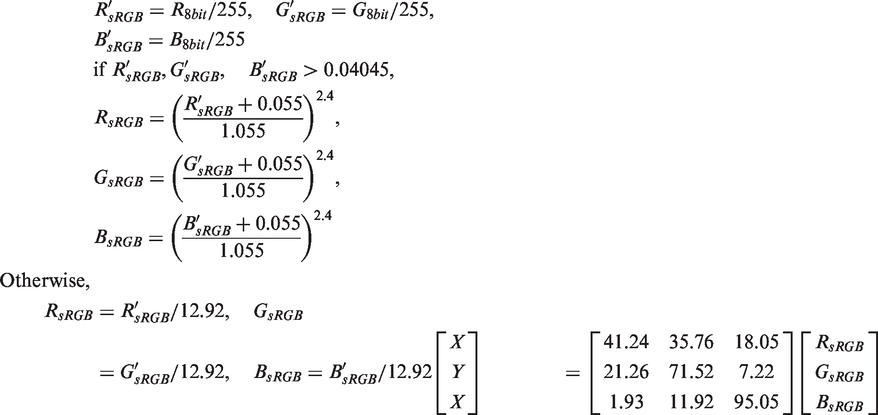
Then the CIE XYZ values are converted into CIE Lab color using Equation (2). Finally, color difference between two CIE Lab colors can be calculated using Equation (4):

Color matching algorithm
The flowchart of the color matching algorithm developed in this study is as shown in Figure 2.
Flowchart of the color matching algorithm.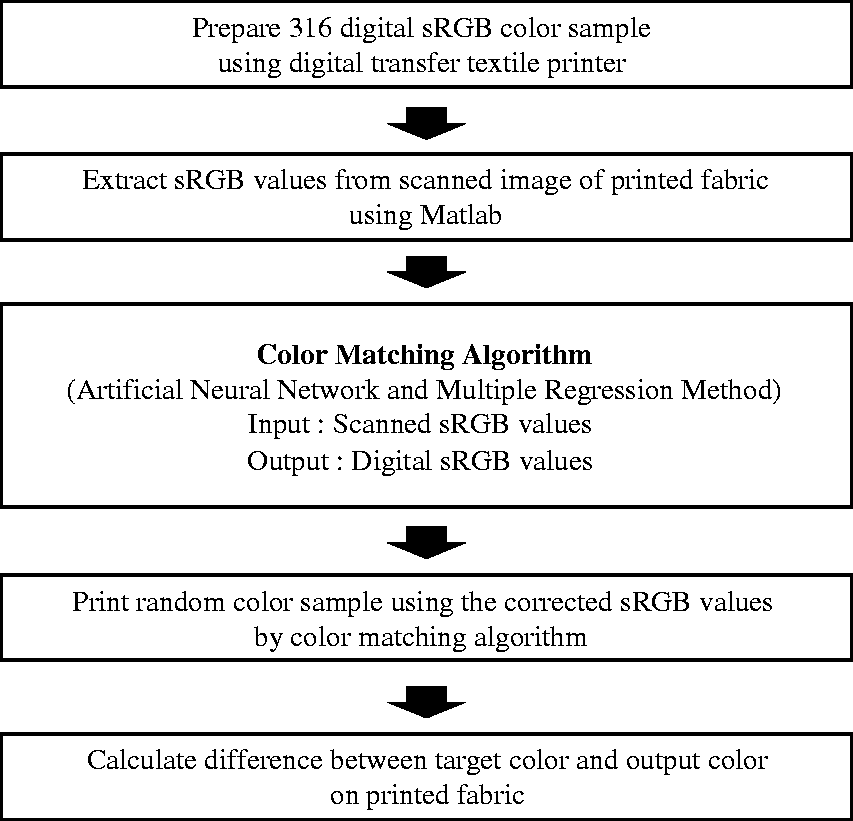
Extraction of sRGB values
A Sindoh D400 flatbed scanner was used to extract the sRGB color values from the printer color samples with the resolution of 300 dpi. The average sRGB value of a specific region in each sample was calculated as shown in Figure 3.
Example of a scanned image.
Color categorization using the CIE Lab color system
A total of 316 color samples were obtained from the Pantone color book
11
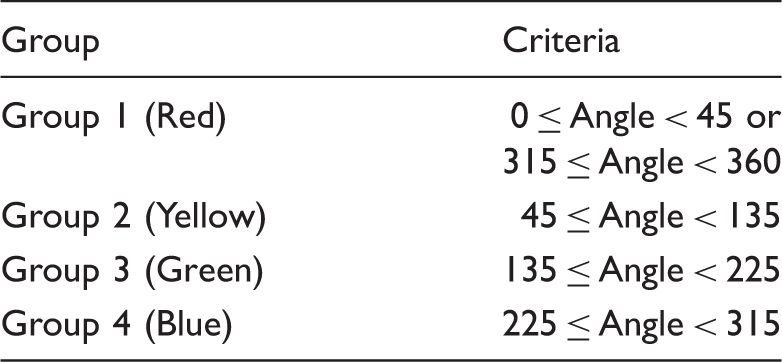
and were categorized into four groups according to their CIE Lab values, as shown in Figure 4, using the criteria shown in Table 2.
International Commission on Illumination (CIE) Lab color space of a printed color sample. Color classification criteria.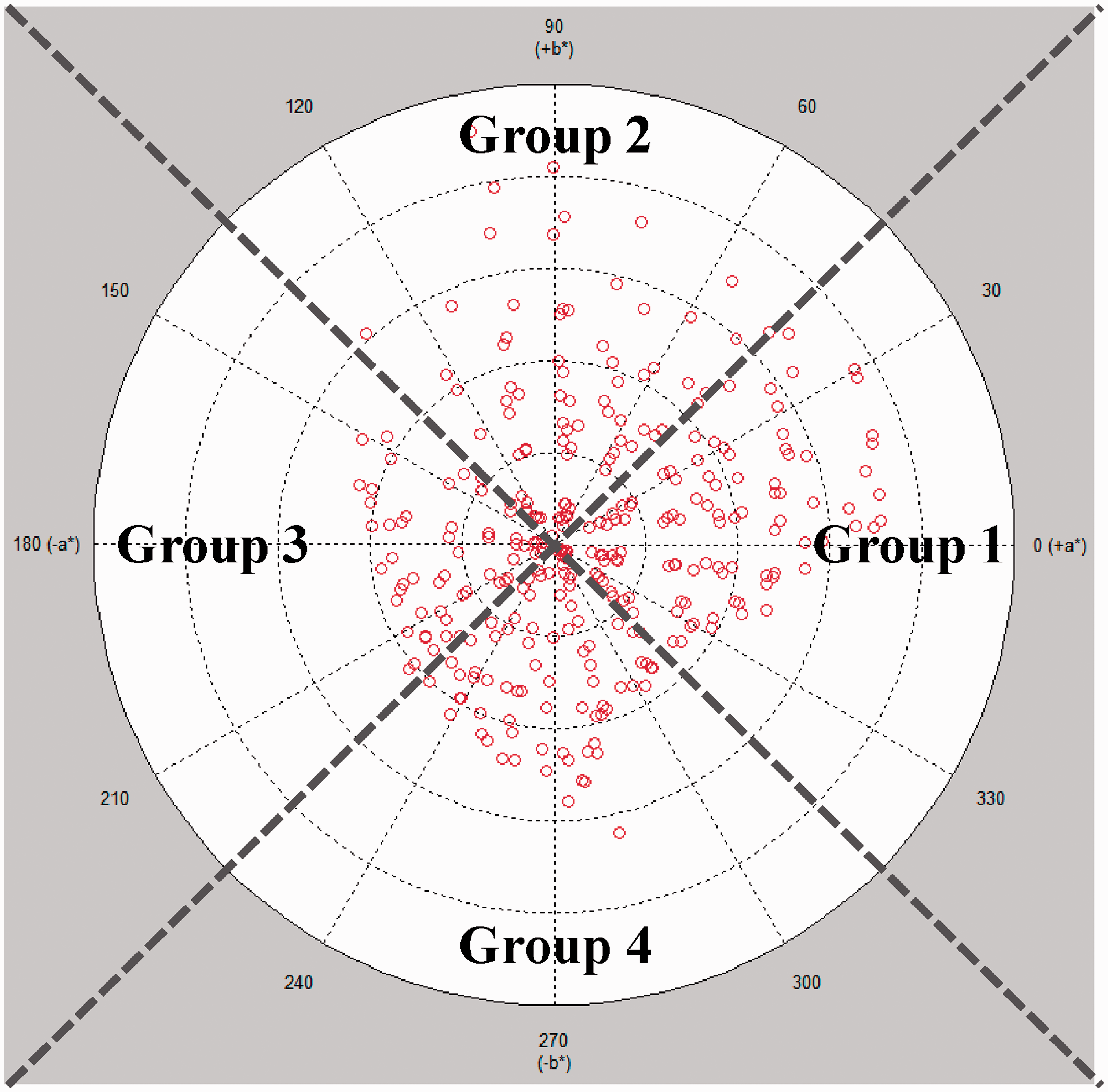
Color correction algorithm
An artificial neural network and a multiple regression equation have been formed for each group. Input values for each method were sRGB values extracted from the scanned fabric image and target values were sRGB values of initially intended color on the computer display. Once the relationship is established, sRGB values needed to reproduce accurate color on the fabric can be predicted. A total of 109 samples (40 for Group 1, 30 for Group 2, 18 for Group 3, and 21 for Group 4), which showed a significant linear relationship between printed and target color, were selected among 316 samples to train the networks and to make the equations. Each input and output sRGB value were normalized to have values between 0 and 1 by dividing them by 255.
Formation of the artificial neural network
The artificial neural network used in this study consisted of three input neurons, three out output neurons, and three hidden neurons each on three hidden layers. Normalized sRGB values from scanned images are input into input neurons and normalized initially intended sRGB values are input into output neurons. Four networks were formed for each group. The learning rate was 0.6 and the learning cycle terminated when the mean square error (MSE) is below 0.00001.
Formation of the multiple regression equation
Multiple regression analysis has been performed on each group, as shown in Equation (5):
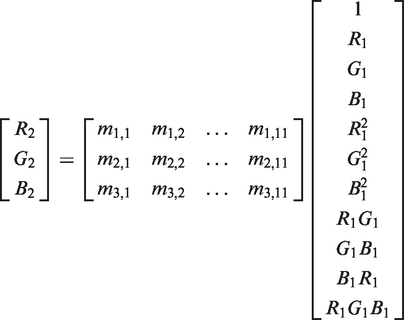
Verification of the algorithm
A total of 100 (25 for each group) random color samples were generated and corrected by artificial neural networks and multiple regression equations. Samples were printed on the fabric with corrected color values and then analyzed to verify the performance of the proposed algorithm.
Results and discussion
Preparation of color samples
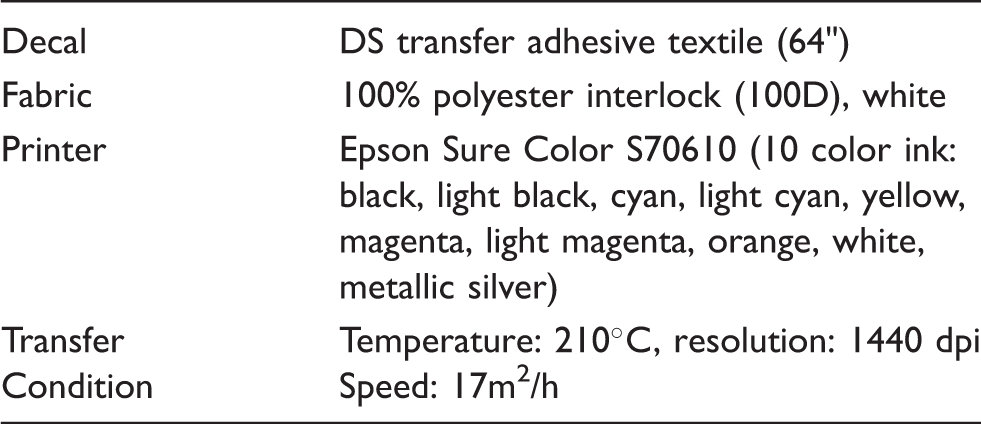
A total of 316 color samples were generated using Adobe Illustrator CS5 and printed on a decal then transferred to the fabric using a digital transfer textile printer, as shown in Figure 5. The printing condition is as shown in Table 3.
Testing apparatus: (a) digital transfer textile printer; (b) heating press machine. Process condition of digital transfer textile printing.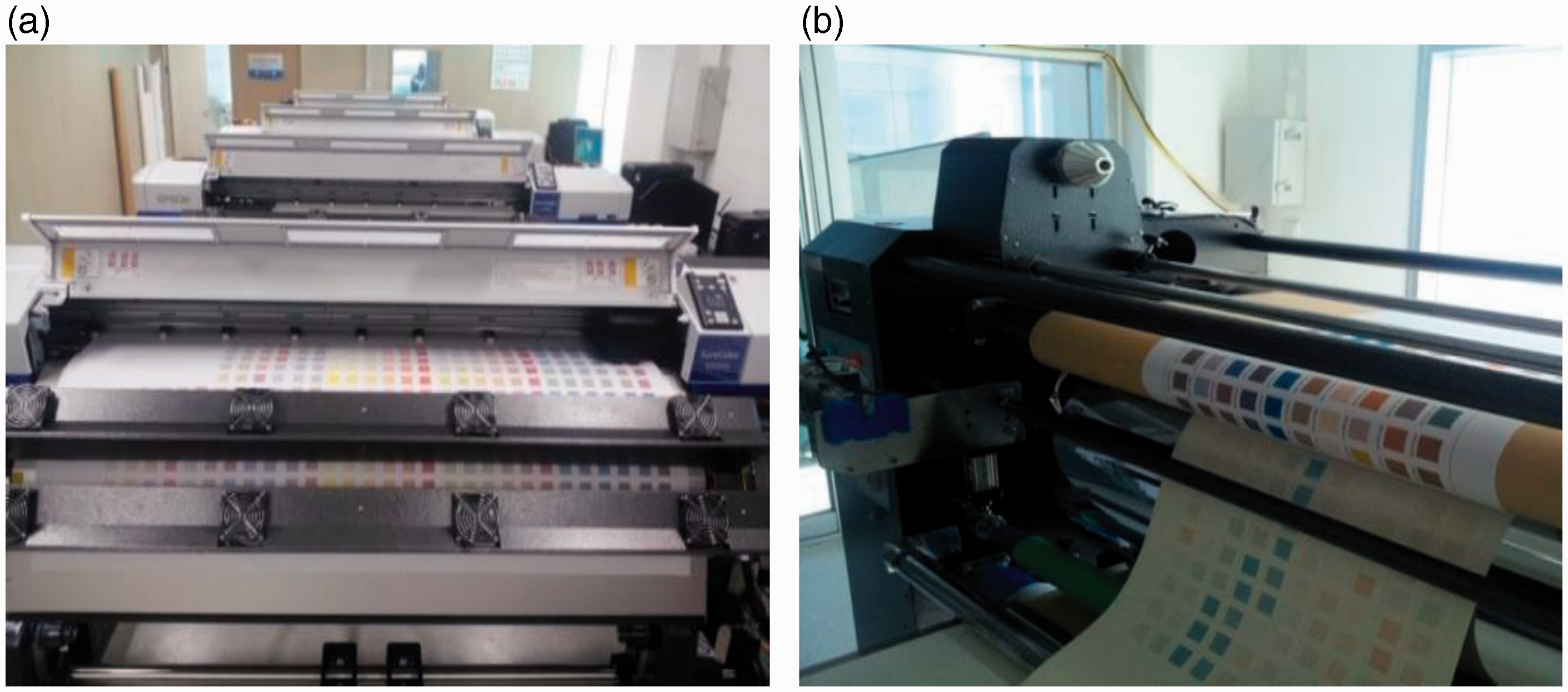
Results of the artificial neural network
Results of the artificial neural network.
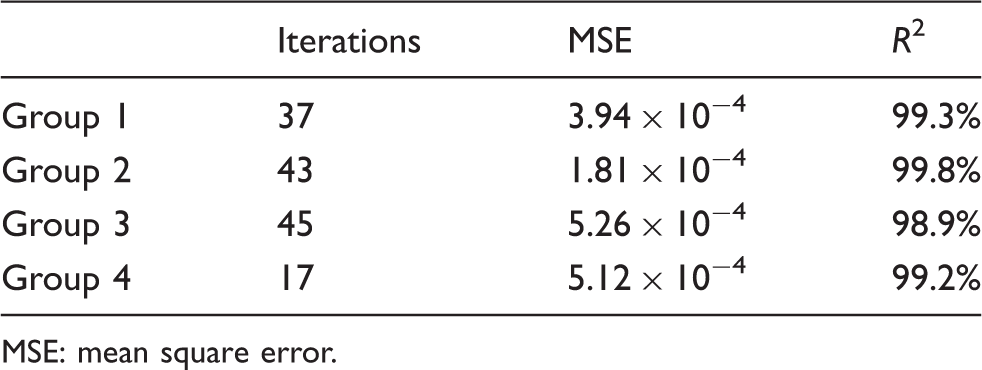
MSE: mean square error.
Results of multiple regression analysis
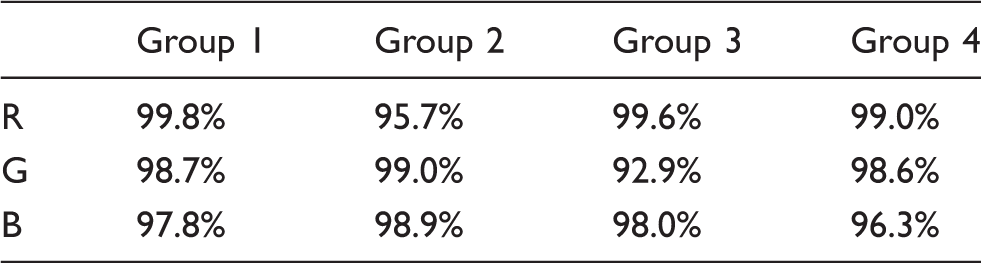
R2 value of equations for each group.
Color difference of random color samples
Paired t-test results on color difference.
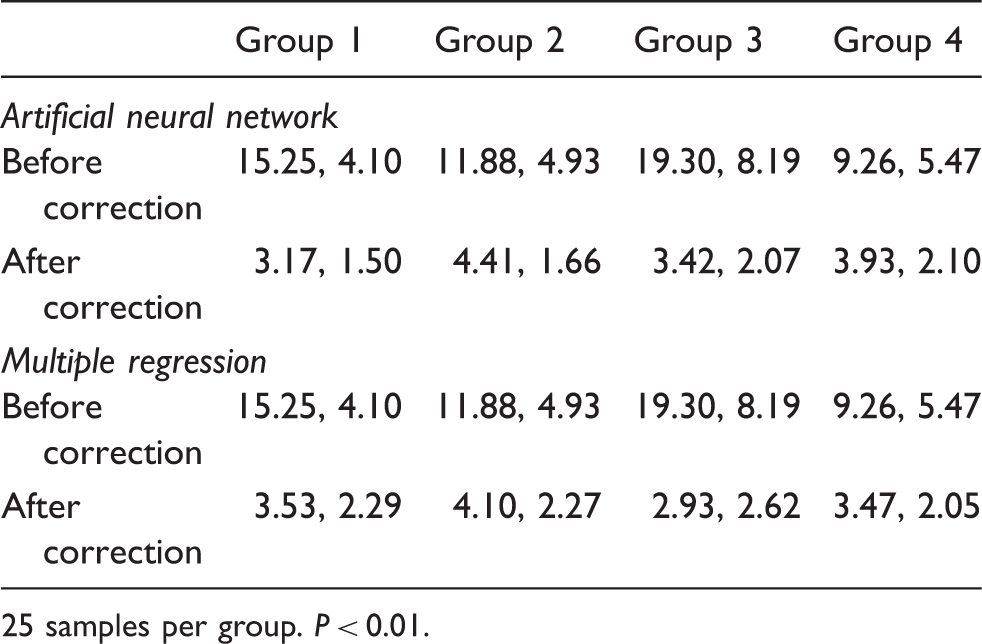
25 samples per group. P < 0.01.
Conclusion
Recently, DTP has grown quickly by replacing the conventional printing process. DTTP is also growing rapidly with the advantages of short processing time and low cost. However, there have been some complex color communication problems between designers and manufacturers.
In this study, an affordable color matching system has been developed using a common flatbed scanner to extract the sRGB values of printed fabric instead of an expensive spectrophotometer. Scanned sRGB values and initially intended target sRGB values were used as the input and output values to train artificial neural networks and to make multiple regression equations to establish the relationship between target and printed colors. Color samples printed with corrected sRGB values showed a good correlation with the target colors and both correction methods were proven to be effective. A total of 100 random color samples were generated and printed with corrected color values to verify the performance of the proposed algorithm, which showed a good correlation. The color matching algorithm developed in this study would be helpful in correcting colors for the DTTP process.
Footnotes
Funding
This research received no specific grant from any funding agency in the public, commercial, or not-for-profit sectors.