







Abstract
This article reviews select contemporary silver (Ag) compounds used for the chemical modification of textile fibers, including colloidal Ag, Ag salts, and Ag powder. The routes of their application, the chemical methods of preparation, and the strengths and drawbacks of the individual application processes are reviewed. The most important additives employed in the preparation of colloidal Ag nanoparticle (Ag NP) solutions and their influences on the properties of the colloidal Ag are discussed. Furthermore, the mechanism of the antimicrobial activity of Ag when incorporated into textile fibers is presented in particular. Different factors related to the application processes and the properties of the fibers themselves are addressed in the context of the efficiency of Ag as an antimicrobial agent in textiles.
Silver (Ag) and Ag-based compounds have become the most widely represented and studied inorganic antimicrobial agents for use in textiles.1–6 Ag is a leaching antimicrobial agent,6–8 whose efficiency depends directly on the concentration of Ag cations (Ag+) and/or nanoparticles (Ag NPs) released from the textile fibers in which they reside. After being released into the surrounding environment, these species act as a poison to a wide range of microorganisms, such as Gram-negative and Gram-positive bacteria, fungi, molds, viruses, yeasts, and algae. In addition to its antimicrobial properties, Ag is assumed to offer the additional advantage of not constituting a major risk to human health, especially in low concentrations.9–11 Ag is suggested for use in various areas, such as medicine, pharmaceutics, agriculture, food packaging, and water disinfection. However, the risks associated with nanoparticles in general, especially those of Ag, which are commonly used by many people, are a topic of extensive scientific discussion.12–14
The use of Ag-based antimicrobials has increased significantly with the development of modern methods for the preparation of Ag NPs that possess a large surface area, resulting in greater activity at lower metal concentrations. The synthesis of such Ag NPs has enabled new applications of Ag not only in the field of textiles but also in the realms of medicine, pharmacy, biology, biochemistry and food technology.
Due to its chemical stability at high temperatures and under UV illumination, Ag can be used in textile manufacturing as an additive introduced during the conventional spinning or electro-spinning processes used to make fibers.15–19 It can also be utilized as a finishing agent in the chemical finishing of fibers, yarns, fabrics, and nonwovens.20–26 The introduction of Ag as an additive into master-batches during spinning processes is only feasible in the case of chemical fiber production, which is a process commonly restricted by the use of hazardous chemicals and expensive equipment and by its high energy consumption. Ag particles located in the core of fibers do not contribute to the fibers’ antimicrobial efficacy. Conversely, the use of Ag as a finishing agent is of great practical importance because it is suitable for the chemical modification of natural and synthetic fibers and their blends. The chemical finishing technique can be applied using standardized methods, which include both pad-dry and exhaustion procedures.
Antimicrobial activity of silver
The antimicrobial activity of Ag has been attributed to the controlled release of both Ag+ and Ag NPs, which are nanoscale clusters of metallic silver atoms, Ag0.14,27–32 The release of Ag+ occurs during the dissociation of Ag salts (i.e. AgNO3, AgCl) dissolved in water. Ag+ also occurs as a result of the oxidation of Ag NPs in the presence of water and oxygen, as shown in the following reaction:

For controlled release mechanisms, Ag+ and Ag NPs should be leached from the solid surface to preserve biostatic activity at concentrations greater than the minimum inhibitory concentration (MIC) and to preserve the level of biocidal activity at the concentrations at which the metal is lethal to microbes. 4
According to the literature, the mechanisms of the antimicrobial activity of Ag+ and Ag NPs are very similar to each other. Both Ag+ and Ag NPs can participate in intermolecular interactions with the cell membrane of bacteria. Furthermore, Ag particles smaller than 10 nm have been reported to penetrate into the interior of microorganism cells, where they bind to the thiol groups of enzymes and nucleic acids.14,27,29–31,33–35 When present in the cell, Ag particles hinder or deactivate its critical physiological functions, such as cell wall synthesis, membrane transport, the synthesis of nucleic groups (including deoxyribonucleic and ribonucleic acids), and electron transport. The interactions of Ag particles with the thiol groups of proteins hinder the enzymatic functions of the proteins. Additionally, the binding of Ag+ to the DNA of bacteria causes the bacteria to lose the ability to reproduce. In the presence of oxygen, Ag+ and Ag NPs may also catalytically accelerate the formation of reactive oxygen species (ROS), which are highly toxic to cells.14,36 The formation of ROS is shown in the following reaction:

Despite the fact that ROS are normal side products in the process of cell respiration, their production in excessive amounts results in oxidative stress, which causes damage to the lipids, proteins and DNA of microorganisms and consequently destroys the cells. A comparison of the antimicrobial activity of Ag NPs with that of Ag+ revealed that Ag NPs are more effective than Ag+ because the biocidal activity of Ag NPs is achieved at a lower concentration than what has been observed for Ag+ (nmol vs. µmol concentration levels).32,37
Despite the findings that the use of Ag+ and Ag NPs at low concentrations is relatively non-toxic to human cells and causes no serious risk for human health,9,10,13,38–41 dilemmas regarding the safety of Ag for humans and the environment are still present. It was demonstrated that humans can be exposed to Ag particles through different routes, including ingestion, inhalation and absorption through the skin. 9 The latter route is the most common in this context because sweat and other bodily excretions facilitate the release of Ag particles from textile fibers to the skin surface. It has been demonstrated that Ag NPs smaller than 30 nm can be absorbed through the skin. 42 From the literature, it is evident that the Ag-modified medical textiles do not lead to cytotoxicity,43–46 irritation of the skin,47–50 and argyria. 51 In addition, they have no adverse effects on the ecological balance of healthy human skin microflora.52,53 It was also found that the use of wound dressings with Ag even accelerates wound healing,48,54,55 and prevents postoperative infections. 56
During the washing of Ag-treated textile products, Ag particles are released into the washing liquid and, via the waste water, pass into the environment. It was found that the amount of Ag released depends on its chemical structure and on the fiber composition.57–59 To reduce the amount of Ag in the waste water, specific bacterial species capable of storing Ag in the biosorption process were used. 57 Successful removal of Ag was also achieved by the use of wool, 60 and with recycled wool nonwoven fabric modified with hydrogen peroxide or alginate. The literature also reports that 85–99% of Ag was effectively removed by cleaning waste water in sewage treatment plants.58,61–63 In these processes, stable Ag2S complexes are formed, which can easily bind to the activated sludge and are afterwards removed in the process of filtration. 64
Silver compounds for antimicrobial textiles
Colloidal silver
Colloidal Ag is a stable dispersion consisting of highly dispersed Ag NPs. It is prepared using the bottom-up approach, which in general means that atoms or molecules are assembled into their molecular structure in the nanometer range. Two different routes for the incorporation of colloidal Ag into textile fibers are most commonly employed: the application of previously prepared colloidal Ag and the in situ synthesis of Ag NPs within textile substrates. Furthermore, commercial colloidal Ag products can be applied directly to textile fibers.24,65–77
Preparation of colloidal Ag
Different chemical methods for preparing colloidal Ag have been developed, among which chemical reduction is the most commonly used.
27
Chemical reduction involves dissolving Ag salt in a solvent and subsequently reducing
Reducing agents for AgNO3 reduction and stabilizers in the preparation of aqueous colloidal silver solution for the chemical modification of textile fibers
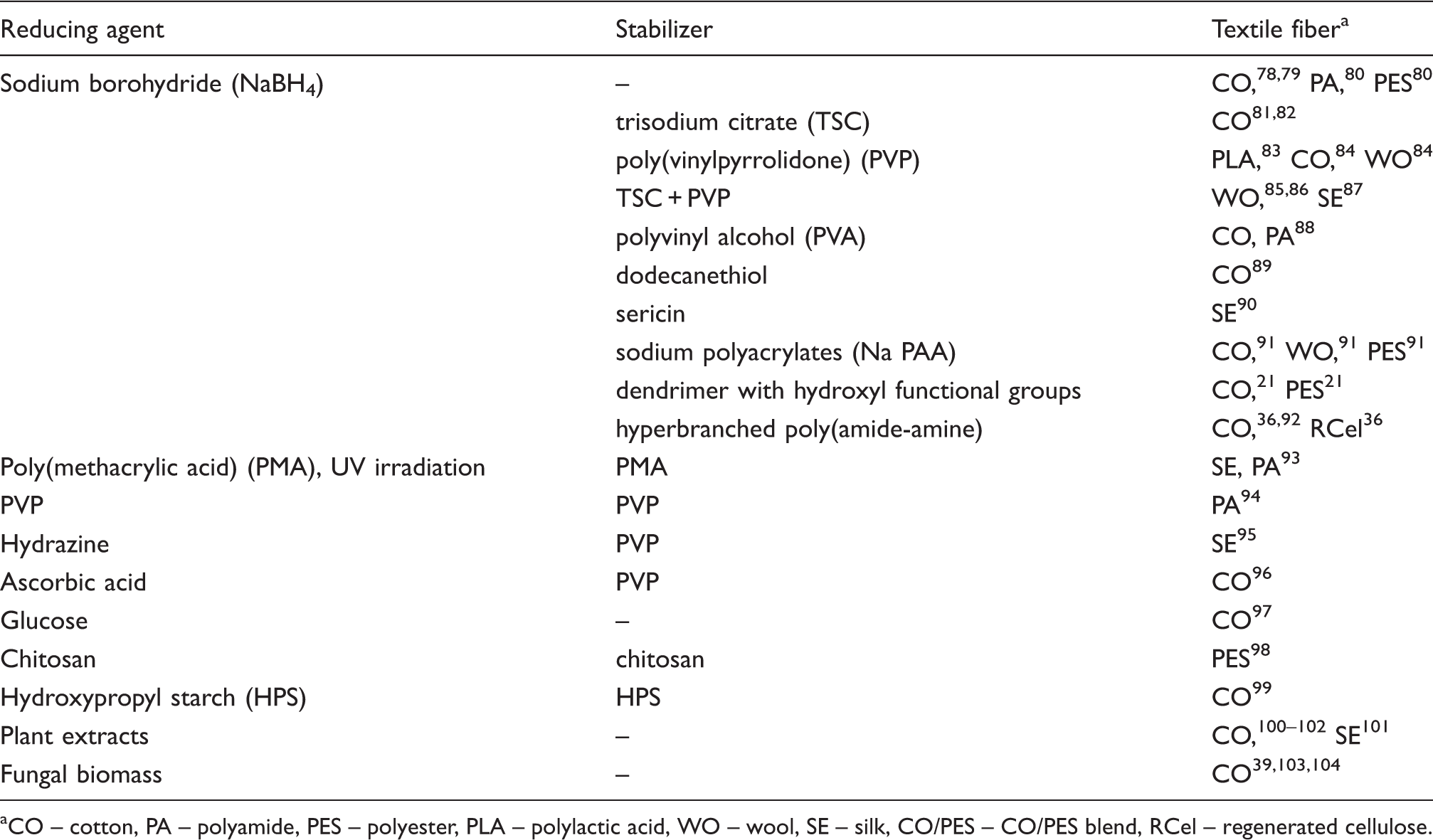
CO – cotton, PA – polyamide, PES – polyester, PLA – polylactic acid, WO – wool, SE – silk, CO/PES – CO/PES blend, RCel – regenerated cellulose.
Solvents, reducing agents for AgNO3 reduction, and stabilizers in the preparation of colloidal silver solution for the chemical modification of textile fibers
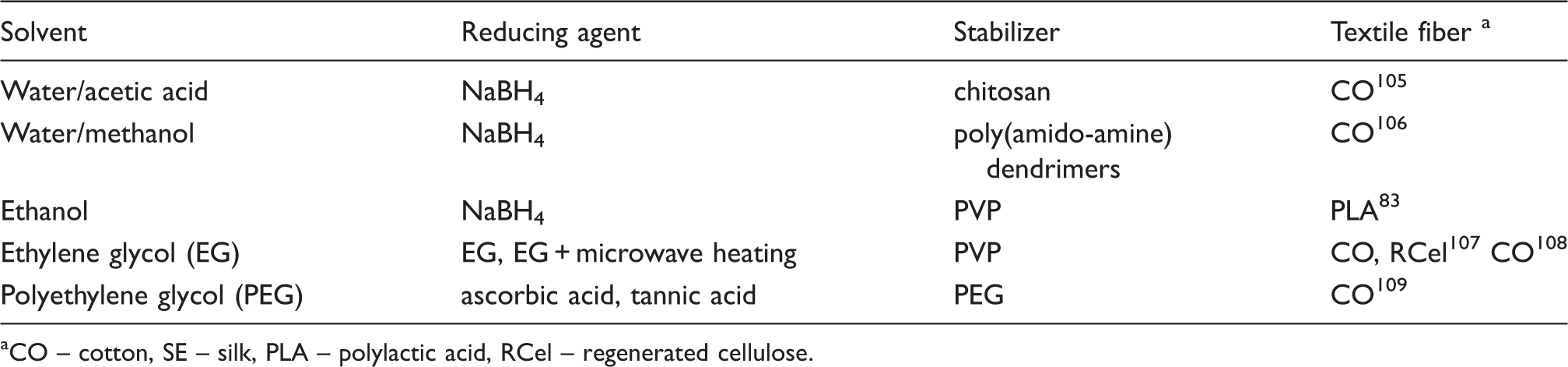
CO – cotton, SE – silk, PLA – polylactic acid, RCel – regenerated cellulose.
Water is the most appropriate solvent for AgNO3 (Table 1) and is also favorable from an ecological viewpoint. The size of the Ag NPs formed has been observed to decrease with decreasing concentration of AgNO3 used during their synthesis. 104 In addition to water, other solvents and their aqueous mixtures have also been used during Ag NPs synthesis (Table 2).83,105–109
Sodium borohydride (NaBH4) is the most commonly used reducing agent for AgNO3 (Tables 1 and 2). NaBH4 is a strong reductant that enables the formation of a large number of crystallization nuclei and consequently the formation of Ag NPs with smaller sizes than those formed using reducing agents with lower reducing strength.
110
If NaBH4 is present in stoichiometric excess relative to AgNO3, then a layer of
Stabilizers are an important additive in the preparation of colloidal Ag NPs because they prevent aggregation of Ag NPs and control the size and shape of the Ag NPs, which directly influence the antimicrobial activity of the NPs. These additives react with the surface of the Ag NPs, as well as with Ag+, and create a barrier that prevents intermolecular interactions. 110 Because of their propensity to interact with metals, compounds with carboxylic, amino, hydroxyl and thiol groups are often used as stabilizers. Among these compounds, polyvinylpyrrolidone (PVP) is most commonly used in experiments reported in the literature.83–87,94–96 An increase in the AgNO3-to-stabilizer molar ratio has been reported to result in a decrease in Ag NP size. It has also been demonstrated that the presence of the stabilizer dodecanethiol significantly increases the adsorption of the dodecanethiol-capped silver nanoparticles onto textile fibers. 89
The choice of the reducing agent and stabilizer used in a synthesis affects not only the size of the Ag NPs in solution but also their shape. Although spherical Ag NPs dominate reports in the literature, Ag NPs with a three-sided prismatic shape have also been observed when particular combinations of NaBH4 and trisodium citrate or NaBH4 and sodium citrate have been used.84,85,87 The size and shape of Ag NPs can also be influenced by the temperature, pH, and stirring rate of the reaction solution during the synthesis.95,102,104,110
Particle size and shape govern the localized surface plasmon resonance (LSPR), which causes different colors of NPs.84,85,87,112 It was found that the spherical Ag NPs exhibit a single LSPR band and that anisotropic particles exhibit more than one LSPR band in the absorption spectrum. Accordingly, the morphology-controlled synthesis of Ag NPs can provide different optical properties of Ag NPs in the visible spectral range. While spherical Ag NPs are yellow, anisotropic Ag NPs can exhibit a variety of colors.84,87
In situ synthesis of Ag NPs
Solvents, reducing agents for AgNO3 reduction, and stabilizers in the in-situ synthesis of Ag NPs in the fibers
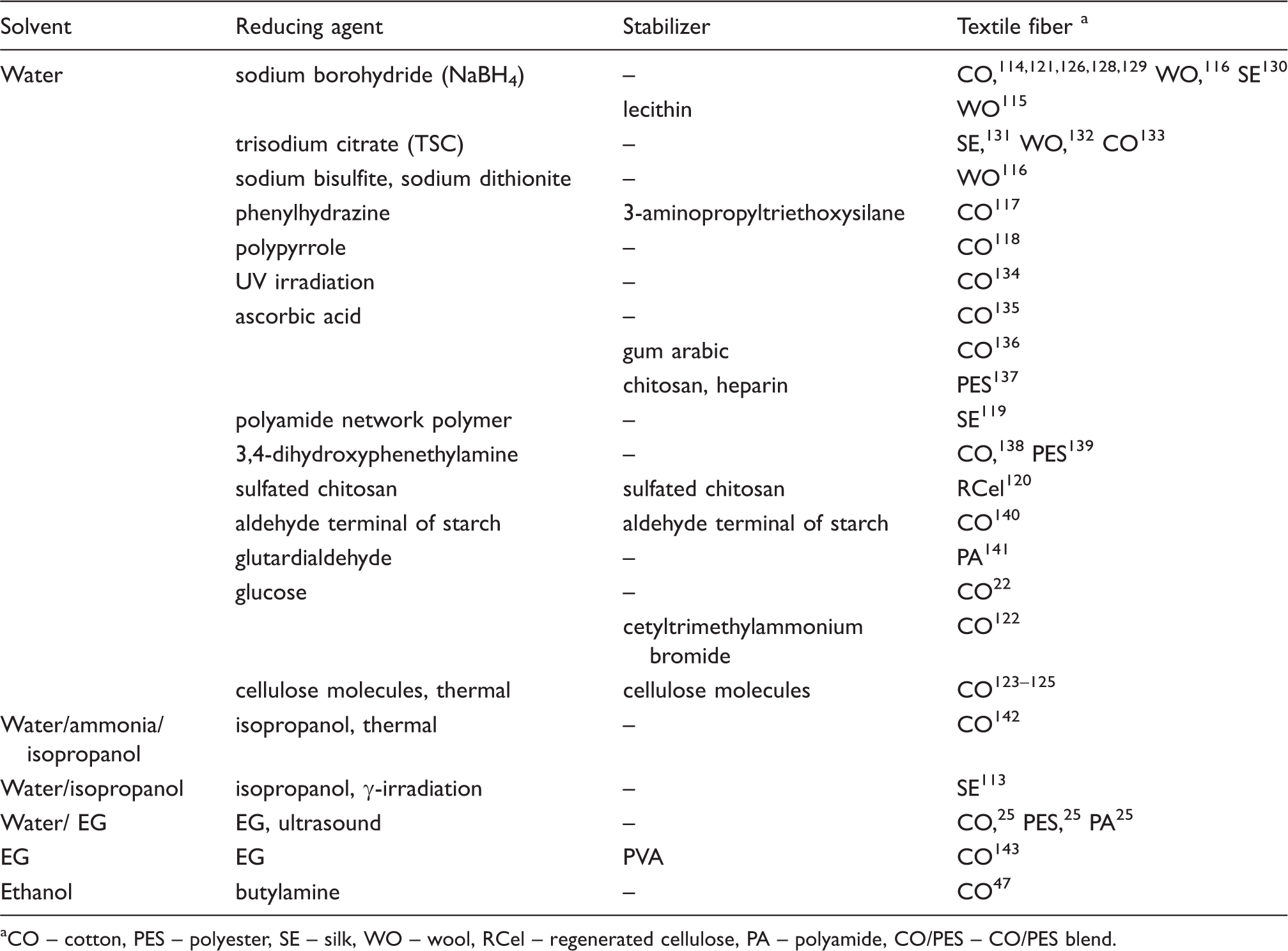
CO – cotton, PES – polyester, SE – silk, WO – wool, RCel – regenerated cellulose, PA – polyamide, CO/PES – CO/PES blend.
As evident from the results compiled in Table 3, sodium bisulfite and sodium dithionite, 116 phenylhydrazine, 117 polypyrrole, 118 ascorbic acid,135–137 polyamide network polymers, 119 3,4-dihydroxyphenylamine,138,139 starch, 140 glutaraldehyde, 141 glucose and cellulose have been used to reduce Ag+,122–125 in addition to the commonly known reducing agents sodium borohydride and trisodium citrate.114,116,121,126,128–133 If sodium bisulfite and sodium dithionite are used as reducing agents of AgNO3 in the presence of wool fibers, these reducing agents also reduce the wool fibers, especially cysteine to thiol groups. As Ag+ ions attract the thiol groups through ionic interaction, this provides the possibility of creating –S–Ag groups. 116 The treatment of polyamide fibers with glutaraldehyde results in the establishment of aldehyde groups on the polymer, which can reduce silver from the silver amine complex of the Tollens’ reagent on the fiber surface. 141
In situ synthesis enables a stable and even distribution of Ag NPs on the surface of the fibers; consequently, the addition of stabilizers is not necessary in this method.113,114,116,121,126,128,129–132 When Ag NPs are synthesized on the surface of cotton fibers, the end groups of the cotton’s constituent cellulose molecules can act simultaneously as a reducing agent and a stabilizer such that no additional additives are required.123–125 Furthermore, ethylene glycol and isopropanol have been documented as serving as both the solvent and reducing agent in these systems.25,113,143 The controlling of evaporation velocity of ethylene glycol leads to the controlling of the nucleation and the Ag crystal growth mechanism on the fabric surface. 143
In the in situ synthesis of Ag NPs, the use of NaBH4 as a reducing agent for AgNO3 also allows the formation of Ag NPs of smaller size than those prepared in cases where weaker reducing agents are used. 130 These results suggest that the mechanism by which Ag NPs are formed in the reduction of Ag+ depends on the chemical nature of the reducing agent. The size of Ag NPs has been observed to decrease with decreasing AgNO3 concentration and with increasing reducing agent concentration.125,130 It was also observed that trisodium citrate in the presence of wool acts not only as a reducing agent but also as a linker between Ag NPs and amino acids in the wool fiber. 132
In situ synthesis of Ag NPs has already been carried out inside wool fibers. In this case, lecithin, a biological lipid, was added to the AgNO3 solution to enhance the diffusion of Ag+ and Ag NPs into the wool fibers. 115 Lecithin increases the loading efficiency and reduces the release rate of Ag.
The literature also reports new methods of the in situ synthesis of anisotropic Ag NPs with the aim to tailor colorful fibers with antimicrobial properties. These methods have been performed with the Ag NP size and morphology controlled reaction by controlling the concentration of Ag ions, the reducing agent, the stabilizer, the application procedure performance and the fiber pretreatment.125,132
In situ synthesis of Ag NPs can also be performed in the polymer solution during the production of chemical textile fibers by electro-spinning processes.18,37,144–148 In this case, the solvents used for the preparation of spinning solutions also serve as the medium in which AgNO3 and NaBH4 are dissolved. Researchers also observed that, when added to the spinning solution, Ag+ could be reduced in the absence of a reducing agent, rendering a reducing agent unnecessary. 147
Silver powder
In the preparation of Ag powder, the top-down approach including the mechanical grinding of bulk metals to nanosized metal particles is used.27,34,35,110 Accordingly, particles of various sizes are used for the application of Ag powder. Prior to the application of Ag powder to textiles, Ag NPs must be dispersed in an appropriate solvent. However, a stable aqueous dispersion is difficult to achieve without the formation of aggregated particles, especially at higher particle concentrations. The most effective mode of application of Ag NP dispersions is the exhaustion process, during which the dispersion is continually stirred.149–152 Despite the addition of a dispersing agent and pretreatment of the dispersion with ultrasound, agglomeration of the Ag NPs is not wholly prevented, which consequently decreases their antimicrobial activity significantly. Ag powder has already been use at an antimicrobial additive into the masterbatch in the melt spinning process of different polymer fibers, such as polypropylene,153,154 polyamide,
155
and poly(
Silver salts
Both AgNO3 and AgCl have been successfully applied on a regular basis as antimicrobial agents in textiles. The excellent solubility of AgNO3 in water allows its application via aqueous solution in a wide concentration range.20,66,157–164 Unlike AgNO3, the use of AgCl is limited because of its very poor solubility in water. Nevertheless, cellulose fibers have been successfully modified with AgCl dissolved in ammonium hydroxide, 38 and with particles of AgCl previously prepared by precipitation of AgNO3 with hydrochloric acid. 96
The simplest procedures for the preparation of antimicrobial textiles include the application of commercial AgCl dispersions by either exhaustion or impregnation processes.23,67,68,165–170 Both application processes ensure efficient antibacterial activity of Ag on cellulose fibers; however, the concentration of adsorbed Ag that results from the impregnation procedure is too low, irrespective of the initial concentration of AgCl in the treatment dispersion, to preserve the antifungal activity of Ag on the fibers. 165
AgCl particles have also been synthesized in situ on fibers.171–175 In this method, textile fibers are sequentially immersed in the precursor solutions, which are typically combinations of AgNO3 and NaCl or AgNO3 and KCl. This synthesis method is simple and environmentally friendly and requires no expensive equipment, thus providing an easy approach to the development of textiles with antimicrobial properties. The size of AgCl particles formed has been observed to increase with an increase in the number of times the textile is immersed in the precursor solutions.174,175
Antimicrobial activity of silver on textile fibers
Influence of the concentration, particle size, and shape of Ag
The antimicrobial activity of Ag-functionalized fibers is directly affected by the concentration, as well as the particle size and shape, of Ag present on the fibers. The concentration of Ag adsorbed onto the fibers increases with increasing concentration of Ag in the finishing solution, irrespective of the application method.31,47,78,104,107,108,116,119,165,176 The efficiency of Ag NPs is believed to strongly increase with a decrease in particle size because the specific surface area of a particle increases as size decreases.31,65,165,177–179 This effect allows small particles to interact with microorganisms while simultaneously enabling a significant increase in the concentration of Ag+ released. 31 Accordingly, to produce an equivalent level of antimicrobial activity, a lower concentration of smaller Ag NPs is needed compared to that of larger Ag NPs.95,106 Furthermore, the particles with the aforementioned three-sided prism shape exhibit better antimicrobial activity than particles with a spherical or rod shape. 179 When studying the antimicrobial activity of Ag applied from Ag NP dispersions in powder form, researchers observed that, despite the increased antimicrobial activity due to the use of smaller Ag NPs, biocidal activity was not achieved even at the highest concentration of Ag on the fibers. Conversely, the concentration of the released particles was even lower than the MIC. 65
Influence of the fibers properties and the binding mode of Ag
The amount of Ag adsorbed directly depends on the chemical structure, as well as on the morphological and topological properties, of the fibers in question.88,93,176,180 The characteristics of the fibers directly influence the mode of Ag binding and its adhesion ability, the adsorption capacity of the fiber and the moisture content necessary for Ag release. As the amorphous chemical structure of the fibers and the amount of functional groups available as binding sites for Ag+ increase, both the uptake of Ag solution and the concentration of the absorbed Ag increase. In general, hydrophilic fibers can absorb a larger amount of Ag particles than hydrophobic fibers. Ag can penetrate into the amorphous regions of fibers through the fiber pores, cavities and inter-fiber spaces, where they physically bind to the substrate. 180 Particles have been observed to easily bind to the rougher surface of natural fibers than to the smooth surface of synthetic fibers. 88 In other words, the increase in the surface area of the fibers results in an increase in the amount of deposited Ag NPs.
Antimicrobial activity is also directly influenced by the mode through which Ag binds to the functional groups of the fibers.72,82,181 Specifically, the continuous release of Ag+ and Ag0 is only possible if Ag is bonded to the fibers through physical sorption. 72 Chemical binding of Ag to the fibers may significantly reduce its effectiveness as an antimicrobial agent. This phenomenon has been observed in the case of wool fibers, where the chemical binding of Ag to the thiol groups on the wool and the subsequent formation of Ag mercaptides hindered the release of Ag+ from the fibers into the surroundings, as reflected by the insufficient antibacterial activity. 181 Accordingly, an increase in the concentration of absorbed Ag was required to achieve a biocidal effect. The application of Ag colloid in the presence of 1,2,3,4-butanetetracarboxylic acid in acidic solution improves the adsorption of Ag NPs, contributes to firmer physical entrapment in the fibers and controls the release of Ag NPs from the covered surfaces. 72
Influence of the fiber pretreatment
The amount of Ag adsorbed in these cases can be enhanced by the application of various types of pretreatments to the textile substrates. Among these processes, plasma functionalization and plasma etching are used to induce fiber surface activation through the introduction of new functional groups and an increase of the surface area,80,121,151,152,159,169,182–184 resulting in an enhancement of the loading of Ag NPs from colloids. Simultaneously, the plasma treatment contributes to higher uniformity of the Ag NP distribution on the fiber surface.
Another important pretreatment process includes the grafting of different acids on the fiber surface, such as tannic acid and ethylenediaminetetraacetic dianhydride,163,185 butanetetracarboxylic acid,72,186 mercaptoacetic acid, 82 acrylic and polyacrylic acid, 121 deoxyribonucleic acid, 187 and glycidyl methacrylate-iminodiacetic acid. 134 The role of the acids as the grafting agents on the fiber surface is to increase the negative charge through the creation of carbonyl and carboxyl acid groups on the surface, which enhances the loading efficiency of Ag+ via electrostatic interactions, as well as to act as capping and stabilizing agents for Ag NPs. In addition, through the application of mercaptoacetic acid to the cellulose fibers, thiol modified fibers are created on which Ag NPs can be attached by a strong Ag–S bond. 82
Furthermore, in the case of cellulose fibers, alkali pretreatment is used to activate surface hydroxyl groups to enhance the deposition efficiency of Ag NPs. 135 Mercerization, 125 as well as the application of reactive polymer β-cyclodextrin as the host compound for Ag NPs,97,158 is applied to the cellulose macromolecules in the pretreatment process. It has also been found that cationization of cellulose fibers with 3-chloro-2-hydroxypropyl methyl ammonium chloride increases the roughness and decreases the zeta potential of the fiber surface, 69 which in turn increases the degree of Ag NP adsorption.
To achieve a more tenacious interaction between Ag and the fiber structure, to prolong the release of Ag+ and Ag0 and to improve the washing fastness of the coating, amino functional silver nanoparticles were prepared with amino-terminated hyperbranched polymer and grafted on the oxidized cotton fabric subsequently. 92 Furthermore, Ag has been embedded into polymer matrices created by hydrogels,128,129,188 chitosan,126,133,189 polyacrylonitrile, 131 polyvinyl pyridine, 161 and silicon alkoxides of different structures, i.e. tetraethoxysilane,26,66,89 amino-functionalized siloxane,23,165,167 water glass, 20 mercapto-functionalized triethoxysilane, 190 and 3-glycidyloxypropyltrimethoxysilane.26,66 As most silicon alkoxides are soluble in alcohols, which require a closed circuit for application, studies have focused on the development of precursors that can be mixed into water.23,150,165,167 The results of these studies have shown that the presence of a polymer matrix enhances the adsorption capacity of the fibers and consequently increases the concentration of bound Ag, contributes to the uniformity of the particle distribution, prevents particle agglomeration and extends the release time of Ag+ and Ag0. However, studies have also shown that the antimicrobial efficiency and the washing fastness of the coating are almost eradicated. Namely, if the polymer matrix contains in its structure functional groups that allow chemical binding of the silver particles, it enables a stronger binding interaction of Ag with the polymer matrix, which simultaneously results in a reduced concentration of released particles. In this manner, only the biostatic activity of silver can be obtained due to a slower release of the silver cations in the presence of moisture. 190 To eliminate this shortcoming, Ag was embedded into a polymer matrix created by active bio-barrier-forming antimicrobial agents.126,133,189,191
Washing fastness of the Ag modified fibers
The binding of Ag through physical interactions does not allow for permanent textile chemical modification, which is an important disadvantage of the Ag coating processes. Physically adsorbed Ag NPs gradually release from the fibers during repeated washings. 72 The release kinetics is determined by a diffusion process and not just by a simple wash-out mechanism. 88 Accordingly, the antimicrobial efficiency of Ag NPs remaining on the fibers after the repeated washings could be ensured by a sufficiently high concentration of Ag NPs applied to the fibers. The results also show that the release of the Ag NPs from the thiol-modified cellulose fibers during the washing is very low, indicating that the covalent linkage between Ag and cellulose has much higher washing durability compared to Ag-modified cellulose without covalent linkage. 82 The post treatment of Ag-modified fibers with cross-linkable polysiloxane also importantly improved the antimicrobial durability. 24
Future aspects of nano-silver in textiles
Research in the field of Ag-modified textile fibers will be conducted in different directions:
– in-situ synthesis of Ag NPs in textile fibers with the use of environmentally friendly chemicals, – pretreatment of textile fibers to increase the adsorption of Ag NPs and to stabilize their embedment in the fibers as well as to control the release of Ag NPs from the fiber surfaces, – improvement of the mode of Ag application to preserve the washing fastness of the coating, – development of new application processes to achieve multifunctional textile fibers with antimicrobial properties, – investigation on the impact of the use of Ag-modified textile fibers on human health and the environment.
Conclusions
Colloidal Ag, Ag powder and Ag salts are the most common forms of Ag used to functionalize textiles. Among these forms, colloidal Ag has been studied in the most detail as a material for imparting antimicrobial properties to modified textiles. It is usually applied as a stable colloidal solution previously prepared by the chemical reduction of AgNO3 in the presence of a reducing agent but can also be synthesized in situ on textile substrates. The latter procedure has an important advantage over the former procedure in that it results in a uniform distribution of Ag NPs and improves their stability on the textile fibers without the need to add stabilizing agents. It is also distinguished by its simplicity, efficiency and environmental compatibility. In the preparation of colloidal Ag, recent research has focused on the replacement of the ecologically less acceptable NaBH4 with more environmentally friendly reducing agents, including polysaccharides, fungal biomass and plant extracts. Among Ag salts, AgNO3 and AgCl are most commonly used to treat textiles. AgCl can be used as a precursor for the in situ synthesis of Ag NPs on fibers via the sequential immersion of fibers in solutions of AgNO3 and NaCl or AgNO3 and KCl. Because this procedure does not require expensive equipment or additives, it provides a simple approach for developing textiles with antimicrobial properties. The highly demanding and difficult preparation of stable dispersions of Ag NPs in powdered form represents the main disadvantage of this application process.
The application process used to modify textiles with Ag NPs directly affects the final concentration of Ag applied to the fibers as well as the particles’ size and shape. The amount of Ag adsorbed is also directly dependent on the chemical structure and the morphological and topological properties of the fibers, which influence the Ag mode of binding, adhesion ability, adsorption capacity and moisture content necessary for Ag release. The latter is favored by the use of higher Ag concentrations, a smaller particle size, the preparation of three-sided-prism-shaped Ag particles and the promotion of physical binding to the fibers. Different pretreatment, as well as post treatment, processes of textile fibers are introduced to increase the adsorption of Ag NPs and to enhance the washing fastness.
Footnotes
Funding
This work was supported by the Slovenian Research Agency (Programme P2-0213 and Basic Project J2-2223).