







Abstract
Staple-spun yarn has been attracting attention as a fiber assemblage for composite fabrication for a decade. Using spun yarn as a fiber assemblage allows us to obtain a higher volume fraction with better fiber alignment if discontinuous fibers are used as reinforcement. However, a staple-spun yarn structure has a very complex geometry of fiber arrangement (such as twist and migration) as well as fiber discontinuity. These complexities make it difficult to analyze a composite system using staple-spun yarn as a fiber assemblage. In this study, a mathematical formulation was developed for the elastic solution of the tensile behavior of a composite system using unidirectionally aligned staple-spun yarn as a fiber assemblage. The influence of the twist angle on the effective axial modulus of the composite and the stress and strain distributions are discussed using the proposed approach.
Staple-spun yarn is a linear assemblage of discontinuous fibers that are given a substantial amount of twist or entanglement to overcome fiber slippage. 1 Staple-spun yarns of natural fibers (NFs) have been widely used in textile applications for centuries, but the application of staple-spun yarns in structural composite materials has been limited. For the last decade, NFs have attracted attention as reinforcement materials because of their environmentally friendly characteristics,2–4 and “green composites” using staple-spun yarns of plant fibers have been investigated.5–7 Staple-spun yarns made with high-performance fibers, including carbon and aramid, have also been supplied for decades, and recently have been watched with interest because of the better drapability for rapid, automated manufacturing. 8 In addition, innovative techniques for making spun yarns from carbon nanotubes (CNTs) have recently emerged, and researchers have started to use CNT spun yarns for fabricating composite materials. 9 The advantage of using spun yarn structures as a fiber assemblage or preform in composite fabrication is the ability to obtain a higher volume fraction with better fiber alignment if discontinuous fibers are used as reinforcement. Pultrusion using staple-spun yarns is a prospective technique for fabricating a polymer composite with higher mechanical properties, even though staple fibers are used.5,6,10 The key to achieving higher mechanical properties is sufficient impregnation of the matrix into the fiber assemblage;7,10 each fiber should be surrounded by a matrix so that better load transfer from matrix to fiber can be achieved.
A staple-spun yarn structure has a very complex geometry of fiber arrangement, such as twist and migration, as well as fiber discontinuity. These complexities make it difficult to analyze staple-spun yarns. Similarly, analyzing a composite system using staple-spun yarns as a fiber assemblage is a challenge, but analytical techniques for determining the mechanical behavior should be developed in order to facilitate research and development of this new composite system, such as material design for obtaining better mechanical properties and fracture analysis for assuring structural integrity.
Several researchers have published papers on predicting the elastic properties of resin-impregnated twisted yarn. These papers modeled resin-impregnated twisted yarn as a series of concentric cylinders in which each cylinder had a different principal material coordinate system. Naik and Madhavan 11 developed a simple analytical model for estimating the elastic properties of resin-impregnated twisted yarn. The approach considers the composite system as a plied yarn. The advantage of this approach is the ability to get a closed-form solution of the effective axial modulus in special cases, such as an idealized helical yarn structure; however, it is not possible to calculate the stress and strain distributions in the model. Rao and Farris 12 and Nakamura et al. 13 proposed an analytical model for predicting the elastic properties of resin-impregnated twisted yarn based on classical lamination theory (CLT). This approach regards resin-impregnated twisted yarn as a laminated cylinder composed of infinitesimally thin plies. The advantages of this approach are the ability to obtain a closed-form solution for the effective axial modulus in special cases such as an idealized helical yarn structure and the ability to obtain the stress and strain distributions; however, this model ignores the normal stress in the radial direction that unavoidably arises from the migration structure.
In this study, a mathematical formulation was developed for the elastic solution of the tensile behavior of a composite system using unidirectionally aligned staple-spun yarn as a fiber assemblage. Our approach is similar to the approach of providing an analytical solution for a thick laminated circular tube.14,15 The influence of the twist angle, which is the most important parameter of a yarn structure, on the effective axial modulus of the composite is discussed using the proposed approach and is compared with predictions by the conventional approaches and experimental results. 16 The stress and strain distributions are compared with the solutions obtained using the CLT-based approach.
Analytical model
In this study, a composite system using unidirectionally aligned staple-spun yarns as a fiber assemblage with a hexagonal arrangement is considered, as shown in Figure 1. A unit cell of the composite system, as shown in Figure 1, is composed of a fiber-reinforced volume with staple fibers and a surrounding resin-rich region, and it is simplified into an axisymmetric model (as shown in Figure 2) in order to allow us to conduct elastic analysis. In this study, it is assumed that the resin is perfectly impregnated into the spun yarn. In other words, each fiber is entirely surrounded by the matrix. In Figure 2, the radii of a unit cell and the fiber-reinforced volume are represented as R and Ry, respectively.
Composite system using unidirectionally aligned staple-spun yarns with a hexagonal arrangement. Simplified axisymmetric unit cell.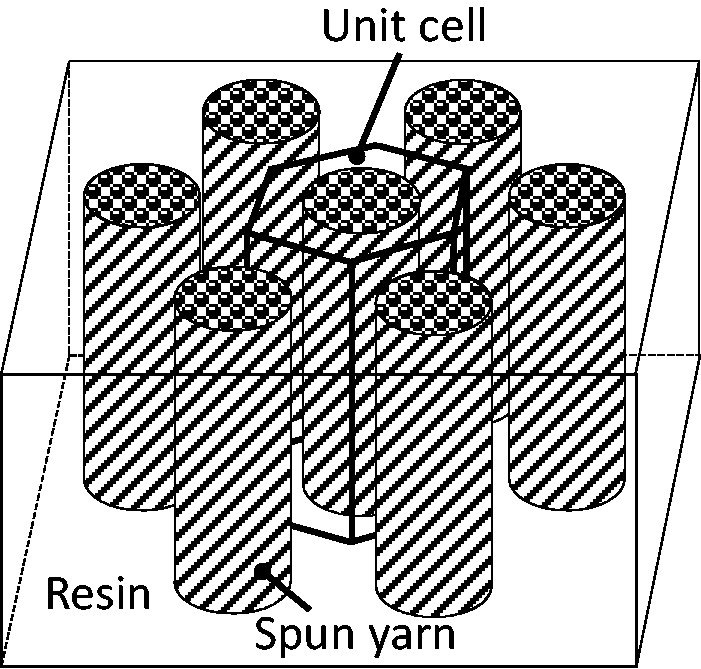
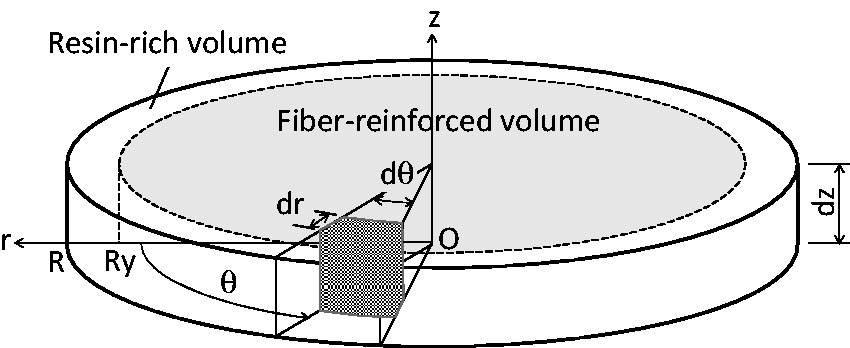
It is well known that a fiber within a yarn follows a spiral path at different radial positions, which is referred to as migration.
17
As the first approximation of a migration structure, a helical yarn geometry is widely used for the mechanical analysis of yarn structures, and the yarn structure is considered as a series of concentric cylinders with differing radii. In this study, the same approach is employed. A global cylindrical coordinate system (r, θ, z) is defined as shown in Figure 2. Let us consider a small element with a volume of Coordinate systems of an element.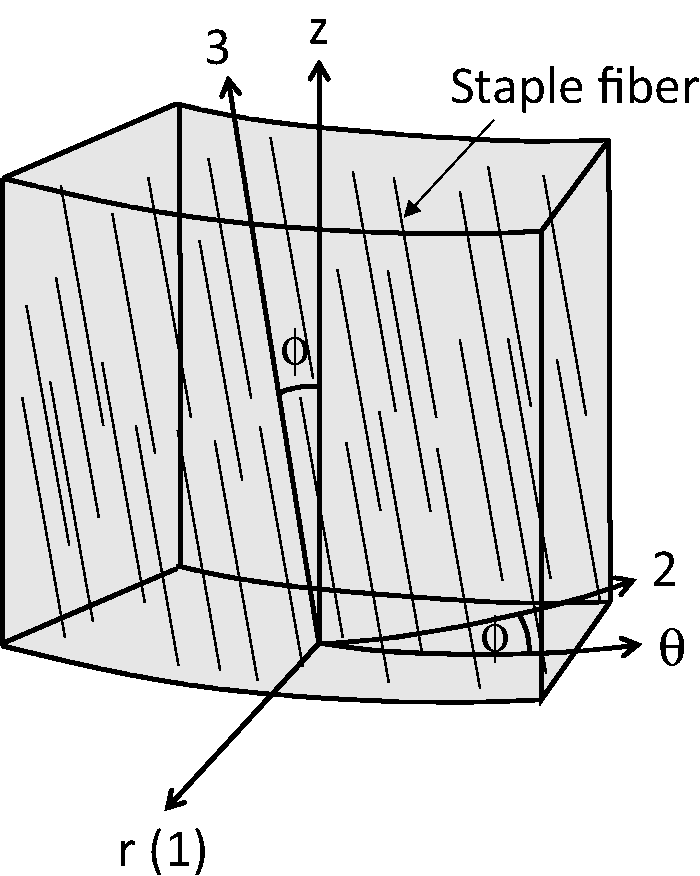
Mathematical formulation for elastic analysis
Displacements
A local principle material coordinate system (1, 2, 3) is defined as shown in Figure 3. The displacements in the r, θ, and z directions are expressed as u, v, and w, respectively. A unit cell is subject to a uniform applied strain

Strains
Substituting Equation (1) into the strain–displacement relations in the cylindrical coordinate system gives
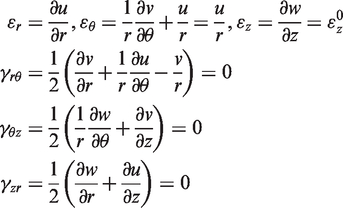
Note that the strain components are independent of θ and z.
Constitutive equations
The constitutive equations in the principal material coordinate system are
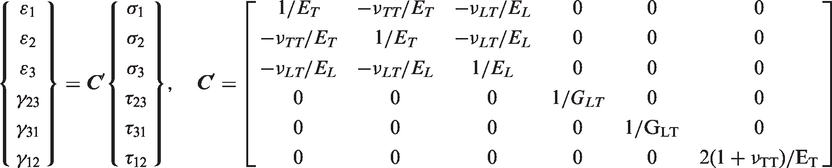
where subscripts L and T represent the fiber direction (i.e. three directions) and the transverse direction to the fiber direction, respectively. EL is the Young’s modulus in the fiber direction, ET is the Young’s modulus in the transverse direction, GLT is the shear modulus in the L–T plane, νLT is the Poisson’s ratio in the L–T plane, and νTT is the Poisson’s ratio in the T–T plane. The material properties can be determined from experimental measurements of unidirectionally reinforced specimens, or they can be estimated using the rule of mixtures or micromechanics such as the combination of Eshelby’s equivalent inclusion method and Mori–Tanaka’s mean-field theory. 18
The constitutive equations in the global coordinate system are
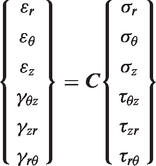
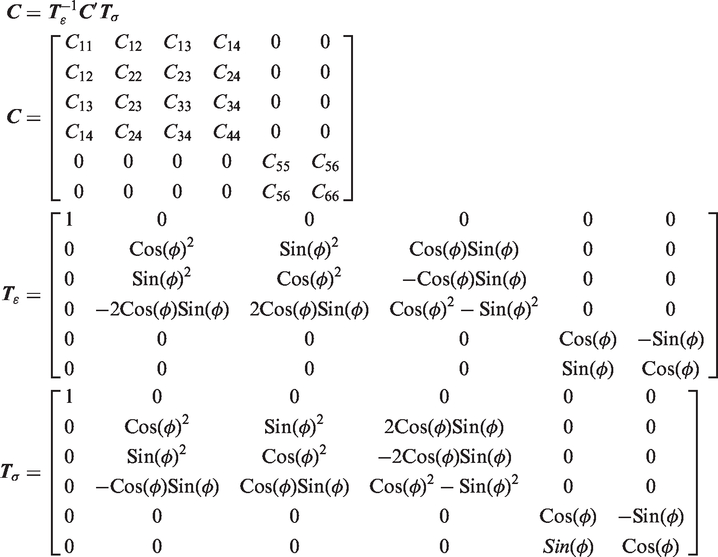
The constitutive equations in the global coordinate system are also written as
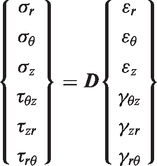
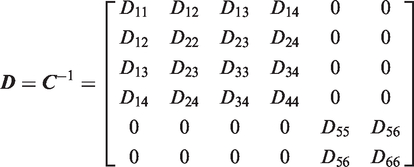
Substituting

Note that the non-zero stress components are independent of θ and z because the strain components are independent of θ and z.
Equilibriums
The equilibriums in the cylindrical coordinate system are
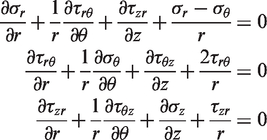
Given that the stress components are a function of r and
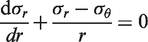
Solution
Equations (2), (5), and (8) are fundamental equations for this model. Substituting Equations (2) and (5) into Equation (8) leads to an ordinary differential equation in terms of the displacement r:
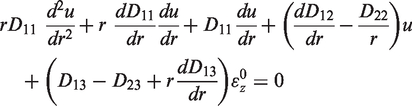
Note that the coefficients Dij are functions of r.
By solving the differential equation under the boundary conditions of
Axial force
The axial force Pz is determined by integrating the axial stress σz over the cross-section:

Effective axial modulus of the composite
The effective axial modulus of the composite Ecomp is obtained as

Calculations and discussion
The twist angle of a yarn is referred to as the fiber angle on the surface of the yarn, and it primarily affects the mechanical properties of the composite system if spun yarns are used for composite fabrication. Therefore, in this section, the effect of the twist angle on the effective axial modulus of polymer-based composites is examined in comparison with the conventional approaches11–13 and experimental results.
16
Then, the stress and strain distributions in the unit cell of a composite are discussed. In this study, an ideal helical yarn structure
19
is assumed as the yarn structure. An ideal helical yarn structure has an identical pitch length of the twist independent of the radial position and, thus, the fiber angle is expressed as
Fiber angle variation for an ideal helical yarn structure.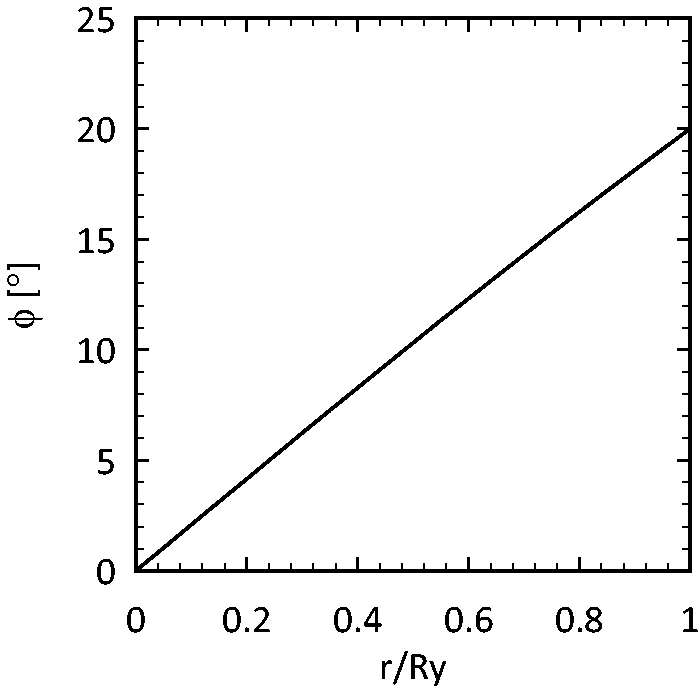

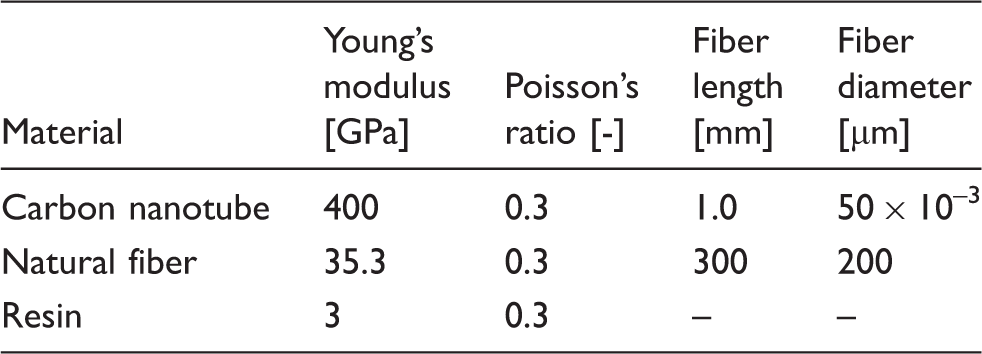
Material properties and dimensions
Effective axial modulus
In this section, our solution is compared with predictions by two approaches based on classical yarn theory and CLT.
Plied yarn approach
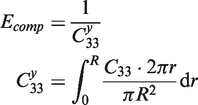
Naik and Madhavan 11 developed a simple analytical model for estimating the elastic properties of resin-impregnated twisted yarn. The approach considers the composite system as a plied yarn.
The effective axial modulus Ecomp is described as
CLT-based approach
Rao and Farris
12
and Nakamura et al.
13
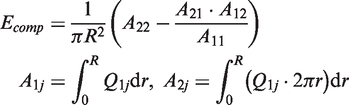
proposed an analytical model for predicting the elastic properties of resin-impregnated twisted yarn based on CLT. This approach considers the resin-impregnated twisted yarn as a laminated cylinder composed of infinitesimally thin plies. The effective axial modulus Ecomp is described as
Effect of twist angle of yarn
Figure 5 shows the dependence of the effective axial modulus of two composite systems on the twist angle of the yarn. For comparison, predictions by the plied yarn approach and the CLT-based approach, as well as experimental results for NF/resin system,
16
are plotted in Figure 5.
Effective axial modulus of composites: (a) carbon nanotube/resin; (b) natural fiber/resin.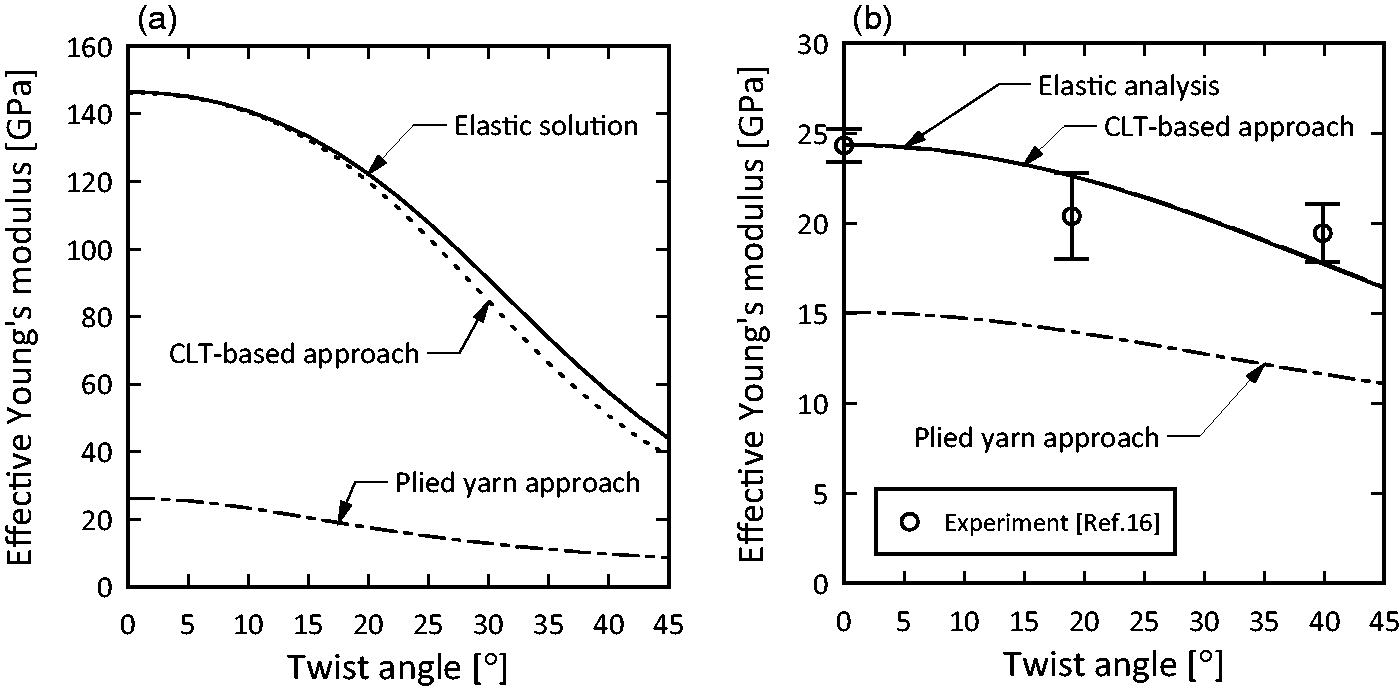
The effective axial modulus of the composites decreased with an increase in the twist angle, and it decreased by about 15% in both material systems if the twist angle was 20°. The amount of decrease was not negligible but was moderate because the migration structure led to a shear deformation constraint similar to angle ply lamination. The comparison with experimental results of the NF/resin system shows that our model reasonably predicts the effect of twist angle on the effective axial modulus.
The CLT-based approach had good accuracy for predicting the effective axial modulus, especially for a low anisotropy ratio. On the other hand, the plied yarn approach underestimated the effective axial modulus because Equation (13) derived from the plied yarn approach is based on Reuss’s model, which gives the lower limit of the effective axial modulus. 20
Stress and strain distributions
Figure 6 shows typical stress and strain distributions of a unit cell in the global coordinate system (CNT/resin, Stress and strain distributions in the global coordinate system: (a) stress distribution; (b) strain distribution.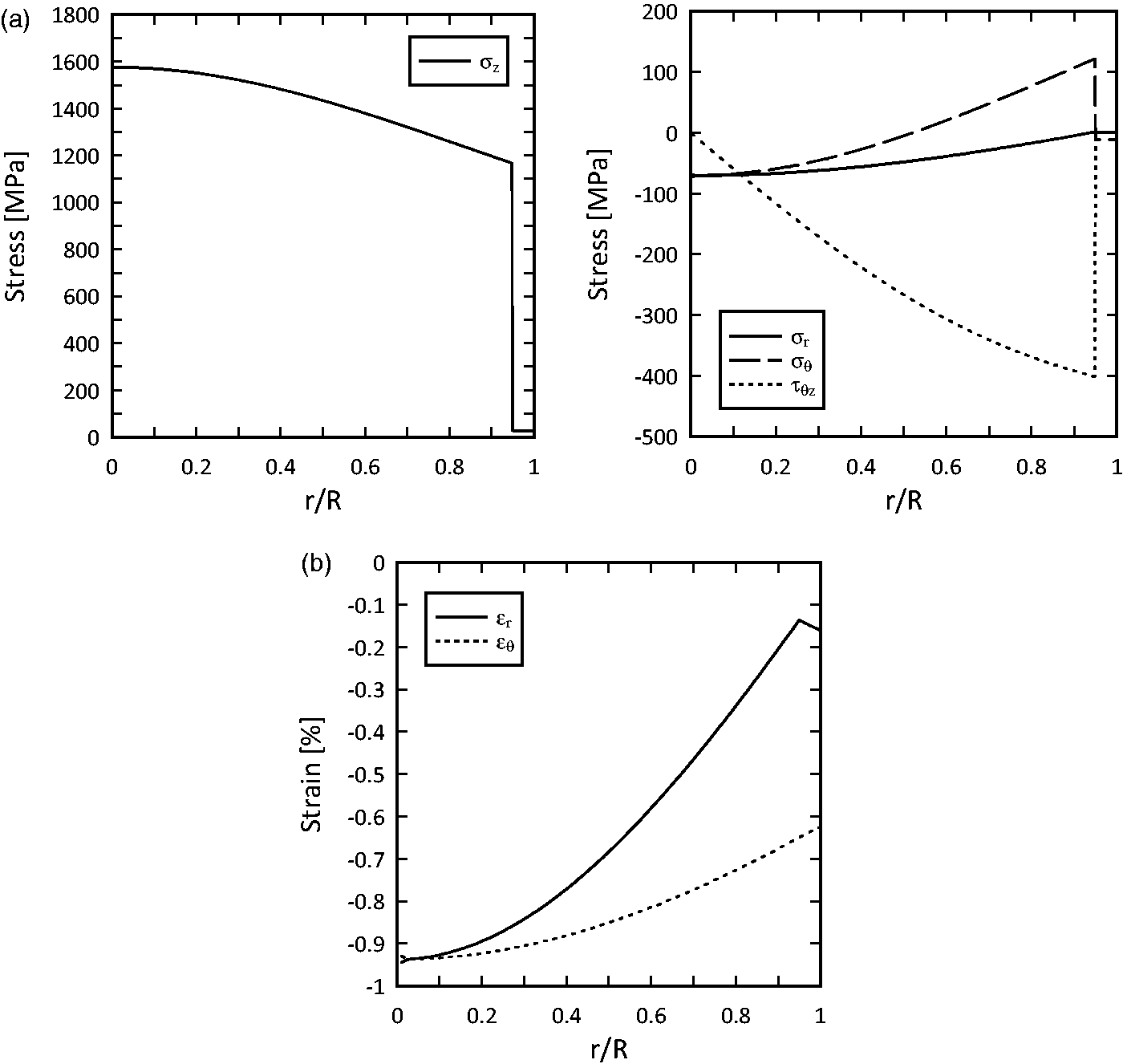
Figure 7 shows the stress distributions within the resin-impregnated yarn volume in the principle material coordinate system. For comparison, predictions by the CLT-based approach are plotted in Figure 7. The normal stress in the fiber direction σ3 for the CLT-based approach is close to that for the elastic solution, guaranteeing the high accuracy of the prediction of the effective axial modulus of composites by using the CLT-based approach, as shown in Figure 5. On the other hand, the CLT-based approach provides inaccurate estimates of the radial normal stress Stress distributions of the fiber-reinforced volume in the principle material coordinate system.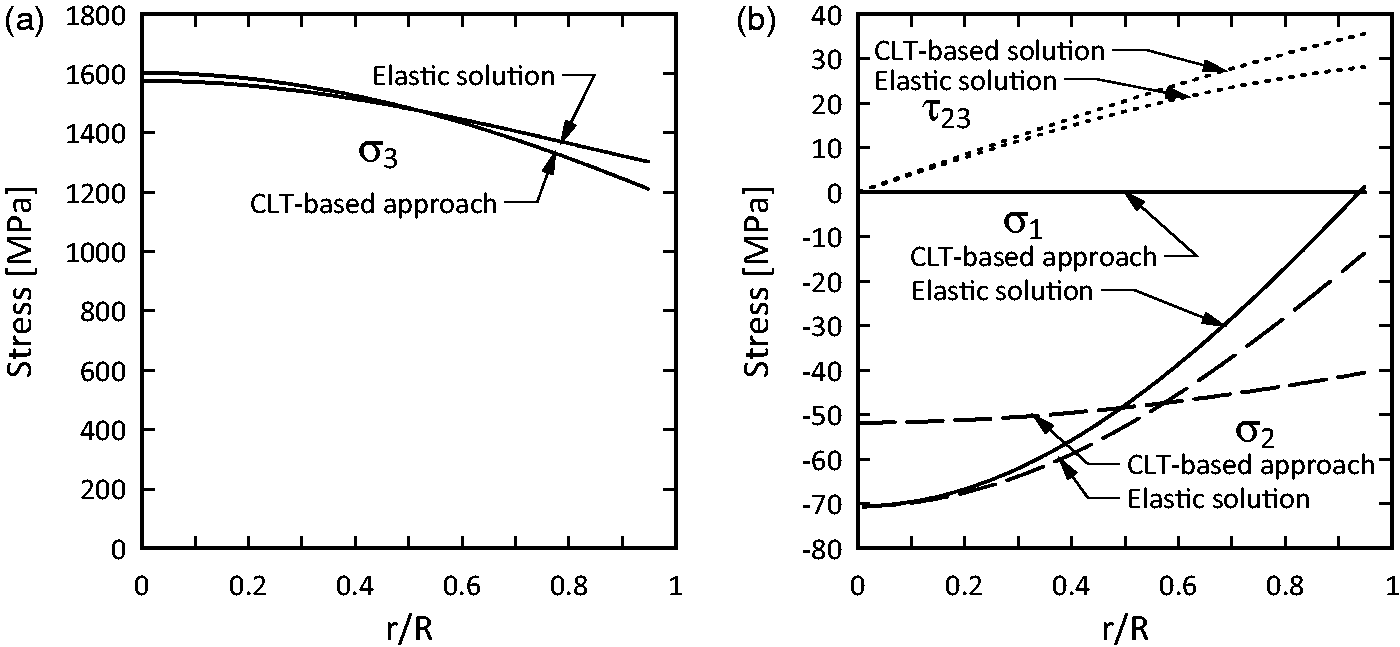
Conclusions
A mathematical formulation was developed for the elastic solution of the tensile behavior of a composite system using unidirectionally aligned staple-spun yarn as a fiber assemblage. The proposed method provides more accurate solutions of the strain and stress distributions in the composite system than those predicted by conventional approximate approaches, such as the CLT-based approach. A parametric study regarding the influence of the twist angle on the effective axial modulus of the composite was conducted, and the results indicated that the CLT-based approach had good accuracy, but the plied yarn approach underestimated the effective axial modulus. Then, the stress distributions were compared with the CLT-based approach results. The comparison demonstrated the usefulness of the proposed method when the stress and/or strain distribution(s) in the composite system was discussed.
Footnotes
Funding
This work was supported by the ISAS Steering Committee for Space Engineering.