






Abstract
This paper describes a study of hip-protective pads made from warp-knitted spacer fabric treated with shear thickening fluid (STF). Hip fractures, mostly caused by falls, are a substantial contributor to morbidity and mortality in the elderly, and incidence is rising worldwide. Hip-protective pads reduce fractures, but wearing adherence is poor. Protective pads made from breathable and comfortable fabrics can improve adherence and prevent more hip fractures. In this research, warp-knitted spacer fabrics were treated with STF using different methods. Treatment 1 involved STF and room-temperature vulcanizing silicone, while treatment 2 applied STF and tetraisopropyl titanate. The effects on force attenuation capacity of each treatment method, the amount of STF used, and fabric layering were measured using drop impact tests. Treated knitted spacer fabric had significantly higher force attenuation capacity than untreated knitted spacer fabric. Impact forces decreased as the number of layers increased and as STF concentrations rose. Treatments 1 and 2 produced fabrics with force attenuation capacity similar to that of closed-cell foam.
Hip fractures occur in around one in four women and one in eight men. 1 Cooper et al. estimated that the number of hip fractures occurring in the world each year will increase from 1.66 million in 1990 to 6.26 million by 2050. 2 Hip fractures often have serious long-term physical consequences and high mortality rates. 3 Many people never regain their prefracture level of functioning, and most suffer a substantial decline in their ability to function in daily life and in their ability to walk. 4
Falls are the cause of 90% of hip fractures in elderly people.5,6 The impact of the fall occurs near the hip; the soft tissue around the hip does not adequately absorb or distribute energy, and reduced bone strength fails to withstand the energy ultimately transmitted to the proximal femur. The risk of hip fractures is magnified greatly in a sideways fall. 7
Hip-protective garments are medical devices commonly used to reduce the risk of hip fractures in elderly people who are at high risk of falling. 8 Hip-protective garments incorporate protective pads, either hard shields or soft pads placed bilaterally on the hip to cover the greater trochanter. 9 People are less likely to suffer a hip fracture when wearing hip-protective garments. 10
Hip-protective garments have various designs and can be made of several different mainstream technical materials of protective textiles. 11 The functional part of a hip-protective garment is the hip pad, or shield, which is designed to prevent hip fractures and injuries by attenuating and/or redirecting the impact force generated in a sideways fall. 12 The garment needs resilience to hold the hip pad over the greater trochanter region – the most vulnerable hip area. 8
Older individuals are often unwilling to wear hip-protection garments, to the extent that even initial acceptance of them is low. The most important reasons for refusal and noncompliance are problems of fitting and discomfort, the perceived extra effort needed to wear them (including difficulty when toileting), appearance, and people’s personal beliefs that they are not at risk of hip fractures.10,13,14
Long-term adherence to the wearing of hip-protective garments is dependent on design, fit, and appearance. Two studies compared a soft hip-protective garment and a hard hip-protective garment; both noted that participants using the soft type were more compliant. 15
To increase wearers’ adherence to hip-protective garments, negative perceptions have to be addressed through improved design. The literature contains numerous mentions of research participants complaining that garments are too hot, tight, and/or bulky. Pad choice plays an important role in overcoming these problems, because pad protective effectiveness or the pad force attenuation capacity is the main attribute that has to be fulfilled. The estimated strength of a typical elderly woman’s hipbone is 2.5 kN, 16 so this is the threshold for the impact force under the pad. Pads that meet the requirements for elderly women can also be used for elderly men and for sportswear and other impact-protective garments, since the estimated strength of a typical elderly man’s hip bone, as well as those of young adult women and men, is greater than 2.5 kN.
Impact force attenuation is determined using a fall-impact simulator. The simulator provides an estimate of the peak compressive force applied to the hip bone during a fall and the hip-protective pad’s ability to reduce force. The test systems used to measure the peak force absorbed by a hip-protective pad during a simulated fall have been described in several studies.17–19 All test systems used a falling mass to generate impact energy, which may either fall vertically from a drop tower or in a curved path using a pendulum. 17
Derler used the drop tower system and hip model as follows. 18 Objects with masses of 5, 10, and 15 kg, each with a flat impact surface of radius 10 cm, are dropped from a height of 50 cm, measured from the surface of the hip model without protective pad. The resulting impact velocity is 3.1 m/s, and the masses generate impact energies of 24.5, 49.1, and 74.6 J respectively. The stated velocity is a typical value for the impact velocity of the hip on a floor resulting from a sideways fall. 18
Two materials that hold great promise for hip-protective pads in terms of both protective and comfort properties are spacer fabrics and shear thickening fluid (STF). Spacer fabric is a three-dimensional warp-knitted or weft-knitted fabric consisting of two separate knitted substrates connected by spacer yarns. Spacer fabric is highly breathable; this gives greater comfort than materials such as foam and neoprene. 20
An STF is a highly concentrated colloidal suspension that exhibits non-Newtonian behavior at high stresses/shear rates. 21 When experiencing low shear rates, suspended particles will begin to flow in the direction of the shear, causing a decrease in viscosity. 21 At a critical shear rate, the particles overcome the weak electrostatic repulsion forces, allowing hydrodynamic lubrication forces to cause particles to be moved closer together, forming hydroclusters. 22 Impregnation of an STF into spacer fabric intended for protective pads may improve performance of the fabric because of the large amount of energy dissipated by viscous effects during flow.
This study aimed to determine the protection capacity of pad materials made of warp-knitted spacer fabric impregnated with STF. The effect of treatment, the amount of STF used, and the effect of layering on force attenuation capacity were studied. Comparisons were made between the impregnated spacer fabric and closed-cell foam, and between two STF treatment types and untreated fabric, in term of force attenuation. The durability of treated fabric to repeated impact was also assessed.
Materials and methods
Warp-knitted spacer fabric made from 100% polyester (Figure 1(a)) was used as the material for an experimental hip-protective pad. The fabric thickness was 5 mm (Figure 1(d)) and the mass of the fabric was 330 g/m2. The warp-knitted fabric had a net structure with interconnected wales. The structure was chosen because of its openness, which previous work has shown to be useful in terms of thermal comfort properties.
(a) Untreated fabric; (b) treated fabric with treatment 1; (c) treated fabric with treatment 2; (d) one layer of untreated fabric; (e) pad from three layers of treated fabric with treatment 1; (f) pad from three layers of treated fabric with treatment 2.
A polyurethane closed-cell foam that the manufacturer claimed to be suitable for impact-protective pads was selected for comparison. The foam thickness was 15.89 mm. The chemicals used for treatment were STF (Dow Corning™, USA), isopropyl alcohol, room-temperature vulcanizing (RTV) silicone and tetraisopropyl titanate.
Warp-knitted spacer fabrics were treated with STF in one of two ways, as described below.
Treatment method 1: shear thickening fluid and room-temperature vulcanizing silicone
Warp-knitted spacer fabric was initially treated using STF from Dow Corning™. The STF was soaked in isopropyl alcohol to change its state from semi-solid to fluid, and applied evenly to the spacer fabric by dipping the fabric into it. The treated fabric was dried to let the isopropyl alcohol evaporate and the STF return to a semi-solid state in the fabric. As the STF could easily leak out, the treated fabric needed to be coated; RTV silicone was used for this purpose.
Experimental fabric samples and their compositions

Treatment 2: shear thickening fluid and tetraisopropyl titanate
In treatment 2 the warp-knitted spacer fabric was treated as described above, but the STF was mixed with isopropyl alcohol and tetraisopropyl titanate.25 The mixture was applied by dipping the fabric in the mixture bath, then squeezing it. The treated fabric was dried in an oven at 90℃ for 20 min.
To measure the influence of STF on force attenuation, the amount of STF was varied but the amount of isopropyl alcohol and tetraisopropyl titanate was kept constant. To measure the influence of tetraisopropyl titanate on force attenuation, the amount of tetraisopropyl titanate was varied, while the amount of isopropyl alcohol and STF was constant (Table 1). The treated fabric using treatment 1 is shown in Figure 1(c).
Methods and data analysis
For the current research the drop tower was utilized as the test method (Figure 2), and was set up as follows. A metal plate was bolted to the top of an S-type 9800 N load cell, and the cell attached to a concrete floor. Artificial flesh was placed on the metal plate, followed by the experimental pad.
Drop impact test diagram.
Figure 2 shows the tower and dropper located above the load cell. The falling height of the dropper was varied to obtain the desired impact energy. The load cell, connected to an Arduino circuit board, measured the impact force of the dropper on the experimental pad, and transferred the data to a computer using Bluetooth. The sampling rate was set at 9615 Hz, the maximum sampling rate allowed by the micro controller board used in the experimental set up.
Releasing the 5 kg dropper from a height of 1 m was calculated to generate an impact energy (E1m) of 49 J. The experimental impact energy chosen in this study was comparable to that used in previous investigations. 18
As Figure 2 shows, the top surface of the load cell was covered with artificial flesh of thickness 20 mm. The flesh was made of soft, translucent silicone (www.dalchem.com.au, Dalchem, Australia) commonly used to simulate soft body parts, flesh, and skin, as used in previous hip-protector testing research (density 1.1 kg/m3 and shore A hardness 12). 18 A thickness of 20 mm was used to simulate the layer of flesh above the most prominent part of the greater trochanter, corresponding to the typical thickness of soft tissue found in female hip-fracture patients. 19
The artificial flesh and the specimen were 5 × 5 cm, derived from the 5 cm diameter of the average female femur head18,23 and the size of the area that projects over the femur and is susceptible to fracture. 24 Each test condition was trialed five times, at least 3 min apart to allow the hip-protective pad and simulated soft tissues to rebound following deformation. 17
We recorded the peak impact force (N) and calculated the mean and standard deviation of five test results. Equation 1 shows the force attenuation of the experimental pad

Since the pad thickness and area in practical applications could be varied, the force attenuation was normalized per unit volume (N/mm3). We assumed that force attenuation varies linearly with pad thickness, and that this was the same in all pads (equation 2)

The pad’s effectiveness in terms of force attenuation was the main attribute that had to be examined. As previously noted, the mean strength of elderly women’s hip bones has been measured at 2.5 kN, 16 so the impact force value of the pad had to be below 2.5 kN.
A one-way analysis of variance (ANOVA) test was conducted to determine the significance of the differences between experimental pads.
The stiffness of the one layer of untreated and treated spacer fabric was measured using a Shirley stiffness tester (ASTM D1388/ BS 3336, Fabric stiffness tester, Shirley, UK).
Results and discussion
Thickness of the experimental pads

Impact force and force attenuation capacity
Influence of amount of shear thickening fluid
Figure 3 presents the mean impact force measured in trials of artificial flesh alone (AF), artificial flesh and three-layer untreated knitted spacer fabric (AF+SR), artificial flesh and closed-cell foam (AF+CF), and artificial flesh and each of the three-layer treated knitted spacer fabric conditions.
Impact force on experimental pads.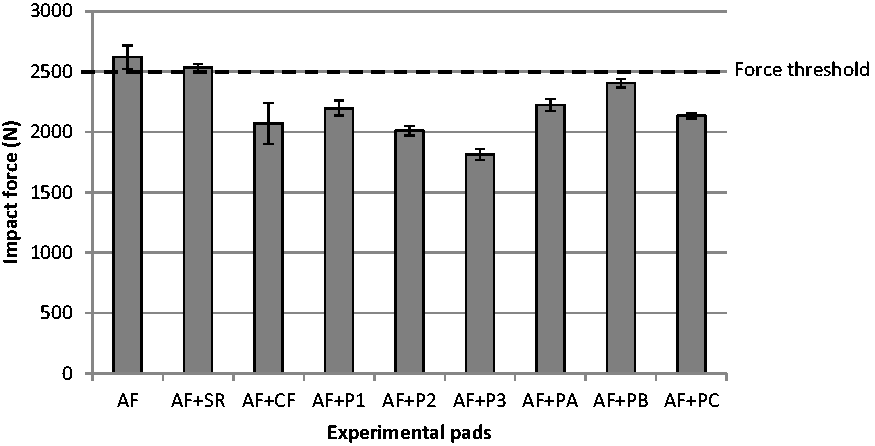
AF and AF+SR had almost the same impact force, 2553 N and 2534 N respectively; therefore, SR would not effectively protect the hip bone, since the impact force was above the force threshold (the typical hip bone strength of elderly women).
Knitted spacer fabrics treated with STF treatment 1 – P1, P2, and P3 – exhibited significant differences in impact forces (p < 0.05). Impact forces on P1, P2, and P3 pads decreased with increasing STF amount and were under the fracture force threshold, indicating that these pads can effectively protect the hip bones of elderly women. Impregnating the spacer fabric with STF changed the stiffness of the fabric significantly (Figure 4); however, the treated fabric retained reasonably good bendability (Figure 5).
Bending length knitted spacer fabric. Untreated and treated spacer fabric folded under metal bars exerting 10 N: (a) spacer fabric; (b) fabric from Pad B; (c) fabric from Pad 2; (d) all three fabrics, folded.

The treated fabrics could still be folded, but to different degrees, as the angle of the 10 N metal bar in Figure 5 shows.
Figure 6 presents the force attenuation capacity of untreated knitted spacer fabric and three treated knitted spacer fabrics, each in a three-layer assembly. The mean force attenuation capacities of the treated knitted spacer fabrics was significantly higher than that of untreated fabric (p < 0.05). Impregnation with greater amounts of STF progressively increased the force attenuation capacity of knitted spacer fabric. This was due to the increased amount of STF in the pad. At impact, this larger amount of STF contained in the fabric changed from semi-solid to solid phase, enabling the pad to attenuate more force.
Force attenuation of experimental pads normalized by volume.
Treatment 2 significantly reduced the mean impact force of the knitted spacer fabric, and significantly increased its force attenuation capacity (Figures 3 and 6). The pad with a larger amount of applied tetraisopropyl titanate (PB) had lower force attenuation capacity than PA. This was because the STF solidified and became rigid after the treated fabric was removed from the oven. In fact, during impact testing, the solidified STF cracked and was dislodged from the pad.
Figure 3 also shows that both PA and PC significantly reduced impact force relative to both AF and AF+SR, and to substantially below the 2.5 kN threshold. Figure 6 shows that PC, with 1.5 times as much STF per unit area as PA, had 1.3 times the force attenuation capacity. Further experiments with a greater number of STF concentrations are needed to characterize this relationship accurately.
Comparison between pads: treatment 1 and treatment 2
Knitted spacer fabric treated with STF and RTV silicone (treatment 1) transmitted different impact force to that of fabric treated with STF and tetraisopropyl titanate (treatment 2) (Figure 3). The differences are probably due to the effects of the tetraisopropyl titanate and the silicone. In treatment 1, the STF was used to impregnate the fabric first, and application of the RTV silicone followed, resulting in the latter covering the former. Therefore, when the impact occurred, the STF could change its phase without being “interrupted” by the silicone; in fact, it appeared that the RTV silicone protected the STF from cracking during impact. In treatment 2, the STF and the tetraisopropyl titanate were mixed together and applied to the fabric, making it likely that the tetraisopropyl titanate affected the STF’s ability to attenuate the impact force.
P3 had the highest force attenuation of all the experimental pads (Figure 6). This was most likely due to P3 having the greatest amount of STF. In terms of mass, treatment 2 produced a lighter pad than treatment 1 (Figure 7). This was because treatment 1 contained high mass RTV silicone as well as STF.
Mass of experimental pads normalized by volume.
Comparison with closed-cell foam
Figure 3 compares the impact force for treated knitted spacer fabrics and closed-cell foam, showing that all lie under the force threshold. Treated knitted spacer fabrics and closed-cell foam were capable of protecting the hip bone. The impact force on P3 was slightly but significantly less than that of the closed-cell foam (p < 0.05), meaning that P3 has higher force attenuation capacity than foam. This means that the treated fabric could be used as an alternative material for impact-protective pads. It is important, however, to consider other advantages of the treated spacer fabric as a pad, notably its open structure that will almost certainly improve the thermal comfort of the wearer.
Pads produced with treatment 2 had lower mass than closed-cell foam, which in turn had lower mass than pads manufactured with treatment 1 (Figure 7). This was because treatment 2 did not contain heavy RTV silicone.
Protective pads for elderly women must be as light as possible to avoid adding significant weight burdens. The pads made with treatment 2 fulfilled this requirement better than the pads produced with treatment 1; moreover, the mass of the pad with treatment 2 was lower than that of the closed-cell foam. However, the PI pad could still be used as a hip-protective pad due to its mass being only slightly different from that of closed-cell foam.
Influence of number of pad layers
To study the effect of pad layering, the impact test was performed on one, two, and three layers of P1. No more than three layers were used because the average thickness of commercially available hip pads is 16 mm, and four layers of P1 exceeded this figure. Figure 8 shows that impact forces on the treated knitted spacer fabric decreased as the number of layers increased. Layering the fabric also exponentially increased the force attenuation capacity (p < 0.05) (Figure 9), because as the number of layers increases, pad thickness and the amount of STF in the pad increase. The STF makes the spacer fabric stiffer, and when an impact occurs, the STF changes from semi-solid to solid phase, allowing pads with more layers to attenuate more force.
Mean impact force by number of layers of experimental padding. Mean force attenuation capacity by number of layers of experimental padding.

Experimental pad durability
To test the durability of the experimental pads, five specimens with three layers of P1 were tested 10 times at intervals of 20 min. Figure 10 presents the mean impact force on the P1 pads under an applied energy of 49 J (severe fall). The impact force on the P1 fabric was lower than the force threshold in all experimental specimens and repeats, with an average force of 2200 N. This result suggests that the experimental pads could prevent fractures even after several falls.
Mean impact force on P1 in 10 tests.
The STF impregnated into the fabric pad enabled the pad to protect even after several falls. STF, as a non-Newtonian fluid, has different viscosity depending on the force working on it; viscosity increases when the shear rate increases. In this study, the viscosity of STF increased when an impact occurred. After the dropper was removed from the pad and the pad was left for 20 min, the viscosity of the STF would have decreased, and the STF-treated pad was ready to receive another impact.
Conclusions
Impregnating knitted spacer fabric with STF increased its impact force attenuation significantly. Knitted spacer fabrics treated with STF exhibited significant differences in impact forces. Impact forces on pads made of treated fabrics decreased with increasing amount of impregnated STF and were under the fracture force threshold, indicating that these pads can protect the hip bones of elderly women in falls.
The force attenuation capacities of the treated knitted spacer fabrics were significantly higher than those of untreated fabric. Impregnation with larger volumes of STF progressively increased the force attenuation capacity of the knitted spacer fabric.
Knitted spacer fabric treated with treatments 1 and 2 transmitted different impact forces. Pads produced with treatment 2 had lower mass than pads made of closed-cell foam, while pads manufactured with treatment 1 had higher mass.
Impact forces on the treated knitted spacer fabric decreased as the number of layers increased. Layering the fabric also exponentially increased the force attenuation capacity.
Repeated testing demonstrated that STF-treated knitted spacer fabrics can effectively protect the hip even after multiple impacts. The impact forces on treated knitted spacer fabrics were similar to those of closed-cell foam. This means that the treated fabric is an alternative material for hip-protective pads. It is important, however, to consider other advantages of the treated spacer fabric as a pad material, in particular its open structure that is highly likely to provide better thermal comfort than closed materials. STF-treated knitted spacer fabrics are suitable for pads designed to protect the hip bones of elderly women.
Footnotes
Acknowledgements
Authors would like to thank Mr. Mac Ferguson and Mr. Martin Gregory of School of Fashion and Textiles, RMIT University for their advice and assistance in experimental set-up used in this research.
Declaration of conflicting interests
The authors declared no potential conflicts of interest with respect to the research, authorship, and/or publication of this article.
Funding
The authors received no financial support for the research, authorship, and/or publication of this article.