






Abstract
Wearable cushioning products that accommodate the body contours are challenging to fabricate. A method that controls the curvature of spacer fabric thus facilitating a high degree of conformity to the body is proposed here. Elastic yarn is inlaid into one of the surface layers and the feeding rate is controlled. The physical properties, curvature and compression properties of five samples with the same knitted structure but different feeding rate of the elastic yarn are evaluated. The results show a linear relationship between fabric curvature and feeding rate. Curved spacer fabric with a lower feeding rate has a greater degree of curvature and is thicker, but with a smaller fabric width, and lower weight and density. The compression stiffness and work of compression increase with curvature, which allows strategic cushioning in areas that are relatively more curved, such as the kneecaps. The proposed method can contribute to the development of protective garments.
Cushioning materials are widely used as a protective layer to shield and support the body from injury, particularly the bony prominences. Wearable cushioning products, such as orthopedic supports, prosthetic liners, knee and elbow protective paddings, sports bras and orthotic insoles are typically made of thermoplastic foams or polychloroprene rubber to absorb the impact forces.1 –3 The barrier materials, however, inhibit heat and moisture transport. A layer of knitted fabric as the cover to provide bidirectional stretch is therefore applied to enhance comfort and reduce skin abrasion. In order to accommodate the three-dimensional (3D) shape of body parts and provide adequate cushioning, the materials used are shaved, trimmed, sewn and laminated into the desired shape. However, the process of forming a shape that provides optimal fit to the body part is particularly challenging due to the complex contours of the body. Additional cushioning and/or support that conforms to different shapes with a customized fit may be prescribed by skilled practitioners. Molding is another commonly used method to fabricate thermoplastic materials into cushioning products with different shapes. 4 However, the molds have to be custom designed to fit the profile and size of different people. The molding temperature, pressure and dwell time in relation to the thermal behavior of the fabrication materials and contour designs must be carefully controlled. 5 Both methods consist of many engineering stages and specialized technologies, as well as substantial human resources, expensive machinery, and large factory spaces. Therefore, custom-made wearable cushioning products are generally costly so that only a small percentage of the population can afford them. Due to the poor air and water permeabilities of traditional cushioning materials, sweat and heat are trapped between the skin and the product. As a result, discomfort and low compliance rate with the use of the orthoses are frequently reported. 6 As such, an articulated design of material with adequate control of curvature is proposed in this study, which not only simplifies the production process, but also enhances the comfort of wearable cushioned products.
Spacer fabrics are a 3D knitted fabric that consists of two outer layers connected by a middle layer with spacer yarns. This sandwich structure provides a cushioning effect, 7 and the knitted structure has good air permeability, water vapour transmissibility and breathability.8 –13 Due to their higher ventilation and enhanced comfort, these fabrics have recently replaced thermoplastic materials in car seats,14,15 intimate apparel, 16 mattresses, 17 shoes, 18 and orthopedic inserts. 19 Many studies have been carried out to evaluate the effect of different materials and fabric structures on improving the cushioning and protective properties of both warp-knitted and weft-knitted spacer fabrics.20 –24 The properties of spacer fabrics can be tailored by modifying the type of yarns, knitting pattern and structure of each of the three layers to suit different end-uses.25 –32 The structure of weft-knitted spacer fabrics has a certain degree of elasticity. In addition, elastic yarn facilitates the stretchability of spacer fabrics, which is conducive to body movement, thus rendering spacer fabrics an excellent wearable cushioning material. However, similar to thermoplastic materials, the cut-and-sewn method or molding 33 is required to form the 3D shape. It is therefore important to offer a method that can be used easily to form a 3D spacer fabric to fit the contours of the human body.
The aim of this study was to create a spacer fabric in which its curvature can be readily modified by controlling the rate that elastic yarn is fed into the fabric. The physical and compression properties of the developed fabric samples were also evaluated. The outcomes of this study can be used to develop protective garments or guards that accommodate the contours of different body parts.
Experimental
Using elastic yarns to create curved spacer fabric
Spacer fabrics consist of two surface layers that are connected by spacer yarn in the middle layer to form the spacer structure. Therefore, modifications of the two surface layers could create an uneven surface for a fabric with curvature. The inlaying of elastic yarn into one of the surface layers of the spacer fabric is proposed here to create the desired curvature that can accommodate the contours of the body. Instead of using the same carrier and knitting the elastic yarn together with the yarn of the surface layer, the elastic yarn is used as the inlay yarn. A 10-gauge, whole garment weft-knitting machine (Shima Seiki SWG091N2, Japan) was used, which has a stepping motor controlled feed device that is used with the elastic yarn (Figure 1(a) and (b)). The feed device is designed to control the tension of the elastic yarn that is usually applied to the hem of socks and gloves to adjust the tightness of the opening. The device can help to control the feeding rate of the elastic inlay yarn (FRE) in terms of the percentage of the width of the knitting course. For example, a 50% FRE means the length of the elastic yarn supplied by the device is 50% of the length of the knitting course on the needle bed. With the feeding device, the length of the elastic yarn is inlaid into the surface courses and thus the curvature of the spacer fabric can be easily adjusted.

(a) Flat-bed weft-knitting machine with device to control feeding rate of elastic yarn; (b) device to control feeding rate; (c) structure of spacer fabric sample with inlaid elastic; and (d) yarn path diagram of fabric sample.
Preparation of curved fabric samples
The curved spacer fabrics are composed of three types of yarns (Table 1). The surface layers with a single jersey knitted structure used a 50 tex polyester drawn-textured yarn. The connecting yarn that forms the spacer layer was a 13.3 tex polyamide monofilament yarn with a diameter of 0.12 mm. The elastic yarn inlaid into one of the surface layers was a 40 tex spandex yarn. Four samples were produced with the same materials and knit structure but used different FRE. In order to create a curved spacer fabric, the inlaid elastic yarn should be shorter than the knitting width to provide contraction on one surface of the fabric. It is noted that when the FRE is lower than 30%, the elastic yarn is extended by more than 233% of its original length, leading to yarn breakage during the knitting process. Therefore, the FREs of the samples in this study were set at 30%, 50%, 70%, and 90%, respectively, that the effects of elastic yarn tensions on the resultant curvatures of the spacer fabric could be systematically analysed. An additional sample without inlaid elastic yarn was also prepared for reference. All five fabric samples were knitted with 80 wales and 100 courses on both surface layers. A linking distance of six needles was used for the monofilament yarn in a pattern of one front tuck stitch, two miss stitches, one back tuck stitch and two miss stitches. Also, six courses of monofilament yarns formed a repeat of the spacer structure. The elastic yarn was used to form the tuck and miss stitches with alternate needles, and inlaid into the knitted course of the technical back of the spacer fabric (Figure 1(c)). As shown in Figure 1(d), the inlaid elastic yarn and the surface yarn were moved together by a carriage forming tuck and knit loops, respectively, in one course. Two fabric specimens of each sample were made to ensure the consistency of the knitting. The fabric samples were then steamed and relaxed in standard conditions (temperature of 21°C and relative humidity of 65%) for one week.
Details of yarns composing the curved spacer fabric

Evaluation of fabric properties
The effect of the controlled variable, FRE, on the measured variables including fabric physical properties, fabric curvature, and compression properties were investigated. The physical properties of the fabric samples including their weight, thickness, density, and dimensions were measured. The sample thickness was measured at 49 kPa and five measurements were taken for each sample.
34
The weight and density of the sample size consisting of 80 wales and 100 courses were measured. The course and wale densities and surface area of each fabric sample with 80 wales and 100 courses were taken from its convex side. In order to measure and obtain the geometric information of the curved spacer fabric, a 3D scanning evaluation method was used, in which the samples were scanned with a light-emitting diode (LED) 3D scanner (Keyence VL-350, Japan) (Figure 2(a)). This 3D scanner can display a resolution of up to 0.1 μm and has an accuracy of ±10 µm. During the scanning process, the fabric sample was placed with its bottom edge which has the fabric wales perpendicular to the scanning platform and hence both surface layers of the fabric can be scanned (Figure 2(b)). Clays were used to fix the fabric sample onto the platform. The curvature of the fabric samples was observed from the convex surface on the 3D images. The osculating circle that best fits the fabric curvature was obtained from three points aligned on the same horizontal plane, with one point located along the centre wale, and two points on the left and right sides (Figure 2(c)). The radius of the osculating circle was measured. Five measurements were taken at different horizontal planes for each specimen. No measurement was taken 2 cm from the bottom where the shape of fabric could be affected by the presence of clays. The curvature (K) is defined as the reciprocal of the radius (r) of the osculating circle:

(a) Three-dimensional (3D) scanner; (b) setting of a curved fabric sample onto the 3D scanning platform; and (c) radii measurement of the osculating circles obtained from a 3D image.
The compression properties were measured based on the Kawabata evaluation system.34,35 A compression tester (Kato Tech Co., Ltd., KES-G5, Japan) with a flat circular indenter that has a surface area of 2 cm2 was used to evaluate the compression properties and measure the fabric thickness (Figure 3). The compression speed used was 12 mm/min up to a maximal compression stress of 49 kPa. Five measurements were taken from different locations of each specimen. The compression stress–strain relationship was subsequently investigated. The work of compression of the fabric samples with loading and unloading (WC and WC′) and the resilience of the fabric (RC) were calculated. WC and WC′ are the areas under the loading and unloading curves, respectively, and were calculated as follows:

Compression test on a curved spacer fabric.
RC is calculated as the area under the curve of the stress–strain unloading divided by the area under the loading curve as:
Statistical analysis
The effect of the independent variable, FRE, on the dependent variables, curvature, WC, WC′ and RC are analyzed by one-way analysis of variance (ANOVA). When the data violate the assumption of homogeneity of variance, the Brown–Forsythe F-test and the Games–Howell post hoc test for pairwise comparison were adopted. The relationship between the FRE and the curvature of spacer fabrics are analyzed by linear regression. The analyses were carried out by SPSS 21 (IBM Corp., Armonk, New York, USA). The significance level of the statistical analysis was set at 0.05.
Results and discussion
Effects on fabric dimensions
All of the samples were fabricated with the same number of courses and wales. Due to the use of elastic yarn as the inlay, the fabric surface area, thickness, weight and density differed. The effect of the FRE of the yarn as the inlay into one of the surface layers of spacer fabric on the fabric physical properties is presented in Figure 4.

Spacer fabric (a) length and surface area; (b) thickness; (c) weight; and (d) density with different amounts of elastic inlay fed into one side of the spacer fabric. 0 elastic inlay feeding indicates a sample without elastic inlay.
A comparison of the fabrics with elastic yarn that was inlaid at 90% FRE and those without inlay showed that they have a similar wale density, while the fabric with inlaid elastic yarn had a slightly lower course density, and hence a slightly larger surface area on the convex side. This is because the elastic yarn caused the fabric to contract along the course on one side, and at the same time, caused the fabric to stretch on the other side. The spacer fabric with inlaid elastic was also thicker than that without inlaid elastic.
Among the four samples with inlaid elastic, the length of the elastic yarn inserted into each course was the shortest at 30% FRE and the longest at 90% FRE. With a shorter inserted length, the elastic yarn stretches more during knitting. When the fabric was released from the knitting machine, the elastic yarn tended to recover back to its original length. A shorter length elastic yarn produced a fabric with higher contractional force along the course direction, which resulted in a higher course density, greater fabric thickness, and smaller surface area (Figure 4(a) and (b)). At the same time, the knitted loops becoming narrower in width would bring about a slight increase in the height, and increase the fabric length in the wale direction.
Figure 4(c) shows the weight of the fabric samples. As the number of courses and wales were the same for all of the fabric samples knitted at the same tension, the number of yarns used for the surface and connective layers were more or less the same. The change in fabric weight can be explained by the difference in the amount of elastic yarn in the fabric samples. On the other hand, the fabric density, as shown in Figure 4(d), decreased with the presence of the elastic inlay and the decrement increased at a reduced FRE. The elastic inlay not only changed the fabric dimensions, but also the space within the spacer layer. When the elastic yarn contracted the knitted stitches on one side of the fabric surface, the density and the inclination angle of the tuck stitches of the spacer yarn were affected. This can be microscopically observed from the cross-section of the samples (Figure 5). The thickness of the spacer layer increased at a lower FRE. As the spacer layer was composed of space and relatively lightweight monofilament yarn, the density of the thicker fabric fabricated by using a lower FRE was subsequently reduced.

Microscopic view of cross-section of spacer fabric samples with different rates of feeding: (a) 30%; (b) 50%; (c) 70%;(d) 90%; and (e) no inlay.
Effects on fabric curvature
The insertion of elastic inlay into one side of the spacer fabric created an uneven surface to form a curved fabric. It is important to understand the ways that this curvature, which is created by the amount of elastic yarn fed, can be controlled. The result of linear regression showed a significant linear relationship (P<0.05) between the fabric curvature (K) and the FRE. The regression equation is:
The coefficient of determination R2 is 0.967, which indicate a high strength of the linear regression relationship. Figure 6 shows that the spacer fabric sample constructed at a lower FRE has a greater curvature than that constructed at a higher FRE. By increasing the FRE from 30% to 90%, the fabric curvature linearly decreased from 0.043 mm−1 to 0.016 mm−1. A relatively larger standard deviation (SD) of the measurements was observed in the fabric with a FRE of 30%. This is because the sample made of 30% FRE was the curviest and a slight change in radius of the osculating circle measured from the 3D scans could result in a large difference in curvature calculated. Although the spacer fabric sample made of 30% FRE had a larger SD in the curvature measurement than other samples, there were significant differences in the curvatures between the samples made of different FRE (p<0.05). This shows that the desired amount of curvature of spacer fabric can be realized by using the proposed method here to control the amount of elastic yarn fed. Therefore, it is feasible to produce spacer fabric for protective gear that can accommodate the curvatures of the human body. With the use of the whole garment weft-knitting machine adopted in this study, which allows fully fashioned knitting, further development of protective padding with shapes that accommodate the contours and curvatures of different body parts such as the elbows and knees can be realized (Figure 7).

(a) Three-dimensional (3D) images of fabric samples constructed at different feeding rates; and (b) plotted relationship between curvature measurements and the amount of elastic inlay fed on one side of the fabric.

Illustration of potential application of curved spacer fabric (knee protector).
Effect on compression properties
Apart from influencing the geometric properties of fabric, another important property of spacer fabric is its compression which affects its energy absorption ability. The compression stress–strain curves of the fabric samples are presented in Figure 8. Similar to traditional spacer fabric and cushioning materials, the plotted compression curve of all of the samples consisted of four stages including the initial, linear elastic, plateau and densification stages, which are determined based on the slope of the curve.7,23,36 As the density and the spacer layer are affected by the elastic inlay, the compression behavior of the spacer fabric also showed a significant change.

Compression stress–strain curve of fabric samples.
The compression stress–strain curve of the fabric with elastic yarn fed at a rate of 90% was quite similar to that of the fabric without inlay. The former had a larger slope at the linear elastic stage and higher stress was required to reach the plateau stage. This result conformed to Yu et al., who showed that elastic yarn inlay can increase the compression stiffness of spacer fabric. 26
A relatively longer initial stage was found for the fabrics with elastic yard fed at a rate of 30%, 50%, and 70%. In the initial stage of compression, the stress applied not only compressed the loose fibres but also constrained and flattened the fabric. In the linear elastic stage, the slope of the curves was the lowest for fabric with elastic yarn fed at a rate of 90%, followed by that fed at a rate of 70%. The slope was the largest for fabric with elastic yarn fed at a rate of 50% and 30%. Moreover, the stress required to enter the plateau stage was found to be higher at lower FREs. This shows that fabric constructed with elastic yarn fed at a lower rate has a higher compression stiffness and can withstand higher levels of stress. The fabric dimensions were also smaller and the knitted stitches of the surface layer and the tuck stitches of the spacer yarns were more compact to each other. Higher supportive force was offered by the spacer yarns to hold the 3D fabric structure and help the spacer fabric to withstand a higher compression force.
The WC, WC′ and RC of the fabric samples are plotted in Figure 9. The results of ANOVA showed that there were significant differences (P<0.05) among the five samples on WC and WC′ while no significant difference (P > 0.05) can be observed on RC. From the pairwise comparison (Table 2), it can be observed that there is no significant difference on WC and WC′ of the fabrics with elastic yarn fed at rates of 30% and 50%, which were the highest. The WC and WC′ decreased when the FRE was increased. A higher WC indicates higher compressibility and energy absorption capability of the fabric. On the other hand, the RCs of the fabric samples were similar, which range from 0.35 to 0.39. Although the fabric samples showed a very different compression stress–strain curve, the resilience of the spacer fabric with and without inlay or with different FREs were similar. When a piece of flat spacer fabric or foam material bends or is molded into a shape to accommodate the body contours, the curved part will stretch, become thinner and lose some of its energy absorption capacity. Using elastic inlay on one of the surface layers of spacer fabric to form a curved shape not only maintains the energy absorption of the spacer fabric, but the compression stiffness and energy absorption capacity can also increase with the degree of curvature. This special feature can be useful when the curved spacer fabric is used for protective garments and padding to offer extra cushioning to the arms, legs, elbows, knees, or other body parts where additional protection is needed. With the use of the feeding device, the spacer fabric not only offered a curvature that accommodated the body contours, but also provided a progressive degree of cushioning or offered specific cushioning at strategic regions. For example, spacer fabric used as a knee protector at the patella region, which has a higher curvature, can be made by using the elastic inlay method here, which would have higher energy absorption capacity to absorb the impact forces and offer better protection.

(a) Work of compression of fabric with loading (WC); (b) work of compression of fabric with unloading (WC′); and(c) compression resilience (RC) of fabric samples.
Games–Howell pairwise comparison of the five fabric samples on WC, WC′ and RC
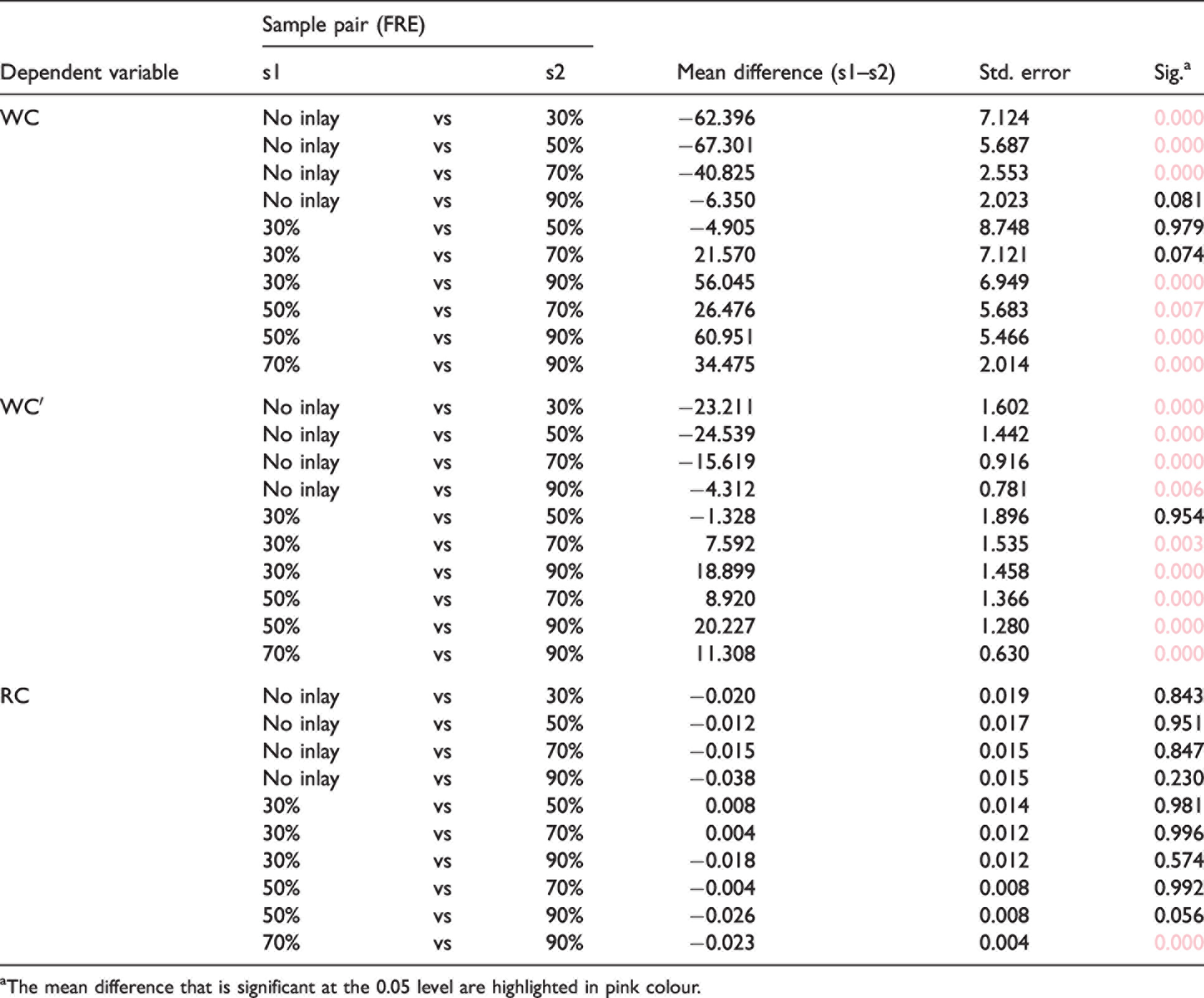
aThe mean difference that is significant at the 0.05 level are highlighted in pink colour.
This study was limited to the evaluation on the curvature and compression properties of the curved spacer fabrics made of the same materials and knitting structure. The cushioning effect of the curved spacer fabric when wearing on the human body was unexplored. With reference to the anatomical shape and protection requirements of the body region, a comparison of the fit, comfort and cushioning properties between the 3D shaped foam materials and the curved spacer fabric materials was suggested for future study to verify the advantages of the curved spacer fabric in real practice.
Conclusions
In this study, a method to create and control curved spacer fabric is proposed. Elastic yarn was inlaid into one of the surface layers of spacer fabric to create curvature, and the degree of curvature was controlled through the FRE by using a feeding device. The physical properties, curvature and compression properties of four fabric samples with the same knitted structure but different FRE (ranging from 30% to 90%) and a fabric without inlay were evaluated and the findings are as follows:
A significant linear relationship can be observed between the fabric curvature and the FRE. A lower FRE results in a shorter length of elastic yarn fed into each course, thus imparting a greater degree of curvature to the spacer fabric. The curvature given to the spacer fabric can be controlled and formulated based on the FRE. Apart from giving different curvature, the FRE also affects the physical properties of the spacer fabric. Curved spacer fabric with a lower FRE is thicker, but has a higher wale density, lower fabric weight and density. Elastic inlaid spacer fabric has higher compression stiffness and exhibits higher work of compression than flat spacer fabric without elastic inlay yarn. The elastic inlay helps to tighten surface knitting loops, resulting in a compact fabric structure. A lower FRE yields to a more curved and compact spacer fabric, which can withstand higher compression stress with a higher energy absorption capacity. The compression stiffness and work of compression increase with reduction of the FRE. However, the insertion of elastic inlay and changes in FRE do not show influence on the resilience of the spacer fabric.
The proposed inlaying method not only controls the degree of fabric curvature but also maintains or even enhances the energy absorption capacity of spacer fabric that can be used as a cushioning layer to accommodate the 3D contours of body parts. The outcomes of this study can contribute to the development of knitted spacer fabric for protective garments or cushioning padding.
Footnotes
Declaration of conflicting interests
The author(s) declare that there is no conflict of interest with respect to the research, authorship, and/or publication of this articles.
Funding
The author(s) disclosed receipt of the following financial support for the research, authorship, and/or publication of this article: This work was supported by JSPS KAKENHI under grant number JP20K14638.
