







Abstract
In this study, a novel AgFeO2 nanocomposite (NC) was synthesized using an eco-friendly green synthesis approach based on Portulaca oleracea leaf extract. The extract, rich in phenolic compounds, served as both a reducing and stabilizing agent in the formation of the NC. Comprehensive characterization of the AgFeO2 NC was conducted using ultraviolet–visible (UV–Vis) spectroscopy, Fourier transform infrared (FTIR) spectroscopy, X-ray diffraction (XRD) analysis, and scanning electron microscopy (SEM) techniques. The NC exhibited strong UV absorption at 306 nm and a direct optical bandgap of 3.0 eV, indicating its potential for photocatalytic applications. XRD analysis confirmed a hexagonal crystal structure with a crystallite size of ~22 nm, whereas SEM images revealed agglomerated nanoscale particles with an average size of 25–30 nm. The photocatalytic activity of AgFeO2 NC was evaluated for hydrogen generation via methanol-assisted water splitting, achieving a high yield of 757 µmol/g over 10 hours. In addition, the NC demonstrated high catalytic efficiency in CO2 methanation, with CO2 conversion reaching 85% at 330°C and considerable CH4 selectivity. These findings confirm that green-synthesized AgFeO2 NC are promising materials for sustainable energy production and environmental remediation.
As the global demand for energy continues to escalate, coupled with intensifying environmental concerns over greenhouse gas emissions and the accelerating effects of climate change, the development and rapid implementation of sustainable and renewable energy technologies has become an urgent global priority.1–3 The finite nature of fossil fuel reserves, combined with their contribution to atmospheric CO2 accumulation and associated ecological degradation, is driving a paradigm shift toward cleaner, more sustainable energy systems.4,5 Within this transition, hydrogen (H2) has emerged as a particularly promising energy carrier owing to its exceptionally high gravimetric energy density, widespread natural availability, and environmentally benign combustion product: water.6–8 Furthermore, hydrogen can be produced from a variety of renewable sources and, when integrated into advanced energy storage and conversion technologies, offers a versatile pathway for decarbonizing multiple sectors, including transportation, power generation, and industrial processes.
Photocatalytic water splitting represents an attractive pathway for solar-to-hydrogen conversion, offering a potentially carbon-neutral approach to fuel production.9–11 However, the practical application of this technology remains limited by intrinsic challenges, including narrow light absorption ranges of many semiconductor photocatalysts, rapid recombination of photogenerated electron–hole pairs, and slow surface redox kinetics.12–15 Strategies to overcome these limitations include ion doping, surface modification, heterojunction construction, and cocatalyst loading to improve charge separation and extend light absorption.14,16,17 For instance, heterostructures based on TiO2 combined with cocatalysts such as NiO, CoP, or Cu2O have demonstrated enhanced photocatalytic activity.18–21 In addition, incorporating plasmonic nanoparticles has proven effective in improving visible-light absorption and promoting photocatalytic efficiency.22–24
Beyond hydrogen generation, the catalytic conversion of carbon dioxide into value-added fuels represents another critical approach to mitigating climate change while producing usable chemical feedstocks.25,26 CO2 methanation, in particular, transforms CO2 and H2 into CH4 via the Sabatier reaction, a process that has gained increasing attention due to its potential for energy storage and carbon recycling.27–29 Supported catalysts, including Ni, Ru, and Pd nanoparticles deposited on oxides or metal–organic frameworks (MOFs), have shown promising CO2 methanation activity30–33; however, challenges such as limited catalyst stability, reduced selectivity, and deactivation under industrially relevant conditions persist.34,35 Developing multifunctional catalysts capable of efficiently driving both photocatalytic H2 evolution and CO2 conversion is, therefore, a pressing research priority.
In recent years, green or bio-inspired synthesis routes have emerged as sustainable alternatives to conventional chemical methods, utilizing plant-derived biomolecules as reducing and stabilizing agents.36–38 These methods eliminate toxic reagents, exploit renewable feedstocks, and enable the synthesis of nanoparticles and nanocomposites (NCs) with tunable size, morphology, and surface chemistry.39–41 Numerous studies have reported the biosynthesis of bimetallic or mixed metal oxides, such as ZnO–Fe3O4, CuO–NiO, and MgO/Ni, using plant extracts, demonstrating their applicability in photocatalysis, dye degradation, and antimicrobial applications.42–44 Iron-based oxides are particularly valued in photocatalysis and CO2 conversion due to their abundance, low cost, chemical stability, and variable oxidation states (Fe²+/Fe³+), which facilitate redox cycling and improve charge carrier separation.45,46 Meanwhile, silver and its compounds exhibit exceptional optical properties, including localized surface plasmon resonance (LSPR), which can enhance light absorption and promote hot electron generation, thereby boosting photocatalytic efficiency. 47 The integration of Ag with Fe-based oxides can create synergistic effects, combining the strong redox capacity of iron with the plasmonic and electron-trapping capabilities of silver, leading to improved activity in both hydrogen evolution and CO2 methanation. However, green-synthesized AgFeO2 NC remain largely unexplored, and no prior studies have systematically evaluated their potential as dual-function catalysts for both solar-driven hydrogen evolution and CO2 methanation.
While numerous studies report the green synthesis of nanoparticles, recent comprehensive reviews have emphasized that eco-friendly claims are not always validated by life-cycle assessments (LCAs), with some biosynthesis methods still involving significant energy, water, or reagent consumption. Accurate evaluation of the environmental sustainability of nanomaterial synthesis requires full LCA from raw material sourcing to end-of-life disposal. According to Osman et al. 48 and others, 49 the environmental profile of green-synthesized nanomaterials depends strongly on the biomass source, processing conditions, and postsynthesis treatments. In this context, Portulaca oleracea (purslane) is an ideal plant extract for green synthesis due to its high content of bioactive phytochemicals, particularly phenolic acids (e.g., gallic, caffeic, and ferulic acids), flavonoids (e.g., quercetin, kaempferol), and omega-3 fatty acids, which have documented antioxidant and electron-donating properties. 50 These compounds can act as natural reducing agents for metal ions and as capping/stabilizing agents, preventing nanoparticle aggregation and controlling growth kinetics.
This study presents a green synthesis of delafossite AgFeO2 NC using P. oleracea leaf extract as a renewable reducing and stabilizing agent. Rich in polyphenolic compounds with strong antioxidant and electron-donating capacity, P. oleracea enables the formation of well-defined nanostructures without toxic reagents. Incorporation of iron and silver within the AgFeO2 lattice combines the redox versatility of Fe with the plasmonic and electron-trapping properties of Ag, resulting in enhanced visible-light harvesting, efficient charge separation, and abundant catalytically active sites. Unlike previous plant-mediated syntheses, this approach yields a multifunctional catalyst capable of driving both photocatalytic hydrogen evolution and CO2 methanation with optimized optical, structural, and interfacial properties. Notably, these multifunctional properties make the AgFeO2 NC particularly suitable for integration into textile-based systems. The NC can be incorporated into fibrous substrates through various textile-compatible techniques (e.g., dip-coating, electrospinning, or screen printing) to create: (1) photocatalytic textiles for air/water purification, (2) catalytic fabrics for CO2 conversion systems, and (3) antimicrobial protective textiles, all while maintaining the environmental benefits of the green synthesis approach. This textile integration potential offers scalable and flexible solutions for energy and environmental applications, bridging advanced nanomaterials with practical textile engineering. The simultaneous integration of dual catalytic functions with an eco-friendly, low-energy fabrication route underscores the novelty and potential effect of this work in renewable energy conversion and carbon valorization.
Materials and methods
Material
P. oleracea leaves were collected in El Oued, Algeria, with a preference for specimens acquired under specific environmental conditions to ensure ecological representativeness. High-purity chemicals, including iron(III) nitrate nonahydrate (Fe(NO3)3·9H2O, ACS reagent grade, purity >99.98%), silver nitrate (AgNO3, ACS reagent grade, purity >99.98%), antimony nitrate (Sb(NO3)3, reagent grade, purity >99.98%), and methanol (CH3OH, HPLC grade, purity 96.0%) were purchased from Sigma-Aldrich. All aqueous solutions were prepared using distilled and deionized water (resistivity of 18.2 MΩ·cm) to minimize potential contamination.
Preparation of the extract
P. oleracea leaves were first thoroughly rinsed with distilled water to remove dust, surface impurities, and other exogenous materials. The cleaned leaves were then air-dried at room temperature (25 ± 2°C) for four days in the absence of direct sunlight to preserve their phytochemical content. Subsequently, 10 g of the dried leaves were immersed in 100 ml of distilled water and subjected to magnetic stirring at room temperature (150 rpm) for 24 h to facilitate the extraction of active biomolecules. 51 The resulting mixture was filtered through Whatman No. 1 filter paper, and the clear aqueous extract was collected and stored at 4°C for subsequent use in the synthesis of AgFeO2 NC.
Synthesis of AgFeO2 NC
To synthesize AgFeO2 NC, a green synthesis method was employed using P. oleracea leaf extract.52,53 Initially, 4.84 g of Fe(NO3)3·9H2O and 3.4 g of AgNO3 were dissolved in 900 ml of deionized water to obtain a homogeneous metal precursor solution. Separately, 10 g of washed and air-dried P. oleracea leaves were soaked in 100 ml of deionized water and stirred for 24 h at room temperature. The mixture was filtered to obtain the aqueous extract. This extract (100 ml) was added dropwise to the metal salt solution under constant stirring at 150 rpm. The reaction was carried out at 80°C for 2.5 hours in a dark environment to prevent unwanted photoactivation. During this period, the phenolic compounds in the extract reduced Ag+ and Fe³+ ions to form the AgFeO2 NC. After completion, the brownish-black precipitate formed was separated by centrifugation at 3000 rpm for 15 min. The precipitate was washed three times with deionized water to remove residual organic matter and unreacted ions.54,55 The washed sample was dried at 100°C for 24 h in an oven, then annealed at 500°C for 3 h in a muffle furnace to enhance crystallinity and phase purity.56,57 The resulting AgFeO2 NC powder was stored in airtight containers for characterization and testing.
Characterizations of AgFeO2 NCs
The structural, optical, and morphological properties of the synthesized AgFeO2 NCs were thoroughly characterized using advanced analytical techniques. X-ray diffraction (XRD) analysis was performed using a Proto Manufacturing Company bench-top diffractometer with Cu Kα radiation (λ = 1.5418 Å) operating at 40 kV and 30 mA. Diffraction patterns were recorded over a 2θ range of 10–80° with a step size of 0.02°. The crystallite size was determined using the Scherrer equation 58 :

where k is the form factor (0.9), λ is the X-ray wavelength (1.5418 Å for Cu Kα), β is the full width at half maximum (FWHM) of the diffraction peak, and θ is the Bragg angle. Optical properties were investigated by ultraviolet (UV)–visible spectroscopy (SECOMAM model 9600 spectrophotometer) across the 200–800 nm wavelength range. Fourier-transform infrared (FTIR) spectroscopy (Thermo Fisher Scientific Nicolet iS5) was employed to identify surface functional groups in the 400–4000 cm–¹ range. Morphological examination and grain size analysis were conducted using scanning electron microscopy (SEM, TESCAN VEGA3) operated at 20 kV accelerating voltage with a 10 mm working distance.59,60
Photocatalytic hydrogen production
The photocatalytic activity of the AgFeO2 NC for the production of hydrogen from aqueous solutions was examined in a controlled gaseous environment at room temperature. Ethanol was used as a sacrificial agent to improve efficiency by facilitating charge separation and arranging the photogenerated electrons, thereby enhancing the H2 yield. The experimental protocol involved dispersing 20 mg of photocatalyst in a reaction mixture of 10 ml methanol and 40 ml water in a tricolumn flask. Irradiation was tested by alternating a 200-W Xe arc lamp with a light intensity of 100 mW/cm2, during which hydrogen production was periodically quantified by gas chromatography. 61 This rigorous methodology enabled precise characterization of photocatalytic performance under reproducible conditions.
Methanation of CO2
An evaluation of the catalytic properties of AgFeO2 nanocatalysts was carried out in a sophisticated reaction system. This included a fixed-bed microreactor operating at high pressures. For all the tests, exactly 0.6 g of the catalyst was carefully compressed to form a pellet, which was then loaded into the reactor to ensure uniform distribution of the catalytic material. A critical step in the experimental protocol is the activation of the catalyst. To this end, the catalyst was reduced in situ at 220°C for 4 h at a H2 flow rate of 50 ml/min to achieve the active sites in their optimum metallic form. In addition, as soon as activation was complete, the reaction conditions were maintained: reaction at 280°C under hydrogen at 5 MPa, to maintain the integrity of the catalytic sites. The composition of the reactive mixture, 20% CO2, 70% H2, and 10% N2 (as an internal tracer), was introduced into each reactor at a flow rate of 120 ml/min to obtain an hourly space velocity of 20,000 h–1, corresponding to conditions representative of industrial applications while maintaining measurable kinetics.
Quantitative analysis of the off-gases was carried out in real time using a high-precision gas chromatograph (GC-2010 Plus, Shimadzu) equipped with an advanced detection system. The analytical configuration included:
a Carboxen™ 1006 Plot column coupled to a thermal conductivity detector (TCD) for the simultaneous quantification of the major gaseous species (N2, CO2, CO, H2, and CH4);
an Rtx® R-Wax column combined with a flame ionization detector (FID) for the specific and sensitive detection of methane and other C1 compounds.
The strategic use of N2 as an inert gas played a fundamental role in the analysis of the results. Its chemical stability under the reaction conditions made it possible to establish a rigorous mass balance between the reactor inlet and outlet. The methodology employed, combining controlled reaction conditions and sophisticated chromatographic analysis, provided reliable and reproducible data for a complete assessment of the nanocatalyst’s performance. This approach facilitated the precise calculation of two key catalytic performance parameters: CO2 conversion (X) and CH4 selectivity (S), determined using validated and referenced mathematical relationships 62 :

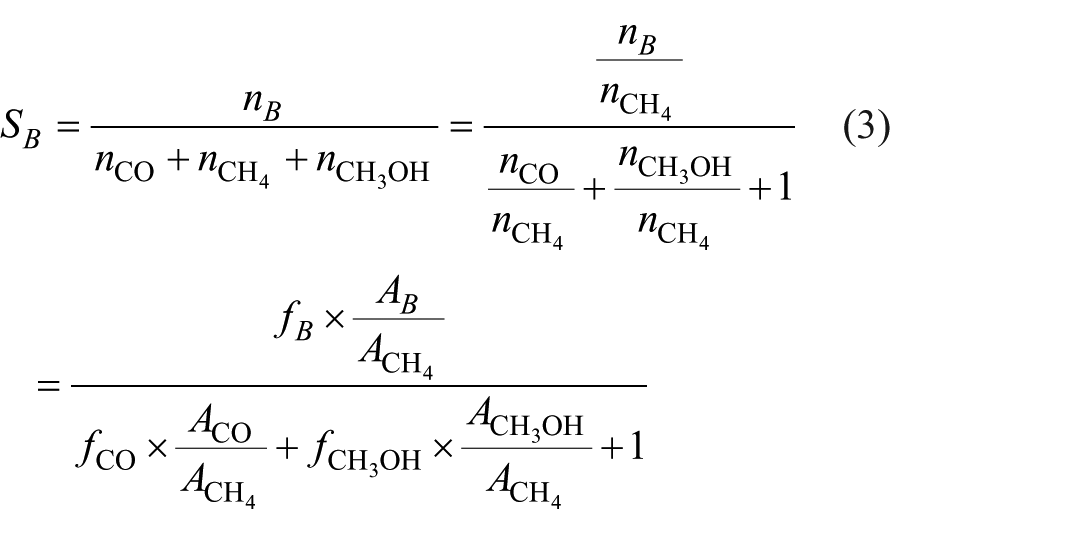
The quantitative analysis is based on mathematical relationships incorporating: X (CO2 conversion rate), A (chromatographic peak areas, with indices T for outflow and 0 for inflow), B (designating the different gaseous species produced), and S (expressing selectivity toward a given product). Standardized correction factors (f) were systematically applied to each gas component relative to methane (CH4) as a reference. 63
Results and discussion
UV–visible analysis
The optical properties of AgFeO2 NC were investigated using UV–Vis spectroscopy to evaluate their light-harvesting behavior and electronic structure. The absorption spectrum (Figure 1a) exhibits a pronounced peak at 306 nm, characteristic of charge-transfer transitions from the valence band (VB) to the conduction band (CB) within the AgFeO2 lattice. The intense absorption in this region indicates a high density of electronic states available for excitation, which is favorable for initiating photocatalytic redox reactions.
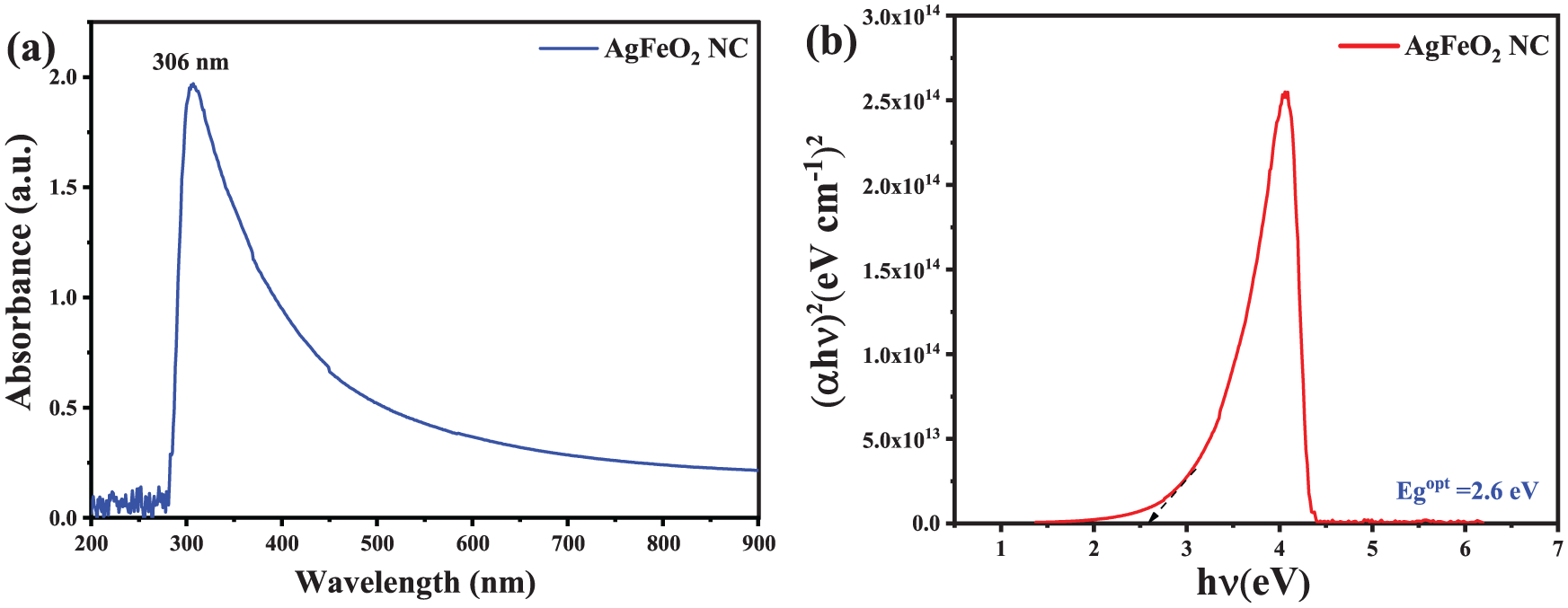
Optical properties of AgFeO2 NC: (a) UV–Vis absorption spectrum and (b) direct optical bandgap determination.
The optical bandgap energy (

where
The moderate bandgap is consistent with the electronic configuration of delafossite-type AgFeO2, in which hybridization between O 2p and Fe 3d orbitals in the VB, 65 together with Ag 4d and Fe 3d states in the CB 66 , facilitates interband transitions. The presence of Ag contributes to enhanced optical absorption via LSPR effects, which can intensify the local electromagnetic field and promote hot-electron injection into the CB, thereby accelerating photocatalytic reactions. 47 The combination of these factors suggests that AgFeO2 NC can generate sufficient photogenerated charge carriers with extended lifetimes, a critical requirement for efficient hydrogen evolution and CO2 methanation. These optical characteristics confirm that the green-synthesized AgFeO2 NC possesses the band structure and photon absorption capability necessary for driving photochemical transformations under solar irradiation.
FTIR analysis
The FTIR spectrum of P. oleracea L. leaf extract in Figure 2(a) revealed characteristic peaks of phenolic compounds as secondary metabolites acting as reducing and stabilizing agents.67,68 A broad peak at 3370 cm–¹ corresponds to O–H stretching vibrations from hydroxyl groups in phenolic compounds such as flavonoids and phenolic acids, essential for reducing metal ions.69,70 The peak at 1626 cm–¹ is attributed to C=C stretching vibrations from aromatic rings, typical of polyphenols. 71 The peak at 1450 cm–¹ is associated with C–O stretching or deformation, likely from phenolic –OH or aromatic ether linkages. 72 The peak at 1331 cm–¹ indicates C–O deformation, supporting phenolic moieties. 73 Peaks at 1157 and 1026 cm–¹ correspond to C–O stretching in phenolic alcohols or carboxylic acids, 74 such as gallic acid or catechins, aiding stabilization through surface coordination. The peak at 2917 cm–¹ is due to C–H stretching from methyl groups, 75 possibly from associated organic compounds. The peak at 591 cm–¹ is likely aromatic C–H bending, reinforcing the aromatic nature of phenolics. These phenolic compounds enable electron transfer to metal ions (e.g., Ag+ and Fe³+) for AgFeO2 NC synthesis and stabilize the NCs by preventing aggregation. The FTIR spectrum of AgFeO2 NC in Figure 2(a) displayed distinct absorption bands. The peak at 1651 cm–¹ is attributed to C=C or C–O stretching, 76 likely from residual organic compounds from the leaf extract. Peaks at 1387 and 1338 cm–¹ indicate C–O stretching or deformation, 77 suggesting interactions between organic residues and the NC surface. The peak at 1053 cm–¹ corresponds to C–O stretching, potentially from stabilized organic groups. The peak at 788 cm–¹ is likely due to metal–oxygen (M–O) stretching vibrations (Ag–O or Fe–O), confirming the NC structure.
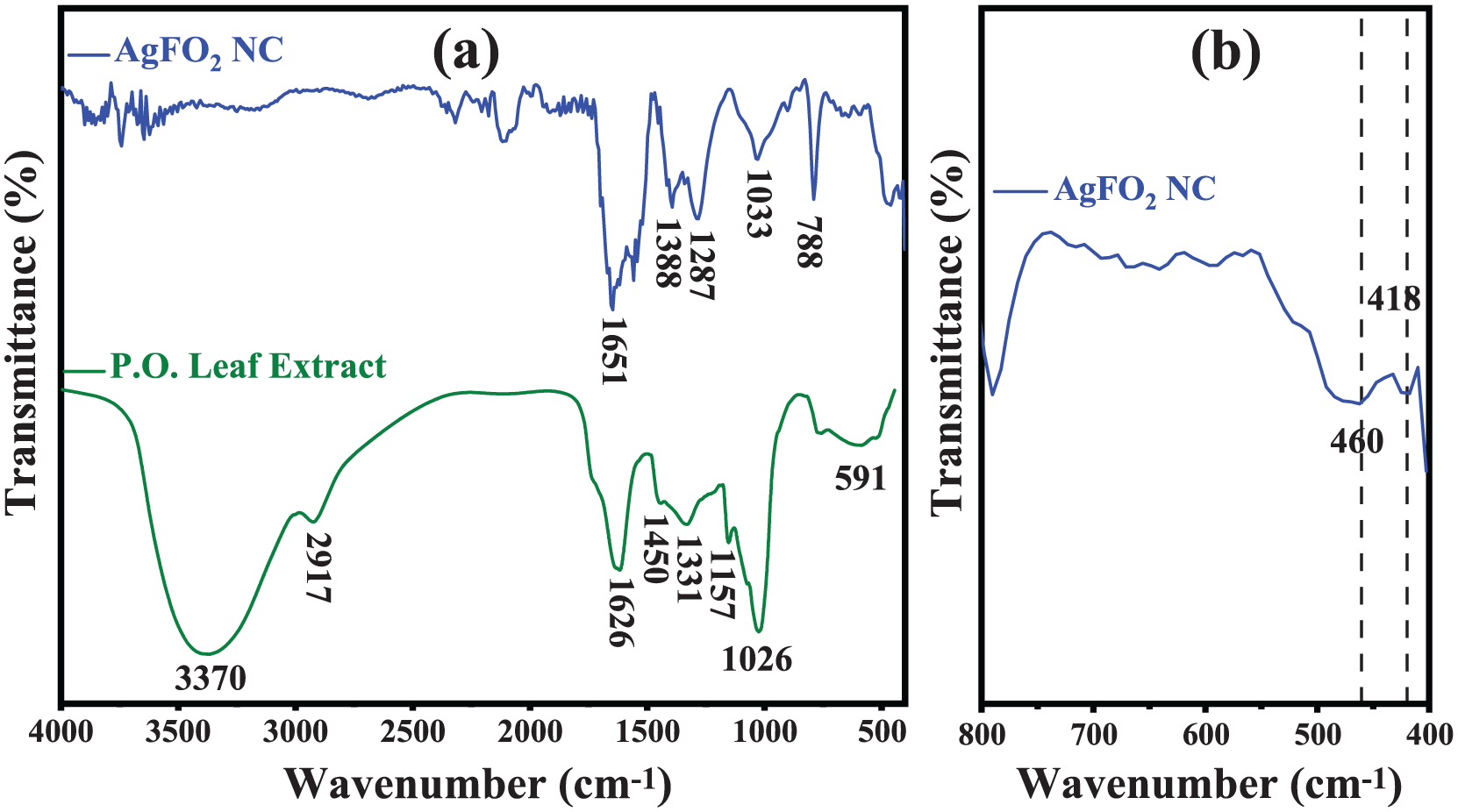
FTIR spectrum of (a) synthesized AgFeO2 NC and P. oleracea leaf extract from 4000 to 400 cm-1 and (b) enlarged view range (400–800 cm-1) of synthesized α-AgFeO2 NC.
The enlarged FTIR spectrum of AgFeO2 NCs in the 400–800 cm–¹ region in Figure 2(b) highlighted characteristic peaks. Peaks at 460 and 418 cm–¹ are attributed to Ag–O or Fe–O stretching vibrations, verifying the presence of M–O bonds in the AgFeO2 NC structure.78,79 The analysis confirms the role of phenolic compounds in the P. oleracea leaf extract as reducing and stabilizing agents, with Figure 2(a) showing organic and M–O interactions and Figure 2(b) validating the NC’s structural integrity through M–O bonds. 80
XRD analysis
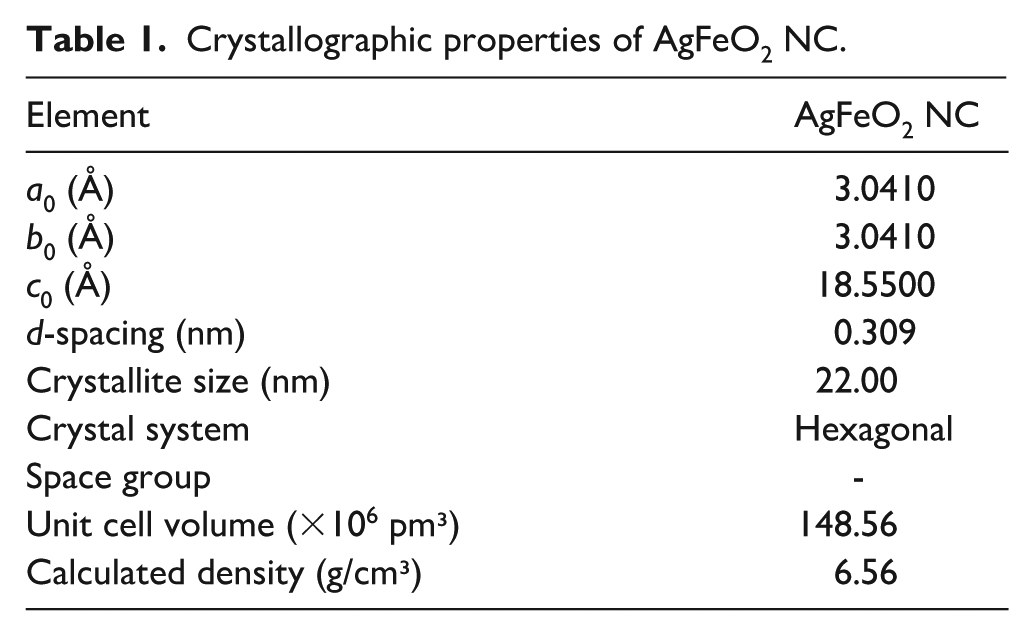
The phase purity and crystallographic properties of AgFeO2 NC were investigated through XRD analysis, as illustrated in Figure 3 and listed in Table 1. The XRD pattern reveals a series of well-defined peaks, confirming the crystalline nature of the AgFeO2 NC. Specifically, the diffraction signals occur at 2θ values of 14.30°, 28.87°, 34.37°, 35.42°, 39.31°, 43.87°, 48.68°, 52.49°, 59.68°, 61.12°, 68.83°, 72.48°, and 74.96°, corresponding to the (003), (006), (101), (102), (104), (009), (107), (108), (00 12), (111), (116), (202), and (204) crystallographic planes, respectively. These peak positions are in excellent agreement with the reference data for AgFeO2 (JCPDS Card No. 00-018-1175), affirming the formation of a highly ordered crystalline lattice for this phase.81,82 Analysis of the high-intensity peaks at 2θ = 28.87°, 34.37°, and 35.42° enabled the determination of the average crystallite size, calculated to be 21.32 ± 3.12 nm. This confirms the nanoscale dimensions and well-defined morphology of the AgFeO2 NC. The absence of significant peak overlap underscores the structural clarity and phase purity of the NC, highlighting the efficacy of the synthesis method. These characteristics position AgFeO2 NC as a promising material for advanced applications in catalysis, sensing, and energy storage.
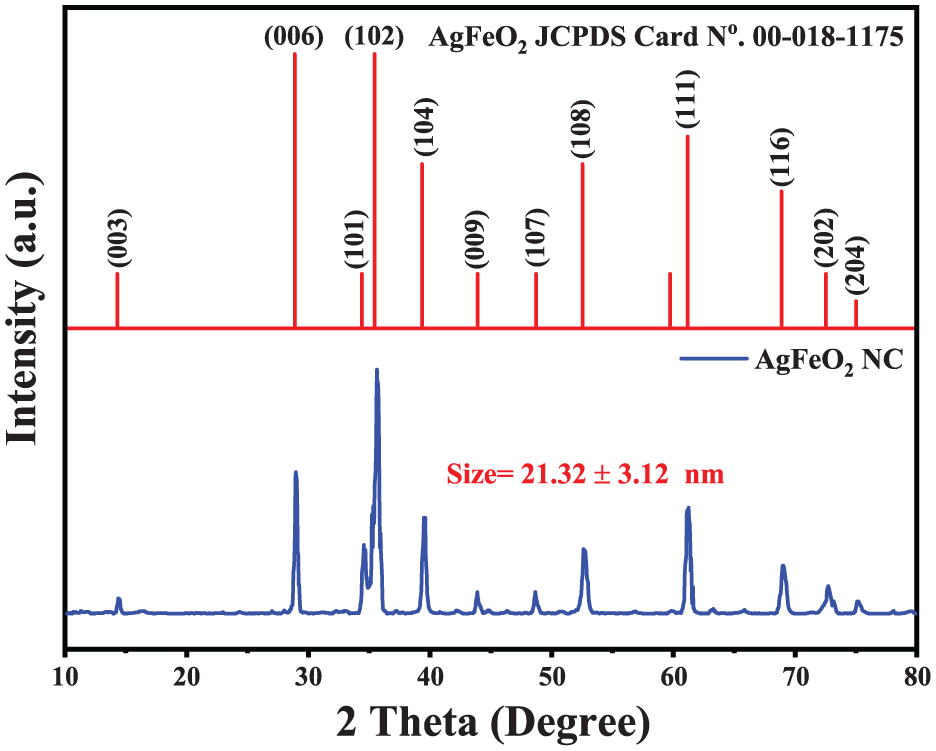
XRD patterns of AgFeO2 NC and standard XRD pattern of AgFeO2 JCPDS Card No. 00-018-1175.
Crystallographic properties of AgFeO2 NC.
SEM analysis
The morphological and structural characteristics of AgFeO2 NC were investigated using SEM, providing detailed insights into their particle morphology and size distribution. The results are presented in Figure 4. Figure 4(a) displays the SEM image of AgFeO2 NC, revealing agglomerated clusters of NC particles with irregular morphology. The image, captured with a scale bar of 1 μm, confirms the nanoscale nature of the particles and highlights their clustered arrangement, indicative of the synthesis process. Figure 4(b) presents the particle size distribution of AgFeO2 nanoparticles, illustrated through a histogram. The particle diameters range from 15 to 45 nm, with an average size of approximately 25–30 nm. The distribution suggests a relatively narrow size range, reflecting the consistency of the synthesis method in producing nanoparticles with uniform dimensions. The SEM analysis confirms the nanostructured morphology and size uniformity of AgFeO2 NC, with agglomerated, irregularly shaped particles and an average diameter of 25–30 nm. These characteristics are crucial for the material’s potential applications, ensuring consistent functional properties.
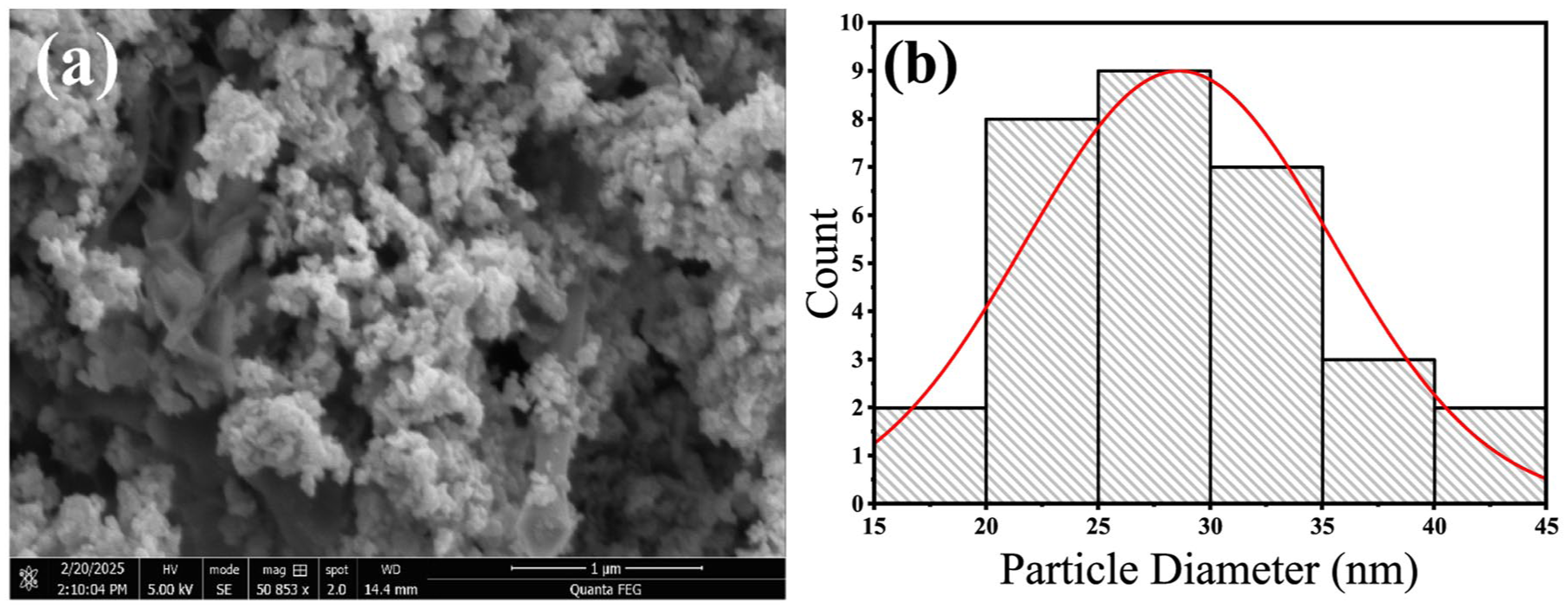
(a) SEM images of AgFeO2 NC. (b) Particle size distribution of AgFeO2 NC.
Photocatalytic H2 production
The results of photocatalytic hydrogen synthesis illustrate the remarkable efficiency of the AgFeO2 NC (Figure 5). The gradual increase in H2 production, from 16 µmol g–¹ at the initial rate to a total amount of 757 µmol g–¹ after 10 h of reaction attests to the continuous catalytic contribution of the material. This improved yield is attributed to the surface characteristics of AgFeO2, which facilitate uniform dispersion of active sites and increase the available reaction zone. In addition to these morphological factors, the coordination environment of Ag–O and Fe–O within the delafossite lattice plays a critical role in modulating the electronic structure, stabilizing catalytically active sites, and lowering the activation barriers for interfacial redox reactions. Such coordination-driven enhancements are increasingly recognized as key design principles in low-energy photocatalysis and thermocatalysis, as detailed in recent literature. 83 Later studies84,85 revealed that this NC also promotes photo-induced dissociation of reactants, explaining the high photocatalytic efficiency.
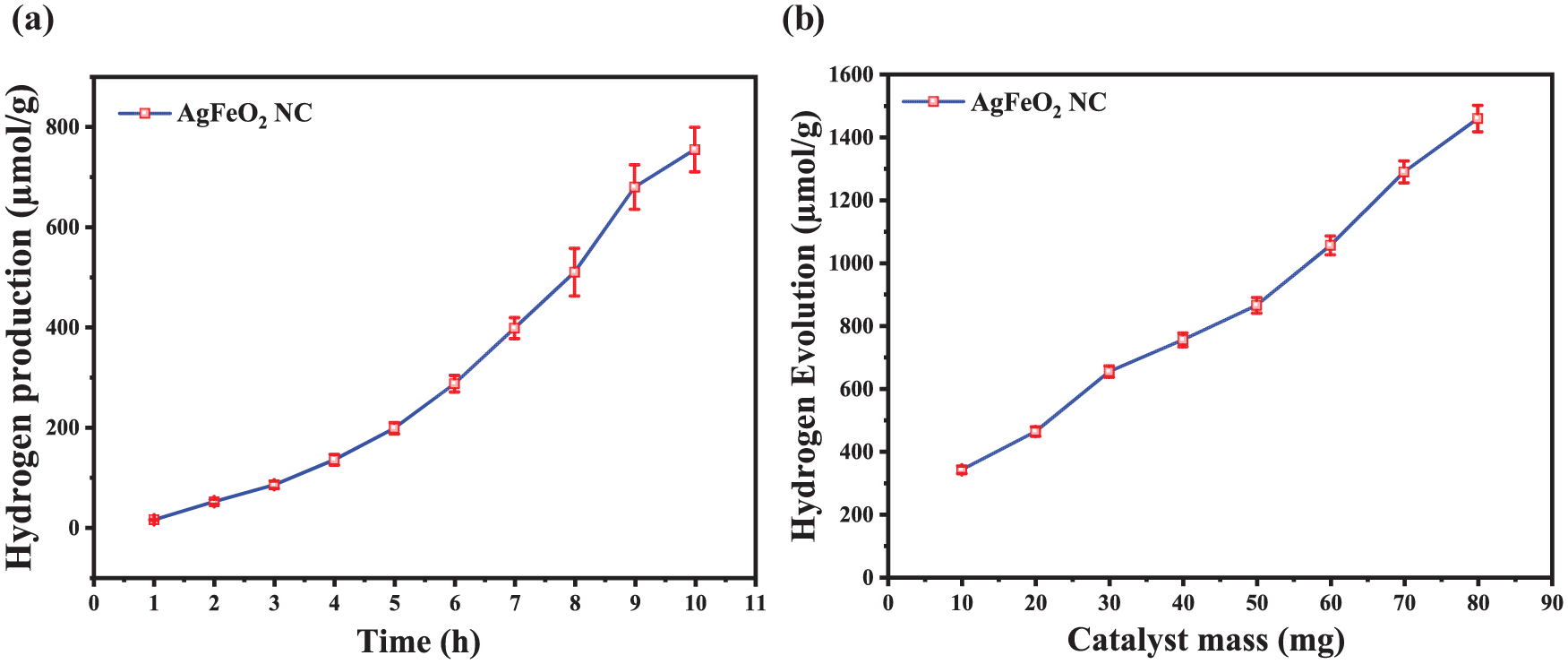
Comparative analysis of H2 evolution employing AgFeO2 NC photocatalysts over: (a) time effect; and (b) mass effect.
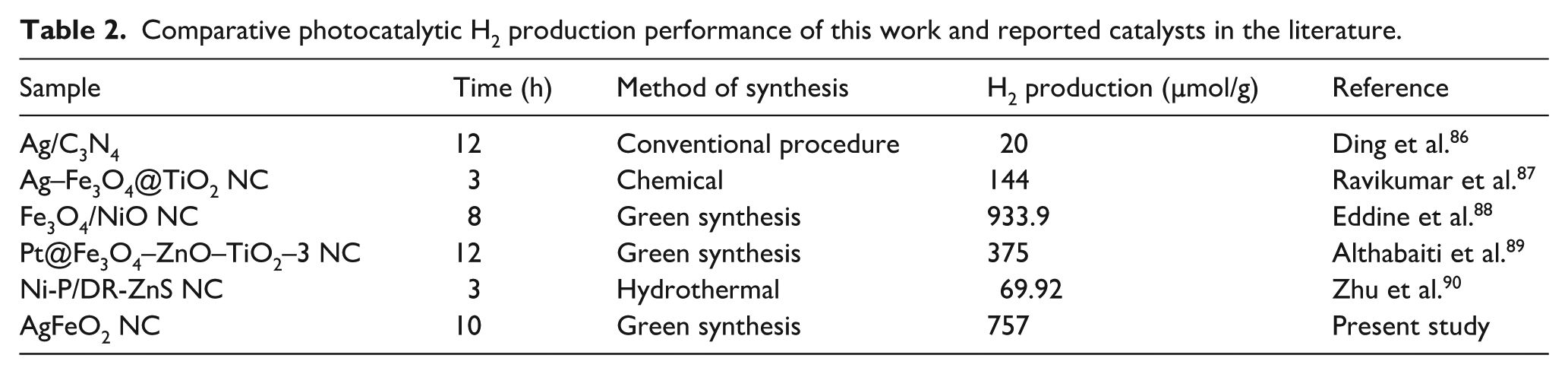
To contextualize the photocatalytic H2 production performance of the synthesized AgFeO2 NC, a comparison with previously reported catalysts is presented in Table 2. The data highlight that the present material exhibits competitive activity relative to both conventionally synthesized and green-synthesized systems under varying reaction conditions.
Comparative photocatalytic H2 production performance of this work and reported catalysts in the literature.
The hypothetical mechanism for the photocatalytic generation of H2 comprises a sequence of key stages. Under irradiation, photogenerated holes on the semiconductor surface facilitate the irreversible oxidation of methanol or water. The coordination geometry of surface Fe and Ag sites influences the energy levels of the VB and CB, enhancing charge separation and promoting efficient interaction with reactant molecules. The overall photoexcitation process is summarized as

Photogenerated holes








Methanol plays a dual role: it acts as an efficient scavenger of photogenerated holes and as a hydrogen source at the AgFeO2 interface. This process enables the final conversion of protons (H+) into molecular hydrogen by recombination with photogenerated electrons:

Thus, the observed high H2 yield is not solely a function of plasmonic–redox synergy between Ag and Fe, but also of deliberate coordination-driven tuning of the active site environment, which facilitates both electron–hole separation and energetically favorable reaction pathways. Although the current energy balance indicates higher input than output, targeted optimization of the coordination environment could further enhance solar-to-hydrogen conversion efficiency, enabling more viable large-scale applications (Figure 6).
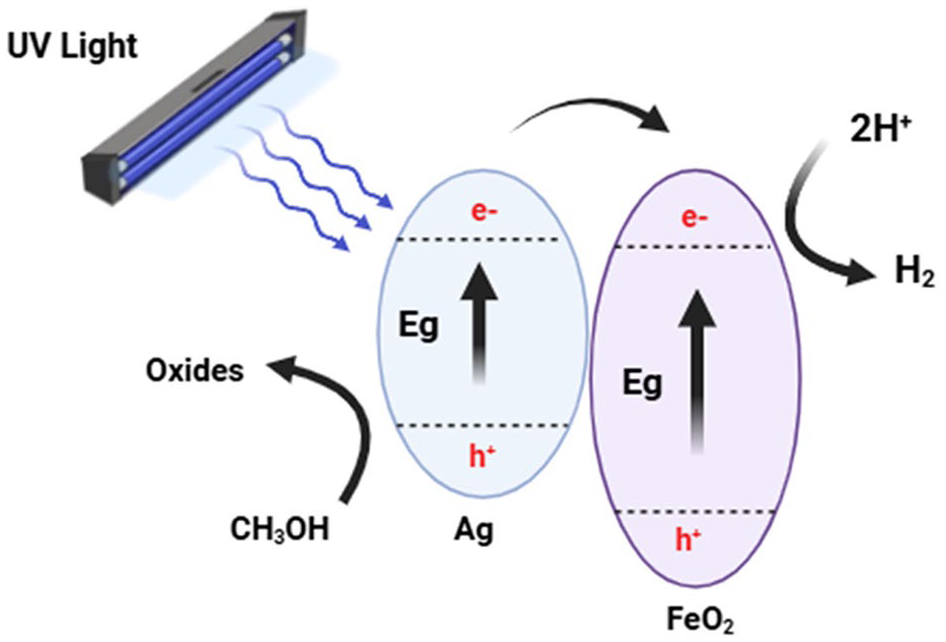
Schematic diagram describing the mechanism of photocatalytic H2 generation by the AgFeO2 NC.
Catalytic CO2 methanation
A detailed assessment of the catalytic performance of the AgFeO2 NC in CO2 methanation was conducted, and the results are presented in Figure 7. The temperature-dependent activity profile clearly demonstrates the thermally activated nature of the methanation process over AgFeO2. At 120°C, the catalyst exhibited a modest CO2 conversion of 12.5%, indicating limited activity at low thermal input. Upon increasing the reaction temperature, CO2 conversion rose sharply, reaching a maximum of 85% at 330°C. This substantial improvement suggests that elevated temperatures promote both CO2 activation and hydrogenation kinetics, consistent with the endothermic barrier associated with CO2 dissociation. CH4 selectivity followed a similar trend, increasing under more favorable thermo-energetic conditions. The highest CH4 selectivity was observed at 330°C, highlighting an optimal balance between CO2 activation, hydrogenation, and suppression of competing side reactions such as the reverse water–gas shift (RWGS). Above this temperature, selectivity decreased slightly, likely due to enhanced RWGS activity leading to CO formation at the expense of CH4.
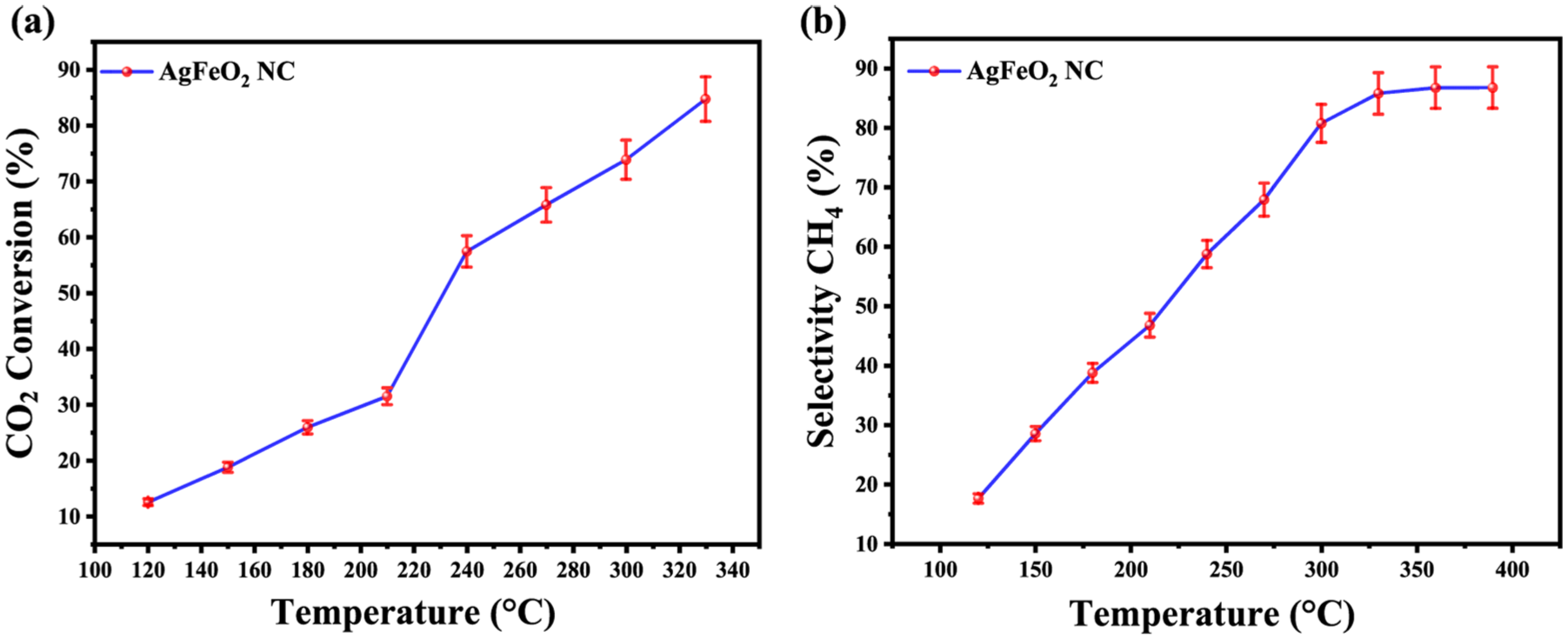
Temperature variations in relation to (a) CO2 conversion and (b) CH4 selectivity during CO2 methanation over AgFeO2 NC.
The enhanced CH4 selectivity of AgFeO2 at 330°C can be attributed to the synergistic functionalities of its dual-metal oxide structure. The Fe³+/Fe²+ redox couple facilitates CO2 activation through reversible oxygen vacancy formation, 92 whereas Ag nanoparticles contribute to electron trapping and LSPR, which can promote H2 dissociation even under thermal catalytic conditions. 93 The intimate Ag–Fe oxide interface provides active sites that favor sequential hydrogenation of CO intermediates to CH4 rather than their desorption as CO, thereby improving selectivity. In addition, the moderate basicity of the AgFeO2 surface, arising from surface oxygen anions, likely enhances CO2 adsorption in a bent configuration, which is more reactive toward hydrogenation.
The methanation process proceeds via the following general sequence of steps on the AgFeO2 catalytic surface44,94:




In this mechanism, CO2 first adsorbs and is activated at Fe³+/Fe²+ redox sites, forming CO and O surface intermediates (14). Simultaneously, H2 is dissociated, facilitated by Ag sites with high electron density, into surface-bound hydrogen atoms (H*) (15). 95 The CO* species undergo stepwise hydrogenation (16) to yield CH4, 94 with the final overall reaction represented in (17). The Ag–Fe interface plays a pivotal role in stabilizing CO* intermediates long enough for full hydrogenation to CH4 rather than premature CO desorption, thereby enhancing CH4 selectivity. The trends observed confirm that precise thermal control and synergistic active site engineering are critical for optimizing CO2 conversion and CH4 selectivity, underscoring the potential of green-synthesized AgFeO2 NC for efficient power-to-methane applications.
The stoichiometric Ag:Fe:O ratio (1:1:2) in the AgFeO2 NC plays a critical role in its photocatalytic performance. The hexagonal crystal structure, confirmed by XRD, and the direct optical bandgap of 3.0 eV, as determined by UV–Vis spectroscopy, are optimized by this ratio, facilitating efficient charge separation and increased availability of catalytic active sites. These properties contribute to the high photocatalytic hydrogen yield of 757 µmol/g over 10 h via methanol-assisted water splitting and the 85% CO2 conversion efficiency with considerable CH4 selectivity at 330°C during CO2 methanation. Deviations from the stoichiometric ratio could introduce lattice defects or secondary phases, potentially reducing the electronic and catalytic efficiency of the NC. The precise stoichiometry achieved through the green synthesis approach thus enhances the material’s suitability for sustainable energy production and environmental remediation.
Conclusion
This study successfully achieved the green synthesis of delafossite AgFeO2 NCs using P. oleracea leaf extract as a renewable reducing and stabilizing agent. Comprehensive characterization confirmed a well-crystallized hexagonal structure (crystallite size ~22 nm), strong UV absorption at 306 nm with a direct bandgap of 3.0 eV, and nanoscale particle morphology (average 25–30 nm) with uniform distribution. The NC exhibited high photocatalytic activity for methanol-assisted water splitting, producing 757 µmol H2/g within 10 h, and demonstrated notable CO2 methanation performance with 85 % CO2 conversion and considerable CH4 selectivity at 330 °C. These results underscore the synergistic role of silver plasmonic effects and iron redox properties in enhancing charge separation, light harvesting, and catalytic efficiency. From a techno-environmental standpoint, the synthesis operates under mild conditions, consumes low energy, minimizes precursor waste, and produces only small amounts of nonhazardous residue, indicating good scalability potential. However, a quantitative LCA is needed to validate these environmental claims and identify tradeoffs at scale. Mechanistic insights are based on performance trends, and future in situ studies will be essential to confirm reaction pathways.
The AgFeO2 NCs developed here hold significant potential for integration into textile-based systems (e.g., catalytic filters or reactive fabrics) for CO2 conversion. Future work will explore immobilization strategies such as electrospinning or dip-coating onto fibrous substrates, leveraging textiles’ high surface area and scalability for industrial applications.
Footnotes
Acknowledgements
The authors extend their appreciation to the Vice Deanship of Scientific Research Chairs, King Saud University, Saudi Arabia for funding this research work; Research Chair of Surfactants.
Declaration of conflicting interests
The authors declared no potential conflicts of interest with respect to the research, authorship, and/or publication of this article.
Funding
The authors received no financial support for the research, authorship, and/or publication of this article.
Data availability
All data generated or analyzed during this study are included in this published article.
