





Abstract
Predicting the color of blended spun products remains an arduous challenge, which hinders practical application, due to the effects of the material structure. To solve this issue, this paper proposes a new structural spectral color prediction method based on the single-constant Kubelka-Munk (KM-1) model, here named the multiscale spectral color prediction model. This method involves fiber-yarn and yarn-fabric reflectance structure and Lab space spectra transfer model, building upon our previously proposed color and non-color prediction method. Significantly, by introducing structural twisted yarns between fabrics knitted from parallel fibers, only five groups of different monochromatic materials and 14 color-blended fibers were needed to train this model. This greatly reduces the number of training samples and improves prediction accuracy. Experimentally, the average and maximum color difference of 87 blended yarn samples were only 0.65 CIEDE2000 units and 1.56 CIEDE2000 units, markedly lower than those of the KM-1 model (~6.18, ~12.26), two-constant KM (KM-2) model (~1.33, ~9.50), Friele model (~1.62, ~3.06), and Stearns-Noechel (S-N) model (~1.14, ~3.51). Moreover, the average and maximum color difference of 87 blended fabric samples were 0.54 and 1.25, smaller than those of the KM-1 model (~6.01, ~12.27), KM-2 model (~1.17, ~8.94), Friele model (~1.29, ~2.31), and S-N model (~1.02, ~4.09). The results indicate that the optimization model has good performance and can be used to predict the color of mixed color-matched spun products.
Keywords
Introduction
Colored spun products have attracted much attention because of their abundant color, obvious stereo sense, low contamination, and low energy consumption during manufacture. 1 However, the precision of color matching and speed of validation cannot meet consumers’ increasing demand for the variety and quality of colored spun products. The conventional artificial color matching method is limited owing to its low efficiency, the length of time it takes, and poor accuracy in color prediction for colored spun products. 2 Therefore, accurate color matching of incoming samples is an urgent issue for color spinning enterprises.
Scholars have carried out research on computer-aided color matching. Computer-aided color matching has high potential for rapid validation and efficient color prediction. 3 Several scholars have proposed color prediction methods based on the single-constant Kubelka-Munk model (KM-1), the two-constant Kubelka-Munk model (KM-2), Friele model, 4 Stearns-Noechel model (S-N),5,6 or by combining backpropagation (BP) neural networks with other models to enhance the accuracy and efficiency of color matching. Among them, the KM-1 or KM-2 model have the advantage of employing fewer training samples for color prediction, but its accuracy cannot be guaranteed. As one of the most widely used models in artificial neural networks, the BP neural network is trained via the backpropagation algorithm and can adapt to various nonlinear functions and complex mapping relations Shi, Li and Qui, 17 while the convolutional neural network achieves color recognition and classification by training classifiers to map color data to predefined color spaces or categories Zhu, Wang and Jin. 15 Wei et al. 7 proposed a light scattering correction equation to improve the accuracy of the KM-1 model. In their study, the colors of 32 test samples were predicted using 16 training samples, and an average color difference of 1.20 Color Measurement Committee (CMC) (2:1) units was obtained . Gao et al. 8 determined the optimal mapping interval for three-color mixed fibers and black and white mixed fibers using the standard mapping method, which improved the applicability of the KM-1 model. However, for samples with white or black fibers the algorithm had to be applied twice to ensure the average color difference for 90 kinds of two-color blended and 81 kinds of three-color blended cotton fiber samples was below 1 (CIEDE2000), and adopted 90 kinds of three-color blended training samples. Zhu et al. 9 reconstructed the KM-2 algorithm by introducing three variables of hue, brightness, and saturation, and determined the absorption and scattering coefficients of nine primary color fibers with 255 cotton fabric training samples. Across 18 validation samples, the color prediction average color difference was 0.69 CMC (2:1) units. Zhu et al. 10 introduced the KM-2 model into the full-color gamut grid color-mixing model of wool color-spun yarns by training on each two-color mixed area separately, and obtained an average color difference of 0.64 for 30 wool fabric test samples after using 211 wool training samples. Zhang et al. 11 employed the relative value method to find the absorption coefficient and the scattering coefficient of other components in the KM-2 model by assuming that the scattering coefficient of one kind of fiber of a component is 1, and gained an average color difference of 1.74 (CIELAB) for 36 blended yarn samples. Based on the full-color gamut grid color-mixing model, Wang et al. 12 introduced the intermediate function of the S-N model to optimize the KM-2 model. An average color difference of 1.04 CMC (2:1) units for 30 kinds of colored cotton yarns was obtained through training on 54 kinds of colored cotton yarns. Studies on the S-N model and Friele model were focused on the optimal empirical parameters to achieve accurate color prediction. Sun et al. 13 proposed a reflectivity conversion parameter equation that combines the spectral wavelength with the mixing ratio to dynamically optimize the constant M in the S-N model. An average color difference of 2.25 CMC (2:1) units for five kinds of colored cotton fabrics was obtained using 31 training samples. Liu et al. 14 studied the optimal parameters of the S-N and Friele models for blended yarns by statistical analysis. It was found that the modified S-N model performed better for blends with fewer than five components, and when there were five or more, the Friele model modified by the median should be applied. Furthermore, a BP neural network has also been applied to chase this goal. Zhu et al. 15 used 810 silk fabric samples to train the convolutional neural network (CNN) model, and the average and maximum color difference values of 0.96 and 5.13 (CIEDE2000) for 540 test samples were obtained. Xiang et al. 16 employed the L, a, and b values of 800 groups of polyester staple fibers and corresponding polyester yarns to train three groups of BP neural networks. The average color difference of the three groups was less than 0.7 CMC (2:1) units. Shi et al. 17 combined a BP neural network with the S-N model, adopted the CIE L*, CIE c*, CIE h* color values of 82 blended wool fabric samples as the input of the neural network, optimized the parameter M, and predicted the colors of 17 blended wool yarns. The average color difference was 1.1773 CMC (2:1) units. Therefore, the applicability and accuracy of methods based on the traditional models described above rely critically on the categories of the training samples. Although high-precision results could be obtained using the optimization method based on BP neural networks, this requires a large number of training samples. Moreover, some have scholars analyzed the influence of materials and process parameters on color. Yuan et al. 18 investigated the influence of fiber mixing morphology and yarn spinning process parameters on the color prediction of dyed fibers and colored spun yarns. He et al. 19 explored the influence of bending yarn depth and structure on the color of dyed fabrics, and found that they had an effect on the brightness of dyed fabrics, but had little effect on saturation and hue. However, the influence of structural changes to fibers, yarns, and fabrics during the production process on color prediction has not been studied before. Therefore, a more adaptable color prediction method is urgently needed.
Here, we propose a multiscale spectral color prediction model for fiber-yarn-fabric color conversion. The model can effectively describe the influence of the multilayer structural transformation due to fiber twisting and yarn interweaving on changes to light propagation, and further expounds the optical mechanism of multilayer color correction in the Lab macro color space. The results show that the model has stronger generalizability and prediction accuracy than other methods. In addition, compared with the results of the fiber-fabric color transfer method, 20 the influence of structural effects on the optical effect is further verified, indicating that the method is more effective.
Multi-scale spectral color prediction model
Spectral correction color prediction model for precolored fiber blends
The most common theoretical models for color prediction are the KM-1 and KM-2 models of the KM theory, proposed by Kubelka and Munk in 1931.21,22 The formula is as follows:

where K is the absorption coefficient of the sample, S is the scattering coefficient of the sample, (K/S) λ is the ratio of the absorption coefficient to the scattering coefficient, and Rλ is the reflectivity of the sample. In 1940, Duncan proposed the mixing theory, 23 which holds that colored fibers have a linear relationship, so that the KM-1 model can be established by the following formula:

where ci denotes the proportion of the precolored fibers in the blend (i=1,2,3,. . ., n),

The complicated nonlinear relationship of the interactions of the internal light is due to the different absorptions and scattering intensities of the dyed fibers in the short-fiber yarn. For example, in a yarn sample mixed with two different main fibers A and B, when the light is irradiated onto the sample, each fiber can absorb and scatter light of different wavelengths to different degrees, and multiple light absorptions and scatterings occur in the sample. The light interaction between the two main fibers is closely related to the reflectivity of each fiber, resulting in a nonlinear relationship between the reflectivity of the yarn sample and that of each main fiber. Therefore, the addition theory is not accurate or applicable. Hence, it is necessary to propose an intermediate function to consider the complex interactions in the yarn to reduce the error between theory and practice. The formula is as follows:
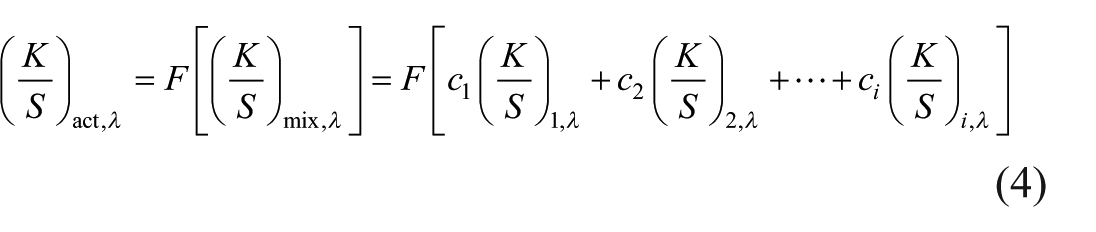
where (K/S)act,λ represents the actual (K/S) λ of the sample, (K/S)mix,λ indicates the sample according to the calculation results of formula (5) for a certain wavelength, function F(x) represents the minimization of the between (K/S)act,λ and (K/S)mix,λ.
The prediction deviation of the KM-1 model comes mainly from the inapplicability of the addition theory. In 2023, Wu et al. 24 proposed a spectral correction model of colored and non-color fiber based on KM-1 theory. It realizes the accurate prediction of the color of the precolored fiber mixture and reduces the influence of the addition theory on the prediction deviation of the KM-1 model. Only 14 samples—nine three-color blended fibers (red, yellow, blue (RYB)) and five five-color blended fibers (white, black (WK)—were used for training, and the average color difference reached 0.63 CMC (2:1) units. The deviation problem of mixed fiber color prediction caused by the complex interaction of light in the interior was solved. The specific formula is as follows:
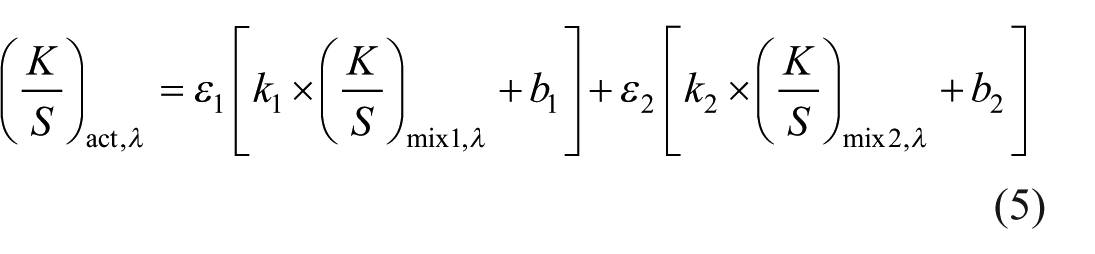
where k1 and b1 represent the correction coefficients for colored fibers, k2 and b2 denote the correction coefficients for noncolored fibers, (K/S)mix1,λ indicates the (K/S) λ of the colored mixture of the sample, and (K/S)mix2,λ means the (K/S) λ of the noncolored mixture of the sample. Finally, ε1 and ε2 are the adjustment coefficients for colored fibers and noncolored fibers, respectively: if there is a colored part in the blend, that is, (K/S)mix1,λ ≠0, ε1 =1, otherwise, ε1 = 0. Similarly, if (K/S)mix2,λ≠0, ε2= 1, and vice versa.
In order to better apply the above model, nine colored blended fibers and five black and white blended fibers were used as training specimens to obtain the corresponding correction coefficients. The adjusted model formula is as follows:

where p1 and q1 represent the correction coefficients of the colored fibers, p2 and q2 denote the correction coefficient of the noncolored fibers, (K/S)mix1,λ indicates the (K/S) λ of the colored mixture of the sample, and (K/S)mix2,λ means the (K/S) λ of the noncolored mixture of the sample.
Fiber-yarn-fabric multi-layer structure spectral color method
The existing theoretical models and empirical models of the Friele, S-N, KM-1, and KM-2 methods are only applicable to a single object, and there is a problem of low accuracy, which makes it difficult to meet the actual requirements of high-quality industrial production forecasting at this stage. The staple fiber yarn is made of fiber bundles twisted into strips. There are tiny voids on the surface of the yarn. Small pores on the surface of the fabric can be observed due to the interweaving of warp and weft yarns in Figure 3 . Therefore, the hierarchical structure of tightly arranged fibers in the yarn and the spatial structure of interwoven twisted yarns in the fabric make the light propagate in unpredictable nonlinear ways. Considering the structural differences among the fiber, the yarn, and the fabric, this paper proposes a high-precision optimized multilayer structure spectral color model suitable for both yarn and fabric. The formula is as follows:

where Ract,λ represents the reflectivity of the blended fiber calculated by equation (1) for (K/S)act,λ in equation (6); Ract,yarn,λ denotes the predicted reflectivity of the blended yarns; and tj1, tj2, tj3, and tj4 indicate the coefficients of the color prediction function of the yarn samples. The formula for the prediction results of the blended fabrics is as follows:

where tf1, tf2, tf3, and tf4 denote the coefficients of the color prediction function of the fabric samples. Similarly, Ract,yarn,λ is the reflectivity of blended yarn calculated by equation (7) and Ract,fabric,λ denotes the predicted reflectivity of the blended fabric samples.
It is worth mentioning that the coefficient of the color prediction function is the interlaminar structure effect coefficient of the fiber-yarn (or yarn-fabric) obtained by training five monochromatic fibers and five monochromatic yarns (or five monochromatic yarns and five monochromatic fabrics), for adapting to the color prediction for more types of colored spun fabrics.
Multi-layer Lab color space correction
Based on this proposed multilayer structure color spectrum method, the distribution of the predicted value and the actual value of the sample in the Lab color space was compared and explored. It was found that there was a certain correlation between the two. Therefore, a two-dimensional color gamut accuracy correction model based on Lab color space was proposed to further correct the prediction results of the above optimization model. The formula is as follows:
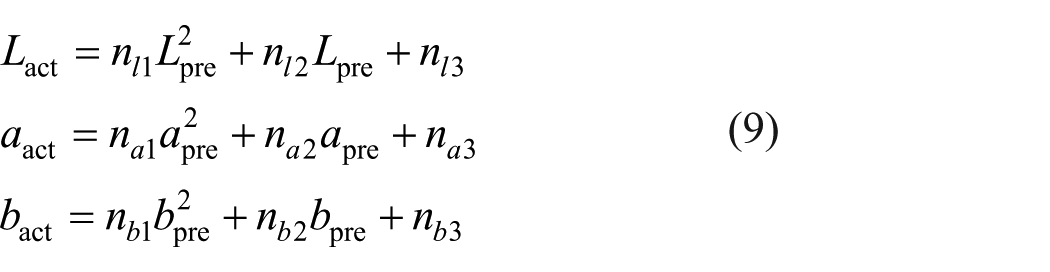
where Lpre, apre, and bpre represent the predicted values of L, a, and b of the samples; Lact, aact, and bact denote the true values of L, a, and b of the samples; and nli, nai, and nbi (i=1,2,3) indicate the parameters of the calibration model. The model uses a total of 14 mixtures of nine three-color blended yarns (fabrics) (RYB) and five two-color blended yarns (fabrics) (WK) as training materials.
Color prediction for colored spun yarns and fabrics based on monochromatic spun materials
The production of fabrics from fiber involved multiple processes of drafting, spun and weaving. Initially, the fluffy and discrete fibers were combed and drafted to parallel fibers, and then converted into yarns by twisting in spun processes. This twisting structure enforced the fibers tightly surrounding the axis of yarn to form a stable spiral arrangement. Subsequently, in the weaving process, these twisted yarns were woven into loops or interwoven points of organization with designed style and density, formed a tightly ordered spatial arrangement fabrics. Hence, these multi-level structures, involving twisting and interweaving, had a significant effect on the propagation of lights.
Specifically, light propagation has direct relation with material’s surface and spatial structure. Mature cotton fibers have a natural spiral structure along their length, and their cross-section is kidney-shaped with a central cavity. Furthermore, these fibers were combined and drafted parallel, and then formed a spiral micro-surface texture of yarn by twisting. While the fabric was composed of these twisted yarns, and its surface presented a more macroscopic and more complex irregular texture. These two levels of texture work together to cause the light reflection characteristics of the fabric surface to be completely different from that of a single fiber or a parallel fiber bundle. The torsional structure inside the yarn enforced the fibers to be closely arranged and entangled with each other, forming a complex light scattering path. When light penetrated into the fabric, it would not only produce multiple reflections on the surface of the fabric, but also produced complex scattering phenomenons at the interface and inner of the fibers inside the yarn, as show in Figure 1. Similarly, this mechanism turns more complex due to the spatial arrangement of fabric. Therefore, from discrete fibers to twisted yarns, and then to the structural evolution of fabrics, the complexity of their surface textures and the uniqueness of internal scattering mechanisms have led to significant differences in spectral reflection between fiber, yarn, and fabrics, as shown in Figure 3. A multi-scale scattering mechanism, core feature of light propagation inside the fabric from fibers, was proposed in this paper, involving internal structure of the twisted yarn and its spatial arrangement.
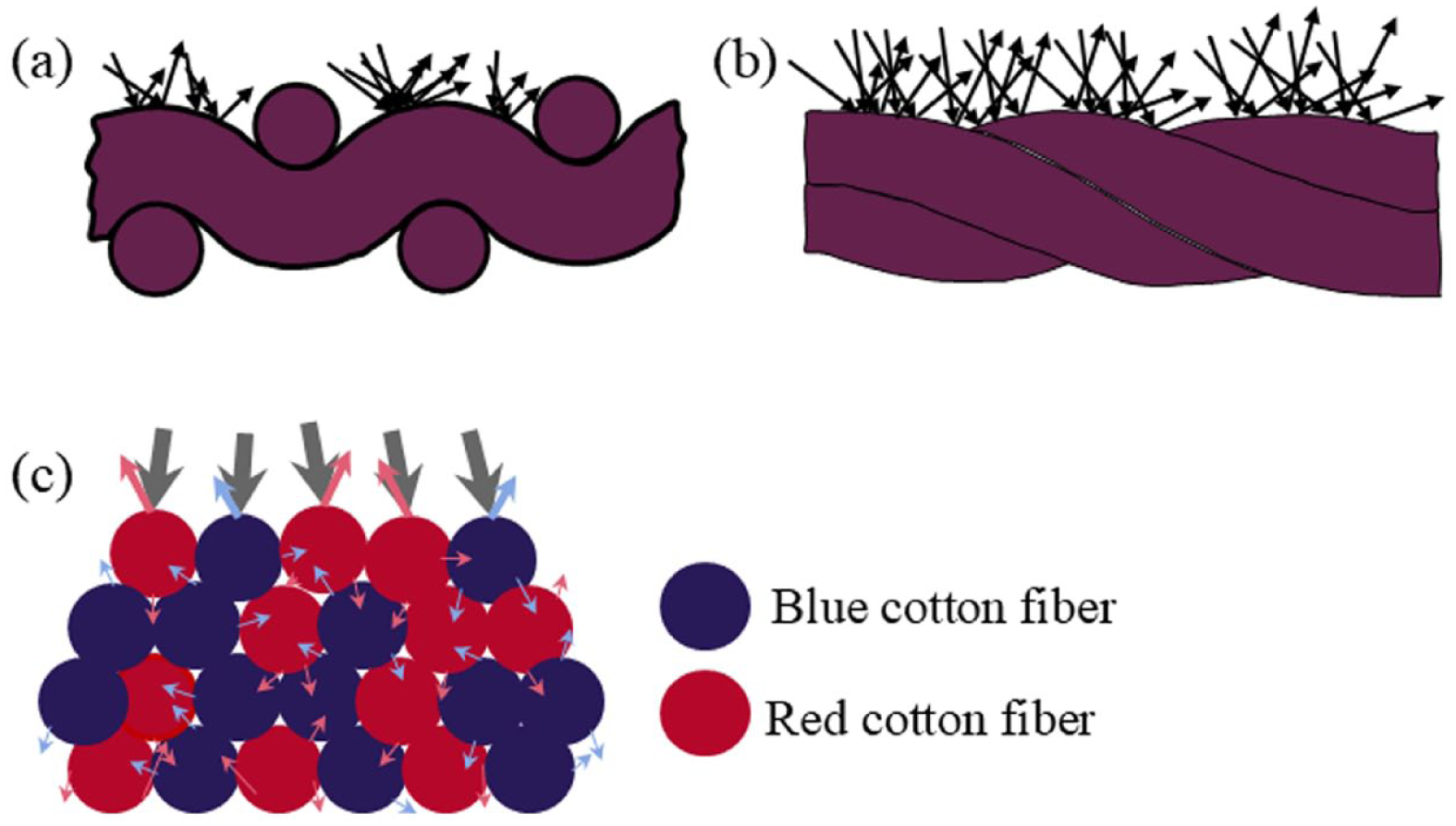
The reflection propogation characteristic of light of different structural layers of fiber-yarn-fabric: (a) light propagation on fabric surface; (b) light propagation on yarn surface; (c) light propagation inside the fiber.
Figure 2 exhibits the procedure of color prediction for color blending yarns and fabrics using monochromatic cotton fibers. Firstly, train optical parameters of spectral correction color prediction model, equation (6), using (K/S)λ of 9 colored cotton fiber blends and 5 non-colored ones. Then, substitute (K/S)λ of 5 monochromatic fiber blends into this model to obtain a designed color, (K/S)act,λ at any ratio, and get its Rmix,i together with equation (1). Secondly, compute the color fiber-yarn-fabric double-layer structure color spectral models of equation (7) and equation (8), using 5 couple of monochromatic fibers and yarns, and yarns and fabrics, respectively. Using this two-step model, the color of fabric Rfabric,λ or yarns, Ryarn,λ could be acquired using reflectance Ract,fiber,λ of the corresponding designed blending fibers. Finally, 9 colored blended fabrics and 5 non-colored ones could be utilized to train the Lab color space correction model as formula (9), obtaining more accurate Lab value of the designed fabrics or yarns.
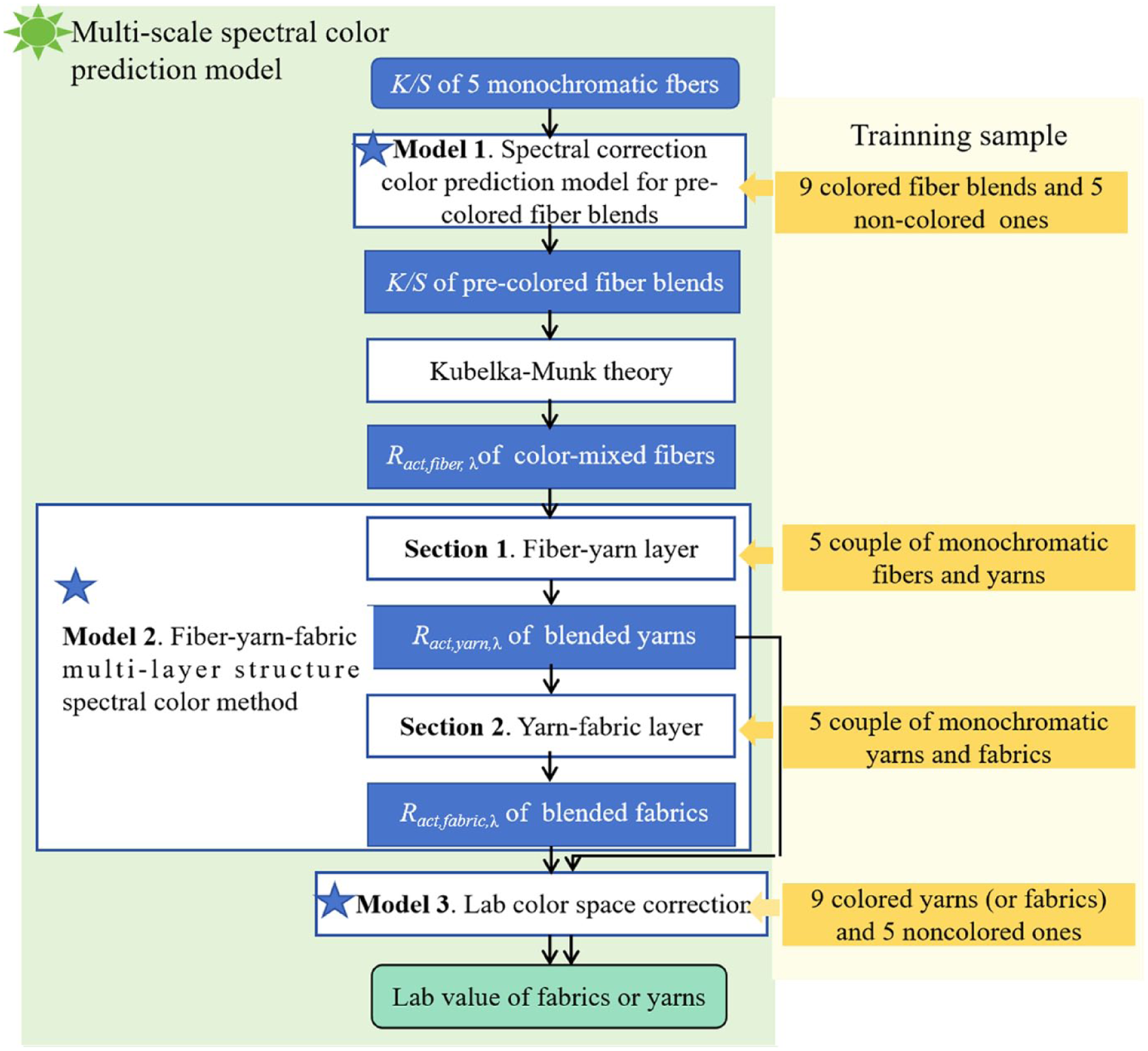
The process of the color prediction for colored spun yarns and fabrics.
Experimental methods
Materials and sample preparation
In this experiment, five primary cotton fibers, yarns, and fabrics were used as the training samples for the proposed multiscale color prediction model, which were red (R), yellow (Y), blue (B), white (W), and black (K), respectively. The color values of these five primary cotton fibers, yarns, and fabrics are show in Table 1. The reflectivity and scanning images of these five fiber, yarn, and fabric samples are shown in Figure 3. Specifically, five kinds of monochrome raw cotton that had been combed, drafted twice, and then drawn were spun into 87 blended yarns with a fineness of 29.16 tex, and then woven into 87 blended 36-line/in single-layer knitted fabrics, as shown in Figure 4. The yarn samples were evenly wound on black cardboard for 1000 turns, and the width was controlled at 4 cm. Five kinds of monochromatic fibers and five kinds of monochromatic yarns were used as the training samples in the first layer of the multiscale color prediction model, and five kinds of monochromatic yarns and five kinds of monochromatic fabrics were used as the training samples in the second layer of the multiscale color prediction model, as shown in Figure 3.
Lab color values for five kinds of colored fiber, yarn and fabric.
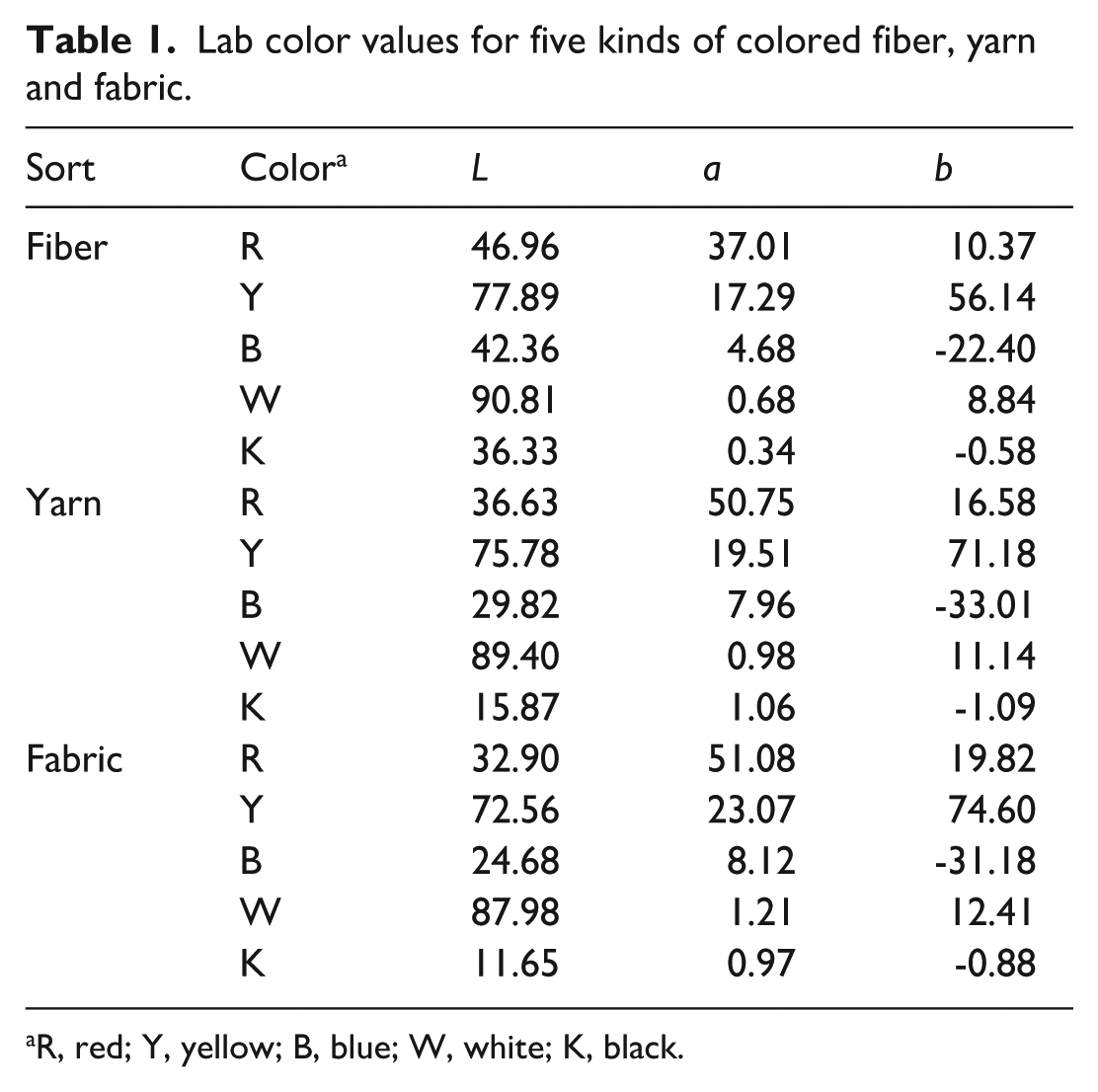
R, red; Y, yellow; B, blue; W, white; K, black.
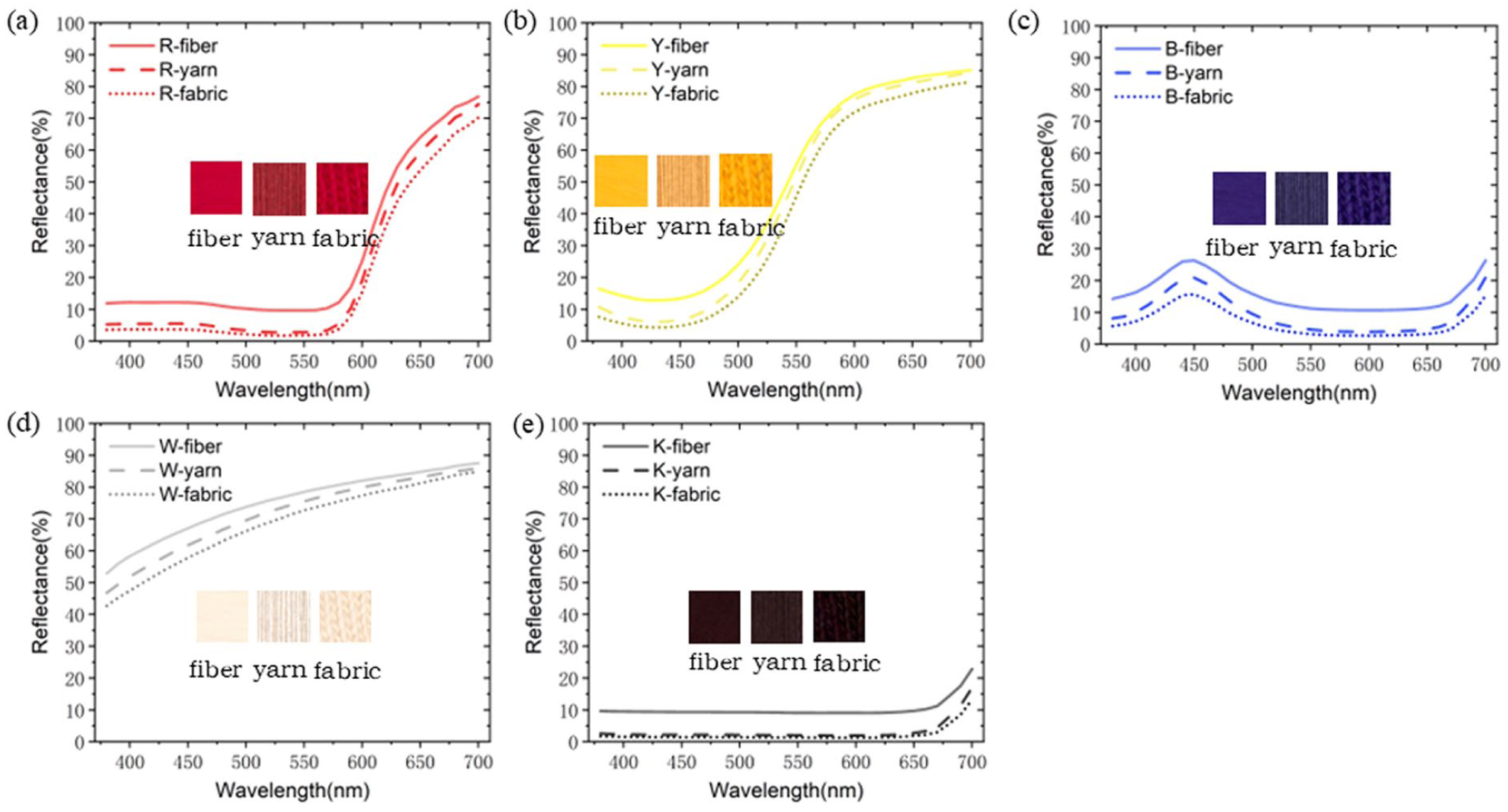
The reflectivity and scanning images of the five primary color fiber, yarn, and fabric samples.
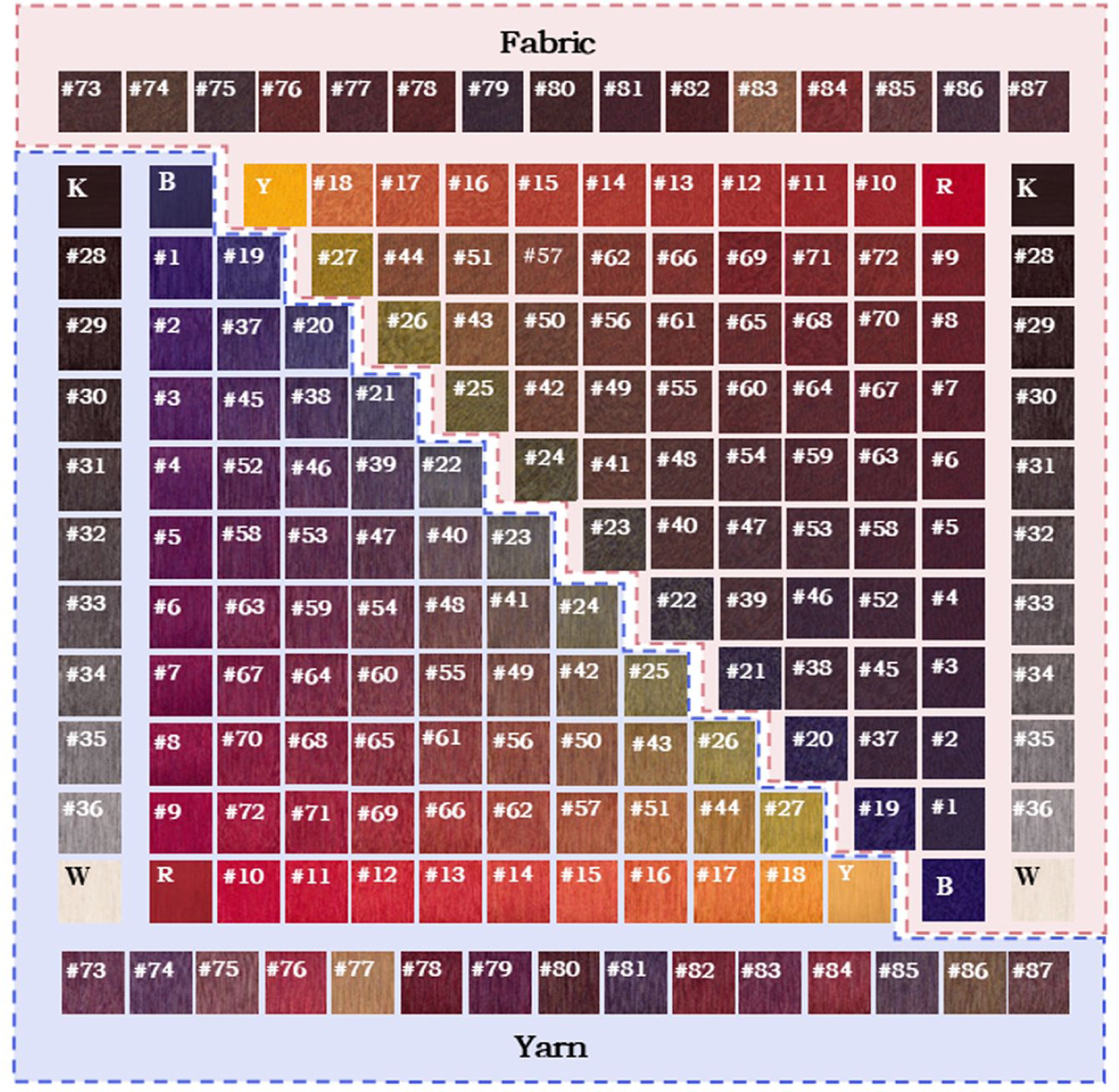
Images of 87 colored spun yarn and fabric test samples.
It is worth mentioning that in the first section of this multiscale color prediction model, nine RYB mixed fibers and five black and white mixed fibers among 87 blended fiber samples were used as training materials for the spectral correction model. In the same way, 14 blended yarn samples and fabric samples with the same color mixing ratios were adopted as training samples for the multilayer color gamut accuracy correction model based on the Lab color space. A total of 87 blended yarn and corresponding fabric samples were prepared as test samples for the second section of the model, as shown in Figure 4. Among them, two-color and three-color blended yarns and fabrics were mixed at a gradient of 10% of each original fiber. Four- and five-color yarns and fabrics were mixed in random proportions. Their corresponding mixing ratios are listed in Table 2.
Color mixing ratio of the 87 colored spun test samples.
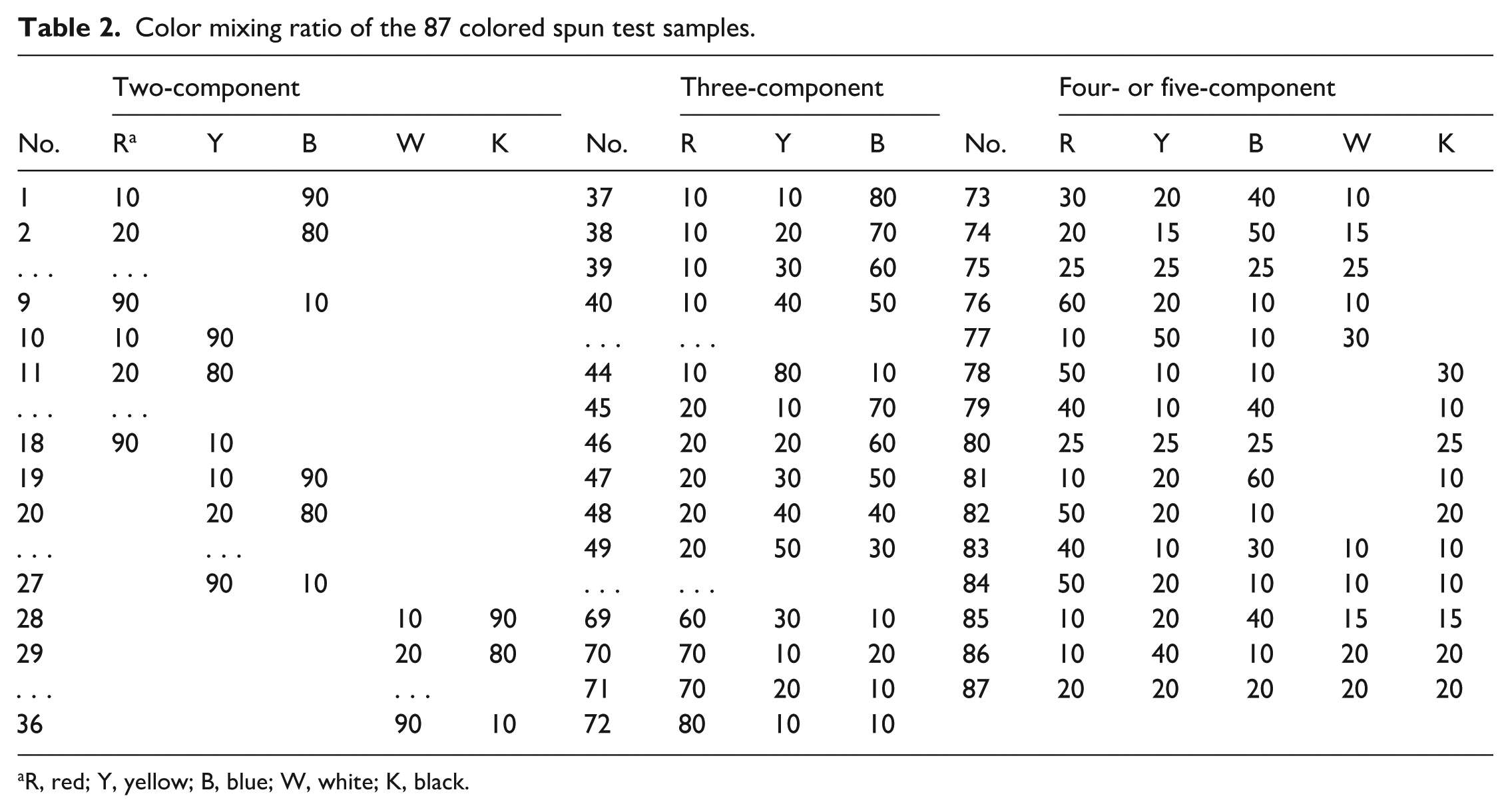
R, red; Y, yellow; B, blue; W, white; K, black.
Color measurement
Color measurements of the samples were executed by a Datacolor 600 spectrophotometer with the optical geometry of the d/8 system, with 30-mm pores for fiber and fabric samples and 20-mm pores for yarn samples. In order to obtain reliable and repeatable color measurement data, each fiber sample with a weight of 4 g was loaded into an optical glass container and extruded until opaque, ensuring that the fibers were arranged in parallel. After the preliminary finishing of the yarn sample, the yarn sample was evenly and parallelly wound on black cardboard, and the width was controlled at 4 cm. Images of these samples were taken by a camera. On the premise of including the specular reflection of the samples, the 33 dimensional spectral reflectivity data with an interval of 10 nm were measured and recorded in the wavelength range of 380–700 nm. To minimize the potential measurement error, each sample was measured nine times randomly at different locations, and the average of the color data was adopted as the real data of each sample.
Application and discussion
Prediction results for the proposed method
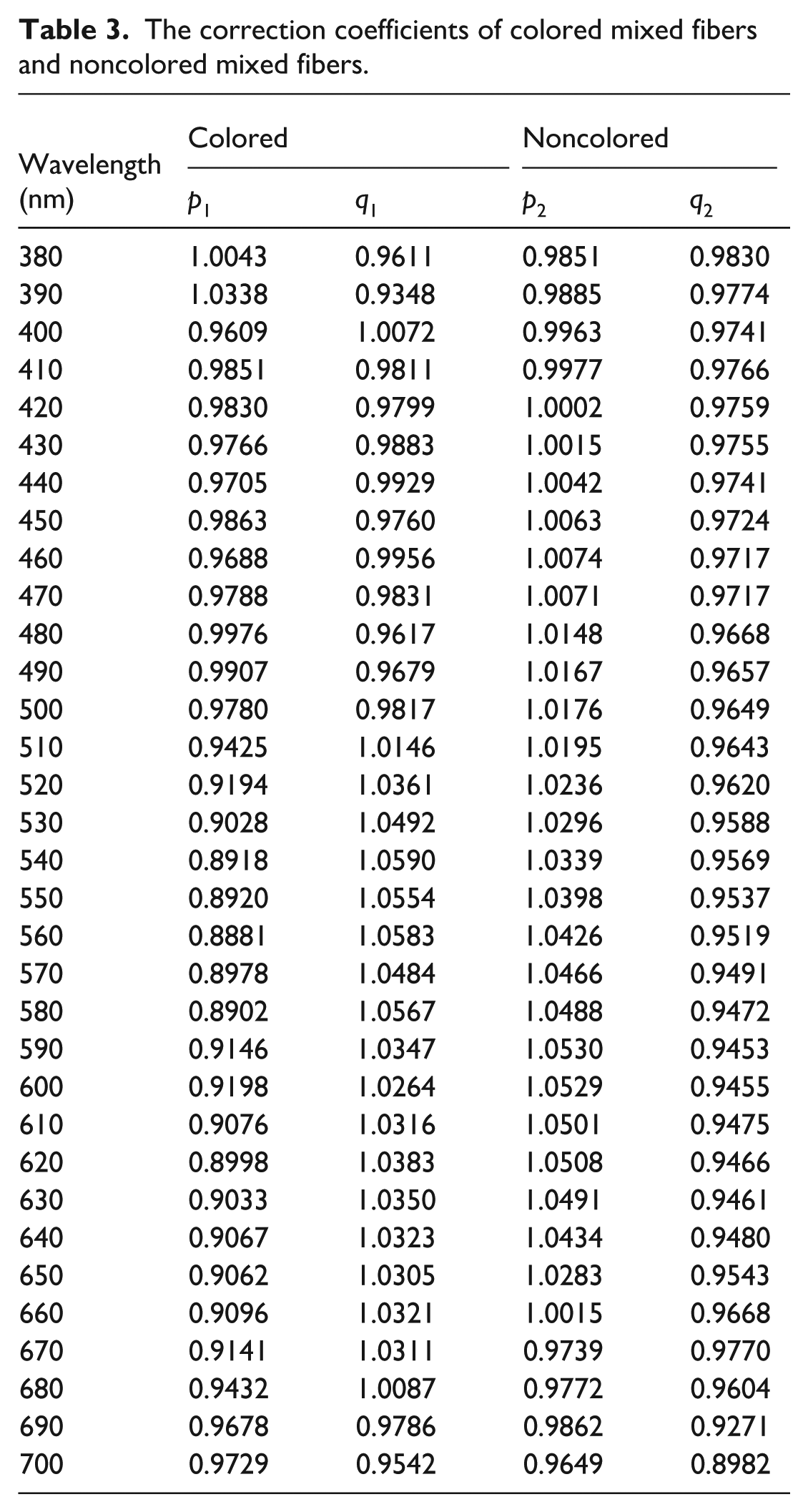
The correction coefficients of colored and noncolored fibers were calculated, respectively, by employing the spectral correction method of equation (6) using nine colored blended fibers (RYB) and five noncolored mixed fibers (WK), as shown in Table 3. Then, five monochromatic fibers and their monochromatic yarns and fabrics were utilized as training specimens for the color spectrum model of fiber-yarn-fabric optimization double-layer structure of equation (7) and equation (8), successively. Then, 14 blended yarn samples and corresponding fabric samples were adopted as training samples for the multilayer color gamut accuracy correction model based on the Lab color space. Finally, a total of 87 yarn samples and 87 fabric samples were used as test samples to validate each section of this proposed method.
The correction coefficients of colored mixed fibers and noncolored mixed fibers.
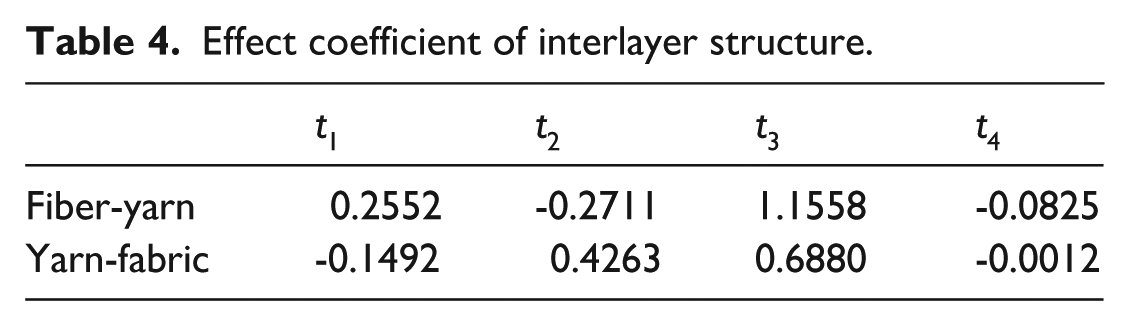
Afterwords, the second part of the model was verified experimentally. Firstly, five monochromatic fibers and their corresponding yarns were adopted to train the coefficients of the fiber-yarn section of this model for each wavelength, describing the interlayer structure effect of fiber parallel aggregation and twisting, as shown in Table 4. This process introduced minor structural changes in the yarn formation from the fibers and could describe more accurately the optical changes of the inner yarns and provide information about the fabric structure for color prediction. Initially, the (K/S)mix1,λ of blended fibers from the KM-1 model was obtained using equation (6) and the coefficients in Table 3. Secondly, these (K/S)mix1,λ values were substituted into equation (2) to get their corresponding reflectivities, and in this case, calculate the reflectivities Rmix,i of the blended yarns using equation (7) and the obtained coefficients from Table 4. Finally, the accuracy of this proposed method was checked using the color difference DE00, according to CIE2000 formula. The results of all 87 blended yarns in the test samples were computed and are listed in Table 5.
Effect coefficient of interlayer structure.
Color difference DE00 of 87 test yarn samples obtained by optimization model.
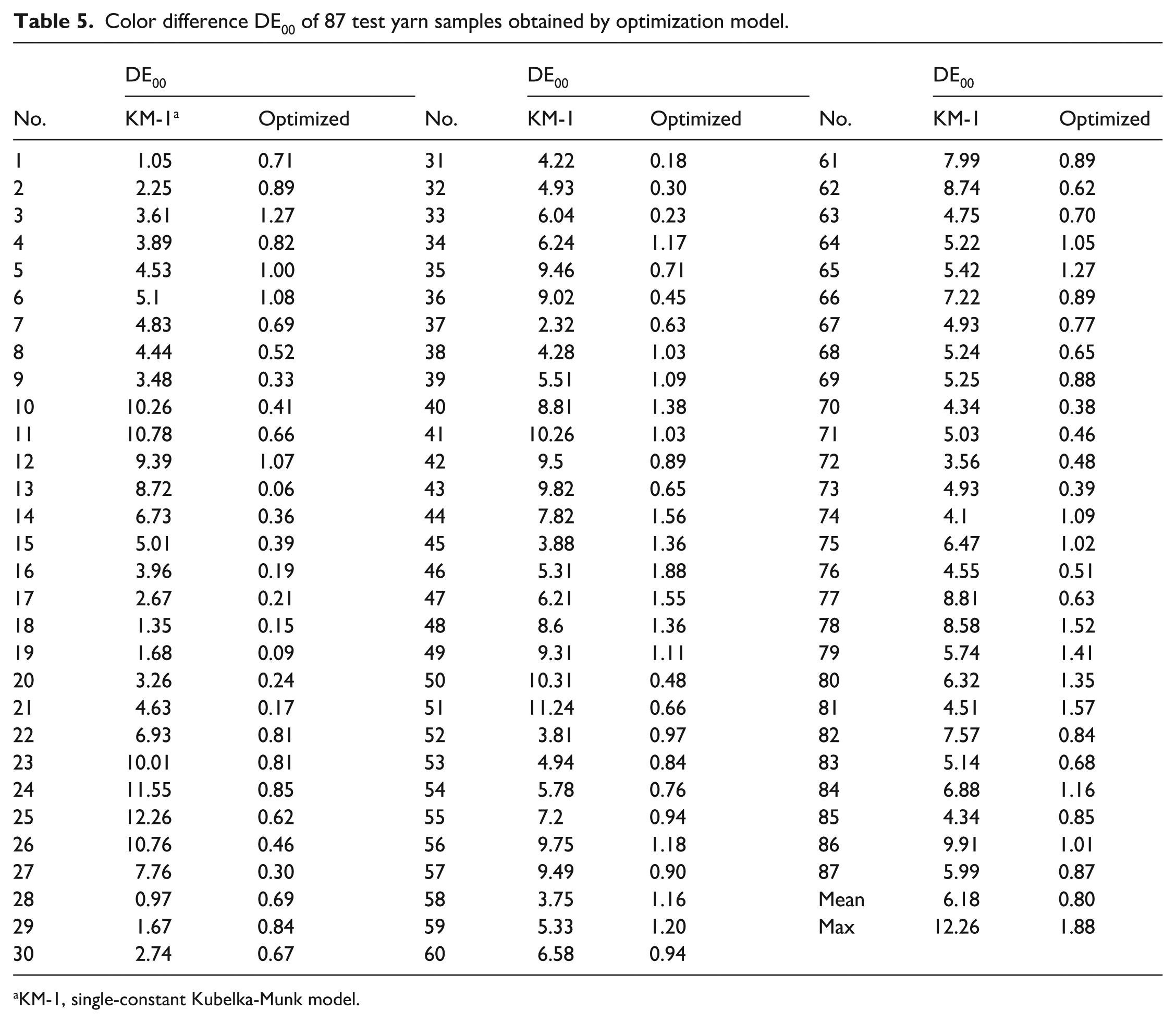
KM-1, single-constant Kubelka-Munk model.
Secondly, five kinds of monochromatic yarns and their corresponding monochromatic knitted fabrics were employed for training in the yarn-fabric layer of the model, expounding the three-dimensional structure effect of yarn twisting and looping. The influence of the structure change from yarn to fabric on the light propagation was better explained, and the interlayer structure effect coefficients of yarn-fabric were obtained, as shown in Table 4. Furthermore, the coefficients were applied in equation (8) to predict the reflectivity Rmix,i of the color-mixed fabric. Finally, the color difference DE00 of the color-mixed fabric verification samples was calculated according to the CIE2000 formula, 19 as listed in Table 6.
Color difference DE00 of 87 fabric test samples obtained through the optimized model.
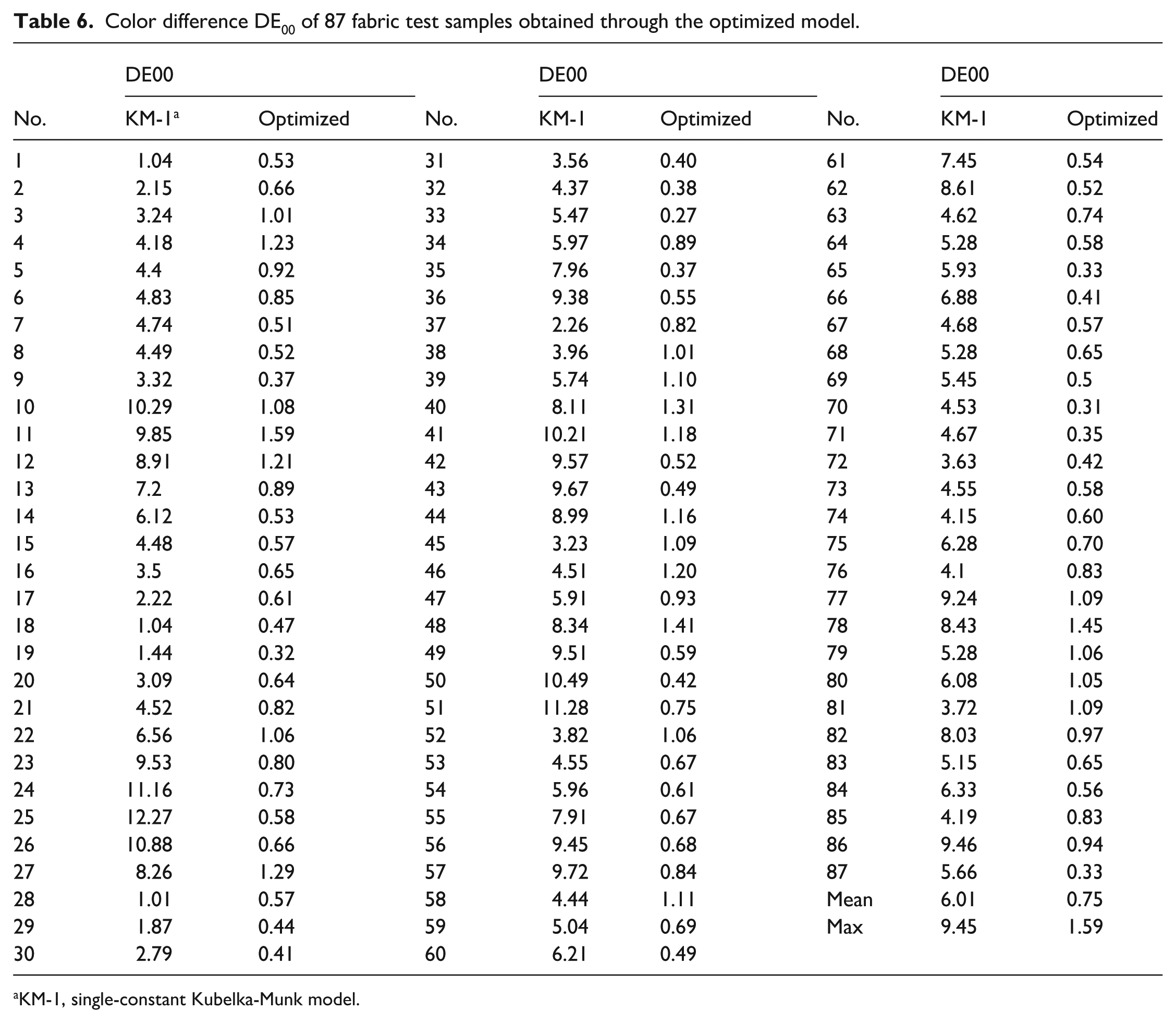
KM-1, single-constant Kubelka-Munk model.
As can be seen from Table 5, the average and maximum color difference DE00 25 of yarn samples decreased from 6.18 and 12.26 to 0.81 and 1.83, respectively, and the average and maximum color difference DE00 of fabric samples decreased from 6.01 and 9.45 to 0.75 and 1.57, respectively. The results show that the introduction of the interlayer structure effect solves the problem that the traditional model has insufficient prediction accuracy under the condition of few training samples.
Comparison with other prediction models
This multiscale color prediction model was compared with the four common color prediction models, the KM-1 model, KM-2 model, S-N model, and Friele model, to certify the effectiveness and superiority of this proposed method. In particular, in addition to the KM-1 model without training samples, the other three models also used nine colored mixed RYB and five noncolored mixed WK yarns and fabrics as training materials. Meanwhile, the empirical parameters in the S-N and Friele models were obtained by the least squares method. The iteration range was set from 0 to 1, and the step size was 0.01. The empirical parameters of the yarn samples of the S-N and Friele models were 0.13 and 0.16, respectively . The empirical coefficients of the fabric samples of the S-N and Friele models were 0.16 and 0.12, respectively. Finally, the color difference DE00 (2:1:1) of each these models were compared with the proposed method.
The excellent color prediction ability with stable and low dispersion in blended yarn and fabric samples under the proposed method are shown in Figures 5(a) and 5(b), and most of the color differences were below 1. Firstly, it should be noted that the predictions of the KM-1 model were significantly larger than those of the other models. Secondly, although the color difference results of the KM-2 model were generally small, there were still some results with large color differences in the two components. The prediction results of the Friele and S-N models were relatively stable, but the color differences of many samples were greater than 1. Afterwards, a histogram including error bars was employed to further analyze the overall performance of each model, as seen in Figures 5(c) and 5(d). The color differences DE00 (2:1:1) and corresponding mean color differences of all test samples are displayed. It can be seen that the data points of the model proposed here were the most concentrated and the degree of dispersion was the smallest. Interestingly, the average and maximum color differences of 87 blended yarn samples were only 0.80 CIEDE2000 units and 1.88 CIEDE2000 units, which were markedly lower than those of the KM-1 model (~6.18, ~12.26), KM-2 model (~1.33, ~9.50), Friele model (~1.62, ~3.06), and S-N model (~1.14, ~3.51). Moreover, the average and maximum color differences of 87 blended fabric samples were 0.75 and 1.59, which were smaller than those of the KM-1 model (~6.01, ~12.27), KM-2 model (~1.17, ~8.94), Friele model (~1.29, ~2.31), and S-N model (~1.02, ~4.09).
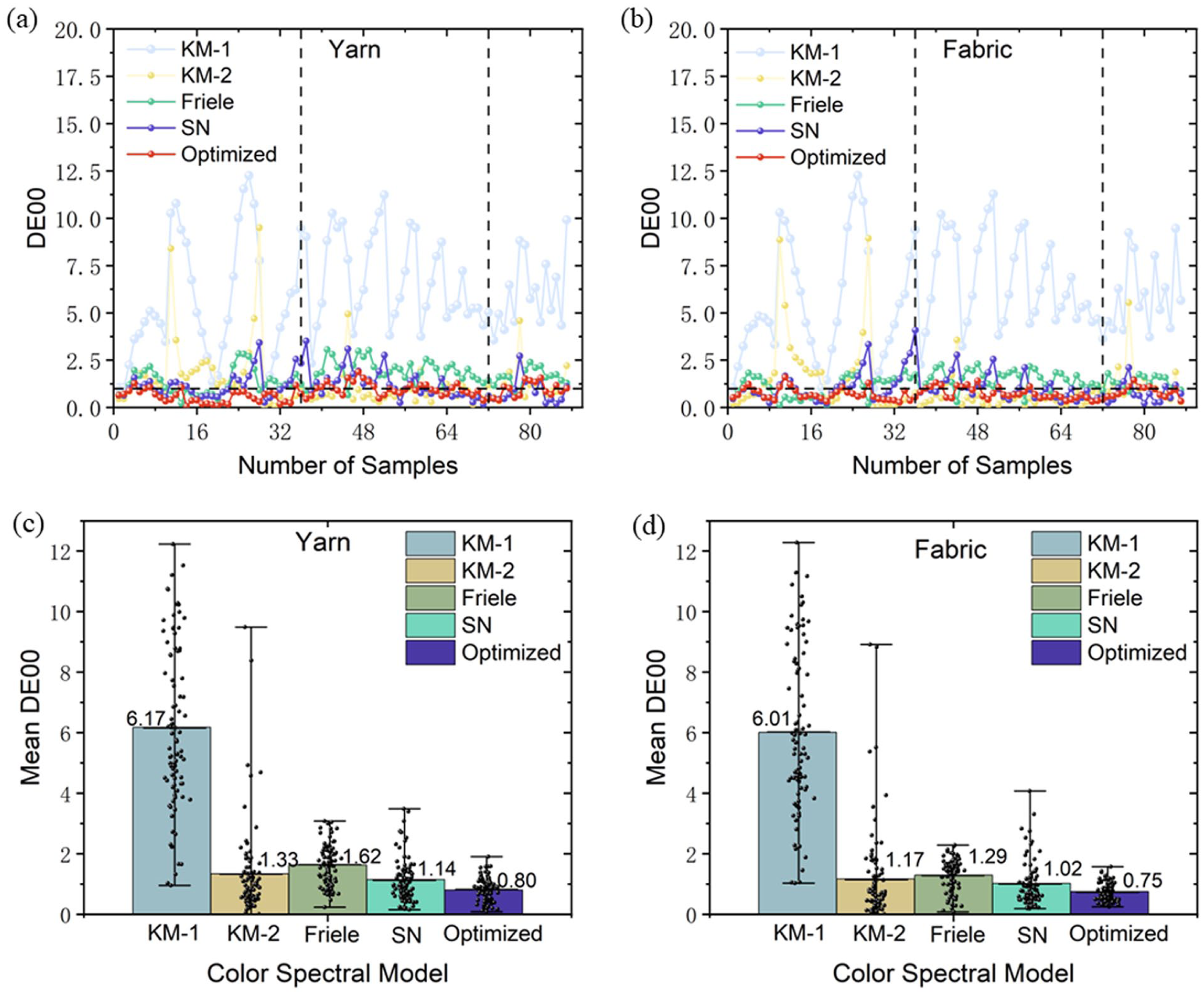
Comparison of yarn and fabric color difference DE00 of different models: (a) yarn samples; (b) fabric samples; (c) yarn samples; (d) fabric samples.
In addition, we found that the average color difference of the optimized model for each type of sample was less than 1, as shown in Figure 6. However, the prediction results for each sample by the KM-1 model were significantly larger. Subsequently, it can be observed from the height of the three-component blend box plot that, although the average color difference of the KM-2 model was lower than that of the optimized model, the maximum color difference of KM-2 model was higher. It is worth noting that the average color difference of the S-N model for each sample type was about 1, and that the average color difference of the four- and five-component samples was lower than that of the optimized model, but the dispersion of the color difference was higher and the stability was worse. Generally speaking, the performance in color difference DE00 (2:1:1) predicted by the optimized model had more stability and less fluctuation, proving that this method has superior color prediction ability.
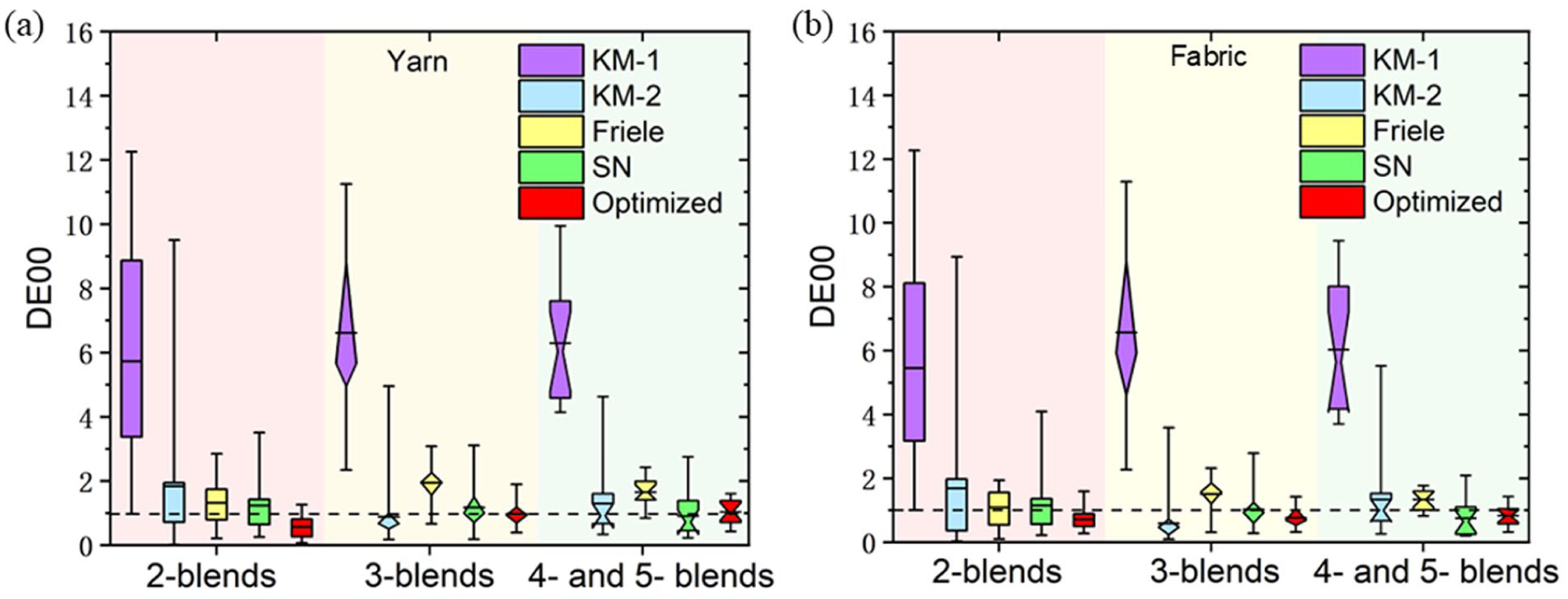
Comparison of yarn and fabric color difference DE00 of different models for each type of composition: (a) yarn samples; (b) fabric samples.
Furthermore, the color difference frequency distribution of the 87 yarn and 87 fabric test samples across the five models are exhibited in Table 7. It could be observed that the color differences DE00 (2:1:1) of the proposed model were concentrated in the range 0–1.5. In particular, 72.4% of yarn samples and 74.0% of fabric samples had color differences of less than 1, which were significantly higher percentages than for the KM-1 (1.2%, 0.0%), KM-2 (54.9%, 66.7%), S-N (52.9%, 60.9%), and Friele (21.8%, 25.3%) models. Additionally, only 4.6% of yarn samples had color differences greater than 1.5 and less than 2, and 2.3% of fabric samples had color differences greater than 1.5 and less than 2. These results highlight the accuracy of this method in predicting the color of the colored spun products.
Interval probability of color difference distribution of 87 yarn and fabric test samples.
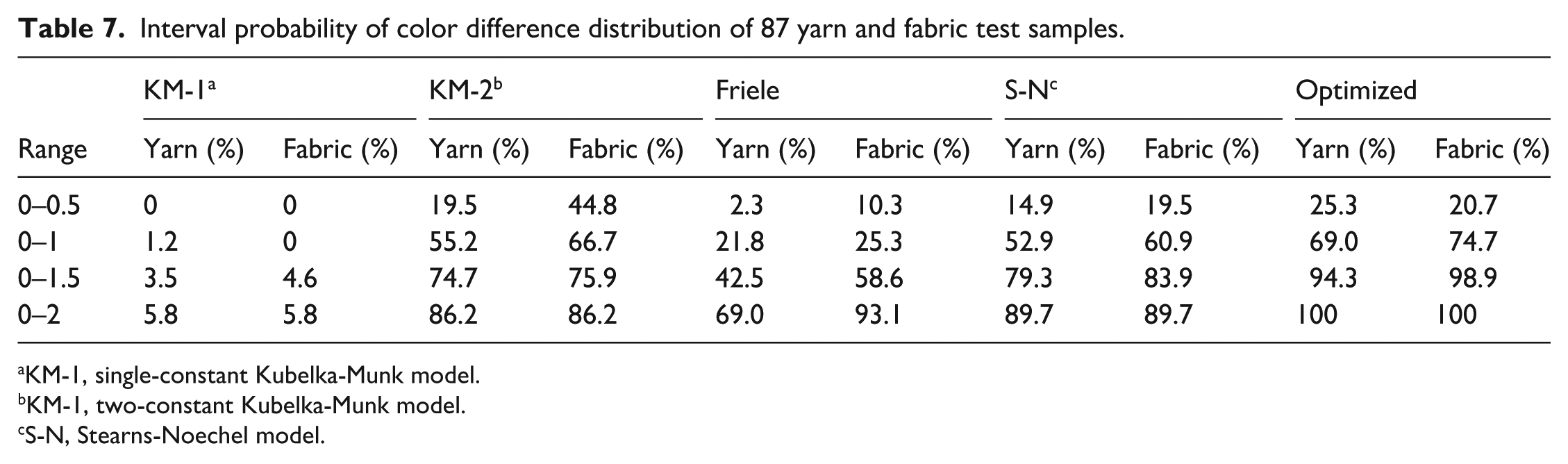
KM-1, single-constant Kubelka-Munk model.
KM-1, two-constant Kubelka-Munk model.
S-N, Stearns-Noechel model.
Lab color space correction
The predicted results of all test samples, yarn, and fabric were compared with the actual ones in Lab color space. Clearly, most of the predicted results turned out to be a little bit larger than the actual ones, as shown in Figure 7. This confirms the essential of correlation algorithm related in the spectral gamut space, revealing the multilayer color gamut correction mechanism of the Lab macro color space in the multiscale color prediction model. The validity of this model is verified again. Therefore, the prediction results were further improved after Lab correction. The average color difference of the yarn sample was reduced from 0.80 to 0.65, and that of the fabric sample was also reduced from 0.75 to 0.54, as shown in Figure 8. Interestingly, only two fabric samples had color differences slightly greater than 1.
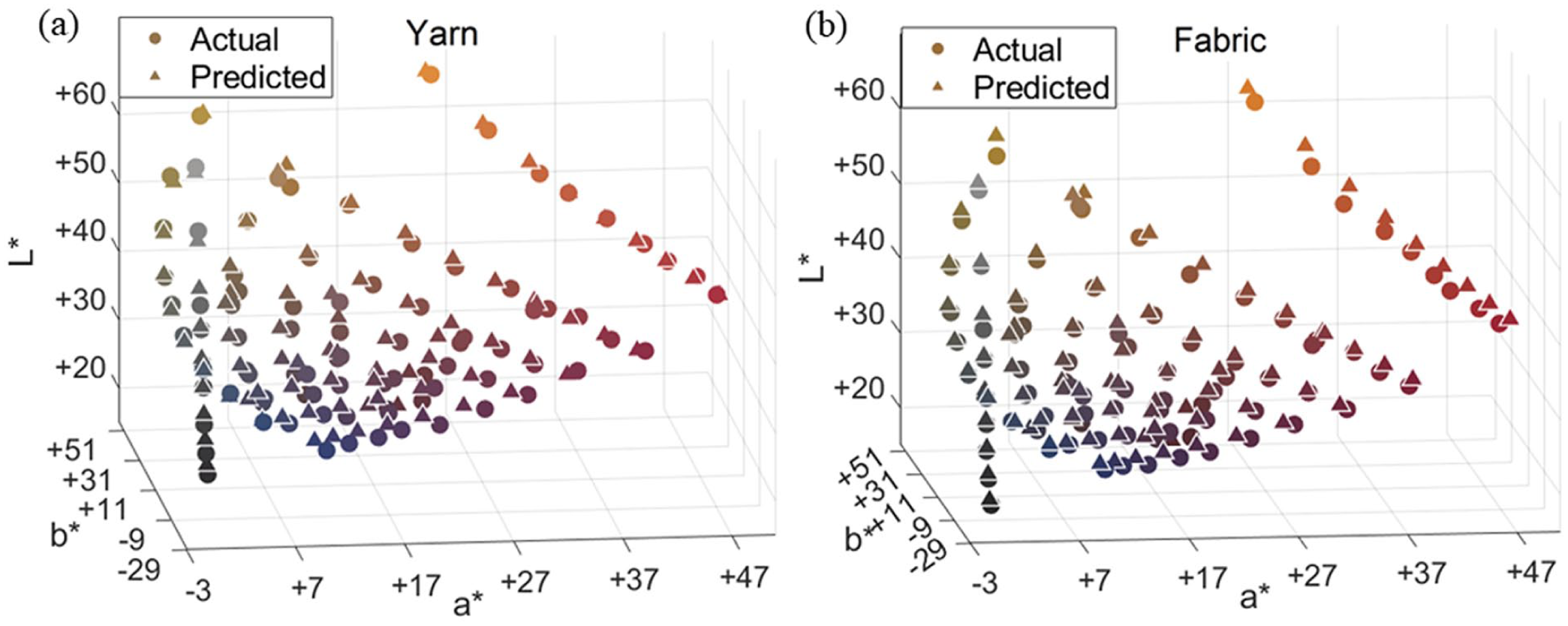
Comparison of the actual reflectivity and the predicted reflectivity in the Lab color space: (a) yarn samples; (b) fabric samples.
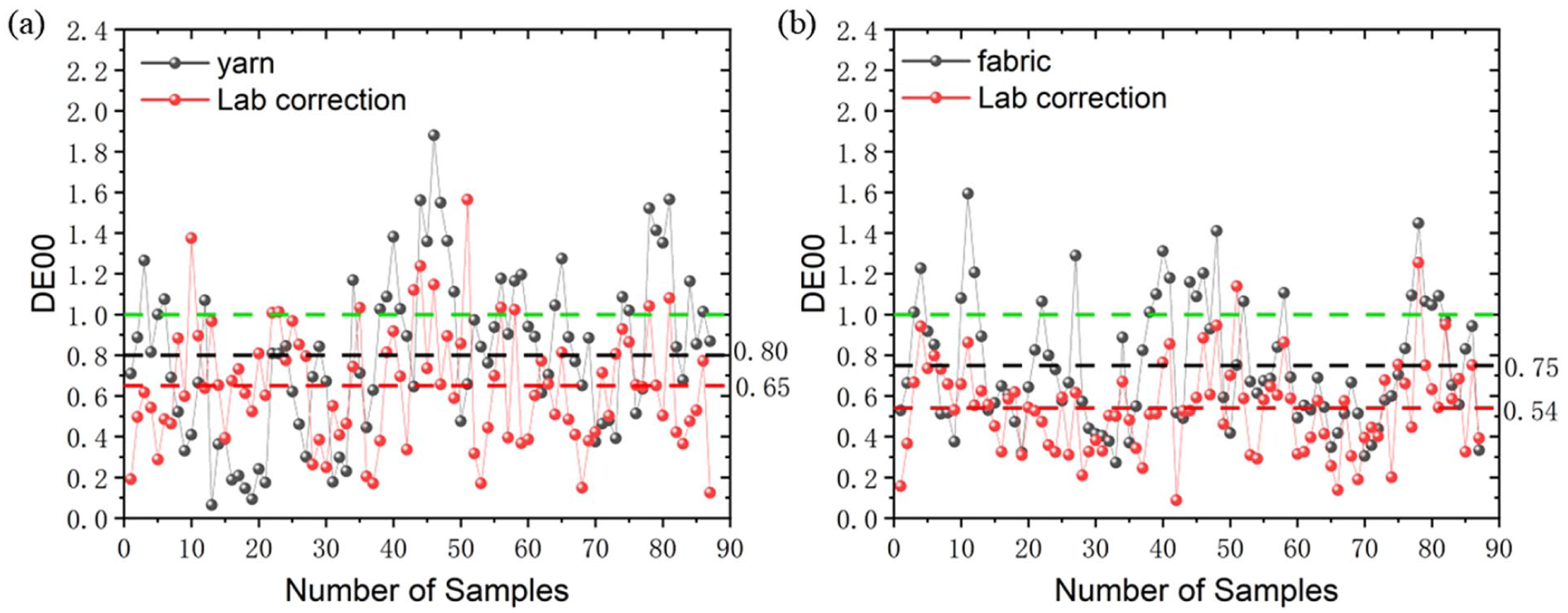
Comparison of sample color difference before and after Lab correction: (a) yarn samples; (b) fabric samples.
The final results of the optimized model were compared with other models. It can be obtained from Figure 9 that the final results of this model were better than those of other models. In addition, the color difference results of this model were also lower than those of Sun et al. 13 on the whole, which again proves the effectiveness of the optimized model.
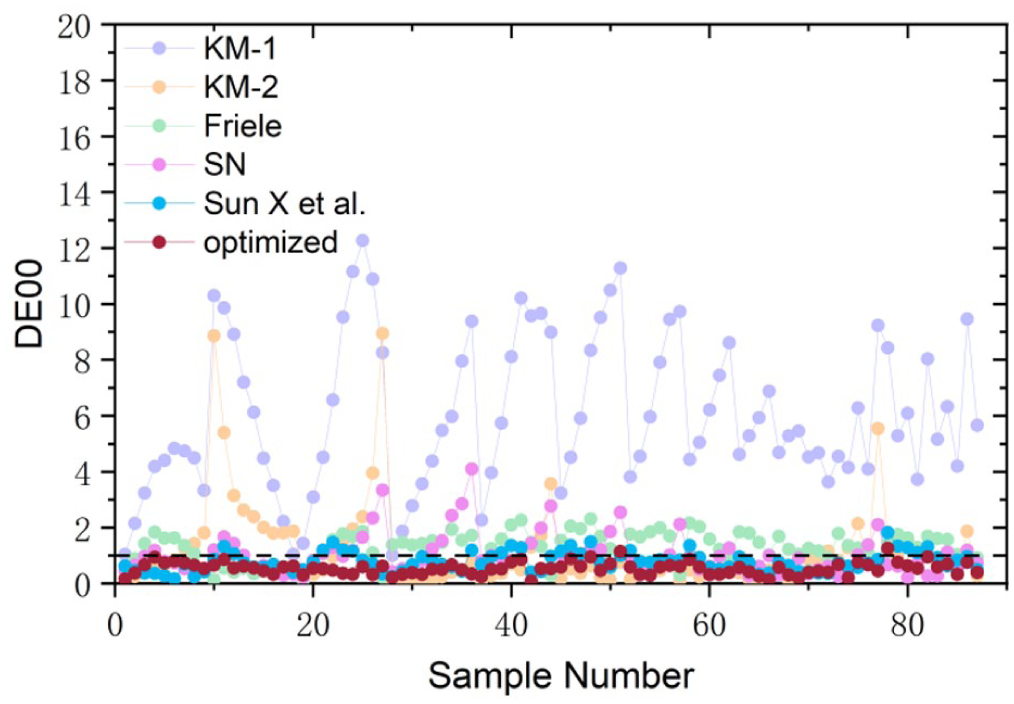
The color differences DE00 of 87 test fabric samples on color prediction models.
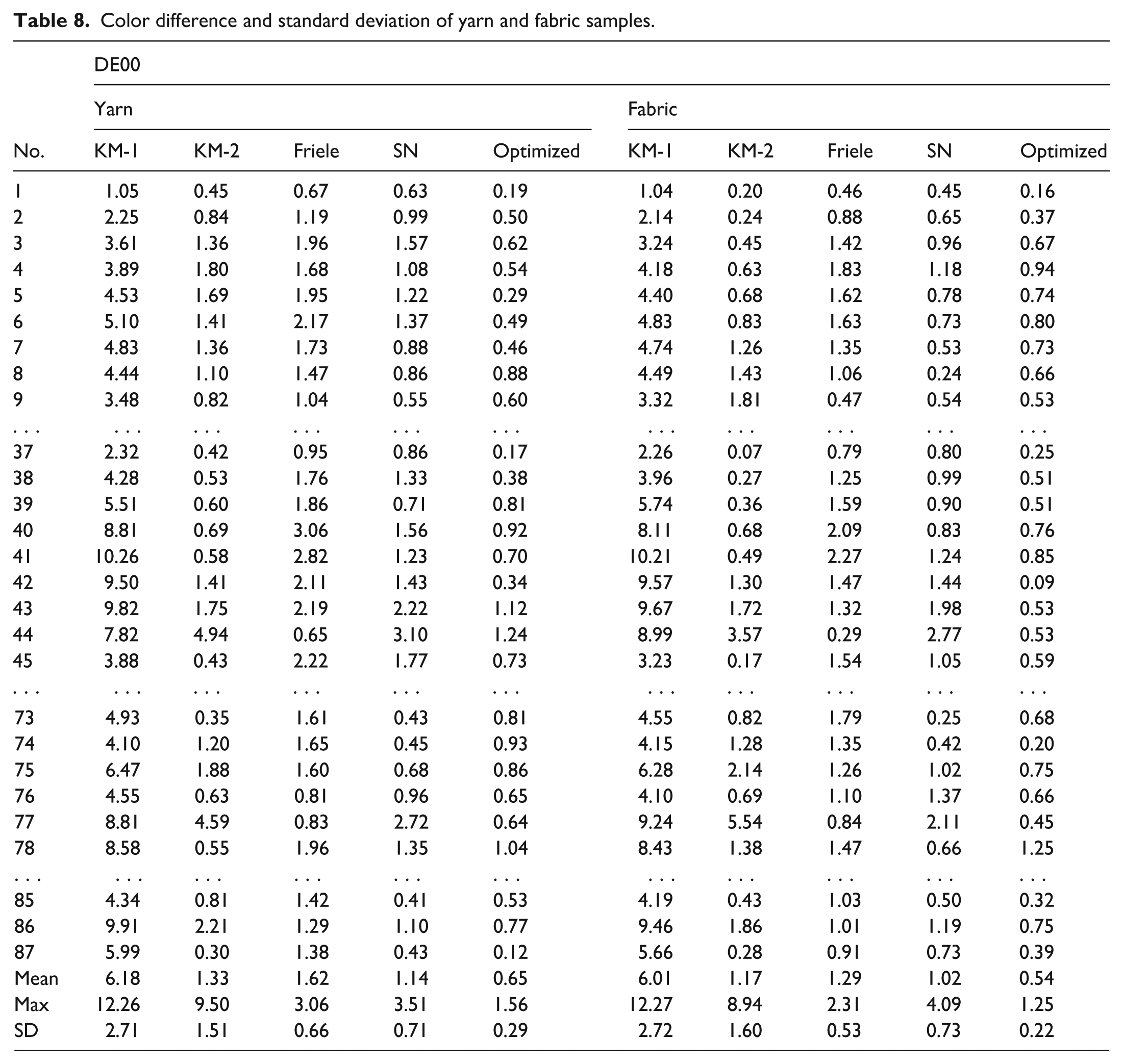
Additionally, Figure 10 provides the distribution of color difference DE00 for 87 colored spun yarns and fabrics within different ranges of different models. It can be observed that the proposed model was significantly better than other traditional models in predicting the color of 87 kinds of mixed yarn and fabric samples. Notably, this proposed method exhibited a higher percentage of fabric samples (97.7%) with color difference DE00 (2:1:1) below 1 compared to other models, obviously outshining the percentage achieved by the KM-1 (0.00%), KM-2 (66.7%), Friele (25.3%), S-N (60.9%) models, and Sun X et al. 13 (74.7%). In particular, all color difference DE00 (2:1:1) values using the proposed method were less than 1.5, while the number of samples with color differences DE00 below 1.5 from the other traditional models was less than 90%. In general, the predicted color difference of this method is obviously better than other standard methods, as partly shown in Table 8. These results underscore the accuracy of this color prediction method in predicting the colored spun fabrics based on monochromatic fibers.
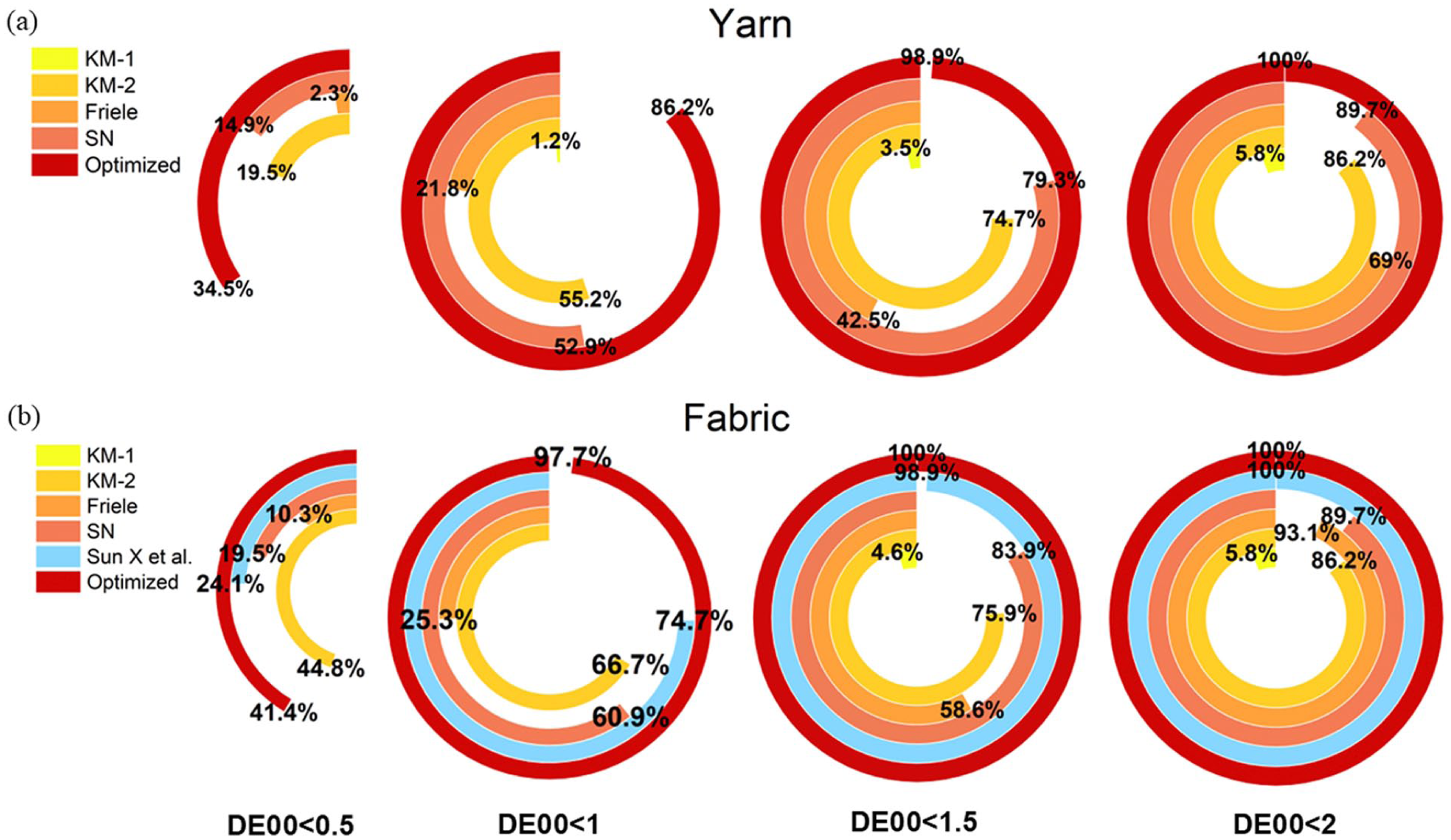
The distribution of color difference DE00 for 87 colored spun yarns and fabrics within different ranges of different models: (a) yarn samples; (b) fabric samples.
Color difference and standard deviation of yarn and fabric samples.
In order to further demonstrate the superiority of the multiscale color prediction model in this paper, the number of training samples, average color difference, and maximum color difference used in this method were compared with the existing research results, as shown in Figure 11. It is evident from this figure that the average and maximum color difference were smallest for the proposed model under the condition of significantly reducing the number of training samples. Moreover, this model used the largest number of test samples. This indicates that this method can still show excellent color prediction performance while reducing the training cost.
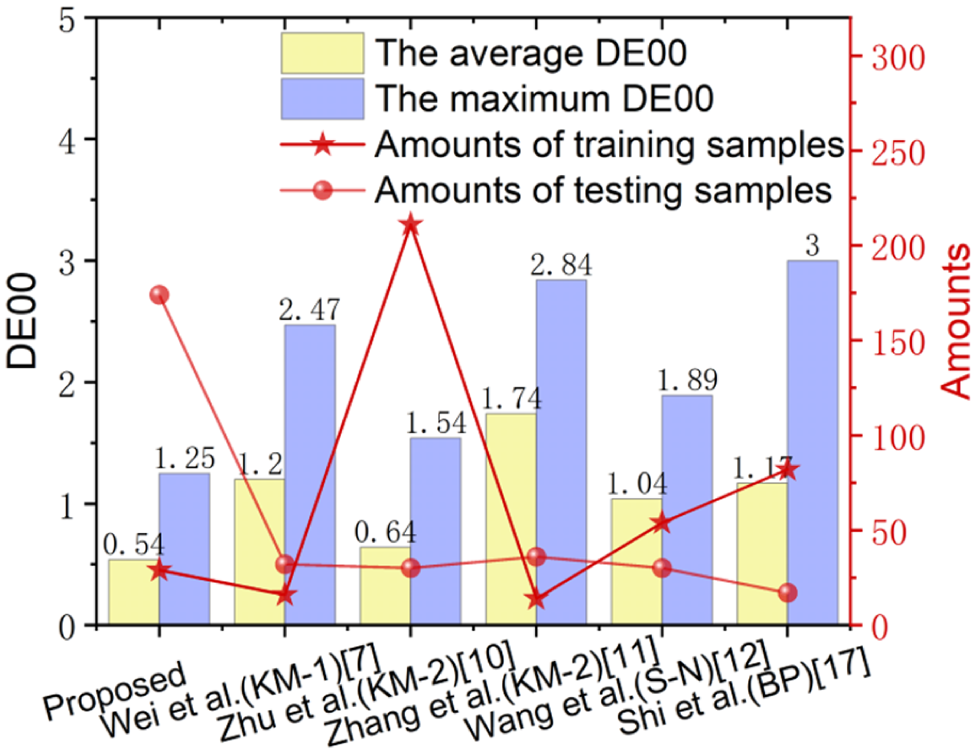
Comparison with the current research results in average color difference, maximum color difference, and the number of training samples.
Conclusions
In this paper, a multiscale color prediction model for color blended spun products based on the fiber-yarn-fabric interlayer structure effect was proposed. This method could achieve high-precision color prediction for color blended yarns and fabrics using only five groups of different monochromatic materials, and 14 color blended fibers as training samples. This multiscale color prediction model not only describes the influence of the microstructure change of fiber-yarn and the three-dimensional structure effect of yarn-fabric on the optical propagation, but also further expounds the optical mechanism of multilayer color correction in the Lab macro color space.
Experimentally, a total of 87 colored cotton spun yarns and fabrics were prepared as test samples, and the validity of the model was verified. The results indicate that the average and maximum color differences of 87 blended yarn samples were only 0.65 CIEDE2000 units and 1.56 CIEDE2000 units, which were markedly lower than those of the KM-1 model (~6.18, ~12.26), KM-2 model (~1.33, ~9.50), Friele model (~1.62, ~3.06), and S-N model (~1.14, ~3.51). Moreover, the average and maximum color differences of 87 blended fabric samples were 0.54 and 1.25, which were smaller than the KM-1 model (~6.01, ~12.27), KM-2 model (~1.17, ~8.94), Friele model (~1.29, ~2.31), and S-N model (~1.02, ~4.09). In particular, 86.2% of yarn samples and 97.7% of fabric samples had color differences of less than 1, only 1.1% of yarn samples had color differences greater than 1.5 and less than 2, and 2.3% of fabric samples had color differences greater than 1 and less than 1.5. As expected, significant enhancements in the color prediction accuracy and operation portability were achieved by enhancing the nonlinear mapping of light propagation among fiber-yarn and yarn-fabric through the introduction of the interlayer structure effect and Lab color space correction. Consequently, this multiscale color prediction model has significant potential value in color prediction for colored spun fabrics. In the future work, we will study more kinds of fiber materials and different fabric structures to further evaluate the performance of the color transfer model and enhance its industry adaptation.
Footnotes
Declaration of conflicting interests
The authors declared no potential conflicts of interest with respect to the research, authorship, and/or publication of this article.
Funding
The authors disclosed receipt of the following financial support for the research, authorship, and/or publication of this article: This work was supported by the National Natural Science Foundation of China (52003244); the Fundamental Research Funds of Zhejiang Sci-Tech University (ZSTU) (24202096-Y).
