






Abstract
Composite materials reinforced with natural fibers such as jute and coir have been attracting increased attention due to their environmental sustainability, affordability, and good mechanical properties. However, most current research has been limited to laboratory experimentation and traditional modeling methods, with little consideration for predictive models that can accommodate nonlinear interactions and optimize multiple objectives. The main objective of this study is to fabricate and characterize the jute–coir composite and precisely determine its mechanical behavior and moisture absorption (MA) properties. These composites were prepared with varying stacking patterns and then evaluated for tensile strength (TS), flexural strength (FS), impact strength (IS), and MA. Response surface methodology (RSM) is used to study the influence of factors such as fiber composition, fiber length, and alkali treatment concentration. The proposed hybrid model, DBN–KNN–GWO, uses Deep Belief Network (DBN) for feature extraction, k-Nearest Neighbor (KNN) for prediction, and Grey Wolf Optimizer (GWO) for hyperparameter optimization. Experimental analysis revealed that the laminate with jute dominance had the maximum TS (68 MPa) and FS (110 MPa). In contrast, the laminate with coir dominance had the maximum IS (13.5 kJ/m2) and the highest MA (11.2%). Multiobjective optimization revealed optimum parameters resulting in a desirability of 0.937. As evidenced by its performance relative to other models, the hybrid modeling approach developed here proved an effective means for designing and optimizing natural fiber composites. The study presents a new approach that combines deep learning, metaheuristics, and statistical design to predict multiple responses in composite materials.
Keywords
Natural fiber-reinforced composites have been identified as be promising sustainable substitutes for conventional synthetic fiber-reinforced products due to their biodegradability, lower density, and cost-effectiveness. 1 Eco-friendly, natural fiber-reinforced composites are increasingly being explored for applications across sectors such as the automotive, construction, aerospace, and consumer product industries, owing to the sustained trend toward eco-friendly products. 2 Jute and coir fibers offer competitive mechanical properties compared with conventional materials such as glass and carbon fibers, while posing less environmental concern than the latter. 3
Of these natural fibers, jute and coir are considered to be more common lignocellulosic composite materials. 4 This is because jute exhibits high tensile strength (TS) and tensile stiffness, and coir exhibits high toughness, resistance to humidity, and microbial resistance, thanks to its lignin content. 5 Therefore, blending any matrix with a polymer and a combination of these lignocellulosic materials yields hybrid composite materials, making them a unique system. 6 With hybrid composite materials, tailoring of their properties, including tensile, flexural, and impact resistance, is possible. 7
Despite the benefits, there exist considerable drawbacks associated with the use of natural fiber composites. First, due to the inherent hydrophilic nature of the fibers, moisture uptake between the fibers and the matrix materials becomes significantly higher, resulting in a condition of swelling that causes a reduction in bond adhesion between fibers and the ultimate deterioration of the overall interaction between the materials as a function of prolonged exposure. 8 Second, due to quality, temperature stability, and adhesion issues, there is considerable potential to incorporate natural fibers into a variety of applications, thereby creating a strong need to develop schemes to address these drawbacks. 9
However, typical experimental evaluation of composite behavior has often proven time-consuming and labor-intensive, necessitating considerable data collection on processing effects and material formulation. 10 This emphasizes the need for more efficient, workable predictive models that can indeed predict composite behavior under varied input conditions. 11 Indeed, there is strong evidence of the potential of machine learning models to accurately predict composite behavior. 12
The present research proposes to bridge this research gap by examining the mechanical characteristics and moisture absorption (MA) capabilities of jute–coir fiber composites through the hybridization of prediction techniques using Deep Belief Network (DBN), k-Nearest Neighbor (KNN), and Grey Wolf Optimizer (GWO), along with an experimental design based on the response surface methodology (RSM). Although jute and coir fibers have been studied extensively, individually and in hybrid forms, most prior work has focused on experimental investigations and conventional modeling approaches. There is a lack of studies that integrate advanced deep learning, metaheuristic optimization, and statistical design techniques to simultaneously optimize mechanical and moisture properties. Therefore, jute–coir composites are selected in this study not only for their complementary properties but also as a representative system for developing and validating a novel hybrid DBN–KNN–GWO predictive framework. Such an approach not only improved the prediction accuracy of key output parameters, including tensile, flexural, and impact properties, as well as MA, but also facilitates a deeper understanding of the combined effects of critical input variables such as fiber content, fiber length, and treatment concentration. The innovation of this research lies in integrating advanced artificial intelligence (AI) modeling with RSM to achieve enhanced prediction capability and multiobjective optimization, representing a significant advancement over existing modeling approaches.
Natural fiber-reinforced polymer composites have received considerable attention from researchers because of their environmental sustainability, light weight, biodegradability, and economic viability. 13 Natural fibers such as coir, jute, flax, sisal, and kenaf have been considered as reinforcement materials in polymer matrices, and previous studies reported that these materials possess acceptable mechanical strength for nonstructural and semi-structural applications in engineering. 14
Jute fiber has been researched extensively due to its high TS, good stiffness, and abundance, 15 while coir fiber has been recognized for its excellent toughness, high lignin content, and improved resistance to moisture and microbial attack. 16 The hybridization of jute and coir fibers has been demonstrated to offer the strength of jute along with the toughness and durability of coir, thereby providing composites with well-balanced mechanical and physical properties. 17 Various experimental studies have shown that jute–coir hybrid composites exhibit improved tensile, flexural, and impact properties compared with individual fiber composites, particularly when surface modifications are introduced to enhance interfacial bonding between fibers and matrices. 18
The problem of MA persists in natural fiber composites due to the hydrophilic nature of plant fibers. 19 Even though methods have been proposed to address MA, such as chemical modification and hybrid fiber layouts, durability in humid conditions remains a challenge. 20
Recently, machine learning approaches such as artificial neural networks (ANNs), support vector regression (SVR), and random forest (RF) have been used to predict the mechanical behavior of composite materials, demonstrating excellent potential for modeling complex nonlinear relationships. 21 However, the existing literature is mostly based on single predictive models, which are generally prone to overfitting, hyperparameter sensitivity, and poor generalization. 22 In addition, there is a significant lack of research on the combination of deep learning with metaheuristic optimization and statistical experimental design for the prediction of mechanical properties and MA of jute–coir hybrid composites. 23
Recent literature on hybrid composites with natural fiber reinforcement has shown that the mechanical performance of these materials is highly dependent on fiber type, stacking order, fiber surface, and fiber–matrix interactions. Kumar et al. 24 found that the mechanical performance of composite materials, especially TS, can be well predicted using machine learning methods, and the relationship between processing parameters and material performance is highly nonlinear. Furthermore, Kumar et al. 25 found that hybrid natural fiber composites exhibit better tensile and flexural performance due to the synergy between the reinforcement materials. Muthalagu et al. 26 found that the mechanical, thermal, and damping performances of jute-based hybrid composites were greatly improved due to a better stress transfer mechanism through the use of natural fillers. Dash et al. 27 have further demonstrated that optimization techniques, such as RSM, can be effective in improving mechanical and tribological characteristics by determining optimal processing parameters. Purohit et al. 28 studied the influence of stacking sequences on the development of jute–Kevlar–epoxy composites, showing that the fiber architecture greatly affects the mechanical and impact characteristics due to differences in load transferring efficiency. Likewise, Kumar et al. 29 have stated that hybrid green composites provide better mechanical strength in both static and dynamic conditions in addition to having excellent thermal stability, thus making them ideal materials for structural purposes. Overall, recent literature confirms that hybridization, stacking sequence, and surface modification significantly enhance tensile, flexural, and impact properties of natural fiber composites while improving their suitability for engineering applications.
Thus, there is a research gap in creating a robust hybrid prediction framework that integrates experimental design techniques with the latest deep learning and optimization methods for multiresponse prediction and optimization of natural fiber composite systems.
Problem statement
Natural fiber-reinforced polymer composites, especially jute-and-coir hybrid composites, have been found to possess immense potential for sustainability, cost-effectiveness, and eco-friendliness. However, the use of these composites is hindered by their lack of uniform mechanical properties and their high MA. The mechanical and physical properties of these composites are highly dependent on several interlinked factors, such as fiber composition, fiber length, surface modification, and processing techniques, making it difficult to predict their properties. The experimental methods used to analyze composite properties are time-consuming, expensive, and involve extensive trial-and-error procedures. Moreover, statistical and single-machine learning models are not proficient at handling the complex nonlinear relationships among multiple input variables and output responses, leading to low accuracy and poor generalization. Thus, there is a strong need for an efficient and effective predictive model that can accurately estimate and optimize the mechanical properties and MA characteristics of jute and coir fiber composites with limited experimental data.
Objectives
The primary aim of this research is to explore and forecast the MA and mechanical properties of jute–coir fiber-reinforced polymer composites using an integrated experimental and intelligent modeling approach.
The research aims to:
develop jute–coir hybrid composites with different fiber proportions, lengths, and surface treatment conditions;
experimentally assess the TS, flexural strength (FS), impact strength (IS), and MA properties of the composites;
design experiments and examine parameter interactions using RSM;
develop a hybrid DBN–KNN–GWO model for feature extraction, hyperparameter tuning, and property prediction;
evaluate the prediction accuracy of the proposed model using root-mean-square error (RMSE), mean absolute error (MAE), and R2 values;
compare the hybrid model with existing machine learning models to demonstrate its superiority.
Materials and methods
Jute and Coir fibers underwent a series of preparation processes (Figure 1), including cleaning, drying, alkali treatment, and cutting to designated lengths. These fibers were mixed at predetermined weight ratios. The composites were then manufactured by hand lay-up, followed by the construction of composite samples by compression curing.
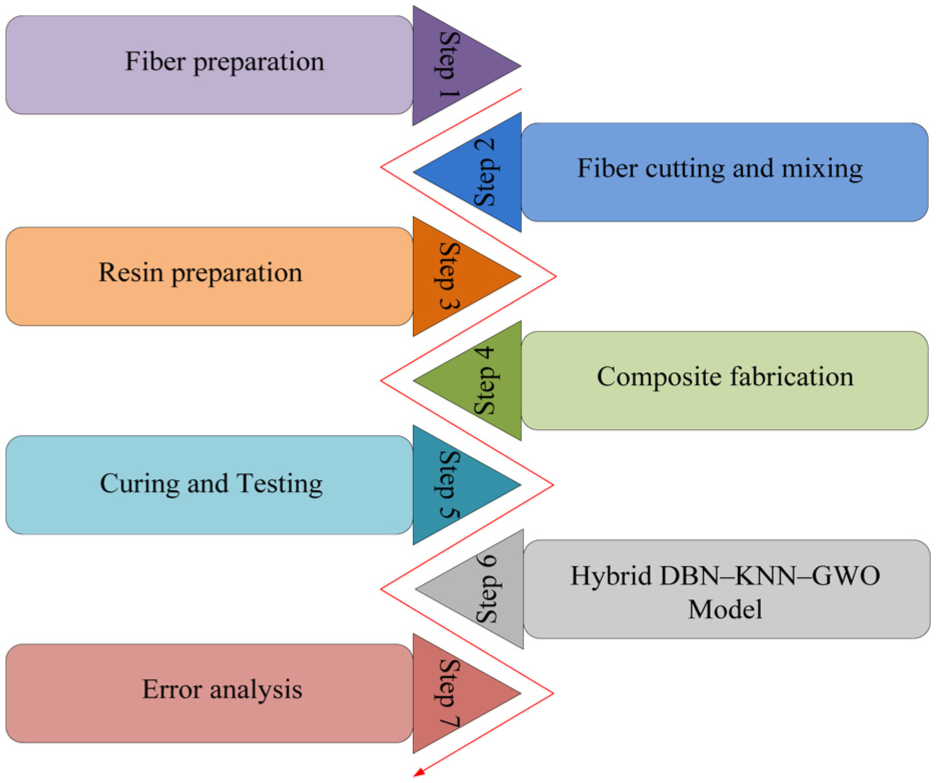
Overall workflow of the study.
Once cured, specimens were prepared according to ASTM procedures and then tested for TS, FS, IS, and MA. RSM was used to design the experiments and analyze the effects of jute fiber content (%), coir fiber content (%), fiber length (mm), and alkali treatment concentration (%, wt) on the output responses.
The experimental data were normalized to create a hybrid DBN–KNN–GWO model, in which the DBN performed feature extraction, the GWO optimized the model’s hyperparameters, and the KNN algorithm predicted the composite properties.
The DBN–KNN–GWO model was assessed using RMSE, MAE, and R2 metrics against conventional machine learning models to validate its predictive accuracy.
Materials selection
Jute and coir fibers (Figure 2) were chosen as the reinforcement materials due to their complementary properties, ease of availability, low cost, and eco-friendliness. Jute fibers have high TS, stiffness, and load-carrying capacity, which make them suitable for enhancing the strength properties of polymer composites. However, coir fibers exhibit better impact resistance, toughness, and water resistance due to their high lignin content, making them suitable for enhancing durability in wet conditions. The combination of jute and coir fibers provides the strength of jute and the toughness and water resistance of coir, resulting in a well-balanced composite with enhanced mechanical properties and water resistance. Moreover, both jute and coir fibers are biodegradable, eco-friendly, and have low carbon footprints, which makes them suitable alternatives to synthetic fibers.
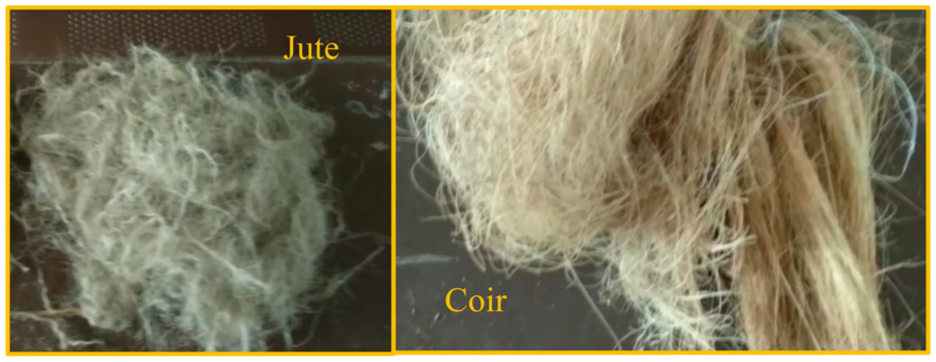
Jute–coir fibers.
Epoxy resin (LY556) and hardener (HY951) were chosen as the matrix material (Figure 3) due to their superior adhesion to natural fibers, ease of handling, and suitability for hand lay-up techniques. The saponification of jute and coir fibers was performed on all samples (S1–S6) using a 6% (w/v) NaOH solution in an effort to remove the waxy and hemicellulose surface contaminants present in both types of fibers and to enhance their interfacial adhesion with the matrix by increasing the roughness of the fibers ' surfaces. The fibers were submerged in a 6% NaOH solution at ambient temperature for 4 hours, washed thoroughly in distilled water until the pH reached neutrality, and then dried for 24 hours at 60°C in the oven before cutting and composite fabrication. This process ensured uniform treatment across all test specimens, resulting in higher mechanical properties and lower water absorption.
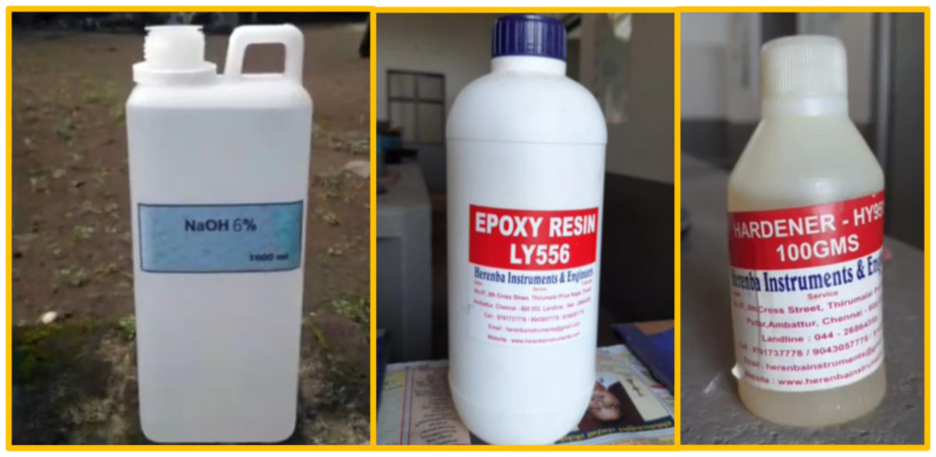
Materials used for composite fabrication: NaOH (6%) for fiber treatment, epoxy resin (LY556), and hardener (HY951).
Fiber and resin preparation
The jute and coir fibers were cleaned, alkali-treated with 6% NaOH solution, and oven-dried. The treated fibers were then cut to an optimal length of 20 mm to enhance stress transfer and mechanical properties. The fibers were then mixed in the desired weight ratios of jute to coir and stacked in an alternating manner (jute/coir/jute/coir) to ensure equal distribution of reinforcement.
The epoxy resin and hardener were mixed a weight ratio of 10:1 and used as the matrix to impregnate the stacked layers of fibers before composite curing.
Hand-lay-up and fabrication process
Stacking of the coiled jute and coir fibers inside the mold (Figure 4) was prepared in the correct orientation. The epoxy–hardener mixture was applied in layers to the fibers via fibers impregnation, whilst a roller was used to remove air from the laminate. The laminate was cured and compressed at room temperature, demolded, and cut into standard test samples.

Sequential fabrication process of jute–coir composite.
The details of the fabrication of jute–coir hybrid epoxy composites with a fixed ratio of 60:40 for fibers and matrix, respectively, are given in Table 1. Various stacking sequences were used to investigate the influence of fibers layering on the mechanical and moisture resistance of the composites.
Fabrication details of jute–coir hybrid epoxy composites.
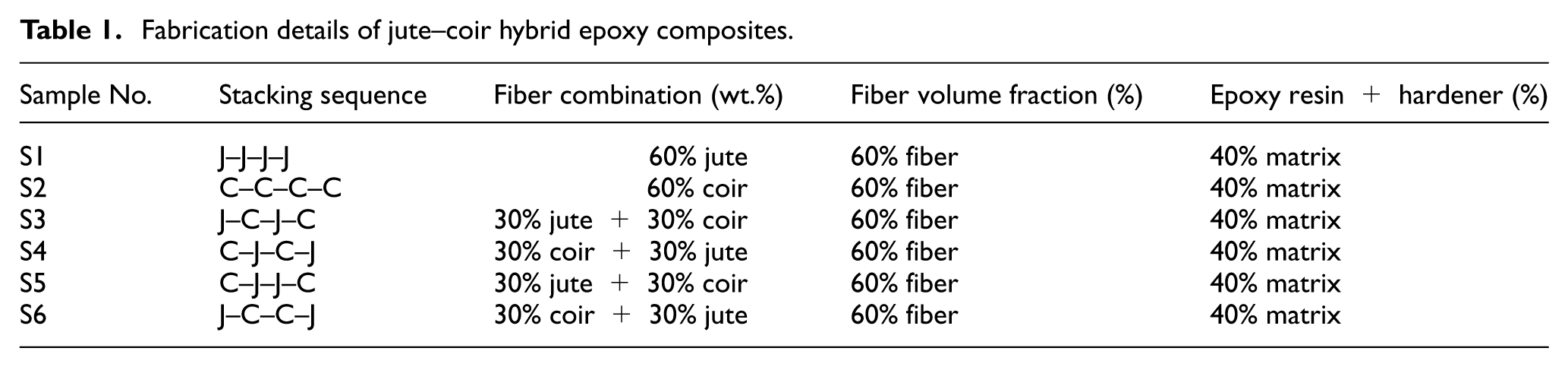
The sample preparation was performed by systematically varying the fiber type, stacking pattern, and content to assess their effects on mechanical properties and moisture uptake. The two pure fiber samples, S1 and S2, were created from jute and coir, respectively, to provide the standard benchmarks for the maximum strength and toughness. Four hybrid specimens, S3–S6, were created with different stacking patterns to determine the interaction of the jute–coir combination and the effect of the stacking pattern on mechanical behavior and moisture uptake. The fiber–matrix volume fraction (60/40) was consistently maintained to allow equal comparison of all specimens. The choice of fiber length and alkali solution concentration was made after reviewing the existing literature and conducting preliminary trials.
Selection of parameters
The input variables, such as jute fiber fraction, coir fiber fraction, fiber length, and alkali treatment concentration, were selected for their significant effects on fiber–matrix bonding, stress transfer, and moisture resistance in natural fiber composites. Jute fibers are responsible for strength and stiffness, coir fibers are responsible for toughness and impact resistance, fiber length is responsible for stress transfer efficiency, and alkali treatment is responsible for improving the interfacial bonding between the fibers and the matrix. The output variables, such as TS, FS, IS, and MA, were selected for their direct relationship with the hybrid composite’s performance.
Mechanical testing
Tensile test
The tensile test measures the maximum stress the composite can withstand under uniaxial tension before failure 30 :

where
Flexural test
The flexural test indicates the material’s resistance to bending under a three-point loading condition 31 :

where
Impact strength test
The IS test represents the ability of the composite to absorb energy during sudden fracture 32 :

where
Moisture absorption test
The MA test quantifies the percentage of water absorbed by the composite after immersion 33 :

where
The ASTM mechanical testing protocols were followed for mechanical strength; tensile testing was performed to determine the ultimate stress under uniaxial loading. Flexural testing was performed with a three-point bending configuration to establish bending strength. Impact testing was conducted to measure the total energy a composite could absorb on impact. The moisture absorbance test was conducted using a water-immersion system, with the weight gain observed after immersion serving as a measure of the composite’s MA. Each type of test, and multiple trials of each type of test, were conducted on each type of test sample, and the average measurement of each type of test will be analyzed for the next stage of analysis.
Response surface methodology
RSM is a statistical and mathematical tool for modeling and optimizing the relationship between several input variables and one or more response variables. It is used to understand the individual, interaction, and quadratic effects of process variables on the performance of composite materials by reducing the number of experimental trials. 34
In this research, RSM was used to analyze the effects of jute fiber content (A), coir fiber content (B), fiber length (C), and alkali treatment concentration (D) on the output responses of TS, FS, IS, and MA. 35 A quadratic model was used to predict the responses:
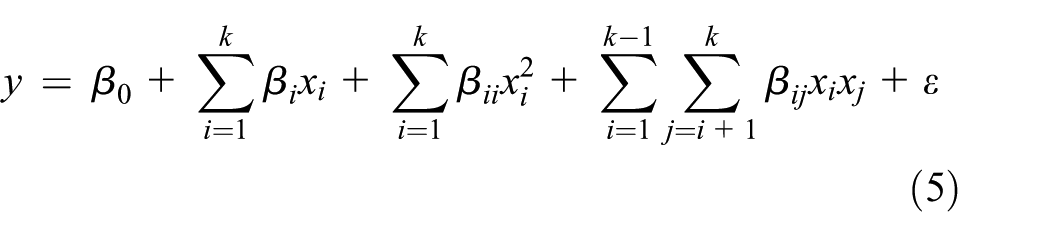
where,
Application of hybrid AI model
In the proposed AI model framework, the input vector represents the set of experimentally controlled parameters that govern the behavior of the jute–coir fiber composite. It is defined as

where
Deep Belief Network
A deep learning algorithm consisting of a series of RBMs stacked together. It can automatically extract complex nonlinear features from experimental input data. 36 In this work, a DBN is employed as a feature extractor to identify relationships between processing variables (jute, coir, fiber length, and alkali concentration) and composite performance, using hidden features.
We used a Restricted Boltzmann Machine (RBM) energy function:

where
Joint probability expressed as

where
Feature extraction is expressed as

where
k-Nearest Neighbor
KNN is a simple and efficient machine learning algorithm that makes predictions of output values based on the closest data points in the feature space. In the current research, KNN is employed as the final prediction model, where the deep features obtained from the DBN are used as inputs. This enables the estimation of the TS, FS, IS, and MA of the composites. 37
Euclidean distance is expressed as

where
Regression output is expressed as

where
Grey Wolf Optimizer
GWO is a metaheuristic optimization algorithm inspired by the social hunting behavior of grey wolves. 38 In this study, GWO is used to optimize the hyperparameters of both the DBN (number of hidden neurons and learning rate) and the KNN (number of neighbors and distance metric) to minimize prediction error.
Coefficient vectors were expressed as

where
Distance update is expressed as

where
Position update is expressed as

where
The proposed DBN–KNN–GWO model is employed to predict and maximize the mechanical and moisture performance of jute–coir fiber composites. The proposed model minimizes experimental cost and time by accurately predicting output properties and optimizing processing parameters to achieve maximum strength and minimum MA.
Key contributions of the study
The main findings from this study can be summarized as follows.
Development of hybrid composite wafers using various stacking sequences and processing parameters.
Assessment of tensile, flexural, impact, and MA properties of the composites.
Analysis of the effects of variation of fiber content, cut lengths, and alkali treatment using RSM.
Development of a new hybrid model applying DBN, KNN, and GWO to provide an accurate prediction of multiresponse variables.
Generation of better predictions than conventional techniques characterized by R2 values and error metrics.
Establishment of an optimal processing set of parameters that will yield the best mechanical properties and lowest MA characteristics.
Results and discussion
Experimental results
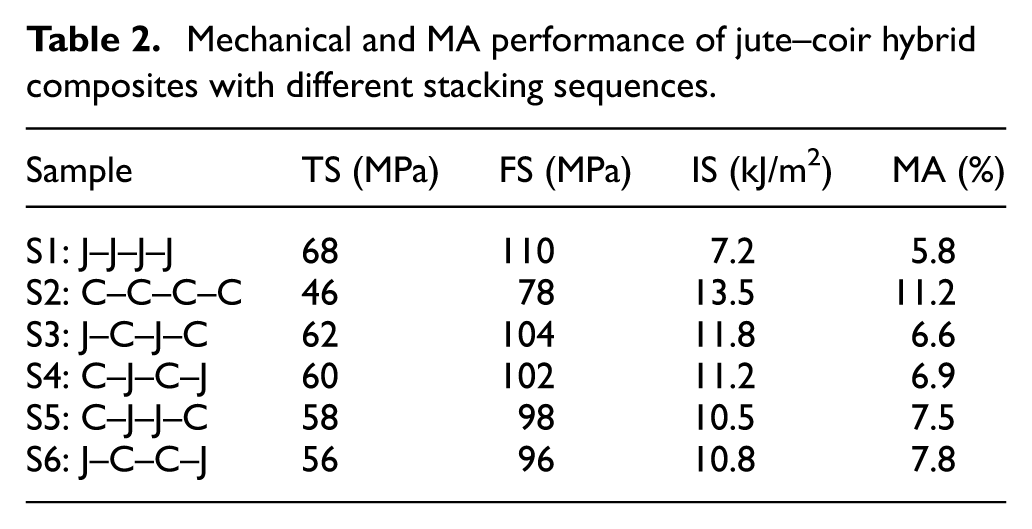
An analysis of the results (Table 2) reveals that the stacking sequence significantly affects the mechanical and moisture properties of jute–coir composites. S1 (J–J–J–J) has the highest tensile and FS because of the stiffness of jute, but it is not impact-resistant. S2 (C–C–C–C) has the highest IS due to coir’s ductility, but it has low strength and high MA. The hybrid laminates (S3–S6) exhibit balanced properties of both fibers. Among these, S3 (J–C–J–C) has the best overall properties, which are high strength, good impact resistance, and low MA, and hence it is the best stacking sequence.
Mechanical and MA performance of jute–coir hybrid composites with different stacking sequences.
RSM-BBD model analysis
Table 3 presents the experimental data set developed for jute–coir hybrid composites with four variables: jute fiber content (A), coir fiber content (B), fiber length (C), and concentration of alkali treatment (D), and four responses: TS, FS, IS, and MA.
Input factors of RSM-BBD.
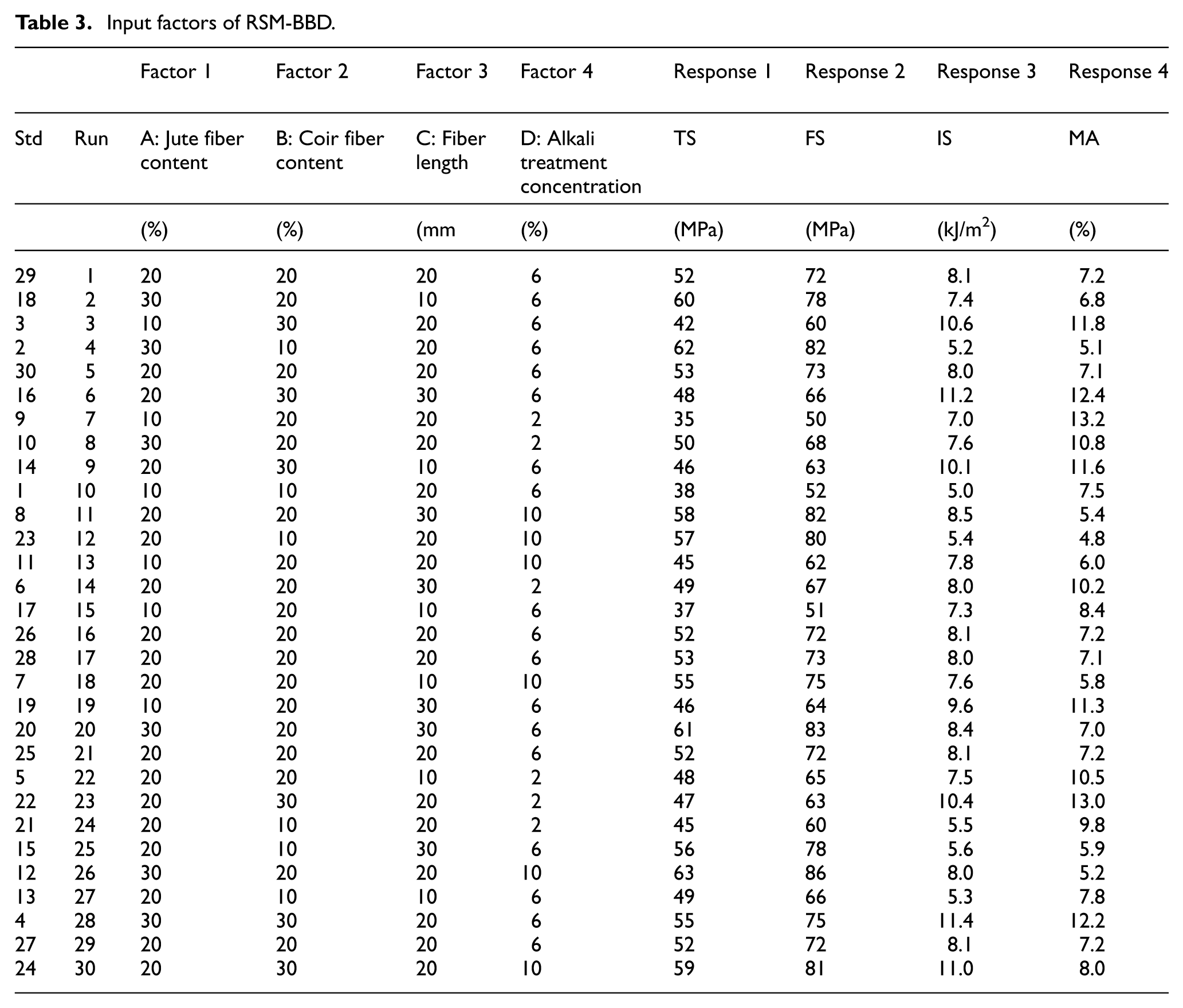
The experimental design was developed using a response surface approach with multiple center-point replicates to ensure accurate error analysis of the results.
The data indicate that increasing jute fiber content enhances TS and FS, whereas increasing coir fiber content enhances IS but increases MA. A fiber length of 20 mm is ideal for maximum strength due to efficient stress transfer, while fibers of shorter or longer lengths are not desirable. An alkali treatment of 6–10% concentration is ideal for enhancing mechanical properties and minimizing MA due to improved fiber–matrix interaction.
ANOVA for quadratic model
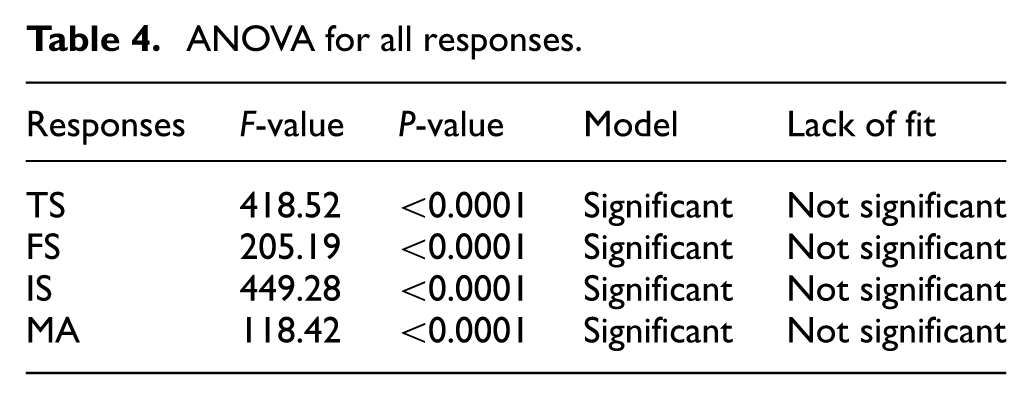
The analysis of variance (ANOVA) tables (Table 4) show that the models developed for all four responses are highly significant, as evident from the very high F-values and P-values less than 0.0001. This reveals that the input variables significantly affect the TS, FS, IS, and MA properties of the composite material. The nonsignificant lack of fit for all four responses confirms that the models developed are a good representation of the experimental data and that no significant terms are being ignored.
ANOVA for all responses.
Fit statistics
The fit statistics (Table 5) confirm the high accuracy and reliability of the models obtained. The extremely high R2 values (≥ 0.991) indicate that the models accurately account for more than 99% of the variation in all responses. The close agreement between adjusted R2 and predicted R2 values indicates strong model stability and predictive power. The low standard deviation (SD) values indicate negligible experimental error, and the high adequate precision (>40) further confirms an adequate signal-to-noise ratio. The models are highly suitable for prediction and optimization.
Fit statistics.

Perturbation analysis
The perturbation plots (Figure 5) demonstrate how each input variable affects the responses by varying one variable at a time from the key point while holding the others fixed. In the case of tensile and FS, the greatest slope is observed for factor A (jute fiber content), followed by D (alkali treatment concentration) and C (fiber length). In contrast, B (coir fiber content) has a relatively weaker and slightly negative effect. In the case of IS, B (coir content) has the strongest positive effect, thus reiterating the fact that coir content has a positive effect on IS. In contrast, the other factors have only a relatively minor effect. In the case of MA, the greatest effect is observed for D (alkali treatment), which significantly reduces water absorption; A follows, while B increases water absorption, and C has only a relatively minor effect.
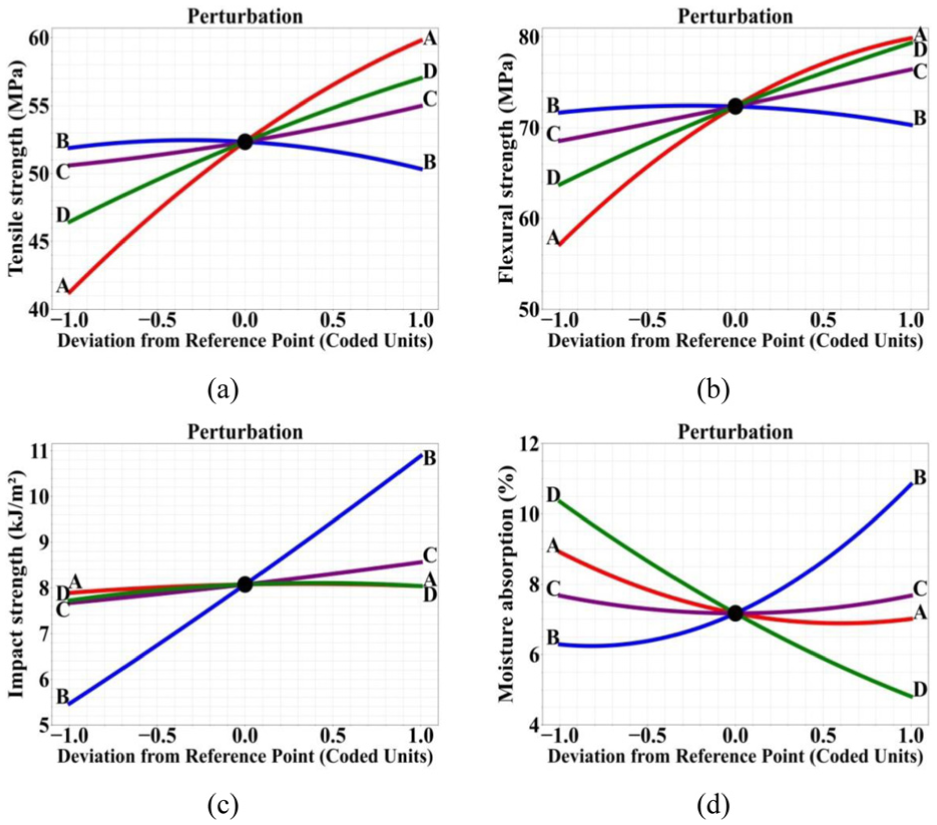
Perturbation plots: (a) TS, (b) FS, (c) IS, (d) MA.
Optimization
The desirability chart (Figure 6) illustrates the optimal combination of input variables that simultaneously maximizes the mechanical properties and minimizes the MA. The optimal values are 28.32% jute, 23.07% coir, 29.99 mm fiber length, and 9.9% alkali treatment, which gave the following results: TS = 63.82 MPa, FS = 88.84 MPa, IS = 9.41 kJ/m2, and MA = 6.26%. The total desirability of 0.937 (nearly 1) indicates that this solution is an excellent trade-off across all responses and yields the best multiobjective optimization outcome.
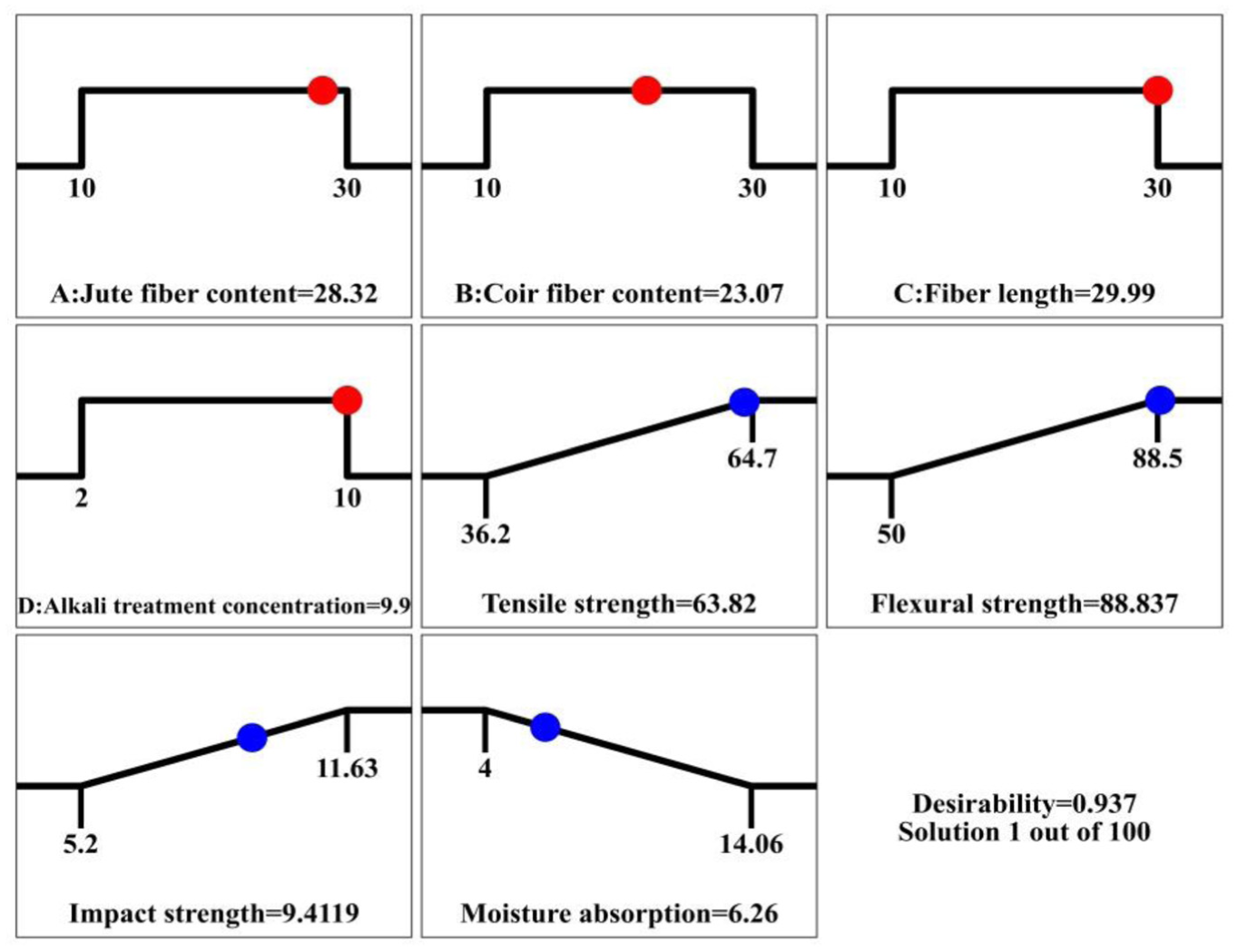
Desirability plots.
A comparison has been made between the mechanical and absorption properties of the jute–coir hybrid composite with those of other natural fiber epoxy composites. The tensile (up to 68 MPa) and flexural (up to 110 MPa) strengths obtained were comparable or somewhat greater than those of typical jute/epoxy composites, and coir-rich composites provided higher IS than that predicted in the literature (IS = 13.5 kJ/m2). The MA rate (5.8–11.2%) was lower than that of most untreated natural fiber composites (12–15%), suggesting that alkali treatment has enhanced durability and improved bonding between fiber and matrix. Collectively, these results indicate that the proposed hybrid system is performing competitively, if not at least as well as currently available natural fiber-based composite materials.
Comparison of prediction and optimization results
The graphs (Figure 7) of the comparison results illustrate the experimental values of TS and FS, side by side with the predictions from the RSM, SVR-GS, ANN-PSO, and the hybrid DBN–KNN–GWO model across all 30 runs. The hybrid DBN–KNN–GWO model graph closely matches the experimental results, with minimal deviation, indicating the highest prediction accuracy. The other models, ANN-PSO and SVR-GS, are moderately close to the experimental results with some deviations, while RSM has the largest deviations and over/under predictions. Thus, it is clear that the hybrid DBN–KNN–GWO model has the best prediction capability among the models.
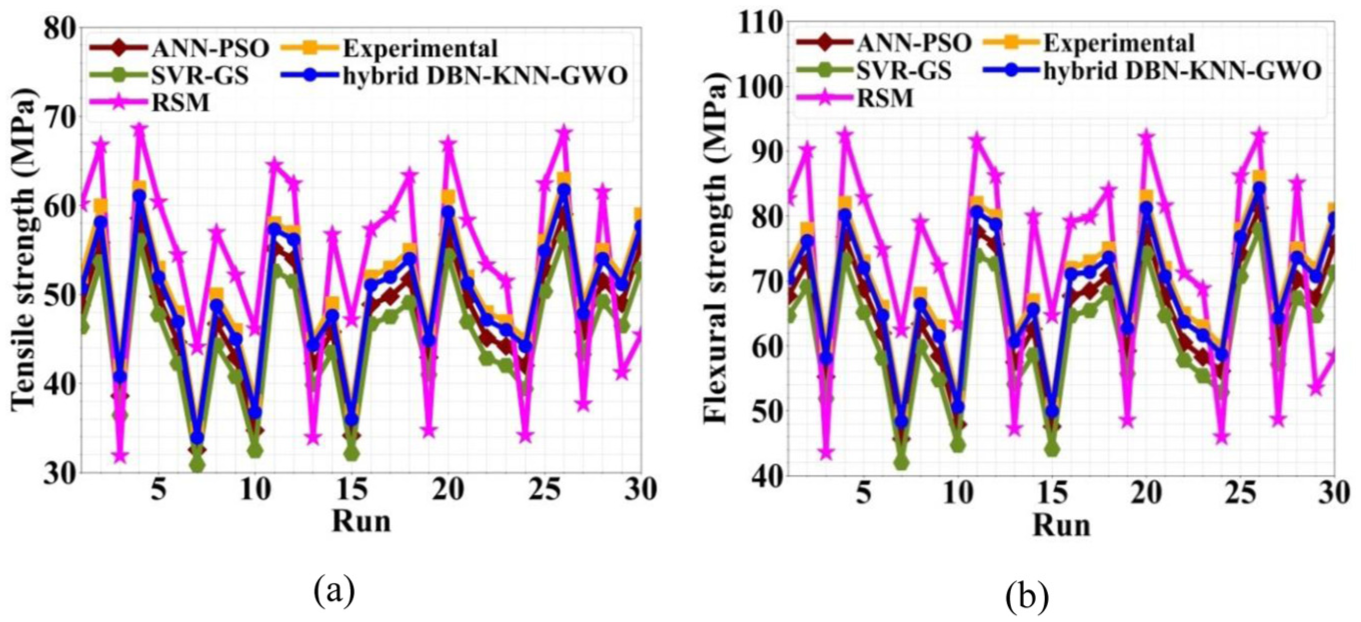
Comparison results: (a) TS and (b) FS.
The graphs (Figure 8) compare the experimental IS and MA values with the predicted values from RSM, SVR-GS, ANN-PSO, and the hybrid DBN–KNN–GWO model for all 30 runs. The hybrid DBN–KNN–GWO model shows curves that closely follow the experimental values, with less deviation, indicating the highest accuracy. The ANN-PSO and SVR-GS models have moderate accuracy, whereas RSM exhibits large deviations and errors, especially at the endpoints. This indicates the reliability of the hybrid model.
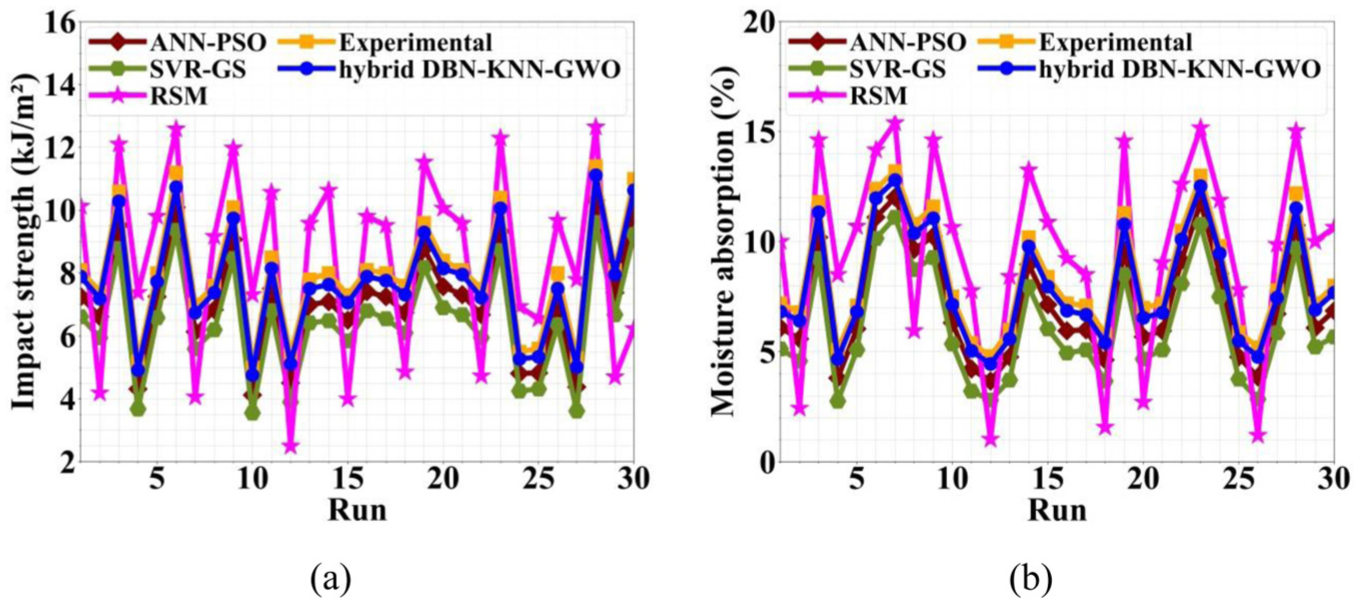
Comparison results: (a) IS and (b) MA.
Error analysis
The graph (Figure 9) showing the error analysis of MSE, MAE, and RMSE for the ANN-PSO, SVR-GS, RSM, and hybrid DBN–KNN–GWO models indicates that the hybrid DBN–KNN–GWO model has the lowest values for all three error measures, which makes it the most accurate and stable model. The RSM model has the highest error values, which makes it the least accurate model, as already established. The ANN-PSO and SVR-GS models have moderate error values, but these are higher than those of the hybrid model.
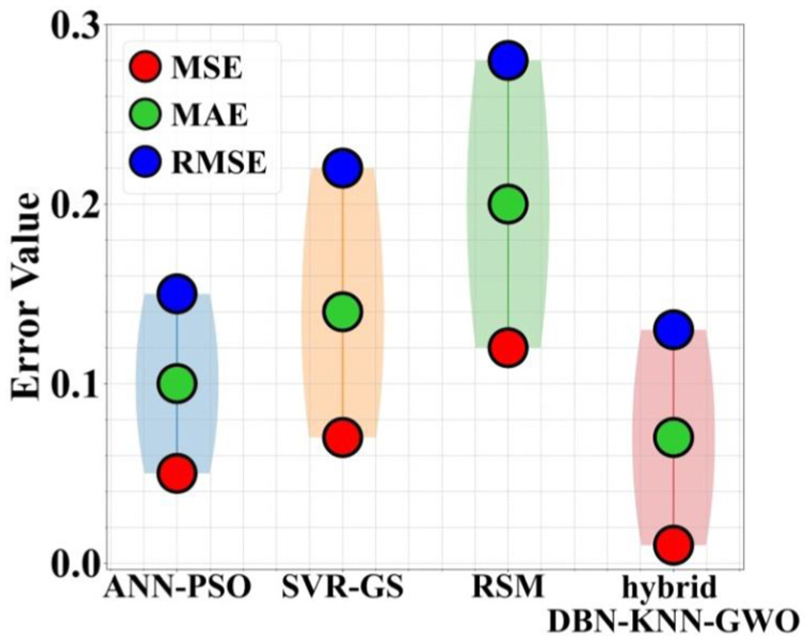
Error analysis.
Conclusion
We can draw the following conclusions from our work.
Jute–coir hybrid composites were successfully developed and tested for their tensile and impact properties, as well as MA.
S1 (J–J–J–J) showed the highest TS (68 MPa) and FS (110 MPa) because of the stiffness of jute fibers.
S2 (C–C–C–C) showed the highest IS (13.5 kJ/m2) but also the highest MA (11.2%) because of the toughness and hydrophilic nature of coir fibers.
S3 (J–C–J–C) offered a balanced performance: TS 62 MPa, FS 104 MPa, IS 11.8 kJ/m2, and MA 6.6%.
RSM analysis: TS/FS increases with the increase in jute fiber proportion, and IS increases with the increase in coir fiber proportion, but MA increases.
The hybrid DBN–KNN–GWO model showed excellent prediction capability with R2 values ≥0.991, predicted R2 values ≥0.948, and adequate precision values >41.
Multiobjective optimization: The optimal parameters are 28.32% jute, 23.07% coir, 29.99 mm fiber length, and 9.9% NaOH treatment, which result in high mechanical properties and low MA.
The work demonstrates the applicability of experimental design and hybrid AI modeling for efficient, accurate prediction of natural fiber composite properties.
The composite of jute and coir has shown significant future application potential in the production of jute–coir hybrid composites.
Composites with more jute content have been shown to exhibit greater tensile and flexural capabilities and could be utilized in load-bearing components (e.g., automobile interior panels, lightweight structural boards, and construction materials).
Coir-dominant composite will offer much better IS than jute-dominant composites and could be used in applications that require energy absorption (e.g., packaging materials and protective panels).
The hybrid composite configuration optimally balances mechanical properties and reduces water absorption, making it ideal for semi-structural applications in wet environments (i.e., marine applications).
Limitation and future scope
This research was carried out only on jute–coir hybrid composites with a defined number of stacking configurations and fiber lengths, and with an epoxy matrix. There is no consideration of environmental factors such as ultraviolet light resistance, thermal stability, or high humidity. The limited experimental data limits the use of the proposed DBN–KNN–GWO model for creating generalized rules and may not produce totally reliable predictions when making those predictions outside the trained range. An inability to provide tensile and flexural stress–strain diagrams because continuous strain data was not captured also limited the data set. Lastly, no information was collected on surface morphology through scanning electron microscopy (SEM) during this current study; SEM is a useful technique for additional insight into the interfacial bonding between jute senior composite and epoxy matrix as well as to failure mechanisms. Further, the performance study focused primarily on TS, FS, IS, and MA as key indicators of composite material performance; other mechanical characteristics such as hardness, fatigue resistance, interlaminar shear strength, and dynamic mechanical analysis could provide additional insight into long-term performance. Future research should include exploring different types of natural fibers in combination with different matrices, and conducting a detailed micro analysis and well as a durability analysis under a variety of environmental conditions.
Footnotes
Declaration of conflicting interests
The authors declared no potential conflicts of interest with respect to the research, authorship, and/or publication of this article.
Funding
The authors received no financial support for the research, authorship, and/or publication of this article.
Replication of results
The results reported in this study can be reproduced using the methods, data, and parameters described in the manuscript.

Data availability statement
The authors confirm that the data supporting the findings of this study are available within the article [and/or] its supplementary materials.