







Abstract
Among the various iconographies of the Trinity which emerged in Christian art, the three-headed or trifrons image has a contested history. Warned about and censured by two popes, Urban VIII and Benedict XIV, this iconography, despite condemnations, was applied, however, by leading Renaissance artists and survived into the nineteenth century in folk art. This article considers its pre-Christian background, the sixteenth-century theological debates, and, finally, in a detailed engagement with a range of tricephalous images, it critically reevaluates and seeks to demonstrate the disputed orthodoxy of this iconography from a theological, artistic, and aesthetic perspective.
Keywords
Throughout Christian history artisans and artists have attempted to image the divine, being aware, of course, that any visual image of God is and always remains inadequate. Neither word nor image can ever capture the transcendent mystery of God, the Holy Other. In that sense any attempted images of the divine may provide us at most with tiny glimpses of divine mystery. Once these limitations are acknowledged, however, the human imagination is free to engage with the reality of God in artistic fashion, be it through music, literature or the visual arts. 1
In this article I will engage with one of the most peculiar iconographies in art with Christian subject matter, the tricephalous (three-headed or three-faced) image of the triune God, also referred to as trifrons. Among the various trinitarian iconographies, such as the Gnadenstuhl (mercy seat) or the “societal” image of the “Old Testament Trinity” (Gen 18), for example, this type has received relatively little attention among art historians and even less among theologians, apart from the debates about it in sixteenth-century Counter-Reformation theology. Due mainly to its pagan associations, it was to become one of, or even the, most controversial of all trinitarian iconographies. While it held a certain fascination among believers and artists, theologically and doctrinally such images were disputed, frowned upon, and rejected by leaders of the church. In the seventeenth and eighteenth century two popes warned against and basically prohibited them, yet such images continued to be painted and sculpted into the nineteenth century in devotional and folk art.
In the following, first I will trace their pre- and non-Christian origins, connections, and disconnections. Second, I will consider their development in Christian history and the ensuing theological controversies and prohibitions. Third, as these images have been usually considered in somewhat general, categorical terms without detailed examination, I will attempt a more in-depth analysis of some representative examples of this iconography. My overall framework thus is not a discussion of early Christian theological debates on the trinitarian relations of Father, Son, and Holy Spirit and ensuing pre-Nicean heresies or later medieval and modern developments in trinitarian theology. Rather I will focus on an examination of the emergence, history, and theological-artistic contents of one specific trinitarian iconography, the trifrons, with a view to defending its contested theological orthodoxy. The final part, in particular, will uncover how artists have approached the tricephalous rendering of the God of the Christians and reveal a surprisingly wide spectrum of trinitarian-theological dimensions in their works. Instead of upholding the historically condemnatory attitude towards such images as being “monstrous” or “tritheist,” my central aim hence will be to challenge those claims and demonstrate that the artists, in fact, strove for Christian orthodoxy with sincerity and imagination. It is hoped that the theological-doctrinal and artistic aspects rendered in the three-headed imagery of the Trinity will thus gain greater appreciation.
Pre-Christian Origins
The Italian historian of religion, Raffaele Pettazzoni (1883–1959), is one of the few scholars who concerned himself with this subject in an article published in 1946. 2 He suggests that in the European pre-Christian world a three-headed, or three-faced, god “held an important position” among the Celts of Gaul. Yet, in Germanic tribes such representations appear to have been almost nonexistent. In the Balkans, especially in the region of today’s Bulgaria, two-faced images were reproduced on steles in the second and third century, while among the Baltic Slavs, idols existed of the god Triglav (meaning “three-headed”). Some temples of this god existed near the town of Szczecin (Stettin) in Poland. According to Ebbo (ca. 775–851), the three heads of Triglav were believed to represent sky, earth, and the underworld; Triglav was seen as the ruler over these three kingdoms. Apparently he was rendered as a man, or as a man with three goat heads, and sometimes with a golden blindfold over his eyes and lips so that he would be unable to see people’s sins or speak about them. 3 Polycephalous gods may have spread from Balto-Slavic regions (e.g., the island of Rügen) towards Finnish and Siberian areas. Pettazzoni further speculates that religious ideas coming from central and southern Asia also may have penetrated representations of polycephalous deities, for example, the “cosmological conception of the seven heavens,” as well as “the iconographical motive of the many heads distributed one above the other” as present in many figures in Tibetan Buddhism and in Indian Shaivism. 4 Similar painted or carved iconographies were found in Obdorsk, Siberia, and in the river Zbruč in today’s Ukraine.
Pettazzoni makes a considerable leap when he suggests that the various pagan deities in Celtic and Slav cultures represented in tricephalous form were “probably, at bottom, one and the same god.” 5 While he does not substantiate this further, he concludes that this evidences a “certain religious unity” in ancient Europe with a “common veneration for this god” whose tricephalous appearance “must have been an essential characteristic.” Thus, he notes that the existence and presentation of this god in tricephalous form across Europe was to be important for “the genesis of three-headed images of the Trinity.” 6 Pettazzoni’s analysis here is reasonable and may well be correct, but one has to be aware that although his conclusion that the various tricephalous gods are basically representations of one god is plausible, it remains speculative. Moreover, if this were true and put to its extreme conclusion, one would wonder whether our ancient forebears whom we always associate with a more “primitive” polytheist worldview, were, in fact, more monotheist than our general perceptions and prejudices would acknowledge.
The German Indologist Willibald Kirfel (1885–1964) also studied the appearance of three-headed images of gods in various Indo-European religions and cultures. Kirfel suggests that the “creator and carrier of tricephalous images must have been a pre-Indo-European cultural sphere which included mainly the Mediterranean world including Gaul” 7 from which emerged the ancestors of the Joruba to the south and ancestors of the Dravidian and other peoples to the east in India. He suggests that three-headed figures originally did not belong to Hinduism but to a people of “non- or pre-Aryan character.” 8 Yet, examples of three-headed figures in the pre-Vedic Indus valley civilization seem to appear as early as the third millennium BCE. Centrally important and the most complex in the later Hindu spectrum of deities was Shiva, who came to be represented in triadic form as creator, sustainer, and destroyer. A seal of a possible proto three-headed Shiva figure was found in the excavated city of Mohenjo-daro (ca. 2600–1900 BCE) (Fig. 1). 9
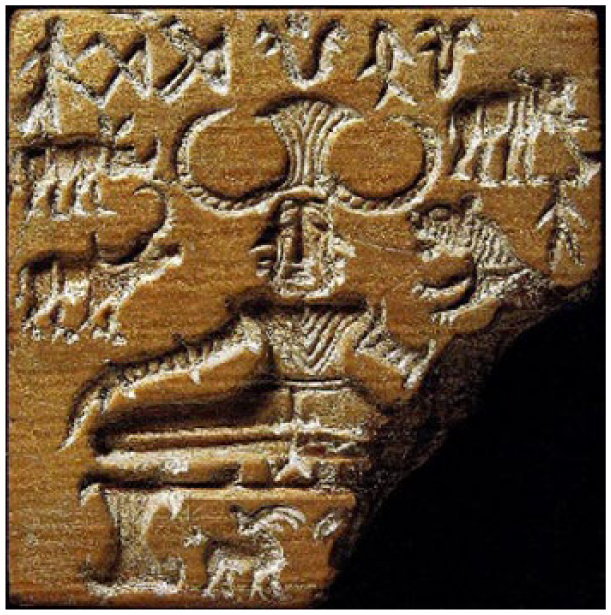
The Shiva Pashupati seal (Sanskrit paśupati: Lord of Animals), Mohenjo-daro, Indus Valley, public domain (Wikipedia).
Later in Greek antiquity, the gods of the pantheon, in order to avert disasters, would be called upon in threes. Important gods and goddesses like Hecate and Hermes were depicted with three heads. Fundamental, from India to Greece, Gaul, and the Slavo-Baltic regions, was, of course, the importance of the number three. Essentially it seemed to connote an intensification, the intention to emphasize the divinity and sacred power of the god by depicting him or her with two, three, or more heads, rather than just with one. The triad indicates, as David Brown remarks, the “presence of something rather more than the natural power.” 10 If the head was seen as the life-force and thus as containing the essence of the gods, it would have made sense to reinforce the sense of power by depicting the god with multiple heads. Further, the polycephalous deity’s power is conveyed through their ability of looking simultaneously in two, three, or all directions, implying a god who is all-seeing, thus all-mighty—a notion which, significantly, is also evidenced in the Jewish and Christian biblical tradition. Further, here we also encounter the solar association of the polycephalous gods. The sun was worshipped as divine in most ancient cultures and was perceived as possessing that all-seeing capacity, a capacity which was attributed “more properly” to the sun than to any other deity. 11 In fact, it does not surprise that later in the Christian tradition the sun and the related halo were inculturated and frequently appear as symbols of God and/or Christ.
Why some gods had three heads (e.g., Triglav, Shiva, Hecate), two (e.g., Janus in Roman mythology), four (e.g., Svantevit in Slav mythology), or even more is not so obvious. In Hinduism deities continue to be depicted in polycephaly, such as Brahma with four heads, to this day. What the concept and images of polycephalous deities fundamentally evoke, then, is their difference, otherness, and power vis-à-vis humans and the world. One could argue, in fact, that this desire to clearly distinguish, through polycephaly, the divine from the human marks the pagan world and myths as closer to notions of the almighty, sovereign Christian God than they may be given credit for from a Christian perspective. The perspective has often been marked by notions of unquestioned superiority and condescension towards the pre-Christian “pagan” world.
In Roman Gaul various images of three-headed gods were also found. Pettazzoni notes that these appear to have had connections with earlier depictions among the Celts of the Danube region as well as with images in more remote Mediterranean and Asiatic (Persian) cultures. While full human figures were rare in Celtic art, the figures of heads were recurrent, especially from the fifth to the first century BCE and beyond. A fine example of a three-faced head, carved in stone around the second century BCE, was found in County Cavan in Ireland (Fig. 2). 12
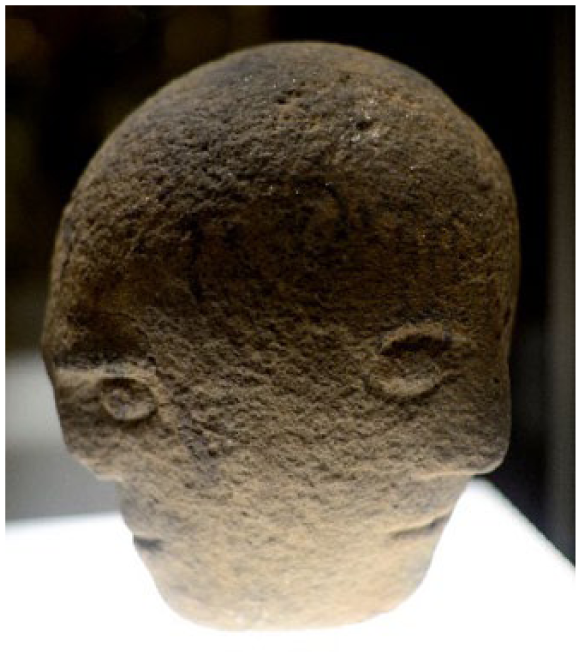
Three-faced head, ca. second century BCE, Corleck, Cavan, National Museum of Ireland, Dublin, O.S. Muhammed Amin, Creative Commons:Attribution-NonCommercial-ShareAlike.
Archaeologist Miranda Aldhouse-Green points out that the human head was considered a sacred symbol containing the essence of the person or of the god among the Romano-Celts and late Iron Age Celts in Gaul. Some tribes decapitated the heads of their enemies and kept them as treasures in shrines as objects of significant value. At times the importance of the head was manifested through its disproportionately large size in comparison to the rest of the body. 13 Echoes of such representations are found in Christian art whereby Mary or Christ may be rendered larger in size than the other holy figures or in relation to the background in an image, such as Giotto’s Ognissanti Madonna (Uffizi Gallery, ca. 1310) or Jan van Eyck’s Madonna in the Church (1438–40).
Once Christianity was spreading, pagan representations of deities with multiple heads, such as Triglav, Zuarasič, Rugievit, and Svantevit, were destroyed. The early Christians with some urgency aimed to propagate the Good News and truth of the one God which entailed iconoclasm towards both pagan idols and unorthodox images of the Christian Trinity. For this reason, the oldest images of the Trinity tended to be symbolic rather than figurative. Indeed, with a God who was now defined as being of one substance and three hypostases, an artistic rendering of such a paradoxical notion would prove intensely difficult: possible and impossible at the same time. While this difficulty safeguarded the total otherness, the mystery of God, it also demanded and inspired intellectual curiosity and artistic imagination.
The dogma of the Trinity evolved over several centuries and gave rise to heresies and strife within the early church and from without. Indeed, against possible charges of tritheism from Jewish, Greek, or later from Muslim thinkers, due to the Christian belief in a trinitarian yet one God, the Church Fathers were at pains to defend the unity and oneness of the divine. Boethius (ca. 480–524 CE), for example, deals with this issue in his treatise The Trinity is One God, Not Three Gods. He writes in no uncertain terms:
Catholic Christians, allowing no difference of merit in God, assuming Him to be Pure Form and believing Him to be nothing else than His own essence, rightly regard the statement “the Father is God, the Son is God the Holy Spirit is God, and this Trinity is one God,” not as an enumeration of different things but as a reiteration of one and the same thing, like the statement, “blade and brand are one sword.” … But since no relation can be affirmed of one subject alone … [the] Trinity is secured through the category of relation, and the Unity is maintained through the fact that there is no difference of substance, or operation, or generally of any substantial predicate. So then, the divine substance preserves the Unity, the divine relations bring about the Trinity.
14
Given the intellectual challenges in the idea of God perceived as being of one essence and three persons, it is not at all surprising that numerous artisans and artists were to depict God the Father, Son, and Holy Spirit as a three-faced or three-headed figure or as three identical human figures. Yet, it is the triadic iconography which could most easily hint at, and be misunderstood as, tritheism. It is for that reason that the early depictions of the Trinity were symbolic rather than anthropomorphic so as to clearly distance the Christian faith from pagan associations.
Pettazzoni does not advocate the condemnation of pagan origins of, and allusions to, the three-headed depictions of the Christian Trinity, but convincingly argues for “a positive contribution to the genetic problem of the three-headed type” of the Trinity. He points out that earlier scholars, like the French art historian and archaeologist Adolphe Napoléon Didron in the nineteenth century, held that this iconography arose in medieval France, from where it spread through Europe. This theory was strengthened by three-headed sculptures found on Gallo-Roman monuments and later on Romanesque churches: “the genetic continuity is shown by the persistence of certain iconographical details (e.g., the four eyes for the three faces) which were transmitted from ancient to mediaeval art.” 15 Yet, importantly, Pettazzoni concludes that the existence of a tricephalous god among other European peoples, such as in the Balkans and in other parts of Europe, as mentioned earlier, seems to indicate that the origins for the three-headed Trinity were not mono- but polygenetic.
Moreover, he remarks that “there were two Christian applications of the pagan iconographical type of the three-headed god,—one diabolical, the other divine.” 16 Thus the devil would appear with three heads and/or horns on Christian monuments, as in the façade of the church San Pietro in Tuscania, Viterbo. It was obvious that for Christians concerned with faith in the one God, any pagan deity could only be a false “god,” that is, a demon or devil. Georg Troescher mentions that references to a tricephalous devil appear in Origen’s (d. 254) Commentary on the Letter to the Romans and in the apocryphal gospel of Nicodemus around 400 CE, as well as in a Good Friday sermon by Eusebius in the sixth century. 17
However, another, opposite, application emerged—instead of a degradation of the tricephalous god to a devil was “his sublimation as the divine Trinity.”
18
Pettazzoni offers a convincing explanation how these two opposing applications could occur. He comments that ideologically it is impossible to imagine that a three-headed devil could be the “immediate antecedent” of depictions of the Holy Trinity or vice versa. “That what is pagan may become Christian; but that which to Christianity itself was diabolical, cannot become divine.”
19
The two opposite applications, the divine and the diabolical, hence did not derive from one another, but both derived “directly from their common pagan prototype.” But the manner how they emerged from their pagan prototypes was different:
In the diabolical application there still vibrates the echo of the fight against paganism and the enthusiasm for the triumph of the faith. The divine application, on the other hand, is more meditative and calm; the figure of the pagan three-headed god is henceforward emptied of all religious content and reduced to a pure form, a form which seems to furnish the solution of an insoluble problem, that of the iconographical representation of the mystery of the Triune divinity.
20
The earliest tricephalous depictions of the Christian Trinity were later than those of the three-headed devil. The tricephalous depiction of the divine, as Pettazzoni argues, could only arise in a time which was “sufficiently distant” from paganism—a time when the possibility of its reemergence had long passed.
From our perspective, one might expect that these images were carried out by second-rate artists who might not have been among the intelligentsia of their time. Far from it. Artists who would apply this iconography included leading painters and sculptors like Andrea del Sarto, Antonio del Pollaiuolo, Fra Bartolommeo, Filippo Lippi, and Donatello. The first examples are found in the twelfth century, especially in French manuscripts. They spread into German, Italian, Austrian, Swiss, and Bohemian lands and apparently enjoyed particular popularity in Florence. 21 Three-headed trinitarian images came to be rendered in frescoes, paintings, and sculptures. They became frequent in the fourteenth century and peaked during the Renaissance, thus coinciding with the golden age of art with Christian subject matter. However, it was already in the fifteenth century that the first protests against these depictions occurred. With the Counter-Reformation and papal condemnations, in the seventeenth and eighteenth century they seem to have been produced less by leading artists, yet survived into the nineteenth century in folk art and popular devotion in Europe, in particular in Austria, Switzerland, Bavaria, and even as far as the New World in Latin America.
Theological Controversies and Prohibitions
Looking back in history, it is quite amazing and curious how this iconography of the three-headed Trinity emerged around the twelfth century and would survive over seven hundred years in Christian culture. As mentioned earlier, its origins have a strong link with Celto-Roman France as the cult of a three-faced deity appears to have been widespread in Gaul. 22 Echoing Pettazzoni, Alex Stock (1937–2016), formerly of Cologne University, noted that as it became possible to depict the deepest mystery of the Christian faith in tricephaly, this Christian iconography would not only manifest the negation of the native antecedent pagan religion, but also constituted a “sublimated fulfilment of its vision.” 23
It is not so surprising then that this imagery became popular in the fourteenth century, especially in France, Italy, the Balkans, and Spain, coinciding with the development of Renaissance art which also looked back to antiquity and aimed to show some continuity between the Christian mysteries and those of antiquity. “The desire of the Florentine humanists to discover vestigia trinitatis not only in the manifold triads of neo-platonic philosophy but also in mythology is obvious, whereby three-headed and three-faced figures also came to feature as trinitarian pre-figurations.” 24 Thus there was a desire to integrate both Old Testament prefigurations as well as pagan ones to show the Christian faith as the final, definitive, and universal religion. At the same time, however, Scholastic theologians began to voice their suspicions concerning such images with warnings about latent “paganization” in such works. Archbishop Antonin of Florence (1380–1459) was to provide the keyword which would be reiterated by other opponents of these depictions, namely that tricephalic images were “monsters”: “quod monstrum est in natura rerum.” 25 Three-headedness was an aberration, a disorder of nature and therefore considered anything but appropriate in imaging the divine. Hence these images came to be seen as apt for rendering the antithesis—the devil—and in this way were no longer seen as worthy of theological evaluation. 26 Yet, as Stock notes, perhaps it is in their strange otherness that they may point us to something which escapes the accepted images of the Trinity. Stock offers interesting interpretations of notable examples, including Andrea del Sarto’s Trinity.
Jan Hallebeek, in his article on papal prohibitions concerning images of the Trinity, examines instances in the history of the Catholic Church where particular depictions of the Trinity were forbidden, first by Urban VIII (1568–1644, pope from 1623) in the seventeenth century, and, over one hundred years later, by Benedict XIV (1675–1758, pope from 1740). 27 It was in the sixteenth-century context of the second major outburst of iconoclasm in Christian history that the question of images was addressed by Reformation and Counter-Reformation theologians. In response to the Calvinists’ staunch rejection of images, the Council of Trent issued a decree on saints and images in 1563 which stated that saints and images should continue to be properly venerated. However, it did not make specific references to depictions of the Trinity.
The question thus was not so much whether images of the Trinity should be allowed, but which ones were acceptable. Theologians, such as the iconodule John of Damascus (ca. 675–749), against the background of the first outburst of iconoclasm in the east in the eighth and ninth centuries, held that God became visible only in Christ and that images of the Father therefore were not permissible. After the end of this first wave of iconoclasm, however, images of the Father gradually began to emerge. 28 The hand or arm, symbol of the creator God, reaching down from heaven was one of the earliest and accepted symbols for God the Father and employed in art already from the fourth century onwards and based on Jewish origins. The human figure of the Father began to be depicted much later from the tenth century onwards, at first with the head of the Father, then the bust, and then the full body appearing by the thirteenth century. 29 Before 1000 CE depictions of the Father and Son as two human figures seem to have been rare or nonexistent.
François Boespflug divides the rendering of the Trinity in three phases:
“Allusion” to the divine trinitarian mystery in the fourth to eighth century;
“Exploration,” ninth to twelfth century, in which the central iconographies emerged;
“Flowering,” twelfth to fifteenth century, when the main iconographies expanded and were differentiated further.
With the rise of anthropomorphic images in the second millennium, some iconographies developed that would prove controversial: three men of same appearance, the three-faced and three-headed Trinity, and the “opening Virgin” shrine (Klappmadonna), statues of Mary which could be opened and had inside a mercy seat image (Gnadenstuhl) with the crucified Son, the Father, and the Holy Spirit. This image of Mary carrying the Trinity in her womb was criticized by theologians like Jean Gerson in 1396 and Jan Vermeulen (Molanus, 1533–85) on the basis that it might give rise to the doctrinal misconception that the whole Trinity was incarnate. 30
Scholastic theologians and medieval mystics, such as Anselm of Canterbury, Peter Lombard, Joachim of Fiore, Hildegard of Bingen, Mechthild of Magdeburg, Thomas Aquinas, and Richard of St. Victor, to name a few, were to reflect on the Trinity in their numerous writings. It is this growing interest in the dogma, along with the Renaissance interest in humanism and naturalism, which impacted on the proliferation and types of depictions of the Trinity, especially on the anthropomorphic and tricephalic iconography.
When trifrons images of the Trinity became popular, they were “immediately criticized by the vast majority of theologians.” 31 Jan Vermeulen of Leuven insisted that God should only be “depicted how he appears in the Scriptures to mortal beings,” for example, as the Ancient of Days (Dan 7:9) or enthroned (Rev 4). 32 While these biblical references were significant in the development of the iconography of God the Father, there are other places in the Bible, especially in John, which may have played a role in the type of the three-faced Trinity. In John, for example, we read: “If you know me, you will know my Father also. From now on you do know him and have seen him … Whoever has seen me has seen the Father. How can you say, ‘Show us the Father’? Do you not believe that I am in the Father and the Father is in me? The words that I say to you I do not speak on my own; but the Father who dwells in me does his works” (John 14:7–10; NRSV throughout). Except for the Jesuit Gregory of Valencia (1550–1603), who defended three-headed trinitarian images, claiming that they “expressed the unity of essence and the diversity of persons,” the majority of theologians from the sixteenth century onwards condemned their use. 33 The humanists and Counter-Reformation theologians considered them monstrous and diabolic. 34 Theologians who opposed these images include Jacques Masson (ca. 1475–1544) and Jean Hessels (1522–66) in Leuven; Francois Du Bois (1581–1649) of Douai, who noted that artists should only depict images which were approved by the church; Louis Richeome, SJ (1544–1625), of Lyon, as well as Gabriel Vasquez (1549/51–1604) and Roberto Bellarmine, SJ (1542–1621) in Rome, who warned that artists should not use their own imagination, 35 obviously sharing the then common view that art was no more than ancilla theologiae.
Interestingly, already prior to the Reformation some theologians had been critical of the veneration of images, including the rendering of the Trinity. Lucas Bishop of Tuy (d. 1249), a historian and intellectual, argued against three-headed images. 36 Durand de Saint-Pourcin (1270–1332), not unlike John of Damascus, held that images of the first and third person of the Trinity should not be regarded as representing the Father and Spirit. Thus one should not revere these. Similarly, the Chapter of the Franciscan Order in Perpignan forbade images of the Trinity on the grounds that it is impossible to depict the Trinity given that it “is not delineated by corporeal boundaries.” 37 The Dominican Antonio Pierozzi (1389–1459), the archbishop of Florence who was involved in the establishment of San Marco friary, its cells famously painted by Fra Angelico, also fought tricephalic images. 38 Likewise Friedrich Nausea Grau (1495–1552), bishop of Vienna, wondered how the triune God could be imaged since its “unity of essence” and its “trinity in persons” cannot be seen. 39
After the Council of Trent and its affirmation of the veneration of images, most Catholic theologians adopted a positive stance towards religious images, including some iconographies of the Trinity. Relevant voices include Vermeulen, Cardinal Raimondo Camillo Capizucchi, OP (1615–91), and the Jesuit Théophile Raynaud (1583–1663), who referred to other supporters, such as Ambrose Catharin, OP (1484–1553), Diego Andrarda de Payva (1528–75), Konrad Braun (1491–1563), Nicholas Sanders (1530–81), and Francisco Torres, SJ (1504–84). Yet, many of these writers emphasized that the Holy Spirit be depicted according to the Bible, as a flame or dove. 40 Vermeulen’s treatise on images came to be seen as “semi-official” from the beginning of the seventeenth century, commenting that some images of the Trinity were permissible. 41 Capizucchi, in turn, listed the trinitarian iconographies which were “traditional and approved” by church authority, including what has come to be known as the Gnadenstuhl iconography and the Father and Son enthroned with the dove between them, the Son sitting at the right hand of the Father. 42 However, Vermeulen warned that images or sculptures of the Trinity should be exhibited only with the proper guidance of the faithful, and he rejected tricephalic images and “opening virgin” sculptures outright. 43 He also disapproved of the compassio Patris iconography where the Son, taken down from the Cross, lies over the lap of the Father. Vermeulen argued that this image had no biblical basis. However, this Pietà-like image was later approved by the church. 44
In this context of controversies regarding certain images of the Trinity, papal prohibitions followed. In 1625 the Inquisition forbade particular iconographies, including three-headed depictions. On August 11, 1628, Urban VIII issued a prohibition against depictions of the Trinity as “a figure with one body, three mouths, three noses, and four eyes.” Hallebeek notes that there is not much else known about this decision and that it was “handed down through several secondary sources.” 45 Over one hundred years later, on October 1, 1745, Benedict XIV pronounced on trinitarian images in a brief, Sollicitudini Nostrae, addressed to Joseph Landgraf von Hessen-Darmstadt (1699–1768), prince-bishop of Augsburg. Apparently this brief was prompted by a depiction of the “Holy Spirit as a youngster surrounded by seven tongues of fire,” following the vision of a Franciscan sister, Crescentia Höss von Kaufbeuren (1682–1744, canonized 2001). 46 Benedict XIV sought to pronounce on the use of images and statues in churches with special reference to the Trinity. He adopted Vermeulen’s views, agreeing that it was allowed to have images of the Spirit, and he applied a distinction between three categories of images: approved, tolerated, and prohibited. “Monsters” were prohibited—the three-headed/faced Trinity, the two-faced Trinity with the dove between the faces, as well as the “opening Virgin.” Images with three figures (men) of similar/identical appearance would be tolerated, while God the Father imaged as the Ancient of Days, Christ in human form, and the Holy Spirit as a dove or tongues of fire were approved. 47 As Hallebeek notes, Benedict’s statement was basically a reaffirmation of what was generally held at the time. There certainly seems to have been widespread consensus about tricephalous images. All Catholic writers, except for the aforementioned Gregory of Valencia, rejected this type and some even conceded that Protestant writers had “good reasons” for being critical of the veneration of images in the Catholic Church. 48
However, Hallebeek wonders whether there was, in fact, a “clear consensus” among theologians at the time on whether it was permissible to render the non-incarnate first and third persons of the Trinity in human form, and the Trinity as such. Before Trent there had been various views on the matter, while the council itself did not comment on trinitarian iconography. Hallebeek comments that secondary literature suggests that post-Trent unanimity had been reached that images of the Trinity should be allowed; yet, some theologians remained critical. Jean Hessels, for example, rejected the image of God the Father seated, basing his views on the Council of Elvira (305/6), which rejected pretty much any image, and on Augustine who held that we do believe in Christ sitting at the right hand of the Father, but we should not image the Father in human form or as seated. 49 Hallebeek also mentions that “a number of French writers” of the seventeenth and early eighteenth centuries, including Antoine Arnauld (1612–94) of the Sorbonne and Philippe Mésenguy (1677–1763) of Port-Royal, were even more critical than Hessels, rejecting or questioning basically any depiction of the first person of the Trinity.
Finally, Hallebeek concludes that while the rejection of tricephalic images was unanimous, the question of whether to have images of the Trinity at all remained controversial even after Trent, when in general a “more lax” approach emerged. Benedict XIV was the first pope who made a move on this subject. He “ruled explicitly” that certain images of the Trinity are permissible, thus adopting a midway pastoral stance between, on the one hand, overly indulging popular devotion which included three-headed images while, on the other hand, not endorsing the views of those theologians who rejected any kind of images or sculptures of the Trinity. 50
However, the Pope’s brief does not seem to have been applied terribly rigorously; images of the Holy Spirit in human form still occurred after the brief and in popular devotion the three-faced image continued for over two hundred years. No doubt, the two papal pronouncements were intended to put a stop to tricephalic images and to the “opening virgin.” Yet, the very fact that Benedict XIV had allowed for certain images of the Trinity considerably reduced the room for a rigorous critical attitude towards the fundamental issue of whether images of the Trinity as such were legitimate. 51 Thus henceforth the Roman authorities “were inclined to turn a blind eye” towards images of the Holy Spirit in human form and towards tricephalic images. Hallebeek notes that the papal permission of some trinitarian images had actually demolished the theologically based stance against the permissibility of any trinitarian images, a stance which, as he notes, had been “totally legitimate” for centuries. 52 Hallebeek’s comments here are interesting: In the context of the Reformation and Counter-Reformation one might easily assume that Catholic writers would always have agreed on the permissibility of depictions of this most central Christian dogma. Hallebeek, however, brings to the fore that there was indeed ongoing discussion and concern among Catholic theologians and leaders vis-à-vis trinitarian images, including a variety of views, a few of which seemed closer to Calvin than one might have expected.
Yet, one would argue that in the end the popes took a reasonable approach, allowing for certain paintings and sculptures of the Trinity while also prohibiting problematic iconographies. In this way they, like Luther in his writings on art, 53 indirectly acknowledged a fundamental aspect in the human being, namely the fact that humans always form mental images and have always desired to give expression to these in artistic form since the beginnings of human existence. The Catholic proponents of religious art in the sixteenth century hence had the wisdom to acknowledge, even if only indirectly and probably unconsciously, this fundamental human need for artistic self-expression, learning and understanding through the visual, rather than denounce and repress it. The very fact that there is growing interest today in theology and the visual arts even among the Reformed (Calvinist) churches is a proof of this undeniable fundamental human reality.
Analysis of Select Images
In this section, I will now turn to some specific depictions of the tricephalous Trinity. The selected images range from the thirteenth to the late eighteenth century and were carried out by leading artists as well by those whose names are hardly remembered today. From different regions and epochs, the images reveal a variety of theological-artistic aspects and concerns.
Abraham and the Trinity (Fig. 3) is one of forty-six biblical illustrations of the late thirteenth century which are inserted at the front of the fourteenth-century St. John’s Psalter (MS K.26), a personal devotional book. 54 The theme refers to Genesis 18 which tells the story of God “the Lord” in the form of “three men” appearing to Abraham and Sarah at Mamre. Christians have always perceived this story in Genesis as the first significant allusion to the Christian notion of God as Trinity, as it is three men who are mentioned; they come to announce to Abraham the birth of his son. Against a largely heavenly blue background the three-headed Trinity is seated on a backless throne. The legs are not in a forward straight angle to the body but veering a little to the right (from the viewer’s perspective), which creates a sense of movement in contrast to the upper part of the body. The Trinity’s hands are raised, with the palms outward. Wearing a blue robe over red, the hybrid figure has three beardless heads with cusped nimbi and seemingly two uplifted wings. 55 Abraham is kneeling on the left with his hand raised in worship. The movement of his knees and the movement of the Trinity’s much larger knees seem to reflect one another slightly, both floating towards the right. What stands out is the deliberate disproportionate size of Abraham and the Trinity in relation to one another. This disproportion as well as the natural human appearance of the figure of Abraham vis-à-vis the three-headed figure of the Trinity are intended to express the difference between the human and the divine. Abraham, the first of the Old Testament patriarchs, was one of the ancestors of Jesus. The genealogy in the Gospel of Matthew, the first gospel, begins with Abraham, while Luke starts with Adam.
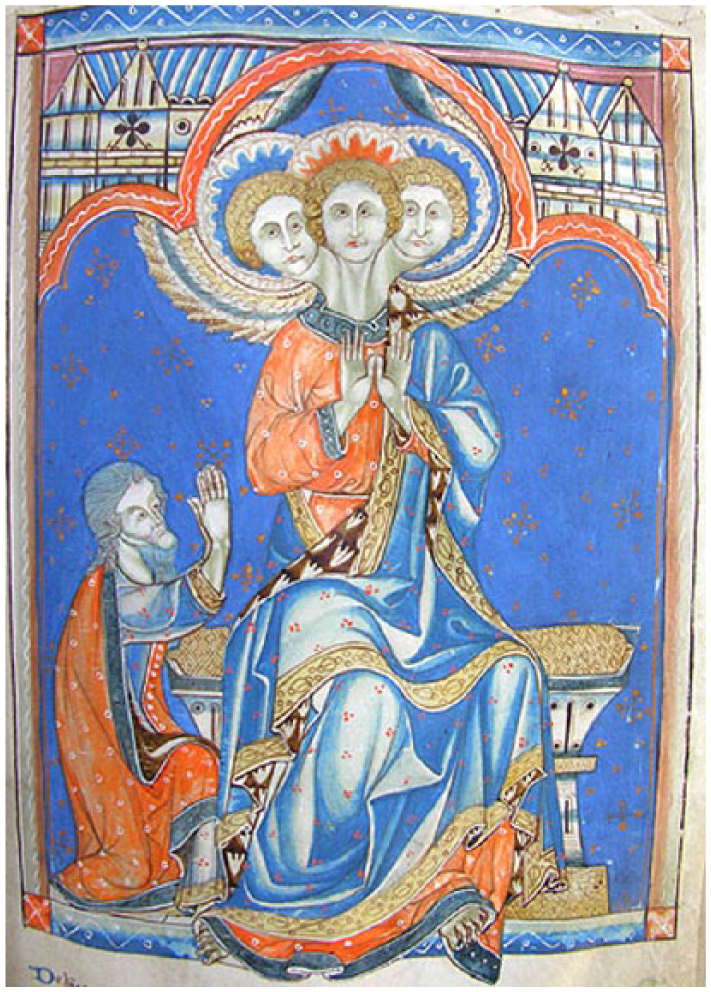
Abraham and the Trinity, MS K.26 f.9r, Vellum, 27.94 cm × 18.42 cm, 1270–80, St. John’s College, Cambridge.
The story about God the Lord appearing in the form of three visitors to Abraham and Sarah has been depicted from early times; one of the most notable examples is the sixth-century mosaic in St. Apollinare Nuovo, Ravenna. However, the tricephalous iconography here is different to the more commonly applied societal trinitarian iconography for the story of Genesis 18 with the three figures seated at a table, for example, in St. Apollinare Nuovo, in Rublev’s icon or Chagall’s depiction of the scene. Interestingly, the present tricephalous image gives more emphatic expression to the interchangeable mention in the text of the one Lord and the three men than the usual societal iconography of the three figures seated at the table: “The Lord appeared to Abraham … He looked up and saw three men standing near him” (Gen 18:2).
The theme, then, is not just the depiction of the Christian Trinity but, in particular, the link between the Old and the New Testament, between Abraham, the ancestor of Christ, and the Christian Trinity, the fullness of revelation and salvation. In comparison to other depictions of the three-headed Trinity it is perhaps the prominent three-ended neck which is the least appealing and somewhat disconcerting aspect in this otherwise quite sophisticated, beautiful image. The heads are of very similar appearance. Each head is frontal unlike in many other tricephalic depictions where the two faces on the left and right are usually shown at an angle looking in opposite directions. Theologically the halos are interesting. While the nimbi over the left and right figures contain blue, the center face has red in the halo which is echoed in the much larger halo and wings surrounding all three heads. In this way the artist chose to give prominence to the central figure. Yet, it is not clear whether he intends to single out the Father or the Son. If it is the Father, he is employing a slight subordinationism, something that would not be the case if he had applied a third distinct color, a different color for each nimbus, or the same color for all. However, it could also be argued, more convincingly, that the person in the center is the Son, emphasizing the link between Abraham and Christ. This is supported also by the color of the clothes, blue and red, which are the same in both Abraham and the hybrid figure. Moreover, red connotes love as well as blood and thus would further indicate that the center head is Christ. The two raised hands pointed outwards are ambiguous; they might indicate a gesture of blessing or signifying distance or divine otherness. The tiny cross-shaped decorations in the blue background on two houses at the top of the image, possibly a reference to the heavenly Jerusalem, also seem to affirm that the Son is the center figure, thus linking two Christian iconographies, Christ pantocrator and the Trinity appearing to Abraham, in one image. Further, the allusion to wings refers us to the tradition prevalent in Eastern Orthodox icons where the Trinity is usually depicted as three angels, stressing divine otherness rather than the incarnation. All in all, this image is theologically astute and balanced in its multifaceted, yet unified symbolizing, allusions to the Trinity, the link between Old and New Testament, Abraham and Christ, divine otherness and incarnation, devotion and salvation, anticipation and fulfilment.
The same theme of Abraham and the Trinity (Fig. 4) is rendered as a small inset on folio 42r in a manuscript by Heinrich von München, who compiled a comprehensive world chronicle from creation to the present in German vernacular verse in the last quarter of the fourteenth century. While in many tricephalic images of the Trinity the artists aimed to represent the head of the Father, Son, and Spirit in identical fashion to stress their unity and essence, here there is a clear attempt to emphasize both their oneness through one body and the individuality of the three persons through three distinctive heads: the Father in the center, with a long grey-white beard, the Ancient of Days, the Son on the left with darker hair and a shorter beard, while the Holy Spirit, on the right, has a pale pink and smaller head and seems somewhat “less incarnate” than the other two faces. The Spirit is a beardless youth and androgynous, or even female, in appearance. The heads are embraced by one large cusped nimbus with an inferred cross, thus further stressing their oneness. The three-headed Trinity displays a gesture of blessing, reminiscent of the iconography of Christ Pantocrator. Abraham, whose human figure is not disproportionately smaller than the divine Trinity, offers food to his guest/s. His face, with white hair and a long beard, is strikingly similar to the Father’s head. So, while in St. John’s Psalter (Fig. 3) we find a more pronounced stress on the link between Abraham and Christ, the Old and the New Testament, in this work there is greater emphasis on Abraham encountering “the Lord,” God the Father, Ancient of Days. Abraham’s blue garment, the color of heaven, may even hint at the notion of our own divinization, a notion more prevalent in Orthodox than in Western theology. Yet, the inferred cross nimbus also calls attention to Christ’s sacrificial death and redemption, while the Holy Spirit’s gentle, youthful face hints at his role as the one who enables our communion with the divine and our love for one another. While this small image is simpler than the one in St. John’s Psalter it is, however, striking in the illuminator’s attempt to stress both the unity and the individuality of the three divine persons as well as making the link between Abraham and God Father which is reinvoked later in Abraham’s sacrifice of Isaac, anticipating the Father’s sacrifice of Christ.
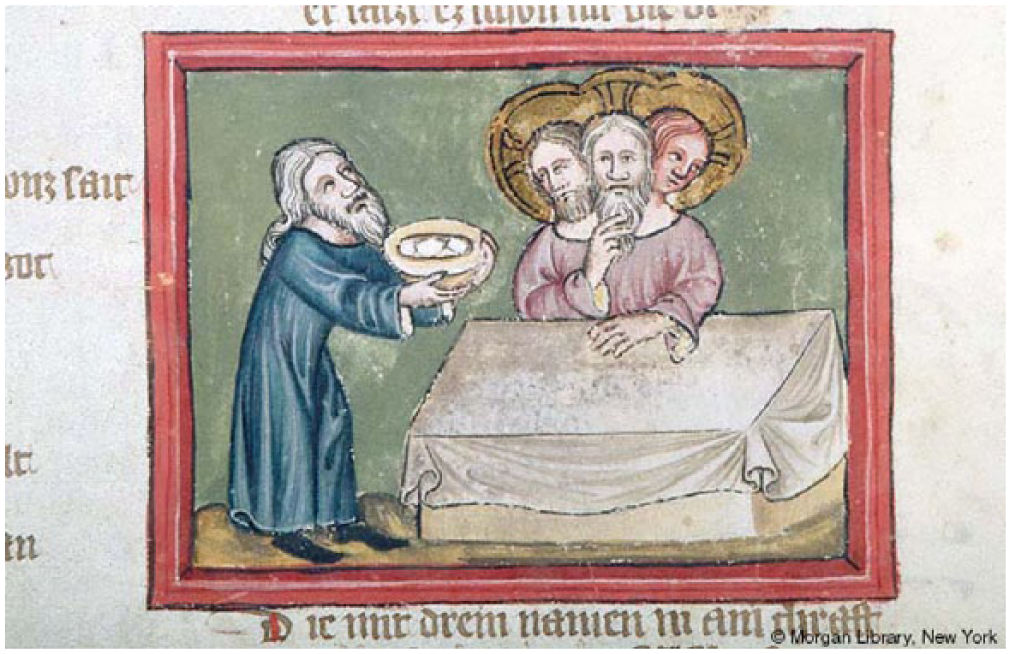
Abraham and the Trinity, Heinrich von München, Weltchronik, ca. 1360, vellum, 34.3 cm × 24.2 cm (folio page), Regensburg, Pierpont Morgan Library, MS M.769 f. 42r, New York.
Contemporary with Heinrich von München’s Weltchronik is the Hamilton Bible, an illuminated manuscript of the fourteenth century, commissioned by the Anjou court in Naples. It includes the Genesis story of Creation and the Fall (Fig. 5). Here a curious development happened in trinitarian iconography. In her article on images of the Trinity as creator mundi, Adelheid Heimann notes how in this manuscript the triune God is imaged with two faces and wings which, she asserts, constitutes “one of the most original solutions to the Trinity representations. Instead of three distinct but identical human figures, this type combines the elements of the conventional Holy Trinity: the white haired and aged Father, the fair and youthful Son, and the winged Holy Ghost.” 56 However, there are, in fact, significant differences. The “Father and Son are fused into a single body, and the Dove appears in the form of big wings, like those of an angel, attached to this curious figure.” Heimann comments that “this fusion can only have come about through the influence of Byzantine and classical models.” She notes, moreover, that a two-headed figure well known in Antiquity as a symbol of Janus “survived in the Middle Ages as the month of January … a youthful and an aged head grown together, as in the Naples miniatures.” 57 However, the development of this figure into a symbol of the Trinity by adding a pair of large wings was “an original idea” of the Neapolitan school of miniaturists, who were working in the city between 1350 and 1365. 58 This imagery seems to have occurred only in the Neapolitan School at that time and appeared repeatedly in manuscripts and in a church in the Naples region. In these miniatures the Father and Son look in opposite directions alluding thus to the powerful, all-seeing God, the eternal creator, sustainer and ruler of all.
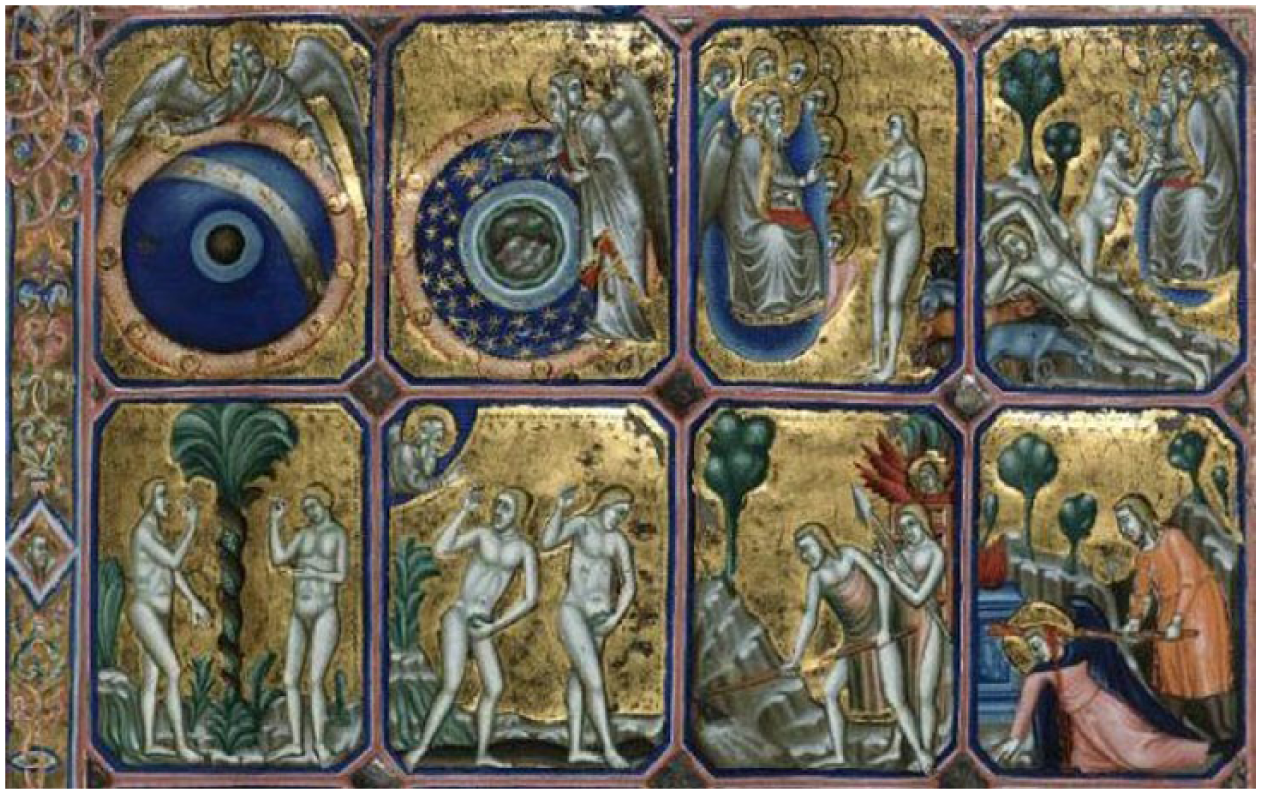
Creation and Fall, Hamilton Bible, illuminated by Cristoforo Orimina, ca 1350–60, f. 4r, dimensions n/a, Kupferstichkabinett, Berlin.
The Vision of St. Augustine (Fig. 6) is the right predella of the Barbadori altarpiece (ca. 1438), one of the most prominent paintings by the leading Renaissance Carmelite artist and priest, Fra Filippo Lippi (ca. 1406–69), father of Filippino Lippi (1459–1504). The predella shows Augustine with arrows, a reference to his Confessions, where he writes how he was led into dissipation. The arrows piercing his breast signify his subsequent remorse. 59 Whether Augustine had a vision of the Trinity is not clear. Neither his own writings nor Possidius’s Vita Augustini provide textual confirmation. 60 In his Confessions mystical experiences are recorded which were later interpreted as visions. This painting probably relates to Book 9 of the Confessions when Augustine confides, “You [God] had pierced our hearts with the arrows of your love (charity), and we carried your words with us as though they were staked to our living bodies.” 61 However, it was Jacobus de Voragine (1228/29–98) who in his widely read Legenda Aurea (Golden Legend) “focused the saint’s mystical experience around visions of the Trinity,” due to Augustine’s seminal work De Trinitate. 62
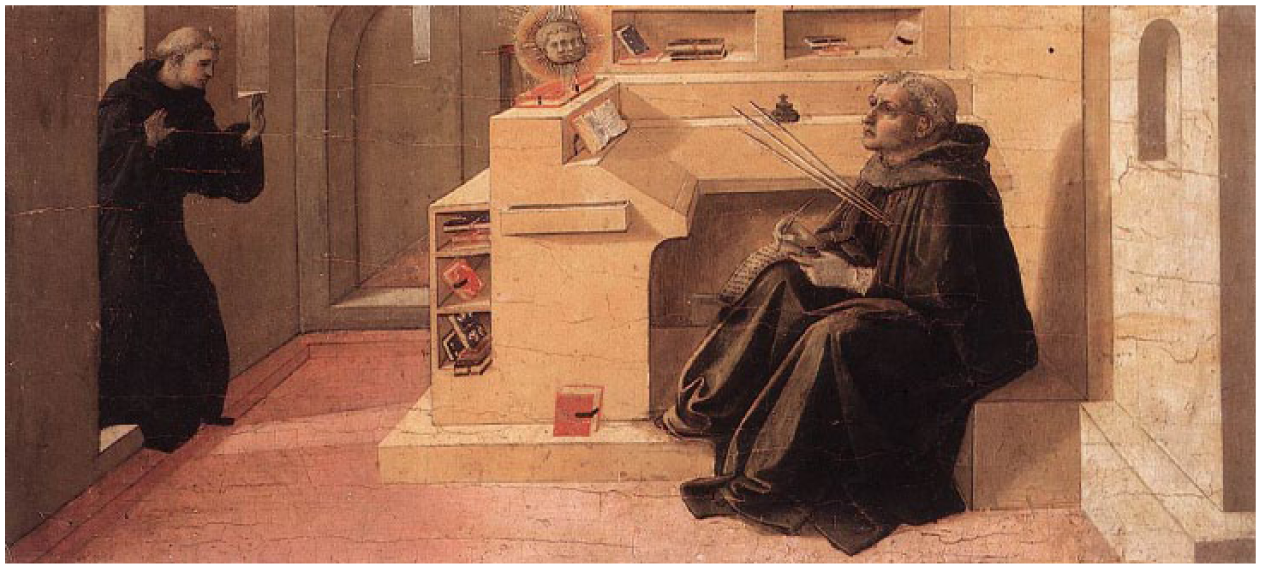
Vision of St. Augustine, Filippo Lippi, ca. 1438, tempera on wood, 40 cm × 235 cm, Uffizi Gallery, Florence.
In the work, Augustine, seemingly looking simultaneously into an indeterminate distance as well as at the Trinity, is unperturbed by and oblivious to a fellow monk entering his study. The monk, with gentle demeanor, is aware at once of something unexpected happening. His arms raised and hands turned out as if in shock, he recognizes that this is a private, intimate moment. Lippi possibly included the figure of a fellow monk to heighten the sense of drama of the human–divine encounter, and to set the human, earthly sphere—the monk—embarrassed and looking down, against the contemplative-transcendent realm—Augustine—looking up towards the divine, the three-headed Trinity. Yet Lippi, wanting to convey the moment of vision, manages to depict Augustine in such a way that he appears to be both looking up and inwards. This in turn leads him to write his De Trinitate—without looking down at the scroll. He writes automatically, recording what he sees and experiences in the divine encounter. It is the triune God who leads his hand. The Trinity in this image is diminutive, three merged faces with four eyes, three noses and three mouths without a body. Rays like the sun emanate from the face and give the impression of a halo. While small, the rendering of the Trinity here immediately catches the viewer’s eyes due to its position at the center top, and, notably, just above two books, one open for daily reading of the Scriptures. This is an understated work, the emphasis being on Augustine’s vision rather than the artist’s grappling with imaging the dogma of the Trinity. It has nothing of the “monstrous” or the bizarre; we merely find a small, easily understood reference to the Trinity. Here the tiny trifrons functions like a shorthand, a symbol. The three faces look like cherubs or putti, typical in Italian Renaissance and Baroque imagery. It strikes one somehow as an “innocent,” childlike, yet completely sincere, approach to rendering the triune God, and in this way hinting at Augustine’s own innocent vision of the divine.
This tricephalous image (Fig. 7) is an anonymous Netherlandish work from around 1500, most likely in oil. 63 What strikes the viewer at once is the realistic portrayal of the human face typical of the Renaissance’s naturalist style. It is a christocentric Trinity. The raised right hand in blessing, the incarnate face/s, and the left hand on the globe with attached crucifix all point to Christ. This is not a stylized sketch of a face as in medieval manuscripts but the portrait of a contemporary young man of that epoch. The strangeness and disturbing element, in addition to the tricephalous aspect, are the somewhat far-apart eyes which, instead of looking straight out at the viewer, are peering downwards right (from the Trinity’s perspective), and the unattractive outlines of the eyebrows. The noticeable peak before the parting of the straight dark long hair at the center top of the slightly too large forehead further contributes to the face’s disturbing appearance. What the eyes’ focus achieves is indeed interesting; instead of a sense of stillness and direct encounter with the viewer, the two eyes’ sideways gaze creates movement. The face on the right shares its right eye with the left eye of the central face, which in turn shares its right eye with the left eye of the face on the left. In this way the gaze is ultimately circular, hinting thus at the all-seeing triune God. From the head emanate barely visible rays in halo-like cruciform fashion, again emphasizing the christocentric aspect. The noticeably long hair is typical of images of Christ in Northern Renaissance art.
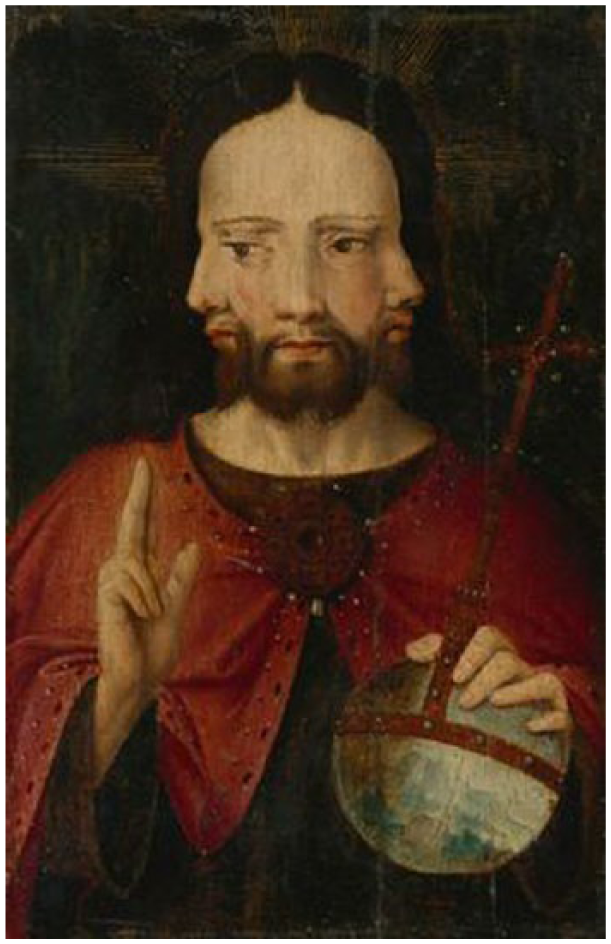
Anonymous, Netherlandish, ca. 1500.
Unlike the previous images under consideration it is significant how this naturalistic rendering of the tricephalous Trinity somehow lacks mystery even though it is precisely the divine triune mystery it wants to convey. As the Trinity does not look out at us, we are not taken into the divine life. However, the eyes’ gaze, from one to the other face in an eternal circular movement, does not only hint at the almighty God but evokes something of the perichoresis of the three persons, their inner divine life of loving indwelling in one another, as stressed in Orthodox theology. While one associates this perichoretic aspect with societal images of the Trinity, such as Rublev’s famous icon, one would agree with Alex Stock that this dimension of mutual indwelling also manages to be conveyed in this iconography of the three divine persons’ heads merging into one another and their gaze. 64 Yet, the sense of the immanent Trinity here is more understated than the manifest christocentric emphasis, that is, the economic Trinity redeeming humankind through the kenosis of the crucified Christ. While one assumes that the artist intended anything but a lack of the spiritual-mystical, the overall unsettling impact does not quite manage to offer a beautiful vision of the Trinity. To condemn such an image, however, as merely “monstrous,” a figmentum diabolicum, may indeed miss a good deal of its theological merit as much as its artist’s sincerity in grappling with divine otherness and divine incarnation.
The all-seeing God is also stressed in a 1511 fresco medallion (Fig. 8) by Andrea del Sarto (1486–1530). It is located at the center top of a vault in the refectory of San Salvi in Florence above a Last Supper painting, also by del Sarto. As in Lippi’s painting, this small fresco functions not so much as an image for veneration but more like a symbol of the Trinity intended to be immediately understood by the viewer. However, it is far more elaborate artistically and theologically than the tiny Trinity in Lippi’s image. Similar to Donatello’s trifrons sculpture on a tympanum on the exterior of Orsanmichele (1413), del Sarto, like his fellow Florentine artists Lippi and Donatello, evidently took an interest in this particular trinitarian iconography. Striking are the circles of orange-yellow, purple, and blue bands which surround, and form the background to, the mask-like faces, 65 the one, yet three, face/s of God depicted en face and in profile. The three joined heads look into three directions. What is evoked thus is the sense of space and time, the all-seeing, all-knowing, all-powerful deity, encircled by the Trinity’s own light. It is the light of the eternal God, the light of the world, looking into space and time. 66 While there are four cardinal directions, here we only have three, and so there is also the sense of mysterious hiddenness “behind” the face, which is underscored by the sense of depth, induced by the circles of light and rays emanating from behind the head/s. God is both hidden and revealed, eternal other yet imaged through three human faces. Here again we are also reminded of the Roman god Janus, depicted as a bifrons looking forward and backward, a god of beginnings (January), transition, and endings, and revered as a solar god in ancient times.
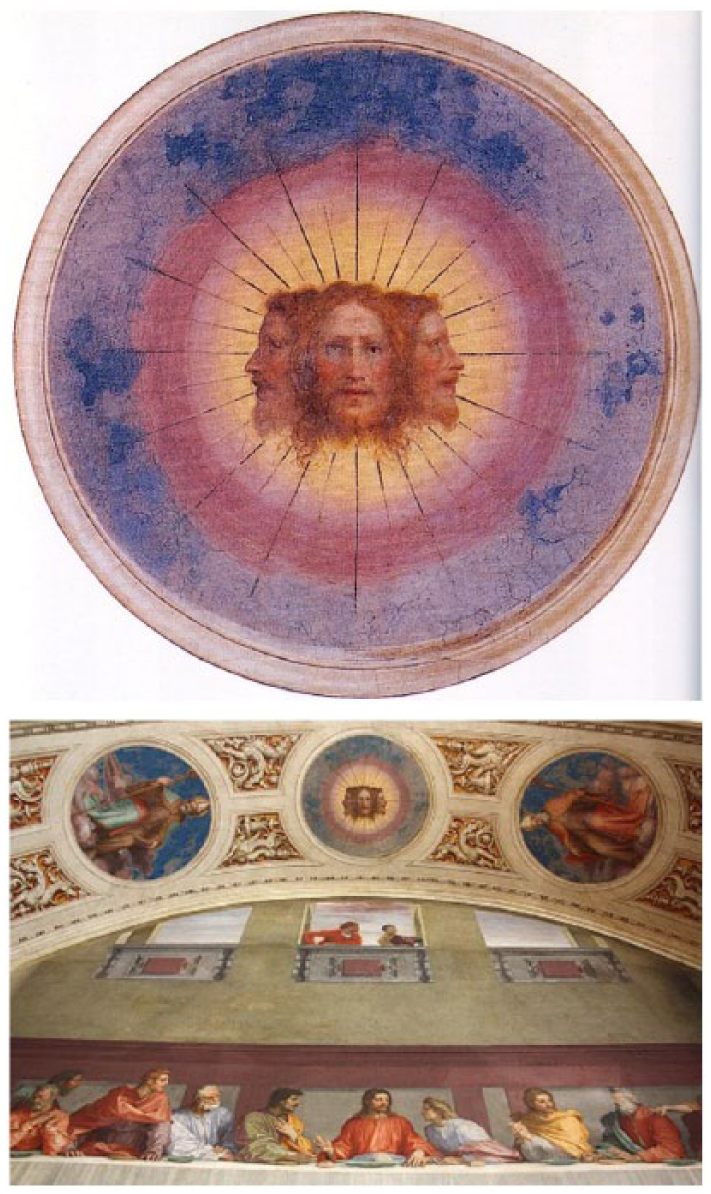
Andrea del Sarto, The Trinity, fresco, ca. 1511, dimensions n/a, San Salvi Refectory, Florence.
In the almost identical appearance of Father, Son, and Spirit, the theological emphasis in del Sarto’s image is on divine essence, oneness, and unity, rather than on the individuality and diversity of the three persons. While the elements of time and space are accentuated, the ultimate sense here is that of the eternal transcendent-other, quietly powerful divine mystery.
The Renaissance, in its forward-looking experimentations and its simultaneous looking back to the art of Antiquity, developed an interest in the allegorical revival of ancient figurations. Thus in addition to trifrons images of the Christian Trinity, during this epoch occasional trifrons and bifrons images of the virtue of prudence (prudentia) developed. 67 Frequently they were similar to the Janus images, with two attached heads looking in opposite directions. In this work by Titian (Fig. 9) there are three heads, symbolizing the three ages of the human being, youth, maturity, and old age. There is an inscription in three sections above the respective heads: “Ex praeterito / praesens prudenter agit / ne future actione deturpet”—“learning from the past, the present acts prudently, not to corrupt future actions.” Underneath the heads we see the figure of the three-headed beast, symbol of prudence: the dog, lion, and wolf. The animals, it seems, are to symbolize something of the character of the respective age of the human being: the dog (youth), loyal, innocent, and trusting; the lion (maturity), powerful and fighting; and the wolf (old age), wise and shrewd. Again the image includes the reference to space and time; the young man looking into the future, the mature man facing the present, albeit with a simultaneous inward contemplative view, while the old man looks back to the past. As in del Sarto’s image, the light on the faces changes significantly from the brightness on the young man’s face to the shadowed face of the old man. Various art historians have commented on this image. It goes beyond the scope of this article to deal with all of their comments. The most obvious interpretation may indeed be that of the human being’s three stages of life, including the central notion of one of the cardinal four virtues, prudence, in which we are meant to grow through our lifetime. Erwin Panofsky, moreover, suggests that the work might refer specifically to the elderly Titian himself when prudence was required of him in handing over his property to his heirs. 68 Erwin Panofsky argues that Titian and his heirs are imaged here: the head on the right being a half-portrait of Marco Vecellio, Titian’s cousin, the center head Titian’s son Orazio, and the half-portrait on the left resembling Titian in old age. Others have suggested that the image might have to do with politics, with sin and penitence, or even with the practice of art itself. 69 It is probably correct to conclude that this work invites a variety of interpretations, each of which may tell us something of the meaning(s) of this highly symbolical image.
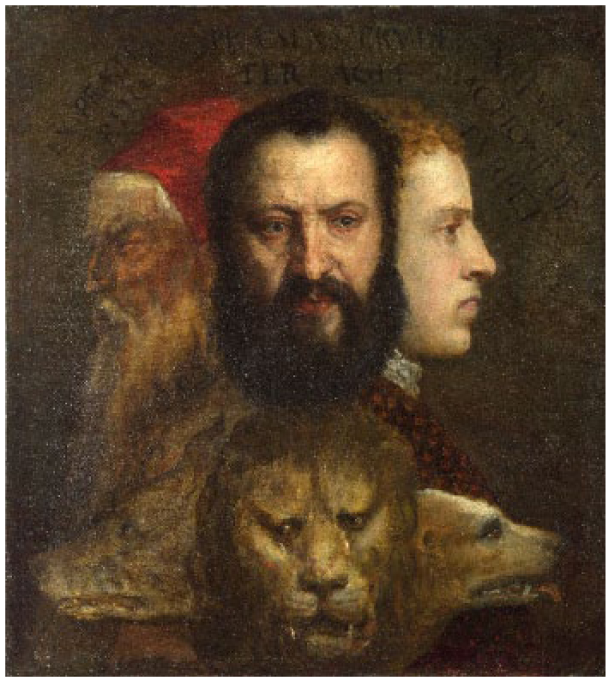
Titian, An Allegory of Prudence, ca. 1550–65, oil on canvas, 75.5 cm × 68.4 cm, National Gallery, London.
Tricephalous images of the Trinity continued to be painted after the Reformation and Counter-Reformation into the eighteenth and nineteenth centuries in European Catholic regions, such as Bavaria and Austria. However, they were no longer carried out by leading artists, who focused increasingly on secular themes. This anonymous seventeenth-century painting (Fig. 10) is a particularly fine example of such works; it displays painterly skill and a fine sense of color. Theologically and iconographically it is quite similar to the anonymous Netherlandish image from 1500 (Fig. 7). It is strongly christological in its inclusion of the blessing hand, the globe and cross, and the red cloak referring to the blood of Christ and his love for the world. With his left hand on the globe, it conveys at the same time the eternal Christ Pantocrator, ruler of the universe. It is a classical trifrons with four eyes, three noses, and three mouths. The four eyes as well as the muted, soft colors lend a unified, perichoretic, and harmonious atmosphere to the image. Strange and a little disturbing in its tricephalic aspect, it is yet aesthetically appealing, evoking an atmosphere of calm divine mystery. And, while strongly christological, the sameness of the three heads stresses the unity and transcendence of the triune God. One wonders: Had Urban VIII, Benedict XIV, and other critics of the tricephalous Trinity image known the painting, would they have simply condemned it? Whatever their thoughts might have been, the image ended up in a museum and not in the fire. Somewhere common sense and respect for such works and for the artist’s struggle with imaging the Trinity prevailed.
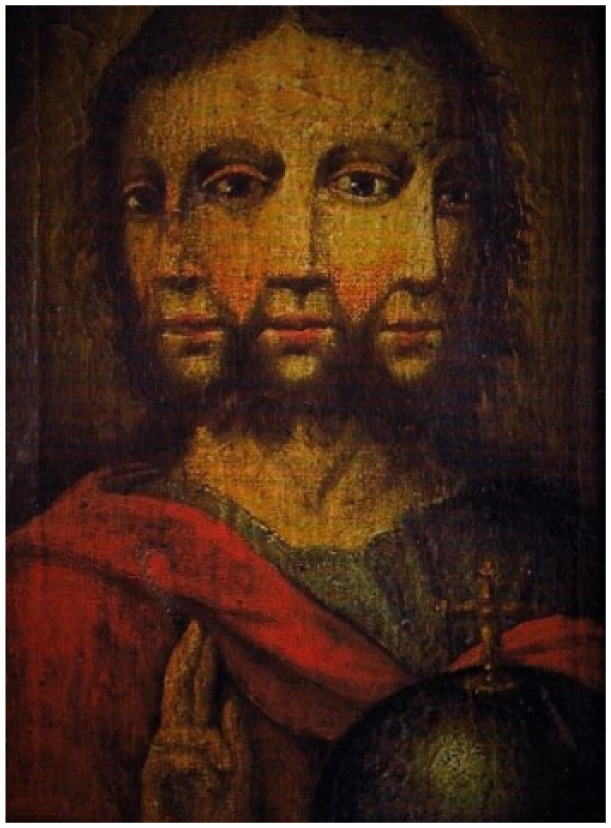
Anonymous, Trinity, early seventeenth century, dimensions n/a, Tiroler Volkskunstmuseum, Innsbruck.
The final image (Fig. 11) brings us from Europe to art in the South American context of Spanish colonialization in Peru and the Andes. After the Spanish conquest of Cuzco in 1534, European painters with a particular interest in Christian religious subject matter settled in Cuzco. From the sixteenth to the eighteenth century the Cuzco School flourished, with its primary aim to bring the Catholic faith to the Inca. Religious images which had served as the biblia pauperum in Europe in the Middle Ages were now transposed and inculturated into the “new world.” The artists brought with them what they had learned; thus there are Byzantine, Italian Renaissance, Mannerist, Flemish, and Baroque influences in these works. Yet, the artists also adopted a liberty not found in European works: bright colors, distorted images for dramatizing effects, a lack of perspective, minute details, as well as backgrounds that depicted the fauna and flora of the Andes. 70
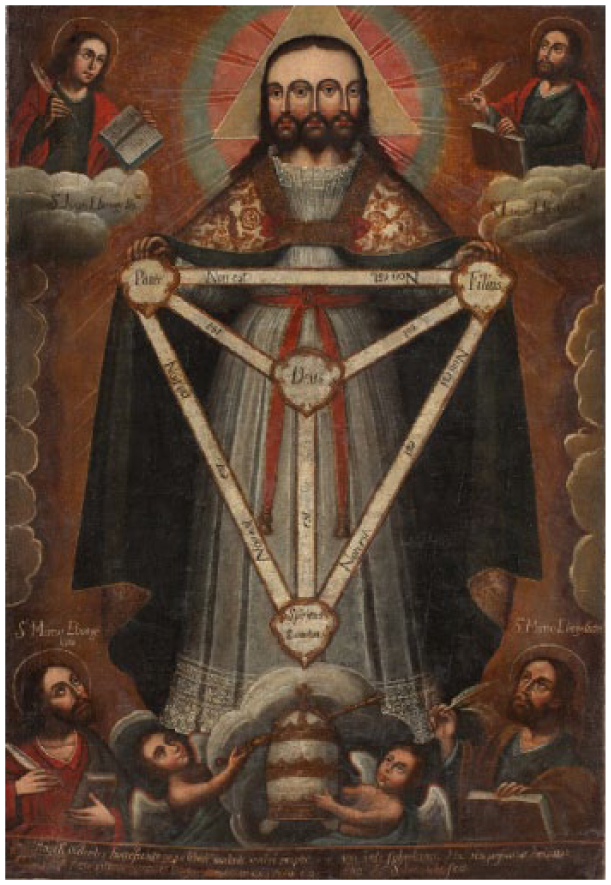
Trinity, anonymous, Cuzco School, 1750–70, oil on canvas, 182 cm × 124 cm, Museo de Arte, Lima.
The primary aim of the Cuzco painters was didactic. It is significant that, instead of adhering to papal prohibitions of tricephalic images, these painters were not shy to use this particular iconography. The present work is an excellent example. Highly didactic, symbolic, and schematic, it seeks to teach the viewer the most basic truths about the mystery of the Trinity. While some European Christian trinitarian images were capable of instilling a sense of mystery, depth, and contemplation in the onlooker, this frontal image does not quite convey that sense of mystery. It comes across as somewhat “flat” and overladen with symbolism. Not only are the three identical interlinking faces depicted, but the triangle and halo behind the Trinity reinforce the “three-in-oneness,” which then again is echoed in the much larger, central Scutum Fidei, the Shield of the Trinity (Eph 6:16), functioning as the briefest summary of the trinitarian faith since about the early thirteenth century. The Trinity is framed by the four Evangelists and heavenly clouds, thus linking the Trinity with the divinely inspired foundational book of Christian faith, the Bible, which contains, of course, the seeds of the dogma’s development. Interestingly, there is one more symbol, the papal tiara, making the link with St. Peter, the papacy, and the church through the centuries. How ironic to include the papal tiara in an iconography which had, in fact, received papal condemnation! The Cuzco painters, thousands of miles away from Rome, seem to have been little troubled by such minor worries. On the contrary, by placing the tiara directly under “Spiritus Sanctus” the artist appears to have intended to emphasize the entirely orthodox Catholic idea of the pope being Christ’s divinely inspired representative on earth. It is ironic indeed that this image from the eighteenth century is at once highly orthodox and highly ecclesiastical, yet would have been dismissed by Catholic European theologians. It is even more ironic that church leaders and artists in Latin America promoted the use of this particular trinitarian iconography, the condemned tricephalous type, to teach the natives the Christian faith. Aesthetic-artistic excellence and papal pronouncements may have been eclipsed by didactic-theological aspirations in this work, but images such as these certainly fulfilled their purpose in teaching the “pagan” Incas about the Christian Trinity—just as they had managed to do so in Europe in medieval times. In a way this development in the new world constitutes an indirect and probably unaware vindication of this iconography.
Conclusion
From India to the Balto-Slavic regions and Celto-Roman Gaul, humans have given expression to their pre- and non-Christian religious beliefs by depicting or sculpting polycephalous deities. While in Christianity many centuries had to pass before tricephalous images could be used and eventually become popular from the twelfth century onward, this trinitarian iconography ultimately had its antecedents in pre-Christian images of the divine.
The physicist Carlo Rovelli, in his acclaimed Seven Brief Lessons on Physics, observes how we humans are part of nature. Nature “is our home, and in nature we are at home”; whatever we are and do, we will always be part of this world. 71 It seems an obvious statement but in its simplicity and, significantly, in its coming from a physicist’s—not a theologian’s—reflections on ourselves in the universe, it points us to both the fundamental value as well as the central issue of contention concerning the tricephalous trinitarian iconography. Having examined non-Christian and Christian three-headed depictions we can conclude that the principal and abiding reason for the use of such imagery was the fact that three-headed human figures go beyond of what is commonly natural. A tricephalous figure was an attempt to stress the otherness, the transcendence of the deity vis-à-vis the human being. It was an entirely logical and obvious choice of ancient humans to portray their god(s) with multiple heads rather than one head. It ensured the sense of the gods/God as being different and set apart from humans and evoking their superior power, thus inducing in the human a sense of reverence, awe, fear, and obedience.
Yet, it is this iconography adopted much later and transformed by Christian painters rendering God as a three-headed hybrid which gave rise to papal condemnations that were supported by fifteenth- to eighteenth-century theologians, precisely on the grounds that they were aberrations of nature. Their rejection had to do with pagan connotations, with concerns about nature and aesthetic perceptions. In a Christian context, which in its naming of God as Father, Son, and Holy Spirit uses anthropomorphic analogies and includes the belief in divine incarnation, such abnormal “monstrous” images of the triune God, associated with both pagan and devilish imagery, could only give rise to their condemnation. And here lie the irony, ambivalence, and value of this iconography, namely that even in a Christian context it could be and indeed was used as an immediately understandable image of the God who is three and one, totally other and incarnate.
In turn, it is this very irony which, in fact, evokes something of the paradoxical nature of our trinitarian faith. I agree with David Brown when he points out that those painters who applied this iconography would have laughed, or, one might add, could even have been offended, at the suggestion that their images were monstrous and unacceptable. Precisely in contradicting and going beyond what is “normal” and natural, rendering the Trinity as a hybrid figure, the artists strove to emphasize divine, transcendent mystery. In this way they reimagined an ancient pre-Christian iconography when humans first began to search for visual expression of their belief in a deity. And, it must be said, this particular instance concerning trinitarian imagery was, of course, only one of many pre-Christian symbols and myths—largely taken from Greco-Roman culture—which Christians adopted, transformed, and gave new meaning to, according to their own needs. Further, this iconography’s striking, succinct imagery is probably also a reason why it became so popular and could survive for about eight centuries in Christian history. Before its demise it was still used in folk art in Europe and for didactic reasons in the “new world” among people whom the colonizers aimed to teach the Christian faith. And so in a sense it came full round, albeit in a very different context and age from its pre-Christian Indo-European antecedents.
The iconographies of the Gnadenstuhl and of the “social Trinity” were not prohibited. They were not deviations of nature, startling and unsettling as the trifrons images were, especially when rendered in naturalistic form as in Renaissance art. Yet, as I have attempted to show through the analysis of a selection of images, it cannot be denied that the tricephalous Trinity, like other trinitarian iconographies, has played a significant and long-lasting role in Christian history. Given its pre-Christian links, it is not surprising that it was condemned. However, from our perspective today, we are now able to appreciate its theological-artistic content, orthodoxy, and value in a more nuanced way.
Yet, in defense of theologians from the past, it must be said that they dealt with a largely illiterate laity among whom excesses of popular devotions were more prevalent than in our rather more secular times. Hence their worries about false interpretations and idolatry would have been more justified.
Along with the “opening virgin” (Klappmadonna), the tricephalous image of the Trinity belongs to the most curious, unusual imagery in the history of Christian faith. It may lack in aesthetic appeal and may not always appear edifying. It may be unsettling and strange. But it cannot be denied that these images are capable of conveying the central tenets of trinitarian theology: the unity and distinction in the triune God, the common substance or essence of the three persons and their individuality. Further, this iconography was to expand and, as became apparent in the analysis, includes references to several aspects relevant to the development of trinitarian theology: images of the “Old Testament Trinity” (Gen 18); inner-trinitarian perichoresis; occasionally emphatic christological emphases (in the Middle Ages, Father and Son were often depicted in identical fashion, thus stressing their unity); the centrality of St. Augustine’s vision of, and writing on, the Trinity; the Christian virtue of “prudentia”; the strongly theological-didactic dimensions in the context of Latin American colonialism; and in most of the images the pronounced manifestation of the classical divine attributes—the all-seeing, omniscient, almighty God, the sense of divine light, power, and transcendence.
Tricephalic trinitarian iconography gave rise to an expanse of images simultaneously hinting at the pre-Christian while presenting the Christian, alluding to the “pagan” while being theologically orthodox—a little paradoxical it seems, but then maybe just like our faith in the fundamental Christian dogma of the triune God.
Footnotes
1.
I am grateful for a Visiting Fellowship at the Longroom Hub, Trinity College, Dublin, in 2011 which assisted me in researching material on the various iconographies of the Trinity in art. I would also like to thank Paul Crowley for his helpful suggestions.
2.
3.
Ebbo, Vita Ottonis 3, 1.
4.
Pettazzoni, “The Pagan Origins,” 146.
5.
Pettazzoni, “The Pagan Origins,” 136.
6.
Pettazzoni, “The Pagan Origins,” 136.
7.
Willibald Kirfel, Die dreiköpfige Gottheit (Bonn: Dümmlers Verlag, 1948), 186.
8.
Kirfel, Die dreiköpfige Gottheit, 29.
9.
10.
David Brown with reference to Kirfel in his article, “The Trinity in Art,” in The Trinity: An Interdisciplinary Symposium on the Trinity, ed. Stephen T. Davis, Daniel Kendall, and Gerald O’Collins (Oxford: Oxford University Press, 1999), 329–56 at 333.
11.
Pettazzoni, “The Pagan Origins,” 14.
12.
Miranda Aldhouse-Green, Celtic Art: Reading the Messages (London: Weidenfeld and Nicholson, 1996), 138–39.
13.
Aldhouse-Green, Celtic Art, 140–41.
14.
15.
Pettazzoni, “The Pagan Origins,” 150.
16.
Pettazzoni, “The Pagan Origins,” 150.
17.
Troescher, “Dreikopfgottheit (und Dreigesicht).”
18.
Pettazzoni, “The Pagan Origins,” 151.
19.
Pettazzoni, “The Pagan Origins,” 151.
20.
Pettazzoni, “The Pagan Origins,” 151.
21.
Alex Stock, Poetische Dogmatik, Gotteslehre, vol. 3, Bilder (Paderborn: Ferdinand Schöningh, 2007), 345, translations mine.
22.
H. Hackel, Die Trinität in der Kunst (Berlin: Reuther & Reichard, 1948), 108, cited in Stock, Poetische Dogmatik, 346.
23.
Stock, Poetische Dogmatik, 346.
24.
Stock, Poetische Dogmatik, 346.
25.
Stock, Poetische Dogmatik, 346.
26.
Stock, Poetische Dogmatik, 346.
27.
Jan Hallebeek, “Papal Prohibitions Midway between Rigor and Laxity: On the Issue of Depicting the Holy Trinity,” in Iconoclasm and Iconoclash: Struggle for Religious Identity, ed. W. van Asselt, P. van Geest, D. Müller, and T. Salemink (Leiden: Brill, 2007), 351–83.
28.
29.
30.
Hallebeek, “Papal Prohibitions,” 363.
31.
Hallebeek, “Papal Prohibitions,” 361.
32.
Hallebeek, “Papal Prohibitions,” 354.
33.
Hallebeek, “Papal Prohibitions,” 361–62.
34.
Hallebeek, “Papal Prohibitions,” 361.
35.
Hallebeek, “Papal Prohibitions,” 362. Hallebeek also remarks that Du Bois did not explain which images were, in fact, approved. For more detailed references to the writings of these theologians see Hallebeek, “Papal Prohibitions,” 351–83.
36.
Kirfel, Die dreiköpfige Gottheit, 185.
37.
Hallebeek, “Papal Prohibitions,” 365.
38.
Kirfel, Die dreiköpfige Gottheit, 185.
39.
Hallebeek, “Papal Prohibitions,” 366.
40.
Hallebeek, “Papal Prohibitions,” 368–69.
41.
Hallebeek, “Papal Prohibitions,” 369.
42.
Hallebeek, “Papal Prohibitions,” 369–71.
43.
Hallebeek, “Papal Prohibitions,” 369–70.
44.
Hallebeek, “Papal Prohibitions,” 370–71.
45.
Hallebeek, “Papal Prohibitions,” 372.
46.
Hallebeek, “Papal Prohibitions,” 372.
47.
Hallebeek, “Papal Prohibitions,” 372–73.
48.
Hallebeek, “Papal Prohibitions,” 373.
49.
Hallebeek, “Papal Prohibitions,” 376–77.
50.
Hallebeek, “Papal Prohibitions,” 379–80.
51.
Hallebeek, “Papal Prohibitions,” 382.
52.
Hallebeek, “Papal Prohibitions,” 382–83.
53.
Martin Luther, “Against the Heavenly Prophets in the Matter of Images and Sacraments (1525),” in Theological Aesthetics: A Reader, ed. Gesa Thiessen (London: SCM, 2004), 132–34.
54.
For information concerning Psalter MS K26 at St. John’s College library, Cambridge see: http://www.joh.cam.ac.uk/library/special_collections/manuscripts/medieval_manuscripts/medman/K_26.htm. See also Jenny Judova, “Threeheaded Trinity in St. John’s Psalter MS K26,”  .
.
55.
56.
57.
Heimann, “Trinitas Creator Mundi.”
58.
Heimann, “Trinitas Creator Mundi.”
59.
James Hall, Dictionary of Subjects and Symbols in Art (London: John Murray, 1974), 35.
60.
Donal Cooper, “St. Augustine’s Ecstasy before the Trinity in the Art of the Hermits c.1360–c.1460,” in Art and the Augustinian Order in Early Renaissance Italy, ed. Louise Bourdua and Anne Dunlop (Aldershot: Ashgate, 2007), 183–204 at 196.
61.
Cooper, “St. Augustine’s Ecstasy,” 197. See also Augustine, Confessions, trans. R. S. Pine-Coffin (London: Penguin, 1961 / Penguin Classics, 2002).
62.
Cooper, “St. Augustine’s Ecstasy,” 199.
63.
The work’s dimensions and location are unavailable.
64.
Stock, Poetische Dogmatik, 348.
65.
Stock, Poetische Dogmatik, 348–49.
66.
Stock, Poetische Dogmatik, 349.
67.
Stock, Poetische Dogmatik, 350.
68.
Erwin Panofsky, “Titian’s Allegory of Prudence: A Postscript,” in Meaning in the Visual Arts (Chicago: University of Chicago Press, 1983), 146–68.
69.
71.
Carlo Rovelli, Seven Brief Lessons on Physics, trans. Simon Carnell and Erica Segre (London: Penguin Random House, 2014), 77–78.