







Abstract
Two theological models, which John Roberto has labeled the theological-maturity and the liturgical-initiation models, have dominated twentieth- and twenty-first-century interpretations of confirmation. Each is successful in explaining part of confirmation’s complex history and one or more of the various contexts for its practice in the Roman Catholic Church today. In this article, a new look at the theological significance of the early precursors of confirmation in North Africa, Iberia, Rome, and early medieval Europe is used to develop a third theological model. The ecclesial-anamnetic model posits that confirmation sacramentally proclaims the baptized person’s participation in the eschatological mission of the church. In North Africa, Spain, Gaul, and Rome, local contexts and tensions influenced the practices that became confirmation, but in each case, ecclesial visibility was at stake. As contexts emerged in which the visibility of the larger church was obscured at baptism, anamnetic methods for “citing” one’s baptism by means of a gesture used after baptism became important for manifesting ecclesial membership. In fact, a deeper theological examination of anamnesis can ground a model that adequately accounts for both the historical development of confirmation and its many pastoral modes today.
Introduction
In contemporary Roman Catholic theology, we discern two operative models for understanding the sacrament of confirmation. John Roberto calls the first the “theological-maturity” model, which dominated before Vatican II and focuses on the giving of the Holy Spirit for human growth and strength. He calls the second the “liturgical-initiation” model, influenced by the historical reconstructions of fourth- and fifth-century rites and those of the Christian East, which emphasize the place of handlaying and anointing as a transitional rite in the initiation complex beginning at baptism and culminating in communion. 1 It is instructive that Roberto names a number of theologians using primarily systematic sacramental theology methods as members of the first school. His sole representative of the second school is Aidan Kavanagh, although others could be adduced. 2 The main difference between the two theologies is that the first takes for granted the late medieval separation of confirmation from baptism for most confirmands, while the second attempts to return to a postulated fourth-century practice. Neither in fact does justice to the historical, theological, and pastoral tensions of confirmation.
Though the theological-maturity model is based on the late medieval practice of confirmation some years after baptism, the desire to have a bishop present, rather than the maturity of the initiand, motivated that complex historical development. The liturgical-initiation school, in its turn, does not attend sufficiently to the social and political implications of handlaying and chrismation in the Christian Roman Empire, particularly in Spain and Gaul, where the name “confirmation” first emerges for a postbaptismal rite presided over by the bishop. 3 Neither attends to local, geographic, and ritual diversity, to varied social contexts and the particularities of historical and ecclesial environments. In what follows, we propose a third model that seeks to take into account the diverse emphases of confirmation in its different times and places in the history of the Latin West. This model, which we have named “ecclesial-anamnetic,” stresses confirmation’s historical and theological role in manifesting the church, using a theology of anamnesis to consider confirmation as a memorial of baptism. We will explain this model further below, but in brief: Confirmation develops in the West as a way of rendering visible the connection between an initiand, the local community into which that initiand is baptized, and the broader ecclesial communion (with its mission and its eschatological focus). When the bishop, the primary symbol of the link between the local and universal church, is not present, the baptismal identity of the Christian is memorialized through a gesture that recalls the postbaptismal rites (anamnesis) to render the connection between baptism and ecclesial belonging visible. The theological-maturity school and the liturgical-initiation school capture the ecclesiological and anamnetic aspects of confirmation in limited historical and pastoral contexts: theological-maturity in the late Middle Ages and when confirmation is done in late adolescence or early adulthood, and liturgical-initiation when confirmation follows immediately after baptism. The new model, then, is an attempt to give a broader theological context for confirmation that sheds light on both past and present diversity of practice.
Toward Three Models
Assessing the varied current liturgical uses and theological meanings of confirmation today will set the stage for evaluating historical origins and theological models. In the contemporary Roman Catholic Church, confirmation is deployed in six contexts:
1a. Candidates baptized as infants in the Roman Catholic Church receiving confirmation as adults as part of an individualized process of discernment (see OCIA, 400–72) 4
1b. Candidates baptized as infants receiving confirmation in adolescence after first communion
2a. Catechumens receiving confirmation as part of the rite of baptism (OCIA, 231–36)
2b. Candidates baptized as infants receiving confirmation between baptism and first communion (restored order)
2c. Children or adults receiving emergency initiation in imminent danger of death (OCIA, 388–91) 5
3. Those baptized outside of the Catholic Church coming into full communion with the Roman Catholic Church (OCIA, 493–94)
While each of these uses the same matter and formula, their varied contexts suggest different meanings. Contexts 1a and 1b fit rather naturally with an emphasis on theological maturity; contexts 2a, 2b, and 2c are influenced by or fit with an initiatory emphasis. Context 3 has tensions with both a maturity and an initiatory model, since candidates may be any age and are often fully initiated in their own communities of origin. A contemporary approach that understands theological models within their human, historical, and liturgical contexts is necessary to consider all six.
In Table 1, we have distinguished between sacramental theologies (which normally consider theologies of grace, incarnation, and church, and inquire about sacramental efficacy) and liturgical theologies (which normally consider the gestures and texts performed throughout history, and inquire about the sacrament’s personal and ecclesial meaning). All three models, it should be noted, draw on Thomas Aquinas’s treatment of confirmation in Summa Theologiae III.72. Aquinas is quite responsive to the liturgical practice of his time, though he is not aware of its history; since he knew confirmation was usually delayed, he treats it as a rite of strengthening, focusing on personal impact: “In this sacrament the fulness of the Holy Ghost is given for the spiritual strength which belongs to the perfect age.” 6
The Origin and Emphasis of Theological Models of Confirmation.
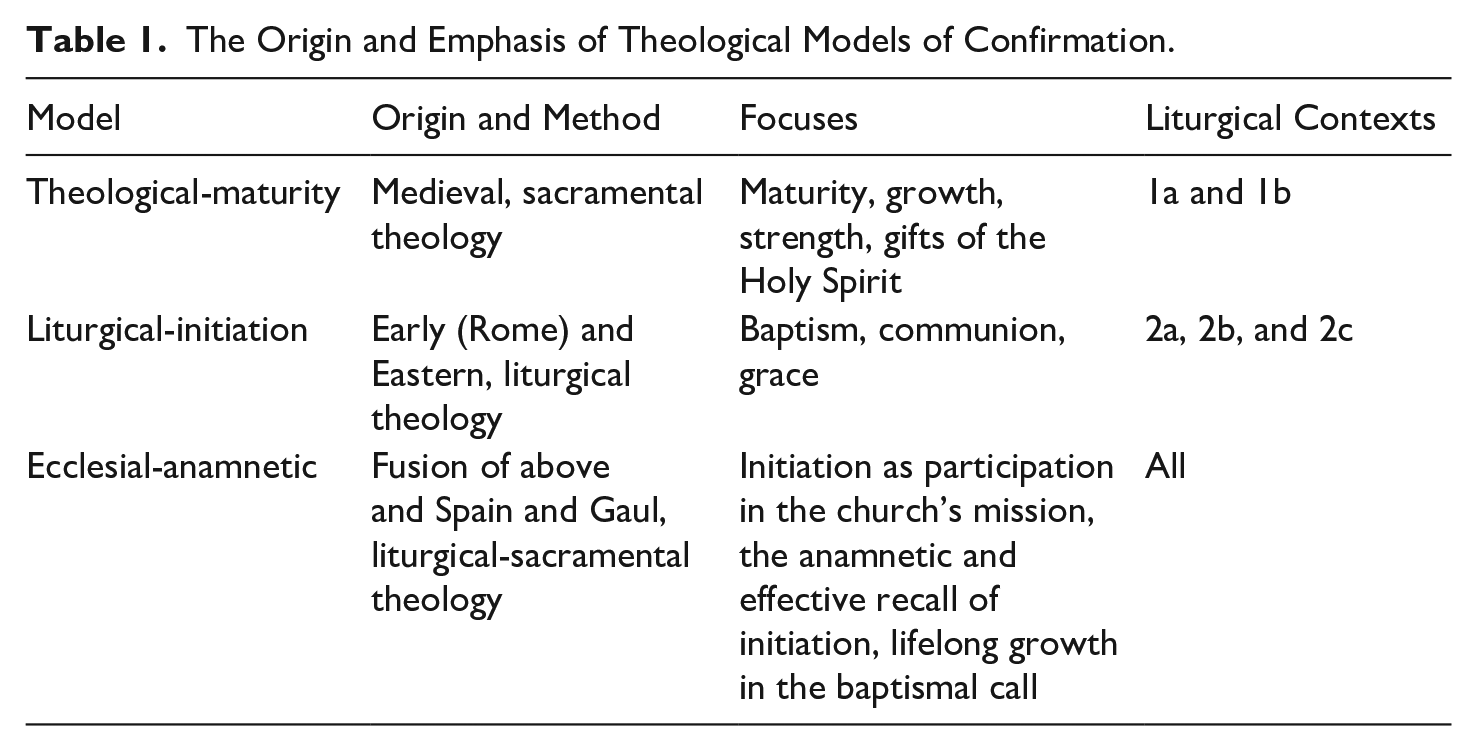
The theological-maturity model fuses this account with theories of psychological and spiritual development to present confirmation as a rite of passage and a mature commitment to the church and to the Gospel. This is pastorally effective for many adolescents and adults undergoing confirmation as a stand-alone sacrament (contexts 1a and 1b). At the same time, Thomas himself denies that spiritual maturity is associated with a particular age; thus confirmation may be bestowed on even infants who are in imminent danger of death (context 2c). Children who were dying, especially, were confirmed regardless of age, “not because he [the confirmand] would [otherwise] be condemned, except perhaps [if he had] contempt of the sacrament, but because it would be detrimental to his perfection. Thus even children who die after confirmation attain to a greater glory just as in this life they obtain greater grace.” 7 This notion of “perfection” accords much better with an ecclesial-anamnetic understanding of confirmation as an anamnesis of baptism and participation in the eschatological church of Christ, as we will see, than it does with psychological maturity (Aquinas explicitly denies a need for psychological maturity in ST III.72.8, ad. 2). Aquinas’s teaching that confirmation “perfects” baptism and bestows “spiritual maturity” or “growth” in Summa Theologiae can thus be understood as a historically specific account responding to the anamnetic practice of his day. In Thomas’s treatment, it does not function as a rationale for restricting confirmation for younger persons in emergency situations, nor does Thomas consider confirmation practiced with baptism or Eucharist in a nonemergency context (2a and 2b) or the reception of baptized Christians (3).
The main theological problem with the theological-maturity model, as is widely recognized in treatments of confirmation, is that understanding the sacrament as a mature commitment tends toward Pelagianism. Pastorally, it encourages a graduation mentality. This is especially true when theological and pastoral teaching about confirmation emphasizes its distinctive character in contradistinction from baptism and speaks of one’s being “filled with the Holy Spirit,” and the result is a weakening of the ecclesial character of baptismal belonging and the priesthood of all the baptized. As we will show in the historical section, confirmation emerged precisely as a way to strengthen the visible ecclesiological testimony of baptism. An anamnetic approach sees the pneumatic, ecclesial, and initiatory aspects of confirmation instead as an effective remembrance and renewal of the Christian’s sacramental immersion into Christ’s ecclesial body and gift of the Holy Spirit at baptism.
The liturgical-initiation model, on the other hand, focuses on the origin of the sacrament in initiation, emphasizing its relationship to baptism and communion. This school aimed to retrieve a patristic understanding of confirmation, which they equated with Eastern chrismation and believed to be a step along the rites of initiation between baptism and first communion. In this school it is important that the rites of initiation be celebrated in their so-called historical order: baptism, chrismation/confirmation, first communion—preferably at the same time. This school makes a strong argument for the restoration of a primitive order, and influenced the shape of rites 2a, 2b, and 2c. It is, however, very difficult for this model to explain the separation of confirmation from the rest of initiation in the West or to reckon with the contexts of 1a and 1b.
The ecclesial-anamnetic model encompasses both liturgical and sacramental models by attending to the varieties of liturgical practice, both historically and in the postconciliar Roman Rite. In this model, baptism is the effective and universal initiation into Christ’s body and filling with the Holy Spirit. Baptism, especially in infancy, may leave a certain invisibility or unclarity about the unity of the local communion that initiates with the universal church. In the modern day, for instance, Catholics may see it as natural and fundamental to belong to their parish and the global Roman communion, but not know the name of their local bishop or anything about their local diocese. Confirmation recalls one’s baptism (anamnetic) and strengthens the participation of the individual in the local and global church (ecclesial), as that church is engaged in the eschatological mission of Christ in the world. It does so liturgically in varied ways in the six different contexts, which will be discussed in the last section.
Though liturgical and sacramental theology have been gradually converging methodologically for well over fifty years, creating a liturgical-sacramental model requires attending to theological issues and also to a notoriously complex historical sequence. 8 At its essence, we must ask what constitutes confirmation both in theological terms and in the history of Western liturgy: the name “confirmation,” the laying on of hands and chrism, the invocation of the Holy Spirit, the age of the confirmand, or the role of the bishop? While each of these is evident in some parts of the tradition and some of the contemporary contexts for confirmation, there are historical antecedents and contemporary rites that are challenging to account for with either model. At the same time, each historical rite, each context today, and each theological model lift up the visible membership of the confirmand in the church, responding to challenges to ecclesial unity that are specific to historical period, geographic location, and human situation. Each rite, context, and model depends on an understanding of liturgical practice as anamnesis of the paschal mystery; some also depend on an understanding of the anamnetic potential of recalling one’s previous sacramental experience.
Third-Century Reception of Schismatics in North Africa
The origins of confirmation are closely tied to the role of the bishop in expressing the unity of a local church and its communion with the broader catholic (universal) ecclesial network. While medieval authors and modern scholars have tried to root this sacrament in scriptural precedents, these are post-hoc interpretations with no continuous ritual tradition.
The earliest roots of what would become the sacrament of confirmation appear in third-century North Africa as a response to the challenges of schism. A moderating response to the dispute between Cyprian and Stephen over the use of the laying on of hands in the treatment of those baptized in schismatic groups suggested that some baptisms outside the church were effective, but still needed to be “corrected” by an imposition of hands.
9
The anonymous tract On Rebaptism appears to have been written by an opponent of Cyprian in North Africa, where the water bath was followed by anointing and laying on of hand:
10
Since there is no Holy Spirit outside the Church, there can be no sound faith not only among the heretics but also among those in schism. Therefore those who do penance and are reformed through the teaching of truth and through their own faith, a faith that has later been improved by a purified heart, should be aided only by a spiritual baptism, that is, by the imposition of the bishop’s hand and by the supplying of the Holy Spirit.
11
As Everett Ferguson notes, “The imposition of hands on those formerly baptized in a group outside the communion of the church thus served both to complete their baptism and to reconcile them to the church.” 12 The writer of On Rebaptism sees this imposition of hands as both reconciliation and a completion of initiation. As a result, the author of the tract distinguished between the baptism itself and the bestowal of the Holy Spirit. This imposition of hands to receive schismatics was not yet confirmation: It was an ad hoc response to a local pastoral crisis, not a regular part of sacramental initiation. 13 At the same time, it used a gesture later appropriated for confirmation (handlaying) to correct an ecclesial deficiency (though the schismatics had been baptized, they were not members of the church). The bishop did this as head of the local church, by performatively “citing” the baptism that had already taken place with a common episcopal gesture (handlaying). The “spiritual baptism” can be understood as an effective anamnesis of the candidate’s previous, imperfect baptism. 14
Ecclesial Insecurity in Iberia and Developing Episcopal Visits
The first precursors of confirmation to be practiced for Christians who had been baptized in the local Catholic Church developed in the Iberian Peninsula. The fourth and fifth centuries brought a rise in infant baptism quamprimum (“as soon as possible,” generally within a few days after birth). Though it originated as an emergency practice, this came to be a standard for all infants because of high mortality rates. In the Synod of Elvira (305 CE), those baptized in an emergency situation were to be brought to the bishop when they were able to have their baptism “perfected [perfici] through the laying on of a hand.” 15
Perhaps we should not consider this yet to be confirmation, but supplying the rites that were omitted in emergency baptism was not considered a sentimental affair. Rather, this rite was essential to the public proclamation of the initiand’s membership in the visible church, a political, social, and saving reality. This aspect of baptism, manifesting the eschatological character of the church, was not an optional appendix of secondary or interpretive importance added (or not) to the individual, salvific importance of the water bath. Rather, these rites were constitutive of the total meaning of initiation. Just as was done in the reception of schismatics by the imposition of the bishop’s hand in North Africa, this practice reflected a belief that the existential reality of baptism itself could be reopened by the use of a closely connected symbolic gesture and prayer—a core anamnetic assumption that would likewise prompt the development of penitential practices. 16
With the growth of dioceses and quamprimum baptism, the bishop could no longer be present at every initiation, imperiling this primary symbol of an initiand’s participation in the visible unity and mission of the church. In Rome, assistant bishops performed the rites of initiation in the titular churches, making the ecclesiological significance of baptism clear. 17 In other places, however, presbyters performed all of the rites of initiation as the usual minister, even though the bishop was presumed to be the ordinary minister. 18 There were two central ways that the symbol of church unity evolved in places where a bishop no longer presided: chrism and episcopal visits. 19
Chrism
Councils and synods across both the East and the West in the fourth century mandated that the consecration of chrism should only be performed by the bishop, who then distributed it to his presbyters. 20 For instance, Toledo I (398 CE), canon 20 “provided an extensive regulation for the blessing of chrism,” confining its blessing to the bishop. 21 The physical and social infrastructure for oil distribution on a regional and transregional basis allowed chrism to become a logistically viable material for broad ecclesiological distribution and in turn an ecclesiological symbol of unity. 22 Furthermore, in the case of the Visigoth Kingdom, which had also been plagued by Arianism, bishops used chrism as the primary way to assert their authority over the initiatory rituals and ultimately each local church. 23 In the East, the episcopal symbolism of the chrism oil used in this anointing was deemed sufficient to serve as a stand-in for the bishop. 24
Episcopal Visits
The Western church (though not the Eastern) also developed a visit by the bishop, particularly in rural areas, after the rites of initiation; at this visit, the bishop would “confirm” the newly baptized’s initiation. These episcopal visits supported the stability of the Visigoth and later Carolingian Kingdoms, particularly in their ecclesiological function. 25 Spanish and Gallican councils from the fourth through seventh centuries, as well as liturgical books from these regions, indicate that originally there was no duplication of the postbaptismal rites performed by the presbyter, even when the bishop visited parishes in rural areas. 26 This is clear in the Gallican missals of the eighth century (Missale Gallicanum Vetus, Missale Gothicum, and Bobbio Missal), 27 which do not contain any additional postbaptismal rites other than those performed at baptism. The same is the case with the Liber Ordinum in Spain. 28
Though the visiting bishop did not normally perform any handlaying or anointing rites, fifth-century conciliar evidence from Gaul begins to talk about the bishop “confirming” during these visits to rural parishes. This language appears in the Council of Riez (439), canon 4, the Council of Orange (441), canon 2, and the third Council of Arles (between 449 and 461). 29 Riez and Arles are vague on what the confirmation by the bishop entailed; however, the Council of Orange canon 2 is more insightful, and it is worth looking at the specific parts of the canon in more detail (see Table 2).
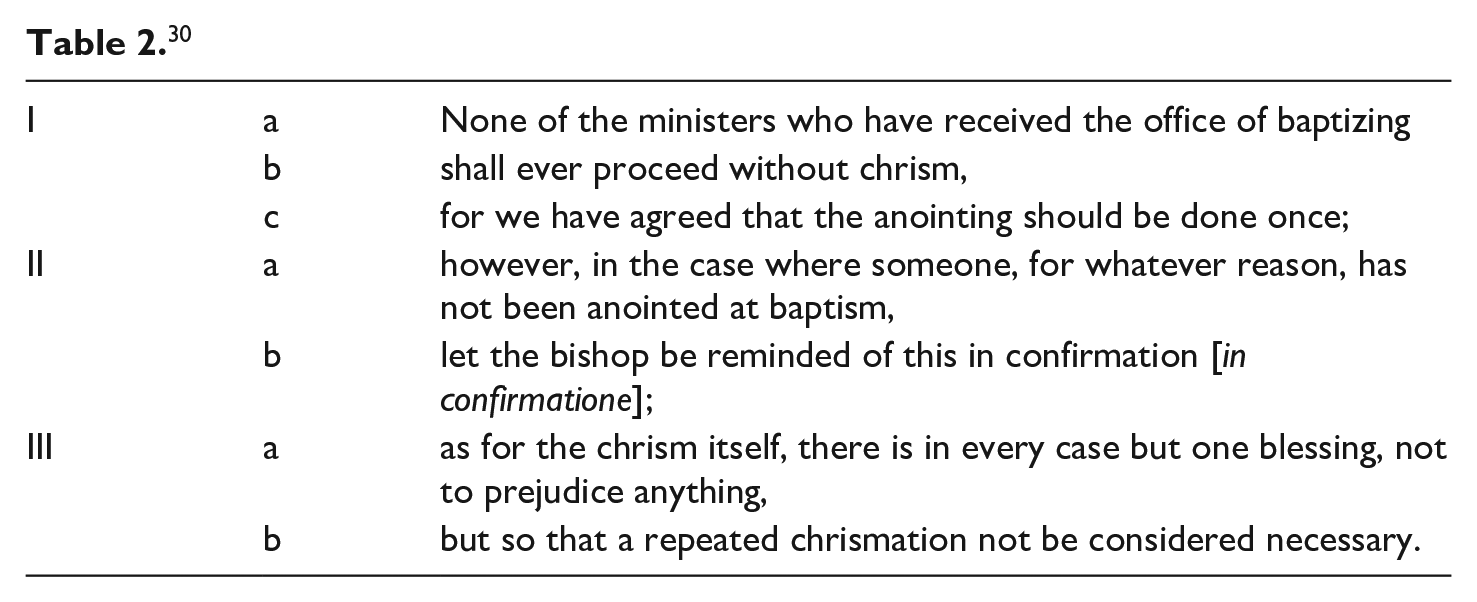
Based on her close analysis of the canon, Gabriele Winkler has persuasively argued that there can be little doubt that only one postbaptismal anointing was customary [Ic, IIIa], which ought not to be repeated [IIIb]. The allusion in IIIb seems to imply that the baptized had sometimes been anointed twice (despite the fact that this was not originally the ordinary practice in Gaul): anointed first right after baptism by the presbyter, and perhaps occasionally by the deacon, when the bishop was not present, and then anointed a second time when the bishop visited.
31
In fact, the canon seems to speak against a double anointing. Moreover, the canon in Ia and IIa makes it clear that it was key that presbyters obtain chrism from the bishop. This regulation, as Winkler notes, also appears in the Synod of Vaison and the Statuta Ecclesiae Antiqua. 32 Thus, before the introduction of the Roman Rite in Gaul there was not a separate rite of confirmation; rather, it appears that “the postbaptismal anointing had been omitted in some parishes, while in other parishes it was being duplicated, that is, presbyters anointed after baptism and then subsequently presented the neophytes to the bishop for a second anointing.” 33
In light of this, Johnson notes that “in confirmatione (‘at confirmation’) . . . refers, primarily, to a visit of the bishop to the parishes of his diocese, who on those occasions ‘confirmed’ or ratified what had already been done by the presbyter or deacon. That is, it is not the newly baptized but the sacramental ministry of the local presbyter or deacon which is confirmed by the bishop’s visit.” 34 The form that this “confirmation” took, as noted with the Council of Orange above, would depend on the local rites: The actions performed by the bishop were a supplement to the rites of initiation as performed by the presbyter and would have included any rituals that were lacking in the presbyter’s administration of baptism. This could have included an anointing or may have also included a handlaying, but it did not repeat a presbyteral anointing or handlaying, as is the case in Roman Rite confirmation today. 35 The bishop’s visit thus recalled the baptisms performed in his absence and manifested the unity of the local church (distinguishing it from the Arian local church): it confirmed an already complete initiation. Since it was the presbyter’s proxy ministry that was confirmed, it was probably not necessary (and certainly logistically unlikely) to locate every infant that had been baptized and communed.
Within the increasing separation of a bishop from some of his local church and within the sociopolitical crucible of Visigothic Spain and Carolingian Gaul, the first rite to be called “confirmation” arose. Though closely linked to initiation, this rite was not strictly speaking an initiatory rite; nor was it reserved to Christian maturity or associated with a new power. It did manifest the local orthodox church within competition with Arianism, and it ritually inscribed the hierarchical connections of the local presbyters with the (proper) bishop. At the same time, since it was “supplying the rites,” rather than repeating a gesture already used at initiation, its connection to baptism was not as multimodal as confirmation would soon become.
The Maturity Model Emerges as Roman Practice Spreads through the Latin West
Confirmation in its medieval form, associated with maturity and strength, came about when the Roman practice of duplicating handlaying and anointing after baptism, one of which was to be reserved to the bishop, fused with the Gallican, Iberian, and eventually Carolingian needs for ecclesiological clarity. Twentieth-century interpretations focused on unitive initiation (liturgical-initiation model) as well as those that presume confirmation is a mature commitment to one’s baptismal faith (theological-maturity model) simplify and misconstrue this period.
A double anointing and handlaying may have been part of ancient Roman liturgical practice. In his letter to Decentius of Gubbio (416), Innocent I includes a section “On the Signing of Infants.” This section focuses primarily on the fact that some presbyters are anointing in a way that usurps the second postbaptismal anointing performed by the bishop. That an anointing is supplied later by a bishop if they are not present seems clear from the bolded text below: Regarding the signing of infants, this clearly cannot be done validly by anyone other than the Bishop. For even though presbyters are priests, none of them holds the office of pontiff. For not only is it ecclesiastical custom that shows this should be done only by pontiffs—in other words, that they alone would sign or give the comforting Spirit—but there is also that reading in the Acts of the Apostles that describes Peter and John being ordered to give the Holy Spirit to those who had already been baptized [Acts 8:14–17].
Innocent I appears to know of a bishop supplying a postbaptismal anointing at a later date, and he associates that anointing with the bestowal of the Spirit. Similarly, in John the Deacon’s (c. 500) description of the rites of initiation, he prioritizes the postbaptismal anointing with chrism (§6), which is presumably administered by the presbyter. 37 But in his discussion of baptized persons who have “departed from this life without the anointing of chrism and the blessing of the pontiff,” he seems to imply that there may have also been a postbaptismal episcopal anointing (or perhaps handlaying). 38 In fact, Michael Whitehouse has cautioned against seeing handlaying as a constitutive part of the early Roman initiatory rites. 39 He argues that Pope Gregory I (590–604 CE) is the first Roman writer to definitively know of, and perhaps celebrate, a postbaptismal handlaying. 40
As the ritual practices of the Western Church, and particularly Rome, gradually solidified, it was in the seventh and eighth centuries that we see the Roman practice of confirmation emerge in the Gelasian Sacramentary and Ordo XI, where an anointing with chrism by a presbyter was followed by a handlaying and anointing by the bishop.
41
Then when the infant has gone up from the font he is signed on the head with chrism by the presbyter, with these words: “Almighty God, the Father of our Lord Jesus Christ . . .” Then the sevenfold Spirit is given to them by the bishop, to seal them, he lays his hand upon them with these words: “Almighty God, Father of our Lord Jesus Christ . . .” Then he signs them on the forehead with chrism, saying: “The sign of Christ unto life eternal.” “Amen.”
42
The order for the initiation of a sick person in the Gelasian Sacramentary also called for a postbaptismal anointing and presumably a later confirmation, now with another sealing (consignatus, possibly a handlaying) and anointing by the bishop. 43
Unlike the earlier Spanish and Gallican texts in which the “confirmation” ritual supplied the postbaptismal rituals that may have been lacking in the individual’s presbyteral initiation, at Rome a prescribed handlaying and chrismation were always performed by the bishop. This Roman practice is reserved to the bishop for ecclesiological reasons; nonetheless, except in the case of emergency baptism of a sick person, it would not be divided from the baptismal rite and was not associated with maturity or strength. It could be (and in the twentieth century, was) interpreted through a liturgical-initiation model, but this label obscures the ecclesiological importance of reserving the consignation to the bishop.
If the Roman practice of episcopal handlaying and chrismation, normally immediately after baptism and before communion, can be understood with the liturgical-initiation model, this model becomes increasingly difficult to maintain outside of the Italian peninsula. In fact, as Roman practice spread through Spain, Gaul, and the rest of the Western church, the rites of anointing and handlaying performed by the bishop at Rome were added to local rites of initiation, blending with the earlier need in those places for the bishop to somehow “confirm” the individuals’ otherwise complete initiation.
44
As Johnson notes: When the Roman postbaptismal rites of episcopal handlaying with prayer and anointing were adopted elsewhere in the Middle Ages it was often the case that these rites, as in the Gelasian order for a “sick catechumen,” did not occur in their traditional Roman position between baptism and first communion but were added at some point after both baptism and first communion had already been administered. In other words, it is not so much the case that “confirmation” gets separated from baptism outside of Rome but that the Roman post-baptismal rites, which came to be interpreted as confirmation, became an addition to the rites of Christian initiation elsewhere.
45
In the end, confirmation as it emerges in the medieval West stems from two different ritual priorities that gradually merged: (1) the Roman practice of anointing and laying hands on the newly baptized, and (2) the Spanish and Gallican practice of episcopal oversight over the rites of initiation, which supplied any rites omitted in presbyteral baptism.
The postbaptismal anointing that is always performed immediately after the water bath, typically in both East and West by the presbyter, has a twofold function: (1) as a seal of the water bath and bestowal of the Holy Spirit, and (2) as a symbol of the bishop as head of the local church. We can see this in one of the earliest liturgical witnesses in the West, namely the Gelasian Sacramentary, whose formula for the presbyteral postbaptismal anointing replicates the first part of an episcopal prayer for the laying on of hands: “The Almighty God, the Father of our Lord Jesus Christ, who has made you to be regenerated of water and the Holy Spirit, and has given you remission of all your sins, himself anointing you with the chrism of salvation in Christ Jesus unto eternal life. Amen.”
46
The longer episcopal handlaying prayer preceding episcopal chrismation reads: Almighty God, Father of our Lord Jesus Christ, who has made your servants to be regenerated of water and the Holy Spirit, and has given them remission of all their sins, Lord, send upon them your Holy Spirit the Paraclete, and give them the spirit of wisdom and understanding, the spirit of counsel and might, the spirit of knowledge and godliness, and fill them with the spirit of fear of God, in the Name of our Lord Jesus Christ with whom you live and reign ever God with the Holy Spirit, throughout all ages of ages. Amen.
47
In the East, the pneumatic symbolism of the chrismation formula is stronger, but chrismation in both cases is a seal for the water bath. 48 In both the Eastern practice of chrismation and the Western presbyteral anointing, the episcopal symbolism of the chrismation is implied by the means of consecrating and distributing the chrism, but does not appear in the prayer texts themselves.
As the Roman episcopal anointing fused with the episcopal visits in the Carolingian period, the ecclesial function of episcopal oversight became fused with the completion of individuals’ initiation. Commentaries on the rites of initiation written during the Carolingian period affirm that the episcopal anointing confers strength on the initiand, an interpretation that Alcuin of York, especially, disseminated. In the context of the concern for imperial stability, the technical term sacramentum still included the sociopolitical and spiritual bonds that built up a community. 49 The metaphors that were called into use to explain the ecclesial concept, such as a brand or a military oath, were directed not at personal interior change but at the recognition of one another by members of a single social body. The first lists creating the category of sacraments in the eleventh century already contained confirmation, and associated it with a gift of strength, which included ecclesial and sociopolitical implications. 50
By the time of Aquinas’s Summa Theologiae, delayed episcopal anointing was taken for granted, though as we have pointed out, he denies a particular age necessary for its bestowal. Aquinas relies heavily on a sermon he attributes to a fictitious pope named Melchiades (quoted directly in articles 1, 7, 8, and 12, and depended on indirectly in 4, 9, and 10). This sermon is usually attributed to Faustus of Riez (d. c. 490), but there are issues with the dating of the text and it may be that the sermon is a product of the Carolingian period. 51 In the late medieval university context, the ecclesiology of the rite was less relevant; on the other hand, Aquinas takes the role of the sacraments in the individual’s return to God by Christ very seriously. 52 As a result, the ecclesiological dimension of the sacrament becomes much more hidden, while the connection to individual salvation becomes more pronounced. In essence, Aquinas’s synthesis completes a personalization of the rite and focuses its ecclesiological dimensions on the mission of the individual, accenting at the same time its anamnetic similarities to baptism (see especially article 5).
Confirmation became a sacrament because in its function as a “seal” it uniquely recapitulates and culminates the entire reality of incorporation into the church and its mission by means of initiation. In the late antique period at the Western fringes of the dissolving Roman Empire, this dimension was especially important because the theological and sociopolitical unity of the church was threatened. In the Carolingian period, it grew in importance because of the desire to make Western Europe into a single, recognizable social body linked by a network of bishops and a unified ritual practice. In the late Middle Ages, it was even more important because the ritual practice of baptism was almost invisible, and yet critical to Christian belonging. At each age, the rite responded to the unique challenges of ecclesial belonging in the social context. As the temporal delay of confirmation increased, its anamnetic citation of baptism became more important, as is evident in ST IIIa, 72, 5, which explicitly compares the powers granted by confirmation’s “spiritual growth” to those bestowed in baptism’s “regeneration.” This article, however, frames the contrast as disjunctive, whereas an ecclesial-anamnetic theology sees confirmation as an effective retrieval of the power of the Holy Spirit received at baptism.
Toward a Unifying Model
The study of initiation in the early period challenges a theological-maturity model, since in the early church, there was no particular age for confirmation. At the same time, more recent study shows that the order baptism–confirmation–Eucharist was not a universal practice later replaced with baptism–Eucharist–confirmation. Rather, the development of confirmation emerged from the need for an individual’s baptism to be manifestly linked to membership in the visible church. In this section we will develop the contours of a more unified model that can account for both history and contemporary practice.
Schillebeeckx’s Via Media as an Example
Edward Schillebeeckx provides an interesting figure between the maturity and initiation models. His specific sacramental theology of confirmation stands within the theological-maturity model, and he attempts to account for the binary of baptism and confirmation by assigning them to Christ’s death and Pentecost. He understands confirmation as a participation in Christ’s mission of sending the Spirit, to be received at a crucial life moment (namely, in adolescence). Such a model would not reflect the Spanish and Gallican history, where confirmation would take place as soon as a bishop was available after baptism, nor does it explain emergency initiation or have a natural fit with children who for other reasons receive confirmation before adolescence. At the same time, Schillebeeckx’s emphasis on confirmation as the Christian’s participation in Christ’s visible mission of sending the Holy Spirit has considerable overlap with our proposal. His choice to treat the characters of baptism and confirmation together, seeing each as the ecclesial effect, a participation in the church’s work as “the earthly prolongation or, better, visibility of, Christ’s high priesthood in heaven,” is a key to our analysis here, as is his sacramental ecclesiology. 53 “Ecclesial” in our proposal is taken to reflect such an ecclesiology.
Schillebeeckx understands the sacraments as the mediation between God and the world, a mediation that is salvific for the world without changing its essential finitude. 54 Human religion for Schillebeeckx is a testament to the creaturely character of human beings as called by God, but without the revelation of the Scriptures, this calling remains invisible—that is to say, interior and individual. In the Jewish Law, on the other hand, the call of God to the world becomes something explicit, social, and visible. Finally, Jesus Christ is the pinnacle of this salvation that mediates the divine presence, remains genuinely creaturely, and includes mutual love and full availability. 55 This is the foundation for Schillebeeckx of the experience of sacramentality, which manifests the interior call in a visible, public, social, and eventually cultural way.
The church is sacrament, then, by bearing witness to God’s will to save in a visible way; the individual sacraments, for Schillebeeckx, make this salvific reality accessible in a personal, existentially specific, and temporally relevant fashion for individuals. 56 In each sacrament, Christ is encountered in a deeply personal and transformative way. At the same time, the sacraments also (as cultural ritual practices and liturgical events) are the concrete manifestation of the sacramental character of the church: It is in the liturgy that the church’s mediation of God to humanity is principally made visible. The Eucharist is of course the central example, but the sacraments that bestow a character play an important role in manifesting the membership and leadership of individuals in relationship to the church’s visible, sacramental reality.
Schillebeeckx grounds the ecclesial “visibility of grace” in “the whole Church; not the hierarchical Church only, but also the community of the faithful.” 57 The church exists as church because the heavenly Lord cannot be perceived in his proper form: Instead of being available in his own form to a limited number of people as he was before the Ascension, the risen Lord is now manifest to the whole world as sender of the Holy Spirit through the sacramental mediation of his church. 58 For Schillebeeckx, the ecclesial effect of each sacrament, the visible incorporation of the individual into some aspect of the church’s ongoing, missional mediation of the risen Christ’s work, is prior to the personal, graced effect on the individual. 59 Thus there is a need for each individual’s participation in the sacramentality of the church to be symbolized in some way.
The theological idea of a character developed from a conviction that baptism outside the boundaries of the visible communion (that is, among heretic or schismatic groups) did not need to be repeated even though it did not integrate a person into the church. 60 This theological concept as developed by Augustine and later the scholastics fits with Schillebeeckx’s choice to treat the ecclesial effect as prior to the graced effect of conformation to Christ. In Schillebeeckx, the character of baptism includes ecclesial participation, but this character is activated and realized in the confirmation character precisely in the existential condition of that person. Both baptism and confirmation’s characters relate to church as “the earthly prolongation or, better, visibility of, Christ’s high priesthood in heaven,” in particular as to ecclesial participation in Christ’s worship of the Father. 61 Confirmation empowers a Christian “to take part . . . in [the church’s] visible activity of bestowing the Spirit.” 62 Schillebeeckx’s theology explains only two contexts: ancient baptism–confirmation–Eucharist (without the granularity of the history above) and contemporary mature confirmation. Nonetheless his treatment is exemplary in recognizing the ecclesial dimension of confirmation and its relation to baptism.
The Ecclesial Dimension of a Unitary Model
Baptism communicates a share in the paschal mystery and salvific grace. Confirmation expresses, by means of the new Christian, the church’s mission as sacramental sign of the risen Christ and seed of the coming kingdom. This visibility, and not only the salvation of the individual, is properly the work of the Holy Spirit, and so the rites of confirmation and its predecessors make use of gestures already associated with the bestowal of the Holy Spirit. A bishop stands on the one hand as a condensed symbol of the local assembly and on the other hand as the sign of the universal church within which the new initiand was to perform her participation in Christ’s work. The church, especially in its unity mediated by the Holy Spirit, serves as sacramental sign of the kingdom, not least against competing political models and social bodies claiming to be church.
According to our proposed ecclesial-anamnetic model, in baptismal washing and presbyteral anointing an individual is both initiated into the ecclesial Body of Christ and conformed to Christ’s death and resurrection, his mission as prophet, priest, and king. At the same time, the visible membership in the church can be contested or insufficiently attested: For example, the reception of schismatics (the author of On Rebaptism and Augustine), adolescent life changes (context 1b), First Communion (context 2b), or impending marriage or ordination (context 1a) might produce a need for one’s ecclesial belonging to be re-attested. It would not be fitting to repeat baptism, of course, but by an anamnetic retrieval of the baptismal effect, confirmation re-attests the ecclesial belonging and mission of the baptized.
By the sacraments that bestow a character—that is, baptism, confirmation, and ordination—the Body of Christ is made manifest in the world institutionally and verifiably, a manifestation that also must be complemented and veri-fied 63 by the gifts of mutual charity and a holy life. In early initiation under the bishop, this aspect of participation was symbolically communicated by the bishop’s personal presidency over the rites. In the origin of the rite that we now call confirmation, baptism had been performed in an emergency context or outside the bounds of the Catholic Church, but the full ecclesial visibility of the unity of the baptized with the local bishop had not been made manifest. The personal presence and touch of the bishop’s hand reprises one element of the rite. This gesture is not demanded for personal salvation but for attestation to the visible character of the church: that is, its character as sacrament of the kingdom.
While the sociopolitical deficit of ecclesial visibility that pertained to Visigoth Spain or Carolingian Gaul does not hold today, 64 there is a manifest deficiency of ecclesial visibility in the fact that most Catholics have very little sense of their own local, diocesan church and little exposure to its bishop. This ecclesiological problem is amplified by the sexual abuse crisis and political polarization. The bishop’s visits for adolescent confirmation are experientially important for them and for the local church, while theologies of confirmation are dominated by two theological models that overlook his role. An explicit focus on the ecclesiological dimension of confirmation accentuates why the ritual process of confirmation (at least for 1b and 2b contexts) still accentuates episcopal visits: In so doing, it responds theologically and ritually to the fragmentation of ecclesial belonging today.
Likewise, the different contemporary rites today all express, though in different modes, how the initiand participates in the visible, sacramental witness of the church to Christ. In the contemporary context, the verification of the connection of the local assembly and its ministry to the global network of Catholic bishops is uncontroversial and thus unremarked; it is unsurprising that the delegation of the bishop’s presidency to presbyters is no threat. Instead the question arises of how confirmation relates to the graces bestowed in baptism.
Anamnesis—Cosmic, Personal, Eschatological
Anamnesis can bridge the various historical manifestations of confirmation and explicate its relationship to the rest of the initiatory complex. Anamnesis is often associated primarily with the Eucharist as memorial of the paschal mystery, but it encompasses all the liturgical rites and the whole work God has done for human salvation. 65 Anamnesis denotes the belief that by entering into the memory of God’s great deeds, as those are commemorated by God’s people, we also enter into the eternal plan for salvation that those deeds manifest and make real. 66
Anamnesis creates “a unique liturgical present which is eschatologically—and anamnetically—transparent.” 67 Christian anamnesis relies on the special character of the incarnate Word’s human actions, which manifest in time the eternal character of the Son of God within the Trinity. The paradigmatic example is the self-sacrificial love expressed in the cross, which manifests the eternal kenotic love of the Son for the Father and the self-giving love of the triune God for creation.
There is a deeper foundation for anamnesis: As the Word that enacts creation, the Logos has already intervened in history by the creation of time and space in a way that also manifests God’s loving will toward creatures. Time itself, as a structural component of creation, permits the experience of God’s deeds and the conforming of the human person to the Son of the Father; anamnesis is thus as much a characteristic of the created order as it is of the special character of the deeds of the incarnate Word. 68 Liturgical anamnesis is the activation of this quality of created time; it unites the deeds of God, which in themselves are a historical manifestation of an eternal characteristic of the mind of God, with the subjective experience of a historical moment. That historical moment, then, itself becomes a new historical manifestation of God’s eternal will to save, tailored to the ever-new historical situation.
David Power explains this characteristic of liturgical celebration in terms of “prophetic remembrance”: It is not however set recital as such that constitutes memorial but narrative, narrative that links the future of the present with its past. Prophetic remembrance is needed when the link has disappeared for the people who hear the story. It takes the form of a reconsideration and even a recasting of the narrative in the face of struggle, catastrophe, and sin. It is totally rooted in the collective memory and speaks of the activity of God for the people. However, it gets inside the experience of catastrophe to discern and proclaim the new ways in which God, in fidelity, is now acting and how the future looks in light of this.
69
Anamnesis neither makes past events present so they can be effective again, nor in some fashion transports the present individuals back to the past. Narratively and sacramentally, anamnesis makes the assembly gathered partakers in the assembly that was convoked by God’s great deeds in their original historical manifestation.
The sacramental actions of the church, because they are actions of Christ the incarnate, risen, and living Word, can themselves be remembered in liturgical anamnesis. 70 At an individual’s baptism, Christ’s historical action, by means of the creation he models as Logos, becomes narratively and irretrievably entangled with the personal history of an individual. 71 The celebration does not merely alter qualities of that individual but also convokes an assembly who partake along with the baptizand in the call to covenant with the God of Jesus Christ. The existence of this body of believers, the community surrounding any particular individual, is one effect of baptism (i.e., the incorporation into the ecclesial Body of Christ), and one that necessarily has a visible and social aspect. 72 Though a physical assembly can be dispensed with in times of emergency, it is a witness to the full sacramental reality: For this reason, children who have been baptized using the emergency rite are to be “brought to church” and the “ceremonies” that were left out of their baptismal rite are to be “supplied” in public, convoking a visible assembly and thus “completing” or “perfecting” the rite. 73
The anamnetic dimension of confirmation runs in two directions: (1) confirmation retrieves one’s conformation to Christ, visible participation in the church, and infusion of the Holy Spirit from baptism, and (2) baptism proleptically accomplishes what confirmation signifies, just as Christ’s paschal mystery proleptically accomplishes the effects of baptism on every Christian. The ecclesial-anamnetic model incorporates the theological-maturity school, since confirmation is an effective retrieval of baptism, which lifts the gift given at baptism into a manifest relationship with the mission of the church in the world. This dimension of confirmation explains the ongoing importance of the theological-maturity model for adolescents (context 1b) and also how easily confirmation was adapted to the demands of Catholic Action in the early twentieth century. 74 It clarifies why confirmation is not necessary for an individual’s salvation, even though it is a sacrament and in that sense “necessary” (as all sacraments are necessary to the full life of the church; see ST III.65.4; 72.1, re. obj. 3).
Nor is the anamnetic and ecclesial character of confirmation limited to the role of an assembly. Christians baptized in infancy benefit from an anamnetic immersion into their baptism. The theological question is not, “What does confirmation give that was not already given in baptism?” but rather, “How does the anamnetic celebration of one’s baptism in the local church narratively integrate the deed of God in Christ of one’s baptism into the concrete here and now of the Christian life?” Sacramental anamnesis may be a foundation for sacramental revival: Confirmation may bring a new or renewed conversion experience, 75 but even in a less dramatic case, anamnesis brings baptism into a concrete relationship with one’s contemporary circumstances. Prophetic remembrance brings one’s narrative future together with the call to participate in the church’s healing work, even though the intervening history may have clouded this future. For this work, likewise, powerful symbols of the worldwide communion of the church and the local assembly’s concrete instantiation of the mission in this time and place are essential.
The anamnetic dimension of confirmation is muted and thus the liturgical-initiation model is more relevant when confirmation is immediately after baptism (contexts 2a, 2c, and early Christian initiation). In these cases, the ecclesial dimension of participation in Christ was holistically demonstrated by the complex of baptism and communion, presided over by the bishop as the visible symbol of the unity of the local church, and eschatologically focused by the consummation in eucharistic communion. There is no unique effect of confirmation within this complex; the whole complex accomplishes the ecclesial effect described as the character of confirmation (or, as Schillebeeckx puts it, of baptism and confirmation). One gesture within this holistic complex was the laying on of hands, which conveyed the relationship between the initiand and the local church. This gesture could then be anamnetically retrieved in cases where baptism needed to be solemnly recalled: for example, in sacramental reconciliation or the reception of baptized Christians. Similarly, some contemporary Byzantine practice allows for the use of chrism in an analogous way. 76 Baptism, participating in Christ’s paschal mystery, bears a timeless significance for the baptized person, as well as for his or her visible relationship to the eschatological community. Ritual gestures associated with baptism such as handlaying or chrismation can activate that significance anamnetically.
In short, ancient, medieval, and postconciliar rites associated with confirmation make use of the ecclesial symbolism of the bishop to confront various challenges to Christian identity and church unity. These rites manifest underlying theological rationales connected to the eschatological vocation of the church in the world and the individual Christian’s responsibility toward this visible calling; they anamnetically recall baptism, as well as Christ’s deeds, when separated from baptism temporally.
In contemporary practice, contexts 1a and 1b (with candidates who are adults or adolescents) find theologies of maturity pastorally useful; at the same time, an emphasis on ecclesiology interprets the role of the bishop. An explicit focus on the anamnetic relationship to baptism highlights the role of the communion of saints, as well as recentering the theology of confirmation on God’s gracious gift. While context 2a (catechumens undergoing full initiation) can be easily explained using the liturgical-initiation model, the confirmation part of the rite is more effectively understood as highlighting the ecclesiological dimension of Christian initiation. Contexts 2b, 2c, and 3 (restored order candidates before first communion, emergency initiation, or full communion candidates), on the other hand, are not adequately explained by either the theological-maturity model or the liturgical-initiation model. In each context, however, symbols of ecclesial unity and, if necessary, an anamnetic citation of baptism serve to connect the initiation of the individual with the eschatological mission of the church.
In conclusion, confirmation’s sacramental function has been misunderstood because of a focus on a privatized understanding of sacramental effectiveness and an underdeveloped understanding of anamnesis. Confirmation, presbyteral chrismation, and Eastern chrismation are different rites, yet each in its theological and sociopolitical contexts conveys the ecclesial and eschatological dimension of baptism. Confirmation uniquely highlights the role of the bishop, both as local head and as representative of the universal church. Both the liturgical-initiation school, which dominated the ritual reforms of the OCIA, and the theological-maturity school, which dominates the pastoral teaching of adolescent confirmation, overlook this important symbolic function. A third interpretation is possible, which understands confirmation as an anamnetic seal of an individual’s initiation, reprising anointing and handlaying to frame the full ecclesial and eschatological meaning of that initiation in a visible, sacramental form. The ecclesial-anamnetic model incorporates the emphases of the liturgical-initiation school (inasmuch as it represents the origin of confirmation in a retrieval of the baptismal rite) and the theological-maturity school, since both convey in divergent ecclesial contexts the importance of participation in the church’s mission. In its various contexts, historical and contemporary, confirmation is a retrieval of the baptismal rite and the sacramental expression of one’s participation in the wider mission of the church.
