







Abstract
Digital technology is changing the world. This article analyses visual images to learn with and from the social media presence of two Christian organizations as they respond to the climate challenges facing our planet. The article demonstrates how online visual images are a public theology that communicates activist journeys, intergenerational participation and prayer integrated into climate justice. The research makes a novel contribution to the study of digital activism, visual images, and the construction of public eco-theologies by grassroots Christian communities.
Digital technology is changing the world. Amid many examples of online toxic discourse, Christian organizations are actively using online platforms to activate for change. Early research in digital religion focused on the online nature of religious presence, communities, rituals, worship and recruitment. 1 However, online digital platforms can be the ‘liveliest place’ for theological reflection as ‘theologians make use of the facilities of the Internet to reflect and communicate with others’. 2 Online activism by Christians becomes a way of doing eco-theology in public. 3 Online activists might not describe themselves as theologians. Yet, as they reflect and publicly communicate, they embody hybrid spaces of practice at the intersection of faith and life. 4 This article analyses online visual images to demonstrate how social media activism by Christian organizations expresses a grassroots public eco-theology.
The ecological crisis has profound implications for theology and Christianity. Sebastian Kim suggests that four strands of eco-theology have emerged: social ecology (liberation for the whole of creation), creation theology (restoring interconnectedness), eco-feminism (challenging dualisms) and eco-spirituality (integrating with the work of the Spirit in creation). 5 As activist organizations work ‘from below’, they offer theologically formed responses to climate change. 6
This article demonstrates how activist organizations undertake public theological work in images as well as words. We live in a society that places increased importance on visual communication. The use of emojis as small visual images in communication has ‘resurrected visuality in phonetic writing’. 7 As new relationships between the verbal and visual arise, new ways of thinking result. This article makes a novel contribution to public theology as it outlines how online visual images posted on social media by climate activist groups are public eco-theologies.
Digital activism and visual grammar and research methods
Debates around the nature of online activism, how Christians might express their faith and theology in visual modes, and how to analyse visual images are essential backdrops for this research.
The description of online activism as ‘slacktivism’ has been used to raise concerns about whether the low-demand nature of liking a piece of online content might inoculate people against activism in offline or face-to-face areas of life.
8
Equally, research has demonstrated how online platforms mobilize movements and solidify collective action.
9
Christina Neumayer and Jakob Svensson suggest four different types of digital activism. The
Historically, Christianity has a complicated relationship with visual images. Some strands of the Christian tradition have expressed concerns about the place of ‘graven images’ in Christian life. At the same time, throughout history, art has been a source for communicating and challenging Christian understandings. 13 Medieval Scriptures, like the Book of Kells, are ‘profoundly multimodal’, with combinations of writing, images and decoration structured by principles of visual composition. 14
Ways to conduct visual image analysis are provided by the academic discipline of sociolinguistics. Gunther Kress and Theo van Leeuwen argue that images, like writing, have a ‘grammar’ defined as the ‘social-semiotic resource of a particular group, the group’s explicit and implicit knowledge about this resource, and its use in the practices of that group’. 15 Tools such as the colour palette, how the viewer is positioned by the perspective of the image, what is included and excluded by way of framing and the composition or elements of an image are all dimensions that speak to the narrative work being offered by a visual image. The analysis of various components, including the size, structure, grouping, circumstances and elements of what is included and excluded, provides resources for interpreting visual images as a source of communication. In this approach, art is seen as a hermeneutical practice. Applied to visual content creation, labour is involved in taking, editing and posting images. This labour is shaped by a set of values and theological commitments. The discipline of sociolinguistics and ideas of visual grammar provide tools for analysis.
This article applies visual grammar tools to analyse online Christian eco-theologies. Two British climate action groups (Green Christian and Christian Climate Action) gave permission to examine their online communication on social media. 16 This article neither assessed the impact of online Christian activism, given the algorithmic variables of online digital platforms, nor analysed viewer engagement, given the difficulty of gaining informed consent on digital platforms. 17
Visualizing climate-justice activism
Green Christian understand themselves as ‘Ordinary Christians: extraordinary times. Acting for a greener Church and a healing World.’ 18 Christian Climate Action take ‘prayerful, non-violent direct action to push for justice in this climate emergency’. 19 Their online social media presence has three dimensions, including header images, images used in regular posting and emojis as small digital images.
Header images of Green Christian and Christian Climate Action
Social media platforms such as Twitter and Facebook allow users to place an image as a header to communicate the essential identity of the organization. Placing the single header images of Green Christian (GC) and Christian Climate Action (CCA) alongside each other provides a contrast in public eco-theologies of activism.
The social media header of GC portrays the sun glinting through trees in a forest. The
The social media header of CCA also involves a pausing, albeit one caused not by nature but by people holding banners inside a church. Like GC, the
The visual grammar of the header images of these two climate-justice activist organizations requires the viewer to pause, either to look up or to find a way beyond a wall of protestors. Different ways of acting are required, one centred on hearing the earth’s cry, the other on humans choosing to ‘divest’ from ‘fossil fuels’. Amid these different approaches to activism, the social media sites of both organizations share a distant source of light: one in a forest, the other through a stained glass window. This can be interpreted as suggesting hope in the climate actions of a divine presence.
30 days of Christian Climate Action
Visual grammar analysis can also be applied to multiple images in multimodal combinations with text. Given that this article aims to be illustrative, not exhaustive, social media posts from 30 days were analysed. 20
Every one of the CCA posts drew in some way on visual images, underlining the need for a visual grammar analysis to interpret CCA’s public theology. Twenty-four of the 28 CCA social posts utilize a single visual image, a repetition that gives visual coherence to the organization’s online presence. Thematically, around 64 per cent of the posts (n=18) relate to
Another theme that was present, although in a more minor way, is that of
A growing dimension of online communication involves small digital images called emojis. Emojis were a particular feature of CCA, present in over 67 per cent (n=19) of the CCA posts. 21 Visual grammar analysis demonstrates how these emojis contribute to CCA’s public eco-theologies. 22 First, creation care is affirmed in the use of a green heart, along with emojis including sunflowers, trees and the earth. Second, the presence of a range of action emojis, including a finger pointing to action, hands together in prayer and a pen on paper, indicate different activist journeys. As visuals, these communicate a diversity of embodied actions that anyone, no matter their age, gender or role in the church, can enact. Third, there is evidence of intentionality in emojis – for example, a blue circle that draws attention to Blue Plaques, a campaign to highlight declining species (12 June). 23 A second example emerges around one of the protest journeys. An original post about the Barclay protest on 17 June included four emojis. Reposts (on 20 and 25 June) utilized different emojis: one of a telephone, another of a smiley face. The emojis contribute visually to the rhythm of a single journey unfolding over time. Hence, the emojis in CCA’s online visual grammar contribute to their public eco-theology. They speak of green-hearted care for creation, encourage diverse forms of climate justice activism, and accentuate the rhythm of the different protest journeys being told by CCA.
30 days of Green Christian
While visual images and emojis are a feature of CCA, much higher rates of posting content online are a feature of GC. Over 30 days (see Figure 1), GC made 118 posts, an average of around four per day. Some 75 per cent (n=86) of these ‘tweets’ either reused (reposted) content from another site or drew from external news sources. This reuse suggests an emphasis on partnerships and resource sharing, but is outside the scope of this article, which is focused on what is created by these grassroots Christian organizations.
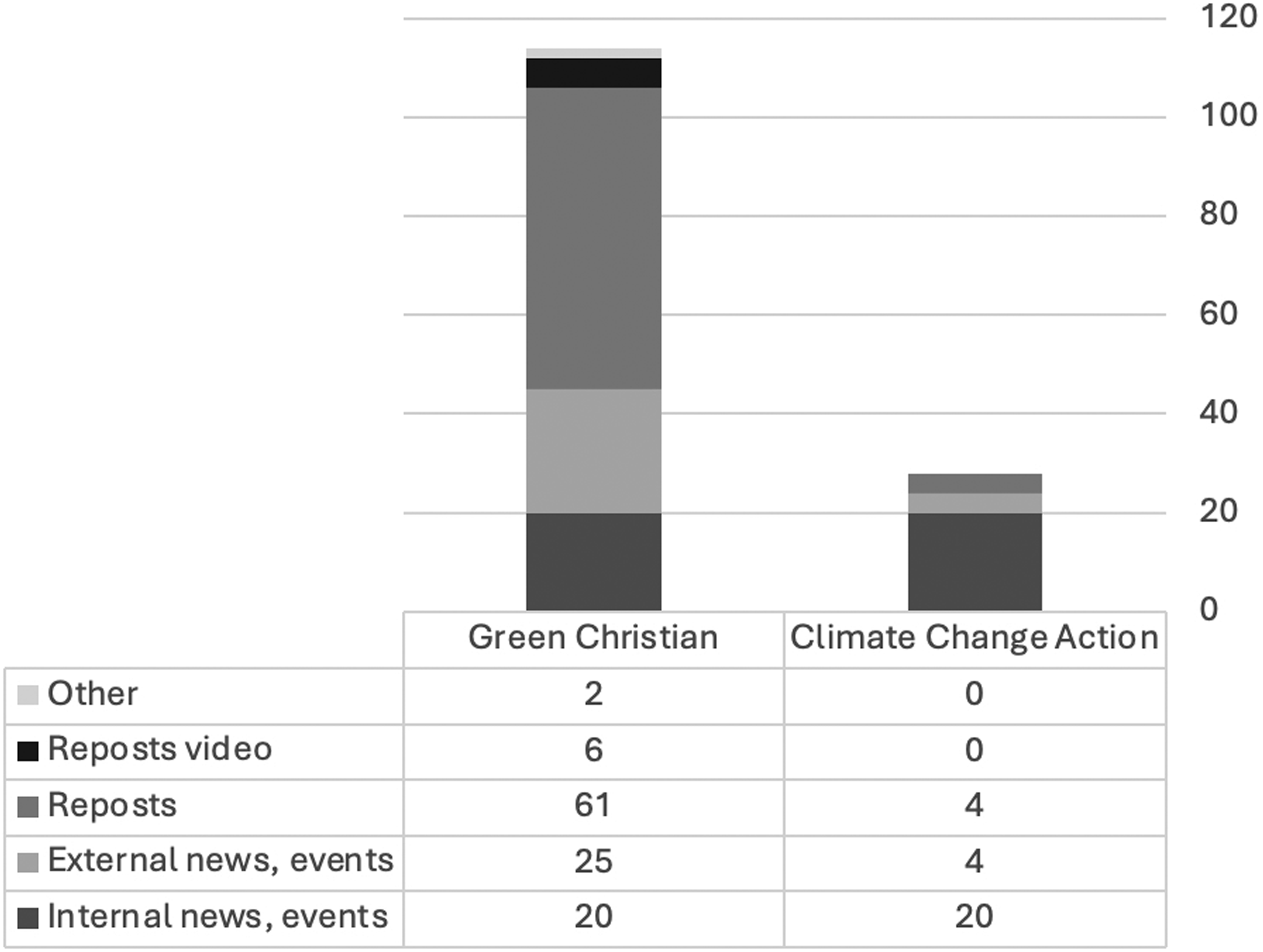
30 days of online content.
It is intriguing that CCA and GC created exactly the same amount of unique content (n=20). While all the CCA content involved images, only four of the GC-created tweets involved images. However, these GC images provide a distinct public eco-theology. First,
Typologies of digital activism
Table 1 brings the four-fold activist typology proposed by Neumayer and Svensson into dialogue with my visual grammar analysis.
Typologies of digital activism with examples of grassroots UK climate activist organizations.
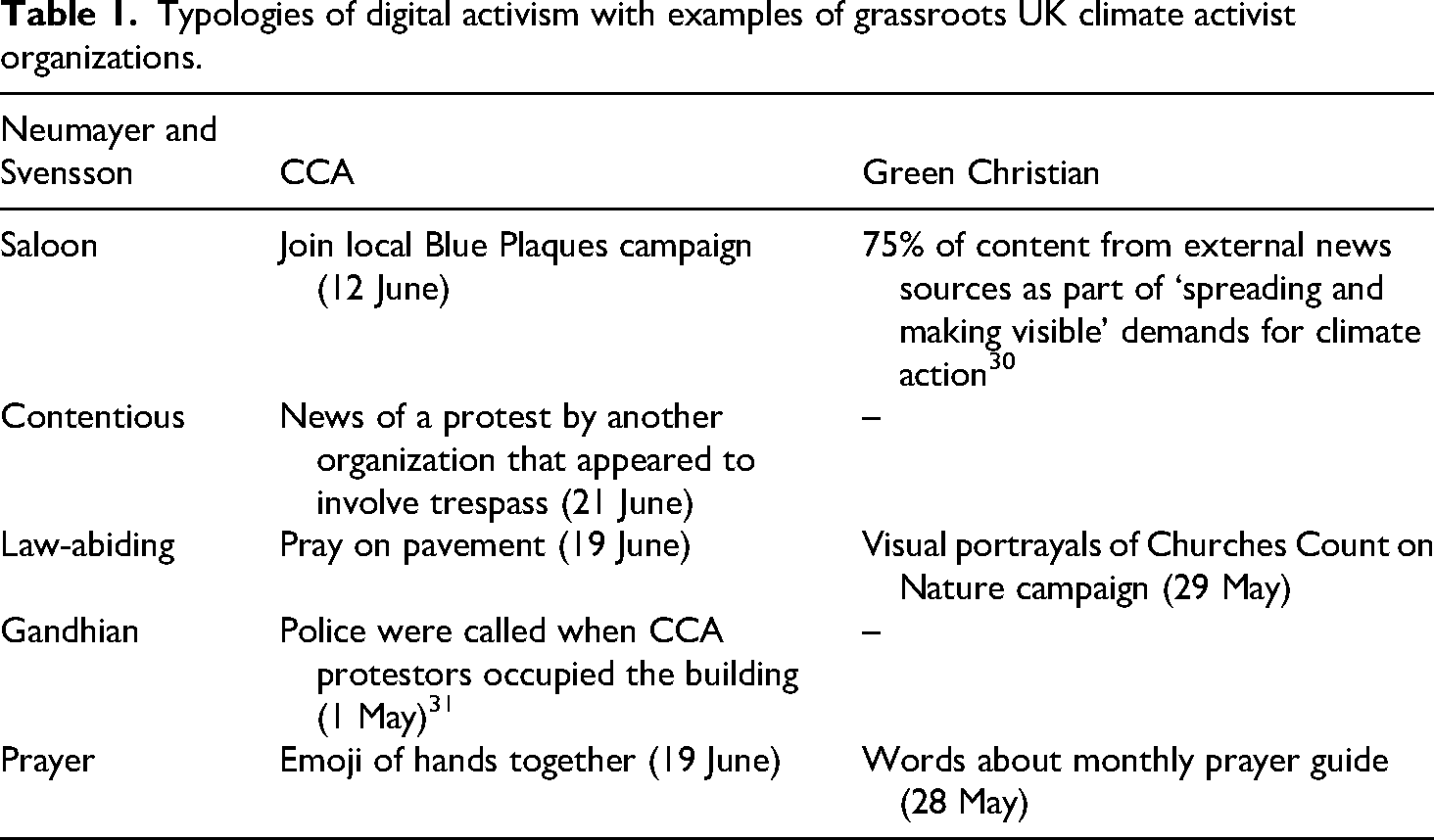
All four types of digital activism were evident in the CCA online presence. Both online activist groups also demonstrated a fifth type of activism: prayer. GC posted about a monthly prayer guide (on 28 and 29 May and 1 June). 25 Prayer is evident in the images posted by CCA, particularly a woman praying. In addition, CCA defined the hands together emoji as ‘prayerful protest’ (19 June). 26 Hence, these two climate activist groups are present online in ways consistent with the four typologies proposed by Neumayer and Svensson. Yet they are also digitally active in a fifth way, as they centre Christian spiritual prayer practices. The presence of prayer as integral to activism challenges secularizing approaches that either overlook or minimize religious practice in a search of common ground.
Analysis of visual activism contributes to thinking about ‘slacktivism’ and the relationship between how people participate in online and offline situations. The online visual content of both CCA and GC involves real people undertaking offline activism, praying on pavements (CCA) or counting nature in churchyards (GC). One of the critiques of ‘slacktivism’ is that the online presence is performative, an expression of ‘aspirational labour’ in online identity formation. 27 However, several tweets from CCA use aspiration to localize activism: for example, ‘Sick of protests being in London? … Check out our local groups page’ (15 June). Hence, social media can be seen as a resource to encourage local aspiration in diverse grassroots contexts.
Finally, these grassroots public eco-theologies invite comparison with established eco-theologies, including the different strands of eco-theology outlined by Sebastian Kim.
28
If participants were interviewed, it would be highly likely that elements from social ecology, creation theology, eco-feminism and eco-spirituality would be present in both CCA and GC. However, CCA’s
Conclusion
This article has demonstrated how two climate activist groups’ visual content on social media can be read as public theology. Visual grammar provides resources to complete the hermeneutical circle of theory and practice that is needed in public theology. Online activism is an important dialogue partner for established theologies, providing immediacy, provisionality and prophetic critique of existing theologies and practices. Both organizations show a distinctly Christian approach to digital activism, centring prayer in climate justice activism.
Alongside these theological implications, the research also has practical implications. The case study approach reveals a diversity in the visual grammar of the two organizations. The different volumes of content posted and the visual contrasts in colour palettes should encourage unique expressions of public eco-theologies among volunteer grassroots organizations.
Further research is needed. First, given that images generate multiple meanings, it would be instructive to interview participants from these activist organizations about how they interpret these visual images. Second, research is needed into indigenous climate faith-based organizations, given that much of the research on digital activism is Eurocentric. 29 Overall, there are rich possibilities for using visual grammar analysis to make visible online public eco-theologies.
Footnotes
Acknowledgements
The research for this article was supported via a Fellowship at the Institute for Advanced Studies in the Humanities at the University of Edinburgh. Thanks to Dr Alex Chow, Dr Rathiulung Elias KC and Dr Andre Theng for several conversations that opened up new intellectual pathways. The study was approved by the School of Divinity, University of Edinburgh on 20 May 2024. Written informed consent was obtained from a legally authorized representative prior to research.
Funding
The author(s) received no financial support for the research, authorship, and/or publication of this article.
Declaration of conflicting interests
The author(s) declared no potential conflicts of interest with respect to the research, authorship, and/or publication of this article.