







Abstract
The current literature on Black middle-class men is sparse, leaving little to be known about the raced, classed, and gendered experiences for many Black middle-class male students and their families. Employing qualitative methodology, this study uses critical race theory (CRT) to examine the educational experiences of Black middle-class high school male students through the counterstories of Black students and their fathers. This study highlights various microaggression events experienced by the male students as well as the forms of cultural wealth drawn upon by the fathers to divert the potential negative outcomes of school racism.
Introduction
Though the literature on the Black male experience is growing, there is still a gap in the literature regarding the experiences of middle-class Black men. Relatively few studies have seriously examined the educational experiences of Black middle-class students in general (Allen, 2010b; Ascher & Branch-Smith, 2005; Ferguson, 2001; Hemmings, 1996; Horvat & Antonio, 1999; Lareau & Horvat, 1999; Ogbu, 2003; Tyson, 2002). The majority of research conducted on Black students has focused on the working-class, only peripherally mentioning the experiences of Black middle-class students, and rarely disaggregating Black underachievement by class. This presumes that Black schooling experiences are homogeneous and are consistent over time. Studies that focus on the raced and classed experiences of Black students, unfortunately, are really only looking at the raced and classed experiences of the working- and under-class. This lends itself to providing explanations of Black (under)achievement and solutions that lack nuance by class, location, and time.
The plight of the Black middle class may not be currently salient in public discourse, though it does not mean Black middle-class families are without their perils. Statistically speaking, the process of middle-class reproduction for Black families is a difficult one. More than 80% of the Black middle-class population is first-generation middle class (Billingsley, 1992; Landry, 1987; McAdoo, 1978), with most specifically identified as lower middle class (McBrier & Wilson, 2004; Pattillo-McCoy, 1999, 2000). Black families also have great difficulty transmitting middle-class status from generation to generation (Hertz, 2005; Issacs, 2007; Kearney, 2006), meaning that many Black middle-class families will have offspring who are downwardly mobile (Attewell, Lavin, Domina, & Levey, 2004).
It is possible that the difficulties of Black middle-class reproduction are emblematic of the achievement gap between middle-class Blacks and middle-class Whites, a gap that in many cases is greater than the gap between working-class Blacks and Whites (Belluck, 1999; Hallinan, 2001).
The research literature regularly speaks to the underrepresentation of Black men, including middle-class men, in gifted and talented programs and overrepresentation in lower-ability, remedial, or special education programs (Aud, Fox, & Kewal Ramani, 2010; Blanchett, Klingner, & Harry, 2009; Grantham, 2004; Mickelson, 2001; Oakes, 2005). In addition, Black men regardless of class status lag behind Black women in achievement scores and graduation rates (Hubbard, 1999; Roach, 2001; Trent, 1991). For these reasons research on Black middle-class men is quite pertinent to the larger investigation of Black educational achievement.
In this article I present narrative data on the school experiences of Black middle-class men, focusing on the school-based racial microaggressions as well as the intervention responses by the middle-class fathers. A brief discussion of critical race theory (CRT) and microaggressions as theoretical frameworks will be followed by a methodological summary. I will then present the study results, which include the experienced microaggressions of assumptions of intelligence and deviance and differential treatment in discipline. Also presented in the results include the intervention responses by the parents, drawing upon their cultural wealth to contest microaggressions and create opportunities for success. Finally, an analytical discussion of the results will be conducted along with concluding remarks.
Theoretical Framework
Critical race theory
Employing critical race theory (CRT) as a theoretical lens, this study foregrounds the role of race and racism in the secondary schooling experiences of Black middle-class men. A product of the 1960s Civil Rights activities and formulated within legal studies, CRT is an interdisciplinary movement that puts the impact of race and racism at the center of any critical examination (Delgado & Stefancic, 2001). Though CRT has largely been used in legal studies (Kimberle Crenshaw, Gotanda, Peller, & Thomas, 1995), it has become an equally useful analytic tool in the field of education. As Solórzano (1998) explains, “A critical race theory in education challenges the dominant discourse on race and racism as they relate to education by examining how educational theory, policy, and practice are used to subordinate certain racial and ethnic groups” (p. 122). The literature on CRT consistently identifies five foundational tenants of the theory.
Centrality and intersectionality of race and racism: As race and racism are endemic to American society, CRT places race, and its intersection with other identities (i.e., class, gender, sexual orientation, language, immigrant status, etc.), at the center of its analysis (Bell, 1992; Kimberlee Crenshaw, 1993).
Challenges dominant ideology: CRT seeks to challenge dominant claims of race and gender neutrality, objectivity, universialism, ahistoricism, colorblindness, and equal opportunity. Such claims within educational and other social institutions camouflage the self-interests and privileges of dominant groups and maintains the status quo of racial inequalities (Delgado, 1991; Ladson-Billings & Tate IV, 2006).
Centralizes experiential knowledge: CRT rejects master narratives that attempt to mask racial, sexual, and gender discrimination and privileges the lived experiences of people of color. Through counterstorytelling, narratives, biographies, and other qualitative methods, the lived experiences of people of color are recognized as valid and necessary to the analysis of race and racism (Delgado, 1995; Dixson & Rousseau, 2006; Miron & Lauria, 1998; Solórzano & Yosso, 2002). In addition, through counterstories CRT seeks to identify various forms of cultural wealth (Yosso, 2006) that people of color draw upon to resist racial injustices and create opportunities for success.
Commitment to social justice: CRT works to eliminate racial injustice as well as other forms of insubordination that pervade American society (Matsuda, 1991).
Interdisciplinary in nature: CRT analysis is applicable across disciplines, as race and racism are endemic to American society and should be studied and taught across disciplines (Crenshaw et al., 1995; Taylor, Gillborn, & Ladson-Billings, 2009).
At its axis, CRT analysis invariably works to uncover how race mediates the ways people of color experience subordination through social and institutional racism, and is a useful tool in analyzing the impact of racial microaggressions on Black males in schools.
Racial microaggressions
Using CRT as an analytical tool, this study seeks to examine how the daily and sometimes subtle experiences of racism adversely affect the schooling opportunities for Black middle-class men. Though overt racism is still very much prevalent in American society, it is often recognized through public discourse as socially unacceptable. It is the covert or subtle racism that often goes unnoticed but quietly demeans and denigrates people of color. Pierce et al. (Pierce, Carew, Peirce-Gonzalez, & Willis, 1978) defines microaggressions as
subtle, stunning, often automatic, and non-verbal exchanges which are “put downs” of blacks by offenders. The offensive mechanisms used against blacks often are innocuous. The cumulative weight of their never-ending burden is the major ingredient in black-white interactions. (p. 66)
Though Pierce is speaking specifically about race, microaggressions affect all marginalized groups and are felt through environmental cues as well as verbal and nonverbal hidden messages that serve to invalidate one’s experiential reality and perpetuate feelings of inferiority. For example, microaggressions taking the form of nonverbal or behavioral exchanges may include a White woman clutching her purse when a Black man walks by or a group of Black students being ignored or given “slow” service at a restaurant. Microaggressions also include verbal exchanges that aim to denigrate people of color (Solórzano, Ceja, & Yosso, 2000) such as, “She’s so articulate,” or “You’re different from the others.” Furthermore, microaggressions are impactful to marginalized groups, as they can psychologically and spiritually affect the ways they can experience successful opportunities in schools or in other settings (Franklin, 2004; Solórzano et al., 2000; Sue, 2004).
Sue et al. (2008, 2007), outline a taxonomy of racial, gender, and sexual orientation microaggressions that fall into three major categories: (1) microassaults, (2) microinsults, and (3) microinvalidations. Microassaults “are conscious, deliberate, and either subtle or explicit racial, gender, or sexual-orientation biased attitudes, beliefs, or behaviors that are communicated to marginalized groups through environmental cues, verbalizations, or behaviors” (Sue, 2010, p. 28). These forms of microaggressions may be more blatant than others and may include outright name-calling (i.e., “nigger-boy”) or environmental cues such as denigrating symbols (i.e., a noose).
Microinsults are subtler but still include the interpersonal and environmental messages that convey stereotypes and biases toward marginalized groups. Common microinsult themes include assigning degrees of intelligence to a person’s race, treating one as a second-class citizen, pathologizing cultural values or communication styles, or assumptions of deviance (Sue, 2010, p. 35). For example, on high school and college campuses, many Black students experience invisibility, differential treatment by school teachers, and the feeling of being stereotyped due to pejorative perceptions of Black identity (Allen, 2010b; Henfield, 2011; Solórzano et al., 2000), which reflect some of the common microinsult themes.
Last, microinvalidations are the interpersonal and environmental messages that negate, nullify, or undermine the experiences, feelings, and realities of marginalized groups. Some examples of microinvalidations include feeling like a foreigner in your own country; encountering color-, gender-, or sexual orientation–blind individuals or policies; or encountering individuals who believe racism, sexism, and homophobia don’t really exist (Sue, 2010, p. 37). Microinvalidations can be the most damaging as they devalue or invalidate the lived reality of racism, sexism, and homophobia for many people.
These categories are useful in understanding the various textures of microaggressions and the ways in which race is embedded in the fabric of one’s life. Drawing upon CRT’s use of intersectionality (Crenshaw, 1993), we must also consider how people may experience microaggressions at the intersection of race, gender, or sexual orientation. Intersectionality explains that race, gender, sexuality, and other identities cannot be examined in isolation as they intersect and influence each other. Thus, an examination of how individuals experience the world must be understood from the position at which these identities intersect. The same should be true for our understanding of microaggressions in that these subtle experiences of oppression may occur at a particular intersection. For instance, Black feminists have pointed out that masculinity for Black men is not always a privileged position (Collins, 2006; Mutua, 2006; Phillips, 2006). Black men often face a gendered racism where being a Black man is often a position of subordination. The race-gendered microaggression of racial profiling illustrates how Black men are targeted because they are Black men and not simply because they are Black or because they are male. 1 Therefore, in the case of Black men, microaggressions can be “race-gendered” (Mutua, 2006), occurring at this particular intersection.
In this study, I extend the discussion of racial microaggressions to include the everyday subtleties of race and racism middle-class Black families face in secondary education. Privileging the voice and the experiential knowledge of these students and their parents through counterstories and personal narratives is an important tenant of the CRT model, necessary to achieve social justice (Delgado, 1995; Montoya, 1995). Despite their middle-class status, these young Black men were not exempt from the experience of school racism and race-gendered microaggressions. However, what made some of these young men and their families unique was their ability to resist and circumnavigate the potential negative outcomes of these microaggressions.
Method
Background information
The findings presented in this article derive from a larger ethnographic study conducted at Central High, 2 a suburban school with a student population of more than 2,000 and located in a large Western U.S. city. Data were collected during the 2008-2009 school year using various interview strategies and field observations focusing on interactions between students, teachers, administrators, and the effects of school policy. The larger research project included 10 Black male students and their families, with 6 of them coming from middle-class households 3 and 4 from working-class households. Six teachers selected by the student participants were also included in the study. Though the project’s emphasis was on middle-class men, including working-class students allowed me to observe how class mediated the experience of Black men in a particular schooling context. However, this article focuses specifically on the data and analysis pertaining to the Black middle-class families.
Research site
Central High School was a racially and economically diverse suburban school. At the time of my study the student population was 29% Black, 28% Asian, 19% Latino, 11% White, and 13% Other; almost half of the students qualified for free or reduced price lunch. 4 The surrounding community consists of a large number of new tract and custom homes, apartments, retail shops, a community college, a new public library, and other facilities. Residents were primarily middle-class families; however, the school catchment area also included students who were bussed from several neighboring communities that are more socioeconomically diverse.
Participants
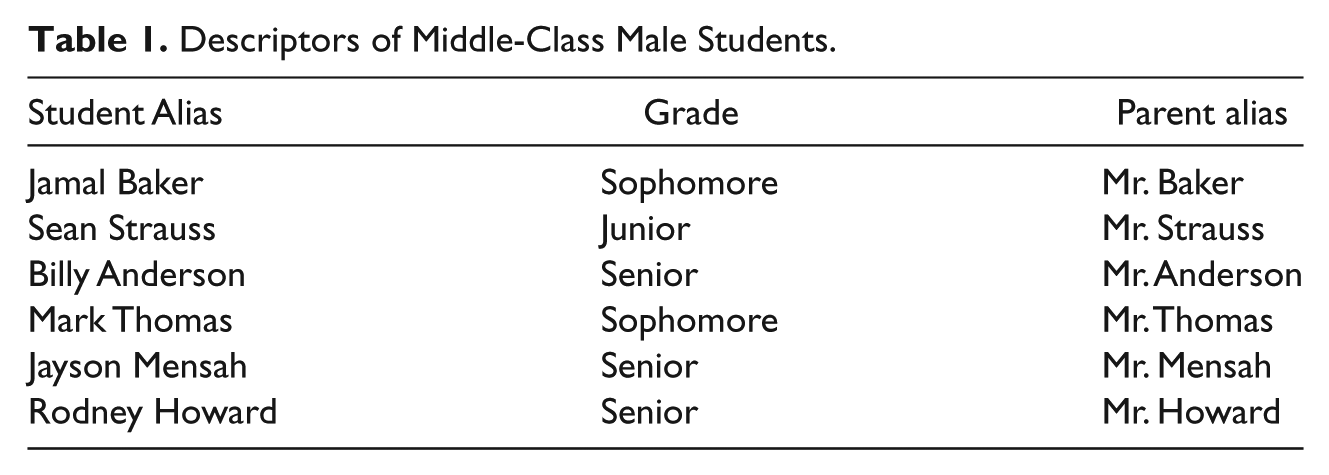
Six Black middle-class male students and their fathers participated in the study (see Table 1). As the study’s primary unit of analysis were Black middle-class men, purposive sampling (Merriam, 1988; Warwick & Lininger, 1975) was used to select this particular population. Selecting informants from a particular set of theoretical and intersecting categories was meaningful to how the identities of race, class, and gender influence the lived experiences of students within school structures.
Descriptors of Middle-Class Male Students.
Data collection and analysis
The students participated in three separate structured interviews, and the parents and teachers were each formally interviewed once. Taken together, the interviews became multivocal interpretations (Tobin, Wu, & Davidson, 1989) of the same phenomena and were an important source for discovering meaning behind the actions and behaviors of participants, particularly the students. Unstructured questions were used during observations and the researchers had casual interactions with the participants. All structured and unstructured interviews were recorded with a digital recorder and were later transcribed.
Observations were conducted within classrooms and other school spaces covering the full range of the school day and after-school activities. In the classroom, I often sat near the student, and when time permitted, asked questions about certain behaviors, practices, or feelings about their classroom experience. Occasionally, a teacher would ask me for help with checking classwork, placing my observations somewhere in the middle of the “detached” and “full participant” observational continuum (Graue & Walsh, 1998). After each observed class session, I asked each teacher and student whether behaviors I observed in the classroom were typical that day, to attempt to determine whether my presence and overt observations had an impact on classroom dynamics (Patton, 1990). I shadowed students in the hallways or during lunch (Solomon, 1992; Valenzuela, 1999), observing and noting the dynamics of their social groups, which provided points of reference for questions during later formal interviews.
Triangulation of analysis was built into the data collection process as multiple data sources (e.g., interviews, observations, document collection, etc.) were used to confirm or disconfirm any findings (Huberman & Miles, 1994; Patton, 1990). Data analysis itself followed a qualitative interpretive approach known as modified analytic induction (Erickson, 1986; Patton, 1990). Interviews and field notes were transcribed, the data corpus was read thoroughly and repeatedly to get a holistic sense of the phenomena, and Atlas.ti qualitative research software was used for coding and managing the data corpus. The data were bracketed into elements, which were analyzed independently for noncontextual meaning (Denzin, 1989). After coding and bracketing, the data corpus was again reviewed thoroughly to search for key linkages among the different forms of data and with a goal of developing an initial set of empirically grounded assertions. The data corpus was then reviewed again, as initial assertions were tested in light of confirming and disconfirming evidence. Assertions were then organized into major themes and subthemes, and the data were reconstructed and contextualized in light of its historical moment in time.
In addition to triangulating my data as they were collected, assertions were evaluated by identifying consistent interpretive patterns among student, parent, and teacher narratives and in field notes. Finally, I employed member checking (Lincoln & Guba, 1985) to obtain an additional level of validation, by asking participants for feedback on final themes identified and on my overall findings. 5
In the next section, I will share my findings, which include Black male school encounters with racial microaggressions; racialized assumptions about intelligence and deviance and differential treatment in discipline will be highlighted. In addition, the cultural wealth used by the fathers to respond to these microaggressions will be presented.
School Encounters With Racial Microaggressions
The Black middle-class fathers in the study displayed orientations toward schooling and involvement practices that were consistent with school ideology and expectations (Allen, 2010a). The parents placed premium value on using education to achieve middle-class status, stressing meritocracy, accountability, and resiliency to their children as important part of their socialization process (Allen, in press). Being highly involved in their sons’ education, they worked diligently to make school and home life consistent, replicating instructional techniques used in the school within their own homes. They frequently activated their highly educated social networks, which included teachers from the school as well as educators within their own families, to provide their sons with opportunities to excel academically. They also closely monitored their sons’ academic progress, using school-sanctioned outlets such as online grade checks and parent–teacher nights, a practice that schoolteachers praised. However, despite their parental involvement practices, these fathers were not naïve about the experience of racism they and their children would face in society. Through proactive racial socialization (Allen, in press; Caughy, O’Campo, Randolph, & Nickerson, 2002; Murray & Mandara, 2003), the parents gave forewarning to their sons that they would experience forms of racism, including racial microaggressions, in their own schooling. Racial microaggressions (Pierce et al., 1978; Solórzano et al., 2000) are the subtle forms of discrimination that serve to denigrate people of color. This includes microinsults, such as race-influenced ascriptions of intelligence or assumptions of deviance. The sons and the fathers in the study all spoke of microaggression events in their school, which included the negative and stereotypical views teachers and school administrators held of Black men that resulted in racialized assumptions of intelligence, deviance, and differential treatment.
Rodney, a senior, describes his observation of how school personnel regard Black deviancy and intelligence:
I experienced it with this lady that actually came to our school. She was like a visitor from somewhere else and she had to visit the athletic director and, you know, you can tell she’s one of those people that hasn’t been around a lot of Black people, and you know our school [has a large Black population] so she’s holding her purse all close and stuff and she’s looking around and you can see her eyes are all big and she’s like wow, all these colored people. You could tell she was really nervous and I was the TA and I had to show her where the athletic office was and so I was walking with her and she was talking with me and she was like, “I can tell you’re—what’s your GPA?” I said 3.6. She said, “Yeah I can tell you have a really high [GPA] because of the way you talk and the way you carry yourself, you carry yourself so well!” And I’m like thank you but . . . it was just this realization of wow; this is how the world sees Black men. They don’t think that we’re smart or talk normal.
Similarly, Mark, a sophomore, explains that teachers are often apprehensive of him until they learn he is a high achiever:
Some of the teachers, like new teachers, they are kind of distant from me at first and then I think once they realize, if I’m in their class and they see my grades, then they’re like, “This is a cool student,” and that’s when they start kind of warming up to me and having more of a relationship. But when they just walk around they don’t have any interaction with me.
The fathers were also concerned with how teachers and administrators assumed deviance of their sons, observing how the pejorative perceptions of Black men influenced school approaches to campus safety. Mr. Mensah, the father of Jayson, describes how popular discourse on Black men created an administrative “witch-hunt” of Black male students:
I went to a meeting. They were talking about gang violence . . . and I heard the whole spiel, Glenpark police, Glenpark sheriff, the county sheriff, detectives, the whole nine yards and they’re telling all the parents what to look for. The hats and if there are tattoos or the cuts in the eyebrows, and they’re telling all these things to look out for and I’m sitting there and I just couldn’t take in no more and I had to really calm myself because I was going to be yelling and my voice was shaking and I said, you know? I’ve sat here for 45 minutes to an hour and I listened to you and all you police and detectives say what to look for in the kids. . . . This witch-hunt, what you’re doing, is kids. These are kids that live in $600,000 homes, million [dollar] homes. But because this is the fad to dress like this, now you’re telling the parents to look at their kids as gang members and not as kids anymore, that can be changed or influenced. You’re saying this is what you look for and when you find it call us so we can take your kids away. And I said because all you’ve done is you’ve told me to hold on to my kids that much closer because what you’re trying to do is arrest them and get rid of them.
Mr. Mensah’s commentary points to a unique intersection of race, class, gender, and youth culture for Black middle-class men in that their class status provides a certain element of economic privilege (i.e., living in $600,000 to million dollar homes), yet they are still subject to racial profiling based on race, gender, and culturally driven youth stylistic preferences. This was a matter of contention for the Black middle-class families who worked to provide opportunities for success for their sons yet also recognized the endemic nature of racism. In this particular situation, their class privilege could not shield their sons from the racial “witch-hunt.”
Racial stereotypes, fear, and curiosity about Black men were understood as contributing to how student participants were treated differentially in matters of discipline. Sean, a junior, describes his observation of this type of differential treatment saying,
It wasn’t . . . like, they said, “Oh I hate you because you’re Black,” kind of thing, but being Black, I think I can tell when somebody has that type of feeling towards me. There will be times where I can do something and another race can do something, but I get in trouble for something and they wouldn’t. I think it happens more than people think.
Likewise, Mark observes how teachers’ misunderstanding of Black men leads to various forms of academic exclusion, explaining,
Some of the teachers don’t know how to deal with the Black kids . . . so instead of teaching them or working with them, they send them to some other class and write them off as ADD. They send them to OCS, suspend them. They do what they can to get them out of their hair not caring what happens in the long term.
Central High’s suspension records evidence the consequences of disciplinary racial microaggressions; Black males accounted for almost 40% of student suspensions, a statistic unfortunately consistent with the larger research literature on Black male suspension rates (Mendez, Knoff, & Ferron, 2002; Monroe, 2005; Skiba, 2001). The students identified teachers most likely to suspend a Black male as White, novice teachers or substitute teachers who, as Jamal, a sophomore puts it, were not “outright racist, but I’m pretty sure they have their prejudices. Like you be in a class and the whole class will be talking and the subs [substitute teacher] will single out the black guy.”
Parents were also observant of the differential treatment of their sons in the school. As many of the parents were involved in customizing their son’s schooling, they often sat in on classes. In doing so, Mr. Anderson observed how his son Billy, a senior, was inexplicably singled out:
I remember one time, I went to school and sat in his class and I was sitting there and kids were, I mean it was kind of bizarre because kids would get up in the middle of class while the teacher was teaching, get up walk over, get some water, get up, walk over, start sharpening a pencil, and she didn’t stop or anything. But then Billy did something and I don’t remember what it was, but it didn’t seem like it was that big of a deal and she kind of like lashed out at him and I was like wow . . . I wonder why that is.
Though Mr. Anderson’s interpretation of his son’s interactions with the school teacher could be explained in other ways (e.g., teacher incompetence) rather than a racially driven encounter, the endemicity of racism in school systems makes race a salient factor for Black parents like Mr. Anderson.
In this next section, I will describe how the fathers demonstrate agency, desiring to provide educational opportunity for their sons by responding to and resisting race-gendered microaggressions in the school. By resisting, the fathers were able to disrupt the racially stratifying nature of the school.
Resisting Racial Microaggressions
In response to microaggression events, the middle-class fathers demonstrated agency by drawing upon various forms of cultural wealth as acts of resistance. Yosso (2006) defines cultural wealth as forms of cultural capital people of color often draw upon as a means to fight discrimination and experience opportunity. Two of the forms of cultural capital she identifies are relevant to this study: social capital and navigational capital. Yosso defines social capital as the networks of people and community resources that allow people of color to succeed within and outside of their communities. Navigational capital is defined as the ability to maneuver through social institutions that were not initially intended for the inclusion of people of color. The fathers in this study frequently drew upon their school-based social networks and their understanding of the school system to respond to and resist race-gendered microaggressions and create opportunity for their sons.
Observing the subtleties of racism in the school seemed to motivate the fathers to closely monitor their son’s education. Black middle-class families are more likely to report racial discrimination and assume that Whites negatively stereotype Blacks (Feagin & Sikes, 1994; Hochschild, 1995; Sigelman & Tuch, 1997). Likewise, Black middle-class families often distrust schools, worrying that their children will be denied opportunity or labeled negatively (Beard & Brown, 2008). Thus, like other middle-class families seeking to shield their children from racism (Carter-Black, 2003; Hochschild, 1995; Tatum, 1987), the middle-class fathers in this study were proactive, relying on their social capital, particularly their relationships with the teachers to shield their sons from differential treatment in the classroom. Building and maintaining relationships with teachers allowed the parents to build better rapport, hoping that this rapport would help teachers see their sons beyond essentialized expectations of racial performance. Mr. Strauss, the father of Juan, describes this effort:
He’s one of those kinds of kids that also feels like when you say something funny, he can’t control the laugh. And so he’s the kind of kid that will sit in class and if somebody says something, he’s going to laugh. He don’t have to be the one that cracked the joke or start trouble, but he would always get in trouble because he’s the loudest. And so I’ve had to go to every school and kind of explain to each teacher, each principal or each counselor, “okay, the one thing I do know is my son. He’s not going to start any trouble.” . . . He’s always been a huge kid, and so they automatically assume he’s going to be a trouble maker. And come to find out, he’s going to be your best student . . . being African American and always the biggest kid in class, I think he automatically had that against him.
Other proactive parents sat in on their sons’ classes observing student–teacher interactions, a practice common to middle-class families (Lareau, 2000a, 2000b). Mr. Mensah explains how he believes his presence in the classroom influenced the student–teacher interactions:
I would go in and the kids would say, “Whose dad is that? Oh, it’s Jayson’s dad.” And I would just stay there, but the teacher was the one that was on her best behavior. I would say [to the students], “How did the teacher act when I left?” “They [the teachers] treated us a little bit different when you was there.”
For parents like Mr. Mensah, their presence in the classroom was a way to not only build teacher relationships and gain inside academic information but also keep teachers “in check” in regards to how they treated students in general and their sons in particular.
Furthermore, when events perceived to be race related specifically involved their sons, the fathers drew upon their navigational capital, which included their understanding of school process and hierarchy and their ability to navigate the institution in ways that disrupted racially stratifying practices. For example, during separate interviews with Mr. Mensah and his son Jayson, they describe what they believe to be a racially motivated outcome of an in-class altercation Jayson was involved in, an outcome that almost led to Jayson’s suspension. Using both Mr. Mensah and his son Jayson’s narrative to describe this event, a verbal argument between Jayson and two classmates occurred, which, by the vice principal’s admission, should have been handled by the teacher but was instead interpreted as a violent event. Jayson felt the teacher’s failure to intercede reflected her fear of students of color (the other students involved in the conflict were Asian males), which could be seen as a microinsult due to an assumption of criminality. Mr. Mensah was called in to meet with the vice principal and was informed that Jayson would be suspended for 3 days, referring to the school’s discipline rubric that assigns a 3-day suspension for classroom arguments involving physical threats. Mr. Mensah replied, “What would make you want to suspend Jayson for three days? Check the school records, he’s never been in any trouble and you want to suspend him for three days? Of course [they made threats], they were heated. They said some things that they didn’t mean. He’s a kid!” Mr. Mensah continued, retorting, “Well, I’ve had enough. I’m going over to the school board right now,” to which the vice principal responded by agreeing to remove the incident from Jayson’s record as well as the other two students involved. Satisfied with the outcome but still disappointed with the disciplinary process, Mr. Mensah concludes the meeting by saying,
You know what, Mr. Matthews? It’s awful odd. I’ve watched these things happen. I’ve been around the school and I’ve come to meetings and I’m so frustrated I have to stay away and just hold my kids close to me. There’s a perception out [there] Mr. Matthews, that most minority children, [people] think they’re lesser than, and so do the teachers. They think [minority] means lesser than.
Mr. Mensah’s narrative exemplifies how he actively resisted the outcome of the microaggression event, which began with the assumption of deviance by teachers and administrators and led to the criminalization of Black men through the discipline policy. In resisting the microaggressions, Mr. Mensah critiqued the vice principal for indiscriminately using a discipline rubric that would have suspended all three students for three days (missing three days of instruction) instead of using discernment to see the event as simply an argument between kids that should have been handled by the teacher. For Mr. Mensah, the fact that his son Jayson, who was a senior and had no discipline record beforehand, could have easily been relabeled as a troublemaker because of teachers’ views on “minority children” was cause for him maintain distrust of the school.
Mr. Mensah’s criticism of the school discipline policy also highlights a key tenant of CRT that challenges dominant claims of race and gender neutrality, objectivity, universalism, and colorblindness (Delgado, 1991; Ladson-Billings & Tate IV, 2006). The problem with the discipline rubric isn’t the rubric in itself, but the fact that Black men are disproportionately sent to the disciplinary office (Skiba, Michael, Nardo, & Peterson, 2002), frequently because of racial incongruences or fear, ensuring that a large number of Black male students will encounter this disciplining system and experience some form of punishment, even for an argument. Furthermore, the use of the discipline rubric allows administrators to act as “objective” or “colorblind” disciplinarians, hiding behind an institutional set of so-called universal guidelines that can be applied to all cases across time. The “objectivity” of such educational policies is called into question by CRT, which argues against universalistic application of laws in favor of a particularistic approach, one that accounts for history and context (Delgado, 1991; Delgado & Stefancic, 2001; Ladson-Billings & Tate IV, 2006).
This is the exact argument Mr. Mensah alludes to when he questions the sensibility of his son being suspended for three days for an argument. A more particularistic approach would have considered the costs of three missed days of instruction, the role the teacher played in failing to employ effective classroom management strategies, and the role race played in escalating the event to the point of parental intervention. Still, the fact that Mr. Mensah and Jayson were able to provide counternarratives to the conflict, and Mr. Mensah was able to use his knowledge of school authority and rank to threaten to go to the school board demonstrates how the counternarratives and cultural wealth of people of color can resist school-based microaggressions and disrupt the stratifying nature of schools.
Discussion
The Black middle-class students and their fathers in the study described various microaggressions encountered in school. This included pejorative views of intelligence, assumptions of deviance, and differential treatment in school discipline. In many ways, the racial microaggressions these students encountered were similar to the experiences of other Black students (Henfield, 2011; Lewis, 2003; Sue, Capodilupo, & Holder, 2008). Assumptions of intelligence and deviance and differential treatment in discipline, all exemplify how race functions as a social stratifying structure, exists as a barrier to social mobility for Black people, and stigmatizes Black male identity (Akom, 2008; Gerald, 1972; Grusky, 1994; Ogbu, 1994).
For example, teacher perceptions of Black male intelligence and deviance are often influenced by racist discourse about Black masculine performance and teachers regularly interpret the behavior of Black boys as aggressive, disrespectful, defiant, and intimidating even when such behaviors were not intended to be so (Davis, 2003; Ferguson, 2000; Lynn, Bacon, Totten, Bridges, & Jennings, 2010; Noguera, 2003). The imprecise interpretation of these behaviors results in discipline that is often unnecessary, unfair, and in many cases, harsher for Black boys than it would be for their White counterparts (Monroe, 2005; Skiba, 2001).
Moreover, on a theoretical level, the microaggressions of “colorblind” disciplining events within the school are important moments where “symbols of power and authority are perpetuated” (Noguera, 2008, p. 96). When Black male students are stereotyped by their teachers, racially profiled by administrators and experiencing racially differentiated discipline, they engage in conflict with White institutional hegemony and a racially stratifying system (Brown, 2003; Delgado & Stefancic, 2001; Essed, 1991; Feagin & Vera, 1995; Gibson, 2002; Noguera, 2008). The disciplining function of schools also become regulators of identity, defining what behaviors or performances of masculinity are “good” or “bad” in relationship to a bourgeois norm (Foucault, 1979; Haywood & Mac an Ghaill, 1996). Employing a Foucauldian analysis, Ferguson (2000) examines the role of school discipline:
So school rules operate as instruments of normalization. Children are sorted, evaluated, ranked, compared on the basis of (mis)behavior: what they do that violates, conforms to, school rules. Foucault argues that disciplinary control is a modern mode of power that comes into existence with the formation of the bourgeois democratic state as a technique of regulation particularly suited to a form of governance predicated on the idea of formal equality. (pp. 52-53)
Schools then become sites of identity regulation where the performances of Black masculinity are stigmatized as “different” through normalizing judgments. Those Black male students who do not perform “normal” school behavior are feared and, thus, deserving of punishment. In this sense, to succeed in schools Black male students must prove they are normal by self-consciously regulating their every action in ways that prove adaptation to institutionally generated norms. This situation also demonstrates how Whiteness is property (Harris, 1993) in that White male behavior is normalized, giving White male students the right of use and enjoyment of school spaces and the ability to perform masculinities in ways that are unchallenged, de-racialized, and with assumed innocence.
The observation of these normalizing practices and other racial microaggressions required the fathers to expend countless amounts of energy socializing their sons to prepare for such events (Allen, in press), monitoring their sons’ education, and attempting to protect their sons from damaging experiences of racism (Day-Vines, Patton, & Baytops, 2003; Lareau, 2003). This form of parental overinvolvement holds the potential for these parents to experience racial battle fatigue, which is the psychological, emotional, and physical strain people of color experience when perpetually having to address racial microaggressions (Nunez-Smith et al., 2007; Smith, 2004; Smith, Yosso, & Solórzano, 2006).
Superficially, the experiences of these Black middle-class families may warrant the argument from some that the structure of race is a greater barrier than the structure of class (O’Connor, 2007), but this is not necessarily so. In many cases, middle-class parents have been able to employ their class power to divert racial injustice (hooks, 2000; Lacy, 2002), and such was the case in this study. Yet the implications of race and class must be seen not as either/or, but as both/and. They are categories that intersect and are indeed intertwined in ways that systematically marginalize people of color out of opportunity structures (Anthias, 2005; Faber, 2005). For the families in this study, race, class, and gender intersect in unique ways. Though their class status affords them opportunities and power within the school not easily accessible to their working-class counterparts their sons are still Black men in school and were subjected to microaggressions rooted in racist ideologies. Thus, these middle-class fathers’ ability to transcend race was made possible by their use of cultural wealth as resistance to the race-gendered microaggressions in the school.
Though the efforts of these fathers are commendable, it can also be argued that their responses to these racial microaggressions were singular acts, aimed solely at removing the danger of racism for their own children. So though these fathers’ ability to navigate a racist school structure provides opportunity for their children, little is done, in the immediate sense, to actually change the racially stratifying structure of the school. However, in the larger sense, the success of these families in navigating the school structure could be interpreted as an opportunity for Black middle-class families to replicate their class status and use education as a means to obtain power, power that could be used to dismantle White hegemony in schools in meaningful and powerful ways. This was DuBois’ (1903) thesis when he called upon the talented tenth, the Black educated, to engage in group leadership with the Black masses. For the middle-class families in this study, the outcome of educational attainment remains to be seen. Yet these fathers’ ability to resist race and racism in the school greatly influences the social and economic trajectories their sons will ultimately travel.
Conclusion
This study documented the raced, classed, and gendered encounters that Black middle-class male students and their fathers had within the school structure and process. Despite the perceived privilege their class standing supposedly afforded, the families observed the endemicity of racism, experienced through subtle but potentially damaging racial microaggressions. Assumptions about intellectual inferiority, deviance, and differential treatment in discipline were just some of the microaggressions encountered by the male students, microaggressions that undermine the identity of Black men and put at risk their ability to use education for social mobility. To resist these microaggressions, the middle-class parents drew upon their cultural wealth, particularly their social and navigational capital, to create opportunity for their sons in light of racist encounters. The actions of these parents demonstrate the power of human agency to resist the racially reproductive nature of schools and provide models of parental intervention that may serve to improve the process of Black middle-class social reproduction.
Footnotes
Declaration of Conflicting Interests
The author(s) declared no potential conflicts of interest with respect to the research, authorship, and/or publication of this article.
Funding
The author(s) received no financial support for the research, authorship, and/or publication of this article.
Notes
Author Biography
References
Supplementary Material
Please find the following supplemental material available below.
For Open Access articles published under a Creative Commons License, all supplemental material carries the same license as the article it is associated with.
For non-Open Access articles published, all supplemental material carries a non-exclusive license, and permission requests for re-use of supplemental material or any part of supplemental material shall be sent directly to the copyright owner as specified in the copyright notice associated with the article.
