







Abstract
Teach For America (TFA), an organization that places college graduates as teachers in low-income areas for 2 years, contributes to teacher attrition. With this mixed methods study in one urban region, we investigated teachers’ professional decisions at the end of 2 years. Respondents fell into categories in relation to the organization’s 2-year commitment, including leavers, lingerers, and lasters, and descriptors related to remaining at placement school or relocating to another school. Historical, environmental, and external factors impacted teachers’ professional decisions related to retention and attrition. Findings provide insight to improve retention of TFA teachers.
Retaining teachers is a continual and contemporary challenge that plagues the American education system (Haberman, 2004; Leland & Murtadha, 2011). One third of the teaching force in the United States turns over each year, with the highest attrition rates occurring in high-need schools—urban and rural schools with low-income and minority populations (Hunt & Carroll, 2003). Districts with low retention spend millions of dollars recruiting and training new teachers (Barnes, Crowe, & Schaefer, 2007), and at times must partake in last-minute hiring of underqualified teachers (Hunt & Carroll, 2003). Because teachers improve effectiveness with experience, with most improvement occurring after the 2nd year of teaching (Hawkins, Stancavage, & Dorsey, 1998), attrition is detrimental to student achievement (Darling-Hammond, 2006).
The contemporary issue of retention and attrition requires an understanding of how teachers enter the profession, typically through traditional or alternative paths to certification. Unlike traditional teacher preparation, which refers to 2- to 4-year university programs of study with culminating student teaching experiences, alternative certification programs provide “streamlined preparation . . . that places them [teachers] in the classroom as the teacher of record more quickly” (Humphrey, Wechsler, & Hough, 2008, p. 2). Emerging in the 1980s to respond to teacher shortages (Glass, 2008; Humphrey et al., 2008), alternative certification programs have grown in number and now certify as many teachers as traditional programs in some regions of the United States (Humphrey et al., 2008). Various alternative certification programs at universities, school districts, and nonprofit organizations differ based on characteristics such as participant selection, length of preservice preparation, and short- versus long-term commitment to teaching (Humphrey et al., 2008).
Founded in 1990, TFA is a large and growing nonprofit organization that utilizes alternative paths to certification to place high-achieving, recent college graduates, referred to as corps members, in high-need schools across the United States for a 2-year commitment (TFA, 2011). By requiring 2 years, including continuous professional development (Gabriel, 2011), TFA hopes that corps members’ experiences will instill the desire to serve low-income communities, improve the educational institution, and affect change at a broader level (Kopp, 2011). Critics of TFA emphasize the high rate of attrition, stating that limited 2-year construct negatively impacts professional growth (Boyd, Grossman, Lankford, Loeb, & Wycoff, 2008; Darling-Hammond, Holtzman, Gatlin, & Heilig, 2005), school reform efforts (Darling-Hammond, 2006; Heilig & Jez, 2010), and budget-stretched districts (Barnes et al., 2007; Heilig & Jez, 2010). The temporary obligation communicates teaching as a service rather than a profession (Larabee, 2010; Veltri, 2008), devaluing traditional paths to teaching and career educators. Although TFA receives negative press regarding attrition, some corps members remain beyond 2 years (Donaldson, 2012; Donaldson-Johnson, 2010, 2011).
This study examines TFA retention and attrition in one urban region. Building on recent large-scale studies of TFA retention and attrition (Donaldson, 2012; Donaldson & Johnson, 2010, 2011), we utilize qualitative methods to study retention (Billingsley, 2004; Olsen & Anderson, 2007) to allow teachers to share stories and perspectives (Rinke, 2011; Tamir, 2009) and move beyond static and stereotypical representations (Chapman, 2005) of corps members. With this mixed methods study, the quantitative survey data serves to generalize the professional pathways chosen by corps members following the 2-year commitment, followed by the qualitative interviews to explain the trends in greater depth and recount the stories of individual corps members. The research questions guiding this investigation include: (a) What do TFA corps members generally do after the 2-year commitment? (b) What shapes corps members’ professional decisions after teaching for 2 years? (c) What are the overall trends in TFA corps member retention and attrition?
In this article, we first situate the study in the extant literature, conceptual framework, and mixed methods design. Next, we share quantitative generalizations of who stays and leaves, followed by qualitative portraits to describe individual corps members’ experiences. We then interpret and discuss the mixed methods results to explore various historical, environmental, and external factors that impacted corps members’ professional decisions. Finally, we close with implications to improve teacher retention after the 2-year commitment.
Studying Teacher Attrition and Retention
With one third of the nation’s teachers leaving the classroom each year (Hunt & Carroll, 2003), an abundance of literature expounds upon why traditionally certified teachers (e.g., 2- to 4-year university program) leave the profession early, typically within the first 5 years of teaching. Teachers’ cited reasons for attrition include negative working conditions (Loeb, Darling-Hammond, & Luczak, 2005), lack of professional support (Cochran-Smith, 2004; Kersaint, Lewis, Potter, & Meisels, 2005), subpar administration (Bogler, 2001; Fantilli & McDougal, 2009; Kersaint et al., 2005, Liu & Meyer, 2005), personal responsibilities (Kersaint et al., 2005), low salary (Kersaint et al, 2005; Liu & Meyer, 2005), and emotional burnout (Haberman, 2004; Hong, 2010). In addition, studies have discerned trends in school and teacher characteristics. Of the teachers who began their careers at public schools, approximately 25% left teaching within the first 3 years (Boyd et al., 2008); rates were higher in schools with low academic achievement. Teachers with strong academic credentials, measured by achievement tests, certification exams, and competitiveness of undergraduate institutions, quit or transferred more often than less qualified teachers, especially if they taught in low-achieving schools (Boyd, Grossman, Lankford, Loeb, & Wyckoff, 2006). In addition, teachers whose hometown was farther from their school were more likely to leave (Boyd et al., 2008). The findings of these studies, determined through quantitative measures, provided only broad trends in teacher attrition.
Increasingly, alternative certification programs fill teacher shortages caused by high attrition, typically recruiting noneducation majors and providing less classroom experience and training prior to independent teaching (Laczko-Kerr & Berliner, 2002). Research suggests that alternative programs do not necessarily increase teacher retention rates; in fact, they may even propel the cycle of high teacher turnover rates (Boyd et al., 2008; Ng, 2003). One large-scale study of alternative certification (Humphrey et al., 2008) found differences between and commonalities across programs as to what causes teachers to stay or leave. Rates of retention and attrition related to the mission and goals of the specific program; programs that recruited lifelong educators had higher retention. Across programs, school placement was the strongest predictor of retention; teachers stayed when placed in environments with strong leaders and supportive coworkers, unlike those in schools with a lack of leadership, poor facilities, and scant materials. Teachers who graduated from competitive universities, specifically TFA corps members, yielded less chance for retention. Aiming to share characteristics across programs, the study of alternative certification (Humphrey et al., 2008) did not provide nuanced information about individual teachers’ experiences that impacted retention.
Specifically focused on TFA affiliated teachers, regional studies have demonstrated low retention rates beyond the 2-year commitment, although statistics vary across studies. In New York City, TFA teachers left after the 2nd year of teaching at triple the rate of traditional teachers and double the rate of other alternately certified teachers; after 4 years, 15% of TFA teachers remained in the district (Boyd et al., 2008). In Houston, 85% of TFA teachers departed after 3 years (Darling-Hammond et al., 2005). Data from Louisiana similarly showed that few TFA teachers stayed beyond a 3rd year (Noell & Gansle, 2009). In Baltimore, many teachers remained for a 3rd year, but 60% left after 3 years and 80% after 5 years (MacIver & Vaughn, 2007). Synthesizing the regional literature, Heilig and Jez (2010) stated that four out of five TFA teachers left within 2 years after the 2-year requirement. While these studies provided regional lenses on the research problem, statistics shared little information about reasons behind attrition of TFA-trained teachers.
Recent findings from a large-scale, national study on TFA retention and attrition push back against the regional statistics and common perception of corps members as “two-years-and-out” (Donaldson & Johnson, 2011, p. 49). Using quantitative techniques with over 2,000 TFA-trained teachers across 3 corps years and multiple regions, Donaldson and Johnson (2010) found that 56% of teachers leave their initial placement school, whereas 44% stay beyond the 2-year commitment. Nevertheless, 61% of respondents stayed in the profession beyond 2 years, as 17% of the overall sample continued teaching at different schools. Challenging placements, such as multiple grades in elementary schools and multiple subjects in secondary schools, led to attrition (Donaldson & Johnson, 2010). Age also played a factor, as corps members above the age of 25 tended to stay at a greater rate than more recent college graduates (Donaldson, 2012). Conducted with a large sample of corps members in the early 2000s, these results quantitatively demonstrated the complexity of TFA retention and attrition, rather than qualitatively exploring individual corps member experiences and unique nuances in regions, schools, and classrooms.
Despite some statistics that more TFA teachers leave than stay, why TFA has higher-than-average levels of teacher attrition remains relatively unknown. Indeed, critiques of the organization’s 2-year obligation suggest the recruitment of individuals with low likelihoods of a teaching career (Darling-Hammond, 2006; Larabee, 2010). TFA advertises teaching as a finite service-stint that lures recruits with financial benefits and partnerships with top graduate schools and companies (Larabee, 2010). Because most TFA corps members did not complete teacher education courses in college, some may not see teaching as a career commitment (Veltri, 2008). Regardless of criticisms, this program places thousands of 1st- and 2nd-year teachers each year (Kopp, 2011). Despite the common perception of corps members as “two-years-and-out” (Donaldson & Johnson, 2011, p. 49), some TFA participants do continue teaching (Donaldson & Johnson, 2010, 2011; Donaldson, 2012). Nevertheless, no studies qualitatively address what occurs before, during, and after the TFA experience to explain why corps members leave, and alternately, what propels them to stay.
Seeking to fill the aforementioned gaps in the literature, we address (a) what TFA corps members do following the 2-year commitment and (b) what factors affect those various professional decisions. Unique to the literature on retention and attrition, we add the category of lingerers to the traditional groups of those who stay or leave; lingerers, those who remain in the classroom for an additional year beyond their original obligation, are unique to TFA where teaching can often be used as a purposive stepping stone to other careers and endeavors (Larabee, 2010). In addition, we emphasize the contributions of the qualitative data to go beyond the statistics and allow teachers to frame factors and issues related to retention and attrition from their perspectives, something rarely done in this field of educational research (Billingsley, 2004).
Framing the Complexity of Retention and Attrition
We recognize that teachers make decisions to stay or leave the classroom based on a myriad of dynamic variables. Brownell and Smith (1993) put forward a conceptual model for understanding teacher attrition and retention that is “sufficiently complex and capable of integrating attrition variables and accounting for their interrelationships” (p. 271).
The framework recognizes that the individual teacher operates within the larger educational context and therefore is affected by environmental factors from the microsystem of the classroom, the mesosystem of interactions at the workplace, the exosystem of the district and community, and the macrosystem of cultural and ideological perspectives. Prior to variables in educational settings, historical factors from the teacher’s personal and professional background affect decisions related to retention and attrition, such as the initial commitment to teach, educational preparation, and demographic characteristics. In addition, external factors outside of the school setting impact professional decisions, such as life cycle events (e.g., marriage, pregnancy) and economic considerations (See Figure 1).
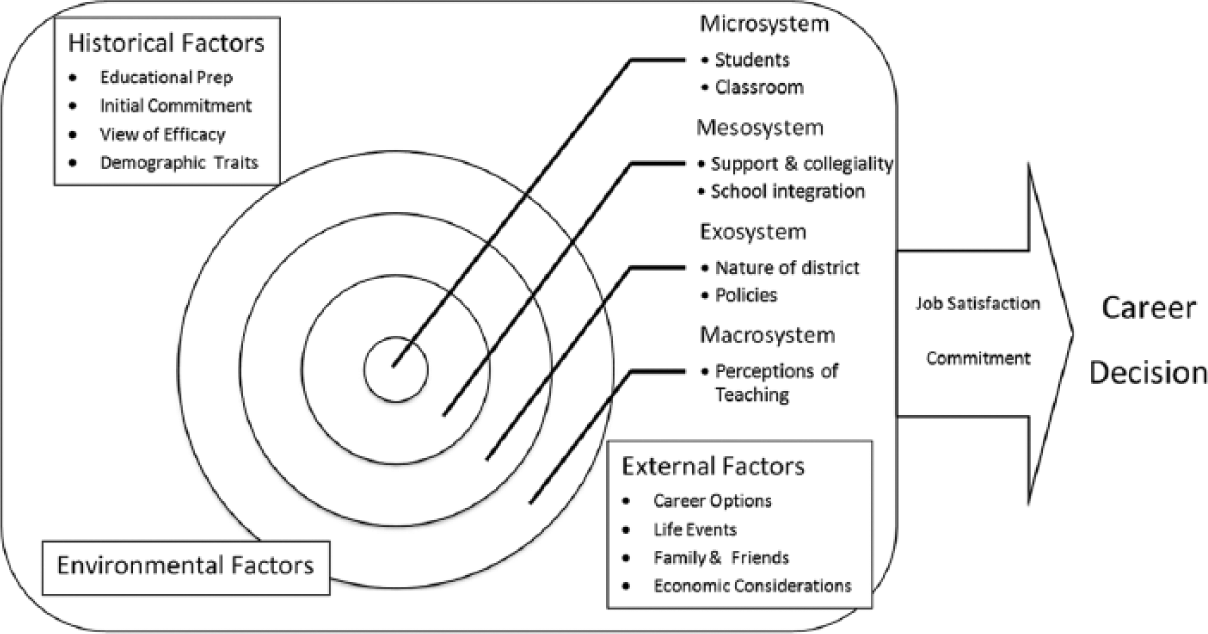
Conceptual framework for understanding teacher retention and attrition.
With recognition of the complex, multifaceted and interrelated factors that weave through the personal and professional lives of corps members, this mixed methods study (Yonezawa, Jones, & Singer, 2011) fills a gap in the broader literature on early career teacher retention and attrition and narrowed literature focused on alternatively certified and TFA teachers.
Method
With this study, we aimed to determine general trends and individual details of TFA retention and attrition in one U.S. region. With research questions that prompted quantitative measures of TFA retention and attrition and qualitative details of corps members’ decisions, a mixed methods approach provided comprehensive evidence to address the research problem (see Figure 2).

Sequential explanatory design: Participant selection model procedures.
The Regional Context and Participants
Conducted in one of the 43 regions across the United States in which TFA places, this study investigates TFA teacher retention and attrition in a mid-size corps in an urban area of the western United States. A large and growing presence in the educational fabric of the region for the past 15 years, TFA boasts 300 corps members and 650 alumni in area classrooms, as well as financial support from dozens of local businesses, universities, organizations, and individuals (TFA, 2012). To become considered highly qualified to teach in the region, corps members complete their teaching certification by the end of the 2-year commitment; the majority of corps members opt to receive a master’s degree and teaching certification through a university partnership (UP) between TFA and a large, public university. Standing out within the broader national organization, TFA (2012) reports that 75% of alumni who begin their teaching in this region continue in education. For this study, we initiated data collection as TFA corps members approached the end of their 2-year commitment to the organization and needed to make decisions about their future endeavors.
The Sequential Explanatory Design
In this mixed methods study, we utilized sequential explanatory design with two distinct phases: quantitative followed by qualitative (Creswell & Plano-Clark, 2007). We began by collecting quantitative data on corps members’ decisions to stay or leave through an online survey. Utilizing the participant selection model, quantitative information supported selection of participants for qualitative interviews (Creswell & Plano-Clark, 2007; Yonezawa et al., 2011) and overall interpretation of results.
In the quantitative phase, we sent a survey to exiting corps members enrolled in the UP to ascertain future plans and contributing factors to their decisions. 73 corps members responded, for a response rate of 68%. The analysis began by coding data to assign numeric values to response fields. Aligned with the quantitative research question asking for a general representation of corps members’ professional paths after the 2-year commitment (i.e., What do TFA corps members generally do after the 2-year commitment?), we used survey data to form general categories related to post-TFA plans (i.e., leavers, lingerers, lasters) and detailed descriptors of plans and locations (e.g., graduate school, placement school). We analyzed the professional pathways and related factors (i.e., historical, environmental, external) across categories to respond to the quantitative research question (see Figure 3).
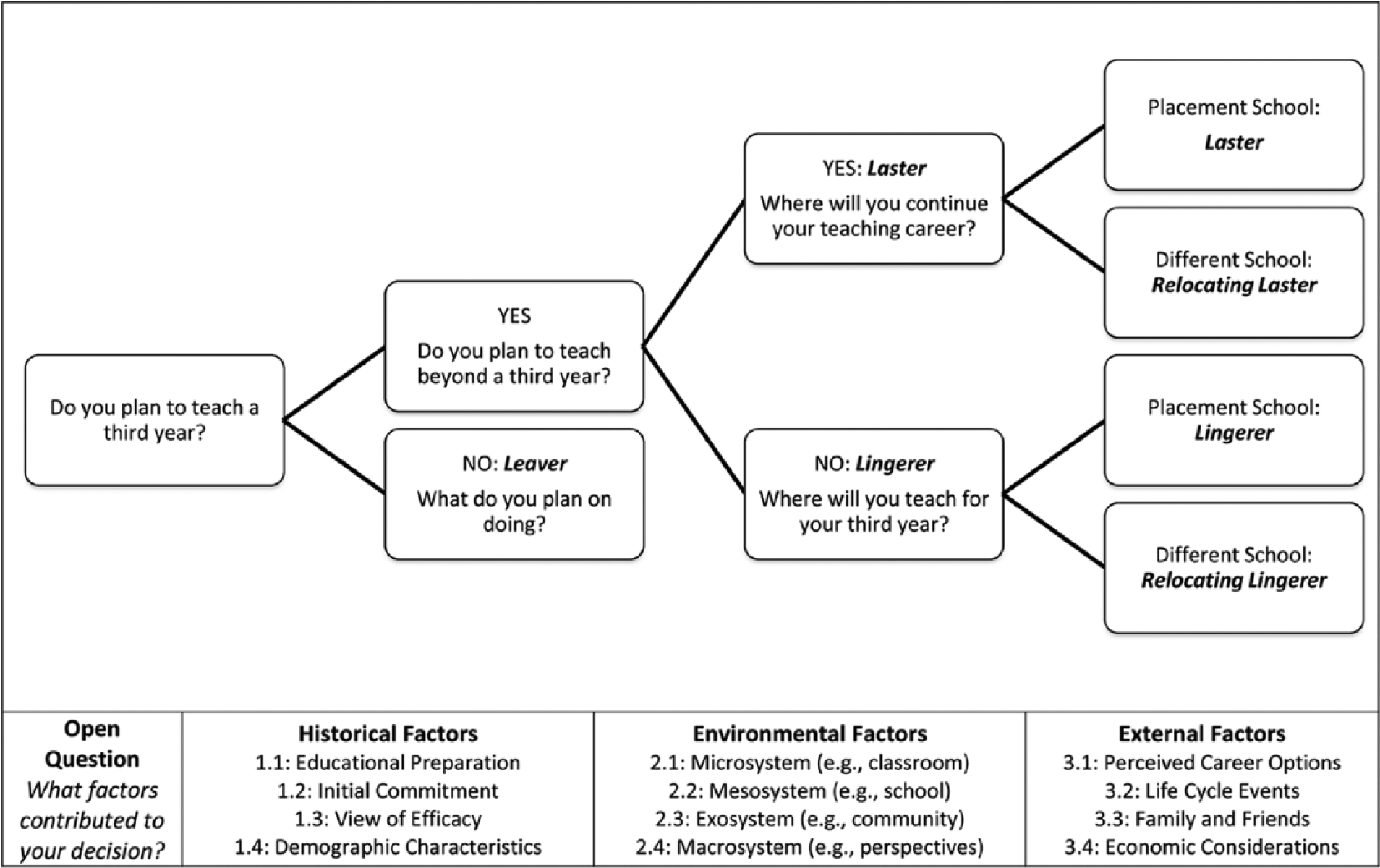
Phase 1: Quantitative data collection and analysis.
Survey data demonstrated that corps members fell into categories in relation to TFA’s 2-year commitment, which we termed leavers, lingerers, and lasters. Leavers planned to leave the classroom after the 2-year commitment, lingerers planned to teach for the short-term (i.e., a 3rd year), and lasters planned to teach for the long term. Lingerers and lasters varied with regard to whether they chose to stay in original teaching placements or transfer to other schools (Billingsley, 2004; Olsen & Anderson, 2007); those corps members who continued to teach but transferred schools were considered to be relocating from their original TFA placement. For example, a laster planned to teach for the long term at placement school, whereas a relocating laster planned to teach for the long term at a nonplacement school. After these categories emerged, we selected, invited, and interviewed seven corps members (pseudonyms) to represent emergent categories: Melanie (leaver), Dawn (leaver), Wade (lingerer), Sara (relocating lingerer), Casey (relocating lingerer), Evan (laster), and Ali (relocating laster). In addition to the professional plans after the corps, we selected participants across teaching placements (i.e., elementary, secondary, special education).
In the qualitative phase, interviews aimed to discern factors before, during, and after the TFA experience to speak to the qualitative research question (i.e., What shapes corps members’ professional decisions after teaching for 2 years?). The interview protocol served as a general guide (Gall, Gall, & Borg, 2003) to explore teachers’ stories, perspectives, and experiences (a) before TFA, including initial career plans before opting to teach for 2 years; (b) during TFA, including events, people, and structures that stood out as significant; and (c) after TFA, with attention to short- and long-term future plans. We captured each interview in an audio file, which was then transcribed for analysis. We drew from the narrative approach of portraiture to record, interpret, and share the voices and visions of corps members (Lawrence-Lightfoot & Davis, 1997, p. xv) to move beyond the “flat, stereotypical explanations” (Chapman, 2005, p. 28) for retention and attrition. Shared in the qualitative results, corps member portraits aimed to capture the unique lives and goals of each individual before, during, and after TFA to illustrate the myriad factors that impacted decisions to leave, linger, or last, either staying at placement schools or relocating to new schools (see Figure 4).
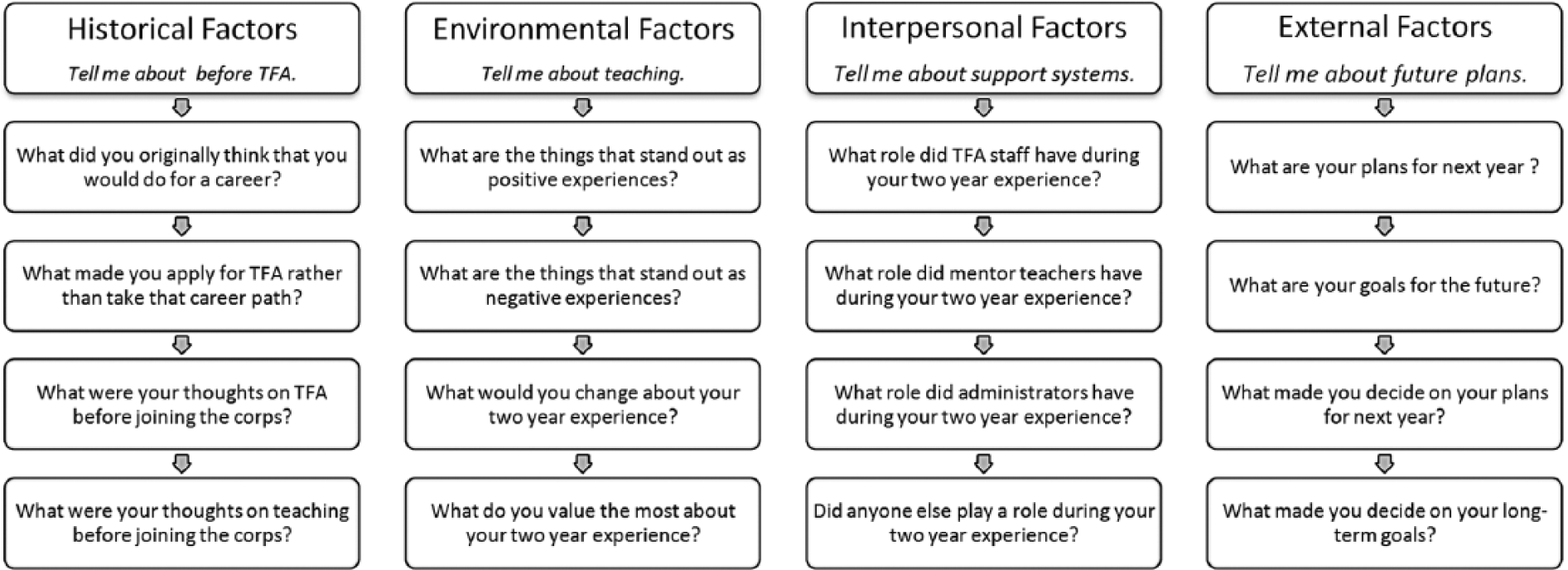
Phase 2: Qualitative data collection and analysis.
Bringing together generalizations from survey data and portraits from interview data, we closed by interpreting trends across data to answer the final research question (i.e., What are the overall trends in TFA corps member retention and attrition?).
Validity
We planned and conducted this study to maximize validity of results. With the mixed methods design, we reviewed and minimized possible threats to validity, including (a) selection of same individuals for quantitative and qualitative phases of data collection, (b) use of a large sample for quantitative phase and small sample for qualitative phase, and (c) selection of qualitative participants to explain significant quantitative results (Creswell & Plano-Clark, 2007). In addition, we utilized the conceptual framework (Brownell & Smith, 1993) to code survey data and member checks and triangulation to ensure objective analyses, particularly since authors entered education as TFA corps members. In addition to measures among authors, we further ensured validity by enlisting external reviewers, including: (a) a graduate research assistant to review and respond to quantiative survey data, analyses, and results, (b) interview participants to read, review, and respond to their qualitative portraits, and (c) a graduate research assistant to review and respond to all data, analyses, and results. The external reviewers, including graduate assistants and seven interview participants, responded and confirmed our analyses and findings.
Results
In this section, we share the results of our investigation on TFA retention and attrition in one urban region. Organized by the sequence of the mixed methods design, we first share the quantitative data and follow with explanatory portraits gleaned from qualitative data (see Table 1).
Teach For America Professional Plans and Categories of Survey Respondents.
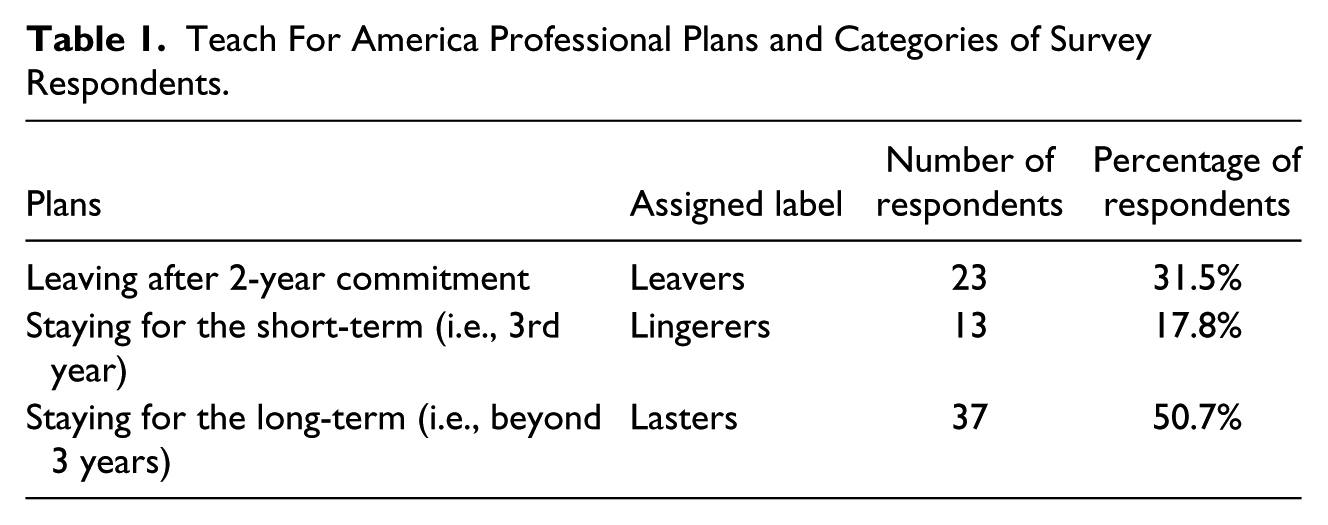
Quantitative Results: Leavers, Lingerers, and Lasters
Corps members classified as leavers departed the classroom after the 2-year commitment. Leavers’ professional plans fell into four categories: graduate school, law school, nonprofit work, or other work. About 65% of leavers returned to further their education (i.e., graduate school, law school); they generally had set pursuits put on hold during their service obligation. These corps members stated that they never had the intention of teaching beyond 2 years, many having deferred entrance to programs spanning the fields of law, medicine, business, and the humanities. While some referenced challenges related to teaching, most listed environmental reasons as secondary to historical factors for leaving the classroom. The remaining 35% of leavers departed for professional positions at nonprofit organizations or other career paths—many of these education related, such as nonprofit work at TFA or other work at an educational publishing house. Reflecting the mostly external factors demonstrated from survey data, these corps members perceived more enjoyment and advancement outside of the school setting or made professional decisions based on personal factors and life events (e.g., long-distance relationship, pregnancy; see Figure 5).
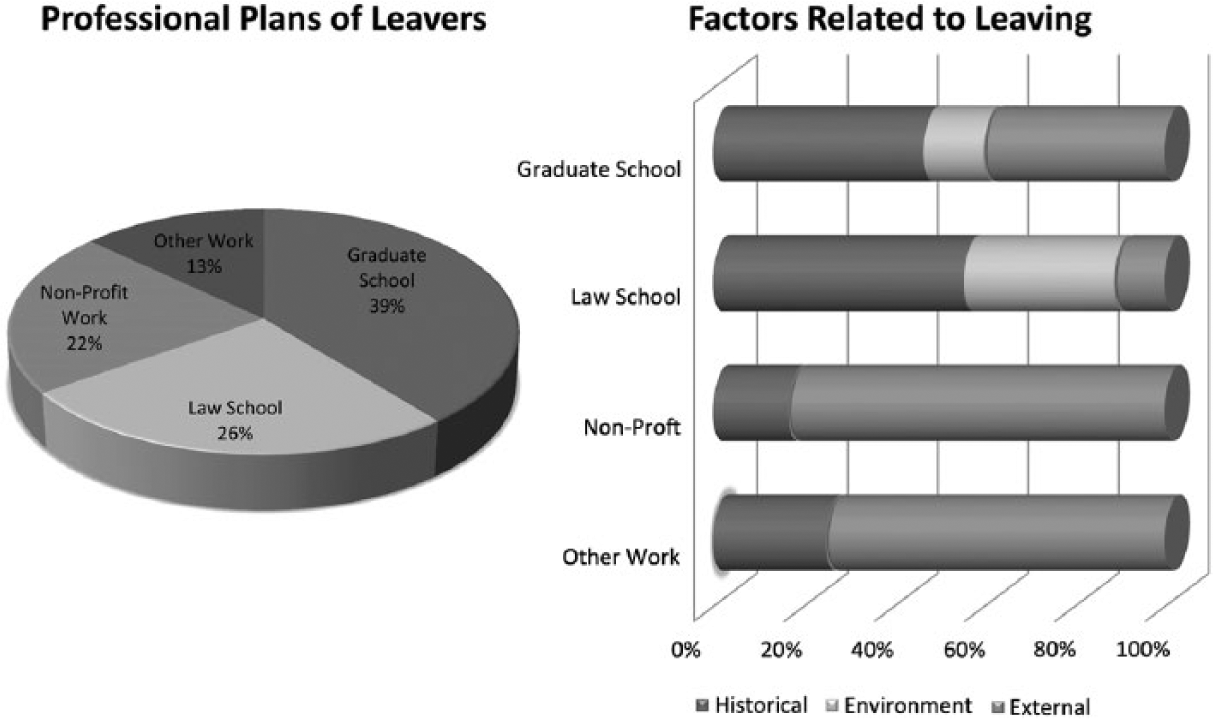
Leavers: Professional plans and contributing factors following the 2-year commitment.
Lingerers decided to stay in the classroom beyond 2 years, typically for a 3rd year as they solidified next steps in their professional and personal lives. Distinct from leavers, lingerers had nebulous targets rather than well-defined goals when they began the 2-year commitment. About 64% of lingerers chose to stay at their original placement school in this urban region; these individuals highlighted the positive environmental factors as pertinent to this decision, as they enjoyed their students, colleagues, administrators, and schools. Secondary factors split between (a) historical factors related to the need for another year to apply for school and (b) external factors specific to maintaining a secure job in a poor economy. The remaining 36% of lingerers chose to relocate to another school out-of-state. The two teachers relocating to other public schools cited personal factors to their professional decisions, specifically the desire to be closer to family and friends and an impending marriage. The three corps members relocating to charter schools based decisions upon negative environmental factors experienced at their placement schools, as well as the desire to have another year to apply for graduate school and follow the paths of their close TFA peers (See Figure 6).
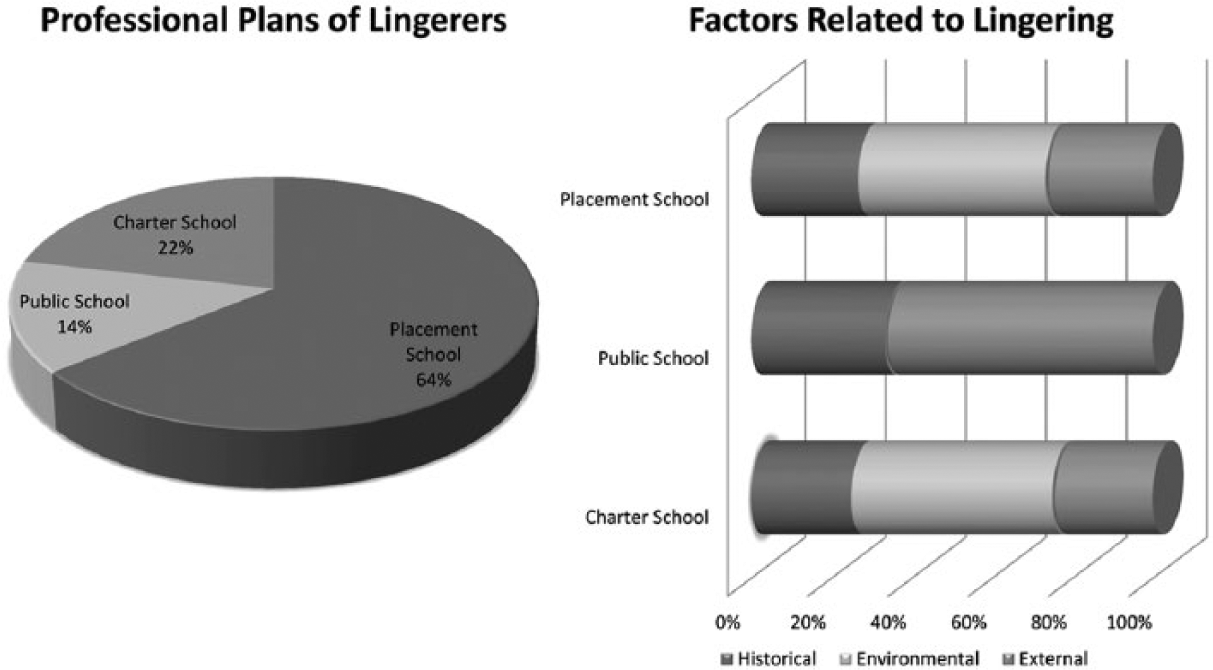
Lingerers: Professional plans and contributing factors following the 2-year commitment.
Intending to stay in the classroom for the long term, 73% of lasters opted to remain at their original placement school. The survey responses of these individuals largely reflected that positive environmental factors prompted them to stay, primarily related to the microsystem (e.g., success with and enjoyment of students and classroom practice) and mesosystem (e.g., supportive school colleagues and administrators) with a few related to the exosystem (e.g., desire to teach without TFA and UP time commitments) and macrosystem (e.g., a broader enjoyment of and commitment to teaching). Of the lasters who decided to relocate at a school other than their original placement site, the identified factors related to this professional decision were similar to those lingerers. Those individuals relocating to a public school did so largely due to external factors, predominantly citing that they wanted to move home to be closer to family and friends. Those teachers relocating to charter schools highlighted the negative environmental factors (e.g., unsupportive administration) experienced at their placement school (See Figure 7).
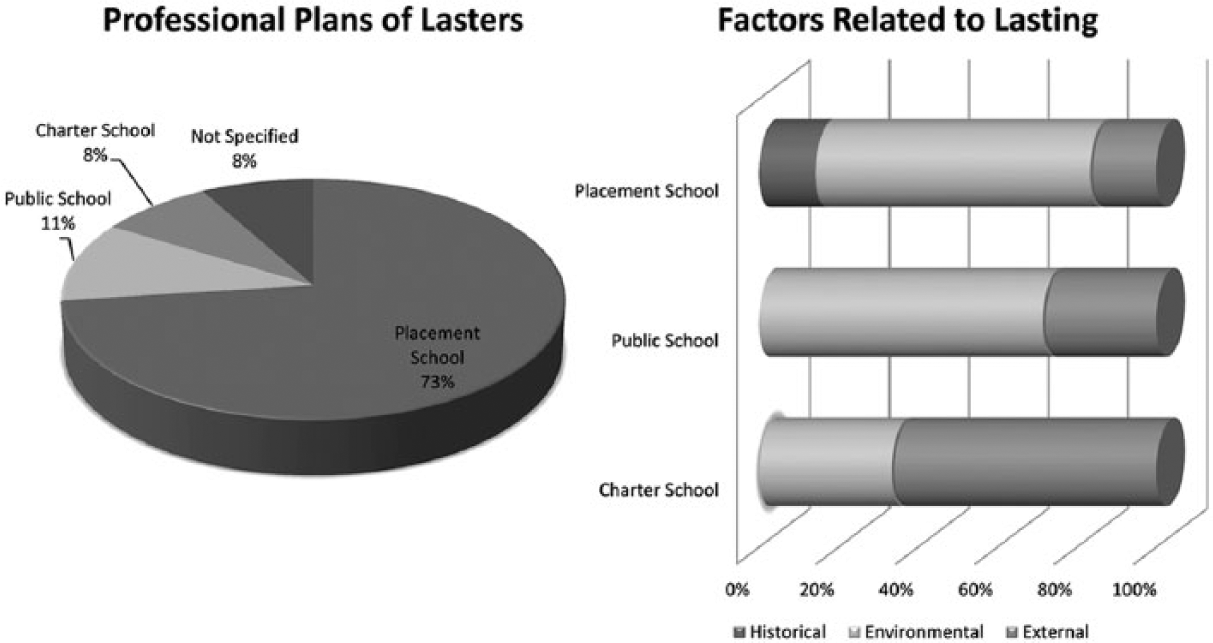
Lasters: Professional plans and contributing factors following the 2-year commitment.
Qualitative Results: Portraits of TFA Teachers
Every teacher has a unique story. Nevertheless, TFA corps members are often characterized as a homogenous group of elite college graduates who teach for 2 years and leave to pursue goals outside of schools. Although corps members may share certain characteristics, they differ in backgrounds prior (i.e., historical factors), experiences during (i.e., environmental factors), and considerations following (i.e., external factors) the 2-year commitment. The portraits build on the generalizations from quantitative data to explore the trajectories of historical, environmental, and external factors that shaped corps members’ decisions after the 2-year commitment (see Table 2).
Teach For America Placements and Professional Plans of Interview Participants.
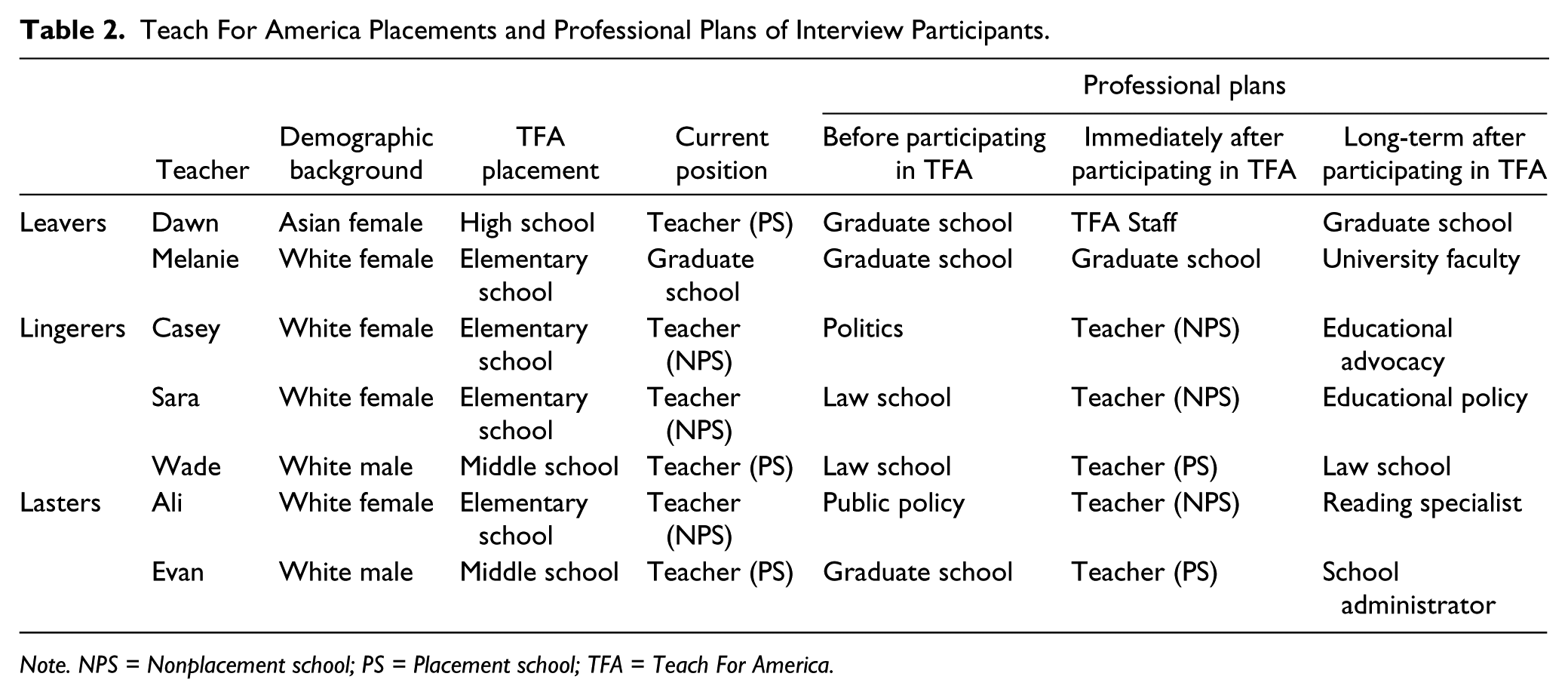
Note. NPS = Nonplacement school; PS = Placement school; TFA = Teach For America.
Melanie: Leaving for Graduate School
After graduating from an elite university on the west coast, Melanie narrowed down her postundergraduate options to graduate school, law school, or public interest work, with particular interest in pursuing a doctorate in the humanities. In an attempt to test her interests, she pursued a 2-year service commitment to TFA with the hope of solidifying her ultimate professional direction while teaching and advocating for high-need students. Melanie applied to TFA, which was known by her peers as a prestigious and rigorous process after college.
Melanie accepted a position as an upper elementary teacher at a school that had served as a regular placement site for TFA corps members over the past decade. In her 1st year of teaching, she struggled to manage her classroom and recognized the impact her lack of management had on her students’ learning. Melanie sought support and dedicated time to improve her practice to better the educational outcomes of her students; however, she found an unresponsive administration at her school. Instead, she utilized the support, resources, and professional development provided by TFA and UP where she was working toward her master’s degree and teaching certification. Melanie appreciated and benefited from the collaboration of external mentors from these organizations, as well as the relationships formed with her peers in the organization. She noted a remarkable shift between the 1st and 2nd year of teaching when “something clicked.”
Nevertheless, the network outside of school did not compensate for the lack of support inside the school. Melanie found that the mediocre administration and deficient internal support was “the single worst part” of her experience. The school environment not only triggered her desire to leave the classroom, but negatively affected her opinion about public education. After 2 years of teaching, Melanie left the classroom to fulfill her original aspirations of a doctoral degree in the humanities; she currently continues her degree program and enjoys teaching university coursework.
Dawn: Leaving for Nonprofit Work
Dawn started down her original path to teaching as an education major in her undergraduate career at a private college on the East coast. Frustrated with the education classes that were exemplified by spending “the entire period putting together a jigsaw puzzle,” Dawn focused on her mathematics degree, recognizing the option to pursue an alternative certification program following graduation. Toward the end of her undergraduate years, she applied to various graduate programs, including the “highly regarded” TFA.
Utilizing her background, TFA placed Dawn as a secondary mathematics teacher. She found success in teaching, particularly in her 2nd year after recognizing what she could accomplish with her students “academically, emotionally, and socially.” At a school with a positive environment and administration, a veteran teacher took the initiative to serve as Dawn’s mentor. In addition, Dawn received individualized support from her UP clinical instructor. Despite the professional growth in her classroom, the larger challenges and harsh realities of the educational system provided frustration. She stated, “I have learned how great our educational inequality is . . . and realize how much work actually does need to be done to close the achievement gap.” Dawn also missed theoretical mathematics and statistical analyses that did not enter her classroom instruction.
After completing her 2-year commitment, Dawn left the classroom to take a position at an educational nonprofit organization at the advice of her TFA program director. Unsure of her immediate professional direction, she knew her ultimate goal was to find a career that would combine her passion for rigorous mathematics with her advocacy for disenfranchised communities. Dawn eventually returned to her placement school after 1 year of working at an education nonprofit organization.
Wade: Lingering at Placement School
Unsure of what direction to head after college, Wade put off his “pretty vague” plan to go to law school and considered other opportunities after graduation. With an interest in teaching, he explained that he had “applied for various other teaching-related jobs, but Teach For America was definitely [his] best option.” Wade was placed as a middle school, special education resource teacher.
Encountering challenges at a school with subpar administration, Wade faced tensions with “fellow staff members who aren’t as cooperative as one would like them to be.” In his first 2 years of teaching, he urged the school to move to an inclusion-based approach for special education students, which was met by resistance. Despite some obstinate colleagues, Wade formed a supportive professional network with other mentors, including a veteran special education teacher, TFA program director, and TFA peers within the same school district. When speaking of his mentor teacher at his school site, he stated, “She’s amazing. She’s helped me more than anyone else.”
The experiences at his school transferred to Wade’s larger growth as a person and professional. He shared,
I value the perspective I have and the changes that I’ve made personally . . . and really buying into everything Teach For America. Now I have a much better understanding of what’s wrong, what needs to be done, what is not working, and what’s really important.
Wade cherished the impact he had on students, while recognizing the difficulty and necessity to improve his practice as a teacher. Although he was “not dying to teach a 3rd year,” Wade decided to stay at his placement school to have job security in a tough economy, utilize his recently earned master’s degree, enjoy teaching without the multiple obligations of TFA and UP, and have time to prepare and apply for law school. Wade continued in the classroom beyond his initially projected 3rd year and then transitioned to law school, where he is currently pursuing his law degree.
Sara: Lingering at Public School
The daughter of two attorneys, Sara had planned to continue the family tradition and attend law school after college. Nevertheless, when her senior year arrived at a private Midwestern university, she did not feel ready for law school. Instead, she decided to pursue TFA after seeing recruitment information online and on campus that emphasized the great need to contribute to improving education. Reflecting upon her decision to join the organization and move across the country to teach in a high-need school in the western United States, Sara recognized her own personal growth in “becoming much more independent [and] becoming much more self-confident. Realizing I can chart my own path, as opposed to it being something that is predetermined.”
Sara learned the profession of teaching firsthand in an upper elementary classroom, where she struggled in her 1st year after “just being totally thrown” into challenging realities. With students performing below grade level, she felt overwhelmed and frustrated and questioned her decision to join TFA: “When I’m working with these kids who can’t subtract, instead of the alternative being that I could be in law school right now. I could be excelling . . . but instead I’m sitting here and doing this and it’s incredibly frustrating.” Sara overcame the obstacles with support from her school administration, TFA program director, and other peers. With external and internal support, Sara felt able to get to know her students as individuals and watch them grow.
Valuing both her positive and negative experiences with teaching and learning in a public school setting, Sara ultimately decided to stay in the field of education, rather than pursue her law degree. Her fiancé encouraged her decision to stay in teaching, telling her, “You should teach if you want to teach. Don’t feel pressure to do something else, if what you really want to do is teaching.” Sara planned to seek out secondary certification to teach high school when she relocated to another region for her partner’s work the following year. Recognizing the need to fix problematic policies plaguing public education, Sara intended to teach and then transition to a career at an educational policy think tank. She currently continues teaching with plans to enter into administration.
Casey: Lingering at Charter School
The daughter of working class parents in the urban Midwest, Casey began high school with little drive for academic pursuits. One teacher, a TFA corps member, took initiative and encouraged her to attend community college, where she began postsecondary education before moving on to and thriving at a private Midwestern university. Recognizing the difference that an individual teacher had on her life path to success, Casey chose to hold off on plans to run for public office to apply to take part in a 2-year service obligation to TFA.
After being accepted to the corps, regional staff placed Casey at an elementary school with an administration that left much to be desired. She found a lack of leadership evident across the school, despite the many teachers who put in extended efforts to help students learn, grow, and achieve. Due to dismal support inside the school, Casey placed a high value on external support from her TFA program director, specifically the constructive collaboration to “help us wrap our head around what’s going on in our classrooms.” She connected the challenges and realities at her school site to the “vast educational crisis regarding the achievement gap.” In addition to teaching in her upper elementary classroom, Casey also coached soccer—taking her school’s junior high team to the state championship; her coaching experience gave her a new lens on the achievement gap, where low expectations prevailed even in recreational settings in this low-income neighborhood.
Disheartened by widespread low expectations for students, parents, and teachers at her placement school, Casey decided to continue teaching in a different school context to be more widely prepared to eventually enter the field of policy. She asserted, “I want to get into educational policy and I’m thinking, I know really well what does not work. I just really feel it would be a very important perspective to see what does work.” Determined to find what works in education, including a higher salary from the reported dismal pay in her placement district, Casey left the less-than-functional school to move to a charter school on the East coast. Casey continues to teach at the charter school, now multiple years beyond her 2-year commitment and 3rd-year lingering period. Recently married, Casey still plans to run for public office to advocate for education reform.
Evan: Lasting at Placement School
Having never heard of TFA prior to receiving an email from the organization during his senior year, Evan contacted a friend to ensure the message was not spam before applying to teach for 2 years. He had previously been accepted to a graduate program that involved work with high-need youth, so participation in the corps seemed to be a logical extension to provide practical experience. After acceptance to the TFA organization and placement in the western region, Evan moved across the country and began teaching middle school social studies.
Evan experienced positive interactions in personal and professional endeavors throughout his 2 years. With hundreds of recent college graduates brought to the regional corps, he found his personal niche and got to know a number of good friends. Evan particularly liked this region of the country due to the outdoor opportunities and adventures that he and his TFA peers could engage in on weekends and breaks from school. When inside his middle school walls, Evan also forged positive relationships with this students, staff, peers, and mentors. Despite having no specific school-based mentor, Evan attributed his optimistic viewpoint and teaching success to the “good, friendly administration” and his helpful relationship with a UP instructor. Describing his clinical instructor as an expert in his field who gave him very specific feedback and advice, Evan explained, “It was good to have someone with that wealth of knowledge available to really lean on.”
Despite an obstinate relationship with his TFA program director and frustrations with external time commitments required by TFA and UP, the overwhelmingly positive experiences in his classroom and school led to the decision to stay in K-12 education for the long run. Evan explained,
I can’t really imagine doing anything but education. I think that after a little more time in the classroom, I’m going to want to affect schools from more of a macro-level than right now. And I think [becoming an administrator] will be a better way to do it.
Evan’s desire to incite change at the local level led him to stay in the classroom at his placement school, with the ultimate goal of becoming a school administrator. Evan stayed at his placement school for a 3rd year before relocating to a charter school in a nearby neighborhood; with a recent degree in administration, he plans to transition into a school leadership role.
Ali: Lasting at Charter School
After attending a prestigious university on the east coast, Ali considered working in international or public policy following graduation. Disenchanted from insights gleaned during the interview process for positions in these fields in Washington, DC, she determined that her life was destined to take a different path. Despite hearing of the demands of TFA teaching from her cousin’s previous experiences as a corps member, Ali decided to apply for TFA at the last minute, submitting her application within 2 days of the deadline. Ali was accepted and placed in an upper elementary classroom on the opposite corner of the country.
Ali defined her TFA experience as “the most challenging 2 years of my whole life.” She described the inherent obstacles of the 2-year corps experience, including “doing the job for the first time, going to school full-time, [and] living all the way across the country . . . away from home and family and friends and just having to be in this really stressful situation without that network.” Nevertheless, the positives of her situation outweighed the challenges: “I loved my placement. I loved my school. I loved my principal. In terms of that, it was all positive for me. And, I really took to teaching.” Although away from her personal network, Ali built an equally strong internal support system, starting with an encouraging and accommodating principal. In addition to the “great community and leadership” at her school, she attributed her success and enjoyment in the classroom to the proactive development of relationships with external mentors from TFA and UP.
Recognizing her love of teaching, Ali knew that education was her calling; however, with a desire to return closer to home, Ali accepted a teaching position at a charter school on the East coast following her 2-year commitment. She explained:
Sometimes I wonder if I should have done the corps a little closer to my home, because then I think I could have stayed in my school longer. But at the same time I’m still committed to the mission, and I’m still continuing on teaching. So I’m leaving my school, but I’m . . . still working for the same cause and I can do it somewhere else with different students and still contributing to the greater goal.
Passionate for literacy and enrichment instruction, Ali continues to teach with plans to pursue an advanced degree in reading or gifted education with an emphasis on high-need schools. Ali left the charter school after 1 year and now teaches at a high-need public school; she is currently considering options in higher education and school leadership.
Discussion
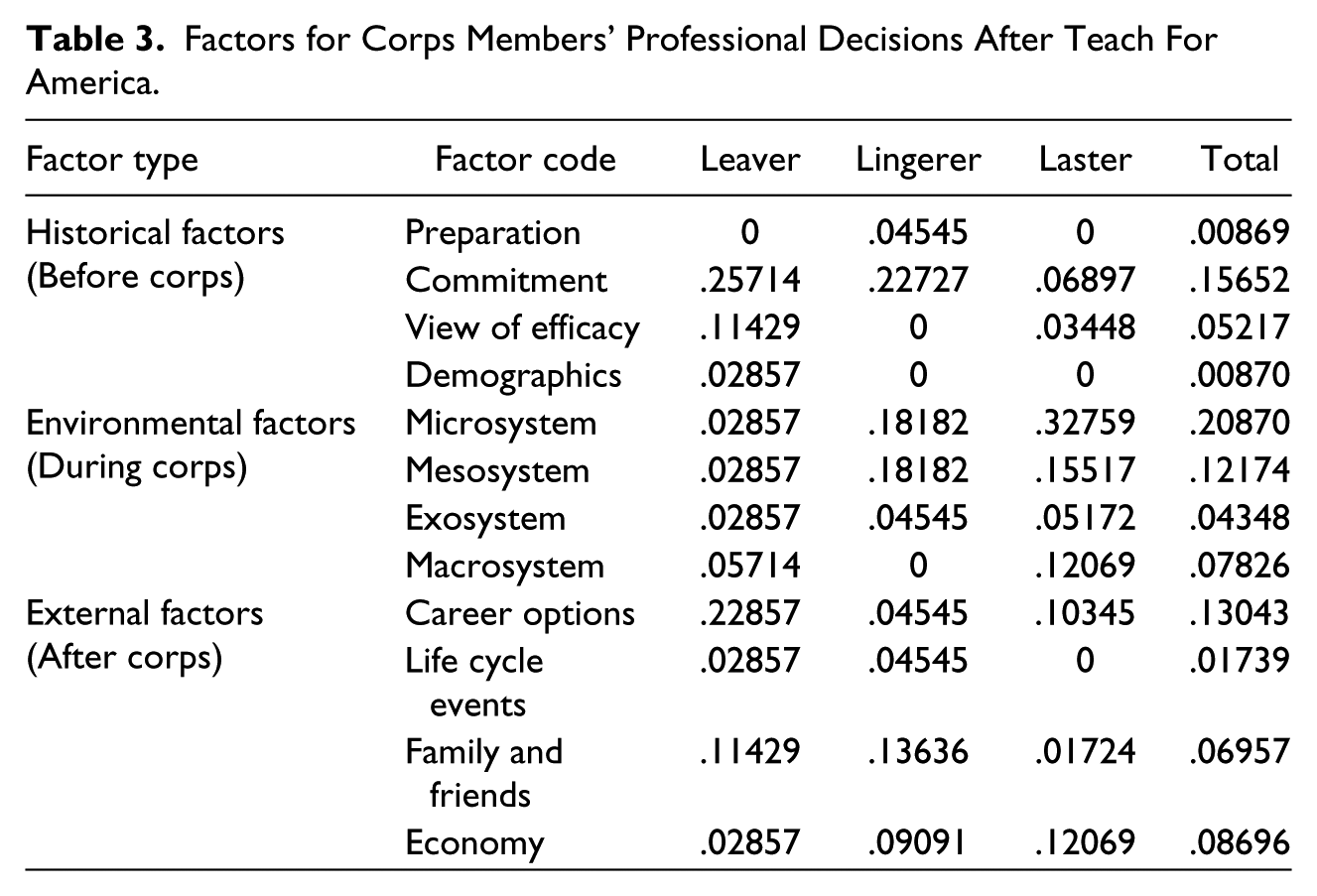
Bringing together the quantitative and qualitative results, we utilize this section to interpret and discuss the results related to TFA retention and attrition. The data revealed trends in the historical, environmental, and external factors affecting corps members’ professional decisions (see Table 3).
Factors for Corps Members’ Professional Decisions After Teach For America.
Historical Factors: Circumstances Before the 2-Year Commitment
Retention and attrition factors persist before corps members ever step into classrooms for their service obligations; specifically, our data demonstrate that leavers, lingerers, and lasters varied based on initial commitment. Building on prior research on commitment, mission, and resilience (Freedman & Appleman, 2009; Hong, 2010), we found that corps member commitment is complex, due to the professional and ideological ties to TFA and the broader profession of teaching.
Leavers typically entered the corps to fulfill 2 years of service and build resumes for future endeavors. The most frequently selected historical factor, 25.7% of leavers departed after 2 years because that had always been the intent; the initial commitment was 2 years, and they endured for that limited time frame. These individuals consistently described alignment of plans prior to and after joining TFA. Whether they had deferred acceptance to a graduate program or used the higher education partnerships provided only for alumni, the majority of leavers knew they would leave before the obligation began. Because they entered with set plans, such as Melanie’s pursuit of her doctorate in the humanities, leavers’ discourse typically reflected decreased commitment to teaching and TFA—recognizing the extant achievement gap, but not conceptualizing themselves as a part of the solution. Returning to plans prior to the corps, leavers demonstrated commitment to their own personal and professional goals as opposed to the larger TFA mission of educational equity or the teaching profession more broadly conceived (Larabee, 2010).
Lingerers often joined TFA to determine and prepare for future endeavors, such as Wade’s plan to further develop his readiness for law school. Similar to leavers, 22.7% of lingerers referenced their initial commitment as a factor contributing to their professional decisions. Although they tentatively planned to return to school, they put off plans for a 3rd year to extend the service commitment. Without a predetermined trajectory before the corps or a commitment to teaching after the corps, lingerers’ discourse reflected commitment to TFA. Two trends among lingerers include the perception that the 2-year experience (a) allowed for personal growth to learn about themselves as individuals and (b) led to change in loosely planned career goals to focus on some aspect of education. Recognizing their role in the TFA mission, they self-assessed shortcomings as novice educators and stayed in the classroom for the short term to improve. One lingerer explained, “I think there is more I can do as a classroom teacher. I do not feel like I have accomplished all that I want to in terms of helping students meet their potential.” This self-assessment exemplified the predominant use of I-centered discourse of lingerers, accentuating the emphasis on individual pursuits in the classroom. Dedicated to the TFA mission but not to teaching, they planned to leave to carry out the organizational expectation in other roles. Some teachers, such as Sara, felt pressured to leave the classroom to “affect change on a higher level.” Respecting that TFA allowed entrance into education, lingerers remained committed to and asserted positive perceptions of the organization.
Whereas one fourth of leavers and one fifth of lingerers attributed departure from teaching to the 2-year commitment, only 6.9% of lasters referenced the initial commitment as the determining factor for staying, as few utilized TFA as an alternative path to their preferred lifelong career. Nevertheless, the majority of the lasters initially maintained flexibility and later committed to stay in teaching. Without firm or nebulous plans like leavers and lingerers, lasters maintained the possibility to commit to the profession. Some lasters reported a corresponding disillusionment with the organization, such as Evan who criticized TFA personnel, because of the short-term commitment they deemed as inappropriate to educational change. As teachers committed to making what Evan described as “the best impact in education by staying in the classroom,” lasters did not demonstrate commitment to TFA, but rather to the broader endeavor of teaching. Ali reflected,
I appreciate everything that TFA has done for me and recognize that I perhaps would never have found one of my greatest passions in life without the organization. Still, I think there are things we can do as a movement . . . The secret to good teaching is to keep doing it, keep learning, keep asking questions, and keep developing. It’s not a process that ends after two years.
Although committed to the organization, Ali demonstrated a broader commitment to the teaching profession. Frustrated by the minimal expectations and perceptions of teachers, many lasters shared the goal of becoming school leaders and administrators.
Environmental Factors: Experiences During the 2-Year Commitment
Classroom experiences, school settings, and professional relationships during the corps contributed to decisions following the 2-year commitment, primarily for lingerers and lasters. Nonleavers reflected greater reliance on environmental factors to support professional decisions, particularly the classroom microsystem and school mesosystem. 66% of lasters’ responses and 41% of lingerers’ responses attributed decisions to environmental factors. Although 14.3% of leavers’ responses referenced negative environmental factors behind the decision to depart, these were secondary to historical or external factors. Remaining and relocating teachers differed in their use of environmental factors during the corps experience to inform professional decisions.
Lasters and lingerers, specifically those who remained at placement schools, cited positive experiences and school environments, including ample professional support from mentors and administrators. Corps members who remained at their placement school, such as Evan, found supportive workplaces needed to excel in the early years of teaching (Humphrey et al., 2008). Participants in both quantitative and qualitative data collection indicated that an encouraging and nourishing school environment typically included facets such as a positive school climate and professional development and support from colleagues, mentors, and administrators (Leland & Murtadha, 2011; Yonezawa et al., 2011). For the most part, lasters and lingerers who stayed at their placement school discussed the influence of positive environmental factors on their decision to continue; however, some remaining teachers, such as Wade, reported negative school-based factors that he was willing to endure due to other historical and external factors.
On the other hand, negative environments deterred teachers from remaining at original placements (Haberman, 2004), such as Casey and Sara. Relocating corps members, particularly those who moved to charter schools, cited factors consistent with existing research, such as subpar administration (Bogler, 2001; Fantilli & McDougal, 2009; Kersaint et al., 2005, Liu & Meyer, 2005), lack of professional support (Cochran-Smith, 2004; Kersaint et al., 2005) and adverse climates (Loeb et al., 2005) in placement schools. Relocators related their move to charter schools, specifically those charter schools started by TFA alumni, to the less than functional, high-need schools and their corresponding desires to see what Casey referred to as a school “that works.”
The qualitative data informed the overall interpretation that the distinction between remaining and relocating corps members was not clear-cut. Ali, who relocated to a charter school followed by an urban public school, had an overwhelmingly positive experience. Ali described, “I was in the right place at the right time—the right school, the right grade level, the right principal, the right colleagues, all the pieces came together for me in making my experience great.” Similar to others who stayed in the classroom, Ali had support inside and outside of her school. In addition to positive supports that led to her retention, Ali described her success in the classroom, revealing that professional support leads to both retention and efficacy (Freedman & Appleman, 2008, 2009; Leland & Murtadha, 2011; Olsen & Anderson, 2007). Ali’s decision to relocate centered on external and personal factors, specifically wanting to be closer to family and friends.
External Factors: Considerations After the 2-Year Commitment
In addition to commitment before and environment during the corps, participants utilized external factors to inform professional decisions after the 2-year commitment, including perceived career options, life cycle events (e.g., marriage, pregnancy), personal relationships (e.g., family, significant other), and economic considerations. Whereas clear patterns emerged from the data regarding historical and environmental factors among categories and descriptors, we found external factors to be more messy and complex. Building on the quantitative findings, we discovered through the qualitative phase that the external factors often trumped the historical and environmental factors. For example, despite the initial commitment to serve and continue to law school and the negative school environment with unsupportive administration, Wade chose to persist at his placement school after considering the poor economy. Ali, who did not have a prior commitment before the corps and raved about her positive school environment and supportive colleagues, departed from her placement site due to the desire to be closer to family and friends.
Corps members looked to the future to determine professional plans based on the job market and economic landscape, as one quarter of survey responses related economic considerations and perceived career options. Not surprisingly, nonleavers referenced the poor economy as a reason to maintain secure teaching salaries, reflected in 12.1% and 9% of lasters’ and lingerers’ responses, respectively, as compared to only 2.8% of leavers who felt confident to leave secure jobs for other endeavors. Despite the distinction in economic considerations, similar numbers of leavers and lasters cited perceived career options for their corresponding decisions. Eight leavers foreshadowed professional contributions outside of school walls, such as Dawn’s desire to use higher mathematics at a nonprofit organization. Six lasters remained inside schools with pursuits in leadership, such as Evan’s goal and eventual completion of his degree in administration. In this region, teachers needed 3 years of teaching experience to shift into administration, a factor that contributed to lingerers’ and lasters’ choices to remain at placement schools for a 3rd year.
In addition to career and economic considerations, we discovered that personal factors played into professional decisions. Whereas one respondent referenced marriage and another pregnancy, most personal factors related to corps members’ desire to mold future professional pathways based on plans and locations of family, friends, and significant others (Kersaint et al., 2005). Still in their early 20s following the 2-year commitment, teachers like Ali wanted to return home to be close to family and friends. Others had forged friendships during the corps and made professional decisions based on peers, whether that be staying within the placement school or region such as Evan or jointly leaving for another locale with other exiting corps members like Casey. In addition to family and friends, significant others played a role in professional decision making, such as Sara’s relocation for her fiancé’s job. The mixed methods design contributed to this finding, as survey data indicated that personal factors only contributed to 8.6% of respondents’ professional decisions; however, participants in the qualitative phase consistently framed perspectives around the central role of family, friends, and loved ones.
Conclusion
In this study, we utilized mixed methods research to investigate the retention and attrition of TFA corps members after the 2-year commitment in one urban region. With evolving factors that influence decisions, corps members’ decisions to leave, linger, relocate, or last in teaching are complex. Results indicate the relevance of historical, environmental, and external factors before, during, and after the 2-year commitment, specifically the initial commitment to teaching, classroom and school environments, and career, economic, and personal considerations. Findings hold implications for TFA, schools and universities who partner with TFA, and educational researchers. Together, all stakeholders can support TFA in reframing teaching as a reputable profession, not a service mission that only warrants a 2-year commitment (Larabee, 2010; Veltri, 2008).
Central to this study, the construct of the 2-year commitment provides corps members with a finite obligation to teaching in high-needs schools. Despite the various historical, environmental, and external factors, corps members base their decisions around the 2-year construct set in place by TFA as a national organization (Kopp, 2011). Currently, the approach infers attrition; TFA recruits leaders to teach for 2 years and go on to affect change at a broader level (Kopp, 2011; TFA, 2011). With corps members dedicated to the mission and values of TFA (Kopp, 2011), an extended temporal obligation would lead affiliated participants to rise to organizational expectations. In addition to bolstering retention, lengthening the commitment to 3 years with a 1-year teacher residency (Hopkins, 2008) or 5 years (Heilig & Jez, 2010) stands to increase teachers’ development (Boyd et al., 2008; Darling-Hammond et al., 2005), impact (Darling-Hammond, 2006), and dedication to the profession of teaching (Larabee, 2010; Veltri, 2008). In doing so, TFA would prioritize teaching as central to the mission of the organization to reflect the importance of classroom teachers (Humphrey et al., 2008) to close the achievement gap.
In addition to extending the 2-year commitment, the organization must consider how historical factors inform selection and placement of corps members. TFA recruits college graduates willing to dedicate 2 years in high-need schools to ignite leadership for a broader change (Kopp, 2011). With more than 45,000 annual applicants for less than 5,000 positions (Kopp, 2011), a narrowed focus to seek out individuals with professional flexibility and personal willingness to stay in the classroom would increase retention. By passing on those with solidified career plans in other fields, TFA would prioritize recruitment of elite individuals into teaching as a profession, rather than a service (Larabee, 2010; Veltri, 2008). After selection based on a firm commitment to teaching, regional personnel can support retention by placing teachers in schools with supportive environments and administration (Fantilli & McDougal, 2009; Liu & Meyer, 2005; Loeb et al., 2005), rather than placing in the toughest settings (Kopp, 2011) with environmental factors that promote attrition (Donaldson & Johnson, 2010). As regional partners committed to support TFA efforts in selection, placement, and support, school and district administrators can also consider historical factors when hiring corps members, as well as environmental factors when placing them in particular schools or classrooms.
In addition to school and district support, universities and institutes of higher education must consider and articulate their role in apprenticing corps members into the profession of teaching (Heineke, Desimone, Carter, & Cameron, 2010; Heineke & Preach, in press). In this study, the role of the UP directly impacted the quantitative trends and qualitative factors demonstrating teacher retention. In a sample of corps members enrolled in the UP, participants highlighted the environmental factors (i.e., classroom-based support of clinical instructors) and external factors (i.e., putting their master’s degree in education to use) directly related to decisions to stay or leave the classroom. When universities partner with TFA to share the responsibility of preparing and supporting teachers, expert and veteran educators can work side-by-side with corps members both inside and outside of high-need schools (Heineke et al., 2010; Heineke & Preach, manuscript submitted for publication). With the collaboration of educational leaders from TFA, schools, districts, and universities (Gabriel, 2011), corps members receive more rigorous and holistic professional development and support grounded in the classroom context (Cochran-Smith, 2004; Kersaint et al., 2005), as well as seeing a model of the teacher as professional in action (Heineke et al., 2010).
The limitations of this study, including the narrow focus on one TFA region and corps year and synchronic data collection at one point in time following the 2-year commitment, require additional research to explore what propels TFA corps members to stay in high-need classrooms. As this study focused on retention and attrition in only one regional corps with those enrolled in the UP, researchers can build off of existing large-scale studies (Donaldson & Johnson, 2010, 2011; Donaldson, 2012) to continue the qualitative investigation of individual teachers’ stories in other TFA regions and corps to explore the complexities and realities behind teachers’ decisions to leave, linger, or last beyond the organization’s 2-year service obligation. In addition, rather than focus on quantitative and qualitative data from one static point in time, researchers should collect longitudinal data to account for the dynamic professional paths (Billingsley, 2004; Rinke, 2011) of many TFA affiliates, such as the unique group of teachers who leave after the 2-year commitment only to return to teach in subsequent years, such as the returner Dawn in this study.
Rather than compartmentalizing the problem with criticism of the corps members who leave the classroom, a multifaceted approach is needed to emphasize, implement, sustain, and research TFA teacher retention. TFA as a national and regional organization, along with other educational partners and stakeholders, must focus their efforts on selecting, placing, preparing, and supporting teachers who stay in classrooms to reframe teaching as a reputable profession, not a service mission that only warrants a 2-year commitment (Larabee, 2010; Veltri, 2008). Further, these nuances of teacher retention and attrition must be considered beyond the oft studied and criticized TFA organization (Donaldson, 2012; Donaldson & Johnson, 2010) to improve the resiliency of teachers across preparation and certification programs. Since the attrition of teachers is a persistent burden on the American school system (Haberman, 2004; Leland & Murtadha, 2011), we must recognize the challenges posed to those who enter the classroom through both traditional and alternative paths and jointly tackle this critical issue that negatively impacts our educational system.
Footnotes
Acknowledgements
We would like to thank the teachers who participated in this study and our colleagues who provided feedback on our work.
Declaration of Conflicting Interests
The authors declared no potential conflicts of interest with respect to the research, authorship, and/or publication of this article.
Funding
The authors received no financial support for the research, authorship, and/or publication of this article.