







Abstract
Schools located near to airports are exposed to high levels of noise which can cause cognitive, health, and hearing problems. Therefore, this study sought to explore whether this noise may cause auditory language processing (ALP) problems in primary school learners. Sixty-one children attending schools exposed to high levels of noise were matched to 68 children in quieter schools. Audiological screening and ALP assessments were undertaken and revealed that the children from the noise-exposed schools scored below average in all the ALP subtests. This study suggests that airport noise may impact on children’s ALP abilities.
Research has shown that chronic noise exposure can have a negative effect on some auditory processing skills (Maxwell & Evans, 2000) and it has also been shown that children who have auditory language processing difficulties may have scholastic difficulties (Cacace & McFarland, 1998). These auditory language processing problems may manifest as difficulties with reading, spelling, or other learning problems at school (Bamiou, Musiek, & Luxon, 2001). However there has been very little research on the effect of long-term aircraft noise exposure on the auditory language processing skills of apparently typically developing school-going children whose hearing thresholds are within normal limits. Therefore, this current study sought to investigate the effects of long-term aircraft noise exposure on the auditory language processing abilities of English First Language primary school learners attending schools situated close to an airport in Durban, South Africa.
Auditory Language Processing
Usually, literature refers to auditory processing disorders as a discrete set of difficulties with the central processing of auditory stimuli, including difficulties with auditory analysis, auditory synthesis, auditory closure, auditory discrimination, among others (Keith, 1999). However, in this article, the authors contend that auditory processing difficulties, despite being largely language independent, in context, there is often a linguistic component to the auditory processing and it is for this reason that the authors propose the exploration of concept of auditory language processing (ALP). Auditory language processing (ALP) can be described as the combination of central auditory processing and language processing. Central auditory processing is the processing and interpretation of auditory signals as they travel along the auditory pathway to the brain (Katz, Stecker, & Henderson, 1992; Phillips, 2007) whereas language processing is the ability to attach meaning to the auditory signal using linguistic knowledge and tends to occur in the temporal lobe (Richard, 2001).
Therefore, it appears as though there may be an overlap in the processing of auditory and language signals and that they cannot always be distinguished as separate entities, and thus the term auditory language processing can be used.
Alain, Arnott, and Picton (2001) also explained that distinguishing auditory signals involves a widely distributed neural network that includes both bottom-up and top-down processing. Many auditory signals have linguistic elements and the learners are required to obtain these auditory signals and provide meaning to this speech in order to learn. The concept of auditory processing in this project is grounded by the combination of these two models, that is, sound is processed up, from the external auditory meatus to the cortex, while in conjunction, these signals are also being organized at the level of the cortical structures to provide meaningful information to the child.
Therefore, there appear to be various components of the phenomenon which the literature often refers to Auditory Processing (AP). This article will refer to ALP in contrast to AP since ALP encompasses auditory processing from the central auditory system, including the language processing system which may be more reflective of the school context. The proposal is not that an Auditory Language Processing Disorder (ALPD) is necessarily synonymous with Auditory Processing Disorder (APD) because of the controversies surrounding the independence of auditory processing and language processing, but that cognizance needs to be given to the linguistic contexts in which auditory processing occurs, and for that reason, in this article, a reference is made particularly to ALP and ALPD.
Signs and Symptoms of an Auditory Language Processing Disorder
An auditory language processing disorder is characterized by difficulties in the interpretation of acoustic signals. The signs and symptoms can vary considerably, depending on the degree of the disorder and the individual child affected (Geffner & Ross-Swain, 2007). According to Dawes and Bishop (2009) there is controversy with regard to the classification of the disorder, as its many symptoms overlap with other disorders, and can possibly become confused with Specific Language Disorders (SLD). Thus, careful and improved assessment is imperative and required (Dawes & Bishop, 2009). Furthermore, the American-Speech-Language-Hearing Association (2005) use the term “auditory processing disorder”, in contrast to the previous “central auditory processing disorder”, although, they can all be considered synonymous. Auditory processing problems can manifest in several ways, however, are different between individuals. In some instances, people with auditory language processing disorders could be aware of their difficulty with listening and understanding signals which may be exacerbated in some situations or environments, such as in noise. However, there may be subtle co-occuring difficulties, such as disturbances with learning, language, spelling, reading, socializing, and problem solving skills (Bellis, 2002). The DSM IV does not mention APDs or ALPDs. Because an ALPD could impact on education and learning as mentioned above, it could thus possibly be considered as a “Learning Disorder” (American Psychiatric Association, 1994, p. 47) since it relates to the description used in the DSM IV: “there may be underlying abnormalities in cognitive processing (e.g., deficits in visual perception, linguistic processes, attention or memory, or a combination of these)” (American Psychiatric Association, 1994, p. 47) and can result in significant underachievement in a person with adequate intellectual capacity (American Psychiatric Association, 1994).
Martin and Clark (2003) mention that auditory processing disorders are estimated to occur in 2% to 3% of children and many teachers and parents complain that children with ALPD often have difficulty following oral directions and show inconsistent responses to auditory stimuli and may also struggle specifically with multistep directions. Sometimes, it appears that the child with ALPD may be partially ignoring the speaker, and not paying attention. Given that the auditory information may be unclear, they may “zone out” and teachers may describe these children with ALPDs as daydreaming or easily distracted from the topic of interest in the classroom (Richard, 2001). Although these presenting factors are not necessarily described as the cause of scholastic difficulties, they can make listening in classroom settings more difficult which may impact on the learning in class and their overall academic performance.
Noise Causing Cognitive, Psychological, and Health Problems
Aircraft and road traffic noise have been shown to impact on cognitive and academic tasks as demonstrated in a study in the Netherlands, Spain, and the United Kingdom by Stansfeld et al. (2005) which showed that chronic aircraft and road traffic noise could impair specific tasks including recognition memory and reading comprehension. Similarly, in Los Angeles, it was shown that there were approximately 300 over-flights daily and that the peak sound readings in these schools were 95 dB (A). This study showed that the children in the noisy schools, compared to the matched quieter schools were more likely to give up before time, more likely to fail on a cognitive task such as test puzzles or maths tasks, and more likely to have higher blood pressure (Cohen, Evan, Krantz, & Stokols, 1980). van Kempen et al. (2010) also show that there may be a link between air and road traffic noise exposure and children’s health and cognition. In this study, cognition was assessed with the Neurobehavioral Evaluation System (NES) where the Switching Attention Test measured the child’s ability to switch rapidly between responses, the Symbol Digit Substitution Test assessed perceptual coding and attention and the Digit Memory Span Test measured the children’s ability to memorize as long as possible sequences. Statistically significant effects were observed in the difficult part of the Switching Attention Test as well as in the Digit Memory Span Test. This study also demonstrated how not only the noise, but the annoyance from the noise exposure affects children’s health and cognition. Some effects are thought to be precipitated through stress, whereas others may arise directly from the noise. These studies seem to show that noise can have adverse effects on learning and it therefore appears necessary to investigate the ALP effects as there seems to be a dearth of literature in this regard.
Classroom Acoustics
Environmental and aircraft noise can contribute to a poor signal to noise ratio and poor listening conditions within classrooms, where, as Palmer (1997) points out, children can spend up to 45% of their school day engaged in listening activities. If the learning environment is not necessarily ideal, for example if, learning takes place in prefabricated buildings with very thin walls or in brick buildings which may have poor acoustics such as thin windows and doors and limited posters and carpets to absorb the sounds, the signal to noise ratio may not be favorable to learning (Levi, 2005). In urban and many rural schools, the ideal listening environment is not always attained, as many factors must be considered. In an ideal classroom, the signal to noise ratio (SNR), that is, the comparison of the signal level to the level of the background noise (Crandell & Smaldino, 2000), is considered one of the most important factors for transmission of spoken information. A child needs at least a +10 dB SNR, while an adult only requires about +6dB to hear speech effectively. Also, the distance from the speaker to listener influences the perception of speech where, in an ideal situation, a learner should be seated in close proximity to the teacher although this is not always possible, especially in poorer schools where the number of learners in the classes tends to be quite large (Palmer, 1997). In order to facilitate the ideal acoustical classroom, the major goal is to facilitate energy and direct sound, and minimize reflections in order to enhance communication (Smurzynski in Chermak & Musiek, 1992). Sound however comes from external sources which is transmitted through the building, as well as internal sound generated within the classroom. The external sources are not only from aircrafts, but also from cars, buses, and sometimes trains. Thus, consideration of the acoustic design needs to be made for both these sources (Shield & Dockrell, 2003). Facilitating this ideal acoustic environment is implemented by taking reverberation, background noise, construction materials, number of children in the class, and many other factors into account. The main premise for improving classroom acoustics though, is that the better a child can hear, the easier it tends to be for a child to process information (van Kamp & Davies, 2011). The major effect of noise and poor acoustics in the classroom is the reduction of speech intelligibility (Shield & Dockrell, 2003). Shield and Dockrell (2003) further mention that it is generally noise has a detrimental effect upon the learning and achievement of primary school children. In addition to learning, it is essential for children to hear and interact with their peers in the classroom (Shield & Dockrell, 2003). Also, children are viewed as vulnerable populations, and thus more susceptible to be affected by noise (van Kamp & Davies, 2011). Thus, the addition of noise to classrooms that are often already not ideal acoustic situations, can exacerbate these poor listening environments.
Therefore, in light of the demonstrated adverse effects which noise can have on learning as well as the high levels of noise near airports, this article reports on the performance of apparently typically developing children on auditory language processing tests so as to better understand the impact of noise on these auditory language processing abilities. This information is important because compromised auditory language processing skills may have an impact on classroom learning.
This article investigates the question whether the performance on auditory language processing tests of English First Language (EFL) primary school learners who attend aircraft-noise-exposed schools differs from primary school learners who attend non-aircraft-noise-exposed schools. Based on the literature review, it would suggest that the ALP abilities of English First Language (EFL) primary school learners who attend aircraft-noise-exposed schools would be poorer when compared to the learners who attend non-aircraft-noise-exposed schools, although this hypothesis needed to be checked and therefore this project was conducted.
Method
The aim of this study was to interrogate the performance of English First Language (EFL) primary school learners who attend aircraft-noise-exposed schools and primary school learners who attend non-aircraft-noise-exposed schools in Durban, South Africa, with regard to auditory language processing abilities.
Context of the Study
The results shared here are related to the RANCH-SA (Road Traffic and Aircraft Noise and Children’s Cognition and Health-South Africa) project conducted in the Departments of Psychology, Education (Geography discipline) and Speech Pathology and Audiology at the University of the Witwatersrand and reflect the perspective of audiologists who work with school-aged children in various urban and built-up environments. A version of this article was presented at the International Conference on the Biological Effects of Noise in London, 2011. This article reports specifically on children’s auditory processing abilities although other cognitive measures were investigated within the larger RANCH-SA study but are not presented in this article so as to focus on the auditory language processing abilities which often go unreported in the field of education. Also, the authors did not report on the academic skills and the extent to which differences in ALPD between the groups of children are associated with poorer academic performance because this study investigated the underlying abilities related to processing of auditory signals which are needed for learning. This project is part of a long-term noise study and so the academic performance and auditory language processing relationship may be investigated in the long term, although for this report, the emphasis is on the auditory language processing aspects.
Research Design
The current study utilized a nonexperimental, cross-sectional, and descriptive design, with post-hoc analysis where noise levels and auditory language processing measures were taken at schools near to an airport and schools further away from an airport in Durban, South Africa.
Ethical Considerations
Permission to conduct this study was granted by the University of the Witwatersrand’s Human Ethics Research Committee (protocol number 2008ECE94). Similarly, permission was obtained from the Department of Education and from the principals at the schools to participate in the research. Information sheets and consent forms were then sent to the parents or caregivers of the learners, as well as verbal assent was obtained from the learners themselves to be participants in this project. A hearing screening was conducted on all participants, and those who failed the hearing screening or who were identified with auditory processing deficits during the data collection phase were referred for further assessment. After the data collection, teachers at the participant schools took part in a workshop about ALPDs and were provided with strategies to implement in the classroom to help these learners. Confidentiality of the results in the write-up of the study was assured.
Participants
In order to investigate the auditory processing abilities of children exposed to aircraft noise, learners from four schools were assessed in this study. These four schools consisted of two schools exposed to high intensities of aircraft noise and two schools exposed to considerably less noise, not located in close vicinity to the airport. The noisy schools, School A and School B, were located 1.7 km and 1.9 km respectively from the airport. These two schools were under or very close to the flight path and were over-flown by landing and departing aircrafts. The quieter schools, School C and School D, were 4.6km and 3.5km from the airport. Reverberation levels were not directly measured but were considered in terms of the room size, construction materials, and furniture inside the rooms and these were found to be similar in the four schools.
The classrooms at all of the schools were of almost identical dimensions, which meant that the volumes or size of the classrooms were very similar which would suggest similar acoustics. All of the classrooms had very similar furniture—a teacher’s desk and chair, and standard learners’ desks and chairs of the type found in state schools in South Africa. All classrooms were similarly constructed from brick and mortar, had a hard floor (i.e., no carpeting which would affect acoustics), gypsum board ceilings, a chalkboard in the front of the class, one 600mm door and windows on the side walls. Given the similarity of reverberation characteristics of the classrooms, it was assumed that reverberation was extremely similar and therefore would not affect the results.
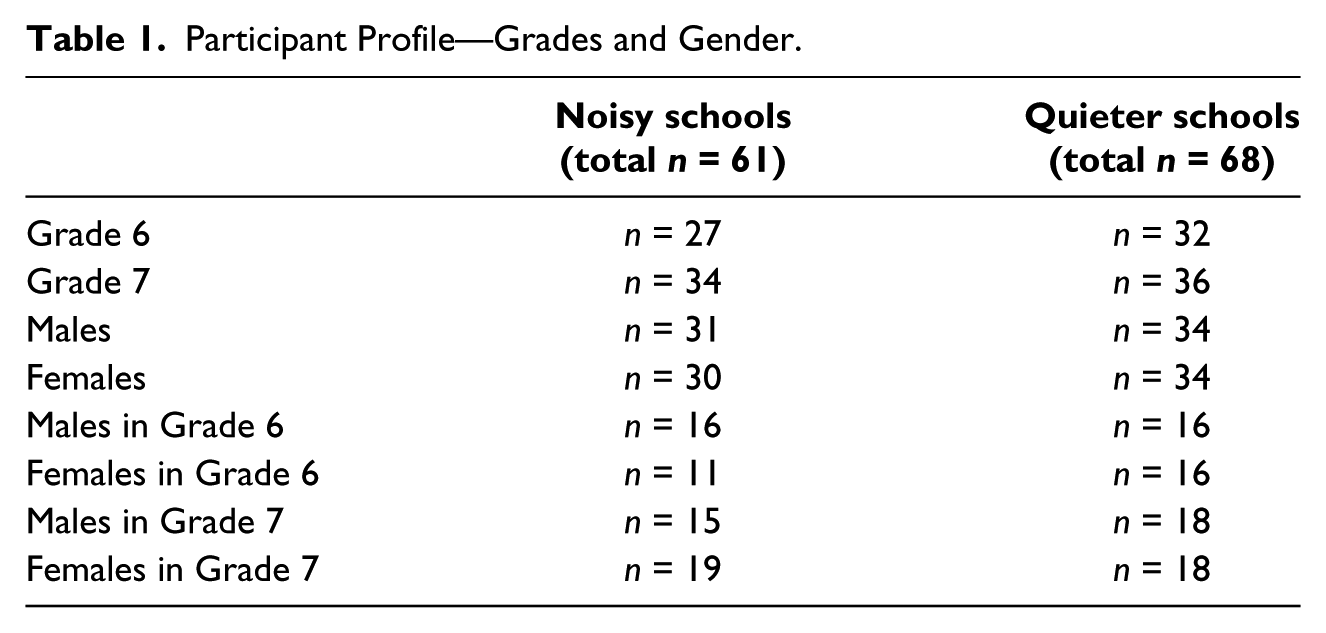
The noisy schools were broadly matched to the quieter schools on the basis of sociodemographic characteristics to reduce subject variability between schools. The children who attended all four schools lived in close proximity to each school and appeared to share a similar working class socioeconomic status (SES). As SES has shown to affect literacy development, this variable was imperative to consider and match (Willms, 2003). SES can affect literacy and academic achievement, for example, less opportunity for home-based cognitive stimulation. Also, lower teacher expectations and poor learners’ academic-readiness skills may to contribute to diminished levels of academic achievement amongst poorer children (Mcloyd, 1998). Children who are from socioeconomically disadvantaged backgrounds may also be at risk for elevated exposure to acute and chronic stressors (McLoyd, 1998). Emotional wellbeing, which can be affected by lower SES, may also be related to poorer academic outcomes (Durlak, Weissberg, Dymnicki, Taylor, & Schellinger, 2011). Successful education is often influenced by teacher resilience which is the interplay between individuals and their supportive contexts and these supportive contexts may not always be available which can take a toll on teachers’ teaching (Yonesawa, Jones, & Singer, 2011). Shield and Dockrell (2003) mentioned that the speech to noise ratio varies from 3dB in a kindergarten to almost 7 dB in university classrooms. This still does not meet the recommended requirements of 10dB (Palmer, 1997). Therefore, since SES can impact on academics, the schools selected for this study were from suburbs of lower economic status. Similarly, because they lived close to the school, they would have been exposed to the similar noise levels at home. All four schools were state run schools with similar teacher complements and teaching methods. In total, 700 children underwent hearing screening, yet only 129 children were tested for ALP difficulties as they were the children that fit the participant criteria and the majority of the children were second language English speakers. Therefore, in light of the inclusion criteria set out hereafter, 61 children participated from the noisy schools (31 boys and 30 girls) while 68 (34 boys and 34 girls) children participated from the quieter schools. This study drew on a nonprobability purposive sampling technique (Arber, 1992) so that the researcher selected the participants based on the variables under investigation which are outlined below. Also, a probability study appeared appropriate, as Arber (1992) points out, these analytical studies look to test an empirical hypothesis.
There were various criteria for the participation in the study including:
Attendance at the school from Grade 1. School staff were asked to only invite children to participate if they had been at the school since Grade 1. In South Africa, learners are required to attend schools in the district in which they live, and thus they cannot change schools for reasons other than relocating. Additional details can be found in school records.
Hearing within normal limits when screened by an audiologist. According to Doehring (1988), hearing levels can be defined by standard audiological tests. Thus, the criteria included thresholds at or better than 20 dB HL at 500 Hz, 1kHz, 2kHz, and 4kHz.
In addition, only the learners from Grade 6 through to Grade 7 were eligible to participate in this study as the study aimed to investigate the long-term effects of aircraft noise exposure on ALP abilities. Thus, these are the last two grades in primary school, allowing for the children to have been exposed to the aircraft noise for at least 6 years.
Only English First Language learners were included in this study because the formal ALPD tests are standardized on first language English speaking children and to preclude any reliability and validity issues from second language English speakers who are prevalent in these four selected schools. Although all of the Grade 6 and 7 learners were assessed for ethical reasons, only the EFL learners’ results were analyzed for the study. It is essential to provide assessment measures to all the children within the selected grades, as well as to provide them with appropriate referrals, in order to maintain accepted ethical standards.
Learners with known learning difficulties, auditory and attention problems were excluded from this study so to ensure validity and to not skew the results. The exclusion of these learners was the stipulations set by the test manuals. Although the learning problems may be due to the ALPDs, one cannot be certain, and thus these children were excluded to maintain reliability of the measures.
Children above 12 years of age could not participate as the instrument was only normed on children up to 12 years of age. However, learners may still score “greater than or equal to 12 years”, even if they are only 12 years of age as seen in the results section. The data collection at both the noisy and quiet schools was completed within the first term of the academic year to ensure that the children were at similar academic levels.
When considering the inclusion and exclusion criteria, the profile of the participants is summarized in Table 1.
Participant Profile—Grades and Gender.
Auditory Processing Measurement Instruments
Verbal working memory, auditory discrimination, phonological awareness, and phonological memory are important skills for academic learning. These areas were thus selected to be the focus of this research. The following tests were selected as they cover many aspects of auditory language processing skills important for academic learning. They were also utilized in the initial phase of the RANCH-SA study in the noisy schools, and because the data were used from the larger RANCH-SA study, it was necessary to match these tests at the quieter schools. This study utilized the following subtests to investigate children’s auditory processing abilities:
Subtests of the Test of Auditory Processing Skills (TAPS) (Gardner, 1985). The TAPS is an assessment tool developed to measure a child’s functioning in various areas of auditory perception and include auditory discrimination, auditory number memory-reversed and auditory sentence memory. In measuring the auditory number memory-reversed, the child is required to listen to the digits listed in a sequence, store these digits in memory, then reorganize the digits from a forward series to a reversed order, and then repeat the data in the new required auditory sequence. This subtest specifically analyzed the child’s ability to concentrate and perform an activity requiring mental control (Gardner, 1985). The auditory sentence memory subtest targets the immediate recall of auditory material in a sequence and can indicate whether the child omits words, substitutes words, distorts words, and/or changes the sequence (Gardner, 1985). Sentence memory is proposed to highlight the interaction between short term memory and language processing and detailed analysis of these results aids in the identification of the relationship (Gardner, 1985). With the auditory word discrimination subtest, the child’s ability to discriminate one and two syllable random words with phonemically similar consonants was assessed (Gardner, 1985).
Subtests of the Phonological Assessment Battery (PhAB) (Frederickson, Frith, & Reason, 1998). The alliteration and rhyme tests are subtests of the PhAB which assess phonological awareness which appears necessary for auditory processing. It is acknowledged that there may be arguments against the evaluation of phonological awareness as part of the assessment of auditory processing. ASHA (2005) proposes that phonological processing and awareness may be reliant on or associated with intact central auditory function and that they are considered higher order cognitive-communicative and/or language-related functions and, thus, are not included in the definition of (central) auditory processing. However, the processing of auditory signals appears to be a combination of bottom-up and top-down processing (Alain, Arnott, & Picton, 2001), which includes both central auditory processing and language processing, hence the term ALP and not AP. Therefore, these subtests were utilized as they were regarded necessary to assess the processing of auditory information. The first subtest, the alliteration test evaluates a child’s ability to isolate the initial sounds in single syllable words. Each trial consists of a set of three words, where the child is instructed to name the two words that start with the same sound. The test increases in difficulty, starting with the words that differ in the first consonant, to words that differ in blends (Frederickson et al., 1998). The second subtest, the rhyme test was designed to test a child’s ability to identify the rhyme in single syllable words. Just as in the above test, each set consisted of three words, of which two of the words rhymed. The child was then required to say the words aloud that rhymed (Frederickson et al., 1998).
The Dollaghan and Campbell Nonword Repetition Task (Dollaghan & Campbell, 1998). The Nonword Repetition Task proposes to assess phonological memory by using nonmeaningful words so as to isolate the specific auditory processing ability without assessing vocabulary. This nonword repetition task involves repeating 16 nonwords, ranging from consonant-vowel-consonant (CVC) nonwords to CVCVCVCVC nonwords (Dollaghan & Campbell, 1998). However, it may be argued that phonological memory is not directly a measure of auditory processing (ASHA, 2005). However, Gathercole, Willis, and Baddeley (1994) explain that the link between nonword repetition and language skills are shown to be consistently higher and more specific than those obtained between language skills and another simple verbal task with a significant phonological memory component. The use of the nonwords was included to tap the learner’s manipulation and retention of auditory information in an unfamiliar form so as to look at how the child uses unfamiliar auditory linguistic information which is not semantically familiar (Smith, Cowie, & Blades, 2003). The use of this test, therefore, allows for crosscheck with the other tests used. These aforementioned assessment tools are routinely used within speech and hearing therapy practice in South Africa for EFL children and so the reliability for these measures is accepted in therapeutic settings and practice.
Procedure and Protocol
Data Collection
Testing was conducted on individual students throughout the day in empty classrooms which had similar acoustics. The individual learners were seated at a desk, facing the back of the classroom to reduce distractions from posters and windows. For the hearing screening, learners sat in front of the audiologist with their backs towards the audiologist. For the ALP measurements, the learners sat at right angles to the tester, so as not to obtain visual cues from looking at the audiologist and to focus on the auditory aspect of the test although not compromising the acoustic signal by sitting at right angles to the investigator. Instead of scoring the tests with check marks and crosses, they were scored using circles and lines in order for the learners not to understand and be intimidated by the scoring process. Both audiologists administering the tests are familiar with the procedures and protocols as outlined by the standardized test manuals as well as stipulated in this research protocol to ensure the validity of the data collected. All instruments, such as the audiometer, tympanometer, and sound level meters were all appropriately calibrated and underwent the appropriate clinical infection control procedures. When an aircraft flew over the school, testing was stopped so as to avoid contamination of the testing and testing was paused when background noise levels exceeded 50 dB (A) SPL because this level is considered the quietest level for conducting TEOAEs (Rhoades, McPherson, Smyth, Kei, & Baglioni, 1998). Testing was also stopped during break time, even when the noise levels were below 50 dB (A) SPL. This stoppage was to ensure that all the children had their “break” in order to prevent fatigue during the testing. The same protocol was utilized at all the schools in this study.
Hearing Screening
Hearing screening included otoscopy (Heine mini otoscope), tympanometry (GSI 38 tympanometer) and screening pure tone audiometry (GSI screening audiometer). The pure tone screening followed the accepted protocol in terms of frequencies screened and cut-off screening levels of 20 dB HL at 500 Hz, 1 kHz, 2 kHz, and 4 kHz (Deconde & Seaton, 2012). Learners who failed the audiometric screening (two or more frequencies in at least one ear), the tympanometery or the otoscopy were referred for further assessment and were excluded from additional auditory processing assessment. This protocol did not include higher frequency testing for all learners but if a learner failed 4kHz only, 8kHz was screened. If the learner failed both of these frequencies, they were excluded from the study and referred for a full assessment.
Noise Measurements
A SVAN 955 type one sound level meter was used to measure noise. The average sound levels (LEQ), maximum sound levels, as well as the noise levels on the 10th (L10) and 90th (L90) percentile were recorded throughout the days of testing. The noise levels were measured from the beginning of the school day until the end of the school day, with a pause during recess. Noise levels were not measured at the children’s homes, which is a limitation to the study. However, because the children lived in close proximity to the schools, it was assumed that the noise levels in their homes may have been similar to the schools’.
Auditory Language Processing Assessment
Tests were conducted with the children on an individual basis during the school day by two audiologists.
Data Analysis
The six different subtests employed in the study have different scoring methods, namely: percentages, age equivalent scores, and standardized scores, and, therefore, different statistical measures were necessary in the analysis of the scores for the write-up of the data. Each method was selected according to the type of data collected, that is, parametric or nonparametric data, as well as the frequency of the specific data. The data were then analyzed by grade in order to show the maturation effect. Each grade (Grade 6 and 7) had children of ages that were within 18 months of each other. In South Africa, learners are accepted into Grade 1 at average 7 years, depending on their date of birth. Thus, some children may be 6 years 6 months, and some may be 7 years, 11 months. The age range in each grade is variable. Therefore, this was analyzed to not only describe the age effect, but so that one can see the grade effect—what children should know at each grade, not necessarily at each age.
Nonparametric measures were utilized in order to avoid the skewing of results. Therefore, the scores from the TAPS subtests were divided into frequencies; scores 12 years and greater, and scores below 12 years. For these nonparametric data, the Pearson’s χ2 tests were performed to determine whether there was a significant statistical difference between the expected frequencies (children in noisy schools) and the observed frequencies (children in quieter schools) in one or more categories. Thus each of these three auditory language processing tests underwent nine different symbol analyses comparing test scores in relation to noise levels, gender, and grade. The Pearson’s χ2 test appears to be very robust in cases where there were small cell frequencies (Camilli & Hopkins, 1978), and thus was a relevant test as some tables in this study had extremely low frequency counts. However, some of the cell counts in the above three tests were below five, and thus Fisher’s exact tests were necessary because, although the chi-squared test works well with a low frequency count, it does not calculate reliable conclusions with a cell count lower than five.
With the remaining three tests, namely the nonword repetition task, rhyme, and alliteration tests, data were analyzed with analysis of variance (ANOVA), in order to obtain interactions within the data. As the scores were percentages and standardized scores, they could be analyzed with more complex measures, such as ANOVA (Doehring, 1988). Each variable was analyzed separately and with interactions (for example, test scores vs. noise; scores vs. noise and gender combined; scores with noise, gender, and grade combined; and so on with each variable). Every subtest used from the PhAB was analyzed separately, and the Dollaghan and Campbell nonword repetition test was analyzed individually.
In order to compare the significance of the auditory discrimination, auditory number memory and auditory sentence memory, the strength of association (Cramer’s V test) was calculated.
Results
The results are summarized hereafter.
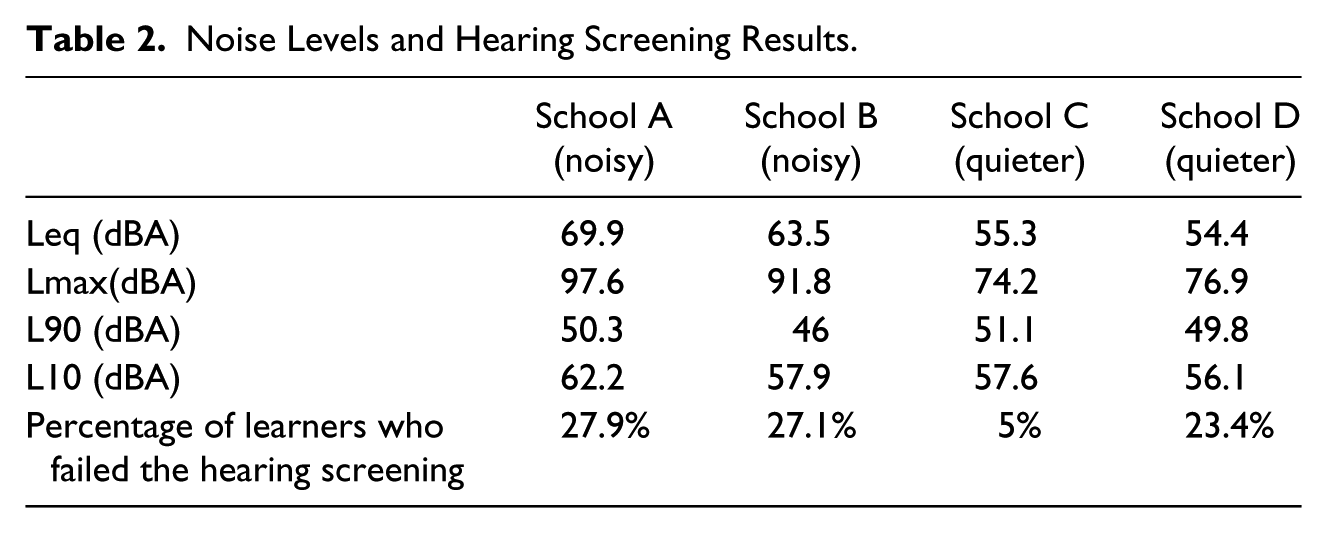
The average sound levels (LEQ), maximum sound levels, as well as the noise levels on the tenth (L10) and ninetieth (L90) percentile were recorded throughout the days of testing (see Table 2). Hearing screening was included in this study in order to eliminate any interfering variables such as hearing loss. As this study did not aim to describe the nature of the hearing loss, simply a pass/fail score was provided for the hearing screening. The noisy schools had a higher percentage of children who failed the hearing screening (see Table 2).
Noise Levels and Hearing Screening Results.
For the auditory discrimination, auditory number memory, and auditory sentence memory tests, a p-value of .05 was utilized, and thus the null hypothesis of no association between the two variables was rejected when the calculated chi-squared value was greater than the critical chi-squared value of 3.84 for p = .05 and one degree of freedom.
These results for the auditory discrimination tests indicated that the overall relationship between the auditory discrimination test and noise levels was not significant. However, there was a higher percentage of Grade 6 learners in the quieter schools (38%) who scored 12 years or greater than compared with the Grade 6 learners in the noisy schools (11%). The association with this test was moderately strong (Cramer’s V = 0.30). The corresponding test for Grade 7 did not show a significant relationship (see Table 3).
Summary of the Chi-Squared Tests, Fisher’s Exact Test, and Cramer’s V Tests Conducted for the Auditory Discrimination, Auditory Number Memory, and Auditory Sentence Memory Subtests.
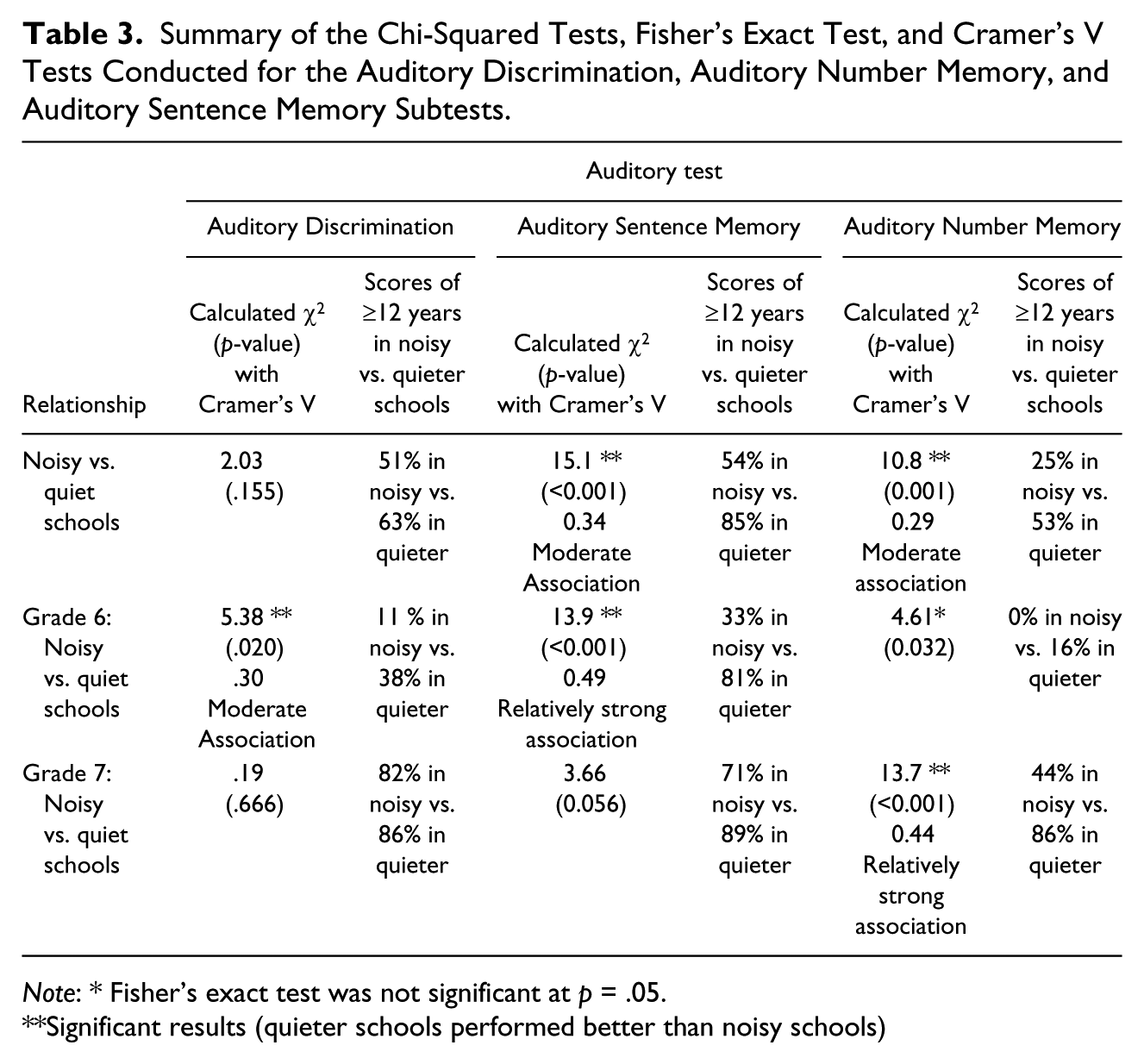
Note: * Fisher’s exact test was not significant at p = .05.
Significant results (quieter schools performed better than noisy schools)
The overall results of the auditory number memory test for learners in the noisy versus quiet schools was significant (53% vs. 25%). The association was moderately strong (Cramer’s V = 0.29). When comparing the Grade 7 learners in the noisy versus quiet schools, the learners in the quieter schools (86%) had a higher percentage who scored 12 years or greater than the learners in the noisy schools (44%). The association was relatively strong (Cramer’s V = 0.44). The corresponding test for Grade 6 learners did not show a significant association (very low percentage who scored 12 years and greater for both the noisy and quieter schools) (see Table 3).
The relationship between the sentence memory test and noise levels was significant (85% of learners scored 12 years or greater in the quieter schools vs. 54% in the noisy schools). The association was moderately strong (Cramer’s V = 0.34). For Grade 6 learners, the quieter schools had a higher percentage of learners (81%) who scored 12 years or greater than the noisy schools (33%). The association here was relatively strong (Cramer’s V = 0.49). The corresponding test for Grade 7 did not show a significant relationship (see Table 3).
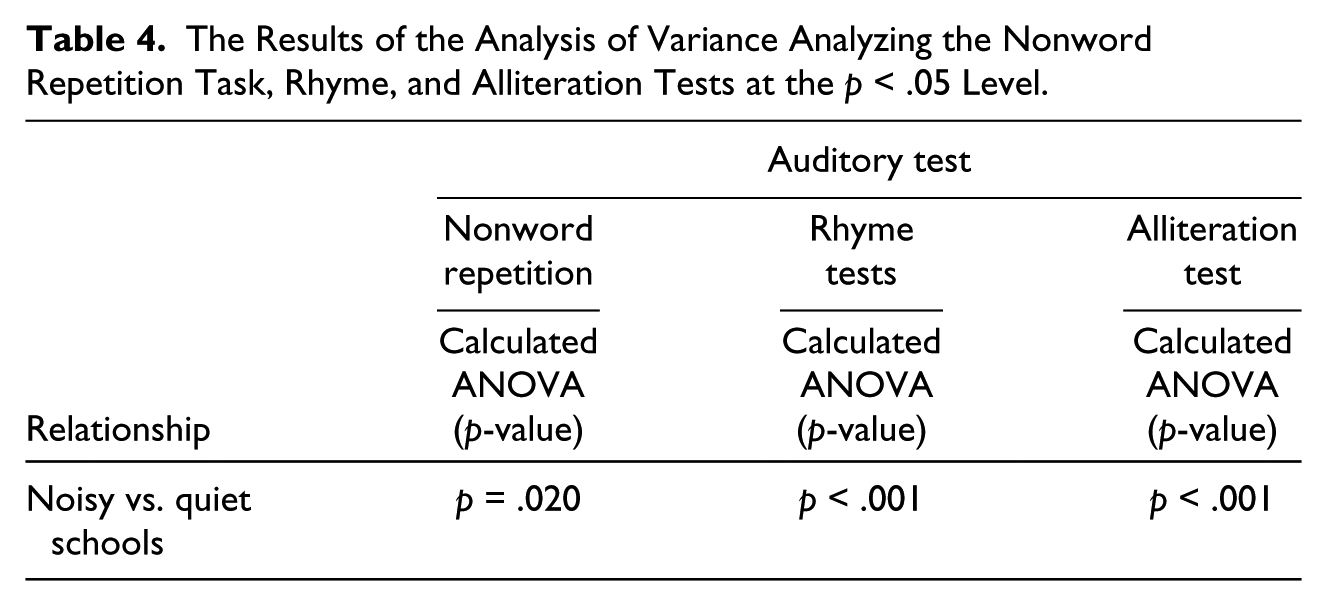
There was a significant effect of noise level on the test scores for the Nonword repetition, Alliteration, and Rhyme tasks. With the Nonword repetition task, the effect of noise level was significant [F(1, 121) = 4.8, p = .031] as well as for the Alliteration task [F(1, 121) = 276.1, p < .001]. There was also a significant effect of noise level on the Rhyme test scores at the p < .05 level [F(1, 121) = 201.6, p < .001] (see Table 4).
The Results of the Analysis of Variance Analyzing the Nonword Repetition Task, Rhyme, and Alliteration Tests at the p < .05 Level.
Discussion
From these results, it appears as though children who attend schools near to airports, which may be particularly common in urban areas, perform more poorly on auditory language processing measures which suggests that they may have some auditory language processing difficulties which, although not the focus of this study, may have secondary effects on other areas such as learning, literacy, and numeracy.
The reduced scores in the rhyme and alliteration tasks may suggest that the learners in this study may have a reduced sensitivity to phonemic awareness, and which, according to Lonigan, Burgess, and Anthony (2000) may have long-term effects on literacy development. Similarly, the decreased performance in areas such as auditory memory, number memory, and sentence memory scores may suggest that learners are not sufficiently able to retain and manipulate linguistic information when it is presented in the auditory modality (Lee, Ng, Ng, & Lim, 2004). This difficulty to retain information may pose problems with auditory sequencing of linguistic information in classroom settings, especially in noisy settings since the reduced scores were observed in children who attended schools near to a noisy airport. Again, although this study looked at the component auditory language processing skills of children and not directly at their academic performance, the findings may suggest that the reduced auditory language processing abilities may place children who attend schools near to airports at risk for ALPDs and possibly academic difficulties. It therefore appears that learning which takes place in noisy environments, such as near an airport, may hinder the development of ALP skills. These results could suggest the need to motivate and advocate for the provision of speech-language therapy and audiology services within mainstream schools, especially those schools exposed to high noise levels, such as, near airports. However, ioHot is essential for both the speech-language therapists and audiologists to work together to provide quality services (Richburg & Knickelbein, 2011). This study has highlighted areas of ALP which may need the particular attention by speech-language therapists and audiologists in noisy settings. This role of these speech-language therapists and audiologists would therefore include the responsibility to alert and inform the educators about ALPDs and the effects of noise, as well as assist in the remediation of children with already existing APLDs, in addition to the promotion of methods to improve the signal to noise ratio (SNR) within the classroom and thus assisting in the prevention of further APLDs. Educators need to be informed about environmental modifications and classroom based strategies for children with ALPDs, which can include more visual cues in conjunction with the auditory instruction, preferential seating, multimodality cues, repetition and rephrasing of information as well as preteaching the new information and the new vocabulary. Remediation techniques by the speech-language therapist can include auditory closure activities, phoneme training and prosody training as well as compensatory strategies such as chunking, verbal rehearsal and paraphrasing (Bellis, 2003).
Also, as mentioned, the results of this study call for ways to improve the SNR within classrooms thereby reducing the possibility of developing APLDs in very noisy settings. Salathiel, Steele, and Edwards (2010) stated that good acoustics are important for learning and therefore, the improvement of the SNR could help maintain children’s attention, and therefore decrease the possibility of an ALPD, as the learners could expend less energy on blocking out other distractions. In South Africa, a country where there are low levels of reading and numeracy (Taylor, Muller, Vinjevold, & Longman, 2003), the addition of noise to an already compromised learning environment may contribute towards ALPDs and possibly, subsequently, to reading and numeracy difficulties. Therefore, due to the possible increased prevalence of ALPDs resulting from noise, learners may need to be encouraged to use visual and auditory input to maximize auditory language processing (Chermak & Musiek, 1992). These strategies, although beneficial for children with ALPDs, are useful for all children, especially if the auditory environment is compromised such as in noisy, built-up areas. Cost effective sound dampening could include limiting mechanical noise, such as clocks, computers and fluorescent lights that are constantly plugged into the electricity source. Floors with hard surfaces can be covered with carpets, rugs, or any other type of padding to help absorb the noise. These changes are also applicable in schools with limited financial resources. Windows can be covered with blinds, shades, or posters, and walls can be covered with cork bulletin boards, egg cartons, carpet squares or any other soft surfaces to absorb the unwanted sound. Some sort of lining, such as rubber, should be placed at the bottom of the door to minimize outside noise. The placement of rubber tips at the bottom of desks in an uncarpeted classroom can prevent the unwanted sounds when desks shift (Hamaguchi et al., 2002). However, in schools which are more financially advantage, a frequency modulated (FM) or on infrared system can be extremely beneficial. Infrared systems are often the chosen option for a group of learners in a classroom since it transmits sound in the form of invisible infrared light waves and is reported to be immune to electromagnetic interference (Brace, 2006). However, the more common FM system can be very useful as it assists in projecting the teacher’s voice to a level which is comfortable for students and it improves the SNR in the range of +5 to +10 decibels by producing a nearly uniform loudness level in the classroom that is unaffected by the teacher’s location. It also reduces the effects of reverberation and distance from the teacher so that those students in the back of the classroom can hear, and it facilitates acoustic access to information for all students in the classroom (Hamaguchi et al., 2002).
Conclusion
This study suggests that children who attend schools exposed to high levels of noise, even though they may not overtly present as children with scholastic difficulties, may have ALPDs. The findings suggest that there are differences in the ALP abilities of children who attend schools closer to airports and those who attend schools further from airports. There are implications for educational and clinical practice which suggest that noise exposure may, in addition to the recognized cognitive and health consequences, have subtle, yet important ALP effects which may have an effect on school children’s learning. Also, it would suggest that speech-language-hearing therapy services, teacher training and sound treatment may be necessary in schools to address the impact of noise on ALP.
Footnotes
Declaration of Conflicting Interests
The authors declared no potential conflicts of interest with respect to the research, authorship, and/or publication of this article.
Funding
The authors disclosed receipt of the following financial support for the research, authorship, and/or publication of this article: Some funding towards the data collection phase of this research project was received through a larger grant received for a PhD study in the Department of Psychology at the University of the Witwatersrand from the South African National Research Fund.