







Abstract
Using 8,265 positive behavior cards and 544 conduct reports for 244 students, regressions of how race and gender influence the allocation of punishments or rewards for students at a New England elementary school with an Effective Behavioral Support (EBS) program were examined. Girls were most likely to receive a positive behavior card for respectful actions and white students were most likely to receive a positive card for safe behavior. Boys and Black students were more likely to receive a conduct report for “bad” behavior than girls and white students. Implications regarding race and gender bias in behavior-based programs are discussed.
Public schools in the United States are envisioned as spaces to cultivate a critical dialogue for learning (Dewey, 1916). Yet, as a social institution, schools also have a hidden curriculum that implicitly teaches students which social groups are valued, whose cultural practices are acceptable in the classroom, and how to be a “good” student (Giroux & Penna, 1979; Langhout & Mitchell, 2008). The hidden curriculum is often transmitted through reward and discipline systems, where “good” behavior is rewarded and “bad” conduct is resolved via disciplinary actions. These systems tend to rest on beliefs about what constitutes good versus bad action that unintentionally result in students from subordinated social groups (e.g., students of Color 1 ) being disciplined more often than their peers (e.g., white students, girls; Arcia, 2007; Fenning & Rose, 2007; Ferguson, 2001; Hale, 2001; Langhout & Mitchell, 2008; McFadden, 1992; Morrison & Skiba, 2001; Raby, 2012; Skiba et al., 2004). For example, in their analysis of the structural roots underlying student disengagement, Langhout and Mitchell (2008) found that rewards and discipline were inequitably distributed on the basis of both race and gender, with white girls receiving the most rewards and Black boys receiving more frequent discipline. The authors attribute the discrepancy to the system’s privileging of the cultural capital of white middle-class students, especially girls, whose behavior most closely emulates the norms, values, and beliefs conveyed through the hidden curriculum. As a result, males and students of Color—particularly Black males—learned implicitly that school was not a place for them and subsequently became academically disengaged.
This study belongs to a large body of existing literature demonstrating that the inequitable outcomes of many disciplinary programs likely signal institutionalized racism and gender bias in perceptions of and responses to children’s (mis)behavior. Researchers argue that the inequitable outcomes of these disciplinary programs signal institutionalized racism and gender bias in perceptions of, and responses to, children’s (mis)behavior (e.g., Arcia, 2007; Delpit, 1996; Fenning & Rose, 2007; Ferguson, 2001; Hale, 2001; Langhout & Mitchell, 2008; McFadden, 1992; Morrison & Skiba, 2001; Raby, 2012; Skiba et al., 2004).
Within the last decade, many U.S. schools have integrated Effective Behavioral Support (EBS) programs into their curricula to promote prosocial behavior with the intention of creating a new learning environment for students. Given the popularity of these programs, it is important to assess whether EBS has moved beyond the problems associated with more traditional paradigms, in terms of race and gender bias. This article examines whether there is an association between punishment and reward cards and the race or gender of the students within one school’s EBS program.
Discipline and Rewards in U.S. Schools
Historically, public education in U.S. schools was conceptualized as an environment to develop “democratic citizens of the future” (Dewey, 1916; Giroux, 2005). Yet, some argue that behavioral management has become paramount in schools (Giroux, 2005; Giroux & McLaren, 1989; Wexler, 1989) and that effective discipline is seen as a prerequisite for learning (Ferguson, 2001). When behavioral management is overlaid with the cultural mismatch often found between teachers and students in schools that serve low-income students of Color (Delpit, 1996), what often results are school rules designed to shape each student to adhere to dominant cultural norms regarding personal conduct, individual responsibility, safety, and respect (Apple, 1996; Delpit, 1988). In the case of schools, dominant culture refers to the process in which social groups with greater access to structural forms of power (i.e., white, upper-middle class) have used their cultural practices to define what it means to be a participant within that cultural space (i.e., what it means to be American or to be a good student; Apple, 1996). One outcome of this student–teacher cultural mismatch is that students of Color are most often disciplined and more severely punished for not following rules, which indicates institutionalized racial bias (Apple, 1996; Arcia, 2007; Bear, 1998; Cornbleth & Korth, 1980; Fenning & Rose, 2007; Hale, 2001; McFadden, 1992; Morris, 2005; Pane, Rocco, Miller, & Salmon, 2013). As such, these systems function within a form of hierarchy where dominant groups receive more power than subordinate groups (Bonilla-Silva, 1996). In the case of schools, dominant cultural norms are an example of how this bias manifests within the institutional structure.
In their overview of how to reduce problem behaviors in schools, Lewis, Sugai, and Colvin (1998) suggest that school-based discipline and reward systems are needed to reduce “challenging behavior” from “at-risk” students (p. 448). “Challenging behavior” and identifying “at-risk” students are often socially constructed categories that are defined by those in power (i.e., school administration) and, at times, target particular behaviors of certain social groups (i.e., boys). Clearly, some behaviors will be considered bad by almost all (e.g., bringing a weapon to school, starting a fight), but there are many other behaviors that are less clear-cut (e.g., being respectful). The problems, therefore, become individualized and solutions are aimed at specific students, not the social climate of the school (Ryan, 1972). Addressing disciplinary problems through this model typically utilizes a deficit approach when considering students who bring different cultural values, norms, and skills into the classroom. Often, the focus is on individual change rather than changing the school climate to meet the needs of all students, including students of Color. Race, however, is not the only social identity subject to bias.
In terms of gender, historically boys tend to receive more disciplinary referrals in school than girls, indicating institutional gender bias (Connell, 1993; Langhout & Mitchell, 2008; Noguera, 2003). Boys tend to be socialized into traditionally masculine roles and behaviors through their family and the media. For example, from an early age, boys are taught that being “a boy” means being physically strong (e.g., aggressive), independent (e.g., acting alone or making one’s own decisions), and outspoken (e.g., voicing one’s opinions; Connell, 1993; Noguera, 2003). Although these behaviors are rewarded within society, they are not often rewarded in schools. To be aggressive, independent, and outspoken can be interpreted by teachers as being hostile, unable to follow directions, and disrespectful (Bear, 1998; Connell, 1993; Cornbleth & Korth, 1980; Hale, 2001; McFadden, 1992; Noguera, 2003; Pane et al., 2013; Thorne, 1993). Girls, who are socialized into traditionally subordinate social roles and norms that include being dependent (e.g., asking for directions), quiet (e.g., waiting to be called on in class), and polite (e.g., taking a passive role in play activities), are often rewarded for their behavior, unlike their male peers (Thorne, 1993). Moreover, teachers often attribute these feminine behaviors as equating to girls being more intellectually engaged and eager to learn, whereas their male peers are often viewed as less “book smart” and not as motivated. Gender conformity for boys not only contributes to the perception of behavior as “bad” but also often affects how teachers perceive students’ academic aptitude and educational futures. Similar to students of Color who are often disciplined for not adhering to the cultural norms of schools in the United States, so too are boys, whose gender socialization places them in opposition to the values that are rewarded in the classroom. One outcome of this gender bias is more school disciplinary referrals for boys.
Codes of conduct are even more complicated when placed in urban schools. According to Noguera (1996), schools are social institutions deeply integrated within the environment where the school resides. Urban environments influence the social context of the school; these structural factors often position students as responsible for their behavior when such behavior is largely shaped by contextual factors beyond their control (Noguera, 2003, 2012). In urban communities, African American and Latino males are often viewed negatively (e.g., violent, gang members, unruly), which can affect how they are disciplined at school (Ladson-Billings, 2011; Noguera, 1996). Often, they are considered the “root of the problem,” not because of who they are as individuals but because of who they are as a social group (Ladson-Billings, 2011). Subsequently, these schools typically adopt programs to promote academic success and a positive campus climate that counter gender roles that urban students may adopt for survival outside of the school environment (Foster, 2004; Foster, Lewis, & Onafowora, 2005). With respect to academics, Noguera (2003) noted that African American and Latino males are unfairly victimized by labeling and tracking programs in schools, largely based on their positionality within the larger urban environment. Considering social climate, urban schools often adopt behavioral programs that increase control over students via monitoring, supervising, and regulating student behavior (Ladson-Billings, 2011). For urban students, disciplinary programs disproportionately control the behavior of African American and Latino males (Ladson-Billings, 2011; Noguera, 2003).
Within the disciplinary system of the school, race and gender intersect to form differential constructions of good and bad students. Ann Arnett Ferguson’s (2001) ethnographic study of disciplinary practices in an urban elementary school explored the manner in which the racialization of gender produced a system that systematically designated Black males as troublesome. The school’s code of conduct focused on individual responsibility and operated under the assumption that school rules were race-, class-, and gender-neutral. Ignoring how perceptions of disrespect, defiance, and misbehavior are filtered through an interpretive lens of mostly white, middle-class positionalities, teachers often regarded the misbehavior of Black male students as the result of personal choice. Whereas white male children were afforded dispensations for acting as “ordinary” male children, Black boys found themselves excluded from the naiveté typically attributed to children, and their misbehavior was seen as intentional, vicious, and threatening to the student body. Ferguson (2001) demonstrates how mainstream images and popular representations of Black men as criminals distort how teachers interpret and respond to their transgressions. Black male children are “adultified” in schools and subjected to more frequent and often harsher disciplinary practices.
EBS
In an effort to eliminate “problem” behaviors in the classroom, most public schools in the United States have utilized an individualized and anecdotal approach to discipline; these approaches often fail to eradicate such behavior. According to the theory of EBS, these disciplinary approaches fail because they do not provide students with examples of positive behavior or ways to change current negative actions. In addition, many schools do not have a systemwide behavioral program, where rules and consequences are consistent from location to location. Instead, most behavioral programs discipline negative behavior through the use of traditional punishments such as detention, loss of recess privileges, or parent–teacher conferences. Furthermore, consequences may vary from classroom to classroom and are not directly related to the behavioral infraction (Lewis et al., 1998). These inconsistencies can lead to bias in who is disciplined and how. The failure of these programs is likely to go unnoticed and unchallenged because there is no empirical assessment to examine the outcomes of the approach. Within the last decade, however, a new approach to reducing problem behaviors in schools has been utilized and adapted to meet the disciplinary needs of public schools throughout the nation and across grade levels. This program is called EBS.
Definition and Intentions
EBS is defined as a proactive schoolwide disciplinary approach comprised of a “broad range of systemic and individualized strategies for achieving important social and learning outcomes while preventing problem behaviors in all students” (Sugai et al., 2000, p. 133). Also referred to as Positive Behavioral Support, EBS is a systemwide approach used to decrease “challenging” behaviors in schools that are often exacerbated by current disciplinary programs (Lewis et al., 1998). EBS programs were first developed to “improve and extend comprehensive interventions for individuals with severe problem behavior and developmental disabilities” (Sugai & Horner, 2002, p. 130). As a component of the 1997 amendments to the Individuals With Disabilities Education Act (IDEA), EBS was designed to develop appropriate positive behavioral interventions for children whose behaviors violate school norms (Sugai et al., 2000). As part of IDEA, schools were asked to play an active role in creating sustainable and effective behavioral interventions to support students with externalizing problem behaviors (e.g., aggression; Sugai et al., 2000). In essence, EBS allows school staff to define problematic behaviors and develop schoolwide prosocial solutions to foster a “safer” learning environment for all students (Lewis et al., 1998).
EBS and Schoolwide Implementation
After its initial implementation in schools, EBS shifted to meet the needs of all students, regardless of previous behavioral factors. The intention of those implementing the program changed from focusing solely on students with externalizing behaviors to all students who exhibit behaviors identified as unfit or inappropriate for the school environment (Sugai & Horner, 2002). Moreover, as a systemic solution, EBS is now more commonly used in schools to combat all forms of what has been referred to as student maladjustment when other systems (e.g., daily monitoring, counseling, feedback, and guidance) have been deemed ineffective in promoting change (Lewis & Sugai, 1999). As a schoolwide approach, EBS is thought to dampen the role that schools can play in the development of “antisocial” or “problematic” behaviors in students based on ineffective instruction, lack of student support, and unclear rules or expectations (Sprague et al., 2001). Unlike more traditional punishment-based interventions, the role of EBS within schools is to alter the environment and to provide students with alternatives to their behavior in the hopes of eliminating unwanted acts. For these reasons, the architects of EBS herald the program as a fairer system because the program targets behavior and reinforces positive actions so that the student will not repeat negative behaviors (Lewis et al., 1998). Also, the rules of the school are made visible to all students, moving the hidden curriculum into the formally taught curriculum. Moreover, this program creates consistency within the school, as all teachers and staff members employ the same system of rewards and punishments, and posters are used to promote the program throughout the campus. Essentially, at the schoolwide level, EBS intends to provide students with prosocial skills (e.g., problem solving, empathy) via the behavioral changes that are often not met by completely individualized intervention strategies (e.g., programs for “at-risk” students; Sprague et al., 2001).
Integrated in Grades kindergarten through 12, a schoolwide approach to EBS is comprised of six essential elements. The first element is a statement of purpose, which, in addition to academic and behavioral outcomes, provides the school with a “mission statement” that serves as the foundation for their particular approach to teaching and learning (Lewis & Sugai, 1999). Once a statement of purpose has been established, the second element is for schools to design a specific set of rules and expectations for student behavior and conduct that address the current “problematic” behaviors (Lewis & Sugai, 1999). For EBS to be effective, all students must be taught what is meant by “problematic” and “appropriate” behaviors through the use of telling students the school’s behavioral expectations, showing them what this looks like, and practicing these behaviors (Lewis & Sugai, 1999). The third element consists of students recreating replacement behaviors through the use of incentives (e.g., coupons to be used in the school store, raffle prizes, etc.), which promote prosocial skills and provide positive feedback from school officials (Lewis & Sugai, 1999).
The schools that implement the EBS program also develop a uniform set of procedures or guidelines for discouraging “problematic” behaviors as the fourth element. Schoolwide procedures make explicit to the student what the “problematic” behaviors are through the use of examples. In addition, specific consequences are attached to such behaviors (Lewis & Sugai, 1999). Last, a new set of procedures are developed and implemented to record the rewards and punishments received by the students (Lewis & Sugai, 1999). This documentation is essential in providing the school with feedback regarding the effectiveness of EBS and addressing other “problematic” behaviors that are not accounted for in the current statement of purpose. Moreover, this last element is critical because it provides empirical feedback to the teachers and staff, allowing an assessment of the effect of current rules and procedures on negative behaviors; adjustments are made accordingly, thus empirically grounding the intervention.
Strength of EBS
Initial findings of EBS suggest that these programs promote prosocial behavior and help alleviate “problematic” behaviors in schools (Fitzsimmons, 1998). Similar arguments have also been made in favor of EBS programs as a way to ameliorate “negative” actions. In an assessment of a middle school EBS program, March and Horner (2002) found that 24 students who had displayed initial signs of “problematic” behaviors showed significant improvement in academic and social performance (e.g., social skills, prosocial behavior) through their participation in the program. In a similar study, the behavioral support programs at 72 public schools in Iowa were assessed; participation in these programs—over a 3-year period—resulted in an overall decrease of “problematic” behavior (Mass-Galloway, Panyan, Smith, & Wessendorf, 2008). Likewise, in a case study of a kindergarten through fifth-grade public school in central Kentucky, there was an overall decrease in student referrals and suspensions through the school’s implementation of a behavioral support program (Scott, 2001). Combined, these analyses highlight the overall strengths of EBS in alleviating “problematic” behavior in schools.
Defining “problematic” behavior students
Current literature assessing the effectiveness of EBS school programs addresses positive outcomes but neglects to acknowledge which students are penalized for “problematic” behavior. It is essential to address this issue because the modes of learning and behaving that constitute and distinguish the “ideal” student from the “bad” or “problematic” student are embedded in the cultural hegemony of the dominant culture (Bourdieu & Passeron, 1977; Koth, Bradshaw, & Leaf, 2008; Nelson, Benner, Reid, Epstein, & Currin, 2002). Continuing to disproportionately penalize the behavior of students of Color, particularly African American males, reproduces the existing norm in schools and indicates that institutional structures have not been sufficiently altered. Thus, without knowing who is being rewarded and punished, it is impossible to know if EBS carries the vestiges of racial and gender bias found in its predecessors. Indeed, in his overview of behavior-based programs, Lewis (1997) argued that these programs must address racial and cultural differences when defining “problematic” behavior and when addressing the programs’ overall “effectiveness,” yet there are few studies that assess these features within the intervention literature (see Nelson et al., 2002, for an exception).
Method
Study Context
This research took place at an urban elementary school in the southern New England region of the United States. We label the school as urban because it is located in an area with a dense housing population. In addition, the school is in a city that many in this New England state would label as urban, partially due to the racial and social class composition of this city (where “urban” is a code word for Black and/or brown and poor). The city suffers from housing segregation, and this school is located in what has historically been the African American and low-income part of town. Increasingly, Latina/os live in this area too. Moreover, the school is in a neighborhood that many label as violent and drug ridden, which are social problems often considered more common in urban communities (Noguera, 1996). Also, most of the teachers do not live in the surrounding community, which is another hallmark of urban schools (Noguera, 1996). This oldest school in the district, frequently in disrepair and the only public school still open on the “west side,” has been threatened with closure by local school administrative bodies because the racial composition of the students often nears noncompliance with desegregation laws. To date, parents have conceptualized the proposed closure as racist and have organized to keep this neighborhood school open.
Two years before this study, the school advisory committee had asked the second author of this article to conduct a school climate survey because teachers, parents, and students had identified student–teacher, parent–teacher, and student–student relationships as strained. They felt that a school climate survey would help pinpoint issues that could be addressed by the school community. Over the summer, the principal quit and an interim principal came out of retirement to oversee the school for one semester.
The year prior to the current study, a new principal had been hired midyear and she had used EBS at her previous school. Given her positive experiences with EBS and the results showing a tense school climate, the principal moved to bring EBS to the school. She implemented parts of EBS immediately. In the intervening months, several teachers and the second author attended district trainings to learn about EBS. Over the summer, the remaining staff received a shorter training, given by the principal. The next academic year, the entire school community implemented EBS; this first full year of implementation is the year that this study took place. EBS implementation included a schoolwide code of conduct, the schoolwide use of positive behavior cards and conduct reports, classroom instruction regarding the code of conduct, prosocial behavior lessons taught in all classrooms, signs posted in all school locations regarding expected behavior, a code of conduct sent home and returned signed by a parent or guardian, monthly and semiannual feedback to teachers (described in the “procedures” section), and finally, bimonthly town hall meetings, led by fifth graders, where there were short performances about prosocial behavior and classroom raffle drawings, based on positive behavior cards. Winners were able to choose from rewards predetermined by a group of school staff (e.g., assisting a teacher in putting up an art display, receiving extra time at recess, having lunch with the principal). Based on the second author’s training in EBS and time spent at the school, the literature’s examination of school practices, and regular conversations with the principal, it seems that EBS was fully implemented at this school.
Participants
Two hundred forty-four students were enrolled at the school the year of this study. With respect to demographics, approximately 75% of the students were eligible for free or reduced price lunches. The student body was racially diverse (1% Asian American, 19% Latino/Hispanic, 40% African American/Black, and 40% white); yet, the staff was comprised of predominately white women and two African American female teachers (U.S. Department of Education, 2013). Although we do not have the age range of the students, they were likely 4 to 12 years old, as this is consistent with the age range for children in Grades K through 5.
Measures
Positive behavior cards
Students could be given a positive behavior card by a staff member (e.g., teacher, recess aide) when that school official perceived the student as behaving in a way that was consistent with the school’s code of conduct. Therefore, students could receive cards from any teacher, the office secretary, the school nurse, or any other adult in the school. The behavior card had a place for the student’s name, grade, classroom, and listed the five areas that constituted the general code of conduct (i.e., respect, fairness, self-responsibility, understanding, and safety). The staff member could check anywhere from one to all five conduct areas on the card. Overall, 8,869 cards were filled out over the course of the academic year, resulting in 8,265 usable data cards. Moreover, 78% (n = 6,785) of the cards were given by teachers, with the remaining 22% (n = 1,840) given by nonteachers (e.g., school nurse, custodian, paraprofessional, librarian). Cards that could not be used either did not have student names (making it impossible to determine the race and gender of who received the cards) or were cards given to staff by other staff members, likely as jokes or to show support. The range for cards given, including all staff and teachers, was from 1 to 962. The teacher range was from 188 to 962. Of these usable cards, safety had been checked 437 times, fairness 297 times, respect 1,723 times, understanding 824 times, and responsibility 5,455 times.
Conduct reports
Students were given conduct reports when a staff member perceived that a student’s behavior was inconsistent with the code of conduct. These forms included a place for the student’s name, grade level, the time and place of the infraction, a place to circle the level of the infraction (ranging from 1 = least severe and low frequency, such as a first offense for chewing gum to 4 2 = most severe and/or high frequency, such as bringing a weapon to school or a low-level behavior with multiple prior infractions, such as repeatedly chewing gum), check boxes for the conduct area infraction (anywhere from one to five boxes could be checked), check boxes for the consequence (i.e., a verbal warning, parent contact/conference, loss of recess, loss of privileges, behavior contract, conference with the student, time out, after-school detention, restitution, community service, and in-school or out-of-school suspension), a comment section where staff wrote the nature of the infraction, a place for the teacher signature, and finally, a place for the parent/guardian signature. Like the positive behavior cards, any school staff member could give a conduct report to a student. Multiple consequences could be given for a single conduct report, but the consequences were constrained by a list of possibilities based on the level of the infraction. This list was determined by the principal and a subset of teachers (i.e., the EBS committee). There were 544 conduct reports given, all of which yielded usable data. Recalling that multiple boxes could be checked, 227 were checked for safety, 45 for fairness, 363 for respect, 69 for understanding, and 260 for responsibility. The range of cards per month was from 30 in April to 94 in October (only 3 of these were given on Halloween day).
Race and gender
Race and gender information was provided by the school and therefore consisted of the “official” race and gender of each student. Based on these data, the school appears to conceptualize Latino as a race rather than an ethnicity. We have elected to be consistent with their social construction.
Procedure
Because of the sheer amount of data generated by the positive behavior cards, it was not possible to provide detailed classroom data for each teacher regularly. Instead, totals were given to the school every 2 weeks, broken down by type of conduct rewarded. These numbers were read to the entire student body and staff at biweekly town hall meetings. The reporting of these numbers allowed the entire school community to assess which areas students were being rewarded for and which conduct areas received few rewards.
Each month, the research team gave all classroom teachers a tally of conduct reports for students in their classroom. This report consisted of a grid of the five conduct themes (rows) and a count of how many students in that teacher’s class were given a conduct report over the course of the month, by staff members (columns). This report enabled the teacher to assess who was giving their students conduct reports, as well as problem areas that could be addressed in the classroom, usually through further instruction.
Twice during the school year, a more comprehensive technical report was given to school staff. The report included an examination of the EBS data from a schoolwide perspective. Both positive behavior cards and conduct reports were included in the analysis. The first report included data collected in the first school semester, and the second report included data collected over the entire school year.
Results
Data Analytic Strategy
Looking at differences in outcomes by racial and/or gender groups is a common way to assess bias in the social science literature (e.g., Connolly, 2006; Reid, 1997; Wilkinson & Pickett, 2007; Williams, 2012). Therefore, regressions were conducted separately for the positive behavior cards and the conduct reports, assessing whether race and/or gender could predict several outcomes (e.g., number of cards obtained, level of punishment). Data were aggregated over each individual student such that cards and reports were collapsed into counts, or sums, followed or not by conduct area (e.g., respect, fairness, self-responsibility). In addition, conduct reports were summed for type of punishment. Level of punishment, however, was the average or mean of the conduct reports for each individual student. Students who had not received any positive behavior cards or conduct reports were added into the data set and given zeros for all variables except race and gender. Any student could receive multiple cards; hence, our rationale for aggregating cards over individual students. Moreover, any student could receive cards from any classroom teacher or school staff (e.g., the school social worker). Given that students could, and did, receive cards from multiple personnel, we did not perform hierarchical data analyses because these data do not meet the assumption of hierarchical linear modeling (HLM), which requires perfectly nested data (Osborne, 2000); indeed, these are multiple membership data and therefore multilevel modeling is inappropriate (Chung & Beretvas, 2012; Rabash, Browne, Steele, & Prosser, 2005). Instead, in both sets of analyses, we examined whether race and gender were significantly related to conduct area via regressions. For disciplinary cards, we also assessed whether there was an association between race, gender, and type of punishment, as well as level of punishment. Some distributions did not meet the assumptions for linear analyses, so nonparametric regressions were employed depending on the data distributions. In all cases, there were no significant interactions between race and gender; therefore, all results reported below do not include the interaction terms. Race was dummy coded into two variables: Black and Latino. Regrettably, the three Asian American students who attended the school were excluded from the analysis because the sample size was too small for regressions. Positive cards are discussed first, followed by conduct reports.
Positive Cards
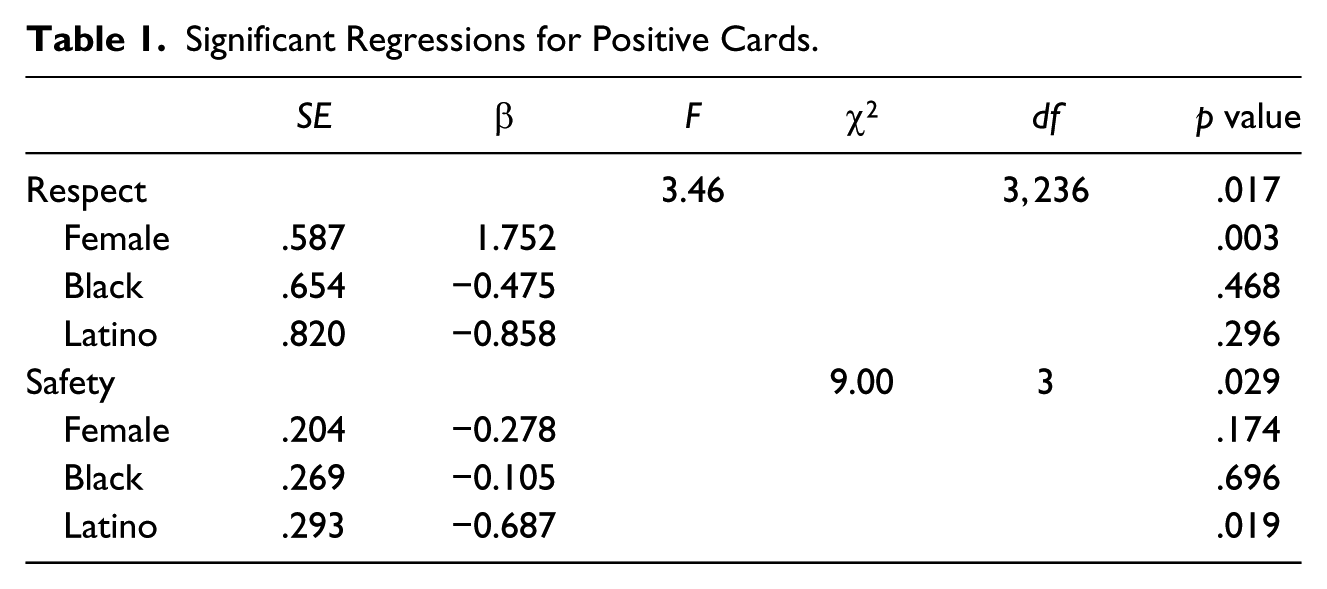
We hypothesized that white students and girls would be more likely to receive positive cards. We theorized this relation because of the dearth of research examining race and gender for EBS. The apparent invisibility of these analyses led us to suspect that the patterns would be similar to what has been reported with traditional behavior programs where the research reports are copious (e.g., Hale, 2001; McFadden, 1992; Thorne, 1993). First, we regressed the number of cards received onto our race and gender variables; the results were not significant, linear regression F(3, 236) = 1.49, p = ns. We attempted to assess the results by also controlling for grade level for each student, but the data did not meet the assumption of equal covariate means (i.e., number of cards grouped by grade level), which is needed for such an analysis (Howell, 2010). Indeed, an ANOVA indicated there were differences in number of reports based on grade level, Welch’s F(5, 104.26) = 15.35, p < .001; briefly, first- and fifth-grade students tended to receive more cards than students at other grade levels. When examining individual conduct areas separately, self-responsibility, linear regression F(3, 236) = 1.06; understanding, linear regression F(3, 236) = 0.46); and fairness, ordinal regression χ2(3) = 0.79, Cauchit link, were not significant. The regression examining respect was significant, linear regression F(3, 236) = 3.46, p < .025; adjusted R2 = .03, such that girls were more likely to receive a positive card for respect compared with boys. Also, the ordinal regression (Cauchit link) examining safety was significant, χ2(3) = 9.00, p < .05; Nagelkerke pseudo R2 = .04. In this case, white students were more likely than Latino and Black students to receive a positive card for safety. See Table 1 for a listing of weights for the significant regressions. Again, we were unable to control for grade level, as the data did not meet the assumption of equal covariate means for any of the five conduct areas. We recognize that some researchers report covariance analyses even when the homogeneity of regression assumption is not met. For this reason, we ran the covariance analyses, and there were no substantive differences with what is reported above. 3
Significant Regressions for Positive Cards.
Disciplinary Referrals
Consistent with our prediction for positive behavior cards, we hypothesized that students of Color and boys would be more likely to receive conduct reports. We anticipated this result based on the literature examining traditional disciplinary programs (e.g., Apple, 1996; Bear, 1998; Connell, 1993; Cornbleth & Korth, 1980; Ferguson, 2001; Hale, 2001; Langhout & Mitchell, 2008; McFadden, 1992; Raby, 2012). Before proceeding, we examined the data descriptively. The highest percentage of cards (34.6%) were given in the classrooms. The next most frequent locations were recess (11.6%), the art room (7.5%), hallways (7.4%), and the cafeteria (5%). All other locations received fewer than 5% of the cards. Next, we inspected frequencies of the summed variables, and no sums approximated normal distributions. In fact, all were skewed, with the majority of students receiving either no conduct reports or one report; this distribution is appropriate given the theory of EBS. That is, many students should receive no conduct reports, and the majority of those receiving reports should receive very few. EBS also theorizes that a subset of students (approximately 5%-15%) will need additional interventions, as referrals and positive cards will be inadequate for facilitating positive behavior (Lewis et al., 1998). For this reason, we elected to exclude all students from the analysis who had received more than 15 conduct reports over the course of the academic year (20 students, or 8% of the student body, in total). We chose 16 conduct reports as a cutoff point because the frequencies of reports for each number above this point tapered off such that only 1 or 2 students received reports for each count, versus 3 to 12 for earlier counts (e.g., 1 student received 16 reports and 2 students received 17 reports, but 12 students received 3 reports and 5 received 14). With respect to the demographics of the holdout students, 10 were Black, 5 were Latina/o, and 5 were white. Seventeen were male and 3 were female. One was in kindergarten, 2 in first grade, 4 in second grade, five in third grade, 2 in fourth grade, and 6 in fifth grade.
We examined who was more likely to be in the holdout group, hypothesizing that male students of Color would be more likely to have received more referrals and thus be excluded from further analysis. This prediction was also based within the literature dealing with traditional disciplinary programs (e.g., Apple, 1996; Bear, 1998; Connell, 1993; Cornbleth & Korth, 1980; Ferguson, 2001; Hale, 2001; Langhout & Mitchell, 2008; Raby, 2012). Our results confirmed this hypothesis, with Black boys being more likely to have received more than 15 referrals compared with all other groups (Fischer’s Exact test, p = .027). Based on this analysis, holding out students with more conduct reports should result in a more conservative analysis, and one that is likely to favor the chances of EBS not reproducing the historical dynamics found within traditional disciplinary programs, where boys and students of Color are more likely to receive disciplinary attention.
Based on the conduct report distribution (with many students receiving 0 or 1 report(s)), data were collapsed into a binary form, with 0 indicating the student did not receive a report (or no report for a specific rule violation), and 1 indicating a report had been received (for a specific rule violation). For all disciplinary data except level of punishment, which was a mean score, logistic regressions were examined. For level of punishment, we conducted a linear regression.
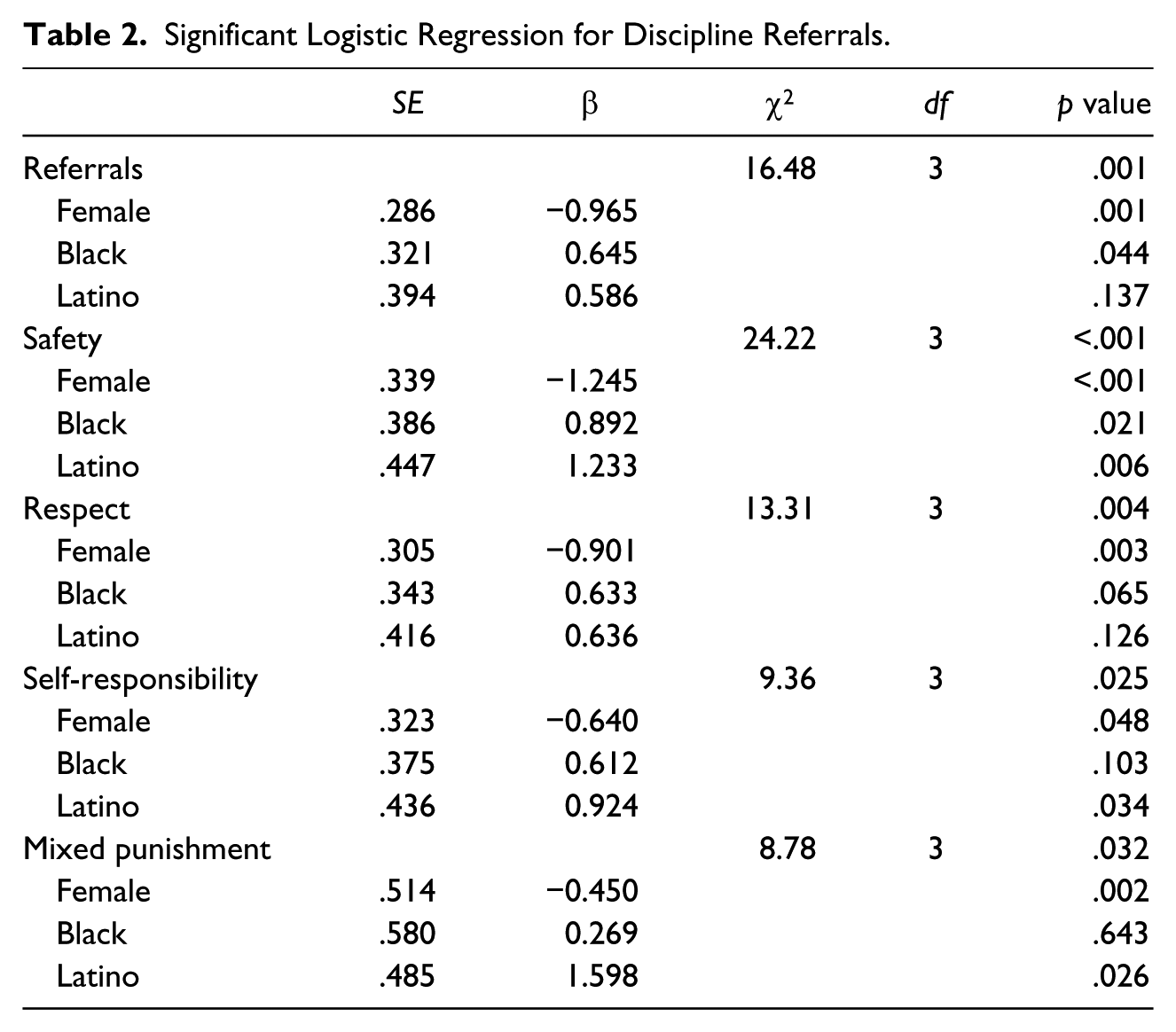
We first examined who was likely to receive a conduct report, regardless of type, and then analyzed specific types of reports. With respect to simply receiving a referral, there was a significant effect, χ2(3) = 16.48, p = .001; Nagelkerke pseudo R2 = .10, such that boys and Black students were more likely to receive a report than girls and white students (respectively). As with positive conduct cards, there were also differences in who received a disciplinary referral or not, based on grade level, Welch’s F(5, 94.89) = 3.13, p = .012, with fewer kindergarten students receiving referrals (26%) compared with third graders (58%). For this reason, a covariance analysis was not appropriate. When considering the code of conduct, fairness regressed onto gender and race was not significant, binary logistic regression χ2(3) = 4.27, p = ns. All other regressions were significant. Being a boy, Black, or Latino was associated with receiving a safety conduct report, binary logistic regression χ2(3) = 24.22, p < .001; Nagelkerke Pseudo R2 = .15. When examining respect, being a boy was associated with receiving a report, binary logistic regression χ2(3) = 13.31, p = .004; Nagelkerke Pseudo R2 = .08. Finally, being Latino or a boy was associated with receiving a report for self-responsibility, binary logistic regression χ2(3) = 9.36, p = .025; Nagelkerke Pseudo R2 = .06. Similar to the positive cards, we could not control for grade level because there were not equal covariate means for the five referral areas. Yet, we ran the covariance analyses, and there were no substantive differences in results.
Next, we examined punishments. According to EBS, punishments should be restorative because the student should learn why that action (e.g., writing on school walls) was not appropriate and what the appropriate action would be (e.g., having the student clean the wall to prevent future writing on school buildings; Lewis & Sugai, 1999; Sugai et al., 2000). For these analyses, we included only students who had received a punishment. Regarding type, we grouped punishments into either restorative (e.g., restitution, community service), traditional (e.g., loss of recess, time out), or mixed (i.e., a combination of restorative and traditional punishments). Results were not significant, multinomial regression χ2(6) = 4.10, p = ns. At this school, few students received restorative punishments; assuming that all students would receive a traditional punishment would correctly classify a majority of the students. Traditional punishments were not associated with race or gender, binary logistic regression χ2(3) = 0.15, p = ns, but being a boy and Latino was associated with receiving a mixed punishment, binary logistic regression χ2(3) = 8.78, p = .032; Nagelkerke Pseudo R2 = .13. There was a trend toward significance for restorative punishments being predicted from race and gender, binary logistic regression χ2(3) = 6.97, p = .07. The final regression was linear and examined level of punishment; there was no significant association, F(3, 86) = 0.91, p = ns. See Table 2 for a listing of weights for the significant regressions. Again, there were no substantive changes when adding in the covariate of grade level, except for restorative punishments, binary logistic regression χ2(4) = 13.49, p = .01, where grade level predicted restorative punishment, with students in more advanced grades being more likely to receive a restorative punishment; there was also a trend where being Black was slightly predictive of not receiving a restorative punishment. These results should be interpreted with extreme caution given the assumptions of covariance analyses have been violated. For this reason, the results do not appear in Table 2.
Significant Logistic Regression for Discipline Referrals.
Discussion
The results of the current study are somewhat mixed, and we draw different conclusions based on data from the “good” and “bad” behavior cards. EBS purports to be a fairer system because it targets behaviors instead of students (Lewis et al., 1998), and it is the case that most positive behavior measures did not show gender and race bias. Specifically, there was no racial or gender bias in positive cards overall, which was likely due to the fact that there were no differences within positive cards by gender or race for self-responsibility, understanding, or fairness. In general, most students seem to benefit from the positive behavior cards at this school. We mark this as clear progress in the pernicious problem of gender and racial bias in school disciplinary systems.
However, the “bad” behavior card data are mostly consistent with the extant literature on traditional discipline paradigms (Apple, 1996; Connell, 1993; Cornbleth & Korth, 1980; Ferguson, 2001; Hale, 2001; McFadden, 1992; Pane et al., 2013; Raby, 2012; Skiba et al., 2004; Thorne, 1993), thus confirming our hypotheses about who generally suffers from the EBS program at this school: boys and Black and Latino students. Specifically, boys and Black students were more likely to simply receive a conduct report, and Black boys were the most likely to receive 15 or more conduct reports. Moreover, boys were more likely to receive a conduct report for safety, respect, and self-responsibility than were girls. In addition, being Black and/or Latino was associated with receiving a bad conduct card for safety or self-responsibility. It may be that safety, respect, and self-responsibility were significant (compared with understanding and fairness) because the latter three had higher frequencies, thus increasing the power of the analyses. In addition, these findings are corroborated by Ferguson’s (2001) ethnographic study of an elementary school discipline system. The teachers and adults in her study tended to perceive the misbehavior (ranging from style of clothing to choice of language) of Black male students as threatening and dangerous to others, and the result of individual choice. The misbehavior of white male students, however, was more often interpreted as the natural disobedience of developing male children. It is possible that boys may have enacted more behaviors that appeared to be in violation of safety rules and school norms, but it is also probable that these discrepancies call attention to the hidden curriculum in schools (Giroux & Penna, 1979). The current study’s results around discipline conduct cards may in fact indicate an unknown problem in the design and/or the implementation of the program that would have serious implications for the fairness and therefore the effectiveness of EBS.
EBS is purported to be an improvement to typical reward and discipline structures in schools, which is intended to increase the chance for all students to be successful by changing the system itself (Horner, Sugai, Todd, & Lewis-Palmer, 1999-2000; Lewis et al., 1998). It accomplishes this through consistent positive reinforcement of predefined behaviors for the students who need it most, paired with minimal discipline strategies when necessary. EBS requires clearly defined expectations and consequences, and calls for the replacement of many traditional forms of discipline with more restorative forms when applicable. Created for students who struggle to conform to the dominant norms for “appropriate” behavior in schools, EBS should benefit all students, thus improving the learning environment for everyone. Yet the results of the current study reflect a slightly different story.
Taking to heart Lewis’ (1997) acknowledgment of the need to consider racial and cultural differences when defining problem behavior and when assessing the effectiveness of EBS programs, this study found that with respect to “good” behavior, three of the five categories showed no gender or racial bias, which is an improvement given the extant literature. Yet, the very students who have traditionally been penalized through the structure of schools’ behavior norms for defining “bad” kids (i.e., boys and students of Color) continue to be the groups identified under the EBS “bad” cards. Therefore, it follows that an implication of this study is that “problematic” behavior may continue to be at least partly defined in congruence with dominant culture values. Although EBS aims to change behaviors and not individuals, systematically identifying the behavior of particular groups of students (i.e., students of Color, male) as in need of remediation normalizes their overrepresentation in discipline tracks. The repercussions of such systematized, if unintentional, labeling is severe. Research indicates that access to resources and educational opportunities (e.g., honors classes) is often granted to students based not only on formal indicators of achievement but also on the more subjective assessment of their behavior, demeanor, and perceived potential (Ferguson, 2001; Gilmore, 1985; Morrison & Skiba, 2001). In addition, the findings from this study suggest that there is some evidence for “racialized social structures” (Bonilla-Silva, 1996) in schools based on card allocation. Moreover, programs like EBS can further emphasize the “structure of power” within schools where dominant cultural values are reflected more often in school rules, potentially creating disparities in who is rewarded and who is punished (Bondy, Ross, Gallingane, & Hambacher, 2007; Delpit, 1988). To address this problem, it may be important to include students and their families in determining what constitutes a disciplinary infraction. This process would be consistent with Luis Moll’s (1997) recommendation that teachers serve as ethnographers to close the cultural gap between home and school. Similarly, this suggestion is consistent with Sarason’s (1995) advice that students spend the first week of the school year debating and constructing the code of conduct. This practice would enable the entire school community to think deeply and critically about how appropriate behavior is constructed in communities, which may begin to decrease cultural misunderstanding and instances of racial and gender bias. Moreover, this type of process would be a first step in bridging the school and community, which, some argue, is a necessary component of school reform (Delpit, 1996; Noguera, 1996).
On a related note, because the results of this study were somewhat predictable in terms of conforming to stereotypes about gender and racial norms of “bad” behavior, it implies that the EBS program as it currently stands within this school serves at least partly to reinforce dominant discourses rather than challenge them. A consequence is that the program is not as successful as it potentially could be and, ironically, behavior that confirms behavioral expectations is perpetuated and reinforced through punishment. This finding may also attest to the fact that although policy can easily change, it can be difficult to implement in ways consistent with its theoretical underpinnings. That said, it is important to note that EBS appeared to be carefully and fully implemented at this school.
It is important to highlight the limitations of this study. One limitation is that findings are based on data utilized from a single school during the first year of implementing this program and may not be generalizable to other schools implementing similar programs. Prior research on EBS has noted that the success of these programs relies on faculty and staff involvement in addition to consistent, systematic use of rewards and punishments (Sugai & Horner, 2008). In their assessment of EBS, Lewis et al. (1998) noted that these programs are often bounded by context, specifically, the students who are present. For EBS programs to remain successful, they must incorporate an evaluation component where the school uses the findings to improve upon what is “bad” behavior and the appropriate rewards and punishments for such actions (Lewis et al., 1998). It is possible that these findings might be different if we were examining the program during its fifth year, yet these results do highlight the potential issues that can arise for particular students involved in EBS programs. Yet, it is also the case that the school was receiving feedback monthly and was given a technical report midway through the academic year. School personnel were open with the university research team in saying that without this pro bono support, they would not know how to analyze their data. Therefore, although the program may have been evaluated differently in Year 5, it is also quite plausible that the attention given to the results in Year 1 assisted the school in reaching implementation faster than they otherwise would have. Moreover, as this study examines conduct reports, we have yet to examine what role (if any) teacher bias might play in the effectiveness of EBS. Perhaps teachers are more cognizant of more overt behavioral problems (i.e., pushing on the playground), whereas more covert issues such as gossiping or teasing might go unnoticed. These discrepancies may explain why gender and race were significant factors in who was labeled a “bad” kid; further research is needed on how teachers interpret what it means to receive a conduct report and how they identify misconduct at school. Third, this study examines the relationship among discipline, race, and gender. Future research should address whether a student’s socioeconomic status might also be related to classroom conduct.
We hope that in providing demographic information about who attends this school and who teaches here, results may be applicable to other schools also utilizing this particular program. We also hope that these findings will prompt further assessment and critical analysis of both the effectiveness and fairness of EBS programs and other behavior-based school programs. It should be noted that to our knowledge, this is the first study of its kind that utilizes a large data set based on both positive cards and behavior referrals.
As research suggests, some groups of students benefit from an unfair system of privilege and power. If we are concerned with implementing fair and effective interventions that amplify the success of all students, then we have to attend to whether and how these interventions are playing out for groups who are historically subjugated in schools. This study begins to answer the first part of this question, indicating that although some progress appears to have been made, there is still some racial and gender bias present in the implementation of the EBS program at this school.
Footnotes
Acknowledgements
The authors would like to thank the faculty, staff, and students at the participating elementary school for their assistance with this research. They would also like to thank Rachael Robnett and two anonymous reviewers for their critical feedback on this article.
Declaration of Conflicting Interests
The author(s) declared no potential conflicts of interest with respect to the research, authorship, and/or publication of this article.
Funding
The author(s) received no financial support for the research, authorship, and/or publication of this article.