







Abstract
Educational disparities are deeply entrenched in U.S. society. Our research focused on a move toward equity and investment in one Midwestern charter school via the implementation of the African American Student Network. Participants were 15 male and 15 female students in Grades 9 to 12 who participated in the network for one semester. Qualitative analysis of focus group interviews revealed that students in the network experienced safety, support, empowerment, affirmation, and connectedness. Quantitative analysis revealed that pre- and post-test grade point averages (GPAs), disciplinary referrals, and attendance trended in promising directions although there were no statistically significant differences.
Keywords
Educational disparities are deeply entrenched in U.S. society, and the cost of these disparities over the course of history has been described as an educational debt. Based on racial stratification and inequity in access to resources, education, and opportunity, this debt has accrued over time and has never been seriously addressed (Ladson-Billings, 2006). The results are the gaps that continue to persist into the 21st century, particularly in education, wealth, and income, where Whites continue to be better-off when compared with other racial groups such as Native Americans, African Americans, and Latinos who have been historically, economically, and socio-politically disenfranchised in this country (Ladson-Billings, 2006). To address the deep and grievous inequities in education, investment is necessary. Milner (2013) alluded to equity in education as working to provide all students with what they need to succeed even if that means making adjustments to take into account race, culture, ethnicity, language, special needs, and so on. Our research focuses on a move toward equity and investment in one Midwestern charter school via the African American Student Network (or AFAM as the students call it). AFAM is a networking group designed to support and engage Black students in school. This intervention not only contributes to the conversation on psychology, health, and human development in terms of serving vulnerable children and youth in the urban context but also spans conversations regarding school policy, reform, resilience, and culturally responsive school practices (Milner & Lomotey, 2014).
Ladson-Billings (2006) reported in her Presidential address to the American Educational Research Association (AERA) that in the Southern United States, Black students did not receive universal secondary schooling until 1968—well into the latter half of the 20th century, and aptly asked her readers, “Why, then, would we not expect there to be an achievement gap?” (p. 5). Indeed, according to the most recent report from the National Center for Education Statistics (2015), only 40% of Black students who started at 4-year post-secondary institutions of education in 2006 graduated within 6 years compared with 63% of White students. Moreover, at the elementary and secondary school levels, White students continue to outperform Black students on standardized tests (Milner, 2013). As Lyndon B. Johnson reportedly averred in 1965 at Howard University, “You cannot take a man who has been in chains for 300 years, remove the chains, take him to the starting line and tell him to run the race, and think that you are being fair” (Miller, 2005). There must be investment to redress disenfranchisement.
Yet, inequity in educational practices persists today, most notably in disciplinary practices. In a comprehensive study of Texas middle school grades, Hilberth and Slate (2014) found that Black sixth, seventh, and eighth graders were 2 to 6 times more likely than their White counterparts to be disciplined with in school suspension, out of school suspension, or disciplinary alternative program placement. On average, approximately 35% of Black middle schoolers in the state received in school suspension, although they only made up 14% of the population. In contrast, White students made up 35% of the population (more than double the number of Blacks), but had an average in school suspension rate of only 16%—half that of their Black counterparts (Hilberth & Slate, 2014).
This inequity is especially stark with harsher punishments such as out of school suspension. Hilberth and Slate (2014) found that the percentage of Black students receiving out of school suspension was 4 to 6 times higher than their White counterparts, despite comprising a smaller part of the population. In addition, the authors found that Black students were much more likely to be censured or disciplined for “subjective” reasons such as disrespect, whereas Whites were more likely to be disciplined for “objective” behavioral reasons that clearly broke school rules, such as smoking (Hilberth & Slate, 2014).
Certainly, a case can be made that connects these inequitable and discriminatory practices to the persistent gaps and the educational debt that continues to accrue. In fact, Hilberth and Slate (2014) questioned how spending so much time out of the classroom might affect students’ test scores, further disenfranchise them from their education, and disconnect students from school. Caton (2012) explored these questions with high schoolers who had experienced zero tolerance policies in school, and found that the harsh disciplinary practices for Black males contributed to a hostile school environment, poor student–teacher relationships, and ultimately failure in school. Given that peer and teacher support are important components of affective engagement in school and that dropout has been described as the process of disengaging from school (Grier-Reed, Appleton, Rodriguez, Ganuza, & Reschly, 2012), the erosion of relationships and the divestment in students that seem to occur when they are put out of the classroom are no small matter.
To redress these inequities, counter spaces are needed. Solorzano, Ceja, and Yosso (2000) described counter spaces as spaces in which people of color are affirmed and validated rather than negated and stereotyped. Black students at all levels tend to experience hostile environments in educational settings. This includes inequitable treatment by school personnel, expectations of deviance, stereotyping, and assumptions of intellectual inferiority (Allen, 2012; Ancis, Sedlacek, & Mohr 2000). Difficulties related to acceptance or fitting in, cultural conflict, help-seeking, coping, lack of resources, mistrust of the institution, racism, social support, and stigma are also common (D’Augelli & Hershberger, 1993; Watkins, Green, Goodson, Guidry, & Stanley, 2007). These negative experiences can be taxing and lead to lower levels of energy, satisfaction, and academic success (D’Augelli & Hershberger, 1993). Counter spaces, on the contrary, represent an investment in students by providing support, cultural affirmation, and enfranchisement.
Counter spaces can be particularly useful in helping students cope with racial microaggressions or race-related stress. Racial microaggressions are the everyday forms of racism people of color encounter (Sue et al., 2007). These range from experiences of being invalidated to being insulted to even being assaulted (Sue et al., 2007). Grier-Reed (2010) articulated the need to create counter spaces that help students cope with racial microaggressions in educational settings.
Grier-Reed, Madyun, and Buckley (2008) described one such counterspace—the African American Student Network or AFAM—at a large Midwestern university. In this space, Black students reported experiencing safety, validation, resilience, empowerment, connectedness, intellectual stimulation, and a home base on campus (Grier-Reed et al., 2008). In short, students in the networking group seemed engaged and enfranchised with respect to their education, and Grier-Reed and Wilson (2015) found that these students seemed more socially connected at the university.
Grier-Reed, Ehlert, and Dade (2011) found that Black students who participated in the network showed higher retention and graduation rates than Black students on campus who were not part of the network. This is despite the fact that students in the African American Student Network (AFAM) did not outperform their African American counterparts on traditional indicators of college potential (i.e., ACT score, high school rank, and first-term grade point average). Reporting similar findings, Grier-Reed, Arcinue, and Inman (2015) described the African American Student Network (AFAM) as an intervention for social justice and educational investment.
In line with Milner’s (2013) notion of equity, the African American Student Network was designed to meet students where they are and to provide support in the educational setting. This includes providing a counter space in which students can cope with racial microaggressions or the everyday racism they experience and counter deficit notions of people of color (Grier-Reed, 2010). In addition to being connected with positive academic outcomes, the network has been found to be therapeutic and uplifting for Black college students (Grier-Reed 2013; Grier-Reed et al., 2015; Grier-Reed et al., 2011). Founded in 2005, the network remains relevant and seems to work because it counters other hostile invalidating spaces on campus.
In an attempt to better support and invest in African American high school students, a local charter school replicated the African American Student Network. To fit the high school population, the charter school developed four networking groups; boys were separated from girls, and ninth and 10th graders were separated from 11th and 12th graders. As with the university network, the high school networking groups met weekly for approximately 1 hr or one class period, and participation was voluntary.
To explore students’ experiences and outcomes in the high school African American Student Network(s), we conducted mixed-methods research. The study included a qualitative component to understand students’ experiences of the group in their own words and a quantitative analysis of academic variables (i.e., disciplinary referrals, attendance, and GPA). We conducted this research during the 2011-2012 academic year—the first year the school initiated the intervention.
Method
Participants
This study took place at a charter school located in an urban city in the Midwest. The charter school had an enrollment of 727 students in Grade K-12 during the 2011-2012 academic year. The racial demographics of the school consisted of 49% Asian/Pacific Islander, 20% African American, 19% Hispanic, 10% White, and 0.7 % American Indian students—although at the high school level, African Americans comprised only 14% of the student population (personal communication, K.P., February 23, 2011).
There were a total of 40 students who participated in the African American Student Network; 20 boys and 20 girls. Ten of the boys were in Grades 9 and 10, and the rest were in Grades 11 to 12. Likewise, 10 of the girls were in Grades 9 and 10, and the rest were in Grades 11 to 12. The four networking groups were segregated by grade and by gender. Participants self-selected into the African American Student Network either by invitation of the African American Family Liaison and/or by invitation of peers, friends, and so on. There was no compulsory component to participation; rather student participation in the group was primarily based on student interest (i.e., self-selection).
Intervention
The high school model separated students by gender and year in school. Weekly meetings began with introductions and check-ins in which students shared highlights and lowlights from the past week, and then the floor was open for general discussion. Meetings were facilitated by Black high school faculty and staff. Based in a person-centered, humanistic counseling approach, students brought in issues to share and discuss. Meetings occurred during the school day for a duration of approximately 45 min or one class period. Network meetings were limited to 10 students each, and students’ participation in the network was limited to one semester.
Procedures
Students who participated in the African American Student Network were not mandated to participate in our research on the pilot program. All network participants were invited to be part of the research, but participation in our study was voluntary. Because the students in this study were minors (under the age of 18), they were unable to provide informed consent. Instead, in accord with the policies of the Institutional Review Board (IRB), the consent process was twofold, where students provided written assent and their parents provided informed consent for participation in the research. The informed consent process allowed parents to opt their child out of the study. Of the 40 students who participated in the African American Student Network, 30 provided written assent and parental consent to participate in the research. Fifty percent of the research participants were male, and 50% were female. These participants were in Grades 9 to 12.
Our research was conducted with the approval of the appropriate IRB and participating charter school. The research included a mixed-methods design and focused only on students who participated in the pilot program; there was no comparison group. Specifically, we used focus groups combined with qualitative methods to analyze students’ experience of the African American Student Network, and we used quantitative methods to determine whether these students showed statistically significant differences in pre-/post-test academic outcomes. The research method also included observations.
The first author initially observed the African American Student Network to understand how the pilot program operated and to introduce our research to the participants. During the observations, students were given the parent/guardian letter with an informed consent form and a self-addressed stamped envelope; students were instructed to give these documents to their parent/guardian. Parents were instructed to sign and return the form to exclude their child from participating. Students were also given an assent form requesting their participation. Thirty research participants assented to participation, and their parents provided informed consent.
Focus groups were conducted with the participants during their regularly scheduled network meeting times. A total of four focus groups were conducted at the school: ninth- and 10th-grade boys, ninth- and 10th-grade girls, 11th- and 12th-grade boys, and 11th- and 12th-grade girls. Each focus group was video recorded and audio recorded with a digital voice recorder. The duration of the recorded focus groups was 30 min each. During the first 10 min of the focus groups, the first author reviewed the consent and assent forms, provided participants with an overview of the purpose of the study, and asked whether participants had any questions. Finally, she reviewed ground rules. The ground rules were as follows:
There are no right or wrong answers.
Share your point of view even if it’s different.
I am recording so I don’t miss any comments.
No names will be in any reports that I produce.
All comments are confidential.
Please follow up with what someone said with agree or disagree.
I’m here to listen and make sure everyone has a chance to share their opinion.
If you are talking a lot I may ask others to share and if you are not talking I may ask you for your opinion.
To get the conversation started, the first author asked students their names and to share what they wanted to be when they grew up to break the ice. After all the students answered, she asked the following questions over a 30-min period:
Tell me about your experience in the African American networking group?
What are the meetings like for you?
Describe some of the topics discussed at the meeting?
Describe your role in the African American networking group?
Describe interactions with the other members in the group?
Why do you continue to attend?
Do you think the African American networking group is important?
Walk me through a typical meeting.
What do you or don’t you like about the meetings?
Can you walk me through an example of when you all talked about something important to you?
Describe the changes you would like to see at the meetings?
To address pre-/post-academic outcomes for students in the African American Student Network (AFAM), we utilized school records that we obtained from school administrators. In line with a pre-/post-design, we collected data for the semester prior to students’ participation in the African American Student Network or AFAM, as well as at the end of the semester that students participated in the network. Although we were unable to obtain semester GPAs, we did obtain cumulative GPAs along with each student’s number of absences and disciplinary referrals. However, of the 30 students who consented to participate in our study, we were only able to obtain complete school records for 18 due to student mobility (i.e., changing schools).
Results
Qualitative Analysis
The qualitative analysis was guided by the Consensual Qualitative Research (CQR) method (Hill, Thompson, & Williams, 1997). In CQR, a team is used to come to consensus and auditors assist in providing feedback and auditing results. Data are coded into domains or topic areas and then into core ideas that capture what was said in each domain. A cross analysis is conducted that compares the domains and core ideas across the data. In 2005, the authors of CQR revised the method (Hill et al., 2005). The analysis used is based on the updated recommended approach, including a team of two researchers and two outside auditors (see Table 1). Results included five core ideas identified in students’ experience of the network. These core ideas were taken back to the students for testimonial validity; this included meeting with the students at the school to share the themes and receive feedback about whether these themes fit their experience. Students validated the five themes, providing feedback that the themes seemed to capture their experience of the group.
Application of Consensual Qualitative Research (CQR).
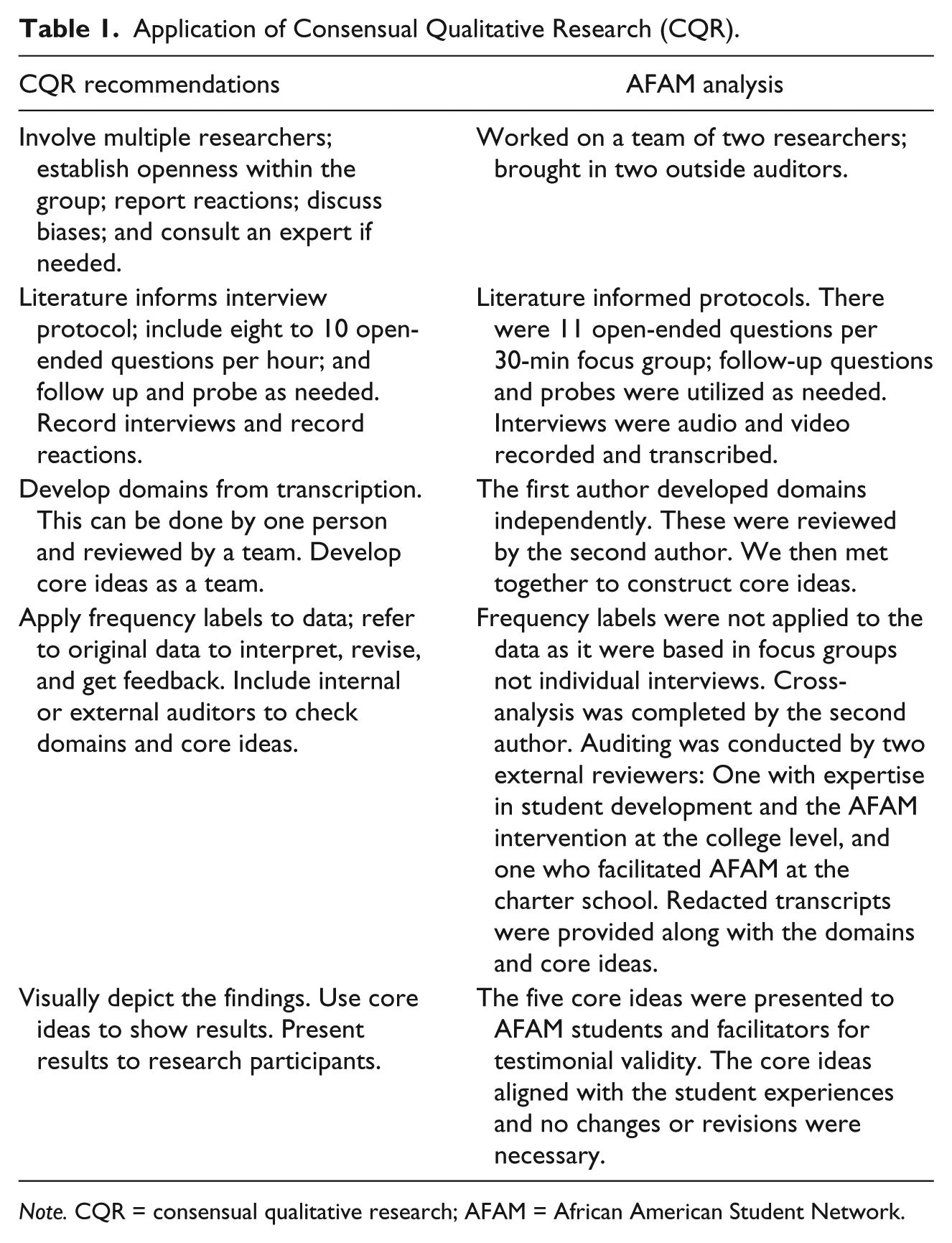
Note. CQR = consensual qualitative research; AFAM = African American Student Network.
Safety
Students described the meetings as providing them with a safe environment within the school. In the African American Student Network, students were able to share what was on their minds without scrutiny or judgment, and students valued the opportunity to open up, reflect, and hear different perspectives. The opportunity to come together in this way created a sense of belonging at school.
Quote 1: The group helped me talk about what I feel, talk about situations at school.
Quote 2: Basically, everything is good about the group. Honesty is out there, and that is all we put out in our group.
Quote 3: I like coming here with close friends talking about what we are going through.
Quote 4: I don’t normally talk to people in the hall ways. [I] was able to talk to people during group.
Quote 5: I continue to attend because like, I felt like I like belong in the group, and I felt that it was good that I was able to come here and speak my mind about certain things that were going on and all that and um yeah.
Quote 6: In the group, they expressed a lot and they allowed them to talk and say what they wanted to say in the group.
Quote 7: At the meetings, we sat in a circle in chairs. Everyone would sit in the circle, and they would just talk. Anyone could bring up a topic, and they would talk about the topic the whole time during the group.
Quote 8: It’s a good way for students to connect and talk about anything.
Quote 9: I like venting to my fellow people.
Quote 10: What I did like about the group is that I was able to say things on my mind that I would not be able to say in the public world.
Quote 11: If you were going through anything that week, it was a time that you could talk about it.
Quote 12: During group, I could express myself, and people could understand where I was coming from or why I felt that way.
Quote 13: Everyone gets to express themselves and to actually say how they really feel, instead of trying to front or hide it.
Quote 14: It’s important to me because I don’t get to talk about this on a daily basis, the topics that the group discusses.
Quote 15: It’s important to me because, it gives me time to express my thoughts.
Quote 16: We talk about whatever is on your minds to get stuff out.
Quote 17: We come here happy to talk.
Quote 18: I think this group is a good way for other students to connect because you don’t feel restricted. We are pretty open to what other people have to say about what they are going through in high school.
Quote 19: I know the people in here are not going to judge if you do something. They will say their opinion; it does not mean that you leave this room, and they will stop talking to you. Like they just let it go. We just accept each other how we are, and that is just how it is.
Apparent in this sense of safety are feelings of trust and belonging. Students in the network seemed to trust their peers and the facilitators (i.e., school officials). The importance of cultivating trust in schools among Black students cannot be overstated. In fact, developing and successfully implementing new interventions can be difficult, because as Ladson-Billings (2006) pointed out, the moral debt—the discrepancy between doing what we know is right—has eroded trust in schools and school systems for many Black children and their families. Yet, in the African American Student Network, Black adolescents found safety and were able to regain a sense of trust and a sense of belonging in school.
Support
Students also found psychosocial support through the network for managing difficult life circumstances. This included interpersonal and other problem-solving skills for managing challenging relationships, particularly with respect to other students and school faculty and administration. Indeed, the African American Student Network seemed to be a space where students could engage in meaningful dialogue, develop interpersonal skills, and resolve conflicts, and students valued the opportunity to receive guidance from facilitators and peers.
The alternative seemed to be that students were left on their own to resolve conflicts with limited opportunities to engage in meaningful dialogue. As one student reflected, “We have passing time, but we don’t have time in school to talk to each other.” As a result, fighting occurred. In contrast, the network seemed to help alleviate this tension by providing a much-needed space for dialogue, perspective, and problem solving. Given the high rates of suspension for African Americans with disciplinary infractions, having affirmative spaces that promote problem solving, conflict resolution, relationship building, and healthy coping strategies can have powerful implications for addressing disciplinary inequities.
Quote 1: This group is important to me because it helps me with certain situations, and it keeps me out of drama.
Quote 2: I laugh and it makes me feel happier when I am around people in this group. I feel that I can bond with people here instead of people out there because there is too much drama [out there].
Quote 3: Everyone in the group was cool. There was problems with one person, but the group brought people together. They were able to talk during group.
Quote 4: I think the group gave me other ways to deal with things.
Quote 5: Group was helpful because friends come to her [the facilitator] with problems. And, in the group, friends could talk about their problems, and she could try to help them out.
Quote 6: We talked about racism, bullying, leadership of students because of class level, and how that can be perceived as bullying.
Quote 7: The people in here . . . because they have good input on what we have to say when any of us have problems.
Quote 8: I think their main focus was to try and get African Americans and boys together to talk about problems that they face in school or on the streets.
Quote 9: We could address problems in the school in different ways, talk about them, or even address them with someone in the group, rather than address it outside of school like in the hallway or fight.
Quote 10: Every time you come you leave out with something more than what you came with.
Quote 11: People can bring home problems to the group, in a confidential space.
Quote 12: Every person gives their input on the situation. You can choose which one has the best advice, and you can choose to follow it or not.
Quote 13: Let it out, so that you won’t stress over it. If you need help on something, other people can tell their opinion and how to solve your problem.
Quote 14: Getting a better understanding of each other’s feeling and what somebody else is going through, it may be related in a way and just getting to know more about people’s life stories and learning from them.
Quote 15: Like we care about each other, we always hear from each other, and someone always has like advice, like girl problems, or girl issues, so it’s like good.
Quote 16: Teachers. Having problems with certain teachers—people give me feedback and it helps me.
Quote 17: When we talked about ways to cooperate with teachers, because sometimes teacher be getting on people nerves.
Quote 18: Like if we had a problem with our boyfriend or somebody we can get advice from each other and it’s helpful.
Quote 19: This group is important to me because sometimes teachers stress me out, and when I come here then the stress is gone.
Through psychosocial support, the network showed potential to engage students in school. Affective engagement in school has emerged as an important component of student engagement and is based primarily in peer and teacher support (Grier-Reed et al., 2012). Student quotes underscore the importance of this kind of emotional and relational support at school, where the curriculum moves beyond the basics of reading, writing, and arithmetic and into life skills and coping with everyday situations students face inside and outside of school. Because students had space to explore the difficulties they were facing with peers and facilitators, they identified more constructive ways to deal with problems and to de-stress. For example, students discussed getting perspective and advice on how to relate to teachers and peers more effectively as opposed to “blowing up” or fighting.
Empowerment
In contrast to other spaces at school, the African American Student Network was an empowering outlet where students felt heard. This included a sense of ownership with respect to their education and a sense of freedom to express conflicted ideas about school and authority figures. Interestingly, students did not feel comfortable criticizing the school or authority figures in other spaces. This finding aligns with research by Hilberth and Slate (2014) who noted that Black middle school students tended to be disciplined or suspended for subjective reasons such as disrespect. Students in our research not only shared this sentiment in the focus groups but also shared that in the African American Student Network, they were able to find a counter space—a space in which they could share thoughts and feelings that they might be punished for outside of group, including instances when they felt belittled, silenced, and/or invisible at the school.
Quote 1: I feel that I cannot talk to a White person how I would talk to a Black person. I feel like a Black to Black, we can touch base and they understand me. If I talk to a White person or someone else I feel they talk to me like I am stupid, and that is the thing I hate.
Quote 2: What I like was just like kind of being heard, like able to tell facilitators what we think so they could hear about it and help to try to change it or something. I mean you can’t change it all but um, but you can try to change it a little bit.
Quote 3: Um for me it was yeah like he had said being able to be heard, and being able to express my own voice because in other places I’m not usually heard. Like I’ll try to speak out, and I’ll usually will be the one that like would be ignored. My ideas won’t be able to get out, and um here I was able to say what I wanted and people understood what I was saying, so yeah.
Quote 4: Like we got to say things in the group that if we walked down the hallway and said them we would probably get expelled, probably.
Quote 5: We cannot express our own feelings or own opinions without a consequence about to happen.
Quote 6: We wouldn’t have been able to say in the hallway what we were saying in this group. We were able to talk like . . . cause I feel like if I hadn’t attended I would have gotten in a lot more trouble. Like I said the facilitator is like the Dean of students, and like I said so I was able to come here then speak those feelings about . . . and then she’ll listen to it. And, then she’ll call me in at different times, instead of me walking down the hallway yelling about what I feel, everyone heard it, and me getting into even more trouble.
Quote 7: We do not get to express ourselves like other cultures do, and if they are going to talk about education they should get together once a week to express themselves. Our voices are not heard like they should be.
Quote 8: You know what’s sad though? How can this school . . . can like, they talk about diversity, and we cannot even talk about Black history month, or Cinco de Mayo. We did have Black history month here, but what teacher talked about it? What teacher really told us about Black history month and showed us part of the Black history? Then Cinco de Mayo, they ain’t even refer to it. I’m part Mexican and so, they did not show no Black history. They did not say anything about it, like we even have a history class, and they ain’t even tell us nothing about it. The only Black history that I know that we’ve talked about in there was . . . Rodney King . . . and we didn’t even talk about that for more than 30 min. This school does not support, it really doesn’t.
Quote 9: We talked a lot about the Asians too. Because there is a lot of Asians in this school and they like, they do a lot of things that we don’t like. So we talked about on how to not turn our conflict into like a race war. We talked a lot about race. In school we talked a lot about not getting ourselves into a race war with the Asians. Mexicans they are cool, but we talked a lot about the Asian stuff cause me, myself had a lot of problems with them at the beginning of the year.
Quote 10: We talked about the school not supporting Blacks.
Quote 11: I never really fully could express myself with teachers.
Quote 12: I feel that the teachers do not see what we see, and that things are bigger than what they think.
Quote 13: Like also, like how they point us out in the middle of the class. And, like, um, we as students we find it, like, very disrespectful. When you be pointing us out, like when . . . cause, I mean, like I don’t know about others, but if I feel like I am getting attacked in the conversation, I am going to automatically attack back. I mean that’s kind of me. I mean I can stop it, but it’s kind of hard.
Quote 14: We help the facilitators see what they see every day as the students; teachers cannot see what’s going on with them as students. Example, if there was a problem between two people they “teachers” may see it as an argument, and they [students] see it as something is getting ready to happen that is much worse.
Quote 15: I like the facilitators. They really like, you know how teachers usually like lead the whole thing, all they did—the facilitators—was give us topics, and we got to basically, basically we got to, um, lead the whole discussion and we got to choose what to talk about. They would just give us topics to talk about and stuff.
Quote 16: We talked about the grades. We talked about the school. We did a lot of talking about the school. We talked about discipline. We did a lot, and we even gave opinions about different disciplinary plans—stuff like that.
The importance of “voice” cannot be overstated in education, and as pointed out by Storz (2008), Black students even at the middle school level tend to be acutely aware of inequities that exist in their schools. For students in the African American Student Network, there seemed to be space where students could give voice to these experiences and be heard instead of silenced. This included expressing criticism of practices in their school that they found inequitable, unfair, discriminatory, or oppressive. In short, the group seemed to empower students to speak their mind freely without fear of consequences such as suspension or expulsion for criticizing school authority, critiquing their education, and/or pointing out inequity and injustice.
Affirmation
The African American Student Network also gave students the opportunity to explore and affirm many facets of identity. This ranged from exploring their academic identity to their racial/cultural identity. In addition, students explored their dreams for the future.
Quote 1: We talked about grades and how we compared with other schools and other students of other races.
Quote 2: Like the grades situation, we talked about grades, talked about what everyone has problems in and where people need help and are failing . . . makes you see that no one is better than you, that you’re equal.
Quote 3: For me it was the same conversation when we talked about our future and all that. Because I like how they were talking about how we could get ready to prepare for it and everything. And, like do what we can to succeed to get to where we want to be and to go to the colleges that we want go to. Like, I’ve been trying to, um, like do everything like get my grades up and all that. And, like, uh, like last year [one college] had sent me a couple of letters and everything because I was excelling at a couple of things like math and all that. So I really like doing that it gives me the thought of that—being my own person, getting ready to go out into the real world, and just to be my own person.
Quote 4: We also talked about like what we wanted to do for college and like in the future, something like that. So we talked about what we wanted to be when we grow up, and what colleges we would like to go to, and whether you would want to stay here.
Quote 5: We talked about our future and college and how we would deal with this racial problem when we are not in school, when we don’t have anybody, like when we’re grown up to deal with our own decisions and deal with the consequences of our own decisions. I, like, there was a specific time period, a few weeks of us talking about getting older.
Identity development and transition are major components of adolescence, and in the African American Student Network, students found space, time, and guidance to affirm and explore their identities and their future. In a similar intervention with high school students, Otoya-Knapp (2004) pointed out how liberating and important having these kinds of spaces can be for students to imagine and create their identities outside of and/or in contrast to negative societal expectations or stereotypes. By affirming students’ various identities, the African American network seemed to counter deficit notions of people of color and/or a sense of inferiority. Instead, students could explore and find support for their dreams of the future, for example, going to college and see that they were not alone.
Connectedness
Finally, students described the African American Student Network as akin to a family group, and they wanted more spaces like this in school. In this space, students found connectedness and relief. The weekly meetings seemed to be a positive buffer to their daily school experiences.
Quote 1: It feels good.
Quote 2: It’s relief.
Quote 3: It’s a good way to express what you feel.
Quote 4: I look forward to coming to group on Thursdays because you talk about stuff you’re going through this week. You let people know. So I feel good coming here.
Quote 5: Family, I feel like I can say anything to any of these guys, like something about my girlfriend cause we have known each other for so long, we hang out outside of school if we have time, chill. We trust each other.
Quote 6: Cause I feel like, you know, in our group, you know, we have more people, but they are not here today. But, like in this school, it’s like some people look up to us in a way and like others like test us. So like, something that I experienced in this group, we here for each other. And, something I like is, you know, the scenario where you be like save your family. Even my friend I would do it for my friend because, you know that’s like a family to me . . .
Quote 7: I respect everyone here, like up there with my mother, not a lot of people get that, but you know with like what (named student) said, like it’s ride or die, pretty much. Like I’ve been there for (named student), times he has called me. Like that’s just how it is, and I know if I called him at like 2:00 in the morning, he will help in any way that he can.
Quote 8: Like family and problems, you can come in here and talk about anything, we family. Problems . . . whatever we feel is important to talk about.
Quote 9: Like this the only time to really talk about down to earth serious things outside of school, sometimes out of school or at lunch, but right here is like a family meeting. It’s pretty good. We talk about usual life things, drama, happy events, and troubles.
Quote 10: I don’t like when the time is over.
Quote 11: Instead of one semester, have it all year, that’s a change that I would like to see.
To summarize, students experienced cohesion and connectedness in the group which have long been considered protective factors in education, and they wanted more of it. Indeed, the experience of connectedness to school is counter to the disconnect students often experience in hostile educational environments that treat students inequitably. For these students, the African American Student Network seemed to make up for some of the disconnects, and the general sentiment was that they did not get enough of this space in school.
Quantitative Analysis
A MANOVA was included to investigate differences between pre- and post-level disciplinary referrals, absences, and cumulative GPA. Data were analyzed using Wilks’s Lambda statistic. Partial η2 calculations were used to determine effect sizes. The standard Type I error rate of α = .05 was used to test for significance in the MANOVA. Results revealed no significant difference between pre- and post-levels of disciplinary referral, attendance, or GPA, F(3, 15) = .857, p = .484, η2 = .146. See Table 2 for pre- and post-test mean differences. It is interesting to note that although there were no statistically significant differences, the data trended in expected directions. However, given the large standard deviations, these data must be interpreted with caution.
Summary of Means and Standard Deviations on Pre- and Post-Test Measures.
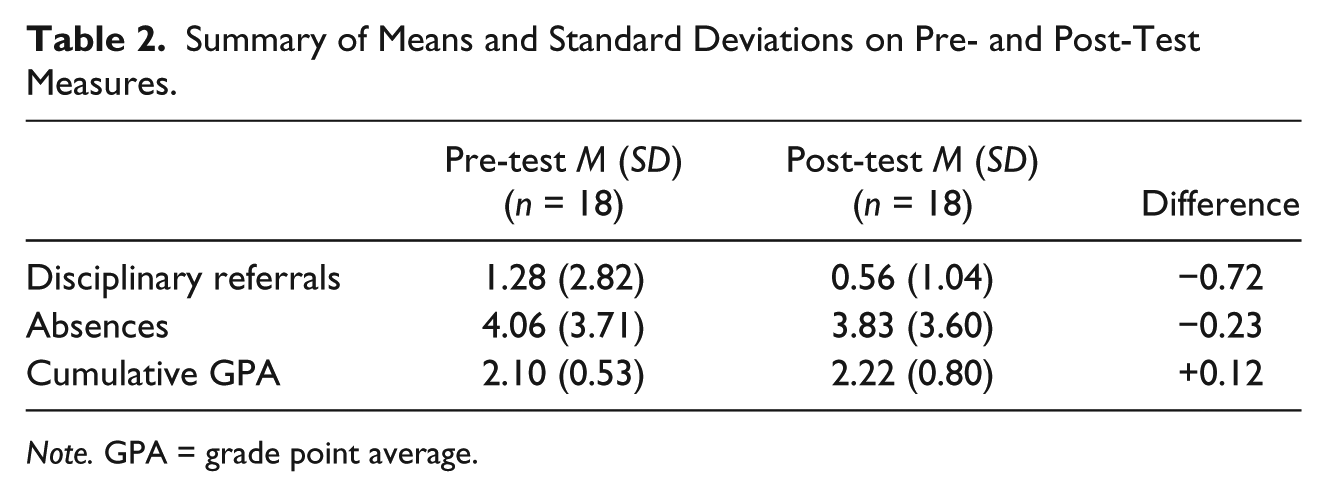
Note. GPA = grade point average.
Discussion
Although there were no statistically significant academic outcomes, the African American Student Network provided high school students with safety, support, empowerment, affirmation, and connectedness in school. In her discussion of the education debt, Ladson-Billings (2006) discussed a moral debt, and asked, “What is it that we might owe to citizens who historically have been excluded from social benefits and opportunities?” (p. 8). Certainly, a supportive safe environment in school is among the least of what is owed, and this is what students found in the African American Student Network. As with the university networking group which provided safety, connectedness, validation, empowerment, intellectual stimulation, resilience, and a home base (Grier-Reed et al., 2008), the high school network also seemed to invest in African American students in ways that helped them get through each week despite challenging circumstances.
Considering that Black students often experience hostile environments in educational contexts, the networking group operated as a much-needed counter space. Students in the network were affirmed and empowered rather than silenced and invalidated; this included affirming their academic and racial/cultural identities and their dreams for the future which might certainly help engage them in school and connect to academic outcomes. Although there were no statistically significant differences in pre- and post-test cumulative GPA, results did indicate slightly higher GPAs at post-test than at pre-test (see Table 2). Moreover, students in the network found support for working through problems, particularly relationship challenges in school, and although there was no statistically significant drop in disciplinary referrals, quantitative results did reveal a downward trend in this variable (see Table 2). Finally, students experienced a sense of connectedness at school which could have implications for attendance, and, interestingly, although there was no statistically significant increase in attendance, post-test means did show a downward trend in absences (see Table 2). Perhaps, if students had had the opportunity to participate in the network for more than one semester, these trends might develop into statistically significant differences.
Implications
These results have implications for implementing thoughtful ways to invest in African American students within our schools. The African American Student Network seems to be one way to provide students with some essential protective factors in education such as safety, connectedness, affirmation, support, and empowerment at school. This group met for 45 min once a week, and in one semester, students’ GPA, attendance, and disciplinary referrals all trended in promising directions. Given, the persistent inequities that exist in education, more such investments are needed, and the African American Student Network provides one practical step.
Interventions such as the African American Student Network may also have implications for reducing inequity in disciplinary practices. Inequity in harsh disciplinary practices such as suspension and expulsion for African Americans and other children of color has gained national attention. Providing a psychosocial space for students to cope with problems, relieve stress, and resolve conflicts was a major theme in students’ experience of support in the African American Student Network, and they noted that having this space helped to de-escalate conflict with other students and teachers.
As schools begin to re-examine disciplinary practices and policies, interventions such as the African American Student Network may provide useful alternatives for supporting students in addressing and preventing the escalation of conflicts. One way students used the network was to obtain advice, perspective, and feedback on handling difficult situations such as cooperating with teachers and/or resolving conflicts with other students. In addition, students used the network to critique their school and their education. In short, the network seemed to operate not only as a reservoir of information but also as a safe outlet for expressing critical concerns in a constructive manner without being sanctioned or disciplined for “disrespect.” This is important because as Hilberth and Slate (2014) pointed out, suspension for subjective reasons such as disrespect represents yet another inequity in disciplinary practices targeting Black students; furthermore, as Storz (2008) pointed out, Black students tend to be keenly aware of the inequities.
The African American Student Network may also have implications for helping students cope with racial microaggressions in school. During the focus group interviews, students shared many negative experiences at school ranging from a general sense that Black culture was not as valued as other cultures at their school to instances of feeling invalidated, invisible, inferior, or attacked in the classroom. These experiences span the range of microinsults, microassaults, and microinvalidations (Sue et al., 2007; Sue, Lin, Torino, Capodilupo, & Rivera, 2009). Yet the African American Student Network operated as an affirming intervention that countered racial microaggressions in school, where students reported feeling safe, heard, affirmed, connected, and empowered. Grier-Reed (2010) has discussed how the network may be useful for coping with racial microaggressions at the college level; the current study suggest that this may also be the case in high school.
Limitations
There are several limitations that should be considered when interpreting these findings. For example, this study only explored outcomes for high school students at one school. In addition, our treatment-only research design did not include a comparison group. Including additional schools and a comparison group could have strengthened the external and internal validity of the study by improving the generalizability of our results and providing a context for comparing outcomes across participants and non-participants in the African American Student Network. This is especially important given the selection bias inherent in our design, where students self-selected into the network and there was no random sample.
As it stands, it is unclear how similar or different the experiences of African American Student Network participants are from the more general population of African American students within the school. Attrition and a small sample size are also limitations of this study. Although 30 participants (50% male and 50% female) were included in focus group interviews, we were only able to obtain complete school records for 18; that is, a 40% attrition rate in our study. Incomplete school records were primarily a reflection of student mobility (moving from one school to another). In other words, because we did not have complete data, we had to exclude 12 of the 30 research participants from our quantitative analysis of academic outcomes. To be clear, although we did not consider those students high school “dropouts,” we were also unable to determine whether they progressed in a positive manner; we simply did not have enough data to include them in our analysis and draw conclusions.
In addition, student mobility made it difficult to obtain data such as semester GPAs which would have been more appropriate for measuring change as a result of our semester-long intervention. Because we were unable to obtain semester GPA data for so many students, we relied instead on cumulative GPAs, where detecting a difference after one semester is much more difficult. Finally, along those same lines, low power is a limitation of this study. Due to the high attrition and small sample size, the probability of a Type II error (failing to find a statistically significant difference although one exists) is a concern.
Conclusion
As a civic duty to provide equitable, accessible, and equal education, the United States has a responsibility to its citizens to invest in quality education that enables citizens to reach their full potential. Yet, in 2016, achieving equity is still more aspiration than reality. Educators and society at large must take seriously the education debt that continues to accrue, and any serious attempt to address educational disparities must revisit the following question: “What is it that we might owe to citizens who historically have been excluded from social benefits and opportunities?” (Ladson-Billings, 2006, p. 8). The African American Student Network represents one step in this direction by providing Black students in a Midwestern charter school with safety, support, empowerment, affirmation, and connectedness so that they may more fully engage in their education, and we argue that this network may be one step toward equity in education. Moreover, this research, these ideas, and such interventions need not only be applied to Black students with the help of African American Family Liaisons. It is our hope that this research, these ideas, and interventions like the African American Student Network contribute to advances in serving vulnerable children and youth across contexts, particularly with respect to promoting resilience and culturally responsive practices that make schools inclusive, welcoming environments for all.
Footnotes
Declaration of Conflicting Interests
The author(s) declared no potential conflicts of interest with respect to the research, authorship, and/or publication of this article.
Funding
The author(s) received no financial support for the research, authorship, and/or publication of this article.