






Abstract
This article explicates the structure, content, and pedagogy of an urban district’s professional development for literacy coaches. To analyze qualitative data on a district’s yearlong coach professional development, I utilize situated cognition theory. Observation and interview data reveal that the coach community of practice (CCOP) was a venue in which coaches engaged in a variety of learning activities regarding literacy instruction, coaching, and school reform. The content of CCOP addressed a band of literacy instruction (e.g., assessment and intervention programs) and coaching methods. The pedagogy of CCOP was loosely aligned with two dimensions of situated cognition: social interaction and authentic activity. There were limited opportunities to critically examine contextualized problems of practice regarding instruction, coaching, or the district context. Coaches rarely discussed their own work routines, teacher practice, or student learning. Although coaches received support around how to coach, this occurred in the absence of clarity around the substance of this coaching. Coaches reported benefiting from opportunities to interact professionally with other coaches from across the district. This article has implications for research on district capacity-building efforts, situated cognition, and the design and implementation of professional development for instructional leaders.
Researchers, educators, and advocates are concerned about glaring gaps in reading achievement in the United States. The 2015 National Assessment Educational Progress (NAEP) results pronounce that 18% of Black and 20% of Hispanic fourth-grade students reached proficiency in reading; this is substantially lower than the 46% of White fourth graders reaching proficiency on this test (Nation’s Report Card, 2015). And several urban districts, including Fresno and Detroit, had proficiency rates below 15% for their fourth graders on the NAEP reading assessment (Nation’s Report Card, 2015). Students of color from Los Angeles to Baltimore are disproportionately concentrated in urban schools nested within urban districts (Reardon & Yun, 2001; Saporito & Sohoni, 2007). Importantly, as Ostrander (2015) describes, “low income and inner city urban families are entrapped” (p. 271) in schools with oftentimes fewer resources and lower achievement (Anyon, 2001; Kozol, 2005; Lewis, 2016).
Attempting to reduce these inequities of opportunity and achievement, leaders of urban districts have embarked on efforts to transform the district itself (Honig, Copland, Rainey, Lorton, & Newton, 2010; Lee, 2002; Reardon & Galindo, 2009). With a specific focus on the core work of teaching and learning, leaders are reconfiguring their district’s bureaucratic structure (Honig, 2008, 2012). District improvement efforts include reframing the district as a learning organization, repositioning district and school administrators as learners, and retooling systems for professional learning (Honig et al., 2010; Mangin, 2009).
While reforming districts, these leaders face hurdles to improving teachers’ reading instruction and students’ reading achievement, including educator quality, resource limitations, and reform turbulence (Anyon, 2001; Balonon-Rosen, 2015; Boyd, Lankford, Loeb, & Wyckoff, 2003; Johnson, 2013; Kozol, 2005; Mintrop & Trujillo, 2007; Ostrander, 2015). To surmount these hurdles, many urban districts, including New York, Oakland, and Charlotte-Mecklenburg, have instituted coaching as a lever for building capacity and coherence (Foote, Brantlinger, Haydar, Smith, & Gonzalez, 2011; Teemant, 2014). In their foundational work on coaching, Joyce and Showers (1980) emphasize that, in comparison with other strategies of promoting teachers’ professional learning, coaching offers “hands on, in-classroom assistance with the transfer of skills and strategies to the classroom” (p. 380). Coaching has spread rapidly; however, scholarship on the structures enabling coaching lags behind (Atteberry & Bryk, 2011; Coburn & Russell, 2008; Kutash & Nico, 2010).
Literacy coaches support teachers’ learning on literacy-related issues, and they guide teachers in designing English Language Arts units and lessons, and assessing students in reading and writing (Atteberry & Bryk, 2011; Bean, 2004). These coaches are intermediaries who engage with district leaders, school administrators, and teachers around particular forms of literacy instruction, for particular learners, in a particular sociocultural context (Coburn & Woulfin, 2012; Marsh, McCombs, & Martorell, 2009; Neufeld & Roper, 2003; Woulfin, 2016). Thus, coaches hold a political position in urban districts and play a political role in reform efforts. So, how are urban districts developing literacy coaches so they can contribute to positive outcomes for students, teachers, and schools?
Research Questions
To extend our understanding of urban educators’ professional learning opportunities, this article explores the professional development (PD) for literacy coaches in an urban emergent district in a northeastern state (Milner, 2012). The school district is located in a city with a population less than 1 million facing “scarcity of resource problems” (Milner, 2012, p. 559). I draw on Milner’s (2012) typology of urban educational settings to describe “the social context within which the schools are located, as it relates to the size, population, and density of the city” (Williamson, Apedoe, & Thomas, 2016, p. 4).
This empirical article applies situated cognition to an investigation of a coach community of practice (CCOP). The CCOP was a district-sponsored PD initiative through which coaches engaged in professional learning activities. This article responds to the following interrelated research questions:
This article reviews the bodies of literature on instructional coaching and PD and then presents a conceptual framework based in situated cognition. After describing the study’s method, the article draws on qualitative data to discuss the structure, content, and pedagogy of an urban emergent district’s coach PD. It delineates foci of CCOP and explores how its pedagogy aligns with principles of situated cognition. The article concludes with a discussion of the sociocultural context for professional learning in urban educational systems, suggestions for future inquiry, and implications for the design of PD in urban districts.
Literature Review
This investigation is rooted in the literature on instructional coaching and PD. First, I briefly review literature that characterizes coaching and its impact in urban districts. Second, I present literature on the nature of PD. Together, these bodies of literature guide my portrayal of the nature of literacy coaches’ PD in the context of an urban district.
Instructional Coaching
Over the past 15 years, coaching models have proliferated, and both quantitative and qualitative research indicate that coaches can influence changes in classrooms (Coburn & Woulfin, 2012; Kersten & Pardo, 2007; Marsh et al., 2009; Matsumura, Garnier, & Spybrook, 2013; Teemant, 2014). For example, Teemant (2014) found that, over a 1-year period, coaching in an urban elementary school positively influenced teachers’ adoption of an innovative instructional model, which included cognitively challenging, collaborative student activities. This indicates that, in this context, coaches advanced a specific instructional program in their work with teachers. However, specific challenges exist for coaching in urban districts, including resources, time, and capacity (Foote et al., 2011; Gardiner, 2012). Specifically, Foote et al.’s (2011) research in New York City public schools pointed to flaws in the enactment of coaching, foregrounding new teachers’ perceptions of experiencing inadequate and inconsistent math coaching.
The coaching literature paints a detailed portrait of the political, educative, and operational roles of coaches (Bean, 2004; Coburn & Woulfin, 2012; Gardiner, 2012). First, coaches hold a political role while serving as an arm of a specific initiative, such as Reading First or turnaround policy (Kersten & Pardo, 2007; Kutash & Nico, 2010), or advancing ideas tied to a specific policy/reform effort (Woulfin, 2015, 2016). By promoting specific instructional practices in their work with teachers, they can sway implementation in a particular direction (Coburn & Woulfin, 2012; Teemant, 2014). Woulfin (2015) used qualitative methods to surface various tactics that three reading coaches, with different conceptions of what is “good” reading instruction, deployed to motivate teachers to adopt certain elements of a district reading program. In particular, one coach encouraged teachers to hybridize workshop-aligned comprehension instruction with accountability-aligned test prep activities (Woulfin, 2015). In sum, coaches have the capability to use their political position to bridge the divide between policy and teacher practice.
Second, coaches play an educative role by modeling lessons and facilitating PD (Deussen, Coskie, Robinson, & Autio, 2007; Marsh et al., 2009; Monroe, 2009). Researchers have examined the influence of coaching cycles, involving a coach observing a teacher’s instruction and providing feedback, on instructional improvement in urban schools, and found that it can be a potent lever for shifting teacher practice (Gardiner, 2012; Teemant, 2014). For instance, Teemant (2014) evaluated changes in classroom practice resulting from educative coaching cycles and determined that the “coached teachers changed the most between pre- and post-intervention in their use of instructional conversation” (p. 589). Therefore, Teemant’s (2014) research contributes to our understanding of the impact of coaching as an intervention within an urban system.
By conducting bus and lunch duties, substitute teaching, and sorting books, coaches also play an operational role. Thus, coaches may function as a school’s “pinch-hitter” (Gardiner, 2012); this could detract from their political and educative responsibilities (Atteberry & Bryk, 2011; Gardiner, 2012). Atteberry and Bryk (2011) used quantitative, time-log methods to reveal the ways that coaches allocate time toward operational versus developmental activities. Additional research is needed on the influence of district and school context on coaches’ operational activities.
Taken together, coaches in urban schools juggle numerous responsibilities—from providing feedback on instruction to delivering instructional materials (Foote et al., 2011; Gardiner, 2012; Marsh et al., 2009)—so it is vital for coaches to understand issues of instruction, policy, and adult learning (Cobb & Bowers, 1999). These coaches must make sense of their political position in addition to the goals and content of initiatives and programs. However, there are serious gaps in our understanding of the development of coaches who play a political role in schools (Gibson, 2005). Specifically, there is a dearth of research on coaches’ professional learning experiences in urban districts.
Professional Development
Research underscores the necessity of developing the knowledge and skills of educators—from novice teachers to principals and district leaders (Darling-Hammond & McLaughlin, 1995; Joyce & Showers, 1980; Milner, 2013; Wei, Darling-Hammond, Andree, Richardson, & Orphanos, 2009). Proponents of capacity building declare that schools, as organizations, are ever-changing and that instructional improvement is complex (Cohen, 1990; Cuban, 1993; McDonnell & Elmore, 1987). And they argue that, because leaders and teachers face shifting demands, they require learning opportunities, or PD, to facilitate improvement (Coburn, 2004; Cohen, 1990, 2011; Spillane, 1999).
PD is a strongly institutionalized practice for raising educators’ knowledge and skills to catalyze reform (Garet, Porter, Desimone, Birman, & Yoon, 2001; Gersten, Dimino, Jayanthi, Kim, & Santoro, 2010; Hochberg & Desimone, 2010; Johnson & Fargo, 2010). PD attempts to foster learning and change, and one branch of the PD literature focuses on the ways in which PD teaches educators about content, instructional methods, and other aspects of teaching (Desimone, 2009; Garet et al., 2001; Pollock, Bocala, Deckman, & Dickstein-Staub, 2016; Teemant, 2014). These researchers highlight that content-focused professional learning activities, extended duration, active engagement with colleagues, and coherence with district and school priorities/initiatives (Garet et al., 2001; Penuel, Fishman, Yamaguchi, & Gallagher, 2007; Smylie, 2014) are PD features contributing to teacher learning and change.
Many scholars argue that, to realize the ambitious goals of schools and contribute to educator learning, PD should be engaging, meaningful, and contextualized (Coburn, 2001; Cohen, 2011; Cohen & Hill, 2001; McLaughlin, 1990; Wei et al., 2009). Specifically, Garet et al. (2001) analyzed survey data from 1,027 teachers, finding that “professional development is likely to be of higher quality if it is both sustained over time and involves a substantial number of hours” (p. 933). More recently, Heath Kaufman and Stein (2010) stress the need for “sustained, quality opportunities for teacher learning” (p. 564) to foster deep changes in instruction. Yet questions remain on whether and how urban districts allocate time for quality PD.
Professional development in the urban district context
With the goal of ameliorating educational outcomes, urban districts allocate significant resources toward developing teachers, coaches, and principals (Layton, 2015; Miles, Odden, Fermanich, & Archibald, 2004). A recent report estimates that the 50 largest districts 1 in the United States spend more than US$8 billion on teacher PD (Layton, 2015; Miles et al., 2004). These resources, including fiscal and human capital, time, and space, are precious in urban education systems (Moser & Rubenstein, 2002; Odden, Archibald, Fermanich, & Gallagher, 2002; Ostrander, 2015; U.S. Department of Education, 2011). District-sponsored PD offerings range from workshops for teachers facilitated by textbook vendors to professional learning community (PLC) sessions for principals (Burch, 2006; Desimone, Porter, Birman, Garet, & Yoon, 2002; Rowan, 2002).
Over the past 15 years, much research has been conducted on PD in urban systems. On one hand, some researchers quantify the impact of PD on teacher practice and student achievement in large urban districts (Amendum & Fitzgerald, 2013; Fishman, Marx, Best, & Tal, 2003). On the other hand, to explore factors enabling learning in urban contexts, some scholars investigate teachers’ experiences with various forms of PD (Anderson & Olsen, 2006; Johnson & Fargo, 2010; Naraian & Oyler, 2014; Smylie, Allensworth, Greenberg, Harris, & Luppescu, 2001; Taymans, Tindle, Freund, Ortiz, & Harris, 2012). There are substantially fewer empirical studies of coaches’ or administrators’ professional learning experiences, so questions remain on how different types of educators engage in professional learning opportunities across various district contexts (Naraian & Oyler, 2014).
Conceptual Framework
People, pedagogy, and place influence learning (Opfer & Pedder, 2011; Spillane, 1999; Spillane, Reiser, & Reimer, 2002). In the case of literacy coaches’ development, each coach’s beliefs, content knowledge, and prior practices affect how they make sense of PD messages (Spillane et al., 2002; Weick, 1995). The format, or pedagogy, of PD activities also contributes to the degree to which a coach develops a clear understanding of the ideas introduced in PD (Fishman et al., 2003; Hochberg & Desimone, 2010; Taymans et al., 2012). Finally, both district and school conditions influence the nature of coach professional learning (Johnson & Fargo, 2010; Naraian & Oyler, 2014). This article draws upon situated cognition to examine how the educator, PD activity, and context interact and, as a result, shape coaches’ learning opportunities.
Overview of Situated Cognition Theory
Within learning theory, situated cognition centers on the premise that “learning occurs as individuals participate in the social and cultural activities of their communities” (Coburn & Stein, 2006, p. 26). Brown, Collins, and Duguid (1989) emphasize that situated cognition contrasts markedly to other learning theories in which “the activity and context in which learning takes place are thus regarded as merely ancillary to learning” (p. 32). Rather, situated cognition hones in on the practices, interactions, and organizational settings that foster learning (Brown et al., 1989; Cobb & Bowers, 1999). In the education literature, scholars have drawn on situated cognition to understand several aspects of teachers’ work, including engagement in PD and collaboration with colleagues (Cobb & Bowers, 1999; Coburn & Stein, 2006; Mayer, Woulfin, & Warhol, 2014). However, there is a dearth of research using the lenses of situated cognition to view leaders’ experiences in PD. To study literacy coaches’ experiences in district PD, I define and apply the following concepts from situated cognition: (a) learning is social, (b) learning occurs through authentic experiences, and (c) learning is shaped by culture.
Learning Is Social
Situated cognition emphasizes the social dimensions of the learning process (Cobb & Bowers, 1999; Lave & Wenger, 1991; Lemke, 1997). More specifically, learning occurs in and through networks of individuals participating in activities together (Lemke, 1997). Thus, while using situated cognition, researchers have paid close attention to individuals’ social interactions, including the ways in which they talk to colleagues and deprivatize aspects of their work (Kirshner & Whitson, 1997; Kuh, 2016). In an ethnographic case study of teachers’ participation in a critical friends group, Kuh (2016) revealed that teachers joined the group to obtain social and emotional support, and they perceived that connections mattered for their mutual learning.
Following these points on situated cognition, this study’s data collection and analysis zooms in on coaches’ opportunities to engage with each another, forming networks and sharing ideas. I consider the teaming of coaches and the ways in which coaches debrief their practices with colleagues during PD. In these ways, I capture coaches’ opportunities for social learning in CCOP.
Learning Occurs Through Authentic Experiences
Situated cognition also attends to the role of authentic experiences, experience, or events in learning (Brown et al., 1989; Lave & Wenger, 1991; Marsh & Farrell, 2015). This theory hinges on the notion that learning occurs through the coordination of individuals and tools, or artifacts, within a particular context (Gee, 1997; Kirshner & Whitson, 1997). Scholars have used situated cognition to bolster the argument that professional learning opportunities should involve authentic, contextualized activities to engage adults (Cobb, McClain, de Silva Lamberg, & Dean, 2003; Lampert, 2001). In a conceptual piece reviewing both theoretical and empirical literature, Cobb et al. (2003) declare that it is beneficial for professional learning activities to include “a well-honed repertoire of ways of reasoning with tools and artifacts” (p. 15). In the education field, artifacts may include instructional materials, data reports, and charts/posters.
Thus, this article’s data collection and analysis concentrates upon the ways in which PD activities included authentic experiences with real-world tools to enable meaning making. Furthermore, I closely analyze coaches’ beliefs and dispositions on the degree of authenticity of the coach PD. Therefore, I depict how this urban district’s coach PD reflects the authentic experiences pillar of situated cognition.
Learning Is Shaped by Culture
Finally, situated cognition focuses on the culture for learning, as comprised by the environment’s overarching norms, values, and rules (Brown et al., 1989; Cobb & Bowers, 1999; Merriam, 2001; Scott, 2001). The learning culture is the context within which adults interact, engage with ideas, and, ultimately, develop (Kirshner & Whitson, 1997). Although different districts hold various norms defining educators’ roles, it appears that the learning culture of urban districts includes the norms of autonomy and individualism (Ingersoll, 2003; Lortie, 1975; Scott, 2001). And, as norms, values, and rules shape educators’ interactions with one another and their receptivity to change, the culture can influence the nature and depth of learning (Huber, 2011; Spillane et al., 2002).
In alignment with this pillar of situated cognition, I attend to the norms of this urban district. More specifically, I study patterns in coaches’ autonomy/discretion and individualism as they participate in CCOP. As such, my analysis surfaces dimensions of the learning culture in coach PD. In sum, situated cognition is well-suited for examining (a) the nature and degree of social interaction of the pedagogy of coach PD, (b) the nature and degree of authenticity of the PD content, and (c) an urban district’s learning culture.
Method
Research Site and Design
Over the 2014-2015 school year, I conducted an exploratory case study of coach professional development in Beech 2 District (Creswell, 1998), which is located in a northeastern state. Beech is an urban district serving approximately 22,000 students in more than 45 schools: About 90% of its students are eligible for free or reduced lunch and more than 40% are English Learners.
I purposively sampled Beech because of its established system for school-based coaches. This district allocated fiscal and human capital toward coaching as an instrument for school reform (Odden et al., 2002). First, all of Beech’s schools have at least one literacy coach; many schools have two or more coaches. Second, leaders of Beech’s department of academics had facilitated a CCOP for 2 years. In addition, I was engaged in a research–practice partnership with Beech (Coburn, Penuel, & Geil, 2013). This place-based study involved collaboration with district leaders on data collection and disseminating findings (Bryk, Gomez, & Grunow, 2010; Coburn et al., 2013).
Data Collection
Utilizing an interpretivist stance, I collected observation, interview, and document data on district leaders, coaches, and coach professional development.
Observation methods
I observed nine 3-hr CCOP PD sessions for the district’s coaches; each session was hosted by administrators from Beech’s curriculum department. I also shadowed district leaders before and after sessions to obtain data on their planning and debriefing activities. During observations, I took ethnographic field notes (Emerson, Fretz, & Shaw, 1995). The notes captured what was being addressed in each session, who was leading various learning activities, how activities were structured, and how coaches were engaging with ideas and participating in activities. The data from the 27 hr of PD functions as the paper’s core data.
Interview methods
To obtain data on participants’ beliefs and experiences, I interviewed district administrators and coaches with a semistructured protocol (Creswell, 1998). I interviewed three district leaders responsible for planning and facilitating CCOP: Director of Academics, Director of English Language Arts K-8, Director of Humanities (9-12). The interviews with the district administrators asked about the history and structure of the coaching system and their vision for coach PD.
I purposively sampled seven coaches who attended all CCOP sessions and represented the district’s range of higher and lower performing schools 3 to interview. The coach interview protocol asked about the coach’s perceptions of the content and format of the district’s PD for coaches and how they interacted with district leaders. Interviews were approximately 40 to 60 min in length; all interviews were digitally recorded and transcribed.
Document analysis
Finally, I obtained and analyzed documents, including handouts of PowerPoint presentations, photos of posters and charts from sessions, and email announcements related to CCOP. These documents provided details on the mission and structure of CCOP as well as the content and activities of each session.
Data Analysis
To analyze this data, I first wrote case reports on each PD session. These reports detailed the content and pedagogical/facilitation techniques of the session. I conducted multiple rounds of deductive and inductive coding of the observation, interview, and document data in NVivo 10 (Creswell, 1998; Miles & Huberman, 1994).
Deductive codes were related to the content and pedagogy of PD, as well as specific concepts grounded in situated cognition. For example, to analyze the content of sessions, I coded field notes for references to topics, such as writing instruction, classroom observations, and coach-teacher feedback. In addition, I coded interview transcripts for educators’ self-reports of their beliefs about contextualized, collaborative professional learning opportunities, which align with the tenets of situated cognition. This open coding of concepts of categories was a step toward drawing claims regarding patterns in educators’ experiences in CCOP. Next, I carried out axial coding to confirm coding and explore relationships among concepts and categories (Strauss & Corbin, 1990).
To compare CCOP sessions and surface patterns, I created matrices (Miles & Huberman, 1994). These matrices included data on who was leading various activities and the grouping configurations of participants (e.g., whole group, teams of coaches representing similar schools, random pairs of coaches). Throughout data analysis, I considered the alignment between different sources of data. For instance, I triangulated interview data from a district leader with observation data from CCOP sessions.
Professional development task analysis
The subsequent step of analysis involved identifying and coding each learning activity, or professional development task, from CCOP sessions. The professional development task is the unit of analysis of this study (Doyle & Carter, 1984; Ragin, 1992; Stein & Lane, 1996). As examples, one PD task involves a district leader conducting a PowerPoint presentation on the stages of English Learners’ vocabulary acquisition. Another task involves a district leader asking coaches to generate a list of effective ways to differentiate literacy instruction.
I identified a total of 39 PD tasks and coded their content and pedagogy in an Excel table. For instance, I coded each task for whether it addressed English Language Arts instruction, coaching practice, or another topic. I also coded each PD task for whether it involved social interaction or authentic work practices, as defined by the literature on situated cognition (Cobb & Bowers, 1999; Lave & Wenger, 1991). Finally, I ran quantitative analyses on the coded CCOP PD tasks. I tabulated the proportion of tasks in different categories and then returned to the qualitative data to study how those findings played out.
Findings
To support coaches’ enactment of their political, educative, and operational roles, Beech’s district leaders developed a system of coach PD in 2013. The PD system espoused the following vision that was shared in a PowerPoint presentation during the October 2014 CCOP session:
[CCOP] will continue to support K-12 literacy leaders in providing a high-quality education to all students across the content areas to ensure equity and access to all students. These meetings will provide suggested structures and processes to help organize school improvement. Through monthly communities of practice, leaders will share their experiences centered on learning and teaching, discuss challenges, problem-solve, and create a network of support.
Matching the social justice frame, the vision highlighted the role of coaches in improving instruction across grade areas and content areas to produce positive outcomes for all students (Rigby, 2014). In this statement, district leaders treated the team of literacy coaches as a network of learners. Concomitantly, district leaders acknowledged coaches’ discretion, to enact (or reject) the “suggested structures and processes” introduced via CCOP sessions. Multiple elements of this vision were translated into the urban emergent district’s practices for coach PD. Leaders from Beech’s department of academics assembled approximately 30 coaches from elementary, middle, and high schools on a monthly basis to engage in PD on literacy instruction, coaching, and other reform-oriented topics. It is necessary to consider the nature of CCOP’s activities and the extent to which coaches had social, contextualized professional learning opportunities.
Content of Coach Professional Development
District leaders facilitated CCOP with the goal of developing the knowledge and skills of literacy coaches to catalyze reform. And as listed in Table 1, CCOP’s vision statement included four objectives related to literacy instruction and coaching, including sharing ELA teaching strategies/experiences and discussing challenges in their coaching work. In the following section, I depict the ways in which the content of CCOP activities addressed literacy instruction and coaching.
Level of Enactment of Four Objectives of CCOP.
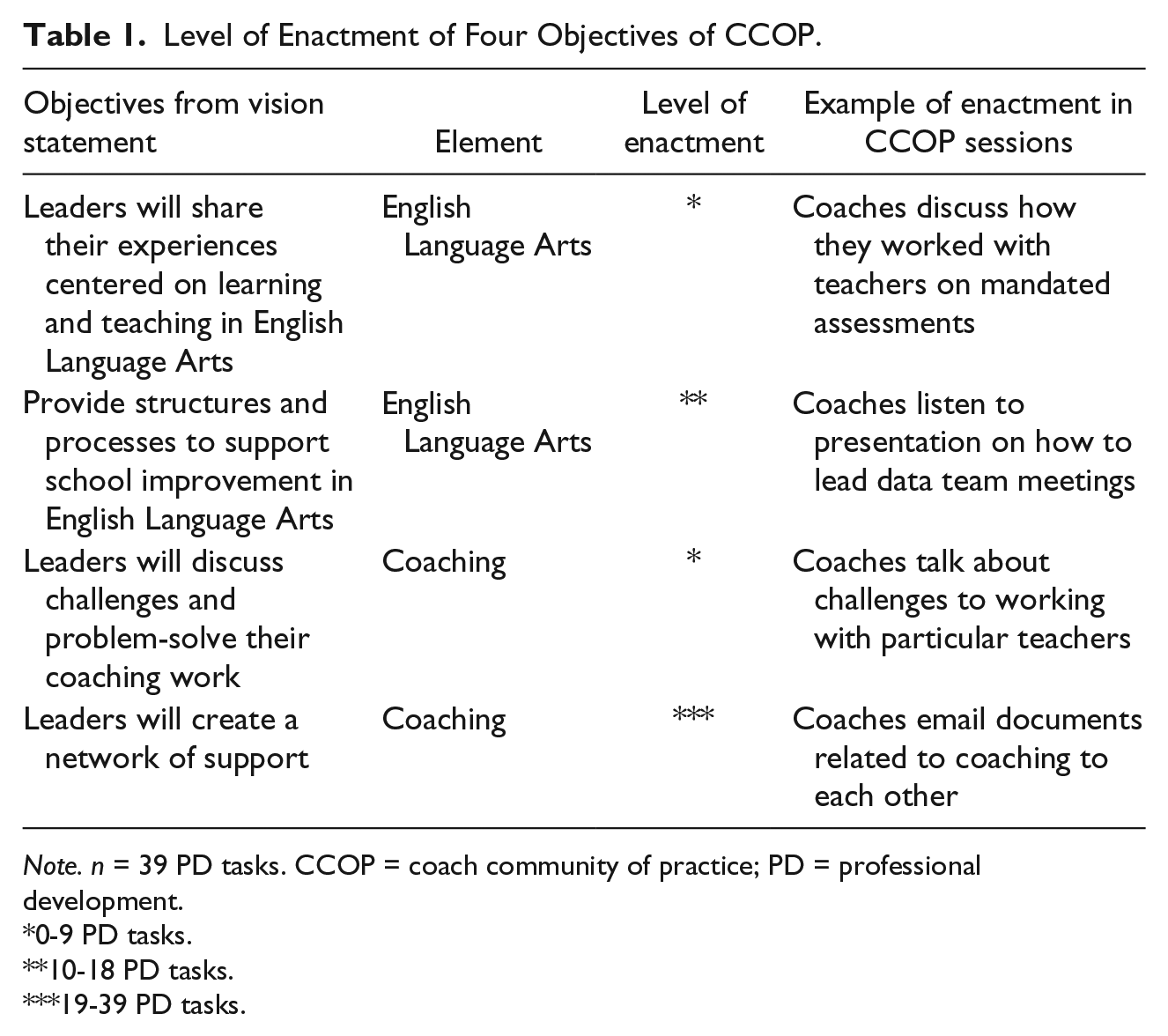
Note. n = 39 PD tasks. CCOP = coach community of practice; PD = professional development.
0-9 PD tasks.
10-18 PD tasks.
19-39 PD tasks.
Literacy instruction
As part of an attempt to improve instruction and achievement in Beech District, 8/39 PD tasks (see Table 1) involved professional learning opportunities related to literacy instruction. The content of these tasks related to differentiation, instructional strategies to support English Learners, and districtwide literacy screening assessments. For example, in winter 2015, coaches brainstormed how teachers could differentiate their English Language Arts instruction. In this PD activity, district leaders from the department of curriculum and instruction facilitated the sharing of ideas about differentiation across the network of coaches, but they did not present new resources on differentiation grounded in research/evidence. Samuel, a coach, expressed,
It [CCOP] gave me leadership skills, at least for curriculum purposes where I can now go back, and use that to write and rewrite the ELA curriculum we are working on.
This reveals how coaches attempted to apply some of the ideas on literacy instruction from CCOP in their work as leaders in their schools.
The assessment element of ELA instruction featured prominently in CCOP. Four CCOP sessions incorporated activities related to assessment. Specifically, coaches shared ideas related to the Smarter Balanced assessment in an April 2015 session. In multiple groups, coaches talked with their colleagues how they dealt with “fast clickers” who speed through online testing. Coaches described their techniques for proctoring online tests, thereby teaching other coaches about their school context. In this manner, coaches engaged in conversations with social engagement around test preparation and the logistics of administering standardized tests.
However, over the 2014-2015 year, there were zero PD activities targeting reading comprehension, decoding, or writing instruction. Sheri, a coach, mentioned that in previous years, they
were learning different strategies and techniques that we could teach the teachers. I remember when we [CCOP] had Ben here, he would teach us . . . the close reading strategies and explained explicitly how we can explain it to the teachers.
This indicates a shift away from content-specific PD for coaches.
Coaching practice
In CCOP, district leaders also facilitated activities designed to expand coaches’ understanding of coaching methods. As represented in Table 1, 13 of 39 tasks included content on how to coach for school improvement. For example, in a March 2015 session, coaches watched a video of a first-grade teacher and role-played providing feedback to this teacher. The group of coaches then debriefed elements of constructive feedback. Thus, the observation and feedback activity related to the CCOP objective of supporting school improvement through coaching.
During another session, district leaders introduced several facilitation protocols from a district-adopted ELA curriculum. These protocols aimed to promote reflective and equitable participation among members of a team. Taken together, by introducing methods for coaching teachers, these PD tasks intended to support coaches’ school improvement efforts.
Pedagogy of Coach Development
Beech’s CCOP addressed particular elements of literacy instruction and coaching practice, but, to more fully comprehend its potential to develop coaches, I depict the pedagogy and learning culture of CCOP. District leaders strived to create a networked learning environment for the pedagogy of CCOP (Bryk, Gomez, & Grunow, 2010; Koellner & Jacobs, 2015), and they were purposeful in their design for developing coaches. Katherine explained,
I mean, I feel like we have these windows that are—they’re windows; they’re the moments that you can have influence, in terms of message and putting in play structures to shift people’s thinking. And so, those windows are really valuable. So, I just think—and I actually think about this for myself—what’s the most valuable way to use those windows, and what are you gonna get—what’s gonna be the best—the strongest levers for change?
Furthermore, as mentioned in the above quote, leaders, such as Katherine, were aware that there was limited time to reach coaches. In the following sections, I portray the pedagogy of CCOP sessions and its alignment with two dimensions of situated cognition: social interaction and authentic activity (Brown et al., 1989; Lave & Wenger, 1991). This helps me depict how an urban district leveraged its window for coach PD.
Social interaction
By bringing the coaching team together on a monthly basis, CCOP functioned as a venue for professional, collegial interaction among coaches, thereby fostering the exchange of ideas and practices (Huber, 2011). Over the course of the year, CCOP provided many opportunities for social learning among coaches (Little 1990, 2002); all CCOP sessions included social interaction in the small group format. For example, teams of coaches discussed instructional methods tailored to meet the needs of English Learners. These teams of coaches created posters and then presented their collective understanding to the whole group. However, in these activities on best practices in literacy instruction for English Learners, coaches and district leaders did not explicitly address issues of race or culture.
Coaches also met in small groups to share ideas about strategies for providing feedback to teachers on literacy instruction. More specifically, 14 of 39 tasks included small group discussion that permitted coaches to learn in and through interaction. Angela declared,
I think it’s amazing and I think what they [district leaders] contribute or what they’re offering for teachers and educators to do is fantastic. To have that space where you can sit and talk about what you’re interested in, it’s invaluable.
This coach appreciated that CCOP served as a space to interact with other coaches and emphasized the value of having opportunities to choose what to discuss. Another coach, Sheri, noted,
Then you also talked to other coaches in the district and find out some of the things that you’re going through, they are also going through. So, it’s not just you alone.
Both of these coaches expressed appreciation for time and space to discuss coaching. However, to more fully understand the pedagogy of coach PD, it is crucial to consider the nature or quality of this social interaction.
With whom coaches collaborated
With regard to social interaction and learning culture, it is necessary to shed light on who coaches engaged with in CCOP (Lemke, 1997; Spillane et al., 2002). In CCOP, much of coaches’ social interaction occurred within randomly assigned groups. This means that coaches collaborated with the individuals sitting next to them rather than with a purposively assembled team of coaches.
In particular, district administrators organized CCOP to be inclusive of coaches from elementary and secondary schools. Jennifer, a district leader, noted,
We shifted this year’s thinking and plan for LLT by bringing all K-12 coaches together. I understand that, in the past, it was separated . . . elementary and the secondary. I understand that things were split off differently last year.
Consequently, social interaction and learning activities included coaches from across the continuum of grade levels. This means an elementary school coach may engage in brainstorming or discussion with a high school reading intervention specialist.
This configuration of CCOP may have permitted district leaders to distribute consistent messages to coaches across Beech, yet it also contributed to leaders tending to select PD content that was less focused on the specific goals or curricula of a school level. Simply stated, coaches oftentimes engaged with generic, rather than specialized, messages about instruction, coaching, and reform that applied from the elementary to high school levels. Rob noted that
It’s really hard, I’ve realized, to address the needs of everybody. Because of that, I think a lot of times information can get lost or misconstrued, or whatever, which might be a way in which—the fact that we have so many different schools, it’s very hard to know what to do. The fact that we have things like the [CCOP] . . . I think has helped bring us together to feel more like a cohesive unit. I would say that the community has things like that that bring everything together is a good thing . . . Hopefully it continues to grow and continues to keep the district together.
In this manner, coaches perceived that a benefit of forming a unitary community of practice was that it promoted districtwide cohesion. CCOP served as a context for collegial exchange in which coaches, typically isolated within schools, could make sense of the district as a whole. And a coach also reported that
Just being amongst other leaders and some of the trainings that have happened have also helped to develop me as a coach.
From her perception, the interaction with other coaches, regardless of their grade level, was beneficial for learning and growth.
Learning teams
Most of coaches’ collegial exchange occurred through CCOP’s learning teams. Each team self-selected a topic to study—with topics ranging from vocabulary instruction and differentiation to coaching methods. Then, coaches conducted team-directed learning on their topics with the aim of sharing out knowledge with the whole group. District leaders also requested that teams prepare a final product representing their learning to share districtwide. Angela had mixed experiences with the CCOP learning team format, stating,
It’s really great because they give you that freedom to explore topics that are interesting to you, but it always gets put on the back burner. . . . It’s just hard to make that time.
Other coaches echoed this sentiment that learning teams enabled them to explore a topic of interest but that it was challenging to carry out the self-directed work. It became apparent that only a subset of coaches had the resources, including time outside of the monthly coach PD sessions, to advance their team’s project. Furthermore, Katherine, a central office director, stated,
I felt like the approach of identifying a problem of practice, and then researching it, and then sharing something like a blog on the repository or whatever . . . I felt like it was too scattered for it to be effective, and I think people went right away to, “What’s our product going to be?” . . . I’m not saying people don’t learn anything, I think people—if you’re committed, you always learn stuff.
The high degree of autonomy was meant to raise coaches’ engagement but presented some challenges. Specifically, Katherine explained that many teams devoted more time to planning their products—over learning about their focal topic. Sam, another district administrator, acknowledged,
I guess there’s always a tension between giving choice—which is important—and also having focus. And I’m not—I guess I’m in the camp of this instance where having a focus might have greater impact than choice. Because it seems like people have a hard time narrowing in on exactly what their focus is going to be.
It is important to note that Beech’s administrators frequently discussed the dilemma between choice and common focus. The administrators acknowledged that additional structure and tools could better facilitate the work of these learning teams, which are coupled to the concepts of situated cognition (i.e., social interaction, authentic activity, learning culture). These refinements could support the success of this form of PD activity in urban districts.
Authentic activity
CCOP intended to function as a venue for coaches to engage in authentic professional learning activities; these activities matched the principles of situated cognition (Lave & Wenger, 1991). In particular, district leaders facilitated scenario-based learning activities in sessions. For example, coaches watched two videos of elementary literacy instruction and then role-played providing constructive feedback. The pedagogy of this session provided opportunities for coaches to practice the authentic work of delivering feedback on instruction. Furthermore, it encouraged coaches to describe their current in-classroom activities.
However, other PD tasks were loosely coupled to coaches’ problems of practice or current work; 33/39 PD tasks were decontextualized from coaches’ daily work. Observation and interview data indicate that coaches lacked opportunities to discuss their coaching schedule, plan PD, or analyze data from their sites. For instance, coaches did not engage in activities to draft or revise artifacts to use in their daily work. A district leader noted that she has come to the realization that
[Beech] is much larger than you can perceive when you’re working one school. It’s really hard, I’ve realized, to address the needs of everybody. Because of that, I think a lot of times information can get lost or misconstrued.
This indicates that district leaders met challenges in designing and facilitating authentic PD activities addressing each coach’s specific needs. In particular, leaders held the viewpoint that the district’s size hindered the implementation of contextualized learning activities in CCOP.
CCOP also functioned as a venue to introduce, or “roll out” new ELA initiatives. These activities used the pedagogical methods of PowerPoint presentations and lectures accompanied by handouts and frequently lacked connections to coaches’ existing work routines. For example, in a fall session, coaches listened to a presentation about the pillars of Universal Design for Learning, which was one of the district’s Special Education initiatives. The PD tasks regarding Universal Design were not contextualized, and coaches did not return to this topic again in CCOP. Similarly, in a winter session, coaches observed a demonstration of an online reading intervention program, facilitated by a program vendor. This online program was not mentioned in subsequent CCOP sessions. A coach noted,
Initiative fatigue is definitely real and happening. And I think that coaches get really overwhelmed with all the different things flying at us all the time.
In these cases, the PD for several new initiatives followed the one-and-done, or fly by, approach and did not relate concretely to current issues in coaches’ schools.
Overall, as represented in Table 1, authentic, contextualized learning activities were infrequent in CCOP. Kris expressed,
I’d like to still continue to learn from other successful coaches. I feel that it’s really helpful to see . . . real-world experience of coaches.
This coach, from a higher performing elementary school, desired authentic opportunities to learn more about coaching. She noted that it would be beneficial to hear about the work of successful coaches, which would enable her to make connections with her own current practice. Other coaches echoed the sentiment of wanting to understand how effective coaches within the district conduct their work. This authentic form of PD would leverage the learning culture of CCOP members as a resource (Horn & Little, 2010).
Discussion
This article’s analysis of Beech’s PD for literacy coaches shows how district leadership, PD pedagogy, and the urban district context mediated learning opportunities. CCOP encouraged the formation of a network of coaches. The findings also articulate the ways in which the pedagogy of CCOP was incongruous with principles of situated cognition, with potential consequences for the development of coaches. More specifically, since most PD tasks were weakly contextualized, they did not enable coaches to learn through their work practices.
This study notes gaps in district administrators’ leveraging of social interaction, a pillar of situated cognition, to develop the district’s literacy coaches. First, these administrators could designate time for coaches to meet consistently with coaches from a purposively selected group of schools (Huber, 2011). Building such a learning network would enable coaches to form trusting relationships with a team of coaches and to learn more about their contexts (Coburn & Russell, 2008; Penuel, Riel, Krause, & Frank, 2009). Second, time could be allocated for coaches to analyze current urban challenges, including organizational conditions, multiple priorities, and conflict with teachers or administration Horn & Little, 2010). These discussions would involve open dialogue that deprivatizes and resolves obstacles in coaches’ work. Third, district administrators could create online systems (e.g., Google drive or the district’s intranet) enabling coaches to communicate and share resources between sessions. These systems could help coaches share artifacts from their daily work and reduce their sense of isolation. These modifications to the pedagogy of Beech’s PD have the potential to shift the nature of coach–coach interactions, which may cultivate deeper learning for coaches.
The study’s qualitative findings on the nature of professional learning activities provides insights as to the pedagogy of PD in urban districts. This is important because if district leaders facilitate high-quality PD, this would provide a model for coaches to lead similar forms of PD to cultivate teacher learning. In particular, if coaches engage in PD that matched the tenets of situated cognition and that was highly relevant to their urban district and school contexts, they would be better prepared to design and facilitate quality learning opportunities for teachers.
The political and sociocultural dimensions of learning have particular prominence in urban contexts, which include diverse stakeholders, educators, and students (Anyon, 2001; Pollock et al., 2016). As a result, PD in urban systems must address sociocultural issues and raise the knowledge and skills of educators around issues of racial and cultural diversity. It is necessary, yet insufficient, for PD to address the nuts-and-bolts of instructional programs and leadership priorities (Milner, 2013). If we aspire for coaches in urban systems to support teachers to teach in culturally responsive ways, coaches should engage in PD on cultural responsiveness (Darling-Hammond & Bransford, 2005; Gay, 2000; Villegas & Lucas, 2002). This PD would encourage coaches to serve as socioculturally conscious educators and build on students’ and teachers’ existing knowledge to make schools more equitable (Villegas & Lucas, 2002). And this PD has the potential to prepare coaches to lead crucial change efforts for urban schools.
This article extends the knowledge base on urban district leaders’ design and facilitation of PD (Honig, 2012). It is necessary to conduct further research on district leaders’ decision making regarding PD. Scholars should delve into these leaders’ conceptualizations of what is “good” PD for system improvement (Coburn, 2001, 2006). Scholars should also unpack how these leaders make sense of and frame major problems and solutions within their urban contexts (Coburn, 2006; Woulfin, 2015).
Finally, the article contributes to literature on developing and supporting coaches in urban schools (Marsh & Farrell, 2015). It foregrounds coaches’ need for ongoing support around their multifaceted, political role in developing teachers and promoting reform. Many coaches had the sense of being isolated. It is crucial that urban district and school leaders determine how to reduce coaches’ isolation so that coaches feel incorporated into their work environment (Lortie, 1975). And more research is needed on the professional learning opportunities experienced by instructional leaders within different categories of urban districts (Milner, 2012). It will be especially important to study leaders’ engagement in PD on instructional content and methods that meet the needs, background, and interest of their students.
Limitations
This investigation of a district’s PD system for literacy coaches contributes to the literature on urban district reform and professional learning, but it is necessary to point out limitations to this qualitative study. First, the single-case design enabled an in-depth analysis of a single, urban emergent district’s approach to professional learning. The findings, aligned with situated cognition, are generalizable to theory, but the case is not generalizable. It is possible, for example, that PD for instructional leaders in different categories of urban districts takes on different forms. Second, two district leaders elected to not participate in interviews. As a result, it is not possible to make certain claims about the rationale behind modes of PD. Third, I did not measure coach learning as an outcome of the PD so cannot not evaluate the relative influence of different PD activities. Thus, the article does not make claims about the impact of CCOP on coaches’ learning or practice.
Conclusion and Implications
This case study on Beech District’s PD for coaches provides insight into the nature of PD within urban districts. My application of concepts from situated cognition aids the analysis of a district’s capacity-building efforts. Specifically, this article disentangles the social interaction, authentic experiences, and learning culture of an urban district’s coach PD. Scholars drawing on situated cognition should devote greater attention to issues of power and politics (Achinstein, 2002; Ball, 1987). This line of research would focus on how district leaders cultivate conditions for educator development, how PD is culturally responsive, and how educators learn within urban contexts.
My findings illuminate that coaches would benefit from additional opportunities for contextualized professional learning; this would link theory with praxis (Huber, 2011; Horn & Little, 2010). For instance, coaches could bring evidence from their coaching (e.g., notes from classroom walkthroughs or handouts from a meeting) to analyze with other coaches during PD sessions. Then, coaches could share constructive feedback plus ideas for improvement. Or coaches could read a case description on coaching a resistant teacher and discuss tactics to resolve the issue. These activities would ask coaches to interpret data and synthesize perspectives, which are key in promoting deep responses to reform (Little, 2002).
Finally, the study’s findings have implications for urban districts. Policymakers and practitioners should devote additional attention to the nature of urban educators’ PD. District administrators should collect evidence from stakeholders on the strengths and limitations of different configurations of PD. Furthermore, administrators should ascertain how PD sessions incorporate authentic activity and purposeful social interaction to enable adult learning and systemic change. I also propose that educators, reformers, and researchers should continually ask questions regarding PD, including, “How does district-sponsored PD prepare leaders and teachers for the complexities of closing opportunity gaps in under-resourced schools?” “How does PD support educators in reflecting on their responsibilities in fostering equity?” and “How does PD engage educators to comprehend the assets of students, communities, and educators?” These reflections could propel the field’s understanding of the ways in which PD contributes to equitable outcomes for urban educational systems.
Footnotes
Acknowledgements
I appreciate the following individuals for their scholarly support: Milagros Castillo-Montoya, Britney Jones, Rachael Gabriel, Cynthia Coburn, Tina Trujillo, and Anysia Mayer. I am also deeply grateful to the administrators and coaches featured in this article who enabled this research and who strive to catalyze positive change.
Declaration of Conflicting Interests
The author(s) declared no potential conflicts of interest with respect to the research, authorship, and/or publication of this article.
Funding
The author(s) disclosed receipt of the following financial support for the research, authorship, and/or publication of this article: The author received financial support from the University of Connecticut for the research discussed inthis article.