







Abstract
Despite growing interest in culturally responsive pedagogy (CRP), little research has examined its effect on student performance. In this article, we place CRP in a sociohistorical context and document how one intervention, Fresh Prep, draws on CRP to engage and instruct high school students identified as high risk for not graduating. Using a quasi-experimental matching methodology, we examine whether the program improves academic performance. We find Fresh Prep students have higher scores and pass rates on state English Language Arts and history exams than students in a matched comparison group, as well as retakers attending the same schools before its introduction.
For the master’s tools will never dismantle the master’s house. They may allow us to temporarily beat him at his own game, but they will never enable us to bring about genuine change.
Scholars and practitioners increasingly point to the value of culturally responsive teaching methods to engage students and help them learn course content. However, little research has examined the effect of these methods on student performance, either in an experimental or in a quasi-experimental framework (Aronson & Laughter, 2016; Sleeter, 2012). In this article, we draw on data from a study of a culturally responsive classroom intervention to examine whether participating in the intervention improves academic performance among students who have been identified by their school administrators as high risk for not graduating from high school. We also draw on existing pedagogical theory to posit the mechanisms by which the program exerts its impact on student outcomes.
Although much attention has been paid to closing the academic achievement gap, statistics still reveal that, when it comes to graduation rates and academic success, demography is still a powerful predictive factor (Fruchter, Hester, Mokhtar, & Shahn, 2012). Economic status and where a person is born remain the most relevant factors in predicting future academic outcomes. For many students of color living in under-resourced communities, the achievement gap becomes apparent as early as between the fifth and eighth grades (Meade & Gaytan, 2009). By high school, high-stakes exams can stand in the way of graduation for many low-income students and exacerbate high dropout rates and existing inequalities (Hursh, 2008). Culturally responsive approaches to teaching were developed for and still largely center on educational contexts characterized by systemic inequities: under-resourced schools in densely populated urban areas with high concentrations of students of color and students living in poverty, disparities in the ethnic backgrounds and lived experiences of the teachers and the student body, and persistent academic disparities (Gay, 2014).
Despite the fact that policy makers wield the power to decide what students need to learn to graduate, the classroom is still a space where the primary relationship between students and teachers can reverse the tide and make all the difference in whether a student succeeds. Culturally responsive methods attempt to bridge the gap between students and schools by recognizing the value of students’ experiences and youth culture in the educational setting. Examining the centrality of educator–student relationships, Gay (2013) contends that culturally responsive teaching starts with considering and restructuring educators’ attitudes and beliefs about students and communities of color. In order for the school system to become more culturally responsive, to start teaching through diversity, students’ communities must no longer be seen through the lens of pathology and weakness (Gay, 2013; Ladson-Billings, 1995). The classroom is the place where that change can be made (Gay, 2014).
There is a dearth of literature examining performance on high-stakes tests in connection with the implementation of culturally responsive approaches. While many have argued that standardized tests—often a central metric for school improvement efforts—are not an accurate measure of student achievement, particularly for students of color (see, for example, Aronson & Laughter, 2016), it is nonetheless necessary to consider the effects of integrating culturally responsive pedagogy (CRP) into test preparation, as standardized tests remain a barrier to success (Ladson-Billings, 1995).
Sleeter (2012) reviews several small-scale studies that demonstrate the outcomes of CRP and calls for more research that illustrates the connection between CRP and academic outcomes to build the essential evidence base needed in an environment where educators are more likely to adopt new approaches if they are directly connected to achievement on the high-stakes exams that have become the main benchmark of student and school success. Sleeter cites several studies that link CRP with student engagement and, hence, academic achievement, as well as studies that specifically demonstrate students’ growth in discussing, interpreting, and analyzing texts. In one of the few studies cited by Sleeter that links CRP to performance on high-stakes tests, Cammarota and Romero (2009) find that Chicano students participating in the Social Justice Education Project, a high school social studies curriculum rooted in critical consciousness, outperformed Anglo students on state exams. In a recent review of culturally relevant education, Aronson and Laughter (2016) demonstrate strong outcomes in math, science, social studies/history, and English Language Arts (ELA) classrooms when educators implement the tenets of CRP, specifically connecting cultural references to academic skills and concepts, engaging students in critical reflection, enhancing students’ cultural competence about their own and other cultures, and critiquing discourses of power. Similar to Gay (2014), they found that culturally responsive approaches, though not uniformly practiced, were associated with enhanced comprehension of the academic material, increased confidence toward academic advancement, increased motivation to complete assignments, and improved performance on assignments and tests. Only one of the studies reviewed by Aronson and Laughter demonstrated improvements in achievement on a state-mandated standardized test in classrooms using CRP (Caballero, 2010).
This article draws on data from a sample of classrooms in New York City that used a culturally responsive program called Fresh Prep to help high school students who had previously failed and were identified by administrators as at risk of failing state exams in history and ELA to prepare for the tests. The program was offered in poorly resourced urban schools receiving Title I funds and populated by ethnically diverse students. We begin the article with a review of the cultural and political origins of CRP, and specifically one of its subset methodologies: hip-hop pedagogy. In describing the culturally responsive elements of Fresh Prep, a program rooted in hip-hop pedagogy, we examine how it engages both the surface structures and the deep structures of hip-hop culture in helping prepare and motivate students in the face of high-stakes exams (Resnicow, Baranowski, Ahluwalia, & Braithwaite, 1999). We use propensity score matching (PSM) methods to estimate the effect of this program on student test scores, pass rates, and graduation rates. We discuss the implications of the data, the need for additional research on this and other culturally responsive interventions, and specific conditions that will yield improved CRP implementation in the classroom.
A Historical Look at CRP
Artists and educators of color have historically used the tools, resources, and structures of the dominant culture to dismantle systems of oppression through movements which on the surface are defined by style, but tap into deep structural relationships that address the need of oppressed people to survive in a hostile world. Current manifestations of CRP are descendants of some of the most influential and subversive, artistic, intellectual social movements of the 20th century, including the Harlem Renaissance, Negritude, Jazz, and the Black and Latino Liberation Movements of the 1960s and 1970s.
The 50 years that encompass the beginning of the Harlem Renaissance (ca. 1920) to the denouement of the Civil Rights movement (ca. 1970) can be viewed as a primordial explosion of ideas and practices that have slowly cooled and coalesced into the phenomenon we now refer to as CRP. Among African Americans, the Harlem Renaissance popularized the idea of the “New Negro,” an ideal embodied by figures such as W.E.B. Dubois, Adam Clayton Powell, Langston Hughes, and John W. E. Bowen. Between World War I and the middle of the 1930s, African American artists and thinkers working in close proximity inside America’s best-known ghetto used Western forms of expression to document the experience of the New Negro (Locke, 1925). The African American experience was examined and presented to the public in poems, films, plays, and books that mirrored Western values in terms of structure and production process, but rejected them in terms of style and content.
Negritude, a distinct literary movement of the 1930s and 1940s, provides another ideological touchstone for modern manifestations of CRP. Founded by Aimé Césaire, Senghor, and Léon-Gontran Damas, French-speaking colonials from the African Diaspora, the Negritude poets took inspiration from the Harlem Renaissance, espoused a philosophy of Black pride, and established a canonical beachhead, widening the acceptance of writers from the African Diaspora and the value of their Black identity (Kennedy, 1975). Having studied in Paris, a customary path toward respectability in the colonial system, these writers instead rejected assimilation. They problematized the cultural inferiority complex that was the legacy of European hegemony and advocated for recognition of Black and African cultures, experiences, and ideas as equally valuable to the European, a viewpoint echoed in CRP educators’ work with students of color.
In the United States, jazz artists in the 1940s closely identified with the Zoot suit, an aggressively flamboyant form of dress that called attention to the wearer and functioned in direct confrontation to the idea that men of color should mimic more conservative White standards of dress to maintain or attain respectability. As with the cultural figures leading the Negritude movement, these men refused the path toward assimilation with the White establishment; in this case, their identification as outsiders was expressed in the overt form of clothing, along with other cultural markers (Cosgrove, 1984). On the bodies of men of color, Zoot suits were “a spectacular reminder that the social order had failed to contain their energy and difference” (Cosgrove, 1984, p. 78). Jazz, the popular musical vernacular of 1940s-1950s America, is played on instruments invented by Europeans, using a musical scale that reflects Western standards of aesthetics (DeVeaux, 1991). However, the musical product is defined by its unpredictability and lack of respect for the rules. Finally, with the slogan “Black is Beautiful,” the Black Liberation movement of the 1960s—the penultimate phase before the advent of hip-hop—moved adherents beyond the mere acceptance of blackness and promotion of Black culture to embrace a more militant vision of Black pride (Anderson & Cromwell, 1977).
In “The Talented Tenth,” the seminal text of respectability politics, W. E. B. Du Bois (1903) asserts that the path to liberation is through respectability, assimilation, elitism, and a classical Western education. His contemporaries, like Marcus Garvey, and later figures, like James Baldwin, reject much of Du Bois’s thesis in favor of a more separatist form of Black liberation theology (Baldwin, 1963). Current manifestations of CRP closely align with Baldwin’s implicit rejection of respectability and assimilation, but as currently practiced in the classroom, CRP stops short of a full-throated endorsement of Malcolm X’s (1963) call for Black liberation and the dismantling of oppressive institutions.
As the Civil Rights movement shifted, and amid the struggles to integrate public schools through busing initiatives (Mills, 1973), multicultural education emerged “out of concerns for the racial and ethnic inequalities that were apparent in learning opportunities and outcomes” (Gay, 2010, p. 28). Throughout the 1970s and 1980s, education scholars developed the principles of what would become known as CRP in an effort to bridge the gap between diverse students’ home cultures and school culture to promote academic success (Brown-Jeffy & Cooper, 2011; Gay, 2010). By the 1990s, it was widely recognized that “focusing solely on culture negates the reality of race and racism in American society” (Brown-Jeffy & Cooper, 2011, p. 69). By including the lens of critical race theory, which highlights the pervasiveness of racism and White hegemony in U.S. society and challenges claims of meritocracy and equal opportunity in educational settings, CRP espouses critical consciousness, beyond a neutral awareness of cultural difference (Brown-Jeffy & Cooper, 2011; Ladson-Billings & Tate, 1995; McLaren, 2002; Yosso, Villalpando, Delgado Bernal, & Solórzano, 2001). Conversely, some educators’ failure to truly grasp systemic racism, its intersections with other social issues, and the extent to which U.S. education practices marginalize communities of color prevent the full realization of CRP’s potential (Kim & Pulido, 2015).
Today’s programs rooted in the principles of CRP lead students toward a middle path of radical compliance, helping them to meet the standards and benchmarks of the dominant culture (e.g., state exams) while simultaneously making them more aware of where history, language, and culture have placed them on the grid. Duncan-Andrade (2007) identifies several key characteristics of effective teachers working toward educational equity. These teachers recognize the need to build trust with their students, are involved in and knowledgeable about the daily occurrences in the communities they serve, and support students as potential change makers, molding the curriculum toward a “critically conscious purpose” (Duncan-Andrade, 2007, p. 625). Hammond (2014) outlines culturally responsive teaching (her preferred term) as a comprehensive process of engagement between teachers and students, in which teachers acknowledge the social and political context of students’ communities and often marginalizing learning experiences; recognize students’ cultural learning tools, such as storytelling; and mimic those tools in their instruction. CRP has been summarized as teaching through a deep understanding of students’ “cultural knowledge, prior experiences, frames of reference, and performance styles” (Gay, 2010, p. 31). At its heart, CRP grapples with reframing classrooms in a way that serves not only to increase diverse students’ academic skills and knowledge but also to “explicitly unmask and unmake oppressive systems through the critique of discourses of power” (Aronson & Laughter, 2016, p. 167).
Hip-Hop Pedagogy in the Classroom
Having arisen within the urban experience, and having been a major part of young people’s lives for decades, it made sense for hip-hop to eventually enter the classroom as a pedagogical tool, and hip-hop pedagogy has become a commonly implemented type of CRP (Akom, 2009; Baszile, 2009; Emdin, 2013b; Kirkland, 2008; Yasin, 2014). Hip-hop pedagogy taps into young people’s cultural knowledge and engages them in familiar performance styles that echo the elements of hip-hop culture, discussed in more detail in the next section. As such, hip-hop pedagogy explicitly recognizes and seeks to connect with the lived experiences of students of color, including students who do not primarily identify as hip-hop music consumers or producers (Emdin, 2013b). Hip-hop pedagogy has been used in a variety of classroom settings to increase student engagement and is particularly relevant in urban educational settings (Diaz, Fergus, & Noguera, 2011; Petchauer, 2009; Yasin, 2014). Originating in popular youth culture, hip-hop also incorporates multiple intelligences, including verbal, kinesthetic, spatial, and musical, a desirable attribute as more curricula seek to include material for a variety of learners (Abe, 2009).
Hip-hop is a necessary counter-story, offering lessons from youth culture that disrupt the Eurocentric identity dominant in the regular school curriculum (Baldwin, 1963; Baszile, 2009). As a form of self-expression and meaning-making that arose within marginalized communities in urban areas—that inherently generates both positive and negative images—hip-hop has a place in a classroom that seeks to engage with students’ identities (Stovall, 2006). For decades, hip-hop artists have recalled struggles with schooling in their music, namely, curricula that largely ignore their histories, and relationships with educators that further marginalize them. Akom (2009) traces the history of politically conscious hip-hop artists such as KRS-One and dead prez calling for African American history to be taught in schools and lamenting its absence. Emdin (2010) recalls popular rap lyrics that speak to artists’ frustration with being labeled by schools and teachers as having lesser intellectual abilities and motivation. In recent years, artists such as J. Cole, Common, and Ludacris have made efforts to reverse the label of rappers as unsuccessful students by attending college “signing days” to encourage their young fans to pursue secondary education, launching nonprofit organizations that promote literacy, and organizing fundraisers to provide students with school supplies.
Hip-hop is a culture “replete with customs, belief systems, practices, and schematic understandings that are almost exclusive to those who are part of the culture” (Emdin, 2010, p. 5). At the same time as they are alienated from conventional education patterns, many students are deeply connected with hip-hop culture, a relationship that their schools often do not understand and find problematic (Emdin, 2010; Stovall, 2006; Ward, 2013). This lack of understanding reinforces already marginalized students’ alienation from school. That is, students reject a culture (the classroom), which has rejected their culture and constantly asks them to leave their cultural expression outside the school building’s doors (Ladson-Billings, 1995).
Best practice examples of hip-hop pedagogy seek to reduce the distance between youth culture and the culture and content of the classroom (Hill, 2009; Kruse, 2014). Kirkland (2008) demonstrates how students’ critical analysis of Tupac’s music led to rich examinations of the social issues the artist brought up; the students gained a voice and a rhetorical tool through which to examine social injustices in their own lives. In such examples, educators do not solely bring hip-hop into the classroom to direct students’ attention to the “real academic texts.” They lead students through song lyrics as valuable cultural and consciousness-raising products in themselves, and in comparison with other texts, thereby teaching from within students’ experiences and cultural memory (Hill, 2009; Morrell & Duncan-Andrade, 2002; Msila, 2013; Petchauer, 2009; White & McCormack, 2006). Emdin (2013b) presents examples of how elements of hip-hop culture other than rap music, such as the battle, can be incorporated to more deeply represent hip-hop culture in the classroom, with resulting opportunities for students to engage in critical inquiry and debate.
Below the Surface of Hip-Hop Culture
Resnicow et al. (1999) presented a widely cited framework for culturally sensitive public health interventions in which they distinguish between surface structures and deep structures as key dimensions of interventions targeted toward specific communities. In their model, adjusting the surface structures of an intervention means taking into consideration the more easily observable aspects of a culture: playing the right music, serving the right food, and speaking the right language when working with a linguistically diverse audience. All these surface structures increase an intervention’s immediate acceptability. Interventions that also acknowledge the deep structures of a culture are rooted in an understanding of the target population’s history, environment, and ways of interacting; deep structures increase an intervention’s meaning and relevance. Successful health promotion interventions address both surface-level and deep-level cultural structures, as do successful CRP interventions in the classroom (though the latter do not typically employ the terminology of surface and deep structures; see, for example, Adjapong & Emdin, 2015; Emdin, 2010; Gay, 2014; Morrell & Duncan-Andrade, 2002).
Teachers must be challenged to move beyond employing strategies based solely on the surface elements of cultural competency, like celebrating Black History Month, and should be encouraged to interweave the deep cultural structures and norms that govern communication and learning behaviors (Brown-Jeffy & Cooper, 2011; Resnicow et al., 1999). Simplistic views of CRP, which include trivialization of culture and surface-level cultural celebration while lacking a critical race perspective in their presumption that all differences are equivalent, have contributed to its marginalization as an approach to teaching and learning (Kim & Pulido, 2015; Ladson-Billings & Tate, 1995; Sleeter, 2012).
In the current article, we apply the public health sphere’s distinction between surface structures and deep structures to the sphere of education to facilitate our examination of the Fresh Prep program. The surface structures of successful CRP are about style and tactics. The deep structures of CRP originate in and advance a social justice agenda set by the makers of the Harlem Renaissance, Negritude, jazz, and the Civil Rights Movement. The major elements of hip-hop culture—rap (emceeing), b-boying/breaking, dee-jaying, graffiti, and knowledge of self—and their attendant patterns such as the cypher, a performative communal exchange in which participants gather in a circle, together form a set of surface and deep structures that are applicable to the classroom setting and enhance students’ learning (Emdin, 2013a; Petchauer, 2009). For example, Adjapong and Emdin (2015) describe how the cultural patterns of call-and-response and co-teaching (by a student from the class) engaged students in a sixth-grade science classroom, deepened their voice and agency, and helped them to achieve a better understanding of the science content. In another study employing co-generative dialogues, students discussed complex analogies between hip-hop lyrics and science concepts (Emdin, 2010).
Fresh Prep
The Fresh Prep program was created to address a critical issue faced by many students in New York City schools: To graduate from high school, students need to pass a set of state standardized Regents exams that assess knowledge of core high school subjects, including Global History, U.S. History, and ELA. For a subset of students, passing one or more exam can be a major hurdle to graduation. A student who does not receive a passing score on an exam will not necessarily pass on the second, third, or even fourth retake of the exam (Figure 1). Students who struggle the most with the Regents exams often have Individualized Education Programs (IEPs), are English Language Learners (ELLs), and have lower school attendance than their peers.
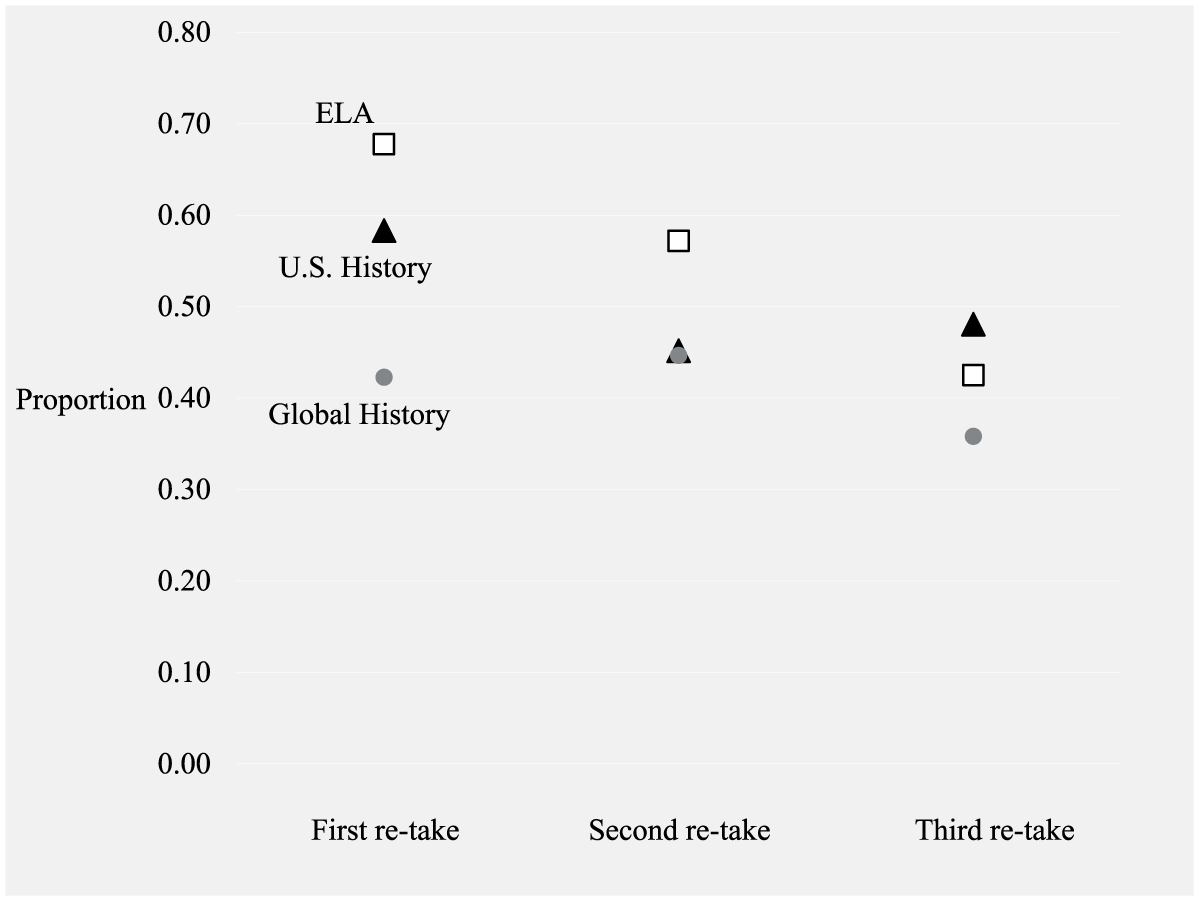
Proportion of students who failed their Regents exam in a prior year and then subsequently passed exam on the first, second, or third retake in 2013-2014.
Fresh Prep places teaching artists called MCs (Masters of Curriculum) in high school classrooms to co-teach a student-centered, arts-integrated curriculum that engages students and helps them learn content and skills tested on the exams. MCs collaborate with classroom teachers to deliver the program during school hours. The program is scheduled for 50 to 60 hours of instruction, leading up to each administration of the Regents exam. Ideally, students who do not pass the test in January continue to participate in Fresh Prep in June, and those who do not pass in June continue to participate in August. The program employs original hip-hop lyrics as a pedagogical tool and draws on the mechanisms of hip-hop culture and the learning-enhancing properties of music to connect students with learning and help them pass the tests (Engh, 2013; Governor, Hall, & Jackson, 2013).
The curriculum teaches both test-taking strategy and content. It provides prerecorded original songs, along with lyrics, so students can listen to the songs in and out of class. As an example, the curriculum teaches a strategy called “predict/eliminate” to help students develop a more systematic approach to answering multiple-choice questions. Students listen to a song called “Predict/Eliminate” that describes the five steps required for them to predict correct answers and eliminate incorrect answers. After listening to the song and following along with the lyrics, students are then taken through a lesson that asks them to interpret and apply the lyrics. Below is an excerpt from the song:
Predict/eliminate Predict/eliminate 5 steps to stop making mistakes Let me demonstrate
Step 1: Underline the words that are key Step 2: Take those words and remember what they mean Step 3: Predict an answer, your best estimation Step 4: Look at the choices and you start eliminating Step 5–What’s left? Step 5–What’s left? Now you just select correct . . .
The program teaches content similarly. For example, in a unit on Communist revolutions in the Global History class, students listen to a song called “Communist Revolutions” (excerpted below) and then go through a lesson where they read the lyrics closely, interpreting and contextualizing their meaning:
Communism is based on the writings of Karl Marx The Communist Manifesto, specifically, left its mark Empowered the working class, that’s the proletariat Equal wages and land instead of ownership pyramids Communism opposed capitalism A profit-driven system with the goal of getting rich and A social alternative, may sound like an oddity The state regulated businesses: command economy This was Russia’s goal of Communist Revolution Overthrew the czar, then rose the Soviet Union Under Lenin came the first Bolshevik generation After Lenin came Stalin and collectivization This turned private farms into communal farmland Stalin introduced what he called the Five-Year Plans The plan would spark economic resurrection China would model this to climb out of Depression
Fresh Prep was consciously designed to incorporate both the surface and deep structures of hip-hop culture to engage students in test preparation. The surface structures of the program, such as the design of program materials, aim to appeal to young people and signal to them that Fresh Prep is not “school as usual.” The deep structures call upon essential patterns of group interaction within hip-hop culture, such as promoting respect, and encouraging students to engage in competitive and playful braggadocio, to facilitate learning through the mechanisms of youth culture. Below, we describe the ways in which the program aims to deliberately draw on surface and deep structures to promote student engagement and learning.
The first way in which Fresh Prep aims to employ the surface structures of hip-hop is through simple aesthetic choices related to design elements and branding. In ways that resemble synergistic commercial marketing campaigns, physical assets in many youth development programs are designed as part of a cohesive brand, intended to appeal to the teenage urban consumer. For Fresh Prep, these assets include the “Fresh Prep Student Workbook,” earphones that look like the popular Beats brand, t-shirts, MP3 players, thumb drives, and wrist bands, all emblazoned with the Fresh Prep logo. The physical assets, designed to resonate with youth, are provided to students in the first week of the program.
Second, Fresh Prep aims to exploit young people’s consumer instincts and love of fashion. MCs tap into these surface structures through their intentional presentation of self. They follow fashion trends, which they make evident in the classroom by “representing” or wearing current fashion. Within the boundaries of school dress codes, Fresh Prep MCs are encouraged to make conscious sartorial choices to subtly support the surface narrative that this is not “class as usual” and to further encourage students to expand their sense of self to include the possibility of a new personal narrative. That is, they aim to send the message that learning is cool, and that cool people are good students.
Third, Fresh Prep encourages MCs, who themselves are artists, to share their artistry via live performance with students in their classes. MCs are encouraged to present themselves as fun and relatable representatives of the world of hip-hop, whose goal it is to liven up the classroom.
Fresh Prep’s MCs are trained to draw on deep structures in a variety of ways to make connections with students and ultimately help them learn course content. The first example is through “code switching” or moving from persona to persona with fluency and agility. MCs are professional pedagogues, many with advanced degrees and similar qualifications to traditional classroom teachers. However, when meeting students for the first time, the MC may put on an intentional display of urban sophistication and emotional strength meant to signify that she or he has the kind of “street smarts” that many urban young people recognize and value. This is true for MCs of all genders, the goal being to give young men and women license to posture and be assertive in the style of hip-hop performers while still engaging in academic work.
Second, MCs are selected for the Fresh Prep program because they have an insider’s understanding of students’ lives which goes beyond basic awareness or empathy. They are encouraged to draw on this understanding to forge authentic relationships with students and manage classroom interactions. The MCs’ ability to use popular slang and their extensive knowledge of youth culture help them bridge the gap between slang, everyday speech, and academic speech. In class, MCs regularly restate and paraphrase academic content delivered by the classroom teacher using more accessible language, and they rely on metaphors and similes that juxtapose pop cultural references with historical events. For example, in the Fresh Prep U.S. History class, a lesson on the Civil War begins with an analysis of the regional accents and music styles of northern rappers and southern rappers. MCs aim to reach beyond a surface-level use of slang words, employing slang in conjunction with references to current youth culture to demonstrate their understanding of students’ lived experiences.
Third, within Fresh Prep, hip-hop music functions as a vehicle for learning and reviewing key academic content and related vocabulary. To that end, the program has produced original music tailored to reviewing Regents exam material and test-taking strategies, excerpted above. The style of the music reflects the sounds, beats, and rhythms of commercially produced and popular hip-hop songs. Fresh Prep students listen to the songs repeatedly during class, and are encouraged to continue listening online, on their own time. During review, MCs facilitate a game called “Rewind That Back” in which they play the songs, pausing at key moments as students fill in the missing vocabulary words. This repetition helps students to memorize content as they commit to memory other music (Campabello, DeCarlo, O’Neil, & Vacek, 2002; Governor et al., 2013).
Fourth, MCs aim to co-construct models of engagement with students, which is important because much of the teaching and learning in Fresh Prep is done through small group work. MCs meet individually with each student prior to the first group session to establish rapport and learn about the student’s perspective, background, and expectations for the class. Students contribute to the “Classroom Contract,” a set of rules, shared norms, and logical consequences for behavior unique to each Fresh Prep class. Following the initial dialogues with the MC, frequent reflective check-ins provide the group with opportunities to revisit and refine the agreement. The goal of this practice is to bolster group cohesion and support classroom management through recalling the egalitarian norm in hip-hop, where each MC’s voice is recognized as a contributor to the collective.
Fifth, MCs consciously organize the classroom to reflect an understanding of students’ cultural preferences and traditions. Fresh Prep classes are often taught with students arranged in a circle. The purpose of this arrangement, which in hip-hop vernacular (and in Fresh Prep classes) is referred to as the “cypher,” is to indicate that each student’s input to the group discussion is valued and respected. Further incorporating kinesthetic learning, some activities involve students moving around a circle of stations set up with different test preparation tasks.
Sixth, most small group work in Fresh Prep classes has a competitive aspect. MCs often use quizzes disguised as games to determine whether content is being retained. Students work in small ad hoc teams, referred to as “crews.” No crew is permanent, but every crew has a unique name. Within the cypher, MCs engage crews in competitive memory games to generate feelings of excitement and allow individual students to demonstrate their learning with the vocal support of their crew behind them. Crews and individual students earn the opportunity to brag by demonstrating their understanding of academic content.
Finally, Fresh Prep aims to use process drama to encourage students to take risks, experiment, and expand their sense of self, with the goal of raising student engagement and building confidence. MCs use role-play and narrative to introduce and explore key academic content, encouraging questioning and critical debate as students embody the historical concepts and discuss their social, cultural, and political ramifications. The use of process drama is an example of the program’s aim to access the hip-hop cultural norms of egalitarian co-construction of space and knowledge of self. In the “drama world,” Fresh Prep students explore significant events, meet historical figures, and engage in interactive research and group problem solving. Typically, when setting up a process drama, the MC will describe an imaginary scenario and make an overt request for help, thus giving the student what Heathcote and Bolton (1995) call the “mantle of the expert.”
In summary, through employing the deep and surface structures of hip-hop culture, Fresh Prep MCs aim to cultivate authentic and positive relationships with their students and to support students’ development of critical consciousness at the same time as they work toward passing the test. Their goal is to bridge the gap between youth culture and school culture and engage students in critical dialogue toward raising awareness of the social and historical contexts in which they are learning. However, as a test prep program, Fresh Prep stops short of explicitly encouraging students to become change makers as called for by Duncan-Andrade (2007). Instead, Fresh Prep takes students down the path of radical compliance (and success as test takers) within the dominant system. This choice is similar to the path taken by many contemporary interventions, though perhaps it amounts to an incomplete manifestation of CRP.
Measuring Fresh Prep’s Impact on Student Outcomes
In 2013-2014, Fresh Prep partnered with 14 schools, serving 549 students across Global History, U.S. History, and ELA. Using data from the New York City Department of Education (DOE), we estimate Fresh Prep’s impact on these students’ test scores, pass rates, and, among seniors, graduation rates. Fresh Prep conducts an annual internal program evaluation to assess its impact on student outcomes; the present article extends this work by comparing outcomes with a matched comparison sample and in situating the analyses within the broader context of the CRP literature. The DOE provides data sets containing de-identified, student-level data for all students attending public school in New York City. We submitted a list of all Fresh Prep students to the DOE, and they returned to us a list of scrambled student IDs that we could use to identify Fresh Prep students in the DOE data sets. This list was limited to 544 students who sat for the Regents exam at least once during their time working with Fresh Prep. 1 According to the program team, this represents the full population of students who were served by the Fresh Prep program. For unspecified reasons, we could not find data for 44 students on the Fresh Prep rosters. 2 Table 1 shows the number of Fresh Prep students included in the final analysis, along with the percentage of total students served represented in the analysis. Across the three subjects, 93% of Fresh Prep students are included in the analysis.
Sample Inclusion Relative to Full Population of Students Served by Fresh Prep.
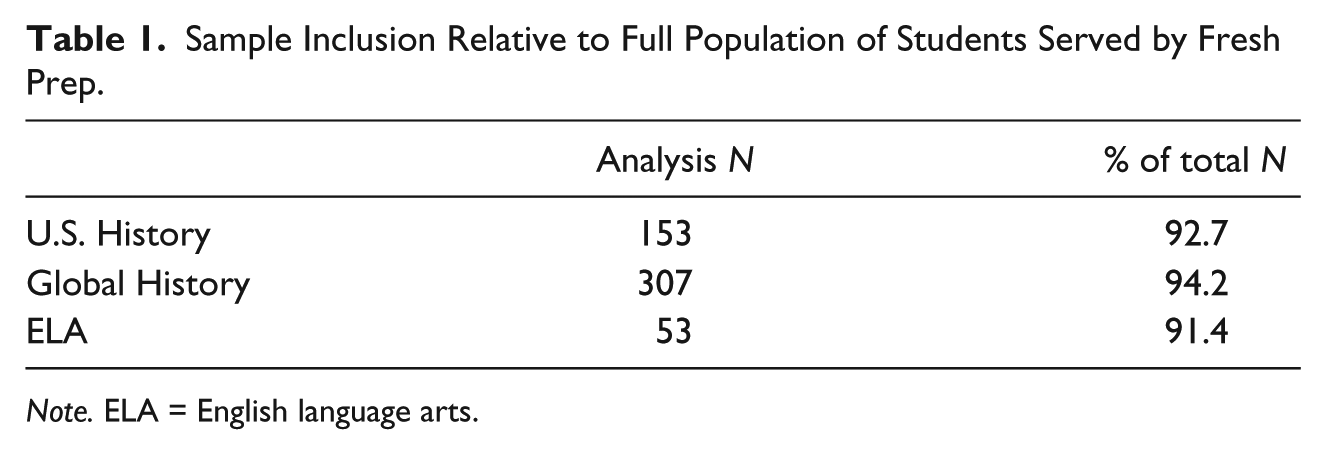
Note. ELA = English language arts.
Outcome Measures
We estimate Fresh Prep’s impact on three student outcomes:
Regents scores: The first outcome we consider is the student’s scaled score on the Regents exam. In the 2013-2014 academic year, Fresh Prep worked with students in three subjects: Global History, U.S. History, and ELA.
Pass rates: The second outcome we consider is the proportion of students passing a given exam. Students pass Regents exams with a minimum score of 65; in these subjects, students with IEPs pass with a score of 55.
Graduation rate: The third outcome we consider is the proportion of seniors who graduated from high school in 2013-2014. This is based on graduation data from the DOE. Graduation is a binary variable, where students were assigned a 1 if they had an outcome of Local Diploma, Regents Diploma, or Advanced Regents Diploma, and 0 otherwise.
Analytic Strategy
This analysis uses PSM, a method for identifying a comparison sample to be compared with the treatment sample when experimental methods are not possible (see Heinrich, Maffioli, & Vazquez, 2010, or Stuart, 2010, for an overview of PSM). 3 In the context of the present article, we use PSM to match Fresh Prep students to other students similar to them in the district. We then compare differences between the Fresh Prep students and this “matched” comparison group on the outcomes of interest. PSM attempts to identify students who are similar to each other on variables that influence both treatment assignment (i.e., participation in Fresh Prep) and outcomes (i.e., Regents and graduation outcomes). Given the similarities between the two groups, outcomes among the matched sample of students can be viewed as “counterfactual” outcomes: how Fresh Prep students would have performed had they not participated in the program. The approach involved the following steps:
Fresh Prep works with students who have either failed the exam or are identified as at risk of failing by the school administrators. Thus, for each exam, we began by limiting the matching population 4 to students who had either never taken the exam or had previously failed the exam.
We further limited the matching population to students attending schools in the same “Peer Horizons” as the Fresh Prep schools. In 2013-2014, for each public school in New York City, the DOE established a set of roughly 40 comparable schools based on the characteristics of incoming students; together, these 40 schools comprise a school’s Peer Horizon. For the purposes of the present analysis, limiting the population of students to those attending Peer Horizon schools has the benefit of reducing school-level variation between the Fresh Prep students and the matched samples.
We created a binary variable indicating whether a student participated in the Fresh Prep program (“yes” = 1) or did not participate (“no” = 0). Among the population of students taking each test, we used probit regression models to estimate each student’s individual likelihood of being in the Fresh Prep program, given their background characteristics (e.g., prior test scores). For each student, the probit model yields the probability or the propensity of participating in Fresh Prep. We estimated separately for each tested subject. (Output from these models is available upon request.) The regression models included the following pretreatment predictor variables: Whether the student has an IEP (yes/no) Whether the student is an ELL (yes/no) Whether the student is female (yes/no) Whether the student is eligible for free/reduced price lunch (yes/no) Whether the student attends a Transfer School or Young Adult Borough Center (YABC) School (yes/no)
5
Student ethnicity: Students could be identified as Asian, Black, Hispanic, Multiracial, Native American, or White. We included ethnicity as a series of dummy variables indicating the ethnic group to which the student belonged. Student grade level in 2013-2014: Participation in Fresh Prep is limited to 10th to 12th graders. Students from other grades are excluded from the analysis. We included a series of dummy variables indicating the student’s grade. Student attendance in 2012-2013: This is a count variable for the total number of days in the academic year that the student was marked present. There were students who lacked a measure of their attendance. Rather than dropping those students, they were assigned the mean level of days present for their school. To indicate that these students did not actually attend school for the assigned number of days, we also included a dummy variable equal to 1 only for those missing a true measure of attendance, and 0 otherwise. Together, both variables provide a measure of the number of days a student attended. We use 2012-2013 attendance instead of 2013-2014 attendance because 2013-2014 attendance could theoretically have been impacted by a student’s participation in the Fresh Prep program. Student eighth-grade state exam proficiency ratings for ELA and math: The proficiency rating on the ELA or math exam is a score in 0.01 increments and ranges from 1.00 to 4.50. There were a number of students who, for reasons that we did not observe, did not have a recorded score or proficiency rating for the eighth-grade exam.
6
To incorporate those students into the model along with students who did possess a rating, the proficiency rating was rounded down to the nearest integer and those without any score were assigned a value of 0. This created a categorical variable for a student’s performance, including a category for missing scores. The categories were included as separate dummy variables in the matching models. The ELA and math variables were defined identically. Students in the Fresh Prep program in 2013-2014 were enrolled in different grade levels, so the eighth-grade scores were drawn from different years, as far back as 2005-2006 for a student who may have repeated grades. Student Regents exam history: Given the Fresh Prep objective to assist students who have failed the test, information regarding past performance is relevant. Because we dropped all students who had previously passed the exam from the matching population, the failing scores ranged from 0 to 64. This range was divided into six smaller ranges: 0 to 35, 36 to 45, 46 to 50, 51 to 55, 56 to 60, and 61 to 64. We computed a count variable to indicate the number of times a student had previously scored in each of these ranges. This enabled us to keep students in the sample who had not previously taken the exam (i.e., the count variable = 0). The count variables were included as separate variables in the model. In addition to each of the variables described above, we also included interactions of the ELL indicator with the variables counting the number of times a student scored in each of the failing ranges. This was intended to capture the possibility that English language skills may affect the ability of a student to improve their Regents exam score in future exam attempts.
Once we estimated each student’s likelihood of being in Fresh Prep, we matched Fresh Prep students to non–Fresh Prep students (from the matching population) with similar propensity scores, using an approach called nearest neighbor matching (caliper = ±0.01) (Stuart, 2010). Where possible, we matched Fresh Prep students to the three non–Fresh Prep students with the closest scores. In some cases, we were only able to find one match for students. However, because the treatment population was relatively small and we were drawing from a sample that included several thousand students, we were able to find at least one match for each Fresh Prep student.
The goal of this process is to create two samples that are statistically similar (or “balanced”) on the variables that are likely to affect both participation in the program and program outcomes. To determine whether the two samples were balanced on these variables, we tested for mean differences between the Fresh Prep students and non–Fresh Prep students on each variable. Results from the t tests for the final, balanced samples are reported in Tables A1 to A3. As these tables show, across all groups, the matching created balanced samples.
When we were certain that the two samples were comparable, we compared the two samples on the outcome measures described in the previous section. We looked for substantive differences between the Fresh Prep students and the matched samples on these outcomes. In addition, we performed between-groups t tests to determine whether the outcomes for each group were significantly different.
Results
Regents and graduation outcomes for both Fresh Prep students and the matched comparison sample are shown in Table 2. We also present results from the significance tests on the differences between the group means in Table 2. For reasons of simplicity, we present only the p value from the between-groups t test. In this article, we are using .05 as the threshold for determining statistical significance; p values lower than .05 suggest “statistical significance,” although in analyses with small sample sizes we point out differences that approach this threshold.
Observed Outcomes for Fresh Prep Students and Matched Sample.
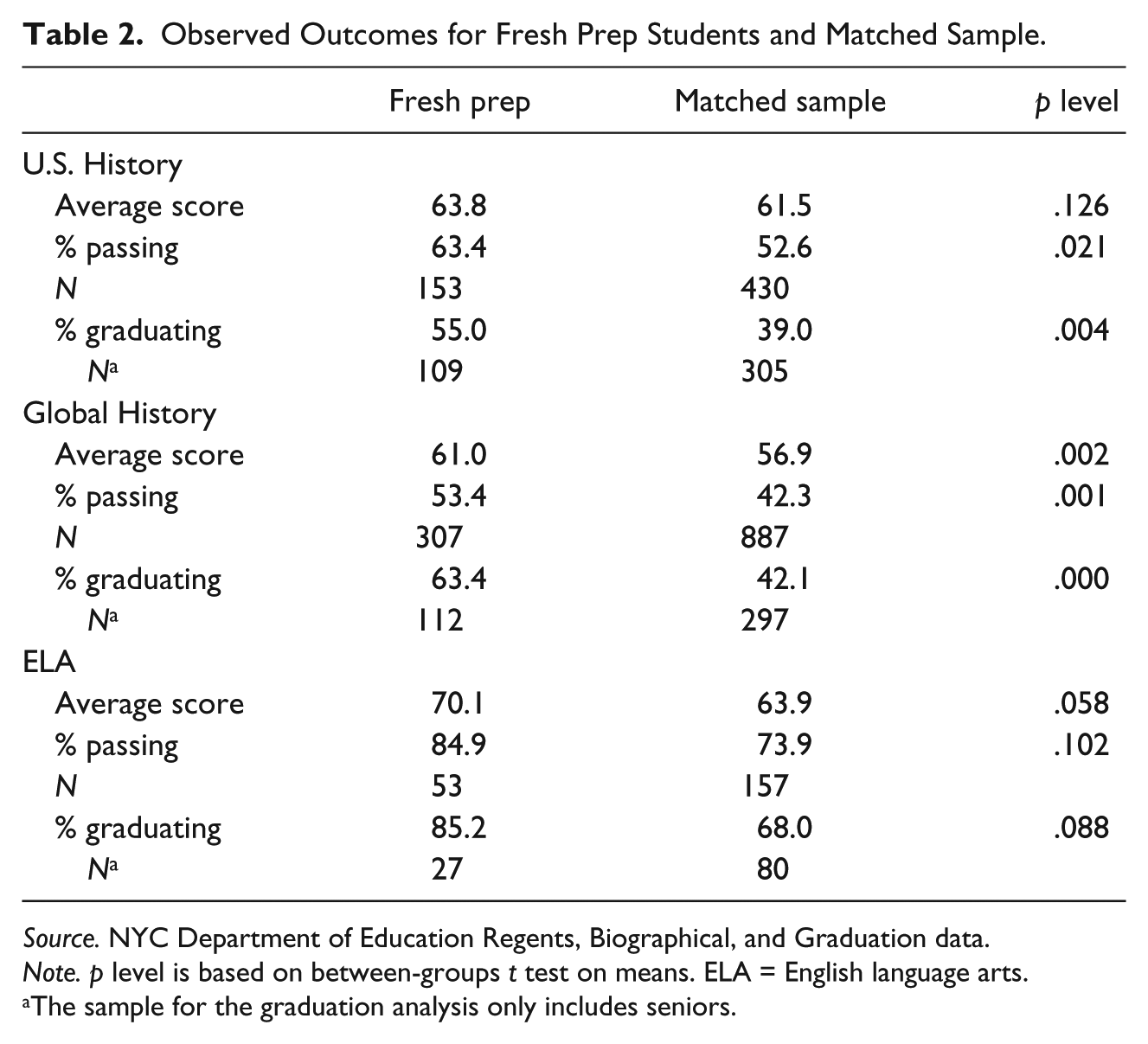
Source. NYC Department of Education Regents, Biographical, and Graduation data.
Note. p level is based on between-groups t test on means. ELA = English language arts.
The sample for the graduation analysis only includes seniors.
In U.S. History, Fresh Prep students scored marginally (and not significantly) higher on the exam than the matched sample. However, the pass rate and graduation rate were both substantively and statistically higher among Fresh Prep students: 63.4% of Fresh Prep students passed the U.S. History exam, compared with a pass rate of 52.6% among comparison students. Moreover, the graduation rate was 16 points higher among Fresh Prep seniors than the comparison seniors (55.0% vs. 39.0%). Fresh Prep students in Global History performed better on all three outcomes than the matched sample. The average score was moderately higher (4 points) and statistically significant. The pass rate was 11 points higher among Fresh Prep students (53.4% vs. 42.3%) and the graduation rate was 21.3 points higher (63.4% vs. 42.1%). Each of these differences was statistically significant. Fresh Prep students also outperformed the matched sample on the ELA exam, scoring 6.2 points higher, on average (70.1 vs. 63.9); this difference was substantively large and approached statistical significance at the .05 level (p = .058). The pass rate was 11 points higher among Fresh Prep students than comparison students (84.9% vs. 73.9%); this difference was not statistically significant. The graduation rate among seniors was also 17 points higher among Fresh Prep students; this difference was also substantively large and it is likely that with a larger sample it would have reached statistical significance at the .05 level.
Comparing Fresh Prep Students’ Performance to “Pre-Fresh Prep” Performance at Partner Schools
It is possible that any observed differences in outcomes between Fresh Prep students and the matched samples could be attributed to differences at the school level. Fresh Prep students may, for instance, simply attend more innovative schools, which could explain both strong performance among students in the school and the school’s decision to partner with a program like Fresh Prep. If this is the case, then we would be overestimating Fresh Prep’s impact on student performance. We attempted to reduce some school-level variation by limiting the matching population to only Peer Horizon schools, but it remains a possibility that Fresh Prep schools still differ in unobserved ways from the schools attended by the comparison students. 7
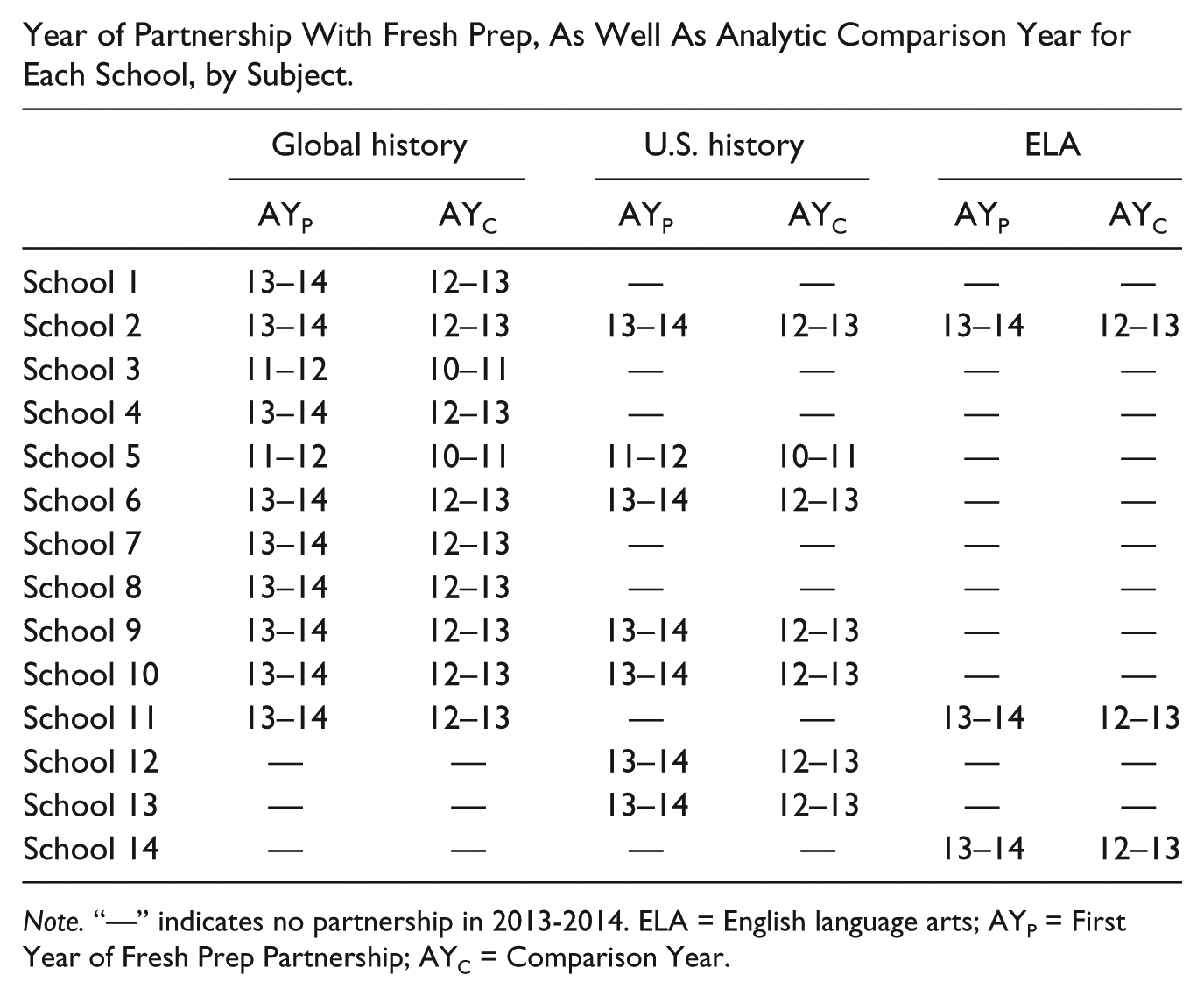
To examine the possibility that students attending Fresh Prep partner schools would have done better than their peers at other schools even in the absence of the program, we compare performance among 2013-2014 Fresh Prep students with performance among retakers attending the same schools before Fresh Prep partnered with the school. (Recall that Fresh Prep students are retaking their Regents exams, which is why we limit the sample to retakers.) For example, for schools that first partnered with Fresh Prep in 2013-2014, we used the 2012-2013 year as the comparison year. This method allows us to control for any unobservable, time-invariant school-level characteristics that might bias the outcomes. (Appendix B shows the academic year in which Fresh Prep began its partnership with each school, as well as the academic year used as the “comparison year” for each school.) Although there are always some changes within schools from one year to the next, comparing changes in year-on-year performance within a school enables us to determine whether student outcomes changed after the introduction of the Fresh Prep program. For each subject, we pool together results from the comparison years and compute a “pre-Fresh Prep” average for the outcomes. We then compare these pre-Fresh Prep averages on the outcomes to the 2013-2014 averages among Fresh Prep students. The results are shown graphically in Figure 2.
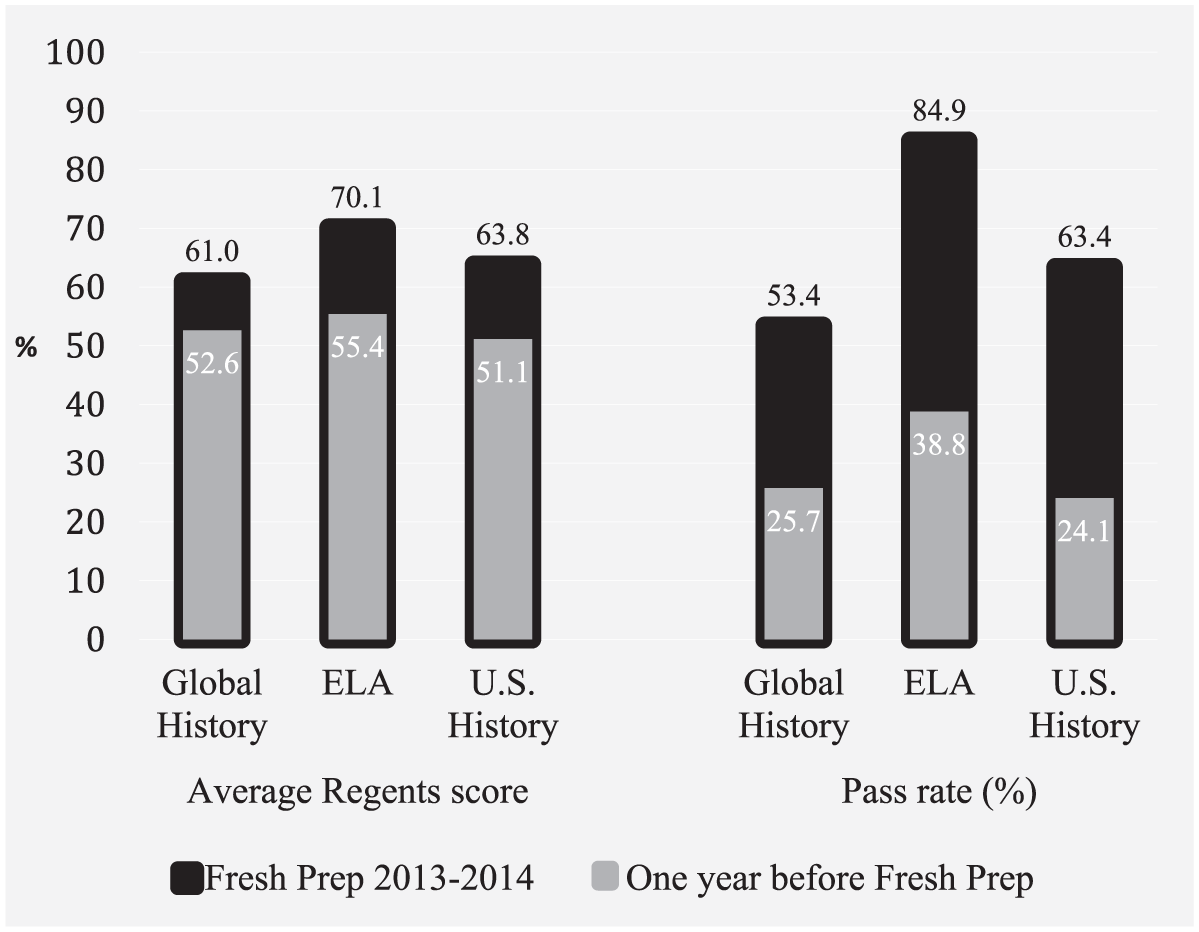
Regents scores and pass rates (%) for 2013-2014 Fresh Prep students retaking the Regents exam (orange) and students attending Fresh Prep schools and retaking exam the year before Fresh Prep partnered with the school (gray).
Across all three subjects, Fresh Prep students performed better than the cohort of students who retook the exam the year before Fresh Prep partnered with the school. Fresh Prep students also had much higher pass rates: roughly two times higher than the comparison cohort in Global History, 2.2 times higher in ELA, and 2.6 times higher in U.S. History. These results verify the robustness of our earlier results and suggest that the differences between Fresh Prep students and students in the matched sample cannot be explained simply by school-level selection effects. On the contrary, both average scores and pass rates increased across all three subjects after the introduction of Fresh Prep.
Limitations of the Analysis
The above analysis has some limitations, most of which can be addressed via additional research. First, we theorize above that Fresh Prep works through accessing the deep and surface structures of hip-hop culture and youth culture, although we are unable to test that theory in the present article. A qualitative study of student participants in the program is needed to further understand, from their perspective, the role that cultural factors play in the classroom, how students become engaged in test preparation, and whether the benefits of Fresh Prep extend into other academic areas: that is, whether the intervention reengages them in schoolwork overall. Second, there was variation in how the program was delivered across schools, as well as variation in student performance across schools. At some schools, MCs faced scheduling challenges that prevented students from receiving the desired dosage; at other schools, MCs struggled to secure buy-in from teachers and engage them as partners in the classroom. These challenges are very common for education interventions integrated into the school day, but the natural question is whether variability in program delivery is associated with variability in student outcomes. Answering that question is beyond the scope of this article. However, we examined internally whether student outcomes differed depending on the strength of the co-teaching relationship between the classroom teachers and the MCs delivering the program, with the strength of the co-teaching relationship for each school being reported by program staff. We found an overall correlation of +.677 (p = .001) between strength of the co-teaching relationship and a school’s pass rate, indicating that quality and consistency of program inputs play an important role in mediating the effectiveness of the program.
Discussion and Implications
Fresh Prep is part of a larger movement to integrate culturally responsive practices into classrooms. This movement includes work by scholars, educators, education nonprofits, and government agencies to cultivate practices that aim to engage students by drawing on their shared histories and interests (see, for example, Kim & Pulido, 2015; Kozleski, Sullivan & Kucera, 2010; Santamaria, 2009; Villegas & Lucas, 2007). Hip-hop pedagogy is one approach to CRP; educators can similarly draw on other areas of youth culture or unique facets of students’ local and global histories as the fulcra for curriculum planning. In this way, Fresh Prep serves as a case study for educators seeking to understand the value of using CRP in the classroom.
The results from this analysis suggest that Fresh Prep may be a promising intervention for increasing high-stakes test pass rates and graduation rates among test retakers in New York City high schools. The analysis indicates that Fresh Prep outperformed the matched sample of students on each of the exams and that this difference was statistically significant on the Global History and ELA exams. As the goal of the program is to ultimately help students graduate from high school, the fact that the program had a consistent, positive effect on pass rates and graduation rates is encouraging, even if the effect on average scores is more moderate. Moreover, the results indicate that scores and pass rates were higher for 2013-2014 Fresh Prep students than for retakers in the “pre-Fresh Prep” era, validating the robustness of our findings on the positive effect of Fresh Prep on students’ exam scores.
Taken more broadly, these results demonstrate the promise of an intervention that employs culturally responsive methods as the core of its methodology in improving academic outcomes on high-stakes standardized tests. While the intervention seeks to support students’ development of critical consciousness in response to academic content, it does so within the goal of supporting students’ success on the tests; in other words, it provides a different learning pathway toward a familiar goal. As such, the intervention does not encourage questioning the metric by which student success is determined and may thus fall short of the full realization of CRP. Additional research is needed on this and other culturally responsive interventions and their effects on student academic outcomes, as well as their stance on the extent to which they challenge the dominant school paradigms, to continue to build this much-needed evidence base (Sleeter, 2012).
Although CRP is increasingly accepted and even lauded in mainstream education circles, the practice is not yet a curricular pillar in most urban schools. In the remaining space, we reflect on practices that will encourage the integration of CRP more broadly. To begin, Fresh Prep places professional teaching artists from a nonprofit organization into classrooms to implement the program. The teaching artists (MCs) are recruited specifically for their understanding of CRP and their connection to hip-hop culture; in their artistic lives, the MCs are rappers, spoken word poets, and/or music producers. Traditional classroom teachers who are asked to incorporate culturally responsive practices in the classroom without a teaching artist present may be hesitant. Some may not immediately see the value of CRP. Others may feel uncomfortable with what may be perceived as appropriating aspects of students’ cultures or insecure using the methods on their own without guidance and support.
These concerns may be well founded. Kim and Pulido (2015) explore evidence from two Chicago-based studies of educators’ use of hip-hop in the classroom and conclude that certain practices can undermine the goals of CRP. These practices include taking a top-down perspective to determine what will be interesting to students, using materials that students do not connect with, and not making explicit the ways in which students can use hip-hop to access broader curricular themes. Moreover, it is plausible that teachers who are not trained in CRP will understandably employ more surface than deep cultural structures in the classroom; as an example, they may use hip-hop as a means to an end without acknowledging its intrinsic value as an art form or its significance in urban culture more narrowly and youth culture more broadly.
For teachers to feel empowered to use CRP in their classrooms will require significant preprofessional and professional development that supports them as they learn about their students’ cultures and sociopolitical histories, the value of CRP, and how it should be used in the classroom to both disrupt and complement mainstream Eurocentric educational practices. Training teachers on a range of culturally responsive methods for engaging students will ideally help them see the generality of the methods and give them practice at adapting a set of methods to reach specific student groups.
It is also crucial that the broader educational community continues to develop and disseminate explicit activities and resources that facilitate the integration of culturally responsive practices in the classroom. A virtue of the Fresh Prep program is that it provides teachers with a suite of songs, branded paraphernalia, and test-aligned workbooks and lesson plans. It also provides teachers with a set of methods (e.g., the cypher, competitive crews) to integrate into their existing lessons if they continue to use the program after the MCs’ involvement ends. Fresh Prep’s resources and activities facilitate CRP by removing from teachers the burden of developing original material; instead, teachers can focus on integrating existing songs and practices into their lessons. Conversely, the lack of culturally responsive materials may stand in the way of teachers who integrate CRP into their practice, but can only access traditional test preparation materials. For CRP to gain a foothold across all urban schools, the educational community will need to continue to develop additional resources and activities that teachers can draw on in their classrooms.
In conclusion, this study provides evidence for the effectiveness of CRP, as manifested in a hip-hop pedagogy–based test prep program, in helping students learn course content and pass high-stakes exams. As the field moves forward, we recommend not only additional research to unpack the black box linking CRP to student outcomes but also development of new trainings, tools, curricula, and methods for helping urban teachers integrate these methods more widely in the classroom.
Footnotes
Appendix A
Mean Scores on Key Covariates for Fresh Prep Students and Matched Sample, Along With Results From Between-Groups t Test: ELA.

| Fresh Prep | Matched sample | p level | |
|---|---|---|---|
| Grade 8 ELA level | |||
| Level 1 | 13.2 | 16.6 | .564 |
| Level 2 | 52.8 | 56.7 | .627 |
| Level 3 | 9.4 | 8.3 | .796 |
| Level 4 | 0.0 | 0.0 | — |
| Missing | 24.5 | 18.5 | .343 |
| Grade 8 math level | |||
| Level 1 | 13.2 | 10.8 | .640 |
| Level 2 | 41.5 | 47.1 | .480 |
| Level 3 | 24.5 | 26.1 | .820 |
| Level 4 | 0.0 | 0.0 | — |
| Missing | 20.8 | 15.9 | .422 |
| Past Regents scores | |||
| 0-35 | 7.5 | 7.0 | .895 |
| 35-45 | 13.2 | 8.9 | .370 |
| 45-50 | 5.7 | 7.6 | .652 |
| 50-55 | 7.5 | 5.1 | .542 |
| 55-60 | 5.7 | 7.0 | .736 |
| 60-64 | 20.8 | 20.4 | .954 |
| Never | 26.4 | 28.0 | .822 |
| ELL | 28.3 | 26.8 | .827 |
| IEP | 28.3 | 23.6 | .492 |
| Black | 30.2 | 26.8 | .630 |
| Hispanic | 56.6 | 59.9 | .677 |
| Free lunch | 83.0 | 86.0 | .600 |
| Ave. attendance | 146.4 | 147.4 | .748 |
| Transfer/YABC | 1.9 | 0.6 | .420 |
| Grade (%) | |||
| 10 | 1.9 | 0.6 | .420 |
| 11 | 47.2 | 51.6 | .580 |
| 12 | 50.9 | 47.8 | .691 |
| N | 53 | 157 | |
Source. NYC Department of Education Regents and Biographical Data.
Appendix B
Year of Partnership With Fresh Prep, As Well As Analytic Comparison Year for Each School, by Subject.
| Global history |
U.S. history |
ELA |
||||
|---|---|---|---|---|---|---|
| AYP | AYC | AYP | AYC | AYP | AYC | |
| School 1 | 13–14 | 12–13 | — | — | — | — |
| School 2 | 13–14 | 12–13 | 13–14 | 12–13 | 13–14 | 12–13 |
| School 3 | 11–12 | 10–11 | — | — | — | — |
| School 4 | 13–14 | 12–13 | — | — | — | — |
| School 5 | 11–12 | 10–11 | 11–12 | 10–11 | — | — |
| School 6 | 13–14 | 12–13 | 13–14 | 12–13 | — | — |
| School 7 | 13–14 | 12–13 | — | — | — | — |
| School 8 | 13–14 | 12–13 | — | — | — | — |
| School 9 | 13–14 | 12–13 | 13–14 | 12–13 | — | — |
| School 10 | 13–14 | 12–13 | 13–14 | 12–13 | — | — |
| School 11 | 13–14 | 12–13 | — | — | 13–14 | 12–13 |
| School 12 | — | — | 13–14 | 12–13 | — | — |
| School 13 | — | — | 13–14 | 12–13 | — | — |
| School 14 | — | — | — | — | 13–14 | 12–13 |
Note. “—” indicates no partnership in 2013-2014. ELA = English language arts; AYP = First Year of Fresh Prep Partnership; AYC = Comparison Year.
Acknowledgements
The authors would like to thank the Fresh Prep pedagogical team. We are particularly grateful to Eboni Hogan, James Miles, and Jamel Mims for their input on earlier drafts of the paper.
Declaration of Conflicting Interests
The author(s) declared the following potential conflicts of interest with respect to the research, authorship, and/or publication of this article: We acknowledge the following potential conflicts of interest. At the time of preparing the manuscript first author was an employee of Urban Arts Partnership, the nonprofit organization whose intervention, Fresh Prep, is described in the research. However, she had no part in the analysis of the empirical data presented in the article. The second author is an independent consultant who was contracted by Urban Arts Partnership to conduct the data analysis presented in the article. The third author is a former employee of Urban Arts Partnership. We certify that the research was undertaken for the purposes of scientific inquiry and not influenced by our affiliation with the organization that sponsors the intervention under discussion.
Funding
The author(s) disclosed receipt of the following financial support for the research, authorship, and/or publication of this article: The intervention described in this research was supported in part by the Robin Hood Foundation.