







Abstract
This article highlights the acclaim, struggles, and ultimate closure of a Detroit public school for pregnant and parenting teens that was shuttered despite national commendation, community protests, for-profit charter conversion, and a civil rights lawsuit. Authors analyze discourse from educational, media, and legal data sources to offer a critical policy analysis of the school’s closure trajectory. Authors suggest how the effects of state decision making, restricted student agency, and waning legal protection fueled public educational disenfranchisement rather than boosted educational access and equity. Implications regarding school closure policy reform, community coalition building, and renewed legal protections in urban education are discussed.
Keywords
Public schools serving large percentages of students of color are being closed at high rates in many U.S. cities. Educational policymakers and urban school officials typically link closure decisions to low student achievement rates, declining enrollment, and decreased public school funding (Deeds & Pattillo, 2015; Johnson, 2013; Lipman & Haines, 2007; Valencia, 2012). Nationally, the former federal policy context of No Child Left Behind and the current Every Student Succeeds Act (ESSA) have encouraged choice policies, school “turnaround,” and school closure as options for persistently failing public schools. Prominent closure tactics, however, can disenfranchise educational and residential communities, disrupt children’s educational progress, and contribute to urban blight and systemic racism while boosting private sector profit (Briscoe & Khalifa, 2015; Conner & Cosner, 2014; Lipman & Haines, 2007; Means, 2008). Some research specifically suggests that school closure decisions are intertwined with broader, privatizing neoliberal market agendas and urban revitalization movements largely guided by corporate entities (Briscoe & Khalifa, 2015; Kretchmar, 2014; Lipman & Haines, 2007). In cities like New Orleans, Detroit, Chicago, and St. Louis, traditional public school closings have also coincided with charter school expansion (Frankenberg, Siegel-Hawley, & Wang, 2010; Zernike, 2016). In Detroit, many traditional public schools have closed and reopened as charter schools serving the same population, at times in the same building (Pedroni, 2011; Wilson, 2015), calling into question, who profits from school closure, chartering, and “renewal” processes that typically displace Black and Brown children.
In this article, we offer a critical examination of the acclaim, struggles, and ultimate closure of one Detroit school—Catherine Ferguson Academy (CFA)—a renowned public school for pregnant and parenting teens (PPTs) that operated from 1986 to 2014. CFA was closed despite its local and national reputation for long-term success in nurturing and graduating a hyper-vulnerable, African American student population. The school was shuttered notwithstanding student and community protests, a for-profit charter school conversion, and a civil rights lawsuit.
The three main research questions guided our inquiry are as follows:
Critical policy analysis objectives guided our inquiry, hence we considered the significance of race, class, and gender factors. Our examination offers important policy, educational, and legal implications often overlooked in school closure research. We pinpoint how damaging educational policies can be when stakeholders have contradictory notions of success and policymakers wield their power in ways that conflict with public will and unjustly penalize youth.
CFA students were subjected to systemic educational failure and antidemocratic policymaking, despite having some legal recourse. CFA’s closing reflected the “politics of disposability”—a convergence of neoliberal agendas, policymaking, and implementation that assumes marginalized groups’ social and political dispensability and spurs privatization that erodes public spaces, institutions, and resources that benefit them (Giroux, 2006, p. 11; Means, 2008; Wilson, 2015).
Detroit’s Divisive Educational Landscape
Detroit public schools (DPS) have languished since the 1970s due to numerous factors, including corporate disinvestment, deindustrialization of the automobile industry, and a severe decline of middle-to-upper income homeowners, which drained tax revenue for school funding (Sugrue, 2005). The city’s public school district also has a crippling debt of over US$500 million, which accrued starting in 1999 when the district faced municipal and state takeover (Gast & Shortell, 2016). State intervention escalated in 2009 when officials first assigned the district a governor-appointed emergency manager due to its drastically low achievement scores. The State of Michigan has only mandated this type of regulation in its predominantly Black public educational systems (Khalifa, Douglas, & Chambers, 2016). Detroit’s school district did not markedly improve after nearly 20 years of state oversight, yet its debt skyrocketed. Unstable governance exacerbated the city’s educational woes.
Detroit’s public schools’ student population is 98% of color, with approximately 80% being African American/Black, and almost all others being Hispanic/Latinx (Michigan Department of Education [MDE], 2016). All district schools receive federal Title I funds given their high poverty contexts. In a 2016 New York Times article, Detroit’s public schools were characterized as “run down after years of neglect and mismanagement, while failing academically and teetering on the edge of financial collapse” (Bosman, 2016).
Until late 2016, the district’s locally elected school board was an impotent entity, and limited governing power was reassigned to the school board via a November 2016 local election after residents called for the return of local control (Zaniewski, 2016). Residents also insisted their newly empowered school board be more accountable to community feedback than in the past (Bach, 2017).
School closure and the proliferation of nonprofit and for-profit charter schools in their place have been the most prevalent educational intervention in Detroit’s public schools (Zernike, 2016), which remain among the lowest performing in the United States (Higgins, 2018). Since 2000, state and district officials have authorized the closing of over two thirds of Detroit’s schools, citing population loss, financial need, and dilapidated facilities. Many closures have occurred without the state or districts providing communities of color high-quality alternatives (Wilson, 2015; Khalifa et al., 2016; Pedroni, 2011). In addition, one third of Detroit’s predominantly Black, school-aged population attends school out of the city given interdistrict choice options that allow students to enroll in nearby, higher resourced, predominantly White or racially mixed suburban schools (Chambers, 2015).
The Politics of Urban School Closure
Contemporary urban school closure tactics represent a prime neoliberal political strategy that is heavily influencing educational policy arenas throughout the United States. Proponents of neoliberalism view market-driven, privatization, and public deregulation tactics as essential to advancing the economy and society-at-large. Neoliberalism aims to censure the role of government and bureaucracy in implementing social welfare policies and/or community-driven, public initiatives (Conner & Cosner, 2014; Johnson, 2013; Lipman & Haines, 2007; Means, 2008). Likewise, dominant neoliberal narratives about urban school improvement suggest creating educational opportunity is a private act or “choice” versus a public obligation (Means, 2008; Wilson, 2015).
Although public officials who call for school closing typically assert it will provide greater academic opportunities and learning outcomes for exiting students, such effects are mixed across research. Brummet’s (2014) Michigan study suggests closures might help exiting student achievement, but demonstrates consistent negative effects for receiving schools. In addition, de la Torre and Gwynne (2009) found school closures did not help most students from low-achieving schools in Chicago. Instead, positive effects were seen only for the 6% of students who could transfer to high performing schools with supportive teachers and strong academics. Basu (2007) contends urban public school students who experience school closure tend to suffer a “loss of place, community and sense of belonging” (p. 110), which affects them emotionally and academically. Moreover, in studying Austin, TX, Johnson (2013) concluded school closure “provided opportunities for privatization of school management” (p. 249) and school repurposing, rather than boosting opportunity and outcomes for exiting students.
Conner and Cosner (2014) more pointedly asserted, “school closure is a form of structural violence that further dehumanizes already marginalized students, families, communities, and schools” (p. 34). Despite the justification that closing one school will allow students to attend better schools, the authors marshal data from Philadelphia to argue that closure policies do not lead to better student achievement or graduation rates; rather in some cases, they found negative effects on students for up to 3 years following a closing. The authors pinpointed higher levels of student violence in schools that absorbed displaced students compared with schools’ violence rates before they were shuttered.
Many researchers have linked the harmful effects of school closure to district and state officials’ faulty decision making and closure approach. Some have found urban, low-income residents—predominantly Black and/or Latinx—have minimal opportunities to influence officials’ decision making about school closure in their communities. Civic officials tend to feel more accountable and be more responsive to higher income—often White—city residents with social capital, “civic skills,” and political savvy they recognize and value (Briscoe & Khalifa, 2015; Finnigan & Lavner, 2012; Green, 2017; Kretchmar, 2014, p. 134; Lipman & Haines, 2007). Lipman and Haines (2007) determined in their study of Chicago school closure that “bypassing the community and eliminating LSCs [local school councils on which low-income family members participated] is about redefining civic competence and concentrating the authority to participate in civic governance in the hands of professional elites” (p. 494), thus largely disempowering urban, communities of color.
In Detroit, such “elites” have largely been conservative, White, Michigan state leaders and policymakers who have regarded privatizing reform measures, like the increased authorization of for-profit charter schools, as socioeconomic remedies to the city’s educational and economic crises (Hammer, 2011; Khalifa et al., 2016). These officials, like many other charter school and market-based reform proponents (DeVos, 2016; Hoxby, 2003; Schneider, Teske, Marshall, & Roch, 2000), have framed charter schools as offering quality options to disadvantaged urban families of color by increasing their choices in the educational marketplace.
As of 2015, Detroit charter schools outperformed the city’s district schools in math and reading by 51% and 60%, respectively. They, however, enroll fewer English language learning (ELL) and special education (SE) students and have negative learning gains on the ELL and SE students they do serve (Center for Research on Education Outcomes [CREDO], 2015; DeArmond, Jochim, & Lake, 2014). Overall, Detroit charter schools are still low performing by state and national standards (CREDO, 2015; DeArmond et al., 2014), and have approximately 15% higher teacher turnover rates compared with the city’s traditional public schools (Robinson & Lloyd, 2017).
In Detroit, as in many other urban locales, the coupling of charter school expansion with traditional public school closure has also exacerbated racial and socioeconomic segregation (Frankenberg et al., 2010). Although studies indicate that school closure processes and effects are politically disenfranchising for communities of color (Conner & Cosner, 2014; Johnson, 2013; Lipman, 2017; Lipman & Haines, 2007), policymakers and educational officials usually situate the impact of closing schools in racially neutral contexts (Briscoe & Khalifa, 2015). Nevertheless, historical analyses of school closure cases, dating back to desegregation resistance in the wake of Brown v. Board of Education, reveal low-income students of color bear the heaviest academic and emotional burdens of school closure implementation (Deeds & Pattillo, 2015; Johnson, 2013; Lipman & Haines, 2007; Valencia, 2012).
Critical Policy Analysis
Critical policy analysis theories constituted our conceptual framework and influenced our methodology. Unlike traditional policy analysis frameworks anchored in rational-technical analysis, critical policy analyses consider policies’ political, social, and cultural contexts and suggest who is empowered and disempowered by policies given these contexts. They assume policymaking and policy analysis are never value free; instead, they are complex, subjective processes steeped in power differentials (Diem, Young, Welton, Mansfield, & Lee, 2014; Gale, 1999; Levinson, Sutton, & Winstead, 2009). Hence, policymaking is ultimately “a practice of power” (Levinson et al., 2009, pp. 778, 767).
Local, regional, state, and federal policymakers are vested with the power to identify and prioritize social problems, set a public agenda, and develop strategies of action or inaction. They also help establish norms of acceptable civic engagement. Critical policy stances view policy as reflecting policymakers’ knowledge, ideology, practice, and dominant discourse (Bertrand, Perez, & Rogers, 2015; Briscoe & Khalifa, 2015; Gale, 1999, 2001; Levinson et al., 2009; Marshall, 2000). The CFA case includes a school community’s use of media, protest, and the courts to influence local education policymakers’ knowledge and decisions, so a critical policy lens provided our team a medium to appraise the sociopolitical and cultural contexts surrounding CFA’s closure, paying specific attention to the sociopolitical positioning of all involved.
Researchers have found that policymakers mainly talk to and learn from other political elites rather than engaging and learning from non-elites like community members at-large, and specifically people of color or those with low incomes (Bertrand et al., 2015). Dominant policy discourse about communities and children of color is consequentially deficit-based, frequently positioning people of color as culturally deficient and to blame for their disadvantaged, societal positions. Others, like Bobo, Kluegel, and Smith (1997), assert that dominant epistemic frames of individualism and meritocracy fuel oppressive policymaking and perpetuate classist and racist policy effects. Such frames intensify classist and White supremacist ideologies, as opposed to epistemic frames anchored in equity-oriented, structural analyses that recognize how policies and institutions construct and perpetuate systemic inequality (Bonilla-Silva, 2006; Briscoe & Khalifa, 2015; Dumas, 2014). Some critical policy analysis scholars also consider the salience of gender bias in policymaking and policy implementation—and to varying extents its intersection with racial and class bias (Marshall, 2000; Pillow, 2004, 2006). In line with critical policy analysis aims, we examined the discursive nature of school closure policy implementation in the case of CFA, including the relevancy of race, class, gender, and power differentials.
Research Focus and Data Sources
Our preliminary assessment of CFA’s history revealed disconnect between the narrative of the school’s stellar achievements and it being targeted for shuttering. Hence, we were interested in understanding district officials’ ultimate decision to close the school rather than support it as a model site. We also wanted to gauge how the perspectives and interests of CFA’s PPT students were represented in the school closure debate, and how the students’ lawsuit mattered.
We analyzed three key areas of discourse to address our research questions. First, we considered the media discourse surrounding CFA and its closure. Second, we considered the educational discourse pertaining to the politics of Detroit’s public and charter schools, school closures, and effective practices for serving PPT students found in educational records, policy, and scholarship. Third, we considered the discourse found in the publicly accessible, CFA civil rights lawsuit documents.
The first author learned of the CFA lawsuit in 2014 after agreeing to serve as an expert witness and submit a report supporting the plaintiffs. The case, however, settled out of court before she offered consultation, submitted the report, or received payment for those services. She is completely unaware of the settlement terms, yet became compelled by CFA’s closure and desired to research its history and details more deeply. We constructed our research questions after all interaction with CFA case affiliates ended. Hence, as co-authors, we developed an independent and shared analysis.
We reviewed several dozen articles and numerous websites, using the school’s name to search local newspapers, radio sites, and Google. We then used a snowball sampling method to trace articles to additional district and state sources. Many articles helped provide contextual details about the school’s history and programs, yet we chose to conduct a closer content analysis of a subset of articles, media sources, and legal documents. Conducting a content analysis involved systematically analyzing text to identify themes, perspectives, and language used to describe and understand phenomena (Hsieh & Shannon, 2005). Our final data include the following: 15 CFA-specific articles, three public educational agency reports about CFA’s charter management organization (CMO), 149 pages of CFA-CMO legal and publicly accessible documents, one CFA documentary film, three CFA community-supported Facebook sites, School Board of Education minutes, and district and state data about CFA’s enrollment, graduation, dropout, and assessments.
In addition, we analyzed 16 news articles published in the 2014 Detroit Free Press investigation series about the city’s charter school system at-large. These articles included significant historical and political details related to charter school and school closure debates in Detroit, including proponents’ and opponents’ perspectives. Most data, however, stemmed from local newspapers, radio and media sources, and a federal district court. We retrieved all legal documents from a public, online court document retrieval service (https://www.pacer.gov).
We examined all data to first establish a timeline of CFA’s history and the key events and debates related to its history, charter conversion, and eventual closure (see Table 1). We reviewed data multiple times to pinpoint and chart the themes, particularly highlighting community member voices and perspectives (e.g., the teen mothers, their parents, local Detroiters). We compared timeline, academic, fiscal, and reputational information from the data and checked for consistency. If conflicting details were reported in the media, we deferred to government and official policy documents. Finally, after charting findings about the educational practices of CFA, we reviewed scholarly literature recommending effective educational practices for PPTs to gauge how research-based recommendations aligned with CFA-related policies and practices.
Timeline of Seminal CFA Events.
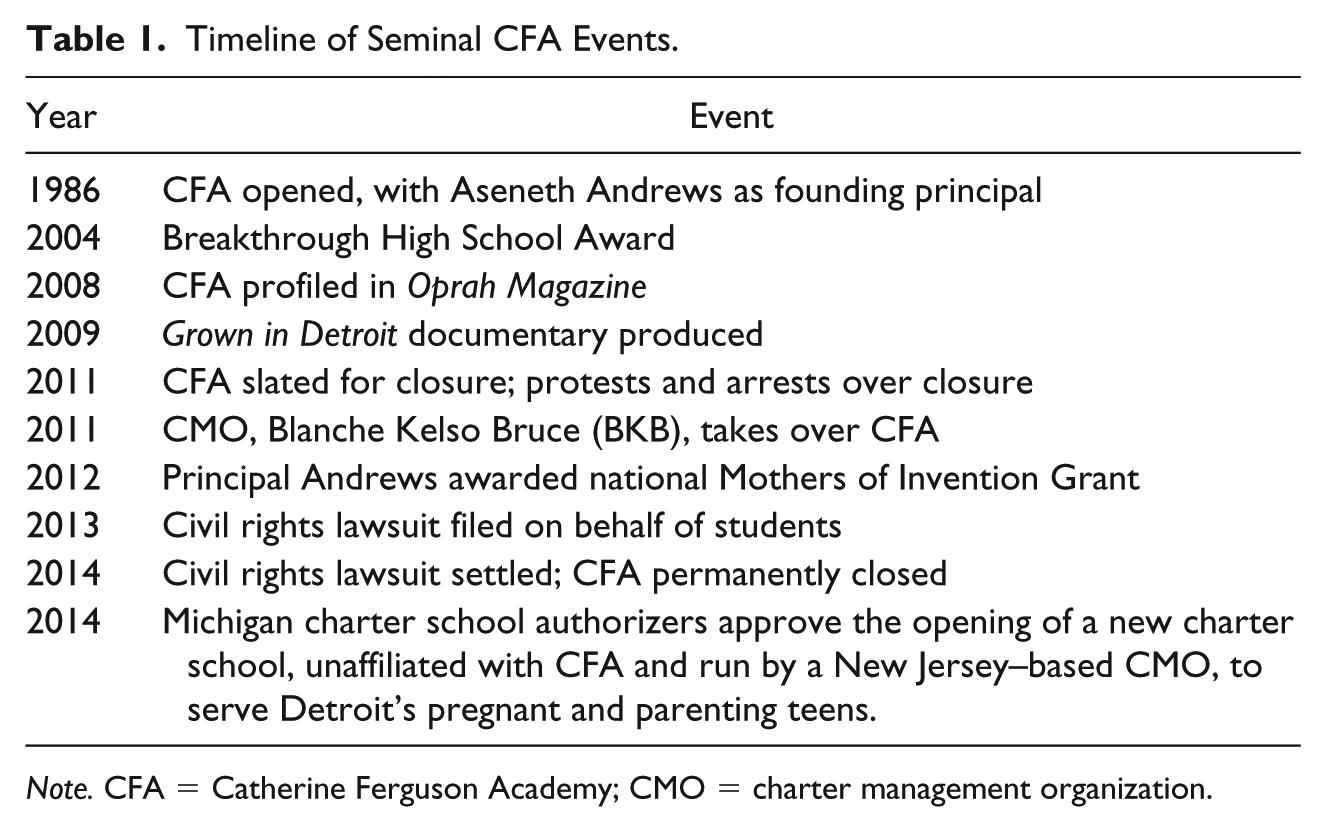
Note. CFA = Catherine Ferguson Academy; CMO = charter management organization.
Policy and legal documents on state education websites typically captured the ideology and agendas of charter school and school closure proponents, while the lawsuit documents largely offered CFA students’ points of view by disclosing the plaintiffs’ detailed allegations against the CMO and public education authorities. In contrast, the defendants’ responses were much briefer and lacked details. Our document analysis allowed us to focus on the perspectives and positionality of Detroit’s Black, pregnant and parenting student population, and it enabled us to present a cautionary counter-narrative about neoliberal school closure approaches and the empowering effects of school choice reform. Our data does not include firsthand interviews as our inquiry began after CFA’s closure in the summer of 2014, which is a limitation. Still, our data stem from sources that routinely influence public knowledge and policy discourse.
The Case of CFA
The CFA was founded in 1986. School district officials created CFA as a single-gendered school to provide a viable, alternative pathway to pregnant and mothering teenaged/preteen girls to deter them from choosing to “ . . . drop out of school, sacrificing one of her most important opportunities for a good future” (“Inside Detroit,” 2008). Throughout its operations, 94% to 99% of CFA students were African American females receiving free and/or reduced lunch. The school served up to approximately 350 students a year.
Unlike most media coverage of Detroit’s educational conditions and schools that emphasize academic struggles, dilapidation, and political controversies (Bosman, 2016; Brown, 2016), coverage of CFA, from local to international sources, offered overwhelmingly positive profiles of the school’s accomplishments (e.g., Fang, 2014; Gerritt, 2010). Over a dozen news articles, court documents, and CFA’s former website concurred that CFA was an innovative school of “academic rigor” with a “reputation for comprehensive study” (Gumbrecht, 2013). CFA also had smaller class sizes than average DPS schools, direct access to community services, and on-site child care that offered early education classes for students’ infants and toddlers (D.W. et al. v. Bruce Kelso Bruce Academy et al., 2013b; Gerritt, 2010; “Inside Detroit,” 2008). Its students were reported to be part of a school that supported holistic wellness and aimed to prepare them for adulthood and academic success post-high school. A CNN reporter concluded, “high school diplomas are the minimum expectation; college acceptance letters are the aim” (Gumbrecht, 2013).
In 2008, Detroit’s school district lauded CFA for its progressiveness, stating in an online profile, “At Ferguson, the main goals are to educate the young mothers and prepare them for a good future.”
1
CFA’s founding and longtime principal was also quoted as asserting, “We want our girls to know that becoming a mother in your teens does not mean you are doomed to a dead end life.” The profile continued, All students are schooled in the core curriculum of English, math, science, and social studies in a family-like, accepting environment. Along with the academics there is “real life” learning about raising a child and how to function as a knowledgeable, independent and productive adult.
The principal added, “The responsibility of providing food, shelter, and other basic needs in life should not be stressful. They have the right to look forward to a rewarding life and we help them achieve it . . . ” (see Note 1).
The media and website sources we located also profiled CFA as an equitable site of experiential learning. The school housed a four-acre urban garden and a farm built and supported by students and staff. The farm was reported as being widely esteemed by the city’s urban agriculture community (Owens, 2008). Teachers said they incorporated the school’s farm in teaching subjects like biology and carpentry, and in fostering students’ learning about motherhood and caretaking (Hair, 2002; Owens, 2008). As part of their affiliation with an international partnership related to urban gardening, community health, and sustainability, CFA students also participated in a study trip to South Africa (Owens, 2008). The documentary Grown in Detroit, which exclusively featured CFA’s urban gardening program and several students’ personal stories, won six national and international film awards (Poppenk & Poppenk, 2009). It also received national attention in Oprah Winfrey’s O Magazine (Owens, 2009; Poppenk & Poppenk, 2009).
Media, school, and district sources linked CFA’s overall success to its turnaround of students’ academic performance and trajectories. Complementary school profiles were published in outlets such as the Detroit Free Press—the city’s largest newspaper (Gerritt, 2010)—a Texas newspaper (Whittaker, 2013), and the Middle Eastern/international news outlet AlJezeera (Fang, 2014). CFA test data, however, were inconsistent across state and district sources, with gaps in data some years and small percentages of data other years. For instance, only twenty-four 11th-grade students of the 44 enrolled were tested in math in 2010-2011 (Michigan Department of Education, 2017b). Various reasons, including absences, medical conditions, refusal, or administrative error could explain these gaps. In addition, Michigan’s state testing system changed in 2008, which may account for some discrepancies. Moreover, test data—typically the most significant indicator of educational success to policymakers—were not reported in either plaintiff or defendant documents associated with the 2013 CFA lawsuit. All this constrained our ability to consider test scores as reliable assessment information.
Instead, we looked to graduation rates—the most frequently cited data by both the school and outside sources. Newspaper articles, CFA’s principal’s statements, a Toyota grant award press release, and legal documents all reported CFA as having a 90% graduation rate (D.W. et al. v. Bruce Kelso Bruce Academy et al., 2013b; Gerritt, 2010; “Toyota Awards $150,000 in Grants to Mothers of Invention,” 2012; Whittaker, 2013)—an impressive figure compared with the 40% to 50% national average graduation rate of PPTs reported by the Centers for Disease Control and Prevention (2016).
The school’s various accolades led to its national award as a “Breakthrough High School in 2004—one of 12 recognized by the National Association of Secondary School Principals for outstanding achievement among schools with high poverty rates” (Gerritt, 2010). In addition, CFA’s principal was profiled in the media numerous times and asked by figures like MSNBC’s Rachel Maddow and officials at the London School of Economics to discuss CFA and offer insight about successful urban schooling (Gerritt, 2010; Owens, 2008; “The Rescue of Catherine Ferguson Academy,” 2011).
Data from across media, educational, and legal records invoked achievement and success discourses when discussing the pre-chartered CFA. Notions of achievement and success were not linked to test scores. Instead, the school was portrayed as a caring learning institution that nurtured, motivated, educated, and graduated its pregnant and parenting students. For instance, CFA’s principal attributed the school’s success to its caring staff and constant and intense attention to individual students’ academic, social, and economic needs (“Inside Detroit,” 2008).
CFA was also recognized for modeling good, research-based educational practices for PPT students, including those that are non-stigmatizing; respectful; offer strong academic options; nurture students’ sense of personal, maternal, and academic efficacy; and provide safety nets for the teen students and their children (Luttrell, 2003; Pillow, 2004).
CFA’s Charter Conversion
After 25 years of operation, CFA was one of Detroit’s 45 traditional public schools scheduled to close by the end of the 2010-2011 school year, with 18 of those schools potentially converting to charter schools (“DPS Outlines Restructuring Plan,” 2011). The district’s school consolidation and closure plan was attributed to its climbing debt, declining enrollment and insufficient funding (Damon, 2011; Gumbrecht, 2013).
News of CFA’s closing was met with student, faculty, and community opposition. In summer 2011, more than a dozen students, two of their children, and one teacher participated in a school sit-in after school hours to protest the proposed closure. Students and the faculty ally were arrested on charges of trespassing, as reported in paper, radio, legal foundation blogs, TV news outlets, and the website of the law firm representing the arrested CFA students (Kaufman, 2011; Stern, 2011). An attorney for the protesters referred to the group as “the defenders of Catherine Ferguson Academy” and asserted “Their determination and courage is a model for the leadership we need to reverse the attacks on public education (Stern, 2011). All charges against the students and teacher were eventually dropped.
Community members and organizations continued to oppose the school’s closure through public demonstrations, petitioning the district’s emergency manager, and demanding that state and district officials remove CFA from the closure list (“Keep Catherine Ferguson High School Open,” 2011; “Save Catherine Ferguson Academy for Young Women,” n.d.). Media sources show CFA’s principal remained one of the school’s most ardent supporters throughout this time. In a CNN article, Principal Asenath Andrews spoke about the “feverish self-promotion and the work of ‘guardian angels’ high up in the DPS just to open the academy nearly 30 years ago,” and indicated her determination to fight the opponents who perceived CFA students as “just throwaways” (Gumbrecht, 2013, n.p.).
Soon after a widely publicized community protest in June 2011—and the district deadline for CFA to present a plan of fiscal solvency or else be closed—DPS announced that the school would remain open under the operation of an existing for-profit charter management organization (CMO) (Gaist, 2014). CFA was cast as being saved by a CMO, with its principal likening the charter intervention to receiving “clemency” (Dawsey, 2011, p. A7). Some sources also claim “students and teachers rejoiced that the school had been saved,” and community organizers promoted the school’s privatization as “a major victory” (Fang, 2014; Gaist, 2014).
The chartered academy would no longer be part of the school district, yet would serve the same student population, keep its name, and operate in the same location (Whittaker, 2013). The announcement of CFA’s continuance under a CMO came in June 2011, and the new school operators had little time to prepare for the upcoming school year. According to news reports, Principal Andrews was retained to keep some continuity (Bukowski, 2011). 2 Local news outlets also reported that under the CMO’s governance, the school would “ . . . have a larger budget, which will allow it to set up more programs for its students” (Morman, 2011). Andrews indicated her belief that charter management would maintain CFA’s quality, saying she thought the new for-profit CMO “got it,” and “[was] familiar with what we [CFA] did and how we did it” (Whittaker, 2013).
As the operators of “strict discipline academies” and involuntary residential facilities, the CMO’s other charter schools were youth detention centers that enrolled students expelled from traditional schools and/or placed there by court order (Bukowski, 2011). After chartering CFA, the CMO made it a strict discipline academy too, requiring students to obtain a court referral to attend.
In addition to the CMO altering CFA’s operation, structure, and academic resources, legal documents and students reported the school changed to prioritize an online curriculum that offered “personalized learning environments” (Burns, 2013; D.W. et al. v. Bruce Kelso Bruce Academy et al., 2013b). The chartered CFA had open classrooms. Less teacher specialization in subject areas became standard practice, along with self-directed inquiry whereby students were assigned “advisors” in group learning teams rather than receiving traditional classroom-based instruction. No data, including CMO legal documents, clarified what prompted the curricular changes.
Students and teachers reported that curricular and organizational shifts significantly decreased student success and teacher satisfaction; they also noted that CFA’s only two math-certified teachers were laid off, with remaining teachers expected to teach every subject, regardless of their specialization (Burns, 2013). A media source reported students “voted with their feet,” as nearly 150 students left the school by the end of the CMO’s first operating year (Burns, 2013).
A 16-year-old student who previously had a 4.0 GPA (grade point average) was also reported as failing her first class after transferring to CFA under its charter structure and overhauled curriculum. She stated, “Since I make up my own work, I have to sit there and think (about) what do I need to do today to get a history credit, what do I have to do to get English,” and she added, “Since they can’t really teach us anything, it seems they just give us anything to keep our hands moving” (Burns, 2013). In 2013, students attempted to bring attention to the instructional changes by walking out to protest the new curriculum (Burns, 2013).
After 2 years of operation under the CMO—and in the midst of a lawsuit—CFA’s charter contract was dissolved, CFA became an independent charter school authorized by the regional educational agency, and its enrollment continued to plummet. The school enrolled 333 to 224 students from the 2004-2005 to 2010-2011 school years, signifying a nearly 30% decline in enrollment over 6 years. The district experienced a 60% decline during a similar time frame (Armario, 2016). Moreover, legal documents reported that CFA lost half of its student population during the 2012-2013 school year under charter management (D.W. et al. v. Bruce Kelso Bruce Academy et al., 2013b). District officials said declining enrollment made the school financially unsustainable (Fang, 2014). Officials then scheduled CFA to permanently close at the end of the 2013-2014 school year, which it did.
The CFA Lawsuit
The CFA civil rights lawsuit was filed by students, their parents, and a teacher in November 2013 in response to allegations that the students experienced a “grossly inferior” education during the 2012-2013 school year, the second year of the school’s for-profit charter status. It was filed against the CMO, its superintendent, the school district, a regional educational agency, and the school. 3 They accused these entities of violating Title IX laws that prohibit sex-based discrimination in schools, 4 Michigan’s Elliott-Larsen Civil Rights Act, 5 and the due process clause of the U.S. Constitution’s 14th amendment (D.W. et al. v. Bruce Kelso Bruce Academy et al., 2013a). The plaintiff attorneys contended the CMO “denied CFA girls an education equal to that of other students similarly situated in DPS. The students ask this court for injunctive relief, monetary damages, attorney fees and costs and other such relief as may be just and equitable” (D.W. et al. v. Bruce Kelso Bruce Academy et al., 2013b, p. 4). Attorneys further claimed “irreparable harm” (p. 4) to the PPT students.
Plaintiffs described the school’s for-profit CMO as lacking certified teachers for math, computers, health education, physical education, and music, and lacking a student code of conduct, which contributed to biased discipline and suspension practices. The CMO also allegedly cut transportation and assistance in arranging the internships students had to complete to graduate (D.W. et al. v. Bruce Kelso Bruce Academy et al., 2013b). Ultimately, CFA plaintiffs asserted the lack of instruction suppressed their academic progress, and the loss of social supports hindered their engagement and emotional well-being, which compromised learning as well. Their attorneys proclaimed, “the actions of defendants have degraded the education at CFA in a way that stigmatizes and punishes these young women for being pregnant and having children” (p. 12). This assertion was heavily linked to CFA students having to seek a juvenile court referral to attend the school given the CMO’s strict discipline academy designation.
Plaintiffs charged, “under (the CMO), to apply for CFA, a student’s parent or guardian must sign a formal complaint,” where they identify themselves as “at risk of formal Juvenile Court contact” (D.W. et al. v. Bruce Kelso Bruce Academy et al., 2013a). A legal document further stated, On this complaint form, next to boxes indicating “Substance Abuse,” “School Expulsion,” “Truancy from Home,” “Not Responsive to Parental Direction,” “Home Curfew Issues,” “School Drop Out,” and “Escalating Aggressive Behavior,” candidates for CFA are supposed to check the “Other” box. (p. 18)
Attorneys concluded, “Classifying pregnant and parenting girls with so-called juvenile delinquents is inherently discriminatory and stigmatizing” (D.W. et al. v. Bruce Kelso Bruce Academy et al., 2013a, p. 12). Students also reported that when they raised their concerns about CFA to school leaders and managers, they were told they could disenroll and go elsewhere.
Finally, the plaintiffs’ attorneys detailed a lack of transparency and accuracy in the district’s former Emergency Manager’s efforts to close CFA. They stated the manager “falsely claimed that the District could no longer financially support the program offered to the students at CFA” (D.W. et al. v. Bruce Kelso Bruce Academy et al., 2013a, p. 6). They further alleged the claim “was false because CFA was and is virtually economically self-sustaining” (p. 6) via federal funding and funds from Michigan’s Department of Human Services rather than the MDE.
Plaintiffs’ attorneys asserted CFA’s closure “was a pretext to discriminate against these pregnant and parenting female students” (D.W. et al. v. Bruce Kelso Bruce Academy et al., 2013a, 2013b, p. 6)—students who were also teenage African Americans experiencing poverty.
Responses from the case defendants, particularly the CMO officials, repeatedly stated they “lack(ed) knowledge or information sufficient to form a belief as to the truth of allegations and, therefore denies the same as untrue” (D.W. et al. v. Bruce Kelso Bruce Academy et al., 2013c, p. 3). The CMO issued “affirmative defenses” to specifically state in some instances: “Plaintiffs lack standing to bring these claims,” “Plaintiffs have failed to allege any cognizable damages resulting from Defendants’ alleged acts and/or omissions” (p. 26), and importantly, “Plaintiffs were not denied any educational opportunities on the basis of race and/or nationality and/or sex and/or pregnancy” (p. 27).
While the defendants denied the bulk of CFA allegations, records from the regional education agency listed a plethora of citations for improper educational management and numerous mandated corrective actions. An April 2012 report from the agency’s charter review team cited the CMO’s problematic handling of all its school sites, including CFA. The agency said the CMO had insufficient evidence of “a systematic approach to reviewing and evaluating the school improvement goals/objectives and the analysis of data to devise strategies that address student needs within various academy sites.” The agency further determined the CMO had “inconsistent implementation of curriculum, instruction, and assessment for all sites …,” while lacking “sufficient evidence of system-wide professional development”; and offering professional development “primarily geared more toward behavior management and crisis intervention, with less emphasis on academic goals, objectives, and instructional best practices” (Wayne County Regional Educational Service [WRESA], 2012, p. 3). Last, the agency’s review team cited the CMO for lacking inclusive governance structures and not complying with financial reporting deadlines.
In response to the negative evaluation results, regional agency officials mandated that the CMO provide better instructional support, improve “implementation of curriculum, instruction and assessments” (WRESA, 2012, p. 4), and revise the technology plan that structured their online curriculum delivery. Officials further noted fire safety concerns at CFA.
In July 2013, the regional educational agency alluded to the detrimental impact of the CMO’s court referral requirement, stating, “This requirement appears to have become a perceived obstacle to some students considering the academy” (WRESA, 2013, p. 49). The CMO lost its authorization that summer, and CFA was reauthorized by a new CMO that did not impose the court referral requirement. Our data, however, suggested that CFA’s reputation soured among prospective and continuing PPTs by that point, and the school’s enrollment continued to decline. This ultimately led to its shuttering.
As CFA prepared for permanent closure during the summer of 2014, the Detroit Free Press published a summer exposé on Detroit charter schools, with articles marshaling data that indicated a systemic problem of schools lacking governance transparency, equity, and fiscal accountability. The 16-article series garnered local and national television attention and prompted a response from Michigan’s Republican governor Rick Snyder and School Superintendent Michael Flanagan. On August 12, 2014, these officials issued the “State Board of Education (2014) Statement on Charter School Reform,” declaring: In Michigan, the original charter school vision has been compromised by a lack of transparency, inadequate oversight, profiteering, and self-dealing among some for-profit management companies and individuals, and too-often poor or indifferent educational performance. (p. 1)
6
The State Board of Education further advised the Michigan legislature to hold both traditional and charter schools more accountable for better performance and disclosure. Their acknowledgment of inequities and call for charter school reform came too late to benefit CFA students and their school community. Yet, data—including those from the regional education agency—suggested CFA’s CMO engaged in the type of mismanagement and inferior practices state officials admonished.
In fall of 2014, following CFA’s closure, state officials and charter authorizers approved another charter organization to operate a new school to serve PPTs. The school had no association with CFA, opened in a new location, and planned to offer prospective students a technology-based curriculum with child care, along with academic features and supports that resembled those for which the pre-chartered CFA was praised with less expense to the district (Einhorn, 2015). Also in late 2014, the CFA plaintiff’s lawsuit against state, district, and charter officials was confidentially settled.
Ultimately, CFA was an esteemed school in its pre-charter state that seemingly declined in quality and integrity under for-profit charter school management. It was closed, and then a new CMO with no history of serving one of the district’s most vulnerable populations was allowed to open its place. The beneficiaries of CFA’s closure were the Detroit public school system that saved operational expenses and absolved itself from responsibility, and another CMO the state positioned to profit by receiving publicly funded per pupil allotments. This inched the district more toward privatization, while eliminating a celebrated public institution and a vital educational resource for Detroit’s PPT students.
Analysis
To answer our first research question, which asks what major sociocultural and political factors influenced the closure of CFA, we identified the impact of conflicting notions of educational success and clashing communal and market-oriented values. This conflict led to policymakers’ and CFA school community members’ competing reform priorities. The educational preferences of CFA’s African American, female, poverty-impacted PPT student population, and their advocates, ultimately carried little political weight. CFA’s students were disadvantaged in Detroit’s educational landscape and marketplace given the intersectionality of race, class, gender, and power—circumstances that also pertain to our second research question: How did the sociopolitical positioning of the PPT students matter in CFA’s closure case? CFA students faced structural barriers to enacting agency, despite their political resistance and efforts to seek legal recourse. Their grassroots and civic tactics were not formidable when matched with the market-oriented policy agenda of state and local educational authorities. Moreover, while the CFA case was anchored in important local contexts, it was shaped by a broader neoliberal political reform agenda that has taken root across the United States. This closure case—and the educational, political, and legal dynamics linked to our third research question—points to a lack of equity accountability, legal protection, and societal care.
Competing Notions of School Success
Michigan’s school closing tactics and charter policies suggest the State’s perspective of Detroit school success was marked by a school having relatively high standardized test scores in an overall low-performing school district, and being fiscally efficient, if not market-oriented and profitable. In contrast, community-based perspectives of success—particularly evident in media coverage and CFA legal documents that shared students’ perspectives—encompassed a valuing of students’ safety, nurturing, care, learning, quality preparation for life beyond school, and institutional and communal stability.
In all, district- and state-centered notions of success were fiscally based and market-driven during the time CFA was targeted for closure, while community-centered notions of success were care-driven, holistic, and centered in CFA students’ educational and socioemotional needs. This aligns with other analysts’ contentions that market-driven values have dominated Detroit’s school district decision making and school funding allocations since the 1970s (Sugrue, 2005).
These types of ideological and experiential clashes—what Galletta and Ayala (2008) comparably discuss as “dueling conceptions of failure” (p. 240)—are prevalent in school closure cases and debates across the country. At odds, then, are state powerholders who devise and implement school closure and charter conversion policies, and students and families experiencing those policies. The two groups operate from drastically different values, knowledges, reform priorities, and operational paradigms. Briscoe and Khalifa (2015) point to similar “discursive conflicts” (p. 756) in their study of the closure of an urban, Black high school in which community members who struggled to maintain their school operated from an “emancipatory knowledge paradigm,” and school administrators overseeing school closure decisions operated from a “technical-rational knowledge paradigm” that prized management efficiency (p. 757). These axiological, epistemological, and ideological divides in school closure policy debates are critical because they lead to various stakeholders devising paradoxical educational solutions.
In CFA’s case, African American CFA’s community members’ desires for public reinvestment of resources to sustain the school were incongruous with the desires of the predominantly, White educational elites to redistribute public resources to the private sector, save the district money, and boost private control.
Student Agency Defeated by Market-Based Paternalism
Much of the data related to the debate over CFA’s chartering and closure included discourses that also contrasted communal agency and market intervention. Students immediately sought to enact agency and exert their voices when CFA was targeted for closure, thereby taking social and physical risks to defy the ruling educational system that deemed their school community expendable. Such efforts to influence discourse were captured in the media data. Still, the values, educational orientation, and market intervention of CFA’s for-profit CMO eventually overrode the voices and perspectives of CFA students, like those involved in public protests and in CFA’s civil rights lawsuit. The state’s failure to support fully public, nonprofit solutions, and instead invite and position a CMO as a savior able to grant “clemency” to a traditional public school (Dawsey, 2011, p. A7), further indicates the privatizing neoliberal orientation of Detroit’s educational power structure.
In all, the market-based rationale and for-profit chartering tactics employed in the CFA case reflected state paternalism and Detroit’s antidemocratic educational and political systems. This paternalism consisted of state policies empowering state and district officials to pursue and implement a policy agenda they purported to be best for their constituents even when their constituents wanted and advocated for entirely different educational and political agendas. State paternalism muted the voices and limited the agency of a vulnerable school community of color, despite officials’ stated intent for charter schools to provide choice and “a new, innovative alternative to traditional public schools.” This intent did not materialize. The main choice CFA students could exercise was the decision to attend the chartered version of CFA—through obtaining a criminalizing court referral—or, by default, attend an under resourced, low-performing city school not specifically designed to serve PPTs.
Altogether, state officials’ control over local educational systems have had racially disenfranchising effects. A predominantly White, conservative state legislature has empowered themselves to govern over (or dismantle) predominantly, Black, liberal to moderate-leaning cities and school systems like Detroit (Khalifa et al., 2016; Pedroni, 2011). 7 Meanwhile, Detroit’s traditional public schools—which all serve communities of color—have been closed with official, yet unmet, promises to replace them with higher quality charter schools.
Collectively, charter schools have not proved to be better alternatives for all of Detroit’s vulnerable school students, and they have exacerbated racial and socioeconomic segregation (CREDO, 2015; DeArmond et al., 2014; Frankenberg et al., 2010). While education officials and policymakers have understandably sought financially viable policy solutions, the case of CFA signals how some schools can become sites of corporate exchange and educational experimentation that harms and excludes youth.
Race, Class, Gender, and the Penalizing of Urban Students
Critical scholarship points to the punitive nature of many school closure interventions (Briscoe & Khalifa, 2015; Galletta & Ayala, 2008; Johnson, 2013; Lipman & Haines, 2007). Indeed, CFA students were penalized multiple times for the inequities of larger educational and political systems outside their control. In addition to racial factors, the intersectionality of the students’ class status, gender identities, and sociopolitical locations mattered. Their engagement and positioning in the debate over CFA’s closure exemplify how such identities and locations “are inseparable and shaped by interacting and mutually constituting social processes and structures, which, in turn, are shaped by power and influenced by both time and place . . . ” (Crenshaw, 1991; Hankivsky, Grace, Hunting, & Ferlatte, 2012, p. 17). Being African American females, highly impacted by poverty, systematically disadvantaged the CFA students in the educational, political, and legal arenas in which decisions about their schooling were made. Their vulnerability was further compounded by their youth and mothering status. Their positionality increased their susceptibility to being disadvantaged by paternalistic and punitive policies. Such penalties included CFA being placed on the original 2011 closure list, its students being marked as criminally at-risk in the juvenile justice system because they were pregnant or parenting, students allegedly contending with decreased curricular and instructional quality under charter management, and students ultimately losing their school.
The case of CFA corroborates several contentions about school closures’ harmful academic and emotional effects as noted in prior empirical studies (e.g., Basu, 2007; Conner & Cosner, 2014). In cities with high rates of poverty like Detroit, school closings press students and communities already vying for basic resources to struggle for educational access and opportunity. They must contest dominant political systems that often ignore them, or worse, cast them as “throwaways,” which CFA’s former principal suggested (Gumbrecht, 2013).
Kelly (2000), Luttrell (2003), and Pillow (2004) have found that the intersection of race, class, gender, age, and sexuality factors often lead to PPT students’ pejorative casting, differential stigmatizing, and regulation via restrictive public policies. These researchers agree that both popular and policy discourse typically question pregnant and parenting girls’ intellect and character. Teenage mothers are commonly perceived as “undeserving” youth whose poor choices and character caused their predicaments (Kelly, 2000; Pillow, 2004). Moreover, compared with their White PPT peers, Pillow (2004) discusses research showing Black teenage mothers are more often perceived as deviant and deficient, thus deserving punishment rather than specialized educational opportunities. While data did not reveal use of explicitly inflammatory language about CFA’s PPT students, the school closure processes and educational transitions students’ experienced (e.g., requiring a court order to attend school) involved shaming and reflected deficit-based ideologies and criminalizing approaches. 8
The social and political contexts of Detroit, including its neoliberal, pro-privatization educational marketplace and the treatment of CFA’s PPT students, converged to exacerbate the politics of disposability. State powerholders exerted top-down authority, sanctioned neoliberal educational experimentation by CMOs with unproven educational records, and eliminated services in the schools and communities in which PPT students of color rely. The case of CFA’s closure signals the urgency of determining ways to counter repressive policymaking and other systemic barriers to ensuring equity accountability for vulnerable youth.
Legal Recourse Opportunities and Limitations
To further address our third question about how political, educational, and legal dynamics mattered in the CFA case, we considered CFA students’ pursuit of legal corrective action. CFA plaintiffs’ settlement terms are unknown, yet legal documents showed their lawyers invoked Title IX of Education Amendments of 1972 (2018), due process mandates of the U.S. Constitution’s 14th Amendment, and state civil rights law. We therefore inquired into how these laws have proven relevant to other legal conflicts involving PPT students or Michigan education law. For instance, Title IX (2018) states that No person in the United States shall, on the basis of sex, be excluded from participation in, be denied the benefits of, or be subjected to discrimination under any education program or activity receiving Federal financial assistance. (n.p.)
Kelly (2000) contends, “Women’s sexuality—spotlighted during pregnancy—has historically been used as a means to devalue and exclude them from public places such as the workplace and school” (p. 43). Title IX protects pregnant or mothering teens from such discrimination and provides some legal recourse. Indeed, CFA plaintiffs cited Title IX law as they argued their education during the school’s charter conversion was “grossly inferior” to their non-PPT public school peers (D. W. et al. v Blanche Kelso Bruce Academy et al., 2013b).
The CFA plaintiffs further sought to leverage the 14th amendment’s Due Process Clause, yet the Amendment’s Equal Protection Clause (Library of Congress, 1868) has been most leveraged in education law cases, such as in Brown v. Board of Education. Overall, the 14th Amendment presses states to enforce equal treatment as designated by law, but Michigan law does not require students to be educated in a particular way. In Michigan, public schools must only be “adequate,” which is not defined and thus open to broad interpretation (Wightman, 2014). Moreover, “equal protection of the laws” calls for equal application of the laws versus blanket equality. Consequently, at minimum, the State of Michigan provides access to school for vulnerable populations with no promise of high quality.
Outcomes of another recent Michigan civil rights case concerning education indicates the reluctance of courts to intervene in claims of inequity when violations of equal protection are evoked. In 2012, the American Civil Liberties Union (ACLU) filed a class action lawsuit against the State of Michigan and the Highland Park School District, which neighbors Detroit. They represented Highland Park students (also predominantly African Americans impacted by poverty) who had scored severely low on state reading tests. The ACLU pointed to the students’ lack of basic literacy, suggested inadequate educational provisions, asserted the students had a “right to read,” and insisted that given equal protection mandates under Michigan law (MCL 380.1278(8)), the state had a responsibility to provide additional support for the students (“Highland Park Students File,” 2012). Attorneys drew on the Michigan Constitution’s provision that “the legislature shall maintain and support a system of free public elementary and secondary schools as defined by law” (Article VIII, Section 2). The case reached the Michigan Court of Appeals, where judges ruled 2-1 in the district’s favor (S.S. v. State of Michigan, 2014). The majority opinion claimed the Michigan Constitution “merely ‘encourage[s]’ education, but does not mandate it.” This countered the dissenting judge’s opinion that the justices had an obligation to protect the rights of Michigan children, “who do not have a voice in the political process” (S.S. v. State of Michigan, 2014).
Outside of Michigan, national legal trends also show the hesitancy of courts to rule against school districts or public educational entities. Instead, courts tend to defer to state political governance, with the exceptions of cases involving physical injury (Henry, 2004; Standler, 2013). All this suggests that, overall, legal recourse is limited for students who charge schools with violating their civil rights.
Conclusion
Our examination of the CFA’s closure responds to calls for critical policy analysis that examines how policy empowers or disempowers the lives, educational outcomes, and social trajectories of vulnerable youth (Diem et al., 2014; Marshall, 2000). We considered what factors led to the school’s closure, how the positionality of CFA’s pregnant and parenting students mattered, and how the educational, political, and legal dynamics of the case offer implications at-large. We found that the circumstances of CFA’s shuttering constitute a cautionary case for those interested in protecting and improving public, urban education. CFA students’ positionality as Black, female, young mothers experiencing poverty situated them as a highly vulnerable and stigmatized population in education and society.
The CFA case embodies Levinson et al.’s (2009) assertion that policy is a “practice of power” (p. 778, 767). It further illustrates the politics of disposability whereby public schools, land, and sometimes whole communities once nurtured and populated by marginalized residents are rendered expendable by powerful elites for fiscal expediency, market control, and private gain (Wilson, 2015; Giroux, 2006; Means, 2008). Implementing school closure policies in communities of color highly impacted by poverty leaves systemic inequities unaddressed. It can also perpetuate colorblind racism, thus projecting “a set of understandings—buttressed by law and the courts, and reinforcing racial patterns of white dominance—that define how people comprehend, rationalize, and act on race” (Bonilla-Silva, 2006; Chapman, 2013, p. 614). Hence, it is necessary for educators, researchers, policymakers, and community members to challenge the “social, economic, political, social control, and ideological mechanisms responsible for the reproduction of racial privileges in a society” (Bonilla-Silva, 2006, p. 9).
The case of CFA illustrates how neoliberal education interventions can manifest racial, gender, and class bias. It further suggests a pressing need for school closure policy reform, greater political action, and renewed legal inquiry and activism. State and district officials can have legitimate concerns about population and school revenue decline, and school closure can be hard to avoid in cities with drastically declining populations. Still, policymakers and other officials should be required to solicit substantive, if not binding, feedback regarding school transition, routing, transportation, and community impact from community residents most affected by closure decisions. Increased electoral coalition building and voting are crucial tactics for holding government and educational representatives more accountable for equity. The crux of equity-based turnaround, however, must be anchored in the enactment of greater societal care for Black and other vulnerable youth. More holistic notions of educational success should be reflected in educational policy creation and evaluation. Policymakers who continue to wield power without such consideration will continue to do harm.
Footnotes
Authors’ Note
Tabitha Bentley is now affiliated with Washtenaw Intermediate School District.
Declaration of Conflicting Interests
The author(s) declared no potential conflicts of interest with respect to the research, authorship, and/or publication of this article.
Funding
The author(s) received no financial support for the research, authorship, and/or publication of this article.
