







Abstract
This case study investigated how three New York City schools responded to gentrification’s effects as student demographics shifted. I used the conceptual framework of urban school leaders as cultural workers to examine the tensions, successes, and challenges inherent in the school gentrification and integration process. I found that each school leader defied the school gentrification narrative by “holding the line” in terms of preserving diversity, cultivating integration, and counterbalancing the opportunity hoarding behaviors of White, advantaged parents. The results have implications for urban school leaders who want to be agents of change by leveraging gentrification’s effects into positive results.
Keywords
Neighborhood gentrification and its effects on the racial and socio-economic (SES) composition of inner-city public schools are increasingly important issues to address in the field of urban education (Diem et al., 2019; Keels et al., 2013; Pearman, 2020). Gentrification is generally defined as the process by which high-income residents move into historically low-income urban neighborhoods (Lees et al., 2008; Pattillo, 2008). This process is related to increased levels of SES mixing, revitalization, and increased amenities (Freeman, 2011), as well as changes in the racial/ethnic composition of neighborhoods and displacement of low-income residents (Byrne, 2003; Powell & Spencer, 2002). Along with neighborhood gentrification, in major U.S. cities, a growing number of White gentrifiers with children have opted into neighborhood schools that historically enrolled mostly students of color (Cucchiara & Horvat, 2009; Freidus, 2016; Kimelberg & Billingham, 2013; Roda, 2018). In New York City, where this research took place, neighborhood gentrification has resulted in an influx of White and Asian students in some schools, and has prompted policymakers to develop integration goals as demographics shift (Mordechay & Ayscue, 2019).
Gentrification’s effects on urban public schools presents new opportunities for school integration. White and/or advantaged parents can bring needed resources and improvements to underfunded schools for the common good and hold “school officials to higher standards . . . potentially raising achievement among low-income students” (Cucchiara, 2013, p. 9). Research has also illuminated the numerous academic and social-emotional benefits generally associated with racially and SES diverse schools (Braddock & Del Carmen, 2010). Indeed, students who attend racially diverse schools acquire critical thinking, problem solving, and academic skills, as well as positive inter-group relations (Linn & Welner, 2007; Wells et al., 2016).
There are also challenges associated with gentrification, including increased levels of school choice participation (Pearman & Swain, 2017), which can disrupt stable integration and lead to re-segregation (Diem, et al., 2019). When schools become popular with gentrifiers it can push out and/or marginalize low-income families of color in the process and eventually lead to disproportionately White schools (Cucchiara, 2013; Pearman & Swain, 2017; Posey-Maddox, 2014). Over the last 10 years, school choice in New York City is on the rise, particularly in gentrifying neighborhoods “evidenced by rising rents, an influx of White and higher-income residents, and displacement of longtime residents” (Mader et al., 2018, p. 20). As Wall (2015) wrote about gentrification and schools, “The problem is, you get this momentary instance of integration before the school starts flipping the other way” (n.p.).
While school choice policies are often framed as colorblind, they actually have been found to reproduce White racial dominance within and across schools (Delgado & Stefancic, 2012; Kohli et al., 2017; Roda & Wells, 2013). White, advantaged families are often “treated as sought-after customers” (Cucchiara, 2013, p. 165); therefore, some enter gentrifying schools with the belief that they deserve special treatment, and that their mission is to improve urban schools (Freidus, 2016). Advantaged families’ typically use their power and privilege to carve out separate, specialized opportunities for their children only (e.g., tracking or gifted programs) (Oakes, 2005; Roda, 2015). Instead of collective benefits to all students, through fundraising and other forms of parent involvement, schools often allow advantaged families to take over the PTA and other extracurriculars that benefit their own children at the expense of others (Cucchiara, 2013; Posey-Maddox, 2014). Indeed, most schools are resistant to question or “ignore the demands” of the parents with the most power, privilege, and status in the system because of the threat of White flight for choice options (Calarco, 2018, p. 188).
An emerging and related body of literature examines how school leaders have responded to demographic shifts, illuminating how they typically respond in race-neutral, and oftentimes negative and deficit-based ways toward students and families of color (Brooks et al., 2013; Cooper, 2009; Evans, 2007; Holme et al., 2014; Posey-Maddox, 2017; Siegel-Hawley et al., 2017). Research has shown that leaders in gentrifying schools do not always treat and value all parents equally when they target marketing efforts to White, advantaged families (Cucchiara, 2013; Turner, 2018). However, few studies have explored how urban school leaders in gentrifying areas have pursued integration policies and practices as demographics shift.
This study documents the experiences of a select group of New York City school administrators who have attempted to harness gentrification to achieve stable integration and prevent schools from re-segregating. These school leaders’ considered integration as a process by which schools “decenter Whiteness- [by] creating educational opportunities and spaces that are affirming and empowering to all students” (American Society of Interior Designers, 2019, n.p.). Therefore, this research could be considered a counter-narrative to the extant body of research on gentrification, schools, and inequality.
The main research questions were:
(1) How do school leaders, parent coordinators, and parents in three New York City schools respond to neighborhood gentrification in their respective schools?
(2) What reasons did the school leaders give for implementing student assignment policies with integration goals?
(3) How did marketing and recruitment strategies change as a result of integration efforts?
(4) What narratives emerged about the tensions, successes, and challenges of the school integration process?
Background: NYC’s Diversity in Admissions Program
Across the country, urban and suburban communities struggle to uphold Brown v. Board of Education’s landmark decision that racially separate schools are inherently unequal. This is the case because court orders for desegregation measures mandated in the 1970s continue to expire and Supreme Court decisions increasingly limit tools to ensure diversity (Frankenberg & DeBray, 2011). In 2007, the U.S. Supreme Court ruled in the Parents Involved in Community Schools v. Seattle (PICs) decision that school districts are not allowed to take the race or ethnicity of individual students into account when assigning them to schools (Wells & Frankenberg, 2007). The two school districts in the PICs case, Jefferson County, Kentucky (including Louisville) and Seattle, Washington, voluntarily used racial classifications to diversify student assignments. As a result of the decision, 100 school districts and charters across the country, including New York City, adopted economic based plans that have had some success at achieving racial diversity (Kahlenberg, 2016).
Added to the legal obstacles is increasing residential segregation (Rothstein, 2017) and deregulated school choice policies that often privilege advantaged families and lead to more segregation across schools (Cucchiara, 2013; Pattillo, 2015; Posey-Maddox, 2014). Research has uncovered the multiple ways in which school choice policies themselves prompt White, advantaged parents to hoard opportunities that secure advantages for their children (Sattin-Bajaj & Roda, 2018). In the New York City context, race and SES are highly intertwined; therefore, most Black and Latinx students in New York City are concentrated in schools that enroll a majority of low-income students of color, while White, higher-income students are “overexposed” to other White students (Kucsera & Orfield, 2014).
Although the New York City school system continues to be one of the most segregated in the country, there has been a decline in the overall number of segregated schools in the last two decades, particularly in gentrifying areas where there is an influx of White, high income residents (Kucsera & Orfield, 2014; Mordechay & Ayscue, 2019). From 2000 to 2016, New York City has experienced rapid gentrification in parts of Manhattan, Brooklyn and Queens (Florida, 2005). The White school-aged population in the 25 most rapidly gentrifying areas, located in the Bushwick, Crown Heights, Ridgewood, Bedford, and Williamsburg neighborhoods, increased from 10% to 29%, and the Black and Latinx population decreased from 87% to 64% during that same time period (Mordechay & Ayscue, 2019). The proportion of White and Asian students attending traditional public schools in these same gentrifying census tracts has also grown since 2000, from 5.7% up to 10.4% (Mordechay & Ayscue, 2019). As student demographics have shifted, researchers, policymakers, and community advocates have called on the New York City mayor and chancellor to institute student assignment policies with diversity controls that are designed to combat the possibility of re-segregation (Kucsera & Orfield, 2014; School Diversity Advisory Group, 2019).
The 2015 Diversity in Admissions (DiA) Pilot program is an example of this type of controlled choice policy. As a response to the high levels of racial/SES segregation across the city schools, the voluntary DiA program is part of a larger effort to have schools reflect the incredible diversity of the overall school system. After an initial 2015 pilot in seven schools, the program is available to all prek-12 schools wishing to apply for set-asides to admissions policies to offset rapid increase of White students, which can create a temporary state of diversity, but can also turn into new segregation. The pilot began with a gentrifying Brooklyn school that had flipped from a mostly Black and Latinx low-income school to a school with a majority of White, affluent families (Wall, 2015).
The DiA program is considered the first serious attempt to desegregate schools since the 1960s, with nearly 100 schools citywide enrolled in the program (Potter, 2017). The program allows individual schools to set aside a percentage of kindergarten seats for students in certain subgroups—anywhere from 10% to 100%—for students who are low-income (Free and Reduced Price Lunch (FRPL) eligible), English language learners, involved in the child-welfare system, homeless, or have incarcerated parents to offset rapid increase of White and/or advantaged students. Ultimately, the DiA program aims to stop public school re-segregation that may exclude the students historically served by the city’s schools.
Conceptual Framework
Scholars of critical whiteness studies (CWS) (Bonilla-Silva, 2003; Leonardo, 2007), interrogate and expose educational policies and practices that result in inequitable benefits to Whites over students of color and other immigrant groups. Whiteness is defined by Leonardo (2007) as “the socially constructed and constantly reinforced power of white identification and interests” (p. 488). Researchers who study educational issues through a CWS lens consider race as the most important factor in achieving educational equity (Leonardo, 2007). I used CWS framework (Craig & Richeson, 2014) to help explain how school leaders navigated the tensions, successes, and challenges inherent in the integration process. This analytical framework was applied to the interview data during the data collection stage because I found a common way that school leadership responded to gentrification’s effects was by managing the expectations of White gentrifier parents (see Diem et al., 2019).
In a related way, I also drew upon Giroux’s (1992) argument that educational leaders should work as cultural workers to navigate borders of difference and challenge practices of [White] privilege to reimagine education in a diverse democracy. A growing field of study has examined educational leaders who are embracing culturally responsive ways of knowing by being intentional about integration (Khalifa et al., 2016; Riehl, 2000). This is where Giroux’s (1992) concept of cultural worker fits in. First conceptualized by West (1990), cultural workers were applied to artists who rejected deficit- based perspectives through their artwork. They pushed back on society’s oppression of people of color and challenged practices of privilege. Applied to public school leaders, cultural workers are “border crossers” that “create alternative public spheres. . . in which social equality and cultural diversity co-exist” (Giroux, 1992, p. 22; see also Cooper, 2009). Cultural workers in schools are advocates that simultaneously critique and transform the taken-for-granted educational practices and policies, like student assignment procedures and marketing strategies, that most public schools subscribe to.
Lipsky’s (1980/2010) work on the “street-level bureaucrat” was also used to help theorize school leaders’ responses to gentrification. Street-level bureaucracies include “the schools, police and welfare departments, lower courts, legal service offices, and other agencies whose workers interact with and have wide discretion over the dispensation of benefits or the allocation of public sanctions” (p. xi). On one hand, school leaders, teachers, and other school staff must follow the bureaucratic policies and structures set forth by local, state, and federal education entities. On the other hand, “street-level” school personnel have the authority to improvise and respond to policies in innovative ways that align with the unique needs of their school community.
Applied to this case, I found that each school principal used their “discretionary authority” to adapt education policies in ways that fit the needs of their communities and also adhere to their school’s integration mission (Leithwood et al., 2008). These leaders essentially tried to build a racially integrated school community by adapting the “bureaucratic rules and regulations” (Reitzug & Patterson, 1998, p. 179), that often result in more, not less, stratification and segregation (Turner & Spain, 2020).
Design and Methods
A case study research design was used to systematically examine the experiences of school leaders, parent coordinators, and parents in three schools affected by gentrification. Qualitative case study research is defined as “an empirical inquiry that investigates a contemporary phenomenon in depth within its real-life context” (Yin, 2014, p. 16). This design is well suited to this study because of its ability to illuminate and compare the lived experiences and perceptions of the participants as they navigate a particular bounded system, such as the school integration process in three demographically-shifting New York City schools (Merriam, 2009). In-depth, semi-structured interviews (Seidman, 2013) and observations of school tours and information sessions were utilized to understand the integration phenomenon.
As the researcher, I considered myself to be an insider and outsider to the phenomena of interest. My research expertise on school choice and gentrification in the New York City context has focused entirely on parental school choice, and not on the ways in which school leaders are responding to demographic shifts that stem from neighborhood gentrification. However, it is important to note that I have first-hand experience as a White parent going through the New York City elementary school choice process, and I fully acknowledge my privilege in obtaining a seat in a highly sought after public magnet school. I currently live and work in a suburban community in the NY metro area. Therefore, while I was aware of and have experienced the school choice context, the respondents viewed me as an outsider to their urban school community.
Data Collection and Analysis
Schools in this study were purposefully selected from three different gentrifying/gentrified neighborhoods in New York City. All three neighborhoods have experienced gentrification and were included in the top 10 neighborhoods with the highest decline of Black residents from 2000 to 2015 (Small, 2017), as well as significant increases in the White population. As shown in Table 1, Neighborhood #1 experienced the most dramatic changes during that time period, with a 203% increase in the White population and a 23% decline of Black residents. Neighborhood #2 experienced a 70% increase of White residents and a 28% decline in the Black population. Neighborhood #3 is considered a gentrified or high-income neighborhood; yet it still underwent demographic changes during this time period.
Demographic Changes in Three Gentrifying Neighborhoods From 2000 to 2015.
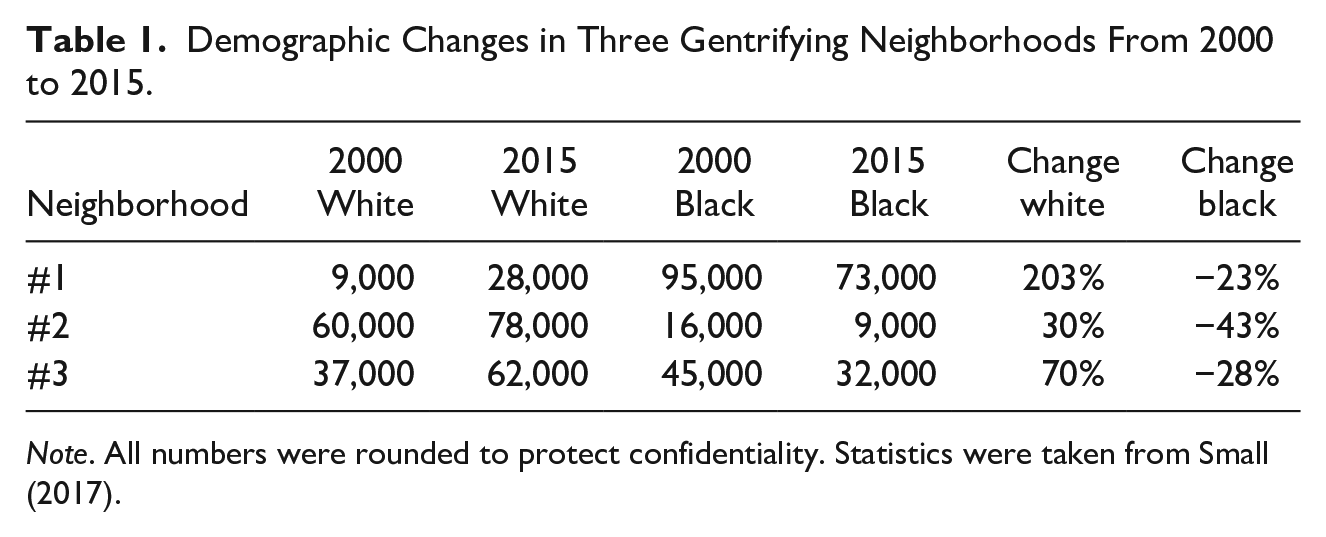
Note. All numbers were rounded to protect confidentiality. Statistics were taken from Small (2017).
I asked 10 parent advocates from a previous study on school choice in these three neighborhoods to provide a list of demographically-shifting school sites that were perceived as responding to gentrification in positive ways. Out of a total of about 90 schools, nine different schools were referred the most by parents. The final sample included three schools that were purposefully chosen to represent different neighborhoods, admission types (zoned, un-zoned (lottery), or screened) and grade levels including one zoned K-5 school in Neighborhood #1, one unzoned K-8 school in Neighborhood #2, and one 6–12 school in Neighborhood #3.
Two of the three schools participate in the DiA program, and one uses geography to diversify enrollments. Each principal, or, in one case vice principal agreed to participate, as well as the parent coordinators at each of the schools. Parent coordinators are unique full-time positions in New York City schools. Their job is to be the point person in the school for parent questions. All three PCs in this study were former or current parents of children enrolled at the school where they worked. Part of their job also involved assisting with marketing, outreach and enrollment decisions.
A diverse group of six to seven parents from each school was also interviewed to compare and contrast what school leadership told me, and to describe their experiences with school choice in the context of school and neighborhood gentrification (N = 20). Parents were purposefully selected to ensure diversity of experiences.
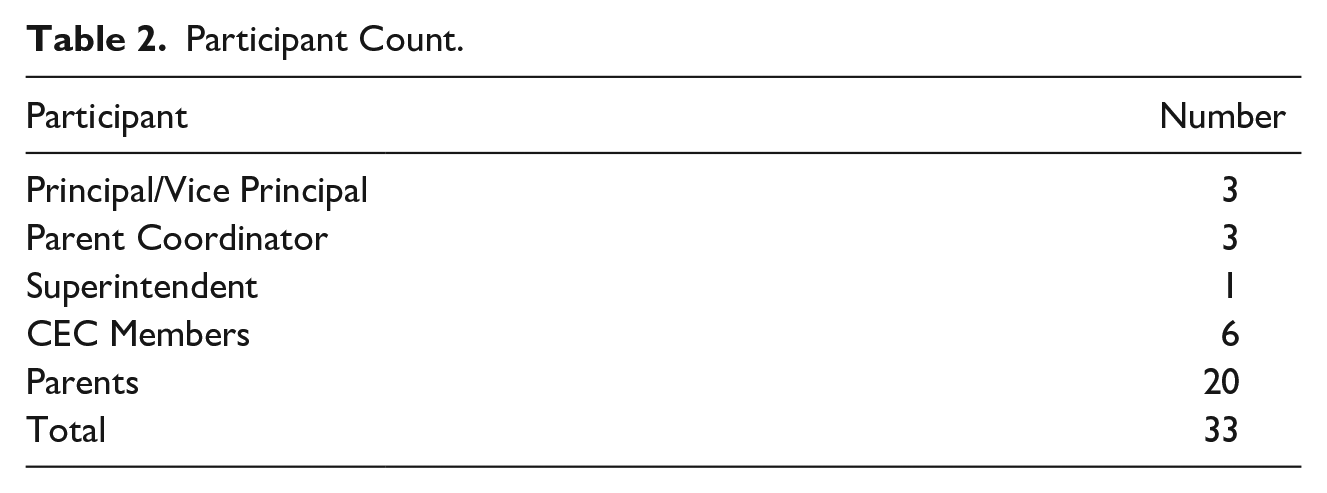
Face-to-face, audio recorded interviews lasted 90 to 120 min and were conducted at the participant’s school, coffee shop or public library between February to November 2018. Observations of several parent advocate meetings, community education council meetings, and school information sessions were also gathered. Additional interviews with one superintendent, and a racially diverse group of six community education council (CEC) members at the district level were also included in the analysis (See Tables 2 and 3). These participants were referred to me by the principals or PCs, and provided me contextual data to compare with the focal respondents at each school.
Participant Count.
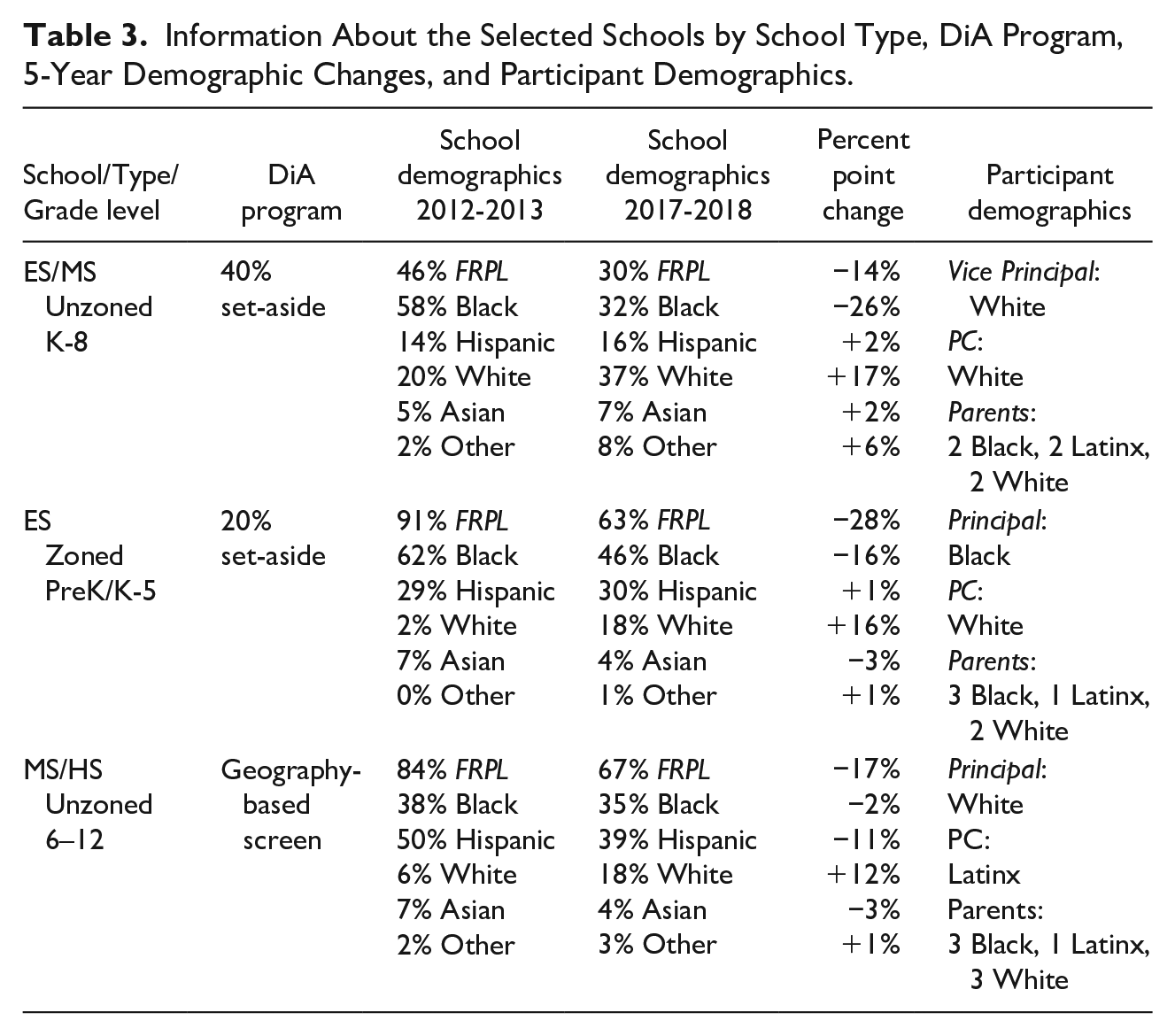
Information About the Selected Schools by School Type, DiA Program, 5-Year Demographic Changes, and Participant Demographics.
Interview questions asked participants to describe their school, the demographic changes, and their experiences with school choice admissions in terms of recruitment and marketing, including the DiA program. I asked what type of questions parents ask on school tours, and what specific things they do to build relationships. Document analysis of newspaper articles, NYCDOE data, and New York City education reports were also used to set the context of the research.
Analysis of data was ongoing as data collection was taking place at each school site. I wrote up field notes and analytical notes as data were collected. Next, I developed codes and analyzed transcripts and interview notes via Dedoose (Saldaña, 2015) based on the cultural worker and critical whiteness studies theory-driven framework. The goal was to find categories, themes and findings that could be used to describe the phenomena of integration from the perspective of the three school leadership teams, and to better understand the shared characteristics and behaviors of the school principals that promote integration at a specific time and place. Codes included narratives of gentrification, civic engagement, challenging Whiteness and privilege, leaders as cultural workers, and common good. Member checking of the emerging findings with one of the participating principals, two integration advocates, and an urban systems scholar was employed to increase trustworthiness.
Findings
I found that each school leader defied the gentrification narrative by “holding the line” in terms of preserving diversity. These “street-level bureaucrats” (Lipsky, 1980/2010) were able to exercise their discretionary authority when enacting DOE policy, and act as cultural workers and community advocates by, (1) foregoing formal district policy and taken for granted admissions and enrollment practices; and (2) resisting the consumer model of education by adapting their marketing and recruitment practices. A central cross-cutting theme was how each school leader worked as community advocates to prioritize the needs and experiences of families most marginalized in the system because of their race and SES, namely the Black and Latinx, low-income students. In general, though, some parents of color felt leadership efforts were based on “good intentions,” but did not go far enough for all families to feel “included, valued and seen.”
It is important to note that while the term “holding the line” is generally presented as a necessary good for neighborhood schools trying to preserve or enhance diversity, there are certainly ways in which “holding the line” could have unintended consequences. The strategies presented below could have the unintended effect of rapid gentrification in the neighborhood surrounding the school, or creating situations in which some families do not feel they belong in the school anymore.
In the next sections, I compare and contrast each schools approach—showing how the tensions, successes and challenges of the integration process were similar and different depending on each school’s approach and response. First, I provide narratives of gentrification to set up the context of this work.
Narratives of Gentrification
The first school is a K-5 zoned school located in Neighborhood #1 that offers separate general education and dual language programs. Zoned schools give priority to students living in the neighborhood. The Black principal of the school is also the school’s founder. It replaced a neighborhood school that was not making yearly progress on standardized tests. The principal described how her school is affected by gentrification: “Our school is not representative of schools in our district. Our schools are predominantly Black and Latino, I would venture to guess that most of them are 85% or more Black and Latino, uh, Title I, schools. We happen to be sort of at the cusp of where gentrification is happening in the district, and we’re adjacent to two other districts that have already gentrified to a great extent. . .the neighborhood is a lot more gentrified than the schools reflect.”
Table 3 shows how the school has been affected by gentrification since 2012 with a 28 percentage point decrease in students eligible for FRPL, a 16 percentage point decrease in Black students, and a 16 percentage point increase of White students. The school has a set-aside policy of 20%, which the principal, PC, and parents said does not do enough to decrease gentrification’s effects on the school. As a result, they are at risk of losing their Title I status, and for the last couple of years have been right above the 60% FRPL mark. A White parent at the school, who was co-author of the DiA proposal to the Department of Education, explained that the school’s goal was to “preserve our existing diversity”: Asking for a pro-diversity admission plan to preserve our existing diversity, not to re-engineer or restore, but to preserve because we had it, and we saw that we were in danger of losing it because of gentrification. Right? So along with, um, our principal. . .I have been involved in holding the line for a long time. Um, and we are hovering right at Title I or less, we are like two or three points above Title I right now.
In this K-5 school, they are considering increasing the set-aside percentage for English Language Learners (ELLs) and low-income students, and phasing out their separate dual language program because while it is a “big draw” for gentrifiers, it also creates within school segregation and division among families who want progressive versus traditional curriculum and pedagogy.
The second school is a K-8 unzoned, detracked school located in Neighborhood #2. Unzoned schools are open to students living within the entire community school district, or CSD, instead of having a smaller school zone surrounding the school. In theory, unzoned schools can admit a more diverse student body because they are open to more students. However, it depends on which families apply and get offered a seat via the lottery. It also depends on the number of seats reserved for sibling priority each year.
As shown in Table 3, from 2013 to 2018, the percent of students who are FRPL eligible dropped 14 percentage points, the Black student population decreased 26 percentage points, and the White population increased by 17 percentage points. A Latinx parent at the school who attended schools in this area and lived in the neighborhood for 40 years described how the school and neighborhood have gentrified: I mean 40 years ago, so I grew up here. Predominately Black and Latino [elementary school], same thing up the block where I went to junior high school as a teen. And then I think by the time I came back from college, [this neighborhood] had gentrified significantly. A lot of the stores started shifting that I grew up with, hardware stores became beer gardens. And then you saw it in schools. And I think at [this school] in particular, I had friends who’ve worked in the school, and when it first opened up, it was predominantly Black and then a few Latinos. And then when they decided to open up the elementary school, I believe five or six years ago, that’s when you saw an influx of White families in the kindergarten classes. And still see that, so if you follow, I believe the current seventh or eighth grade class is the original kindergarten class. And you just see a demographic shift amongst kids.
As this parent and others explained, the school started as an upper grades school, and then added elementary grade levels each subsequent year because of popularity. Every year, the school has gotten Whiter, more Asian and wealthier in the younger grades, and this shift caused the leadership to push for the diversity pilot. A White parent explained why she chose the school, “it’s not as diverse as I would have liked, it’s not homogeneous either, and the school is trying really hard to figure out what that means and struggling with that a bit, but the effort is there and the intentions are there, and that means a lot.” The White school principal was quoted as saying, “I’m struggling with diversity, both economic and racial.”
Because it’s an unzoned school, families must apply to the school, and a computerized lottery chooses students randomly. After the school receives the list of students that are chosen from the lottery, which includes 40% of kindergarten students who are coming from low-income backgrounds, they have to save seats for siblings. For example, the vice-principal reported during the interview that out of 48 seats for two kindergarten classes, 20 seats went to siblings which only left 28 seats for the lottery (11 FRPL-eligible) and about 600 students on the waitlist.
The third school is a 6–12 unzoned, detracked school in Neighborhood #3. The middle school application process is different than elementary school choice because there are no zoned middle schools in this particular district. Therefore, all students have to apply and rank their top choices. The schools receive a list of students who ranked their school, and then choose students off the list.
This middle/high school had long been a low-income Black and Latinx school, but the neighborhood surrounding the school had gentrified, and residents are now mostly White and upper class. Most families in the neighborhood and in the district thought of this school as the last resort. However, according to the White principal of the school, in the “first year, like even before I started, I was approached by a group of White middle class parents, um, who basically said, ‘we’ll give you our kids if you’ll give us a talented and gifted program’. Um, to which I said, ‘your children are welcome in our school, we would love to have them, but I don’t believe in talented and gifted programs or academic tracking in any way’. And so, that was the end of that.” Those families never came even though the principal had a strong sense that the district wanted her school to gentrify and match the neighborhood demographics. The principal explained, that “the DOE was getting a lot of pressure from political forces in the neighborhood to do something about the school. Which is funny, I mean we had already been here for eight years, I thought we’d done great things for the school, our graduation rate when I got here was 35%, and however many years later, it was 70%.”
Then, in 2013, a different group of 10 White families from the nearby mostly White elementary school decided to ask the principal if they could enroll their incoming sixth graders there as a group. The principal immediately went back to her school and asked the teachers and PTA board what they thought. She said that most people were OK with it, but “there was a lot of concern about the fact that every gentrified school was integrated for a minute, we’ve been serving [low-income neighborhoods] for years, we don’t want them to be pushed out, and that will happen eventually.”
After conferring with staff and parents, the principal said yes, and within a 5-year time span the school’s population exploded as more and more White families from the neighborhood applied. It went from offering one sixth grade class to three classes, and from predominantly Black and Latinx to a more even mix of Black, Latinx, Asian, and White students. Table 3 shows how the school’s percentage of FRPL and Latinx students fell by 17 and 11 percentage points respectively, while the White student population grew by 12 percentage points in the last 5 years. The principal safeguards the diversity by giving priority to students coming from elementary schools that have less than 15% White students (the district average). The principal said location was a big draw for gentrifiers: “I think it all conspired, right, I was open to it, we’re the perfect location; the fact that their kids could walk to school. . .they could run up and save them if they needed, if it really went wrong (Laughter).”
Forego Formal District Policy and Taken for Granted Admissions Practices
The first finding that emerged from the interview data was how intentional each school leader and PC was in their efforts to preserve racial diversity in their schools and not allow the school to re-segregate. School leaders and PCs referred to other district schools that had “flipped” and were now majority White, and said they did not want the same thing to happen at their respective schools. The public school population in the community school district was 15% White overall; therefore, schools that enrolled a disproportionate share of White students were considered at risk of re-segregating. Two questions that each school grappled with was how to make all district families (1) aware of their school, and (2) want to enroll their children there and be part of the school’s mission because, as the K-8 PC said, “part of it is even knowing you have a choice” (see Makris, 2015). The principals and PCs in the two DiA schools and the screened 6–12 school did background research on the demographics of the CSD, looking at maps and strategically doing outreach in the communities and schools where they knew they could recruit families in their target demographics. Every year, this meant principals had to be creative and hold their ground. The superintendent explained, “[certain schools] have somewhat more integrated populations because of, let me put it in a delicate way, of the creative way that principals bend the rules.” When asked how schools do that, the superintendent responded, “I know that if they have an opening and somebody approaches them, I’m sure that’s the way they do it.”
Indeed, a common strategy to avoid flipping at the elementary school level was to wait until the last minute to offer seats that were freed up by parents who left for other options. Waitlist procedures were key in maintaining school diversity at the K-5 and K-8 schools. The K-5 zoned school also admits students in their set-aside population who live outside of the zone. Meanwhile, the 6–12 school adopted a unique geography-based priority system in admissions to maintain Black and Latinx student enrollments.
K-5 school
The K-5 school principal knew that parents in their “priority population” typically were not touring the school or applying online “eight months before school starts.” This group of Black, Latinx, and low-income parents were, as the PC from the K-5 school explained, “walking in a week before school starts, or a week after school starts.” The PC talked about how there is a lot of “holding our ground and not giving the seats away” so when parents in the set-aside category came into enroll their children right before or after school starts they have a seat to offer them on a first come, first served basis.
During the interview, the K-5 PC had just received the kindergarten list from the DOE and said it is filled with zoned students, which means mostly White students. Because the neighborhood is gentrifying, she said there were only two or three students on the list who were English Language Learners, which was obviously not enough students to fill the Dual Language seats: “More upper middle class residents moving into our zone can tip the school to be more White. Historically, we did not fill our zoned seats so we had wiggle room to accept out of zone students of color, now we have to be more creative with our admissions process to safeguard the diversity”. She bemoaned the fact that the DOE does not create a separate list with their 20% set aside students on it (ELLs and low-income students), which places all of the recruitment work on the school.
A Black parent at the school explained that the Spanish-speaking families live in a different neighborhood because they cannot afford to live in the zone anymore. She described the impetus of re-segregation: We got a new school and a new principal, and she started a dual language program; I think that’s really what did it. You have those kinds of un-screened programs; it’s not really supposed to be a screening, dual language program, but in effect, it is. Um. Those kind of, like perks associated with an elementary school sometimes bring people to come and look at it when they wouldn’t consider it otherwise. And then it’s hard to get rid of it.
Dual language programs were originally designed for integration purposes (Gándara & Aldana, 2014). However, school leaders must be vigilant and not allow within school segregation to occur because parents with the most cultural and social capital know their options and apply.
When asked how the school avoids gentrifying, the PC in the K-5 school basically said that they are just holding onto the diversity and she is not sure how long it is going to work—”it’s one of those things that looks great on paper, but it’s nearly impossible to implement, not only the way the DOE assigns people here but all of the other supports. . .just having the systems in place to support the initiative as well. They’re just not there.” One of the main supports that is lacking is busing. She explained that when they call the transportation office, they have no idea about the DiA program and do not offer late buses for students who stay afterschool, which places the burden on parents of color who tend to live farther away than the White parents in the immediate neighborhood. School choice research has shown that low-income parents of color are more concerned about transportation than White, advantaged families (Smrekar & Goldring, 1999)—making transportation an important resource to provide when implementing integration programs.
K-8 school
Similarly in the K-8 school the PC said their strategy was to “hold onto the empty seats,” even after the first day of school in the hopes of more diversity. This school’s process starts with a lottery of all applicants with a 40% set aside for low-income students. After that, wait lists are generated. As families choose other options (charter, G&T, other publics, private schools), the PC goes down the list to offer seats off the waitlist. A White parent who was offered one of the waitlist seats, described the process as being under the principal’s discretion:
The principal will say that it’s really important for the school to be racially diverse. . .
the lottery, you can’t touch, but then there’s all the waiting lists, right? And so, and they [school leadership] would be the first to say, actually, I think they’re pretty comfortable saying like this [diversity] is important to us. This is something to consider when we figure out who’s getting off the waitlist. I mean, the lottery is the lottery. But the waitlist is totally up to the principal’s discretion. I mean that’s how we got in, right?
The question this brings up, however, is which families can change their commuting and childcare plans to accept a last minute seat. A related question is, who’s benefiting from the informal waitlist procedures, in this case it was a White family who got off the waitlist. Yet, it is important to note that through generous PTA fundraising, the K-8 school offers early and late busing for low-income Black and Latinx students who live in neighborhoods far away, unlike the K-5 school.
6–12 school
The 6–12 school principal explained that she avoids re-segregation by giving first priority to students on the list who are coming from elementary schools with fewer than 15% White students (the district average). When the Department of Education found out what the principal was doing, they reportedly called her and questioned whether the screening process was based on race, and whether she was worried that the admissions process would alienate White families. The principal had to explain that the process is based on geography of the district, that most neighborhood elementary schools are segregated by race and class, and that schools are not a “protected class” under the PICs decision. The PC at this school proudly said that their “admissions process is at the forefront of fighting for integration.”
During the interview, the 6–12 principal admitted that her process probably does alienate some White families, however, she argued that ensuring student diversity in her school was more important. Her approach was to not “sugarcoat anything or beg anyone to come. . .I think we knew and never said out loud, but acted from the assumption that we knew we were offering them [White parents] so much more than they were offering us, there was no hard sell at all.” However, she was not prepared for the “sheep effect, that once we were sanctioned as ok, it’s crazy, the White middle class networks are extraordinary.” This principal used the sheep effect to illustrate the pattern she saw when a small group of White parents chose a school that used to be a non-option (because of demographics). Then, other like-minded White parents copy the first group and choose the school the following year. It is like a flock of sheep that follow the leader without questioning it. The 6–12 principal explained that they did not lose any Black and Latinx students, but they got an extraordinary number of White students after the first group of White students came—going from one sixth grade class to four classes and 0% to 50% White in the eighth grade. The superintendent described the 6–12 school “as an interesting story” when she explained, “I think the [6–12] principal has a concern that they [White parents from the mostly-White neighborhood school] would tip the school, and so she’s been very judicious in terms of creating a diverse population without allowing it to become too gentrified.”
Resisting the Consumer Model of Education by Adapting Marketing and Recruitment Practices
The second main finding that emerged from the data was the way in which leaders and PCs adapted their marketing and recruitment practices to their priority populations, for example, low-income families of color instead of White advantaged families. The schools in this study thought about outreach and marketing in different ways than the “typical gentrifying school” that basically just allows school demographics to tip by doing nothing (DiMartino & Jessen, 2018). The focal schools realized that school tours and marketing strategies were targeted toward what advantaged parents wanted or expected (Turner, 2018) instead of low-income parents. For example, all of the focal schools were located in gentrifying or gentrified neighborhoods. That meant they had to concentrate their outreach efforts in low-income neighborhoods farther away. Although principals and PCs were advised by the district to do equal outreach for everybody, they wanted to avoid the “sheep effect” of White, advantaged families flocking to their school.
The three schools also wanted to attract the right type of gentrifier family who was open to different cultures and values. Because of that, principals and PCs spoke about being intentional about how they spoke to families during school tours and open houses. For example, when parent coordinators talked to prospective White, advantaged parents about what a ‘good school’ means to them, they said they had to dig deeper into what parents valued in a school. This was especially important because of the diversity and the overarching goal to build relationships among families from diverse backgrounds after enrollment. Ultimately, the schools in this study sought parents who wanted to be at their school, invest in the mission, and be committed to integration.
K-5 school
Most participants at the K-5 school stressed that the DiA program is only a “tiny piece” of the work they do, as one Black parent explained, “Some of it is in how we speak to people on tours, the expectations we set. We actively do not want too many gentrifying families in our school, we don’t. . .the whole point is to explicitly not tip it.” A White parent at the school said, “Like now the principal has to ask herself, ‘How much of school business is customer service? And how much of it is taking care of kids?’ You know? And gosh, it’s hard to see her consumed by certain things that she really shouldn’t have to mess around with.” In other words, instead of treating certain parents like valuable customers in a market place and selling their product (e.g., school), the schools in this study hold the line by targeting outreach to low-income families who are not typically courted by schools.
The PC at the K-5 school explained her approach when White families ask questions during school tours or via phone or email, “I try to be really specific about some core structures and communal beliefs of this community to find out if that aligns with folks, where they’re coming from, and what they’re looking for.” For example, when someone says they want a progressive model, she questions how parents are defining that term. When parents ask too many questions about the curriculum or behavior issues or which middle schools students get into next, they (parents, PC, and the principal) know immediately that they are not the right fit for their school. For example, the K-5 PC replied, “if anyone comes to me and says like, ‘sell me your school’, I’m like ‘yeah, no. I don’t do that.’”
The other issue is that some White parents apparently like saying that their child is going to a diverse school, but then are not fully prepared to be open to different cultural values and norms. The principal explained: Who doesn’t, who doesn’t that appeal to? Right? That your child is gonna be in a classroom with different kinds of children, different kinds of backgrounds, they’ll learn about different cultures and different norms, and certainly when you think about it objectively and you think about the, the future and the world really becoming smaller, it’s an asset to have your child exposed to different backgrounds and ethnicities, cultures. The truth of the matter is, though, when you do get everyone together in the same building and people’s norms and values are different from yours, it’s difficult to separate the difference as just being a difference and not being less than. Or your values or norms being somehow the right values and norms, and the other norms being different, other, somehow not, you know, not up to your standards. . .
The mentality from the school side was that they want families who want to be there. School fit was determined by the types of questions asked. For instance, a parent asking questions about what the school could do for his/her child was generally not a good fit. However, a parent asking questions about how the school promotes equity and access to all students would be a good fit.
K-8 school
The K-8 vice principal’s response about the equal outreach directive from the DOE was, “did you forget that things are not equal?” The PC concurred, “if that [information] is already amassed in certain demographics, then to be equitable we have to offset that by doing more” in low-income neighborhoods and schools. The parents from the immediate neighborhood who have their children in mostly White preschools already know that the K-8 school is having an open house on a certain date, so administrators do not go there to do outreach anymore.
The K-8 school also realized that having a connection to the school was extremely important for parents to even consider sending their child to a school in a different neighborhood. The PC said, “They have to feel like they have a connection or somebody who’s like them” at the school. This school’s recruitment strategy was to ask current Black and Latinx parents to be “ambassadors” and do the outreach work back home in their communities, and then be the point person once the students arrived. They also listened to what questions parents asked about the school. There were questions about busing and the fact that the school day started later than other schools. Because they felt they might lose some families, they responded by offering early drop-off and Saturday open houses to accommodate Black and Latinx families travel and work considerations.
The K-8 school also responded by making sure the families, especially ones from outside of the neighborhood felt a sense of “belonging and were welcomed right out of the gate.” The vice-principal and PC explained that the admissions process continued after the family accepted the kindergarten spot all the way through the summer months to “make them feel connected before that first week of school,” and to not lose them to charters. The vice-principal said administration noticed a pattern around mid-August in which some of their accepted families that had already registered and qualified for free and reduced lunch showed up as transferring and most of them to charter schools. She noted, I, especially, was like how do we create some, some stronger senses of community earlier so that if those people are like getting kind of courted by charter schools that they have a strong sense that like they’ve made a very intentional choice to send their child to us, um, and that they’re gonna stick with that, even if people kind of luring them away with like a longer school day, or free aftercare or whatever or just glossy pictures. A lot of times like charter schools just really, I worked at one, so I know how they market. I know the kinds of things that they do. Um. I know the language that they tell families and families like don’t always know that they have an option.
Instead of the typical enrollment process in which parents and the kindergarten student come in for an individual appointment, they changed it to a group appointment of four to five families. The administrators intentionally made the groupings diverse, and tried to include a family that had an older sibling in the school—again to serve as ambassadors, introducing themselves and developing relationships with other parents. The PC described the community circles: We had folks meet in our library, we welcomed them, they filled out the paperwork together. It gave them an opportunity to see face to face other families and children and feel a sense of community, and then when they were done we very simply formed a circle and percolated a couple of questions that we found through trial and error were successful. One of them was, what neighborhood do you live in?, which at first we thought could be divisive for folks, for have and have-nots, but we actually found in every meeting there was somebody in the room who said, ‘oh, you live there? I live around the corner’, and people were excited and talking.
During the school tours, the K-8 vice principal said she realized that the term ‘progressive’ signaled Whiteness, and explained that “there’s places where it preserves the status quo with opportunity gaps in education so we avoid that term.” A Latinx parent noted how the term progressive is a “code for White and that’s not who we are, and we don’t wanna be that.” Therefore, the school removed the term from their mission statement and replaced it was child-centered and caring learning environment.
6–12 school
Leadership as well as several parents reported that nearly 1,000 parents show up at the 6–12 school’s yearly open house because it is considered the next “it school” for gentrifiers. One White parent described the open house as “stunning, it was standing room only in their giant auditorium.” The PC explained that they used to have “a bunch of” open houses but they stopped because, “We ended up, last year, we had almost 700 applicants for, a hundred, basically a hundred slots. And far too many of them were from the primarily White schools that were close to us. So we cut that back to just one huge event.” A Latinx parent described the principal’s message as apologetic because parents have to go through the school choice process.
The marketing strategy at the 6–12 school was to offer tours to the low-income priority elementary schools (with fewer than 15% White students), and to get these schools to invite them to their middle school fairs. What the PC tells the group of Black, Latinx and Asian students and parents at the fairs is “if you choose us, you will get in,” which is not the marketing strategy that other schools used. The other schools, he said, “trot out their principal” and basically tell the students about all of the special programs they have, and send the message that it is nearly impossible to get into their school because of their long wait lists and academic screens. The 6–12 school is different because of their unique geography-based priority system.
Meanwhile, the PC said White families ask him about “the perks. What else? What else you got? It’s become a system of what else can you give my kid.” Instead of telling parents that “we’re the best school”, he starts by saying “come fight racism and come to our integrated middle school, and be part of the fight.” This is a prime example of holding the line by counterbalancing the opportunity hoarding behaviors of advantaged families. The PC described parents who ask “the challenge questions” about how they handle behavior problems and disruptions in the classroom or how rigorous the math classes are in their detracked school. He admitted that these concerns are legitimate, but that they are also resolvable. The PC and principal also talked about how White parents tend to “highlight the things that are not going well.” Yet the “White, affluent school” across the street is not a perfect school either but ironically “they’ll accept the things that are so flawed about it.”
Discussion
This research examined the role school leaders played in “holding the line”—for example, leveraging gentrification in a way that promoted diversity and integration without catering to the needs and demands of advantaged families. It illuminated how gentrification was used as a community good through the efforts of school leaders who felt they were at risk of re-segregation. This study also adds to our understanding of how Whiteness operates and how school leaders’ experienced the tensions, successes, and challenges of the integration process. The K-5 school with a separate DL program was successful at attracting White families but not very many English Language Learners into the school because of neighborhood gentrification. While they had a 20% set-aside plan, it was not enough to stop re-segregation from happening at a rapid pace, and now they are re-evaluating their set-aside percentage and the value of keeping the DL program. Along with the K-8 school, their approach to preserving diversity was to save seats on the waitlist for families in their set-aside category. The K-8 school’s 40% set-aside plan was helping them enroll Black and Latinx families, as well as the availability of before and after school busing, the Ambassador program for recruitment, and group enrollment appointments. The 6–12 school’s approach was to give priority to students enrolled in elementary schools with fewer than 15% White students, and to market their school differently to White parents versus parents of color.
All three focal school leaders acted under the assumption that their schools were giving White families more than White families were giving them in return. The school leadership teams sought out gentrifier families that wanted to invest in their integration mission instead of allowing them to overtake the school. In the K-8 and 6–12 schools, they did not allow White parents to carve out separate classes, extracurriculars or programs for their children only. And, in the K-5 school they were considering phasing out the DL program because it was leading to within school segregation. Not included in this study, but mentioned as a comparison during the interviews, was the “non-integration” school model. These schools have allowed gentrification to go unchecked, and, as the participants repeatedly told me, are “not addressing race and class at all.” As Orfield (1981) cautioned, “Too often. . . [the desegregation plan] is operated without imagination or timely revision and resegregation occurs” (p. 9). Yet, as I have shown, the school leaders profiled in this article responded differently than most leaders because of their attempts to hold the line and preserve diversity in their schools.
What we know from prior research is the harms of segregation are pervasive not only for students of color that are often concentrated in high poverty schools, but also White students enrolled in high-income schools (Linn & Welner, 2007). At the same time, there is overwhelming evidence of the potential benefits of school integration (Wells et al, 2016). Yet, as the principal in the 6–12 school emphasized, most leaders do not want to try to create racially diverse and integrated schools because they do not want to fail: We know how to create segregated schools, we know how to create academically tracked schools. We know how to do school, and the results suck. We know that we have horrible graduation rates, literacy rates, the achievement gap, we know how to do this. Over here, we have created intentionally anti-racist, de-tracked, integrated schools. We don’t really know how to do it. But we think that if we try to do it, we will make some mistakes but the results could not possibly be worse. So which would you rather do? And what’s sad is that a lot of people would rather do what they know how to do, even though they get the exact same results that you would expect, this is really scary.
Policymakers and practitioners should draw on the lessons outlined in this study, as well as learn about the abundance of social science research conducted during the post-desegregation era on effective strategies to create and maintain integrated schools. For example, Hawley et al.’s (1983) book summarized the most effective desegregation strategies from the literature at the time, which strongly parallels what was found in this study. Some of the most relevant strategies from the book include assigning students into schools and classrooms that are racially diverse with mixed-ability students; offering adequate amounts of interaction among racially diverse students in academic and extracurricular spaces; implementing outreach efforts to encourage parent involvement at home; and sustaining a stable student population over time.
Similarly, Orfield (1981) found in his analysis of 11 cities with urban integration plans that both Whites and people of color wanted to avoid gentrification and resegregation, and achieve stability. He wrote, “Their common interest in stability could form the basis for a powerful political constituency supporting integrationist policies. . .achieving integrated schools through housing policies requires that integration be substantial. . .and that it be maintained” (p. 27). Yet the problem in the post-desegregation era was that integration was often temporary and limited to housing, which did not affect public schools because Whites would opt out for private options. Back then, schools competed for White families to avoid White flight out of urban areas. The school leaders in this study, however, were essentially competing for families of color who often are pushed out and marginalized in their neighborhoods and schools. Ultimately, participants in this study believed the DOE, chancellor, and mayor could do more to support and incentivize integration. I would argue that the other thing that is needed is an education campaign on effective strategies to achieve and maintain integrated schools. That way, school leadership would not feel like they are “going it alone”.
Limitations of this research include the unique context of New York City schools, in terms of student assignment policies, school choice, and rate and type of demographic changes. This makes it difficult to apply all of the strategies employed by the school leaders to other urban school contexts. Yet it is not the goal of qualitative research to be generalizable; therefore, it will be up to the reader to discern what applies and can be adapted to his/her specific context. Future work should include how school leaders are implementing school integration initiatives after enrollment, how regional integration plans could be implemented to stabilize neighborhood and school diversity, and how other street-level bureaucrats, like teachers, respond to demographic shifts in the classroom.
In sum, the results of this study have shown how bureaucratic admissions and marketing policies were experienced and adapted by three urban school leaders. I found school leaders who used their discretionary authority to promote integration instead of re-segregation as neighborhood gentrification took hold. In essence, each school leader became advocates for their community by giving special attention to historically marginalized families in the admissions and marketing process and by bridging the gap between policy and practice. These school leaders are advocating for more DOE resources and support to do this integration work. While not perfect, these leaders are holding the line through the tactics they are employing to achieve integration.
Footnotes
Acknowledgements
The author would like to thank Kelly Bare, Maia Cucchiara, and the anonymous reviewers for their helpful comments on previous drafts of this article.
Declaration of Conflicting Interests
The author declared no potential conflicts of interest with respect to the research, authorship, and/or publication of this article.
Funding
The author disclosed receipt of the following financial support for the research, authorship, and/or publication of this article: The author received a Molloy College Faculty Research grant to help fund this research project.
