







Abstract
Special education and dual language/bilingual education (DLBE) programs originated to protect educational rights for students with disabilities and multilingual students. However, these structures require categorizing learners through standardized testing, which can reinforce ableist and racist practices. This ethnographic and discourse-analytic study examines educators’ perceptions of fourth-grade students’ language practices within an urban K-8 bilingual program as they inhabit an institutional perceiving subject position. Rooted in critical perspectives on race, language, and disability, findings suggest that all students were subjected to the white normative gaze, highlighting structural oppression in DLBE and special education while exploring implications for urban schooling contexts.
Keywords
Introduction
Special education and language services were federally mandated within the context of the Civil Rights Movement to ensure the educational rights of students with disabilities and students learning English. To receive such resources, students must first receive the categorization of English learner (EL) or student with disabilities (SwDs), which has required that educational agencies create institutional mechanisms to categorize and provide services for students. Florian (2019) argued that service delivery “positions special needs education as a resource-based response that is provided when individual learners require something different from or additional to what is on offer to everyone else” (p. 693). In other words, this model is focused on “individual learners” rather than the impact of educational structures and learning environments (Aggarwal, 2016; Gomez-Najarro, 2023). Differences become compartmentalized through categories of disability OR language (e.g., SwD OR EL); abilities and academic needs are thus separated from a student's environment, sociopolitical context, and social identities. EL and disabled are often perceived as objective learner categories rather than categorizations created through schooling within specific racialized, historical, and material contexts (Kangas, 2021). Accordingly, disabled and EL become color-evasive learner categorizations that are supposedly unrelated to race.
Standardized testing is one of the several mechanisms used to determine formal learner categorizations and eligibility for language and/or special education services. Standardized testing is rooted in the sorting and ranking of individuals (Ferri & Connor, 2006) and eugenicist conceptualizations of intelligence as fixed, linear, and hereditary (Smith, 2008). The rationale is to provide so-called objective measures of student performance, gauge students’ educational needs, and hold schools accountable for meeting said needs. Accountability more often refers to standardized measures of school, teacher, and student quality, which leads to an educational environment driven by scripted curricula and constant benchmark testing. Standardized tests also restrict students’ capacity to communicate their learning through specific modalities, that is, speech and print literacy, to demonstrate their linguistic and cognitive abilities.
This neoliberal ecology of standards and testing reflects deficitizing policy orientations to students’ language practices (Phuong, 2017). These inequitable dynamics are exacerbated in the context of urban education, especially for multiply-marginalized socioeconomically exploited communities (Blaise, 2018; Gadsden & Dixon-Román, 2017). Welsh and Swain (2020) argued that deficit orientations are key to the concept of urban education itself, which demands attention to the dynamic and multifaceted nature of education in spaces constructed as urban. They highlighted the ways that educational inequality is always presumed in urban education, pointing to the nexus of ideological and material conditions that shape perceptions of education. Similarly, perspectives on language are not neutral, but rooted in oppressive logics perpetuated by educational structures (Lippi-Green, 2012).
One example is ableism, which is often perceived as a system of oppression that impacts SwDs and pushes conformity (Hehir, 2002). Incorporating insights from the disability rights and disability justice movements, we also point to Lewis's (2022) definition of ableism: a system of assigning value to people … based on societally constructed ideas of normalcy, productivity, desirability, intelligence, excellence, and fitness [rooted in one's] culture, age, language, appearance, religion, birth or living place, “health/wellness”, and/or their ability to satisfactorily re/produce, “excel” and “behave.” (para. 4)
Ableism is thus a system of oppression that enforces normative ways of being and doing, and is mutually constitutive with other forms of oppression. Through construction of norms, individuals and communities can be positioned as (un)able—to that end, Lewis argued that those who do not identify as disabled may also experience ableism. This acknowledgment is not meant to minimize the oppression experienced by people who identify as disabled (e.g., disablism, see Goodley, 2018), but rather, draw attention to the dynamic, social, and embodied ways in which disability and ability are constructed and negotiated.
We bring these ideas together to examine how linguistic ability becomes interactionally accomplished through ableist and racist institutional mechanisms, namely standardized testing and the service delivery model, within the context of an urban K-8 bilingual charter school. Rooted in data from an ethnographic and discourse-analytic study, we anchor this paper in the following research questions:
How do the service delivery model and standardized testing mediate the creation and negotiation of learner categories in inclusive bilingual schooling? How do these institutional mechanisms mediate educators’ descriptions of students’ language practices in inclusive bilingual schooling?
Through critical perspectives on language and Dis/ability Critical Race Studies (DisCrit), we explore how the nexus of testing and learner categorization perpetuates ableist and racist educational practices and outcomes in the United States. We argue that all students, with and without formal learner categorizations, are subject to discourses of monoglossic, raciolinguistic, and ableist language ideologies.
Notes on Language
Kanno et al. (2024) highlighted the importance of considering the goals, sectors, systems, and consequences of choosing and using a label to refer to students. In our own narrative, we use the terms student labeled as disabled (SLAD; see also Cioè-Peña, 2020) and labeled as EL to foreground the institutional processes that require specific ways of performing disability and/or English-language proficiency, and how those labels impact students’ educational trajectories. While we generally use the term disability to destigmatize its use (Andrews et al., 2019), we also use dis/ability with a slash when used in an original source. The slash is meant to disrupt and call attention to social constructions of ability and disability (Goodley, 2018). We alternate between person-first and identity-first language when referring to people with disabilities to honor the variety of preferences among disabled people (Gernsbacher, 2017).
In terms of EL, because we are examining the function of the label, we use the term classified as EL. Terms like emergent bilingual, dual language learner, and multilingual learner have emerged to highlight students’ multilingual capabilities and to decenter English. However, in bilingual schools, like the site of this study, all students might be emergent bilinguals, regardless of one's dominant language and institutional classification. These alternative terms do not shift the underlying deficit-oriented raciolinguistic and material underpinnings of the EL category that prioritize remediation (Flores & Lewis, 2022). When referring to students who are labeled as both, we use the term dually-classified to highlight the classification process.
Conceptual Framework
To explore constructions of ability within a dual language/bilingual education (DLBE) context, we outline how critical perspectives on language are necessary to understand the relationship between the institutional perceiving subject and hyper-labeling in the pathologization of language practices.
Critical Perspectives on Language
In this section, we integrate raciolinguistic and monoglossic ideologies, critical dis/abilities raciolinguistic (CDR) perspectives, and crip linguistics to examine how language practices and proficiency are evaluated through the lens of schooling.
Raciolinguistic and monoglossic ideologies
Language ideologies broadly pertain to the relationship between representations of people and language in society. They are discursive, ideological, practiced, and embodied (Gilmore, 2011). Raciolinguistic ideologies (Rosa & Flores, 2017) highlight the role of the white perceiving subject to emphasize racialization in perceptions of language practices. A raciolinguistic perspective (Rosa & Flores, 2017) also traces the historical context and impact of the rise of nation-states and (settler) colonialism, particularly how colonized communities, and in turn their language practices, were deemed to be inferior and uncivilized by European colonizers (Iyengar, 2014). In this view, linguistic and racial categories are mutually reinforcing. Raciolinguistic ideologies are tied to monoglossic ideologies, which position idealized white mainstream English-language monolingualism (Baker-Bell, 2020) as the desired norm for communication.
Within this framework, languages are considered separate entities that can be possessed and quantified, rather than a social practice. A monoglossic view of language oversimplifies conceptualizations of bilingualism, leading many to consider so-called true bilingualism to be “double monolingualism” (De Houwer, 2023), or the idea that being bilingual means having the same kind of proficiency across all named languages. These also support ideologies of languagelessness (Rosa, 2016), whereby students may be assumed to possess no legitimate language. In contrast, more critical frameworks, for example, heteroglossia (see Flores & Schissel, 2014), consider the social and political contexts of language use, rooting perceptions of language in the experiences of multilingual rather than monolingual (English-speaking) people.
Chaparro et al. (2021) argued that language and literacy testing compartmentalizes language and literacy abilities and erases students’ multilingualism, thereby reifying harmful monoglossic and raciolinguistic ideologies (Flores et al., 2020). Standardized testing undermines bilingual education (Poza & Viesca, 2020), highlighting the role of assessment in language policy that prioritizes English at the expense of bilingual development. This testing regime also impacts EL and disability classifications. Language proficiency tests determine one's eligibility for English-language services, creating a dichotomy of EL or not and ignoring the complexity of multilingualism and its fluid nature (Flores & Lewis, 2022). For referral to special education, psychological and intelligence testing are often used to evaluate and diagnose disability (e.g., WRAT-5, WISC-V) and are largely unavailable in non-white mainstream English varieties. Ultimately, the primacy of English medium testing pathologizes any perceived deviance from a white mainstream English norm (Cioè-Peña, 2021).
CDR perspectives
Attention to multiple dimensions of oppression and resistance requires intersectionality, an analytical and practical tool to interrogate and challenge interlocking systems of oppression. Rooted in Black Feminist Thought (Hill Collins, 1990), intersectionality emphasizes the interdependence of structural oppression, that is, racism, linguicism, and ableism. To that end, we rely on insights from DisCrit (Annamma et al., 2013), which highlights the co-constitution of race and dis/ability; the historical and material conditions, legal structures, and policies under which dis/ability and race have been intertwined; and the importance of challenging racism alongside ableism. In integrating DisCrit and a raciolinguistic perspective, Cioè-Peña (2021) introduced a Critical Dis/abilities Raciolinguistic (CDR) perspective.
CDR considers how racialized and/or disabled people are subject to the white normative gaze, which idealizes the linguistic practices of white, nondisabled people as “normal” and those of people of color (with disabilities) as “deviant” (Cioè-Peña, 2021, p. 67). Cioè-Peña highlighted how language practices are leveraged for their proximity to whiteness and “normalcy.” A CDR perspective thus demands attention to how the white normative gaze operates from a social model of disability. This contrasts with a medical model of disability, where disability is perceived as an individual problem; conversely, within a social model, disability is considered in the context of physical and social environments and one's embodiment (Annamma et al., 2013). For example, a medical model would position a student with dyslexia as requiring intervention and treatment to excel on reading assessments; a social model would perceive that same dyslexic student as requiring exploration of multimodal ways of reading alongside building (print) literacy skills (Phuong et al., 2021).
To challenge the white normative gaze in schooling, Cioè-Peña (2020) rooted CDR in the experiences of emergent bilinguals labeled as disabled and how their languaging is perceived, with the goal of countering deficit-oriented frameworks. For instance, Sterponi (2007) explored how an ideology of reading frames reading as an individual and silent act, void of interactional elements. In this way, assessment standards for reading mirror white, middle class, and nondisabled standards for classroom behavior and academic performance; any deviation from these standards are considered deficient. As Lewis's (2022) definition of ableism suggests, disability is one of many markers of difference.
Crip linguistics
We consider a CDR perspective alongside crip linguistics (Henner & Robinson, 2023), both of which have been described as complementary frameworks within applied linguistics (Hou & Namboodiripad, 2024). Drawing from intersectionality, disability justice, a raciolinguistic perspective, and deaf and autistic scholarship in linguistics, crip linguistics demonstrates how language has been historically tied to judgments of a person's capacity, intelligence, and personhood. Henner and Robinson (2023) proposed crip linguistics to “critique language and language scholarship through the lens of disability” (p. 3). This is accomplished by cripping language, or disrupting power structures and unsettling normative beliefs about language use. Although the term “crip” has an oppressive history as an ableist slur, disability studies scholars have reclaimed crip as a verb, which “spins mainstream representations or practices to reveal able-bodied assumptions and exclusionary effects” (Sandahl, 2003, p. 37), exposing the arbitrary nature of what counts as (ab)normal. Thus, crip linguistics considers how collaborative, temporal, and multimodal aspects of language reflect the natural diversity of humans, rather than uplifting independence and efficiency as the norm for communication.
People who are not deemed independent and efficient speakers may be labeled as “disordered,” reflecting fundamental deficit ideologies toward disabled individuals. Crip linguistics grounds our stance that “no language is bad” (Henner & Robinson, 2023, p. 7) or inherently disordered, including those with diagnosed speech disorders. In other words, all forms of communication are legitimate and valid. Building on social models of disability, Henner and Robinson (2023) asserted that language is labeled as disordered “by people with investments in maintaining structures of power such as white supremacy and racism” (p. 17). Simultaneously, they contended that material conditions and environmental factors can impair and impact language development, for example, deaf children who are barred from learning signed languages, and thus experience language deprivation. This framework does not deny that language differences exist, but rather attends to “what meaning is brought to bear on those perceived differences” (Baglieri & Knopf, 2004, p. 525).
Thus, one of the main concerns of crip linguistics is how ideologies of language and disability can disproportionately impact people who are positioned as communicating differently due to language practices like stuttering, lisping, pausing, mumbling, or being nonspeaking (Henner & Robinson, 2023). Additionally, they examine how normative timelines and benchmarks for language production, processing, and development can shape perceptions of failure, which are often interpreted as markers of a disability, as well as a lack of intelligence, capacity, or agency within the individual. In an educational context, such students are often placed in speech interventions to “remediate” their languaging, rather than facilitate mutual understanding. Building from raciolinguistic and monoglossic ideologies, a CDR perspective, and crip linguistics, we argue normative expectations of language use (e.g., speech, white mainstream English) lead to the pathologization of students with/without disabilities, especially students of color.
Institutional Perceiving Subject and Hyper-Labeling
We build on these critical stances toward language that center on race and disability to examine how teachers’ descriptions of students’ language practices are not simply individual opinions. In challenging the narrative of a “bad teacher” who perpetuates inequality, we emphasize the structural conditions that teachers are forced to confront (Kumashiro, 2012). Students’ standardized test scores impact school and teacher ratings, which in turn impact school funding and even closure. Schools face immense pressure, and washback occurs (Spratt, 2005), shaping curricular and instructional choices, including in DLBE (Palmer et al., 2016). Educators thus must act on behalf of their institutions, that is, as an institutional perceiving/listening subject (Flores et al., 2018); this is not to presume that teachers have no agency, but rather, teachers’ agency is constrained by such institutions, a dynamic that has been explored within the context of urban education (Dover, 2022; Li & Qin, 2024).
Flores et al. (2018) explored the cases of three elementary school students who were labeled as ELs and were considered to be English-dominant because their English literacy scores surpassed their Spanish literacy scores. When asked to describe a student's language use, teachers generally did not consider any learner categorizations until they were mentioned—one student was described as high-achieving and “fully bilingual”; once “EL” was mentioned, however, teachers shifted to justifying why that student was classified as an EL (e.g., noticing grammatical errors in writing and speech). To that end, we argue that teachers inhabit an institutional perceiving subject position as they perceive and describe students’ languaging within the ableist educational institutions they must navigate.
We pair the institutional listening subject position with DisCrit, specifically Annamma's (2018) pedagogy of pathologization that seeks to find, label, surveil, and punish students who are deviate from an imagined white, cisgender male, nondisabled, middle-class norm (Annamma et al., 2013). Annamma (2018) introduced three processes: hyper-labeling, hyper-surveillance, and hyper-punishment. We highlight hyper-labeling, which Annamma (2018) defined as “the formal/informal naming of a student's undesired identity (e.g., race, gender, dis/ability) and the addition of other unwanted identities” (p. 14). Thus, hyper-labeling accounts for learner categorizations tied to the service delivery model, but also informal categorizations used at Dual Language Charter School (DLCS), the site of the study (see Phuong, 2021).
In theory, learner categorizations facilitate the grouping of students with seemingly similar academic, behavioral, and linguistic needs. However, Cioè-Peña (2020) argued that: labels being placed on these students are not being used to support their academic needs but rather to enforce segregated learning spaces by denying them access to the range of programs and settings that are available to children who are perceived as able-bodied and/or English proficient. (p. 20)
In other words, rather than serving as objective categorizations, educational labels are constantly (de)constructed, reconstructed, contested, negotiated, and resisted while having material effects on the lives of people who are positioned as unable, disabled, racialized, or linguistically minoritized. Ability groupings in general have been shown to impact students’ educational trajectories (Buttaro & Catsambis, 2019).
One example is the Multi-Tiered System of Support (MTSS), which is intended to provide supports for students and exists within the ecology of Response to Intervention (RTI) and Positive Behavioral Interventions and Supports (PBIS). These frameworks stratify students into three tiers based on perceived need of support, and student progress and performance are closely monitored and regularly revisited to make educational decisions. Kim and Venet (2023) argued that PBIS is a tiered system that categorizes and labels students (tier 1, tier 2, or tier 3) and involves surveillance of this student and their data, which are part of a pedagogy of pathologization. They also emphasized the inconsistency of how these systems are implemented across schools. On a procedural level, quantitative data driven practices like RTI can lead to standardized intervention procedures that erase the complexity of students and their identities (Gomez-Najarro, 2023). Notably, a student does not need to be classified as disabled or as an EL in order to receive services through these mechanisms. Thus, learner categorizations can contribute to the intersectional oppressions impacting the lives and education of multilingual students of color and students labeled with disabilities.
Bringing together critical perspectives on language, the institutional perceiving subject, and hyper-labeling, we argue that educators are tasked with evaluating language through ableist monoglossic and raciolinguistic ideologies, which are core to the process of hyper-labeling within a larger pedagogy of pathologization. To that end, we choose not to use the names or identities of the teachers to highlight the structural nature of oppression (see Flores et al., 2020).
Researcher Positionality
Jennifer (she/her) is a multilingual daughter of Southeast Asian-Chinese refugees and was the principal investigator of this study. She became familiar with the DLCS community as a research assistant for 3 years prior to the data collection period. Her former position as a high school special education teacher in Brooklyn, New York helped to build relationships with DLCS teachers.
Ari (they/them) is a second-generation Latine who has experienced intergenerational heritage language loss. They were invited to engage in secondary data analysis through crip linguistics, and thus have no relationship to the DLCS community. They were also a literacy instructor in New York City, and so we are familiar with ableist logics that undergird special educational structures (Beratan, 2006). Even though we have both worked in urban intensive contexts (Milner, 2012), we recognize that urban education is not a monolith (Welsh & Swain, 2020). We also share the experience of learning in general education contexts and becoming (labeled as) disabled later in life.
There are many identities and experiences that we do (not) share with participants. Even so, crip linguistics requires “disidentification” (Schalk, 2013), in that one may not identify as a member of but with a marginalized group. This entails coalition building across marginalized groups and scholars, especially including cross-disability solidarity (Sins Invalid, 2019). Having worked within special education structures, we acknowledge the constraints experienced by educators that are subject to punitive measures for not meeting accountability standards. On the other hand, our speech and print literacy privileges also mean that we do not share the educational experiences of the students being evaluated. Nonetheless, our focus is on overarching schooling systems that uphold standards of ableism, whiteness, and monolingualism that impact these students in K-12 education, as opposed to highlighting individual teacher practices.
Methods
This article draws from a year-long ethnographic and discourse analytic school-based study in the 2018–2019 academic year, as part of Jennifer's dissertation research at an inclusive K-8 Spanish–English bilingual charter school in the northeastern part of the United States; it is situated in a racially and socioeconomically segregated community in an urban intensive (Milner, 2012) context. The original study focused on teacher collaboration and learner categorizations within bilingual special education, attending to how teachers trained in various disciplines—general education, special education, language education—navigated learner categorizations, both those mediated by the service delivery model and those that were not.
This study is rooted in the ethnography of language policy and planning (ELPP; Hornberger & Johnson, 2007) and discourse analysis. With no explicit language policy, U.S. language education policies (LEPs) are mediated through a combination of federal legislation, state and local ballot measures, and societal attitudes toward language (Lippi-Green, 2012). Thus, LEPs can be covert, implicit, and de facto and emerge through interactions among various policy actors in specific contexts, rather than policy as an explicit, top-down, totalizing mechanism. Furthermore, explicitly stated LEPs, including in the United States, can erase intersectionality and support single-issue conceptualizations of justice and rights; for example, policy related to English-language services ignores the context of special education, creating an intersectional gap (Cioè-Peña, 2017). In emphasizing the bottom-up nature of LEPs, Menken and García (2010) highlighted language teachers’ agency in enacting and transforming policy.
Central to ELPP are discourse analytic methods that situate classroom interactions in larger sociopolitical and economic contexts (Martin-Jones & da Costa Cabral, 2018). Discourse analysis examines how “texts, talk, and other semiotic interactions […] are constructed across time and contexts” (Rogers, 2011, p. 1). Fulcher (1989) explained that discourse “contains a social theory of how this bit of the social world works and ought to work,” which in the context of schooling is that “children differ and they should be selected on the basis of their differences and sent to ‘appropriate settings’” (p. 9). These discourses can be institutionally or interpersonally mediated, but are not deterministic and static; individuals maintain, negotiate, resist, and create discourses as we interact with them. Discourse analysis was used to examine how teachers’ communicative and collaborative processes were tied to the service delivery model. Ethnographic and discourse analytic research methods are appropriate for examining schooling discourses of language and ability contextualized within genealogical and contemporary contexts.
Context and Participants
This study took place at the Dual Language Charter School (DLCS, a pseudonym). DLCS was established in the late 2000s to address the shortage of bilingual English–Spanish schooling options for Latine communities in a large city in the U.S. northeast. Although characteristics of DLCS fit normative conceptualizations of urban education—geographic area, municipal boundaries, racialized population density, and other nonschool factors (e.g., poverty; Welsh & Swain, 2020)—DLCS is unique in its offering of special education services within a two-way immersion (TWI) school, an opportunity that is often denied to SLADs.
DLCS followed a 50–50 model of instruction, that is, the proportion of instructional time in both languages (English and Spanish). However, educators and students were much more fluid in their language use beyond this model. In reality, DLCS educators described DLCS as a 1.5-way program, due to (a) the multilingual nature of the school and its surrounding community and (b) school demographics which challenged typical racialized and linguistic assumptions about TWI—often, TWI classrooms are envisioned as bringing together two groups of students from different monolingual backgrounds, often tied to racialized assumptions (e.g., Latine Spanish-speaking and white English-speaking children). A total of 86% of students at the time were counted as Hispanic, while 12% of students were considered Black, which is representative of contemporary racial segregation in urban schools. The percentage of SLADs was higher than the state average (27% and 17%, respectively). A total of 23% of students were classified as ELs, though there was no data on proportions of students who were dually-classified. In total, 83% of students were considered “economically disadvantaged” (echoing the district's language).
Jennifer worked with the fourth-grade team at DLCS, which included three general education teachers (bilingual, Spanish, English), one special education, and one English as a Second Language (ESL) who collectively taught three fourth-grade classes. The classes were created to facilitate service provision—mimicking language used by personnel at DLCS, there were three homerooms: EL, Sped, and SpEL classes. One class included students classified as EL (EL), who stayed with the bilingual general education teacher the whole day. The classes with SLADs (Sped) and dually-classified students (SpEL) switched between the English and Spanish general education teachers.
Data Collection
Data collection occurred from August 2018 through June 2019. From the fourth-grade teacher team, the focal teachers were the Spanish general education teacher, the ESL teacher, and the special education teacher, who are all often considered marginalized within teacher teams and partnerships in DLBE (Amanti, 2019; Ashton, 2016). Working with different teachers allowed for exploring how teachers from different disciplines collaborate to meet the needs of students across learner categorizations and how they make sense of learner categorizations through language.
Jennifer spent 1 day a week with each of the focal teachers, in classrooms, meetings, lunch, prep periods, and other spaces, which allowed for a large variety of settings (Kusenbach, 2003), especially within the context of service delivery—both the ESL and the special education teachers pushed into general education classrooms and provided pull-out services for small group instruction. Jennifer audio-recorded interactions throughout the day and regularly wrote memos (n = 26) and fieldnotes after observations (n = 109). She also interviewed teachers and administrators, both semi-structured (n = 8) and informal, and collected relevant documents and images. In this paper, we draw from fieldnotes and interview transcripts.
Data Analysis
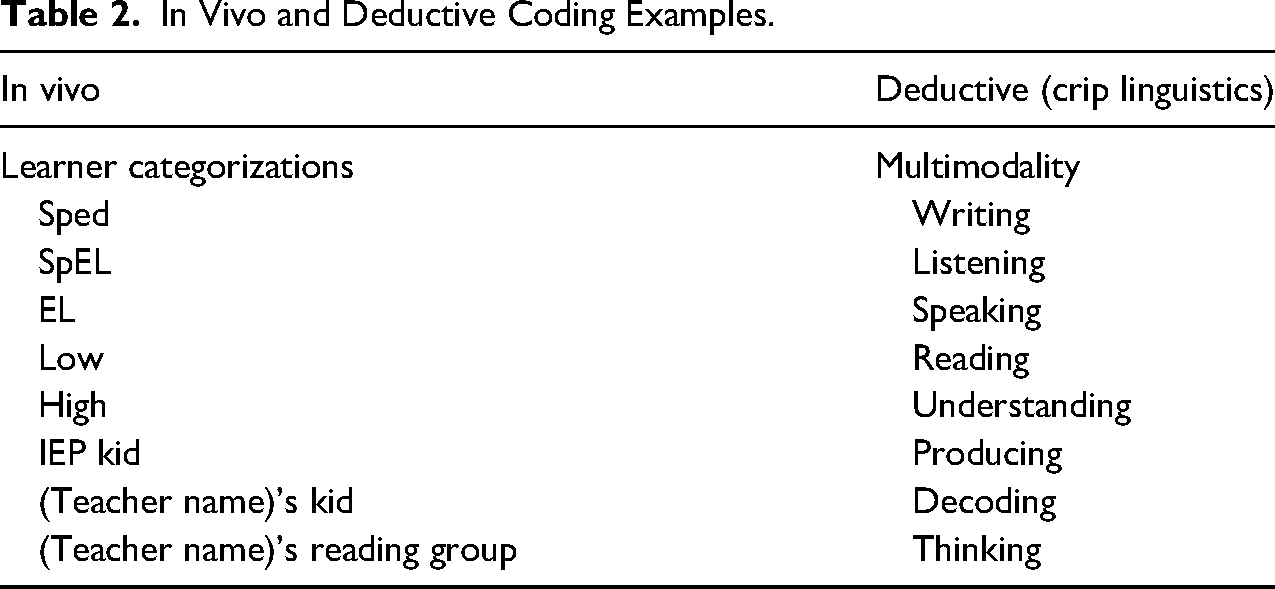
Initial rounds of data analysis included open coding to notice themes across data sources; in vivo coding to highlight the terms used by participants; and deductive coding to map on conceptual frameworks and core constructs of the research study, namely those related to race, disability, and language (see Table 1). The next round involved revision of codes and the codebook, then a third round of data review was conducted employing the codebook (see Phuong, 2021). Building on previous rounds of coding, for discourse analysis, Jennifer recorded and coded interactional routines by participant(s), location, time, and context. In this paper, dialogue was edited to remove fillers and repetition to be able to focus on how discourse reflects social theory (Fulcher, 1989), rather than a fine-grain interactional analysis.
Open Coding Examples—Constructions of Ability.
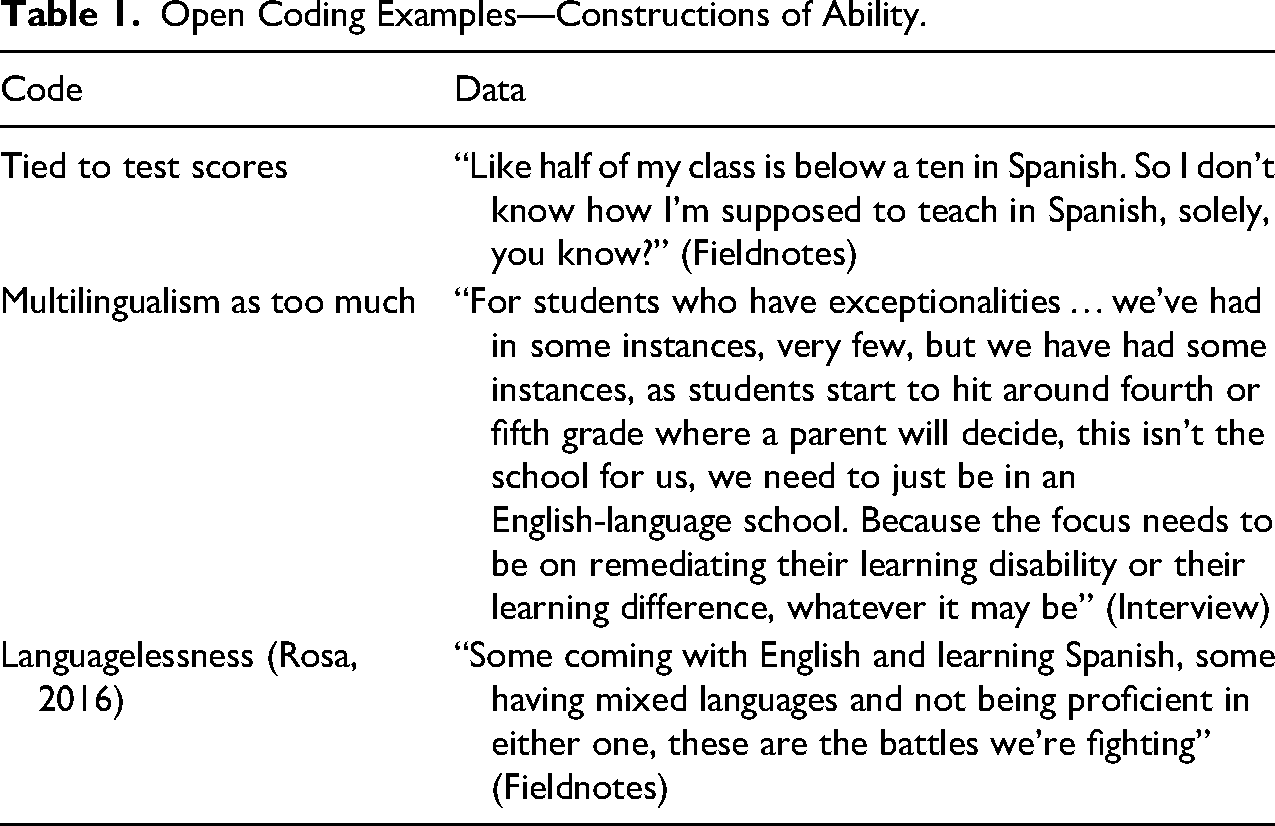
Additional rounds of deductive coding involved discursive constructions of ability (see Table 2), discussions of language and special education services, and discussions of testing, both broadly and in reference to specific people or events. Ari was invited to a secondary data analysis to deductively examine and code the data through a crip linguistics lens, in particular considering multimodality, structural ableism, and how linguistic competence is interactionally accomplished. A crip linguistics perspective allows us to center anti-ableist perspectives to language in considering the impact of educational structures on the perception of students’ language practices.
In Vivo and Deductive Coding Examples.
Findings
In examining the role of the service delivery model and standardized testing in learner categorizations, we argue that all students of color were subjected to pathologizing discourses in school, regardless of schooling categorizations. Students without formal learner categorizations were subject to the same institutional mechanisms, whether through the service delivery model or groupings by instructional practices. This institutional context mediated teachers’ discourse around language proficiency and use, specifically how constructions of students’ language abilities at DLCS were mediated by monoglossic, raciolinguistic, and ableist ideologies that are embedded within service delivery and standardized testing. We begin by examining the service delivery model and its implementation at DLCS.
Intervention Services
At DLCS, students classified as EL were taught within a co-taught general education classroom, while SLADs often received small group intervention services that brought them outside of the general education classroom. There were students in all three homerooms who did not have a formal learner categorization yet received intervention services through MTSS. MTSS relies on the similar ranking logics as special education, and is often seen as the penultimate step for students who may need to be referred for special education services.
In the “sped” class, there were 20 students total; 10 were SLADs (50%) and five students received intervention services (25%), leaving five students who did not receive any type of service (25%). During the literacy block, the 10 SLADs left at the beginning of the class to do a reading intervention program, while 10 students remained. One of the students receiving intervention services was Isaiah (pseudonym), a Dominican American fourth grader who, at the time, was not classified as an EL nor disabled. Because he was on tier 2 of MTSS, he participated in pull-out reading intervention services three times a week and took part in social emotional learning activities during his lunch. Isaiah was described as “low low” in both Spanish and English classes by his teachers, as measured by his performance on literacy assessments. Reading assessments, standardized testing, and student work mediated a linear ability hierarchy of low, medium, and high that was applicable to all students, regardless of formal classifications. Students could have differing abilities in regard to Spanish and English (e.g., high in Spanish, low in English), different subject areas (e.g., high in math, low in reading), and overall ability (low low).
For English, this led to the initial MTSS referral and subsequent intervention services that removed him from the English-medium general education classroom for literacy. Conversely, due to the lack of available Spanish-language intervention services, his Spanish teacher never referred him to MTSS. To be clear, we do not suggest that Spanish intervention services would be equitable, but that the differing orientations reveal underlying ideologies about language—namely that English-language proficiency is prioritized over multilingual development and impacts what services are available and how students may be classified. Despite Isaiah not being formally placed in special education, he was still positioned as a “low” performer in assessments and thus received intervention services in this perceived area of need, that is, English instruction. He was also removed from the general education classroom for such intervention services, an experience common to SLADs. Next, we outline how standardized language assessments contribute to the construction of students’ abilities in literacy and language.
Multilingualism, Modality, and Ability in Testing
In addition to how eligibility for intervention services revealed hierarchies of ability, student literacy scores mediated how teachers constructed language abilities. Standardized literacy tests arbitrated how multilingualism and students’ language practices were categorized and deficitized (Chaparro et al., 2021; Flores, 2021). Language proficiency was assessed through literacy skills and academic performance driven by standardized testing mechanisms that emerged from and continue to reify monoglossic and raciolinguistic ideologies. These assessments, as well as self-reporting measures through the home language survey, mediated classifications of English OR Spanish as an L1 OR L2, erasing the complexity of multilingual children's language practices. This reflects a monoglossic orientation to literacy in its strict compartmentalization.
One such exam was the Evaluación del Desarrollo de la Lectura 2 (EDL; the Spanish-language version of the Developmental Reading Assessment), which determined a student's reading level according to grade level. In Excerpt 1, the Spanish teacher and Jennifer discussed Nayeli, a classmate of Isaiah, who did not have any formal learner categorizations and did not receive any intervention services. At this grade level, the test typically involved a student decoding a passage aloud to assess fluency; answering comprehension questions related to the passage both aloud and in writing to assess comprehension, all in Spanish, on the part of both the teacher and the student. Thus, the EDL assessed reading through the use of multiple modalities. Nayeli was positioned as able in both English and Spanish Language Arts, though much greater in English, in part due to her test scores (see Excerpt 1).
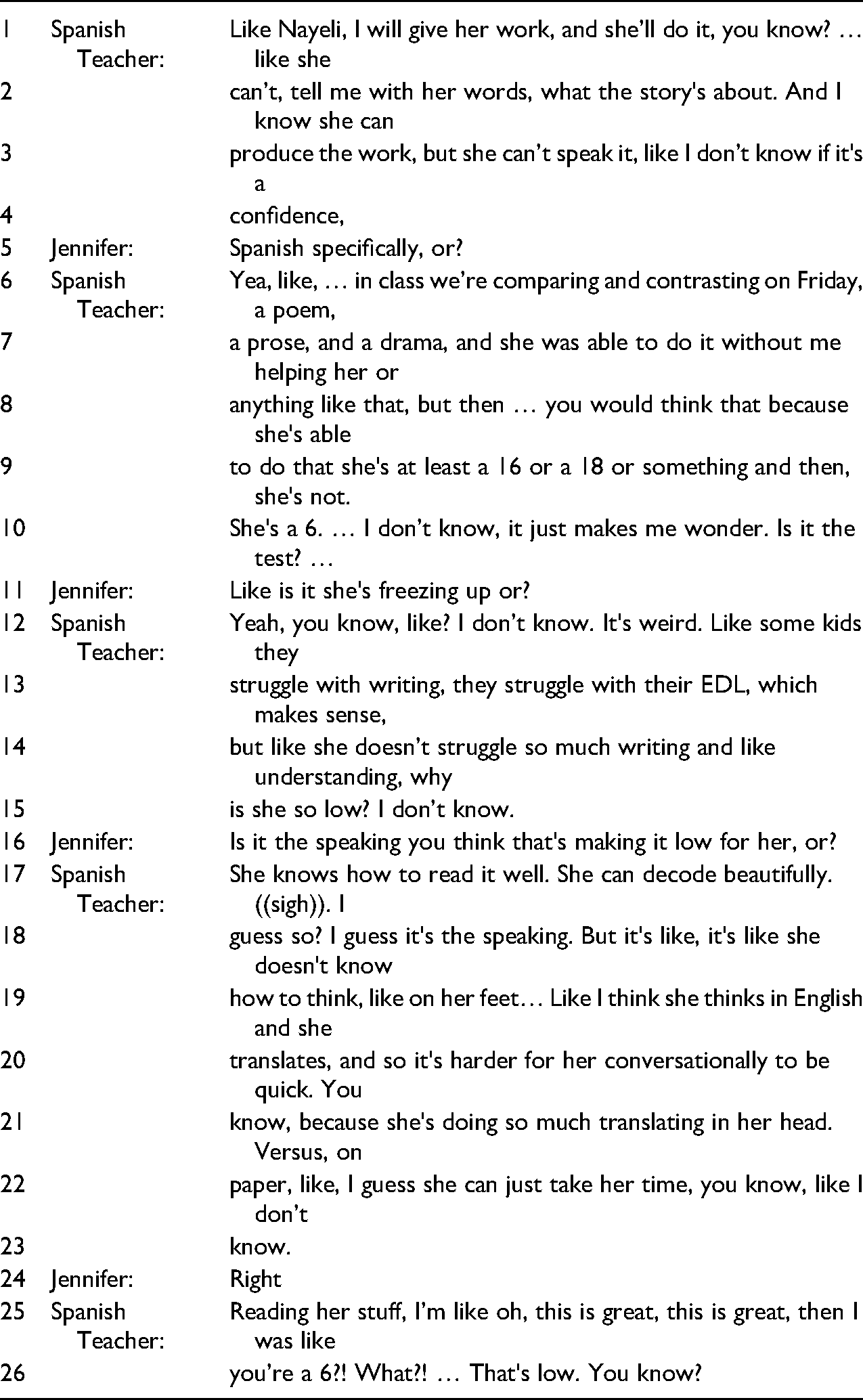
The Spanish teacher made sense of Nayeli's abilities based on a complex dynamic of student work, reading assessments, medium of instruction, and modality. In lines 7–8, the Spanish teacher described Nayeli's academic proficiency (“she was able to do it without me helping her or anything like that”) based on her completing class work independently, and then contrasted that with her EDL score (lines 8–9); in other words, the Spanish teacher had expected Nayeli to perform better on the EDL score because she was proficient in her written work in Spanish Language Arts. The Spanish teacher asserted that it is typical for a student who “struggle[d] with writing” to “struggle with their EDL” (lines 12–13), but that Nayeli did not follow this pattern—she had a low score on the EDL even though she is positioned as able to write and understand in Spanish based on class work (lines 17–19). She asserted that the student “[was] a 6” (line 10), calling the score low (line 26), but also asking, “why is she so low?” (lines 14–15). Throughout, she sought out explanations for Nayeli's performance on the test (with a score of 6), primarily behavioral, cognitive, and emotional reasons (i.e., confidence, line 4). In this way, the Spanish teacher mapped test performance onto a student's cognitive ability, with “low” becoming a characteristic for Nayeli in Spanish.
The Spanish teacher also considered different modalities in making sense of language proficiency and academic ability (lines 12–14, 17–23), distinguishing between decoding, writing, speaking, and thinking. She also describes Nayeli as not knowing how to think on her feet (lines 18–19), which positions speed and fluency as markers of linguistic ability. Further, the teacher conjectured that Nayeli may have experienced a heavy cognitive load: “it's harder for her to conversationally be quick… because she's doing so much translating in her head” (lines 20–21). She adds that “on paper, like, I guess she can just take her time” (line 22). In this way, Nayeli is positioned as abled writer in Spanish because she could complete her written work when given the appropriate amount of time. Although she could produce speech through decoding the text aloud, she was positioned as lacking language proficiency in Spanish because of the (lack of) speed with which she spoke. This way, the temporal constraints of testing and the positioning of her speech abilities led the Spanish teacher to describe her reading as “low” (lines 6), demonstrating the complexity of how reading is assessed.
This example demonstrates how oppression can be masked through a focus on individual student failure. Further, even though the teacher questioned the test itself (line 3), the EDL was ultimately prioritized over her expertise (Hinnant-Crawford, 2023). The results of reading tests impacted students’ educational trajectories through classification processes and the levels of reading groups they were placed in; these dynamics can lead to deficit-oriented assumptions about cognitive and linguistic ability.
ELs, Home Language, and Linguistic Ability
Teachers often questioned the accuracy of students’ classifications, which led to dynamics around learner categorizations where teachers would discuss if a student is “actually” an EL or a SLAD, and which students “should” be classified as an EL or SLAD. With students, teachers were careful not to discuss either categorization, pointing to both confidentiality laws and the stigmatization of even discussing disability in schools (Sapon-Shevin, 2017). For example, the teachers tended to use logistical markers and euphemisms, such as “small group kids” or “kids who go upstairs,” which pertained explicitly to special education and other intervention services.
Students’ experiences at home with language and their family background often mediated how teachers oriented to the EL label. For example, a student named Erik was not officially labeled as an EL but was discussed as such because he was deemed to have high Spanish-language proficiency, based on performance on literacy assessments, in class usage of spoken Spanish, and the cultural and linguistic context of his home—namely, that his parents were primarily Spanish-speaking and positioned as not knowing English. In other words, even though Erik had passed the WIDA screener and was not classified as EL, he was still subject to deficitizing EL discourses and positionings, such as the ESL teacher's assertion that “any kid that really primarily speaks Spanish at home probably should have EL support” (INT20190529).
Conversely, lack of Spanish spoken at home was understood to mean a student was not truly an EL, even if they were classified as such (FN20190529). Thus, teachers tended to construct the EL label in relation to Spanish. This reflects an ideology of a type of purism of English in which the presence of Spanish would impact a student's English-language proficiency. This dynamic of the conflation of EL status and perceived Spanish-language proficiency points to the raciolinguistic positioning of Latine students.
Family background in terms of ethnic and racial positioning also impacted how language and overall ability were discussed. Returning to Isaiah from a previous section (see Intervention Services), the ESL teacher and I discussed for whom a bilingual program would be appropriate, within the context of Isaiah's mother reconsidering his educational placement in a bilingual setting: I think a Hispanic bilingual program for a lot of students who are Hispanic is good. But… if they have a disability, I don't know how good that would be… Like we have Isaiah's mom asking about what we thought as far as for him going into this new school that he's been offered to have this opportunity for, versus, like, staying here. To my knowledge, he's not Hispanic, in his, I mean, at least not at home, he's not an EL. And so he's not going home and practicing Spanish on [a] regular [basis]… it's not reinforced at home, his parents may not be able to help him with homework because they don't speak Spanish or read Spanish. (INT20190613)
Here, the ESL teacher drew on biologically rooted categories of difference, with (lack of) Spanish proficiency being explicitly tied to upbringing (see Evans et al., 2019). She discusses his parents’ lack of Spanish proficiency, drawing from an ideology of language as inheritance. Ironically, the teachers generally did identify Isaiah as Hispanic in other contexts. Yet in saying that Isaiah was not Hispanic at home, nor was he an EL, she equated being Hispanic with speaking Spanish at home and with being an EL, erasing the complexity of Hispanic as an ethnic category. Her assertion reified a tie between race, ethnicity, and language and the raciolinguistic category of EL (Flores et al., 2020).
The ESL teacher also named the impact of ability on multilingualism and language development, mirroring harmful discourses that deny multilingual abilities to disabled students, that is, that bilingual development is not appropriate for certain students. Even though Isaiah was not labeled as disabled, multilingualism was positioned as too difficult for him because of his struggles with reading in his L1—the teacher still raised concerns about how “good” a “Hispanic bilingual program” would be for a student that “ha[s] a disability.” Tying disability to special education, the descriptors “sped” and “low” operated interdependently, and were also sometimes conflated, pointing to the ties between conceptualizations of ability and disability in testing and service delivery.
Thus, discussions of disability elicited Isaiah as an example of a “low” student, with his Spanish-language proficiency mediated by his family background. This implies that (in)ability can be perceived as biologically contained within individual students, and that those students are presumed to be unable to learn in multiple languages. These are discourses commonly found in schools, and yet, decades of linguistic research find that disabled students, no matter the kind of disability, can learn to be multilingual in some way (e.g., Yu, 2015). This excerpt demonstrates the complex ways in which ability can be constructed through language, regardless of learner categorization.
Discussion
DLBE is often positioned as a panacea for students in linguistically diverse urban schools who are dually-classified, as well as bilingual children in general. These findings suggest that even within inclusive bilingual programming, all students are subject to ableist, raciolinguistic, and monoglossic ideologies in schooling, regardless of (lack of) classification. To be clear, we do not suggest that bilingual education is exceptional in the way it is informed by oppressive schooling structures. Bilingual schools, like all educational institutions, are still subject to the monoglossic and raciolinguistic ideological underpinnings of schooling that ultimately lead to racist and ableist educational outcomes for multiply-marginalized students. However, DLCS presents a unique glimpse into how the white normative gaze can operate within a multilingual context.
Revisiting Lewis's (2022) definition of ableism, we argue that students’ language practices were perceived through ableist hierarchical notions of ability tied to the service delivery model and standardized testing. Standardized assessments and normative understandings of ability and language mediated the creation of learner categories based on perceived language proficiency and ability without needing the specific labels of disabled or EL to operate ability hierarchies. Isaiah and Nayeli, for example, were described as “low” in Spanish because of their literacy assessment scores. Although Nayeli was positioned as literate in Spanish, this categorization of lowness is seen to reflect her linguistic (in)capabilities, despite the teacher's own assessments.
Meanwhile, Isaiah was positioned low in both English and Spanish because of scores, highlighting that ableism in testing does not require disability classifications to pathologize learners on the basis of language and ability. Further, the consequential validity (Schissel, 2019) of standardized testing can be questioned, given the material and social consequences of students’ communicative practices being devalued upon being labeled as “low.”
Learner categorizations arising from the service delivery model became mapped onto those who were not classified. The EL category and perceptions of Spanish-language proficiency became entangled with racial and ethnic categories, also highlighting the importance of delinking Spanish language use as a marker of Latine/Hispanic identity (Barillas Chon, 2024). At the same time, the categories of “low” and “sped” coalesce with monoglossic ideologies to frame students labeled as disabled, as well as students who are positioned as having low ability, as unable to be multilingual, despite research that suggests otherwise (e.g., Yu, 2015). When removed from historical and material contexts, these categories often functioned as individualized and biological categories of difference. These data show how students on an individual and group level were entrapped in processes of hyper-labeling, and how the institutional perceiving subject position impacted such processes.
Conclusion and Implications
Ableism must be considered as part of how monoglossic and raciolinguistic ideologies mediate the construction of deviant categories of language users in schools. It is also important to name how standardized testing and service delivery impact and constrain teachers’ experiences, such as the Spanish teacher's difficulty in reconciling scores from literacy assessments and student work. These conditions can be exacerbated within urban education contexts, with high rates of attrition; a lack of instructional support and resources; inequitable working conditions; and heightened political and polarized attention to curriculum (Woo et al., 2022). To that end, we do not suggest that teachers only inhabit an institutional perceiving subject position, but must navigate and negotiate it. To that end, we begin concluding this article by highlighting teachers’ agentive capacity (Li & Qin, 2024). As Hornberger and Johnson (2007) argued, “local educators are not helplessly caught in the ebb and flow of shifting ideologies in language policies—they help develop, maintain, and change that flow” (p. 527). The following excerpt took place during lunch, as some of the fourth-grade team chatted about administering reading assessments, specifically a passage entitled Duque.
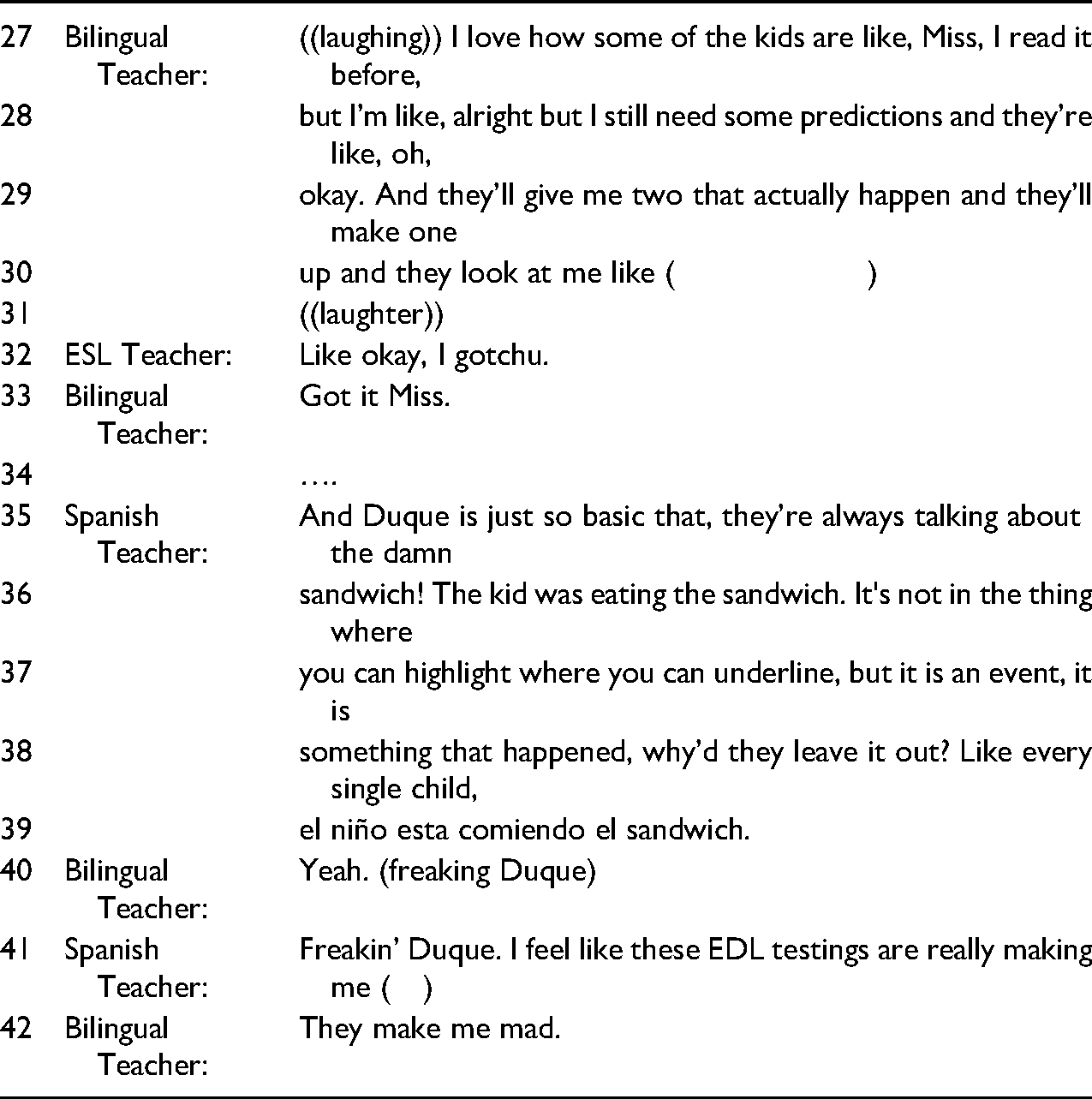
In this excerpt, the teachers are questioning and challenging reading assessments. They highlight the procedural display involved in schooling (Bloome et al., 1989), that is, their negotiation with students to create predictions to satisfy test requirements (lines 1–7). The teachers critique the text itself, calling it “basic” and critiquing a question (lines 9–13). They also emotionally orient toward these assessments—in this case, with both humor and anger, demonstrating the complexity of teachers’ roles.
These dynamics impact teachers at all stages of their careers, with compliance often prioritized over relationship building and connection within schools and local educational agencies (Voulgarides, 2018). Teacher education programs have been shown to reify compliance-oriented educational practices, leading preservice teachers to feel like they lack “self-efficacy, agency, and enthusiasm” (Dover, 2022, p. 977). In Kavanagh and Fisher-Ari's (2020) study on scripted curricula and teacher agency, both students and their early career teachers reported limitations on agency and autonomy (see also, Milner, 2013). For in-service teachers and administrators, their frustrations were mediated by external factors over which they had no power (e.g., class sizes, standardized assessments, shortage of bilingual personnel; Cioè-Peña, 2017). Even with research on systemic oppression and teacher agency, educators and administrators are often still held solely responsible for their involvement in oppressive pedagogical practices.
However, the data presented in this paper are a snapshot of a moment in time. Educators’ views toward academic achievement, behavior, and the education system at large, are constantly in flux, and are contingent upon interactional and social contexts (Razfar et al., 2023). Despite the nature of structural oppression that disproportionality impacts multiply-marginalized students within urban education, addressing these discourses in schools can create opportunities to promote equitable educational opportunities for multiply-marginalized students.
Therefore, we wish to contribute to expansive ways of understanding and practicing justice (Annamma & Winn, 2019; Tuck & Yang, 2018). Aligning with transformative justice practices (Williams & Richards-Schuster, 2023), we believe that everyday little practices (Li & Qin, 2024) are key to challenging oppression and developing agentive capacity. Questioning the utility of certain assessments (Excerpt 2) can be an everyday little practice that can be practiced, nurtured, and built upon to disrupt the aforementioned flows. Practical implications include carefully considering data sources in decision-making (Evans et al., 2019) and reflecting on their pedagogical practices through anti-ableist lenses (Hoffman & Martin, 2023; Phuong et al., 2021).
Teachers are already regularly challenging their institutional subject position in subtle yet meaningful ways. Teachers and students are already constantly negotiating language in skillful ways regardless of language ideologies imposed by schooling. From a crip linguistics perspective, Henner and Robinson (2023) highlighted linguistic care work, which has ties to the notion of care work emerging from the Disability Justice Movement (Piepzna-Samarasinha, 2018)—or the notion that disabled people care and labor for one another in collective and collaborative ways that center on communities rather than service provision. Extending care work to language, Henner and Robinson emphasized that “linguistic care work embraces interdependence between languages as a practice of collective access in desire to work toward mutual understanding” (p. 6). This framework highlights the interactional and interdependent ways individuals collaborate to understand one another.
Linguistic care work must occur in education at all scales and fields, from curriculum (Sapon-Shevin, 2017) to teacher education (Keefe, 2022). In part, this involves taking care with the language used to describe, label, assess, and understand students. We hope that the concerns raised in this article can help educators develop ideological clarity (Alfaro & Bartolomé, 2018) for our own practices in considering how we frame questions and problems in education, and how we can act toward linguistic and disability justice (Phuong & Venegas, 2022).
Footnotes
Acknowledgments
We would like to thank Drs. Nelson Flores and Subini Annamma for their guidance and feedback on earlier drafts of this work, along with Drs. María Cioè-Peña, Jon Henner, and Octavian Robinson for their critical frameworks that anchor this paper.
Declaration of Conflicting Interests
The authors declared no potential conflicts of interest with respect to the research, authorship, and/or publication of this article.
Funding
The authors received no financial support for the research, authorship, and/or publication of this article.
Ethical approval
The study was approved by the University of Pennsylvania Human Research Protections Program (Protocol Number: 831790) on October 10, 2018.
Informed consent statement
All participants provided written informed consent prior to participating.

Author Biographies
Appendix
Transcription Conventions
word.
Falling intonation
word,
Continuing intonation
word?
Rising intonation
word!
Excited intonation
wor:d
Elongated syllable
Stressed syllable/word
=word=
Attached speech
wor–
Cut-off speech
[word]
Overlapping communication
( )
Inaudible speech
(word)
Presumed speech
↑↓
Especially high or low pitch change
(.)
Micro-pause (less than 0.2 s)
(#.#)
Timed pause
˚word˚
Quiet speech
((word))
Transcriber's note/non-verbal communication