







Abstract
Applying to college is a complex process requiring significant economic and cultural resources. Students from more affluent backgrounds often have the advantage of family support, while low-income students face challenges due to limited access to navigational knowledge, especially in urban schools where counselors are overwhelmed. This qualitative study highlights how near-peer advisors, working alongside school counselors, provide emotional support and trusted guidance in ways that support a wider range of students to engage with and complete the college application process. Based on observations and interviews, we explore how near-peers leverage their unique position to connect marginalized students with college advising resources in high-need urban schools.
Keywords
While the majority of young people in the United States aspire to attain a four-year college degree after high school (Holland, 2019; Youth Truth, 2023), college enrollment and completion remain highly stratified by race and class. In 2022, 79% of 18–24-year-olds from the highest income quartile were enrolled in college compared to 44% of their peers in the lowest income quartile (Cahalan et al., 2024). A disproportionate number of high school graduates who do not enroll in postsecondary education within a year of high school come from Black, Latinx, or Native American backgrounds, or from low-income families (Reyna & Norton, 2020).
A vast body of research demonstrates that racially and economically marginalized students face multifaceted and intersecting barriers to attaining the information and support necessary to successfully navigate applying to college (Cox, 2016; Gast, 2022; McDonough, 1997; Perna & Titus, 2005; Perna & Thomas, 2006; Renn & Reason, 2021; Shamsuddin, 2015; Welton & Martinez, 2014; Woods & Domina, 2014). The college application and choice process is highly complex and spans multiple contexts, namely home and school (Perna & Thomas, 2006; Savitz-Romer & Nicola, 2022). Negotiating the process requires not only knowing what steps to take, but when to take them and how to strategically engage school authority figures to secure individualized assistance (Gast, 2022). Given longstanding race and class disparities in college attendance and completion, low-income, Black, Latinx, and Native American students are less likely to have parents who attended college themselves, increasing their reliance on their high school for guidance to complete college application steps (Farmer-Hinton, 2008; McDonough, 1997).
Concerningly, due to continued racial segregation in public schools, racial wealth gaps, and the funding of public schools through property taxes, the students who need the most assistance with applying to college are least likely to attend high schools that are positioned to provide intensive support with the process (Duncheon, 2021; McDonough, 1997; Roderick et al., 2011). This is particularly the case for urban school districts, where students are more likely to attend high poverty schools with low graduation rates, limited resources, and high staff turnover (Hill, 2012; Savitz-Romer & Bouffard (2012)). As Duncheon summarizes, “poverty, systemic racism, and inequitable resource allocation commingle in urban school contexts to disrupt postsecondary opportunity” (Duncheon, 2021, p. 1365) through insufficient investment in the types of supports needed to help students in urban schools submit applications on-time, apply for financial aid, gain acceptance, make a “good fit” college choice, and take necessary steps to enroll (Roderick et al., 2011; Savitz-Romer & Nicola, 2022).
Inequities in access to school-based resources that help students enroll in college are most visible in unequal access to school counselors. School counselors possess the formal knowledge and positional authority necessary to act as “institutional agents” to students (Stanton-Salazar, 1997) by providing expert guidance, advocating on their behalf, and offering emotional support. However, counselors are rarely positioned or sufficiently resourced to provide this type of individualized advising (Corwin et al., 2004; Gast, 2021; Savitz-Romer & Nicola, 2022): in the 2021–2022 school year, on average, each public school counselor was responsible for 405 students, almost twice the recommended caseload size by the American School Counselor Association (NACAC, 2024). Student-to-counselor ratios are particularly large in urban school districts, where the median ratio is nearly 500 students for every one counselor (Gagnon & Mattingly, 2016). Burdensome caseloads are concerning because research indicates low student-to-counselor ratios are associated with a range of positive student behaviors and outcomes, including those that promote college-going like talking about college plans and taking the SAT (Woods & Domina, 2014). Given the complex and multilevel constraints that inhibit school counselors from fulfilling their roles, interventions often attempt to circumvent school counseling offices (i.e., text nudges) or offer access to counseling through nonprofit organizations, rarely bolstering the support of existing school counselors or delivering assistance in schools directly.
A promising intervention that seeks to expand the capacity of school counselors involves positioning “near-peer advisors” to support students. Near-peers share the demographic and educational background of the students they serve, and have successfully navigated the college enrollment process themselves. Some of the nation's largest urban school districts are now employing near-peer advisors to support college-going for historically marginalized students, and seeing gains in college enrollment (Bos et al., 2012). However, it is not clear if the gains in matriculation are due to the increased capacity of college advising staff to provide individualized advising, or because near-peers bring unique characteristics and skills to how they support students.
In this paper, we interrogate this question and find that adding near-peer advisors to the social network of urban high schools enhances both the capacity and cultural responsiveness of the college advising ecosystem, therefore expanding the number and range of students who can be supported to successfully complete the steps necessary to apply to and enroll in a postsecondary destination of their choice. By acting as holistic cultural guides through unfamiliar territory, we find near-peers provide three distinctive resources for historically marginalized students in urban schools: they expand the capacity of the counseling office to individually walk students through the bureaucratic maze of the college application process; they offer emotional support that school staff are often unable to, normalizing the complexity that historically marginalized students encounter when they apply to college; and, near-peers serve as consistent and credible role models of postsecondary success. Our findings demonstrate that near-peer advisors make unique contributions to the college advising resources provided in high schools by leveraging their shared identities to build meaningful relationships with students, serving as a bridge to the institutional knowledge required to navigate college admissions. Consequently, they enhance and expand urban high schools’ ability to support historically marginalized students to successfully navigate the many steps of the postsecondary process.
Challenges to Serving Students Through School-Based College Advising
In order to complete college application and enrollment steps, racially and economically marginalized students need ongoing and reliable access to supportive adults at their high school—namely, school counselors—who possess expert information about applying to college, and can help students to act on that information (Hill, 2008). This is especially important when administrative burdens become high-stakes barriers for low-income students. For example, the bureaucratic complexity of filling out the free application for federal student aid (FAFSA) often leads low-income students to forfeit grant aid they could use to pay for college (Bird et al., 2021). When counselors’ administrative load is reduced, more low-income students fill out the FAFSA and are able to access financial aid (Bell & Meyer, 2024), and students whose counselors have smaller caseloads are more likely to take other steps that increase the likelihood of their students attending college, such as making a college plan, taking the SAT, and applying to two or more colleges (Bryan et al., 2011; Woods & Domina, 2014).
However, recent figures indicate college counselors’ caseloads remain large, which disproportionately affects students who stand to benefit most from one-on-one time with a counselor but are least likely to have access to it (Avery et al., 2014; Stephan & Rosenbaum, 2013). Counselors who serve predominantly students of color work with 34 more students on average each year (EdTrust, 2019), and large student-to-counselor ratios have negative impacts on the likelihood of college enrollment among students of color and first-generation students (Pham & Keenan, 2011). Supporting the college-going of students from first-generation backgrounds also requires “an emotional investment that is extensive, nuanced, and comprehensive” from school staff (Martinez et al., 2024, p. 1928), but the schools that serve this population are already overstretched helping students complete required procedural steps in the application process.
The summer after high school graduation is a particularly vulnerable time for students who rely on their school for postsecondary resources, as voluminous administrative tasks are required while high schools are closed (Page et al., 2020). This is a driving factor of summer melt, the nationwide trend whereby up to 40% of low-income students who have committed to a college in the spring fail to matriculate in the fall (Castleman & Page, 2014). Studies have looked at light-touch interventions that use text messages, bots, or other “nudging” prompts to provide students with procedural information about, for example, deadlines for filing the FAFSA. Although these scalable interventions have figured prominently in research about how to broaden access to college application information and support (e.g., Hoxby & Turner, 2013; Pappano, 2020), evidence indicates these approaches have limited effects on student behavior (Gurantz et al., 2019), particularly in terms of positively influencing students’ use of advising resources (Meyer et al., 2023; Page et al., 2020). Addressing summer melt specifically, and equitable postsecondary access more broadly, requires targeting students’ access to college information and social connections through their high school community (Holland, 2019; McDonough, 1997), with an approach that draws on a social network of trained, school-based staff to share the work of college advising (Nauer et al., 2013).
The Emerging Role of Near-Peers in Expanding Access to College Advising
Given the many challenges facing historically marginalized students, and the systemic under-resourcing of schools in high poverty areas across the country, it is unsurprising that urban high schools lack the resources to make the college application process fully accessible. As noted above, these students need both extensive help from informed adults through each step of the process and the kinds of cultural capital that emerge from close-knit relationships in families and communities. The relational trust held within family and community protective networks (Bassett, 2021; Beard, 2021) provide the emotional support and motivation needed to overcome obstacles in the college process by, for example, reinforcing culturally-situated beliefs, values, and priorities (Carolan-Silva & Reyes, 2013; Gofen, 2009; Missaghian, 2021). Families and communities also bring other forms of “community wealth” such as aspirational capital, or the capacity to maintain optimism and motivation in the face of real and perceived barriers, and navigational capital, or strategies that assist students from historically marginalized communities to move through and cope with dominant social institutions (Yosso, 2005).
College access programs that employ slightly older peers who share similar racial and socioeconomic backgrounds to students in high-need settings capitalize on the role of protective networks by positioning these “near-peers” as supplemental college advising resources to students. Programs informed by best practice provide near-peers with extensive professional training about the college application process, including how to provide instrumental advising alongside emotional support to students (Angelique et al., 2002). Near-peer advisors are also typically supervised and mentored by a school's college counselor (Anderson et al., 2019), and thus build dominant institutional knowledge through this mentoring relationship.
Many place-based and national postsecondary access programs, such as the City University of New York (CUNY) College and Career Advising Fellows and College Advising Corps, are implementing and scaling near-peer models of advising support, and there is emerging evidence of positive effects for students attending high schools in urban settings. In New York City, the summer melt prevention program administered by New York City Public Schools places near-peer advisors at most high schools in the city over the summer to support with college pre-enrollment tasks, with outcomes showing three-fourths of college-intending students who received support from a near-peer matriculated to college in the fall (Ahn & Studer, 2018). In Los Angeles, a randomized controlled trial of a near-peer program targeted to low-income high school students found students assigned a near-peer applied to college at significantly higher rates than students who were not (Bos et al., 2012). Students advised by a near-peer also enrolled in college at higher rates: 2.5 percentage points higher enrollment at 2-year colleges and 4.4 percentage points higher enrollment at 4-year colleges (Bos et al., 2012).
Further research indicates that students who are advised by a near-peer over the summer after high school are more likely to have access to help with completing required college pre-enrollment tasks, such as submitting immunization forms and applying to special programs (Tichavakunda & Galan, 2023). High school students with near-peer advisors describe trust, fidelity, and identification with the near-peer as important features of the relationship, as well as the experience of “mutuality” (Liang et al., 2008). Near-peers’ ability to build relational trust is key because the challenges that arise for low-income students when applying to college can be shrouded in social stigma, like housing insecurity, lack of transportation, or insufficient funds to pay application fees (Bassett, 2020). Near-peer advisors who have experienced similar challenges to their students may be especially adept at developing trust and delivering support because they are more likely to have up-to-date local knowledge of the issues faced by students, as well as the strategies that are needed to solve problems that are specific to particular institution types, like regional public university settings (Bahl, 2021; Beard, 2021; McCallen & Johnson, 2020).
Conceptual Frameworks
Exploring postsecondary options and applying to college is a complex social process that requires a significant investment of economic and cultural resources. Research demonstrates that middle and upper-income students draw on their parent's financial resources, social networks, and institutional know-how to navigate this process effectively. For example, in an ethnographic study of how working-class and middle-class Black students navigated the college admissions process in the same high school, Gast (2022) found that middle class students were coached by their parents and social networks to approach college admissions like a competition. They received early, specific advice from their families about how to navigate admissions processes and were prompted to proactively visit and talk to school teachers and counselors to ensure they were on the right track (Gast, 2022). This cultural strategy paid dividends as school counselors were unable to meet with all students but were receptive to proactive help-seeking efforts.
Certain cultural strategies, or cultural capital (knowledge, norms, and attitudes), are highly valuable when negotiating access to dominant social institutions, and middle or upper-class families are able to draw on this tacit knowledge in order to purchase “social profits” from those institutions (Bourdieu, 1986; Lareau, 2000). Like a financial inheritance, wealthier families possess and transmit the types of cultural dispositions and strategies that yield rewards giving their children a cultural advantage in fields of social competition, like college admissions. In contrast, students from lower social classes may have identical aspirations, exert similar effort, and have the same abilities as their upper-class peers, but their interactional styles, dispositions, and navigational strategies fail to reap dividends from dominant institutions. For example, the lower-income Black students attending the same high school in Gast's (2022) study, expected high school staff to help them in the admissions process and hopefully waited for assistance. This strategy was not well suited to the open door, understaffed structure of the counseling office and resulted in this group gaining very little individualized and specific assistance (Gast, 2022).
Although students from economically and racially marginalized backgrounds are less likely to have parents who can transmit college knowledge, when they develop trusting and supportive social relationships with informed adults, they can acquire the cultural capital needed to successfully navigate dominant institutions (Bassett, 2020; McCallen & Johnson, 2020; Stanton-Salazar, 1997; Stephan & Rosenbaum, 2013). These relationships are essential for gaining access to knowledge about the inner workings of institutions that is more readily available to middle-class families (Lareau & Cox, 2011). Consequently, engendering a more equitable college application process for high school students who are members of social groups historically excluded from benefits derived from material (e.g., money) and non-material (e.g., knowledge) resources bound by race and class (Mishra, 2020) requires intervening in their social networks to make supportive relationships available with adults who possess both positional and personal resources (Stanton-Salazar, 2011). “Positional resources are those that are linked to an advantageous position within a hierarchically arranged organization, network, institution, or social system….and personal resources are in the possession of individual actors who can use or transmit these resources” (Stanton-Salazar, 2011, p. 1078).
Stanton-Salazar (1997) conceptualizes two types of social networks conveying cultural capital resources found to positively impact racial or ethnic minority students’ educational trajectories: institutional agents, or individuals who have status, authority, and access to resources within institutions, such as teachers or counselors;and protective agents, such as family or community members. Institutional agents use their status to transmit, or negotiate the transmission of, specific forms of social and cultural capital that support students with accessing needed information and resources in educational settings (Stanton-Salazar, 1997). Gaining this complex cultural knowledge about the formal and informal rules of dominant institutions (Lareau, 2015) enables “a segment of society [to gain] the resources, privileges, and support necessary to advance and maintain their economic and political position” (Stanton-Salazar, 1997, p. 6).
Through the formation of relationships with institutional agents, historically marginalized students become recipients of knowledge and resources outside the boundaries of their social group (Missaghian, 2021). The amount of resources students gain access to “can be considered a function of (a) the levels of trust and closure that exist within their relationships with institutional agents, (b) the size of the social networks to which those agents belong, and (c) the amount of resources possessed by institutional agents within those social networks” (Museus & Mueller, 2018, p. 195). Research indicates institutional agents who share students’ racial or ethnic background are especially instrumental to transmitting knowledge and resources because they capitalize on these similarities to develop trust and to provide “holistic support…[that] transcend[s] academic discussions” (Museus & Neville, 2012, p. 448). Institutional agents also “humanize” educational processes and are proactive in their support of students by taking initiative to engage with students rather than waiting for students to seek help (Museus & Mueller, 2018).
While Stanton-Salazar conceptualized an institutional agent as “an individual who occupies one or more hierarchical positions of relatively high-status, either within a society or in an institution (or an organization)” (2011, p. 1075), near-peer advisors more often occupy low-status roles in organizations, closer to an intern or teaching assistant. Yet, as research from recent interventions indicates, they appear to be effective at transmitting the knowledge, cultural dispositions, and engagement styles that help students from marginalized backgrounds navigate the college application process in a resource-constrained environment, thus straddling the roles of institutional and protective agents.
In this study, we build on a robust literature concerning the structural and relational challenges that prevent urban schools from providing sufficient college advising resources to the predominantly historically marginalized student populations they serve (Savitz-Romer & Nicola, 2022; Shamsuddin, 2015). We contribute to an emerging research base about the role of near-peers in expanding historically marginalized students’ access to postsecondary guidance, and ask: what skills and experiences do near-peers leverage when advising historically marginalized students through the college application process in urban high schools?
Study Site and Context
To answer this question, we studied a near-peer advising program in New York City, College Access: Research and Action (CARA). New York City is an “urban intensive” school context (Milner, 2012), home to a sprawling and dense public school system marked by long-standing race and class segregation (Kucsera & Orfield, 2014) and a close connection to CUNY, the local public university system where the majority of the city's graduates attend college. As of 2022, 82% of freshmen at CUNY had attended a public high school in New York City (New York City Comptroller, 2024).
CARA trains near-peers to work in the college advising offices of non-selective high schools in New York City to provide additional college advising support to historically marginalized student populations. Near-peers in CARA's program are college students who return to their alma mater high school to work part-time (10–15 hours per week) in the college counseling office. Near-peers receive 70 hours of training from CARA over the course of the year in how to help high school seniors explore college options, complete college and financial aid applications, and make an informed postsecondary choice. The training also includes skill development in counseling, such as using reflective listening techniques, and other professional “soft skills,” like communication and leadership. These near-peers continue to provide advising over the summer after graduation to ensure students matriculate to intended postsecondary destinations by completing tasks such as accepting a financial aid package, enrolling in an opportunity program, and registering for classes. An evaluation revealed schools implementing CARA's near-peer program at high schools in New York City demonstrate postsecondary enrollment rates that are 4.5 percentage points higher than comparison schools.
Our research took place amidst a “college for all” policy shift in New York City that began around 2015–2016 (Brighenti, 2017). Following dramatic improvements in high school graduation rates, which rose from 54% to 75% between 2004 and 2015 (Kemple et al., 2019), the city pivoted focus and invested millions of dollars to create an Office of Postsecondary Readiness within the city's central Department of Education. The “College Access for All” initiative administered programs, professional development, and coaching to ensure all students attending high school in the city received sufficient exposure to postsecondary options and the support needed to complete college applications. In the 2019–2020 school year, 439 out of the city's total 533 high schools participated in the initiative (Roland & Herman, 2020).
Research Methods
This paper draws on data from a broader longitudinal, multi-method qualitative case study conducted over the course of three years before the COVID-19 pandemic to document how high schools in New York City serving majority low-income, first-generation students of color were accessing and disseminating college advising resources and supports (see Bloom, 2020). In this paper, we extend the bounds of the original study to include follow-up data collection with school counselors, in order to strengthen the validity of our initial findings to school environments post-pandemic (Yin, 2018). In this study, we aim to achieve conceptual, rather than empirical, generalizability about the role that near-peers can play in urban intensive public school systems facing high student-to-counselor caseloads, serving a large proportion of historically marginalized students, and experiencing local pressure (and support) to improve college enrollment with limited funds (Collins et al., 2024).
We focus specifically on the role of near-peers in the college advising process, analyzing three qualitative data sources: individual semi-structured interviews with near-peer advisors conducted in 2017–2018; field notes from observations of near-peers working with students in college offices collected in 2017–2018; and focus group and individual interviews with college counselors collected in 2023–2024. Follow-up data collection with college counselors in the 2023–2024 school year was conducted to integrate multiple accounts of the work of near-peer advisors into our dataset to enhance the validity of our findings (Maxwell, 2013). This more recent follow-up data collection also enabled us to confirm that our pre-COVID findings were still valid and relevant to the present context of urban high schools.
Data Collection
Sampling
Purposeful sampling was used to select schools meeting the following criteria: (1) had partnered with CARA to implement the near-peer advising program, (2) demonstrated a gap of at least 10 percentage points between their high school graduation rate and postsecondary enrollment rate, indicating a need for additional college advising resources; and (3) were quantitatively and qualitatively representative of the types of non-selective New York City public high schools attended by students who are first-generation to college, low-income, and students of color. Participation in the research study was voluntary and not a required component of CARA program implementation, and members of the research team did not have a role in implementing the program at participating schools. Institutional Review Board (IRB) approval was obtained from New York City Public Schools and from CUNY prior to commencing research procedures. In accordance with NYC Public Schools’ IRB requirements, payment in the form of incentives or compensation were not provided to study participants. School names have been replaced with pseudonyms and other identifying information has been removed.
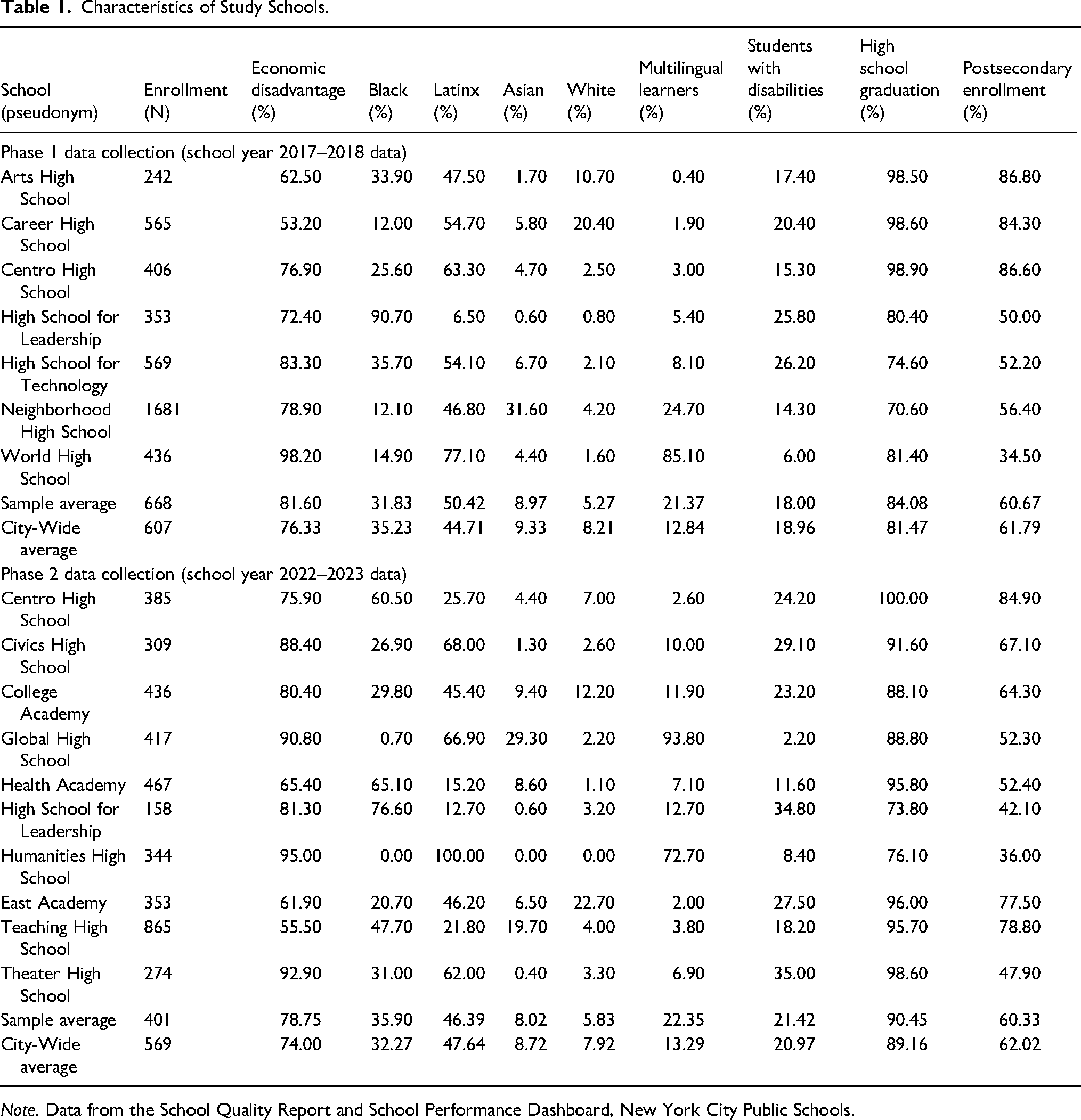
Table 1 presents student population characteristics of the high schools represented in this paper's analysis (N = 15), as well as the sample and citywide averages for each variable. Seven high schools who participated in the original study are represented in the 2017–2018 data collection, and counselors from ten schools participated in the follow-up phase of data collection in 2023–2024; two schools, Centro High School and High School for Leadership, participated in both phases.
Characteristics of Study Schools.
Note. Data from the School Quality Report and School Performance Dashboard, New York City Public Schools.
In 2017–2018, the seven participating schools served student populations that were more economically disadvantaged (81.6%), Latinx (50.42%), and composed of more multilingual learners than high schools across the city, on average. The proportion of Black (31.83%), Asian (8.97%), white (5.27%), and students with disabilities (18%) served at the schools in the study was on par with citywide averages, and the average high school graduation rate (84.08%) and postsecondary enrollment rate (60.67%) was also similar to citywide rates. In 2023–2024, the ten schools represented by counselors who participated in the follow-up interviews served student populations that were similar to typical schools across the city, except for having more multilingual learners enrolled (22.35%). Notably, in the years that elapsed between the two phases of data collection, the graduation rate of high schools in the study sample and across the city increased by ∼7.0 percentage points on average, while the postsecondary enrollment rate of the study schools and citywide average remained unchanged (based on data from 2021–2022, the most recent available at the time of writing).
Interviews
The near-peer advisors interviewed in 2017–2018 (n = 10) were all students of color (eight identified as Black and two as Latinx), seven were immigrants, and all were first-generation to college and/or from low-income backgrounds. Six of the near-peers attended CUNY four-year colleges, two attended CUNY two-year colleges, and two attended private four-year colleges in New York City. The interview protocol was informed by the nine principles of a college-going culture (McClafferty et al., 2002) and Stanton-Salazar's (1997) institutional support framework. Interviews were audio recorded and lasted 45 minutes, on average. Audio recordings were later transcribed verbatim. Interviews typically took place at the participant's school in their office or an empty classroom, and a few were held in a private office at a local university. All interview participants reviewed and signed a consent form prior to being interviewed.
The college counselors interviewed for the follow-up phase of data collection in 2023–2024 (n = 10) were all women; seven were white, three were women of color, and they had all been supervising near-peer counselors for at least two years. Several counselors had worked with near-peer counselors for over ten years, hiring new near-peers as others graduated from college and began full-time jobs. Counselors participated in the interview voluntarily during breakout sessions for a regularly planned professional development series, and were recruited in advance through their partnership with CARA. The interview protocol was guided by our preliminary findings from the original study, and sought to gather additional detail about the role of near-peers and the ways they interact with students and counselors in college offices. We also used these follow-up interviews as an opportunity to ask questions that could reveal disconfirming evidence about the influence of near-peers on a school's postsecondary advising ecosystem. Some interviews were conducted as focus groups and a few were conducted as individual interviews. All interviews lasted 15–20 min and were conducted virtually and recorded over Zoom, and later transcribed to text verbatim. All interview participants verbally consented prior to commencing interview procedures. Participant names are pseudonyms and other identifying information has been removed.
Observations
We conducted 70 hours of observation in the 2017–2018 school year across the seven schools in the original study, visiting each school 4–5 times over the year. We observed the everyday college advising work of near-peers and counselors, such as watching college counselors and near-peer advisors meet with students in the college office, and sitting in on college preparation classes. Field notes of observations were written during and after observations.
Research Team Positionality
This study was motivated by the research team's past and current lived experiences as educators and college access and success practitioners, and by our scholarly interests and expertise in the field of postsecondary advising. The research team was composed of three white women with doctoral degrees, a white woman with a postgraduate degree who was a doctoral candidate, a Latinx woman who was a doctoral candidate, and a woman of North African/Middle Eastern descent who was a doctoral candidate. Our positionality as researchers with advanced degrees from high status institutions of higher education afforded us relative social power and privilege in our interactions with the schools and individuals who participated in the study. Our educational backgrounds further intersected with each member of the research team's individual racial, social, and linguistic identities in varied ways that were “intricately and inextricably embedded in the process and outcomes” of the research (Milner, 2007, p. 389). In an effort to bridge social distances and understand our participants’ perspectives and experiences, we emphasized our shared goals, adopted an open learning stance, and positioned our participants as the experts in college advising. We followed-up with participants after interviews and during observations to ask clarifying questions, gather additional data about their work, and probe our initial impressions of their approach with students (Small & Calarco, 2022). Given our shared professional experiences working in college access and success nonprofits, during data analysis, we frequently discussed how these experiences shaped our perceptions, goals, and account of events in the field. In an effort to strengthen the validity of our account, we critically assessed the plausibility of our conclusions based on the supporting evidence and discrepant evidence and revised our findings accordingly.
Data Analysis
We used Stanton-Salazar's (1997) framework to develop a coding scheme for the interviews and field notes through an iterative process. As part of this iterative process, we used NVivo to develop and apply thematic codes (Deterding & Waters, 2021) that captured the emotions and actions conveyed in participants’ interview responses and in our field observations (Miles et al., 2014). We simultaneously produced memos with higher-level reflections on emergent themes, and met as a research team during analysis to discuss the coding and memos. During these meetings, we questioned and reflected on the lenses (i.e., identity, professional experience, age) through which we interpreted participants’ behaviors and responses to interview questions. In the final phase of analysis, we refined the conceptual framework and removed domains that did not reach saturation in our data.
For this paper's analysis, we began by meeting to discuss the original coding scheme alongside notable observations and passages from the near-peer interviews and field note observations. Next, we consolidated our observations and coding to describe the ways near-peer advisors work with students, and what this means for how they expand marginalized students’ access to additional cultural capital resources, such as navigational support and role modeling. We conducted follow-up interviews with college counselors to assess whether the adult counselors who supervise near-peers shared similar assessments of near peers’ work and their contributions to the counseling office. Aware that we may be predisposed to crafting an overly positive account of the work of near-peers given our experiences working with college access and success organizations that used near-peers in various ways, we asked counselors open-ended questions about the role of near-peers in their offices to avoid assumptions of positive impact. Using the constant comparative method, we analyzed areas of convergence and divergence between the counselor interviews, observational data of counselor and near-peer work, and near-peer interviews to refine our overarching analytical themes and findings (Boeije, 2002).
Findings
When well-versed in the procedural aspects of applying to college and positioned within urban high schools to work with students in ongoing ways, near-peer advisors function as holistic “cultural guides” to students through a complex and burdensome process. We find near-peer advisors who are current college students themselves can provide many of the same navigational resources supplied by “institutional agents” while simultaneously serving the function of “protective agents” for students historically marginalized by schools. Near-peers in our study helped students navigate the bureaucratic maze of the application process, normalized and managed emergent challenges, and served as tangible, authentic role models for college-going. In doing so, near-peer advisors injected key resources throughout the college advising ecosystems of urban high schools, bringing unique and essential forms of cultural capital that are needed to ensure students successfully navigate the postsecondary landscape.
Guiding Students Through the Bureaucratic Maze of College Admissions
Applying to college is an extended bureaucratic process—or really, a series of many bureaucratic processes, piled one after another—that is unlike other processes students encounter up to that point in their schooling. For high school seniors who are middle-class, large parts of the application process are often completed by their parents, or with heavy adult scaffolding (Bloom, 2007). However, the parents of first-generation, low-income students are often unable to provide this same degree of support. College counselors we interviewed gave many examples of how near-peer advisors expanded the capacity of their school's college advising office to help these students navigate the mundane, repetitive, time consuming, and consequential bureaucratic tasks their more advantaged peers complete at home with their parents. Lisette, a college counselor who supervised near-peers for three years at East Academy, detailed the volume of procedural tasks near-peer advisors completed with students during the school day in her college office. She helps with all of the general minutia of applications. The FAFSA, she knows exactly how everything is supposed to look, the CSS profile. So if a student was working on an application and I wasn't available, she would review it and make sure that everything was done and submitted. Same with TAP, same with CUNY, helping them set up their CUNYFirst account, completing SUNY applications…she does the overseeing of the applications.
Near-peer advisors carrying out essential, “high-level” college advising activities that support and enhance the effectiveness of a school's college advising ecosystem was a common report among counselors we interviewed. “He does a lot of data information, and we also do classroom push-ins, and that's a big help for me,” explained Nasira, the counselor at College Academy. “We push into economics classes and [he] is such a great help…we were able to knock out all our CUNY [applications] in October. So having him there by my side was a great accomplishment.” Near-peer advisors in our study were not only well-positioned to help students fill out forms, but also to help them troubleshoot emergent application issues in real-time. During visits to college offices, we observed in our field notes how near-peers work intensively with students on procedural application and enrollment tasks that students simply could not complete independently. The bureaucracy is never ending in terms of doing financial aid verification and dealing with paperwork from schools now that students have committed [to a postsecondary destination]. The office is full of 3–5 students at a time, it's the end of the day and mid-May, so students have received their college acceptance letters. The [near-peer] is working with students on the computers, a student had trouble with tax verification and needs to call the IRS, but not sure if there will be a translator. Another student is having issues with his financial aid package for [CUNY 4 year college]–he's been accepted, but can’t locate the forms needed to confirm his commitment. He also shows the [near-peer] his financial aid award letter and they discuss how to calculate the gap between his financial aid award and the cost of attending the college with room and board. The gap is $7,789. The [near-peer] encourages the student to start applying for scholarships now. While this flurry of activity is going on, the college counselor is in her office meeting with a student who was accepted to NYU. [The student] did not receive enough financial aid, and the counselor is helping petition for more aid. (Fieldnotes, 5.18.2017)
Notably in this example, the near-peer's unique combination of knowledge and patience freed the college counselor to concentrate on more specialized tasks (best completed by informed adults) required to help a student gain access to a highly selective institution (Hill et al., 2015). We heard from multiple counselors about how near-peer advisors similarly enhanced their capacity to address more complex tasks with and for students applying to high-status colleges.
Near-peer advisors were especially skilled at helping students overcome application roadblocks because they intimately understood how intimidating and overwhelming the process felt to high school students. Jaide, a near-peer at Leadership High School, reflected on how a particular student “just appreciated me giving her my time and me being understanding, not being impatient with her when she came across something she didn’t understand, even if it meant I have to explain it to her a million times.” Barry, a college counselor, echoed this sentiment in observing how “a lot of our seniors this year respond really well with the [near-peer advisors], some of them are in college opportunity programs, and can walk students through that process and what to expect with the interviews. And just sharing their own experiences with scheduling classes, registration, and financial aid.”
The bureaucratic load of applying for college is highest for low-income students and the counselors who serve them. These students must not only fill out college applications, but also fee waivers, FAFSA forms, scholarship applications, and tax verification forms. While these forms are standardized, students with the least resources are asked to complete a far higher number of these kinds of tasks, requiring additional individualized assistance, advice, and coaching. College counselors in urban intensive public high schools are simply not staffed adequately to offer this assistance, making an additional expert in the office a valuable addition. The value that near-peers bring to navigating the bureaucratic process is not just instrumental, but also affective—they understand the stress, uncertainty, and frustration that accompanies the process and incorporate this understanding into how they work with students. Blending patience and empathy into their interactions, near-peers in our study encouraged students to persist in the face of endless confusion. Nora, a long-time counselor at Civics High School who supervised near-peers in her college office for ten years, explained, I think one of the most beneficial aspects of having a [near-peer] is that you have somebody who was in the position of the students that you currently have. Just a few years ago, they were a student in the school, student in my class, somebody who went through the whole process themselves not too long ago and knows what it feels like to be a [student at this school] applying to college, and also knows what it feels like to be at CUNY currently as an undergrad. And how to navigate the whole CUNY system. That's actually very helpful.
Offering Emotional Support and Normalizing the Complexity of Applying and Going to College
Near-peer advisors also increase counselors’ capacity by extending additional emotional support and empathy to students as they navigate postsecondary hurdles. The ability of near-peer advisors to do this stems, in part, from their own lived experiences of the “pervasive, complicating conditions” (Cox, 2016, p. 16) students face when they are the first person in their family to attend college. As Jaide noted, “I was in that position where I was confused, I didn’t get into the school I wanted, or in some cases I was a little bit laid back, because I was overwhelmed.” Near-peers have proximal, recent experience of the application process, which can close a generation gap between staff and students in ways that alter students’ comfort with seeking help with their college applications. Jaide continued, I think it's just keeping it real. Sometimes, the adults, they come from a perspective where the students might think, “Oh, you went through this process years ago, ages ago, ancient times ago.” They see we’re going through [college] now, and if they ask us something, we just keep it real with them.
These similarities created a natural common ground with students, which in turn enabled near-peers to more easily establish trust (Museus & Neville, 2012). If students do not trust a school authority, they are unlikely to open-up and share challenges and barriers they face along their college pathway (Bassett, 2021). By sharing their own experiences and challenges with applying to college, near-peers laid the groundwork for trusting, open, and vulnerable relationships with students. Fatima, the near-peer advisor at Arts High School, used her own story to connect with a student who was grappling with stigma about college prestige. We were talking about how he needs to apply to CUNY, and he was just totally against it. And I was like, “Listen, I didn’t think I was going to come back from a private school and go to CUNY, and that's what I did.” And he was just like, “Whoa, that's really what you did? You’ve been through this, this, and this? You’re right, maybe if it worked out for you, it could work out for me.” After sharing that with him, now he comes to me all the time, all the time. He’d rather come to me than [the college counselor] sometimes. It honestly gave us a bond, it brought us a little bit closer.
By normalizing these challenges and modeling how to persist through set-backs, Fatima developed a closer bond with her student which in turn helped the student envision multiple pathways to achieving long-term goals, promoting hope and self-efficacy (Savitz-Romer & Bouffard, 2012). Similarly, the near-peer advisor at Centro High School, Elena, had just started graduate school to become a school counselor and observed how sharing her experience reinforced realistic expectations for her students about the types of responsibilities (e.g., completing FAFSA, homework) they will continue to hold once in college. They’re like, “Wait, you’re in grad school Miss? I didn’t know that,” and I’m like “Yeah, I’m doing this with you guys, I also have to renew my FAFSA every year even though it's just loans, I also got homework assignments and stuff I gotta [sic] do.”
Another near-peer, Ahmed, described being purposeful in discussing his own background because he knows students will be more likely to trust information that is communicated by someone who is relatable. …[my experience] definitely influences [my role] significantly, both in how I counsel the students academically, as well as, how I offer emotional support. I often try to emphasize my own experience because the majority of the students that go to the school are Latino and/or from low-income backgrounds…I myself grew up in a predominantly Latino home, also low-income, so I'm able to relay information to them that they really trust.
It is through strong relationships with students and attunement to their experiences, especially those who may interpret the arduousness of the application process as a signal college is “not for them,” that near-peer advisors offer emotional support and normalize the complexity of navigating college admissions as low-income, first-generation students of color. Fatima reflected how students “…always come [into the office] crying, thinking that their life is going to end in this process, because it's never ending. It's a long process. So, just me being there. I listen to them a lot, they just rant and rant and rant. And I think a lot of them, that's what they look for, just someone that they can rant to.” In this aspect of their role, near-peers not only expand the existing capacity of the counseling office, but they also change the way students experience the counseling office, offering an alternative, lower-stakes avenue for help-seeking. Fatima further explained, They call me the face of the office. I’m what they see—I am smiley and open and welcoming. I’m basically there for whatever they need—whether with applications, when they need to call their parents for tax documents and don’t want to call them alone—because you know sometimes parents don’t want to give away their information. The way they come to me is a little different, since I used to go to this school. I feel like it's easier for them to talk to me, more casual.
Serving as Credible Role Models of Postsecondary Success
Because near-peer advisors typically hold many of the same social identities as students (and college counselors often do not), they fill an important need in urban schools by providing consistent access to role models of college-going that are authentic to students’ lived experiences. In our interviews, we heard from college counselors about how this “credible role modeling” by near-peers amplifies their own capacity to engage students in the postsecondary exploration and application process. Sade, a veteran college counselor at a high school serving predominantly Black and Afro-Caribbean students, recounted how the educational trajectory of a near-peer advisor at her school modeled a new vision of what the student body could accomplish. You definitely see a difference in [students’] reaction when they hear that she was a student here…so that always shifts the atmosphere when they hear her story. ‘Well, I left here, I went to [CUNY 2-Year college], now I'm at NYU.’ Last year when she did the summer program at Harvard, I mean…they're watching her progress….it's absolutely, absolutely incredible [that the students are] witnessing it firsthand.
Gloria, the counselor at a school serving largely recently immigrated multilingual students, noted the ways in which students at her school sought out and tuned in differently to the near-peer advisor. “The kids look for [the near-peer advisor],” she explained. “…the 12th grade [class], 50 percent are undocumented, and a huge Latino population. His background is Central American, and I think it's really helped a lot with our Latino boys, they look to him, and when he leads workshops in the class, students are listening.”
The power of leveraging their identities played out in a range of ways for near-peers, and not just through racial or ethnic lenses. For example, Alejandro saw himself as a role model for students who didn’t realize their full academic potential in high school, and would purposefully reference this when talking with students. I was like, “Hey man, I am going to be honest with you, life is not going to be easy but it is ok, life is challenging.” He was afraid that he was not smart enough. Just like me. Eventually, I got him to enroll into [CUNY 2-year] and ASAP and he was extremely happy. The last day of summer school he came crying saying “thank you for trusting and believing in me,” and I started tearing because that was the first time someone told me “thank you” for something I did…so that's when I realized that I can’t be doing anything crazy, I have to be a role model.
Near-peers also talked about offering themselves up as role models of mistakes not to make. Ahmed, the near-peer advisor at Career High School, often spoke with students about how he dropped out of the college he first attended after high school. I very much try to emphasize my own experience…the summer melt phenomenon, I was able to see myself as part of that statistic, so I always relay my story to them and offer my own account so they’re not making the same mistakes I did.
The authentic and trusting relationships students develop with near-peers through their identity and shared experiences was named repeatedly throughout our interviews as a unique benefit of having near-peer advisors working in college offices. Near-peers possess a set of experiences that are distinct from the typical profile of teachers and counselors in urban schools who remain overwhelmingly white women from middle-class backgrounds. Nora recounted how, when her school first opened, they had a lot of “well-meaning adults…that wanted to have an impact on the kids. And they would always place them with me!” So I’d always have these middle-aged, white women coming in and they wanted to help and it was really nice and they were really kind, but they didn’t have any real capacity for this work. They went to college, their kids went to college. Okay. But this is a whole different situation, and the whole process is very different, especially when you’re applying to programs that are geared towards low-income students. So having a near-peer is like night and day…it's really helpful to have somebody who was a student at this school who's currently in college.
Discussion
In order to successfully apply to and enroll in college, racially and economically marginalized high school students must navigate a highly bureaucratic, complex, and consequential process with fewer familial or school resources than their upper-income peers. School counselors play a valuable role in helping low-income and racially minoritized students in urban schools (Martinez et al., 2024), but are rarely staffed or positioned to effectively serve all students (Savitz-Romer & Nicola, 2022). The addition of near-peers to the postsecondary advising ecosystem of urban high schools creates conditions for a broader swath of students who have been historically marginalized from postsecondary education to access the social and cultural capital necessary to successfully apply to and enroll in college.
In a role that spans “institutional agent” and “protective agent,” near-peer advisors offer both expertise on navigating dominant institutions and the credibility and empathy to be an effective messenger of this invaluable information. Near-peers who share students’ background characteristics in terms of racial identity, social class, or home language are able to communicate in ways that are comfortable to students, and they have local, up-to-date information about how to navigate the college application, transition, and enrollment process through their own first-hand experience. This type of resource is especially critical for first-generation, low-income students as they engage in the college search, application, and matriculation process, given how the “complicating conditions” of their lives are absent from traditional college choice models and college advising frameworks (Cox, 2016, p. 12).
While the college application process is emotionally challenging for all students, for first-generation students, moments of confusion, worry, or rejection make them vulnerable to stereotype threat (Steele & Aronson, 1995), seeding doubts about whether or not they are ‘college material’ that middle-class and continuing-generation students typically do not experience. Historically marginalized students face additional emotional barriers, including the need to manage the stress of navigating hostile environments (Yosso, 2005) and cope with “negotiating one's growth and development as an outsider and subordinate [and]…remaining resilient in the face of subtly coercive social relations and hidden exclusionary processes“ (Stanton-Salazar, 1997, p. 26). These challenges are far too often invisible to school staff, many of whom do not share students’ racial or social class background. These adults are thus less able to serve as effective “cultural guides” because their identities, age, and lived experiences do not give them sufficient insight to students’ needs, fears, and hopes. Both Valadez (2008) and Bloom (2012) find that the unconscious assumptions of middle-class teachers and counselors, along with their lack of understanding about the financial, cultural, and social capital resources available to poor and working-class students, undermine these adults’ capacity to provide the kinds of help their students actually need to be successful.
Near-peers help students navigate hurdles that are specific to historically marginalized students, and too often navigated on their own, such as accessing tax documents for verification, needing translation for a parent, or figuring out how to fill out FAFSA if their parent is undocumented. Near-peers’ procedural and bureaucratic-navigation knowledge, combined with their much greater availability and approachability, supports students with the “development of key ‘coping strategies’ which are directed toward overcoming stressful institutional barriers and harmful ecological conditions,” ( 2011, p. 1093) and to build their aspirational capital, “the ability to maintain hopes and dreams for the future, even in the face of real and perceived barriers,” (Yosso, 2005, p. 77). Because they are from the same communities as the students they are serving, near-peer advisors are also able to position themselves as protective agents that students can turn to with struggles they are not comfortable seeking help with from school personnel. Carolan-Silva and Reyes (2013) note that Latino youth place a heavy emphasis on the role of trust and reciprocity in how they form relationships, and are more likely to be influenced by information from people they trust and also more reluctant to burden those with whom they do not have close social ties with requests for help. Near-peer advisors hold the relational currency that allows a wide range of young people to turn to them for support navigating the college application and enrollment process in ways students are typically disinclined to do with school authority figures.
Our findings demonstrate how leveraging the role of near-peer advisors can solve for a range of challenges the field of college access has failed to surmount for decades. For example, prior research on school-based postsecondary access reforms reveal that although culturally responsive and relational approaches are key, schools consistently struggle to adopt strategies that build social and cultural capital (Bryan et al., 2011; Farmer-Hinton, 2008; Shamsuddin, 2015). Accomplishing this requires simultaneously drawing on strong horizontal ties with family and peers while also building vertical, institutional ties (Carolan-Silva & Reyes, 2013). This is a unique strength of near-peer advisors, who leverage their shared experiences and institutional know-how to build trusting, nonjudgmental relationships with students through which they offer specific, targeted assistance (Bassett, 2021; McCallen et al., 2023). This study demonstrates that near peer advisors, working in conjunction with school counselors, are a powerful policy solution for under-resourced schools aiming to help large numbers of historically marginalized student populations successfully navigate the complicated and unequal terrain to higher education.
In light of their ability to promote greater access to college advising resources for historically marginalized students in urban schools, more research on near-peer advisors and the specific school contexts where the model is effective are needed. Future research about the forms of school-based supervision and support by adult counselors that enable near-peers to fulfill their roles most productively would be useful to program leaders and policymakers. Additionally, research examining the efficacy of near-peers embedded in non-urban post-secondary contexts would be valuable for school districts in less urban-intensive areas. For example, near-peers may be especially good at helping students navigate local and state higher education systems with standardized applications and processes, like New York and California, but may need additional training to be as effective in states with fewer postsecondary options and greater variation in application processes.
While important questions about replication and scale remain, our research confirms that near-peer models where young people from low-income communities are trained to advise slightly younger peers not only increase a school's capacity to provide guidance to all students, but also injects key college-going resources that are often missing or difficult for marginalized students to access in urban schools. Near-peers’ unique role spans that of a protective agent and institutional agent, delivering both logistical know-how, affective support, and credible role-modeling. Highly valued by the counselors they support and effective with the students they advise, our research indicates near-peer advisors play a critical role towards redressing race and class disparities in college enrollment that stem from historically marginalized students’ limited access to college-going information and guidance at the under-resourced schools they attend.
Footnotes
Consent to Participate
All participants provided written or verbal informed consent prior to participating in focus groups or interviews. School leaders provided consent to conduct observations.
Data Availability
The terms of IRB approval by New York City Public Schools does not permit sharing the qualitative data collected for this research.
Declaration of Conflicting Interests
The authors declared no potential conflicts of interest with respect to the research, authorship, and/or publication of this article.
Ethical Considerations
The Human Research Protection Program at The Graduate Center, City University of New York (CUNY) and the Institutional Review Board (IRB) at New York City Public Schools approved our interviews, focus groups, and observations.
Funding
The authors received no financial support for the research, authorship, and/or publication of this article.
