







Abstract
Centering Black Critical Theory (BlackCrit), this qualitative research study uses interview data to accomplish the following related aims: (1) to investigate under-explored factors that influence participants’ postsecondary decisions and pathways as Black high school students and (2) to examine the nuanced, alternative definitions of success they construct and employ during their high school trajectories. The study findings serve to expound factors impacting Black high school students’ postsecondary trajectories that, in the current literature, are less pronounced. Additionally, the findings identify self-defined meanings of success held by Black students, challenging prevailing and often exclusionary conceptualizations of student success.
Introduction
Across public and private universities, two- and four-year colleges, and for-profit colleges, Black students currently have more postsecondary educational options than previous generations (Clayton et al., 2023). This withstanding, Black students remain primarily enrolled in community colleges (Iloh & Toldson, 2013) and are significantly underrepresented at more selective institutions (Monarrez & Washington, 2020). We note this not to reinscribe hierarchical notions among higher education institutions, but to highlight the postsecondary enrollment and representation trends of Black students—trends that are often used to contextualize perceived gains or gaps in Black student achievement. Despite variation in Black students’ outcomes and experiences, high school graduation and college completion are continually treated as the dominant or proverbial markers of student success (Kuh et al., 2006; Nunn, 2014). While we recognize the utility of these traditional measures of student success, we also bring attention to the major implications such a narrow scope has. Specifically, this marginalizes differing and alternative postsecondary pathways and limits our conceptualization of success, rendering invisible the valuable and logical student definitions of success particularly from minority groups.
Within higher education discourse, there is limited consideration of asset- and identity-based examinations of how Black students interpret and perceive their available pathways after high school. There is also minimal attention to pathways alternative to university enrollment such as (but not limited to) vocational training or certificate programs at community colleges. Considering that most students enter their postsecondary careers through community colleges (Deil-Amen, 2015), elucidating the factors that contribute to their postsecondary decisions is imperative for understanding pertinent outcome trends. As such we examine the lesser-explored factors, that is, factors less pronounced in current research, that contribute to Black students’ decisions to pursue postsecondary outcomes different from four-year university enrollment. We do not position postsecondary outcomes and pathways different from university matriculation as lesser, nor do we replicate hierarchical thinking about high school student outcomes and by extension, notions of success (Weatherton & Schussler, 2021). In fact, we challenge deficit framings of postsecondary outcomes outside the college-going narrative by centering the ways Black students define success for themselves beyond college matriculation or completion. We use Black Critical Theory (BlackCrit) to conduct an antiblackness-specific analysis of factors informing participants’ postsecondary decisions, pathways, and their held definitions of success. This study explores how Black high school students decipher among choices about their futures and construct nuanced definitions of success.
This study centers student voices, sense-making, and perspectives to accomplish two key aims: (1) to investigate underexplored factors influencing participants’ postsecondary decisions and pathways, and (2) to examine the nuanced and alternative definitions of success they construct and employ during high school. Our four research sites are located in a densely populated and diverse metropolitan area, which we recognize as “urban intensive” (Milner, 2012, p. 559). This classification reflects educational settings where demographic complexity, population density, and contextual forces such as housing, poverty, and resource distribution are deeply intertwined with school experiences. Recognizing the historical and structural dimensions of these contexts allows this study to contribute to broader understandings of school settings of similar characteristics. In particular, our findings reflect and extend scholarship on schools shaped by the distinctive patterns—captured in an urban intensive typology—of resource allocation, teacher quality, student academic trajectories, and the systemic challenges that accompany them (Milner, 2012).
Literature Review
Research has extensively documented factors and contexts that influence Black students’ postsecondary opportunities and choices. Within higher education and student achievement research, matriculation into four-year universities is often regarded as the ideal postsecondary pathway and central measure of success. However, as researchers and educators continue to grapple with barriers to four-year university matriculation, it is important to comprehensively examine the factors that inform students’ postsecondary outcomes, particularly for those from marginalized communities. As such, we offer the following review of relevant literature.
Factors Influencing Black Students’ Postsecondary Choices
Despite gains in enrollment and persistence among Black students in postsecondary programs over the last twenty years (The Campaign for College Opportunity, 2019; Espinosa et al., 2019), Black undergraduate students remain severely underrepresented at more selective four-year institutions (Allen et al., 2018). Relatedly, racial disparities in high school graduation rates (Espinosa et al., 2019), limited college access supports (The Campaign for College Opportunity, 2019; Comeaux et al., 2019), and broader issues of access and choice have been the foremost topics in postsecondary literature. As the aforementioned data illustrate, enrollment in selective four-year colleges and universities has become an increasingly less viable postsecondary option for Black students. In California, for example, following the passage of Proposition 209, the University of California (UC) system experienced a rapid decline in Black student enrollment (Contreras et al., 2015). Despite the presence of (limited) intervention and access programs supposing an investment in the recruitment of underrepresented students, research shows that universities continue to target their college access efforts toward white, higher-income communities (Jaquette & Salazar, 2018). Current data reveal that Black students in particular are continually underrepresented in four-year non-profit institutions while disproportionately overrepresented in community colleges and for-profit institutions (Boykin, 2017; The Campaign for College Opportunity, 2019). Underrepresented students who are academically qualified to enroll in four-year institutions often do not apply or enroll (Roderick et al., 2011). Instead, they are frequently funneled into institutions with lower selectivity criteria for which they are overqualified (Roderick et al., 2011). This “undermatching” contributes to the disproportionate enrollment of low-income students of color in the community college sector and their underrepresentation in the four-year college sector (Anderson et al., 2015; Rodriguez, 2015).
When examining the factors that influence Black students’ college decisions, the literature most prominently highlights issues of affordability and college preparedness (Freeman, 2002; Iloh & Toldson, 2013; Reid & Moore, 2008). For example, Black students are among those most likely to incur substantial debt in order to pursue college, owing nearly twice the amount of their white counterparts (Scott-Clayton & Li, 2016). Accordingly, more Black students are entering for-profit schools following high school, contributing to the student loan debt crisis facing Black students (Mustaffa & Dawson, 2021). In Baltimore, DeLuca et al. (2016) found that for-profit schools were the modal option for students after high school. Such institutions aggressively market to low-income, marginalized students, with profit models driving students to take on exorbitant loan amounts (DeLuca et al., 2016).
Regarding college preparation, Black students often face barriers to achieving postsecondary goals (Carey, 2019; Knight-Manuel et al., 2019; Smith, 2008). They are among the most likely to attend high-poverty, under-resourced schools (Leithwood et al., 2010), which offer limited access to advanced coursework needed for competitive college eligibility. Within their schools, Black students may also encounter counselors who (intentionally or unintentionally) gatekeep pertinent resources and opportunities related to college-going such as academic advising and enrollment into rigorous courses (Lackey & Lowery, 2023; Rodriguez & McGuire, 2019).
Students from low-income communities must often seek opportunities for upward mobility outside their immediate surroundings (Morton, 2019). For Black students experiencing poverty, this pursuit is documented to come at what Morton (2019) describes as significant ethical costs—such as strained familial responsibilities and weakened community ties. This added cost-benefit dilemma further complicates postsecondary decision-making, as students must weigh not only financial considerations but also how their choices may ultimately support (or harm) their families and communities (Hilton & Bonner, 2017).
As discussed, community context, socioeconomic status, race, and habitus are among the most pertinent factors informing students’ postsecondary choices. Iloh (2018) posits that a person's identity (including race, gender, and socioeconomic status) and life experiences, shape the opportunities available to them and subsequently influence how they perceive the necessity of college. Additionally, traditional choice models that primarily emphasize economic perspectives and cost-benefit analyses have substantial limitations, as they fail to adequately consider the lived experiences and realities of students of color (Iloh, 2018). While college choice models have contributed to our understanding of barriers to college access, they are limited in that they rarely account for students’ intersectional identities or the bodies of knowledge they already possess—both informing postsecondary choices (Pitre et al., 2006).
Dominant Definitions of Student Success
Postsecondary outcomes are often treated as central indicators of student success. Although definitions of success vary across the field of education, U.S. educational systems largely reflect Westernized conceptions—centered on material gain, affluence, and social mobility (Mosconi & Emmett, 2003). In a study of three public schools, Nunn (2014) found that student success was consistently linked to higher education. While high school completion is seen as a key milestone, dominant narratives position it as merely a requisite toward the ultimate marker of success: college degree attainment (Kuh et al., 2006).
In their comprehensive review, Pascarella and Terenzini (2005) find that student success is primarily conceptualized in terms of academic performance and attendance at four-year universities. Similarly, Kennedy and Upcraft (2010) situated success as earning grades sufficient for degree completion. Jennings et al. (2013), in a study focused on students’ own conceptions of success, also centered college students. While participants acknowledged broader themes such as academic engagement and satisfaction, their definitions were largely dominated by academic achievement—particularly earning the grades necessary for graduation. This aligns with what Pascarella and Terenzini (2005) label the institutional standard of success.
Student success is often defined through traditional academic metrics, such as standardized test performance (Kuh et al., 2006). In a review of academic success (a term frequently used interchangeably with student success) York et al. (2015) identified grades and GPA as the dominant measures. Rose and Steen (2014), in their study of middle school success as resiliency, adopted Bryan's (2005) definition of educational resiliency as achieving academic success despite significant barriers, once again centering grades as the primary indicator. Their work illustrates how student success is frequently equated with academic success, narrowly measured by GPA, graduation rates, and other performance outcomes.
Ideologically, student success has also been associated with a variety of intellectual and developmental outcomes that serve the supposed democratic and larger societal goals of US educational systems (Kuh et al., 2006). These include, but are not limited to, writing proficiency, critical thinking, quantitative skills, self-awareness, and social competency (Kuh et al., 2006). While it is agreed that each of these ranging measures of student success is important, the extent to which they have been researched varies (Kuh et al., 2006).
Challenging the dominant focus on academic and higher education outcomes, some researchers have emphasized non-cognitive factors as key dimensions of student success (Hossler & Vesper, 1999; Strauss & Volkwein, 2002). Kuh et al. (2006) offer a broader definition, framing student success as encompassing academic achievement, engagement in purposeful activities, satisfaction, skill and knowledge acquisition, persistence, attainment of goals, and post-college performance. While still including traditional metrics, this definition also highlights student-centered elements such as satisfaction and meaningful learning—emphasizing what students themselves value when defining success.
Student Definitions of Success
Although dominant definitions of student success—centered on grades and graduation rates—are widely used by researchers and institutions, students themselves continue to construct their own criteria for success as key stakeholders in education (Howard et al., 2019; Wallace & Wallace, 2016). Contrary to narratives suggesting that Black and other students of color lack interest in higher education, research shows that Black students are deeply invested in their postsecondary goals, offering definitions of success that challenge and complicate dominant frameworks (Huerta et al., 2018). Yet, student perspectives are often rendered peripheral in broader debates about how success is defined (Wallace & Wallace, 2016). In one study, Mosconi and Emmett (2003) found that students, after reflecting on their personal values, defined success in terms of personal fulfillment, career satisfaction, and financial stability—broadening the conversation beyond academic outcomes alone.
Student definitions of success are diverse and shaped by lived experiences and structural factors (Kuh et al., 2006). Wallace (2000) found that minority and economically disadvantaged students often viewed securing employment as a key indicator of success. For these students, academic achievement was viewed primarily as a means to social mobility, rather than a quintessential measure of success in itself (Blackwell & Pinder, 2014; Wallace, 2000). Research shows that variations in students’ experiences, goals, and circumstances contribute to significant differences in how success is defined across demographics (Wallace, 2000; Wallace & Wallace, 2016). In a study at a predominantly White institution (PWI), minority undergraduates identified personal growth and development as central to their definitions of success, contrasting with majority students, who focused almost exclusively on academic outcomes—aligning with traditional success metrics (Wallace, 2000).
Though limited, existing research acknowledges that student-defined notions of success significantly shape their experiences and outcomes. Jennings et al. (2013) posit a rethinking of how student success is conceptualized, warning against narrowly tying it to academic metrics like high grades. They argue, ‘We need to find ways of communicating to students that “best” isn’t always associated with high grades’ (p. 6). Jennings and colleagues emphasize the need to broaden definitions of success by centering and valuing student perspectives.
Theoretical Framework
This study was informed by BlackCrit (Dumas & ross, 2016). As a theoretical framework, BlackCrit functions within, and as a response to critical race theory (CRT) (Dumas & ross, 2016). BlackCrit situates antiblackness—the antagonistic relationship between notions of humanity and Blackness—as present in and embedded in the structural arrangements and institutional practices of U.S. schools. BlackCrit as a tool specifically helps us identify and explicate how antiblackness informs Black students’ outcomes and experiences. As described by scholars Dumas and ross (2016), BlackCrit is organized into three central framing ideas:
“Antiblackness is endemic to, and is central to how all of us make sense of the social, economic, historical, and cultural dimensions of human life” (p. 429). “Blackness exists in tension with the neoliberal multicultural imagination” (p. 430). BlackCrit should create space for Black liberatory fantasy and resist a revisionist history that supports dangerous majoritarian stories (p. 431).
Within this study, we leverage the first framing idea to identify relevant predispositions facing Black U.S. students as informed by antiblackness, and how these conditions (and students’ responses to them) inform their postsecondary decision-making. The experiences students in this study describe cannot be separated from their racial identity. While some college choice models are beginning to account for race, rarely do they account for racism, and, even less so, antiblackness. As such, we employ BlackCrit to explicate how our participants’ racial identity deeply affects their experiences and shapes their decisions. Relatedly, the second framing idea—Blackness exists in tension with the neoliberal- multicultural imagination—helps us (1) name and explicate that antiblackness is perpetuated by people of color and (2) complicate notions of racial and economic progress amid disparate and complex variations of postsecondary opportunities and pathways.
While recognizing antiblackness as an irreconcilable condition, our work (and more broadly the utility of BlackCrit in education) does not suggest giving up on schools (ross, 2019). Rather, we use the third framing idea of BlackCrit—the necessity of Black liberatory fantasy—as a tool to acknowledge and validate the ways Black students have and continue to navigate conditions of constant subjugation. That is, we uplift the ways in which Black students assert and define success for themselves, despite the ways school systems relegate them as (for example) violent and ineducable or quantify their capabilities against rigid and Westernized definitions of success. Our analysis and findings were primarily concerned with expounding and uplifting self-held definitions of student success. Their departure from hegemonic notions of student success signals a resistance to ideologies that render peripheral the ways Black students for themselves imagine, understand, experience, and model success. To the third framing idea, in centering these student definitions of success as responsive educational practices and instances of resistance, reimagining, and application, we recognize students as partaking in the work Black critical theorist kihana miraya ross (2019) calls the “meantime in between time” (p.3), the intermediate action done to mitigate the impact of antiblackness on experiences and outcomes.
Methods
This study is grounded in the interpretivist tradition, which emphasizes how individuals construct meaning from their lived experiences (Garrick, 1999). Aligned with our focus on participants’ subjective, socially constructed realities (Creswell & Poth, 2016), we adopted a qualitative design. This approach was well suited to the study's exploratory aim: to examine underexplored factors shaping the postsecondary decisions of Black high school students in Los Angeles and their self-defined understandings of student success.
Data Collection
The data in this study come from two larger projects that explored facets of Black students’ experiences in Los Angeles high schools, specifically high school achievement and postsecondary decisions. Data were collected using semi-structured individual and focus group interviews. All interviews were conducted exclusively by the authors. The semi-structured interview format, while including topic-specific protocol items, invites and allows participants to flexibly report experiences and perspectives while affording interviewers opportunities to probe for deeper explanations (Merriam & Tisdell, 2015). Our semi-structured interview protocol covered topics of participants’ experiences within their schools and communities, goals and pathways after high school, and perceptions and experiences of success. From one site, three sequential individual interviews were conducted with eight participants. Two-part focus groups were conducted with participants from the three other schools included in this study. Focus group sizes ranged between 3 and 7 students.
All interviews lasted between 60 and 90 min. Interviews were audio recorded then later transcribed using digital transcription software. Verbatim transcriptions of interviews were systematically uploaded to a cloud-based analysis software (Dedoose) and exclusively coded by the researchers.
School Site Selection
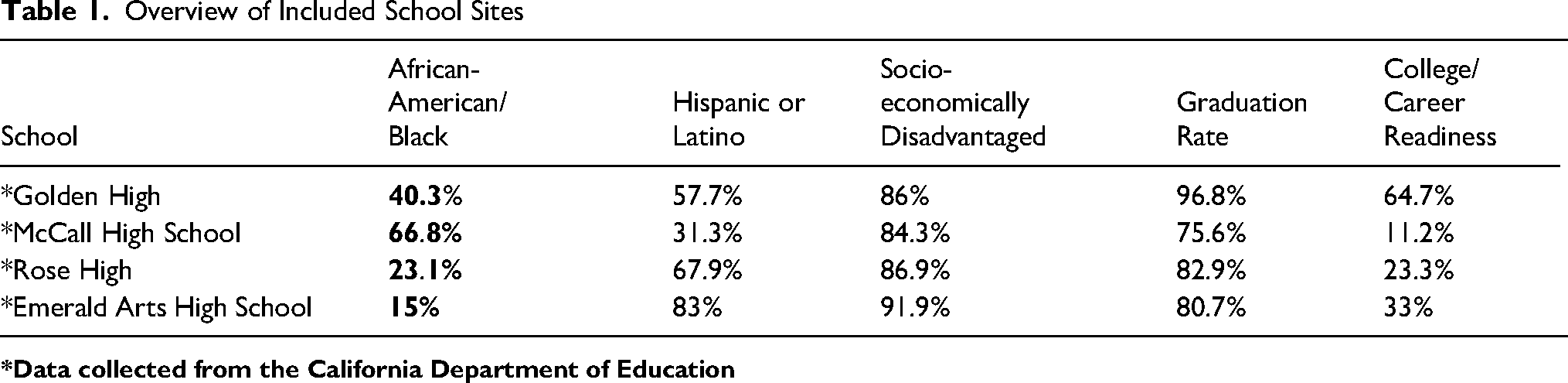
High schools were selected based on professional affiliations the researchers had with participating sites. At each of the four included schools, researchers had worked as part of collaborating college preparatory and mentoring initiatives. Site selection criteria also included racial and ethnic composition; specifically, we were interested in schools within the Los Angeles Unified School District (LAUSD) that served Black students, particularly amid the shifting racial demographics of Los Angeles County and public schools. Table 1 provides a further overview of school sites. All schools and participants were given pseudonyms to protect their identities.
Overview of Included School Sites
Participants
In both larger studies, purposeful sampling (Patton, 1990) was used to recruit participants. Both studies shared the common participant criteria of self-identified Black/African-American students who had attended high schools in Los Angeles. Combined, both studies yielded a total of 27 participants. Within both larger projects, analysis revealed that participants similarly (1) articulated how their postsecondary trajectories and choices were influenced by a set of distinct circumstances researchers identified as understudied and (2) described nuanced self-definitions of success that accompanied their educational experiences and outcomes, both of which are the basis for the current study. Researchers centered this aspect of the data and conducted a focused analysis of this area of responses. Table 2 provides an overview of the included participants.
Overview of Research Participants.
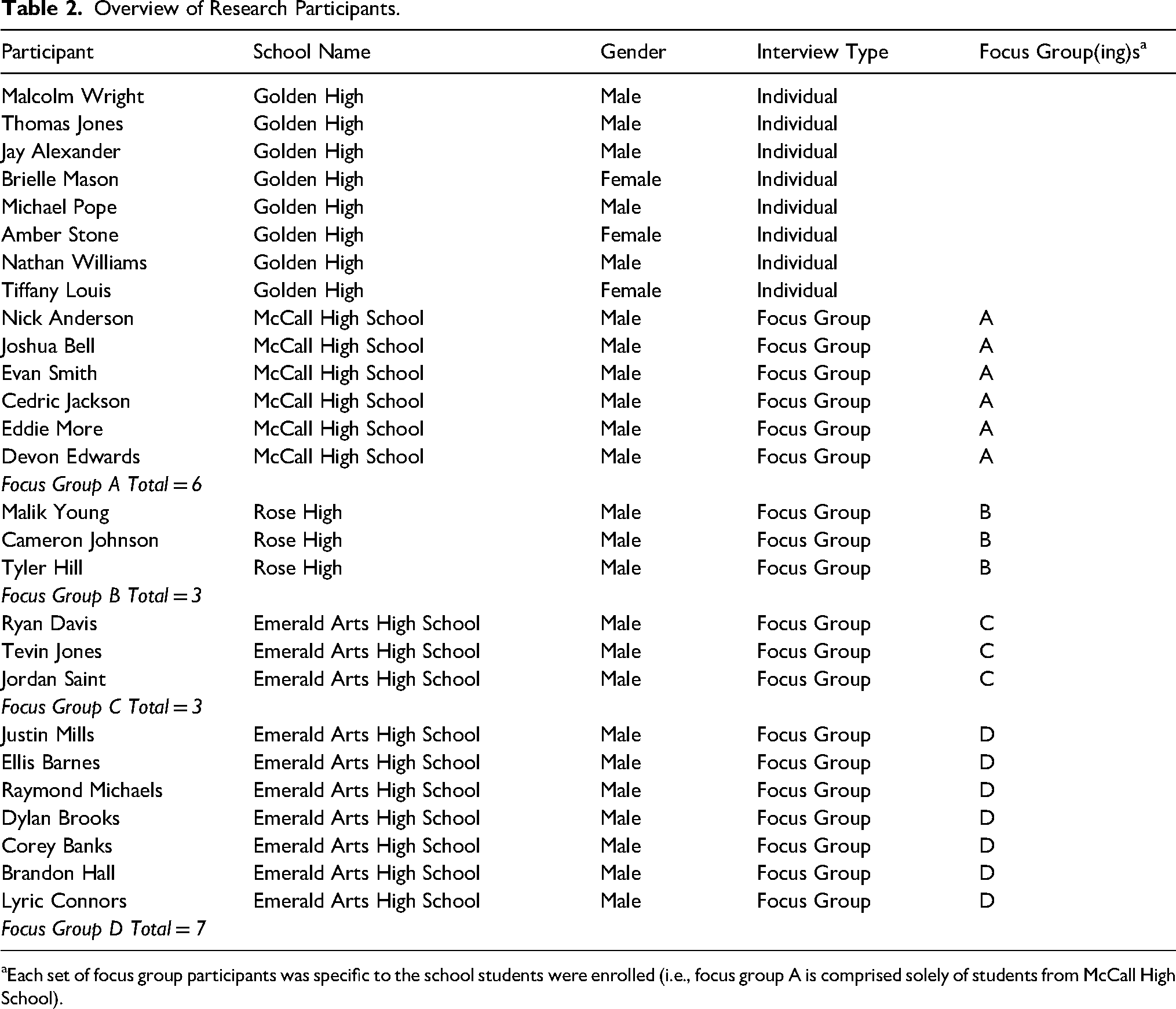
Each set of focus group participants was specific to the school students were enrolled (i.e., focus group A is comprised solely of students from McCall High School).
Validity
Two forms of member checking were used to support the validity, accuracy, and credibility of data interpretation. First, individual member checks were conducted with interview participants. After the analysis was complete, concise narrative profiles (one to two pages) were created and emailed to participants for review. These profiles invited participants to provide comments, questions, or edits related to the themes and direct quotes that represented their responses and contributions. Second, member checking was embedded throughout focus group interviews. When a participant expressed a particularly relevant idea (or when multiple participants shared similar perspectives or experiences) the interviewer offered restatements, paraphrasing, or summaries of what was shared. Additionally, verbal summaries of responses were provided at the close of each focus group session. These targeted and periodic restatements served as real-time member checking, allowing participants to clarify meaning and enabling the interviewer to assess alignment between participant intent and the researcher's interpretation. Throughout the member checking process, participants confirmed the accuracy of our interpretations, understandings, and summaries of their responses. These confirmations affirm the trustworthiness of our analysis. We attribute this in part to the researchers’ cultural competence, which fostered respectful, informed, and responsive engagement with participants. To further support the effectiveness of member checking, we ensured that participants were given sufficient time and clear explanations when reviewing our interpretations. By engaging all participants in the member checking process, we strengthened the internal validity of our findings, minimized the potential for misinterpretation, and managed our own potential biases and assumptions (Maxwell, 2013). These practices also facilitated greater clarity, mutual understanding, and opportunities for participants to confirm their ideas.
Analysis
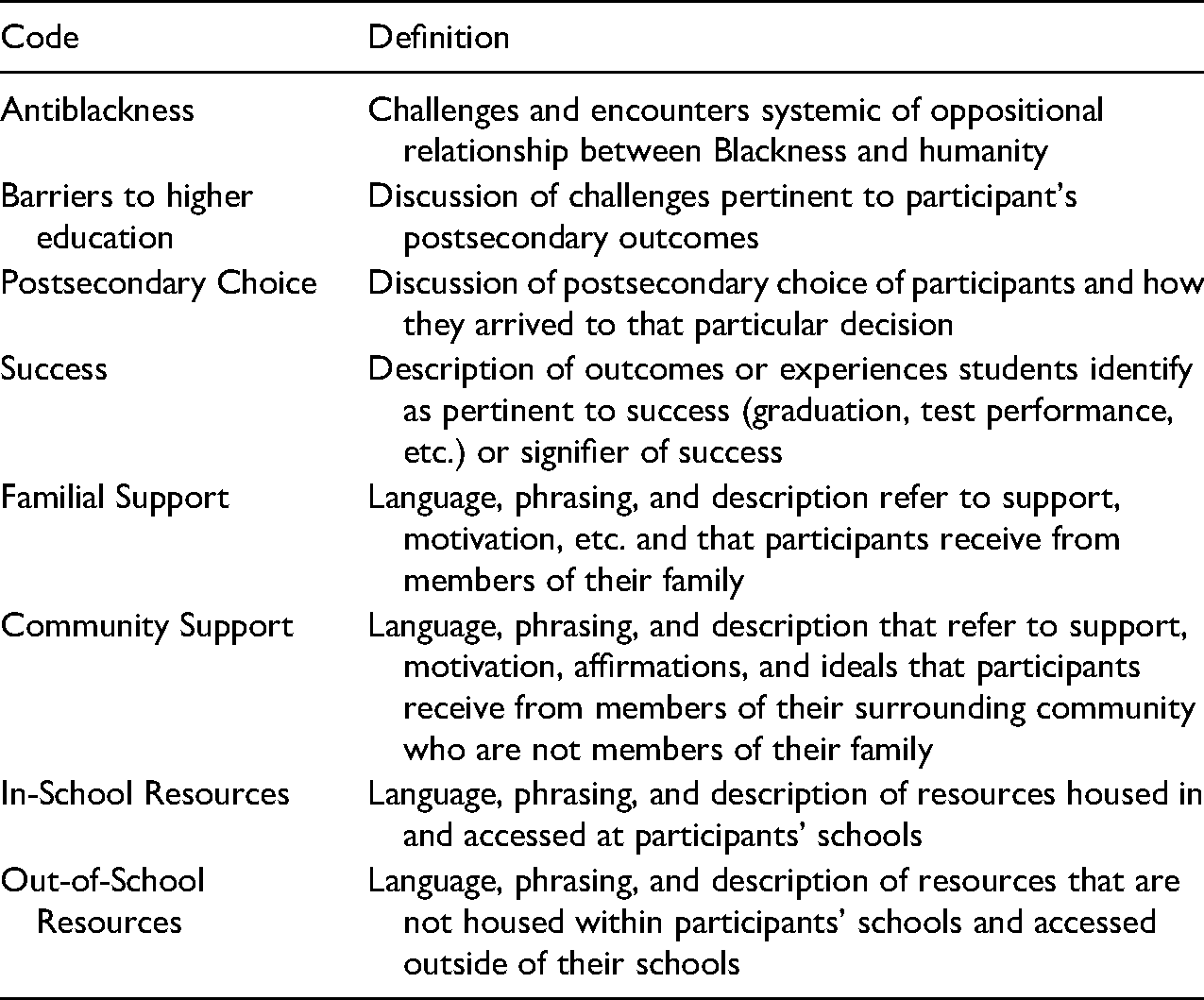
To direct analysis of data towards our aims of examining participants’ postsecondary choices and student definitions of success, we began with a re-reading of interview transcripts (Miles & Huberman, 1994) to ascertain a general sense of participants’ responses (Creswell, 2009) in regard to these ideas. Employing a priori coding, we then utilized a multistep deductive methodological process to analyze interview data (Bogdan & Biklen, 2003). Methodologically, a priori codes allow for targeted analysis of particular ideas within data sets. To begin coding, we conducted a review of research pertinent to our study topics. Next, we developed a coding scheme informed by BlackCrit as well as extant literature and work regarding postsecondary educational choices/opportunities for underrepresented students and definitions of student success (see Appendix). Following this, our informed coding scheme was used to analyze transcripts, alternating between transcripts and allowing researchers to identify and group segments of data relevant to our examination of factors impacting students’ postsecondary decisions and their self-defined definitions of student success. Next, we used responses organized around our codes to identify specific and recurrent ideas pronounced within responses that were pertinent to our domains of interest—factors impacting student postsecondary decisions and nuanced definitions of student success. Finally, we used our clarified domains of responses to develop our finalized thematic findings (Emerson et al., 1995). To ensure reliability of final themes, during analysis, we cross-collaborated, sharing analytic memos of data as we examined responses to verify that we were arriving at the same evaluations of data as well as to identify and resolve any discrepancies.
Researcher Positionality
To ensure the trustworthiness of this qualitative research, we acknowledge that our personal identities, lived experiences, and proximity to participants may shape the research process (Watt, 2015). However, we contend that our positionalities serve as a critical asset—supporting our interpretation of participant narratives. The lead researcher is a Black man who was educated in public school systems within low-income neighborhoods. The second researcher is a Black woman who also attended and graduated from public schools in Los Angeles. Both of us completed high school in Los Angeles and went on to become first-generation college students at a large, flagship, predominantly White institution (PWI) in California. These shared cultural, geographic, and educational experiences foster a level of cultural competence that deepens our understanding of participants’ perspectives and supports the development of relational trust throughout the data collection and analysis processes. We do not suggest that similarity to participants inherently qualifies us to interpret their experiences more accurately. Rather, we emphasize that cultural competence enhances a researcher's ability to critically engage with their positionality by cultivating deeper awareness of how cultural norms, power dynamics, and identity markers inform the research process—particularly interpretation—thereby promoting more ethical and reflexive inquiry (Chavez, 2008; Milner, 2007). While we share important social and educational identities with our participants, we remain critically attuned to our roles as researchers and the power dynamics they entail. We approached this study with intentional reflexivity, acknowledging the ways in which our experiences both resonate with and diverge from those of the youth we engaged. Our collective navigation of formal and informal educational spaces has given us an experiential understanding of the structural conditions that shape the educational realities of many Black students. At the same time, we resist framing Black students or their experiences through a deficit lens. Instead, we center their agency, decision-making, and self-defined visions of success in both our analysis and representation.
Findings
The findings of this study are organized into two major categories: understudied factors influencing postsecondary choices and participants’ nuanced definitions of success. In the first category, two significant yet often overlooked factors emerged from student responses—academic pressure shaped by race and the impact of life circumstances. In discussing their personal definitions of success, participants highlighted how they (1) embodied honorable characteristics, (2) fulfilled familial responsibilities, and (3) navigated the racialized dynamics of traditional conceptions of student achievement.
Understudied Factors Impacting Postsecondary Choices
Consistent focus on the “gaps” that exist within education, while necessary to examine, often leads to deficit notions of Black students, their intentional choices, and their success in education. While all participants were eligible for some form of postsecondary education, many intended to enroll in community college after high school, a postsecondary option traditionally stigmatized and viewed as less rigorous than university enrollment (Claxton, 2015; Lazerson, 2010; Ravitch, 2013). In examining the understudied factors impacting Black students’ decisions after high school—those outside of prominent factors identified in current college choice literature (i.e., cost, access, and preparation)—we found that participants often linked their postsecondary decisions to racialized academic pressures and extenuating life circumstances. These understudied factors had a substantial impact on participants’ schooling experiences, academic performance, and interest in college.
Academic Pressure Tied to Race
Several participants detailed immense academic pressure they described as linked to their racial identity. Nathan, a student from Golden High, for example, shared I really do feel like … we do put a lot of pressure on ourselves. We are Black kids in urban areas, and we are at this prestigious school, so we got to kind of get these grades and get into good colleges. To keep up you know, keep the funding going. And stuff like that … we got to make the school look good … To show that not all these kids are you know, like f*ck ups or something like that.
Nathan explained that specific pressures and expectations of Black students at Golden High are tied to sets of racial logics—deficit antiblack notions governing perceptions about Black students—that he and his Black peers are expected to subvert. Nathan noted having to demonstrate himself not to be inept in ways Black students are often anticipated and imagined to be. As a Black student attending this well-resourced, high-performing school, he must validate his deservingness to attend Golden High through high academic performance and yield admission to competitive universities. Jay, another student from Golden High, offered an intersectional analysis of the academic pressure tied to race present at the school: I feel like I have to work twice as hard all the time as a Black girl. Even when applying to college, it was like I have to be the best. And it wasn’t just out of my entire school. I have to be the best out of my district. Like I need to be the best student I can be instead of just trying to exemplify myself and hoping that they like me … I felt like there was always no room for error … And that always messes with me now because I just have this thing of like trying to be perfect or trying to not make mistakes. That is like my whole life I've always had to do the right thing to make it to the right space or talk appropriately and always like make sure I did everything right because I didn't want to be denied access.
Like Nathan, Jay described having to navigate challenges of potential typifying and stereotype threat (Steele & Aronson, 1998) throughout her schooling experience. Jay noted that as a young Black woman, there is an operating expectation for her to overlabor during academic pursuits, college admissions especially, as opportunities are limited and often fleeting for young Black women. Jay also described having to “talk appropriately” in order to gain access to spaces and opportunities pertinent to college admissions and related endeavors. In describing this forced code-switching to legitimize herself as a student and candidate, Jay identifies how Black Language (BL) and African American Vernacular English (AAVE) (Smitherman, 2006) are marginalized forms of language used to invalidate Black students. Such antiblack linguistic racism insists that Black students code-switch to avoid discrimination and denies Black students the right to leverage AAVE/BL as a resource and asset during learning (Baker-Bell, 2020), academic pursuits, and in everyday life. For Jay, in terms of postsecondary pathways, antiblack linguistic violence manifested as normalized code-switching practices considered requisite to access pertinent resources and spaces.
Participants frequently described experiencing racially linked academic pressure. Thomas, a Black male student at Golden High School, noted the expectation to excel academically while simultaneously navigating deficit-based stereotypes about Black students. He pointed to the underrepresentation of Black male students in AP courses, often finding himself the only one in his advanced classes. Other participants elaborated on the emotional toll of this racialized pressure, describing feelings of being overwhelmed, unmotivated, and stagnant. Those most affected highlighted frequent exposure to negative stereotyping by non-Black teachers and staff. Malcolm, for instance, recounted a 10th-grade meeting with his counselor, whom he identified as Asian, during which he shared his aspiration to attend a four-year university in Texas. The counselor discouraged him from applying, suggesting instead that he pursue community college. Malcolm explained that this encounter led him to abandon his four-year college aspirations for much of high school. He stated I didn’t apply myself. If a counselor, someone who is paid to counsel students on college plans, is telling me I can’t go to college, then I can’t go to college … It wasn’t until senior year when that is the topic of discussion for everybody that I started to be like, oh what am I going to do?
Although Malcolm was only a sophomore, his counselor concluded that he lacked the eligibility and competitiveness for four-year universities and advised him against pursuing that pathway. As a result, Malcolm abandoned his goal of attending a four-year institution. Malcolm's encounter can be framed as part of a broader, more insidious pattern in which Black students are subject to low tracking and exclusionary practices that impede their educational outcomes.
Like Nathan, Jay, Thomas, and Malcolm, most participants described academic pressure as deeply intertwined with their racial identity. They were acutely aware that racial ideologies shaped their in-school experiences and influenced how they conceptualized and ultimately made decisions about postsecondary options. This racially linked academic pressure was not confined to Golden High School. Although some students reported affirming support from teachers and counselors, participants across all school sites more frequently described how academic expectations, assumptions about their abilities, and postsecondary planning were shaped by deficit-oriented, antiblack perceptions of students.
Life Circumstances
Unexpectedly yet organically (reflecting the realities of life) tragedy and trauma emerged frequently in conversations with participants. For some, experiences of loss and hardship profoundly shaped their high school trajectories and postsecondary decisions, leaving little room for pause or recovery, such is life. However, grounded in a BlackCrit framework, we acknowledge the systemic disregard for Black students’ traumas and full narratives as part of broader structures that devalue Black lives and bodies. These accounts are not presented to reduce Black students to their pain, but rather to foreground a set of often-overlooked realities that meaningfully inform how some Black students navigate their postsecondary pathways. Two participants specifically lost their mothers and discussed how this affected their pathways post-high school. Brielle, a student from Golden High, shared that changes in her living arrangement following the passing of her mother substantially limited the support and encouragement she received. She stated [L]iving with our uncles and then of course they have full time jobs, and they have kids to worry about too. Not that I was a burden or anything or they despised me, it was just like go to school, come home. And it was never ‘how's school, do you need help with science project or do you need …’ I mean they took me to the store, of course, to get things … but it was never … It wasn't a one on one, it wasn't a parent … if my mom was here, it would have been way different.
Brielle explained that in the absence of intentional parental support, her academic performance declined, leading her to view community college as a default next step after high school. While family support is often considered as an auxiliary resource that complements students’ existing skills and knowledge, Brielle's account underscores that such support is often central, not supplementary (Smith, 2008). Its absence, she noted, had a significant impact. This is not to suggest Brielle's path is one of failure, but rather to convey how she described her circumstances as directly shaping her postsecondary decisions.
Similarly, in addition to Malcolm's described encounter with his counselor, during this same year he experienced tragedy which caused him to place college in the rear of his mind. He shared Honestly, to be 100% honest with you, my 10th grade was horrible. One of my favorite guys got locked up, and you know like it was my Big Brother to me, so it was that. Then as I got older I [also] realized like oh, my mom [passed away]. It really didn't hit me until tenth grade to be honest. So, my grades, transcripts were like piss poor and after that thing with my counselor I wasn’t thinking about college.
Throughout the interviews, Malcolm discussed other people close to him that have passed away, as well as witnessing a shooting at his bus stop. When asked how (if at all) he understood these experiences to have impacted him, he stated I think, for me, death has taught me that nothing in life is really guaranteed. Like for me, life is short, it's unexpected. So, it's made me appreciate life more. When I have the opportunity to do something, I do it. I’m not going to let anything stop me regardless of what has happened
Having experienced frequent loss in a short time span understandably took a toll on Malcolm, both emotionally and academically. However, he articulated that these experiences (among other things) inspired a form of resiliency that allowed him to continue pursuing his goals, postsecondary and otherwise. Particularly, Malcolm described that in response to adversity (in-part), he chose to practice fortitude to serve his goal of being admitted to and graduating from a four-year university.
Tragedy should not be romanticized as a catalyst for clarity or decision-making, nor should resilience be idealized as the expected response to adversity. Nonetheless, our findings suggest that school counselors and other staff must be attuned to the profound impact such experiences can have on students’ educational trajectories. When supporting Black students in navigating postsecondary options and decisions, it is essential that college preparatory programs, counselors, career centers, and educators develop a nuanced understanding of their students’ demographics and lived realities—including needs arising from unexpected or traumatic life events.
Nuanced Definitions of Success
This study centers Black students’ self-defined meanings of success. While many participants met conventional academic benchmarks (such as high GPAs and college eligibility) our findings reveal that these rigid standards often exclude critical, student-defined experiences and conceptualizations of success (Wallace & Wallace, 2016). When asked to define success, most participants emphasized (1) demonstrating honorable character, (2) fulfilling familial responsibilities, and (3) navigating the racialized dynamics surrounding traditional notions of student achievement. These definitions reflect forms of success grounded in participants’ lived realities, values, and social contexts. We refer to these as nuanced definitions of success. Their consistent and immediate articulation suggests that these meanings are deeply intertwined with, rather than siloed or separate from, participants’ academic outcomes.
Honorable Characteristics
When discussing academic success, participants frequently emphasized that their achievements were accompanied (and often defined) by personal qualities such as being hardworking, respectful, family-oriented, and diligent. Their definitions of success were often process-oriented, focusing less on specific outcomes and more on alignment with personal integrity and communal expectations. Lyric, a student at Emerald Arts High School, shared: “I'm not quick to call myself high performing only because I see other people working so much harder than me. So it's like, dang, I'm not working nearly as hard as them, even if my grades are better than theirs.” Lyric resists the label of “high-performing student” because he evaluates success based on effort rather than academic metrics alone. Despite earning grades equal to or higher than his peers, he considers himself less successful than them because he does not work “nearly as hard as them”. For Lyric, effort (not just outcomes) is the defining measure of success. Joshua, from McCall High School, shared In my opinion, being high-performing in school or just doing well is about getting closer to your goal. Like if your goal is to get a job, doing well is getting your work permit, graduating high school early to find a good job so you can make money quicker. If your goal is to get to college, doing well is you doing what you need to get good grades in school, taking a lot of extra-curriculars to make your application process easier, making colleges more likely to select you if that is your goal. Either way, you're working hard.
For Joshua, success, or “doing well” in school, is defined by his commitment to excellence and sustained effort toward any goal, regardless of its nature. He emphasizes that success is not tied to a specific outcome but achieved through doing one's best. To illustrate this, Joshua references both immediate workforce entry and college attendance—two postsecondary paths often juxtaposed—to assert that success lies in the effort invested, not the prestige of the outcome. He explains, “either way you’re working hard,” underscoring that success is found in dedication and diligence across goals. Joshua's perspective challenges outcome-oriented definitions of success, rejecting hierarchical valuations of postsecondary choices. Instead, he centers commitment and effort as the core markers of success, grounded in the worth students assign to their chosen paths. Evan, also from McCall High School, in his description of success explained The way I look at myself, I never considered myself to be high-performing particularly. Instead, in whatever I do, I just put in the work and I try my best. Whatever I get out, that is what I get out of it. I also feel like if your mindset is ‘I’m already at the top,’ then you start to feel like you don’t have to work for it [being at the top] anymore. More importantly, if you know you could be better, that mindset will make you keep striving to do better. That's why I don’t look at myself as high-performing simply because of grades because as soon as I start to view myself in that way, how am I going to continue to progress?
Evan contextualized success in terms of the effort he invested in school and other responsibilities, rather than specific outcomes. Like others, he defined success as doing his “best” and was hesitant to accept the label of “high-performing student,” despite having a strong GPA and meeting college eligibility criteria. Evan shared that external recognition of success, such as being praised for his academic standing, can foster complacency, undermining his commitment to continued effort. He explained that adopting a mindset of “I’m already at the top” would hinder his drive for self-improvement, which he sees as central to success. For Evan, success is achieved through consistent dedication and striving to improve, not solely through academic outcomes. In this way, participants like Evan disentangle student success from static measures, instead grounding it in effort, growth, and personal accountability.
Family Accountability
For many students, academic achievement is seen as a pathway to an improved quality of life. While this was reflected in our data, most participants described success (and the upward mobility associated with academic performance) as rooted in accountability to their families. When asked about the meaning of success, Tyler responded: “Just be happy. Just be okay with where you are. Have a stable household, stable income, and you just have happiness with your life.” His response reflects a connection between happiness, freedom, and the stability of family and finances. Similarly, Cameron (adding to his peers’ comments) described wanting to be a better son and brother, comparing himself to his two older siblings, he stated [G]rowing up with two older brothers who have not accomplished much with their lives and seeing how that stuff I feel like that's kind of pushing me. I don't want to end up in that hole and I just keep striving to be the better brother even though I'm the youngest and just show them examples. I can help them from what I do and show them how you can prosper and do something with your life. Even if it's not something extraordinary.
Like Cameron, many participants expressed that accountability to family was central to their definition of success. Ryan, for example, emphasized responsibility to his siblings as a key motivator. He shared that his drive to succeed academically stems from a desire to demystify college access for his younger siblings, and he stated I just hope to make my life, make life better for my siblings. I feel like my siblings think that going to college or graduating from college gonna be hard [audible affirmative from other focus group participants]. But I want to make them feel like going school is not something that they should be scared of, but is something that they know they can do. I want them to know that you can do this. And being so successful is not a bad thing. It's not about saying it, it's about doing the action. Pushing yourself to do the right thing. And if you do that right, I know you're gonna be successful. So, I guess that's all.
In many responses, participants framed their accountability to family within the broader context of enduring racial and class-based conditions affecting Black communities. This sense of responsibility often reflected a desire to challenge and redress those conditions. For instance, Cameron described how his older brothers had been impacted by school pushout and limited opportunities, motivating him to model a more well-rounded life. Aware of antiblack narratives of unpreparedness (both internalized and imposed) Cameron saw his pursuit of college as a way to counter those beliefs and encourage his younger siblings to pursue higher education. Another participant, Corey, explained that being successful meant helping his family: I really strive to be successful to help out my family, my mom. My mom wasn't able to go to college; my dad wasn't able to go to college. They didn't even finish high school. So, they can only get certain jobs that don’t bring much to the table. So, I'm trying to give them the life they deserve because I know they're really putting in the work to make me who I am today (audible affirmation from other participants). I'm trying to give back to them. So, I feel like the only way I could do that is to be successful in school, especially because I’m not an athlete and I can’t rely on sports. So I put my effort into everything else, and I try to strive to be better. That's my motivation to do good in school.
For Corey, doing well in school is not the marker of success. Rather, his marker of success is being able to support his family, while performing well in school serves as a means to achieve this.
Despite witnessing his parents work exceptionally hard, Corey saw how educational barriers relegated them to physically demanding, low-paying jobs. His account illustrates how structural inequality shapes the conditions of poverty that affect his family and many other Black families (Edwards, 2023; Winship et al., 2021). In response, Corey is driven by an ambition to achieve what he described as long-overdue upward mobility for his family. He defines success as improving his family's circumstances, with academic achievement as the primary means toward that goal. Corey underscored this distinction, explaining that his strong commitment to school stems from his belief that education is his most viable route to success. He also noted that, unlike some of his peers, he is not an athlete and thus cannot pursue the commonly promoted pathway of sports—a route often idealized for young Black men (Hoberman, 1997). Consequently, Corey places even greater emphasis on academic performance as his means of upward mobility.
Conditions of poverty and community marginality were unfortunate realities for many of our participants. Experiences and encounters with these conditions were written into how they defined success, seeking better life conditions for themselves and their families. Like Corey, Devon, from McCall High School, stated [A]t the end of the day, it all comes back to money for me. I know that's not a deep thing to say, but where I came from and how I grew up, my family wasn't always the wealthiest or this happy family. It wasn't like that. I feel like if I can become financially stable through academics, then that will bring my family closer and be able to just do things that we have never been able to do before so that's why I feel [money is] important to me.
Devon critically reflected on the economic conditions that have shaped his family's experiences, noting how his definitions of success are directly informed by the material hardships of poverty. He did not prioritize an impression of being profound or “deep” in his response, although his commentary was in fact both. He prioritized honesty, grounding his perspective in the realities of his life as a young Black man from a poverty-impacted household. His understanding of success is shaped by these lived experiences. Devon identified financial instability as a major source of difficulty and distress within his family and viewed financial stability as the solution. For him, success means moving his family closer to financial wellness—an outcome he hopes to achieve through academic performance. Devon later added [T]his is really for my family. They see that I do really good in school and because they know what I'm capable of, they bring nothing but words of encouragement ‘Keep doing this.’ They position me as a role model for all my little brothers and sisters. They always tell them, ‘Look what Devon is doing. Look where he's getting into; you can do this too.’ So, my family, that is my motivation, my inspiration for what I do and anything I do.
Devon again emphasized his dedication to his family, expressing a desire to rightfully repay them for the support and encouragement that have enabled his academic efforts. Closely tied to this sense of accountability is his role as a model for his younger siblings—a position that reinforces his responsibility to his family and serves as the primary way he defines success. Like Corey and Devon, many participants framed success in terms of family accountability: addressing their family's material needs, fulfilling expectations as role models, and honoring the support they had received. In this framing, academic performance was not the ultimate measure of success but a necessary means to achieve it.
Racialized Relationality to Success
Beyond offering nuanced definitions of success, participants shared that their racial identities shaped both how they are perceived in relation to traditional notions of success and how they define success for themselves. Collectively, their accounts reflect a racialized relationality, demonstrating how participants navigate and respond to dominant narratives of student success while constructing their own meanings of it. For example, Nick from McCall High School stated [H]aving good grades is super important to me because it redefines my position. Especially being a student-athlete since I was six, because I played sports, I was put in one kind of category as if there are no other avenues. So, by having good grades, I've got the opportunity to step out of that stereotype and that stigma of a Black male. A lot of us, we just play sports and there's nothing wrong with that. But having good grades, it says something else about my character, that I can compete on every level, not just physically but mentally. And I think that's one of the biggest reasons why I hold myself to these higher standards.
Nick described navigating persistent stereotypes about young Black men as part of his academic journey. Although he is a student-athlete, he emphasized that athletics do not define him—countering common assumptions that sports are central to the identities of Black male students. His commitment to academics is not secondary to athletics, challenging the prevailing notion that Black male student-athletes prioritize sports over school (Stone et al., 2012). While acknowledging how often Black male students are stereotyped as athletes, Nick reflected on being “put in one kind of category” since childhood due to his involvement in sports. In response, he uses academic achievement not simply to fulfill expectations of success, but to resist the stereotype that Black males “just play sports” and to assert his intellectual capabilities. For Nick, excelling academically is both a personal goal and a strategy to confront racialized assumptions. His experiences with success (conventional or redefined) are deeply shaped by the racialized stigma Black male students continue to face (Carey, 2025).
Similarly, Joshua described how for Black students, notions of accomplishment are filtered through a racial lens: I feel like they give us praise because they're so used to seeing Black male students underperforming. Personally, I just feel like I'm doing what I'm supposed to do and I don’t expect recognition for doing something I am supposed to do … I have teachers like Mr. Crown, who simply acknowledge me. He goes, ‘You’re doing really well,’ but it's not giving me praise. And I respect that type of mindset because in my opinion, I'm doing what I'm supposed to be doing. You feel me? Like you can’t get an award for breathing. Breathing is something you naturally do. It wouldn’t make sense if someone went, oh, he's breathing so we’re going to give him a trophy. That's how I feel when people like over-congratulate me for doing good in school.
Joshua critiqued dominant perceptions of Black student success, noting that it is often treated as exceptional rather than expected. He expressed discomfort with overly congratulatory reactions to his academic achievements, which, to him, are simply what he is “supposed to do.” Yet his success is frequently met with awe, responses that reinforce the idea that academic excellence is disconnected from Black students. His experience illustrates racial spotlighting: the hyper-visibility that occurs when Black students demonstrate academic ability. Drawing on BlackCrit, analysis of this spotlighting (Andrews, 2012; Carter, 2008) reveals how anti-Blackness renders Black students hyper-visible (and subsequently invisible, unseen for their full selves), a dual condition where their success becomes a spectacle rather than the norm. While some may view praise as affirming, Joshua sees it as a reminder that his achievements are racialized. Black students, he argues, are not expected to excel academically, a reality that informs how he views his success: as a standard for himself, not an exception. This sense of othering was echoed across participants’ accounts, all of which pointed to the enduring influence of stereotypes and dominant narratives in shaping how Black students experience and define success.
Discussion
Student Postsecondary “Choice”
This study examined factors influencing Black students’ postsecondary decisions, revealing that many experienced academic pressures closely tied to their racial identity. Life circumstances, including personal loss and community context, also shaped how students viewed their pathways. Participants described pressure from schools to uphold ideals of prestige or to counter deficit narratives about Black youth, pressures resulting from antiblackness, which left many feeling overworked and undervalued. Several students shared experiences of trauma and loss that deeply affected their postsecondary decisions. All participants attended schools situated in heavily policed communities marked by violence, gang activity, homelessness, and poverty. This daily exposure reflects the routine and mundane suffering characteristic of a global antiblack climate (Rowell-Cunsolo et al., 2022; Sharpe, 2016), as articulated within their narratives. While tragedy and trauma affect many students, the specificity of anti-Blackness reveals how Black students uniquely experience these conditions, shaped by historical and structural forces (McAdoo et al., 2025). Antiblackness manifests personally, structurally, systemically, politically, and environmentally—some elaborated within this work, others not. Across their experiences and encounters, participants remained determined in pursuing their goals.
College access and choice operate at both macro- and micro-levels—where structural forces and educational opportunities intersect with individual decision-making, behaviors, and determinants (Hughes et al., 2019). This study found that at both levels, students experienced anti-Black racism perpetuated within schools, directly shaping their postsecondary decisions. These findings extend existing discourse by highlighting how race and antiblackness influence student decision-making, access, enrollment, and matriculation—factors often overlooked or limited in college choice literature (McLewis, 2021). We argue that postsecondary choice models must fully confront the realities of white supremacy and anti-Blackness, both of which are deeply embedded in higher education systems and shape how students navigate their futures (Dancy et al., 2018; Pirtle et al., 2024).
Defining Success for Themselves
This article also examined the nuanced definitions of success that participants constructed and used. Most notably, participants articulated three categories through which they measured, conceptualized, and experienced success. First, they identified a set of principles and values that, when upheld, represented student success. These definitions were not solely (or even primarily) academic. While still aligned with their goals and sense of purpose, participants’ definitions challenged dominant conceptions of student success. Their perspectives offered a counter-narrative to traditional, hegemonic measures that are narrow in scope and disconnected from the lived experiences of marginalized students.
We do not underestimate the radical nature of these student-defined notions of success especially given the precarity Black students face in U.S. public high schools. Their ability to define success on their own terms, outside dominant school norms and in alignment with their personal values, represents both excellence and resistance. Viewed through the lens of Black critical theology, we see participants engaging in the kind of selfhood and labor that Dumas and ross (2016) describe as “carrying it on” (p. 436)—rejecting dominant ideologies and instead envisioning and asserting their own definitions of success.
Participants once again challenged outcome-based academic definitions of success, instead emphasizing success as accountability to family and contributing to their family's material well-being and overall wellness. As previous research has shown, student definitions of success—both independent from and intertwined with postsecondary decisions—are shaped by economic realities and labor market demands (Benson & Owens, 2022; Bozick, 2009). This was true for our participants: while academic performance and school-based achievements mattered, they were not the ultimate markers of success. Rather, success was defined by advancing their families’ social and financial mobility. Participants offered pointed critiques of the structural conditions—particularly poverty and limited access to educational resources—that shaped their own and their families’ lives. In response, they constructed definitions of success rooted in and responsive to these realities. Crucially, academic achievement served as a means to success, not its primary measure.
Finally, participants identified how their relationship to student success is shaped by race. Even when challenging dominant narratives of Black ineducability through high GPAs and other achievements, they remained subject to anti-Black rhetoric about Black students’ academic abilities. Participants described constant reminders that their accomplishments were seen as exceptions. The dominant perception, they noted, is that Black students do not succeed (by any definition) which renders their success anomalous and evokes responses of surprise or awe. In naming this dynamic, participants critiqued how anti-Black ideologies continue to shape perceptions of Black students, even amid academic success. For these students, achievement is permissible only when understood as episodic and atypical, reinforcing and extending narratives of Black intellectual inferiority.
Limitations and Future Work
This study has several limitations. First, our sample primarily consisted of Black male students. While this is not inherently problematic, the project was not designed to focus specifically on Black males, resulting in their overrepresentation and shaping the study's intersectional scope. We acknowledge the limited inclusion of Black women and non-male Black students, and we encourage future research to engage these underrepresented perspectives. Second, the study is situated within the specific geographic, demographic, and socio-political context of the Los Angeles Unified School District (LAUSD). While the goal is not generalizability, we recognize that postsecondary decision-making and definitions of success may differ among Black students in other regions or educational settings. We therefore suggest that future research examine a wider range of contexts, including private, faith-based, homeschooling, and alternative learning environments. Finally, while our qualitative approach offered deep insight into student experiences, future studies could incorporate quantitative methods (such as surveys) to identify broader patterns and trends. A mixed-methods approach could strengthen understanding of how Black students define success and navigate postsecondary choices, contributing to a more comprehensive picture of their educational pathways.
Implications
This study expands discourse on postsecondary decision-making by illustrating how academic pressures and uncontrollable life circumstances shape how students understand and navigate their options. For example, our findings indicate that family support is not a secondary factor but a central one in guiding students’ postsecondary choices. When life conditions disrupt this support, the consequences are significant. These findings underscore the need to move beyond dominant narratives of linear, college-going pathways and instead recognize the legitimacy and success of alternative routes. Further, research must shift away from centering the needs and trajectories of white, “traditional” students. Scholars must instead prioritize frameworks that address the realities of students of color, adult learners, parenting students, and other groups marginalized in education. Our study contributes to this shift by emphasizing how Black students define and pursue success on their own terms.
Practical Implications for Educators and Counselors
Counselors, teachers, and staff would benefit from ongoing, targeted professional development focused on effectively serving Black students. Such training should begin in educator and counselor preparation programs and continue throughout their careers. Professional development should be trauma-informed and explicitly address anti-Blackness and its impact—especially in the context of grief, loss, and systemic marginalization. It should also include training in cultural competence and humility, culturally sustaining pedagogy, and family engagement practices. Moreover, there remains a persistent disconnect between what counselors communicate and what low-income students (and their families) need to know, particularly regarding financial aid and postsecondary options (McDonough & Calderone, 2006). Counselors must be adequately prepared and more intentional in providing accurate, accessible information to support students’ decision-making. Schools that serve predominantly Black and Brown populations already house important resources such as community engagement efforts, strong social networks, and existing college readiness programs that can be leveraged and augmented more strategically. Doing so would help ensure that students have the information and support they need to optimally explore the full range of postsecondary opportunities.
Reframing success
As degree attainment continues to dominate definitions of student success, it is essential to examine both the factors influencing Black students’ postsecondary decisions and the broader ways they conceptualize success. We must expand beyond narrow academic benchmarks to more holistic understandings of student achievement—ones that reflect how students, despite structural barriers, pursue goals deeply tied to their educational experiences.
This research centers student-defined meanings of success that resist and reframe dominant metrics. While existing literature often focuses on college and university students, it tends to overlook the structural inequities that shape outcome trends, particularly for Black students. Furthermore, there is a significant gap in scholarship examining how success is defined at the high school level. Our study addresses this gap by: (1) focusing on high school students’ definitions of success, rather than those already in higher education; and (2) applying a critical racial lens to examine how structures and lived experiences inform Black students’ understandings of success.
Conclusion
This study examined lesser-explored factors influencing Black high school students’ postsecondary decision-making and highlighted how they define success for themselves. Using BlackCrit as a guiding framework, we emphasized the role of antiblackness in shaping students’ educational experiences and choices. Simultaneously and synergistically, we explored how participants articulate and redefine success both within and beyond the context of school.
Findings revealed that participants experienced racialized academic pressures and faced personal life circumstances that significantly influenced how they envisioned their futures and approached postsecondary decisions. In doing so, they articulated what we term nuanced definitions of success—student-defined conceptualizations that challenge dominant narratives. These definitions emerged across three key domains:
Upholding honorable personal values; Meeting familial responsibilities; and Navigating a racialized relationship to dominant ideas of student success.
These student-centered definitions reflect participants lived realities, values, and aspirations, positioning them as critical stakeholders in educational discourse and practice.
Footnotes
Declaration of Conflicting Interests
The authors declared no potential conflicts of interest with respect to the research, authorship, and/or publication of this article.
Funding
The authors received no financial support for the research, authorship, and/or publication of this article.

Author Biographies
Appendix. A Priori Codes.
| Code | Definition |
|---|---|
| Antiblackness | Challenges and encounters systemic of oppositional relationship between Blackness and humanity |
| Barriers to higher education | Discussion of challenges pertinent to participant's postsecondary outcomes |
| Postsecondary Choice | Discussion of postsecondary choice of participants and how they arrived to that particular decision |
| Success | Description of outcomes or experiences students identify as pertinent to success (graduation, test performance, etc.) or signifier of success |
| Familial Support | Language, phrasing, and description refer to support, motivation, etc. and that participants receive from members of their family |
| Community Support | Language, phrasing, and description that refer to support, motivation, affirmations, and ideals that participants receive from members of their surrounding community who are not members of their family |
| In-School Resources | Language, phrasing, and description of resources housed in and accessed at participants’ schools |
| Out-of-School Resources | Language, phrasing, and description of resources that are not housed within participants’ schools and accessed outside of their schools |