







Abstract
Twice exceptional urban students often experience schooling in ways that essentialize their identity and refuse to see them wholly. This means that their school experiences are often focused on their disability, where they have limited access to environments that nurture their gifts and talents while honoring their cultural background. For this reason, more is needed to support the wholeness and humanness of twice exceptional urban students. In this article, the authors describe the experiences of urban twice exceptional students along with related legislation and legal cases. Further, the authors detail a pathway forward integrating disability justice and antiracism through Mad maps.
The political ascendancy of white Christian nationalism is defining the current educational moment in ways felt at local, state, and federal levels. Recent political efforts, ranging from Moms for Liberty to Project 2025, are culminating in the dismantling of public education. While it is important to contextualize these efforts as an ongoing practice that dates to the inception of American schooling and the political machinations of white motherhood (Kearl & Mayes, 2024), there is something uniquely destabilizing about the current educational moment, especially when refracted it destabilizes impacts on urban education, where most Black and Brown students are enrolled. The present perpetuates harm through school choice and the elimination of civil rights protections, both of which render Black and Brown students increasingly vulnerable to extreme racial and economic segregation in urban schools. These students increasingly experience limited access to educational resources and opportunities, while encountering growing uses of surveillance and carceral school environments under the guise of school safety (NAACP, 2025; Owens & Reardon, 2024).
Further, both state and federal pushes towards anti-DEI legislation and policy have disrupted fugitive spaces and programs in urban schools that provided a safe haven where students could heal, build community, learn about their collective histories, and resist dehumanizing conditions. Simply put: the present educational moment is maddening. The present moment produces feelings of anger, but also frustration that can result in questioning one's sanity: “Am I the only one who notices what they’re doing? Am I Mad?” These questions and the feelings they produce are experienced again and again when attempting to navigate school systems that were not designed for you to thrive. To the Black and Brown students, caregivers, and communities navigating this system, we say, embrace being Mad. In doing so, we can reclaim joy against a system that dismantles rather than builds homeplace (hooks, 1990).
This is particularly true for urban students who are twice exceptional (2E), that is, gifted students with disabilities, as they have multiple layers of school they must navigate. More specifically, the intersection of race, disability, and giftedness render urban 2E vulnerable across gifted and special education and in the school environment as a whole. It is critical to understand their experiences and needs in order as a means to develop antiracist approaches towards restoring their humanity. In this article, we discuss the experiences of 2E urban students, related legislation and policies, and also pathways forward center antiracism and liberation.
Researcher Positionality
As critically engaged scholars and activists, we recognize that our approach to this work is situated in our unique contexts that shapes our involvement and commitment to urban education, especially as it relates to supporting the success of twice exceptional students. We acknowledge that our own racialized, gendered, and (dis)abled experiences shape our commitments to antiracism, abolition, and disability justice as educators, school counselors, and school counselor educators. We leverage our diverse identities and experiences along with our expertise in critical race theory, disability critical race theory, antiracism, abolition, liberation, and freedom dreaming towards the interruption of P-12 education knowledge that focuses, often solely, on white saviorism while essentializing the identities and experiences of urban students. Our collective goal is to challenge those logics while recentering other ways of knowing, leading, and loving urban twice exceptional students as a way to heal and fight for liberation in P-12 schools.
The Educational Experiences of 2E Urban Students
Twice exceptional students face a cadre of challenges in navigating the urban school environment. We note these challenges to recognize the systemic failures in urban school settings post Brown v. Board and IDEA legislation, which still leave dreams yet to be realized. These challenges do not override the strengths of 2E students and urban communities, nor do they overdetermine outcomes. Instead, they demonstrate the maddening systems that 2E urban students must navigate in order to make good on the promise of a free and appropriate education.
First, it should be noted that while urban students can indeed be gifted and have a disability, it is likely that they will be under-identified as twice exceptional students. This is due to multiple factors, which include masking, a phenomenon in which the presence of a disability may mask giftedness or vice versa making students appear to be average (Foley-Nicpon & Assouline, 2015). Additionally, if identified for any exceptionality, it is likely that Black and Brown students will be identified as having one exceptionality, typically that of having a disability (Mayes et al., 2024). The disproportionate referral for special education is often made by white teachers who perceive behaviors of Black and Brown students as disruptive and/or aggressive, which, then, justifies referrals to special education and increased interactions with the carceral system (Annamma, 2017; Mayes & Moore, 2016a).
The rate of referral differs significantly when Black and Brown students are matched with Black teachers who are less likely to view students and their culture through a deficit lens (Hart & Lindsay, 2024). Referrals to special education typically end in identification for services, which can be helpful, but for Black and Brown students often mean limited opportunities to engage in typical educational experiences with their non-disabled peers (Mayes, 2024). Further, once identified and receiving special education services, Black and Brown students are often seen as students to be managed or worse, policed, rather than engaged for their strengths (Losen & Martinez, 2020; Mayes, 2024). This lack of engagement, then, limits the possibilities of being recognized for their gifts and ultimately missing from gifted education (Gentry et al., 2022; Mayes & Moore, 2016b).
If Black and Brown urban students with disabilities are appropriately identified as being gifted, they still may face challenges in their educational experiences. For example, while Black and Brown students with disabilities are identified for gifted education, it does not mean that they have access to such (Mayes, 2016). Their lack of access to gifted education and related rigorous coursework may be decided by school staff, including special educators, general educators, and so on, who may determine that 2E students are best served by focusing on their disability through pull-out services and specialized classrooms (Lackey & Lowery, 2020; Mayes, 2018). As such, while 2E students are counted towards total district numbers and diversity of students for gifted education, the reality is that 2E students’ engagement in such leaves much to be desired (Mayes, 2016).
Should Black and Brown students with disabilities have access to gifted education, they can face similar challenges as they would in P-12 schools and society writ large. For example, racism, sexism, and ableism are ever present in the gifted education classroom where teachers and non-BIPOC peers engage in policing and adultification of Black and Brown students as a way to “protect” gifted education for those whom they perceive do not belong (Anderson, 2020; Ferrell & Black, 2023; Hines et al., 2025). Moreover, access to gifted education does not prevent 2E urban students from experiencing the carceral nature of schools that often work in multiple ways to police and push them out of gifted education and P-12 schools as a whole (Ferrell & Black, 2023). It is perhaps unsurprising, then, that engagement with an often-hostile environment negatively impacts 2E urban students’ ability to develop and make meaning of their unique and intersecting identities (Cotton et al., 2022; Ford & Moore, 2024a; Mayes, 2018).
Guiding Legislation and Policy for 2E Urban Students
Within the legalistic framework of special education, 2E students regularly encounter education policies and practices that mis- or under-identify their free and appropriate education (FAPE), placing FAPE at the center of legal challenges involving not only 2E students but also non-gifted students with disabilities. These challenges ask schools to take an expansive understanding of appropriateness, moving beyond the delimiting standard set in Board of Education of the Hendrick Hudson Central School District v. Rowley (1982) and reaffirmed in modified form under Endrew F. v. Douglas County School District (2017).
This standard relies on an individual student's education program (IEP) being reasonably calculated to enable the child to receive educational benefits. In deciding Rowley, the U.S. Supreme Court reversed the Second Circuit holding that Amy Rowley—a deaf first-grade student who was succeeding academically—was not receiving a FAPE because of disparities between her performance and potential. The Second Circuit's holding had maintained that FAPE required equality of services or opportunities for students with disabilities.
The Rowley (1982) decision continues to produce (special) education conditions within which schools are held to minimal requirements and expectations in how they provide students with disabilities a FAPE. This is because FAPE is a substantive right protected by the IDEA, which means that it can be met through de minimis education policies and practices. Through Rowley, the school system itself became evidentiary proof of FAPE because when students with disabilities, regardless of twice-exceptionality, pass from grade-to-grade in a general education environment, courts are inclined to view their educations as appropriate, regardless of any disparities between potential and performance (Bell, 2020). While the Supreme Court did not take up how special education should contend with such disparities in granting certiorari for Endrew, it did seek to settle competing interpretations of Rowley.
While most rulings post-Rowley (1982) continued to hold that students with disabilities only need some educational benefits, a minority of decisions were asking states to heighten their FAPE standards. Prior to being reversed by the Supreme Court, the Tenth Circuit had held that Endrew F.'s IEP was sufficient because it was written to allow him to make some progress. Endrew F.'s parents, however, argued that his IEP had stagnated and, as a result, they were forced to enroll him at a school for autistic students at their own expense. In reversing the Tenth Circuit, the Supreme Court seemingly expanded the standard set by Rowley, insisting that “a school must offer an IEP reasonably calculated to enable a child to make progress appropriate in light of the child's circumstances” (Endrew, 2017, p. 15). However, appropriateness remains undefined by the Court, which argued that the individualized nature of IEPs makes it difficult to enunciate progress for every case. Instead, states must ensure that IEPs are “reasonably calculated” enough to allow students to progress. Thus, despite modifying the legal interpretation of FAPE from benefits to progress, Endrew continues a problematic history of not defining FAPE, begun when the standard was first introduced in the Education for All Handicapped Children Act (1975).
The Rowley (1982) and Endrew (2017) decisions continue to be acutely felt by 2E students in part, because of the nature masking effects of in the presence of both disability and giftedness, where 2E students are likely to present as “average.” Understood through Rowley, when 2E students encounter education conditions that deny them educational benefits, grade-to-grade progression is the delimiting standard courts utilize to determine whether schools have provided FAPE, even if progress is achieved by 2E students masking their disabilities or through coping mechanisms. Disability masking and coping mechanisms are critically reflexive entry points into conceptualizations of twice exceptionality. This is particularly important in questions of who can be twice exceptional, as disability masking, coping mechanisms, and even giftedness are intertwined with student cultural identities. Thus, student cultural identities, especially those who are Black and Brown, may be (mis)read and may inform decisions about which educational conditions and educational benefits are “appropriate.”
Additionally, if 2E students already encounter difficulties receiving education benefits (Rowley) or making progress respective of their circumstances (Endrew), then how can urban education ensure that 2E Black and Brown students are benefiting and progressing in chronically under-resourced schools? Resourcing students with disabilities, especially students who experience their disabilities at or across intersecting systems of oppression, also invites consideration of what societies owe their students and which students’ educations are being reasonably calculated to ensure greater benefits because of their presumed benefit to society. Catherine Bell (2020) identified three difficulties 2E students continue to encounter after the Endrew (2018) decision. Reflecting on these difficulties is important because they pinpoint the present limitations facing gifted students with disabilities, limitations we suggest are exacerbated for gifted Black and Brown students with disabilities.
The first limitation of the Endrew (2017) decision is that it is directed toward students with disabilities not progressing in a general education environment. Because 2E students’ capacity to mask their disability and/or develop coping mechanisms that allow them to progress in most of their courses, it is unlikely that these students will experience significant changes to their educations. Second, while Endrew modified Rowley (1982), how 2E students experience FAPE remains largely unchanged. Problematically, proving that 2E students are not receiving FAPE invites judges to consider a student's IQ score to substantiate claims that their educations have not been reasonably calculated. However helpful this juridical use of scientific reasoning might be to 2E students, it enacts and codifies eugenics as a legal discourse.
Lastly, both Rowley and Endrew, indeed, the IDEA as a whole, is ordered around a substantive legalistic belief that disability resources should be more available for lower-functioning students. Once de minimis procedures have been met, it is unlikely that 2E students will receive additional resources to meet “challenging objectives” as gestured toward in Endrew. The present-history of special education for all students with disabilities, regardless of exceptionality, remains troubled by the Supreme Court's Rowley holding, which reversed and subsequently removed from further legal consideration equality of services or opportunities for students with disabilities.
Eugenics at the Root
While legislation and policies have attempted to end segregation and discrimination in schools, specifically impacting Black and/or disabled students, and have in some ways advanced their rights, the cases and federal law they interpret have not catalyzed the movements needed to bring about deep questioning of the social constructs they describe. What is “appropriate” progress, as written in Endrew? What is the utility of Brown v. Board when Black children experience racial and economic segregation in schools at increasingly high rates? (Owens & Reardon, 2024). Further, what are the assumptions of such cases and laws that contribute to the pathologization of already marginalized young people?
IDEA, for example, includes a child find requirement, which mandates that educators evaluate young people suspected of a disability to determine their eligibility for special education (IDEA, 2019). The assumption here is that, given the resources and instruction tailored to their individual needs, students with disabilities can achieve at standardized rates. The idea that enough training, instruction, and practice can eradicate a person's deficiencies to “fix” them is rooted in eugenic thought (Boler, 1999).
Eugenics was popularized in the late 19th and early 20th centuries, promoting the notion that the human species could be improved through manipulation of breeding (National Human Genome Research Institute, 2022). This pseudoscience assumed that human abilities like intelligence were genetically inherited, and as such, the population could be controlled and developed through methods such as selective breeding, segregation, and exclusion, particularly those who were identified as “unfit” or “degenerate” (Boler, 1999). The impetus to fix people who were classified as inferior, to bring them up to a standard, disproportionately impacted Black people, people with disabilities, and queer and trans people (National Human Genome Research Institute, 2022). For example, Black people who protested racist conditions during the Civil Rights Movement of the 1960s were diagnosed with “the protest psychosis” (Frazer-Carroll, 2023, p. 59).
Conceptualizations about what is natural, normal, healthy, and proficient are rooted in the same eugenics ideologies and are fueled by racist and ableist thinking. While some may argue that being classified as gifted can be a boost, providing access to enriching instruction, this measurement (or diagnosis) is similarly rooted in eugenics logic (Hendrix, 2022). Children labeled as gifted are classified and sorted based on eugenic notions of worth, ability, and competency, creating a hierarchy that labels and constructs people as superior, average, and inferior (Ferrell & Black, 2023). The influence of eugenics also creeps into academic planning for young people, identifying supposedly compatible tracks for them based on their perceived abilities and aptitudes (Stoskopf, 1999).
Individualized Education Plans (IEPs) and gifted programming presumably act to support the educational experiences of disabled and gifted youth. However, the focus on one aspect of an individual's identity, their disability or their giftedness, is a fundamental act spurred by eugenic and neoliberal logic. We explore neoliberalism and diagnosis below.
Neoliberal Logic and Diagnosis
Disabled communities have long challenged the reductive social and political framings of disability that they are forced to exist within (Mingus, 2011). Diagnosis, which wields power and produces consequences regarding what kind of treatment or services one is entitled to, was initially constructed as a tool, and at its best, when used consensually, it can be. However, more often than not, diagnosis is undergirded by neoliberal logics, or the ideologies that center free markets, lack of government regulation, and individualism and personal responsibility (Kaba & Richie, 2022; McGuire, 2017).
Under neoliberalism, diagnosis determines who is normal, abnormal, disordered, or gifted. Traditionally, Western medicine has sorted people, ranking them as “good” and “bad,” and identifying “good parts” and “bad parts,” drawing from eugenics. The goal is standardization, which neoliberalism uses as a way to create efficiency and order. Ultimately, by standardizing bodies, we make and remake the social order and reach for certainty in a realm in which it does not exist (Frazer-Carroll, 2023). We focus on “disability” or “giftedness” in ways that splice them from an individual's whole, reducing them to only part of themselves, instead of honoring the complexity and complications that make them human (Frazer-Carroll, 2023).
Further, diagnosis is fettered to social and cultural meanings. In some societies, for example, hearing voices is considered a gift. The International Hearing Voices Movement understands hearing voices and related experiences as meaningful with diverse interpretations. Hearing voices is not necessarily indicative of illness or suffering; however, at times, some people who hear voices do experience distress. When they do, the movement recommends that people are offered support based on consent and not coercion.
In some Indigenous communities, like the Six Nations of the Grand River, a First Nation in Canada, hearing voices can be considered a gift; some members of a community are thought to hear spirits and be able to communicate with them (Duric, 2022). If the voices cause distress, then traditional medicines such as ceremonies are used to support their healing. However, in the United States, diagnoses and labels that classify people as disabled do so to describe what they cannot do, rather than what they can. Western diagnosis remains individualistic; in schools, if young people cannot achieve at a standard rate, they fail. This pathologizing framing then extracts their beauty and complexity, marking and ranking them against norms and standards that attempt to define and delineate what is normal and what is abnormal, both of which are socially constructed categories.
Disability Justice and Antiracism: New Directions for 2E Urban Students
Moving beyond the debates about the utility of diagnosis requires radical thinking. Disability justice was created by Patty Berne, Mia Mingus, Stacey Milbern, and other Black, Brown, queer, and trans people in 2005, and emphasizes solidarity and intersectionality (Movement Generation, 2024). This movement focuses on the oppression of disabled people of color, immigrants, queer and trans people, underresourced and houseless people, incarcerated people, and Indigenous communities (Frazer-Carroll, 2023). Organizers and writers of disability justice have documented and traced the ways Black people are incarcerated and labeled as disabled at higher rates than white people and highlighted the historical notion of “degeneracy” as not only a label for Mad 1 and disabled folks, but for Black people (Brignell, 2010).
The disability justice movement has long collaborated to take care of each other by creating cultures and communities of care and mutual aid (Piepzna-Samarasinha, 2024). Knowing that they cannot depend upon the state for the resources and infrastructure needed to meet their basic survival needs, they work outside of the systems to ensure everyone is well-resourced. Disability justice starts from that very principle: “Everyone has a right to life in the community” (Frazer-Carroll, 2023, p. 163). Segregating young people into separate classrooms or using diagnoses as a way to classify them are not real answers to ongoing social and political problems; instead, these “solutions” typically isolate them, drawing them away from their communities. Ensuring every young person has access to safe and accountable communities and spaces is a life-affirming action that urban education needs to seriously contend with.
Communities have been organizing for one another's needs for as long as needs have existed. Rather than seeing needs as something extra, many disabled communities act from the knowledge that everyone has needs (Piepzna-Samarasinha, 2024). There are many ways to strategize and organize for the many needs of young people in schools, and we should anticipate them. This anticipation is an intentional manifestation of antiracist practice, which recognizes the full humanity of individuals through an intersectional lens that seeks to restore the wholeness of individuals as they are more than the sum of their parts (Mayes & Byrd, 2022). This work, then, must be grounded in the creation of homeplace (hooks, 1990) in schools, which supports the humanity, healing, and growth of 2E students.
Homeplace is an effort to love and protect 2E urban students from systems, structures, policies, etc. that are set for their demise while providing space for their radical imagination and freedom dreaming towards a liberatory future in and outside of school (Mayes et al., 2024). As such, homeplace becomes a location where urban 2E students can express the fullness of their emotions—the joy and the rage—of their existence while also harnessing the power of their voice to tell the truth about what is and what could be (Mayes et al., 2024; Mayes & Byrd, 2022).
A marker of antiracist work and the development of homeplace is having critical conversations with urban 2E students that centers their experience and their voice. Their voice is instrumental in ensuring understanding of systemic harms but also guiding future solutions to ensure that new efforts do not perpetuate the aforementioned harms. Below, we describe Mad maps as a strategy that can be used as a part of homeplace to humanize, restore, and affirm the lives of 2E students in urban schools.
Mad Maps as Community Care
Mad Maps are a tool created by The Icarus Project (2015), a group committed to building liberatory mental health supports in an oppressive world. While many disagree on a definition of Madness, describing it as “wobbly, messy, and contextual,” the term and concept of Madness, like all labels and diagnoses, attempts to categorize an experience. Reclaimed intentionally by those deemed “Mad” (i.e., mentally ill), the term Mad rejects dominant psychiatry, refusing to be labeled as in need of fixing. Refusing to be pathologized, though, does not mean that Mad people do not need support or resources to deal with suffering. Organizations like The Fireweed Collective, a group committed to mental health education through disability justice and healing justice frameworks, understand mental illness through the lens of community and relationships, prioritizing self-determination (Fireweed Collective, n.d.).
Mad maps are “wellness documents” that are designed to document one's dreams, needs, goals, and preferred supports, particularly in dealing with oppression and harmful structures (The Icarus Project, 2015). For example, some map formats invite the creator to identify microaggressions they commonly experience, the emotions they feel when they do, how those experiences impact their behavior and compromise their well-being, how they cope with the impacts of oppression, and how others can best support them when they are struggling with an oppressive experience (The Icarus Project, 2015). They are then prompted to consider community responses to oppression, including how they and their community might transform community-based processes to better anticipate the needs of everyone. Those in their community, then, use the maps as a way to best care for them. Some people also create and include “wellness/safety teams,” or groups of people who have built trust with the individual and have particular skills or knowledge that are helpful when they are struggling, in their maps.
Rather than splitting a student into categories that isolate their race, disabilit(ies), and gifted qualities, and create academic plans that purportedly serve these isolated parts of a 2E student in urban schools, Mad maps, disability justice, and antiracism more broadly invite us to consider a student's wholeness. They are not one or the other. They are all, and planning for their unique needs means applying an intersectional lens to understand how they are particularly impacted by racism and ableism, as well as how our social constructions of race, ability, and giftedness are created through eugenic and neoliberal logic.
Using Mad maps as a guide, we adapted some of the commonly asked questions for urban educators to consider as they create learning maps with 2E students. These maps should be understood through a disability justice and antiracist orientation, and categorizations should be recognized as socially constructed. Every map should be different, rather than standardized with required categories and staple questions like IEPs, reflecting a student's particular dreams, needs, and supports. By planning well in advance, learning maps clarify the type of care a person needs, practice consent, and involve a community, rather than focusing only on the individual student. Honoring the autonomy of the young person, especially in schools that typically deny and refuse autonomy, is a step toward anti-pathologization.
There Is No One Size Fits All: Implications for Urban Education
Too often, 2E students in urban schools experience standardized academic processes that segment them into only aspects of their total identity. We reject those overly simplistic and reductive framings and believe that antiracism and disability justice offer opportunities for us to better understand and support students with many marginalized identities (e.g., race, disability, socioeconomic status, etc.). Importantly, disability justice and antiracism offer us openings to explore more liberatory experiences in education for 2E students in urban schools. We introduced the concept of learning maps as an example, and we include a model below that demonstrates some of the possibilities we imagine when constructing a learning map with a student.
In the learning map below (refer to Figure 1), we aim to sketch a student's dreams, needs, and particular challenges, including how adults and peers might intervene and best support. In our model, we plan for joy, enriching learning, and crisis responses. Questions should vary based on a student's unique intersectional experiences. We conceptualize learning maps as a form of mutual aid, in which we take care of each other by planning for and meeting one another's needs.
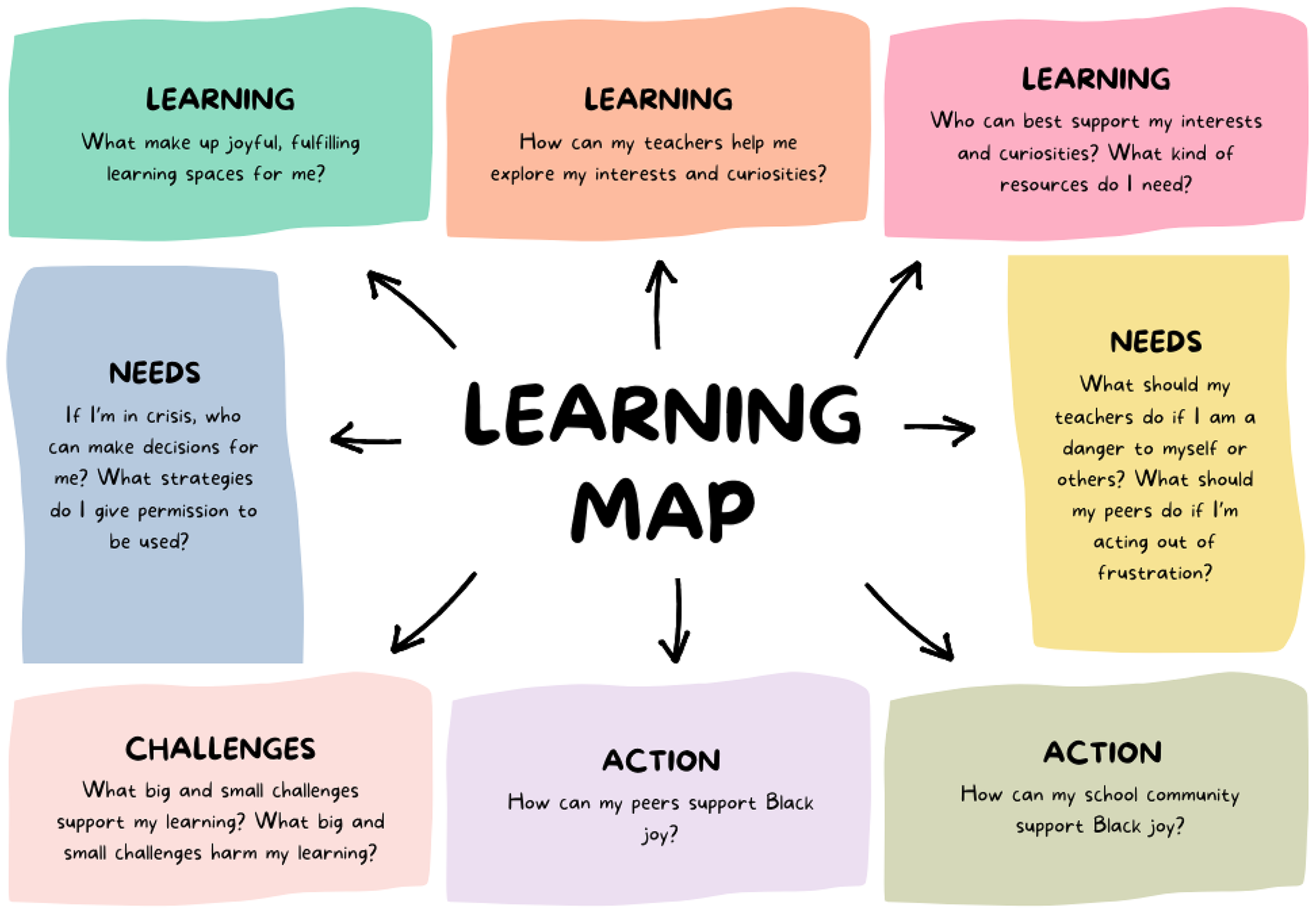
Sample Learning Map. Note. This Figure Includes the Words “Learning Map” in the Center With Arrows Pointing Outward to Boxes That Ask Questions Related to a Student's Dreams, Needs, and Preferred Supports. For Example, One of the Boxes Is Titled “Action” and Asks: “How can my school community support Black joy?”
Educators, counselors, and administrators, if acting in solidarity, might consider using learning maps structurally, identifying how best to create collective access to liberatory learning experiences that rightfully engage students in their own power, truth-telling, and radical imagination. We also imagine learning maps as critical to 2E, urban students re-entering PK-12 schools, particularly those students who are transitioning to school from psychiatric and/or juvenile incarceration, those who have experienced a loved one or community member's abduction by Immigration Customs and Enforcement, or those directly impacted by ongoing genocide around the world, such as young people with ancestral connections to Gaza, the Congo, and Sudan. Importantly, a map is not simply another apolitical tool, or “contract,” a carceral reproduction that relies on diminished autonomy and coercive treatment. Maps, as we describe them above, should be constructed with consent from the student involved, fully voluntarily, honoring their autonomy to modify or withdraw the map from our shared use at any time.
Conclusion
The current realities for 2E urban students require intentional action to not only refuse systemic harm but also embrace liberation as the focus of practice. With liberation at the core, educators, school counselors, and administrators center the humanity of 2E urban students, inclusive of the totality of their emotions, along with their needs, at the intersection of their identities. This work not only changes the school environment for 2E urban students but also has the ability to transform urban schooling to be a space of love, protection, and resistance of white Christian nationalism and Project 2025.
Footnotes
Acknowledgments
We acknowledge that academic institutions reside on occupied Indigenous lands and were largely built by enslaved Africans who were trafficked to this land. We acknowledge that academic institutions profited from slavery and settler colonialism. The Black and Indigenous peoples, without whose labor and land these institutions would not exist, were explicitly excluded from these institutions until the late 20th century. Even now, de facto segregation upholds white supremacy in our colleges and universities. We also acknowledge that academia exploits the labor of economically disenfranchised populations and disproportionately capitalizes on the labor of women and minoritized populations. Finally, we acknowledge that institutions of higher education play a role in the prison industrial complex, purchasing materials made with prison labor, an exploitative relationship that further disenfranchises incarcerated people. We must actively work to combat labor issues in academia, being mindful of the disproportionate assumption of labor by marginalized academics (including graduate students) and taking responsibility for equitable shares of labor. We must recognize that the adjunctification of academia is inherently exploitative and work to prevent and remedy the damage it does. The reimbursement system in academia is a class issue, and our institutions must move away from partnerships that exploit already vulnerable populations.
Funding
The authors received no financial support for the research, authorship, and/or publication of this article.
Declaration of Conflicting Interests
The authors declared no potential conflicts of interest with respect to the research, authorship, and/or publication of this article.
