






Abstract
China’s rapid urbanisation has prompted its government to explore new sustainable sources of public revenue to finance the continued demand for urban infrastructure and services. Property tax advocates have sought to take advantage of the real estate booms that have occurred since economic liberalisation by actively campaigning for a real property levy as an appropriate policy choice. Against this background, this study evaluates the prospect of implementing market-value-based property tax reforms in mainland China. Based on the new institutional economics perspective, it posits property tax as an institutional arrangement which requires complementary mechanisms in land registration, property appraisal, tax administration, social security and dispute resolution. Property tax reforms would not only necessitate technical changes, but would also have extensive social, political and legal repercussions for Chinese society.
1. Introduction
Sustainable urban development requires strong public finance to support timely investment in urban infrastructure. In many market economies such as the US, Canada and Hong Kong, property taxation has long been established as a major source of government revenue to fund urban investment and economic growth (Connellan, 2004; Jin, 2004; Oates, 2001; Gao and He, 2006). Property taxes are often levied on the market value of property assets. This value-based approach enables government revenues to grow with the local economy (Rosengard, 1998; Zang et al., 2003; Gao, 2005). This is acceptable to the community because it establishes a virtuous connection between public finance and local economic conditions. With increasing privatisation and marketisation of the land and property markets, many former socialist countries such as the Czech Republic, the Slovak Republic, the Russian Federation and Poland are eager to adopt similar property tax institutions. Despite the continued efforts of the governments in these countries to create transferable property rights and expand property market activities, considerable difficulties have been encountered in implementing a market-value-based property taxation system (Malme and Youngman, 2001).
Property tax reform is also a major policy direction in socialist China. China’s current property taxation system is frequently criticised for having a “narrow tax-base, numerous tax types, and high tax rates” (shuijizhai, shuizhongduo, shuilugao) (Jin, 2004; Ma, 2004; Li, 2005; Jia and Zhou, 2006; Sun and He, 2006). These characteristics have not only weakened the fiscal strength of local governments, but have also impeded the growing maturity of the land and property markets. Property tax reform has become an increasing focus of attention in China and efforts to promote such reform are currently driven by three forces. First, fiscal decentralisation from the central to local governments has heightened the importance of local financial responsibility and encouraged local governments to expand their revenue sources. Secondly, persistent growth in the property market offers a fertile ground for local governments to capture tax income from this sector. Thirdly, Chinese governments perceive property tax as a potential macroeconomic management tool that would enable them to regulate what has become an excessively speculative property market. While the idea of introducing a market-value-based property tax (wuyeshui) to China’s taxation system was contemplated in a national policy document issued at the third plenary session of the 16th Chinese Communist Party Congress in October 2003, little progress has been made to date in making this proposal a reality.
The purpose of this paper is to provide a systematic analysis of the institutional constraints that hinder the implementation of a market-value-based property taxation system in China. It explores why the Chinese government still cannot levy a real property tax according to market value, even though successive moves in privatisation and marketisation have already resulted in extremely active and vibrant property markets in urban China. China has an extremely high homeownership rate. The 2000 Population Census recorded that about 72 per cent of the urban households in China owned their homes (Li and Yi, 2007, p. 343). Other reports suggest that the current proportion of homeownership has exceeded 80 per cent (Arora, 2005; Oster, 2007). There is thus a great potential of securing stable income for the Chinese government by levying taxes on owner-occupied domestic property. Despite this substantial opportunity, the Chinese authority has not included owner-occupied domestic properties in the property tax-base. This policy has pushed the local governments to rely heavily on land leasing and taxation on real property transactions in funding public expenses. The decision to exempt taxation of owner-occupied housing can perhaps be attributed to the complexity of property ownership rights in China. Incremental housing reforms have resulted in a complex housing tenure composition of differing ownership and transferable rights (Duda et al., 2005; Li and Yi, 2007). This study will argue that other institutional factors should not be ignored and they are far more crucial in obstructing the implementation of an effective and efficient property tax system in China.
Drawing upon the theoretical perspective of New Institutional Economics (NIE), this study argues that market-value-based property taxation involves much more than the simple tasks of tax administration or legislation. Instead, it should be conceived of as comprising four mutually supportive institutional mechanisms: land registration, property appraisal, tax collection/enforcement and dispute resolution. Using this analytical framework, this paper evaluates the current operation of and arrangements for these four aspects of the Chinese property market and examines possible changes in these areas which might facilitate the implementation of a value-based property tax system. This study aims to fill the gap in the current literature, which tends to emphasise what a rational and equitable property taxation system in China should look like, but ignores the many institutional obstacles that may have thwarted its introduction. This paper highlights the institutional barriers that perpetuate the current Chinese property taxation system, which appears to be ineffective, complex and costly. It is only by analysing these institutional constraints that a more realistic and viable direction for property tax reform can be conceived.
The rest of this paper is divided into four sections. Section 2 outlines the evolution of the regulatory framework for property taxation in China, sets out the key issues and synthesises the major arguments from the existing literature about their diagnosis and prescription. Section 3 introduces the theoretical perspective of NIE in understanding institutional changes and develops an analytical framework for examining the success of efforts to implement a market-value-based property taxation system in transitional economies. Section 4 applies this framework to examine the situation in China and explains how the existing institutional arrangements in land registration, property appraisal, tax administration, public welfare and the judicial system may make the implementation of a fully fledged market-value-based property tax difficult in practice. The final section gives the conclusions.
2. Property Taxation in China: Background and Issues
2.1 Regulatory Framework
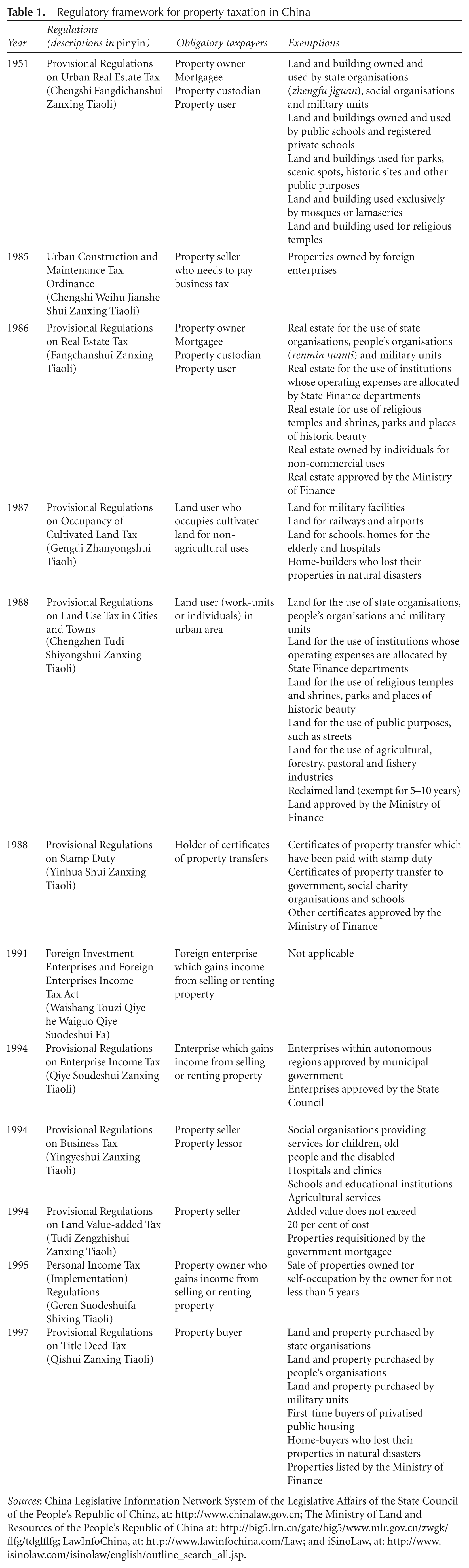
In socialist China, property taxation has a history of more than 50 years, although its importance as a fiscal instrument that can be used to address a multiplicity of economic and social problems has received attention for less than a decade. The first property tax legislation was the Provisional Regulations on Urban Real Estate Tax (Chengshi Fangdichanshui Zanxing Tiaoli), which the central government enacted in 1951 to tax land and property by entitlement. Under these regulations, building tax was levied at 1 per cent per annum on the assessed standard value of the physical structure, which took into account the category and grade of building, general building values and construction costs in the same locality. Land tax was charged at 1.5 per cent of the standard land value, which was assessed according to location, grade and general land prices. Article 9 of the Regulations stipulated that standard land and building values should be determined by a Real Estate Appraisal Commission (Fangdichan Pingjia Weiyuanhui) comprising delegates from the local Conference of the People’s Representatives and governmental officials responsible for finance, taxation, land administration and building construction. However, local governments did not pay much attention to these taxes before the 1980s, largely due to the low tax rates and the removal of private property ownership rights under a centrally planned economy (Song et al., 1999).
Land and housing reforms pursued after the mid 1980s led to a gradual restoration of private property markets in Chinese cities. Alongside the re-establishment of market institutions, the central government enacted the Provisional Regulations on Real Estate Tax (Fangdichanshui Zanxing Tiaoli) in 1986 to resume government taxation of the holding and leasing of urban buildings. Although the existing Provisional Regulations on Urban Real Estate Tax remained in force, they were subsequently applied to land and properties leased to foreigners and foreign enterprises only. Under the new Regulations, building tax was levied at a rate of 1.2 per cent on between 10 per cent and 30 per cent of the property’s book value. Rented premises were taxed at a much higher rate of 12 per cent. However, it is important to note that these real estate taxes covered buildings and physical structures only. The first article of the 1986 Regulations clearly stipulated that the definition of ‘real estate’ excluded land. This legal interpretation reflected the philosophy of the Chinese government of the time whereby Chinese individuals could have de facto ownership of building premises and physical structures, but could not own the associated land because all land in China belonged to the socialist state (Tang, 1992; Ma, 2001).
The policy of treating land and buildings as separate tax entities was highly influential in the socialist rule in China. It also explains why subsequent tax legislation has covered land as urbanisation began to accelerate after the mid 1980s. The Provisional Regulations on Occupancy of Cultivated Land Tax (Gengdi Zhanyongshui Tiaoli) and the Provisional Regulations on Urban Land Use Tax (Chengzhen Tudi Shiyongshui Zanxing Tiaoli), promulgated in 1987 and 1988 respectively, are widely considered to be the statutory cornerstones of Chinese land taxation. The former regulations imposed taxes on the conversion of cultivated land to non-agricultural uses. The primary purpose of these regulations was to protect arable land resources and generate income to subsidise peasants displaced by urbanisation (Li, 2005). The latter regulations imposed taxes on the use of urban land with the objective of encouraging the effective utilisation of land resources. The amount of tax payable was assessed on the basis of the land area occupied and used by the taxpayer. The annual rate for land use tax varied from RMB 0.3 yuan to RMB 10 yuan per square metre, depending on location and the level of economic prosperity in the city concerned. The tax authorities of the respective provinces and autonomous regions determined the actual tax rate charged within the range stipulated in the regulations.
Increasing marketisation during the 1980s also enabled the Chinese government to capture revenues from property transaction activities. In this respect, stamp duty (yinhua shui), urban construction and maintenance tax (chengshi weihu jianshe shui) and the education surcharge (jiaoyu fujia fei) were the three major tax items. Stamp duty, which had been introduced in 1950, was consolidated with the unified tax for industry and business (gongshang tongyi shui) from 1958 to 1987. The enactment of the Provisional Regulations on Stamp Duty (Yinhua Shui Zanxing Tiaoli) in 1988 marked the resumption of the levy of stamp duty as a separate tax covering 13 types of contractual instruments executed, which included property transactions and assignments. The resurrection of this tax in the 1980s was not aimed solely at generating public revenue. As Ma (2001) suggests, levying stamp duty allowed the Chinese government to keep a close eye on the growing level of contractual activities in the country and to cultivate public awareness about the tax obligations of individuals. The other two taxes—the urban construction and maintenance tax and the education surcharge—were respectively introduced in 1985 and 1986 to finance urban infrastructure and education services. To facilitate their collection, they were levied as additional items on top of business tax (yingye shui), which was payable on all property transactions.
Urban development in China accelerated in the 1990s, leading to unbridled growth in the private property sector in many Chinese cities. According to China’s National Bureau of Statistics, the volume and average current price of property transactions rose by 280 per cent and 54 per cent respectively, between 1999 and 2005. Land and property speculation became rampant. Many property owners and investors were able to make huge profits from land and property transactions. The Chinese government recognised the need to regulate the overheated property market. In 1994, the Provisional Regulations on Land Value-added Tax (Tudi Zengzhi Shui Zanxing Tiaoli) were introduced to tax the net capital gains of property sellers. The land value-added tax (tudi zengzhi shui) was intended to serve the twin purposes of capturing tax revenues for the government and acting as an anti-speculation measure (Ma, 2001). Furthermore, the Provisional Regulations on Deed Title Tax (Qishui Zanxing Tiaoli), which had first been introduced in 1950, were revised in 1997 to capture more revenue used to finance urban development and construction at the local level. The revised version of these regulations taxed transfers of land use rights and the ownership of immobile assets at rates of between 3 per cent and 5 per cent of the value of the transaction.
2.2 Institutional Features and Problems
Table 1 summarises the key government regulations related to land and property taxation in China. Several important characteristics are worthy of note. First, while land and property taxation is nothing new in China, there has been a recent shift of emphasis from taxing the use/holding of assets to taxing transaction activities in the market. As the socialist economy has undergone an incremental process of market reform since the late 1970s, China’s taxation framework has also been the subject of evolutionary change. The government has introduced new legislation and regulations at different stages which have been designed to achieve different policy objectives appropriate at the time. Taken together, all these rules build up a complex regulatory framework. There are now a total of 12 different taxes directly or indirectly related to real property (Table 2). These taxes are levied at differing rates on four separate activities: the development, transaction, leasing and holding of real property. It is clear that property holding is subject to comparatively fewer tax levies than are the other three activities. Between 1999 and 2006, for example, there was a significantly larger increase in revenue from property transaction taxes such as land value-added tax and deed title tax than in property holding taxes such as the real estate tax and the urban land use tax (Table 3).
Regulatory framework for property taxation in China
Sources: China Legislative Information Network System of the Legislative Affairs of the State Council of the People’s Republic of China, at: http://www.chinalaw.gov.cn; The Ministry of Land and Resources of the People’s Republic of China at: http://big5.lrn.cn/gate/big5/www.mlr.gov.cn/zwgk/flfg/tdglflfg; LawInfoChina, at: http://www.lawinfochina.com/Law; and iSinoLaw, at: http://www.isinolaw.com/isinolaw/english/outline_search_all.jsp.
Property taxes in China: key elements

Sources: China Legislative Information Network System of the Legislative Affairs of the State Council of the People’s Republic of China, at: http://www.chinalaw.gov.cn; The Ministry of Land and Resources of the People’s Republic of China, at: http://big5.lrn.cn/gate/big5/www.mlr.gov.cn/zwgk/flfg/tdglflfg; LawInfoChina, at: http://www.lawinfochina.com/Law; and iSinoLaw, at: http://www.isinolaw.com/isinolaw/english/outline_search_all.jsp.
Property tax revenues in China (billion yuan)

Source: National Bureau of Statistics of China, China Statistical Year Book (various years).
The second important characteristic is that the revenue-sharing tax system established by the Chinese government in 1994 has had a profound impact on the role of land and property taxes in local public finance. This system enhanced local fiscal autonomy by defining the respective financial and administrative responsibilities of the central and local governments. The central government is responsible for national affairs relating to national defence, armed police, foreign affairs and macroeconomic control. Jurisdiction over local administration expenditures and urban construction and maintenance is vested in the local governments. More importantly, the system distinguishes between local and shared taxes (Table 4). Property holding taxes such as the real estate tax, the urban land use tax and the occupation tax on cultivated land are designated as local taxes from which all revenue is to be retained by the local governments. However, these taxes make only a minor contribution to local government finances, collectively accounting for less than 5 per cent of total revenue in 2006 (Table 3). Intense interurban competition has put many local governments under enormous pressure to fund the huge costs incurred in urban development, infrastructure upgrades and local services. To meet their fiscal needs, some have had to resort to quick-fix measures such as borrowing funds, leasing land and sourcing extra-budgetary revenues (Deng, 2005; Li, 2005). Land resources have become overexploited and tax administration has been complicated even further (Dai, 2005; Tao, 2006). The Chinese government thus has a strong interest in exploring a sustainable and stable source of income from land and property taxation.
Tax-revenue sharing in China

The third characteristic of China’s existing property tax system is that it has been widely criticised as inefficient, costly and inequitable (see Wang, 2003; Fan and Li, 2004; Ma, 2004; An and Wang, 2005; Dai, 2005; Gao, 2005). One notable feature of this system is that although the Chinese government has continued to add new property taxes over the years, the tax-bases on which they are levied have not been widened to any significant extent. For instance, revenue from land value-added tax and deed title tax accounted for only about 6 per cent of total government revenue in 2006 (Table 3 above). This low proportion can be explained by three factors. First, some tax assessments are based on non-valuation criteria such as ‘physical area’ and ‘historical book value’. As a result, there is limited potential for revenue from these property taxes to grow as property appreciates in value (Figure 1). Secondly, some property holders are exempt from property taxation, thereby narrowing the tax-base. In addition to benefiting from preferential tax rates, foreigners and foreign companies are exempt from land use tax, urban construction and maintenance tax and the education surcharge (H. Liu, 2006). Real estate taxation is confined to cities, county towns, state-designated townships and industrial and mining areas, and does not apply to vast rural areas in which land title is owned collectively. Furthermore, real property owned and used by state organisations (zhengfu jiguan), people’s organisations (renmin tuanti), military units and organisations designated by the Ministry of Finance are exempt from real estate tax. Thirdly, property taxpayers who fall outside these exempted categories have to shoulder a heavier tax burden. This gives them an incentive to engage in tax evasion, leading to a reduced tax collection rate (Wang, 2003; Ma, 2004).

Relationship between property prices and property tax revenues in 27 provinces and 4 municipalities of China, 2002–06.
In view of these problems, there is a general consensus among Chinese policy-makers and scholars that the Chinese property tax system is in need of reform and that a major policy direction that might be pursued is to move towards implementing market-value-based taxation (for example, Shen, 2002; Gao, 2005; Shu, 2005; Shun, 2005; Jia and Zhuo, 2006; Tao, 2006; Bird and Slack, 2007). Other proposed reform measures include merging and combining taxes, reducing tax rates, adopting uniform tax rates for properties held by domestic residents and foreigners, and strengthening property tax legislation and administration (Mao, 2005; Xiao, 2005; Dong, 2006; Ng, 2006). Building on these proposals, it has been advocated that Western taxation models should be adopted in place of the existing Chinese property tax system (Zhang, 2003a, 2003b; Xing, 2004; Zang et al., 2003; Su, 2005; Sun and He, 2006). The Hong Kong model has been cited as one of the most desirable templates due to the successful capitalist experience in Hong Kong and its strong connections with mainland China in terms of Chinese culture and the land tenure system. Notwithstanding these considerations, the current slow progress in Chinese property tax reform suggests that there are major obstacles hindering a successful institutional restructuring towards a Western-style taxation system in China.
3. Theoretical Perspective and Analytical Framework
3.1 New Institutional Economics
This study applies the theoretical insights of the New Institutional Economics (NIE) in examining the prospects for implementing market-value-based property taxation in transitional urban China. Following the seminal ideas of Coase (1937) about the costs of transaction, the substantial body of NIE literature provides a useful analytical framework for examining why and how institutions evolve in response to historically derived constraints with an emphasis on bounded rationality and path dependence. The theoretical argument is that new institutions will emerge when the prevailing ones lose their self-enforcing capacity and fail to generate economic benefits out of new transactions and social needs resulting from technological or organisational changes (Libecap, 1989; Greif, 2006). From the NIE perspective, economic efficiency and good economic performance in many developed countries are invariably correlated with cost-minimising institutions including secure property rights, transferable title, voluntary contracting, rule of law, social trust and effective contractual enforcement (North and Thomas, 1973; Libecap, 1989).
The central questions addressed from the NIE perspective are about why different societies evolve along dissimilar trajectories of institutional development and why some of them fail to adopt the institutions of those that are economically more successful (Greif, 2006). The NIE explanation is that institutional change and restructuring towards a more efficient system are costly. Efficiency-enhancing institutional changes are often thwarted by cumulative past experiences, opposing organisations and prevailing beliefs in society (North, 1997). If a new institution is expected to create a redistribution of income that harms vested interests, or if the transaction costs involved in establishing the new system are high, the prevailing institutions tend to persist even though the new alternatives appear to be more rational and efficient (Libecap, 1989). North (1997) thus suggests that the success of institutional change depends critically on what the present constraints and the future choices are. What is central to this social enquiry approach is to clarify the origin of the current institutional arrangement and to understand how it persists and evolves in light of efficiency improvements, the distribution of costs and benefits, and the implications for transactions costs.
3.2 Analytical Framework
This study builds on the NIE theoretical perspective by examining four interrelated institutional components that need to be in place to support the successful implementation of a market-value-based property tax system (Figure 2). The first fundamental element underpinning market-value-based taxation is an integrated property database which accommodates regular data maintenance and the updating of land and property characteristics, ownership details and rental and sales information (Lafakis et al., 1993). Irrespective of whether a single property unit or a group of properties is to be valued, appraisers have to make reference to an inventory of property data which covers ownership status, usage and physical and other characteristics to allow them to compare their estimates with recent market transactions and to determine market value. Given the huge amount of property valuation work involved in a taxation exercise, such exercises are technically impossible without the support of a comprehensive and readily retrievable property database (McCluskey, 1997; McCluskey and Williams, 1999). The factors governing the success or otherwise of efforts to collect and accumulate quality property data for taxation purposes go beyond mere technical advances; social and political institutions also have a strong bearing on such systems.

Analytical framework.
The second component buttressing market-value-based taxation is mass appraisal, which is defined as
the systematic appraisal of groups of properties as of a given date using standardized procedures and statistical testing (Gloudemans, 1999, p. 1).
To support property taxation, an effective mass appraisal system should be firmly established to achieve consistency and fairness and ensure an equitable distribution of tax liability among taxpayers (Pang, 2006). Two factors are needed to accomplish these objectives. The first factor is related to the quantity and quality of property data which influence decisively the accuracy of value assessment (Lafakis et al., 1993). The second is the establishment of a set of legally defined principles to guide the assessment process. These principles should clearly define a range of important issues such as the definition of taxable real property, the reference date on which the taxable value is determined, the basis of assessment and the deductions allowed for depreciation, repairs and maintenance. Faithful implementation of these principles requires not only sophisticated computing technology, but also competent property appraisal professionals. In addition, it requires an appropriate institutional setup to ensure the independence of assessment. To avoid conflict of interest, tax assessment and collection tasks are often handled by separate management authorities in many developed cities such as Vancouver and Hong Kong.
The third component is a tax collection and enforcement mechanism. The success of a taxation system is ultimately determined by its performance in revenue collection and enforcement. To achieve this objective, it is imperative to establish a healthy balance between the amount of tax revenue generated and the cost of raising such revenue (Rosengard, 1998). What is central to achieving this balance is to induce desirable behaviour among both tax officers and taxpayers to ensure that a high tax collection rate is achieved. This requires a good understanding of the factors influencing tax compliance behaviour. Previous studies have indicated that tax compliance is positively related to the ability to pay, the perceived probability of detection/prosecution and the severity of sanctions, but is negatively affected by the perceived unfairness of tax distribution, a lack of clarity about obligations and reasons to pay, oppressive tax enforcement, harassment of taxpayers and dissatisfaction with the delivery of public goods and services (Allingham and Sandmo, 1972; Richupan, 1987; Bukurura, 1991; Fjeldstad and Semboja, 2001; Bell and Bowman, 2006). Therefore, in addition to competent tax administration, effective collection and enforcement require a well-established land registration system in which property titles are clearly defined to facilitate legal enforcement procedures aimed at collecting tax arrears (Tang, 1992). Moreover, the support of the social security system is also required for taxpayers who are asset-rich but cash-poor.
The fourth component supporting a value-based taxation system is a dispute resolution system. Property appraisal is a scientific art in which the assessment gives a defined range of market values instead of an exact figure. Different appraisers may arrive at different value estimates. A dispute resolution mechanism is thus needed to allow aggrieved taxpayers to object to and appeal against taxable value assessments. This mechanism enhances the transparency and equity of a taxation system and ultimately contributes to a higher degree of voluntary compliance among taxpayers. At a first level, objectors should be offered ample opportunity to gain access to the taxation authority and discuss disputes with it (Pang, 2006). Fundamental to this process is an open institutional setting that recognises the rights of taxpayers and allows for public scrutiny of government decisions. At the next level, an arbitration and court system needs to be in place. Either the assessment authority or the aggrieved taxpayer should be able to lodge appeals for a final decision to be made if an agreement cannot be reached by negotiation. To be successful, this type of hierarchical dispute resolution mechanism requires backing from the property appraisal and legal professions. The extent to which legal and property appraisal services are privatised is crucial, as it influences whether taxpayers can appoint independent lawyers and property appraisers to act on their behalf in a professional capacity when they want to challenge a government assessment.
4. China’s Property Tax Reforms: Institutional Analysis and Discussion
4.1 Property Data Registration
It is evident from the experiences of many developed countries that a good-quality land registration system plays an indispensable role in supporting property appraisal (Zhang, 2003a, 2003b) and enforcing tax obligations (Pang, 2006). It should be a mandatory property database system empowered by law to require registration of all instruments affecting land interests. This mandatory aspect makes it the most reliable source of property-related information including property particulars, ownership details and market transaction data. However, establishing a reliable land registration system often takes a long time and a significant amount of resources. The present land registration system in China is still in its early stage of development and is thus inevitably fraught with many institutional and technical problems (Ma and Wai, 2005). Some of the key problems include the low level of geographical coverage, poor-quality registered data and inconsistent registrations for land and buildings (Li, 2006; Qiu, 2006). Taken together, these problems represent a significant barrier to the aggregation of property data for tax assessment and collection.
Following in the footsteps of market reforms, China’s urban land registration system was not resumed until after the mid 1980s. In many Chinese cities, systematic registration of real property is often confined to recently built residential properties only. Extending the existing system to cover other properties has proved to be difficult because the relevant data for some old properties have not been collected, updated and stored systematically. Before the abolition of welfare housing in the late 1990s, all housing units in China were owned by the socialist state and were administered by the various work units (danwei) as a kind of welfare facility. As a consequence, property data, especially on old building premises, are usually incomplete and scattered (Song et al., 1999). There is an urgent need to match and digitalise missing data for these properties for registration and taxation purposes so that property tax reform can move forward (Ding, 2005).
Extensive cadastral surveys are necessary to address the problems created by an inadequate property database. This requires strong political will and the commitment of local government resources (Ding, 2005; Li, 2006). Guangzhou, a city located in the Pearl River Delta in southern China, is often described as one of the pioneering cities in terms of housing marketisation and property market maturity. In this city, the secondary housing market already accounted for about 45 per cent of total housing transactions in 2004, with over 6 million square metres of housing floor space being sold annually (Guangzhou Municipal Statistics Bureau, 2004). Part of Guangzhou’s success in this regard was attributed to the substantial efforts made by the municipal government to extend the geographical coverage of its land registration system. According to informed sources, its property registration records have been expanded to the point where they now cover more than 90 per cent of the urban land area and 95 per cent of the housing stock. Even so, many defective titles have not been identified. Given the legal complexities involved, the formalisation of these missing or problematic titles has to be left to the passage of time (Li, 2006).
Another problem with the present land registration system in China lies in the authenticity of property transaction data. The high property tax loading on transaction activities has led to an undesirable side effect: it induces buyers and sellers to submit fake reports of the sale price to the registry to evade tax (Wang, 2003; H. Liu, 2006). This is happening because the responsibility for reporting the transaction to the registry lies with the parties to the transaction or the property agent, who all have incentives to complete the deal (Tang, Wong and Liu, 2006). Moreover, under the current regulatory framework, the general public has limited access to the land registration system. Members of the general public are not allowed to conduct land searches without obtaining authorisation from the property owner. This has led to insufficient public knowledge of and confidence in the property registration system and has further frustrated the process of verifying and accumulating property-related data through public inspection (Li, 2006).
Another aspect in need of improvement is the paucity of market rental data held in the land registry. China’s rental market is dominated by ‘black market’ leasing in which the obligations to register rental contacts with the government and pay taxes are avoided (Tang, Haila and Wong, 2006). Collecting these data requires the compulsory registration of tenancy agreements. Based on the experience of Hong Kong, for instance, property rental information is collected through the registration of tenancy agreements and regular government surveys on property owners or occupiers. The tax assessment authority of Hong Kong has a statutory power to issue survey forms to collect information such as the commencement of a tenancy agreement, tenancy term, agreed rent and other particulars. Property owners and occupiers are required by law to complete and return such forms within a specific period. This process has allowed Hong Kong to accumulate a rich rental database over the years. In the case of Guangzhou, however, property rental data have been treated in a systematic manner only since the establishment of the Guangzhou Housing Leasing Management Office (Fangwu Zuren Guanlisuo) and the data management system has been in place for less than five years. The property leasing market still suffers from low transparency because the key information is often held by property agents, who have much more detailed inside knowledge about rental contracts than the government authority.
A further problem with the existing land registration system in China is that the issue of separate land and building registrations has yet to be resolved (Chan and Cai, 2006; Liu, 2006; Qiu, 2006). In China, land matters are administered by the Ministry of Land and Resources, whereas building-related matters are the responsibility of the Ministry of Construction. Under this institutional arrangement, land and building titles are recorded in two separate sets of legal documents. The property title certificate (fangchan zheng) confirms the ownership rights to a subject property, while the land title certificate (tudi zheng) records the ownership of land use rights attached to a property. According to the Urban Real Estate Management Law (Chengshi Fangdichan Guanli Tiaoli), all transfers of real property require amendments to these certificates and must be separately registered with both the housing management authority (fangchan guanli bumen) and the land management department (tudi guanli bumen) separately. However, many have ignored this legal requirement because the general public perception is that registration of the property title certificate is adequate to prove ownership. As a result, many real property registration records are defective, inconsistent and incomplete, leading to numerous ambiguities in property rights (Li, 2006; Y. Liu, 2006). The integration of land and building titles is an explicit policy move, as evidenced by the Provisional Management Measures for Urban Housing Ownership Registration (Chengshi Fangwu Chanquan Guanli Zanxing Banfa) promulgated by the Ministry of Construction in 1990. Effective property tax enforcement requires clear property titles so that legal action can be taken to recover property tax arrears by registering a claim on the ownership title and prohibiting any change in ownership.
4.2 Property Appraisals
To support property taxation, a sound property appraisal system requires both technology and personnel. In many Western countries, computer-assisted mass appraisal (CAMA) techniques have been used extensively to improve property value assessments for taxation purposes (Gloudemans, 1999; McCluskey, 1997). In this respect, China has not been slow in strengthening its appraisal technology. For example, implementation of a mass appraisal system in Guangzhou was completed in 2007. This system is owned by the Guangzhou Real Estate Appraisal Administration Office (Guangzhoushi Gujiasuo) under the Bureau of Land Resources and Housing Management (Guotu Ziyuan he Fangwu Guanliju) of the municipal government and provides estimated benchmark property values (jizhun fangjia) for four types of real property: housing (both new and secondhand), office, retail and factory premises. This system has achieved three main purposes. First, it has given the government an objective and equitable property value database which can be used as the basis for considering the imposition of property taxes. Secondly, it has provided a tool that can be used to inform policy decisions on appropriate market regulation strategy. Thirdly, the benchmark property values recorded by the system have helped to enhance market transparency by providing reference prices to all market participants (Liu, Wang et al., 2006).
CAMA techniques are effective tools that appraisers can use to enhance valuation efficiency and consistency. However, property appraisal technology will never replace human judgement and does not preclude the involvement of property appraisers. Human input is particularly necessary where a group of assessed properties are not homogeneous. Moreover, the role of property appraisers is not confined to technical value assessments only, but also extends to an appreciation of market sentiment and forecasts of future market trends. In many Western countries, property appraisers are normally required to be members of an independent and locally recognised professional institute such as the Royal Institution of Chartered Surveyors in the UK or the Appraisal Institute in the US. Professional appraisers can choose to work for the government or in the private sector and are subject to a licensing process regardless of their employers. The professional body monitors and regulates appraisal practices and requires its members to comply with a code of practice, business ethics and practice standards.
In contrast, the Chinese property appraisal profession has emerged from a different institutional setting due to its specific historical context and unique social environment. In line with other intermediary services such as development consultancy and property agency, the appraisal profession has grown since the late 1980s when there was a rapid increase in the commodification of housing in some of China’s major cities. At the beginning of this process, such services were almost exclusively provided and managed by government departments or work units. When private valuation firms began to emerge in the market, it was found that the direct provision of valuation services by government bodies had resulted in unfair competition and distorted market development. In response, the State Council implemented a series of reform measures in the late 1990s to promote the privatisation of property services. In essence, government departments at various levels were instructed to withdraw from offering market intermediary services. For example, the Ministry of Land and Resources had ceased to approve the results of property value assessments in 1999, after which it was merely responsible for recording them (X. J. Liu, 2006).
Nonetheless, institutional reforms of the governmental authorities continue to lag behind privatisation of the housing markets. Various forms of substantive administrative intervention in the assessment of property values remain in place (Liu, Sun and Han, 2006). For instance, many ‘private’ appraisal firms are nominally independent of the government bureaucracy, but are essentially subsidiary companies of the local governments. For several reasons, appraisal firms set up with private capital still need to establish an intimate relationship with the bureaucracy to survive in the business. First, the government departments involved provide authoritative data sources to appraisers. Property data were historically compiled and stored by the land- and housing-related departments in China. As there is now a market demand for this information to support property appraisal, it has become not only a kind of saleable asset for these departments, but is also an invaluable resource that can be used to discipline non-conforming appraisers. Secondly, some local governments can exercise their administrative discretion to endorse on a selective basis valuation reports produced by private appraisal firms in respect of which they have exclusive nomination and appointment powers (Cui, 2006; X.J. Liu, 2006).
The third and most important reason for the need of private property appraisal firms to maintain close relationships with government departments relates to the qualification system for professional property appraisers and the grading for property appraisal firms. Under existing institutional arrangements, the powers to assess, certify and register professional property appraisers are vested in the Ministry of Construction and the Ministry of Land and Resources rather than in independent professional institutions. Furthermore, certified Chinese property appraisers are not permitted to practise unless they are employed by a company unit. In other words, ‘individual professional practice’ is prohibited by law and similar rules also apply to other providers of intermediary services such as property agents. This requirement stems from the socialist Chinese practice of social control in which an emphasis is placed on monitoring the ‘affiliation of individuals’ with an organisation (Tang, Wong and Liu, 2006). Regulation of professional services is achieved at the organisational level. The Chinese government uses a grading system to classify property appraisal firms into three categories: grade I, grade II and grade III. The higher the grade a firm is given, the wider the scope of the business activities the firm can pursue (Table 5).
Grading criteria for property valuation companies in China

Note: Grading criteria are summarised from Management Measures on Real Estate Appraisal Firms (Decree No. 142 from the Ministry of Construction, 27 September 2005).
This regulatory framework provides an opportunity for the government bureaucracy to exert an influence on property appraisal firms. The grade awarded to each firm is reviewed and evaluated on an annual basis by the construction administration departments of the local governments based on its registered capital, the number of qualified property appraisers and its historical performance in appraisal services. Under this regulatory framework, the autonomy of professional valuation practice is inevitably compromised because appraisers will find it difficult to act against government interests on behalf of their clients, particularly in objections or appeal cases. Hence, it is not surprising that the property appraisal profession does not have a positive public image in China. This is evidenced by the many media reports about malpractice among property appraisers including the reckless use of property data, fictitious price information and unreasonable service charges (Gao, 2005; Li, 2005). To promote the credibility of appraisal services, there is a need to shift the licensing and certification powers from the government to independent professional bodies. Instead of being confined to its current role of promoting social networking, the Chinese Institute of Property Appraisers (Zhongguo Gujiashi Xuehui) must be developed into a truly statutory organisation and given adequate powers and responsibilities enabling it to represent the profession, to set standards for professional services and performance, to establish codes of ethics, to decide on membership admission requests and to take disciplinary action in cases of professional misconduct.
4.3 Tax Collection and Enforcement
Effective property tax collection requires a reasonable distribution of the tax burden and public acceptance of the tax loading. A major problem in China is its shrinking tax-base. Owner-occupied domestic properties and many special property categories are entirely exempt from tax (Wang, 2003; Dai, 2005). Furthermore, property taxes, especially those for holding and occupation, are levied on a nominal basis and the taxable amount is not based on authentic market value. As a result, the overall tax-base, regardless of whether it is assessed in terms of taxable value, number of taxable properties or number of taxpayers, has remained at a low level. If market-value-based property taxes are to be implemented to generate more public revenue, the tax-base has to be widened substantially to include more property types and taxpayers. This will inevitably involve more owners, occupiers and property types falling within the tax-base. While this may result in a fairer distribution of the tax burden, some taxpayers may have to pay more tax than they do now when taxes are assessed on the basis of market value.
However, property tax obligations have no direct relationship with the ability to pay. A mismatch between property wealth and income may result in a taxpayer being asset-rich but cash-poor (Rosengard, 1998). Differentiated tax rates, reductions and exemptions can help those who have genuine difficulties meeting their tax payment obligations, but may cause hidden subsidies. Setting a clear dividing line in terms of statutory administration is often controversial and it is also difficult to prevent a continuous expansion of exemptions (Pang, 2006). For these reasons, a social security system has to be in place to tackle the problems of affordability and property tax arrears among taxpayers. While Hong Kong is an example of a jurisdiction that does not grant any reductions, allowances or exemptions on the grounds of the taxpayer’s financial resources, property rates arrears have remained below 1 per cent annually. Its social welfare system has played a significant role in maintaining such a high tax collection rate. Property owners who have trouble fulfilling their property tax obligations can seek financial assistance from the Social Welfare Department in Hong Kong. They may be required to sell their property in the private market to release them from their property tax burden and move to public housing.
Property tax reforms thus require twin support from social welfare and public housing services. Implementing market-value-based property taxation in China may increase the tax burden on some property owners. While requiring owners to sell their property in the market is a possible relief mechanism, it is not adequate in itself, especially for properties that have title problems for which an open market sale may not be feasible. At present, China’s social welfare system lags behind its remarkable economic achievements. Taking Guangzhou as an example, expenditure on social security was about RMB 5.6 billion in 2006, accounting for only about 10 per cent of total government spending. According to the National Bureau of Statistics, the number of recipients of minimal subsistence payments from the government among the urban population in China remained at a low level of about 22 million from 2002 to 2006. Many urban poor who fall outside the subsistence net will suffer if a property tax is imposed on them. Furthermore, the public housing system in urban China has collapsed since the elimination of welfare housing. Lacking the support of a responsive social welfare and public housing system to help those suffering genuine financial hardship, China is likely to see a higher rate of tax arrears and greater social discontent if it introduces a market-value-based tax system without addressing social welfare concerns.
Another consequence of implementing property tax reforms in China is that they will shift tax obligations from organisations to individuals. Many Chinese people are not comfortable with paying property taxes because there is a general lack of awareness about this obligation, given that many do not perceive themselves as taxpayers (Yin, 2003; Shu, 2005). This perception has been influenced by the history of socialist China. Given that all properties have traditionally been owned and administered by the state, Chinese people have not been required to pay tax as individuals because such payments have historically been made by the state-owned enterprises (guoyou qiye) and work units (danwei). Even under the policy of privatisation, many individual owners are new to property tax matters because real properties owned and used by individuals for non-commercial purposes are exempt. As the general public has not been prepared to accept new tax liabilities, implementing a new regular tax levy on property holding will necessitate more public education about their taxpaying obligations so that a high level of tax compliance can be achieved.
The proposal to implement a market-value-based property tax seems to have received widespread support among the general public. One major reason behind this positive public sentiment is that a property tax is perceived to be a powerful tool that can be used to address a number of economic and social problems that have arisen—such as taming the overspeculative urban property markets and enhancing fiscal independence at the local level (Li, 2005; Shu, 2005). In recent years, skyrocketing house prices have reduced the accessibility of private housing. Many expect property taxes to be effective in cooling down the overheated property market and returning property prices to an affordable level. However, these hopes are likely to be dashed as the impact of property tax on property prices, which are largely determined by market demand and supply, is very limited. When public expectations are not met following implementation, the willingness of the public to comply with their new tax obligations will inevitably wane. Under such circumstances, local governments will face not only lower levels of tax compliance, but will also incur a higher political cost in terms of social grievances, especially without support from the social welfare and public housing systems.
4.4 Dispute Resolution
Implementing market-value-based property taxation will lead to new disputes over property values, appraisals, tax payments, transactions and tax administration across society. Statutory laws, regulations and rules cannot operate in practice in the absence of an effective dispute resolution system. To ensure the success of property tax reforms in China, the functions of courts of law should not be limited to making judgements on taxable property values and imposing penalties on those with property tax arrears. The courts should also be required to play an important role in verifying and confirming property titles when property taxation is expanded to cover properties with title discrepancies. More importantly, one of the judiciary’s primary functions is to strengthen the confidence of taxpayers in any new property taxation system implemented by demonstrating its justice and fairness. The functions performed by China’s judicial system must be expanded and the quality of the system improved to support property tax reforms.
The socialist legal system has evolved and expanded quickly since its restoration in the early 1980s. China’s judicial system has had to deal with enormous demand for its resources as a result of the economic growth and socio-political developments seen in recent decades. An increasing number of disputes have been taken to court for settlement and remedies. Due to resource limitations, it is not surprising that the judicial system has given a higher priority to trying cases of a complex nature involving serious social repercussions. According to the submission of the Supreme People’s Court to the National People’s Congress in 2003, the court tried about 2.8 million criminal cases and 23.62 million civil cases in that year, but heard only about 460 000 administrative cases (Chen, 2004). Implementing market-value-based property tax reforms will require an expansion and restructuring of the judicial system to address the likely increase in the number of disputes over land and housing matters, which the courts generally regard as less important at present.
To enhance the credibility of market-value-based property taxation, it is absolutely essential that clear rules and mechanisms by which taxpayers can object to and appeal against government decisions be laid down. The principles and procedures governing tax arrear cases should be stipulated. To avoid overloading the judicial system, it would be worthwhile establishing specialist courts to deal specifically with property tax disputes and appeal cases. This institutional setup would also ensure that technical cases are examined in full by individuals with the relevant expertise and in a cost-efficient manner. Hong Kong’s Lands Tribunal and Small Claims Tribunal make a significant contribution to property tax collection and enforcement. Lands Tribunal adjudicators comprise both legal and valuation experts and are legally empowered to hear dispute cases and make final judgements on property value assessments. The Small Claims Tribunal effectively contributes to the recovery of outstanding tax arrears from defaulters by registering a legal charge against the property title and denying the owner the right to transfer the property in the open market. These institutional mechanisms are both cost-effective and accessible and assist in the quick resolution of disputes (Pang, 2006).
From an institutional perspective, property tax reform is not simply an economic policy issue, but also has major repercussions for the legal sector. Table 6 shows that the number of qualified lawyers and the number of law firms per capita both remain at a low level in China. Some judges and legal practitioners have not received formal legal training. The development of the legal profession needs to be improved considerably to handle the likely increase in the number of tax disputes and appeal cases in the wake of property tax reforms. Another more difficult problem the existing legal system in China presents is its lack of autonomy from government intervention. Under Communist Party ideology, laws and courts are positioned as instruments of the democratic dictatorship and leadership of the Party, which represents the people. Local courts are sometimes seen as subordinate departments of the local governments (Chen, 2004). Property tax disputes essentially represent taxpayer disagreement with government decisions. The legitimacy of a market-value-based property tax system cannot be established unless the public is allowed a fair opportunity to challenge and alter government decisions. This can only happen when the rule of law and the principle of judicial impartiality are upheld in society.
Key statistics about lawyers and legal affairs in China

Source: National Bureau of Statistics of China, China Statistical Year Book (various years).
5. Conclusions
During the past three decades, China’s rapid urbanisation has resulted in a dramatic expansion in urban infrastructure and services. This massive increase in urban infrastructural investment has created both opportunities and challenges to the sustainability of urban growth. On the one hand, it has led to noticeable improvements in the urban built environment and the standard of living in major Chinese cities. On the other hand, it has exerted enormous pressure on the fiscal capabilities of local governments in funding continued development, management and maintenance. Local governments in China have been struggling to bridge their funding gaps by exploring new sources of public finance. Land leasing has become a popular measure since land reclaimed its market value under the land reforms implemented in the mid 1980s. However, this public land financing model has quickly led to other problems such as the loss of arable land, environmental degradation, land speculation, displacement of affected residents and social tension. It is against this background that the Chinese government has found it necessary to strengthen its land and property tax institutions to provide a relatively steady source of public revenues and support its fiscal capacity.
Land and property taxes are nothing new in socialist China, except that as they currently stand, they are economically inefficient, socially inequitable and costly to administer. Many Chinese leaders and scholars have advocated implementing property tax (wuyeshui) reforms modelled on the experiences of developed countries, and they have made two key recommendations. First, to generate a stable source of government income, the activities at which property taxes are targeted should be extended from transaction activities to property holding and usage. Secondly, to enhance fairness and promote effective tax collection, a market-value-based approach should replace the existing area-based or non-value-based modes of assessing taxable value. If adopted, these proposals are likely to result in significant structural changes to the existing system. The numbers of taxable properties and taxpayers are likely to increase, which is almost certain to be coupled with a redistribution of the tax burden and tax obligations. However, while Chinese advocates invariably recommend implementing market-value-based property taxes, the scholarly literature and policy documents have paid surprisingly little attention to the institutional background and constraints that sustain the current ‘inefficient’ system.
Implementing property tax reforms constitutes an institutional change in society and adopting an efficiency-enhancing taxation system will involve certain transaction costs. Based on the theoretical perspective of New Institutional Economics, this study argues that the existence of four institutional ‘pillars’ is vital to support the successful implementation of a market-value-based property tax system. These pillars are: a good-quality land and property data registration system which is publicly accessible and economical to use; professional property appraisal practices which are guided by transparent, sound and objective principles and are supported by computer-assisted mass appraisal technology and a critical mass of property appraisers free from government intervention; an effective tax collection and enforcement mechanism that encourages tax compliance, deters taxpayers from going into arrears and supports taxpayers in financial hardship through responsive social welfare and public housing services; and, a dispute resolution system that allows for the impartial, efficient and low-cost adjudication of public objections and appeals against government tax assessments.
Seen in this light, implementing market-value-based property taxation in China is not simply a public finance decision. Property tax reforms will involve the transformation of institutions governing the technical, organisational and socio-political aspects of Chinese society. Considerable progress has been made to date in establishing land and property registries in Chinese cities. Some headway has also been made in developing computer-aided mass appraisal technology that matches the Chinese urban setting. These developments are consistent with new institutional economic thinking, which posits that institutional change is more likely to succeed in aspects involving low transaction costs and low levels of political and social resistance. To allow property tax reforms to proceed, there is a clear need to make greater efforts in institutional restructuring and capacity building to move beyond the technical areas into developing the appraisal profession and enhancing the social welfare, public housing and dispute resolution systems. This is unlikely to be a quick and easy process. Implementing property tax reforms is likely to have far-reaching social and political repercussions for Chinese society that will be greater than many might initially expect.
Footnotes
Acknowledgements
The authors are indebted to Raymond R. Chen, Jeff Ruan, Mark Wang and Sameul Zhou for their support in fieldwork study in China. Earlier versions of this paper were presented at the International Conference on China’s Urban Land and Housing, at the Hong Kong Baptist University in December 2007 and the Ronald Coase Institute’s First Asia Workshop on Institutional Analysis in January 2008. The authors are grateful for the comments received from Michael Arri, Alexandra Benham, Lee Benham, Scott Gehlbach, P. J. Hill, Marc Law, Si-ming Li, Henry Mohrman, Ya Ping Wang, Mary Shirley, Alberto Simpser and other workshop participants. They also thank the four anonymous referees for their constructive comments. All remaining errors are the responsibilities of the authors.