






Abstract
This paper examines how the loss of 6300 jobs from the closure of MG Rover (MGR) in the city of Birmingham (UK) in April 2005 affected the employment trajectories of ex-workers, in the context of wider structural change and efforts at urban renewal. The paper presents an analysis of a longitudinal survey of 300 ex-MGR workers, and examines to what extent the state of local labour markets and workers’ geographical mobility—as well as the effectiveness of the immediate policy response and longer-term local economic strategies—may have helped to balance the impacts of personal attributes associated with workers’ employability and their reabsorption into the labour markets. It is found that the relative buoyancy of the local economy, the success of longer-run efforts at diversification and a strong policy response and retraining initiative helped many disadvantaged workers to find new jobs in the medium term. However, the paper also highlights the unequal employment outcomes and trajectories that many lesser-skilled workers faced. It explores the policy issues arising from such closures and their aftermath, such as the need to co-ordinate responses, to retain institutional capacity, to offer high-quality training and education resources to workers and, where possible, to slow down such closure processes to enable skills to be retained and reused within the local economy.
Introduction: Labour Market Restructuring and Urban Renewal
Labour market restructuring has been an important feature of change in UK urban areas over the past 25 years. The processes of deregulation, privatisation, technological change and globalisation have combined to reshape the urban economic landscape (MacKinnon et al., 2008). Some industries have grown, whilst others have declined. In particular, there has been a dramatic process of deindustrialisation with UK employment in manufacturing decreasing from 7 053 000 in 1979 to 2 730 000 in 2009 (Hudson, 2010). In turn, the debate on structural change has been intimately linked to the discussion on the emergence of the ‘post-industrial city’ (Gospodini, 2009) and the need to embrace urban revival (van Winden, 2008). In such a context, it is often argued that industrial cities need to reinvent themselves and provide an accommodating environment for growth sectors, in order to cater more effectively for the (higher value added) jobs of the future in finance, information technologies, other high-tech services, or other ‘desirable’ consumption sectors such as creative and cultural industries (see Mommaas, 2004; Gospodini, 2009).
However, the reality of employment change and urban regeneration in the UK has painted a much more mixed picture. Job growth between high-skilled and low-skilled sectors continues to display severe regional and intraurban disparities, with high-skill/high-wage jobs being skewed towards London and the south-east, and far smaller islands of prosperity in urban centres elsewhere (Glasmeier et al., 2008). Hence, whilst total employment in the UK has grown (until the recession of 2007–09 at least), many newly created positions have been in sub-standard low-paid, low-skilled occupations (Nolan, 2004). Many lesser-skilled workers leaving declining industries, largely concentrated in outer suburban areas, have therefore been at risk of underemployment, long-term unemployment or leaving the workforce entirely (Dorling, 2009). Current policies and programmes may not have adequately addressed the difficulties confronting such groups and associated local communities (Nolan, 2004)—particularly when considering the uneven socio-spatial impact of unemployment (and recent financial crisis) in the UK to date, which has been disproportionately concentrated in the urban centres of the midlands and north of England, Wales and Scotland (Clayton, 2009).
In this context, the closure of the MG Rover (MGR) plant at Longbridge in the West Midlands in April 2005 was one of the most significant in the UK for 25 years, with the loss of some 6300 jobs. The closure of the plant took place in a context of a continuous and rapid local and regional economic transformation from manufacturing dependence towards the ‘new economy’ supported by local and regional clustering and up-skilling economic strategies. Thus, the closure represents an interesting case study of labour market adjustment (Bailey et al., 2008) and how such issues need to be situated in their specific local and regional socioeconomic and policy environments. This is particularly relevant as MGR workers predominantly lived in the periphery of Birmingham and neighbouring outer suburban localities (Chapain and Murie, 2008) displaying very different local labour markets. Examining the labour market experience of MGR workers in these contexts will help us to assess whether ex-Prime-Minister Blair’s view that ex-MGR workers would be able to find ‘full and fulfilling jobs’ was indeed realised. In doing so, we look at the nature of jobs entered into (income levels, employment status, etc.) over the medium term. Most research looking at the impacts of plant closures on people and place tend to examine these impacts at one point in time, usually within the first one or two years after the closure. Our research offers a longitudinal perspective allowing us to follow the employment trajectories of the workers being made redundant from three months to three years after the closure.
The paper is structured as follows. The following section discusses the socio-spatial aspects of economic restructuring and labour market change, before introducing the particular features of the MG Rover closure in Birmingham and the West Midlands. After outlining the data and methods used (notably, the use of a longitudinal survey and follow-up interviews), findings are presented in terms of: worker characteristics, employment outcomes and trajectories; the impact of local labour markets and workers’ geographical mobility; and the effectiveness of specific policy and wider local and regional strategies. After a discussion and consideration of policy implications, concluding thoughts round off the paper.
Exploring the Socio-spatial Aspects of Plant Closure and Labour Market Adjustment
Job losses arising from plant closure are examples of labour market adjustment due to economic restructuring; and have been studied by a number of researchers (Pinch and Mason, 1991; Hinde, 1994; Tomaney et al., 1999; Kirkham and Watts, 1998; Henderson and Shutt, 2004; Pike, 2005). Such studies have followed two major approaches. The first group of studies (particularly on multi-plant closures) has tended to examine the nature of plant closures themselves, whilst the second group has focused on the aftermath of closures and their impact on the workers being made redundant and the local economy.
There are a number of ways in which one might conceptualise the impact of redundancy on individuals and communities. The first view is that the costs of adjustment are short term and that displaced workers would be able to find employment in more productive firms/industries (O’Farrell and Crouchley, 1983) and/or migrate to where job growth is occurring (Armstrong and Taylor, 1993). Here, policy initiatives would consist merely of retraining individuals to meet the needs of emerging industries and encouraging labour mobility. However, other authors argue that such an abstract view of labour market adjustment could downplay personal and community factors pertaining to job search (Hinde, 1994). Older workers, in particular, could place a higher premium on staying within their community than on relocation (Hinde, 1994). Social networks can also be seen to link household and employment opportunities and hence define social identities which in turn can constitute a key determinant of which workers get jobs (Harris, 1987).
The nature and duration of impacts are thus mitigated by various factors. Personal attributes such as gender, age, personal and marital status and levels of skills and education play an important role (Wooden, 1988). Previous research showed that the likelihood and speed of finding another job decline with age and increase with levels of education and skills (Wooden, 1988; Tomaney et al., 1999). Women also have a greater chance of withdrawing from the labour market than men in the case of lay-offs, while research also suggests that married men spent less time unemployed compared with single men (Wooden, 1988). Changes in commuting and migration are also potential responses to job loss (Hinde, 1994; Bailey and Turok, 2000). However, there is still debate over the importance of these responses for workers with different occupations and levels of income (Bailey and Turok, 2000; Dawley, 2007). There are a number of issues associated with coping strategies adopted by households and their responses will depend upon their resources, needs and choices. How, for example, are decisions about relocation affected by housing tenure and/or spouses working locally and/or potential disruption in children’s education?
These issues connect with a consideration of neighbourhood effects and the impacts of the closure on the local economy. If the workforce was concentrated in occupational communities very close to the workplace, then significant local impacts may be likely. However, where the workforce is more dispersed, the impact might not be spatially concentrated at all or, alternatively, the places where impact is felt most severely might not be adjacent to the workplace at all. Hence, there are important issues regarding the absorptive capacity of the local (and regional) labour market when a sudden influx of relatively skilled workers occurs following plant closure (Dawley, 2007). In particular, research has shown that redundant workers find work more quickly if the closure happens in a buoyant local labour market (Pinch and Mason, 1991).
As Pike (2005) notes, the roles of social agency and particular socio-institutional, temporal and spatial contexts are often underplayed when analysing the impact of plant closure. Plant closure can be seen not merely as a case of shut-down due to economic imperatives operating at a higher level of abstraction, but rather as a contingent, path-dependent process (Tomaney et al., 1999). Here, the role of institutions and the interaction between business strategy and legal regulation is pivotal (Tomaney et al., 1999). Hence, the role of the state becomes crucial in setting the parameters within which a process of adjustment will take place, both in terms of maintaining a sound macroeconomic climate and alleviating the impact of external shocks, and also in terms of what opportunities or assistance can be provided to individual firms and workers at the local or regional level (or the “activities of institutions in resettling redundant workforces”; Dawley, 2007, p. 1404). In this context, Shuttleworth et al. (2005) argue that three important dimensions need to be taken into account when examining the employment outcomes and trajectories of workers being made redundant after a plant closure
the personal attributes associated with workers’ employability and reabsorption in the labour market;
the local demand and geographical mobility shaping their transition back to employment; and
the effectiveness of the policy interventions, their uptake and how they were perceived by the workers.
We argue that the wider local and regional policy environment and long-term economic strategies put in place need to be taken into account as well since they will have strong linkages with dimensions (2) and (3). In what follows, we highlight the demise of the MGR plant at Longbridge and discuss the local and regional economic and policy environments—dimensions (2) and (3)—in which this demise took place. We then analyse and review the extent to which these two dimensions have balanced the first dimension highlighted by Shuttleworth et al. (2005)—i.e. the personal attributes associated with workers’ employability. In so doing, we also begin to assess the relative effectiveness and usefulness of the specific policy measures used in the aftermath of the MGR crisis. We will try to distinguish between the impacts of the specific policy response associated with the closure and the wider policy framework put in place to foster urban renewal and regeneration in the city and the region. We consider that successful policy adjustments extend beyond merely providing ‘jobs’ or ‘job opportunities’ for displaced workers. They extend to the quality of employment and lasting career opportunities.
The MG Rover Closure in Birmingham and the West Midlands
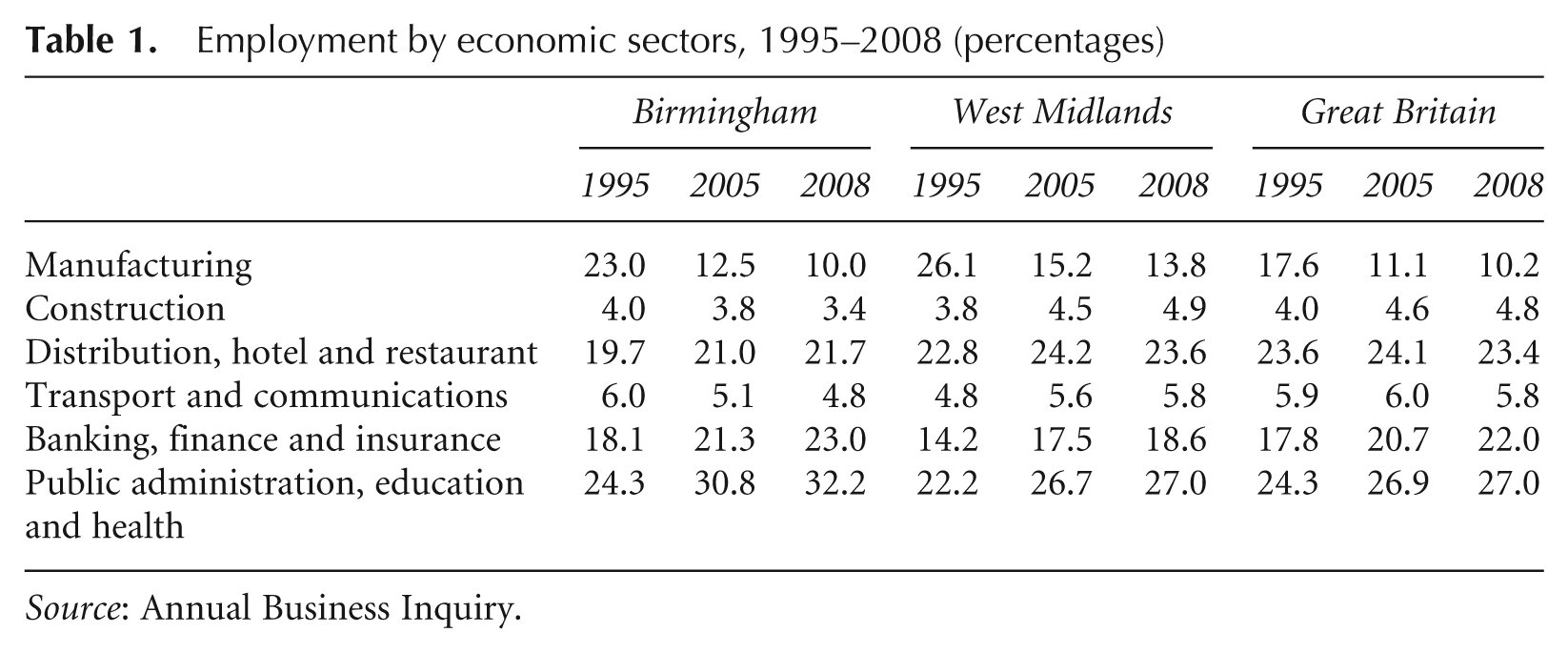
Up to the 1960s, Birmingham and the West Midlands were characterised by rapid economic growth and prosperity, based on strengths in metal goods, motor vehicle and electrical equipment manufacturing. However, the city and the region were strongly hit by the recessions and manufacturing crisis of the 1970s and the 1980s leading to significant levels of unemployment (Brown et al. 2007) and on-going deindustrialisation. At the turn of this century, the newly created regional development agency set out its economic development strategy based initially on priority business sectors and later on 10 clusters in line with national policy (Bailey and MacNeill, 2008). Additional regional initiatives included the development of three technology corridors, one of which, the Central Technology Belt (CTB) included the Longbridge area. These initiatives included a mix of training, business support and infrastructure provision, and were developed in partnership with other local and regional public organisations and the private sector (Bailey and MacNeill, 2008). The local and regional economy underwent important changes with regard to its economic make-up from 1995 to 2008, with the city moving away from its concentration on manufacturing activities and increasing its service-sector activities (Table 1). This diversification, along with strong national economic growth, had positive impacts on the local and regional economy, and the period 1999–2005 was marked by decreasing levels of unemployment with the claimant count in the city falling from 9.4 per cent in 1999 to 7.6 per cent in 2004 and in the region from 5 per cent to 3.7 per cent respectively (Birmingham City Council, 2009). Nevertheless, these levels remained higher than national averages.
Employment by economic sectors, 1995–2008 (percentages)
Source: Annual Business Inquiry.
It is in this economic and policy context that the closure of MG Rover at Longbridge took place in 2005. It is important to note that the plant was first threatened with closure in 2000, resulting in the implementation of a specific programme to diversify the regional economy into non-automotive sectors. The Task Force model developed at that time (Bailey, 2003) also served as a basis to deal with the final closure of the plant in 2005. The second Rover Task Force created in 2005 put together a package of £176 million to support actions directed at MG Rover suppliers, vehicle retailers and workers and the local community around Longbridge. Actions to support the workers included facilitating access to Job Centre support and statutory redundancy payment and compensation (£40 million) and dedicated training programmes (£50 million) (Bailey and MacNeill, 2008).
In summary, the closure of MG Rover took place in a period of significant economic growth and economic diversification for Birmingham and the West Midlands. In addition to existing local and regional economic strategies supporting the growth of new economic sectors and up-skilling of the local and regional workforce, the closure also generated an important dedicated policy response.
Methods and Data
The data used in this article are derived from a three-wave longitudinal survey of ex-MGR workers, building on the findings of Bailey et al. (2008). Letters were sent to all ex-MGR workers inviting them to participate in the study via a telephone interview consisting of a series of structured questions, enabling ready comparison of results. This was conducted in strict accordance with the ethical principles of fully informed voluntary participation, anonymity and confidentiality. The third wave of this survey (which is the focus of this article) was carried out in April 2008, three years after the closure. It was designed to follow on from the previous two surveys of ex-MGR workers carried out by The Work Foundation in conjunction with BBC Radio 4’s Life after Longbridge series and thereby provide a unique three-wave longitudinal survey.
Ex-MGR workers were first interviewed in July 2005 (wave 1, three months after the closure), again in December 2005 (wave 2, eight months after the closure) and finally in April 2008 (wave 3, three years after the closure). In the first wave, 273 interviews were conducted with ex-MGR workers. In the second wave, 232 interviews (86 per cent of the original sample) were conducted and, in the third wave, 204 interviews were conducted, with 176 ex-workers across all three waves and 19 new volunteers. The demographic profiles of the samples were representative of the MGR workforce. Similar to the MGR workforce, the third-wave sample was 93 per cent male and the majority (over 70 per cent) of workers were aged between 40 and 54 (with an average age of 48 years) and had worked on average for 21 years at MGR. The average yearly salary of the ex-workers interviewed at MGR was £27 624 or a weekly salary of £514, as compared with £404 for a full-time worker (£444 for a man) in the West Midlands in 2005. Some 98 per cent of the sample had worked full-time at MGR, with around a third of workers then being process, plant and machine operatives; just under 20 per cent were in skilled trades, with 8 per cent in administrative and secretarial positions, 9 per cent in associate professional and technical jobs and 12 per cent in professional and 18 per cent in managerial roles. Only 11 per cent had no qualification, which was lower than the regional average. Almost 80 per cent of the respondents were married (compared with 42 per cent in the West Midlands), with almost no change from the wave 1 survey. Some 93 per cent were homeowners (with 55 per cent still paying a mortgage) in 2008; this was higher than the regional average (70 per cent). Overall, this enabled a high degree of generalisation of the findings to the whole ex-MGR workforce.
The survey data were supplemented with qualitative interview data obtained from ex-workers (over 20 in total). These interviews were conducted between July 2008 and April 2009, and consisted of semi-structured interviews during which issues pertaining to labour market adjustment were further explored.
Findings
This section presents our findings with regard to the employment outcomes and trajectories of the MG Rover workers against the three main dimensions discussed earlier—i.e. workers’ personal characteristics; the state of the local and regional labour market plus workers’ mobility; and, the effectiveness of policy interventions.
Workers’ Characteristics, Employment Outcomes and Trajectories
Employment outcomes in 2008
Prima facie, it could be argued that ex-MGR workers had undergone successful labour market adjustment. Evident from our findings was that approximately 90 per cent of ex-MGR workers in our sample were in some form of employment in April 2008, with nearly three-quarters employed full time, around 11 per cent self-employed and just under 5 per cent employed part time. In terms of contractual arrangements, some 86 per cent of the ex-MGR workers employed said that they were in a ‘permanent’ job, with the remainder (14 per cent) employed on a casual basis or on fixed-term contracts or via agency work. This in turn could suggest that ex-MGR workers ‘leapt to the front of the jobs queue’ in that, as relatively skilled, experienced workers, they may have been seen as more desirable to employers than the existing unemployed. However, another 5 per cent were unemployed and looking for work, and 2 per cent were unemployed and not looking for work. These findings are illustrated in Table 2. Overall, the activity rate in our sample was over 95 per cent and actually above the average for the West Midlands of 83 per cent for the same period.
Main employment status at wave 3, April 2008
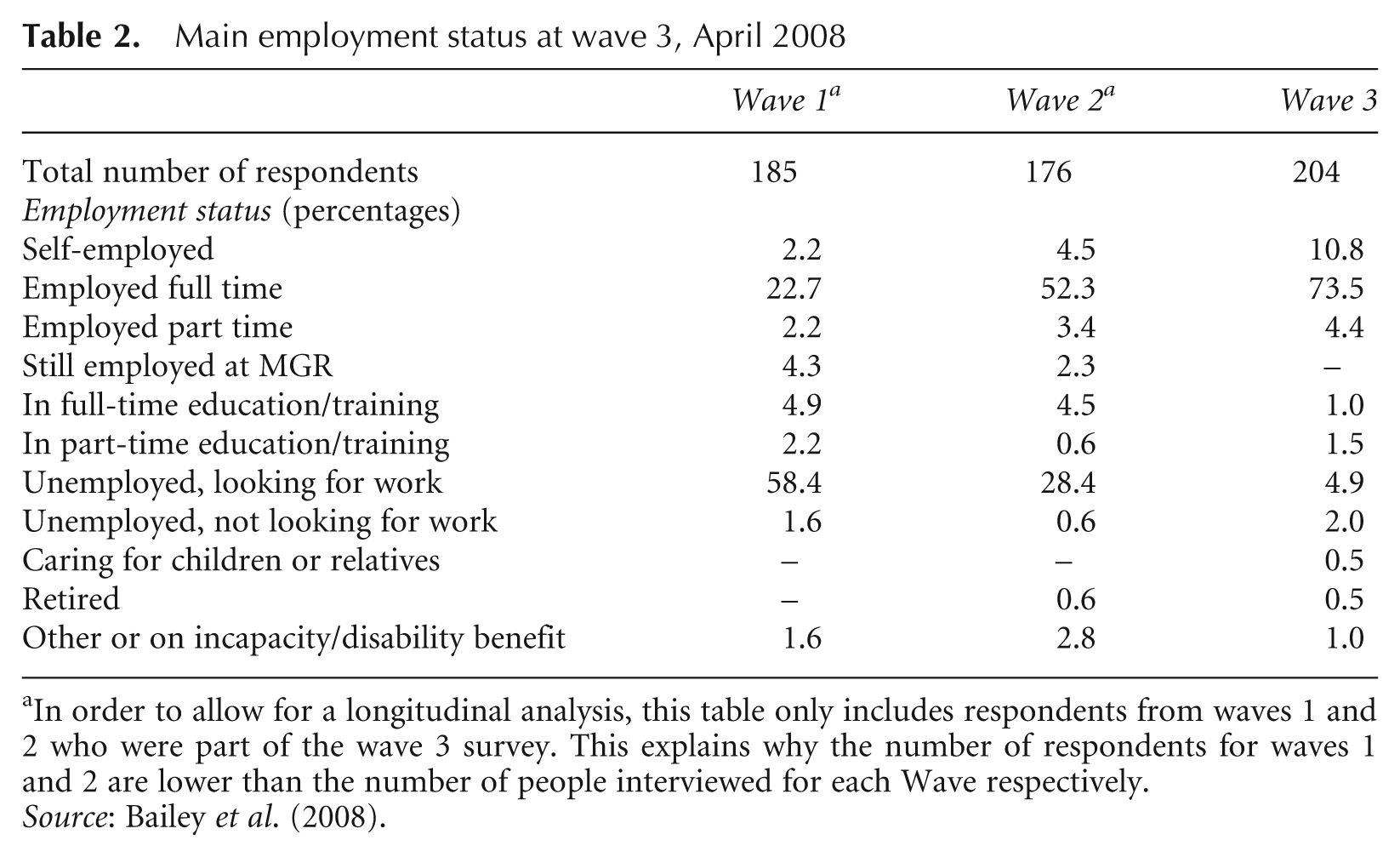
In order to allow for a longitudinal analysis, this table only includes respondents from waves 1 and 2 who were part of the wave 3 survey. This explains why the number of respondents for waves 1 and 2 are lower than the number of people interviewed for each Wave respectively.
Source: Bailey et al. (2008).
In considering worker characteristics, overall, workers in full-time employment were more likely to be male and younger, having worked a slightly shorter period of time at MGR. On average, workers in self-employment at wave 3 were older, more qualified, had higher levels of occupations at MGR and owned their own house. Common occupations taken up by self-employed workers included work related to the car industry (such as independent automotive engineers and consultants), but also quite different areas of work such as plumbers, carpenters, gardeners and driving instructors. The frequency of the first two groups (independent auto engineers and consultants) amongst self-employed workers may help to explain why it has been ex-workers with higher occupational profiles who were more likely to have gone into self-employment. Roughly 70 per cent of respondents who were self-employed in wave 3 were in managerial or professional occupations at MGR. In contrast, workers employed part time at wave 3 were more likely to be female, had higher qualifications, had worked a long period of time at MGR and by 2008/09 were working in services. Respondents who were still unemployed and looking for work at wave 3 were more likely to be older, had lower levels of qualification and did not own their house. Finally, respondents that were inactive at wave 3 were more likely to be close to retirement age, to be female, to have lower levels of qualification and to own their house.
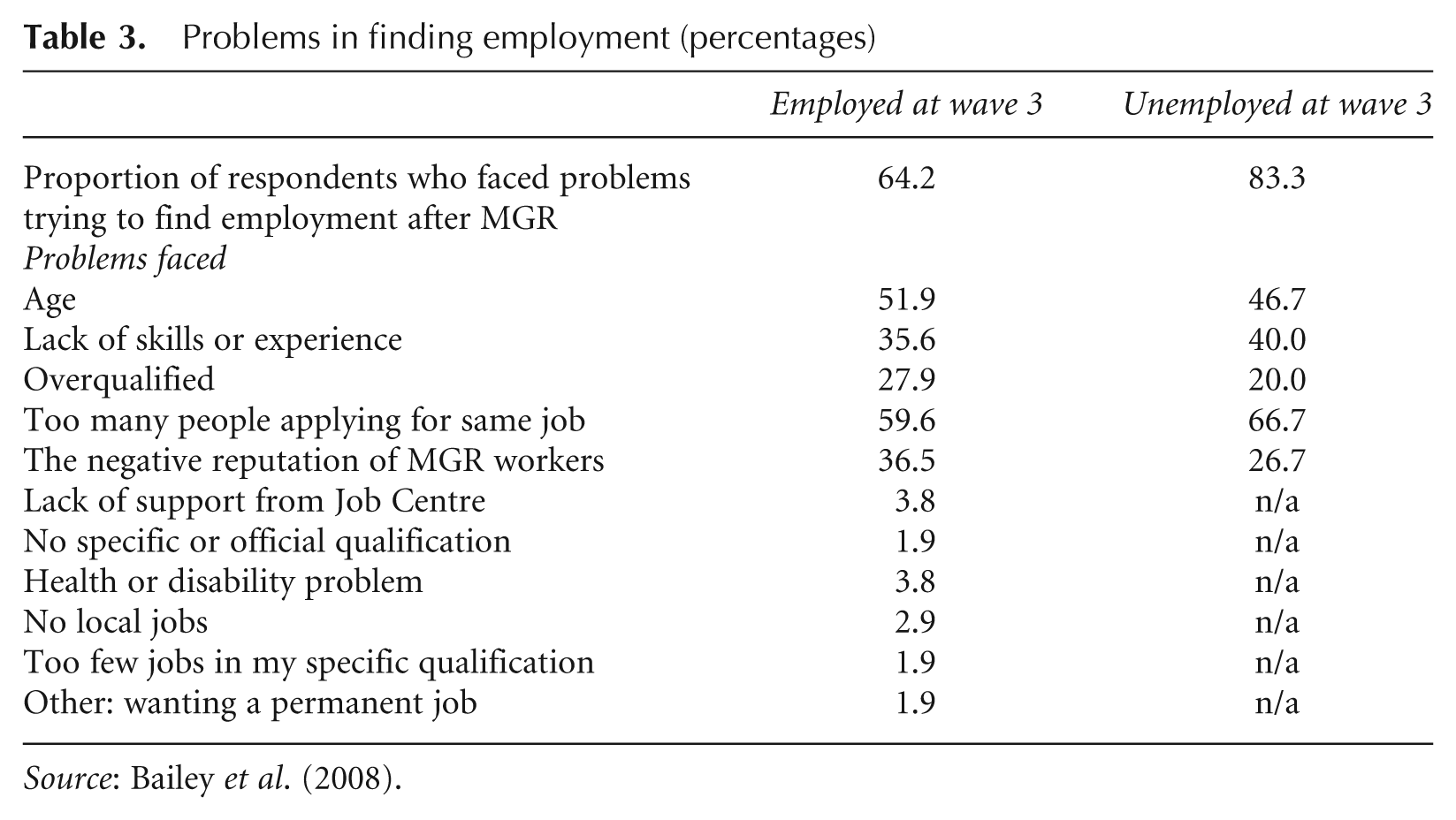
These brief demographic profiles by employment status suggested that some ex-MGR workers could have encountered difficulties in finding work according to their specific characteristics. These problems were confirmed by respondents’ answers. Opportunities for re-employment were tempered by the problems that ex-workers felt they had to face, with nearly two-thirds of those employed and over 80 per cent of those unemployed at April 2008 reporting such problems. Key problems cited by ex-workers are detailed in Table 3. These included too many people applying for the same job, age, a negative reputation of MGR workers, a lack of skills and experience, as well as the opposite problem, that of being overqualified for the jobs available. This could explain why around 70 per cent of workers found their job through personal connections and initiative, including personal contacts (such as family and colleagues) (29 per cent), searching via newspapers and the Internet (27 per cent), approaching firms directly (10 per cent) and starting their own firms (6 per cent).
Problems in finding employment (percentages)
Source: Bailey et al. (2008).
Workers’ trajectories
Given such challenges, it is also pertinent to examine the number of jobs that ex-workers have had since the closure. Workers had often had more than one job since working at MGR. Approximately half of those employed full time at wave 3 reported having had more than one job since leaving MGR, as had those in full-time education and training. All of the workers in part-time employment and in part-time education and training reported that they had worked in more than one job since MGR. In addition, approximately half of those unemployed and looking for work, and three-quarters of those unemployed and not looking for work, reported having had more than one job since leaving MGR. The impact of the recent recession (particularly on the manufacturing sector and motor vehicle industry in particular) was also felt, with some respondents who had obtained permanent employment by April 2008 reporting subsequent job loss in the downturn, as explained by one ex-worker who had obtained a job elsewhere as a tooling manager and was hiring other ex-workers
When I started with [Tool Co.] they got me to employ more people. I took on 10 ex-MGR workers six months after Rover went bust—but now, of those 10, I only have three left who are permanent full time. Two others are working on-and-off as casuals and the other five have all gone. I was going to eight or nine companies. Now three of them are out of business and of those that are left, most are on three-day weeks and have lost 40 to 50 per cent of their workforce. It’s carnage in the car industry at the moment (Worker 8, April 2009).
In the UK, all employees with more than 12 months’ tenure in their job can file for unfair dismissal should they be arbitrarily dismissed (Waring et al., 2006). However, from our sample, we can ascertain that only a quarter of respondents had the same job in April 2008 as in November 2005—six months after the closure—suggesting that, for a significant proportion of the sample, lack of automatic entitlement to claim unfair dismissal could be a problem. Thus, whilst 75 per cent of our sample had entered full-time employment by April 2008, the external labour market context remained fragile for many.
In fact, the trajectory for adjustment differed in terms of demographic profiles. Evident was the fact that the time taken to re-enter the labour market appeared to be inversely related to age and the length of time working at MGR as well as levels of qualifications. Younger, more skilled workers and those who were prepared to commute further generally found work more quickly, whilst for older workers and lower-skilled workers, successful adjustment was more problematic. Other individual factors that could affect the trajectory of adjustment included the level of occupation at MGR and income. These differences are explored in more detail next.
Incomes: a story of polarisation and overall decline
The previous study (Bailey et al., 2008) examined the findings from waves 1 and 2. This research revealed that MGR workers’ salaries were on average lower than when at MGR. Three years on, a key question was whether workers’ salaries recovered to their original—or even a higher—rate than at MGR. Using median estimates, workers’ unadjusted annual salaries, adjusted for inflation, at the time of the wave 3 interview, were significantly lower than their final MGR salaries with a median salary difference of -£5640 for those employed at wave 3. This discrepancy represents a significant decline in annual wages. As one worker commented
Since I left MGR, we’ve been living on savings; that won’t last me until I die. I won’t be able to go on holidays or anything like that (Worker 1, October 2008).
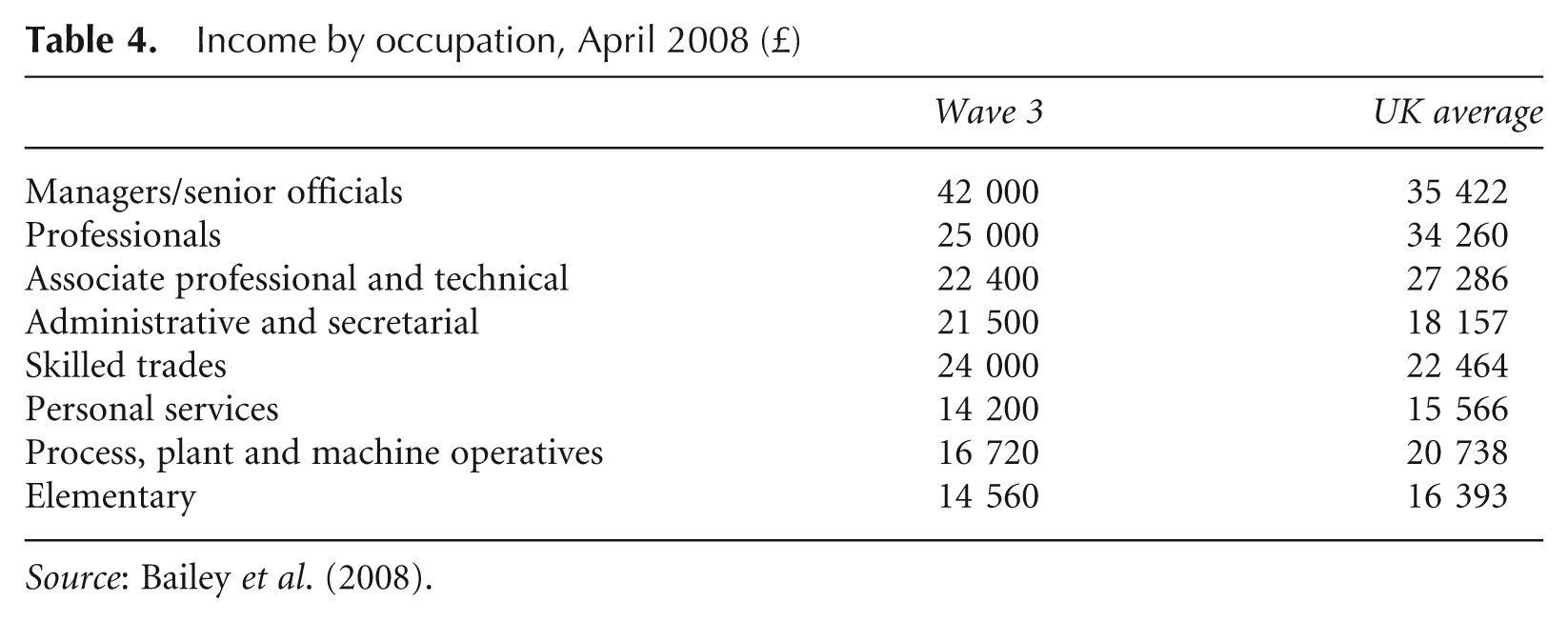
In one sense, this was perhaps to be expected: MGR provided relatively well-paid (unionised) work compared with industry averages. For many workers, changing jobs also meant a loss in earnings not only from changing skills, but also the benefit in pay from length of service. However, critically our findings also indicate a greater dispersion of earnings and yet again a differential story, with an overall decline in the median concealing a marked polarisation: one-third of respondents reported an increase in salary, and two-thirds a decrease in salary. By occupational group, managers were in 2008 earning just about the same as they did at MGR, while most other workers were earning less, elementary-level workers having seen the greatest drop. Respondents also demonstrated a far higher degree of occupational earnings dispersion than the UK average. This can be seen in Table 4, where it is also apparent that those in managerial positions at wave 3 have done best in terms of earnings compared with the UK average.
Income by occupation, April 2008 (£)
Source: Bailey et al. (2008).
The overall comparison of income levels highlighted the relative drop in salaries that nearly all MGR workers witnessed after closure. However, occupation and industry were not the only factors to dictate the salary levels of workers beyond the closure. We also observed salary differences amongst workers who were re-employed shortly after the closure relative to those for whom re-employment took longer. Those who had found employment by eight months following the closure reported higher salaries three years on compared with those who were still unemployed eight months after the closure. Those amongst the last to find re-employment (i.e. by the time of the wave 3 interview) reported a loss in salary relative to their MGR salary and reported lower salaries compared with those who found re-employment sooner. Finally, it was worth noting that, for most ex-MGR workers, the main source of personal income was salary (66 per cent). However, over 6 per cent reported a pension as having been a main source of income at wave 3.
The Impact of Local Labour Markets and Workers’ Geographical Mobility
Chapain and Murie (2008) analysed the extent of the spatial impact of the closure of MGR, by using a payroll dataset of employees at MGR at two points in time (1998 and 2005). Both datasets provided postcodes for the home addresses of most MGR workers at that time and they mapped these data in detail. The 1998 dataset also comprised information on age, type of occupation for each employee (executive, hourly workers, managerial staff, general staff and trainees). There were 13 127 people working at MGR in 1998, with the bulk of employees living in a triangle stretching across the south of Birmingham, extending along the A38 to Bromsgrove, Redditch and Wychavon in the south and to Dudley and Sandwell in the west. Around 20 per cent of MGR employees lived in the Birmingham Northfield constituency (the wards of Longbridge, Northfield, Kings Norton and Weoley) in 1998, with the largest number in Longbridge (9 per cent) and Northfield (6 per cent). There were also important pockets of employees in other parts of Birmingham and together this comprised 45 per cent of where the workforce lived.
The total number employed at MGR had decreased to 5858 by 2005. However, there was relatively little change in the geographical distribution of MGR employees across south Birmingham by the time of the closure in 2005. There are two immediate implications from this. First, while there was a ‘local’ concentration effect, there was also a widely dispersed workforce and the spatial impact was therefore sub-regional rather than local. Secondly, by the time of the closure in 2005, all of the areas affected by that closure had already been affected by earlier job losses. The MGR closure could thus be seen as the final shock—following on from a period of long decline which had already affected the labour market and would affect the capacity to adjust to the shock. Indeed, by 2005, the firm was already effectively ‘hollowed out’. The spatial impact can be ascertained by considering data available on MGR employees, disaggregated by the type of job for 1998. Hourly paid workers (74 per cent), general staff (14.8 per cent) and management staff (8.8 per cent) formed the three main categories of the MGR workforce. The majority of hourly paid workers lived in Birmingham (50 per cent), Dudley (15 per cent) and Sandwell (10 per cent). In contrast, executive employees were more dispersed, with only 20 per cent of them living in Birmingham, Dudley and Bromsgrove. More than half of management staff lived outside these three districts. The pattern for general staff lay between these two extremes and involved a more even distribution regionally: 40 per cent of them lived in Birmingham, 17 per cent in Bromsgrove, 9 per cent in Dudley and 30 per cent were dispersed across the rest of the West Midlands.
Overall, this suggests that the impact of the plant closure on local labour markets is likely to have been uneven spatially and profession-related (Chapain and Murie, 2008). It also suggests that some of the redundant workers were competing for similar jobs in areas of Birmingham and the West Midlands. Their chances to re-enter employment were thus dependent on the state of the local labour market as well as their propensity to travel to access job opportunities in the regional market. As discussed previously, the city and the region had enjoyed relative economic prosperity in the first half of the 2000s and a decline in unemployment rates. However, this situation changed in 2004–05 with unemployment rates rising again in Birmingham and the West Midlands. This rise was not uniform across the region, with neighbouring local authorities such as Bromsgrove, Dudley and Sandwell experiencing a decline in their unemployment rates from 2004/05 to 2005/06 (see Table 5). Hence, the local and regional labour market contexts varied by locality for workers with a given skill-set, with some areas less enabling than others. Most local labour markets, however, worsened over time, with the recent economic downturn affecting the West Midlands more severely than any other UK region. Indeed, the regional unemployment rate had increased from approximately 6.5 per cent in August 2008 to over 10 per cent by July 2009, whilst Fothergill (2009) demonstrated that, for many old industrial areas such as Birmingham, Wolverhampton and Sandwell, the real joblessness rate was by 2009 well above 15 per cent (joblessness being defined as the officially unemployed plus hidden unemployed such as discouraged jobseekers).
Unemployment rates (Percentage of working age population, Local Authority) April 2004 to March 2010
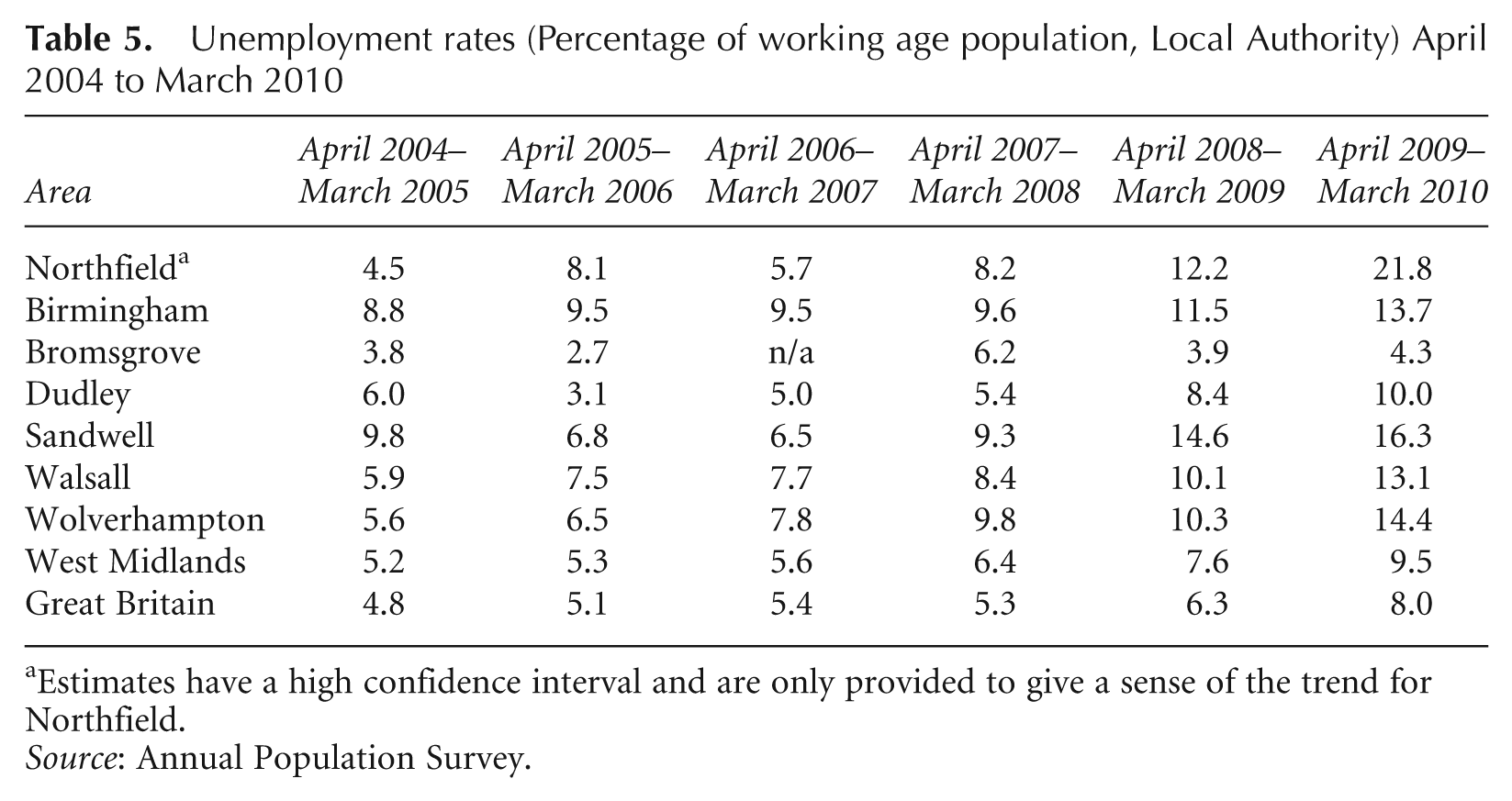
Estimates have a high confidence interval and are only provided to give a sense of the trend for Northfield.
Source: Annual Population Survey.
The fact that the great majority of workers were in full-time employment at wave 3 seems to indicate that, despite the rise in unemployment levels after 2005, the regional labour market was able to accommodate these workers over the medium term. However, findings from our survey suggest that some had to increase their commuting distance (40 per cent). This was particularly the case for workers residing in Birmingham (49 per cent) and Bromsgrove (46 per cent). In the latter case, some 59 per cent of employed workers at wave 3 living in Bromsgrove had difficulty finding employment due to the fact that there were too many people applying for the same job (versus 38 per cent on average for all employed workers at wave 3).
Effectiveness of Specific Policy Interventions and Wider Local and Regional Economic Strategies
As noted, a range of policy interventions were put in place to help workers find new jobs. One of the key policy interventions was to offer training opportunities to workers to help them to reskill. The next section discusses the effectiveness of this intervention.
Training: a relative success story
Overall, training opportunities seem to have played an important role, especially for the workers who had difficulty finding a job in the manufacturing sector and who had to consider other job opportunities. At wave 1, findings from the survey indicate that around a quarter of the sample were not even aware that MGR workers were entitled to reskilling in a manufacturing skill. Consequently, only 29 per cent of the sample had actually taken advantage of the reskilling opportunity. In addition, fewer than half of the workers were aware of the free training support available for wives and partners of MGR workers, resulting in just five out of the 273 having a partner enrolled in the training. At wave 2, this picture was very similar, with not many more workers and their partners taking advantage of the services available to them. From the point of view of both workers and service providers, this was clearly less than ideal and would appear to reflect a lack of effective communication as to what support was available. By wave 3, the situation had improved dramatically, with 60 per cent of respondents indicating that they had undertaken some form of training (including on-the-job training).
A positive finding at wave 3 was that a majority of workers retrained to increase their opportunities or to change career or vocation. In particular, 35 per cent decided to retrain to increase their opportunities—24 per cent to change career and 13 per cent as a requirement of their new job. Interestingly, only 8 per cent took up training as an alternative to unemployment and 7 per cent because they were simply unable to find work with their qualifications. Of those workers who had undertaken training, approximately 50 per cent had trained towards a recognised academic qualification (mostly vocational in nature). The very fact that ex-workers pursued specific forms of academic and vocational training in a range of demanded skills such as information technology could help to explain some of the key findings of our study; notably, the very positive uptake of training opportunities, in contrast to much other research on other plant closures (for example, Shuttleworth et al., 2005, where a low take-up rate was reported). Finally, it is worth noting that those who were employed earlier (i.e. at wave 1) were less likely to receive training, whereas those who were not employed until later waves were more likely to take up training, with the figure for the third trajectory (i.e. those unemployed at waves 1 and 2 but employed at wave 3) most noticeable in that almost 80 per cent of this trajectory had received training. Finally, two-thirds of those who received training reported that they found it helpful.
Work: a shift into services
Finally, we consider the local and regional strategy to move Birmingham and the West Midlands economy away from traditional manufacturing towards new sectors of the economy and whether this played a role in the type of jobs that workers found.
An examination of the industries in which ex-MGR workers found employment three years on revealed a shift away from employment in manufacturing towards employment in service industries, mirroring the employment structure found in the local and regional economy. However, the proportion of our sample employed in manufacturing was still around double that of the regional average. This was particularly the case for workers who had already found another job at wave 1. In addition, a greater proportion of workers found a new job in related sectors such as transport and communications.
Hence, major shifts also took place in occupational patterns from MGR, including (as expected) a shift away from employment as plant and machine operatives (from around a third of workers at MGR to around 20 per cent of ex-workers at wave 3), as well as a fall in the proportion classed as managers (from 18 per cent to 12 per cent) and professional (from 12 per cent to 3 per cent). At the same time, there was an increase in employment at associate professional and technician status (from 9 per cent to 15 per cent), in personal services (from zero to 9 per cent) and in elementary skills (from 2 per cent to 12 per cent). This occupational shift was also reflected in the type of skills that workers reported using in their current roles; more than 60 per cent of all those employed at wave 3 said that in their new jobs they were using different skills to those they used at MGR.
Thus, the diversification of the economy away from traditional manufacturing supported by local and regional strategies seems to have enabled most workers to find another job. Nevertheless, this transition was not smooth for all workers and, as noted, in some cases resulted in lower occupational levels and in many cases in significantly lower salaries.
Summary
These findings paint a mixed picture for ex-MGR workers. Clearly evident was that most had made a successful transition into another job by wave 3, with 90 per cent having obtained some form of full-time employment three years after the closure (including self-employment). In a similar manner, success was also apparent in terms of skill development and reproduction, to the extent that a majority of the respondents had undertaken some form of training to reskill in order to be employable in growing sectors of the economy. In addition, there was significant financial assistance provided by central and local government and also by the regional development body, Advantage West Midlands under the auspices of the MGR Task Force. While employment outcomes have varied across workers depending on their personal characteristics, it seems that the relative buoyancy and diversity of the local and regional economy at the time of the closure, combined with a willingness on the part of some workers to increase their commuting time and to take advantage of training opportunities, enabled most disadvantaged workers (in terms of age and experience) to find a job in the medium term.
Yet two-thirds of respondents had suffered a very significant fall in earnings relative to their job at MGR. A sudden influx of workers caused by the closure had placed further pressure on some already depressed local labour markets and generated further ‘knock-on’ competition for what (low-wage) jobs were available (Chapain and Murie, 2008). This overall fall concealed earnings polarisation, in that one-third of respondents reported an increase in earnings relative to MGR. Having to cope with reduced earnings only increased the financial pressures on households, something which the recent credit crunch and prospect of further redundancies has only exacerbated.
Discussion and Policy Implications
Our findings suggest implications and lessons for urban policy. In particular, dealing with plant closure as part of a broader strategy for urban renewal needs to acknowledge the differential geographies of place. Here, ‘place’ may be defined not as
a bounded entity but must be seen rather as a jagged fragment drawn from systems that are larger, as well as a rough assemblage of many things that are smaller (Collinge and Gibney, 2010, p. 382).
By this, we mean that a ‘place’ may not be thought of as being co-terminous with one Local Authority operating in isolation, but rather that localities are interconnected and affected by what happens in other localities and the actions of sub-local, regional and national actors, and thus require co-ordinating mechanisms to highlight (and act on) shared interests—as demonstrated by the fact that ex-MGR workers and supplier firms were scattered across the West Midlands. This was evident in the Regional Development Agency’s Task Force approach in bringing stakeholders together and providing a co-ordinated local response that individual groups may have struggled to achieve. As van Winden argues
Cities are not passive ‘receivers’ of global trends: they can take action to make themselves ‘fit’ for the knowledge economy through initiatives of local leaders or coalitions. Concerted action in the form of co-operations between municipal authorities, companies, and local knowledge institutions in the city can be effective, if designed properly and realistically (van Winden, 2008, p. 198).
However, this requires the development of local and regional strategic capacities over the longer term. In addition, some form of planning for potential economic shocks is important to help mitigate them in advance or to be able to respond quickly. Another key policy lesson is the need for agencies to move swiftly; it is helpful to have knowledge and actions in place rather than ‘fire fighting’ after the event. When MGR closed in April 2005, the second Task Force was able to start work on the day of the closure announcement. Such advance preparation work could work well in future closure situations, as it is unlikely that a future closure would happen without at least some prior warning. There is therefore a need for a ‘permanent capacity’ to deal with these issues, as a way of having institutional memory of how things were done. It is interesting that, when the Birmingham van-maker LDV went into administration in June 2009, a task force was set up immediately, learning from the MGR experience, and staffed by some of the same people. The regional task forces put in place during the recession have also been modelled on the MGR experience, albeit in very different circumstances. There have been calls to make these permanent in order to retain this knowledge and capacity (House of Commons, 2009), although this now seems unlikely in the post-election context of the abolition of RDAs. Indeed, with the abolition of RDAs by the coalition government, it is not clear that fragmented local enterprise partnerships (LEPs) will be able to provide the co-ordinated leadership needed to tackle effectively such situations.
The economic diversification of Birmingham and the West Midlands in the early 2000s also played an important role in enabling workers to adjust post-MGR closure. Hence, economic diversification should be further encouraged, particularly post-credit-crunch. As Clayton (2009) notes, the impact of the current downturn was felt differently across different regions of the UK, in turn requiring that labour market policies are built on local initiatives and local knowledge. On this note, government and regional development agencies (or successor bodies) need to do more to ensure that employees have the necessary skills to cope as industries change, through high-quality, flexible education, training, information and mobility programmes (a more ‘Nordic’ approach). Here, it needs to be recognised that much work was done by the RDA Advantage West Midlands and other agencies before the MGR closure, in diversifying the supply chain and economy; this work may have ‘saved’ as many as 10 000–12 000 jobs in the local automotive supply chain at the time (Bailey and MacNeill, 2008). Avoiding sudden closures and slowing down the process where possible also enable workers released to pick up jobs arising through ‘replacement demand’ where firms require workers to cover those who have left, retired and so on. Such replacement demand can actually be quite significant and in the medium term may outweigh negative changes arising from projected decline (Wilson et al., 2006). These policy suggestions from MGR experience accord with a view of plant closures not as discrete one-off events but rather as long-term path-dependent processes (Pike, 2005) beginning well before the ‘event’ itself and with repercussions continuing well after. At critical moments, there may be significant opportunities for local and regional policy interventions which may alter evolutionary trajectories (Bailey et al., 2010).
Finally, the ‘success’ story noted earlier in respect of retraining in the case of ex-MGR workers seems linked to the specific forms of training and education that were taken up and which provided skills of use in the local labour market. Training and education played a key role in particular in ensuring that those who did not find re-employment quickly were not left unsupported.
Conclusion
This paper has presented a longitudinal analysis of the labour market adjustment of workers made redundant following a plant closure in a post-industrial city by looking at the example of the closure of MG Rover in 2005 in Birmingham, UK. More specifically, the paper examines to what extent the state of the local and regional labour markets and workers’ geographical mobility—as well as the effectiveness of the immediate policy response and longer-term local economic strategies—may have helped to balance the impacts of personal attributes associated with workers’ employability and reabsorption into the labour markets. Our findings suggest that the then relative buoyancy of the local and regional economy, supported by economic diversification strategies as well as a strong policy response and retraining initiatives, did indeed play a role in enabling the most disadvantaged workers to find a new job in the medium term. While younger and highly skilled workers were usually able to find another job quickly and more often in the manufacturing sector, older and less skilled and less experienced workers took longer to find new jobs, but were able to do so in the growing local and regional service sectors and usually by experiencing some form of retraining. These positive impacts are illustrated by the fact that approximately 90 per cent of ex-MGR workers had obtained some form of employment by April 2008, with nearly three-quarters employed full time. In contrast, only 5 per cent were still unemployed and looking for work. However, our findings also highlight sharp declines in income for many, with a majority of respondents reporting a considerable decline in real earnings compared with when they worked at MGR; and further that a quarter of respondents reported that they were experiencing financial difficulties. The findings also indicated polarisation through a greater dispersion of earnings. Our analysis confirms the unequal employment outcomes and trajectories that many lesser-skilled workers leaving traditional industries can encounter and the critical role played by short- and long-term policies to help them in this process.
In terms of policy responses, much work was done by the RDA Advantage West Midlands and other agencies before the MGR closure in diversifying the supply chain and economy and this avoided much larger job losses in the supply chain. These specific measures were reinforced by wider local and regional economic development strategies implemented at the beginning of 2000s. In addition, when MGR closed in 2005, the MGR Task Force II was able to start work immediately on the day of the announcement of the closure. Such advance preparation undeniably helped to cushion some of the impacts of the closure and could be used in future closure situations, as it is unlikely that a future closure would happen without at least some prior warning. This lesson points towards the need for good ‘institutional memory’ of how to operate in such situations, with some sort of permanent capacity to deal with closures, in addition to efforts to promote economic diversification and consequent urban renewal. In this regard, as has been noted in other studies of plant closures, the strength of the local economy and labour market is a key determinant of how many workers will find re-employment. With the abolition of regional development agencies by the coalition government, a key task for Local Enterprise Partnerships will be to capture the existing regional ‘institutional memory’.
Footnotes
Funding Statement
The authors are grateful for the support of the Economic and Social Research Council under award number RES-000-22-2478.