






Abstract
This paper considers farmland conversion for the purpose of urban development as a series of transactions and discusses the determinants of appropriate governance structures for governing farmland conversion in terms of process efficiency. Towards this end, the paper develops a theoretical framework for analysing the process of farmland conversion based on transaction cost economics. The framework covers transactions, transaction attributes, governance structures and performance with the aim of minimising transaction costs. The paper also demonstrates the usability of the framework by creating a corresponding quantitative model for a case study in China. Furthermore, it identifies factors that influence the transaction costs associated with farmland conversion in China and explains why the related governance structures are chosen.
1. Introduction
Farmland conversion for the purpose of urban development involves appropriating agricultural land for non-agricultural uses: residential, industrial or infrastructural. Although this type of economic activity usually creates growth, investment and employment, it also has negative effects, including urban sprawl (Ewing, 1994), the disappearance of open spaces (Burchell et al., 2002) and the degradation of peri-urban ecological environments (Nuissl et al., 2009). Therefore, how to achieve efficient farmland conversion has become an important issue in urban studies.
The efficiency of farmland conversion has been a focus of neo-classical economists and planners since the 1930s (Plaut, 1980). However, neo-classical economics has de-emphasised related issues, such as transaction costs, unstable property rights and inefficient policy implementation (Webster, 1998) and this omission has often created a divergence between theory and practice. When the idea of process efficiency in the context of farmland conversion emerged at the beginning of the 1990s, the focus changed from optimal land allocation to the transaction process itself, including both the physical transformation of the land and its transformation as a bundle of rights in terms of its material and symbolic value (Alexander, 1992, 2001a; Buitelaar, 2004). Determining the appropriate governance structures for farmland conversion may be at least as important as determining the optimal level of farmland conversion.
The development of transaction cost economics (TCE) introduced a new point of view on defining process efficiency and has gradually influenced the debate. Although TCE has been employed extensively in the private domain of industrial organisation (for example, markets versus firms), it is just beginning to be used in the public domain (Ruiter, 2005). Buitelaar (2007) recently reviewed the research on land development from the TCE perspective and concluded that there are still many unresolved questions concerning the extension of TCE into the public domain, specifically regarding efficiency assessments for governance structures.
Based on TCE, some studies have discussed important attributes of farmland conversion, including interdependence, uncertainty, timing (Alexander, 2001a), spatial heterogeneity, temporal effects, externalities (Tan and Beckmann, 2010) and the relation between the attributes of farmland conversion and transaction costs from a qualitative perspective (Buitelaar, 2004; Webster, 2009). However, there have been few quantitative analyses of the relationship between the attributes of these transactions, transaction costs and the selection of governance structures.
Thus, the first goal of this paper is to establish a TCE framework for analysing the factors that determine the transaction costs and governance structures associated with farmland conversion. The second goal is to test the framework using a Chinese case study that exemplifies how transaction costs can be compared and indicates the determinants of transaction costs.
The paper is structured as follows. The second section develops the TCE framework. The third section establishes an econometric model. The fourth section presents the empirical study conducted in China. The final section is the conclusion.
2. A TCE Framework for Analysing Farmland Conversion
The core of TCE is that transactions, which differ in their attributes, are aligned with governance structures, which differ in their cost and competence, so as to effect a discriminating—mainly a transaction cost-economizing—result (Williamson, 1996, p. 12).
Therefore, we must develop a framework that takes into account transactions, transaction attributes, governance structures and related transaction costs.
2.1 Considering Farmland Conversion as a Set of Transactions
Farmland conversion is a complex activity. Some of this complexity is physical: the nature of the surface changes when one is building roads or houses on agricultural land. In addition, in the legal sense, the rights and duties associated with the land change. The changes in land rights and in the physical form of the land require many interrelated transactions A transaction occurs when a good or service is transferred across a technologically separable interface. One stage of activity terminates and another begins (Williamson, 1985, p. 1).
Thus, on the whole, farmland conversion changes the appearance and use of the land, and it involves many different but related transactions.
In the latter case, the term ‘transactions’ refers to the transfer of properties, services or information that can be organised in different ways. For instance, a land assessment company might provide a land assessment and a government conversion project might be used to transfer property to certain stakeholders. This understanding of transactions is related to other activities, steps and tasks, but their relationships are not well defined. In this paper, we refer to farmland conversion as an activity that combines many interrelated steps or tasks. If a particular step or task is related to the transfer of a single good, piece of property, kind of service or unit of information across a technologically separable interface, then it can be called a transaction. This approach is useful because it opens the ‘black box’ of farmland conversion; each of these transactions may be organised in different ways. Thus, although ‘farmland conversion’ as a whole can be seen as a transaction for other research purposes, we prefer to define it here as an activity composed of a set of transactions. A similar approach is used in Alexander (2001a, 2001b) and Whittington and Dowall (2006).
However, this definition presents a problem: a single transaction may often be further divided into another set of transactions. For example, purchasing land, one of the transactions involved in farmland conversion, can be further divided into sharing information, paying money, transferring ownership, etc. Similarly, the act of sharing information can itself be further divided: it involves finding an advertising agency, paying for the agency’s services, the agency’s work to broadcast the relevant information and other related steps. Furthermore, the work of finding an agency itself involves another set of transactions. We could continue this process of division indefinitely.
However, there are ways to solve this problem. First, we must recall that we only need to decompose a transaction to a certain level according to the purpose of the research. As Ostrom (2005, p. 8) points out, “There is not one optimal map that can be used for all purposes” and “each level of detail is useful for different purposes”. Thus, we can argue that it is only necessary to decompose the farmland conversion process as far as the purpose of our research requires.
We should also consider that a step can simultaneously involve several transactions. For example, when buying a plot of land, one consults an agency in the land market. The agency provides the information about an appropriate plot, at which point one pays the agency. This step involves two basic transactions: the transfer of information from the agency and the monetary transaction that follows. However, we argue that information transfer is the dominant transaction in this case because the main goal of this step is the transfer of information, which is relevant to the overall farmland conversion process.
2.2 The Transaction Attributes of Farmland Conversion
Some of the most important factors that affect the magnitude of transaction costs are the transaction attributes, which present a hazard for the parties involved in a transaction. There are three fundamental transaction attributes, according to TCE: factor specificity, uncertainty and frequency (Williamson, 1985). As Alexander (2001a) has proposed, attributes related to interdependence, uncertainty and timing are the core factors resulting in the hazard associated with farmland conversion. Although Alexander (2001a) does not identify additional transaction attributes, it is useful for us to analyse further the sub-attributes.
Although the literature shows that the process of farmland conversion varies in different countries because of possible differences in property rights and legal procedures (Alexander, 2001b; Buitelaar, 2007; Tan et al., 2009), it seems that the main components of the process are usually the same. These involve land planning, project selection, land purchasing, land servicing, land sales, house construction, home sales and redevelopment. These common components comprise the foundations of farmland conversion (which are probably the same for the same type of project in any legal system), whereas the legal dimensions of farmland conversion (how rights are obtained and what legal procedures must be followed) may vary. This section will only explore the former type of transaction attributes; the legal dimension will emerge in a detailed case study later in this paper.
Design and approval of land use planning
First, land use planning requires specific knowledge. Therefore, specificity is the most obvious transaction attribute involved in this step. The human capital invested in land use planning creates human capital specificity. The professionals involved possess highly specific knowledge and would need to learn other knowledge to perform alternative jobs. The value of their human capital relies on whether they can engage in land planning projects. Additionally, because of the scarcity of farmland and the extreme difficulty of reclaiming land used for construction to create new farmland, the design and approval of land use planning involve other spatial and temporal details. For instance, the value of the converted farmland partially depends on the selected site and the timing of the planning.
Secondly, a common agreement regarding land planning should be reached before the approval. Such agreements are affected by information asymmetries (i.e. uncertainty), which result in extra costs. Additionally, the time it takes to reach an agreement affects the cost. For instance, extended negotiation may increase vulnerability to opportunistic action.
Thirdly, government monitoring is itself monitored by the public. Thus, information asymmetry creates another source of uncertainty. However, if the measurability of government performance, the honesty of external companies or the probity of internal employees can be guaranteed, then costs will decrease. Furthermore, if we examine uncertainty in a repeated game, we see that trust can be established under such circumstances and that the transaction costs that arise from some aspects of uncertainty can be eliminated (Buchan and Croson, 2004). Therefore, frequency becomes another transaction attribute of land planning design and approval.
Project locating
Because of the neighbourhood effect, location is the primary factor governing land development projects (Tan and Beckmann, 2010). At the same time, the government needs to consider the consequences of different land development projects and this creates what is called temporal specificity. Transparency can help land developers to assess correctly the net returns of a project, which makes information uncertainty an important attribute. Whatever plans are approved should also be effectively implemented; thus, the probity of the officials responsible for the planning is also important.
Land purchasing
An experienced seller or buyer can decrease transaction costs, as the role of land speculators demonstrates. Thus, human capital specificity is significant during the process. If there is an intermediary between the buyer and seller, the human specificity of the intermediary is even more obvious. The probity of the intermediary also matters for those on both sides of the trade. In addition, if the purchased land area is large, then the former residents or owners and their plots will need to relocate, which will extend the process. This, in turn, may lead to opportunistic behaviour and information uncertainty, thereby increasing transaction costs. Similarly, an experienced purchaser or vendor is normally trained through repeat purchases. As a result, frequency is another important attribute.
Land servicing
Land servicing, also called land preparation, entails improving the soil content, levelling the surface of the land and providing the necessary public infrastructure for a development project. Normally, this step is not related to land value itself. Thus, spatial and temporal factors are not important, but the duration and frequency of the land servicing projects play a vital role in determining the related transaction costs (Alexander, 2001a). The interactions that occur during an extended project may be unpredictable, creating transaction uncertainty. Joint involvement in land servicing generates repeated contracts between the same developers, professional consultants and contractors. Frequency thus becomes an important attribute of repeated contracts and makes probity important for the parties on both sides. A contractor with advanced technology or specialised heavy equipment also creates human specificity and can improve the reputation of a company.
Constructing
After the land is serviced, construction begins. The construction process has attributes similar to those of land servicing. The main attribute is the duration of the construction project, which may increase information asymmetry and opportunistic behaviour. Human capital specificity and asset specificity are also important. If the consultants and the company working on the project update their specific knowledge, technology and equipment, their value is dependent on their ability to find subsequent projects. Furthermore, if frequent construction projects increase trust or long-term relationships can be built, costs may decrease, thus decreasing hazard.
Property sale
After construction, industrial-use property and residential-use property will either be put into use by the landowner or be transferred to other users. In the former case, the farmland conversion process is finished, whereas in the latter case, the next step is the sale of the property. This process is similar to the land purchase process. However, because the location, the use and the surroundings of the property are fixed, the information on this process is much more transparent than that of the land purchase process. Thus, neither the effect of spatial specificity nor the neighbourhood effect is obvious (although they still exist). The most important type of specificity is human capital specificity; for instance, a skilled and experienced property seller can decrease costs during a sale. It is also important to recognise that the frequency of property sales determines the skill of the seller. The sale process may be long because of changing market conditions, thus resulting in uncertainty and increased total transaction costs. Consumers tend to judge the quality of a property according to the reputation of the developer; thus, reputation is also an important related attribute. Finally, the probity of the employees who directly handle the property sale is also important.
Redevelopment
Sometimes a farmland conversion process is combined with a redevelopment process, such as a brownfield development process. This section will not examine the details of this step because a retransfer or brownfield readjustment process is similar to the process already described, from the purchase of the land to the sale of the property; thus, the related attributes are similar to those discussed earlier.
If farmland conversion is seen as a set of transactions, then the attributes of each transaction can be understood as shown in Table 1.
Transaction attributes: farmland conversion
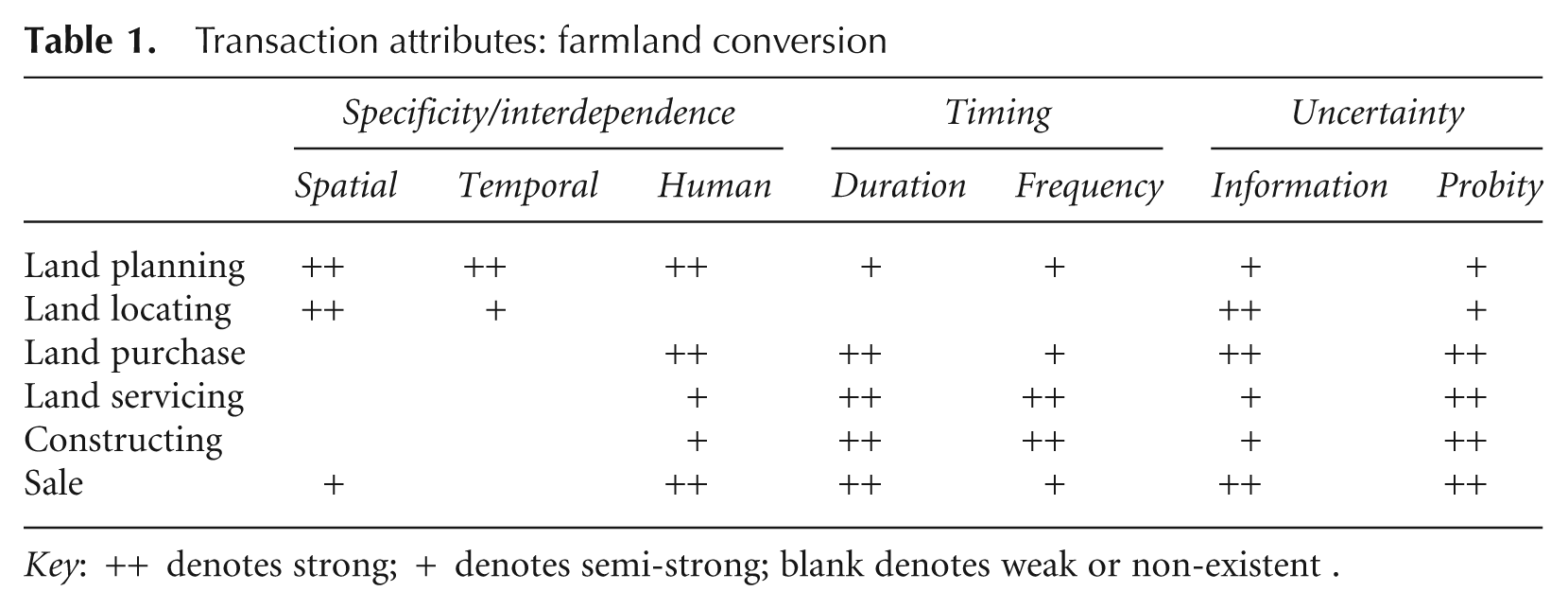
Key: ++ denotes strong; + denotes semi-strong; blank denotes weak or non-existent .
2.3 Governance Structures of Farmland Conversion
The second main category of factors that impact transaction cost is comprised of those related to the governance structure at play. TCE distinguishes between three fundamental governance structures: market, hybrid and hierarchy (Williamson, 1996) (although other categories of structures are also discussed, including relational contracts, networks and relationships based on trust and reciprocity; see Hodgson, 2002; Ruiter, 2005). However, judging which governance structure is actually being used based on these theoretical categories is quite difficult. For example, the market structure and the hierarchy are extreme cases and are rarely employed exclusively in practice (Hodgson, 2002; Ruiter, 2005). Instead, they are often combined to form hybrids (Ménard, 2004). Therefore, neither the categories presented by Williamson (1996) nor others are ideal for use in defining practical governance structures in the public sector.
Fortunately, there are acceptable ways to categorise real-life governance structures, such as the ‘buy or make’ structure in an industrial chain (Williamson, 1985) or the ‘contracting in or out’ structure used in public services (Brown and Potoski, 2003). Essentially, if a transaction is sponsored by the government, then the governance structure is regarded as involving insourcing; otherwise, it is understood as a product of outsourcing. For example, land use planning approval is sponsored by the government, which thereby authorises the planning. Thus, we consider this transaction to be an instance of insourcing governance. In contrast, the development of plans for land use is the responsibility of external experts working for the government, so in this instance, outsourcing is occurring. This type of categorisation is not useful for all purposes, but we argue that these kinds of categories are easily understandable and applicable to our empirical study. Table 2 illustrates where insourcing and outsourcing occur when the related attributes change according to TCE.
Performance of insourcing and outsourcing on governing farmland conversion
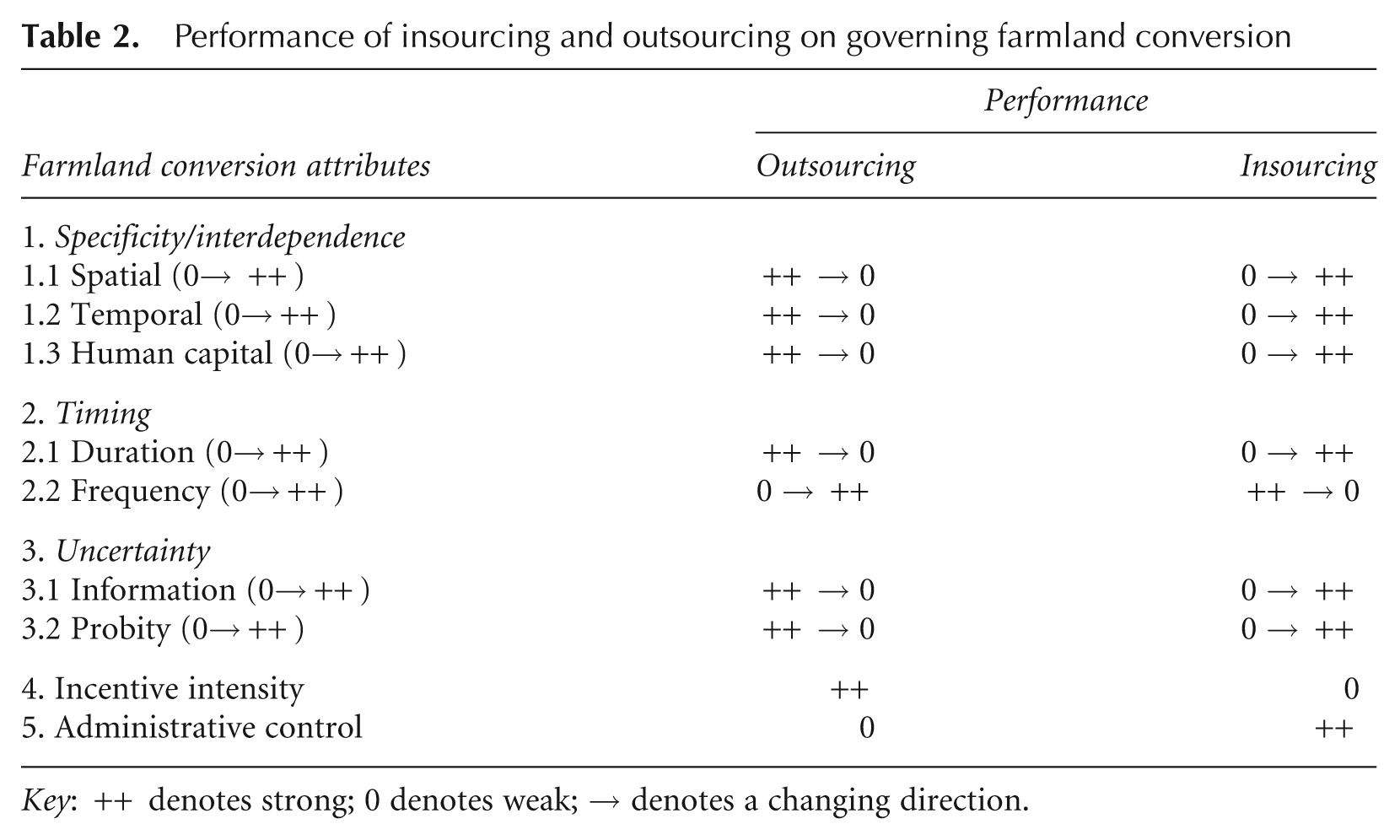
Key: ++ denotes strong; 0 denotes weak; → denotes a changing direction.
Spatial specificity encourages hierarchical governance structures (i.e. insourcing) rather than market-based structures (i.e. outsourcing). A similar argument can be found in Alexander (2001a) and Tan and Beckmann (2010). Similarly, when temporal specificity increases, extra governmental control is required to avoid market failure or negative externalities in neo-classical economics.
Human capital specificity is an interesting attribute. TCE argues that high human capital specificity creates hold-up risk and requires extra input/expenditures in the form of either market support or administrative support. In the sovereign transactions discussed in Williamson (1999), human capital specificity is the investment that governmental employees make in mastering the protocols and procedures required for them to conduct foreign affairs. Because there is little value in the best alternative employment options for these government employees given their human capital, to protect their value, the government needs to provide them with job security and a comparatively high salary. These mechanisms are part of the insourcing strategy (i.e. administrative support). A similar scenario is that of large naval shipbuilding yards, an example presented in Masten et al. (1991). The specialised design of military vessels encourages a fairly high degree of human capital specificity because the skills, knowledge and experience required of the company’s workers may have limited value outside a specific shipyard, thus creating the need for comparative job security in the shipyard. However, this is an example of the outsourcing strategy from the point of view of the navy (i.e. market support). These two studies show that neither insourcing nor outsourcing is always chosen to save the transaction costs caused by the increase of human capital specificity. Rather, it depends on the degree of human capital specificity at play.
Duration and frequency are the two sub-attributes of timing. TCE argues that long duration creates information asymmetry and encourages opportunistic behaviour, thus requiring extra costs to ensure the transaction. In the private domain, to guarantee the success of a transaction, a company may produce materials internally instead of buying them because interruptions at one stage can influence the rest of the project (Masten et al., 1991). In the public domain, for transactions such as those related to foreign affairs (Williamson, 1999), the government always uses insourcing regardless of the duration of the related transactions. However, for other public affairs (including planning design, land readjustment, etc.), long project duration probably has external effects; it may decrease the executor’s probity, decrease policy implementation success and even encourage corruption. To improve efficiency, the government will probably seek market support (Brown and Potoski, 2003). Therefore, if the duration of the farmland conversion process increases, seeking support from the market or from firms will be necessary if the aim is to limit transaction costs. Nevertheless, this does not necessarily result in insourcing or outsourcing because the latter also depends on the actual duration.
Frequency, another sub-attribute of timing, indicates the degree to which the same transaction repeats over a longer period. Frequency can have its own influence on transaction cost through the effects of trust and skill, for example: trust can lower transaction cost, as can skill. If frequency increases, a decentralised governance structure becomes appropriate, with outsourcing instead of insourcing. Additionally, if the frequency of government transactions such as the assessment and approval of land development projects increases, boredom and carelessness may result in mistakes and inefficiency (i.e. extra costs). Therefore, although certain transactions will not be outsourced as noted earlier, transactions such as land valuation and land surveys will be outsourced to improve efficiency. In general, frequency thus has a negative relationship to insourcing.
TCE argues that information uncertainty creates a need for market or administrative support. However, as with duration, an increase in information uncertainty will not necessarily make insourcing or outsourcing the proper choice, as outsourcing is also connected to market support. Selecting outsourcing only indicates that the uncertainty of the related transaction is not sufficiently high for insourcing to be appropriate.
Probity uncertainty is another interesting attribute because probity is still a controversial concept (Williamson, 1999; Ruiter, 2005; Webster, 2009). It is widely accepted that when probity increases, as Williamson (1999) argues, a more co-operative governance structure will decrease hazard. However, we argue that insourcing or outsourcing is not necessarily the natural choice in our context. Webster (2009) discusses horizontal and vertical probity in the context of development co-ordination and enforcement in urban planning. The simple conclusion is that vertical probity normally requires insourcing, whereas horizontal probity requires either outsourcing or insourcing. Therefore, we argue that probity exists in every transaction but differs based on the transaction itself, the individuals involved, the location and the time. In other words, even when the activity is the same, if the people involved or the location where the transaction takes place changes (or, likewise, if the timing of the start of the transaction changes), the risk associated with probity will change. Thus, we first consider probity as one kind of sub-attribute of uncertainty. Then, whether insourcing or outsourcing is more appropriate depends on the level of uncertainty. If a pecuniary incentive or punishment can decrease the hazard, then outsourcing is the better option, whether that involves a contract, third-party monitoring, ex post censoring or repeated co-operation. If a pecuniary tool is not expected to be effective, insourcing will be used. This may mean official promotion or social restrictions. If outsourcing is chosen, this will only mean that the level of probity hazard is not sufficiently high for insourcing to be necessary.
We also examine two attributes of governance structure: incentive intensity and the administrative control effect, for two reasons. The first reason is that governance also affects transaction costs (Williamson, 1996). The second reason is that, as Webster (2009) argues, whether a traditional public bureau or a commissioned non-governmental client does the social planning depends on the purpose of that planning (for example, certainty or flexibility). In the former case, insourcing is better; otherwise, outsourcing is better. Thus, we argue that the government will experience a trade-off between incentive and control in overseeing farmland conversion. Outsourcing improves incentive intensity, whereas insourcing ensures proper administrative control.
Here, we have individually considered the changes that occur in two governance structures for farmland conversion based on changes in the different transaction attributes. The governance structure ultimately selected will require a trade-off. The easy way to determine which governance structure is more suitable in practice is to compare the overall transaction costs associated with the two scenarios.
2.4 Transaction Cost of Farmland Conversion
Comparing transaction costs is the basis for selecting a governance structure. However, in reality, it is almost impossible to measure transaction costs precisely because the concept of transaction costs is very broad. Therefore, Buitelaar (2004) attempts to categorise transaction costs as either information costs or institutional costs and argues that only the costs that result from the creation and use of institutions should be taken into account in determining process efficiency.
Following this logic, to develop an easy way to collect data on transaction cost, we argue that the cost of creating and using institutions can be further related to two types of practical costs: labour cost and administrative cost, as related to the creation and use of institutions. Thus, from the viewpoint of the government, the transaction costs associated with insourcing mainly involve staff salaries and the cost of administration. In contrast, the transaction costs associated with outsourcing include staff salaries and the cost of contracting, monitoring and enforcement. This kind of categorisation provides us with the opportunity to collect transaction cost data via an empirical study.
In summary, a TCE framework can be used to analyse farmland conversion, including its transactions, their attributes, the governance structures in question and assessments of performance based on transaction costs.
3. Why Insourcing or Outsourcing? A Quantitative Model
The TCE empirical analysis process can be divided into two main stages (Yvrande-Billon and Saussier, 2005). The first stage involves predicting the choice of governance structure depending on the attributes of the transaction. The second stage involves directly estimating a function with transaction costs as the dependent variable.
3.1 Impact Factors on Governance Choice: First-stage Regression

Formulae (1) and (2) represent the transaction cost functions for different governance structures,
When it is not possible to obtain data on transaction costs and the purpose of a study is only to determine which factors influence the choice of governance structures, the problem can be reduced to
3.2 Transaction Cost Function: Second-stage Retesting
The first-stage approach has several limitations. For example, because the coefficient of the probit and logit regression model is

The aim of the second stage is to test the results of the first stage by estimating the actual costs of the organisation using econometric techniques. For instance, an inverse Mill’s ratio (λ) can be introduced into the transaction cost function as an independent variable to solve the selection bias problem (Heckman, 1979); at the same time, it can serve as a test of the first-stage regression (Masten et al., 1991). The inverse Mills ratio
4. Application of the Framework: A Chinese Case
This section focuses on a farmland conversion case study in China. Generally, the process of Chinese farmland conversion fits the process described in section 2.2, although the legal dimension of the conversion process is unique. A detailed introduction to the legal process can be found in Tan et al. (2009). Here, we present a brief explanation.
In China, urban land is state-owned and rural land is collectively owned by the farmers in each village. Farmland acquisition, in which landownership is transferred from the collective organisations to the state, is obligatory and is the responsibility of local governments before any farmland conversion project takes place. A quota system within the Land Use General Plan, including a quota of farmland conversion for the entire country, is the main governmental tool for constraining land conversion. Land use rights, as one element of ownership, are allocated or conveyed to urban land users after land acquisition. The transfer of use rights for converted land is also dominated by local governments. Depending on the type of land user, the local governments allocate land use rights at no charge or at various prices.
This section aims to apply the TCE framework to a Chinese case, not only testing the theoretical analysis but also providing evidence from a legal environment that is clearly different from those presented in the frequently discussed cases in Western countries (Alexander, 2001b; Buitelaar, 2007).
4.1 The Data
A survey was conducted in Hangzhou, the capital of Zhejiang province, which is located within the developed area on the eastern coast of China. The survey was centred on a farmland conversion project intended to create urban residential land, the Jiangcun project. The project was begun in 2005 with acreage of 41.20 hectares. The survey covered 96 transactions involved in the farmland conversion project (see Table A1 in the Appendix), including the subset of smaller steps that make up the basic transactions mentioned in section 2.2. 1 For example, transactions no. 1–8 are part of the basic transaction of land planning. Transactions no. 9–29 involve the task of locating a project, transactions no. 30–56 represent the transfer of farmland from the farmers to government and transactions no. 62–74 represent the transfer of land from the government to urban land users and comprise the land purchasing process. Transactions no. 57–61 are part of the land servicing stage and transactions no. 75–93 represent the construction stage. Finally, transactions no. 94–96 are the steps needed for property transfer (including the transfer of the land and the house).
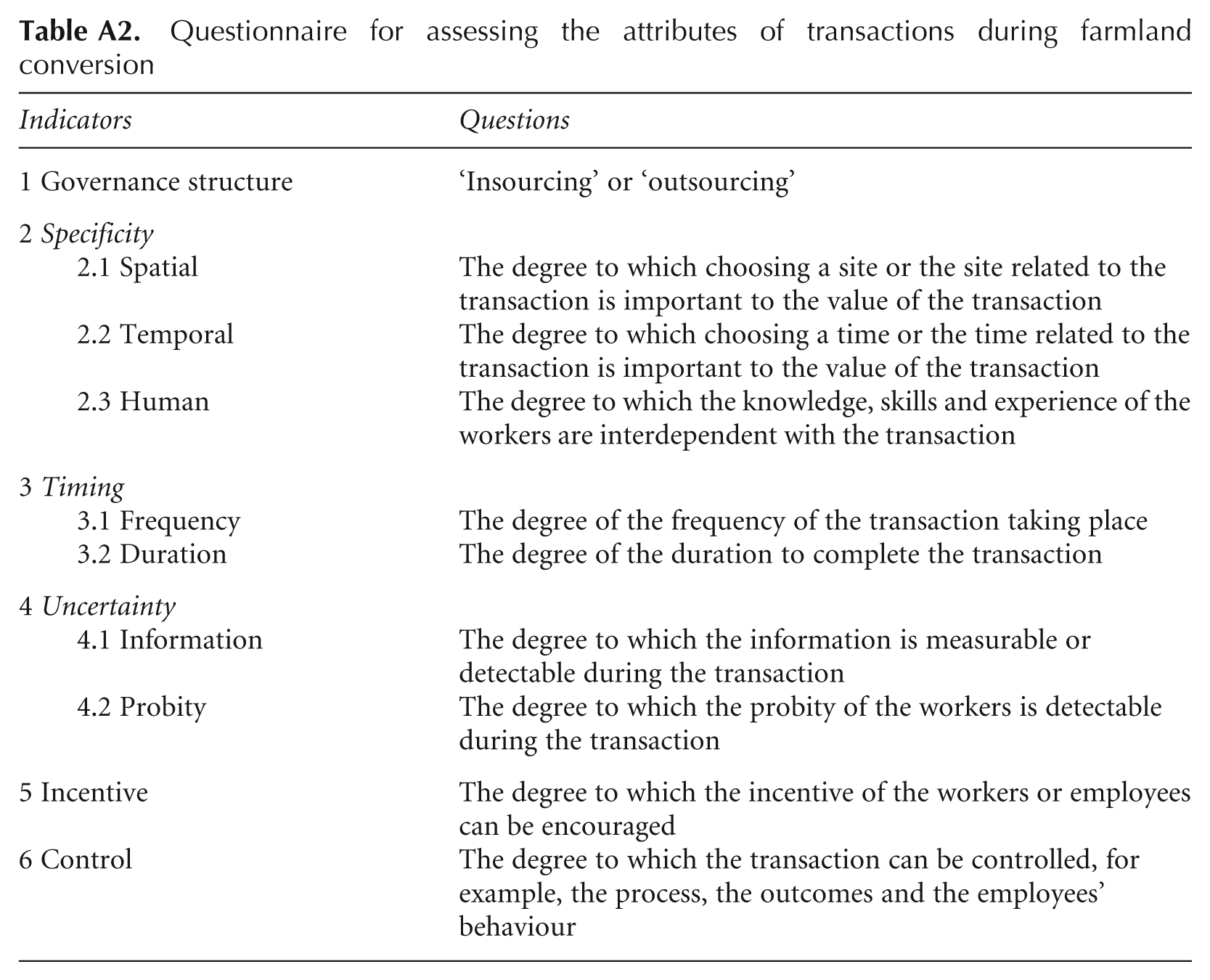
A closed questionnaire was completed (see Table A2 in the Appendix) through a group interview with representatives of all of the governmental function units involved: the Committee for Development and Reform, the Bureau of Urban Planning, the Bureau of Land and Resource Administration, the Construction Committee and other related sub-organisations. Before completing the questionnaire, the officials were given a short introduction on the basic knowledge of transactions, relevant attributes, governance structures and process efficiency. All of the interviewees then discussed the issues and jointly scored each indicator for each transaction. 2 The official from the government unit in charge of the related transaction decided the score if there was no consensus. The ordinal response scale ranged from 1 to 10, which represented the lowest and highest effects of the indicators.
The survey also collected data on transaction costs. The officials were asked to provide a list of expenditures related to the project based on the records in their finance offices. The transaction costs included two main categories: labour cost and administrative cost. Labour cost was calculated as the number of working days multiplied by labour input and average labour cost per day. Administrative costs included the cost of acquiring and delivering information (for example, publishing, consultation and meetings), office expenditures during the project (for example, electricity, heating and maintenance) and reporting (for example, accounting, audits). 3
4.2 Why insourcing or outsourcing
First-stage testing
Because the data collected come from biased samples, two-stage regression methods were employed. With governance structures as the dependent variable (G = 1 for insourcing and G = 0 for outsourcing), Table 3 presents the results of the probit model in the first stage with five different columns of independent variables. Five columns are presented because the variables are colinear and to ensure that there are at least two estimated coefficients for each variable to be presented, which can be used to check stability. In Table 3, CONSTANT is the constant term. SPATIAL, TEMPORAL and HUMAN represent spatial, temporal and human factors respectively. DURATION and FREQUENCY denote the two factors related to timing. INFORMATION and PROBITY are the variables related to uncertainty. INCENTIVE is the variable for incentive intensity and CONTROL is the variable for the effect of administrative control. Most coefficients are significant at the 5 per cent level or better. Furthermore, the signs of the coefficients in each column are consistent, demonstrating the stability of the estimations.
Estimation results for reduced-form governance structure functions
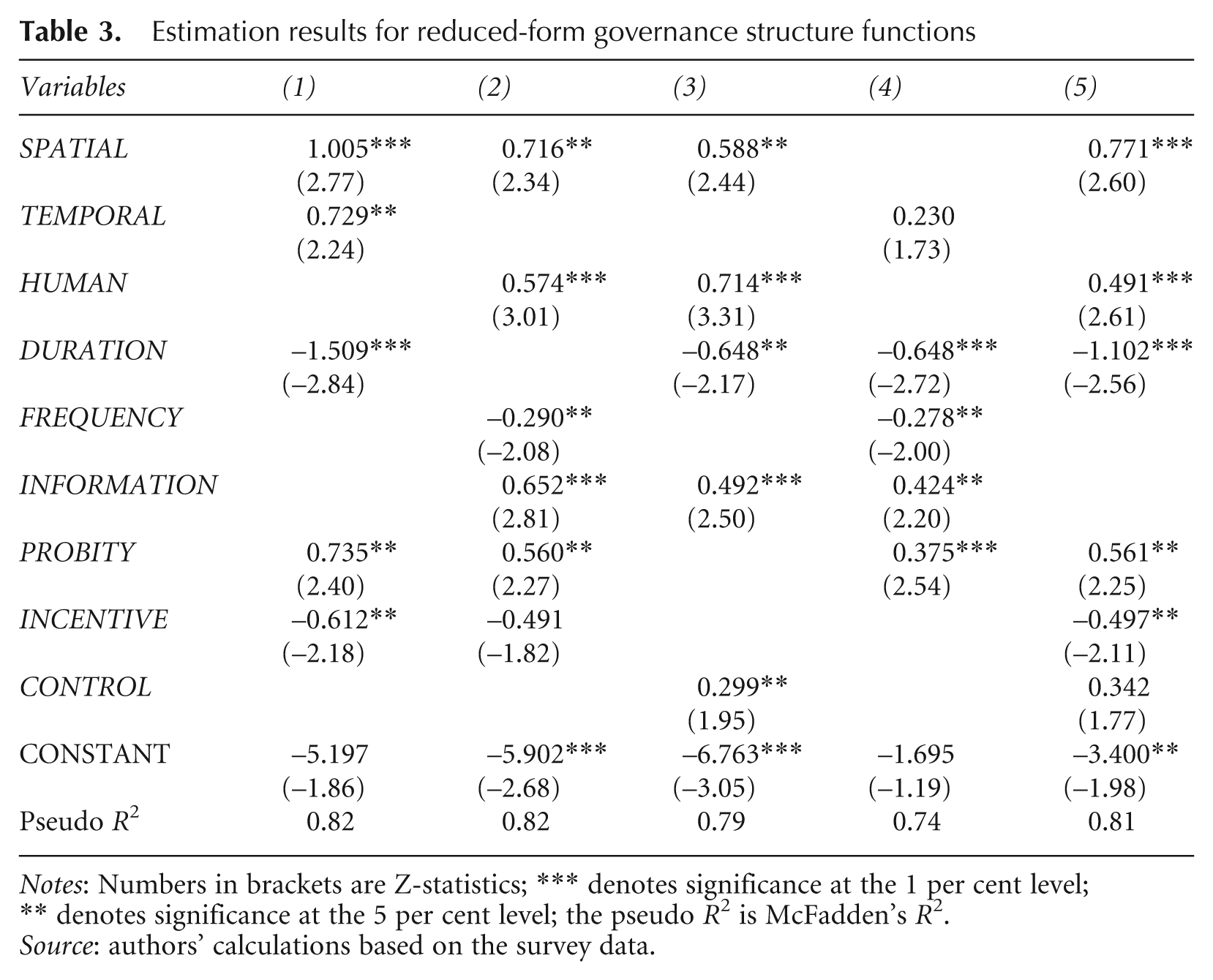
Notes: Numbers in brackets are Z-statistics; *** denotes significance at the 1 per cent level; ** denotes significance at the 5 per cent level; the pseudo R2 is McFadden’s R2.
Source: authors’ calculations based on the survey data.
The coefficients of SPATIAL in all columns are positive, illustrating that greater spatial specificity makes it more likely that insourcing will be chosen. The results confirm the theoretical analysis presented earlier. The coefficients of TEMPORAL are also all positive, implying that greater temporal specificity, again, requires more hierarchical governance.
The coefficients of HUMAN are positive, indicating that the human capital specificity associated with Chinese farmland conversion is sufficiently high for insourcing to be helpful in decreasing transaction costs, even though both insourcing and outsourcing could be used in theory. However, during the survey, we also found that tasks such as planning design are commissioned externally, which indicates that the related transactions are not as human capital specific, even though the related knowledge is specific. We therefore argue that the existence of specific knowledge does not necessarily lead to human capital specificity.
For example, urban planning requires specific knowledge. However, the specific knowledge used in urban planning does not result in transaction-specific human capital. Webster (2009) discusses different hold-up hazards that arise in urban planning and that create human capital specificity. These include issues related to zoning permits, regional planning guidance and discretionary development control, which require local knowledge and relationships. In this paper, we argue that whether specific knowledge leads to human capital specificity depends on human resource competition. In China, even those who provide town- or village-level planning do not exhibit human capital specificity as Webster (2009) claims. There are more than 40 000 towns in China and, every 15 years, revisions to land use plans must occur. The demand for planners is thus quite large, which means that unemployment is not a problem and human capital specificity is low.
The coefficients of DURATION in each column are negative, indicating that the duration attribute of Chinese farmland conversion transactions is low and that outsourcing governance is appropriate. For example, land use planning, which takes a long time, was originally conducted internally by the government but now has been contracted out. Interestingly, although the purpose of outsourcing is to improve the efficiency of planning, the companies or experts commissioned in China try to establish their own relationships or connections with the government because they want to have the advantage in being assigned lucrative tasks or projects. The government also likes to co-operate with previously established partners when it needs such services from outside. The interviewees from the government also stated that contracting out such duties saved the government money on monitoring and enforcement and avoided bureaucracy and corruption. Thus, frequency is also an essential consideration.
In our theoretical analysis, we argue for a negative relationship between frequency and insourcing. The coefficients of FREQUENCY confirm this relationship. The obvious examples in the Chinese farmland conversion process are the land evaluation and land surveying processes. These processes were once conducted via insourcing but now are outsourced to private companies; indeed, this has been the case since the rapid urbanisation in the 1990s. Furthermore, the results of the survey also indicate that high frequency encourages long-term contracts and trust between government and companies, as previously discussed.
The coefficients of INFORMATION are positive, indicating that administrative support is more cost-effective than market support. The same is true for the coefficients of PROBITY. Neither set of results is inconsistent with the theoretical analysis in the TCE framework.
The attributes of governance structures in terms of incentive intensity and administrative control are also examined in the Chinese case. The negative coefficient of INCENTIVE indicates that, when more incentives are required, decentralisation (i.e. outsourcing) occurs. Meanwhile, the positive coefficient of CONTROL indicates that more insourcing results in more control effects.
Second-stage retesting
Table 4 reports the estimated transaction cost functions for outsourcing (
Estimation of the transaction cost functions for insourcing and outsourcing
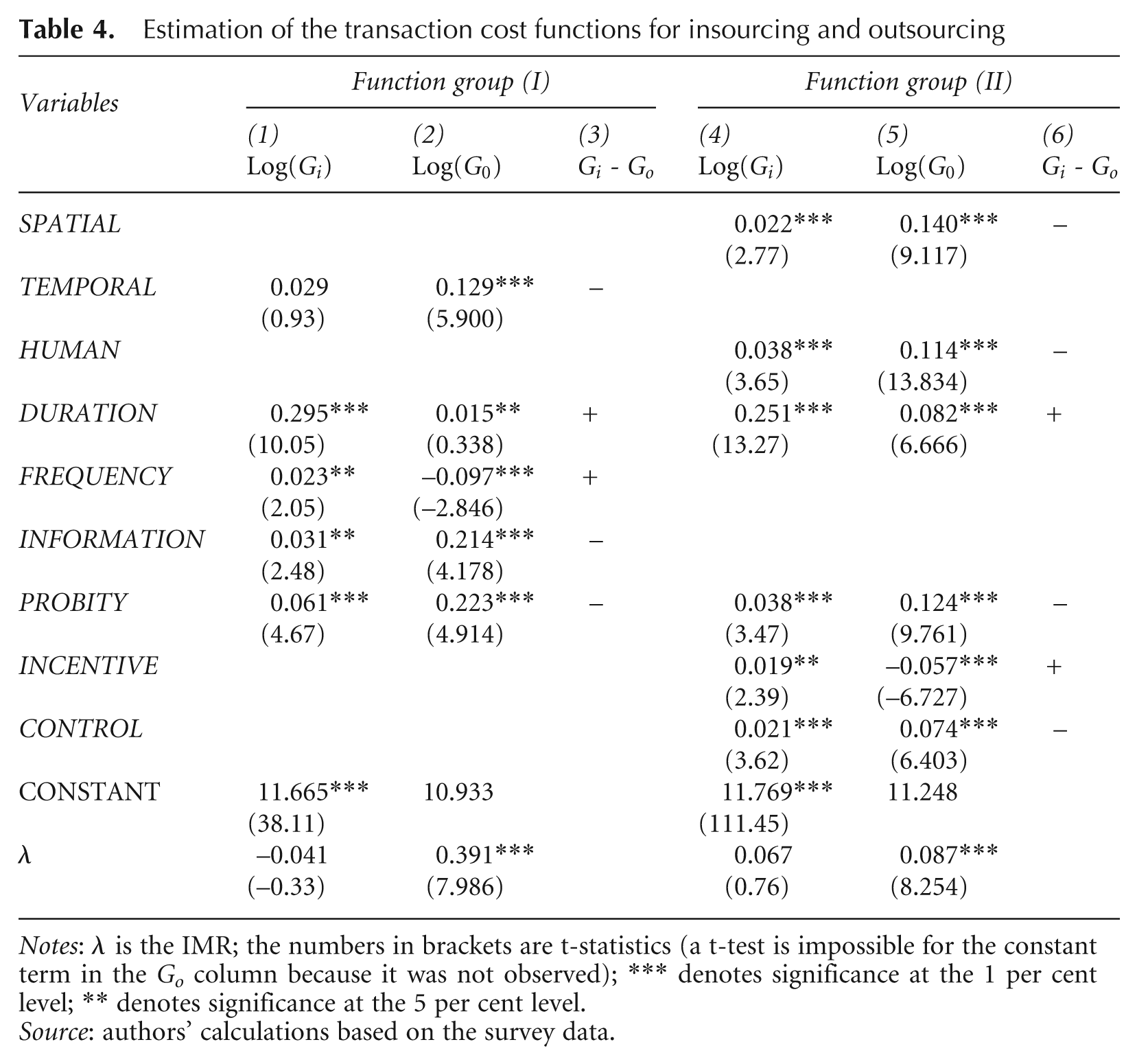
Notes: λ is the IMR; the numbers in brackets are t-statistics (a t-test is impossible for the constant term in the G o column because it was not observed); *** denotes significance at the 1 per cent level; ** denotes significance at the 5 per cent level.
Source: authors’ calculations based on the survey data.
Columns (2) and (5) of Table 4 are the coefficients of ‘outsourcing’, which are derived from the coefficients of each
The estimated results in Table 4 indicate that almost every coefficient is significant at the 5 per cent level or better; the only exception is TEMPORAL in column (1). The results confirm that the factors examined in Table 3 are important attributes of farmland conversion in China. Furthermore, the sign of each coefficient illustrates the impact of each attribute on overall transaction cost and these figures are also consistent with our theoretical analysis.
Table 4 allows us to compare directly the coefficients of insourcing and outsourcing, which can be used to verify further the results in Table 3. For example, if we subtract the coefficient of a variable in column (2) from the coefficient of that same variable in column (1) and the result is negative, then insourcing leads to greater cost savings than outsourcing, verifying the first-stage results if the coefficient of the same variable is positive in the probit regression and vice versa. Column (3) of Table 4 verifies the first-stage results because the signs are all the reverse of those in column (4) of Table 3. Analagously, the signs in column (6), which indicates the comparative relationship between columns (4) and (5), are also consistent with the results of the first-stage analysis, as indicated in column (5) of Table 3. In summary, Table 4 verifies the validity of Table 3.
5. Conclusions
This paper uses transaction cost economics to analyse the process efficiency of farmland conversion for the purpose of urban development. Three main conclusions can be drawn. First, seeking to build a theoretical framework for using TCE to analyse the farmland conversion process, this paper discussed three main attributes that influence transaction costs: specificity, uncertainty and timing. These attributes can be further divided into spatial specificity, temporal specificity, human specificity, duration, frequency, information uncertainty and probity uncertainty.
The more specificities at play (including spatial, temporal and human asset specificity), the greater the probability that insourcing will be chosen. A transaction of longer duration will require extra support, whether market or administrative; however, either insourcing or outsourcing might be acceptable. Frequency, another sub-attribute of timing, is negatively related to insourcing. When information uncertainty and probity hazard increase, market or administrative support is required for transaction security. However, this does not always result in insourcing or outsourcing.
Secondly, a Chinese case study was conducted to test our theoretical use of the TCE framework. The case study illustrated that the governance structures used for farmland conversion in China are determined by the sub-attributes discussed here. Spatial, temporal and human capital specificity, along with information uncertainty, concerns about probity and the administrative control, require insourcing, whereas duration and incentive intensity lead to outsourcing.
Thirdly, let us consider some potential contributions of this paper. The TCE framework presented in this paper is different from that developed by Alexander (2001a); it systematically describes the sub-attributes of farmland conversion and examines their relationship to governance structures. Following Webster (1998), this paper further probes into the use of TCE to analyse the structures selected to govern farmland conversion. Based on the categorisation of transaction cost as presented in Buitelaar (2004) and the comparison of farmland conversion processes presented in Tan et al. (2009), this paper develops a method of quantitative analysis. Finally, the TCE framework and the quantitative model can easily be used in other countries. If two countries are compared, researchers will be equipped to consider the impact of institutional environment on the process efficiency of farmland conversion. This may be valuable in urban studies.
Footnotes
Appendix
Questionnaire for assessing the attributes of transactions during farmland conversion
| Indicators | Questions |
|---|---|
| 1 Governance structure | ‘Insourcing’ or ‘outsourcing’ |
| 2 Specificity | |
| 2.1 Spatial | The degree to which choosing a site or the site related to the transaction is important to the value of the transaction |
| 2.2 Temporal | The degree to which choosing a time or the time related to the transaction is important to the value of the transaction |
| 2.3 Human | The degree to which the knowledge, skills and experience of the workers are interdependent with the transaction |
| 3 Timing | |
| 3.1 Frequency | The degree of the frequency of the transaction taking place |
| 3.2 Duration | The degree of the duration to complete the transaction |
| 4 Uncertainty | |
| 4.1 Information | The degree to which the information is measurable or detectable during the transaction |
| 4.2 Probity | The degree to which the probity of the workers is detectable during the transaction |
| 5 Incentive | The degree to which the incentive of the workers or employees can be encouraged |
| 6 Control | The degree to which the transaction can be controlled, for example, the process, the outcomes and the employees’ behaviour |
Acknowledgements
The authors would like to thank the Editors and the four anonymous referees for their valuable comments on earlier draft versions of this paper. Any remaining mistakes belong to the authors.
Notes
Funding Statement
This research has received financial support from the Natural Science Foundation of China through projects no. 70903057 and no. 70833001, the Social Science Foundation of China through project no. 09 & ZD046, the Zhi-Jiang Programme of Young Social Science Scholars of Zhejiang Province (ZJQN2011T2-1), the Ministry of Education of China through project no. 09YJC630195, the German Ministry of Education and Research (BMBF) through the SUNRISE project, and the Robert Bosch Foundation within the project “Governing Farmland Conversion in the Quest for Sustainability”. The authors would like to thank the funding organisations for the grants.