






Abstract
Promoting physical activity among youth is an important public health objective. Initiatives in urban settings targeting different types of physical activity like cycling are important. This study sought to examine qualitatively urban youths’ experiences in and perceptions of a community cycling initiative (Earn-A-Bike) delivered in Philadelphia, PA, by a local non-profit, Neighborhood Bike Works (NBW). Focus groups were conducted to understand the impact of this programme and to inform future community-based initiatives targeting urban youth. Five themes were derived from the qualitative analysis, comprising benefits of cycling, barriers to cycling, cycling knowledge, support from family and friends, and self efficacy. Earn-A-Bike was well accepted by urban youth, who reported positive perceptions and intentions to continue cycling after the conclusion of the programme. NBW is an example of how local non-profits can integrate into urban communities, creating a positive impact on urban children’s lives from a health, cultural and educational perspective.
Introduction
Physical activity can confer a number of physiological and psychosocial benefits for youth (Ahn and Fedewa, 2011; Nelson and Gordon-Larsen, 2006). Physiological benefits of physical activity for children are similar to those for adults, including lowered blood pressure, improved cholesterol and glucose levels, and enhanced heart and lung function (Strauss et al., 2001). Active youth also have increased fitness, muscular strength and endurance, higher bone density (Strong et al., 2005) and increased motor skill competencies (Ahn and Fedewa, 2011). Physical activity may also help to enhance cognition through improved memory and foster the development of executive functioning skills (Tomporowski et al., 2011). Although the literature is mixed, a recent meta analysis identified that higher levels of physical activity contribute to improved academic achievement (Fedewa and Soyeon, 2011). Additional psychosocial benefits associated with physical activity include higher self-esteem and less depressive and anxiety-related symptomatology (Ahn and Fedewa, 2011; Nelson and Gordon-Larsen, 2006).
Despite the many benefits of physical activity, inactivity is among the major leading causes of chronic illnesses from childhood to adulthood (Bauman and Craig, 2005). Current recommendations suggest that youth engage in moderate to vigorous physical activity for at least 60 minutes daily (Strong et al., 2005), yet objective data indicate that only 42 per cent of children and 8 per cent of adolescents in the US meet this standard (Strong et al., 2008; Troiano et al., 2008). The rates of physical activity and amount of time spent outside (Cleland et al., 2010) decrease as children age (Bray and Born, 2004); thus, physical activity in childhood is an important public health target.
Physical Activity and Urban Youth
General barriers to physical activity like crime and safety concerns (Moore et al., 2010; Nichol et al., 2010) might be particularly relevant in urban environments. Barriers related to neighbourhood characteristics in urban areas include access to safe play areas, availability of after-school programmes and traffic and street safety (Giles-Corti and Donovan, 2002; Saelens et al., 2003; Timperio et al., 2005). Environmental characteristics such as physical distance to activity areas (for example, park, playgrounds) and associated costs of transport are commonly identified barriers by urban parents and children (Moore et al., 2010). Furthermore, neighbourhood SES and social capital have been found to predict physical activity even when controlling for sociodemographic background (Wen et al., 2007).
People derive meaning and culture from their physical environment (Low, 1996, 1997). The interaction between such meaning and physical health may be particularly salient for those living in urban environments. Living in urbanised areas has been associated with less activity and more sedentary behaviour in youth (Levine et al., 2011). Processes such as low neighbourhood collective efficacy or social cohesion may further inhibit physical activity (Kimbro and Schachter, 2011; Giles-Corti and Donovan, 2002). A recent analysis found that youth in less cohesive environments have lower rates of physical activity (Cradock et al., 2009). Many of these barriers correspond to those identified by adults residing in urban environments (for example, neighbourhood safety and availability of exercise facilities; Eyler et al., 1998; Sallis et al., 1997).
Despite barriers to physical activity, there are activity-facilitating factors that should be considered. For example, perceived availability of recreational facilities is associated with increased activity (Ries et al., 2011). Improving safety perceptions, even just by adding one staff member, can improve activity rates, with one programme finding that 24-hour staff monitoring was associated with an 84 per cent increase in the number of physically active children compared with the control group (Parley et al., 2007). Other factors associated with physical activity among urban youth include having active friends, parental encouragement and parental supervision, which collectively accounted for a significant percentage of time spent outdoors in a five-year longitudinal study (Cleland et al., 2010). This finding is important because one longitudinal study found that each additional hour spent outdoors during weekends and weekdays was associated with an extra 27 minutes a week of physical activity (Cleland et al., 2008). Facilitators of physical activity also extend beyond individual characteristics to include systems-level factors such as social cohesion, collective efficacy, socialisation of children and social exchange, all of which have been found to predict physical activity more accurately than neighbourhood characteristics (Cradock et al., 2009; Franzini et al., 2009).
Cycling in Urban Environments
Cycling, in particular, has been acknowledged as a potential means to promote public health (Bassett et al., 2008). Cycling is recommended for its low cost (Bauman and Rissel, 2009) and ability to promote cardiovascular stimulation for individuals of all ages and fitness levels (Shephard, 2008). Children who cycle have a lower risk of early death, heart disease and high blood pressure (Oja et al., 2011). Additionally, among urban youth, cycling once a week has been associated with healthier body weights (Dudas and Crocetti, 2008). Thus, cycling may be a particularly beneficial form of physical activity for youth residing in urban environments.
One specific method for promoting cycling among youth is active commuting. Active commuting to school among children has decreased steadily over time (47 per cent in 1969 vs 12.9 per cent in 2001), as more children travel by car or bus (McDonald, 2007). Cooper and colleagues (2005) reported that boys who actively commuted to school were more physically active after school compared with boys who commuted to school by car. Cycling provides urban children with a form of transport not otherwise available. Therefore, the potential exists that access to bicycles and programmes focused on promoting cycling may help to increase activity during the critical time-periods after school and on the weekends (Biddle et al., 2011).
Urban Community Initiatives
Community-level initiatives and programmes have been implemented in urban environments to promote health and physical activity. The Center for Disease Control and Prevention (CDC) has funded several ‘Get Healthy’ initiatives in major urban cities throughout the US in an effort to reduce obesity and related chronic diseases by increasing access to healthy foods and providing opportunities for daily physical activity (City of Philadelphia, 2010). The programme aims to create safe spaces for community members to be physically active, including walkable and bikeable neighbourhoods.
Other programmes have focused on increasing cycling and active commuting, specifically. Government-sponsored, US nation-wide programmes such as Safe Routes to School and the CDC’s KidsWalk programme aim to increase active commuting through building bike paths, reducing speed limits in school zones and providing education (National Center for Safe Routes to School, 2012). Early results indicate that children who completed the Safe Routes to School programme were more likely to cycle or walk to school (14 per cent) than those who did not (4 per cent) (Boarnet et al., 2005).
Furthermore, several non-profit organisations in the US promote cycling among urban youth. Bike Works, located in Seattle, aims to educate urban youth and promote cycling through their eight-week class in which students learn how to fix and ride bikes (Bike Works, 2011). Cycles of Change in East Oakland has the Bikery Community Bike Shop and Bike-Go-Round initiatives that teach safe urban riding and provide access to healthy, reliable transport (Cycles of Change, 2010). Urban Youth Bike Corps located in Harlem provides after-school hours for bike mechanics and cycling training (Urban Youth Bike Corps, 2010). Similar youth programmes are located in Detroit, Boston and St. Louis (Back Alley Bikes, 2010; Bikes Not Bombs, 2011; St. Louis Bike Works, 2012). However, despite the existence of these programmes, there remains a lack of published data regarding the feasibility, acceptability and efficacy of such programmeming.
Current Study
The current study sought to examine qualitatively urban youths’ experiences and perceptions of a cycling programme delivered in Philadelphia, PA, by a local community non-profit organisation, Neighborhood Bike Works (Neighborhood Bike Works, 2010). Rich descriptions were elicited to develop a better understanding of children’s perceptions of urban youth cycling programmes and to better inform future community-based initiatives targeting urban youth.
Methodology
In Philadelphia, Neighborhood Bike Works (NBW) is a non-profit organisation that promotes cycling in four areas of the city (Neighborhood Bike Works, 2010). In these locations, NBW acquired existing spaces integrated into the community that housed former businesses (for example a hair salon) and equipped them to serve as cycling shops and instructional settings (see Figure 1). As part of its operations, NBW sponsors a free programme, Earn-A-Bike. The programme consists of 14 sessions during which children are given the opportunity to refurbish a bike that they can keep after completing all the required courses. Those enrolled learn the basics of bike repair and maintenance, as well as bike laws, safe urban riding, health and nutrition. Additionally, children regularly cycle with instructors and sightsee to areas around the city. This study sought to enroll four groups of children who participated in the first four Earn-A-Bike classes offered at the Philadelphia ‘Bike Salon’ location from February 2010 to August 2010.
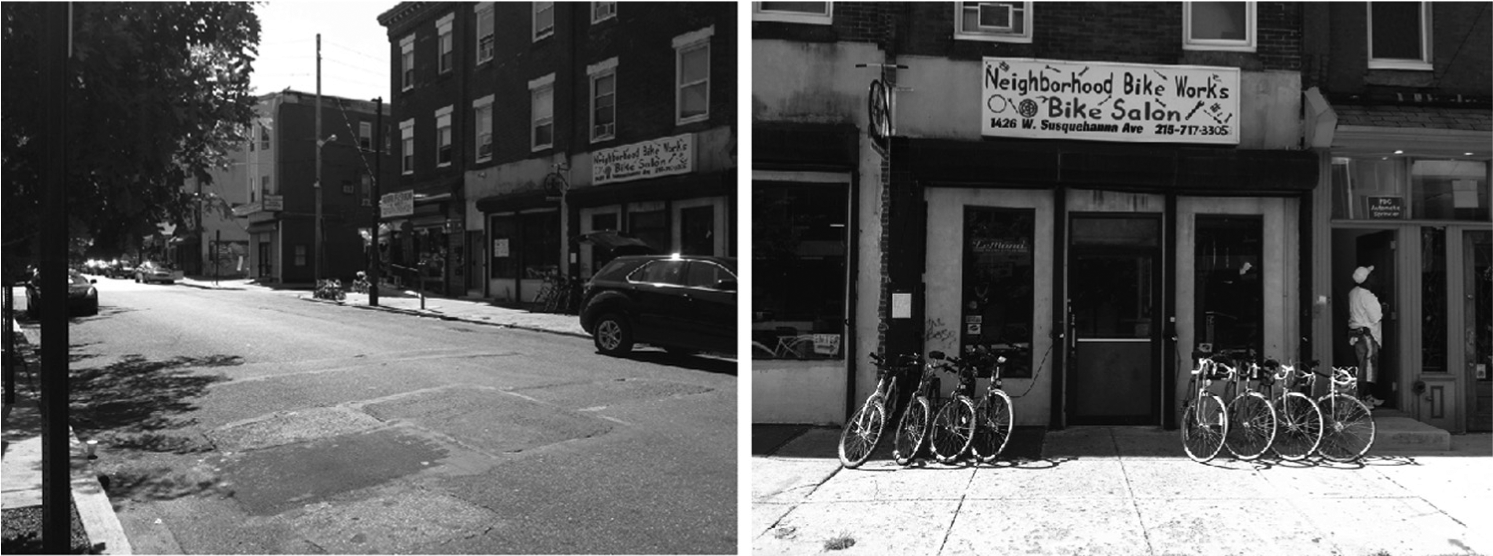
Street views of the Neighborhood Bike Works ‘Bike Salon’, Philadelphia.
Participants
Participants were children aged 7–14 (N = 32) who participated in the first four Neighborhood Bike Works Earn-A-Bike classes offered at the Bike Salon. More than 90 per cent of all students enrolled in the Earn-A-Bike programme during the timeframe mentioned earlier obtained parental consent to participate. The mean age of participants was 10.21 (S.D. = 1.96) and they were predominantly African American and male (n = 24). The researchers obtained appropriate IRB approval to conduct this research, as well as parental consent and child assent.
Procedure
Earn-A-Bike students participated in entrance (N = 32) and exit (N = 27) focus group interviews (i.e. within one week of commencement of the programme and during the final course meeting). Each session lasted about 45 minutes. All of the discussions were audio recorded and transcribed verbatim.
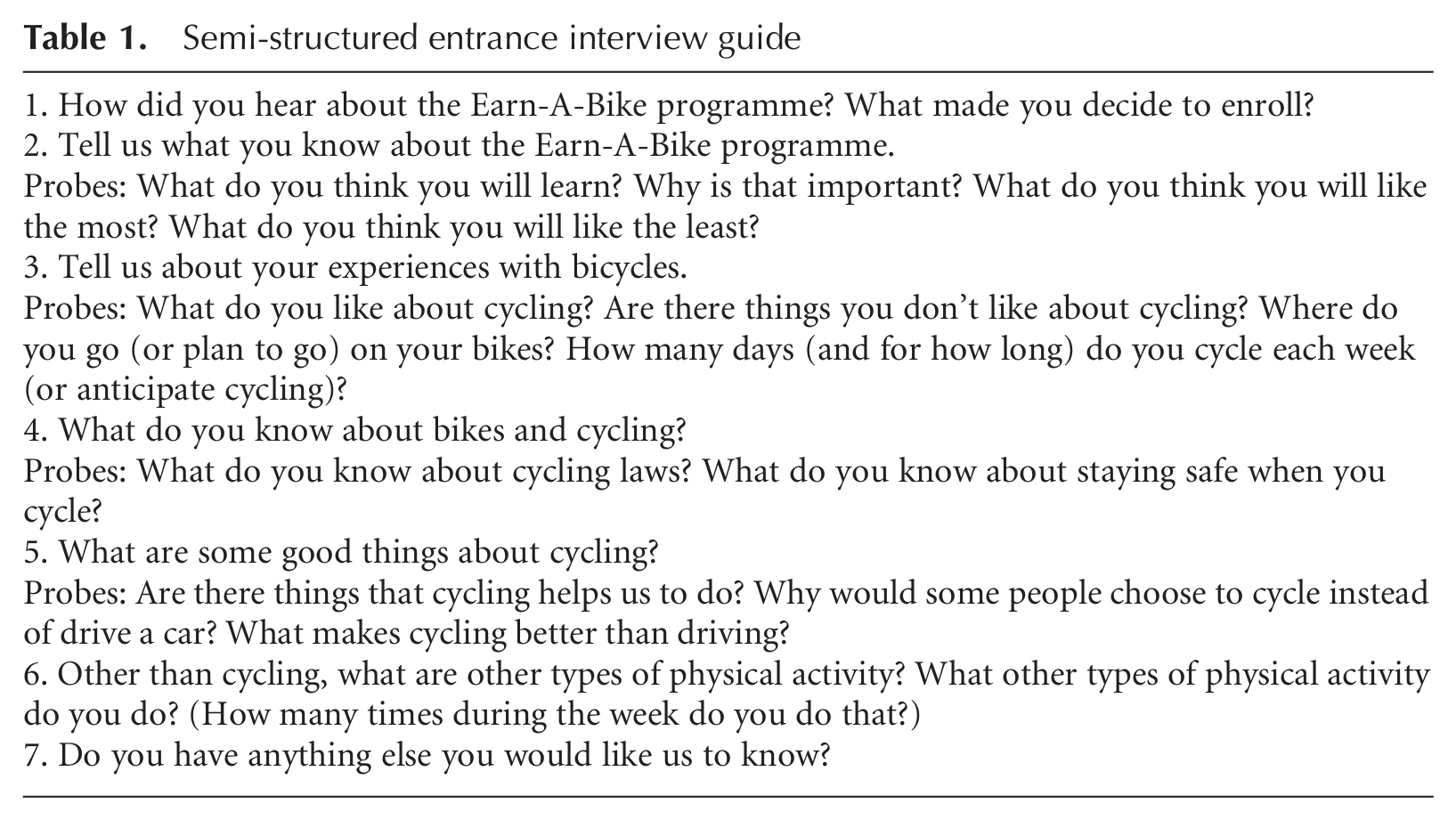
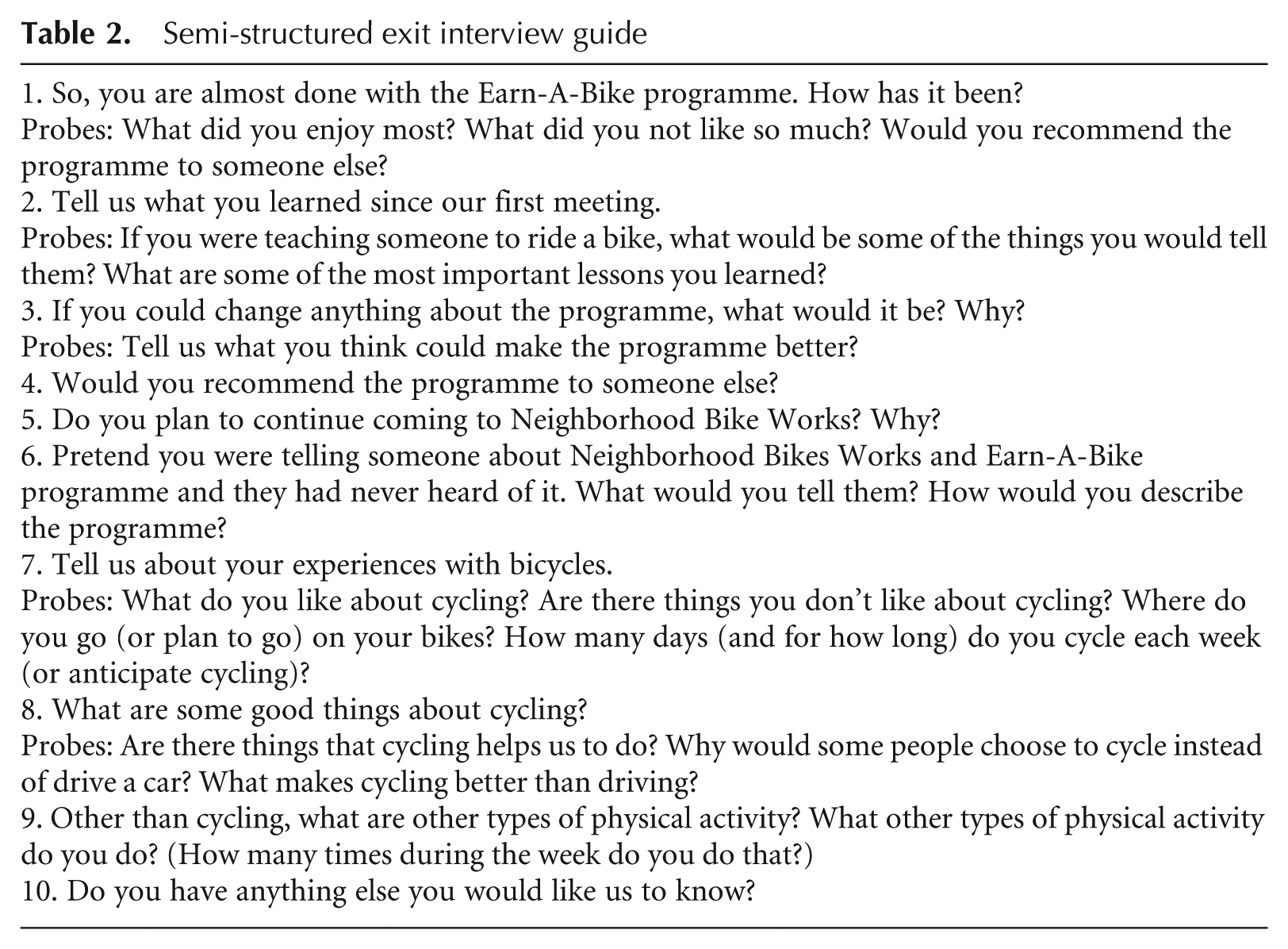
A qualitative focus group approach was utilised to generate discussion among the students regarding their perceptions, opinions and experiences about the topics. Previous literature has supported the validity of focus groups among children and young adolescents (Kennedy et al., 2001). Each focus group was guided by a collection of key questions to explore areas of interest. The focus group guide for entrance interviews (see Table 1) explored children’s: previous knowledge and experiences with cycling; barriers to cycling and physical activity; and, expectations of the programme. The focus group guide for the exit interview (see Table 2) explored children’s: experiences and opinions about the programme; acquired knowledge regarding cycling skills and bike maintenance; future plans for cycling and physical activity; and, a programme evaluation. For their participation, the students were given a healthy boxed lunch and a $10 gift card following completion of each focus group.
Semi-structured entrance interview guide
Semi-structured exit interview guide
Data Analysis
Consensual qualitative research (CQR) was developed by Hill and colleagues (1997) and a review of the methodology’s application with recommendations was later published (Hill et al., 2005). This method provides a vivid, full, and dense description of the studied phenomena in its natural language (Hill et al., 2005). Data are gathered using broad open-ended questions so that restrictions are not placed on participants’ responses. Themes and conclusions are built from the data rather than imposing a priori theory. Following the interviews, a codebook was designed to explore themes from the focus groups (see Table 3). Three coders independently reviewed two representative transcripts. Using CQR methods, coding was initiated by extracting quotes from the transcripts, which were then examined for similar content and grouped into sub-themes. If multiple sub-themes focused on similar concepts, the sub-themes were grouped together as a theme (Auerbach and Silverstein 2003; Hahn, 2008; Hill et al., 2005). The three coders met after having individually identified all themes and sub-themes in the transcripts. The coders reviewed and discussed all disagreements (Hill et al., 2005). Themes that were agreed upon by coders were added into a consensual codebook. Once all themes were identified, the consensual codebook was used to code the themes in the remaining transcripts.
Codebook used for qualitative analysis
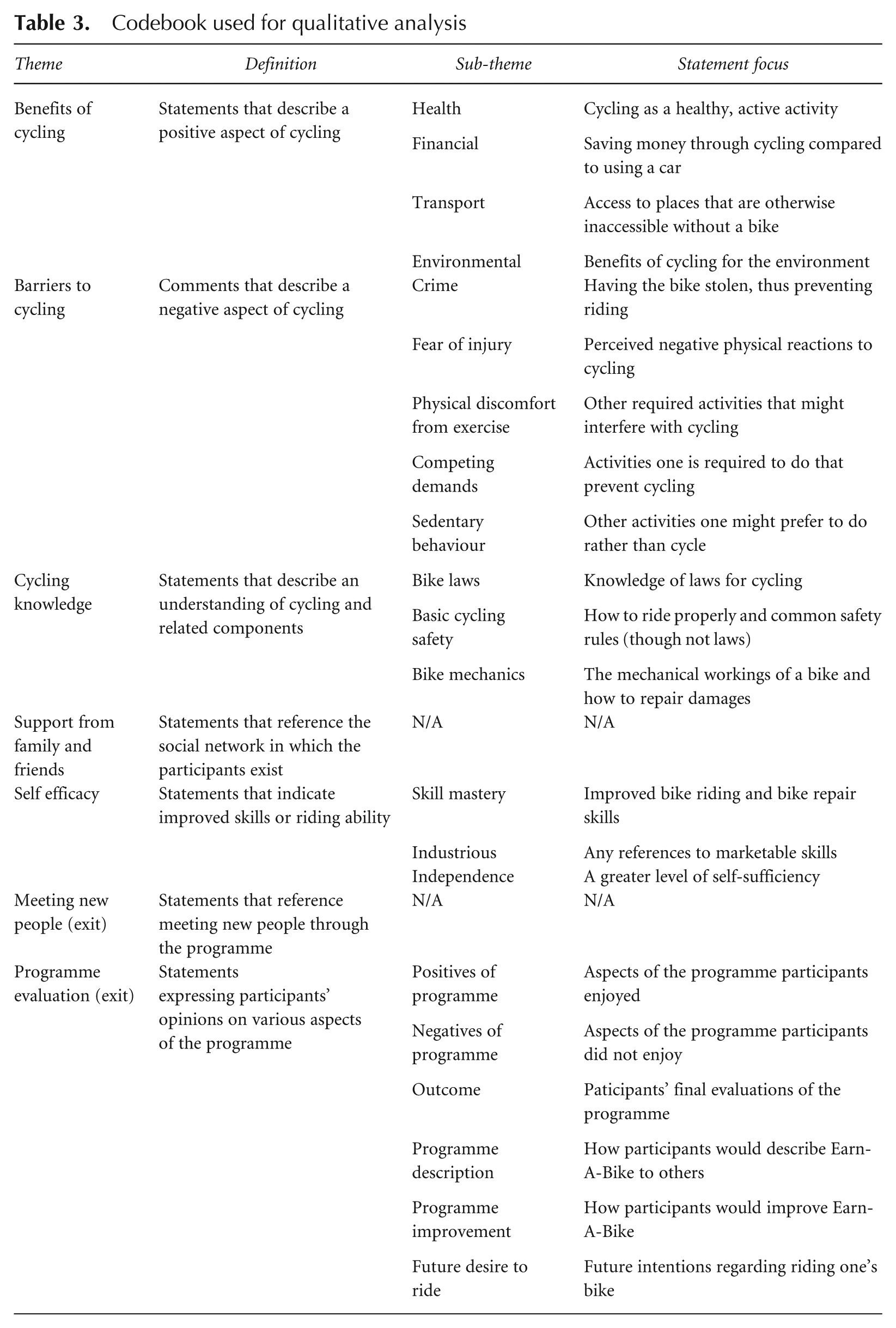
As defined by Hill and colleagues (2005), each theme was classified as General, Typical, or Variant (see Table 3). A General theme is one that was present across 100 per cent of the focus groups in either the entrance or exit interviews. A Typical theme was present in at least 50 per cent or more of the focus groups. Lastly, a Variant theme is one that was present in less than 50 per cent of the focus groups, but deemed important.
Results
The results are presented according to the themes that arose from the qualitative analysis of the entrance and exit interviews. Themes are described according to their classification as General, Typical or Variant, as described earlier.
Entrance Interview Themes
There were five primary themes that emerged from the focus groups that were conducted at the beginning of the programme: benefits of cycling; barriers to cycling; cycling knowledge; social support from family and friends; and self-efficacy. Each theme is next described in detail. Additional example quotes are included in Table 4.
Example Quotes from Participants
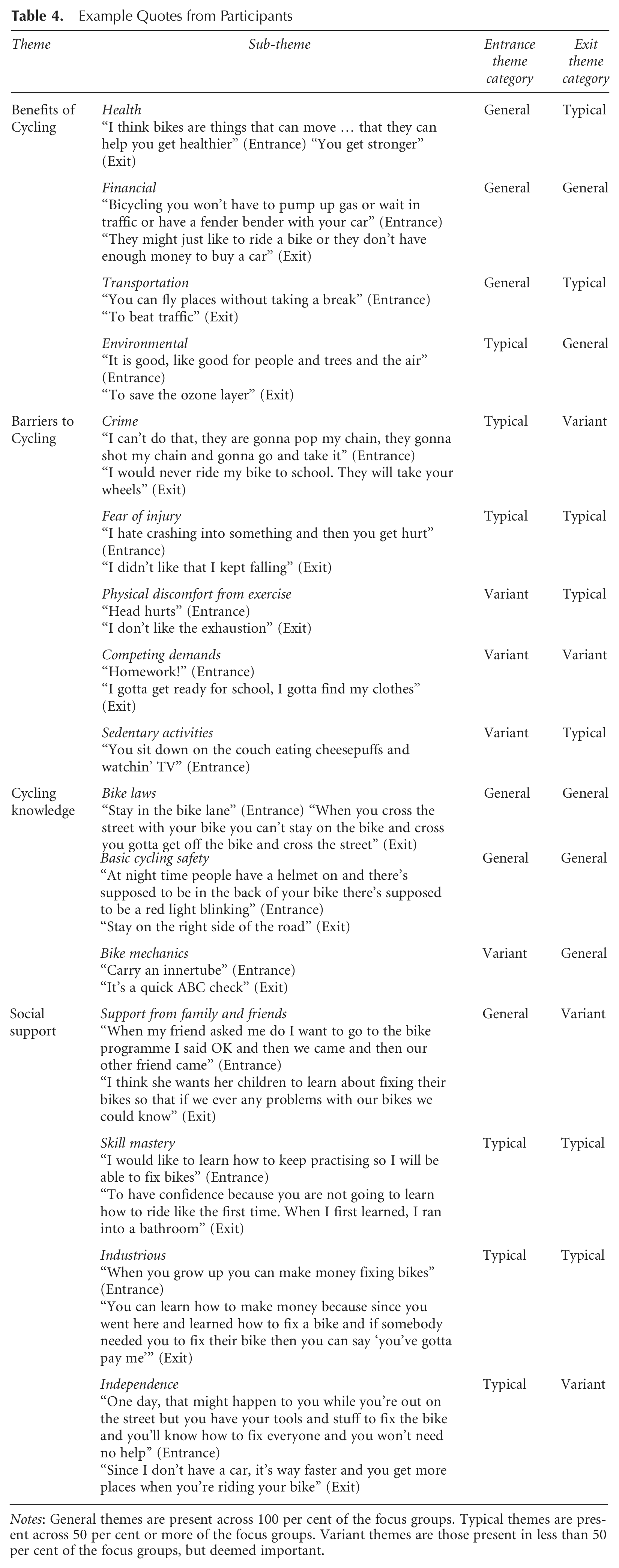
Notes: General themes are present across 100 per cent of the focus groups. Typical themes are present across 50 per cent or more of the focus groups. Variant themes are those present in less than 50 per cent of the focus groups, but deemed important.
Benefits of cycling
The benefits of cycling theme consisted of comments that described a positive aspect of cycling. Four sub-themes emerged, including three General themes present across 100 per cent of the focus groups—health, financial and transport and one Typical theme present in > 50 per cent of the focus groups—Environmental.
Health
The health sub-theme includes quotes that described cycling as a healthy, active activity. Participants in the programme acknowledged the physiological benefits that cycling provides. They also recognised that cycling can serve as a means to increase physical fitness. One 8-year-old stated, “Bikes are things that can move, that can help you to get healthier”. A 10-year-old added, “It’s good for exercising”.
Financial
Many participants referenced the financial cost of maintaining a car and gas. An 11-year-old noted that with, “Bicycling you won’t have to pump up gas”. A 10-year-old added that, “You can budget with your bike”.
Transport
The quotes within the transport sub-theme included statements that refer to access to places that are otherwise inaccessible without a bike. Using the bike as a mode of transport was acknowledged, serving as a gateway to more independence rather than relying upon being driven or walking. As one 10-year-old child pointed out, “You don’t have to borrow a car”. Another 10-year-old said, “You can fly places without having to take a break!”.
Environmental
Quotes categorised within the environmental sub-theme were those describing the benefits of cycling for the environment. Several participants were able to discuss the general environmental benefits of cycling compared with using a car. For example, a 13-year-old participant said, “When you ride a bike you less pollute the air”. While an 11-year-old added, “Because if you had gas like then like … it’s bad for people”.
Barriers to cycling
The barriers of cycling theme consisted of comments that described a negative aspect of cycling. Five sub-themes emerged. These were: crime; fear of injury; physical discomfort from exercise; competing demands; and sedentary activities.
Crime
The sub-theme Crime includes references to having a bike or its parts stolen, which would prevent future riding. This was the most prevalent and discussed theme during the entrance interviews. A 10-year-old participant stated, “My bike got stolen but then I found it again and then it got stolen again”. Many participants echoed similar sentiments. A 9-year-old feared that if the bike is left outside the school, “They gonna cut my chain and gonna go and take it”.
Fear of injury
Quotes within this sub-theme described a fear of being injured or hurt while cycling, a concern expressed by many participants. A 9-year-old said, “I hate crashing into something and then you get hurt”. A 10-year-old said that, “When you riding your bike too fast and you crash the back, the back of the bumper, you brake and just fly off”.
Physical discomfort from exercise
Participants also mentioned the physical effects of cycling as a barrier. These were quotes that referenced perceived negative physical reactions to cycling. For example, a 14-year-old said when he bikes he, “Sweats a lot”, something he does not enjoy, while an 8-year-old said when cycling, “My head hurts”.
Competing demands
Characterised as other required activities that might interfere with cycling, competing demands included references to commitments, such as school. Two 13-year-olds said that “Homework” is something that can prevent them from cycling as frequently as they like.
Sedentary preferences
Sedentary preferences comprised references to sedentary activities children enjoyed that might limit their cycling activity. For example, a 14-year-old stated that he prefers, “Usually watching TV” or “Eating cheesepuffs”. A 10-year-old said that he prefers to, “Go outside and take [his] PSP [a portable gaming device]”.
Cycling knowledge
The theme of cycling knowledge consisted of comments that described an understanding of cycling and related components. Within this category, three sub-themes arose: bike laws; basic cycling safety; and bike mechanics.
Bike laws
Participants were asked to explain their knowledge regarding the laws of cycling. This sub-theme consists of quotes that referenced knowledge of laws for cyclers. Participants were able to state several common laws, including, as one 11-year-old said, “Stay in the bike lane”. However, some responses given showed an incomplete understanding, such as this comment by a 9-year-old, who said, “There’s a law or there’s a pole with this sign to tell all bikes to go in the street. I’m not sure why”.
Basic cycling safety
The sub-theme basic cycling safety comprises statements referencing how to ride safely and properly. Participants knew some common rules of cycling, such as this added by a 10-year-old: “You gotta see if a car is coming so you don’t get hurt”. Another 10-year-old participant stated, “At night time people have a helmet on and there’s supposed to be in the back of your bike there’s supposed to be a red light blinking”. While all participants knew they should be wearing helmets, some admitted to not doing so, such as a 9-year-old who said, “I have a bike helmet but I just don’t like to wear it”.
Bike mechanics
The sub-theme bike mechanics includes statements that referenced the mechanical workings of a bike and how to repair damages. Bike mechanics was only mentioned by one focus group during the entrance interviews, in which a 10-year-old said, “Carry an inner tube”.
Social support from family and friends
This theme consists of statements indicating support from one’s existing social network, such as participants being reinforced for their decision to join the programme. Many of the participants mentioned their parents’ support for the programme because it serves as a safe environment and increases independence. The participants themselves also appreciated having a place to go. For example, one 12-year-old boy said that he liked the programme, “So I won’t waste my time instead of watching TV”.
Self-efficacy
The self-efficacy theme consisted of those comments that described improved skills or riding ability. Within this category, three sub-themes emerged: skill mastery; industriousness; and independence. All three of the sub-themes were categorised as Typical themes (present in 50 per cent or more of the focus groups) during the analysis.
Skill mastery
This sub-theme encompassed statements of anticipated improvements in bike riding and bike repair skills. Participants of the programme expressed excitement to learn about cycling. A 9-year-old student said he wanted to learn, “How to take apart a bike, how to put together a bike, how to take off tires, how to fix tires when they have holes in them and stuff”. An 11-year-old added, “I would like to learn how to keep practising so I will be able to fix bikes”.
Industriousness
Industriousness consisted of any references to marketable skills. Those in the programme acknowledged that the skills they acquire through the Earn-A-Bike programme could be used to generate income. An 11-year-old stated, “When you grow up, you can make money fixing bikes”. A 10-year-old mentioned similar benefits, saying, “Like my friend, he said he’s gonna make his own [bike repair] business, but he needs help”.
Independence
The final sub-theme within this category is independence, which contained any references to a greater level of self-sufficiency. The participants enrolled in the programme identified increased independence as a potential result of the programme. When asked why it is important to know how to fix a bike, an 11-year-old responded, “When you get like a flat or something like and you’re not in a real good neighbourhood, you can fix it”. Similarly, a 10-year-old said, “One day, that might happen to you while you’re out on the street but you have your tools and stuff to fix the bike and you’ll know how to fix everyone and you won’t need no help”.
Exit Interview Themes
Four of the five themes that arose from the entrance interviews (benefits of cycling, barriers to cycling, cycling knowledge, and self-efficacy; see Table 4 for relevant exit interview quotes) were present during the exit interviews. Social support from family and friends was not present, but a related new theme, ‘Meeting new people’, emerged as a theme that illustrates participants’ enjoyment of the opportunity to expand their social network and meet new children in the NBW Earn-A-Bike programme. For example, one 9-year-old said, “Because by coming here you get to meet new people and you get to teach them things you already know”.
Programme Evaluation
During the exit interviews, children also answered questions related to programme evaluation. Overall, participants reported that they enjoyed the programme, as one 8-year-old proclaimed, “I liked everything”. A 10-year-old said, “It’s awesome!”. Other participants, including one 8-year-old, enjoyed the fact that “We got a free bike”. Lastly, an 11-year-old proclaimed, “It has been great learning about bikes and fixing bikes. And I really liked it and we get to go on rides and stuff”. Children enjoyed working with the staff, too (for example, “I think the staff are very nice”). With regard to what they did not enjoy, they were disappointed when their usual leader was absent and a small segment (i.e. two individuals in one focus group) noted that they did not get along with all of their classmates (for example, “I really did not like some of the students here”).
In response to how they would describe the programme to others, many participants choose to focus on the enjoyment of the experiences, such as an 11-year-old who said, “It is fun and we learned about bikes”. An 8-year-old discussed several components of the programme when describing it, stating, “They teach you how to ride bikes, teach you how to fix bikes up and inspire you to keep trying to teach others to fix bikes too”. Participants gave some suggestions for improving the programme, including a 9-year-old who said, “Lower the age range” and an 8-year-old who said, “More kids coming”. However, the majority felt that the programme need not be changed at all, like an 8-year-old who, when asked what could be improved, said, “It was perfect as it is”.
Related to their knowledge of bike mechanics, participants overwhelmingly felt they had learned a lot having gone through the programme. For example, one 11-year-old said he learned “How to do a 123 quick check”, designed to ensure the bike is ready to be ridden. Participants also expressed a desire to continue riding their bikes following the end of the programme. Several participants said they would cycle “Everyday”. One 11-year-old replied, “Every single day”. Others, including one 9-year-old, stated, “Five days a week”.
Discussion
This study qualitatively examined children’s experiences with, and perceptions of, an urban community cycling programme run by Neighborhood Bike Works (NBW), a non-profit organisation with locations in four urban neighbourhoods in Philadelphia. Entrance and exit interviews were conducted at the NBW ‘Bike Salon,’ located in an underserved and low SES area of Philadelphia. This is the first study explicitly to assess youths’ perceptions on cycling and related barriers within urban environments. The analysis revealed several barriers (for example, Crime, Fear of Injury) and facilitators (for example, self-efficacy, social support from family and friends) to cycling.
During the entrance interviews, participants identified several benefits of cycling, including environmental, financial and health benefits. Participants also stated several barriers to cycling including crime, fear of injury, physical discomfort from exercise and sedentary preferences. One of the themes, fear of theft, emerged as a prevalent barrier to active commuting to school. Crime and safety as a barrier to exercise has been previously acknowledged in research (for example, Burdette and Whitaker, 2004; Moore et al., 2010). Participants expressed a need for a quality bike lock so that they would to be willing to use their new bikes to commute to school. This finding suggests that initiatives based in areas with high rates of crime may need to collaborate with schools to ensure that safe bike parking locations are available to encourage active commuting and reduce concerns related to theft. Additional collaborations are also needed, such as community-based improvements in neighbourhood safety (for example, providing well-maintained paths, bike lanes and well-lit streets), all of which have been associated with higher rates of active commuting among youth (Nelson and Woods, 2010). Interventions with a concerted effort to prevent crime or theft may allay the maternal concerns of outdoor play and combat the effects of mutigenerational poverty (Gans, 2011; Kimbro and Schachter, 2011).
Many children also reported that sedentary activities would compete with cycling during their time off from school. Some participants expressed a desire to remain indoors watching TV or playing video games. Previous studies have found a positive correlation between time spent watching TV and low physical activity levels (Ogunleye et al., 2012). The Earn-A-Bike programme provides urban youth with an opportunity to engage in physical activity rather than sedentary behaviours, with an active social network. Increased levels of physical activity among youth can lead to physiological and psychosocial benefits (Ahn and Fedewa, 2011; Nelson and Gordon-Larsen, 2006); this may be particularly important for children residing in low SES urban environments where adults are disproportionately affected by obesity, diabetes and hypertension (Martos-Cerezuela et al., 2010).
During exit interviews, participants expressed enjoyment over making new friends during the course of the programme. Given that having active friends has been previously associated with increased physical activity (Cleland et al., 2010), programmes such as Earn-A-Bike may be helpful in promoting physical activity among urban youth by creating active social networks. Programmes like this also afford the opportunity to promote collaboration and positive interaction among children while partaking in a shared learning environment. These interactions may be particularly valuable in building social capital and addressing issues of collective socialisation that have been previously identified as predictors of low physical activity (Franzini et al., 2009).
Post-programme focus groups indicated that the Earn-A-Bike programme was well accepted and enjoyed by the participants. Programmes such as Earn-A-Bike have heightened importance because they combat the various barriers to physical activity confronting urban youth such as crime, safety concerns and multigenerational poverty (Gans, 2011; Moore et al., 2010; Nichol et al., 2010). Rather than implementing large interventions that are often transient, community-based non-profit programmes such as Earn-A-Bike are relatively sustainable and offer youth opportunities to develop social capital and skills that may help to promote the adoption of lifelong physical activity and cycling behaviours. NBW and the Earn-A-Bike programme focus on community-based environmental changes as well as individual instruction consistent with evidence-based recommendations (Kumanyika et al., 2000; Sallis and Glanz, 2009), further underscoring the value of the Earn-A-Bike programme and similar urban youth cycling initiatives. NBW is an example of how local non-profit organisations may be able to integrate into urban and underserved communities, addressing the byproducts of mutigenerational poverty and altering the cultural meanings derived from public spaces (Gans, 2011; Low, 1996). As a function of being located in a reclaimed space in a high-traffic location near local transit stops, many Earn-A-Bike programme participants learned about the programme by simply walking in the location to investigate the new business. 1 During the interviews, research staff observed heavy foot traffic and positive response from the community as several people of all ages were inquiring about information regarding cycling. Earn-A-Bike operates with a low overhead cost, yet still provides a safe local environment for urban children to be active. Altering the environment can change the cultural meanings and influence individual behaviours (Low, 1997) while also beginning subtly to shift the effects of multigenerational poverty as it relates to physical inactivity, social skills and transport, for example (Gans, 2011). A programme in which children self-enroll and bring in others can also lead to greater social capital and cohort changes oriented towards increased physical activity, ultimately changing behaviour and combating social disorganisation (Small, 2002). Earn-A-Bike provides the opportunity to combat barriers to physical activity such as access to safe play areas and availability of after-school programmes (Giles-Corti and Donovan, 2002; Saelens, et al., 2003).
Participants commented on their desire to continue to come to the Bike Salon, teach others what they had learned and explore the city. This is consistent with what was theorised by Small (2002) that neighbourhood environmental changes must be enacted by cohorts. The children of Earn-A-Bike took back their experiences to family and friends, spreading the benefits of this new public programme. This programme also afforded increased exposure to the greater community through bike rides, which many reported enjoying. Erin DeCou, Executive Director of Neighborhood Bike Works, believes that
Programmes such as Earn-A-Bike empower the youth, giving them spaces for positive activities and a place to have fun. Children in the programme have a place to be engaged and they get excited to be there. They learn about cycling and healthy lifestyles. While the programme is about biking, it is more about connecting with the kids.
2
Thus, a non-profit like NBW may have a holistic and positive impact on urban children’s lives from a health, cultural and educational perspective.
Programmes such as Earn-A-Bike may also be particularly beneficial for urban environments with limited resources because they allow long-term sustainability. Interventions that alter the urban built environment can influence the nature of the social life that takes place (Carmona et al., 2003). Given that there are pronounced socioeconomic inequalities in urban environments (Lannoo et al., 2012), the chance to increase social capital through programmes such as Earn-A-Bike can be valuable not only to participants, but the community as a whole. One example of a related programme is Work to Ride, an urban-based horse ranch and polo team that seeks to promote discipline, motivation and self-esteem through year-round physical activity and programme participation (Work to Ride, 2012). Programmes such as these can provide a wide range of pro-social benefits through physical activity such as academic achievement, increased self-esteem and overall childhood well-being (Vernez et al., 1999). To date, no studies have attempted to assess cycling initiatives among urban adults. Still, other cycling-based programmes focused on community and grassroots efforts at addressing public health exist. One such example is Gearing Up, which utilises cycling as a form of exercise and positive development among a specific population of women (Gearing Up, 2012).
Limitations
Despite the many strengths of the current study, three limitations should be considered. First, long-term data on physical activity and cycling use were not collected, as this was a preliminary study to evaluate perceptions of and experiences with a local cycling programme. Future studies should focus on objective outcome measurement to determine the effects of participation on children’s activity level. Secondly, information reported in this study is based only on child self-report. Data obtained from parents in potential future studies would help to provide additional perspectives that may contribute to enhancements of local non-profit agencies and community cycling initiatives. Finally, the participants were primarily male and African American, which limited our ability to examine differences in perceptions and experiences based on sex and race.
Conclusion
This study provides a greater understanding of the experiences of urban youth engaging in a community cycling initiative. Results of this qualitative analysis suggest that cycling initiatives that are integrated into the fabric of the existing community may appeal to local youth. Additionally, the benefits of community initiatives like the Earn-A-Bike programme may extend beyond physical activity. Earn-A-Bike provides urban youth with a safe place to participate in positive experiences, be engaged and learn about cycling, enabling the programme to serve as a potential gateway to create long-term behavioural changes. Urban cycling programmes targeted at youth provide both the tangible support to be more physically active, as well as an opportunity to reap the various psychosocial benefits associated with higher rates of activity.
Footnotes
Acknowledgements
The authors of this paper would like to extend their gratitude to the various people who have been involved with this study. Special recognition goes to the Bike Temple programme and Neighborhood Bike Works. The authors would also like to recognise Robert Gage, Gary Foster, Allison Ives, Mika Miyake and Michael Cronin for their help.
Funding
This project was funded, in part, under a grant with the Pennsylvania Department of Health. The Department specifically disclaims responsibility for any analyses, interpretations or conclusions.