







Abstract
A night out in the metropolis can offer a plethora of hedonistic experiences in urban spaces such as waterfront districts, shopping boulevards and cultural precincts. In stark contrast to this post-modern spectacle of contemporary nightlife are the mundane night-time activities that pervade the everyday spaces of ordinary people. Here, we are confronted with a tapestry of a different material culture—one that has evaded the lacklustre and homogeneous pattern of urban bars, pubs and clubs. This paper will illuminate the sociospatial dimensions of everyday (night)life in the neighbourhood of Toa Payoh Central, Singapore, and will demonstrate the resilience of urban informality in an increasingly formal and regulated global city like Singapore. It is contended that everyday (night)life has a significant role to play in the making of vibrant and liveable cities by helping to foster social sustainability in the forms of accessibility, tolerance, diversity and participation.
1. Introduction
Contemporary cities in a global era never sleep—they are, today, more wakeful than ever. Since the dawn of electric lighting, wireless telecommunication and capital mobility, cities have increasingly become better equipped to harness the potential of the night to advance their economic positions on the world stage as ‘24-hour’ sites for capitalistic modes of production and consumption (Melbin, 1987). Urban administrations in advanced capitalist economies have been swift to boost the attractiveness of their cities at night so as to lure foreign direct investment, creative talent and tourism. London, New York and Paris are traditionally cited for their vibrant urban nightlife. Increasingly, however, we are seeing cities such as Bangkok, Shanghai and Singapore promoting their night-time economies (NTEs) to international audiences.
In this global race to ‘colonise’ the night, it is pertinent that we reflect on the sociospatial implications arising from the commodification of urban nightlife. It has been well publicised that city centres bolstered by neoliberal revitalisation strategies transform into homogeneous landscapes at night, where alcohol-fuelled activities and anti-social behaviours fragment the city into socially and spatially segregated urban districts. In the past decade, research on the NTE has burgeoned and evolved along three central themes: planning, product and design (see Hollands and Chatterton, 2003; Campo and Ryan, 2008; Roberts and Eldridge, 2009); regulation and management (see Thomas and Bromley, 2000; Talbot, 2004; Tiesdell and Slater, 2006); and liminality and deviance (see Hayward and Hobbs, 2007; Hubbard, 2011). Most recently, a new area of research has begun to examine the exclusionary nature of the NTE (see Grazian, 2009; Eldridge, 2010) by, for example, illuminating the ‘cultural complexities’ of the city after dark (see Rowe and Bavinton, 2011). This paper is a contribution to current discourse on the NTE and seeks to advance our knowledge of the city at night in three ways.
First, the NTE has been researched extensively through a Western lens and with the employment of Euro-American case studies, while investigations that espouse an Asian geography and perspective remain underrepresented (Chew, 2009). Secondly, as the ‘24-hour city’ movement gains momentum, there is a need to improve our understanding of not only the planning and policy implications but also the sociospatial processes of this phenomenon. Thirdly, missing from the NTE literature are the lived practices of night-time denizens whose experiences can only be unveiled if one adopts a street-level perspective. Therefore, drawing on Singapore’s urban experience as a post-industrial city in a globalising Asia, this paper asks: how is the NTE in quotidian environments produced and consumed, and how does this form of everyday (night)life contribute to the making of a more inclusive city at night?
We will begin with a critical examination of the commodification of urban nightlife in contemporary Singapore and explore new means of rethinking the NTE through the concepts of urban informality and social sustainablility. This discussion will be followed by our fieldwork in the neighbourhood of Toa Payoh Central (TP Central), where we will reveal the peculiarities of everyday (night)life and the informal processes that penetrate the daily lives of urban dwellers, effectively to produce a public realm that is accessible, tolerant, diverse and participatory. It is hoped that such an investigation into the everyday (night)life will help to inform policy-makers, planners, architects, community groups and all concerned with the making of liveable cities.
2. Contextualising and Conceptualising the Night-time Economy in Singapore
Situated one degree north of the equator, Singapore has a consistent tropical climate characterised by warm daytime (~30°C) and cool night-time (~25°C) temperatures. After dark, the city becomes a significant space–time backdrop for the production and consumption of the NTE which, in turn, has vividly transformed the urban landscape in Singapore.
The Marina Bay precinct, a waterfront destination for entertainment and finance, is an explicit example of Singapore’s ambition to construct a signature venue for high-profile events such as the Formula One race, New Year’s Eve countdown and National Day celebrations (Soh and Yuen, 2011). Staged in the hours of darkness, these events cast the city in a spectacle of light and sound that serves as an exuberant exhibition of nationalism, cosmopolitanism and globalism. Moreover, these events are televised not only in Singapore but also broadcast beyond the shores of the city-state, thereby expanding the reach of the government’s place-marketing efforts to promote Singapore as a world-class city.
As Chang and Huang (2008, p. 228) explain, place-marketing strategies are based on “state-led visions” that operate on a “global scale” to create “worldly landscapes comparable to other cities”; place-making, on the other hand, is “conceived in the hearts and minds of users” and, therefore, has a tendency to favour “quotidian environments unlike anywhere else in the world”. This paper argues that quotidian environments, or ordinary places, are ‘made’ extraordinary by the users and can be encountered in specific places and at specific times, that is, the everyday (night)life. We will now consider new means of understanding the NTE by exploring a framework that correlates the concepts of urban informality, everyday life and social sustainability.
First, urban informality is gaining greater scholarly attention because it offers an alternative understanding of urban life in a modern city (Elsheshtawy, 2011). While urban informality can have varying manifestations across different global contexts, it is the remarkable pervasion of informal practices in the formal spaces of today’s advanced capitalist urban economies that this paper seeks to understand. As Portes et al. (1989) and Sassen (1994) argue, informality can co-exist alongside the forces of institutionalisation and regularisation; it is a means of negotiating the formal processes that govern a modern city. This revelation not only exposes the resilience of the informal sector in the face of rising formality, but also alludes to the significance of urban informality as it pertains to contemporary Asian cities confronted with the twin forces of globalisation and capital accumulation (see Heng, 2001; Polakit and Boontharm, 2008; and Tunas, 2008).
Secondly, everyday life can offer profound insights into the informal modes of sociospatial practices in a modern city. De Certeau (1984, p. 96–97) points to “pedestrian speech acts” as an empowerment tool for the ordinary pedestrian to appropriate the “disciplinary spaces” of a modern city. Routine performances that people engage in at night—for example, shopping, walking the dog, playing games, etc.—may, at first glance, appear banal and insignificant, but a closer examination can reveal their magnitude in the shaping of social life and the making of public spaces. Within these nightly rituals are informal moments of spontaneity, ludicity and flexibility that expose the plural meanings and orders of space and time in a modern city.
Thirdly, it is imperative to discuss the NTE in relation to sustainability, particularly as cities are grappling with a slew of pressing social, economic and environmental issues. Literature on urban sustainability from the planning and ecological perspectives provides coverage on a broad range of topics such as high-density living, transit-oriented development and green urban infrastructure. Missing from these discussions is the relationship between human actors and the built environment—that is, the social dimension. Social sustainability, however, is a dynamic concept that can encompass multiple meanings across different urban contexts and geographical scales (Dempsey et al., 2011). Our approach to social sustainability, therefore, is framed by the space–time conceptualisation of everyday (night)life at the neighbourhood scale and views public spaces as a common resource with the potential to: stimulate local economies; support household livelihoods; enhance civic engagement; promote community identity; and improve the overall quality of life in communities.
3. Toa Payoh Central: A Brief Introduction to the Neighbourhood
Singapore’s public housing estates are a product of the government’s pragmatic urban planning system and currently house more than 80 per cent of the resident population. Designed and developed by the Housing and Development Board (HDB) since the 1960s, these state-managed townships represent a power-charged landscape where the government’s hegemonic planning policies and ordinances can have the greatest impact on public life and public spaces. Examples of such governance include the: implementation of racial quotas to create a balance of ethnicities residing in HDB townships; inspection of public housing estates for cleanliness; issuance of permits for the staging of vernacular customs such as weddings and funerals in common areas; and prohibition of activities such as football and cycling in the ‘void deck’ (an open space constituting the ground floor of an HDB residential apartment block). While many aspects of HDB living are controlled and regulated by the government, there is also an informal way-of-life that has survived unabated as a result of culture and agency. For this reason, HDB townships like Toa Payoh (one of the oldest in Singapore) are affectionately referred to as the ‘heartlands’ because of their endearing and informal kampong (village) spirit.
The site of our research study is a 2-hectare area in the town centre of Toa Payoh that local residents identify as ‘Toa Payoh Central’ (see Figure 1). Toa Payoh Central (TP Central) is a neighbourhood shopping street defined by two rows of four-storey HDB slab blocks—separated by a 14-metre-wide pedestrian promenade—each accommodating shop units on the ground floor and residential units above. An open public square—enclosed by an HDB residential point block, community library and commercial buildings—also forms part of the public realm that is TP Central. TP Central is an ageing community where 26 per cent of the 28,000 residents are aged 55 and above (Statistics Singapore, 2012). In recent years, however, young working professionals have moved to TP Central as they are drawn to the neighbourhood’s amenities and proximity to the central business district. The everyday crowd in TP Central also includes an influx of outsiders such as office workers, retail staff, shoppers, students and retirees; this is a result of the town centre’s mixed land use and connectivity to other parts of Singapore. TP Central, without romanticism, closely resembles the fine-grained neighbourhood typology advocated by Jacobs (1961), where dense concentrations of people live, work and play to produce active streets supported by a diversity of commercial and non-commercial uses. At the same time, such a heterogeneous neighbourhood is also a contact site for contestations and negotiations between private, public and state actors. In the subsequent sections, we will discuss these issues by illuminating the informal modes through which the NTE is produced and consumed in the intricate spaces and during the informal hours of TP Central.
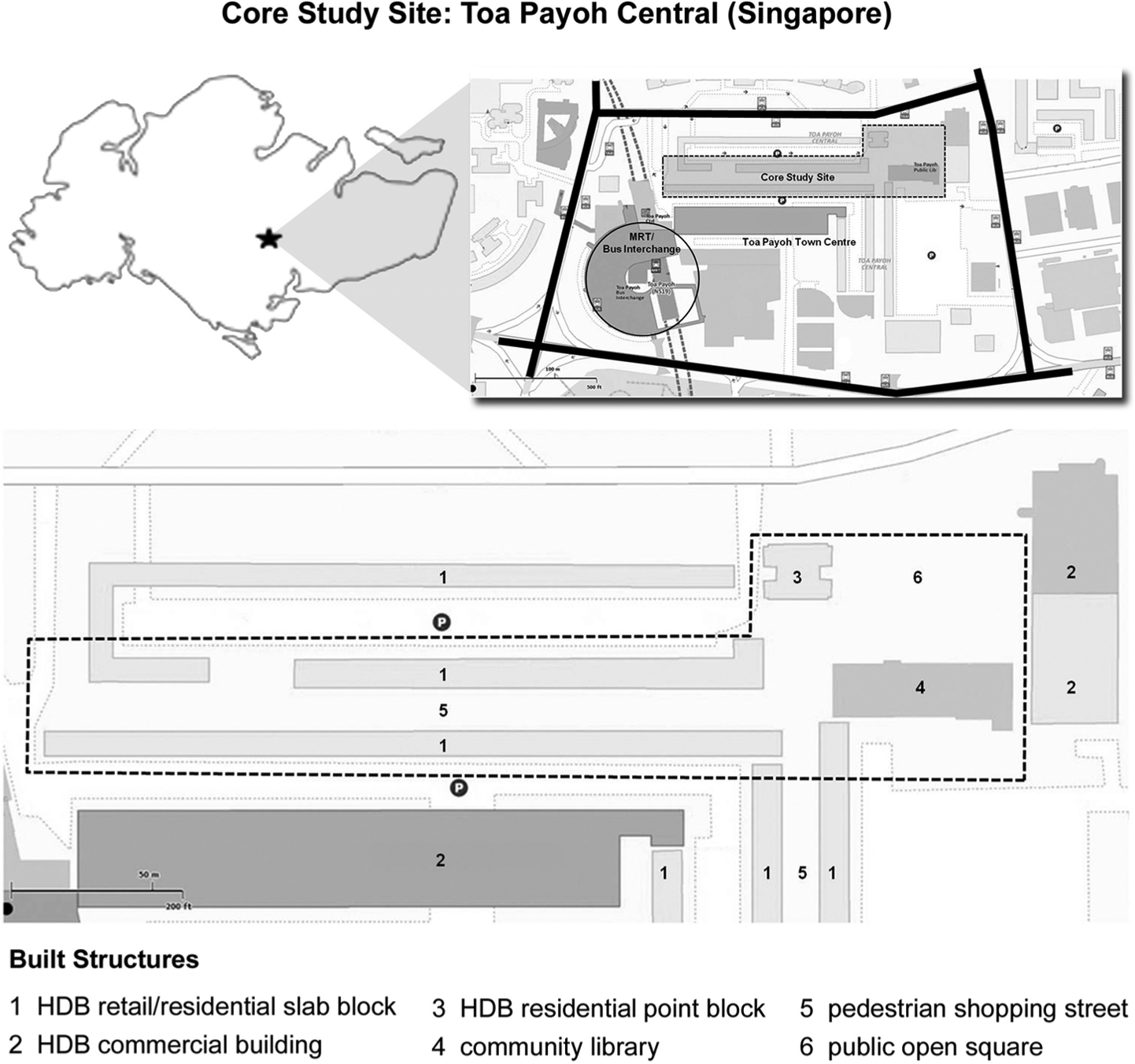
Location and site plan of Toa Payoh Central.
4. Methodology
This study takes a ‘view from below’ perspective, which allows us to “look at daily life, with its spontaneity, difference and disorder” and add new dimensions to our understanding of urban space by acknowledging the different groups and life forms that can only develop in the city (Madanipour, 1996, p. 73).
In order to provide alternative insights into the variegated urban experiences of the NTE and open the topic out to new avenues of debate, three qualitative methods of inquiry will be adopted: flânerie, photography and narration (see Yeo et al., 2012).
The trialectics of flânerie–photography–narration allow us to embody the role of a “walking methodologist” (Jenks, 1995, p. 153)—that is, one who: traverses the streets of the city; encounters the lifeworlds of ordinary people; and partakes in the performance of place. Equipped with a notebook, camera and audio recorder, the walking methodologist gathers data in the form of text (field notes), images (photographs) and narratives (interviews) that are collected from frequent field visits over a prolonged period of time. As the global city is a textured pattern of experiences, images and stories, flânerie–photography–narration can help to synthesise these discoveries into a telling “montaged account of urban life” (Highmore, 2005, p. 160).
Our immersion in TP Central spanned from March 2011 to June 2012. In order to experience and capture the informal practices of TP Central after dark, we conducted the majority of our observations and interviews between the hours of 7:00pm and 12:00am (defined here as the night-time economy) on random weekdays and weekends. During our forays in the field, we participated in the ‘urban rhythms’ of the crowd as a flâneur/flâneuse would by: dining at neighbourhood eateries; taking rest breaks on public benches; purchasing drinks and snacks from vendors; and strolling at a leisurely pace (for more on rhythmanalysis, see Lefebvre, 2004; Highmore, 2005; and Edensor, 2010). We engaged 40 random individuals in semi-structured interviews when the opportunity presented itself while seated, standing next to, or passing by a stranger. In this way, we were able to experience spontaneous face-to-face encounters with participants/spectators and seek answers to questions about particular space–time activities as they unfolded. Our understanding of the field was also aided by two long-time residents of Toa Payoh and a Chinese–English translator, all of whom enhanced our immersion by providing invaluable access to people and information.
In addition, we employed a camera to capture ordinary scenes that resonate with the research theme of everyday (night)life. We were led by Cartier-Bresson’s notion of the ‘decisive moment’ which materialises the instant when all the elements of an event converge within the frame of the camera’s viewfinder, thus enabling us to “recognize—simultaneously and within a fraction of a second—both the fact itself and the rigorous organisation of visually perceived forms that give it meaning” (Cartier-Bresson, 1999, p. 16).
In this way, the images we produced are aesthetic compositions of fleeting spatial and temporal realities that articulate our subjective encounters with the ‘observed’ in TP Central (for more on urban street photography, see Evans, 1938; Levitt, 1993; and Winogrand, 1999). Another visual component of this study is time-lapse video-recording. For this, we captured 96 hours of footage from one corner of the shopping street. Such objective data allow for comparisons between the daytime/night-time and weekday/weekend pedestrian volumes in TP Central. Whyte (1980) was an early adopter of time-lapse photography in the seminal book The Social Life of Small Urban Spaces, while Roberts and Turner’s (2005) employment of time-lapse video-recording in their study of the NTE in London’s Soho district is a contemporary adaptation of this method. In the following section, we will describe in two parts the spatial and temporal manifestations of urban informality in TP Central at night.
5. An (Extra)ordinary Night Out in Toa Payoh Central
5.1 Informal Economy
Modern shopping malls are appearing more frequently in HDB town centres across Singapore, thereby making any surviving outdoor shopping street like TP Central an anomaly. Here, the types of business include: eateries; fashion boutiques; beauty salons; telecommunication stores; and medical clinics. Currently, the HDB has drawn up strict guidelines that permit shop owners to utilise the ‘outdoor display area’ (ODA)—a common space fronting each HDB shop unit—for the organised display of goods related to their core businesses (Housing and Development Board, 2007). These regulations are intended to achieve a sense of formality and order in neighbourhoods where small businesses operate. However, as our findings reveal, informal appropriation of the ODAs is a common practice in TP Central.
First, a number of items on display—ranging from fruits to children’s toys and mobile phones to undergarments—bear no similarities to the core businesses of the immediate HDB shop units, as the ODAs are occupied by unrelated vendors. One media report investigated the ‘misuse’ of ODAs and found that retailers were employing “tricks and tactics to get around the strict rules on subletting” such as “claiming that they own a stake in the makeshift stalls set up in front of their shops”, with some retailers going so far as to “stock products sold by the stalls within their premises” (Ong, 2010). According to the report, retailers explained that sub-letting the ODAs to third parties “was the only way they could survive the economic downturn and afford rent when sales are down” (Ong, 2010).
Secondly, the display of goods in the ODAs is to be confined within designated areas demarcated by red and yellow paint; this is to ensure that public walkways are unobstructed. However, a number of retailers contravene these guidelines with the employment of mobile equipment such as: makeshift tables and shelving units; roll-away display counters; temporary partitions; and removable signage—all of which give retailers the flexibility to modify the layout of their commercial space as required (see Figure 2). Furthermore, retailers also attempt to maximise the ODAs by affixing bamboo poles, clothes hangers and hooks to stationary structures such as ceilings and columns for the display of additional merchandise. Fashion boutiques, in particular, appear to adopt various advertising techniques that involve the use of: mannequins dressed in the latest fashion trends; eye-catching sale signs; and popular music playing in the background. During the Chinese New Year period, many retailers will embellish their shop space with festive decorations. These habitual and seasonal display practices highlight the desire of retailers not only to maximise their commercial space for economic reasons, but also personalise their commercial space for aesthetic purposes.
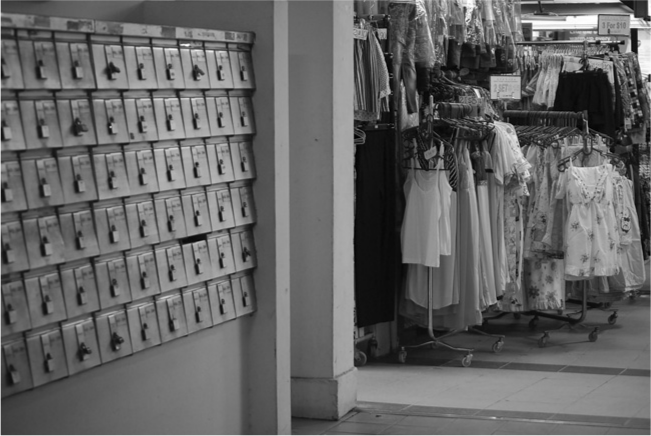
The informal display of retail merchandise on semi-fixed equipment is juxtaposed with the formal arrangement of mailboxes nearby. Photo: authors.
The informality of the retail businesses in TP Central are quintessentially ‘local’ in flavour and viewed by many Singaporeans as such This is one of those classical grassroot[s] kind of shopping that I think you can also find in other neighbourhoods. It’s a neighbourhood kind of shopping (female, 30s, visitor, Chinese-Singaporean).
In this regard, TP Central has become a shopping destination for visitors from other areas of Singapore. Well-known for the abundance of mobile phone vendors, TP Central has become a go-to place for shoppers in search of new and used mobile phones, accessories and parts. Moreover, with many independent mobile phone vendors located in close proximity, competition leads to the common practice of buyers negotiating prices with sellers, which contributes to the informality of the shopping experience as well as the informality of place They say that Toa Payoh has got more handphone shops than anywhere else. … I’ve come here a few times … and I’ve got a few good deals [on] secondhand phones. … But you have to browse around, you don’t go to one shop. The [reason] I come here is because there [are] a lot of shops here, handphone shops, so I can browse and mix and match the price (male, 50s, shopper, Indian-Singaporean).
Another popular commodity item in TP Central is durian (a tropical fruit with a distinctive odour). A recent competition between two durian vendors in April 2012 led to a momentary ‘price war’, which attracted enthusiastic bargain-hunters from near and far (see Figure 3). Customers were eating the fruit amidst the crowd and nonchalantly tossing the seeds and husks into large baskets set out on the pavement by the vendors. In a highly regulated city-state where the carrying of durians on public transport is banned and the consumption of durians in commercial buildings is viewed as socially uncouth, the blasé manner in which durians are transacted in TP Central is emblematic of the permeation of urban informality in the heartlands. In this regard, the durian price war phenomenon not only attracted hundreds of people to TP Central over the course of several nights, but also threw light on the vibrancy and spectacle of the NTE in local neighbourhoods.
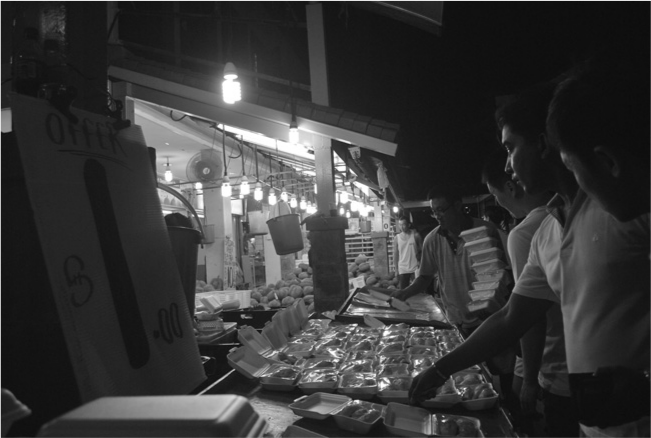
Customers purchasing durians during a price war between two competing vendors. Photo: authors.
5.2 Informal Rhythms
At 6:00am the slow stirring of activity at a kopitiam (a vernacular eating establishment where food and drinks prepared by individual stalls can be purchased and consumed) marks the start of a new business day in TP Central. These pre-dawn hours are also a time for the street cleaners to make their rounds. With many of the retail businesses and commercial offices still closed, the shopping street functions primarily as a conduit for the flow of morning pedestrians who include: office workers commuting to the city centre; children walking to school; and homemakers marketing for groceries. As one resident relates Here, in the morning, if I go to the market … I have to meet about six person[s] before I can finish marketing and then come back and meet another four person[s] before I can come home … you meet them and you have a few conversation[s] with them … You can’t help it because it’s a heartlander’s [way]—the people [are] like that, they’re very friendly … they’re concerned about one another (female, 70s, homemaker, Chinese-Singaporean).
The pace accelerates after 10:00am as retailers open for business. Between 12:00pm and 2:00pm, the tempo shifts to a brisk pace as TP Central becomes populated with office workers, residents and the elderly patronising the kopitiams, window-shopping and running errands. At the nearby HDB residential point block, several elderly men can be seen gathering in the void deck where they nap, read, socialise and play chess. Between 2:00pm and 6:00pm, the activity level in TP Central lulls as the afternoon passes. The urban rhythm of TP Central during the daytime from 6:00am to 6:00pm can be described as formal and purposeful (see Figure 4).
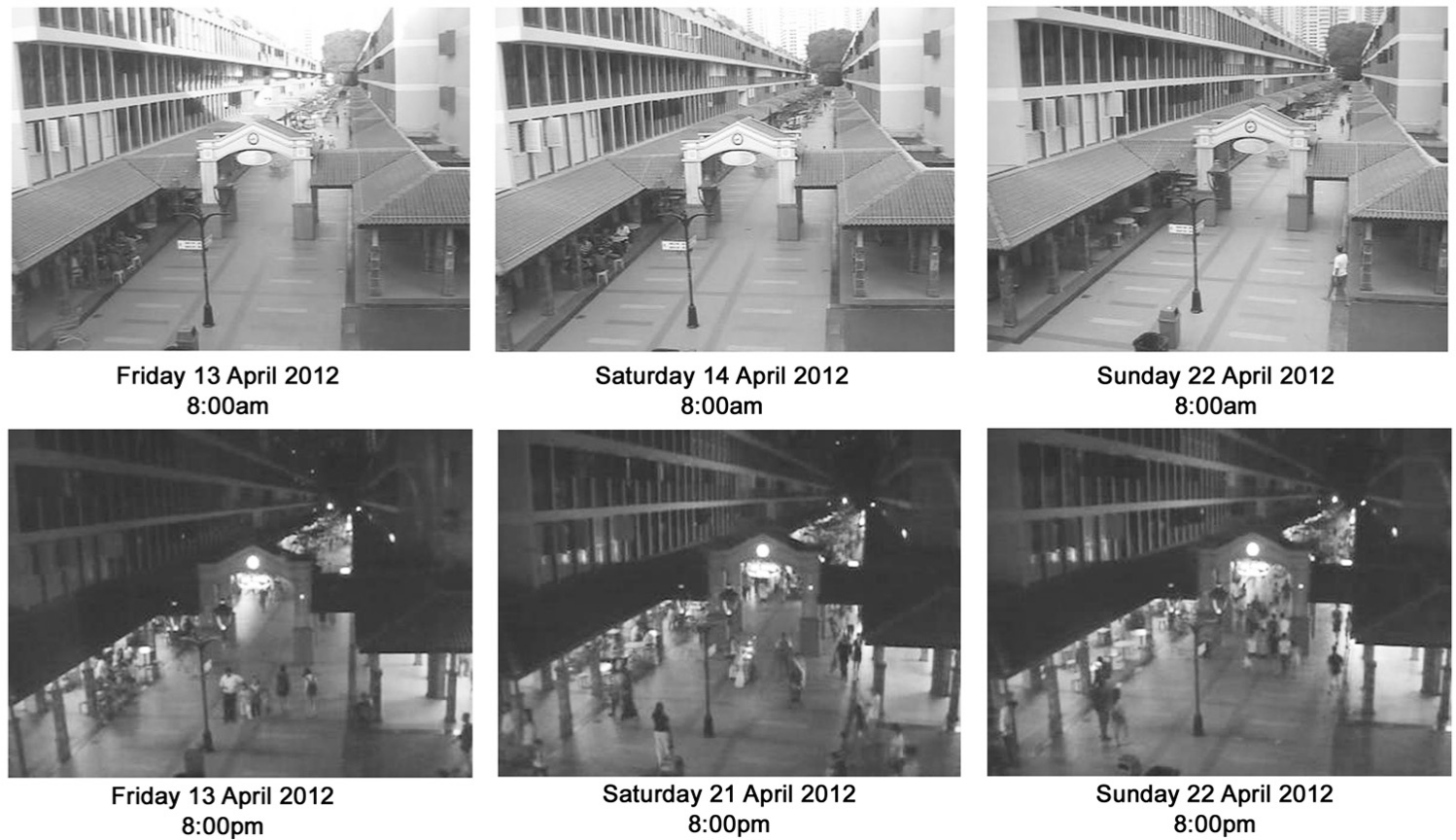
Time-lapse footage of the day vis-a-vis the night. Images: authors.
At night, the urban rhythm takes on a more informal and spontaneous nuance. The crowd begins to diversify from 6:00pm onwards as: office workers; students; retirees and the elderly; caregivers and the physically disabled; parents and children; and young couples converge in TP Central. During this time, the shopping promenade is abuzz with people partaking in a cacophony of activities that include: eating; shopping; strolling; people-watching; playing; loitering; resting; and socialising. Night-time in TP Central also attracts groups with shared interests. The public open square, for example, has become a gathering site for amateur astronomers who voluntarily deploy their telescopes and invite members of the public to view the night sky in an informal activity known as ‘sidewalk astronomy’ (see Figure 5). The spontaneity of this activity stirs curiosity and prompts pedestrians to become involved participants.
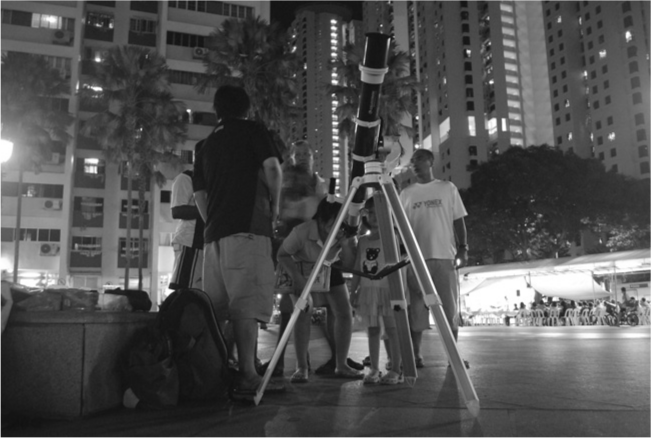
An informal ‘sidewalk astronomy’ session. Photo: authors.
The activity also catches the attention of individuals who are often located at the margins of society due to their physical disabilities or economic disadvantages, such as a group of deaf friends who noticed a sidewalk astronomy session taking place one evening. With the assistance of the group’s interpreter-friend, one of the members describes the deaf community in Toa Payoh The reason why we’re coming here to Toa Payoh is because there’s a huge deaf community that lives here. … The people here tend to have exposure to the deaf community … there’s a lady working at the newspapers stand, she’s deaf so she tends to gesture. And people who buy newspaper from her also would tend to gesture to her. They respect her deaf culture, so I’m impressed with that (male, 50s, visitor, African).
TP Central’s heterogeneous cross-section is a microcosm of Singapore’s cosmopolitan society, albeit one that is geographically situated in the heartlands. The informal heartland way-of-life is further exhibited at night in the public spaces of the neighbourhood Those granite benches along that area [are] very warm in the afternoon. … So once it’s evening time then the regulars sit there and chit-chat … Some of them even stay there pretty late. Maybe some of them stay [and sleep] overnight. … From what I understand, most probably they have some family problems with their in-laws or relatives … so they just don’t want to see them during the nighttime. … [For others] it’s [the] kampong spirit because they feel that [during] the warmer months it’s just more airy outside (male, 40s, resident, Chinese-Singaporean).
Another example of urban informality is the nightly chess games that take place in the void deck of the nearby HDB residential point block. Dressed casually and sitting on the bare floor, the chess players are intensely focused on the game while spectators watch (see Figure 6). For residents living in this HDB block, the nightly gathering of chess players at the threshold of their residential domain is an everyday occurrence that they have tolerated for more than 20 years. One female resident (20s, Chinese-Singaporean) explains that the chess area is a signifier of ‘home’ because it is a sight she encounters each time she enters and leaves her home.
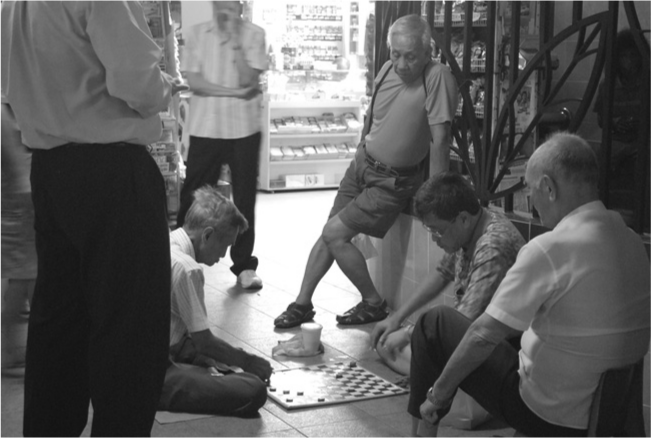
Nightly gathering of chess players. Photo: authors.
By 10:00pm, the sound of store shutters rolling down echoes through the empty shopping street. A few individuals armed with plastic bags and pushcarts rummage through the overflowing waste bins to salvage recyclable materials that have accumulated during the night. At this time, a lone female wanders about—she has come to feed the stray cats, many of whom emerge from their hiding places once the shops have closed. The informant explains that there are more than 10 cats in the area that she feeds on a nightly basis. Her feeding sessions last until midnight and, during this time, she will often encounter other likeminded residents who share the same cause.
6. Social Sustainability in the City at Night
Contemporary urban nightlife plays a significant role in the making of global cities today. More than simply a means of merry-making, boosting civic pride and creating job opportunities, the night-time entertainment industry is contributing to the larger urban economy with its potential to attract foreign direct investment, creative talent and tourism. At the same time, the spectacular consumption spaces of a global city can exclude segments of the population along the lines of age, class and ethnicity. If cities are to become the vibrant and sustainable environments that policy-makers, planners, architects and community groups envision, then issues of accessibility, tolerance, diversity and participation need to be addressed not only within the formal realms of the day but also the informal realms of the night.
First, accessibility is employed here to describe the ‘publicness’ of public spaces. The heterotopic night-time city, in particular, is often regarded as a socially divided and spatially segregated milieu (Chatterton and Hollands, 2003). TP Central, on the other hand, demonstrates what an accessible NTE could offer. Here, the physical and economic barriers to entry are low. Unlike some areas of the city where outdoor rest areas are generally insufficient or require patrons to purchase food and beverage items from a vendor, the public amenities in TP Central are free and accessible at all times (see Figure 7). In addition, the unpretentious character of TP Central helps to remove any stigma related to personal appearances such that one can be having dinner while immaculately dressed or window-shopping in casual clothes. Moreover, in a multilingual society like Singapore, business transactions and social interactions in TP Central are conducted in a number of different languages and dialects. This is particularly useful for new immigrant groups, elderly Singaporeans and the illiterate who have difficulties communicating in English (the lingua franca of a post-colonial Singapore).
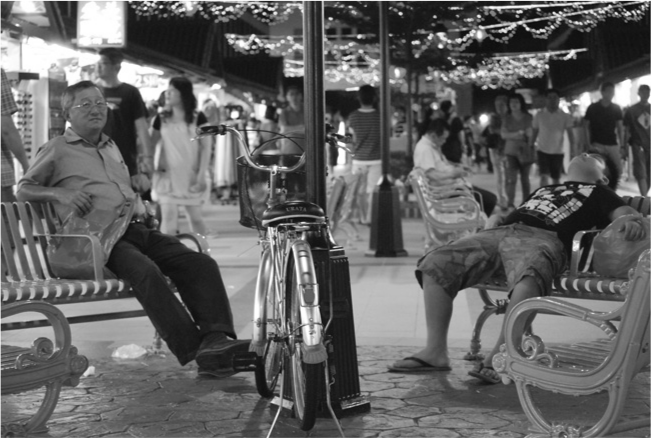
Accessible public amenities. Photo: authors.
Secondly, inclusivity hinges on tolerance of differences, digressions and disorder. The privatised consumption spaces along Marina Bay, for example, exudes a particular kind of consumptive culture that appeals to individuals with discerning tastes in fashion, art and entertainment. In order to maintain this illusion, there are social norms that uphold certain ways of dressing, behaving and speaking. Intolerance, therefore, arises when these social norms are not met. In comparison, the everyday (night)life in TP Central exhibits an unfettered tolerance for plural ways-of-life where: public benches function as temporary beds; kerbs serve as places to rest; and open spaces transform into an imaginative playground for young children. Moreover, there also appears to be tolerance of practices that deviate from local ordinances that regulate the use of space. Bicycling, for example, is prohibited along the shopping street; nevertheless, bicyclists continue to contravene this bylaw while pedestrians have learnt to negotiate the promenade with other users. Similarly, receptacles for refuse are dispersed throughout TP Central for the disposal of garbage, which accumulates faster than it is cleared. What may be considered a visual blight on the urban landscape is, instead, seen as a recycling ground for opportunistic karang guni (rags and scraps) collectors whom residents and shopkeepers tolerate as members of the community.
Thirdly, diversity is paramount to the continued existence and relevance of local neighbourhoods in a competitive urban economy. The everyday (night)life in TP Central produces sites of difference, diversity and depth; this, in turn, adds to the array of urban nightscapes available in a modern city as well as providing opportunities for the disenfranchised to be included in night-time leisure and recreation. As Zukin asserts Neighborhood shopping streets, especially when they are connected with ethnicity, social class and gender, are sites where identities are formed (Zukin, 1995, p. 190).
In terms of the built environment, TP Central imbues a highly formal and planned urban design, yet there is a prominent diversity of aesthetics contributed by: independently owned small businesses; unco-ordinated displays of goods and merchandise; haphazard signs; hanging props; retractable screens; appropriation of the ODAs; and transient ‘fire sales’ (see Figure 8).
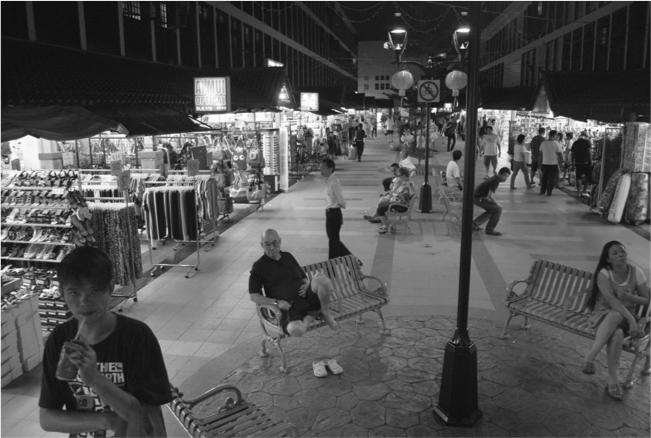
Urban informality and the making of place and image. Photo: authors.
Here, we speculate on two political impetuses that have enabled TP Central to retain much of this informal diversity. First, as a loosely regulated place, TP Central is an inviting environment for small enterprises to participate in the domestic economy. These independently owned businesses help to sustain the livelihoods of lower-income groups and reduce their dependencies on a state system that advocates self-reliance and meritocracy (see Chang and Ong, 2012). Secondly, as one of the earliest HDB public housing estates, TP Central is underpinned by decades of collective social memories. This nostalgic sense of place is valued more and more by Singaporeans as old townships in other parts of the city-state are being replaced by high-density developments. Nevertheless, low-density neighbourhoods such as TP Central face a precarious future in Singapore where increasing population growth and land scarcity drive the need for the optimisation and intensification of land use.
Lastly, in a globalising world where an increasing portion of the public realm is being threatened by the insurgence of corporate ownership and control, the dynamism and ludicity of public life in ordinary places are valued assets that warrant safeguarding. As “the locus where everyday life manifests itself, where solutions are sought to remedy failures in the formal system, and where resistance is galvanized” (Laguerre, 1994, p. 23), public spaces have the capacity to promote active citizenry. On Tuesday nights, a crowd of residents in TP Central mill outside the doors of their neighbourhood constituency office where they meet with their elected Member of Parliament on matters concerning the community and personal livelihoods. However, more than simply serving as an outlet for remediation and exchange, these ‘meet-the-people’ sessions in TP Central also act as a visual barometer of the civic role of public spaces in nurturing engagement between civil society and the state. As Douglass et al. (2008, p. 3) argue, the competitive nature of globalisation and the fluid mobility of wealth are contributing to “increasingly complex” relations “between state, civil society and capital”. The spatiopolitical function of the public realm as a staging ground for citizen participation in the civic life of everyday places, therefore, should not be underestimated.
7. Conclusion
The NTE has played a hallmark role in cultivating Singapore’s ‘urban renaissance’ story. Contemporary urban nightscapes in Singapore—such as the waterfront precinct of Marina Bay, nightclub district of Clarke Quay and shopping boulevard of Orchard Road—are planned and developed to attract people to the city centre during the day and night, thereby increasing the economic viability and social vibrancy of urban places. At the same time, however, more and more public spaces are becoming privatised in the form of shopping centres, event facilities and entertainment complexes where individuality and autonomy are regulated and controlled by the hegemonic surveillance of corporate entities. Moreover, such formal realms and the prescribed lifestyles of their privileged users may, directly or indirectly, exclude ‘Others’ of a different age, class and ethnicity.
In this study, we shift the spotlight from the carnivalesque haunts of the night-time city to the everyday (night)life of ordinary places in order to answer the questions: how is the NTE in quotidian environments produced and consumed, and how does this form of everyday (night)life contribute to the making of a more inclusive city at night? As our fieldwork in the suburban neighbourhood of TP Central reveals, the NTE in Singapore does not only prevail in the city centre but also flourishes in quotidian places where ordinary people live, work and play. In such places, one can observe informal modes of appropriation, negotiation and democratisation performed by pedestrians, shoppers, vendors and entrepreneurs during the laissez-faire hours of the night. These (extra)ordinary sociospatial practices shape our experience of urban life and influence our attachment to urban places. More significantly, the NTE in quotidian places like TP Central could help to foster social sustainability as it enables: accessibility by the wider population; tolerance of plural norms; diversity of people, businesses and design aesthetics; and participation by civil society.
We acknowledge, however, that this study has limitations set by temporal markers that frame our observations and analysis of the NTE within the hours of 7:00pm and 12:00am. It is generally thought that the late-night economy from 12:00am to 5:00am produces a significantly different night culture (Rowe and Bavinton, 2011), which can generate feelings of fear and anxiety among a ‘mainstream’ public yet simultantenously create opportunities for an ‘alternative’ public to participate in urban life after dark. An extensive investigation across the temporal continuum of the evening, night and late-night economies, together with a close examination of the producers and consumers of urban nightlife, could provide a more complete understanding of the nocturnal city. Moreover, as this paper has demonstrated, such an understanding can be enriched if we include in our explorations the everyday (night)life of ordinary urban dwellers in the quotidian places that make the city at night extraordinary.
Footnotes
Acknowledgements
The authors are grateful for the insightful comments and helpful suggestions contributed by the three anonymous Urban Studies referees. The authors would also like to thank Urban Studies managing editor, Dennis Rodgers, for his editorial efficiency and guidance.
Funding
This research received no specific grant from any funding agency in the public, commercial or not-for-profit sectors.