






Abstract
This paper analyses the policing strategies of private security companies operating in urban space. An existing literature has considered the variety of ways that territory becomes of fundamental importance in the work of public police forces. However, this paper examines territory in the context of private security companies. Drawing on empirical research in Cape Town, it examines how demarcated territories become key subjects in private policing. Private security companies are responsible for a relatively small section of the city, while in contrast the public police ultimately have to see city space as a whole. Hence, private policing strategy becomes one of displacement, especially of so-called undesirables yielding a patchworked public space associated with private enclaves of consumption. The conclusions signal the historical resonances and comparative implications of these political–legal–security dynamics.
1. Introduction: Exclusionary Definitions of Order
This paper contributes to the discussion of urban fragmentation by scrutinising imbrications of security, governance and territory at the level of the street. A growing literature has recognised the significance of security practices in defining and reshaping public, urban space, often with exclusionary results (Herbert and Beckett, 2010; Mitchell and Staeheli, 2005; Mitchell, 2003; Smith, 1996; Wacquant, 2009). This work has established that a range of agencies from the state, private and voluntary sectors now contribute to policing public spaces, often in formalised partnerships (Yarwood, 2007). To date, work has tended to focus on the roles of state and voluntary sectors in public space and, by contrast, less is known about the role of the private sector in shaping urban space. While some studies have paid attention to its use in securing private or semi-private spaces, such as shopping malls, gated communities or commercial premises (Atkinson, 2003; Low, 2003; Shearing and Wood, 2003), there is a lack of knowledge about its increasingly prominent role in public space. This is despite evidence that private security companies are being used to supplement or replace state policing at a range of scales from the management of individual streets to the running of whole policing areas and headquarters (Noakes, 2008; Rigakos, 2002; Travis and Williams, 2012).
In these cases, private agencies are felt by those who employ them to provide more efficient and targeted ways of policing urban spaces, reflecting broader neoliberal approaches to governing urban space (Bénit-Gbaffou, 2008; Davis, 2006; Herbert and Beckett, 2010; Kempa and Singh, 2008; Samara, 2009; Smith, 1996; Young, 1999). Unlike state policing, private security companies do not aim to provide a universal coverage of space but, instead, concentrate on patrolling particular urban places that have been identified by urban managers, such as City Improvement Districts (Bénit-Gbaffou et al., 2012; Berg, 2004, 2010; Didier et al., 2012; Miraftab, 2007). Their work often focuses on ‘preventing the worse’ through the creation of literal and metaphorical barriers to keep out ideas, things and people that are seen to threaten the security of these spaces (Herbert and Brown, 2006; Loader, 2006; Sidaway, 2007; Turner 2007; Yarwood, 2010; Young, 1999); what Bookman and Woolford (2013, p. 314) call an “exclusionary definition of order”.
Although the imposition of private actors on public spaces may reflect neoliberal ideologies, the extent to which they actually transform urban space depends on their effectiveness as agents of security. Certainly, some commentators have questioned the effectiveness and power of private security. Herbert (1999, p. 158) suggests that it is “not new, overlaps significantly with public agencies and is frequently anaemic in its power and its affects”. If this is the case, it would be premature to assume that there is a link between the operation of private security and the transformation of urban space. Rather, as Herbert’s (1996, 1997) work demonstrates in the context of state police, it is important to understand how the daily practices of agencies on the ground reflect and shape broader changes in urban governance.
Yet relatively little is known about the practices of private companies in public, urban space. While detailed work has been carried out on the use of law and the public police (Beckett and Herbert, 2008; Mitchell, 1997; Samara, 2008, 2010), the role of private security tactics on the streets has received little attention. Indeed, this is new ground for private security agencies themselves as, hitherto, they have largely operated within the easily defined parameters of private enclaves. By contrast, public space is likely to be more diverse, fluid and multifunctional than private space, lacking the visible boundaries that define and segment private spaces. The challenge for private security agencies has been to adapt their practices to these new spaces, while the challenge for scholars is to understand how and where these daily routines contribute to the fragmentation of urban space.
Addressing these changes in private policing strategies, our paper aims to enrich discussion around territorial understanding of policing bodies and urban policing strategies. It has two main aims: first, to foreground the practices of private security in public space and, second, to consider how these practices contribute to the fragmentation of urban space. It draws upon grounded analysis of the policing tactics applied by private security firms in Cape Town (South Africa) in their attempt to exclude people regarded as ‘undesirable’ by city managers from the City Improvement Districts (CIDs). In order to provide a framework to understand the operation of private security on a daily basis, the following section identifies the significance of territory to their daily routines.
1.1 Policing and Urban Territory
Territory is important to the daily geographies of the contemporary city (Sack, 1986; Storey, 2012). However, it also needs to be understood as “a political technology: it comprises techniques for measuring land and controlling terrain” entangled with the state (Elden, 2010, p. 811). The fragmentation of urban space by different, and sometimes competing, urban managers hence reflects the efforts to define and establish territories according to neoliberal forms of governance and capital accumulation (Didier et al., 2012; Ward, 2011).
The use of security represents an important technique to achieve these goals that, in turn, allow broader reconfigurations of socio-spatial power. To do so, territory itself becomes the basis for policing as it is used to enable and organise disciplinary powers (Herbert, 1996; Yarwood and Edwards, 1995). Spaces are policed using a normative ordering of practices, rules and actions based around routinised values (Herbert, 1996, 1997). Traditional state policing uses a clear, nested hierarchy of space to ensure the whole of the state is policed (albeit in different ways) (Fyfe, 1991). At the lowest level, this hierarchical network consists of beats or precincts which define and police different local territories without overlap or gap. Within these spaces, territory is used dynamically to exercise state-sanctioned discipline (Herbert, 1996, 1997). On a daily basis, as Herbert (1996) demonstrates with the Los Angeles Police Department, the police are able to establish temporary boundaries in urban space to achieve public order. These can be used to negotiate between public and private space, to send people into certain directions and deny them other spaces. The controversial use of ‘kettling’ tactics by British police, whereby protesters are hemmed into a space by police and held there, is a telling example of this use of territory (Storey, 2012). These types of territory are temporarily produced in response to contingent situations, usually related to public order or providing security.
In the case of public and voluntary policing, territory is therefore used to fulfil wider policing objectives, but the securing of territory is the main objective of private policing as it is largely concerned with “delimiting and asserting control over a geographical area” (Sack, 1983, p. 56). The easiest way to achieve this is by erecting real and symbolic barriers that exclude people and activities that do not conform to the assigned purposes of these spaces (Cresswell, 1996; Mitchell, 1997; Young, 1999). What occurs outside these spaces is of little concern to those tasked with securing them.
Non-state policing actors operate in specific, often fragmented spaces. Geographically this means that governing bodies implement different, often uneven, forms of regulation over space leading to a ‘patchwork’ of policing and the emergence of security ‘quilts’, ‘bubbles’ or ‘corridors’ (Zedner, 2009). These spaces are not embedded in a wider hierarchical structure and the actors that police them are not responsible for the whole city or state. They are isolated places within the city in which certain activities (such as consumption in retail malls, residence in gated residences, travel in transport corridors) are permitted by selected denizens (Shearing and Wood, 2003).
Following Elden (2010), who shifts the terms of debate towards the political tactics involved in the production of territory, our paper examines the relationships between private security directed at securing bounded spaces and the wider state territorial duties of the police. In the case of Cape Town, this produces disjuncture, fragmentations and complex territorialisations of state and commercial power. These reconfigure the relationships between state, territory and police and commercial powers that were associated with apartheid statecraft (Bénit-Gbaffou, 2008; Robinson, 1990; Samara, 2009), where urban space was racially coded and, especially in the non-White territories, policing was largely about maintaining this segregation (Brewer, 1994). While the policing practices we discuss in this paper differ significantly from those of the apartheid era, they continue to fragment public space in the centre of the city. Wealth rather than race has become the main focus of private policing although, inevitably this contributes to a spatial division of White, wealthier citizens from the poorer, non-White majority. 1 The enclaves of the city centre, secured through a combination of law and (private) force, contrast markedly with other parts of the city where insecurity prevails, mirroring the racialised landscapes of power and privilege of Cape Town’s apartheid era (Jensen, 2010). The key difference of post-apartheid space is that territory, enforced by different policing practices, is less as a uniform container and more of a mobile and fractured array. We return to this in our conclusions.
2. Structure and Methods
With these frames in mind, our paper considers three issues in the context of Cape Town. First, it examines how private policing is practised and how territory becomes significant in its daily practices. It focuses on the spaces of the City Improvement Districts (CIDs) and their ‘invisible boundaries’ that form the basis of security operations. Secondly, we consider how the territorialisations of the CIDs reflect power relations by examining the daily struggles between private security agencies and street people 2 that unfold within these territories. It reveals a strategy that aims to displace certain people and crime beyond the privately policed territory and ultimately towards the periphery of the city. Cultural as well as criminal threats are the target of private policing. Thirdly, the paper focuses on power relations within the wider policing network and considers how the spaces of private security impact on the territories of state policing. The paper examines five CIDs in central Cape Town that include the City Bowl and its surrounding suburbs of Woodstock and Sea Point (see Figure 1). The Central City Improvement District (CCID) was introduced in 1993 and was the first Improvement District in Cape Town. In the following years, more Improvement Districts were introduced in concentric rings around the CCID. At the time of the research, 17 different CIDs were operating all over the city.
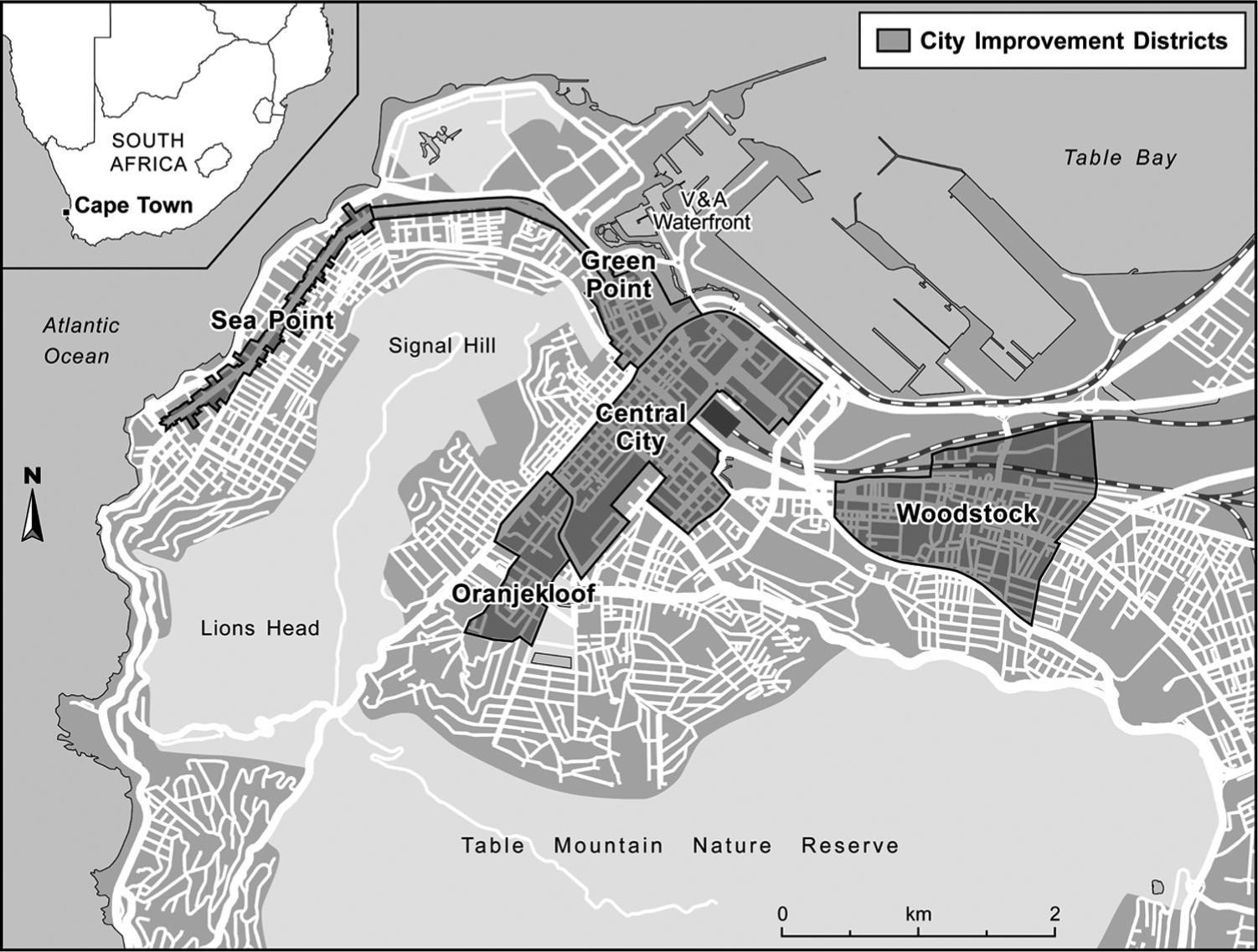
Privately policed territories in central Cape Town.
The paper draws on 47 semi-structured interviews that were conducted with a range of informants that included security agencies, local politicians, city officials, police officers, representatives of the criminal justice system and managers from different City Improvement Districts. All were chosen for their insights into the practicalities of territorialised private policing strategies and were selected by a combination of targeted correspondence prior to fieldwork and snowball sampling on the ground. The themes discussed in the interviews included the use and definition of space and territory, operational procedures of private security, and attitudes to the urban poor.
Additionally, 15 ethnographic observations of private security patrols were conducted over a nine-month period by the first author. These involved shadowing (overtly and with their consent) foot or car patrols of security companies, observing their practices and talking to security officers and members of the public, including street people. The following sections draw upon this work to provide insights into daily security routines, the production of territory and the social implications of these practices.
3. Producing Territory using Private Security: The Cape Town Context
Since the official end of apartheid, high crime rates and low levels of police resources have been seen by some decision-makers to have hindered Cape Town’s commercial development. In response to these concerns, city managers have adopted the North American concept of the City Improvement District (CID) (Didier et al., 2012; Miraftab, 2007). These are formal associations of businesses and property owners who assume collective responsibility for managing a prescribed urban area. Their aim is to manage and maintain the public environment at a better and superior level to that provided by the local authority, The establishment of the CID is to ensure a more effective management of public areas, address issues of crime and grime, promote business confidence and play an all-embracing role in the promotion of the designated CID area … To be an integral part of a world class city (Sea Point Improvement District, 2012).
Regulated by a by-law (City of Cape Town, 2003), CID status requires business owners to pay a levy to fund the provision of services beyond those usually delivered by state agencies. These include street-cleaning, place marketing and, most significantly, security. The CCID (Central City Improvement District) is the largest CID in the case study (see Figure 1) and spends 50 per cent of its budget on security (Central City Improvement District, 2012). In order to be awarded CID status, territory must be clearly defined and all money raised by the extra levy must be spent within defined geographical space. While the primary function of CIDs is to provide top-up or additional services to those provided by the state, this also lends them considerable powers to order social relations on their streets (Paasche, 2012).
These in turn help to establish the CID as a distinct territorial unit within the city. Its managers are keen to emphasise that their district it is a clean, attractive, fashionable and, above all, safe place to shop, in contrast to other parts of Cape Town. 3 The key point for the CIDs is that their space is seen differently by middle-class and tourist consumers to other public spaces. The establishment of distinctiveness with recognisable territory is therefore a key to the CID’s commercial success.
To achieve this, CIDs assume a direct control of public space. This occurs in three ways. First, the legitimacy of the CID is achieved by enrolling members. If more than half of all businesses in the geographical area proposed as a CID vote for it, the CID is established and every business within this territory must pay the levy that finances the CID (City of Cape Town, 2003). The new CID will then establish a management structure and hire security and cleaning companies.
Second, once the CID is established, by-laws are promulgated (or, if already in place, enforced) to regulate the space and ensure that it has the social and spatial characteristics that are distinct from other parts of the city. Although widely used in Cape Town, the CIDs are one of the few governing bodies that actually enforce by-laws and utilise them to recompose urban territory. Particular use is made of the by-law “relating to streets, public spaces and the prevention of nuisances” (City of Cape Town, 2007) to exclude those from the CID whose behaviour is deemed conducive or disruptive to consumption. The law targets behaviour that makes it impossible for street people to live in the spaces of the CID. 4 In the South African context of high crime rates and an overstretched police forces (The Economist, 2011; Shaw, 1997), private security and their power to create space by recomposing the social structure is essential to the functioning of the CIDs.
Third, private security officers on the ground enforce these by-laws and thus establish the de facto territories of the CID. CIDs in Cape Town employ up to 220 uniformed security officers who provide a continuous and, above all, visible presence in their territory (see Figure 1). The appearance and equipment of the guards varies depending on the kinds of threats they are perceived to face, but often include black army trousers tucked into combat boots, batons, pepper spray and two-way radios. Officers patrol on foot and are backed up by colleagues in vehicles that look remarkably like police vans to the extent that they have facilities to detain and transport people in custody. All operations are co-ordinated by private companies’ own control rooms. Private security companies are now the most significant and visible form of policing inside CIDs. As the next section explores, the ways in which territory is envisioned by security practices are essential to the definition and technologies of CIDs.
4. Governing Security and Struggling over Space
4.1 Policing the ‘Invisible Boundary’
While the state police are responsible for the city as a whole (Fyfe, 1991; Herbert, 1996), private security companies see territory as a specific container in which they assert their power (Zedner, 2009). They have little concern about what happens outside the boundaries of their space, even if it is just a few metres away and hence their primary modus operandi is to expel threatening objects or people from their territory.
There is an ‘invisible line’ that marks the boundary of a CID and distinguishes between private and public space within it. It runs around entire CIDs. It envelops the private space of every shop entrance, every cafe with outside seating, intersects private property and divides every side street not part of the CID from the public space of the CID. Although it is not marked on the ground, it is very palpable for security officers and those subject to their gaze. In other words, the boundary becomes real as a frame for those who police and are the subjects of policing. Writing about policing another branded urban improvement district (that of Winnipeg, Canada), Bookman and Woolford note how the district also policies the actions of the actors who occupy branded space, enlisting them to the project of maintaining the brand’s image. Put differently, the brand serves as a framing decive by which all actions within the branded space can be assessed and are given coherence (Bookman and Woolford, 2013, p. 304).
Bookman and Woolford argue that in Winnipeg, private security is key to preserving the brand’s definition of order, but these patrols are only one set of actors wrapped up in interpreting, intuiting and embodying the very characteristics of the brand in their everyday activities. Business owners, employees, urban dwellers, vistors, homeless individuals and others who make use of branded space are also enrolled in the creation and recreation of its image (Bookman and Woolford, 2013, p. 304).
In Cape Town too, this negotiation is not static or monolithic and there is some to-and-fro of interaction and movement. Yet the frame or line is key. Moreover, in the case of Cape Town, whatever is beyond this is not the CID’s concern in terms of security practices (and the contrasts between the CID and other parts of the city beyond are especially marked). However, during their daily routine, security officers do cross the line between public and private space to sign the logbooks that are placed in shops along their patrol route. 5 This way, officers must make regular contact with the customers of their service.
On an operational basis, the main purpose of the patrols is to deal with unwelcome people who cannot consume and might impact negatively on the commerce within the CID and disrupt the desired secure atmosphere of the space. This also includes managing the physical space of the street through, for example, containing the tables and chairs of cafes to certain sites, limiting stand-up displays outside shops, or registered traders whose merchandise is outside designated spaces (see Figure 2). In this context, the yellow boxes for the traders depicted in Figure 2 symbolise efforts to produce a ‘neat and tidy’ space as CID managers often term it. However, the biggest challenges for security officers are street people who challenge the hegemony of consumption in the CIDs.
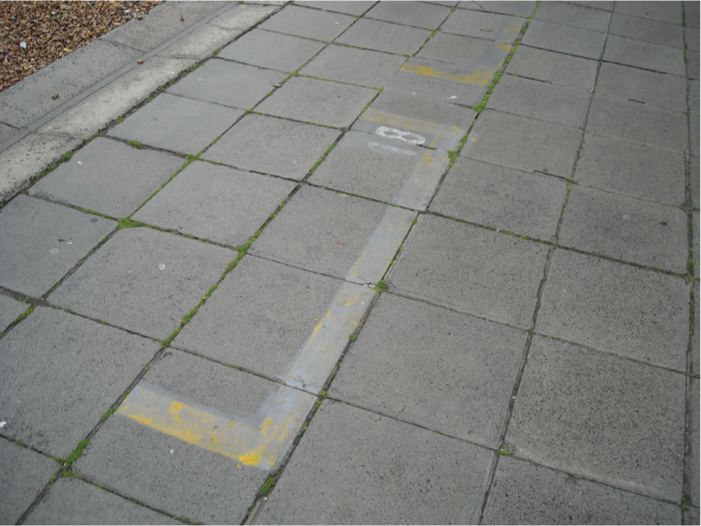
Managing street space.
Security officers push (verbally or literally) those who are deemed to threaten CIDs in cultural or criminal ways out of the CID’s territory. Once excluded, they are no longer of concern to the security officer. This very strict understanding of territorial boundaries is supported by the following two notes from street-level observations conducted by the lead author. The following two field observations were also confirmed by many other observations and statements made during interviews throughout the patrol, the importance of territory was emphasised and that they, the private policing body, were not to act outside the CID’s territory; if they witnessed a crime outside they called SAPS. When being asked if the street people know these boundaries, this was confirmed. Street people and urban poor know exactly where the ‘invisible boundaries’ are and as long as they behave well within it, private security will leave them alone. Here behaving well means not breaking any of the by-laws. If they do, they are removed from the territory, meaning they are being arrested or pushed out of the space. Furthermore the importance of keeping the ‘others’ moving was emphasised. Because if they settle, they have time to watch for an opportunity to commit crime. Soon after this conversation we encountered three so called rent-boys [young men, working as prostitutes] hiding all of their belongings in a gully in just a few bags. I was surprised that this was not pursued but then realised that this had happened just outside the territory of the CID confirming what has been explained just a few minutes before (excerpt from observation notes). Talking to a group of young men, security officers were drawn to our group and asked us to leave the public space as we were seen as a commotion to the peace and quiet. After some discussion between the groups of young males and the security guards, we all moved up the stairs of some shops that were private property. Once on the stairs and out of public space, the security guards relaxed and retreated a few steps to observe, as the problem was ‘solved’ (for the moment) (excerpt from observation notes).
Compared with other boundaries in Cape Town, such as walls and electric fences, this territorial boundary remains relatively invisible to those social groups (tourists and consumers) that CIDs aim to attract. However, for those enforcing or experiencing displacement, the ‘invisible boundary’ is a tangible presence. The head of a security company working for a CID explained if you go there in the early evening … just on the other side of XYZ street you will see where they [the street people] have their sleeping places and stuff like that ’cause they know on this side of the street they are going to be picked up (representative from private security sector A).
Occasionally private security staff are deployed outside these boundaries to support the state police or to respond to an emergency if it is in their interests to do so. Furthermore, the heads of CIDs hold regular meetings to discuss their different police or by-law issues (CID representative A; CID representative C). However, on a routine basis, security companies only police the territories they are contracted to (see Figure 1). In other words, they ensure that the governing bodies of the particular areas get value for their money within their particular territory. On the face of it, these tactics are successful in that they appear to be providing the safe environment desired by their clients: publicly available data reported that the “Central City Improvement District (CCID) has managed to reduce crime by 28 per cent” (Iol News, 2008) and the CCIDs chair in 2008 claimed that the crime rate of the past five years (before 2008) had “come down by more than 60 per cent” (Iol News, 2008). 6 More broadly, as the next section observes, the development of security bubbles contributes to the fragmentation of urban space (Mitchell, 1997, 2003; Young, 1999).
4.2 Displacement Struggles
The reterritorialisation of city space and its accompanying boundary practices rest on a policing strategy of displacing ‘unwelcome’ others. These practices of security differ from those experienced in private or semi-public urban space such as enclosed shopping malls or gated complexes (Bénit-Gbaffou, 2008; Kempa and Singh, 2008; Shearing and Wood, 2003; Wakefield, 2003) where a wall, gate or fence usually keeps strangers out. Here, the practice and performances of security guards are critical to maintaining more porous boundaries. As a member of the Mayoral Committee for Safety and Security in Cape Town confirmed to us, the daily struggle over space between private security and street people almost follows a ritual. The security guards will target and approach a street person, often both parties recognise each other (the security guards tend to know names, habits, preferred sleeping places and history of those they deal with on the streets) and will ask him or her to leave the territory. Sometimes after a short ritualised discussion (Figure 3) and sometimes without any comment, the addressed will leave the space, crossing the ‘boundary’, only to return after the patrol have turned their backs and walked on. This procedure then repeats itself when the next patrol comes along. These encounters suggest that, while the space of the CID appears transgressed, challenged and even negotiated on a daily basis, there is a powerful, exclusionary discourse that dominates the urban spaces and social relations of CIDs.
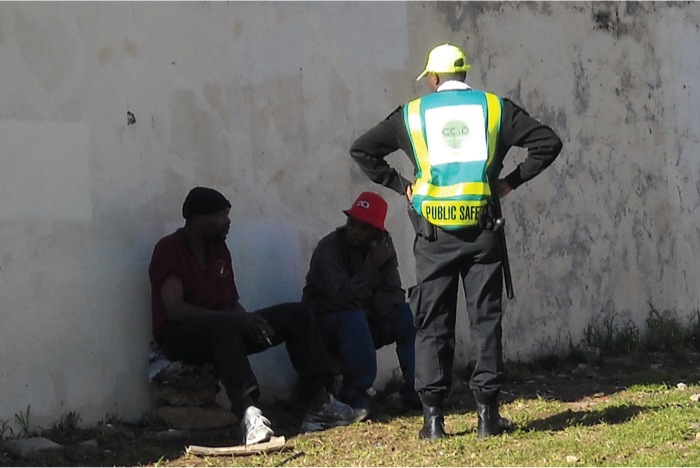
Private security and street people.
The following observation exemplifies the ritual between local street people and security officers that was observed on many security patrols our patrol car was driving around the territory to show force/visibility. When stopping at the corner of a bottle store, several street people came into sight. As soon as they saw the patrol car pulling up, they walked further away from the territory beyond the boundary. Again the importance of the territory was getting obvious as this displacement of the group just metres outside the territory was the only purpose of the stop. Knowing that the group will come back, the officer in the patrol car then contacted the guards on foot patrol to keep an eye on that particular corner and to chase the group of street people away again. Talking about this strategy after the event, the officer explained that there are the local street people and foreign ones [foreign not referring to, for example, nationality, but being not local]. The local ones know how to play the ‘game’ and do not carry weapons because they know that they are searched regularly. The ‘foreigners’, however, are different. Therefore they have to be prevented from settling down in the area. Often they are on the run, meaning they don’t know the ‘game’ (excerpt from observation notes).
One of the consequences of this is that street people accumulate in spaces beyond the privately policed territories so what in theory that has done is displaced all the crime from the centre of town. I’m not saying that there is no crime, but it has displaced crime a lot from the centre of town to the periphery. So we are picking up a lot of it here … there is an element hanging around … I saw it today six or seven guys real not-up-to-good guys at the crossway. Instead of them walking to town and robbing tourists and everything, they kind of wait on the peripheries where the cameras don’t cover. So it has effect, that definitely has effect on where crime transpires (representative from private security sector B).
Our data suggest two levels of displacement. The first is at a local scale, the second at a city-wide level. Some street people, so-called ‘locals’, became part of a particular suburb. They know the ‘rules’ of the game and are tolerated on the immediate boundaries of the CIDs as long as they obey these rules. These include not causing any disturbances when drunk, being unarmed and, foremost, not harassing customers within the CID. If the CID feels that they forget the rules, they initiate a police ‘crack down’ on ‘locals’ gathering on the fringes of the CIDs, using their contacts with the police. While CID security might not be directly involved in the raids, the police use the CID’s intelligence on these subjects. Having reminded everyone of their place in the urban power landscape, the daily security routine then continues.
The response to the street people pushed into the space is ambivalent in the residential areas around the CIDs. While some support them with food and thus enable their existence in the suburb, others feel that their property and lifestyles are disturbed. In turn, smaller, non-commercial versions of the CIDs are increasingly being introduced in residential areas. Residents with the organisation and financial resources group together and contract security companies. In consequence, street people may also be expelled from these public spaces and have to move on (representative from private security sector C; representative from private security sector A; CID representative C). In the words of one of our informants I mean in the areas when we don’t have CIDs … And this is also where private people, people that are living in the areas come together and they start taking care of the areas. So yeah there is definite shift into people taking more responsibility for their area (CID representative A).
This second form of exclusion is more city-wide and affects street people with no ‘local’ status and informal, unregistered vendors coming in from the townships to sell their merchandise. Those groups are sent away from one CID, ending up in the next where the exclusion is repeated. About one decade ago, the CCID (see Figure 1) became the epicentre of and model for other CIDs to mushroom throughout Cape Town. Yet crime is never eradicated. You displace it … And I have seen a lot of times where we were very successful in the city, that you could see that the displacement better than all the crime dots all around us and then we so assisting all our neighbours and those dots spread even further into the next policing area and not into our area … You know the kids that I found begging and snatching changed here in Cape Town, I just see them in Claremont again. Why are they in Claremont? Because they are not being giving the right to be in Cape Town [referring to the very centre of the city]. Cape Town is too strict. Cape Town is arresting them or catching them or preventing them. So obviously they … go somewhere else where they might get it right (CID representative A).
With the spreading of CIDs from the city centre outwards, they consequently contribute to city-wide exclusion of the urban poor towards the township areas, a development with parallels to the apartheid order (Samara, 2011). The views of one local politician from the opposition party reflect widespread criticism of this policy they [the CIDs] are pushing the poor to the slums, the shanty towns, to Khayelitsha and Gugulethu, to the township. The poor are being pushed away from the centre.
This has an impact on the city’s policing network as a senior Metro Police
7
officer explains you’ve got your private security there that does have an impact on your crime whether you want to acknowledge or not, but all it does basically, it pushes that crime to the less privileged areas that cannot pay for the security, which aggravates the situation on that side (Senior Metro Police officer A).
Yet as private schemes become successful in reducing crime rates in one area, there is a greater need for other territory-based forms of security in others. Depending on the wealth of the area these range from more private security schemes (of varying presence and quality), voluntary schemes such as neighbourhood watches by regular citizens or vigilante policing that is evident in townships. The territorial and organisational changes we observed also bear important implications for the state police, as the next section explores.
4.3 ‘Displacing’ the Public Police
The title of this section is deliberately provocative. By using the term ‘displacement’ (rather than replacement or supplement) in this context, the impact and consequences of private policing actors on wider policing network are foregrounded. In the interests of efficiency, the public police in many countries have followed ‘intelligence-led’ approaches to identify the areas of highest crime and locate officers to them. Although the areas of highest crime in Cape Town remain unpoliced or at the whim of vigilante groups (Fourchard, 2012; Gottschalk, 2005; Kinnes, 2000; Minnaar, 2001), there has been a tendency for the state police to be redeployed away from the CIDs (where crime rates appear to be lower as a result of private security) and towards other districts in the centre of the city where crime rates are increasing (perhaps as a result of displacement from the CID).
The CIDs and other privately policed areas require less public policing as they appear to be reducing crime rates and offering assurance for the producers and consumers of CID territories (Senior Metro Police officer B). Although private security mainly focuses on petty crimes and by-law offences; it is evolving to become the first port of call for any complaints for businesses at the same time. To further relieve public police forces (and to increase their powers), CIDs have also hired law-enforcement officers from the City of Cape Town with full powers of arrest (Berg, 2010). In this way, CID security can deal with routine arrests for minor offences on their own, not involving public police forces. A member of Mayoral Committee for Safety and Security informed us that what happens at least from the Metro Police’s perspective is that it leaves the City free to concentrate on the higher crime areas. We constantly adjust our policing resources to where the highest crime rates are and in response to new crime patterns and trends. As the areas within the CIDs see reduced crime we are then able to reduce our resource allocation to that area, which might not be a popular thing to admit to, but it is true. Obviously we give less energy to an area where the crime rate reduces.
When crime rates drop and/or criminals are being displaced outside the privately policed spaces, the public police follow the crime, while the private policing companies keep maintaining order only in their territory. This highlights that the public police have greater territorial flexibility to adapt city-wide, something private security does not have, or want. A CID representative argued in response to our question about consequences no, it’s a case of these actual cops are maybe freeing up other cops to go to these poorer areas. … Like you said earlier, could elevate certain people and they could say look we used to have 500 police there, now because there is a joint partnership we don’t need 500, we could do with 400. That now 100 could go to the poorer areas where nobody is paying (CID representative A).
Although this might overemphasise the effectiveness of ‘his’ CID as well as its advantages for the poorer communities, it confirms the general notion that, by displacing people and crime through strong private policing, the police follow the crime and/or need fewer resources in the privately policed areas. Having a chronically understaffed police service, this is the logical response. In other words the formula is: effective private policing in one space limits or displaces crime into other spaces. Given limited resources and staff, it is apparent that the state police are starting to focus on areas with no private policing, leaving private patrols as the sole or dominant agents in some areas. As a Metro commander admits if you really want to be transparent, none of my members patrol residential areas. They don’t because I can’t afford to let them patrol residential areas. And I don’t think that there is anybody here [referring to the rest of Cape Town’s Metro commanders] that with a clear conscience can say that they have daily deployment in residential areas. You [referring to the researcher] made an example yourself earlier, in fact you see one police van you see two private security. That’s the reality (senior Metro Police officer A).
This is testimony to how private policing contributes to a ‘displacement’ of the public police and therefore possesses considerable power in reformatting the policing network of Cape Town. However, the public police force does maintain full powers over the privately policed public space. This division of labour only functions through a strategic partnership between the public police and private security companies. In case of the serious crimes that for example involve the use of firearms, all CIDs maintain good working relationships with public police forces to guarantee immediate backup if needed.
5. Conclusion: Territory/Legality/Security
Our work points to a reciprocal relationship between practices of security and the use of territory as a political technology. Territory can only be used to achieve political goals if it is secured but, as the same time, clearly defined and established territories are necessary for the effective operation of security practices.
With our empirical focus on private CID policing of public space, the paper bridges the growing work on urban governance including the increasing management of public space by private (business) associations, and literature concerned with the police and social ordering. The focus on private policing practices demonstrates how governing power is actually being implemented in space using a highly visible police force. While Smith (1996), for example, showed us that municipalities and their public police forces are biased towards urban development and capital, we develop these ideas by showing that urban developers and capital by-pass the city municipality and their police to govern space utilising private security companies as their agencies. As the analysis of CIDs shows, the private policing of particular space has an impact far beyond their boundaries and contributes to the fragmentation of urban space through the displacement of crime and the reorganisation of public policing. While the practice of private policing is highly territorial, its consequences are not. Unlike urban managers, critical scholars should conceptualise urban territories as porous and interconnected rather than a fixed, defined and exclusive space. Further research is needed to establish precisely how policing in one area impacts on another and, in turn, how this contributes to fragmentation of urban space.
This paper thus indicates how, in the case of private policing, territory is not only the ‘fundament’ of police work but a key rationale for such policing efforts. Following the orders of their governing bodies, the main concern of private security agencies is to maintain limited crime rates and numbers of urban poor in their patrol space. This is achieved through a relentless displacement strategy pushing undesirables to the other side of the boundary that marks their territory. Although the police are also organised territorially, there are clear differences between them and the private security agencies as revealed in the paper. While private security is bound to and responsible for fragmented territories within the wider city, the police have a responsibility for the city, the county, the territorial nation-state as a whole. For private security, this enables a highly territorialised strategy of displacement. As this case study specified, the public police have to follow the crime patterns and the movement of people, especially urban poor, and to change their organisational procedures exemplifying their responsibility to the city as a whole. Thus the political apparatus of state territory also contains diverse, fragmented territorialisations of security. Like those who have analysed armed vigilantism at other sites in South Africa, we see the more regulated and legal forms that security takes in the area of Cape Town as intimately connected with state structures and productive of what Buur (2006, p. 735) termed a “new legal-political order” around reconfigurations of boundaries and demaractions.
As others charting territory elsewhere have noted, it is less a coherently defined ‘flat’ homogeneous space (with a monopoly of legitimate violence, in the classic Weberian sense of sovereignty) than a relational and networked assemblage “of contingent connections and relationships of propinquity … between people, discourses and objects” (Jones and Merriman, 2012, p. 951). In other words, the connections and fractures of security and space produce a variegated range of territories within and around the state. These are particularly legible in a city like Cape Town. However, the proliferation of such territorialisation merits further critical scrutiny and contextualisation in other urban sites.
In turn, this entry point raises a series of further questions about how the relationships between territories and styles of policing redefine categories of crime and order, legitimacy and the dynamic nexus of public and private spaces. These questions return us to the intersections of legality, governance and security and the relationships between state and corporate power in the production and functions of territory.
In the context of Cape Town these also demand careful historical contextualisation. Miraftab claims that the seeming novelty of neoliberal urban strategies of Improvement Districts in Cape Town belies a continuity with the apartheid era contemporary ‘zonification’ strategies … have keen affinity with the old colonial practice of ‘location creation’. While colonial practices of location creation segregated those at the bottom … to secure access to cheap labor, … CIDs … construct special locations for those higher up in the social hierarchy to secure and promote spaces of consumption. In both eras, ‘fear’ is mobilized … What fear of disease did at the turn of the previous century, the fear of crime has accomplished at the turn of the present century (Miraftab, 2012, p. 284).
Much can be learnt about such affinities through asking how territories’ multiple political-legal and political-technical dynamics are being re-moulded within tactics of policing and reproducing the orderly city (see also Paasche, 2013).
Footnotes
Acknowledgements
We would like to thank Jonathan Bannister in his capacity as Editor and three anonymous referees for their thoughtful suggestions on an earlier draft. We also thank James Quinn and Brian Rogers at the Cartographic Resources Unit, Plymouth University for their help with the maps. All interviews and street-observations were conducted by Till Paasche. We are grateful to informants and the private security companies that allowed Till to join some of their patrols.
Funding
The fieldwork for this paper was enabled by a fully-funded studentship the first author received from Plymouth University, UK.