






Abstract
A significant number of immigrants fail to realise their full potential in the US labour markets, as evidenced by those working in occupations requiring skill levels far below their own level of education. While previous studies have studied immigrant underemployment with a focus on individual labour force characteristics, the spatial dimensions of immigrant underemployment have been largely overlooked. Using microdata from the 2006–2010 American Community Survey and a multilevel research design, this study examines the interaction of metropolitan labour market characteristics with individual labour force’s underemployment experiences, and explores how these interaction effects differ between the foreign-born and the native-born. Results suggest that the probability of individual labour force’s underemployment within any metropolitan area is highly contingent on metropolitan labour market characteristics including ethnic diversity, the proportion of its foreign-born population, the economic structure, and the level of educational attainment of the labour force, in addition to individual characteristics.
Introduction
Labour market inequality and marginalisation among ethnic minorities and immigrants have been central to understanding issues of poverty, social injustice, and socioeconomic upward mobility among these groups. A large number of studies have focused on unemployment as a disadvantaged labour market outcome. However, some other forms of marginalised labour market outcomes become alarmingly detrimental as the boundaries between work and non-work are not as clear-cut as they used to be. Different forms of underemployment or hidden-unemployment such as working poor, involuntary part-time, temporary or intermittent employment, involuntary employment in a field outside an area of formal education, and overqualification have become increasingly common (Baum and Mitchell, 2008; De Jong and Madamba, 2001; Feldman, 1996; Jensen and Slack, 2003; Madamba and De Jong, 1997). The most documented outcomes of underemployment include job dissatisfaction, lower affective organisational commitment, higher turnover intentions, and other negative job attitudes and behaviours (Feldman, 1996; Fine and Nevo, 2008; Hamilton, 2011; Khan and Morrow, 1991; Van Ham et al., 2001).
In many advanced economies, immigrants are more likely than the native-born to be ‘overeducated’ for their jobs (Hamilton, 2011). A large number of studies have documented that immigrants are more likely to concentrate in traditionally low-skill, low-wage sectors with poor working conditions and limited upward mobility (Ettlinger and Kwon, 1994; Hudson, 2002; Wang, 2004; Wright and Ellis, 2000). While underemployment negatively affects the wellbeing of immigrant workers and their families, it also represents unrealised returns to these immigrants and to the nation as a whole. Under the global context, underemployment of highly educated immigrants could make brain drain more severe for the sending countries by undercutting remittances or the circulation of knowledge (Batalova and Lowell, 2007; Batalova et al., 2008).
Previous studies have identified a number of factors associated with immigrants’ underemployment, such as personal characteristics (level of education, English proficiency, etc.), country of origin, job research strategies, and firm-level practices. While these studies have provided valuable insights, the spatial dimensions of immigrant underemployment are seldom examined. For example, are immigrants more likely to be underemployed in one place than another? If so, why? What regional and place-specific characteristics are associated with the underemployment of immigrants? Knowledge to answer these questions is very limited. The exceptional works by Baum and Mitchell (2008, 2010) and Baum et al. (2008) have demonstrated that, in addition to individual characteristics, metropolitan labour market conditions, such as the general strength of the local labour market and the extent to which local workers are able to gain jobs within their local labour market, have significant impacts on the underemployment experiences of immigrants. This study builds on Baum and Mitchell’s multiscalar spatial approach to further examine how specific characteristics at the macro labour market level (measured here at the metropolitan area level in the USA) interact with immigrants’ underemployment experiences, and explore how the interaction effects differ between the foreign-born and the native-born.
We specifically want to argue that, while general market conditions are fundamentally important for everyone in that labour market, some factors could be even more critical for immigrants. For example, in the US labour markets, immigrants have been documented as segregated in particular job sectors. Spatially, immigrants have historically concentrated in a few immigration gateways, with rising settlement in new and emerging destinations in the South and Midwest (Lichter and Johnson, 2009; Painter and Yu, 2010; Singer, 2004). While a rising literature has linked regional labour market characteristics to individual labour market outcomes such as unemployment, job earnings, self-employment, and women’s work-welfare choices (Flynn, 2003; Green and Sanchez, 2007; van der Waal, 2011; Wang, 2010), we still know little about how these characteristics are associated with immigrants’ experiences of underemployment and underutilisation. Given this, the objective of this study is to examine how the rate of underemployment of immigrant labour force, relative to the US-born whites, varies across metropolitan labour markets in the USA. In addition to personal and household characteristics, we especially look at how immigration levels, ethnic compositional changes, economic structure, and the educational attainment levels of the labour force at the metropolitan area level (MSA-level) are associated with underemployment experiences.
This study makes several contributions. Geographically organised labour markets offer differing opportunity structures. Explicitly examining the spatial organisation of urban labour markets, this study attempts to gauge the interaction between people and place through the lens of immigrant labour market marginalisation. Specifically, it integrates factors unique to the immigrant labour market segmentation process and economic restructuring into the spatial framework at the MSA-level, thus expanding our knowledge on the interrelationship between place and people’s socioeconomic wellbeing. Further, a multilevel research design allows for simultaneous examination of multiscalar underlying forces at the individual, household, and regional labour market level. In addition, considering the multiethnic reality in the US urban labour markets and adopting a comparative framework, the current study should inform immigration debates at both the regional and national level, particularly policies addressing immigrant labour markets’ upward mobility, and allow for a broader understanding of the relationship between migration and development in a globalised context.
Literature review: Underemployment and regional labour market
A number of explanations are provided to understand immigrant underemployment. For example, human capital accumulated in home countries most often loses value as individuals cross national borders (Carneiro et al., 2011; Friedberg, 2000). Other factors, such as job-searching strategies, immigrants’ unfamiliarity with labour regulations in host countries, education credentials that are non-transferable, visa status, as well as other economic and cultural differences between source and destination countries have all contributed to the imperfect transferability of human capital across borders (Chiswick and Miller, 2010). Furthermore, discrimination, especially as in many cases immigrants are visible ethnic minorities, could unfairly influence their prospects of success in the labour market (Chiswick and Miller, 2010; Pichler, 2011).
In addition, it has been long documented that immigrants and ethnic minorities in the USA are highly segmented in particular occupations and industrial sectors (Borjas, 2006; Ettlinger and Kwon, 1994; Logan et al., 1994; Mehahem, 1999; Wang, 2004). Some studies have argued that, because of disadvantaged social status and labour market discrimination, immigrant and ethnic minority workers are more likely to concentrate in the secondary labour market that is characterised by low pay, poor working conditions, instability and lack of upward mobility (Fortuijn et al., 1998; Teixeira et al., 2007). Even in highly skilled job sectors and for the highly educated labour force, a ‘glass ceiling’ is reported for immigrants and ethnic minorities (Saxenian, 2000; Varma, 2004). At the same time, researchers have also found that social capital and ethnic networking are important in immigrant labour market experiences, because information about employment in certain sectors is often disseminated through co-ethnic networks, causing a particular occupation to become an ethnic niche (Bohon, 2010; Nakhaie and Kazemipur, 2013). In all these cases, the occupations in ethnic niche sectors may not be commensurate with the workers’ educational attainment levels.
Mechanisms related to immigrant and ethnic minority labour market experiences do not operate in a vacuum, however. Many studies have argued that the opportunities and constraints of job prospects are not evenly distributed across labour markets. There is considerable variation in labour market outcomes even for the same person. A number of studies (Baum and Mitchell, 2011; Flynn, 2003; Wilkins, 2004) have found that differences in regional labour markets were significantly related to the probability of underemployment. In particular, Baum and Mitchell (2008) argue that local labour markets with deficiencies in broad labour demand characteristics result in an increase in the risk of negative labour market outcomes. While the general local labour market demand-supply structure is very important, we also believe it is necessary to consider the uniqueness of immigrant labour market experiences and how it may interact with the metropolitan labour market conditions. Specifically, the rising immigrant population, ethnic diversity, economic structure, and other social economic characteristics at the regional labour market level could all play a role.
First of all, the demographic dynamics of immigration are very important for immigrant labour market experiences. With the huge influx of immigrants, regional labour markets become more racially and ethnically diverse. This demographic diversity has not only directly changed the ethnic and skill composition of the labour supply, but also impacted the social, political, and cultural environment both formally and informally. Numerous studies suggest that the size and growth of the foreign-born population can significantly shape public attitudes toward immigration, which has profound labour market implications (McCall, 2001; Wang 2010). When a specific racial/ethnic group becomes relatively large within a metropolitan area, that group’s power to negotiate with existing employers and to influence state/city laws or regulations favouring specific ethnic/racial groups supposedly increases (Jibou, 1988). Therefore, this study includes the proportion of the foreign-born and an ethnic diversity index 1 at the MSA-level to gauge the impacts of immigration.
In addition to the changes brought about by immigration, deindustrialisation and the emergence of a knowledge-based service economy have had significant impacts on individual employment opportunities, especially for minority workers (Elliott, 2004; Lichter, 1988). While subsequent demand for a labour force with a high level of skills and education is accelerated given these changing economic conditions, there is also a concomitant rising need for workers in low-wage industries such as domestic and personal services, retailing, and downgraded manufacturing sectors (Sassen, 2006). Many immigrants are highly concentrated in these low-wage sector jobs, both voluntarily and involuntarily. Such a concentration is due in part, as discussed earlier, to the effects of ethnic networking as well as the possible disadvantaged social status of immigrants, particularly after white workers, who exist as the majority group, move up the job ladder (Reingold, 1999; Waldinger, 1996). Other researchers have also indicated that cities with a well-developed service sector yield higher labour demands for lower-educated labour, and are thus better equipped to integrate newcomers in the labour market (Van der Waal, 2011). Therefore, it is necessary to include the regional economic structure, particularly the changes in manufacturing and service sectors, in the current study.
Furthermore, according to Hall et al. (2011), different industrial and occupational demands for workers result in disproportional distributions of low- and highly educated immigrants. Metropolitan areas with highly educated native-born residents do not necessarily attract highly skilled immigrants, as their skills may not be an ideal substitute for the human capital of native-born people. Likewise, areas where native-born populations are less educated tend to attract highly skilled immigrants to fill the positions for which natives are not qualified. Therefore, the education levels of the foreign-born versus those of the native-born should also be considered.
Given the discussion, we expect that the presence of a foreign-born population, ethnic diversity, regional industrial structure, and levels of education among the foreign-born and the native-born are important for understanding the underemployment experiences. Specifically, the following questions will be addressed:
How does the probability of underemployment for immigrants vary across metropolitan labour markets?
How is spatial variation associated with the metropolitan labour market level characteristics, in addition to personal and household level characteristics?
Data and method
The analyses utilise the Public Use Microdata Samples (PUMS) extracted from the American Community Survey (ACS) 2006–2010 5-year sample (Ruggles et al., 2010). For the purpose of this study, we restrict the samples to full-time (at least 40 working hours per week) civilian employed labour force in the US metropolitan areas. In addition to the foreign-born, the US-born non-Hispanic white labour force is included for comparison. The reference group can be the entire US-born labour force or another racial/ethnic group. However, selecting only one group can avoid noise caused by diversity among the entire US-born group. At the same time, as a racial and ethnic majority group, we assume non-Hispanic whites have less social and structural barriers in entering labour markets when compared with other minority groups; therefore, we choose non-Hispanic whites as a ‘benchmark’.
The underemployment variable is defined dichotomously (underemployed = 1 and not underemployed = 0). Underemployment has been measured in many other ways, such as occupational mismatch, involuntary employment in a field outside an area of formal education, overqualification, low income, and insufficient hours (De Jong and Madamba, 2001; Feldman, 1996; Jensen and Slack, 2003; Madamba and De Jong, 1997). In this study, a person is considered underemployed when he or she possesses more education than the job requires. We use the method of ‘realised matches’, which is most often used with analyses of the Census data (Badillo-Amador et al., 2005; Chiswick and Miller, 2010; Hartog, 2000). In this method, the required amount of schooling for a worker is inferred from the mean of completed schooling of all workers holding the same occupation. We first use the national data and three-digit occupational codes to calculate the average years of education of the employed labour force in each occupation. The labour force is then considered as overeducated when it has more years of education (at least one standard deviation above the mean) than that of the overall occupational sector.
We use a hierarchical linear regression to examine the characteristics at the personal, household and MSA-level associated with each individual labour force’s probability of underemployment. Individual-level characteristics include US-born or foreign-born (US-born as the reference group), age, gender, marital status, English proficiency, hours working per week, self-employed or not, family size, and the industrial sector in which the labour force is engaged. Metropolitan-level characteristics include rate of unemployment, the percentage of the foreign-born, ethnic diversity, industrial structure, and educational attainment of the labour force. The detailed list and coding strategy of each variable are presented in Table 1.
Variables in the model.
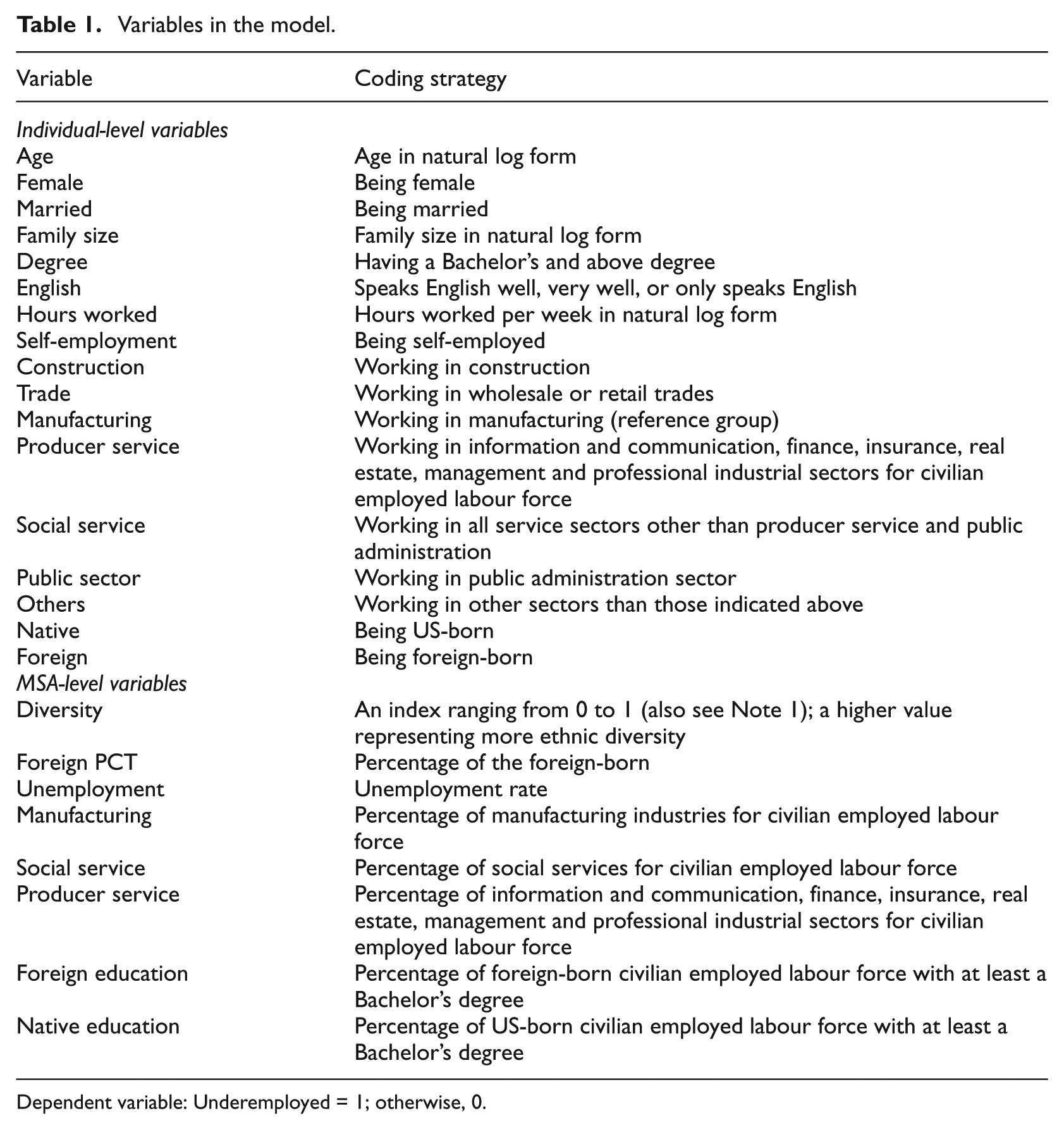
Dependent variable: Underemployed = 1; otherwise, 0.
In conventional studies, metropolitan-level variables are merged with individual-level variables to assess the effect of metro conditions on individual employment outcomes. This is not appropriate because the significance of effects at the MSA-level will be overestimated because of correlation errors within labour markets (see Raudenbush and Bryk, 2002 for a detailed discussion). Therefore, this study uses a hierarchical linear model with data on both individuals (level 1) and labour markets at the MSA-level (level 2). This two-level approach includes random errors that control for correlation error among individuals in the same metropolitan area; therefore, it allows for the simultaneous estimation of a full MSA-level model with controlled personal-level variables to predict the probability of underemployment.
At level 1, the (log) odds of underemployment for each individual labour force are estimated using individual-level data for each labour market, as shown in the following:
where Yij, the dependent variable, is the (log) odds of underemployment for person i at the metropolitan area j. β0j represents the adjusted average probabilities of underemployment for the US-born labour force. The differences between US-born whites and the foreign-born are represented by β1j. A standard vector of Cij represents all other individual-level variables with their associated coefficients r (see Table 1).
At level 2 (the MSA-level), both β0j and β1j are estimated as a function of MSA-level characteristics, Wj (see Table 1). We hypothesise that the MSA-level conditions are significant for underemployment; and further, that the interaction relationship between MSA-level labour market conditions and underemployment is contingent on the foreign-born status. Therefore, we allow β0j and β1j to vary randomly across the metropolitan labour market. The estimation is shown below:
The level-2 error terms (μ0j through μ1j) indicate that a separate variance component is estimated for each group’s probability of underemployment. This random spatial variation in the probability of underemployment is partially explained by the MSA-level characteristics (Wj). In other words, γ0 and γ1 allow us to gauge the interaction effects between foreign-born status and metropolitan area characteristics, as is clear when equations (2)–(3) are substituted into equation (1) to form the full mixed model.
Results and discussions
The foreign-born labour force has a slightly higher rate (14.0%) of underemployment than the US-born white labour force (13.5%); but, there exist significant differences between the foreign-born and the natives in the rate of underemployment across the metropolitan labour markets in the USA. The underemployment rate for native whites ranges from 5.0% (Houma-Thibodoux LA) to 22.9% (Stamford CT), and from 0.5% (Billings MT) to 35.9% (Decatur IL) for the foreign-born. For the same metropolitan area, the underemployment rate between the foreign-born and the US-born can differ widely. For example, while Billings MT has the lowest rate for the foreign-born, the rate is as high as 14.5% for the native whites. While 35.9% of the foreign-born are overeducated for their jobs in Decatur IL, the rate is only 9.4% for native whites.
Figure 1 depicts the frequency distribution of rates of underemployment for native whites and the foreign-born across all the MSAs. This graph indicates that rates for native whites are more concentrated in the lower categories (12–13%) than the foreign-born (14–16%) across the 283 MSAs; variation in the rates for the foreign-born is greater than that for native whites; and a longer right tail for the foreign-born suggests some extremely high rates of underemployment in certain MSAs.
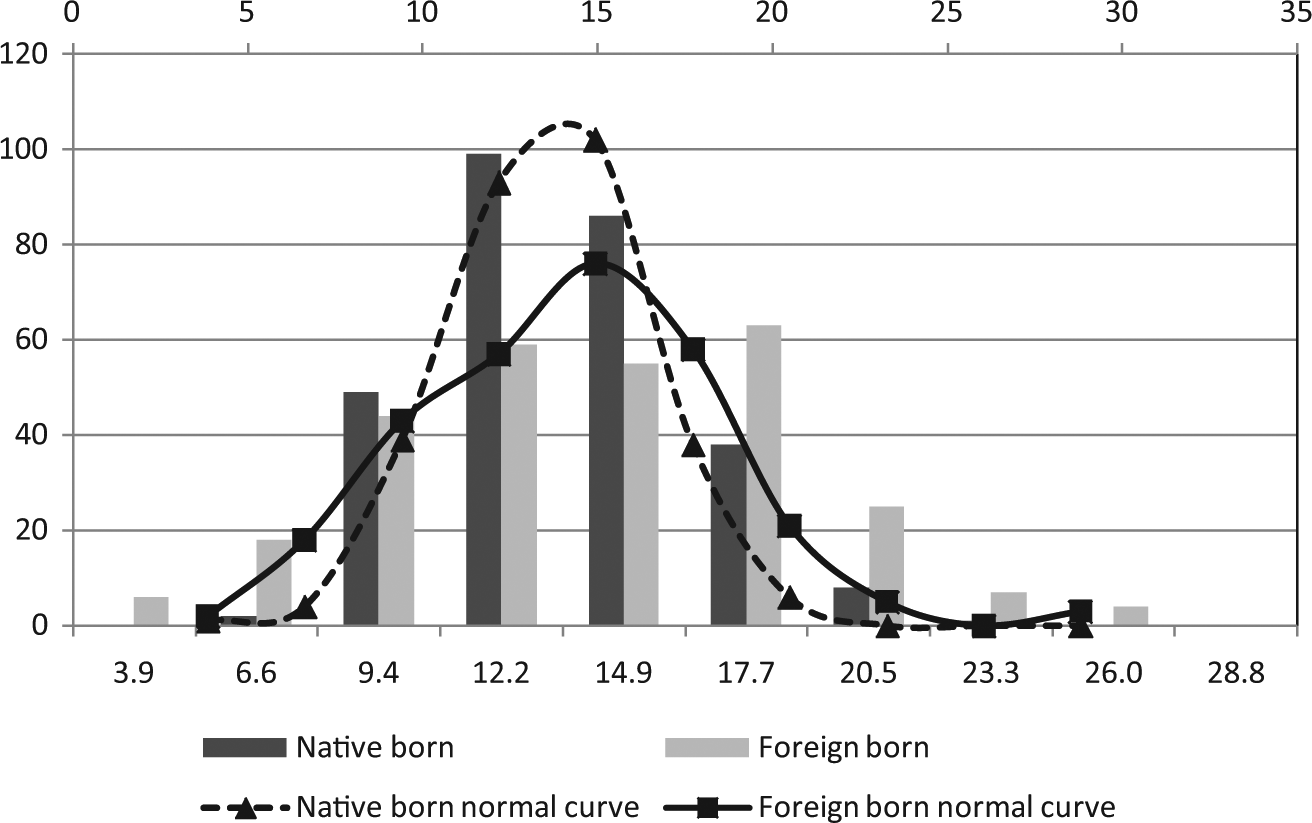
Frequency distribution of underemployment rates across the MSAs.
The multilevel modelling reveals significant variation in underemployment across the metropolitan areas as well. Table 2 gives the coefficients for each MSA-level variable in the regression (the individual-level variables are omitted because of limitations of space). When holding all the MSA-level characteristics at their means, the foreign-born still have a significant higher probability of underemployment than US-born whites, as indicated by the intercept. For US-born whites, all the MSA-level characteristics are significant in predicting the probability of underemployment. At the same time, several MSA-level variables make significant differences between the foreign-born and the US-born whites.
Regression results from the multilevel modelling (MSA part).
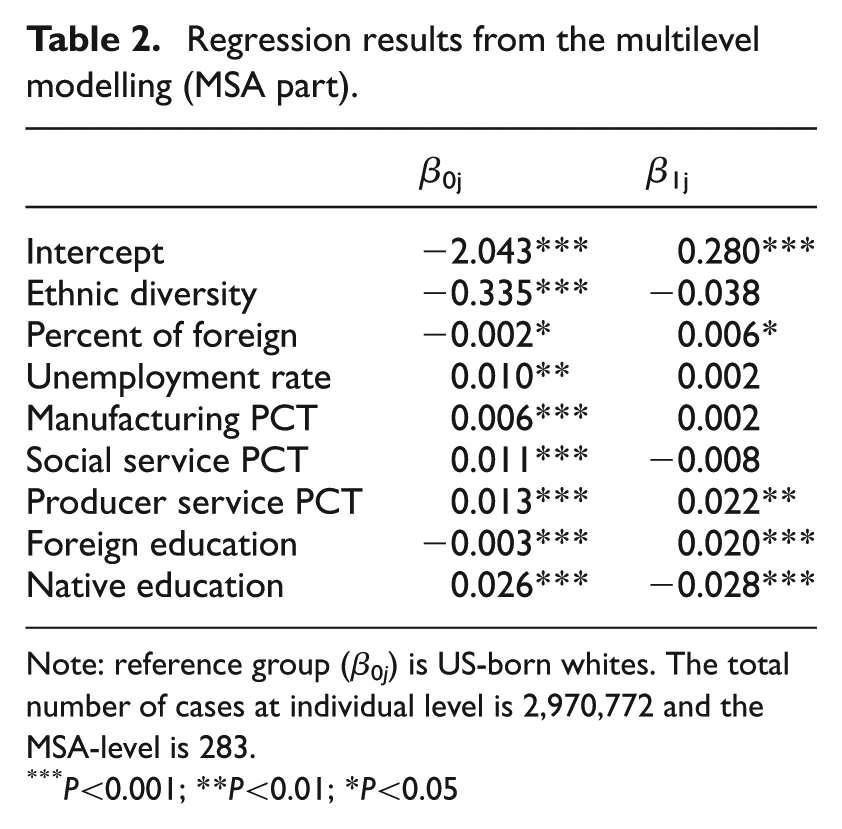
Note: reference group (β0j) is US-born whites. The total number of cases at individual level is 2,970,772 and the MSA-level is 283.
P<0.001; **P<0.01; *P<0.05
Relationship between an increasing immigrant population and underemployment
The result indicates that US-born whites are more likely to be underemployed in a metropolitan area that is less ethnically diverse and has a lower percentage of foreign-born. Effects from ethnic diversity do not differ significantly between these two groups. However, the percentage of foreign-born in a metropolitan area is positively associated with the underemployment of immigrants in that area. Specifically, if other conditions held the same, when a metropolitan area’s foreign-born population increases by 10 percentage points, the likelihood of underemployment decreases by 2.4% [= 1−exp(−0.002*10)] for a native-born white; with the same increase in the foreign-born, compared with US-born whites, the likelihood will increase for the foreign-born by 6% [= exp(0.006*10) −1] which is 2.5× the decreased value for US-born whites. So, the overall effect from the percentage of the foreign-born is negative for the foreign-born.
In our sample, the percentage of the foreign-born in a metropolitan area ranges from 1.4% (e.g. Johnstown PA, Lima OH, and Altoona PA) to 50% (e.g. Miami-Hialeah FL and San Jose CA). Findings from this study indicate that US-born whites are more likely to do better in metropolitan areas with higher proportions of immigrants and higher ethnic diversity. Such a phenomenon is consistent with previous case studies. For example, based on evidence from Los Angeles, Chicago and Atlanta, Rosenfeld and Tienda (1999) have argued that immigrants may push native workers to move upward in the occupational stratification system by taking the low-skill jobs formerly held by natives. Studies of other immigration gateway cities also find that the exit of native whites from certain sectors has created a succession of job vacancies that growing populations of native non-whites and immigrants could fill (Logan et al., 2000; Waldinger, 1996; Wright and Ellis, 1996). Meanwhile, the metropolitan areas with lower percentages of the foreign-born usually are those in the US Rustbelt with stagnant economic and population growth. In these places, US-born whites generally are composed of larger cohorts of an older labour force whose education and skill-sets may not match the demands of the current labour markets. Further research that disaggregates different age cohorts of the labour force could shed more light in this aspect.
On the contrary, for the foreign-born, there could be a ‘penalty effect’ represented by a higher rate of underemployment as one form of a marginalised labour market outcome, when the relative size of the foreign-born population increases in a metropolitan area. Previous studies argue that when a minority group becomes more ‘visible’, it may provoke more perceived threat to the majority, which triggers more discrimination and worsened labour market outcomes. Meanwhile, when the size of the immigrant population increases, more competition could be generated among immigrants themselves (Cantanzarite, 2003). This study does not provide direct evidence on the mechanism of whether and how the penalty effects happen, but it does inform us that while a larger size of immigrants are ‘complementing’ the native whites in matching their education with appropriate jobs, they are ‘competing’ with the foreign-born themselves if measured by underemployment.
Association between level of educational attainment and underemployment
The association between educational attainment and underemployment differs significantly between the foreign-born and native whites. Specifically, in a metropolitan area, a 10% increase of the foreign-born with at least a Bachelor’s degree is associated with a decrease in the odds of underemployment by 3% [=1−exp(−0.003*10)] for native whites; but, an increase in the odds of underemployment by 23% [=exp(0.02*10)−1] for the foreign-born when compared with native whites. In other words, the highly educated foreign-born in a metropolitan area are associated with higher chances of their being overeducated for their jobs, although native whites do much better in the same place.
A 10% increase of native whites with at least a Bachelor’s degree in a metropolitan area is associated with increased odds of underemployment by 30% [=exp(0.026*10)−1] for native whites; but, a decrease in the odds of underemployment by 25% [=1−exp(−0.028)] for the foreign-born when compared with native whites. In other words, the highly educated native whites in a metropolitan area are more likely to be associated with higher chances of overeducation for their jobs, while the foreign-born labour force would do much better in the same place.
The percentage of the labour force with at least a Bachelor’s degree across MSAs ranges from 14 to 64% for US-born whites and from 5 to 80% for the foreign-born. Figure 2 shows how the predicted probability of underemployment for the same person changes as the percentage of college (and above) graduates increases in a metropolitan area. Holding all other conditions the same, when the percentage of native white college graduates changes from 0 to 80, the predicted probability of underemployment for the same native whites increases from 0.06 to 0.32 (five times), and decreases from 0.15 to 0.13, a much smaller change, for the foreign-born. In contrast, when the percentage of foreign-born college graduates changes from 0 to 80, the predicted probability of underemployment for the same native whites decreases from 0.12 to 0.10, and increases from 0.09 to 0.29 for the foreign-born, a much bigger change.
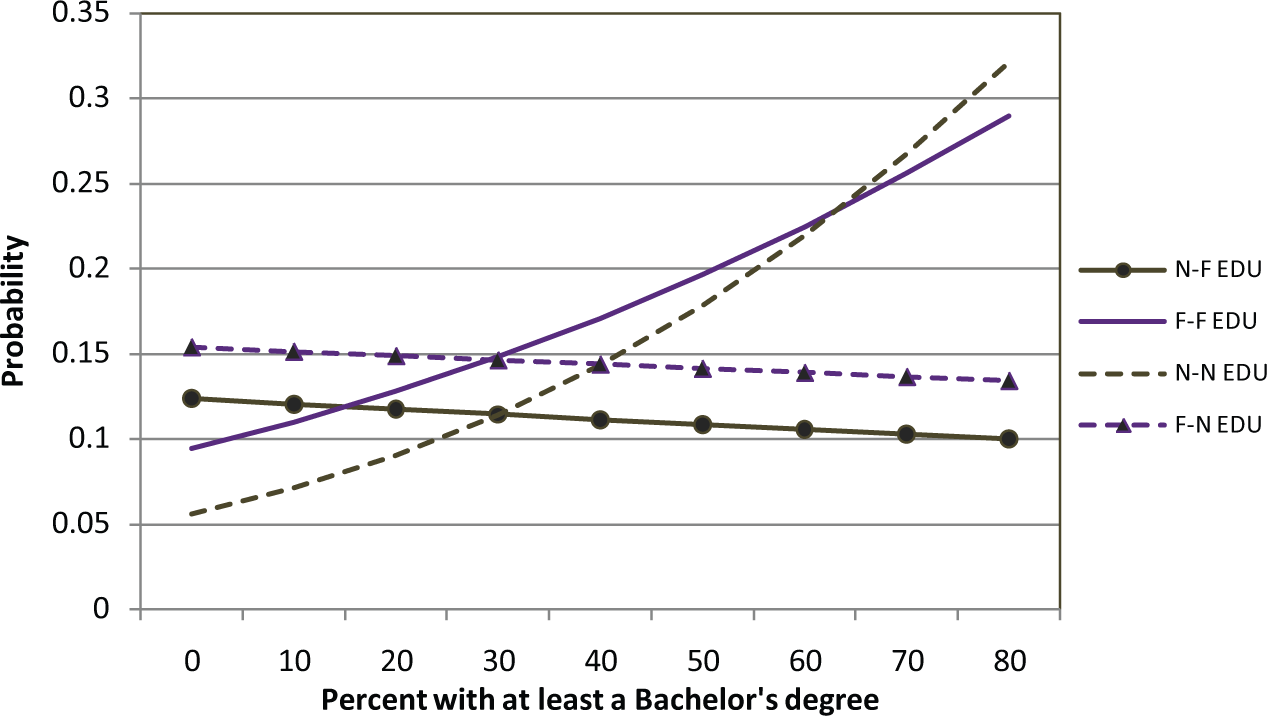
Predicted probability changes with the level of education changing in a metropolitan area.
Relationship between industrial structure and underemployment
To gauge the impacts from economic restructuring, we mainly focus on the association between changes in manufacturing sectors and service sectors. We further divide the service sectors into two parts: one is producer services that include information and communication, professional and management, and finance, insurance and real estate; another part is social services and personal services that do not include public administration services. As shown in Table 2, when the percentage of manufacturing industries increases in a metropolitan area, US-born whites are more likely to be underemployed. That is, for an increase of 10% in its manufacturing industries in a metropolitan area, the likelihood of underemployment for whites increases by 6.5% [=1−exp(−0.006*10)], if holding other conditions constant. There is no significant difference between native whites and the foreign-born. Likewise, for an increase of 10% in its service sectors (mainly social services and personal services) in a metropolitan area, the likelihood of underemployment for whites increases by 11.5% [=exp(0.011*10)−1]. Again, the effects do not significantly differ between native whites and the foreign-born.
There is a significant difference in the association between the percentages of producer services at the metropolitan labour market level and underemployment. For an increase of 10 percentage points in producer services, the likelihood of underemployment for native whites increases by 13.5% [= exp(0.013*10−1)]. Compared with native whites, the same increase of producer service industries is associated with another 25% increase for the foreign-born in their odds of being underemployed.
In our sample, the percentage of manufacturing industries across MSAs ranges from 1.6 to 36.5%, social and personal service industries from 29.1 to 56%, and producer service industries from 10.2 to 39.4%. Figure 3 presents the predicted probability of underemployment with the change of economic structure. With economic restructuring, most metropolitan areas have experienced a steady decrease of manufacturing sector jobs and an increase of service sector jobs. Therefore, the upper horizontal axis shows how the predicted probability changes when the percentage of manufacturing industries decrease from 60 to zero. The lower horizontal axis shows how the predicted probability changes when the producer service sector percentage increases from 0 to 60 in a metropolitan area.
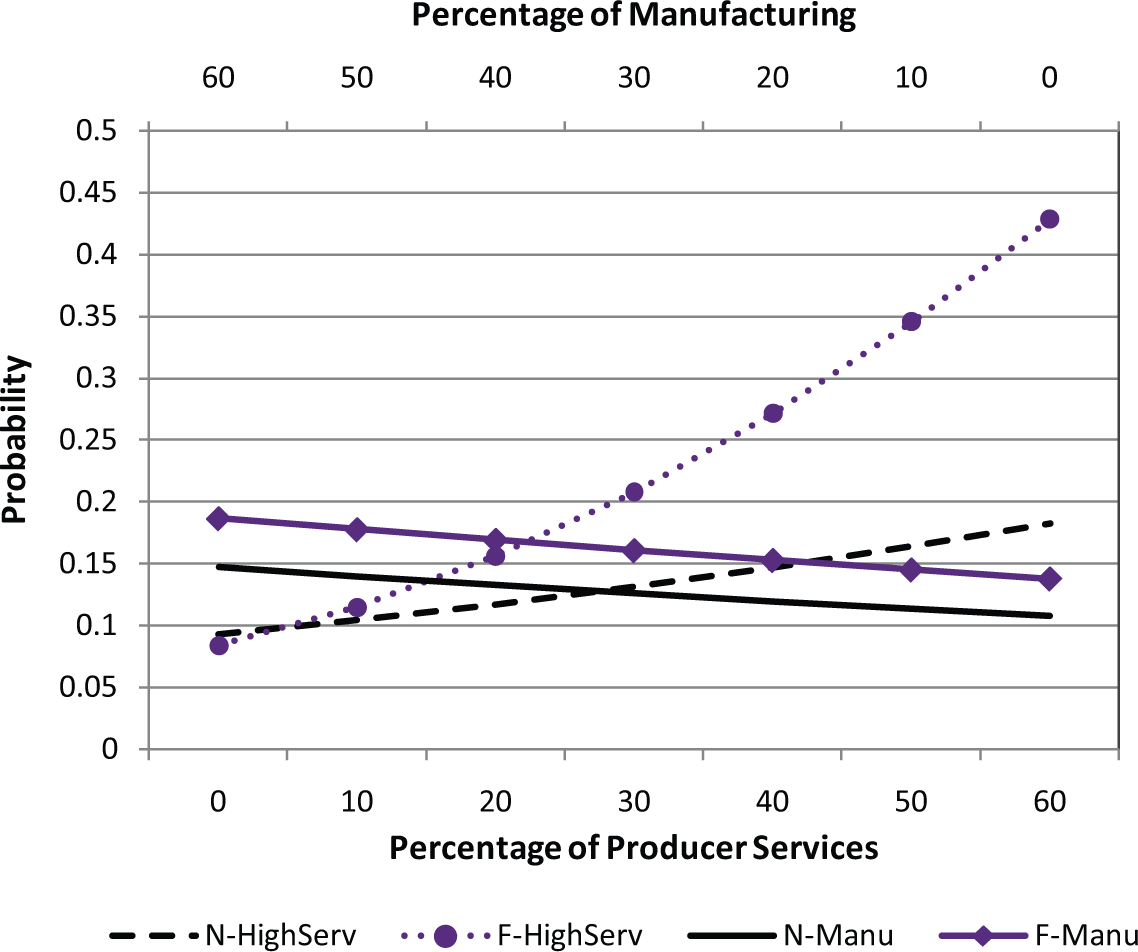
Predicted probability of underemployment with changes in manufacturing and producer services.
Overall, it is fair to conclude that experiences of underemployment for both the US-born and the foreign-born are highly contingent on changes in the industrial structure at the metropolitan labour market level. Related to earlier findings on educational attainment, the results suggest that the percentage of highly skilled labour force and producer service industries make a significant difference between the two groups, with the foreign-born having a much higher probability of being underemployed. This finding is consistent with previous studies that found anecdotal evidence of a ‘glass ceiling’ for highly educated immigrants especially in high-tech industries (Saxenian, 2006; Wadhwa et al., 2009).
Putting all the factors together, Figure 4 depicts the predicted probability of underemployment for a ‘hypothetical’ individual in the national top ten foreign-born labour force destinations, separately for the foreign-born and the US-born. The characteristics of the individual labour force are at the ‘average’ level of the entire data sample. In other words, the figure indicates the extent to which the probability of underemployment varies across the ten metropolitan areas for the same person.
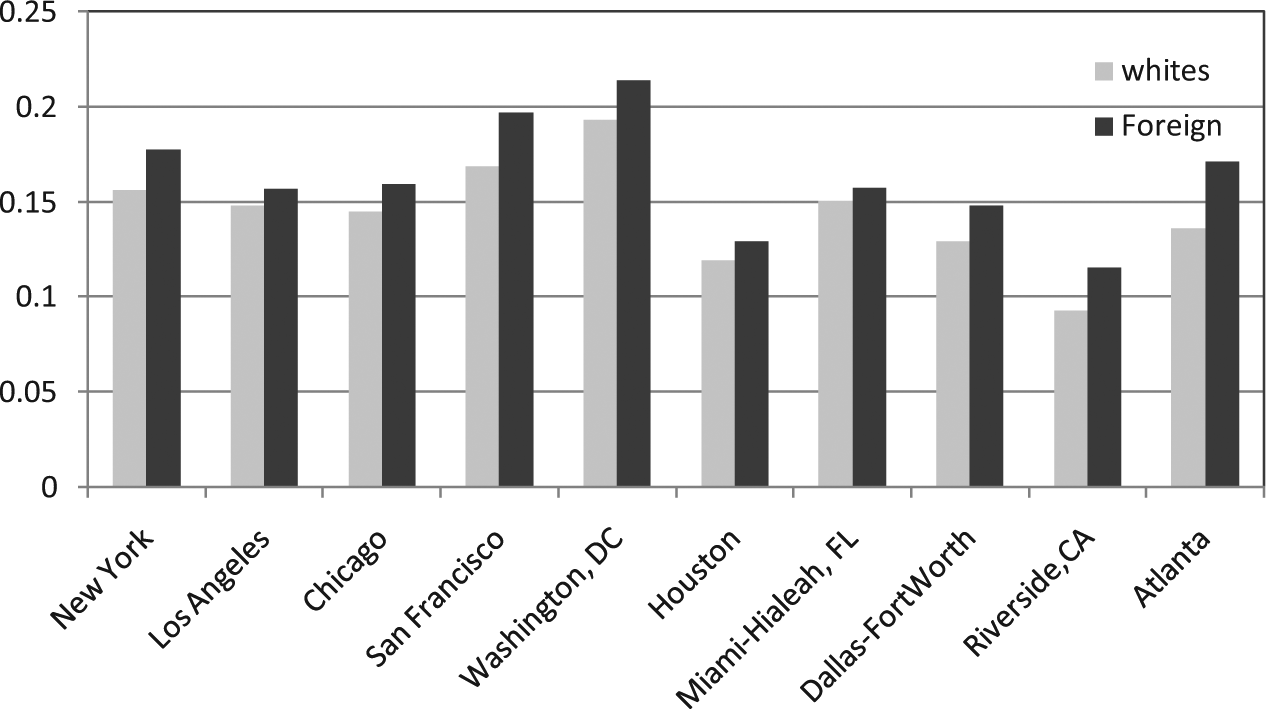
Predicted probability for a hypothetical labour force in top ten foreign-born labour force destinations (MSAs).
Washington DC and San Francisco CA, followed by New York and Atlanta, stand out for higher probabilities of underemployment than most other places. These metropolitan areas have much higher than the national average ethnic diversity, share of the foreign-born, and lower percentages of manufacturing sectors, all of which predict a lower rate of underemployment for the US-born; however, these places have much higher percentages of producer service industries and highly educated labour force, which contribute significantly to a higher probability of underemployment overall. Atlanta is the smallest metropolitan area of the ten study areas, with the lowest percentage of the foreign-born, but one of national top metropolitan areas with the fastest growth of immigrants. As one of the high-tech industry concentrated metropolitan areas, its percentage of producer services is higher than the national average. The percentage of the Bachelor degree holders ranks third of the ten study areas, following San Francisco and Washington DC. The predicted probability between the US-born and the foreign-born in Atlanta is the largest among all the ten areas.
Chicago, Los Angeles, and Miami, as established immigration gateways, are very similar to each other in the rate of underemployment. They are similar to each other in their socioeconomic profiles except that Miami and Los Angeles have much higher percentage of foreign-born than does Chicago, but their average levels of educational attainment of the foreign-born labour force are much lower than Chicago.
Houston and Dallas-Fort Worth have a lower predicted probability of underemployment than most other metropolitan areas. They are very similar in their MSA-level characteristics, such as a higher than national average ethnic diversity and a slightly lower than national average percentage of manufacturing industries. These two places have a higher than national average percentage of producer service sectors but much lower than places such as San Francisco and Washington DC. The level of educational attainment among the foreign-born is much below the national average in these two places. All of these characteristics predict a lower probability of underemployment. Riverside-San Bernardino metropolitan area has the lowest predicted rate of underemployment of the top ten. Its percentage of total service industries is higher than average; however, its proportion of the producer services and college graduates for both foreign-born and US-born are the lowest among the study areas, which contribute to a lower predicted rate of underemployment than all other places.
Conclusions
Previous studies have identified a number of factors related to immigrant underemployment, such as poor English, non-US degree, immigrant-visa status, and/or coming from certain countries such as Asia. However, the role of place, specifically that of regional and local labour market conditions, is largely overlooked. This study has demonstrated that the proportion of foreign-born, ethnic diversity, level of education of labour force, and industrial structure at the metropolitan labour market level are closely related with the probability of individual labour force’s underemployment, and the relationship differs between foreign-born and US-born.
It is important to note that, because of endogeneity, it is impossible to provide a causal relationship between these metropolitan labour market conditions and underemployment in the current analyses. Indeed, we have not intended to identify such causal relationships; rather, we have simply identified associations that exist between a range of independent variables net of other factors in the model and the dependent variable of interest, underemployment. Further analysis using longitudinal data will provide some insight into these issues. In addition, immigrants are far from a homogeneous group. A detailed comparison by country of origin, especially among those with extremely high or low rates of underemployment, deserves further exploration. With these limitations in mind, the analysis provides some meaningful findings.
The large influx of immigrants has significantly transformed the US urban labour markets. Impacts from immigration on underemployment, seldom discussed before, are found in this study to suggest that both the foreign-born and native whites fare much better in a more ethnically diverse metropolitan labour market by successfully matching their jobs to their educational attainment. It is possible that an ethnically diverse labour market provides more evenly distributed job opportunities to everyone, with fewer discrimination practices towards immigrants. Although the foreign-born population is the direct source of ethnic and racial diversity in most places, the percentage of the foreign-born itself has distinctive relationships with underemployment between the US-born and the foreign-born. When the proportion of the foreign-born increases in a metropolitan area, the chance of underemployment decreases for native whites, but, increases for the foreign-born themselves.
For immigrants, metropolitan labour markets with larger proportions of immigrants are more likely to provide organizational, service-delivery, and advocacy infrastructure that better help economic integration of the foreign-born. However, since immigrants have segmented along the labour market hierarchy differently from the native-born, highly concentrated in a limited number of sectors, it is possible that saturation of the local labour markets and competition simultaneously increase the probability of underemployment for the foreign-born.
In addition, economic restructuring has redefined different opportunity structures for both groups. While the probability of underemployment for native whites is positively related to manufacturing, the foreign-born are more sensitive than native whites to the structural changes, especially in high-tech and producer service sectors. With the thriving of knowledge-based service sectors, the foreign-born could be more likely to be underemployed, if other conditions are held the same. Such a pattern is consistent with our findings observed from the level of educational attainment at the MSA-level.
Native whites are more likely to be underemployed when the percentage of a native-born population with at least a Bachelor’s degree increases in a metropolitan area. Likewise, the foreign-born are more likely to be underemployed when the percentage of college graduates increases among the foreign-born. Competition among the highly educated seems obvious; however, we also need to notice that the competition effect differs by nativity. When the percentage of the foreign-born who have at least a Bachelor’s degree increases in a metropolitan area, native whites fare better in matching their jobs with their education level. Likewise, the same association exists between the higher proportion of native college graduates and immigrants’ labour market outcomes. The co-existence of completion and complementation between the foreign-born and the native indicates that the foreign-born and native labour forces could have distinctive channels in the job searching and matching process. Again, immigrants’ labour market segmentation and concentration could have significant impacts. Future study should look into these niche sectors and examine whether and how underemployment and the labour market segmentation process remain parallel. It could also provide stronger evidence on the impacts of economic restructuring, especially the simultaneity of labour demand and supply conditions.
For policies related to immigrant underemployment, existing studies have focused on overcoming a number of institutional barriers such as validating foreign academic credentials, helping newcomers with language training, providing employers with more knowledge and cultural competence in evaluating and hiring internationally trained professionals, and, more broadly, reducing discrimination against visible minorities. While these policies are important, we also need to be aware that many factors related to underemployment are beyond the individual level. This study suggests that the nature of the immigrant underemployment process is fundamentally indigenous and idiosyncratic to each place. Under the current globalization of a knowledge-based new economy, integrating immigration policies and labour market equity policies targeting at individual labour forces (or groups) into the regional economic development agenda could provide the best mix of both people- and place-based policy responses.
Footnotes
Funding
This research is funded by the US National Science Foundation (BCS1127343).