






Abstract
Urban agriculture (UA) has recently received increasing attention in both scholarly and policy cycles as a potential tool for poverty alleviation in sub-Saharan Africa. This paper focuses on urban crop cultivation (UCC) and examines men’s and women’s motives and needs in UCC, the (perceived) contribution of UCC to household livelihoods, and the benefits men and women derive from it. Although the contribution of UCC to overall household food and incomes appeared to be modest, for the majority of farming households such benefits were nonetheless greatly valued and bore varied and important meanings for men and women. The paper also examines the implications of recent national UA policy responses in Kenya for urban development and household livelihoods, and for equitable distribution of UA’s benefits for men and women.
Introduction
Africa’s urban population growth and urbanisation rates are among the highest in the world. In many sub-Saharan African countries this has, for the most part, been accompanied by economic decline and rising urban poverty and food insecurity (Dietz and Zaal, 2001; Frayne et al., 2009). Although many economies experienced considerable improvements between 2000 and 2009 (Dietz, 2011) and urbanisation trends now suggest that urban population growth across sub-Saharan Africa is slowing down or stagnating, these trends do not necessarily signal a lessening of urban poverty (Potts, 2009). Mostly attributed to circular or return migration, they instead point to persistent economic hardships and livelihood insecurity in urban areas (Potts, 2009). For many urban poor, participation in diverse informal sector activities – among them urban agriculture (UA) – is critical to their survival in town (Owuor and Foeken, 2006). UA has been cast as an important means of enhancing food security and nutritional status, and as a source of supplemental income as well as indirect income resulting from savings on food expenditure (Foeken, 2006; Mkwambisi et al., 2010; Simatele and Binns, 2008). Among women food producers in particular, UA also forms an important basis for empowerment and self-esteem, and for social networking and solidarity (Jacobs and Xaba, 2008; Simiyu, 2012; Slater, 2001).
Until recently, many national governments and urban authorities viewed UA negatively, omitted it from urban land-use planning and restricted – even criminalised – its practice, citing public health and environmental concerns as well as UA’s supposed transitory nature and marginality to the urban economy (Bryld, 2003; Foeken, 2005; Simiyu and Foeken, 2011). Thanks to sustained advocacy and the tenacity of urban farmers, and to the rising urban food prices and inherent political risks, many governments and local authorities across sub-Saharan Africa are increasingly embracing UA and formulating policies to support its development (Nel et al., 2009; Simiyu and Foeken, 2011; Thornton, 2008; van Beek and Rutt, 2007).
Despite the momentum towards pro-UA policies in sub-Saharan Africa, questions have continued to be asked about whether UA is deserving such policy attention and support, and whether in fact those who practice it do actually realise the benefits commonly attributed to the activity (Webb, 2011). Such questions have been informed by studies that have tended to show that, for many households, UA makes only marginal contributions to household food and incomes (see e.g. Hebinck and van Averbeke, 2007; Maxwell et al., 2000), and by the economic logic that favours allocation of scarce resources to more productive land uses (Ellis and Sumberg, 1998). The amenability of UA to urban spatial planning is also questioned on account that it is an activity in constant flux giving way to other land uses and subsequently moving into newer spaces (Ellis and Sumberg, 1998).
Critics of the ‘UA bandwagon’ further point out that laying emphasis on UA per se diverts attention away from a more broad-based approach to urban development problems, of which UA is just one manifestation (Bourque, 2000). Consequently, pro-UA policies are viewed as an attempt by governments and local authorities to not only transfer their responsibility for urban development to poor urban residents but to also lock them up into a poverty trap by failing to provide better opportunities in other sectors (Hovorka, 2006). According to this logic, the benefits of supporting UA should be weighed against the potential benefits of supporting alternative livelihood activities and rural food production (Rogerson, 1998). More specifically, the point has been made that while UA policies could enhance the urban poor’s access to food in the short term, such policies may undermine overall city-wide food security initiatives in the longer term because UA is just one of many household-level responses to food insecurity (Bourque, 2000).
Yet, there is growing recognition that such policies must be informed by an understanding of not only what UA promises to achieve for households or even the urban economy and environment, but also what it means for those participating in it (Hovorka, 2005; Webb, 2011). Gender has been identified as an important factor in mediating UA outcomes for individuals and for their households (Foeken, 2006; Hovorka, 2005), although it has received only scant attention in UA research (Ngome and Foeken, 2012). However, the existing literature on the gender dimensions in UA (e.g. Hovorka, 2005; Hovorka et al., 2009; Ngome and Foeken, 2012; Simiyu, 2012) provides indicative insights into how gender ideologies shape men’s and women’s preferences, roles and opportunities, and how these influence household and individual livelihood outcomes. The studies show that, as a result of this, men and women in diverse contexts attach varied meanings to UA.
Conceptual grounding
This paper is guided by the Sustainable Livelihood Approach (SLA) and the gender planning framework. The SLA is credited for its holistic perspective on people’s livelihoods, and for putting the poor and their situated agency at the centre of development discourse and practice. It recognises that when people’s livelihoods come under threat from external shocks and stresses, they do not remain passive victims but rather draw on the portfolio of assets they command to pursue diverse actions and strategies in order to sustain and/or improve their livelihoods. This includes making claims on informal social networks and relations of trust, solidarity and mutual aid (which constitute social capital), which according to Kaag et al. (2004: 59) is ‘What makes the difference between being vulnerable or not’. The SLA also calls attention to an understanding of poverty and wellbeing from the totality of poor people’s lived experiences and livelihood objectives as expressed by the poor themselves (Chambers, 1995; Scoones, 1998). Besides the material outcomes necessary to cope with and adapt to changing circumstances – e.g. improvements in income levels, access to food, etc. – people also draw on the assets they command to achieve a broader range of longer-term socio-political wellbeing outcomes such as self-esteem, personal fulfilment, etc. (de Haan and Zoomers, 2006).
Critics have, however, pointed out that overemphasising the poor people’s agency draws attention away from, and diminishes the urgency to address the structural causes of poverty such as power inequalities and unequal access to resources (Kaag et al., 2004). Given the social fragmentation and instability of urban societies, the extent to which the urban poor are able to draw on social capital during times of great adversity has also been questioned (Abdalla, 2008). In any case, it is argued, not all individuals benefit equally from social relations and networks, some of which constitute a basis for tension and conflict; and for social exclusion for some and social advantage for others (Woolcock and Narayan, 2000).
Of particular relevance for this paper is the criticism that the SLA tends to gloss over issues of power relations embedded within the institutional and social structures that form the context within which people construct their livelihoods (Scoones, 2009). Indeed, it is now increasingly being recognized that livelihood strategies are very much gendered. This is based on an understanding that (1) men and women play different roles within their households and in the community and, because of this, they have different needs, preferences and livelihood goals (Oberhauser et al., 2004); (2) men and women experience poverty differently and unequally (Baden, 1999); (3) the social norms that ascribe statuses and roles to men and women enforce unequal power relations between them, thereby presenting them with different opportunities and constraints (Mandel, 2004); (4) men and women benefit from and are affected by livelihood outcomes differently (BRIDGE, 2001); and (5) in the particular case of most of sub-Saharan Africa, the dominance of patriarchy means that gender relations favour men over women (Apusigah, 2009). Notwithstanding these premises, several studies have also shown that the impact of social norms and gender relations on men’s and women’s livelihood strategies and outcomes is not definitive (Narayan et al., 1999); rather that the strategies and outcomes reflect an interplay of various other factors including the structure of the local economy, formal as well as informal institutions, individuals’ endowments, and personal agency.
Gender planning aims to incorporate men’s and women’s needs and interests into development policy interventions with a view to delivering equitable development outcomes for both sexes, and to ultimately transform gender relations and empower women (Wieringa, 1994). Popularised by Moser (1989), one of the widely applied approaches to gender planning is the distinction between practical and strategic gender needs/interests. Practical gender needs are those needs that derive from women’s experiences related to their gender roles; they ‘are usually a response to an immediate perceived necessity which is identified by women within a specific context’, and give rise to practical gender interests which primarily focus on survival rather than challenging social structures responsible for their subordination (Moser, 1989: 1803). On the other hand, strategic gender needs refer to ‘those needs which are formulated from the analysis of women’s subordination to men’, and which focus on achieving ‘an alternative, more equal and satisfactory organization of society … in terms of both the structure and nature of relationships between men and women’ (Moser, 1989: 1803). This dichotomisation of gender needs/interests has, however, been deemed untenable by critics (see, e.g., Wieringa, 1994) on account that women’s diverse roles, needs and interests are not only interlinked, dynamic, and sometimes contradictory, but are also under constant negotiation and vary within different social and political contexts. The gender planning framework has also been faulted for its implied assumption that women’s needs and interests are attributable to gender alone, ignoring other aspects of women’s lives – such as race, class, age, etc. – that intersect with gender to shape women’s circumstances. Moreover, its goal of supporting women to better perform their (socially ascribed) roles related to practical gender needs, it is argued, tends to legitimise existing gender relations and to accentuate women’s subordination.
The Eldoret study
This paper focuses on urban crop cultivation (UCC) and examines the various benefits that households and men and women in Eldoret (Kenya) derived from UCC. It also explores the implications of the recent UA policy initiatives for livelihood outcomes of households and individual participants, but also for overall urban food security and development in Eldoret in particular and in other Kenyan towns in general. Eldoret is Kenya’s fifth largest town with an estimated population of about 500,000. Fieldwork was carried out between 2007 and 2010 in the town’s largest informal settlement, Langas (Figure 1). First, a general, quick census was done in two adjoining areas in Langas. It appeared that 22% of the 1051 households could be classified as ‘urban farmers’. Of these 232 households, 160 were crop cultivators. These households were visited with a detailed, largely pre-coded questionnaire. In 40 of the households, both the male head and his spouse were interviewed separately (bringing the total number of respondents to 200). Follow-up in-depth interviews were done with 24 households drawn from those surveyed. The data were analysed at various individual and household levels involving comparisons between: married males and their spouses; male-headed and female-headed households; and female household heads and married women.

Map of Eldoret showing the research area.
The majority of the Langas residents are low-income earners making a living mostly from the informal sector. An asset-based household poverty/welfare analysis of the study population using principal components analysis tended to confirm the widely held view that female-headed households are among the poorest of the poor as more than half (58%) of the female-headed households surveyed belonged to the lowest welfare category compared with just over one-third (37%) of the male-headed households. 1 However, despite the female-headed households being on average poorer than the male-headed households, there was comparable representation of male- and female-headed households among a small group (20%) of relatively better-off households, underscoring the growing recognition that female household-headship is not necessarily synonymous with poverty and that it may in fact, under certain circumstances, offer greater opportunities for the advancement of women and thus household welfare (Baden, 1999).
Urban crop cultivation as a source of food and income
The 160 crop-cultivating households grew a wide variety of crops. By far the most common of these were sukuma wiki 2 and maize, which were each grown by more than 80% of all crop-cultivating households. Maize is the staple crop used in making Kenya’s popular ugali dish (maize meal), while sukuma wiki is its regular accompaniment. Other crops cultivated by at least 10% of the households included spinach, bananas, suja (black night shade), sugarcane, cowpeas, nduma (arrow roots) and onions.
The importance of cultivating such crops to the households and individuals involved can be construed from the reasons for which they took up the activities in the first place, and from the use patterns of the various products. It is apparent from Table 1 (column ‘All’) that urban crop cultivators were motivated primarily by the need to enhance household food security and nutrition, but also to earn and/or save some income. Other motivations included prospects for economic independence, availability of space and, to a more limited extent, culture and/or farming background.
Main reason for crop cultivation, by gender (%).

Source: fieldwork 2008.
Whereas the food-related reasons influenced men’s and women’s decision to farm to more or less the same extent, there were apparent gender differences among income-related reasons (Table 1). Men were more concerned about saving money on food expenditure and less so about gaining economic independence. Men generally regarded themselves (as was expected of them by society) as the main household breadwinners who were expected to provide finances not only for the purchase of food but also for meeting other, non-food requirements. As such, any food produced by the household would ease their financial burdens and the money thereby saved (i.e. indirect or fungible income) channelled towards meeting other household needs.
Table 2 shows that each of the five most prevalent crops was self-consumed by over 80% of the cultivating households. A traditional vegetable, suja (black night shade), was an important item in diet diversification. A smaller proportion of the households (also) earned some income from selling crops, notably from sukuma wiki, suja and spinach. Of these, sukuma wiki was the most widely sold crop, often over several months, while suja was the most marketable but was usually sold over only a few weeks.
Consumption and sales of crops (%).
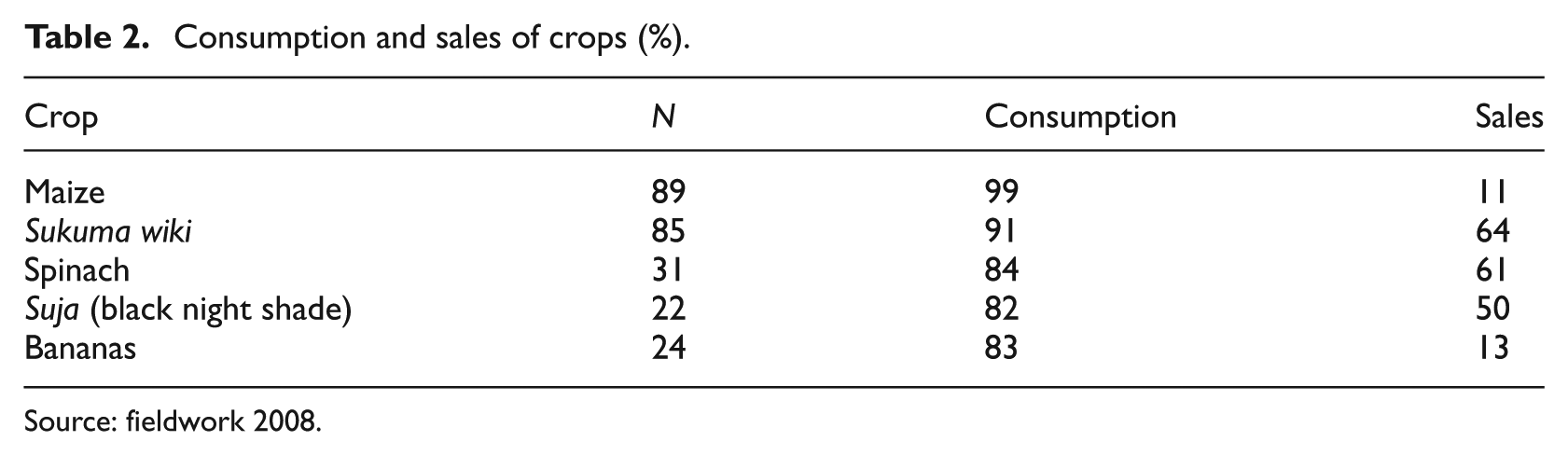
Source: fieldwork 2008.
Overall, one-quarter of crop cultivators considered crop cultivation as a major source of food. For the rest, it constituted just a minor or even a negligible food source. Given their low and irregular incomes, the more such households depend on the market for food supplies the more vulnerable they are to food insecurity (see Stage et al., 2010). When respondents were asked whether their households ever faced food shortages, 43% of them answered in the affirmative.
The modest contribution of urban crop cultivation to household food security is largely because of the small scale and limited diversification of crop production. Because of the limited space available to households, and because of non-adoption of intensification technologies and appropriate farming practices (see Simiyu, 2012, forthcoming), many households realised low yields and consumed most of what they produced, leaving little, if any, for sale. And with the exception of maize grains that could be easily stored for future use, most other crop products were perishable and, for a lack of refrigeration facilities, farmers were forced to sell the produce even when future shortages were anticipated.
Contrary to the conventional wisdom that women hold a more favourable view of urban agriculture as a source of food, there were no significant gender differences regarding the urban farmers’ perception of the contribution of crop cultivation to household food supply; not even between female and male heads (see Table 3). This may not be entirely surprising though, given women’s reproductive and home-keeping roles, on the one hand, and the difficult economic circumstances that limited men’s support for their families, on the other hand. Thus, confronted with a myriad of household needs, and with their husbands absent from the home most of the time, many women were often forced to look for alternative food and income sources to supplement home-produced food, and their husbands’ financial contributions. Some women would even sell part of essential home-produced food without the knowledge of their husbands in order to purchase other food and non-food items.
Perception of the importance of crop cultivation as a source of food, by relationship to household head (%). a

Two cases, both single-man households, are missing.
Chi-square: χ2 = 4.667; d.f. = 4; p = 0.323>0.05.
Source: fieldwork 2008.
Compared with its contribution to household food supply, an even smaller proportion (16%) of the respondents considered crop cultivation to be a major source of household income. One in every ten respondents noted that crop cultivation had not earned their households any income. Whereas some of these (male) respondents may have been simply unaware about some income being generated from home gardens, it was also the case that maize, one of the most prevalent crops, was rarely sold because many households realized only limited output that could last them just a few months before they could start buying grains for the rest of the year. It would seem that crop cultivation bore greater significance as a source of income for women than for men (see Table 4). As we will demonstrate below, men’s underestimation of the economic value of crop cultivation was underpinned, in part, by women’s concealment of incomes generated from home gardens.
Perception of the importance of crop cultivation as a source of income, by relationship to household head (%). a

Two cases, both single-man households, are missing.
Chi-square: χ2 = 17.068; d.f. = 4; p = 0.002<0.05.
Source: fieldwork 2008.
Notwithstanding its modest contribution to overall household incomes, UCC was valued by men and women for various reasons. The fungible income value of gardening was of particular significance to men as captured by Mhubiri’s and Mudavadi’s
3
comments: The vegetables we grow on the plot are very important for the household. We save money on vegetables. We also buy sugar, milk and other minor household items from the sale of vegetables. Sometimes my children also meet some school needs from the vegetables such as transport to school and books … Nowadays I take a lot of interest in urban farming because if I don’t I will be the one expected to meet all these expenses. You can’t manage at this time. It is very difficult to get money out there.
I do not give my wife money directly. Instead I plant it in the soil so that she can get it from there when she starts selling vegetables. That is the only way she can access money whenever she wants it without bothering me … I normally don’t ask for the money unless I am very broke. Otherwise if you give her money once, you will have to be giving her every time. That way you can’t save any money for development.
On the other hand, because women were more disadvantaged in terms of accessing alternative income sources,
4
they tended to take up crop cultivation also as a means of gaining some economic independence. In other words, they considered gardening as a way by which they could meet practical needs related to feeding their families as well as advance their strategic interests, including gaining autonomy, self-esteem and enhanced social status in the household and within the community. This was illustrated by a woman as follows: If I did not do farming in town, I would not have been able to offer you this cup of tea. I would have had to look for my husband for money to buy milk, sugar and a loaf of bread. I would not even know where to look for him at this time of the day. Even if I am lucky to find him, he will not give me the money without asking many questions … Because I make some money from my sukuma wiki garden, I don’t ask my husband for small amounts of money and he knows that whether he is there or not, we cannot go hungry in this house. Sometimes he even asks for money from me.
Similarly, Njeri (female respondent) regularly received remittances from her husband (who worked in another town and was not a regular co-resident of the household). However, because the money was not always enough, Njeri met part of her household’s food needs from her garden. On the significance of the garden to her social standing and autonomy, she noted thus: ‘although he does not say so, I know my husband appreciates what I do on the plot because whenever he is around he does not see me bothering him about money for buying vegetables and other minor kitchen items’. 5
As a strategy to achieve some economic independence and autonomy, many of the interviewed women under-reported or even totally concealed the income they earned from their gardens, especially from the sale of sukuma wiki. This was possible because of women’s gender roles related to home-keeping, food preparation, garden-tending and marketing of produce that enabled them to control the use of crop produce and to access income from sales. Moreover, many husbands tended to undervalue the economic significance of home gardens, and spent most of their time outside the home, thereby giving women space to manoeuvre. When asked how much income their households earned from gardening, some men would express surprise that anyone would expect any produce to be sold from such small mama’s gardens. Yet their spouses would confide that they actually made some money out of the gardens: The problem with men is that when they know you have some money, however little, they stop supporting you financially. Moreover, there are other important obligations that require finances, such as contributing to my women’s group and tithing in church, which are difficult to secure from my husband. Therefore, whenever I sell sukuma wiki from my garden, I do not tell him … Luckily, he is away most of the time so he never knows about it. Thus, he continues to make his usual contribution towards household up-keep. When I put together whatever I earn from sukuma wiki and whatever I save from what he gives me, I am able to meet personal obligations and to keep the household going whenever my husband’s income is not forthcoming.
Since my husband does not sell vegetables and he is rarely there when I am selling, I never tell him the exact amount I make from the sales. If I make Kshs. 1000,
6
which is the minimum I make in a day, I tell him I have made Kshs. 500. Still he thinks it is a lot of money and encourages me to use it wisely so that I don’t bother him with financial requests. I have decided to invest in women’s groups to generate more income.
Social networks and empowerment
As with Mama Atieno and Shimuli, crop cultivation was particularly instrumental in building social capital for women. Income from gardening, especially from vegetable sales, formed an important basis for women’s participation in credit-based social networks by enabling them to meet their obligatory financial contributions to such networks. Many more women than men participated in such networks. The first of the two most important types of credit-based social networks identified in Langas consisted of rotating savings and credit associations (ROSCAs), popularly known as ‘merry-go-rounds’. Members of such groups usually contributed equal amounts of money and met at given intervals. The money collected at each meeting was given in lump sum (locally known as pouring) to one member at a time until all members in the group were reached. The order in which members received their money was usually predetermined, typically by lottery. Sometimes rather than pour the money for members, the group could agree to purchase a particular item or set of items for members using the money collected.
Mama Sella’s story typifies benefits that many women derived from participating in such groups. Her household cultivated a variety of crops including maize and vegetables on just under one-quarter of an acre of land. Different crops were grown during different seasons to mitigate seasonal variability and maximize productivity. Mama Sella was directly responsible for the garden because her husband, a mason and carpenter, was always out looking for work. Part of the farm produce was consumed by the household and the surplus sold. Mama Sella made about Kshs. 500 from vegetable sales everyday throughout most of the year. She used part of the money on household food and other non-food essentials, and saved the rest with two merry-go-round groups. One group consisted of 27 members, each of whom contributed Kshs. 200 every week, while the other had a membership of 11 and each member contributed Kshs. 1100 fortnightly. On how she had benefitted from her membership of the groups, Mama Sella stated: The money has helped me to spruce up my house. I have bought household items like cups, vacuum flasks, and furniture clothing. The money has also enabled me to buy clothes and shoes for myself and my children. When visitors come in you are not embarrassed because the house looks presentable; and myself and my children too. People can tell that you are a responsible married woman who can maintain a house and take care of yourself and your children … My husband does not like me participating in women groups but I will continue … Yet, when you serve him with tea in a new vacuum flask and nice cups bought with merry-go-round money he is always very happy … The most recent money I received from one of the groups enabled me to assist my daughter. I received the money when she was just about to deliver. Because she got pregnant before marriage, my husband was not willing to take any responsibility so I was left to struggle with her alone. The money enabled me to admit her to a maternity hospital. Fortunately she delivered without any complications.
The second category of social networks comprised of groups that provided members with the avenue to access financial credit from conventional banks and formal micro-finance institutions on the basis of group guarantee rather than against collateral. Would-be individual borrowers were required to organise into groups and to save money through those groups at regular intervals. After saving with a group for some time, an individual could then apply for a loan, which would be granted based on the member’s cumulative savings and endorsement by other group members. Some women had accessed financial credit, in some cases substantial enough to constitute major investment capital for their households. One example will suffice:
From a minimum daily income of Kshs. 1000 that Shimuli 7 earned from sukuma wiki sales, she used about Kshs. 200 every day on her kitchen budget, and made a daily contribution of Kshs. 200 to a ten-member ROSCA, and a weekly contribution of Kshs. 1500 to another women’s group of 15 members. But before she could join the groups, Shimuli had to first ask for permission from her husband, Mudavadi. He (Mudavadi) was initially apprehensive of the idea claiming that such groups were time-wasting and forums of gossip and that joining them would interfere with his wife’s work on the plot. He wanted her to be always available at home to attend to vegetable customers. However, because Shimuli understood the benefits of such groups, she sought to allay her husband’s fears that doing so would interfere with her work, and managed to convince both groups to reschedule their weekly meetings from week days to Sundays when her children did not go to school. The children would therefore attend to the customers while she attended group meetings. Mudavadi reluctantly agreed with this arrangement. After saving for some time with the second group, and in consultation with her husband, Shimuli applied for a loan of Kshs. 120,000, which she was granted. She used the money to build four rental rooms on their plot. Since Shimuli was repaying the loan with proceeds from vegetable sales ‘without any problem’, her husband became fully supportive of her plans. About his wife’s progress, Mudavadi 8 commented that contrary to his earlier negative perception of women groups, he had come to realize that they were actually beneficial forums, and that ‘she is nowadays free to join as many groups as she can and to plan for any money she may get from such groups’.
Shimuli’s case highlights some of the varied meanings of social capital leveraged by crop cultivation for women, and the implications of the same for gender relations and wellbeing outcomes for households and individual household members. For Mama Sella, social capital built with income from gardening seems to have been especially important as a means with which she could play her reproductive and care-giving roles more effectively, to assert her gender identity, and to enhance her standing in the community. Conceptually, Mama Sella’s account also questions the practical-strategic dichotomisation of gender needs/interests. It is clear from her perspective that by being able to fulfil her household’s immediate daily survival needs, Mama Sella simultaneously furthered what would be regarded as medium- or longer-term strategic interests (see Hovorka, 2006). On the other hand, Shimuli’s account shows how social capital built with income contributions from crop cultivation can empower women by enabling them to gain economic independence, to enhance their bargaining power at the household level and, as a result of this, to reconfigure gender relations by earning their husbands’ trust as capable decision-makers even in matters that are traditionally regarded men’s domain (in this case investment in housing).
Conclusions and policy implications
Whereas the debate on the real significance of UA may be considered by some academics as being far from over (e.g. Webb, 2011), for most of those who participate in UA its benefits, limited as they may seem, are clearly demonstrable and greatly valued. As has been illustrated in the particular case of Eldoret, overall UCC made modest contributions to household food supply and incomes, but such contributions were nonetheless significant for household survival at some critical moments. It was clear that most respondents turned to urban farming in an effort to diversify their portfolio of activities to cope with economic hardships, mostly after incomes from other non-farming activities were no longer sufficient to support their families.
UCC also achieved various outcomes and derived varied meanings for individual men and women. It was valued by men more as a means of saving money on food expenditure, thereby enabling them to use their often limited financial resources to meet other household obligations. For women, UCC provided the means with which they were more able to perform their gender roles and responsibilities (practical gender needs), and to gain social and economic empowerment (strategic gender interests). These conclusions notwithstanding, both men and women tended to have a shared vision regarding the most immediate and basic household survival needs, namely to enhance food availability and income to meet basic household requirements.
Moreover, as long as economic hardships of the urban poor persist, own food production 9 will remain an important strategy of improving their household food situations, even if only marginally. Following Amartya Sen, food security has come to be framed more as an access and affordability or an entitlement issue rather than simply one of supply. Sen’s (1987: 7) observation about rural famine has resonance in the urban context too: ‘If a person lacks the means to acquire food, the presence of food in the market is not much consolation’. Indeed, it is now widely recognised that whilst urban settlements may and often do have adequate food for their inhabitants at the city/municipality level, not all urban residents are able to establish entitlements over the food leading to unequal availability of food at the household level (e.g. Frayne et al., 2009).
Moreover, in livelihood studies and development work poverty and wellbeing are increasingly being understood not just from the point of view of economic and material concerns, but from the totality of poor people’s lived experiences and livelihood goals – including non-material and social concerns – as expressed by the poor themselves. This being the case, the varied meanings that participation in UCC gives to the worlds of those participating in it (women in particular) affirm UCC’s importance as one of the strategies of fighting urban poverty. But for UCC to achieve equitable outcomes and benefits for men and women participating in it, gender issues must be incorporated into urban agriculture policy and planning. The recent legal and policy developments at the national level in Kenya have attempted to address these issues.
Of special importance is the Draft National Urban and Peri-Urban Agriculture and Livestock Policy (UPAL) – made public in May 2010 – that more specifically lays down policy guidelines and intervention measures for the support of UA (GoK, 2010). The policy’s broad objective is ‘to promote and regulate sustainable UPAL development to improve incomes, food security, create employment, enhance living standards and reduce poverty; while focusing on land use, public health and environmental management’ (Section 2.1). It is expected that a supportive and facilitative legal and policy environment will attract external resources, innovations and technologies necessary for improving productivity, profitability and environmental sustainability. In a city such as Eldoret, where UA has in most part been restricted and even criminalised (Simiyu and Foeken, 2011), legalisation of UA will remove anxiety among farmers about its official status and future and about the risk of having their crops destroyed. Support for farmers to access farming resources in order to increase UCC’s productivity as proposed in the policy (Section 3.0) will be of particular significance.
By virtue of women’s gender roles and, deriving from this, their control over the use of agricultural produce (especially crops), it could be assumed that any improvement in productivity would not only translate into improved household wellbeing, but also advance women’s so-called practical gender interests by enabling them to play their reproductive roles more effectively. It also enables women to advance their strategic gender interests where extra income can be earned with which to build social capital as a basis for accessing credit. Yet, because women contribute the most labour, support for urban agriculture may end up burdening women more (Hovorka, 2006). And while adoption of some technologies may also lessen women’s workload, improvements in agricultural productivity resulting from the use of such technologies has the potential of attracting greater interest of men in UA that may end up eroding women’s manoeuvring space.
In other words, while interventions in the public arena may be relatively easy to implement and/or monitor, it is more difficult at the level of the household, which, as Chant (1998: 19) points out ‘is widely seen as a “private” as well as a “natural” domain’. Moreover, external actors’ perceptions about women’s circumstances and prescriptions about the choices they should make may not necessarily cohere with women’s own values and the meanings they attach to their choices or even be feasible in the contexts within which the women are situated (Kabeer, 1999). Thus, policy interventions need to take cognizance of such sensitivities embodied in cultural structures operating at the extra-household level and of the available possibilities and opportunities for exercising agency if the activities that are the subject of intervention are to have meaning for and be valued by the participants. It is significant that the proposed UPAL policy in Kenya proposes to ‘incorporate gender concerns in UPAL related development programmes; and … [to] develop and implement innovative programmes that enhance equity between men and women in UPAL production and marketing’ (GoK, 2010: Section 3.9.1). Hopefully the concerns discussed above, among others, will inform such programmes.
Footnotes
Acknowledgements
The authors wish to thank the two anonymous reviewers for their useful comments and insights on the draft of the manuscript.
Funding
This research was funded by the Netherlands Organization for Scientific Research – WOTRO Science for Global Development.